










-
Since Pruden et al. first defined antibiotic resistance genes (ARGs) as emerging contaminants in 2006[1], the subsequent two decades of research have been dominated by a typical chemical-pollutant paradigm: detection, quantification, and removal. However, this abundance-driven logic creates an unsettling paradox: most of what we strive to eliminate may pose little real threat, while the small fraction of ARGs that truly endanger human health often escape targeted control. This commentary aims to expose the inherent flaws of the traditional total-removal paradigm, demonstrate that risk-based management has shifted from being optional to imperative, and propose actionable pathways for differentiated ARG management.
HTML
-
The current removal paradigm for ARGs suffers from three fundamental flaws (Fig. 1). First, environmental ARGs are usually quantified as total abundances, which indiscriminately lump together ARGs residing on mobile genetic elements (MGEs) with those carried by non-pathogenic bacteria on their chromosomes that pose minimal dissemination risk. This totality-based indicator not only exaggerates the apparent risks but also completely obscures the key factor that determines the essence of the threat. Second, ARG removal does not equate to risk reduction. For example, although wastewater treatment can reduce overall ARG abundance, it may inadvertently reshape ARG–MGE–host networks under selective pressure, resulting in the persistence or even propagation of high-risk ARGs[2]. Third, not all ARGs are harmful. Certain ARGs in their native environmental hosts perform ecological functions, such as antibiotic degradation, and their indiscriminate removal may disrupt ecosystem services without proportional health benefits[3]. Applying a one-size-fits-all removal strategy to these genes is not only inefficient, but may even produce counterproductive effects.
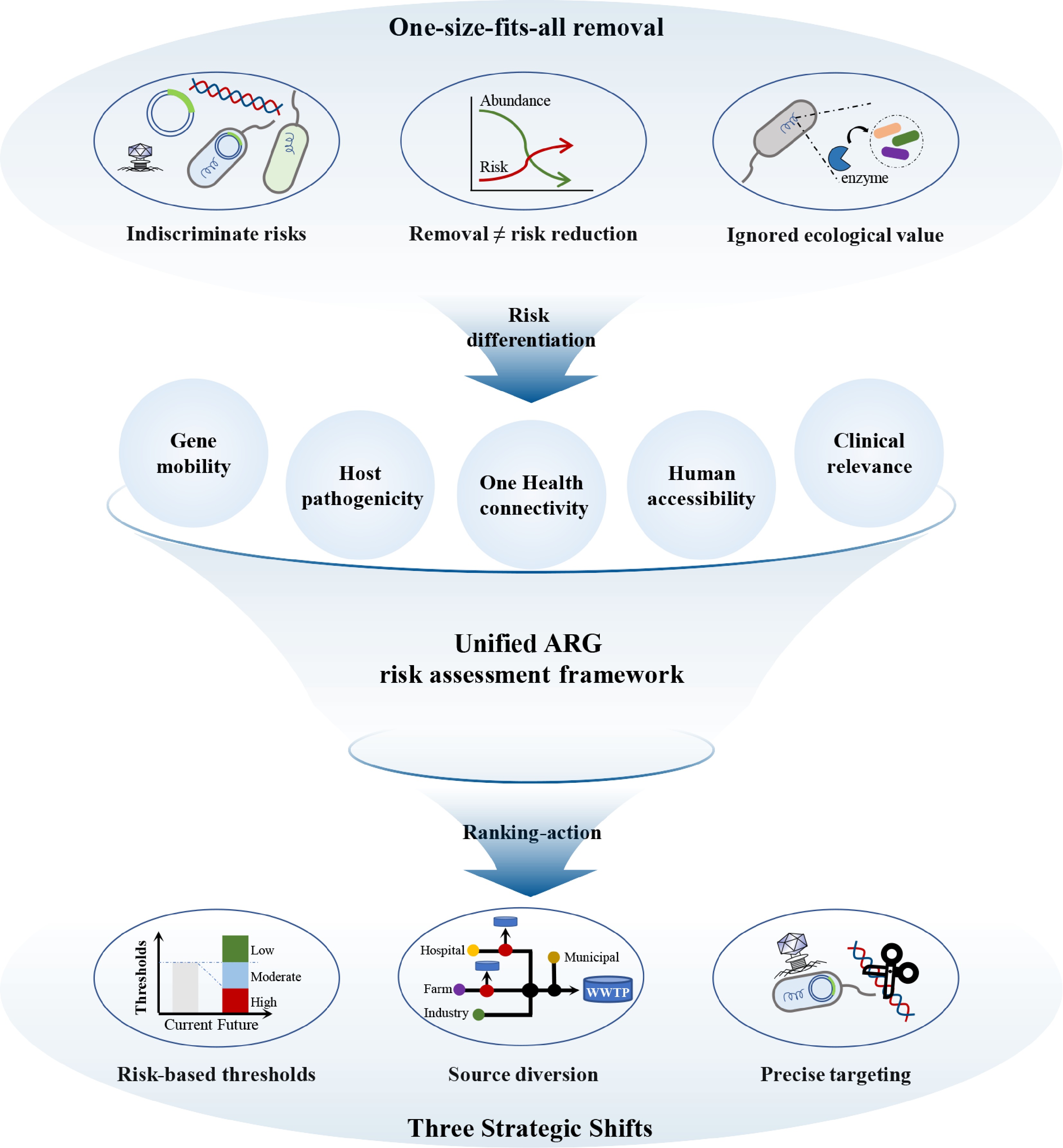
Figure 1.
ARG management must shift from one-size-fits-all removal toward a risk-tiered, action-oriented framework.
-
To focus limited resources on the ARGs that matter most, differentiating risk is urgent. In recent years, several multi-level risk assessment frameworks have emerged in the academic community, depending on criteria such as gene mobility, host pathogenicity, human accessibility, clinical relevance, and One Health connectivity[4−6]. However, these frameworks differ considerably in their choices of evaluation dimensions and the weighting of indicators, lacking a unified and standardized protocol. As a result, the same ARG can be classified as 'high risk' by one scheme and merely 'moderate' by another. This lack of comparability leaves regulators in a quandary, precluding direct incorporation into discharge standards.
More importantly, most frameworks stop at the stage of risk ranking and fail to address the most fundamental question for decision-makers: what specific actions should be taken for the top-ranked ARGs? Should we pursue source reduction, process control, or enhanced end-of-pipe treatment? And for the same risk level across different environmental media, should the same intervention strategy be applied? The absence of such 'ranking-action' mapping has relegated most grading frameworks to mere academic exercises, incapable of bridging the gap between research outputs and regulatory implementation. To break this deadlock, the international community must first reach agreement on the core dimensions and weighting of risk assessments—through mechanisms such as a joint expert panel of WHO, FAO, and UNEP, or via ISO standardization processes. A pragmatic interim consensus framework can be adopted and progressively refined as data accumulates.
-
Additionally, translating such a framework into effective governance requires transformation along three dimensions—regulation, spatial allocation, and technology (Fig. 1).
Shift 1: From uniform discharrge standards to risk-based regulatory thresholds
-
Although no country worldwide has yet integrated ARGs into mandatory pollution monitoring programs, future regulation should not simply mirror the fixed emission limits applied to conventional contaminants. Instead, a tiered response mechanism should be adopted. For low-risk intrinsic ARGs, routine background monitoring without active intervention is sufficient. For medium-risk mobile ARGs, a warning threshold should be set; when signals of co-occurrence with potential pathogens intensify, source tracking and identification of selective pressure are triggered. For high-risk ARGs, a binding action threshold must be established; persistent detection or significant exceedance should trigger a mandatory multidisciplinary investigation and risk intervention. Linking risk level, monitoring threshold, and response action can translate academic classification into operational regulatory language. However, implementing such a tiered system requires the ability to conduct real-time monitoring of the coexistence of ARGs and pathogens, a challenge that remains significant in many regions. A phased approach could begin with sentinel monitoring of a small panel of high-risk ARGs in urban centers or large hospitals, using targeted qPCR or metagenomics, and gradually scale up as infrastructure matures.
Shift 2: From end-of-pipe treatment to source diversion at high-risk nodes
-
Over the past two decades, we have invested heavily in end-of-pipe removal at wastewater treatment plants, attempting to solve all problems at the last mile. However, the transmission dynamics of ARGs demand a fundamental restructuring of our management focus across spatial scales[7]. Specifically, we need to implement precise upstream diversion along the transmission chain, guided by risk classification. For instance, high-risk mobile ARGs present in livestock manure and wastewater should undergo dedicated pretreatment within the farm area. Likewise, hospital/medical and pharmaceutical wastewater are high-risk nodes with strong selection/co-selection pressure; they should follow control principles for toxic chemicals, requiring dedicated collection and separate disposal. High-risk ARGs must be intercepted at the source, not diluted and ineffectively treated downstream. To ensure the implementation of this source diversion, it is advisable to incorporate high-risk ARG indicators into discharge permits and establish corresponding policy incentives, thereby creating both regulatory pull and economic feasibility.
From broad-spectrum disinfection to risk-informed, precise targeting of high-risk ARGs
-
Although traditional processes such as ultraviolet irradiation and chlorination can effectively kill antibiotic-resistant bacteria, they suffer from two inherent limitations: poor selectivity and the potential to exacerbate gene dissemination via DNA released from lysed cells. These drawbacks make precision interventions imperative. Yet precision first requires scenario-specific identification and risk ranking of high-risk ARGs, their mobile genetic elements, and keystone hosts. Only then can emerging technologies, such as CRISPR-based targeted gene elimination, synthetic biology-enabled extracellular DNase engineering, and phage-mediated removal of keystone ARG hosts, cut off the transmission chain at the level of genetic connectivity[8−10]. Future priority should go to these precision containment technologies, while tackling their inherent technical and ecological risks in environmental applications—off-target effects, unintended horizontal gene transfer, and ecological disruption from engineered organisms.
-
The past two decades have exposed the inadequacy of the total-removal paradigm and established the scientific basis for risk classification. The challenge for the next two decades will not be whether we can distinguish risk levels, but whether we can translate those levels into differentiated, implementable management decisions. Meeting that challenge requires abandoning the mindset of uniform treatment and completing a profound transformation—in regulation, process configuration, and technology development—from abundance reduction to risk governance. Faced with the threats of the post-antibiotic era, we must learn to manage risks wisely rather than vainly chasing their total elimination.
Not applicable.
-
Not applicable.
-
The authors confirm their contributions to the paper as follows: Haining Huang designed and prepared the draft; Yinguang Chen revised the manuscript. All authors reviewed the results and approved the final version of the manuscript.
-
All data generated or analyzed during this study are included in this published article.
-
The authors declare that they have no known competing financial interests or personal relationships that could have influenced the work reported in this paper.
-
Full list of author information is available at the end of the article.
- Copyright: © 2026 by the author(s). Published by Maximum Academic Press, Fayetteville, GA. This article is an open access article distributed under Creative Commons Attribution License (CC BY 4.0), visit https://creativecommons.org/licenses/by/4.0/.
Huang H, Chen Y. 2026. Rethinking antibiotic resistance genes after 20 years: from one-size-fits-all removal to differentiated risk management. Biocontaminant 2: e015 doi: 10.48130/biocontam-0026-0012


|