











-
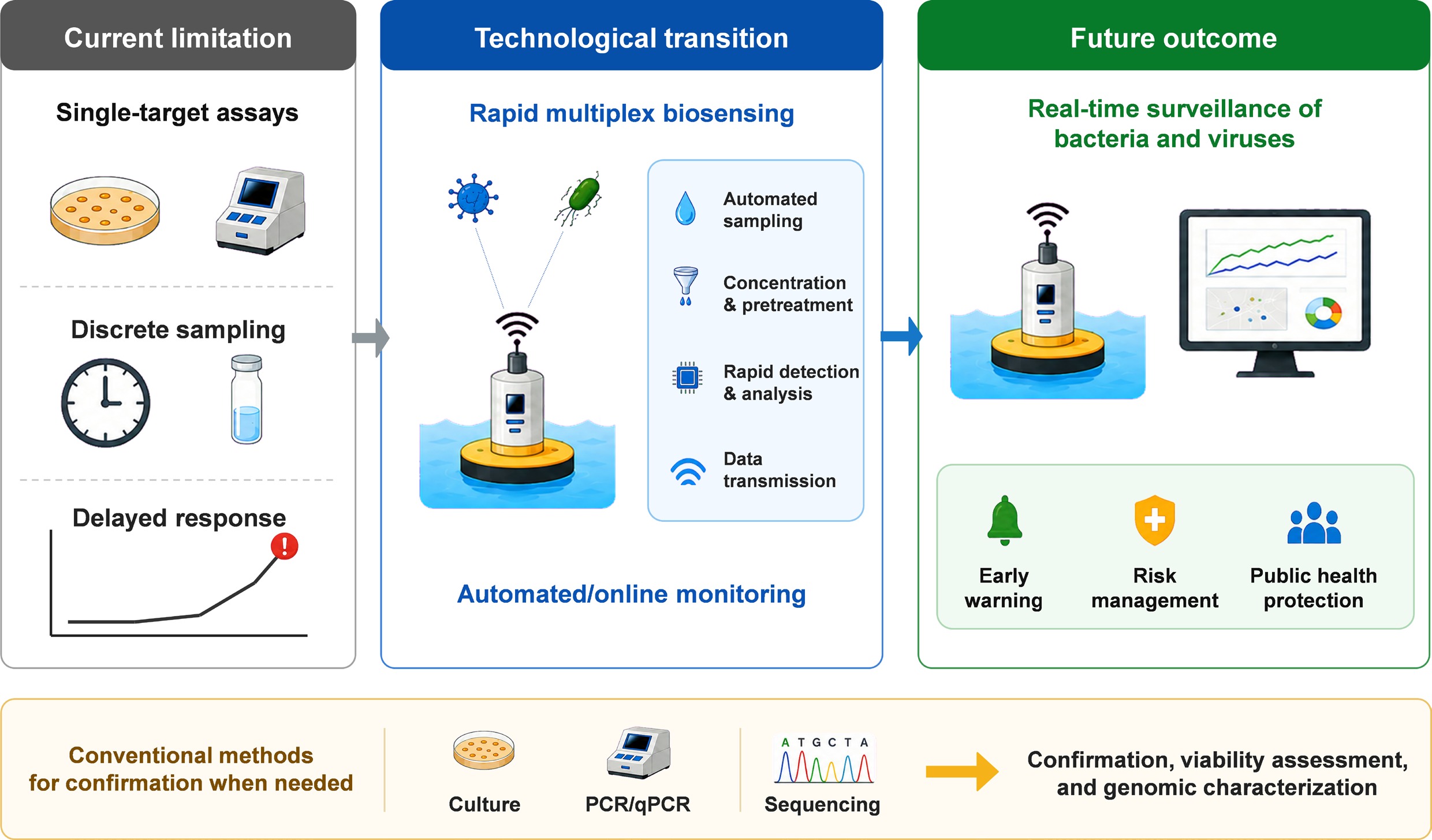
Since the outbreak of the COVID-19 pandemic, the occurrence of biological contaminants in aquatic environments and the necessity for real-time online monitoring and early warning systems have increasingly attracted public attention, prompting critical academic reflection and research on mitigation technologies. Unlike physical contaminants (such as noise, light, heat, and electromagnetic radiation) and chemical pollutants (including heavy metals, organic pollutants, and nutrients), biological contaminants exhibit unique characteristics of self-reproducibility, pathogenicity, environmental variability, and high concealment. Comprising diverse pathogenic microorganisms and other harmful biological entities, these contaminants often trigger large-scale waterborne pathogenic infections that remain a major global threat. Compared with physicochemical monitoring frameworks, however, routine environmental surveillance of biological contaminants remains relatively underdeveloped, particularly with respect to the rapid, continuous, and simultaneous detection of multiple pathogenic targets[1]. Therefore, an important future objective is not merely to improve the sensitivity of individual assays, but to increase monitoring frequency and expand detection from single predefined targets toward multiplex surveillance of priority waterborne pathogens.
Culture-based assays remain important reference methods for assessing the viability of culturable waterborne microorganisms, although modern surveillance increasingly incorporates molecular and analytical techniques such as mass spectrometry, immunoassays, and polymerase chain reaction (PCR) for rapid identification. Although these methods are highly reliable and widely used in clinical and environmental laboratories, significant bottlenecks remain when applying them to rapid or continuous environmental monitoring. For example, bacterial culture methods require prolonged incubation cycles and demand trained personnel for identification[1], and mass spectrometry generally requires specialized operators and expensive equipment. Conventional nucleic acid-based assays, including PCR and real-time PCR (PCR), provide high sensitivity and specificity but do not inherently distinguish viable from nonviable microorganisms without additional viability-linked pretreatment or molecular strategies[2]. Importantly, molecular detection has also advanced beyond conventional single-target PCR. Multiplex PCR and related assays can simultaneously detect several predefined pathogens[2,3]. Targeted and sequencing-based approaches can additionally provide broader pathogen characterization and sequence-level information[4]. These developments represent important advances in aquatic pathogen surveillance and should be regarded as complementary to emerging biosensing technologies. Nevertheless, most molecular and sequencing-based workflows still require discrete sample collection, concentration or extraction, laboratory instrumentation, and subsequent data analysis, which currently restricts their application for continuous in situ or online monitoring. Consequently, developing robust, in situ, and rapid detection technologies for waterborne pathogenic microorganisms has become an important research priority in the post-pandemic era.
Furthermore, online monitoring of water quality is heavily constrained by the instruments' performance. Current online water quality monitoring systems predominantly focus on physicochemical parameters such as water temperature, pH, dissolved oxygen (DO), electrical conductivity (EC), turbidity, permanganate index, ammonia nitrogen (NH3-N), total phosphorus (TP), total nitrogen (TN), chlorophyll a, and algal density. Although automated microbiological monitoring systems have also been developed for selected indicator organisms such as fecal coliforms or Escherichia coli, biological monitoring remains considerably less mature than routine physicochemical monitoring, and many existing systems still require incubation, enrichment, or other time-consuming sample-processing steps. Similarly, though the US Environmental Protection Agency (EPA) designates E. coli and enterococci as important biological indicators for relevant water quality applications, existing automated microbiological approaches generally remain focused on a limited number of indicator organisms rather than simultaneous monitoring of broad pathogen panels[5]. More broadly, environmental pathogen surveillance has expanded internationally since the COVID-19 pandemic, with wastewater and other environmental monitoring programs demonstrating the feasibility of repeated multitarget surveillance[6]. However, most current systems still rely on periodic sample collection and laboratory-based molecular analysis rather than continuous in situ detection[6,7]. It is also important to distinguish among "online", "in situ", and "real-time" monitoring[7]. An online system may automatically collect and analyze water samples at predefined intervals, whereas an in situ sensor operates directly at or near the monitored water body. Real-time or near-real-time surveillance additionally requires the complete process, from sample acquisition and preparation to signal interpretation[7,8], to be sufficiently rapid to support timely intervention. These traditional instruments therefore remain limited in delivering the rapid, high-throughput, and specific responses required to mitigate acute biological contamination risks. The transition toward in situ or online monitoring systems characterized by high sensitivity, operational stability, and multiplexed specificity therefore represents an important frontier for aquatic biosafety.
Recent advancements in nanobody-based recognition offer highly specific affinity reagents for pathogen-associated targets[9,10]. When coupled with high-speed fiberoptic sensing technology[11−13], these recognition elements can support rapid and sensitive optical detection of biological contaminants. For multipathogen applications, different nanobodies could be immobilized in spatially separated or otherwise encoded sensing channels, enabling parallel recognition of multiple predefined targets. However, increasing the number of targets also requires a careful evaluation of cross-reactivity and signal interference among the recognition channels. Concurrently, functional nucleic acid fluorescent probe technology, which utilizes in vitro-selected nucleic acid fragments with specific structures and functions, including aptamers (with target-specific binding capabilities) and deoxyribozymes (with catalytic activity), provides a versatile platform for biosensing[14−16]. Functional nucleic acids can recognize diverse targets, including nucleic acids, proteins, and small molecules, and offer advantages such as sequence programmability, chemical synthesis, and favorable storage stability. Their sequence programmability also provides an attractive basis for multiplex sensing because different recognition sequences can potentially be assigned to different pathogen-associated targets and coupled with spatially or spectrally distinguishable signal channels[16−18]. Functional nucleic acid-based sensors can also be coupled with fluorescent, nanomaterial-based, or electrochemical signal transduction and amplification strategies to improve analytical sensitivity. Detection by functional nucleic acid- or nanobody-based sensors does not necessarily indicate pathogens' viability because the recognized molecular targets may persist after losing viability. Viability discrimination therefore depends on the selected target and sensing mechanism and requires specific validation. This limitation should be evaluated on a target- and platform-specific basis. Microfluidic technologies can further facilitate automated liquid handling, compartmentalization, and parallel detection[19].
Despite these technological advances, translating laboratory biosensors into continuous aquatic surveillance systems remains challenging. Pathogenic microorganisms in natural waters may occur at low concentrations, making efficient sampling, concentration, and enrichment essential before detection[8,19]. Therefore, the effective system-level detection limit depends not only on the sensors' sensitivity but also on the sampled volume, pathogen recovery efficiency, concentration factor, and processing time. Environmental matrices may further interfere with target recognition through suspended particles, dissolved organic matter, nonspecific adsorption, and competing microorganisms[8,17,18]. Long-term deployment introduces additional problems, including biofouling, sensor drift, calibration, degradation of recognition elements, and maintenance requirements[20,21]. These challenges indicate that rapid pathogen sensing should be considered as one component of an integrated monitoring system rather than as an isolated analytical step.
Accordingly, future real-time multipathogen surveillance may require the flexible integration of several functional modules, including automated water sampling, pathogen concentration and sample pretreatment, multiplex target recognition, rapid signal transduction, automated data acquisition, and early warning interpretation. Within such an integrated framework, parallel fiberoptic sensors functionalized with different nanobodies may provide a rapid first-line screening approach for multiple predefined pathogen targets. Signals requiring further evaluation may subsequently be examined using functional nucleic acid probes integrated with microfluidic platforms as a more specific secondary target analysis layer. Culture-based methods, targeted molecular assays, or sequencing may be used for additional confirmation or deeper characterization when required (Fig. 1). Importantly, multipathogen surveillance requires more than placing multiple probes within a single device; reliable multiplex operation also depends on independent target recognition, low cross-reactivity, appropriate positive and negative controls, signal discrimination, and management of false positive and false negative results.
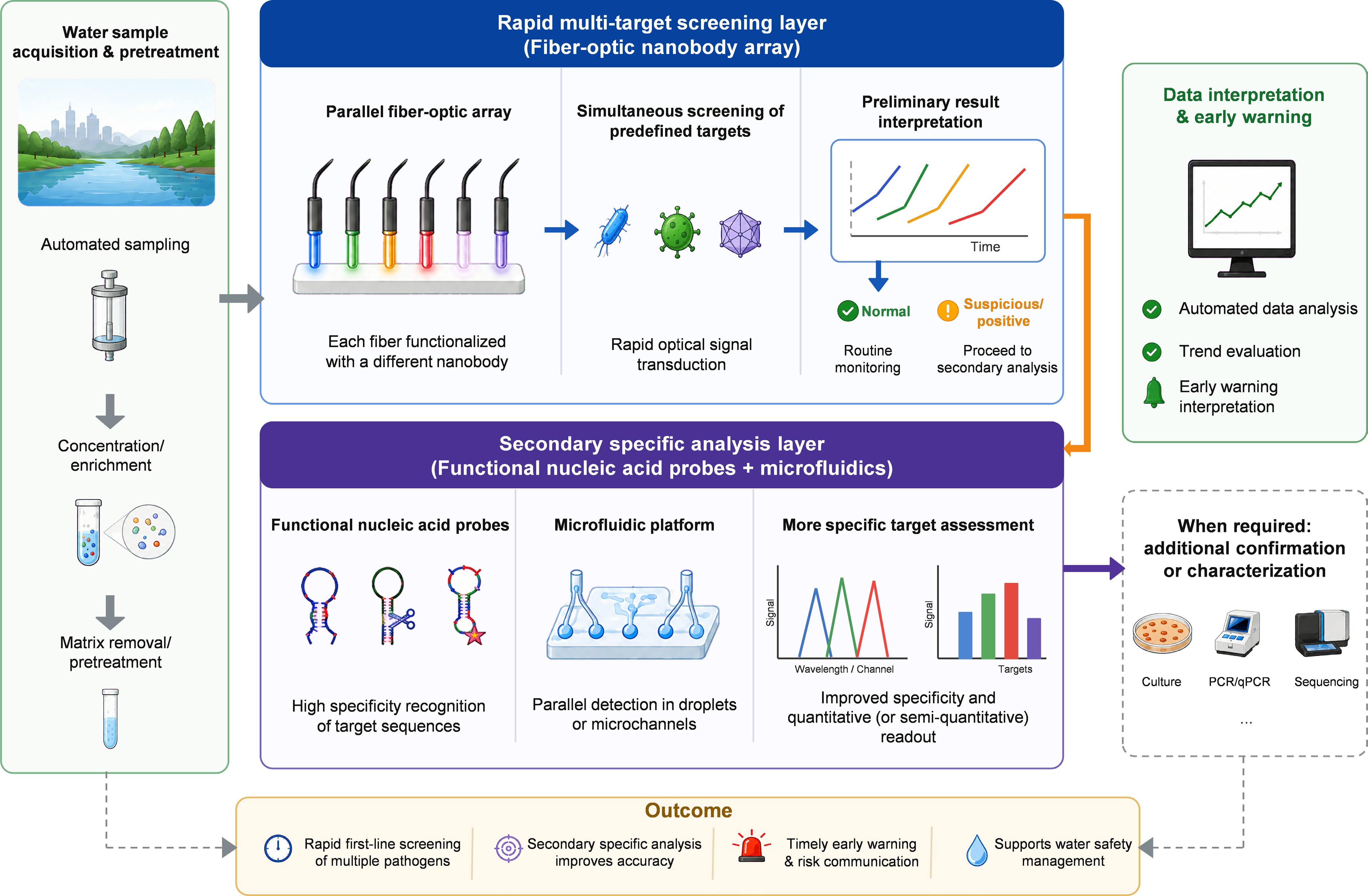
Figure 1.
Conceptual framework for integrated multipathogen surveillance in aquatic environments. Parallel fiberoptic sensors functionalized with different nanobodies may provide a rapid first-line screening approach for multiple predefined pathogen targets. Signals requiring further evaluation may subsequently be examined using functional nucleic acid probes integrated with microfluidic platforms as a more specific secondary analytical layer. Practical online surveillance additionally requires appropriate sample acquisition and pretreatment, data interpretation, and operational stability. Culture-based, molecular, or sequencing-based methods may be used for additional confirmation or characterization when required.
The integration of these technologies may facilitate rapid, targeted, and highly sensitive online surveillance of biological contaminants in aquatic environments. Compared with conventional single-target or laboratory-based methods, emerging biosensing platforms offer particular potential for reducing the response time and enabling the parallel detection of multiple predefined pathogens. However, these systems should not be viewed as replacements for culture-based or advanced molecular methods. Instead, these technologies may provide complementary analytical layers for rapid screening and more specific target assessment. Culture-based methods remain valuable for assessing viability, whereas PCR-based assays or sequencing can provide confirmatory detection or deeper pathogen characterization when required. Ultimately, the transition from single-target assays to real-time multipathogen surveillance will depend not only on improved recognition chemistry and signal sensitivity, but also on reliable sample concentration, multiplex specificity, sensors' long-term stability, automated data interpretation, and integration with operational early warning systems. Such integrated monitoring platforms represent a promising direction for future aquatic biosafety and managing waterborne pathogen risks.
HTML
-
Not applicable.
No acknowledgments are applicable for this work.
-
The authors confirm their contributions to the paper as follows. Lu Li: conceptualization, resources, writing – original draft. Meng Liu: conceptualization, resources, writing – original draft. Bo Liu: conceptualization, resources, writing – original draft. Xiaowei Jin: conceptualization, resources, writing – original draft. Xiaoli Zhao: conceptualization, resources, writing – original draft. Yoong-ling Oon: conceptualization. Yoong-sin Oon: conceptualization. Kang Song: conceptualization, resources, writing – original draft. All authors read and approved the final manuscript.
-
Data sharing is not applicable to this article as no datasets were generated or analyzed during the current study.
-
The authors declare that they have no conflicts of interest.
-
Full list of author information is available at the end of the article.
- Copyright: © 2026 by the author(s). Published by Maximum Academic Press, Fayetteville, GA. This article is an open access article distributed under Creative Commons Attribution License (CC BY 4.0), visit https://creativecommons.org/licenses/by/4.0/.
Li L, Liu M, Liu B, Jin X, Zhao X, et al. 2026. Transitioning from single-target assays to real-time multipathogen surveillance: the future of aquatic biosafety. Biocontaminant 2: e014 doi: 10.48130/biocontam-0026-0011


|