











-
Polycyclic aromatic hydrocarbons (PAHs) are ubiquitous compounds encompassing over 200 organic matter and classified as persistent organic pollutants (POPs) in the environment. PAHs are hydrophobic with the chemical structure of two or more fused carbon-hydrogen rings. Based on the number of aromatic rings, compounds can be classified as light (2–4 rings) or heavy (more than four rings). The latter category, characterized by more than four rings, is generally more stable and toxic[1−4]. PAHs are formed according to incomplete combustion of organic matter and pyrolytic process, with anthropogenic (industrial process, motor vehicle exhaust, tobacco smoking, etc.), or natural (volcanic eruptions and natural forest fires) sources[5−8]. Various studies have confirmed the occurrence of PAHs in food[4,8,9]. The presence of PAHs in food generally could be due to environmental contamination through air, water, and soil, packaging material migration, and thermal processing (smoking, grilling, roasting, direct drying, baking, and frying), which may result in elevated levels of PAHs formation[6,10−12]. PAHs are recognized as one of the significant health challenges in the food industry, and their negative effects on public health, especially in vulnerable groups such as children, should be considered[8].
Several PAHs have been considered carcinogenic, mutagenic, and genotoxic[13,14]. Even PAHs that have not been considered carcinogenic could synergically increase the carcinogenicity of other PAHs. PAHs are not present individually; human exposure to them is complex. PAHs can enter the body through inhalation, the gastrointestinal tract, and skin contact. It has been suggested that food is a significant source of human exposure to PAHs. PAH exposure varies depending on dietary habits in different regions worldwide. Research indicates that animals absorb between 30%−50% of PAHs through the gastrointestinal tract, ultimately metabolizing these substances in the liver. Activating dioepoxide metabolism raises significant health concerns as it can lead to DNA mutations and replication issues. Numerous studies have demonstrated that exposure to PAHs is positively linked to various health issues, including stomach cancer, biochemical and cytogenetic changes, as well as lung alterations, which encompass DNA damage. Therefore, accurate monitoring of different food matrices concerning the prevalence of PAHs and implementing control measures to limit population exposure is crucial[2,10,11,15−19]. Previously, it was believed that the ratio of toxicologically significant PAHs in food remained constant, making benzo[a]pyrene [B[a]P] a reliable indicator for PAH presence. However, with the extensive scientific evaluation on the occurrence of carcinogenic PAHs in food, the EFSA (European Food Safety Authority) CONTAM Panel concluded that the eight higher molecular weight PAHs (PAH8) or its subgroup, four PAHs or PAH4 including [B[a]P], benzo[a]anthracene [BaA], chrysene [Chr], and benzo[b]fluoranthene [BbF] are the most studied PAH markers in foodstuffs. Based on these findings, maximum limits (ML) of the four PAHs were defined for certain foodstuffs in European Union Commission Regulation (EC regulation) No. 835/2011[6,10,20−22].
Chocolate is widespread globally, particularly among children. It is the most consumed and financially successful confectionery product worldwide[6,23−25]. The health advantages of chocolate are primarily due to the antioxidant effects of flavonoids in cocoa. Some plants, including cocoa beans, are a significant source of dietary phenolic compounds, comprising 12%−18% of their total dry weight[26]. Antioxidants play a key role in protecting against oxidative damage in the body and food[27,28]. Chocolate mainly consists of cocoa solids, cocoa butter, sugar, glucose, buffering agents, and aroma or flavoring substances. Chocolates are generally categorized into dark chocolate, milk chocolate, or white chocolate according to their composition[25,29,30]. Chocolate production involves a comprehensive post-harvest process, including fermenting, drying, roasting, breaking, winnowing, grinding cocoa beans, mixing ingredients, refining, conching, tempering, and molding[2,31,32]. Chocolate contamination with PAHs can mainly occur during different conditions of the drying processes of cocoa beans, such as drying on asphalt or bitumen in the sun or through direct firing methods. Poor maintenance of air dryers can cause smoke to contaminate cocoa beans with PAHs and affect flavor. Cocoa beans are roasted at 100−200 °C for 15 min to 2 h to promote the Maillard reaction, reduce moisture, and decrease volatile acids. However, uncontrolled roasting can also produce PAHs[18,33]. Additionally, storing and transporting cocoa beans in jute or sisal bags treated with batching oil and lube or hydraulic oils can lead to contamination of PAHs[10,25,33]. Environmental PAH deposition on cocoa shells and then the transportation of them to the nib and cocoa butter is another possible contamination source[6,34]. The levels of PAHs in cocoa butter are higher than in other oils and fats. This may be attributed to inadequate drying, roasting methods, and the inability to refine cocoa butter like other vegetable oils and fats. Cocoa butter comprises a significant portion of cocoa raw products, such as cocoa beans, cocoa mass, or cocoa liquor. It is, therefore, present in chocolate and other cocoa-based products that children predominantly consume. Since PAHs, as hydrophobic substances, concentrate in the fat fraction (cocoa butter), the EC regulation established the ML of the four PAHs for cocoa beans and derived products on a fat basis. In addition, it should be mentioned that it is the only food category in the regulation that the levels of PAHs are reported on fat fraction[2,6,21,35]. It has been said that the study by Dennis et al., was the first investigation of the PAHs presence in chocolate, and their results expressed the mean of 0.21 μg/kg for [B[a]P] and 1.53 μg/kg for the total four PAHs[36,37]. Also, in the survey of EFSA on PAHs in food, the constant presence of [B[a]P] in barbequed meat, dried tea, bivalve mollusks, chocolate, and cocoa butter has been reported[20,38].
Considering the daily risk of exposure to PAHs through various routes, such as inhaling polluted air, consuming PAH-contaminated food, smoking, or exposure to smoke from fireplaces, it is crucial to implement regular monitoring and control measures on potential sources of PAHs[19]. Children consume chocolate products in larger amounts relative to their body weight than adults. Consequently, this confection may contribute to a higher accumulation of PAHs in their bodies. Furthermore, children are more vulnerable to the effects of chemical hazards due to their developing organ systems and increased exposure levels[28]. To the best of our knowledge, there is no systematic review regarding the status of PAHs in chocolate. In this study, we aimed to conduct a comprehensive survey on the content of the four main PAHs in common chocolates, including dark chocolate, milk chocolate, and white chocolate, and compare them with the last EC regulation No 2023/915 on maximum levels for certain contaminants in food[35], to verify whether chocolate, as a potential source of PAH could be health threatening based on four PAH markers or not.
-
The chosen keywords and the syntax for this survey were (((chocolate) OR (cocoa) OR (cacao) OR ('cocoa bean') OR (confection)) AND ((PAH) OR ('polycyclic aromatic hydrocarbon') OR ('benzo(a)pyrene') OR ('benzo(a)anthracene') OR ('benzo(b)fluoranthene') OR (chrysene) OR (CHRY) OR ('B[a]P') OR (BaA) OR (BbF))). The search was done in Scopus, Web of Science Core Collection, and PubMed without any limitations by two authors (NV and BM) independently on January 26, 2025. The search results for these two authors were the same.
An additional manual search of the bibliographies of relevant articles retrieved from the initial search was conducted to minimize the possibility of missing pertinent studies.
Inclusion and exclusion criteria
-
This systematic review's inclusion and exclusion criteria were determined before searching the databases. Inclusion criteria were articles that have measured [B[a]P], [BaA], [Chr], and [BbF] in any chocolate product that contains mostly cocoa paste (solids), cocoa powder, or cocoa butter along with, or without sugar, emulsifier, flavorings, milk, or milk-derived products such as powdered milk, cream, etc., and vegetable fats (examples are dark chocolate or bittersweet chocolate, milk chocolate, and white chocolate)[25,29,30]. Articles that have been measured [B[a]P], [BaA], [Chr], and [BbF] in other kinds of foods or chocolate products such as Gianduja chocolate, filled chocolate, chocolate pralines, chocolate with dried fruit or cereals, chocolate 'a la taza', and any kind of chocolate product that has ingredients not mentioned in the inclusion criteria[29,30], articles that have measured other PAHs than [B[a]P], [BaA], [Chr], and [BbF] in different kinds of chocolate, articles that have studied other parameters than PAHs in chocolate, articles that were in different fields than food science and safety, review studies, and chapters of books were set as exclusion criteria for this systematic review.
Data extraction
-
Based on the purpose of this study, the necessary data from eligible articles were extracted by two authors (NV and BM). The desired data were the name of the first author and article publication date, the country where the study was conducted, the type of studied chocolate/s, sample size, fat content (%), detection method, PAHs content (μg/kg fat), their Max (μg/kg fat), the result of comparing with EC regulation No. 2023/915, and main findings of the study. In studies where the sum of four PAHs (ΣPAH4) or the average concentration of [B[a]P] across multiple samples has not been reported, the desired parameters were calculated and presented using the data provided by the original studies and Excel software (Version 2016). The corresponding author discussed and solved discrepancies by comparing the data extracted by the two authors.
Comparison with international standards
-
Since the international food standard, Codex Alimentarius has not established a maximum level for any of the PAHs in food[39], therefore the reliable EC regulation, No. 2023/915, on maximum levels for certain contaminants in food and repealing Regulation (EC) No 1881/2006, was used for comparing with the results of the articles[35]. This regulation states a maximum level of 5.0 μg/kg fat for [B[a]P] and 30.0 μg/kg fat for ΣPAH4 in cocoa beans and derived products. In the case of studies that have not reported the PAH content on the fat basis, if the study itself reported the fat content of the samples, [B[a]P] and ΣPAH4 would be calculated based on fat and reported in this study.
-
A total of 143 results were obtained from the databases. After removing duplicates, 78 articles were carefully screened by two authors (NV and MM) by examining the titles and abstracts. According to inclusion and exclusion criteria, a total of 62 articles were excluded which were generally concerning records that have measured PAHs in other cocoa byproducts (cocoa bean, cocoa powder, cocoa butter, etc.) or other food products (n = 12), records that have evaluated other parameters in cocoa products (smoky taste, flavors, and fragrances, mineral oil, acrylamide, etc.) and other foods, adulteration (n = 8), records that were about other fields i.e., environmental, agricultural, analytical chemistry and anthropology chemistry science (n = 13), toxicology, case-control, case-report, cohort, animal, and in vitro records (n = 17), reviews (n = 9), chapter of books (n = 2), and letters (n = 1). Also, a manual search through the bibliographies of relevant articles was conducted, identifying five additional records that were not captured in the initial search results. Two records were for the Food Safety Authority of Ireland (FSAI), and Stiftung Warentest (German consumer organization and foundation), and their complete reports were not retrieved. Finally, 18 reports were assessed for eligibility (NV and MM). For qualitative evaluation, declaration of chocolate type, sample size, detection method, [B[a]P], and ΣPAH4 reports based on fat basis or report of fat content of samples were among the evaluation criteria. Finally, four reports were chosen for data extraction. The flow diagram of the search strategy is shown in Fig. 1.
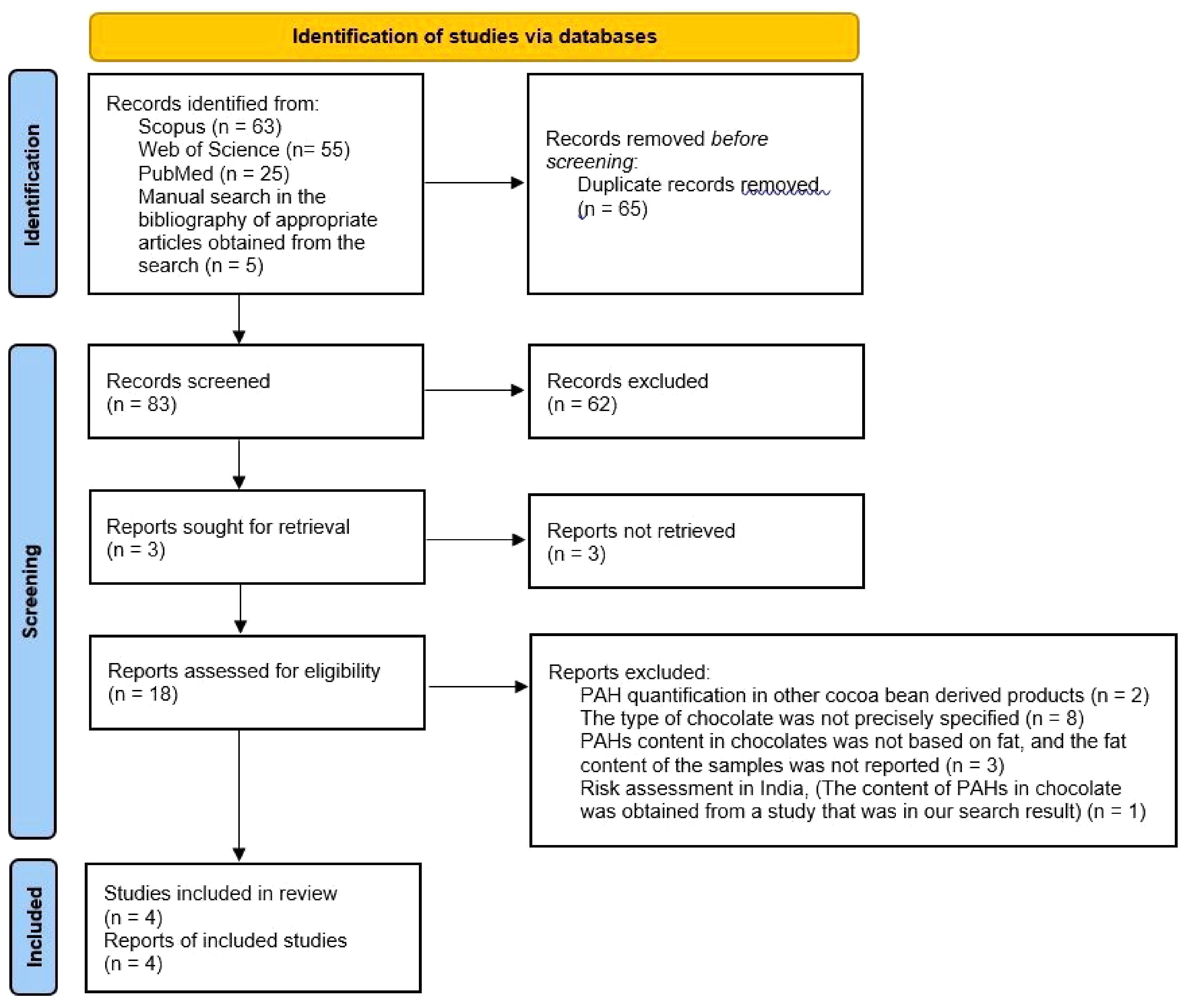
Figure 1.
The PRISMA flow diagram of the study.
Data extracted from selected reports
-
According to the data extraction approach, and after finalizing the results obtained from the searches, desired data from four selected reports were extracted and summarized in Table 1. The analysis of the extracted data reveals that the majority of studies in this field have been conducted in countries that are members of the European Union (EU). Dark chocolate was the most extensively studied type, followed by milk chocolate, while white chocolate was the least studied case that was previously reported. One study utilized cocoa beans to produce various cocoa bean by-products, including chocolate, to investigate the effects of different parameters on the PAH content in these products. The fat content in the chocolate samples varied between approximately 26% and 66%, both of which were observed in dark chocolate. The HPLC (high-performance liquid chromatography) method was utilized in all studies, with three studies equipped with FLD (fluorescence detector) and one study equipped with HRMS (high-resolution mass spectrometer).
Table 1. Intended data extracted from selected papers.
Country Type of chocolate/s Sample
sizeFat content
(%)Detection method Mean content of PAH4 & B[a]P
(μg/kg fat)Max of B[a]P
& PAH4
(μg/kg fat)Comparing with
EC regulation
No. 2023/915Main findings Ref. Brazil White chocolate 10 32.26 HPLC/FLDa PAH4: 20.53 B[a]P: 2.31 PAH4: 46.24 B[a]P: 6.62 Two white chocolate samples and one 70 % cocoa chocolate sample exceeded the ML of PAH4 and B[a]P. The major PAH for all samples was Chr. Women and adolescents were more exposed to PAHs due to the high consumption of chocolate. Totally, according to findings chocolate consumption presents low potential
health risks.[24] Milk chocolate 14 32.10 PAH4: 14.46 B[a]P: 1.00 PAH4: 26.22 B[a]P: 2.61 40 % cocoa chocolate 4 26.90 PAH4: 15.73 B[a]P: 0.79 PAH4: 26.38 B[a]P: 1.87 53% to 60% cocoa chocolate 3 35.01 PAH4: 16.52 B[a]P: 1.64 PAH4: 24.16 B[a]P: 3.13 70% cocoa chocolate 4 36.56 PAH4: 27.24 B[a]P: 4.56 PAH4: 37.48 B[a]P: 7.94 Dark chocolate undeclared cocoa 3 47.28 PAH4: 13.12 B[a]P: 1.56 PAH4: 15.45 B[a]P: 3.32 Latvia Dark chocolate samples with cocoa content in a range of 41–77% 26 30−66 HPLC/HRMSb PAH4: 4.24 B[a]P: 0.71 PAH4: 16.07 B[a]P: 2.90 PAH4 and B[a]P of all samples were lower than the ML. In all of the chocolate samples, the concentration of Chr and B[a]A were relatively higher than B[a]P and B[b]F. Also, Chr was the predominant PAH (ranging from 0.37−7.39 μg/kg fat) while B[a]P was just detected in 77% of samples. [2] Germany Milk chocolate/chocolate coatings 27 − HPLC/FLD PAH4: 10.11 B[a]P: 0.70 PAH4:17.08 B[a]P: 1.96 PAH4 and B[a]P of all samples were lower than the ML. The lowest and highest PAH4 was for cocoa mass and cocoa butter, and the lowest and highest B[a]P was for cocoa mass and raw cocoa, respectively. Among cocoa and chocolate products B[a]P of cocoa powder and cocoa drink powder were higher than chocolates but totally all were below the ML. Among PAH4, Chr followed by B[a]A were higher than B[a]P and B[b]F in cocoa butter, cocoa mass,
and raw cocoa.[22] Dark chocolate/chocolate coatings 69 PAH4: 5.88 B[a]P: 0.57 PAH4: 17.42 B[a]P: 1.56 Polish chocolate factory Cocoa bean imported from: Dominican Republic (Varc. Trinitario) Roasted at 160 °C Dark chocolate 9 chocolate samples of every kind of cocoa bean and roasting condition 32−43 HPLC/FLD ndd − PAH4 of all samples was way lower than the ML. B[a]P and B[b]F were not detected in any of the samples. Chr was slightly higher than B[a]A. The highest contents of PAH4 were for roasted cocoa beans, cocoa mass, and cocoa butter, and the lowest contents were for raw cocoa beans and chocolate. Light PAHs were predominant in any kind of cocoa bean products. Cocoa beans and their derived products especially chocolate are stated to be not a threat to consumer's health. [6] Ecuador (Var. Nacional) Roasted at 160 °C 1.24 ± 0.12 Ghana (Var. Forastero) Roasted at 160 °C 1.29 ± 0.14 Ivory Coast (Var. Forastero) Roasted at 160 °C 0.47 ± 0.16 Nicaragua (Var. Trinitario) Roasted at 160 °C nd Nicaragua (Var. Trinitario) Roasted at 140 °C nd Venezuela (Var. Criollo) Roasted at 160 °C 1.03 ± 0.16 Venezuela (Var. Criollo) Roasted at 140 °C 0.91 ± 0.18 a FLD (fluorescence detector); b HRMS (high-resolution mass spectrometer); c Var. (variety); d nd (not detected). Generally, the Max of ΣPAH4 was 46.24 μg/kg fat for white chocolate, 37.48 μg/kg fat for dark chocolate, and 26.22 μg/kg fat for milk chocolate. In addition, the Max for [B[a]P] was 7.94 μg/kg fat for dark chocolate, 6.62 μg/kg fat for white chocolate, and 2.61 μg/kg fat for milk chocolate. Among all four studies, two white chocolates (20%), one dark chocolate (0.85%), and none of the milk chocolate samples exceeded the ML of EC regulation. The average of ΣPAH4 (μg/kg fat) in four studies was 20.53 for white chocolate, 12.29 for milk chocolate, and 7.22 for dark chocolate. The average of [B[a]P] (μg/kg fat) in four studies was 2.31 for white chocolate, 0.85 for milk chocolate, and 0.85 for dark chocolate. According to these results, it can be seen that milk chocolate followed by dark chocolate in terms of [B[a]P] and ΣPAH4, is safer than white chocolate.
Commonly, in all four studies, [Chr] followed by [B[a]A] (4-ring PAHs) were the predominant PAHs compared to [B[a]P] and [B[b]F] (5-ring PAHs); also, in two studies, the absence of [B[a]P] were reported[2,6]. According to studies on cocoa bean byproducts, the content of [B[a]P] and ΣPAH4 of chocolate were not at maximum levels[6,22].
-
Sources of PAHs are diverse, and population exposure to these compounds is frequent and not confined to a single source. Therefore, assessing and controlling the amounts of PAHs in different sources could be helpful in achieving lower final concentrations of PAHs in the body[19,40]. Chocolate is one of the popular sweets among children, and according to EC regulation No. 2023/915, there has been an established ML of [B[a]P] and ΣPAH4 for cocoa beans and derived products[6,35]. According to IARC (International Agency for Research on Cancer), PAH markers in food are classified as group 1 (carcinogenic to humans) for [B[a]P], and group 2B (possibly carcinogenic to humans) for [Chr], [B[a]A], and [B[b]F][41]. Therefore, it can be concluded that chocolate is among the food categories in which PAH content should be closely monitored and reduced through appropriate measures whenever possible.
Based on the obtained results, milk chocolate followed by dark chocolate has lower [B[a]P] and ΣPAH4 content than white chocolate. This could be due to the high cocoa butter (not less than 20%) that should be used in the formulation of white chocolate. Also, besides the cocoa butter, other sources of fat, including milk fat and hydrogenated fat in the formulation of white chocolate, could contribute to the high amounts of [B[a]P] and ΣPAH4 in this type of chocolate[24,29,30]. Another reason for this may be the fact that the only cocoa bean component in white chocolate is cocoa butter, meaning that the portion of the cocoa bean rich in flavonoids is not present in this product. Consequently, due to the lack of flavonoids, which possess antioxidant and radical scavenging properties, the higher concentrations of B[a]P and ΣPAH4 in white chocolate are plausible[26,29,30,42,43]. Regarding milk chocolate and dark chocolate, according to the reported results, it can be seen that although the maximum of [B[a]P] and ΣPAH4 for dark chocolate is higher, the average of ΣPAH4 in milk chocolate is higher than that of dark chocolate. This could be attributed to the obtained results in the study of Ciecierska[6], which shows that roasting the cocoa beans in a known condition, compared to other studies in which the production process is unknown, and typically it has been said that PAH contamination occurs through cocoa bean processing in the country of origin[2]. Also, the unknown condition of transportation and storage of chocolate may lead to undesirable reactions like oxidation and decomposition, and higher contents of PAHs[44]. The amounts of chocolates ΣPAH4 in this study were too low compared to other included studies, and even [B[a]P] was not detected in any of the samples. Regarding this, the average of ΣPAH4 and [B[a]P] for dark chocolate in three studies[2,22,24] were 9.42 μg/kg and 1.14 μg/kg, respectively, which ΣPAH4, still higher in the milk chocolate than dark chocolate however, [B[a]P] for dark chocolate goes higher than milk chocolate. The reason for the higher content of ΣPAH4 in milk chocolate compared to dark chocolate could be due to PAH contamination of other ingredients that may be utilized in milk chocolate. On the other hand, the higher amount of [B[a]P] in dark chocolate could be because a considerable portion of dark chocolate (not less than 35%) consists of cocoa solids that go through all the cocoa bean processing, including drying and roasting. Therefore, a high amount of PAHs in dark chocolate is expected[24,29,30].
Among the studies included in this review, only one conducted in Brazil reported the exceedances of ML of EC regulation in two samples of white chocolate and one sample of 70% cocoa chocolate. In the other three studies that were conducted in EU member countries, [B[a]P] and ΣPAH4 of all chocolate samples were below the ML. Based on the research carried out in the UK, in 1991, an average of 0.21 μg/kg for [B[a]P] and 1.53 μg/kg for ΣPAH4 in different chocolate brands was recorded[36]. In Italy (1995), the amounts of 0.33 μg/kg for [B[a]P] and 1.32 μg/kg for ΣPAH4 were obtained for mixed samples of three different brands of chocolate[45]. The amount of 0.18 μg/kg for B[a]P was reported for mixed samples of chocolate candies on national brands in 2001 in the USA[46]. According to EFSA (2008), the upper bounds for the average of [B[a]P] and ΣPAH4 in chocolate were 0.32 μg/kg and 1.75 μg/kg, respectively[20]. FSAI 2006 reported a range of [B[a]P] from 0.06 to 0.3 μg/kg for 16 chocolate samples[47]. In a German market survey in 2007, with an analysis of 25 bitter chocolates, one sample showed a high content of 10 μg/kg for [B[a]P][47]. Another study in the German market (2009) showed a median of 0.22 μg/kg for [B[a]P] and a mean of 2.0 μg/kg for ΣPAH4 in 40 samples of diverse types of chocolate[47]. A study conducted in Poland (2015), reported that ΣPAH4 of one sample of milk chocolate (36.2 μg/kg) and one of the dark chocolates (38.5 μg/kg) was higher than ML of EC regulation while [B[a]P] and [B[b]F] was not observed in any of the samples[25]. In another research in Poland (2017), the average ΣPAH4 in chocolates obtained from the processing of cocoa beans under different conditions was 0.03 μg/kg[34]. In this study, [B[a]P] was not detected in any of the chocolates. A study in India (2012) showed an average of 1.62 μg/kg for [B[a]P] and 8.16 μg/kg for ΣPAH4 among 25 local chocolate candies, with one sample containing 12.76 μg/kg of [B[a]P][38]. On the other hand, in another study in India (2013), among ten samples of sweet chocolate bars, two samples showed 0.32 μg/kg and one sample showed 0.31 μg/kg of [B[a]P][37]. In the Iwegbue et al. study, which was conducted in Nigeria, among 15 chocolate brands, three samples showed high amounts of ΣPAH4 (120.91, 73.15, and 62.93 μg/kg), along with one sample that contained 39.16 μg/kg of [B[a]P][10]. Considering reported amounts based on the minimum fat contents of chocolate, the amount of [B[a]P] and ΣPAH4 exceeds the ML of EC regulation way too high. The Food Safety and Standards Authority of India (FSSAI), and the National Agency for Food and Drug Administration and Control (NAFDAC) of Nigeria have not established ML for PAHs in cocoa beans and by-products[48,49]. Also, the study of Guizellini et al., which was conducted in Brazil, compared the amount of [B[a]P] and ΣPAH4 with EC regulation[24]. Therefore, regardless of the country's origin and the different factors affecting the content of PAHs in chocolate, the content of these three origins with those of countries, mostly EU members, were inevitably compared. It is obvious that the status of [B[a]P] and ΣPAH4 in the EU, USA, and UK, compared to other countries, including Brazil, India, and Nigeria, is better. Of course, the exact types of chocolate in some studies were not specified and it is possible that there are compounds with high potential of PAH contents in the formulation or some extra processing steps needed for the intended type of chocolate[2,10], therefore, if the type of chocolates were clear, it would be easier to make a decision.
In all four included studies, the [Chr] was the predominant PAH compared to the other three PAHs in the group of four PAHs. The same results were also observed in studies by Dennis et al.[36], FSAI 2006[25], EFSA 2008[20], EFSA 2007[50], Iwegbue et al.[10], Sadowska-Rociek et al.[25], and Żyżelewicz et al.[34]. Also, in some studies, [B[a]A][45], and [B[b]F][38] had the highest content. This confirms the EFSA statement about the fact that in some foods [Chr] was found to be predominant when [B[a]P] was not detected, and [B[a]P] is not a proper marker in foods, and more PAHs are needed as markers[20,24]. The same phenomenon can also be seen in the studies that evaluated PAHs in cocoa beans and their byproducts instead of chocolate[33,51,52]. The assortment of cocoa beans and processing parameters, including the form of the cocoa beans, time, and temperature, could be effective on the type of PAHs predominance[6,34,51]. In most of the studies, light PAHs (2−4 rings) comprised the most measured PAHs[6,10,25,33,34,36,38,45,52,53].
More or less content of [B[a]P] and ΣPAH4 in chocolate compared to cocoa beans and their by-products are variable[6,10,22,34,52]. Generally, it could be said that the possibility of the transmission of PAH compounds from cocoa beans into cocoa mass during shell removal and grinding, the formulation of chocolate (the percent of cocoa used and other PAHs proneness ingredients that may be used), and the chocolate processing (may reduce the content of PAHs) can contribute to the final content of PAHs[2,6,24,33,34,54,55].
According to obtained studies, drying and roasting parameters including temperature, time, relative humidity, failure of dryer, and direct contact of cocoa beans with smoke, type of fuel used, along with other parameters such as the variety and country origin of cocoa beans, the form of cocoa bean during roasting, and to a lesser extent the fermentation process, were stated as effective parameters in increasing contents of PAHs[6,33,34,51,52,54]. The country of origin of cacao beans can be more related to the drying process parameters and the environmental pollution of the origin country[6,52]. Also, from some studies, it could be concluded that removing the cocoa bean shell before roasting could reduce the PAHs contamination of cocoa nibs since it was stated that the major content of PAHs originated from the cocoa shell and transferred to cocoa nibs[33,34,51]. Based on the included studies it can be seen that dark chocolates with the same content of cocoa (70%) and cocoa butter can have various amounts of [B[a]P] and ΣPAH4, for instance, dark chocolates with a mean fat content of 36.56%[24] had higher amounts of PAHs compared to dark chocolates with a fat content of 32%-43%[6]. This indicates the importance of good processing and manufacturing practices in reducing the PAH profile in chocolate. The Codex Alimentarius has established a Code of Practice to help reduce PAHs in foods affected by direct drying and smoking processes, which can be referred to in the CXC report[56].
The most common detection and quantification methods for PAHs in recent years are gas chromatography (GC) and liquid chromatography (LC) since these methods have shown acceptable sensitivity, separation, and identification power[1]. PAHs are thermally stable and most of them are volatile, therefore GC could be a good method for the detection and quantification of these compounds. The common detectors that are coupled with GC for PAH analysis are MS (Mass Spectrometry), MS/MS, FID (Flame Ionization Detector), and HRMS. GC/MS is the most commonly used method[1,57] since, compared to GC/FID, it performs better sensitivity, selectivity, and identification; while it is more cost-effective and convenient compared to GC-MS/MS and HRMS[1,4]. Besides the advantages of this method, in the case of isomeric PAHs like [Ant] (Anthracene) and [Phen] (Phenanthrene), [B[a]A], [Chr], and [B[b]F] and [B[k]F] (Benzo[k]fluoranthene), the chromatogram peaks of these PAHs usually overlapped and GC/MS is unable to declare the quantities accurately. Also, the co-elution of dibenzo[a,h+a,c]anthracene, [Chr] with [TP] (triphenylene), and benzo[b+j+k]fluoranthene may occur in GC conditions, and only a single peak is recorded for these compounds[1,44]. In the study by Ziegenhals et al., GC/HRMS was performed for the analysis of PAHs in chocolate, and the chromatography conditions did not separate [Chr] and [TP][47].
LC is another reliable detection method for analyzing PAHs, along with detectors such as FLD, DAD (Diode Array Detector), and UV. Among these detectors, FLD is more precise and sensitive. Also, HPLC/FLD in comparison with GC/MS has superior sensitivity and requires a shorter time for analysis[1,57]. This method meets the requirements of EC regulation No. 836/2011 regarding performance criteria for methods of analysis for PAHs[6,58]. Most of the PAHs have fluorescent properties, but some are weakly fluorescent or do not have this property[57]. On the other hand, HPLC coupled with FLD, DAD, or UV detectors has the challenge of structural information for detecting PAHs in different food categories[1,4]. In this regard, HPLC/MS could be a promising solution. However, due to the non-polar characteristic of PAHs, it is hard to ionize them with conventional atmospheric pressure ionization techniques, but it has been said that atmospheric pressure photoionization, due to its capability of ionizing low polarity or non-polar analytes, could compensate for this problem[1,57]. HRMS detector does have superior selectivity and sensitivity, but, it should be noted that this method is very specialized and has high operation and maintenance costs, which makes it unfeasable in a laboratory[1].
In general, it can be said that while GC is suitable for compounds with thermal stability, low molecular weight, and volatile/semi-volatile compounds, LC is better for identifying high molecular weight, less thermal stability, and less volatile PAHs. On the other hand, GC is the gold standard that is routinely used in regulatory and research laboratories, but LC is generally preferred and more applicable for complex food matrices[5,44].
Other methods, including Enzyme-linked immunosorbent assay (ELISA), and Surface-enhanced Raman spectroscopy (SERS), have been developed for analyzing PAHs in food. These methods introduced sensitivity, time-saving, and convenience of PAH detection. However, ELISA's cumbersome operating procedure affects its convenience and detection efficacy. Although SERS is a non-destructive method and in the future would be highly helpful in in situ analysis of PAHs in food, the prepared sensor, when performed under laboratory conditions along with practical validation, makes it hard to implement in real life. On the other hand, these methods can now detect an individual or a limited number of PAHs[1]. Machine learning methods for building up determination and classification models could be implemented with non-destructive methods to achieve an in situ, rapid, intelligent, and automated PAH detection. For instance, implementing SERS based on a flexible substrate combined with a lightweight deep learning network (ShuffleNet) showed promising detection and identification practice for PAH residue on the surface of fruits and vegetables[59]. In another study, it was stated that combining Raman spectroscopy with machine learning methods could rapidly determine [B[a]P] in peanut oil[60]. In this regard, it could be said that implementing the combination of non-destructive methods with machine learning could provide high performance of safety control of foodstuff in the future; however, many studies need to be done to reach the desired goal.
-
In this systematic review, we investigated the content of [B[a]P] and the sum of four PAH markers of food worldwide in three categories of chocolate (white, milk, and dark) based on the literature and compared them with the maximum limit established by European Commission regulation on maximum levels for certain contaminants in food, No. 2023/915. Based on the findings, milk chocolate followed by dark chocolate is safer than white chocolate in the context of [B[a]P] and the sum of four PAHs. However, the amount of cocoa in dark chocolate can effectively change this classification. Most studies had [B[a]P] and the four main PAHs contents below the ML. Most of the studies focused on dark chocolate rather than milk or white chocolate. In all of the studies, [Chr] (possibly carcinogenic to humans) was the predominant among the four studied PAHs; even in some studies, [B[a]P] (carcinogenic to humans) was not detected. The status of EU member countries was better in terms of [B[a]P] and the sum of four PAHs in chocolate, indicating the need for strict monitoring by regulatory bodies and optimizing production conditions in other countries and/or developing standards and determining maximum limits for PAHs not only in chocolate but also in other foods with high potential for containing PAHs, considering the conditions of PAH concentration in foods in that country. In all of the studies, HPLC was used as a perfect detection method, and in most of the studies, an FLD detector was used, which is a good choice according to sensitivity, meeting the requirement of EC regulation No. 836/2011, and fluorescence of the four PAHs. Although more research on white and milk chocolate is needed, based on these findings, it could be said that chocolate is not a threatening source of PAHs, and research on mitigation strategies to reduce PAH contamination in chocolate, optimizing processing conditions and providing higher quality raw materials by chocolate producers and increasing consumer awareness regarding the choice of the type of chocolate consumed, mitigation of health risk is possible, and Sustainable Development Goal No. 3 (Good health and well-being) could be achieved.
-
Since this investigation was based on the data obtained from other studies, it was faced with various limitations including uncertainty of the type of chocolates, failure to report the unit on a fat basis, or failure to report the fat percentage of samples, which meant that most of the studies did not have the necessary approvals to enter the study. On the other hand, most of the studies were published before 2020, and only two were conducted from 2020 onwards, one of which was not a market survey. Additionally, the majority of studies focused on dark chocolate, with only one study including white chocolate. Hence, the conclusion about white chocolate was based on only one study. As a result, there is a need for more research on white and milk chocolate in different countries by different researchers. Furthermore, there is a need for new studies that incorporate geographic diversity and seasonal variations and focus on specific types of chocolate available in the market. These studies should also report PAH values on a fat basis for accurate comparison with EC regulations. Research on emerging mitigation strategies to reduce PAH contamination in chocolate, such as optimizing processing conditions from farm to fork or investigating the effect of probiotics-enriched chocolate on PAHs, could be interesting. It can also be suggested that by conducting comprehensive studies on cocoa beans and their by-products in EU countries, the results may be such that the maximum limit for this food category can be reduced. This review only focused on PAHs, while it is possible to conduct a systematic review on other contaminants in chocolate, including acrylamide, furan, and mycotoxins, to have an acceptable number of studies and conduct a risk assessment and meta-analysis study.
-
The authors confirm their contributions to the paper as follows: investigation: Velayati N, Mohamadi B, Mansourianfar M; validation: Mazaheri Y, Jahanbakhsh M, Akbari-adergani B; supervision: Aghebat-bekheir S; project administration: Akbari-adergani B; writing – original draft: Velayati N, Mohamadi B; writing – review, and editing: Aghebat-bekheir S, Oskoei V, Mazaheri Y, Jahanbakhsh M, Akbari-adergani B. All authors reviewed the results and approved the final version of the manuscript.
-
All data generated or analyzed during this study are included in this published article.
-
The authors would like to thank Dr. Parisa Sadighara from the Tehran University of Medical Sciences for her support of this research and guidance during the preparation of this study.
-
The authors declare that they have no conflict of interest.
- Copyright: © 2026 by the author(s). Published by Maximum Academic Press, Fayetteville, GA. This article is an open access article distributed under Creative Commons Attribution License (CC BY 4.0), visit https://creativecommons.org/licenses/by/4.0/.
-
About this article
Cite this article
Velayati N, Mohamadi B, Aghebat-bekheir S, Oskoei V, Mazaheri Y, et al. 2026. The occurrence of four major carcinogen polycyclic aromatic hydrocarbons in various chocolate products: a systematic review. Beverage Plant Research 6: e004 doi: 10.48130/bpr-0025-0028 

The occurrence of four major carcinogen polycyclic aromatic hydrocarbons in various chocolate products: a systematic review
- Received: 02 May 2025
- Revised: 13 June 2025
- Accepted: 07 July 2025
- Published online: 10 February 2026
Abstract: Polycyclic aromatic hydrocarbons (PAHs) are toxic compounds with carcinogenic, mutagenic, and genotoxic properties in the environment and food, including chocolate. Cocoa butter is a significant source of PAHs in chocolate, raising concerns about exposure, especially among children, due to their higher consumption rates and vulnerability. This study aimed to assess whether chocolate poses health threats based on four PAH markers. The review focuses on global PAH contamination in white, milk, and dark chocolate, particularly benzo[a]pyrene (B[a]P), benzo[a]anthracene (B[a]A), chrysene (Chr), and benzo[b]fluoranthene (B[b]F), and compares these levels to European Commission Regulation No. 2023/915 limits. A meticulous review of Scopus, Web of Science Core Collection, and PubMed was conducted using appropriate keywords without applying any filters. A manual review of bibliographies from relevant articles was conducted to ensure thorough coverage. Ultimately, 148 records were identified, and following a screening process, four reports were deemed eligible for data extraction. The findings indicate that white chocolate has the highest PAH levels, followed by dark and milk chocolate, with the higher PAH levels of dark chocolate depending on its higher cocoa content. Most studies report PAH levels below regulatory limits, with lower contamination in European Union countries. Among the PAHs, [Chr] is the most frequently detected, while [B[a]P] is sometimes undetectable. While more research on white and milk chocolate is needed, the findings suggest that chocolate is not a threatening source of PAHs. Mitigating risks can involve developing mitigation strategies to reduce PAH contamination during the supply chain, optimizing processing conditions, providing high-quality raw materials, and increasing consumer awareness.
-
Key words:
- PAHs /
- Chrysene /
- Benzo[a]anthracene /
- Benzo[a]pyrene /
- Benzo[b]fluoranthene /
- Chocolate /
- Food safety