










-
Tea, produced by the leaves of the tea plant (Camellia sinensis), is a popular health drink that is consumed worldwide due to its attractive taste and significant health benefits[1]. China has the richest tea plant germplasm and the longest history of plantation[2]. Over long-term cultivation, tea plants inevitably accumulate numerous mutations caused by various environmental factors, among which color variation is one important aspect[3,4]. In addition to the common green color, leaf colors of tea plants can be divided into white, yellow, purple, and compound colors. The yellow-leaf tea varieties are regulated by light intensity, such as 'Huangjinya' and 'Zhonghuang 1'. Purple-leaf tea plant varieties are characterized by high anthocyanin accumulation, which can be triggered by strong light and high temperatures, such as in 'Zijuan'[5]. The compound leaf tea plant varieties consist of green, white, yellow, and mixed colors. The leaf color variation of tea plants is basically independent of different environmental factors[6].
Among leaf color variations, albinism is one of the most common but important appearances. Apart from normal tea plant varieties, albino tea is a kind of special mutant tea plant that usually displays white or yellow leaf color[7]. Albino tea plants are classified as temperature sensitive, light sensitive, and ecologically insensitive according to their different responses to environmental factors[4]. For light-sensitive albino tea plants, the color of their leaves will change at light intensities more than 15,000 lx[8]. For the temperature-sensitive albino tea, when the ambient temperature falls below a certain value (< 20 °C), the leaf color of the tea plants will gradually change from green to white, and when the ambient temperature returns to a certain value (22–25 °C), the leaf color will recover to green again[9]. Previous studies have found that the yellowing or whitening of tea plants is caused by changes in the pigmentation, that is, the ratio of carotenoids and chlorophyll, which are the main pigments in tea plant leaves. Generally speaking, the carotenoids of yellowing tea plants are higher than those of whitening tea plants, while the chlorophyll content is low in both[6]. Studies also revealed that abnormal chloroplast development is one of the most typical characteristics of the albino tea plant[10].
'Baiye 1' was originally discovered in the early 1980s on a mountain at an altitude of 800 m in Daxi Village, Anji County (China); it was named 'Anji Baicha' at that time. In 2001, it was renamed to 'Baiye 1' to distinguish it from the tea brand Anji Baicha. The leaves of 'Baiye 1' are all white except for the veins, and the leaf color changes were proven to be affected by temperature, as well as in some other varieties, like 'Qiannianxue' and 'Xiaoxueya'. 'Baiye 1' is a kind of temperature-sensitive albino tea plant that exhibits a reversible albino phenotype at low temperatures[11]. 'Baiye 1' displayed twice the amino acid content, but only half the tea polyphenol content compared to ordinary green tea plant varieties.
Variety degeneration is the phenomenon when good varieties lose their advantages and become inferior in the process of production, including quality deterioration, production reduction, and weak resistance to adversity. The phytochemical characteristics of fresh tea leaves, including polyphenols, amino acids, caffeine, and aromatic compounds, are the most important substances that have a direct impact on the quality of finished tea[12]. Studies have shown that the quality of tea deteriorates as the age of the tea plants increases[13]. Numerous studies have focused on the mechanism of the albino process, the effect of anthropogenic measures on its quality, and the content of quality components of 'Baiye 1'[14]. As a result, the growth of tea plants is inhibited, leading to lower yields and poorer quality over time. Studies have also found that the expression of synthetic enzymes in response to chloroplast photosynthetic differed between the albino and the regreening period. Key enzymes in chlorophyll biosynthesis, such as uroporphyrinogen-III synthase (UROS), magnesium chelatase (Chl), protoporphyrin lipid reductase (PORA), and chlorophyll synthase (CHLG), show decreased expression during the albino period[15]. Recently, Wu et al.[16] linked CsNYC1a-mediated chlorophyll degradation to an elevated polyphenol-to-amino acid ratio in albino tea, and Gao et al.[17] showed upregulation of aromatic amino acid biosynthesis and downregulation of photosynthesis-related genes in albino leaves. Therefore, the potential roles of CsNYC1 and CsNOL in varietal degradation of long-time clonally propagated 'Baiye 1' warrant further investigation.
In the current report, we investigated the content change of tea quality-related metabolites and chlorophyll in the albino tea plant variety 'Baiye 1' with different cultivation ages. We also characterized the gene expression patterns and revealed the underlying mechanisms of candidate genes responsible for the metabolite changes causing varietal degeneration along with long-term tea plant growth. The results can help to reveal the pattern of tea quality-related secondary metabolite changes and understand the varietal degeneration of the tea plant along with increasing clonal propagation.
-
Fresh first leaves under the bud of a Camellia sinensis 'Baiye 1' cutting grown for 10 (AJ10), 20 (AJ20), 30 (AJ30), and 40 years (AJ40) were plucked in April 2021 from Anji, Zhejiang Province (China) (Latitude 30°44' N, Longitude 119°45' E) (Supplementary Fig. S1). These materials were grown in the same plantation and location (Latitude 30°44' N, Longitude 119°45' E), and were managed under the same cultivation and fertilization practices. All fresh leaves were sampled and immediately kept on dry ice and then placed in a −80 °C freezer until use. In addition, rhizosphere soil samples of AJ10, AJ20, AJ30, and AJ40 tea plants were collected. Three biological replicates were employed for each leaf and soil sample.
Determination of tea quality related metabolites
-
Free amino acid content of all samples was measured according to the Chinese standard for the detection of plant amino acids (GB/T 30987-2020). Briefly, the samples were freeze-dried, ground, and ultrasonicated with 500 μL 4% sulfosalicylic acid. Following 10 min of standing, 500 µL of the supernatant was collected in centrifuge tubes and centrifuged at 14,000 g for 30 min. The supernatant was filtered through a 0.22 μm filter and collected in a sample bottle. The free amino acid content was then detected using a High-Speed Amino Acid Analyzer (L-8900, Hitachi, Tokyo, Japan) under UV light at 570 and 440 nm. The standard amino acids, including theanine, aspartic acid, serine, glutamic acid, glycine, alanine, cystine, valine, isoleucine, leucine, tyrosine, phenylalanine, histidine, lysine, proline, hydroxyproline, tryptophan, and arginine, were purchased from Sigma-Aldrich Inc. (St. Louis, MO, USA). The content of amino acids was determined by the peak areas of the compounds after being compared to the amino acid standards.
Catechins and caffeine composition were analyzed by a high-performance liquid chromatography (HPLC) system (Waters, Milford, MA, USA) according to the standard GB/T8313-2008 of China (Determination of tea polyphenols and catechins content in tea). 20 mg of freeze-dried sample was ground and extracted twice with 1 mL of 80% methanol. The supernatant was filtered through a 0.22 μm filter and collected. The standards of catechins and caffeine, including (−)-gallocatechin (GC), (−)-epigallocatechin (EGC), (+)-catechin (C), (−)-epigallocatechin gallate (EGCG), (−)-epicatechin (EC), (−)-gallocatechin gallate (GCG), Gallic acid (GA), (−)-epicatechin gallate (ECG), and caffeine, were used for quantifying the contents. Catechins were detected using an ultraviolet detector at a wavelength of 278 nm. All experiments were performed in three replicates.
Measurement of chlorophyll content
-
The leaf discs without thick veins were cut, ground, and extracted with 1 mL of 95% ethanol in the dark. The absorbance at 649 nm and 665 nm was detected by an ultraviolet spectrophotometer (U-5100, Hitachi, Tokyo, Japan). All experiments were performed in three biological replicates for each sample. The content of chlorophyll a and chlorophyll b was calculated by the following formula:
$ Content\; of\; chlorophyll\; a= [(13.36 \times A665) - (5.19 \times A649)] \times \dfrac{V}{1000\omega } $ $ Content\; of\; chlorophyll \;b= [(27.43 \times A649) - (8.12 \times A665)] \times \dfrac{V}{100\omega } $ $ \begin{split}Content\;of\;chlorophyll=\;&Content\;of\;chlorophyll\;a + \\&Content\;of\;chlorophyll\;b\end{split} $ in which A665 is the absorbance at 665 nm, A649 is the absorbance at 649 nm, V is the volume of 95% ethanol, and ω is the fresh weight of the leaf.
Extraction and analysis of volatile compounds
-
Volatile collection, identification, and quantification were conducted according to previous methods[18] with slight modifications. All experiments were performed in triplicate. Ethyl decanoate was 99% pure and obtained from Aladdin Biochemical Technology Co., Ltd (Shanghai, China). n-Alkanes (C7-C40; Sigma-Aldrich Inc., St. Louis, MO, USA) were used to aid in the identification of volatile compounds through the calculation of retention indices. Three grams of lyophilized sample and 90 mL of boiled water were added to a conical flask, shaken gently, and steeped for 5 min. 10 mL of cooled tea infusion, 3 g NaCl, and 5 μL of 5 μg/L ethyl decanoate were sealed in a headspace bottle and immediately placed in a water bath at 30 °C for 15 min. Subsequently, the SPME fibers were passed through the pores to enable volatile adsorption at 1 cm above the liquid for 40 min. The fibers were then immediately inserted into the GC-MS injector for thermal desorption. Volatile compounds were analyzed by an Agilent 7890A-5975C MSD inert GC-MS system (Agilent, Santa Clara, CA, USA), and the capillary column was DB-5 MS (30 m/0.25 mm/0.25 μm). High-purity helium (1 mL/min, 99.999% purity) was used as a carrier gas. The chromatographic conditions were as follows: 40–60 °C (held at 40 °C for 3 min) at a rate of 2 °C/min; 60–160 °C at a rate of 4 °C/min (held at 160 °C for 5 min); 160–280 °C at a rate of 10 °C/min (held at 280 °C for 2 min).
Volatile compounds can be classified as grassy, fatty, floral, fruity, and unpleasant odors according to the odor properties. The OAV (odor activity value) is the ratio of its concentration in the tea infusion to its odor threshold in water[19]. It can be calculated with the equation ROAV = C/T (C: the concentration of volatile compounds T: the odor threshold). The compounds whose ROAV > 1 are considered to contribute to the overall aroma characteristics.
Transcriptome and differentially expressed genes analysis
-
Total RNA of all the leaf samples was isolated using the RNAprep Pure Polysaccharide Polyphenol Plant Total RNA Extraction Kit (Tiangen Bio-tech Co. Ltd, Beijing, China). Qualified RNA was then used for sequencing library construction and was sequenced on the BGISEQ platform (BGI, Shenzhen, China) according to the manufacturer's manual. Raw sequencing data were trimmed and mapped to the tea plant reference gene sequences for expression level calculation. The FPKM (Fragments Per Kilobase of exon model per Million mapped fragments) values were calculated for each gene using RSEM (
https://github.com/deweylab/RSEM ). Differentially expressed genes (DEGs) were identified by comparing AJ10 with AJ20, AJ30, and AJ40 using the R package DEseq2 (FDR < 0.05, |log2FoldChange| ≥ 1). Functional annotation and enrichment analysis of the DEGs were performed using the KEGG and GO databases via the online genetic data analysis platform provided by BGI (https://biosys.bgi.com ).Validation of gene expressions with qRT-PCR
-
Specific primers for qRT-PCR were designed using the online Primer3 tool (
https://bioinfo.ut.ee/primer3 ) (Supplementary Table S1a). Primer specificity and amplification efficiency were verified on a CFX 96 Real-Time PCR system (Bio-Rad). CsActin (Genbank ID: XM_028240324.1) was used as the internal reference gene. Three biological and three technical replicates were performed for each sample. The relative gene expression was calculated using the 2−ΔCt method[20].Transgenic Arabidopsis
-
The full-length sequences of CsNYC1 and CsNOL, containing BamH I/Spe I restriction sites, were synthesized and cloned into the linearized p1305 vector at these sites to generate the recombinant plasmids p1305-CsNYC1 and p1305-CsNOL. These recombinant plasmids were then introduced into Agrobacterium tumefaciens strain GV3101. Concurrently, Arabidopsis thaliana (Col-0) seeds were germinated on MS medium for 10 d before being transplanted into soil composed of a 5:3 (v/v) mixture of peat soil and vermiculite. Arabidopsis transformation was performed using the floral dip method with the recombinant Agrobacterium. Transgenic plants were subsequently selected using hygromycin (Hyg) resistance. Homozygous transgenic Arabidopsis lines were maintained and used for subsequent assays.
Transient overexpression of CsNYC1 and CsNOL in tea plants
-
The full-length sequences of CsNYC1 and CsNOL, containing BamH I/Spe I restriction sites, were synthesized and cloned into the linearized p1305 vector at these sites to generate the recombinant plasmids p1305-CsNYC1 and p1305-CsNOL. The positive recombinant strains were transformed into A. tumefaciens GV3101 and were expanded until the OD600 was 1.0, and then were injected into 'Baiye 1'. After 2 d of dark incubation, leaves from both the control and experimental groups were homogenized for total RNA extraction. The relative expression of target genes was then analyzed by qRT-PCR.
Assay of chlorophyll b reductase activity
-
To produce the NON-YELLOW COLORING 1 (NYC1) and the NYC1-LIKE (NOL) recombinant protein, we amplified the NYC1 and NOL coding sequences from leaf cDNA and cloned them into pET-32a and pmal-c2x at the BamH I and Sal I sites, respectively. The expression plasmid was introduced into Escherichia coli (Rosetta DE3) cells containing NYC1, empty pET-32a plasmid, NOL, and empty pmal-c2x plasmid. Expression of NYC1 and NOL was induced using 0.4 mmol isopropyl-β-D-thioacetamide for 10 h at 16 °C. After incubation, the bacterial culture was harvested, resuspended, and centrifuged; the supernatant containing soluble recombinant NYC1 was then loaded onto a nickel affinity column. The recombinant protein was subsequently eluted using the same buffer, supplemented with 300 mmol imidazole. The supernatant containing the soluble recombinant NOL was loaded onto an Amylose Resin column. The recombinant protein was then eluted using the equilibration buffer supplemented with 10 mmol maltose. The concentration of the purified NYC1 and NOL proteins was 1 mg/mL.
For the assay of enzymatic activity, 0.3 mL of purified NYC1 and NOL protein and NADPH were added to the reaction mixture and incubated with 50 nmol of chlorophyll b at 25 °C for 15 min. After centrifugation, the samples were analyzed by a photodiode-array detector (Waters), and a UPLC system (Infinity 1290; Agilent Technologies, Santa Clara, CA, USA), connected to a Q-TOF/MS instrument (Q-TOF 6540; Agilent Tech-nologies, Santa Clara, CA, USA). Samples were separated with an ACQUITY UPLC BEH C18 column (2.1 × 100 mm, 1.7 μm; Waters). Elution in a linear gradient manner was conducted at a flow rate of 0.3 mL/min as; 50% B (0–5 min), 50%–90% B (5–10 min), 90%–98% B (10–15 min), 98% B (15–18 min), and 98%–50% B (18–20 min). The injection volume was 5 μL. Electrospray ionization (ESI) in positive ionization mode was performed with the following parameters: capillary voltage set at 3.5 kV; drying gas temperature and flow rate set at 300 °C and 8.0 L/min; nebulizer pressure was set at 35 psi; the sheath gas temperature and flow rate were set at 350 °C and 11 L/min, respectively. The mass range was scanned as m/z 100–1,200. Elution profiles were monitored by absorbance at 441 nm. Pigments were identified by their retention times on UPLC and their total molecular mass. 7-Hydroxymethyl chlorophyll a was prepared from chlorophyll b by reduction with NaBH4[21].
Statistical analysis
-
All experimental data were taken as an average of three replicate experiments and reported as the mean ± standard deviation. SPSS 26.0 (SPSS, Chicago, IL, USA) was used to analyze the significant differences among different treatments. Part of the statistical analysis and figures were performed using the Biozeron Cloud Platform (
www.cloud.biomicroclass.com ). Pearson correlation was analyzed using cor.test in R to evaluate the correlation between candidate genes and tea quality components with |R| > 0.6 and p-value < 0.05. -
We detected the contents of three major characteristic metabolites related to tea quality, i.e., catechins, caffeine, and amino acids, in the samples from different cultivation ages. Free amino acids, especially theanine, are important components of tea plants that determine tea quality. We investigated the content of free amino acids, including theanine in 'Baiye 1' with different cultivation ages and found that the content of total free amino acids gradually decreased with an increase in tea plant age (Fig. 1b; Supplementary Fig. S2). In particular, we found that theanine also illustrated a significant reduction from AJ10 to AJ40 (Fig. 1c). We also divided the free amino acids into sweetness-related amino acids such as threonine and glycine; freshness-related amino acids such as glutamic acid and theanine; and bitterness-related amino acids. We observed that all three types of amino acids decreased with increasing age, especially the freshness-related amino acid (Fig. 1d; Supplementary Table S2).
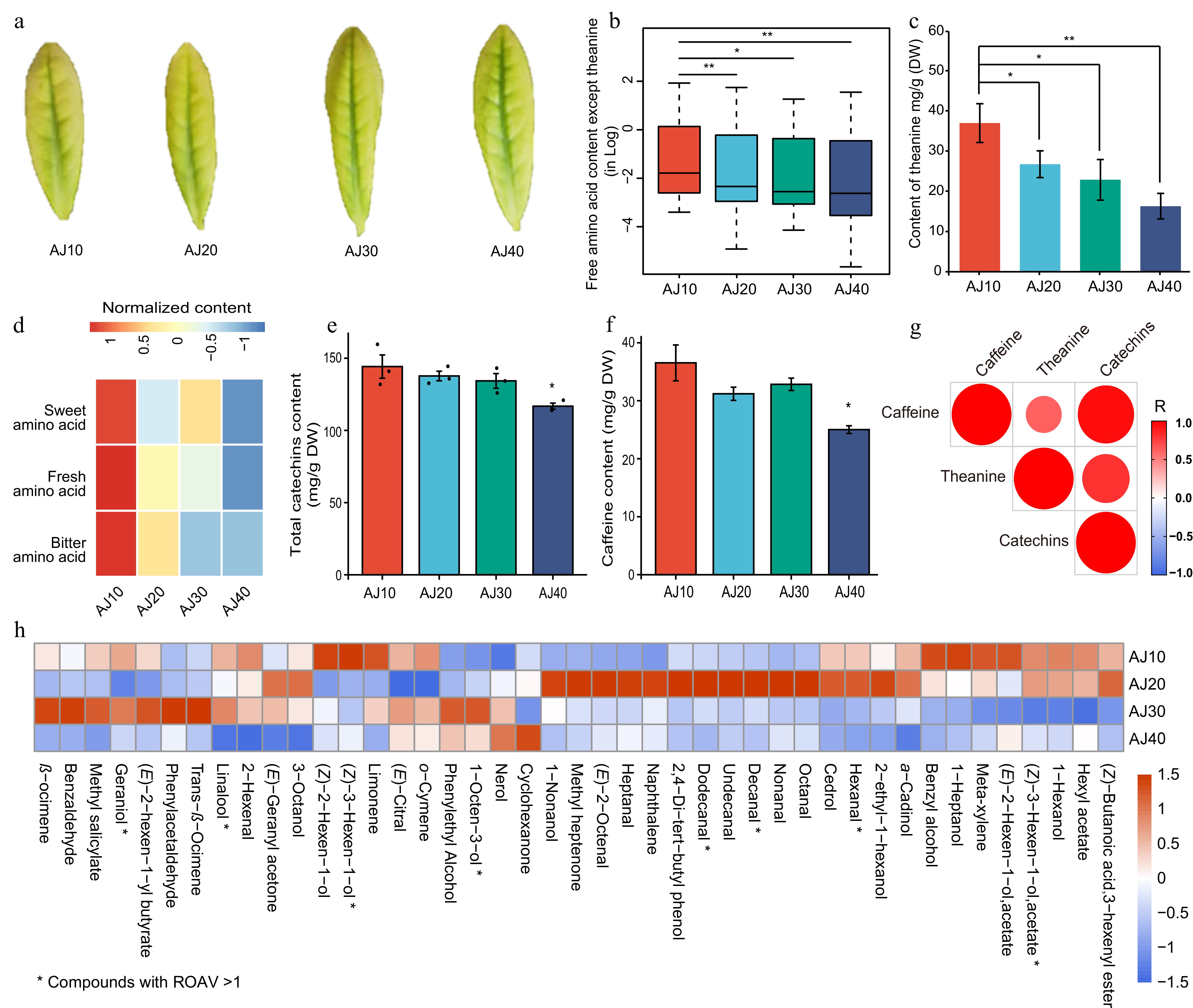
Figure 1.
The content change of tea-quality-related metabolites under long-term clonal propagation. (a) Phenotype of tender leaves of 'Baiye1' at different stages of 10 (AJ10), 20 (AJ20), 30 (AJ30), and 40 (AJ40) years. (b) The content of free amino acids in 'Baiye 1' at different cultivation ages. (c) The accumulation profile of theanine in 'Baiye 1' at different cultivation ages. (d) The accumulation profile of different types of amino acids in 'Baiye 1'. The contents of (e) total catechins, and (f) caffeine in 'Baiye 1'. (g) Correlations of catechins, theanine, and caffeine at different cultivation ages. (h) The pattern of aromatic compounds in 'Baiye 1' at different cultivation ages. AJ10–AJ40 indicated the cultivation age from 10 to 40 years. * p value < 0.05, ** p value < 0.01.
Total catechins content of tea plants decreased as growing years increased, especially in the AJ40 samples, of which a significant difference was observed (Fig. 1e). Among the catechins, EGCG, ECG, and GCG showed similar decreasing patterns (Supplementary Fig. S3; Supplementary Table S3). The general decreasing trend with increasing cultivation years in tea plant samples from AJ10 to AJ40 was also observed for caffeine content, which was as low as ~24 mg/g in AJ40 samples, but not significantly decreased in AJ20 and AJ30 (Fig. 1f). We further identified the correlation of the above-mentioned metabolites along with the increase in cultivation age and found that the content change in catechins were highly correlated with caffeine, while weakly correlated with theanine (Fig. 1g; Supplementary Fig. S4).
We also investigated the volatile compound changes in 'Baiye 1' with different cultivation ages. There are 41, 42, 40, and 39 aroma compounds that were detected in AJ10, AJ20, AJ30, and AJ40, respectively (Supplementary Table S4). The compounds whose ROAV > 1 were considered to contribute to the overall aroma characteristics, and the higher the value, the greater the contribution to the overall aroma characteristics. We observed that these compounds show different accumulation patterns among the AJ10–AJ40 samples, in which eight compounds held ROAV > 1, including linalool (citrus-like, lily-like, magnolia-like), 1-octen-3-ol (mushroom-like), (Z)-3-hexen-1-ol, acetate (banana-like), decanal (sweet, candle-like), geraniol (sweet, rose-like, fruit-like), dodecanal (a strong smell of fat), (Z)-3-hexen-1-ol (grassy), and hexanal (green apple-like, grassy) (Fig. 1h).
Transcriptome patterns of albino tea 'Baiye 1' with different cultivation age
-
A total of 508.8 million clean reads in the leaf transcriptomes of 'Baiye 1' with 10, 20, 30, and 40 cultivation ages were generated, with an average of 6.36 Gb per sample, and Q30 more than 94% (Supplementary Table S1b). By mapping the clean data to the reference genome of the tea plant, we observed a high mapping rate (~82%) in all samples, indicating the high quality of the sequencing data (Supplementary Table S1b). We further estimated the gene expression patterns and identified the differentially expressed genes from 'Baiye 1' with different cultivation ages. In total, we characterized 3,659 unique DEGs among the samples, of which the most DEGs (1,931) were found between AJ30 and AJ40, and the least were between AJ20 and AJ40 (Fig. 2a). Venn analysis showed that 294 genes were shared in comparisons between AJ20 or AJ30 or AJ40, with AJ10, while only 18 genes were shared among all the comparisons (Fig. 2b, c). The shared 294 genes illustrated diverse abundance among the samples of AJ10 to AJ40 (Fig. 2d). We further conducted gene annotation and enrichment analysis; the results demonstrated that those DEGs were enriched in KEGG pathways like alpha−linolenic acid metabolism, cytochrome P450, diterpenoid biosynthesis, flavonoid biosynthesis, galactose metabolism, glucosinolate biosynthesis, metabolism of terpenoids and polyketides, monoterpenoid biosynthesis, phenylpropanoid biosynthesis, signaling proteins, and transcription factors (Fig. 2e). It demonstrated that secondary metabolites, sugar and photosynthesis, as well as the transcription factors, may play vital roles in phenotypes and tea quality related compound change between different cultivation ages of variety 'Baiye 1'.
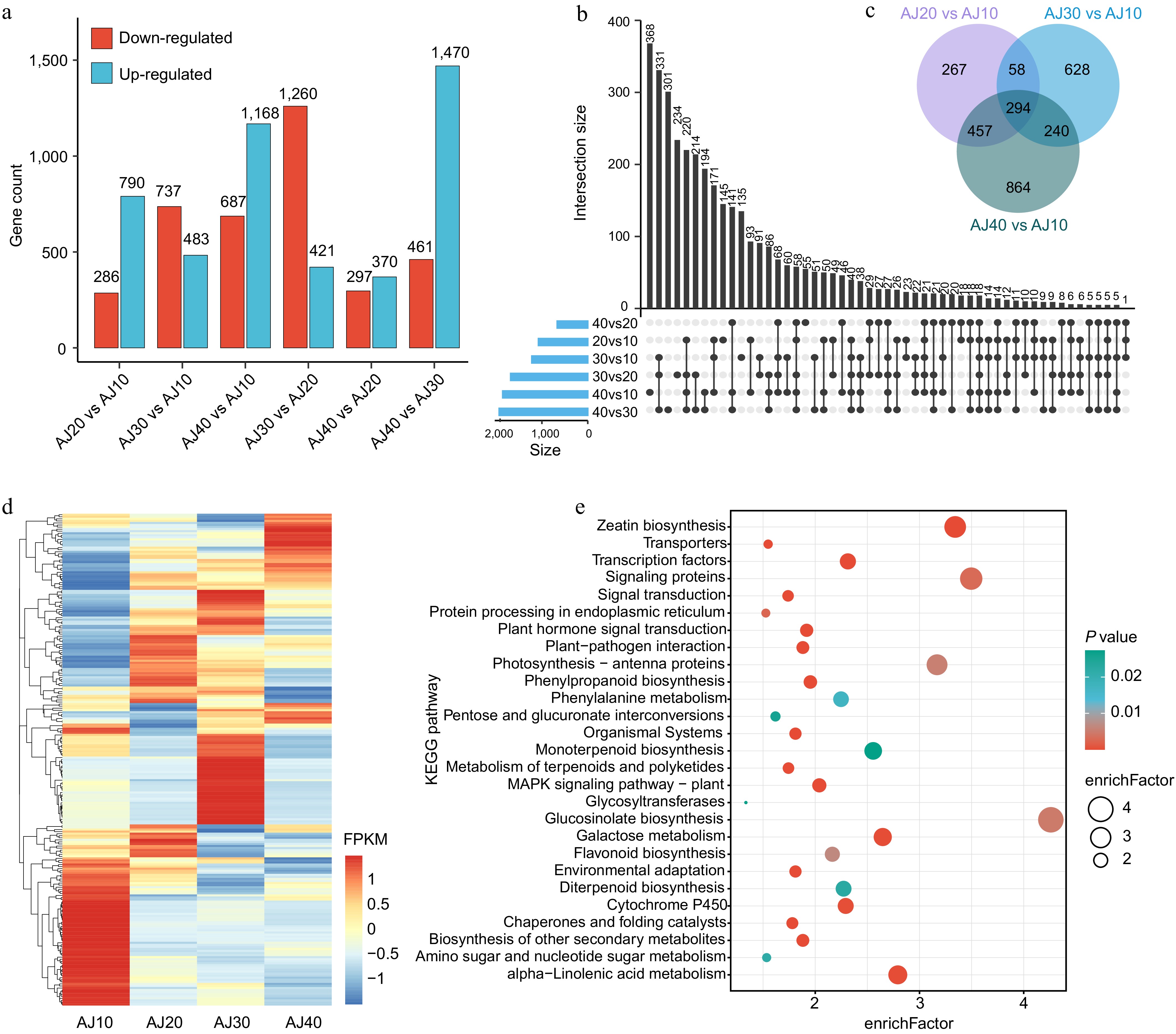
Figure 2.
Transcriptomic change patterns of 'Baiye 1' during different cultivation ages. (a) Differentially expressed gene identification among different cultivating ages from 10 to 40 years. (b), (c) Counts of differentially expressed genes between different comparisons. (d) Expression patterns of the differentially expressed genes in AJ10 to AJ40. (e) Functional gene enrichment of the differentially expressed genes. AJ10 to AJ40 indicate the cultivation age from 10 to 40 years.
Expression variation of tea quality-related key genes in albino tea with different cultivation ages
-
To identify gene responses for content reduction of tea quality-related metabolites, we detected expression patterns of candidate genes in the synthesis pathway of theanine, catechins, and caffeine in AJ10–AJ40. We first characterized the expression of genes related to theanine synthesis and their correlation with theanine content change along with the cultivation age (Fig. 3a). Results demonstrated a general reduced expression of the genes encoding theanine synthetase (TSI), alanine decarboxylase (AlaDC), and glutamate dehydrogenase (GDH), while an increased expression of glutamine synthetase (GS), arginine decarboxylase (ADC), along with increasing cultivation years (Fig. 3a). Correlation analysis between those genes and the related amino acid contents (theanine, Glu, Gln, Ala, and Arg) further indicated that CsADC, CsGS1.1/1.2/1.3 and CsGOGAT2/3 are negatively correlated with most of the above-mentioned amino acids, especially Ala and Arg, while CsAlaDC, CsGOGAT1, CsGDHs, CsGS2, and CsTSI are positively correlated with most amino acids, such as Glu, Gln, and Ala (Fig. 3b).
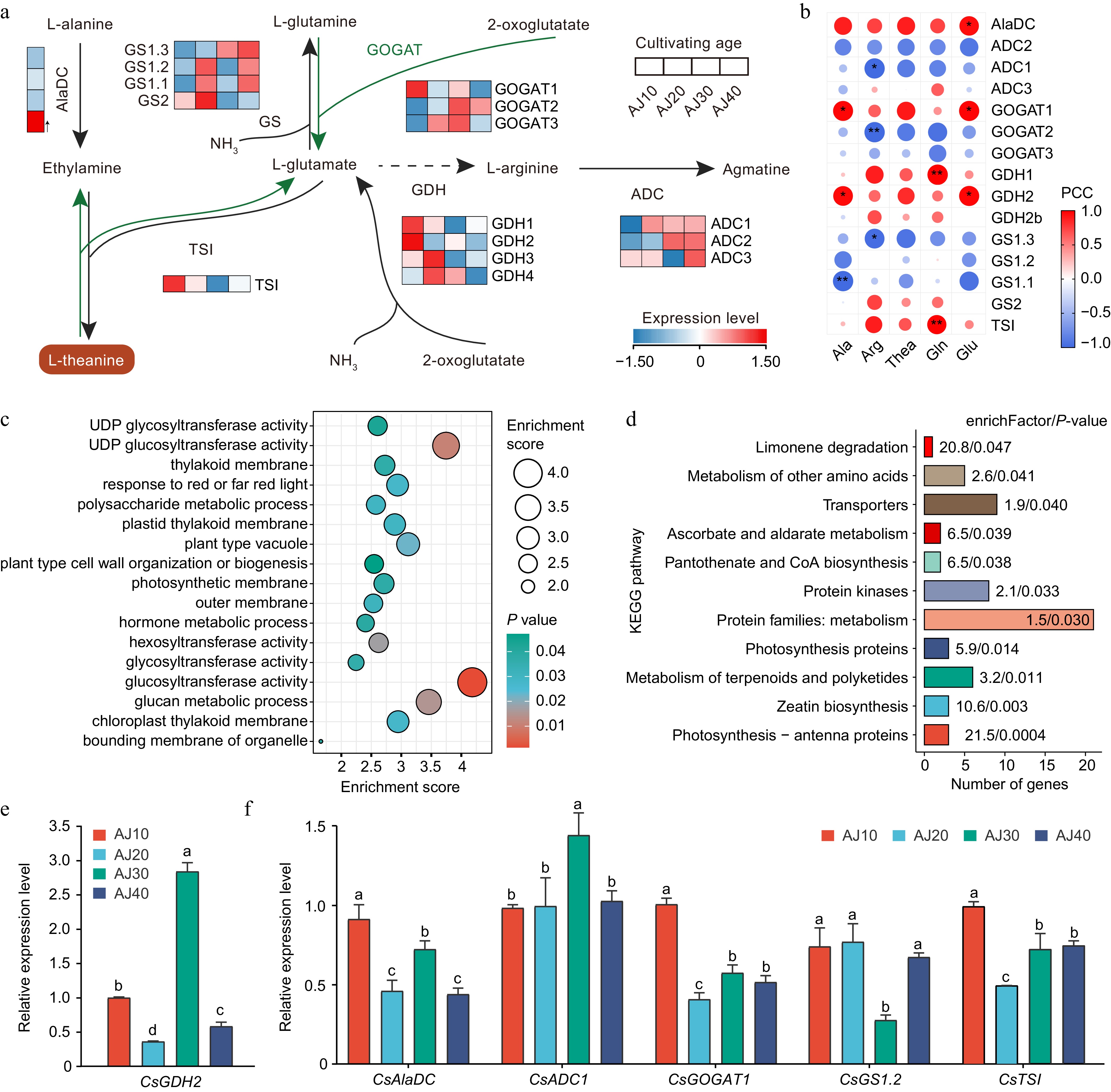
Figure 3.
Expression profile of genes in the theanine metabolism pathway in 'Baiye 1'. (a) The expressions of key genes of theanine synthesis. (b) Correlations analyses of the key genes in theanine pathways and major free amino acids in 'Baiye 1' at different cultivation ages. * p value < 0.05, ** p value < 0.01, *** p value < 0.001. (c), (d) Functional enrichment of the DEGs. (e), (f) Validation of the key gene expressions with qRT-PCR. Different lowercase letters indicate a significant difference.
We found that the theanine content is not significantly correlated with the expression of the above genes (Fig. 3b). We thus conducted correlation analyses between the expression of DEGs identified among AJ10 to AJ40 with the corresponding theanine contents. We identified 208 genes that were significantly correlated with theanine content, with R ≥ |0.95| and p value < 0.05, of which 69 were shared in the comparisons between AJ20/AJ30/AJ40 and AJ10 (Supplementary Table S5). Further functional annotation and enrichment analysis found that these highly associated genes were enriched in GO terms like UDP-glucosyltransferase activity, glucosyltransferase activity, glucan metabolic process, chloroplast thylakoid membrane, response to red or far-red light, polysaccharide metabolic process, photosynthetic membrane, as well as in KEGG pathways like metabolism of terpenoids and polyketides, protein kinases, transporters, and metabolism of other amino acids(Fig. 3c, d). qRT-PCR was adopted to validate the expression of key genes in theanine synthesis, and the results revealed a relatively high expression consistency between the transcriptome data and qRT-PCR (Fig. 3e, f).
We characterized the expression of key genes in the flavanol metabolism pathway and observed complex expression patterns of the catechins pathway-related genes under different cultivation ages (Supplementary Fig. S5). Most of the PAL, LAR, FLS, C4H, and ANS genes were upregulated in the AJ20–AJ40 samples compared to those in AJ10, while some ANR, DFR, F3'5'H, and SCPL1A genes showed downregulated expression (Fig. 4a). Among those genes, we found one 4CL, two ANR, two F3'5'H, one SCPL1A, and two UGT84A genes showing gradually decreased expression during the increase in cultivation age, of which CSS0030176 (F3'5'H) and CSS0043878 (UGT84A) were differentially expressed (Fig. 4b). Correlation analysis between the content of catechins and expression of DEGs among the AJ10–AJ40 samples revealed 1,266 uniquely associated genes, with 46 were shared in comparisons between AJ20/30/40 and AJ10 (Supplementary Table S6). We pay attention to the total catechins content, EGCG, GCG, and ECG, which show a gradual decrease with the increase in cultivation age. Ten, eight, nine, and ten genes correlated with the above-mentioned catechin types were detected, respectively (Fig. 4c). Among them, we found several genes were associated with multiple catechin types, such as CSS0000744, CSS0007720, CSS0013927, CSS0017381, CSS0021588, CSS0033797, and CSS0036379 were correlated with content of ECG, EGCG, and total catechins (Fig. 4d).
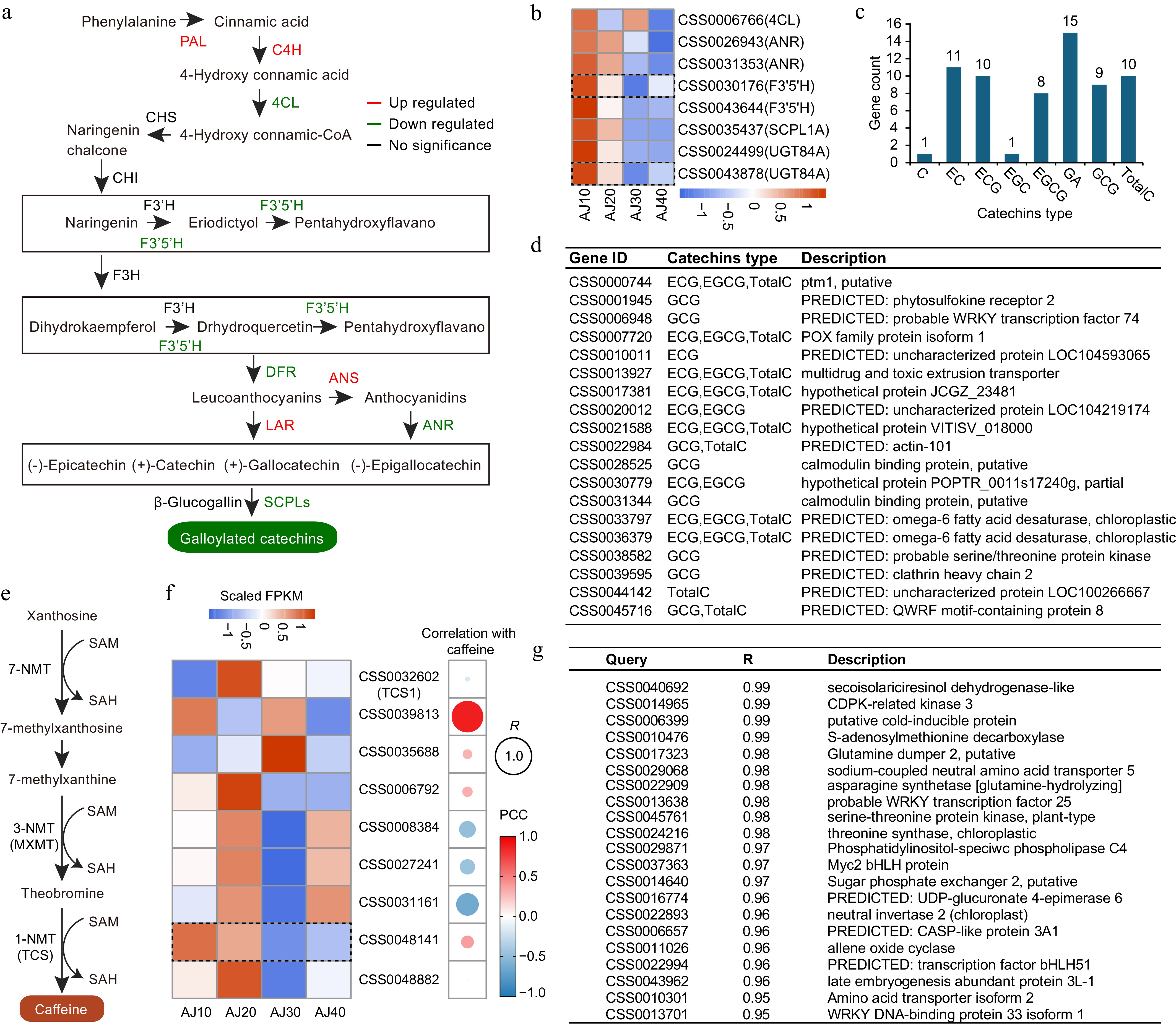
Figure 4.
Identification of candidate genes associated with the decrease of caffeine biosynthesis. (a) The pathway and the expressions of key genes of catechins synthesis. (b) Expression patterns of key genes related to catechins at different cultivation ages. (c), (d) Number of DEGs and candidate genes correlated with different types of catechins. (e), (f) The caffeine synthesis pathway and the correlations between key gene expression and caffeine content in 'Baiye 1' under different cultivation ages. (g) Candidate DEGs associated with the caffeine content change. The significance is indicated by 'a'–'c', where different letters mean significant. AJ10-AJ40 indicates the cultivation age from 10 to 40 years.
We also analyzed the expression of key genes in the caffeine biosynthesis pathway and found that few genes were positively correlated with decreasing caffeine content in AJ40, compared to that in AJ10–AJ30 (Fig. 4e, f). We identified only one gene (CSS0039813) that is positively correlated with caffeine content. However, we detected 347 DEGs that were significantly correlated with decreasing caffeine content in all these samples, of which 59 are positively correlated with the reduction in caffeine content (Supplementary Table S7). Among these 59 genes, we found some genes that may be involved in caffeine synthesis, such as the gene encoding S-adenosylmethionine decarboxylase (CSS0010476) and allene oxide cyclase (CSS0011026) (Fig. 4g). Besides, we also surprisingly found several transcriptional factors, such as WRKY (CSS0013638 and CSS0013701), MYC2 (CSS0037363), and bHLH (CSS0022994), that were also highly correlated with caffeine content, indicating that those genes might be associated with caffeine metabolism in 'Baiye 1' (Fig. 4g; Supplementary Table S7).
Increased chlorophyll and photosynthesis attenuate the albinism phenotype in aged 'Baiye 1'
-
The chlorophyll biosynthesis in chloroplast photosynthesis plays an important role in albino and regreening of the tea plant leaf. We thus detected the pattern change in chlorophyll content in 'Baiye 1' samples at different cultivation ages. We obviously found that the content of chlorophyll a is significantly increased in the aged samples (Fig. 5a), whereas we observed a general decrease in chlorophyll b content with the increase in cultivation age in the AJ30 and AJ40 samples (Fig. 5b). Taken together, the total chlorophyll content increased with an increase in tea cultivation years, especially in AJ40 samples (Fig. 5c). We also checked the expression patterns of genes related to the chlorophyll metabolic, photosynthesis, and photosynthetic antenna protein pathways (Supplementary Table S8). Results show that most of the key genes related to photosynthesis and photosynthetic antenna proteins displayed accumulated expression levels with increasing cultivation age (Fig. 5d; Supplementary Table S8). However, more genes that are involved in the degradation of chlorophyll were downregulated in the older tea plants (AJ20, AJ30, and AJ40) than in the young samples, i.e., AJ10, such as the NYCs, hemH/FECHs, UROS/hemD, and hemAs in the chlorophyll metabolic pathway (Fig. 5d).
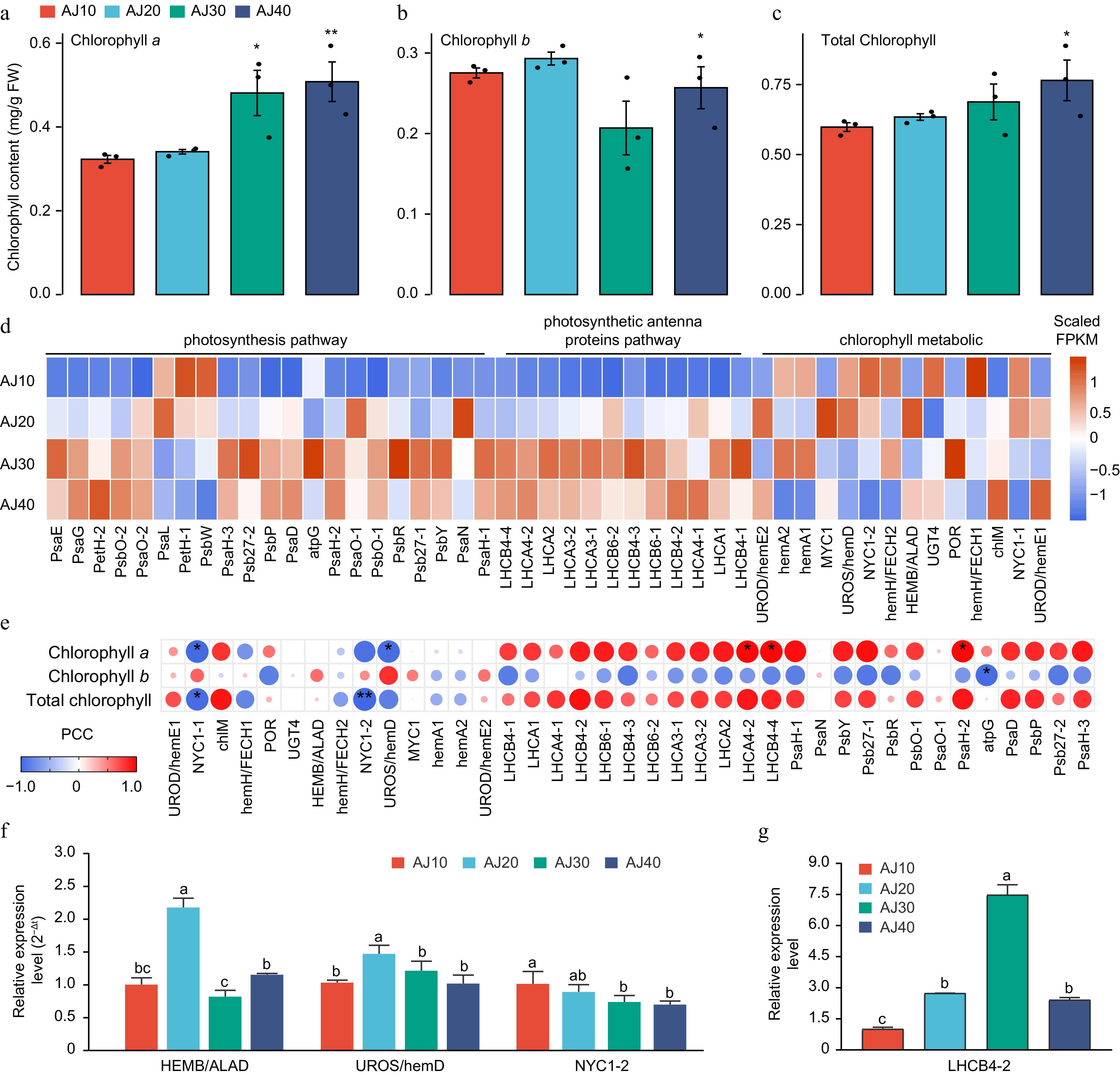
Figure 5.
Chlorophyll and photosynthesis change during the long-term cultivation of 'Baiye 1'. (a) The content change of chlorophyll a of 'Baiye 1' at different cultivation ages. (b) Chlorophyll b change in 'Baiye 1' at different cultivation ages. (c) The content change in total chlorophyll at different cultivating ages. (d) Expression variations of key genes related to chlorophyll. (e) Correlation analysis between the chlorophyll-related genes and chlorophyll content in 'Baiye 1' over different cultivation ages. PCC: Pearson correlation coefficient. * p value < 0.05, ** p value < 0.01, *** p value < 0.001. (f), (g) qRT-PCR validation of the key genes relative to chlorophyll content and the photosynthetic antenna protein pathway. Significance is indicated by 'a'–'c', where different letters mean significant. AJ10–AJ40 indicated the cultivation age from 10 to 40 years.
Pearson correlation analysis between the expression of the above-mentioned genes, the DEGs among those samples, and the chlorophyll content in different samples was performed. We observed that two NYCs and one UROS/hemE are both significantly negatively correlated with chlorophyll a and total chlorophyll content, while one LHCA4, one LHCB4, and one PsaH are positively correlated with chlorophyll a content (Fig. 5e). Forty-eight genes, significantly correlated with chlorophyll contents, were identified in the 294 shared DEGs, in which 6, 33, and 9 are correlated with chlorophyll a, chlorophyll b, and total chlorophyll content, respectively (Supplementary Table S9). We also validated the expression of several candidate genes, including the key gene in the chlorophyll degradation pathway—NYC1—using qRT-PCR and revealed a high expression consistency with the transcriptome data (Fig. 5f, g).
Overexpression of CsNYC1 and CsNOL in Arabidopsis
-
To investigate the roles of CsNYC1 and CsNOL in regulating leaf color and chlorophyll levels, we overexpressed the full-length sequences of both genes in Col-0 and compared leaf color phenotypes between transgenic lines overexpressing CsNYC1 (CsNYC1-OE) or CsNOL (CsNOL-OE), and Col-0. After 3 d of dark treatment, discernible leaf yellowing was observed in CsNYC1-OE and CsNOL-OE lines compared to Col-0 (Fig. 6a, b). Chlorophyll quantification showed that its level was 0.59–0.66 mg/g in Col-0, while the levels of chlorophyll a, chlorophyll b, and total chlorophyll were reduced by 29.34%–22.99%, 54.66%–36.81%, and 40.66%–28.63% in CsNYC1 and CsNOL transgenic Arabidopsis, respectively (Fig. 6c).
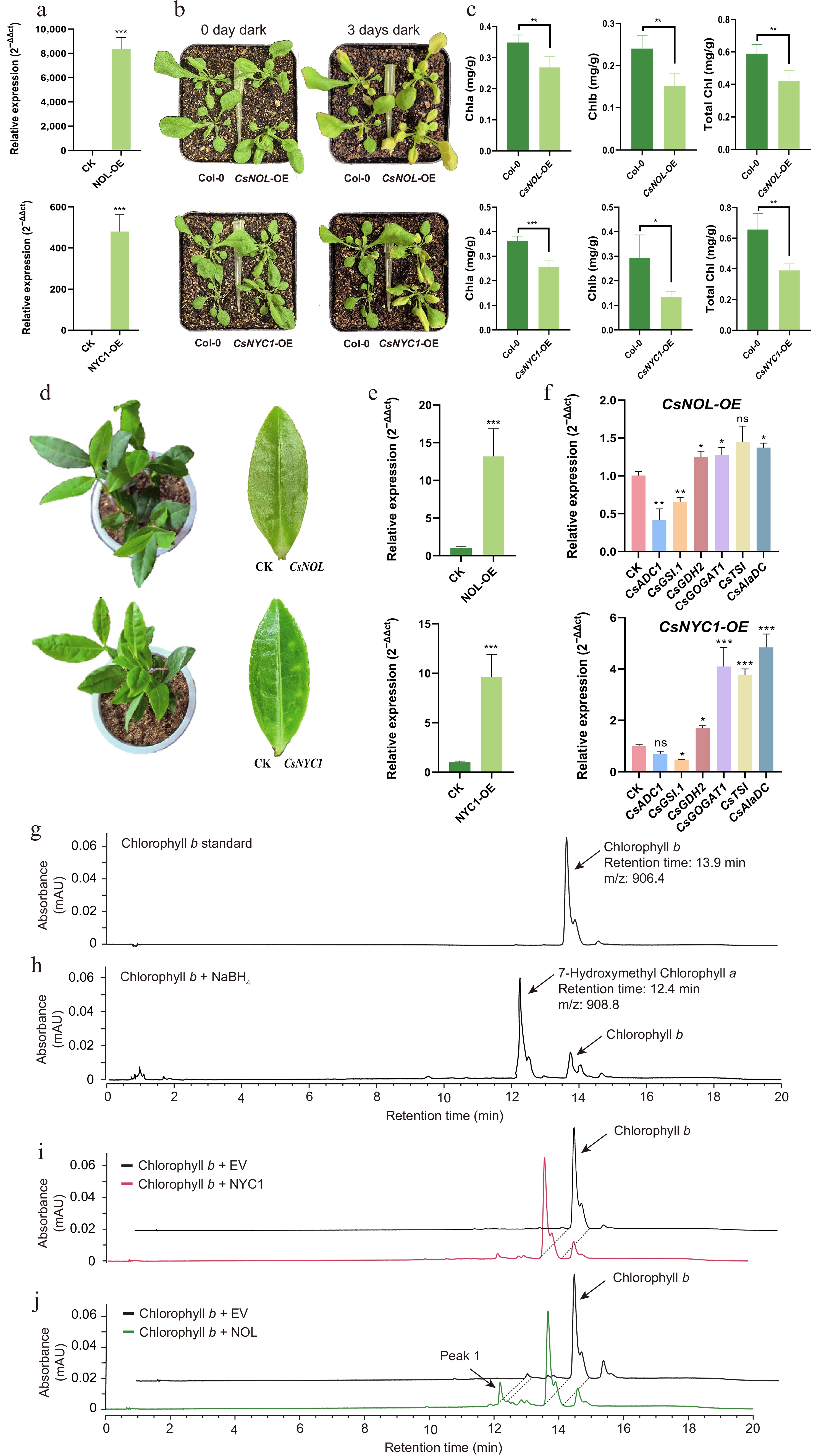
Figure 6.
Functional analyses of CsNOL and CsNYC1 in vivo and in vitro. (a) Gene expression levels and phenotype analyses in transgenic Arabidopsis of CsNOL and CsNYC1. (b) Phenotype of transgenic Arabidopsis. (c) Chlorophyll content. (d) Transient overexpression of tea plants. (e) Expression level of CsNOL and CsNYC1 in overexpressing tea leaves. (f) Genes related to amino acid content expression levels of tea plants with transient overexpression. (g) Chlorophyll b standards. (h) 7-hydroxymethyl chlorophyll a prepared from chlorophyll b using NaBH4. (i), (j) Pigments extracted from the reaction mixture incubated with chlorophyll b harboring empty or recombinant CsNOL proteins were subjected to UPLC. Peak 1 newly appeared in the incubation of chlorophyll b and CsNOL. The absorbance at 441 nm is shown. * p value < 0.05, ** p value < 0.01, *** p value < 0.001.
Transient overexpression of CsNYC1 and CsNOL in tea plants
-
In order to investigate the roles of CsNYC1 and CsNOL in regulating the chlorophyll levels in tea plant leaves and their effects on tea quality, we transiently overexpressed the full-length sequences of the genes in 'Baiye 1' (Fig. 6d). The results indicated that the relative expression levels of CsNYC1 and CsNOL in 'Baiye 1' leaves were significantly higher than those in the control following transient overexpression (Fig. 6e). Expression analysis of key tea quality-related genes across different cultivation years in the 'Baiye 1' cultivar revealed that their overexpression induced distinct alterations: downregulation of amino acid content-negatively correlated genes (CsADC1, CsGS1.1) and upregulation of positively correlated genes (CsAlaDC, CsGOGAT1, CsGDH2, and CsTSI) (Fig. 6f). This shift in transcription levels is predicted to influence amino acid accumulation and overall tea quality.
CsNOL but not CsNYC1 shows chlorophyll b reductase activity in vitro
-
As mentioned above, the increased chlorophyll levels that mitigate the albinism phenotype in aged 'Baiye 1' were associated with CsNYC1, a key gene in the chlorophyll degradation pathway. We thus verified the function of CsNYC1 by characterizing its enzyme activity. The initial step of chlorophyll b degradation involves the reduction of chlorophyll b to 7-hydroxymethyl chlorophyll a, catalyzed by chlorophyll b reductase (Fig. 6g, h). We detected the chlorophyll b reductase activity of the recombinant CsNYC1 protein expressed in Escherichia coli. However, we were unable to detect the activity from the recombinant CsNYC1 protein (Fig. 6i). CsNOL and CsNYC1 both belong to the short-chain dehydrogenase/reductase (SDR) family, which function as isozymes in chlorophyll degradation by serving as chlorophyll b reductases. Through UPLC and LC-MS analysis, we confirmed the presence of chlorophyll b reductase activity of CsNOL when incubated with chlorophyll b, as evidenced by the new peak corresponding to 7-hydroxymethyl chlorophyll a (Fig. 6j).
-
Albino tea plant cultivars with white or yellow leaf color have attracted increasing attention due to their unique phenotypes, great flavor, and good economic value. The leaf color of these cultivars is usually affected by light or temperature[22]. Interestingly, albino tea cultivars generally have a higher content of amino acids, especially theanine, which contributes to the umami taste of tea[23]. Previous reports revealed that the free amino acid content of 'Huangjingui' (at 1, 6, 9, and 15 years of age), and 'Zijuan' (at 3, 5, 6, and 12 years of age) was decreased following the increase in tea plant age[24]. Besides, the total catechins content of albino tea plants was found to be lower in 'Baiye 1' than in 'Huangjinya'[25]. Compared with conventional tea varieties, albino tea contains high amounts of theanine, but the total catechins content of albino tea markedly decreases during the albino stage[26]. In the current report, we investigated the contents of tea quality-related secondary metabolites in a representative albino tea plant cultivar 'Baiye 1' over different cultivation ages. We demonstrated that the content of the three major characteristic tea quality-related secondary metabolites, i.e., theanine, catechins, and caffeine, showed a general decreasing pattern in samples with longer cultivation ages. These results indicated that the long-term cultivation might have triggered the reduction of major tea quality-related metabolites in 'Baiye 1', and thus caused the degradation of the variety. It has been reported that the tea quality of 'Tieguanyin' has declined with an increase in planting years. However, they also found that the reduction in tea quality did not significantly change after propagating the tea plant into new soils; thus, they predicted that the reason for the reduction in tea quality could be attributed to the planting soil. We also roughly investigated the soil pH of 'Baiye 1' in AJ10 to AJ40, showing that the relative pH of the rhizosphere soil also decreased with an increase in cultivation age (Supplementary Fig. S6). As shown in a previous report, a pH between 4.5 and 5.5 in China was thought to be the best pH, optimal for tea plant growth[27]. Previous studies have also shown that soil pH decreases gradually with increasing ages of tea plant cultivation, leading to changes in the rhizosphere soil microbial structure and a decreasing trend in tea plant yield and quality[27]. Here, the pH of soil in the AJ30 and AJ40 samples decreased significantly to ~3.5; it is possible that the pH may not be suitable for tea plant growth by affecting the accumulation of tea quality-related secondary metabolites.
Variation of gene expressions involved in the quality reduction of 'Baiye 1'
-
As mentioned above, we observed a clear tea quality reduction of 'Baiye 1' with an increase in cultivation age. To present the transcriptomic changes in the reduction pattern, we characterized the detailed expression patterns of genes related to the pathways of theanine, catechins, and caffeine. We found that quite a lot of key genes in the pathways were diversely expressed. For example, we identified reduced expression of the genes CsTSI, CsAlaDC, and CsGDHs, and increased expression of CsGSs and CsADCs with the increase in cultivation years in the theanine synthesis pathway. We also found and characterized the differentially expressed genes that were highly correlated with the reduction of theanine from AJ10 to AJ40. Previous studies have revealed that the transcript levels of CsTS2 and CsGDH2 showed a positive correlation with theanine content[28]. Especially, CsTSI was found to be one of the most important gene encodings theanine synthetase; thus, its decreased expression in tea plants with longer cultivating time may be involved in the reduction in theanine content[29].
We also found that downregulation of the genes encoding 4CL, F3'5'H, DFR, ANR, and SCPLs may lead to a decrease in total catechins and EGCG content with increasing cultivation age. However, we also observed that PAL, C4H, ANS, and LAR showed increased expression, indicating the complex regulation of catechins in 'Baiye 1'. We identified DEGs among the samples with different cultivation ages and found several candidate genes that showed high correlation with the content of catechins and caffeine in 'Baiye 1'. We found several transcriptional factors, such as WRKY (CSS0013638 and CSS0013701), MYC2 (CSS0037363), and bHLH (CSS0022994), that were also highly correlated with the content of caffeine, indicating that those genes might be associated with caffeine metabolism in 'Baiye 1'. It was reported previously that MYB184 could activate CsTCS1 and positively regulate caffeine biosynthesis in tea plants[30]. It can be predicted that those transcriptional factors might work together and then regulate the biosynthesis of caffeine content in 'Baiye 1'.
Chlorophyll content increased during the clonal propagation
-
Chlorophyll is one of the most important compounds in tea leaves, which are involved in determining the tea quality[31]. Chlorophyll is synthesized within the chloroplast from a predominant precursor, the amino acid glutamate, leading to the 'chlorophyll cycle' that refers to the interconversion between chlorophyll a and chlorophyll b[32]. We herein observed an overall increase in chlorophyll a and total chlorophyll content in the aged 'Baiye 1'. It has been previously demonstrated that the chlorophyll content of tea plant leaves in the albino tea cultivars 'Baijiguan' and 'Huangjinju' increased under shading. Shao et al. showed that the level of chlorophyll increased in the leaves of 'Xiangfeicui' and 'Jinxuan' in a field trial[33]. Proteomic analysis of 'Baiye 1' revealed that quite a lot of differentially expressed proteins were related to photosynthesis during the albino stage. By studying the variegated tea plant, Lu et al. found that the high expression and enzyme activity of CLH showed active chlorophyll degradation in variegated leaves; the lower expression of Lhcb1, Lhcb3, and POR in chlorophyll synthesis might be related to the low chlorophyll in variegated leaves[34]. In our study, we found that key genes related to photosynthesis and the photosynthetic antenna proteins pathway displayed accumulated expression levels or positive correlation with chlorophyll a and total chlorophyll content. More genes involved in the degradation of chlorophyll were downregulated or negatively correlated with chlorophyll a and total chlorophyll content, along with the increasing cultivation age (such as the NYCs, hemH/FECHs, UROS/hemD, and hemAs). Wu et al. identified that overexpression of CsNYC1a in Arabidopsis recapitulated the albino phenotype[16]. Similarly, in this study, we demonstrate that overexpression of CsNYC1 and CsNOL in Arabidopsis recapitulated a similar albino phenotype (Fig. 6b). Previous research has indicated that NOL and NYC1 are co-localized within the thylakoid membrane and function as a complex, serving as a chlorophyll b reductase in rice[35]. Kusaba et al. have demonstrated that NYC1 lacks chlorophyll b reductase activity in vitro, while NOL, the SDR most closely related to NYC1, exhibits chlorophyll b reductase activity[36]. Our findings are consistent with this result (Fig. 6j). However, the potential link between chlorophyll degradation and nitrogenous compound accumulation in tea plants remains a knowledge gap. Here, we provide evidence that transient overexpression of CsNOL and CsNYC1 directly influences the transcript levels of genes central to amino acid metabolism. In 'Baiye 1' plants, this manipulation resulted in the downregulation of amino acid-repressing genes (CsADC1, CsGS1.1) and the upregulation of biosynthesis-promoting genes (CsAlaDC, CsGOGAT1, CsGDH2, CsTSI) (Fig. 7). This suggests that chlorophyll catabolism may regulate amino acid biosynthesis by modulating precursor availability or signaling pathways, consequently affecting amino acid accumulation and, ultimately, the overall quality of tea.
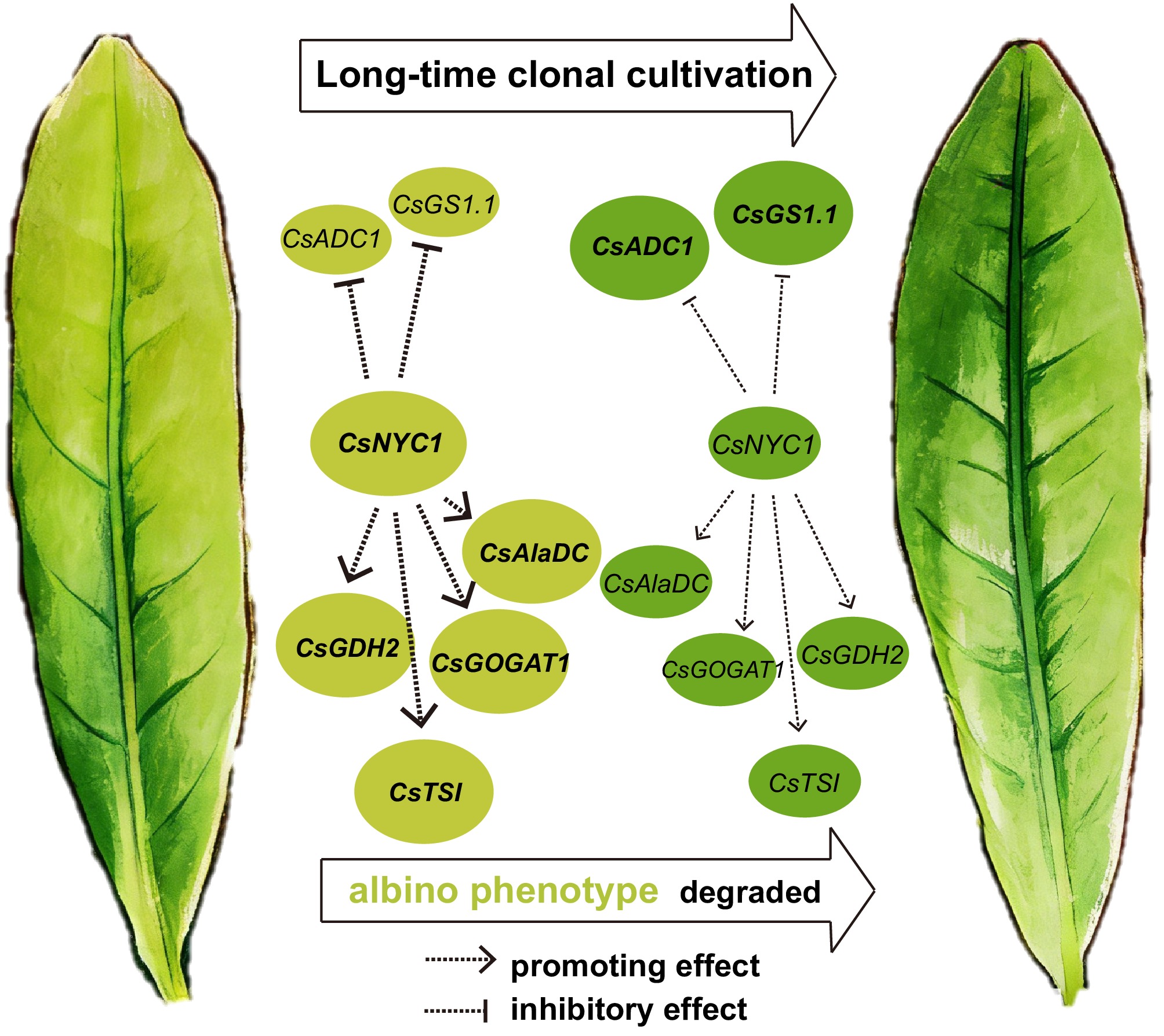
Figure 7.
Proposed regulatory network of chlorophyll degradation and amino acid metabolism-related genes in albino tea plants under long-term clonal propagation.
-
At present, there are few reports on the effect of increasing cultivation years on the changes in quality components of tea plants, especially in albino tea plants. In this study, we revealed that the content of tea quality-related metabolites, including free amino acids, tea polyphenols, and caffeine decreased in albino tea plant 'Baiye 1' after long-term clonal cultivation, while total chlorophyll increased during the cultivation. This suggested that long-term cultivation attenuates the albinism of 'Baiye 1'. We then characterized that the genes CsTSI, CsAlaDC, and NOL/NYC may play vital roles in regulating the decrease of quality components and increase in chlorophyll content in 'Baiye 1'. Overexpression of CsNYC1 and CsNOL in Arabidopsis results in albino phenotypes, confirming their conserved role in chlorophyll metabolism. In vitro assays demonstrate that CsNOL, but not CsNYC1, exhibits chlorophyll b reductase activity. Then we found that the transient overexpression of CsNYC1 and CsNOL would affect the expression levels of genes related to tea quality, thereby potentially influencing amino acid accumulation. We additionally observed that the inter-root soil pH of 'Baiye 1' was significantly reduced after being clonally cultivated for more than 30 years, which may also affect the accumulation of secondary metabolites. These findings will be helpful to present and explain the pattern of quality with cultivation years of albino tea and other tea species, and provide a theoretical basis for the cultivation management of albino tea.
-
The authors confirm their contributions to the paper as follows: preparation of the material for sampling and data analysis: Yu L, Xu P, and Li Y; aroma components analysis: Zhang J; manuscript drafting: Xu P and Deng WW, manuscript revision: Tong W and Deng WW; assist in collecting sample: Zhang X; research guidance: Wan X, Deng WW, and Tong W. All authors reviewed the results and approved the final version of the manuscript.
-
The raw sequencing reads of transcriptomes in this study have been deposited into the National Center for Biotechnology Information (www.ncbi.nlm.nih.gov) bioproject database under accession number of PRJNA1045874. The other data are available in the article and in its online supplementary material or on reasonable request to the corresponding author.
-
The authors declare that they have no competing interests.
-
accompanies this paper online at: https://doi.org/10.48130/bpr-0026-0024.
-
# Authors contributed equally: Luyao Yu, Pengfei Xu
- Supplementary Table S1 (a) Specific qRT-PCR primers used in current report. (b) Summary of the transcriptome sequencing.
- Supplementary Table S2 Content of different types of amino acids in AJ10−AJ40.
- Supplementary Table S3 Content of different types of catechins in AJ10−AJ40.
- Supplementary Table S4 Content of volatile compounds in AJ10−AJ40.
- Supplementary Table S5 Correlation between DEG gene expression and theanine content in AJ10−AJ40.
- Supplementary Table S6 Correlation between DEG gene expression and catechins content in AJ10−AJ40.
- Supplementary Table S7 Correlation between DEG gene expression and caffeine content in AJ10−AJ40.
- Supplementary Table S8 Correlation between key gene in chlorophyll and photosynthesis pathway and chlorophyll content in AJ10−AJ40.
- Supplementary Table S9 Correlation between expression of DEGs and chlorophyll content in AJ10−AJ40.
- Supplementary Fig. S1 Phenotypes of the 'Baiye 1' in current report.
- Supplementary Fig. S2 Free amino acids content measurement of the samples.
- Supplementary Fig. S3 The catechins content in 'Baiye 1' plants grown for 10 (AJ10), 20 (AJ20), 30 (AJ30) and 40 (AJ40) years.
- Supplementary Fig. S4 The correlation coefficient between the changes of secondary metabolites related to tea quality.
- Supplementary Fig. S5 Expression patterns of genes related to catechins in samples AJ10, AJ20, AJ30 and AJ40.
- Supplementary Fig. S6 Estimation of pH of the rhizosphere soil in AJ10, AJ20, AJ30 and AJ40.
- Copyright: © 2026 by the author(s). Published by Maximum Academic Press, Fayetteville, GA. This article is an open access article distributed under Creative Commons Attribution License (CC BY 4.0), visit https://creativecommons.org/licenses/by/4.0/.
-
About this article
Cite this article
Yu L, Xu P, Li Y, Zhang J, Zhang X, et al. 2026. Long-time clonal cultivation divergently alters the content of tea quality related components and chlorophyll in albino tea plant. Beverage Plant Research 6: e042 doi: 10.48130/bpr-0026-0024 

Long-time clonal cultivation divergently alters the content of tea quality related components and chlorophyll in albino tea plant
- Received: 31 March 2026
- Revised: 13 May 2026
- Accepted: 26 May 2026
- Published online: 12 November 2026
Abstract: 'Baiye 1' is a precious temperature-sensitive albino tea cultivar widely used to produce Anji Baicha, one of the most famous green teas in China. However, little is known about how the tea quality changes with the long-term clonal cultivation age. We elucidated the variation patterns of the tea quality components of 'Baiye 1' and identified key genes contributing to quality variation over extended cultivation. Our results showed that the contents of theanine, catechins, caffeine, and volatile compounds gradually decreased with increasing cultivation duration (10, 20, 30, and 40 years after clonal propagation), whereas chlorophyll content increased over time. Expression analysis revealed that the reduced transcript expression of CsTSI, CsAlaDC, and CsNYCs was associated with these changes. We identified that overexpression of the chlorophyll b reductase genes CsNYC1 and CsNOL in Arabidopsis induced the albino phenotype. Transient overexpression of CsNYC1 and CsNOL in tea plants affected tea quality-related genes. Furthermore, we demonstrated that CsNOL, but not CsNYC1, possesses chlorophyll b reductase activity in vitro. Collectively, our findings indicate that 40 years of cultivation significantly reduce key tea quality metabolites and attenuate albinism in 'Baiye 1'. These results provide a theoretical basis for the cultivation, management, and breeding of albino tea varieties.
-
Key words:
- Camellia sinensis;
- Albinism;
- Tea quality;
- Varietal degradation