












-
The sustainability of intensive vegetable production is increasingly challenged by the environmental and economic costs associated with the excessive reliance on synthetic fertilizers. The global dependency on synthetic fertilizers has significantly revolutionized both horticultural and agronomical production. However, excessive use of synthetic fertilizers to support rapid agricultural expansion has become a major global threat to the natural ecosystem, and its prominent impacts on climate change are associated with the emission of greenhouse gases (GHG), soil acidification, ammonium volatilization, soil degradation, groundwater contamination, and eutrophication of coastal areas[1–3]. These concerns are compounded by rising fertilizer prices and market volatility, which threaten farm profitability and food affordability in many developing regions[4,5]. As a result, there is growing interest in strategies that enhance crop performance through physiological regulation rather than direct nutrient supply. The relevance of such approaches is especially pronounced in bell pepper (Capsicum annuum L.), a globally important vegetable crop valued for its nutritional quality, functional compounds, and economic return. Bell pepper fruits are rich in vitamins, antioxidants, and bioactive compounds such as capsinoids, which contribute to consumer demand and dietary benefits[6,7]. However, bell pepper productivity and fruit quality are increasingly constrained by rising input costs, declining soil fertility, and disease pressure[8]. Moreover, the crop's short postharvest shelf life and susceptibility to chilling injury limit long-distance transport, emphasizing the need for efficient and resilient local production systems closely linked to management practices[9]. Consequently, in fruiting vegetables such as bell pepper yield responses to increasing fertilizer rates often decline due to excessive vegetative growth, delayed flowering, and deterioration of fruit quality[10]. These effects are particularly evident under tropical conditions, where high rainfall and temperature accelerate nutrient losses and intensify imbalances between vegetative and reproductive growth. Hence, strategies that stabilize plant growth and reproductive development under variable fertilizer supply are increasingly needed. Within this context, it is crucial to explore other means that are holistic, efficient, and eco-friendly.
Wood vinegar (WV) is a biostimulant capable of modulating physiological processes and contains a complex mixture of organic acids, phenolic compounds, aldehydes, esters, and alcohols that influence plant metabolism and development[11,12]. At low concentrations, WV has been reported to stimulate root activity, enhance antioxidant defense systems, and regulate hormone-mediated pathways associated with auxin and ethylene signaling[13,14]. Moreover, the agricultural value of WV has received increasing attention for its multifunctional role in crop production. WV has been applied for soil conditioning, the regulation of plant growth in vegetables and fruit trees, and improvement of fruit quality attributes, while also contributing to crop protection through partial substitution of synthetic pesticides. As a biodegradable, plant-derived product, WV contains organic acids and phenolic compounds that exhibit insecticidal and antimicrobial activity, supporting its potential use in environmentally sustainable agricultural practices[15]. Through these mechanisms, WV may influence vegetative growth rate, flowering dynamics, and assimilate allocation between vegetative and reproductive organs. Previous studies have shown that such responses can translate into improved growth and yield in crops such as tomato and rice[16,17], while antimicrobial effects against pathogens such as Colletotrichum and Fusarium spp. have also been documented in bell pepper and tomato[18,19]. However, plant responses to WV remain inconsistent, as efficacy depends strongly on application rate, feedstock origin, pyrolysis conditions, and background nutrient supply[20].
Evidence consistently indicates that WV acts as a biostimulant at low concentrations, typically below 1% (v/v), whereas higher doses may induce phytotoxic effects[21,22]. For this reason, WV is increasingly regarded as a complementary input that should be integrated with mineral fertilization rather than used as a substitute. Despite increasing interest in WV as a biostimulant, most published studies have examined its effects under a single fertilizer regime and have focused primarily on overall yield responses. As a result, the specific roles of WV and mineral fertilization in regulating distinct components of yield formation remain poorly resolved. In particular, it is unclear whether WV primarily influences fruit initiation, fruit filling, or both, and how these responses change under reduced or elevated nutrient supply. Addressing this gap requires a trait-based evaluation that distinguishes fruit number from fruit size and morphology, rather than relying on yield alone. Therefore, this study examined the effects of WV and mineral fertilizer supply (50% below, and 50% above the recommended rate) on growth, flowering, yield components, and fruit morphology of bell pepper. We hypothesized that WV modifies plant growth rate and flowering time in a fertilizer-dependent manner, thereby influencing fruit number and the proportion of marketable yield, and that these effects extend to fruit size and shape attributes associated with assimilate allocation during fruit development.
-
The study was conducted in Sta. Cruz, Magalang, Pampanga, Philippines (15°12′22.8″ N, 120°39′49.3″ E). The site is classified with Climate Type I, characterized by a pronounced dry season (November–April) and a wet season (May–October)[23]. The pot experiment was conducted from January to April, corresponding to the dry season. During this period, the average monthly temperature was 26.9 °C and the relative humidity 68.5 %, based on recorded data (Fig. 1). Before the experiment, soil samples were collected from 0–20 cm depth using a zigzag pattern across the site. Ten subsamples were combined, air-dried, ground, and sieved (2 mm) to remove debris and clods. The composite sample was analyzed for baseline physical and chemical properties: pH (1:1 soil-to-water), organic matter (Walkley-Black method), Phosphorus (Olsen extraction), potassium (ammonium acetate extraction), texture (Bouyoucos hydrometer), and nitrogen (Kjeldahl digestion). The soil was sandy loam with pH 7.37, organic matter 1.88%, available P 39.38 ppm, exchangeable K 0.36 cmol kg−1, and total N 0.09%.
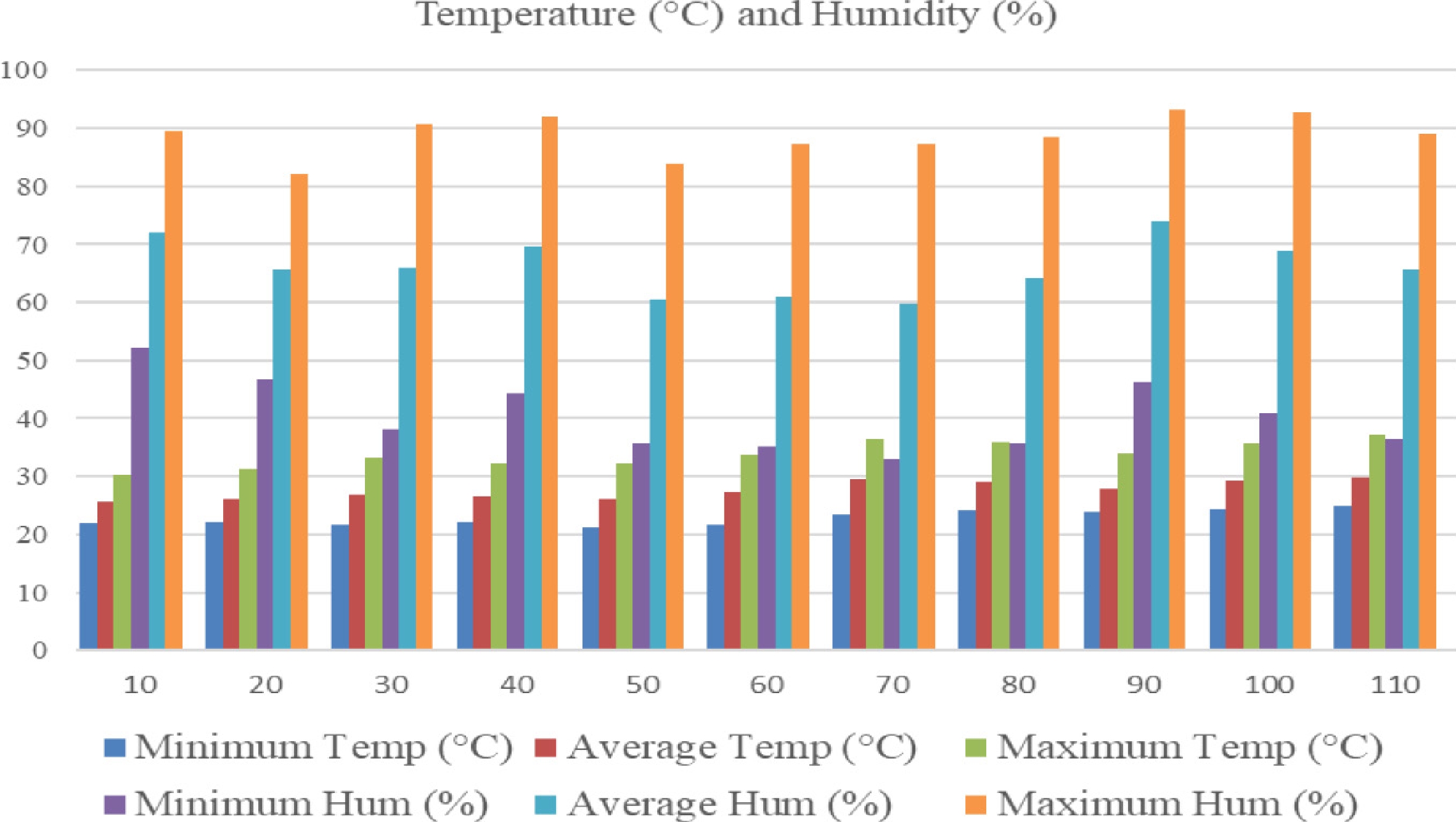
Figure 1.
Meteorological data (temperature and humidity) during the study.
Experimental plant, design, and treatment
-
The experimental crop was bell pepper (Capsicum annuum L.) hybrid 'Sultan F1', valued for its firm, thick-walled, conical fruits. This hybrid reaches physiological maturity 55–60 d after transplanting (DAT) and can yield 20–30 t ha−1 under optimal field conditions[24]. A Completely Randomized Design (CRD) was used, with five treatments, each represented by 30 biological plants per treatment, for a total of 150 pots. Although the experiment was conducted outdoors, environmental variability among experimental units was minimized by implementing the study as a pot-based system using a single homogenized soil, uniform pot size and spacing, and synchronized irrigation and nutrient application schedules. All pots were placed within one open experimental area to ensure comparable exposure to light, temperature, and ambient conditions. Under these relatively uniform conditions, a CRD was employed, as no systematic spatial gradients requiring blocking were present. The treatment groups were as follows: 1) Control group - no inputs; 2) WV alone group, where WV was applied; 3) synthetic fertilizer (SF) alone group, where only synthetic fertilizer was applied; 4) WV + SF at 50% below the recommended rate; 5) WV + SF at 50% above the recommended rate. All recommended fertilizer rates were based on soil analysis results.
Seedling management and pot preparation
-
Bell pepper seeds were sown individually in 128-cell plastic trays containing peat-moss medium at a depth of 1.0 cm. Trays were irrigated daily until germination and maintained under 50% shade. Seedlings underwent a 7-d hardening period involving reduced watering and gradual exposure to sunlight. After 30 d, uniform seedlings were transplanted into pots during the late afternoon to minimize transplant shock, with careful handling of the root systems. Pots were immediately irrigated to field capacity, and subsequent watering maintained consistent soil moisture while preventing waterlogging and drought stress. Polyethylene bags (25 cm in diameter × 30 cm in height, with perforated bases) were used as pots. Each was filled with 20 kg of air-dried, sieved (2 mm) sandy loam soil for uniformity. The soil was not sterilized to preserve biological conditions; only debris and clods were removed.
Fertilizer and WV application
-
Fertilizers were incorporated into the soil to minimize volatilization and phytotoxicity. Fertilizer rates were based on the recommended nutrient requirement of 90–0–60 kg N–P2O5–K2O for bell pepper and were converted to a per-pot basis. For the 100% recommended rate, each pot received 4.285 g ammonium sulfate (21–0–0) and 1.0 g muriate of potash (0–0–60) as a basal application prior to transplanting, while an additional 7.0 g ammonium sulfate per pot was applied as nitrogen topdressing at the early flowering stage. Fertilizer rates for the 50% and 150% treatments were proportionally adjusted while maintaining identical application timing and methods. Organic fertilizer was applied uniformly to all fertilized treatments as a basal soil conditioner to provide consistent organic matter input and was not treated as an experimental factor. The unfertilized control received no inputs to maintain a true baseline comparison. Applications occurred early in the morning, and timing was selected based on previous studies indicating that early morning applications can reduce nitrogen losses through volatilization and improve nutrient uptake efficiency[25].
The WV used in this experiment was derived from the slow pyrolysis of mixed hardwood residues. The product had the following characteristics: pH 3.1, acetic acid 5.8%, and phenolic compounds 1.2%. WV was applied according to the treatment structure described in Table 1. Foliar application was conducted three times during the experimental period at 2-week intervals, beginning 2 weeks after transplanting (2 WAT). These application timings corresponded to the early vegetative stage (2 WAT), active vegetative growth (4 WAT), and early flowering stage (6 WAT) of bell pepper. For each application, 16 L of water was mixed with WV at a 1:20 (v/v) dilution, equivalent to 800 mL of WV per application, resulting in a total spray volume of 16.8 L per treatment. With 30 plants per treatment, each plant received an average of approximately 560 mL of spray solution per application, equivalent to about 26.7 mL of WV per plant, per application, while the negative control received neither fertilizer nor WV. These specific rates were chosen based on preliminary trials that showed optimal plant response within this range[22].
Table 1. Description of WV and fertilizer treatments applied to bell pepper.
Treatment Description Details of application T0 Negative control No input No fertilizer or WV applied T1 WV WV only WV applied at 1 mL per 20 mL water (1:20, v/v) as a weekly foliar spray; no synthetic fertilizer applied T2 RRF
(90–0–60 kg NPK)Recommended rate of fertilizer A total of 128.55 g AS (21–0–0) and 30 g MOP (0–0–60) were applied to 30 pots, with 24 g OF used as basal application. At early flowering, an additional 7 g AS per pot was applied as topdressing T3 WV + RRF
(45–0–30 kg NPK)WV + 50% RRF WV applied at 1 mL per 20 mL water, combined with 50% of the recommended fertilizer rate (64.27 g AS, 15 g MOP, and 24 g OF as basal application). At early flowering, 3.5 g AS per pot was applied as topdressing T4 WV + RRF
(135–0–90 kg NPK)WV + 150% RRF WV applied at 1 mL per 20 mL water, combined with 150% of the recommended fertilizer rate (192.82 g AS, 45 g MOP, and 24 g OF as basal application). At early flowering, 10.5 g AS per pot was applied as topdressing WV: wood vinegar; RRF: recommended rate of fertilizer; AS: ammonium sulphate; MOP: muriate of potash; OF: organic fertilizer. Harvesting and fruit sampling
-
Fruits were harvested at physiological maturity (55–60 DAT), characterized by a glossy apple color covering ≥ 50% of the fruit surface. Harvesting was done manually using sanitized shears to avoid bruising, and fruits were collected in plastic crates and immediately transported for data collection. For each treatment, 10 randomly selected plants per treatment (one per replicate pot) were sampled for fruit morphological analysis, while yield data were recorded for all 30 plants per treatment.
Plant height, days to flowering, and growth rate
-
Plant height was measured at 60 d after transplanting (DAT) from the base of the stem to the apex of the tallest shoot, using a meter stick. Measurements were taken on all sample plants per treatment, and the average plant height was calculated to represent each replicate. The number of days from transplanting to flowering was recorded when approximately 50% of the plants within a treatment produced at least one open flower. To describe vegetative growth without destructive sampling, a relative height growth rate (RHGR) was calculated using sequential plant height during 30 and 60 d after transplanting as a non-destructive proxy for plant growth. Relative height growth rate was computed following a modified growth analysis approach, similar to relative growth concepts traditionally applied to biomass, but using plant height as the growth variable[26]. RHGR was calculated using the equation:
$ \text{RHGR}=\dfrac{\ln\left(\text{H2}\right)-\text{ln(H1)}}{\text{t2}-\mathrm{t}1} $ where, H1 and H2 are the mean plant heights (cm) measured at times t1 and t2, respectively, and RHGR values were expressed as cm day−1.
Fruit yield parameter
-
The total number of fruits produced by each plant was counted at harvest. Only fully developed fruits were included in the count. The average fruit weight was calculated by dividing the total fruit weight per plant by the corresponding number of fruits harvested. Harvested fruits were sorted into marketable and non-marketable categories based on visual quality and uniformity. Marketable fruits were characterized by a uniform shape and size, absence of cracks, blemishes, or pest and disease damage. Non-marketable fruits included those that were deformed, undersized, or damaged[27]. The fresh weights of each category were determined using a digital weighing scale with 0.01 g precision, and mean values were expressed on a per-plant basis. The total yield per plant was obtained by summing the weights of both marketable and non-marketable fruits per plant.
Fruit morphometrics
-
Fruit length and diameter were measured using a digital caliper with 0.01 cm accuracy on five randomly selected fruits per plant. Length was measured from the fruit apex to the pedicel attachment point, while diameter was recorded at the fruit's widest portion[28]. The mean of these measurements represented the average fruit dimension for each replicate. The fruit shape index (FSI) was computed by dividing fruit length by its diameter (L/W ratio). Based on this value, fruits were classified as round (≤ 1.1), intermediate (1.1–1.5), or elongated (> 1.5), following the standard horticultural descriptors for Capsicum annuum L.[29].
Fruit volume estimation
-
In this study, the fruit volume of potted bell pepper plants was estimated non-destructively using simple geometric models based on measured fruit length (L) and width (W). These estimations were done to approximate the actual fruit volume without damaging the samples, as destructive measurements such as water displacement were not feasible for all fruits. Two geometric assumptions were used to describe possible variations in fruit shape[30]. The first considered the fruit as an ellipsoid, suitable for fruits that taper at both ends, and was calculated using the equation:
$ \text{V ellipsoid}=\dfrac{\text{4}}{\text{3}}\text{π(L/2)(W/2)}^{\text{2}} $ The second model treated the fruit as a cylinder, which assumes a nearly constant cross-section along its length, and was expressed as:
$ \text{V cylinder}={\text{π}}({\mathrm{W}}/2)^{\text{2}}\text{L} $ Statistical analysis
-
All collected data were subjected to statistical analysis using a Completely Randomized Design (CRD). Data was first examined for normality and homogeneity of variances using the Shapiro–Wilk test and Levene's test, respectively. Analysis of variance (ANOVA) was performed to determine the significance of treatment effects on growth and yield parameters. When significant differences were detected, multiple comparisons of each treatment against the control were performed using Dunnett's test at the 5% probability level (p ≤ 0.05). All statistical analyses were conducted using the Statistical Tool for Agricultural Research (STAR), version 2.1, and results were expressed as mean ± standard error (SE).
-
Plant height and relative height growth rate (RGR) did not differ significantly among treatments at 60 d after transplanting (p > 0.05; Table 2). Mean plant height ranged from 47.95 to 50.41 cm across treatments. Although plants receiving the recommended rate of synthetic fertilizer exhibited the highest numerical mean height (50.41 cm), this value was not statistically different from the untreated control (47.95 cm), or from plants treated with WV alone or in combination with reduced or increased fertilizer rates. Similarly, relative height growth rate showed minimal variation among treatments, indicating that neither WV application nor fertilizer rate significantly influenced plant height. In contrast, days to flowering were significantly influenced by treatment (p < 0.001). The combined application of WV and SF at both 50% below (26.25 d), and 50% above (27.25 d), the recommended rate resulted in earlier flowering by approximately 5 and 4 d, respectively, compared to the control (31.50 d). WV alone (28.00 d) also promoted earlier flowering by 3.5 d relative to the control, while SF alone (30.00 d) led to a modest advancement.
Table 2. Effect of wood vinegar and fertilizer on growth of bell pepper.
Treatment Relative height growth rate (cm day−1) Plant height 60 DAT (cm) Days to flowering T0 Negative control 0.11 ± 0.04a 47.95 ± 4.57a 31.50 ± 1.00d T1 WV 0.11 ± 0.08a 48.99 ± 4.54a 28.00 ± 0.82b T2 RRF (90–0–60 kg of NPK) 0.11 ± 0.02a 50.41 ± 6.44a 30.00 ± 0.82c T3 WV + RRF (45–0–30 kg of NPK) 0.10 ± 0.05a 48.44 ± 5.21a 26.25 ± 0.96a T4 WV + RRF (135–0–90 kg of NPK) 0.10 ± 0.04a 49.05 ± 5.54a 27.25 ± 0.50ab LSD (0.05) NS NS 1.13 Means with the same letter within a column are not significantly different at the 5% level; NS = not significant. Values are presented as mean ± standard error (SE). Yield parameters
-
Fruit number varied significantly among treatments (p < 0.001; Table 3), with the recommended rate of SF yielding the highest fruit number at 4.34 fruits per plant, a 32% increase relative to the control (3.29 fruits per plant). Notably, integrating WV and inorganic fertilizer at 50% below (3.96 fruits per plant) and 50% above (3.48 fruits per plant) the recommended rate also resulted in greater fruit counts than the control. In contrast, plants treated with WV alone produced only 2.82 fruits per plant, which was significantly lower than the control. In terms of marketable fruit weight, patterns mirrored those observed for fruit number (p < 0.001; Table 2). WV alone (17.14 g per plant) and SF at the recommended rate (17.50 g per plant) increased marketable fruit weight by 27% and 30%, respectively, compared to the control (13.45 g per plant). The greatest enhancements occurred with the combined application of WV and SF, increasing marketable fruit weight by 53% (20.52 g per plant) at 50% below the recommended rate and by 65% (22.12 g per plant) at 50% above the recommended rate. Examination of non-marketable fruit weight further highlights treatment differences: SF alone produced the highest non-marketable fruit weight (3.49 g per plant), representing a 78% increase over the control, followed by the WV + SF treatment at 50% below the recommended rate (5.28 g per plant). By contrast, WV applied alone yielded the lowest non-marketable fruit weight (2.74 g per plant), a 21% reduction relative to the control, and this result was statistically similar to both the control and the WV + SF treatment at 50% above the recommended rate (3.83 g per plant). These findings collectively indicate that while SF primarily increased fruit number, integrating WV notably improved marketable fruit weight and reduced the non-marketable fraction, particularly when used alone or at higher input levels.
Table 3. Effect of wood vinegar and synthetic fertilizer on fruit yield components of bell pepper.
Treatment Number of fruits Marketable fruit weight (g) Non-marketable fruit weight (g) T0 Negative control 3.29 ± 1.15 cd 13.45 ± 4.27 c 3.49 ± 1.91 b T1 WV 2.82 ± 0.76 d 17.14 ± 3.67 b 2.74 ± 2.03 b T2 RRF (90–0–60 kg of NPK) 4.34 ± 1.55 a 17.50 ± 4.43 b 6.23 ± 3.61 a T3 WV + RRF (45–0–30 kg of NPK) 3.96 ± 1.39 ab 20.52 ± 3.83 a 5.28 ± 3.56 a T4 WV + RRF (135–0–90 kg of NPK) 3.48 ± 0.97 bc 22.12 ± 3.76 a 3.83 ± 2.23 b LSD (0.05) 0.52 1.76 1.38 Means with the same letter within a column are not significantly different at the 5% level (LSD). Values are presented as mean ± standard error (SE). More so, fruit weight also responded significantly to treatment (Fig. 2a). The combination of WV + SF at 50% below the recommended rate increased mean fruit weight by 28% (7.01 g fruit−1) compared with the control (5.50 g fruit−1). WV alone yielded a comparable result (7.43 g fruit−1), representing a 35% increase, WV + SF at 50% above the recommended rate increased fruit weight by at least 44% (7.90 g fruit−1), while the plant fertilized with inorganic fertilizer alone produced 5.80 g fruit−1, almost similar to the control. Consequently, plants treated with WV alone increased yield by 17.35% (19.88 g plant−1), while SF alone produced a 40.07% increase (23.73 g plant−1) compared with the control (16.94 g plant−1). The highest yields were observed under WV + SF at 50% below the recommended fertilizer rate, resulting in a 52.29% increase (25.80 g plant−1). In comparison, the 50% higher rate resulted in the most significant yield (25.96 g plant−1), representing a 53.27% increase over the control (Fig. 2b).
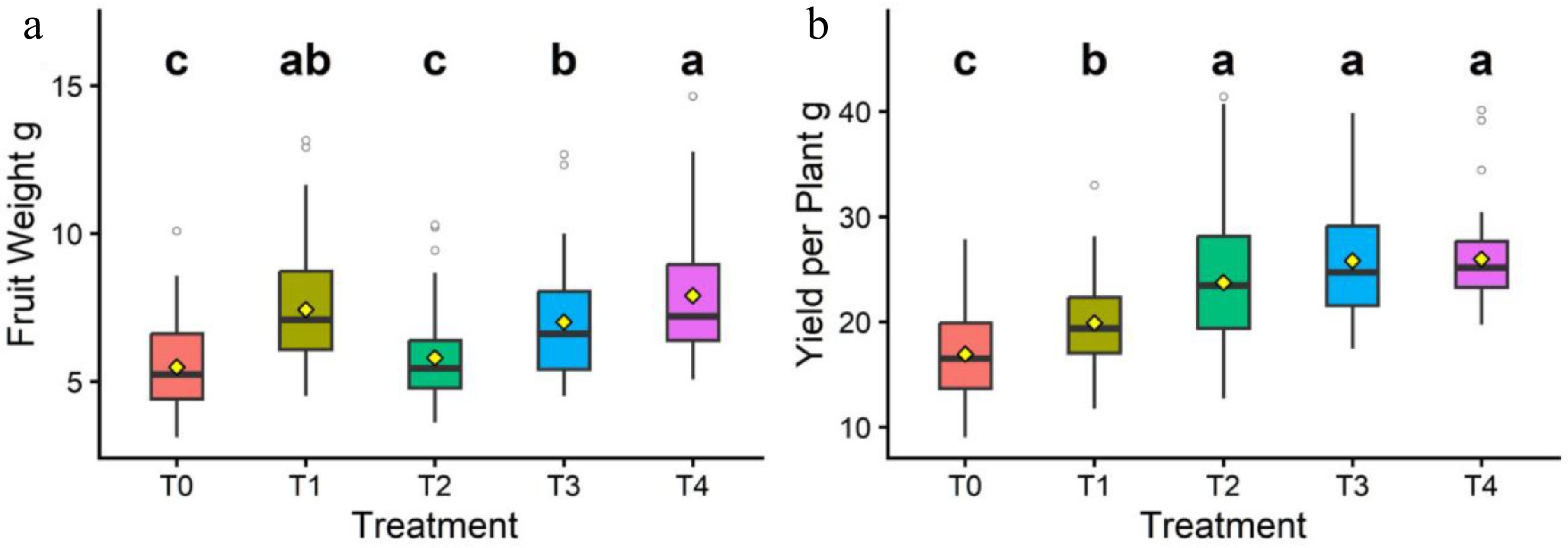
Figure 2.
Crop yield as influenced by wood vinegar and inorganic fertiliz. The panel shows fruit weight (a) and yield per plant (b). Different lowercase letters indicate significant differences among treatments. T0: Negative control; T1: WV; T2: RRF (90–0–60 kg NPK); T3: WV + RRF (45–0–30 kg NPK); T4: WV + RRF (135–0–90 kg NPK).
Fruit morphometrics
-
The combined application of WV and inorganic fertilizer significantly affected bell pepper fruit morphometric traits. Treatments with WV + SF at 50% below (6.64 cm) and 50% above (6.74 cm) the recommended rate produced the longest fruits, corresponding to 28% and 30.5% increases over the control (5.17 cm), respectively. Inorganic fertilizer alone resulted in a 19% increase in fruit length (6.16 cm), while foliar application of WV alone produced a 17% increase (6.04 cm), both comparable to the control (Fig. 3a). Fruit width was also significantly influenced by treatment. WV + SF at 50% above the recommended rate produced the widest fruits, representing a 59% increase (4.29 cm) over the untreated control (2.70 cm). This was followed by WV alone (3.35 cm), WV + SF at reduced rates (3.15 cm), and SF alone (3.12 cm), all of which exceeded the control (Fig. 3b).
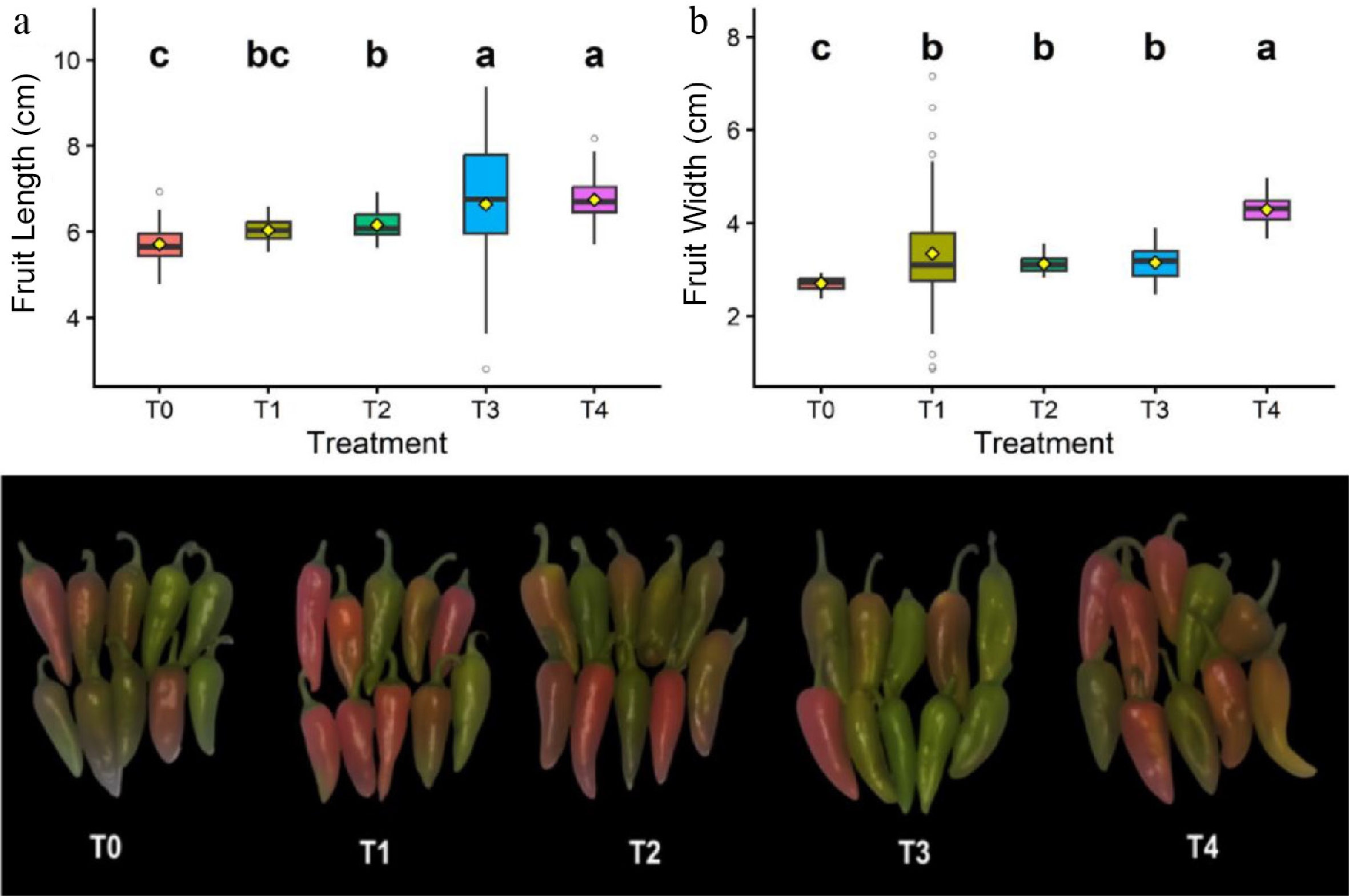
Figure 3.
Effect of different treatments on (a) fruit length, (b) fruit width of bell pepper. Different lowercase letters indicate significant differences among treatments. T0: Negative control; T1: WV; T2: RRF (90–0–60 kg NPK); T3: WV + RRF (45–0–30 kg NPK); T4: WV + RRF (135–0–90 kg NPK).
The fruit shape index (FSI) ranged from 1.58 to 2.22 across treatments and was significantly lower under WV + SF at 50% above the recommended rate (1.58; p < 0.01), indicating blockier, more desirable fruit morphology (Fig. 4c). Cylindrical fruit volumes (CFV) were significantly higher under combined WV + SF applications (p < 0.001). WV + SF at 50% above the recommended rate recorded the highest EFV (65.16 cm3) and CFV (97.75 cm3), relative to the control. Intermediate increases were observed in WV alone and WV + SF at reduced rates, whereas SF alone consistently produced the smallest volume among the treated plants (Fig. 4a, b).
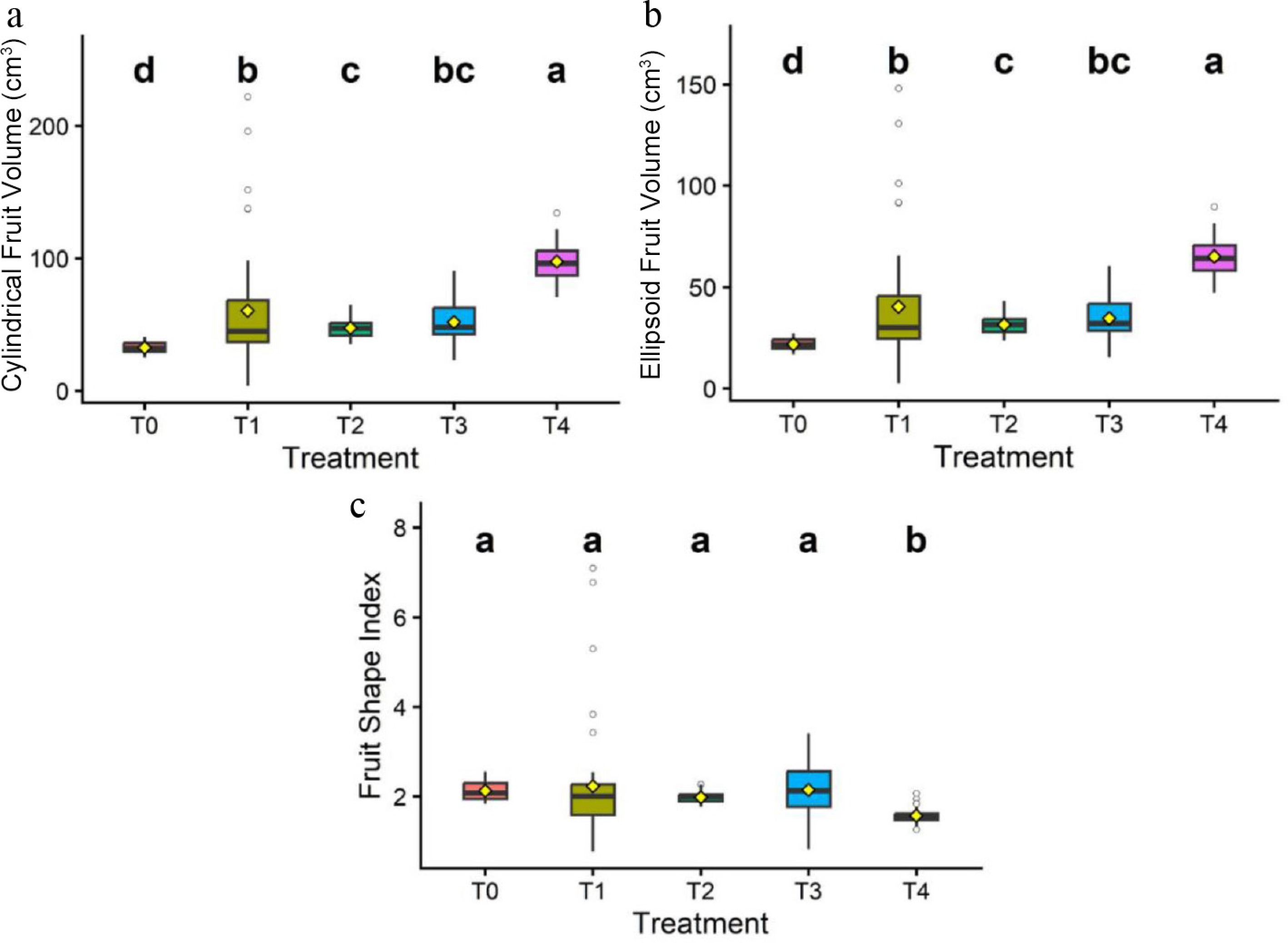
Figure 4.
Fruit morphology of bell pepper as influenced by different treatments. Panels represent (a) cylindrical fruit volume, (b) ellipsoid fruit volume, and (c) fruit shape index. Different lowercase letters indicate significant differences among treatments. T0: Negative control; T1: WV; T2: RRF (90–0–60 kg NPK); T3: WV + RRF (45–0–30 kg NPK); T4: WV + RRF (135–0–90 kg NPK).
Correlation analysis of plant parameters
-
Plant morphometric and yield traits show distinct correlations, as indicated by analysis (Fig. 5). Plant height (PH60, plant height at 60 d) showed strong positive correlations with fruit length (r = 0.82) and with both ellipsoid and cylindrical fruit volumes (r = 0.62 and r = 0.69), indicating that taller plants tend to produce larger fruits. Fruit-size traits were tightly interrelated with EFV, and CFV were almost perfectly correlated (r = 0.99), showing that both metrics represent the same fruit-size dimension. Both volumes were strongly associated with yield per plant (YPP; r = 0.70 and r = 0.69). Fruit length exhibited the strongest yield association (r = 0.92), confirming that fruit size, particularly length, is the dominant contributor to total productivity. A clear trade-off was observed between fruit number and fruit size. The number of fruits was strongly and negatively correlated with cylindrical fruit volumes (r = –0.74), indicating that plants producing more fruits tend to have smaller individual fruits. Further, marketable and non-marketable weights were strongly correlated (r = 0.87), indicating that plants with high total fruit biomass allocate proportionally to both categories. Physiological traits, such as relative growth rate (RGR) and days to flowering (DTF), showed weak, mostly non-significant correlations with yield and fruit metrics.
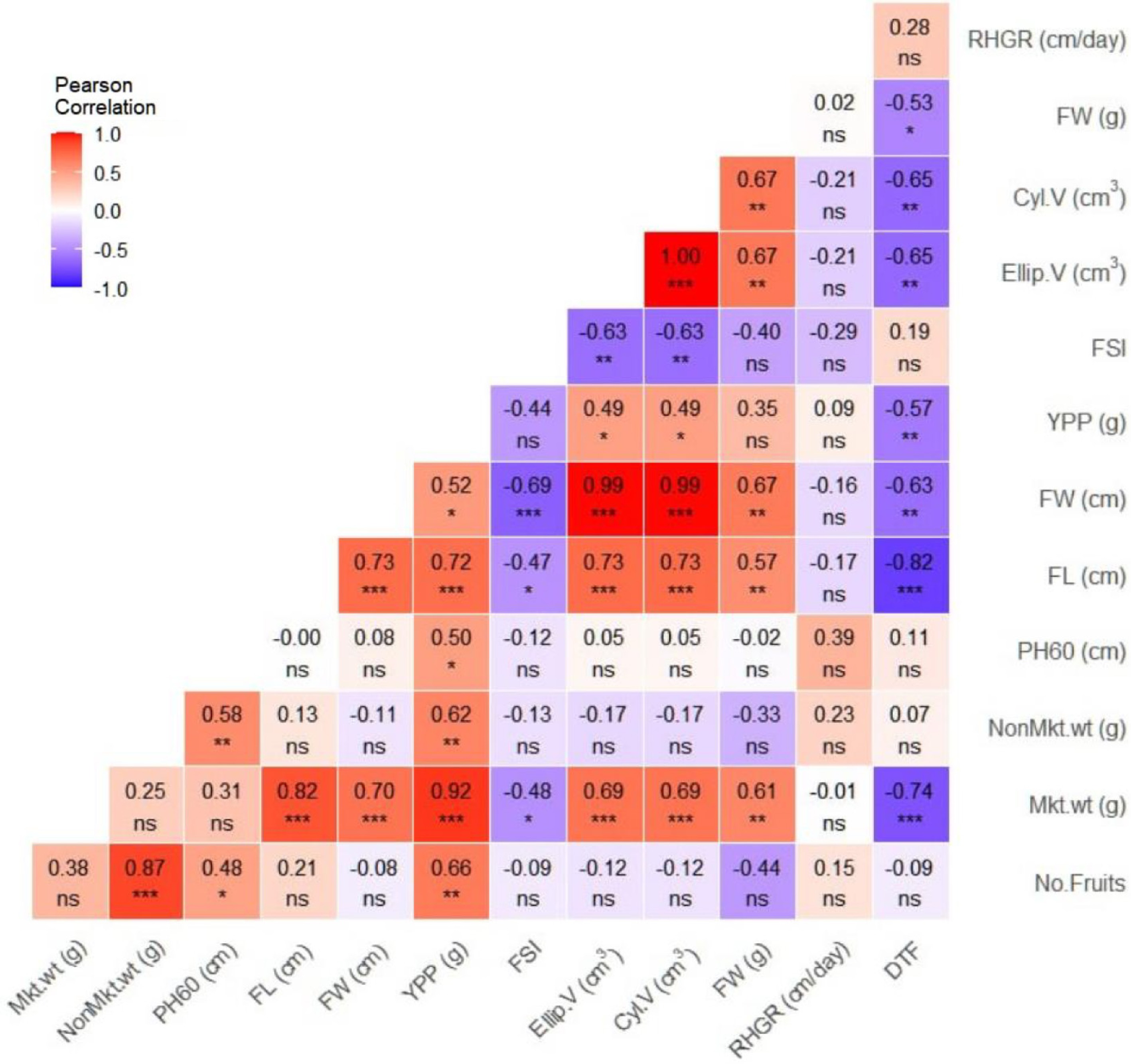
Figure 5.
Pearson correlation analysis of selected growth and yield parameters in bell pepper. PH60: plant height; RHGR: relative growth rate; DTF: days to flowering; No. Fruits: number of fruits; Mkt. wt: marketable weight; Non Mkt.wt: non-marketable weight; YYP ;plant yield; FL :fruit length; FW: fruit width; Elli.V: ellipsoid fruit volume; Cyl. V: cylindrical fruit volume; FSI: fruit shape index.
-
WV, a pyroligneous distillate rich in organic acids and phenolic compounds, has been widely evaluated as a plant biostimulant due to its capacity to influence nutrient availability, root activity, and internal physiological processes. In the present study, WV and synthetic fertilizer acted through distinct yet complementary mechanisms, resulting in clear differences in yield formation and fruit morphology in bell pepper. While previous studies on WV and mineral fertilization have primarily reported overall yield responses under a single nutrient regime, the present study advances this literature by explicitly distinguishing their roles in fruit initiation versus fruit filling across contrasting fertilizer levels. Therefore, this study clarifies how WV and mineral fertilization regulate separate components of productivity, thereby providing insight into yield allocation processes under integrated nutrient management.
Vegetative growth traits, including plant height and growth rate, were not significantly affected by either WV or mineral fertilization when applied alone, indicating that canopy expansion was not a primary driver of yield variation. Similar findings have been reported in other vegetable crops, where biostimulant effects are expressed predominantly in reproductive traits rather than in vegetative growth when nutrient availability is not strongly limiting[8,19]. Although WV contains bioactive compounds capable of influencing hormonal balance and root function, the lack of a vegetative response in this study suggests that its physiological influence was manifested primarily during later developmental stages. This stage-specific activity is consistent with reports showing that biostimulant efficacy depends on crop phenology and source–sink relationships rather than on early vegetative growth alone[30,31]. Given this limited vegetative response, subsequent yield differences can be attributed mainly to reproductive and post-flowering processes. Reproductive development was notably responsive to both WV and mineral fertilization. The advancement of flowering by 3–5 d, particularly under combined WV and synthetic fertilizer treatments, indicates that WV may have facilitated an earlier transition to reproductive growth, while mineral nutrients ensured adequate metabolic support for this shift. Low concentrations of phenolic compounds have been shown to prime plant tissues and enhance physiological readiness, which may indirectly accelerate phenological progression[32,33]. The flowering response observed here aligns with established evidence that balanced nutrition combined with mild biostimulant inputs can promote floral differentiation without excessive vegetative stimulation.
Analysis of yield components revealed a clear functional distinction between biostimulant and fertilizer effects. Synthetic fertilization with nitrogen and potassium significantly increased fruit number, reflecting the known role of nitrogen in promoting floral initiation and reproductive sink establishment[34,35]. However, the higher proportion of non-marketable fruits observed under mineral fertilizer alone indicates that sink initiation exceeded the plant's capacity for effective sink filling. Such responses are commonly observed when assimilate supply becomes limiting relative to sink demand, resulting in increased size variability and reduced market quality[36,37]. Similar patterns have been documented in pepper and tomato grown under high nutrient regimes, where greater fruit load is often achieved at the expense of uniformity and marketable quality[38,39]. In contrast, responses under WV application highlight its influence on assimilate partitioning rather than on sink formation. When WV was applied without supplemental NPK, total yield declined despite increases in average fruit weight and reductions in non-marketable fruits. This pattern indicates a shift toward enhanced sink strength at the individual fruit level, with assimilates preferentially allocated to fruit growth rather than to the initiation of additional sinks[16,40,41]. Because WV supplies negligible quantities of essential macronutrients, it cannot meet the nutritional demands required to support both high sink establishment and sustained assimilate production[42,43]. Under such conditions, plants appear to compensate by reinforcing fruit filling rather than increasing fruit number, a response consistent with source–sink relationships under nutrient-limited conditions[44]. Organic acids and phenolic compounds present in WV have been reported to influence membrane permeability, nutrient translocation, and internal carbon allocation, thereby improving the efficiency of assimilates utilization during fruit development[45,46]. These effects likely contributed to the increases in individual fruit mass and improved fruit quality observed in this study. However, in the absence of sufficient nitrogen to sustain photosynthetic capacity and potassium to facilitate carbohydrate transport, these physiological enhancements alone were insufficient to increase total yield[47]. Consequently, yield reduction under sole WV application reflects constrained sink formation rather than impaired plant metabolism.
When WV was applied in combination with NPK fertilizer, the plant response shifted towards improved fruit development and quality rather than increased fruit initiation. Under these conditions, adequate nutrient availability ensured sufficient sink number, while WV enhanced assimilate partitioning during later growth stages, improving fruit size, shape, and uniformity[43,47]. This response does not indicate reduced nutrient uptake, but rather reflects differential allocation of assimilates once fruit set had been established. Similar trade-offs between yield quantity and fruit quality have been reported in vegetable crops treated with biostimulants, where improvements in individual fruit characteristics occur without further increases in fruit number[48,49]. These results indicate that WV is most effective as a complementary input under balanced nutrient supply, where its influence on fruit filling and structural development can be fully expressed. Comparable yields between the unfertilized control and the highest NPK rate suggest a plateau response due to increasing fertilizer input, a phenomenon frequently reported in vegetable production systems with moderate baseline soil fertility. Previous studies have shown that fertilizer application beyond an optimal threshold often fails to increase yield, particularly where residual soil nutrients are sufficient to support vegetative growth and fruiting. For example, increasing nitrogen above the optimal level in pepper has been reported to result in no significant yield improvement, indicating diminishing marginal returns at elevated nutrient inputs[50]. Similarly, meta-analyses of enhanced-efficiency fertilizers in vegetable systems demonstrate that yield responses are most pronounced at low to moderate nitrogen rates, while higher inputs lead to yield stabilization rather than continued increases[51]. These findings support the non-linear yield response observed in the present study.
In contrast to yield quantity, fruit morphometric traits, including fruit length, width, volume, and shape index were responsive to both WV and mineral fertilization, particularly at higher input levels. The observed reduction in fruit shape index, indicative of blockier and more market-preferred fruits, supports the interpretation that WV promoted cell expansion and fruit thickening, contributing to improved uniformity[52,53]. Comparable improvements in fruit morphology have been reported in pepper systems receiving wood distillate-based treatments, which were attributed to enhanced nutrient mobility and physiological efficiency[21,42]. The combined application of WV and essential macronutrients likely optimized both source activity, through sustained photosynthetic assimilate production, and sink processes, through improved fruit filling. These responses are consistent with physiological mechanisms involving antioxidant activity and hormone regulation, supporting WV's role as a biostimulant that enhances metabolic efficiency without replacing mineral nutrition[54,55]. Therefore, physiological interpretations presented in this study are based on trait-level responses and allocation patterns, rather than direct biochemical or molecular measurements. Thus, the findings are intended to clarify functional relationships between mineral nutrition and WV in yield formation and to generate testable hypotheses regarding fruit initiation and fruit filling. Overall, the findings demonstrate that WV and mineral fertilizers perform distinct but complementary roles in bell pepper production. Mineral nutrients primarily regulate sink initiation and yield quantity, whereas WV enhances assimilate utilization, fruit filling, and quality attributes. Their combined application generated additive and in some cases synergistic effects on yield and marketable fruit characteristics that exceeded the performance of either input applied alone. These results reinforce the concept that integrated nutrient management strategies incorporating biostimulants alongside conventional fertilization can effectively optimize both yield quantity and quality in intensive vegetable production systems.
-
This study demonstrates that WV and synthetic fertilizer regulates bell pepper productivity through distinct but complementary pathways. Synthetic fertilizer primarily controlled fruit initiation, increasing fruit number, whereas WV mainly enhanced fruit development, improving individual fruit size, morphology, and marketable yield. When combined, these inputs optimized both sink establishment and sink filling, resulting in superior fruit quality and overall productivity compared with their individual application. Importantly, these effects occurred without significant changes in vegetative growth, indicating that yield responses were governed by reproductive allocation rather than canopy expansion. The findings confirm that WV functions most effectively as a biostimulant complementing mineral nutrition, rather than as a substitute, and support its integration into fertilizer management strategies aimed at improving yield quality and input efficiency in bell pepper production. Future studies should verify these patterns under varying environmental and soil conditions across multiple seasons, evaluate dose–response relationships, and incorporate physiological measurements.
-
Not applicable.
-
The authors confirm contribution to the paper as follows: study conception and design, and data collection: Guanzon IM; analysis and interpretation of results: Supan ET; draft manuscript preparation: Supan ET, Guanzon IM. All authors reviewed the results and approved the final version of the manuscript.
-
The datasets generated during and/or analyzed during the current study are available from the corresponding author upon reasonable request.
-
Not applicable.
-
The authors declare that they have no conflict of interest.
- Copyright: © 2026 by the author(s). Published by Maximum Academic Press, Fayetteville, GA. This article is an open access article distributed under Creative Commons Attribution License (CC BY 4.0), visit https://creativecommons.org/licenses/by/4.0/.
-
About this article
Cite this article
Supan ET, Guanzon IM. 2026. Source–sink modulation associated with wood vinegar and mineral fertilizer shapes fruit size and yield formation in bell pepper (Capsicum annuum L.). Circular Agricultural Systems 6: e006 doi: 10.48130/cas-0026-0005 

Source–sink modulation associated with wood vinegar and mineral fertilizer shapes fruit size and yield formation in bell pepper (Capsicum annuum L.)
- Received: 11 December 2025
- Revised: 06 February 2026
- Accepted: 10 February 2026
- Published online: 28 March 2026
Abstract: Wood vinegar (WV) has gained attention as a low-cost biostimulant with potential to enhance crop performance when integrated with mineral fertilizers. However, its effects on yield and fruit development in bell pepper remain insufficiently understood. This study evaluated the effects of sole and combined applications of WV and synthetic fertilizer (SF) on plant height, growth rate, flowering time, fruit number, yield components, and fruit morphometrics of Capsicum annuum L. under pot-based conditions. Five treatments were arranged in a completely randomized design: an unfertilized control, sole WV, SF at the recommended rate (RRF), and WV combined with SF at 50% below, or 50% above the RRF. Vegetative growth parameters, including plant height and growth rate, were not significantly affected by treatment. In contrast, flowering occurred earlier under combined WV and SF applications (26.25–27.25 d) compared with the control (31.5 d). Sole WV application reduced fruit number (2.82 fruits per plant) but increased fruit weight (7.43 g fruit−1) relative to the control (5.50 g fruit−1), indicating enhanced fruit development rather than increased fruit set. Synthetic fertilizer primarily increased fruit number, reaching 4.34 fruits per plant at the recommended rate. The combined application of WV and SF produced the highest yield per plant (20.52–22.12 g) and improved fruit size and morphology, including increased fruit length (6.64–6.74 cm) and fruit volume. Overall, these results demonstrate that WV mainly enhances fruit filling and size traits, whereas SF promotes fruit initiation, and that their combined application optimizes reproductive efficiency and marketable yield in bell pepper production.
-
Key words:
- Bell pepper /
- Fertilizer /
- Source-sink /
- Wood vinegar