












-
Nutrient management is a crucial technique for achieving high plant productivity and preserving soil fertility[1]. Nitrogen (N), phosphorus (P), and potassium (K) are the principal macronutrients that govern, plant growth and development[2]. These vital elements are crucial for physiological activities; potassium, in particular, is necessary for the growth, production, and quality of agricultural plants. It participates in protein synthesis, enzyme activation, glycolysis, and redox processes related to sugar transport[3]. Potassium constitutes approximately 5% of plant matter and is vital for stomatal conductance, photosynthesis, phloem transport, and cellular ion equilibrium. The global potassium fertilizer market is valued at
$\text{\$} $ The application of microbial biofertilizers is a more environmentally sustainable approach, as they are less harmful to plants and provide access to all soil nutrients. Despite the establishment of symbiotic relationships between plants and microorganisms, and the identification of some microorganisms that enhance abiotic stress tolerance[9], our comprehension of these interactions under abiotic stress remains elementary. Furthermore, the utilization of alternative nutrient sources, such as potassium ore (mica), could mitigate the adverse effects of chemical fertilizers due to various advantages, including low cost and ease of procurement. Ground rock is utilized in organic agriculture to release macro- and micronutrients for plants. Simultaneously, the use of rocks is constrained by their low solubility, and the chemical elements contained inside these minerals are released only gradually. The availability of nutrients in rocks can be enhanced by employing soil microorganisms that facilitate rock solubilization and release chemical components from them. Feldspar is the predominant mineral, constituting almost fifty percent of the Earth's crust. It contains a silicon-oxygen-aluminum tetrahedron with potassium occupying the interstitial spaces to neutralize the matrix's charge. The cost of potassium fertilizer is directly influenced by the roasting reagents[10]. Consequently, it is essential to employ a more economical and environmentally sustainable approach to diminish the expenses associated with commercial potassium fertilizer and reliance on imported synthetic potassium, thereby benefiting the farmers.
Trichoderma is a genus of filamentous fungi within the Hypocreaceae family, recognized for its widespread occurrence in soils, decomposing wood, and plant roots globally. These rapidly growing, green-spored ascomycetes display opportunistic avirulent symbiotic interaction with plants, functioning as saprophytes that degrade organic matter while colonizing rhizospheres[11]. Trichoderma functions as a versatile bio-input: it provides biocontrol against numerous pathogens (such as Fusarium, Alternaria, and Rhizoctonia), promotes plant growth through phytohormones like IAA, and facilitates mineral solubilization (phosphates, potassium, micronutrients via organic acids, chelation)[12,13]. Trichoderma possesses the capability to synthesize enzymes, antibiotics, and siderophores, facilitating nutritional competition and antagonism against pathogens[14]. Furthermore, it is important in solubilizing insoluble minerals such as phosphates, potassium, iron, zinc, copper, and manganese, hence enhancing their accessibility to plants in nutrient-deficient soils[15,16]. Trichoderma solubilizes potassium largely through acidification via organic acids, reducing pH by 0.5−1.0 degrees and dissolving minerals[17]. Additionally, they facilitate the chelation of related cations and produce extracellular polysaccharides that assist in the release of potassium[18]. Trichoderma consortia consist of multi-strain formulations of compatible Trichoderma species cultivated together, improving biocontrol, nutrient solubilization, and plant development compared to single-strain applications[19]. Consortia surpass monocultures by synergizing antagonism, promoting growth (increased IAA, acids), and enhancing stress tolerance, hence augmenting cucumber yields and seed germination[20].
Potassium fertilization is crucial for potassium-demanding crops like potatoes, as certain soil types, such as calcareous soils, are comparatively deficient in potassium. The potato (Solanum tuberosum L.) is a crucial food crop that serves as an economical energy source for human nutrition. Moreover, it is an economical food rich in starch, minerals, vitamins C and B, and amino acids, and is globally esteemed. In Egypt, the potato is a significant vegetable crop, with a total production of 6.9 million tons in 2023, cultivated across approximately 235,625 ha, yielding an average of 29.2 ton·ha–1, according to FAOSTAT[21]. Potassium has a crucial role in the growth and development of potato plants, aiding their adaptation to biotic and abiotic stressors, including pathogens, drought, and extreme temperatures[22]. Potassium absorber effectively alleviates drought stress in potatoes by enhancing osmotic adaptation and diminishing oxidative damage[22]. Stegelmeier et al.[23] indicated that more than 50% of existing agricultural land is moderately or severely affected by soil degradation processes including erosion, acidification, compaction, salinization, and pollution. Moreover, unsustainable farming practices coupled with droughts have resulted in a decrease in groundwater levels throughout numerous regions. Combined with climate change and the reduction in natural resource availability, this presents a significant challenge for agriculture to satisfy current food demand. A combination of inorganic and organic fertilizers was employed to achieve increased production. The combined use of potassium rocks and the co-inoculation of potassium-solubilizing microorganisms may facilitate a more rapid and sustained availability of potassium for optimal plant growth. Nevertheless, there is limited knowledge regarding the synergistic effects of rock materials and co-inoculation with potassium-solubilizing microorganisms on mineral availability in sandy calcareous soils, as well as on mineral content and growth of potatoes under different irrigation regimes. Furthermore, it is imperative to save water resources while ensuring high yields and product quality, as water is becoming progressively limited and expensive[24]. Consequently, the use of irrigation strategies that improve water use efficiency in agricultural output is imperative. Therefore, this study was conducted in field conditions to evaluate the effects of soil fertilization with potassium ore (mica) and the co-inoculation of potassium-solubilizing microorganisms under different irrigation regimes on potassium uptake, as well as growth and yield of potato plants, with the objective of optimizing mineral potassium consumption through mica utilization.
-
Trichoderma harzianum and T. longibrachiatium were isolated from heavy metal contaminated soil and mushroom wastes on Czapek's dextrose agar medium, which comprised 3% dextrose, 0.3% NaNO3, 0.1% KH2PO4, 0.05% KCl, 0.001% FeSO4·7H2O, 0.05% MgSO4, and 1.8% agar in 100 mL of distilled water, utilizing the dilution plate method for soil and the direct plate method for mushroom waste[25,26]. Both isolates were morphologically identified on Czapek's dextrose agar medium. Prior to commencing the experiment, both isolates were cultivated on identical plates using Czapek's dextrose agar medium and incubated at 28 °C for 4 d to identify any antagonistic interaction between the two isolates.
Assessment of potassium solubilization and organic acid synthesis
-
Potassium solubilization by T. harzianum and T. longibrachiatium was evaluated using the plate assay as per Shanware et al.[27] and Mahmoud et al.[8]. Trichoderma species were inoculated onto Aleksandrov solid agar medium supplemented with 0.1% mica (comprising 0.5% glucose, 0.01% Ca3(PO4)2, 0.01% CaCO3, 0.025% MgSO4·7H2O, 0.001% FeCl3, 1.8% agar, and 100 mL doubled distilled water). The inoculated plates were incubated at 28 °C for 4 d, resulting in the formation of halo zones indicative of potassium-solubilizing activities. T. harzianum and T. longibrachiatium were evaluated for organic acid generation utilizing a plate test based on pH variation, as per Dezam et al.[28], with the adjustment of the pH indicator to phenol red. The organic acid test medium utilized was Czapek's agar, comprising 3% sucrose, 0.2% NaNO3, 0.1% KH2PO4, 0.05% KCl, 0.001% FeSO4·7H2O, 0.05% MgSO4, and 1.8% agar, with fortified with an initial pH 7.2, augmented by 0.1 g·L−1 phenol red as a pH indicator for acid formation. Pure cultures of Trichoderma were inoculated at the center of the plates and incubated at 28 °C for 5 d, with the creation of yellow zones suggesting acid production.
Plant materials and experimental field
-
Potato tubers (cv. Cara) were cultivated in rows measuring 20 m in length, 0.5 m breadth, and spaced 0.3 m apart, utilizing a drip irrigation system. Each row utilized a single line with a spacing of 0.3 m between drippers, and the discharge rate was 4 L−1 per dripper. The prescribed agricultural practices were implemented in accordance with the extension guide for potatoes provided by the Ministry of Agriculture, Egypt. The field experiment was executed throughout two winter seasons, 2022/2023 and 2023/2024, at the Arab El-Awammer Research Station, Agricultural Research Center (A.R.C.), located in Assiut Governorate, Egypt (27°17′03.3ʺ N, 31°13ʹ25.4ʺ E). The experimental soil is classified as sandy calcareous soil (Table 1), and the methodologies outlined by Klute[29] and Jackson[30] were employed to define its physical and chemical features. Table 2 presents the climate data for the study region for the two winter seasons. Potassium sulfate was added at a rate of 236.7 kg·ha−1 at 100%, and 50% was 118.3 kg·ha−1 at 50%; mica was 595.2 kg·ha−1. Nitrogen and phosphate fertilizers were added according to the recommendations of the Egyptian Ministry of Agriculture.
Table 1. Physical and chemical properties of representative composite soil sample from the field trial site.
Chemical properties pH (1:1) 8.21 EC (ds m−1) (1:1) 0.52 Soluble cations (mmol kg−1) Ca++ 2.06 Mg++ 1.54 Na+ 0.58 K+ 0.92 Soluble anions (mmol kg−1) CO3-- + HCO3- 2.89 Cl- 1.94 Available Phosphorus (mg kg−1) 8.31 Total nitrogen (%) 0.09 Physical properties Particle size distribution (%) Sand 89.7 Silt 7.2 Clay 3.1 Texture class sandy Moisture content (Volumetric %) S. P. 24.2 F.C. 11.2 W.P. 4.6 O.M (%) 0.8 CaCO3 (g kg−1) 254 Bulk density (ton m−3) 1.6 Table 2. Average monthly meteorological data of Assiut weather station during two seasons (2022/2023 and 2023/2024).
Year Month Tmax (°C) Tmin (°C) RH WS (km·h−1) Sunshine 2022/2023 October 30.2 17.6 48.8% 15.7 10.0 November 25.7 12.1 51.4% 12 9.4 December 22.9 9.3 57.6% 9.6 9.0 January 21.1 7.1 56% 10.1 8.9 February 20.2 6.1 51% 11.8 9.7 2023/2024 October 31.9 18.7 47.5% 13.9 10.0 November 28.9 14.8 50% 10.4 9.4 December 23.4 9.9 60.2% 8.9 9.0 January 20.9 7.1 53.2% 9.1 8.9 February 21.9 8.2 46.3% 10.5 9.7 Tmax = Maximum temperature (°C); Tmin = Minimum temperature (°C); RH = Relative humidity (%); WS = Wind speed (km·h−1) (fieldclimate.com, Asyut, Egypt 00001125). Design of experiments
-
The present field experiment was structured as a randomized complete block design (RCBD) in a split-plot configuration and conducted in triplicate, with each plot covering an area of 10 m2. Three irrigation levels (Full irrigation (100% ETc), Moderate Irrigation (80% ETc), and Stress Irrigation (60% ETc)) were designated in the primary plot. The sub-plot was designated for organic treatments (T1 = Chemical Fertilizers (CF), T2 = 50% CF + micro, T3 = 50% mica + micro, T4 = micro). The micro used in the current investigation is T. harzianum and T. longibrachiatium; the inocula were prepared as follows: the spores of 3 d old cultures were scraped and suspended in sterilized distilled water to a final concentration 106 spores·mL−1. The reference evapotranspiration was computed utilizing the CROPWAT model as delineated by Penman-Monteith[31], as clarified in Eq. (1):
$ \text{Crop evapotranspiration}\; (\mathrm{ETc}):\ \ \ ETc=ETo\; x\; Kc $ (1) where, ETo is the reference evapotranspiration, and Kc is the crop coefficient according to FAO 56[32].
Irrigation water applied (I.Ra) was assessed using Eq. (2), where it reflects the quantity of actual irrigation water utilized
$ \text{I.}Ra=\dfrac{ETc+LF}{Er} $ (2) where, I.Ra is the total real irrigation water applied in mm per interval, ETc is the crop evapotranspiration calculated via the Penman-Monteith equation, LF is the leaching factor of 10%, and Er is the efficiency of the irrigation system.
Measurements of yield and its components
-
In the final week of January, during both cultivated seasons, potato tubers were harvested, and ten individual plants from each plot were randomly selected to assess tuber weight per plant (kg), tuber count per plant, average tuber weight, weight of marketable tuber per plant (kg), count of marketable tubers per plant, average weight of marketable tuber, and dry matter percentage. The total yield (ton·ha−1) and marketable yield (ton·ha−1) were calculated based on total tubers produced in each plot.
Collection of samples for analysis
-
Tuber samples from each plot were randomly taken following the assessment of yield and yield-related parameters to conduct biochemical and quality analyses. Clean tubers were categorized into two groups: one for assessing nitrogen (N), phosphorus (P), potassium (K), protein, dry matter percentage, and starch yield, and the other for evaluating total carbohydrates, total antioxidants, total phenols, and total flavonoids in their fresh state.
Examination of the chemical composition of the potato tuber
-
For NPK measurements, tubers were sectioned and then subjected to oven drying at 70 °C until a stable weight was achieved. Precisely 0.5 g of dried tuber, pounded to a fine powder, was weighed for wet digestion using H2SO4 in conjunction with HCIO4, adhering to the approach outlined by Chapman & Pratt[33]. The nitrogen content (%) was assessed using the micro-Kjeldahl method as outlined by Jackson[30]. Total phosphorus and potassium were measured using methods outlined by Jackson[30] and Page et al.[34], respectively. The protein content of potato tubers was determined by multiplying the nitrogen percentage by 6.25, according to Hymowitz et al.[35].
Quality characteristics of potato tubers
-
The yield of dry tubers (ton·ha−1) was ascertained in accordance with Haque et al.[36] following Eq. (3):
$ \mathrm{Dry}\; \mathrm{matter}\; (\text{%})=\dfrac{\mathrm{Dry}\; \mathrm{weight}\; (\mathrm{g})}{\mathrm{Fresh}\; \mathrm{weight}\; (\mathrm{g})}\times100 $ (3) The yield of tuber starch was determined using the Eqs (4 and 5):
$ {\text{Starch yield}} \;({\rm{ton \cdot ha}}^{-1}) = {\text{Tuber dry yield}}\times {\text{Starch percentage}} $ (4) $ \mathrm{Tuber}\;\mathrm{dry}\;\mathrm{yield}=\dfrac{\mathrm{Total}\;\mathrm{tuber}\;\mathrm{yield}\times \mathrm{Dry}\;\mathrm{matter}\;\text{percentage}}{100} $ (5) The starch percentage was determined using the Burton[37] Eq. (6):
$ {\mathrm{Starch}}\;({\text{%}} )=17.457+[0.891\times ({\text{Dry matter percentage}}-24.182)]. $ (6) The total carbohydrate content was measured using a spectrophotometer; total antioxidants were quantified utilizing the phosphor-molybdenum method as delineated by Prieto et al.[38], incorporating ammonium molybdate reagent. The absorbance was measured at 695 nm using a spectrophotometer, and the findings were obtained using an ascorbic acid standard curve serving as the antioxidant reference. The Folin-Ciocalteu method, as described by Singleton et al.[39], was employed to quantify total phenolic content. Absorbance was measured at 765 nm utilizing a spectrophotometer, with values obtained from the gallic acid standard curve. Total flavonoids were measured using an aluminum chloride reagent as per the method developed by Da Silva et al.[40]. The yellow color was measured at 415 nm with a spectrophotometer, with values obtained from the quercetin standard curve.
Statistical analysis
-
Analysis of variance (ANOVA) was performed using Statistix 8.1 software according to the experimental design. The normality of the data was assessed using the Shapiro–Wilk test before performing ANOVA. Treatment means were compared using Tukey's multiple comparison test at a significance level of p ≤ 0.05. Data are presented as mean ± standard deviation (SD). Exact p-values are reported throughout the Results section. Cluster analysis was performed on the obtained data using the unweighted pair group method with arithmetic averages (UPGMA) and the Bray–Curtis dissimilarity index using PAST 4.17 software[41].
-
The growth of T. harzianum and T. longibrachiatium on Czapek's dextrose agar medium at 28 °C for 4 d showed no antagonistic interaction between the two isolates, hence endorsing their use in consortium application. The growth of T. harzianum on Czapek's dextrose agar medium exhibited smooth mycelial development, transitioning to a bright green hue within 2 d. Conidiophores exhibited extensive branching, with phialides that include a smooth-walled structure and truncated-base conidia. The growth of T. longibrachiatium on Czapek's dextrose agar medium exhibited a surface mycelium of dark green coloration and a pale greenish-yellow reverse. Conidiophores exhibited branching with elongated primary branches; phialides appeared in clusters, and conidia were green with smooth walls. T. harzianum and T. longibrachiatium had significant acid generation capabilities, as seen by the color change of phenol red in Czapek's agar medium from red to yellow with prolonged incubation periods. Acid production commenced 2 d post-inoculation for both isolates, with T. harzianum exhibiting 45 mm and T. longibrachiatium 22.5 mm. After 5 d, acid diffusion reached 90 mm, resulting in a full color change of the plate to yellow. T. harzianum and T. longibrachiatium demonstrated effective potassium solubilization on Aleksandrov solid agar medium containing mica (a natural potassium source), resulting in clear zones measuring between 22.5 and 28 mm after 4 d of inoculation.
Irrigation water applied (m3·ha−1)
-
The volume of irrigation water applied (m3·ha−1) is a crucial statistic in agriculture for resource management, efficiency assessment, and water supply planning based on climate, crop type, and irrigation technology. It denotes the volume of water, quantified in cubic meters, supplied to one hectare of land for agricultural irrigation. Fig. 1 illustrates that the actual irrigation water fluctuates across various potato growth stages and irrigation levels during the two growing seasons. As the plant developed and grew during the initial and development stages, a progressive increase in water usage and application was noticed. The highest irrigation water applied occurred around mid-season, with average values across two seasons of 1,413.2, 1,130.5, and 847.9 m3·ha−1 for Full Irrigation, Moderate Irrigation, and Stress Irrigation, respectively. In the late season phase, the volume of irrigation water utilized markedly diminished throughout both seasons at different irrigation levels. The total real water volume over two seasons was 3,986.8 m3·ha−1 at Full Irrigation, 3,189.4 m3·ha−1 at Moderate Irrigation, and 2,392 m3·ha−1 at Stress Irrigation.
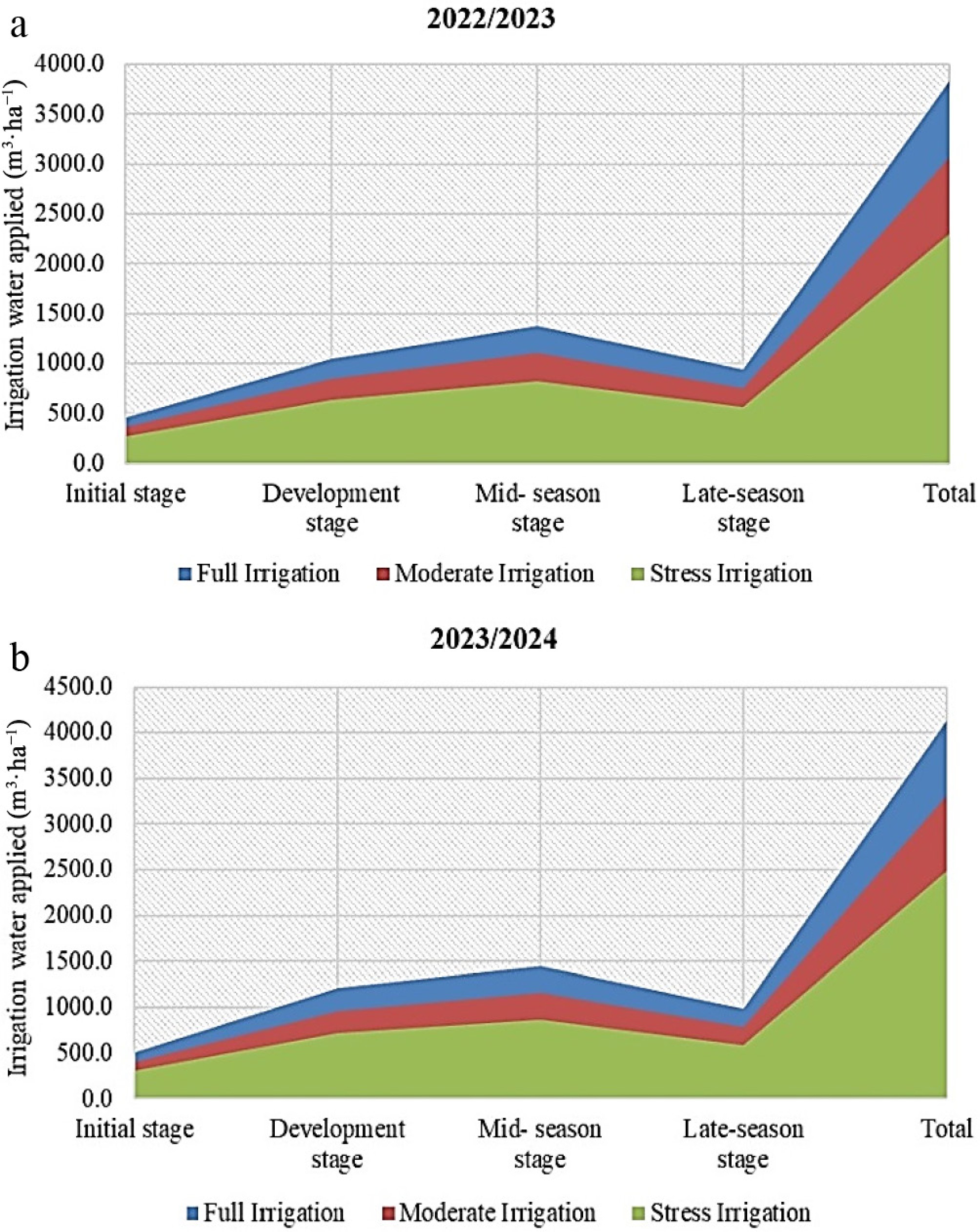
Figure 1.
Volume of irrigation water applied (m3·ha−1) at various growth stages of potato during the (a) 2022/2023, and (b) 2023/2024 seasons, cultivated under different irrigation regimes utilizing a drip irrigation system.
Measurements of yield and its components
-
The results regarding yield and yield component parameters demonstrated that various irrigation treatments, the application of mica with or without Trichoderma consortium, and their interaction significantly influenced the outcomes. Tuber number and weight per plant (Table 3), average tuber weight, and total tuber yield (Table 4) exhibited the lowest values under water scarcity at the irrigation level of Stress Irrigation, in contrast to plants irrigated with Full Irrigation. Simultaneously, by conserving 20% of utilized irrigation water at Moderate Irrigation (797.4 m3·ha−1), the average reduction percentage across both seasons was 10.5%, 5.2%, 13.9%, and 28.5% for the number of tubers per plant, tuber weight per plant, average tuber weight, and total tuber yield, respectively. The application of 50% mica combined with a Trichoderma consortium (T3) yielded the highest value for the specified parameters compared to other treatments, including 100% chemical fertilizer (control, T1).
Table 3. Influence of varying irrigation levels, application of Trichoderma consortium with potassium ore, and their interaction on tuber number and weight (g) per plant during growing seasons of 2022/2023 and 2023/2024.
Treatment Tuber number per plant Tuber weight per plant (kg) Full irrigation Moderate irrigation Stress irrigation Mean Full irrigation Moderate irrigation Stress irrigation Mean 2022/2023 T1 6.00 ± 0.10ab 5.00 ± 0.12c 4.00 ± 0.10d 5.00b 0.409 ± 0.01c 0.322 ± 0.01de 0.211 ± 0.00g 0.314d T2 6.00 ± 0.10ab 5.67 ± 0.12bc 4.00 ± 0.10d 5.22b 0.523 ± 0.01b 0.339 ± 0.00d 0.257 ± 0.00f 0.373b T3 6.67 ± 0.20a 6.00 ± 0.12ab 5.00 ± 0.10c 5.89a 0.608 ± 0.00a 0.420 ± 0.01c 0.314 ± 0.01e 0.447a T4 5.67 ± 0.10bc 5.00 ± 0.12c 4.00 ± 0.10d 4.89b 0.415 ± 0.01c 0.315 ± 0.00e 0.250 ± 0.01f 0.327c Mean 6.08a 5.42b 4.25c 0.489a 0.349b 0.258c 2023/2024 T1 6.05 ± 0.11cd 5.37 ± 0.15ef 3.55 ± 0.12i 4.99c 0.433 ± 0.00c 0.339 ± 0.01e 0.220 ± 0.00g 0.331d T2 6.49 ± 0.20bc 5.81 ± 0.12de 4.52 ± 0.11gh 5.61b 0.548 ± 0.01b 0.355 ± 0.00d 0.267 ± 0.00f 0.390b T3 7.40 ± 0.13a 6.70 ± 0.17b 4.97 ± 0.20fg 6.36a 0.639 ± 0.00a 0.441 ± 0.01c 0.332 ± 0.00e 0.471a T4 5.86 ± 0.11de 5.24 ± 0.23f 4.20 ± 0.20h 5.10c 0.432 ± 0.00c 0.334 ± 0.00e 0.261 ± 0.00f 0.342c Mean 6.45a 5.78b 4.31c 0.513a 0.367b 0.270c Values are expressed as the mean of three replicates ± SD, with different superscript letters indicating significant differences at the p ≤ 0.05 level according to Tukey's test. T1 = Chemical Fertilizers (CF), T2 = 50% CF + Trichoderma consortium, T3 = 50% mica + Trichoderma consortium, T4 = Trichoderma consortium. Table 4. Changes in average tuber weight (kg) and total tuber yield (ton·ha−1) as affected by varying irrigation levels, application of Trichoderma consortium with potassium ore, and their interaction during growing seasons of 2022/2023 and 2023/2024.
Treatment Average tuber weight (kg) Total tuber yield (ton·ha−1) Full irrigation Moderate irrigation Stress irrigation Mean Full irrigation Moderate irrigation Stress irrigation Mean 2022/2023 T1 0.155 ± 0.00bc 0.127 ± 0.00e 0.081 ± 0.00g 0.121c 26.726 ± 0.40c 21.037 ± 0.82de 13.778 ± 0.23g 20.514d T2 0.156 ± 0.00bc 0.147 ± 0.00cd 0.087 ± 0.00g 0.130b 34.147 ± 0.38b 22.121 ± 0.11d 16.751 ± 0.21f 24.340b T3 0.184 ± 0.00a 0.161 ± 0.00b 0.113 ± 0.00f 0.153a 39.676 ± 0.19a 27.409 ± 0.85c 20.507 ± 0.34e 29.197a T4 0.144 ± 0.00d 0.116 ± 0.00f 0.084 ± 0.00g 0.115d 27.091 ± 0.53c 20.590 ± 0.26e 16.323 ± 0.35f 21.334c Mean 0.160a 0.138b 0.091c 31.910a 22.789b 16.840c 2023/2024 T1 0.164 ± 0.00b 0.132 ± 0.00d 0.083 ± 0.00g 0.126c 28.283 ± 0.19c 22.177 ± 0.48e 14.380 ± 0.12g 21.613d T2 0.165 ± 0.00b 0.155 ± 0.00c 0.090 ± 0.00f 0.137b 35.767 ± 0.33b 23.183 ± 0.19c 17.417 ± 0.12f 25.456b T3 0.196 ± 0.00a 0.172 ± 0.00b 0.119 ± 0.00e 0.162a 41.747 ± 0.11a 28.820 ± 0.42c 21.663 ± 0.14e 30.743a T4 0.152 ± 0.00c 0.123 ± 0.00e 0.088 ± 0.00fg 0.121d 28.230 ± 0.23c 21.840 ± 0.25e 17.053 ± 0.13f 22.374c Mean 0.169a 0.146b 0.095c 33.507a 24.005b 17.628c Values are expressed as the mean of three replicates ± SD, with different superscript letters indicating significant differences at the p ≤ 0.05 level according to Tukey's test. The maximum percentage increase, averaged over two seasons, was 20% for tuber number per plant, 34.8% for tuber weight per plant, 27.2% for average tuber weight, and 34.7% for total tuber production compared to the control treatment. The interaction effect revealed that the maximum values for potassium ore, tuber weight per plant, average tuber weight, and total tuber yield were seen with the application of 50% mica combined with a Trichoderma consortium under full irrigation. No significant difference was seen in the number of tubers per plant, tuber weight per plant, average tuber weight, and total tuber yield when comparing the control treatment at Full Irrigation with the treatment of 50% mica plus Trichoderma consortium under an irrigation level of Moderate Irrigation. Moreover, a 40% reduction in water consumption (1,594.7 m3·ha−1) at Stress Irrigation, combined with the addition of 50% potassium ore to the soil and inoculation with a Trichoderma consortium, resulted in a comparative analysis against chemical fertilizer at Full Irrigation. Over two seasons, a reduction of 17.3% in tuber number per plant, 23.3% in tuber weight per plant, 27.5% in average tuber weight, and 26.0% in total tuber yield were recorded.
The percentage of marketable tubers, marketable tuber weight per plant (Table 5), along with the total marketable tuber yield (Table 6), were assessed to clarify the influence of the examined factors in this study. A substantial effect of different irrigation levels on the marketable tuber percentage per plant was observed; however, no notable difference was detected regarding mica with or without Trichoderma consortium, nor for their interaction. The weight of marketable tubers per plant and total marketable tuber yield were significantly affected by the experimental variables and their interaction. Water scarcity diminished the marketable tuber weight per plant and total marketable yield by 31.8% and 31.7% at 80% of ETc and by 49.6% and 49.5% at Stress Irrigation across two seasons, respectively. The results from the soil application of Trichoderma consortium inoculation and mica indicated that the combination of 50% mica and Trichoderma consortium (T3) achieved a 32.7/% increase in marketable tuber weight per plant and a 33.7% increase in total marketable yield, averaged over two seasons, in comparison to chemical fertilizer (T1). In light of the interaction impacts, soil application of 50% potassium ore combined with Trichoderma consortium, as opposed to chemical fertilizer, enhanced the marketable tuber weight per plant and total marketable yield by 41.2% and 41.0%, respectively, across both seasons at Full Irrigation. Nonetheless, with water savings of 20% and 40% at Moderate Irrigation and Stress Irrigation, the reduction percentage for marketable tuber weight per plant was 7.6% and 31.1%, respectively, and for total marketable yield, they were 7.4% and 31.0%, respectively.
Table 5. Marketable tuber per plant (%) and marketable tuber weight per plant (kg) as influenced by varying irrigation levels, application of Trichoderma consortium with potassium ore, and their interaction during growing seasons of 2022/2023 and 2023/2024.
Treatment Marketable tuber per plant (%) Marketable tuber weight per plant (kg) Full irrigation Moderate irrigation Stress irrigation Mean Full irrigation Moderate irrigation Stress irrigation Mean 2022/2023 T1 71.78 ± 0.70bc 58.21 ± 0.90e 70.98 ± 2.66abc 66.99a 0.384 ± 0.01c 0.296 ± 0.01ef 0.193 ± 0.00i 0.291c T2 76.24 ± 1.66a 60.27 ± 2.93de 68.22 ± 3.81abcd 68.24a 0.528 ± 0.00b 0.307 ± 0.01e 0.236 ± 0.00h 0.357b T3 75.00 ± 2.71ab 60.46 ± 2.67de 68.09 ± 4.01bcd 67.85a 0.544 ± 0.00a 0.355 ± 0.00d 0.265 ± 0.00g 0.388a T4 66.95 ± 0.82cd 60.51 ± 0.89de 69.57 ± 2.42abc 65.68a 0.360 ± 0.00d 0.283 ± 0.01fg 0.228 ± 0.01h 0.290c Mean 72.49a 59.87c 69.21b 0.454a 0.310b 0.231c 2023/2024 T1 71.78 ± 0.70ab 60.00 ± 4.00e 67.74 ± 2.30abcde 66.51a 0.405 ± 0.00c 0.311 ± 0.00ef 0.197 ± 0.00i 0.304c T2 75.50 ± 2.-91a 60.27 ± 2.93de 68.22 ± 3.81abcde 67.90a 0.556 ± 0.00b 0.321 ± 0.00d 0.244 ± 0.00h 0.374b T3 69.96 ± 0.87abc 64.69 ± 2.91bcde 69.50 ± 5.98abcd 68.05a 0.570 ± 0.00a 0.375 ± 0.00d 0.279 ± 0.00g 0.408a T4 66.95 ± 0.82abcde 61.51 ± 1.50cde 71.76 ± 4.21ab 66.74a 0.378 ± 0.00d 0.297 ± 0.00f 0.238 ± 0.01h 0.304c Mean 71.05a 61.62c 69.30b 0.477a 0.326b 0.239c Each value represents a mean of three replicates ± standard deviation, with different superscript letters indicate significant differences at the p ≤ 0.05 level according to Tukey's test. Table 6. Mean of total marketable tuber yield (ton·ha−1) and irrigation water productivity (kg·m−1) as affected by varying irrigation levels, application of Trichoderma consortium with potassium ore, and their interaction during growing seasons of 2022/2023 and 2023/2024.
Treatment Total marketable tuber yield (ton·ha−1) Irrigation water productivity (kg·m−1) Full irrigation Moderate irrigation Stress irrigation Mean Full irrigation Moderate irrigation Stress irrigation Mean 2022/2023 T1 25.08 ± 0.42b 19.32 ± 0.35de 12.59 ± 0.26h 18.996c 6.97 ± 0.10cd 6.86 ± 0.27cd 5.99 ± 0.10e 6.61d T2 34.47 ± 0.29a 20.03 ± 0.44d 15.39 ± 0.28g 23.296b 8.90 ± 0.10b 7.21 ± 0.04c 7.28 ± 0.09c 7.80b T3 35.53 ± 0.32a 23.19 ± 0.17c 17.33 ± 0.29f 25.351a 10.35 ± 0.05a 8.93 ± 0.28b 8.91 ± 0.15b 9.40a T4 23.53 ± 0.32c 18.44 ± 0.36ef 14.89 ± 0.79g 18.952c 7.07 ± 0.14cd 6.71 ± 0.08d 7.09 ± 0.15cd 6.96c Mean 29.65a 20.24b 15.05c 8.32a 7.43b 7.32b 2023/2024 T1 26.42 ± 0.30c 20.28 ± 0.10e 12.87 ± 0.10i 19.86c 6.83 ± 0.04cde 6.70 ± 0.15de 5.79 ± 0.05f 6.44d T2 36.33 ± 0.22b 20.99 ± 0.26e 15.94 ± 0.10h 24.42b 8.64 ± 0.08b 7.00 ± 0.06c 7.01 ± 0.05c 7.55b T3 37.21 ± 0.19a 24.48 ± 0.14d 18.20 ± 0.18g 26.63a 10.09 ± 0.03a 8.70 ± 0.13b 8.72 ± 0.06b 9.17a T4 24.66 ± 0.28d 19.41 ± 0.18f 15.54 ± 0.76h 19.87c 6.82 ± 0.06cde 6.59 ± 0.08e 6.87 ± 0.05cd 6.76c Mean 31.156a 21.290b 15.638c 8.10a 7.25b 7.10c Each value represents a mean of three replicates ± standard deviation, with different superscript letters indicate significant differences at the p ≤ 0.05 level according to Tukey's test. Irrigation water productivity (m3·ha−1)
-
Irrigation water productivity (IWP) denotes the correlation between total tuber production and the volume of water utilized (Table 6). Irrigation water productivity helps elucidate the effects of irrigation regimes on crop productivity. The reduction percentage due to water scarcity at Moderate Irrigation was 28.5%, while the average reduction percentage in IWP over two seasons compared to Full Irrigation was 10.6%. Furthermore, the deficit irrigation treatment at Stress Irrigation exhibited a 12.2% drop in IWP compared to Full Irrigation. The combination of potassium ore (50%) and microorganism inoculation increased water productivity by 42.3% over two seasons compared to chemical fertilizer. The interaction effect results indicated that T3 (50% mica + Trichoderma consortium) exhibited the largest percentage growth (48.1% over two seasons) in comparison to chemical fertilizer at Full Irrigation. No significant difference was observed between Moderate Irrigation and Stress Irrigation while applying 50% mica and Trichoderma consortium inoculation, with a percentage increase of 27.8% compared to the control treatment under Full Irrigation level.
Chemical composition of potato tuber
-
The variations in nitrogen (N), phosphorus (P), potassium (K), and protein levels in potato tuber, associated with distinct irrigation levels (Full Irrigation, Moderate Irrigation, and Stress Irrigation), soil application with or without potassium ore, and the interactive effects of both factors, are detailed in Tables 7 and 8. A reduction in irrigation water supply, along with a drop in N, P, K, and protein levels, was noted. The reduction percentage in water deficit, compared to fully irrigated conditions during both seasons, was 28.7% for nitrogen, 34.7% for phosphorus, 31% for potassium, and 29% for protein content. The utilization of mica and Trichoderma consortium inoculation enhanced the nitrogen, phosphorus, potassium, and protein levels in potato tubers relative to chemical fertilizer. The percentage increase of 50% mica + Trichoderma consortium (T3) application relative to chemical fertilizer treatment, averaged over two seasons, was 20.6% for nitrogen, 42.4% for phosphorus, 7.6% for potassium, and 20.8% for protein, respectively. The interaction effect of applying 50% mica + micro under Full Irrigation resulted in an increase of 13.7% in nitrogen, 28.6% in phosphorus, 8% in potassium, and 17.1% in protein compared to the control treatment. At the same time, the identical treatment at Moderate Irrigation resulted in an increase of 5.6% in nitrogen content and 8.5% in protein content across two seasons. No substantial variation was observed in phosphorus and potassium levels between the two regimens. Furthermore, a 40% reduction in water usage at an irrigation level of Stress Irrigation, compared to chemical fertilizer at Full Irrigation, resulted in decreases of 4.4%, 9.5%, 17.6%, and 11% in nitrogen, phosphorus, potassium, and protein content of potato tubers, respectively.
Table 7. Nitrogen and phosphorus percentages in tuber tissues of potato plants as influenced by varying irrigation levels, application of Trichoderma consortium with potassium ore, and their interaction during growing seasons of 2022/2023 and 2023/2024.
Treatment Nitrogen (%) Phosphorus (%) Full irrigation Moderate irrigation Stress irrigation Mean Full irrigation Moderate irrigation Stress irrigation Mean 2022/2023 T1 1.57 ± 0.01c 1.28 ± 0.00g 1.11 ± 0.00h 1.32c 0.41 ± 0.01e 0.35 ± 0.00fg 0.21 ± 0.01i 0.32d T2 1.63 ± 0.02b 1.48 ± 0.01e 1.27 ± 0.01g 1.46b 0.49 ± 0.01b 0.43 ± 0.00d 0.34 ± 0.00g 0.42b T3 1.78 ± 0.01a 1.65 ± 0.01b 1.35 ± 0.00f 1.59a 0.52 ± 0.00a 0.46 ± 0.01c 0.36 ± 0.01f 0.45a T4 1.53 ± 0.01d 1.11 ± 0.02h 0.88 ± 0.01i 1.17d 0.47 ± 0.01bc 0.41 ± 0.00de 0.31 ± 0.01h 0.40c Mean 1.63a 1.38b 1.15c 0.47a 0.42b 0.31c 2023/2024 T1 1.65 ± 0.01c 1.35 ± 0.01g 1.19 ± 0.01h 1.39c 0.43 ± 0.01e 0.37 ± 0.01g 0.23 ± 0.01i 0.34d T2 1.72 ± 0.01b 1.56 ± 0.01e 1.34 ± 0.01g 1.54b 0.52 ± 0.01b 0.46 ± 0.01d 0.35 ± 0.01g 0.45b T3 1.87 ± 0.01a 1.74 ± 0.01b 1.43 ± 0.01f 1.68a 0.56 ± 0.01a 0.48 ± 0.01c 0.40 ± 0.01f 0.48a T4 1.62 ± 0.01d 1.16 ± 0.01i 0.94 ± 0.00j 1.24d 0.51 ± 0.00b 0.44 ± 0.01de 0.32 ± 0.01h 0.42c Mean 1.71a 1.45b 1.22c 0.51a 0.44b 0.33c Data are expressed as averages ± standard deviation (n = 3), with different superscript letters indicating significant differences at the p ≤ 0.05 level according to Tukey's test. Table 8. The contents of potassium and protein in tuber tissues of potato plants as affected by varying irrigation levels, application of Trichoderma consortium with potassium ore, and their interaction during growing seasons of 2022/2023 and 2023/2024.
Treatment Potassium (%) Protein (%) Full irrigation Moderate irrigation Stress irrigation Mean Full irrigation Moderate irrigation Stress irrigation Mean 2022/2023 T1 1.72 ± 0.02b 1.61 ± 0.01c 1.30 ± 0.00g 1.55b 9.18 ± 0.08c 7.99 ± 0.03g 6.94 ± 0.03h 8.25c T2 1.51 ± 0.01d 1.39 ± 0.00f 1.10 ± 0.01i 1.33c 10.17 ± 0.11b 9.25 ± 0.03e 7.97 ± 0.03g 9.13b T3 1.85 ± 0.00a 1.72 ± 0.01b 1.41 ± 0.00f 1.66a 11.14 ± 0.06a 10.30 ± 0.06b 8.47 ± 0.02f 9.97a T4 1.46 ± 0.01e 1.19 ± 0.00h 0.73 ± 0.00j 1.26d 9.59 ± 0.05d 6.92 ± 0.12h 5.52 ± 0.04i 7.34d Mean 1.63a 1.47b 1.13c 10.18a 8.61b 7.23c 2023/2024 T1 1.80 ± 0.01b 1.70 ± 0.01c 1.36 ± 0.00h 1.62b 10.33 ± 0.07c 8.42 ± 0.05g 7.39 ± 0.05h 8.71c T2 1.58 ± 0.01d 1.46 ± 0.01g 1.16 ± 0.00j 1.40c 10.75 ± 0.03b 9.75 ± 0.04e 8.37 ± 0.04g 9.62b T3 1.95 ± 0.01a 1.81 ± 0.01b 1.49 ± 0.01f 1.75a 11.72 ± 0.04a 10.87 ± 0.04b 8.91 ± 0.03f 10.50a T4 1.54 ± 0.01e 1.24 ± 0.01i 0.77 ± 0.01k 1.18d 10.11 ± 0.04d 7.26 ± 0.06h 5.84 ± 0.01i 7.74d Mean 1.72a 1.55b 1.19c 10.73a 9.08b 7.63c Data are expressed as averages ± standard deviation (n = 3), with different superscript letters indicating significant differences at the p ≤ 0.05 level according to Tukey's test. Quality characteristics of potato tubers
-
The percentage of dry matter and starch yield (ton·ha−1) considerably decreased with increased water scarcity (Table 9). The reduction percentage peaked at Stress Irrigation, compared to Full Irrigation, registering 18.5% and 18.7% in the 1st and 2nd, season respectively. Moreover, the application of 50% mica combined with a Trichoderma consortium resulted in a notable boost in dry matter and starch yield compared to chemical fertilizer, with an increase of 16.2% in dry matter and 74.4% in starch yield over two seasons. The statistical analysis indicates a highly significant interaction effect on potato tuber dry matter and starch yield across the two seasons. At Full Irrigation, dry matter (%) and starch yield improved by 13.6% and 73.3%, respectively, with the application of mica combined with Trichoderma consortium inoculation (T3) in comparison to chemical fertilizer (T1). T3 at Moderate Irrigation exhibited a 5.5% rise in dry matter and a 9.3% increase in starch yield, averaged over two seasons, in comparison to chemical fertilizer at Full Irrigation. Despite achieving a 40% reduction in water consumption at Stress Irrigation, the decline in dry matter and starch yield over two seasons was merely 7.0% and 30.2%, respectively.
Table 9. Influence of varying irrigation levels, application of Trichoderma consortium with potassium ore, and their interaction on dry matter percentage and starch yield (ton·ha−1) during growing seasons of 2022/2023 and 2023/2024.
Treatment Dry matter (%) Starch yield (ton·ha−1) Full irrigation Moderate irrigation Stress irrigation Mean Full irrigation Moderate irrigation Stress irrigation Mean 2022/2023 T1 21.31 ± 0.61cd 19.82 ± 0.28efg 16.21 ± 0.08i 19.11c 3.98 ± 0.10cd 2.86 ± 0.16ef 1.43 ± 0.03h 2.75c T2 22.99 ± 0.47ab 21.05 ± 0.64cde 18.55 ± 0.50gh 20.86b 5.60 ± 0.20b 3.24 ± 0.14e 2.08 ± 0.08g 3.64b T3 24.29 ± 0.28a 22.36 ± 0.33bc 19.71 ± 0.46fg 22.12a 6.96 ± 0.06a 4.34 ± 0.16c 2.76 ± 0.12f 4.89a T4 20.10 ± 0.53def 18.31 ± 0.21h 17.78 ± 0.23h 18.73c 3.75 ± 0.18d 2.52 ± 0.03f 1.92 ± 0.07g 2.73c Mean 22.17a 20.38b 18.06c 5.01a 3.24b 2.05c 2023/2024 T1 22.08 ± 0.40c 20.42 ± 0.29e 16.76 ± 0.05g 19.75c 4.41 ± 0.08d 3.13 ± 0.12g 1.56 ± 0.01j 3.03c T2 23.78 ± 0.34b 21.91 ± 0.40cd 18.94 ± 0.73f 21.54b 6.12 ± 0.15b 3.58 ± 0.11f 2.23 ± 0.13i 3.97b T3 25.01 ± 0.19a 23.43 ± 0.23b 20.64 ± 0.16e 23.03a 7.60 ± 0.06a 4.84 ± 0.03c 3.10 ± 0.01g 5.18a T4 21.04 ± 0.09de 18.92 ± 0.15f 18.38 ± 0.13f 19.45c 4.14 ± 0.03e 2.79 ± 0.00h 2.10 ± 0.03i 3.01c Mean 22.98a 21.17b 18.68c 5.56a 3.58b 2.24c Values are expressed as the mean of three replicates ± SD, with different superscript letters indicating significant differences at the p ≤ 0.05 level according to Tukey's test. The results for total carbohydrates, total antioxidants, total phenols, and total flavonoids in potato tubers are displayed in Tables 10 and 11, which indicate substantial differences among the experimental treatments. A Stress Irrigation water deficit diminished total carbohydrate levels in potato tubers, while simultaneously increasing total antioxidants, total phenols, and total flavonoids content. The average reduction percentage in total carbohydrates was 44.7% over two seasons. Total antioxidants, total phenols, and total flavonoids increased by 28.2%, 28.9%, and 71.5% during two seasons, respectively. The organic treatments yielded results contrary to the yield trait, with T3 (50% mica + Trichoderma consortium) exhibiting the lowest values for total antioxidants, total phenols, and total flavonoids, while T4 (Trichoderma consortium) demonstrated the highest values, followed by the chemical fertilizer treatment, due to water stress. Nevertheless, T3 recorded the greatest total carbohydrate value, followed by T2 (50% CF + Trichoderma consortium). The interaction effect indicated that the total carbohydrate content in potato tubers was elevated under Full Irrigation with the application of 50% mica + Trichoderma consortium. Simultaneously, the identical treatment at Moderate Irrigation surpassed the control treatment at Full Irrigation, exhibiting an increase of 24.9% in the 2022/2023 season and 24.5% in the 2023/2024 season. Nevertheless, total antioxidants, total phenols, and total flavonoids exhibited higher levels under water deficit with Trichoderma consortium inoculation compared to other treatments, with percentage increases of 35.3%, 35.5%, and 82.8% across both seasons, respectively, in comparison to chemical fertilizer.
Table 10. Mean of total carbohydrate and total antioxidants influenced by varying irrigation levels, application of Trichoderma consortium with potassium ore, and their interaction.
Treatment Total carbohydrate (mg·g−1 fresh weight) Total antioxidants (mg·g−1 fresh weight) Full Irrigation Moderate Irrigation Stress Irrigation Mean Full Irrigation Moderate Irrigation Stress Irrigation Mean 2022/2023 T1 42.21 ± 0.59d 36.20 ± 0.57e 20.31 ± 0.16g 32.91c 89.24 ± 1.17e 96.12 ± 0.21cd 112.05 ± 1.09b 99.14b T2 48.40 ± 0.96c 43.32 ± 0.51d 29.06 ± 0.44f 40.26b 79.03 ± 0.32f 85.99 ± 0.37e 95.11 ± 0.77d 86.71c T3 62.88 ± 1.22a 52.73 ± 0.43b 38.23 ± 0.43e 51.28a 61.29 ± 0.47h 73.29 ± 0.45g 87.99 ± 0.74e 74.19d T4 36.100 ± 0.30e 26.97 ± 0.60f 17.58 ± 0.50h 26.88d 95.02 ± 0.93d 99.31 ± 1.15c 120.99 ± 2.87a 105.11a Mean 47.40a 39.81b 26.30c 81.15c 88.68b 104.04a 2023/2024 T1 44.99 ± 0.89d 38.38 ± 1.14e 21.66 ± 0.44g 35.00c 85.32 ± 0.87e 91.87 ± 0.42d 107.06 ± 0.46b 94.75b T2 51.48 ± 0.88c 45.81 ± 0.95d 30.84 ± 0.85f 42.71b 75.94 ± 0.89f 82.23 ± 0.92e 91.25 ± 0.47d 83.14c T3 67.36 ± 1.14a 56.03 ± 0.80b 40.47 ± 0.83e 54.62a 58.70 ± 0.86h 70.13 ± 0.92g 84.13 ± 0.15e 70.99d T4 38.79 ± 0.90h 28.98 ± 0.58f 38.57 ± 0.78e 28.78d 91.17 ± 0.47d 95.25 ± 0.59c 116.23 ± 1.84a 100.88a Mean 50.60a 42.29b 27.94c 77.78c 84.87b 99.67a Data are expressed as averages ± standard deviation (n = 3), with different superscript letters indicating significant differences at the p ≤ 0.05 level according to Tukey's test. Table 11. Total phenols and flavonoids contents in response to varying irrigation levels, application of Trichoderma consortium with potassium ore, and their interaction.
Treatment Total phenols (mg·g−1 fresh weight) Total flavonoids (mg·g−1 fresh weight) Full Irrigation Moderate Irrigation Stress Irrigation Mean Full Irrigation Moderate Irrigation Stress Irrigation Mean 2022/2023 T1 55.20 ± 0.80f 64.69 ± 0.82d 70.82 ± 0.54b 63.57b 3.86 ± 0.05f 5.17 ± 0.03d 6.61 ± 0.05b 5.21b T2 47.53 ± 0.33g 54.23 ± 1.12f 64.19 ± 0.87d 55.31c 3.05 ± 0.03g 4.44 ± 0.04e 5.55 ± 0.03c 4.36c T3 41.98 ± 0.65i 44.69 ± 0.87h 53.03 ± 0.88f 46.56d 2.21 ± 0.02h 3.69 ± 0.02f 4.50 ± 0.04e 3.47d T4 59.03 ± 0.90e 68.28 ± 0.65c 74.82 ± 0.58a 67.37a 4.57 ± 0.24e 5.49 ± 0.03c 7.06 ± 0.07a 5.71a Mean 50.93c 57.97b 65.71a 3.42c 4.70b 5.93a 2023/2024 T1 52.90 ± 0.21f 61.95 ± 0.27d 67.78 ± 0.77b 60.87b 3.68 ± 0.03g 4.93 ± 0.01d 6.26 ± 0.04b 4.96b T2 45.59 ± 0.66h 51.98 ± 0.72fg 61.80 ± 0.34d 53.13c 2.90 ± 0.01i 4.24 ± 0.02f 5.29 ± 0.02c 4.14c T3 40.32 ± 0.34j 43.23 ± 0.34i 50.83 ± 0.29g 44.79d 2.12 ± 0.02j 3.52 ± 0.01h 4.26 ± 0.03f 3.30d T4 56.88 ± 0.41e 65.36 ± 0.57c 71.59 ± 0.53a 64.61a 4.52 ± 0.06e 5.24 ± 0.02c 6.72 ± 0.03a 5.49a Mean 48.92c 55.63b 63.00a 3.31c 4.48b 5.63a Data are expressed as averages ± standard deviation (n = 3), with different superscript letters indicating significant differences at the p ≤ 0.05 level according to Tukey's test. Cluster analysis
-
Cluster analysis in this investigation was utilized to examine the data collected to identify all potential positive and negative correlations between the plant responses to treatments and potato tuber characteristics, yield, and physiological and biochemical parameters. The first dendrograms (Fig. 2a) illustrate the impacts of several irrigation levels on potato productivity, tuber attributes, and physiological and biochemical assessments. The similarity coefficient among irrigation levels varied from 0.87 to 0.99, resulting in the formation of two clusters at a similarity threshold of 0.90. The irrigation regimes of Full Irrigation and Moderate Irrigation were categorized together in cluster I, while Stress Irrigation was classified separately in cluster II. Fig. 2b illustrated the cluster resulting from the organic treatments, classified into two primary groups. Cluster I consisted of a combination of Trichoderma consortium inoculation with 50% chemical fertilizer or 50% mica. Cluster II comprised the chemical fertilizer treatment (control) and a sole application of Trichoderma consortium inoculation. The interaction between experimental components (different irrigation regimes and chemical or organic treatments) demonstrated that the resulting cluster illustrated in Fig. 2c does not correspond precisely with the individual effects of the research factors shown in Fig. 2a, b. The use of a Trichoderma consortium inoculation is isolated within an individual group (cluster I), as opposed to dendrograms created in Fig. 2b. Meanwhile, other treatments classified within the same group (cluster II) are subdivided into two sub-groups. Sub-group A comprises chemical fertilizer treatment (control), whereas sub-group B involves Trichoderma consortium inoculation in combination with either 50% chemical fertilizer or with 50% mica. Simultaneously, the irrigation level of Full Irrigation was categorized in a distinct group (cluster I), while Moderate Irrigation and Stress Irrigation were grouped together in cluster II.
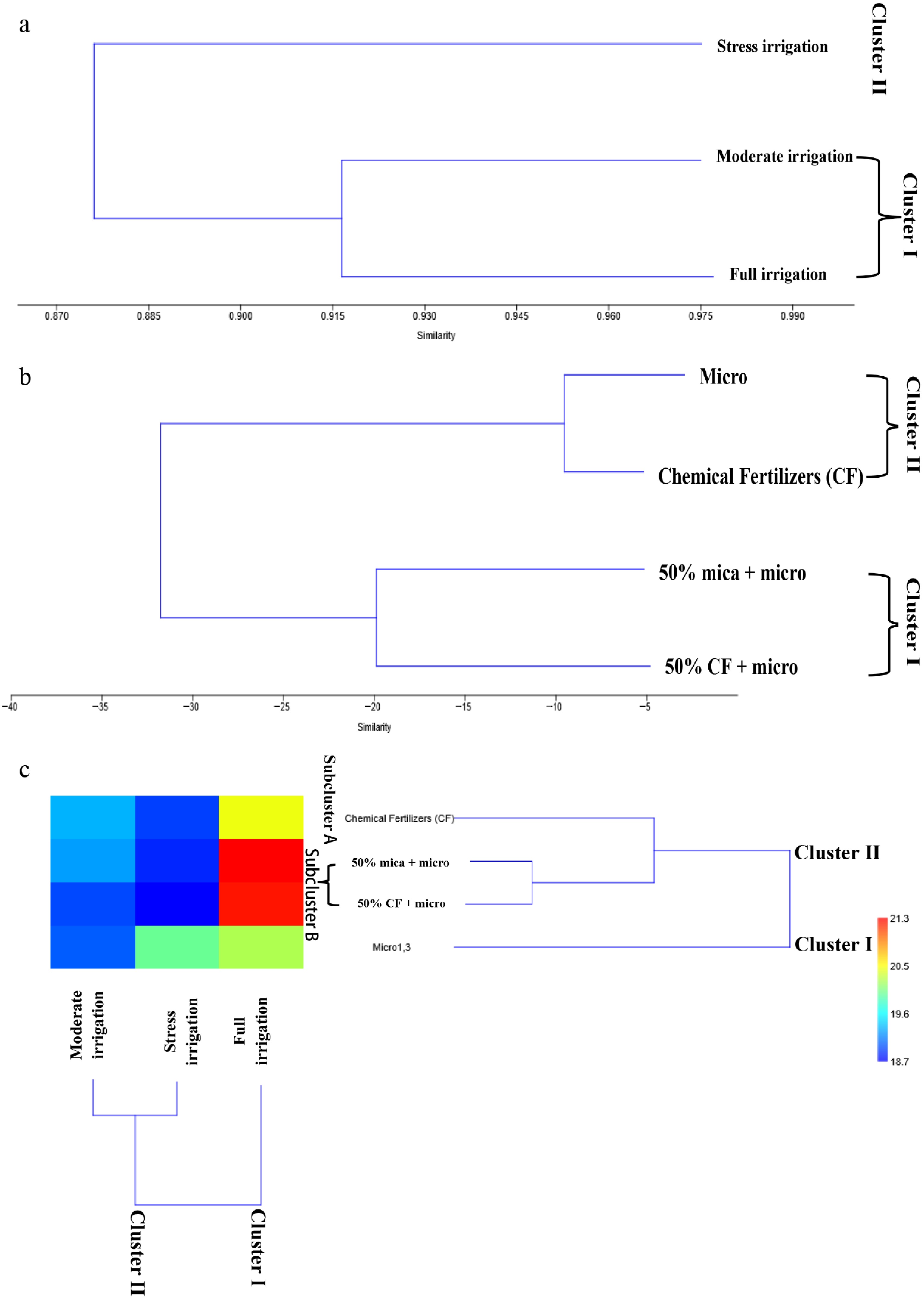
Figure 2.
Cluster analysis of (a) diverse irrigation regimes, with or without (b) Trichoderma consortium inoculation (micro) and potassium ore (mica), and (c) their interaction based on yield and yield components, irrigation water productivity, and potato tuber chemical composition, utilizing paired-group UPGMA and Bray-Curtis similarity index.
-
The utilization of irrigation water differs among various crops and water management systems, highlighting the significant impact of efficient irrigation techniques like drip irrigation. Irrigation levels significantly affect potato productivity, as optimal or near-optimal water supply generally maximizes tuber production, although moderate deficiencies may diminish yields yet improve water use efficiency in arid environments[42]. Research indicates that yield grows linearly with applied water until reaching ideal levels, after which additional water yields diminishing returns. Deficit irrigation frequently reduces yields by 7%−35%, contingent upon severity and soil type[43]. Full irrigation yields range from 46−57 t·ha−1 in trials, decreasing by 6%−14% under 25%−40% deficiencies. In sandy soils, 90% of the evapotranspiration (ETo) resulted in optimal yields with drip irrigation systems, highlighting uniform moisture distribution in the root zone. In the arid regions, optimal yields reached 46.8 t·ha−1 with a total of 180 mm of water (20 mm every 7 d), achieving a water use efficiency of up to 15.7 kg·m−3[44]. Irrigation levels markedly enhance average tuber weight. This contrasts with Wenzel et al.[45], who showed no direct correlation between irrigation amount and the mean tuber weight. Improving potato yield may result from the consortium of Trichoderma, which boosts the physical characteristics of sandy calcareous soil by facilitating organic matter decomposition, augmenting porosity, and fostering superior root development.
Irrigation treatments substantially influence NPK content in potato tubers, with complete or near-complete irrigation typically optimizing nutrient absorption, whereas moderate deficits may occasionally elevate specific nutrient concentrations but diminish overall yields[43,46,47]. Complete irrigation at 100% evapotranspiration or similar levels boosts NPK uptake in tubers by optimizing soil moisture, hence improving nutrient availability and root absorption. Research indicates that 100% ET irrigation yields superior tuber NPK concentrations compared to deficit irrigation, corresponding with trends observed in sandy soils where sustained moisture mitigates stress-induced nutrient uptake limitations[43,46,48]. Moderate deficit irrigation (e.g., 75% or 66% field capacity) may sustain or marginally increase NPK concentrations by concentrating dry matter; however, severe deficits diminish overall uptake and tuber yields by 12%−42%. Drip irrigation at 0.4−0.8 pan evaporation (PE) demonstrates no significant alteration in tuber NPK, whereas overall plant absorption increases with elevated water levels[43,46,47]. The integration of irrigation with organic amendments or nitrogen fertilization enhances NPK benefits, as demonstrated in trials where complete irrigation alongside soil conditioners increased marketable tuber yields and nutritional composition. In environments such as Egypt's sandy calcareous soils, comprehensive drip irrigation enhances NPK levels, as in a previous study on cabbage and maize. Potassium application rates of 200−400 kg·ha−1, combined with 500 mm of water input, enhance tuber quality[46,49,50]. Trichoderma species, functioning as potassium-solubilizing microorganisms, release potassium and phosphorus from natural mineral sources (like mica), converting them into forms accessible to plants. The findings indicated that the application of mica and Trichoderma consortium inoculation improved nitrogen, phosphorus, potassium, and protein concentrations in potato tubers compared to chemical fertilizers under conditions of water shortage. The fungi enhance plant resilience to abiotic challenges prevalent in sandy soils, including low water retention and high alkalinity, by promoting root stimulation and nutrient absorption.
The findings indicated that starch yield diminished due to the imposition of water deficit, whereas it was augmented by the application of potassium roe and Trichoderma consortium inoculation. Prior research has demonstrated that starch content, the primary quality criterion in starch potato food production, is genetically determined and influenced by several subordinate external factors, such as climatic conditions, water availability, soil characteristics, and fertilization[45,51−53]. Furthermore, the obtained data demonstrated a positive correlation between total yield and starch yield, while drought stress resulted in yield reduction, thereby decreasing starch yield[45]. Irrigation levels significantly affect the total carbohydrate content in potato tubers, with complete irrigation (100% ETc) often optimizing accumulation in contrast to deficiency situations. Water stress diminishes photosynthesis and the transfer of assimilates, resulting in decreased total carbohydrates, while several studies indicate a shift toward soluble sugars. Research regularly demonstrates elevated total carbohydrates with sufficient irrigation. For example, an increase from 50% to 100% ETo elevated total carbohydrates in tubers by 27.7% over two seasons. Complete irrigation (100% ET) produced a maximum of 63.8% total carbohydrates, decreasing to 50% at 50% ET[54]. Water deficiencies diminish total carbohydrates by lowering chlorophyll levels, photosynthetic activity, and the conversion of starch into sugars. Conventional farming with full water supply achieved 86.2% total carbohydrates, whereas 80% water stress reduced it to 78.2%; organic systems exhibited analogous patterns, peaking at 82.8% under extreme stress (50% ETc). Zahran et al.[55] shown that the utilization of soil conditioner markedly improved the protein, carbohydrates, vitamin C, and total phenolic content of pea seeds in comparison to chemical fertilizer. Certain reports suggest elevated levels of soluble sugars during deficits, partially offsetting overall losses[46,54,56].
Fungal potassium solubilization improves soil fertility by transforming insoluble minerals into forms accessible to plants. This method facilitates sustainable agriculture, especially in potassium-deficient soils, in accordance with bioremediation and plant growth enhancement strategies[8,57]. Fungi solubilize potassium by acidifying the environment through the generation of organic acids, including gluconic, citric, and oxalic acids, which decrease pH and dissolve minerals such as feldspar or biotite. Chelation and complexation by fungal metabolites destabilize mineral structures, whereas certain strains demonstrate redox activity to promote ion release. The synthesis of polysaccharides facilitates mineral aggregation and decomposition, hence improving efficiency[15,16,58]. These fungi enhance nutrient absorption, seed germination, and crop productivity (e.g., maize growth enhancement), hence diminishing the use of chemical fertilizers. In potassium-deficient areas, bioinoculants integrate solubilization with biocontrol, thereby reducing environmental contamination. Subsequent investigation ought to enhance strain consortia for field effectiveness[16,57,59].
Research indicated that microbial consortia containing Trichoderma had significantly enhanced efficacy in diverse agricultural applications[60]. Furthermore, the innovation of biofertilizers utilizing Trichoderma-based microbiomes not only promotes plant growth but also rehabilitates healthy soil microbiota, particularly in impoverished and degraded agricultural regions[61]. The genus Trichoderma (T. koningii, T. harzianum, T. citrinoviride, and T. viridescens) possesses the ability to solubilize insoluble potassium from minerals such as biotite and feldspar, thereby rendering it accessible for plant absorption. Trichoderma koningii and T. harzianum significantly enhanced potassium solubility, achieving a rise of up to 123% compared to controls in media such as Altomare et al.[18]. Consortia of T. asperellum, T. asperelloides, and T. harzianum were observed to enhance cucumber seedling growth more effectively than the monoculture of an individual strain[20]. The application of T. harzianum and T. virens consortia in tomato plants promotes plant growth and enhances the rhizosphere microbial population[62,63]. Generally, the application of a Trichoderma consortium in conjunction with natural potassium sources (e.g., mica) considerably enhances potato growth, tuber production, and nutrient absorption in sandy calcareous soil. Trichoderma enhances soil structure and solubilizes mineral-bound minerals, offsetting the low nutrient retention of sandy soils and improving the efficacy of natural fertilizers. Future research under diverse soil and climatic conditions is advised to confirm the reliability of the synergistic effects of Trichoderma and potassium ore, as well as their long-term implications for soil fertility, rhizosphere microbial communities, and postharvest tuber quality, thereby enhancing their integration into sustainable potato production systems.
-
This study demonstrated that the combined application of T. harzianum and T. longibrachiatum as a microbial consortium is a compatible and effective biofertilization strategy. Both isolates exhibited strong capabilities for organic acid production and potassium solubilization, particularly from mica as a natural potassium source. The consortium significantly enhanced potato growth, yield components, and tuber quality compared to conventional chemical fertilization. Importantly, the integration of 50% mica with the Trichoderma consortium improved irrigation water productivity and maintained competitive yields under moderate water deficit, highlighting its potential in sustainable and water-efficient agriculture. Additionally, the treatment positively influenced tuber nutritional composition and quality attributes, while mitigating the adverse effects of water stress. Furthermore, it enhanced the chemical and qualitative content of tubers, including nitrogen, phosphorus, potassium, protein, starch, total carbohydrates, total antioxidants, total phenols, and total flavonoids. These findings confirm that the Trichoderma consortium can serve as an eco-friendly alternative to reduce chemical fertilizer inputs and optimize crop performance under varying irrigation conditions. Future research should focus on large-scale field validation of the Trichoderma consortium across different soil types, climatic conditions, and crop systems to confirm its broader applicability. The development of stable, cost-effective bioformulations and carrier systems for long-term storage and field application is also essential. Additionally, integrating the consortium with other beneficial microorganisms could further enhance nutrient availability and stress tolerance. Exploring its role in improving plant resilience to multiple abiotic stresses, such as salinity and drought, will be valuable. Finally, long-term studies assessing soil health, microbial diversity, and environmental impacts will support the adoption of this approach as a cornerstone of sustainable and climate-smart agricultural practices.
We thank the Agricultural Research Center (ARC), Assiut, Egypt, and Assiut University, Assiut, Egypt. No available funding support.
-
The authors confirm their contributions to the paper as follows: study conception and design: Mostafa HHA, Mahmoud GAE, Hefzy M; experimental work: Mostafa HHA, Mahmoud GAE, Hefzy M; data analysis: Mostafa HHA, Mahmoud GAE, Hefzy M; draft manuscript preparation: Mostafa HHA, Mahmoud GAE, Hefzy M. All authors reviewed the results and approved the final version of the manuscript.
-
The datasets generated during and/or analyzed in the current study are available from the corresponding author upon reasonable request.
-
The authors declare that they have no conflict of interest.
- Copyright: © 2026 by the author(s). Published by Maximum Academic Press, Fayetteville, GA. This article is an open access article distributed under Creative Commons Attribution License (CC BY 4.0), visit https://creativecommons.org/licenses/by/4.0/.
-
About this article
Cite this article
Mostafa HHA, Mahmoud GAE, Hefzy M. 2026. Synergistic effects of Trichoderma consortium and natural potassium fertilization on potato quality under water scarcity in sandy calcareous soil. Circular Agricultural Systems 6: e029 doi: 10.48130/cas-0026-0027 

Synergistic effects of Trichoderma consortium and natural potassium fertilization on potato quality under water scarcity in sandy calcareous soil
- Received: 17 June 2026
- Revised: 25 August 2026
- Accepted: 27 August 2026
- Published online: 02 November 2026
Abstract: Excessive use of chemical fertilizers affects the environment and soil health, while using natural fertilizers like nutrient ores is constrained by their low solubility. To address this issue, this research aimed to evaluate the function of Trichoderma consortium in solubilizing, and releasing potassium and alleviating the effects of water scarcity in potato plants grown in sandy calcareous soil. The field experiment was performed throughout two winter seasons of 2022/2023 and 2023/2024. Three irrigation levels (Full, Moderate, and Stress Irrigation) were designated in the primary plot. The sub-plot was designated for organic treatments (T1 = Chemical Fertilizers (CF), T2 = 50% CF + micro, T3 = 50% mica + Trichoderma consortium, T4 = Trichoderma consortium); microbial inoculum concentrations were 106 spores/mL. Varying irrigation conditions revealed that water deficit significantly reduced yield components, marketable yield, and tuber quality. However, the application of 50% mica combined with the Trichoderma consortium significantly enhanced tuber number and weight, total yield, and irrigation water productivity compared to chemical fertilization. Notably, this treatment achieved yield improvements of up to 34.7% and increased water productivity by 42.3% over two seasons. Under moderate irrigation, the consortium-based treatment maintained yields comparable to full irrigation with chemical fertilizers, indicating its potential for water-saving agriculture. Biochemical analysis revealed that water stress increased antioxidant compounds, while the consortium treatment promoted higher carbohydrate accumulation under optimal irrigation. Overall, the Trichoderma consortium represents a promising eco-friendly biofertilizer strategy for enhancing potassium availability, improving crop productivity, and increasing water use efficiency under limited irrigation conditions.
-
Key words:
- Ground rock /
- K-solubilizing microorganisms /
- Organic agriculture /
- K-availability