













-
More people are living with and beyond cancer than ever before[1]. It is estimated that 5% of the European population are currently living beyond a cancer diagnosis[2]. As many cancers have become more treatable, some of the 'work' of managing cancer has shifted from health professionals to patients and families[3,4]. Those managing cancer are often asked to take on a significant degree of healthcare workload, such as planning and attending appointments, managing side-effects and medication regimens, monitoring for signs of possible recurrence, and making dietary or lifestyle changes. Treatment burden is an emerging concept that does not have one single definition[5]. Broadly, treatment burden is referred to as the workload of healthcare and self-management and the impact of this work on functioning and wellbeing[6−8].
Treatment burden results from an imbalance between a patient's treatment or self-management workload and their capacity to manage this workload[5]. Importantly, treatment burden is related but conceptually distinct from illness or symptom burden, which is the negative impact of a new diagnosis or the experience of symptoms and side-effects, rather than treatment and self-management tasks[9]. Compared with other burdens associated with cancer, treatment burden has been understudied. However, there is evidence that treatment burden in other long-term conditions can lead to treatment nonadherence, and poorer quality of life and may drive inequities in health outcomes, particularly when there is multimorbidity[3,4,6–8].
Sav et al.'s conceptual framework[10] identified six important dimensions of treatment burden – financial burden, time and travel burden, medication burden, healthcare burden, lifestyle burden, and administrative burden. Financial burden and time burden have been well described and investigated in cancer[11−16]. Qualitative studies have also established the importance of time burden and other healthcare burdens in cancer and suggest that treatment burden might be experienced differently in cancer compared with other long-term conditions[17,18]. It is important that treatment burden in its entirety can be quantified in cancer. This requires an understanding of how existing measures have been applied to people with cancer and their suitability, comprehensiveness, and validity for cancer populations.
Although there are aspects of treatment workload (number of medications or healthcare encounters) that can be captured from routinely collected data, treatment burden is a subjective experience and can only be measured by self-report[9,19,20]. Patient-reported outcome measures (PROMs) of treatment burden have been developed and validated for multimorbidity and various long-term conditions[19,21,22]. Three main measures are used across long-term conditions and multimorbidity – the Treatment Burden Questionnaire (TBQ)[22], the Patient Experience with Treatment and Self-Management (PETS) Questionnaire[19], and the Multimorbidity Treatment Burden Questionnaire (MTBQ)[21]. Items ask about the problems or difficulty associated with different healthcare tasks (e.g., taking medications; arranging and attending lab tests, exams, and appointments; self-monitoring). The PETS also asks about the impact of self-management on mood and emotions (e.g., frustration, depression etc.). The TBQ consists of 15 items assessed on a 10-point Likert scale ('not a problem' to 'very big problem'). The PETS consists of 48 items within 9 domains assessed on a 5-point Likert scale (very easy–very difficult). The MTBQ consists of 10 items (and 3 optional items) assessed on a 5-point scale (not difficult at all-extremely difficult). These measures differ in their development, length, and content. It is essential that PROMs capture aspects of treatment burden that are important in different populations. Adaptations to existing measures for specific populations (i.e., those with cancer) may be required.
To date, relatively few studies have formally evaluated whether there are benefits to measuring and integrating treatment burden PROMs in cancer care. There is strong evidence that the integration of PROMs more broadly in cancer care improves several outcomes such as pain, quality of life and mortality[23,24]. Collecting PROMs can help clinicians to identify symptoms, problems, and unmet needs. The resultant clinical actions and interventions can, in turn, improve outcomes[20,21]. It is possible that routinely integrated treatment burden PROMs could identify patients who are experiencing difficulties with treatment or self-management and allow clinicians to address and reduce treatment burden through-evidence based interventions.
Treatment burden PROMs have mainly been applied in multimorbidity research, but there has been limited research on their use specifically after cancer[19,21,25,26]. To the best of our knowledge, there are no cancer-specific treatment burden PROMs. It is not clear how the current generic PROMs are being used to quantify and understand treatment burden after cancer[26], whether these measures have adequate psychometric properties, or whether they are suitable for people living with and beyond cancer. We also lack an understanding of the prevalence and severity of treatment burden among people living with and beyond cancer, or factors that might increase or protect against treatment burden in this population. It is feasible that high levels of treatment burden could lead to poorer health outcomes after cancer[17].
This systematic scoping review aims to:
(a) Identify and explore PROMs which have been used to measure treatment burden in people living with and beyond cancer;
(b) Understand the psychometric properties (validity and reliability) of these PROMs;
(c) Synthesise the results from studies to report the prevalence, severity, and factors associated with treatment burden after cancer.
-
The review followed Arksey & O'Malley's framework[27] for scoping reviews. The Preferred Reporting Items for Systematic reviews and Meta-Analyses extension for Scoping Reviews (PRISMA-ScR) checklist informed the design, conduct, and reporting of the review (Supplementary File S1). The protocol was preregistered on the Open Science Framework (
https://osf.io/59v8g/?view_only=b0424d132853415289b7e15e3141073c ).The first stage of this review was to systematically identify all the studies that used, developed, or validated treatment burden PROMs in any long-term condition. This first step was necessary to ensure that relevant cancer studies would not be missed and to identify the literature relating to the development and validation of the PROMs used in the cancer studies. Here, we focus on studies which were conducted in people living with and beyond cancer.
Literature search and inclusion criteria
-
Medline (Ovid), CINAHL (EBSCO), Web of Science (Clarivate), Embase (Ovid), and PsycINFO (Ovid) were searched. A search strategy was informed by previous reviews[6,10,26,28] and devised in consultation with a senior medical librarian. The full search strategy can be found in in Supplementary File S2. Inclusion and exclusion criteria are detailed in Table 1.
Table 1. Inclusion and exclusion criteria.
Inclusion criteria Exclusion criteria Studies in people living with and beyond cancer Qualitative research, literature reviews, unpublished work, grey literature or work not published in peer-reviewed journal, conference abstracts, randomised controlled trials (RCTs) or studies where treatment burden is measured as a primary or secondary outcome of an intervention. Published from 2000 to current in English Studies in which a measure of treatment burden is described but the items included in the measure are not reported or available. Any geographical location Studies that measure the burden on caregivers, healthcare professionals, health services and systems, or economic burden, where patient treatment burden is not reported separately. Studies that describe the use, development, or validation (including assessing the psychometric/measurement properties) of a patient-reported subjective measure of treatment burden (i.e., not simple counts of pills, medications, costs, or clinician-assessed treatment burden). Full measures, subscales, and single items which met the definition of treatment burden – 'the workload of healthcare and the impact on functioning and wellbeing'[29] – were included, as well as measures that assess only one dimension of treatment burden if this definition is met. Studies where a measure of treatment burden is not used, developed, or validated. Participants are individuals over 18 years of age. Studies that only examine illness burden, symptom burden, or other health/medical burdens where treatment burden is not reported separately. Quantitative research or mixed-methods studies that have a distinct quantitative component Screening
-
Database searches were imported into Refworks Proquest (
https://refworks.proquest.com ) and duplicates were removed. Additional duplicates were removed using Rayyan (www.rayyan.ai ). Rayyan software was also used to support article screening.The first author (LD) screened all titles and abstracts and screened out conference abstracts, records for which full abstracts could not be found, and duplicates that had not been captured by automatic de-duplication. Twenty-five percent of the remaining records were collectively screened by the other study authors (RA, DD, and JA). There was full agreement on 91.6% on the records which were double-screened. The lead author re-reviewed all abstracts where there was a disagreement or uncertainty and discussed these discrepancies with the review team. Full texts were sought for all articles that were marked as 'include' or 'maybe' by at least one author.
Full texts were screened by LD. During full texts screening, we automatically included papers which used any of the three widely used measures, the TBQ[22], the PETS questionnaire[19], and the MTBQ[21], without second screening as long as they met our other inclusion criteria. This was deemed appropriate by the authors, as the decision to include or exclude the paper did not involve any judgement over whether the measure met the definition of treatment burden. Studies which used a measure other than the PETS, MTBQ, or TBQ were collated. The measures from these papers (rather than the original papers themselves) were circulated among all study authors, who screened the measures independently and then met to discuss their inclusion until agreement was reached. In addition, any papers where the first author was uncertain about its inclusion were discussed with another author until agreement was reached.
Data extraction/charting and synthesis
-
As part of the synthesis process, we used the categorisation of PROMs proposed by Sav et al.[10]. Table 2 describes the categories that the PROMS/studies were grouped into, with examples.
Table 2. Categorisation of PROMs according to Sav et al.[10].
Categorisation Description Example Direct PROMs PROMs/studies that explicitly mention and comprehensively measure treatment burden The Patient Experience with Treatment and Self-Management (PETS) questionnaire which explicitly mentions treatment burden and assesses all six domains Inferred PROMs PROMs/studies that mention 'treatment burden' but only measure one or two domains/dimensions The European Organisation for Research and Treatment of Cancer quality of life questionnaire elderly cancer patients module (EORTC-QLQ-ELD14), which includes a two-item illness/treatment burden subscale Indirect PROMs PROMs/studies that do not mention 'treatment burden'
(or a domain of treatment burden) explicitly but measure one or two dimensionsThe Treatment Satisfaction with Medication Questionnaire (TSQM) which includes a three-item 'convenience' subscale A data extraction guide (Supplementary File S3) and a Microsoft Excel template were created to support data extraction. Data extraction was conducted by LD. Extraction of the psychometric properties was guided by the COnsensus-based Standards for the selection of health Measurement Instruments (COSMIN) taxonomy, reporting guidelines, and checklist[30−32], which detail the psychometric properties that should be assessed for PROMs. We did not aim to assess the psychometric properties' quality but to describe which have and have not been reported to date. Double-extraction was not conducted, but the extracted data were carefully checked by LD.
-
The PRISMA diagram is shown in Fig. 1. Database searches carried out in February 2023 yielded 8210 records. After duplicates were removed, 4,886 titles and abstracts and 265 full texts were screened. of these, 164 full texts described treatment burden PROMs in any long-term condition. An updated search of MEDLINE in November 2024 identified an additional 38 full texts. Of the 202 full texts, 21 papers focused on individuals living with and beyond cancer and are included in this review.
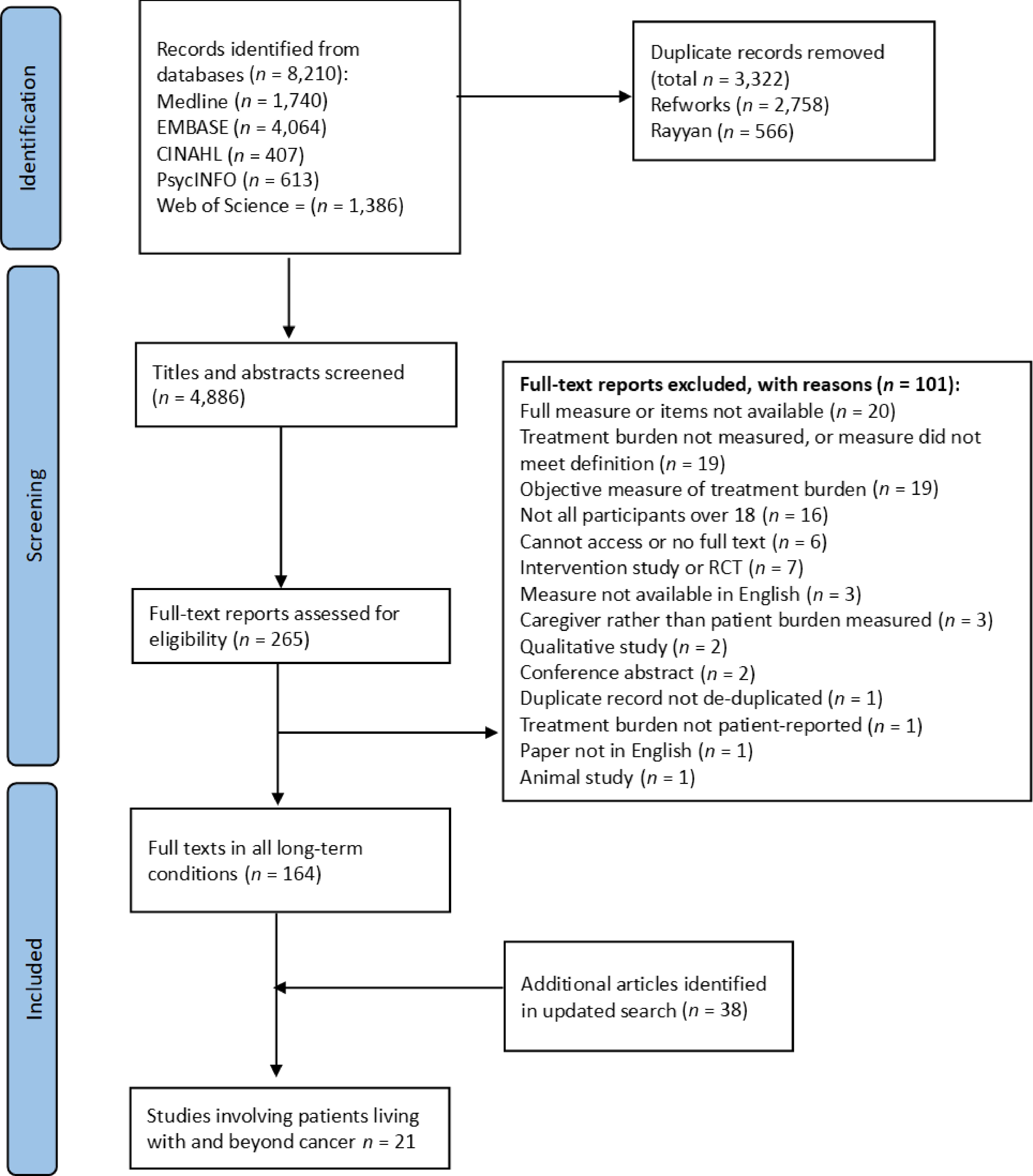
Figure 1.
PRISMA flow diagram of the study inclusion process.
Characteristics of included studies
-
All studies were published between 2019 and 2024, except for one study, which was published in 2013. The number of studies using treatment burden PROMs in cancer has increased since 2019.
The sample characteristics of the included studies are summarised in Supplementary Table S1. There were 8,312 participants across the studies. Two studies[33,34] reported on the same sample but answered distinct research questions. The median/mean age of the samples ranged from 31.5 to 78.9. Most (n = 16) studies were conducted in the USA[35−50], three studies[33,34,51],including two studies reporting on the same sample, were conducted in Norway, one study was conducted in Germany[52], and one in China[53].
Studies were conducted in people living with or beyond prostate cancer (n = 3)[35,38,52], colorectal cancer (n = 3 papers [including two on the same sample])[33,34,49], bladder cancer (n = 2)[48,50], head and neck cancer (n = 1)[37], breast cancer (n = 2)[42,51], multiple myeloma (n = 1)[44], glioma (n = 1)[40], gastrointestinal cancer (n = 1)[47], ovarian cancer (n = 1)[45], and testicular cancer (n = 1)[43]. Five studies included participants living with or beyond mixed or unspecified cancer types[36,39,41,46,53].
The reporting of demographics was inconsistent across studies, with some studies omitting the collection or reporting of certain demographics. Most studies had mostly White samples. Eleven studies reported on the employment status of the participants and most participants were retired or employed full-time. The average household income was generally high, with few participants reporting financial insecurity. The studies mainly sampled highly educated participants. Few studies reported on urban/rural status, but in studies that reported place of residence, most participants lived in urban areas or close to where they received treatment.
Included PROMs
-
A summary of the included PROMs and the treatment burden domains they assess is shown in Table 3. Detailed data on the included PROMs is provided in Supplementary Table S2.
Table 3. The domains of treatment burden assessed in each study and PROM according to Sav et al.'s[10] framework of treatment burden.
First author Patient-reported outcome
measure (PROM)Domains of treatment burden Financial Medication Administrative Lifestyle Healthcare Time/travel Other Other domains Aghdam[35] EORTC-QLQ-ELD14 ✓ Anderson[36] PETS (subscales) ✓ ✓ ✓ ✓ Emotional impact Bath[47] PETS ✓ ✓ ✓ ✓ ✓ ✓ ✓ Emotional impact Beeler[37] Two bespoke financial burden items and COST ✓ Eton[46] PETS (subscales) ✓ ✓ Emotional impact Garg[48] TBQ ✓ ✓ ✓ ✓ ✓ ✓ Greenup[42] Bespoke ✓ Haider[40] MEPS-Household Component ✓ ✓ Husebø[34] PETS ✓ ✓ ✓ ✓ ✓ ✓ ✓ Learning about treatment
Emotional impact
Side-effectsHusebø[33] PETS ✓ ✓ ✓ ✓ ✓ ✓ ✓ Learning about treatment
Emotional impact
Side-effectsKarimzadeh[52] EORTC-QLQC30 ✓ ✓ Kircher[49] COST ✓ Kent[39] Bespoke ✓ Myers[50] Bespoke ✓ ✓ Philp[45] EORTC-QLQC30 and EORTC-OV28 ✓ ✓ Rifkin[44] Convenience subscale of TSQM-9 ✓ Saoud[43] EORTC-QLQC30 ✓ ✓ Smedsland[51] EORTC-QLQC30 ✓ ✓ Stone[38] Bespoke ✓ Xiao[53] TBQ and COST ✓ ✓ ✓ ✓ ✓ ✓ Yucel[41] SEQ-G-CSF ✓ ✓ ✓ ✓ ✓ Total papers 21 16 8 7 15 6 6 5 Learning about treatment
Emotional impact
Side-effectsEORTC-QLQ-ELD14, European Organisation for Research and Treatment of Cancer quality of life questionnaire elderly cancer patients module; PETS, Patient Experience with Treatment and Self-Management; COST, COmprehensive Score for financial Toxicity; TBQ, the Treatment Burden Questionnaire; TSQM-9, the Treatment Satisfaction Questionnaire for Medication-9; SEQ-G-CSF, the Satisfaction and Experience Questionnaire for Granulocyte Colony-Stimulating Factor; MEPS-Household Component, Medical Expenditure Panel Survey - Household Component; EORTC-QLQC30, European Organisation for Research and Treatment of Cancer Quality of Life Questionnaire Core; EORTC-OV28, European Organisation for Research and Treatment of Cancer Quality of Life Questionnaire Ovarian Cancer Module. Seven studies[33,34,36,47,48,53] used direct PROMs that are explicitly designed to capture and quantify treatment burden. Of these, five studies used the PETS questionnaire[33,34,36,46,47]; two of these used specific subscales from the PETS[36,46], and two studies (with same sample) used the Norwegian translation of the PETS[33,34]. Two studies used the TBQ[48,53], one of which used the Chinese translation of the TBQ[53]. Notably, we did not identify any studies which used the MTBQ, a treatment burden PROM developed in the UK and commonly used in multimorbidity and other long-term conditions[21,54,55].
Three studies[35,42,50] used inferred PROMs that mention treatment burden but were either not explicitly designed to measure it or only measured specific domains. One study used the European Organisation for Research and Treatment of Cancer quality of life questionnaire elderly cancer patients module (EORTC-QLQ-ELD14), which has a single treatment burden item[35]. One study used a bespoke financial burden item[42] and one study used a bespoke measure which included two items, assessing financial and lifestyle burden[50].
Eleven studies[37−41,43−45,49,51,52] used indirect PROMs which do not explicitly mention treatment burden but measure at least one domain of treatment burden. For example, one study used the Treatment Satisfaction Questionnaire for Medication-9 (TSQM-9), which includes a three-item convenience subscale[36] that measures aspects of treatment burden. Details of the indirect PROMs can be found in Supplementary Table S2.
Domains of treatment burden assessed by PROMs
-
Table 3 demonstrates the domains of treatment burden (from Sav et al.[10]) assessed in each of the included studies. The domain most commonly assessed across the included studies was financial burden in 16 studies[33,34,37−40,42,43,45,47−53], followed by lifestyle burden (e.g., constraints associated with changing behaviours such as diet, exercise, or social constraints) (15 studies[33−36,40,41,43−48,50−53]), medication burden (8 studies[33,34,36,41,44,47,48,53]), administrative burden (7 studies[33,34,36,41,47,48,53]), time/travel burden (6 studies[33,34,41,47,48,53]), and healthcare burden (6 studies[33,34,41,47,48,53]). Some PROMs assessed general or overall treatment burden (e.g., 'How much has your treatment been a burden to you?' from the EORTC-QLQELD14[35]), and there were other domains of treatment burden not specified in Sav et al.'s framework assessed by the PETS[33,34,36,46,47]. These include learning about treatment; treatment side-effects; and the emotional impact of treatment or self-management. The most comprehensive measures were the PETS and the TBQ, which both assessed all six domains of Sav et al.'s framework[10].
Psychometric properties of PROMs
-
There were very limited data on the psychometric properties of treatment burden PROMs in cancer populations. Anderson et al.[36] assessed the face validity of the PETS using focus groups in which the participants were asked to discuss the self-management activities they do. The results of these focus groups were not described in detail, but these discussions were used to inform a set of items used in the study. No further information on the face validity was reported.
Aghdam et al.[35] examined the convergent validity of the EORTC QLQ-ELD14 treatment burden subscale by comparing it with domains of the Expanded Prostate Cancer Index Composite (EPIC-26)[44], a health-related quality of life instrument for prostate cancer. This study reported sufficient convergent validity, with correlations between the treatment burden subscale and domains of the EPIC-26 exceeding 0.35.
Yucel et al.[41] developed the Satisfaction and Experience Questionnaire for Granulocyte Colony-Stimulating Factor (SEQ-G-CSF) and assessed the relevance of the items for people with cancer. Average relevancy of these items ranged from ~2 to 4 (possible range: 1 = not important to 5 = extremely important), but no other information was reported.
Supplementary Table S1 details whether the PROM used in each study had been validated in the country the study was conducted. Most studies used PROMs that were originally developed or had been validated in the country they were conducted. However, some studies used PROMs that had been translated or culturally adapted (in papers not included in this review) but it is unclear if these translated PROMs underwent further psychometric validation[33,34,53].
Treatment burden findings
Prevalence and severity of treatment burden
-
A summary of the treatment burden findings alongside details of the demographics of the study samples can be found in Supplementary Table S1. Treatment burden was generally low to moderate, with small proportions of the study samples experiencing a significant burden. The items or domains of treatment burden rated to be most burdensome for participants were those related to accessing healthcare services, such as arranging and attending appointments.
Patient Experience with Treatment and Self-Management (PETS)
-
Three of the five studies using the PETS measure reported mean subscale scores[34,36,47]. Anderson et al.[36] reported a mean PETS difficulty score of 1.9 (possible range: 1–5, a higher score indicates greater difficulty) and a mean PETS impact score of 19.1 (possible range: 0–100, a higher score indicates greater impact), indicating low to moderate treatment difficulty and impact. These scores were calculated by summing the scores of different PETS subscales (further details in Supplementary Table S2). The highest mean subscale scores were reported for difficulty with healthcare services, medical expenses, role/social activity limitations, and physical/mental exhaustion. Husebø et al.[34] reported mean subscale scores of 0–33 (possible range: 0–100) with the highest scores for medical information, difficulty with healthcare services, and physicial/mental exhaustion, indicating low to moderate treatment burden.
Treatment Burden Questionnaire (TBQ)
-
Two studies used the TBQ, but one study did not report TBQ scores for the sample[53]. Garg et al.[48] reported an overall mean score of 15.8 (possible range: 0–150) indicating low levels of treatment burden. The highest rated items in this study were financial burden, doctor's visits/appointments, lab tests/exams, and arranging appointments.
Other PROMs
-
Using the EORTC-QLQ-ELD14, Aghdam et al.[35] reported low overall treatment burden. Across all follow-up points (1, 3, 6, 12, 18, and 24 months post-radiotherapy) only 3%–6% of participants reported treatment burden as 'quite a bit' or 'very much'. Greenup et al.[42] reported a high prevalence of financial burden, with 20% of the sample reporting significant or catastrophic financial burden as a result of treatment. Myers et al.[50] reported the high prevalence of lifestyle burden (26% of respondents felt that treatment for bladder cancer adversely affected their ability to perform daily activities) and a moderate prevalence of financial burden (7.1% reported that they had cancelled, skipped, or missed a bladder instillation because of the cost of treatment).
Change in treatment burden over time
-
Only one study[35] reported data about change in treatment burden over time following radiotherapy. In this study, though there was not a statistically significant change in treatment burden across the 24-month study period, treatment burden was highest 1 month following radiotherapy (6.3% of participants reporting treatment burden as 'quite a bit' or 'very much'), and 5.4% of participants remained burdened 24 months after radiotherapy.
Factors associated with treatment burden
-
Across the included studies, there were demographic, social, psychological, health-related, and treatment-specific factors that were associated with treatment burden.
Demographic factors
-
Higher levels of treatment burden were associated with younger age[34], being female[34], a lower household income or financial insecurity[36,42], lower levels of formal education[34,42,46], non-White race[42,44], and unemployment[34,36].
Social and psychological factors
-
Higher levels of treatment burden were associated with lower levels of social support[46] and living alone[34]. In addition, higher levels of treatment burden were associated with lower health literacy[36], a lack of self-management routine[46], and lower self-efficacy for managing chronic conditions[46].
Health-related factors
-
Higher treatment burden was associated a higher number of comorbidities[34,36], higher cancer-related fatigue[33], having a mental health condition (anxiety, depression, or both)[46], frailty[48], and more urinary symptoms (among patients with bladder cancer)[48]. One study reported that treatment burden was associated with a less advanced cancer stage[34].
Treatment-specific factors
-
Only two studies reported on treatment-specific factors. Higher levels of treatment burden were associated with receiving chemotherapy[42] and receiving injectable treatment (compared with oral therapy)[44].
Health outcomes associated with treatment burden
-
There was limited exploration of the relationship between treatment burden and health outcomes. Anderson et al.[36] reported that treatment burden had a mediating role between the number of comorbidities and general physical and mental health. Eton et al.[46] reported a relationship between higher treatment burden at baseline and poorer health-related quality of life at 6 months. No studies examined the relationship between treatment burden and outcomes such as adherence to treatment, health behaviours, hospital admissions, or mortality.
-
In research quantifying treatment burden in cancer using PROMs, treatment burden was generally reported to be low to moderate. Small proportions of the samples experienced significant burdens, particularly financial and lifestyle burden. The included studies reported associations between higher treatment burden and several demographic, health-related, treatment-specific, social, and psychological factors. These included younger age, financial insecurity, non-White race, receipt of intensive treatments such as chemotherapy, higher comorbidity burden, and more severe cancer-related symptoms. Most of these groups and characteristics were underrepresented in the existing research. It is therefore likely that research to date has underestimated treatment burden among people living with and beyond cancer.
The main PROMs that directly measure treatment burden in cancer were the PETS[19] and TBQ[22], though their use in cancer has been limited. No studies used the MTBQ, a commonly used multimorbidity treatment burden PROM[21]. There has been very limited psychometric testing or adaptation of treatment burden PROMs for cancer populations. A variety of other PROMS which measure certain domains of treatment burden have been used after cancer (e.g., financial toxicity), but many of these measures were not designed to assess treatment burden comprehensively. Therefore, it is difficult to draw clear conclusions about treatment burden from these studies.
Comparison with previous literature
-
Two previous reviews have investigated treatment burden in cancer. Sav et al.[11] investigated treatment burden in cancer survivors aged over 65 and reported that time and financial burden were the key issues. Our review finds similar moderate to high levels of financial burden but identifies other important domains of treatment burden after cancer. For example, healthcare burden (e.g., attending appointments) was common and often high. Sav et al.[11] noted that a limitation of the literature included in their review is that it focused on only one or two dimensions of treatment burden, mainly financial and medication burden. Our review has captured more recent studies and studies that have used more comprehensive PROMs assessing multiple domains of treatment burden (e.g., healthcare burden).
Our previous review of the qualitative literature[17] identified that individuals from ethnic minority backgrounds, those facing financial insecurity, and those with limited social support were at risk of treatment burden after cancer. These factors were also identified as important among the quantitative studies in this review; however, the studies did not sample sufficient participants who might be at a higher risk of treatment burden. The quantitative studies in this review did not capture more nuanced aspects of treatment burden specific to cancer identified in the qualitative literature, such as differences between cancer site and stage or the role of stigma or perceptions about time becoming more precious in people with limited life expectancy[17].
In the studies included in our review, younger age was generally associated with a higher treatment burden. Age is likely to be inter-related with other factors that impact on treatment burden. For example, younger adults may experience greater financial, work-related, and social disruption[56] alongside competing priorities (e.g., childcare responsibilities, full-time employment) which increase treatment workload and reduce capacity[11,57]. Perceptions of time burden were important themes in both Sav et al.'s[11] and our previous qualitative review[17]. Time burden might be more socially acceptable in later life and, as a result, the same levels of time workload might be perceived as more burdensome by younger adults[11]. Importantly, treatment burden is also influenced by the extent that treatment or self-management impacts a person's identity[58]. Younger adults might experience greater biographical disruption when living with life-threatening or long-term conditions, as illness and ongoing treatment conflict with their expectations of health and functioning[59−61].
Compared with the cancer studies in this review, higher levels of treatment burden have been reported in other conditions such as chronic kidney disease[62] and coronary heart disease[63], long-term conditions generally[64−66], and multimorbidity[54,67−70]. One possibility is that people with cancer experience less treatment burden than those with heart or kidney disease or multimorbidity. However, a more likely explanation is that the studies in this review and/or the PROMs may be underestimating the treatment burden in cancer populations. In addition, as demonstrated in qualitative literature[17], cancer site and stage will play a role in the level of treatment burden. Many common cancers may be curable with limited treatments (such as surgery), and though a range of cancer sites were included in this review, it is likely that studies focusing on rarer or advanced cancers which are managed with more complex treatments would report higher levels of treatment burden.
Financial and time toxicity research has also found high levels of financial and time burden after cancer[8,10]. Financial and time toxicity are typically operationalised using objective measures such as number of days of healthcare contact[15], cost of treatment[14], number of hours spent managing side-effects, or number of days of missed work[16]. This contrasts with PROMs which assess a patient's subjective perception of the burden of healthcare and self-management. The differences in reported levels of treatment burden between these types of measurement echo and emphasise what is described by treatment burden theories, namely that objective treatment workload (e.g., time or cost of treatment) will not necessarily equate to subjective treatment burden (which is assessed by PROMs). It is possible that the current treatment burden PROMs are not adequately capturing key aspects of treatment burden that are important to individuals living with or beyond cancer. This review highlighted the lack of cancer-specific PROMs and a lack of research exploring the psychometric properties of existing PROMs for cancer populations. Further, as objective measures can be captured from routinely collected data, they are not subject to the sampling limitations highlighted by the current review and are less likely to underestimate treatment burden. These issues make a case for both improving the current PROMs or developing new cancer-specific PROMs, as well as using a combination of objective and subjective measures to ensure accurate estimations of treatment burden in cancer.
Though attention has been given to treatment burden in multimorbidity and other long-term health conditions in Europe[54,55,71−73], it is interesting to reflect that most treatment burden research in cancer has been conducted in the USA. One reason may be the additional financial burdens posed by the US healthcare system, and most studies report significant levels of financial burden. The level of financial burden experienced in nations with universal healthcare systems may not equate to that in the USA, but this merits further consideration. Similarly, there may be differences in how cancer, as a health condition, is considered and managed in the USA versus other nations. There have been significant efforts to improve care in the USA through the development of cancer survivorship guidelines and specialised cancer survivorship programs[74]. These programs consider cancer survivors to be anyone living beyond a cancer diagnosis[75]. This contrasts with care in the UK, where cancer does not receive lifelong follow-up, as is the case for conditions such as diabetes, asthma, and hypertension[76]. These differing models of healthcare could impact on perceptions of treatment burden and highlight the need for research across a wider range of countries and healthcare systems.
Implications for research and practice
-
The first priority is to firmly establish the conceptualisation of treatment burden within oncology, anchoring the concept theoretically and defining the distinctive features of treatment burden in cancer care. The next step is to reach a consensus on what to measure and how best to measure it. Treatment burden measurement strategies must be sufficiently validated and contextually appropriate. For example, it is still unclear whether generic PROMs can adequately capture treatment burden in cancer populations or whether cancer-specific PROMs are needed. Evaluation of PROMs' acceptability, feasibility, and timing will be crucial for clinical integration. Measuring treatment burden could paradoxically increase the patient burden, particularly in those with fatigue, distress, or cognitive symptoms related to cancer and its treatment. Clear standards for reporting treatment burden PROMs should also be established so that new and existing evidence can be more readily synthesised.
A major limitation of the existing literature reviewed here and previously in stroke survivors[28] is that few or no studies have captured changes in treatment burden over time. Though there are illness trajectories in other illnesses, changes in treatment burden over time are likely to be particularly salient among individuals living with or beyond cancer. There are key transitions and phases of cancer which may impact on perceptions of treatment burden[77,78]. An understanding of the fluctuations in treatment burden will be key for understanding when intervention or additional support may be needed, and for designing interventions to manage treatment burden. Similarly, there is a major gap in our understanding of the relationship between treatment burden and important health outcomes. Only one study in the current review reported a relationship between increased treatment burden and lower quality of life[36]. Robust longitudinal research and the integration of treatment burden PROMs into routinely collected data would allow us to investigate the relationships between treatment burden and key outcomes such as healthcare use, adherence to medication, disease progression, and mortality.
This review highlighted a lack of diversity in research on treatment burden in cancer to date. Future research should focus on addressing issues of equity in both the measurement of treatment burden and the application of treatment burden PROMs. Most studies were conducted in the USA and did not include individuals who might be at the highest risk of burden. The over-representation of relatively affluent, highly educated, and predominantly White populations in the existing evidence also raises important concerns about the cultural validity of existing PROMs. Future research and PROM development and validation should therefore prioritise the inclusion of participants from diverse backgrounds, such as younger people, individuals from ethnic minority groups, those experiencing financial insecurity, and individuals unable to work because of illness or disability.
There are several potential strategies for increasing diversity in study samples. These include recruiting from existing databases or patient lists (e.g., clinics), advertising in locations visited by participants (e.g., posters), in-person recruitment for those who may be digitally excluded, and recruitment by referral (whereby participants pass on study information to others)[79]. To address language barriers, efforts should also be made to translate existing PROMs, and researchers should involve patients and members of the public in the study design to ensure the accessibility of the study materials.
In individuals where treatment burden is high, there is a need for interventions which address this burden. No studies have focused specifically on treatment burden interventions in cancer, but some interventions used more widely have been described. For example, the PETS-Now tool (based on PETS items) assesses treatment burden in people with multimorbidity and shares this information with healthcare professionals in primary care[80]. Initial evaluations of the tool did not show significant improvements in quality of care, but overall views on the tool were positive, which demonstrates that there may be potential in routinely monitoring treatment burden if this is linked to evidence-based interventions or clinical actions.
Beyond the identification of those with a high treatment burden, there is a need for further research to develop and evaluate interventions focused specifically on reducing treatment burden. Two reviews have summarised interventions more broadly[81,82]. Lesage et al.[81] reported that interventions focused on reducing aspects of treatment workload such as changing medications, simplifying medical devices, or changing care processes (e.g., receiving some therapies at home) demonstrated improvements in treatment burden. Polus et al.[82] reviewed studies describing digital interventions which offer support with self-management, information provision, and improve ease of contact with healthcare professionals. Some of the interventions improved treatment burden directly, whereas others improved related factors such as motivation for treatment and treatment satisfaction[82]. Within the cancer literature, there are several interventions which address treatment burden but without articulating or recognising that treatment burden plays a central role. For example, patient navigators who support patients (usually those experiencing language barriers or socioeconomic deprivation) throughout and beyond treatment have a particular focus on improving access to care (an aspect of treatment burden). Patient navigators have demonstrated improvements in treatment adherence, treatment satisfaction, and quality of care[83]. It is possible these effects are mediated through reductions in treatment burden. Treatment burden might therefore be an important outcome to consider in clinical trials and evaluations of interventions, particularly with the goal of understanding the mechanisms by which outcomes such as quality of life are improved. In addition, it is possible that new treatments or interventions could have unintended effects on treatment burden, and it is important that we evaluate and understand these effects.
Strengths and limitations
-
This review was conducted using a systematic scoping approach, and the screening of studies followed a rigorous process by the study authors. This was the first attempt to comprehensively synthesise studies which quantify treatment burden after cancer, and the inclusion of studies that both directly and indirectly assessed treatment burden allowed for a broader synthesis of how treatment burden is currently operationalised in cancer populations. The review mapped PROMs onto existing treatment burden domains, which allowed us to demonstrate the key areas of attention and gaps in the literature.
The review is limited in part by the limitations of the included literature. Most studies were conducted in high-income countries, particularly the USA, and most participants were White, highly educated, working full-time or retired, and living in urban areas. This is likely to have led to an underestimation of treatment burden. We only included papers in the English language, and it is possible that other relevant papers that would add to our understanding of treatment burden in non-English language settings have been missed. Although most studies used PROMs that were developed or validated in the country the study was conducted, some used translated PROMs that may have not undergone further psychometric validation. This limits the applicability of some of the included studies. Finally, the review is limited by the high levels of heterogeneity across the included studies. There were multiple sources of heterogeneity – reporting of sample characteristics, the PROMs utilised, and the reporting of PROM results – which created significant challenges for synthesising and making comparisons across studies. Nevertheless, the scoping review methodological approach was chosen to capture this heterogeneity and to describe the broad range of existing studies.
-
The included studies reported varying levels but generally low to moderate treatment burden in people living with and beyond cancer. Because of sampling and measurement limitations, these levels might reflect an underestimation rather than true patient experience. Increased treatment burden may be associated with younger age, non-White race, multimorbidity, and financial insecurity. There is still an underutilisation of existing, validated treatment burden PROMs after cancer, and a lack of evidence on the psychometric properties of these PROMs for cancer populations. Future work should focus on conducting robust cross-sectional and longitudinal studies which make comparisons across different cancer sites, stages, and points in the treatment trajectory and which explore the relationship between treatment burden and important health outcomes such as treatment adherence, healthcare utilisation, and mortality. This work should include diverse samples and those at the highest risk of treatment burden.
The authors would like to thank Melanie Bickerton, Information Consultant for Medicine, Dentistry and Medical Sciences for her assistance with database search strategies.
-
Not applicable.
-
The authors confirm their contributions to this study as follows: conceptualisation, methodology, data curation, writing – review & editing: Duncan L, Dixon D, Allan J, Adam R; supervision: Dixon D, Allan J, Adam R; formal analysis, project administration, writing – original draft: Duncan L; funding acquisition: Adam R. All authors reviewed the results and approved the final version of the manuscript.
-
All original articles included in this review are available online.
-
The authors declare no conflicts of interest.
-
accompanies this paper online at: https://doi.org/10.48130/ejcc-0026-0001.
- Supplementary Table S1 Sample characteristics and results of each included study.
- Supplementary Table S2 Details of PROM developed or used by included studies.
- Supplementary File S1 PRISMA-ScR-Fillable-checklist.
- Supplementary File S2 Search strategy.
- Supplementary File S3 Data extraction guide.
- Copyright © 2026 by the author(s). European Journal of Cancer Care by Maximum Academic Press on behalf of John Wiley & Sons Ltd. This is an open access article under the terms of the Creative Commons Attribution License, which permits use, distribution and reproduction in any medium, provided the original work is properly cited.
-
About this article
Cite this article
Duncan L, Dixon D, Allan J, Adam R. 2026. Measuring and quantifying treatment burden in individuals living with and beyond cancer: a scoping review. European Journal of Cancer Care 2026: e003 doi: 10.48130/ejcc-0026-0001 

Measuring and quantifying treatment burden in individuals living with and beyond cancer: a scoping review
- Received: 05 September 2025
- Revised: 23 April 2026
- Accepted: 09 May 2026
- Published online: 12 June 2026
Abstract: Treatment burden – the workload of managing long-term health conditions and the impact this can have – could lead to poorer outcomes after cancer. This review describes patient-reported outcome measures (PROMs) used to quantify treatment burden after cancer and their psychometric properties. The aim of this review is to understand the prevalence, extent, and factors associated with treatment burden after cancer. A scoping review protocol was registered on the Open Science Framework (doi: 10.17605/OSF.IO/MWG2C). Databases were searched for studies which used, developed, or validated PROMs of treatment burden in cancer populations. Studies were synthesised narratively. Twenty-one studies were included. Most studies (n = 16, 76.2%) were conducted in the USA. Studies used a range of existing PROMs but there were limited data on the psychometric properties. Studies reported low to moderate levels of treatment burden but mainly sampled White, highly educated, and affluent participants who were employed or retired. Younger age, financial insecurity, chemotherapy, comorbidities, and severe cancer-related symptoms were associated with higher levels of treatment burden. One study found that higher treatment burden was associated with lower quality of life; however, the relationship between treatment burden and other outcomes was not examined. Studies have found low to moderate levels of treatment burden after cancer but are likely to have underestimated treatment burden because of sampling limitations. Certain demographic characteristics could increase the risk of treatment burden. Future research should ensure these characteristics are represented in study populations and should explore the impact of treatment burden on outcomes such as treatment adherence and survival.
-
Key words:
- Cancer /
- Treatment burden /
- Patient-reported outcome measures /
- Measurement /
- Validity /
- Reliability