












-
Lymphedema in the oral cavity, larynx, and pharynx – internal head and neck lymphedema (I-HNL) – is an increasingly recognized adverse effect after head and neck cancer (HNC) treatment reporting prevalences of 74%–96%[1−4]. During cancer treatment, the lymph nodes and lymphatic vessels can be obstructed, damaged, or removed, causing impaired drainage and an accumulation of fluid in the soft tissue[5]. The accumulation of fat and protein within lymphedematous tissue might trigger a local inflammatory response and has been highlighted as a factor in late radiation-associated disorders, such as fibrosis and nerve atrophy[3,6].
The most widespread grading system used for assessing I-HNL is the revised Patterson Edema Scale, performed during endoscopic evaluation of the laryngopharyngeal structures[7]. The degree of lymphedema, as measured by the revised Patterson Edema Scale, correlates with the severity of impaired swallowing[8,9] and strongly affects the patients' breathing, speech, voice, and quality of life[10−14]. Recent studies have also explored imaging diagnostics in I-HNL assessments, with promising results[15,16].
There is neither clinical consensus[17] nor high-quality clinical studies[18] stating that any specific method of treatment reduces I-HNL. Methods such as photobiomodulation, kinesotaping and complete decongestive therapy have shown an effect on external head and neck lymphedema (E-HNL, lymphedema in the neck and cheeks) without reducing I-HNL[18].
A Delphi study exploring practice among the top international HNL experts in the field showed no consensus and a strong variation in practice regarding both assessment and treatment recommendations[17]. Several studies among health care professionals in a predominantly Anglo-Saxon context confirm this[19−21]. System-level barriers, including uneven access to specialized services, variations in referral practice, and resource constraints, create challenges[21]. A multinational qualitative study shows low confidence on the topic among health professionals, limited clarity around roles and responsibilities in the multidisciplinary team, and a need for additional training to support clinical decision-making[22]. Professional roles in lymphedema management vary across countries, and existing multinational research largely reflects perspectives from specialized settings, and there is a lack of studies that provide a broader, national overview. Including a wide range of healthcare professionals with varying levels of experience in head and neck lymphedema (HNL) may contribute to a more comprehensive understanding of current practice and its challenges.
In Sweden, lymphedema therapy is an adjunct qualification held by licensed healthcare professionals. Training to become a lymphedema therapist is offered through universities, professional organizations, or private providers, but lacks national standardization in curricula or clinical requirements[23]. To our knowledge, no university education programs in Sweden specifically address HNL. Lymphedema therapists (LTs) and physiotherapists (PTs) assess and treat lymphedema in a cancer rehabilitation setting. Speech and language pathologists (SLPs), with specialized knowledge in swallowing, voice, and upper airway function, play a key role in HNC rehabilitation.
Hence, the purpose of this study was to explore how SLPs, PTs, and LTs in Sweden assess and treat I-HNL and how they perceive their competence in doing so.
-
This was a cross-sectional observational study using web-based surveys. The study was reported following the Strengthening the Reporting of Observational Studies in Epidemiology (STROBE) and Standards for Reporting Qualitative Research (SRQR) reporting guidelines.
Respondents and recruitment
-
SLP, PT and LTs with experience in HNC rehabilitation (> 1 patient in the previous year) were included. Respondents answering < 50% of the questions were excluded. Nonprobability sampling was used for participant selection. SLPs were recruited through the national SLP HNC special interest group and through a dysphagia network for SLPs. PTs and LTs were recruited from the authors' connections and from the Swedish Edema Association. When completing the survey, respondents were asked to forward it to other colleagues (snowball sampling). Links to the web-based surveys were provided with the open invitation. Because of the mode of distribution, no reminder notifications were sent to potential respondents. The sample size was limited by the duration of the online survey, which was closed after one week of no new responses.
Survey
-
Data were collected through a web-based study-specific survey in Sunet Survey (Artisan Global Media), open from January 11, 2024 to February 29, 2024. Prior to distribution, a pilot survey was tested on one clinician from each targeted profession, affiliated with clinics other than the authors'. Following the pilot results, a single response option was rephrased for clarification.
The survey consisted of 14 multiple choice questions and two open-ended questions (see Supplemental File S1). It opened with information about the purpose of the study, as well as a request for active consent. The multiple choice questions targeted work experience, clinical setting and how/if they assessed and treated I-HNL. The respondents were also asked to rate their own competence concerning HNC and I-HNL. Open-ended questions regarded challenges with I-HNL and if the respondent had anything to add. SLPs had two additional multiple choice questions regarding access to evaluations of swallowing, and whether I-HNL affected treatment options for a patient with dysphagia or dysphonia (18 questions in total).
Data analysis
Quantitative data
-
Answers to the multiple choice questions were analyzed using descriptive statistics (frequencies, percentages, medians, and interquartile ranges) in IBM SPSS Statistics 29, with missing data reported.
Qualitative data
-
Systematic text condensation (STC) was used to analyze answers to the two open-ended questions[24], through the following steps:
(1) Total impression – from chaos to themes. This was performed by KS and TMN separately. The themes were then compared and a consensus reached.
(2) Identifying and sorting meaning units – from themes to codes. This was performed by KS; code groups and subgroups were reviewed by all authors.
(3) Condensation – from code to meaning. This was performed by KS.
(4) Synthesizing – from condensation to descriptions and concepts. This was performed by KS and reviewed by all authors.
Trustworthiness
-
To enhance the rigor of the analysis, several methodological strategies were applied. Investigator and data triangulation were ensured through the involvement of multiple researchers and the inclusion of respondents from diverse professional backgrounds and clinical contexts. Potential bias related to the clinical background of KS and TMN as SLPs was addressed through structured reflexive procedures, including ongoing critical review and discussion within the multidisciplinary research team.
-
The survey was completed by 69 respondents. Four were excluded because they were in noneligible professions (neither SLPs, PTs, or LTs) and/or a lack of recent caseload involving HNC patients. No respondent needed to be excluded because of missing data. In the whole set, 3% of the data were missing. In total, 65 respondents, namely 28 SLPs and 37 PT/LTs, were included in the final analysis (see Table 1). Given the overlap between PTs and LTs – 26 of 37 respondents identified themselves as both – these groups were analyzed jointly.
Table 1. Respondents' work experience.
Variables Measure SLPs (n = 28) PT/LTs (n = 37)a No. of HNC patients last year Median (IQR) 15 (1−400) 7 (1−160) Work experience in HNC 0−1 year, n (%) 6 (21.4) 5 (13.5) 2−5 years, n (%) 12 (42.9) 9 (24.3) 6−10 years, n (%) 6 (21.4) 8 (21.6) 11+ years, n (%) 4 (14.3) 15 (40.5) Clinical settingb Inpatient care (%) 78 27 Outpatient clinic (%) 89 89 Before or during radiotherapy (%) 68 62 HNC, head and neck cancer; SLP, speech and language pathologist. PT, physiotherapist; LT, lymphedema therapist. a Both PTs and LTs, n = 26; PTs only, n = 7; LTs only, n = 4. b Multiple responses allowed. Assessment of I-HNL
-
The assessment methods are summarized in Fig. 1. Among SLPs, flexible endoscopic evaluation of swallowing (FEES) and visual inspection of the oral cavities were most used. The revised Patterson Edema Scale[7] was used by 7.1% of SLPs and none of the PTs/LTs. FEES was clinically avalible to 75% of SLPs.
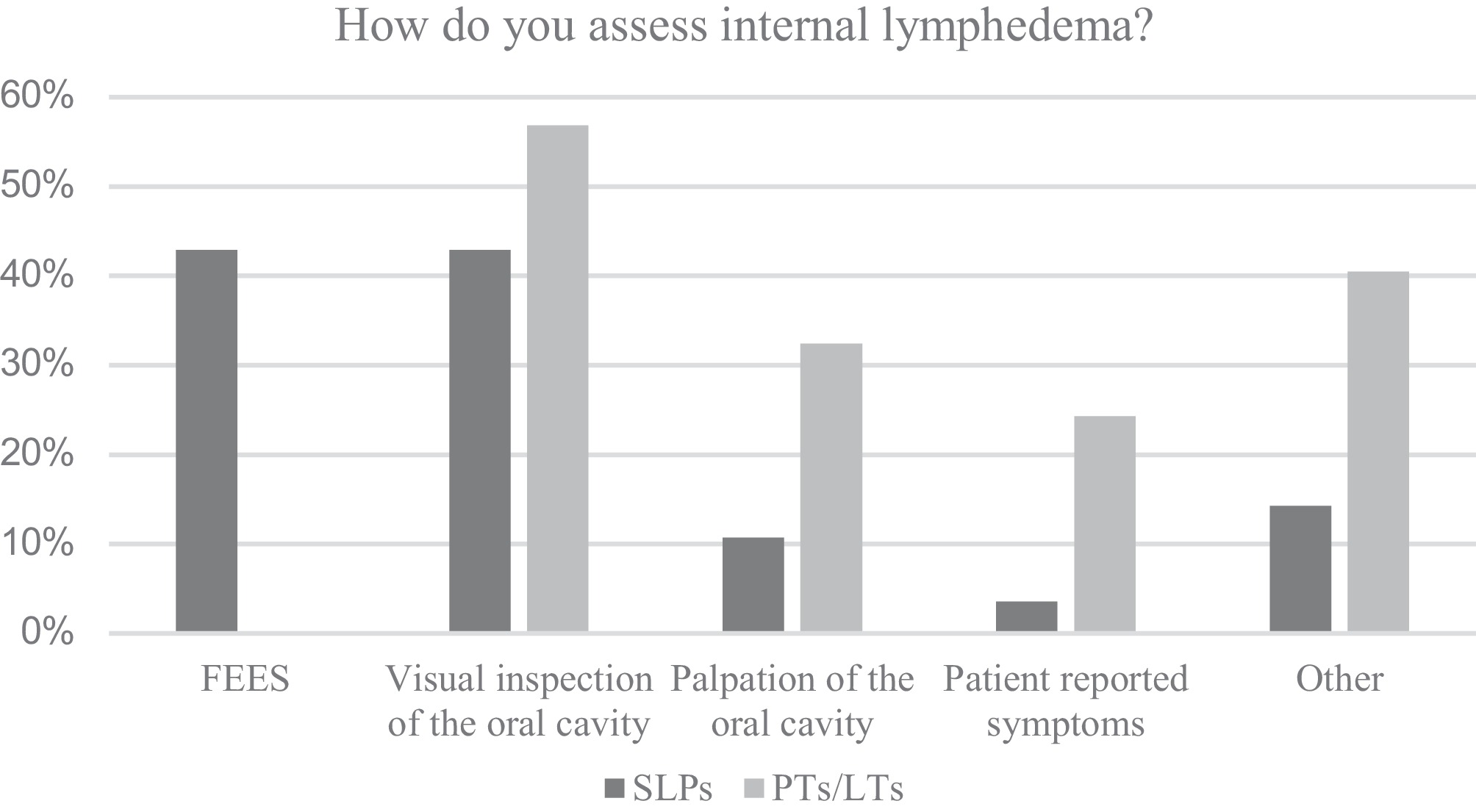
Figure 1.
Assessment methods used by the responders. Multiple responses were allowed. FEES, fiberoptic endoscopic evaluation of swallowing; PROM, patient-reported outcome measures, nonstandardised; SLPs, speech and language pathologists; PTs/LTs, physiotherapists/lymphedema therapists. "Other" was specified as patient-reported experiences. Analyzed sample (n = 52); missing data from 8 SLPs and 5 PT/LTs.
PT/LTs relied on palpation, noninstrumental visual inspection of the oral cavity and neck, patients' self-report (with visual analog scales being the most common), and prior assessments by physicians or SLPs. One PT/LT reported using computed tomography (CT) imaging to verify internal edema.
Routine documentation of I-HNL was reported by 25% of both SLPs and PT/LTs. Conversely, 39% of SLPs and 25% of PT/LTs never documented I-HNL in their patients' records.
Treatment of I-HNL
-
Clinical practices are presented in Fig. 2. SLPs' interventions for I-HNL included oral motor exercises, stretching, straw phonation (a type of semi-occluded voice rehabilitation technique), and dysphagia therapies such as expiratory muscle strength training and McNeill's dysphagia therapy program. One SLP reported using manual lymphatic drainage for I-HNL. The most common action for SLPs was to refer the patient with I-HNL to a physician (43%), contact nurse (21%), LT (14%), or PT (11%).
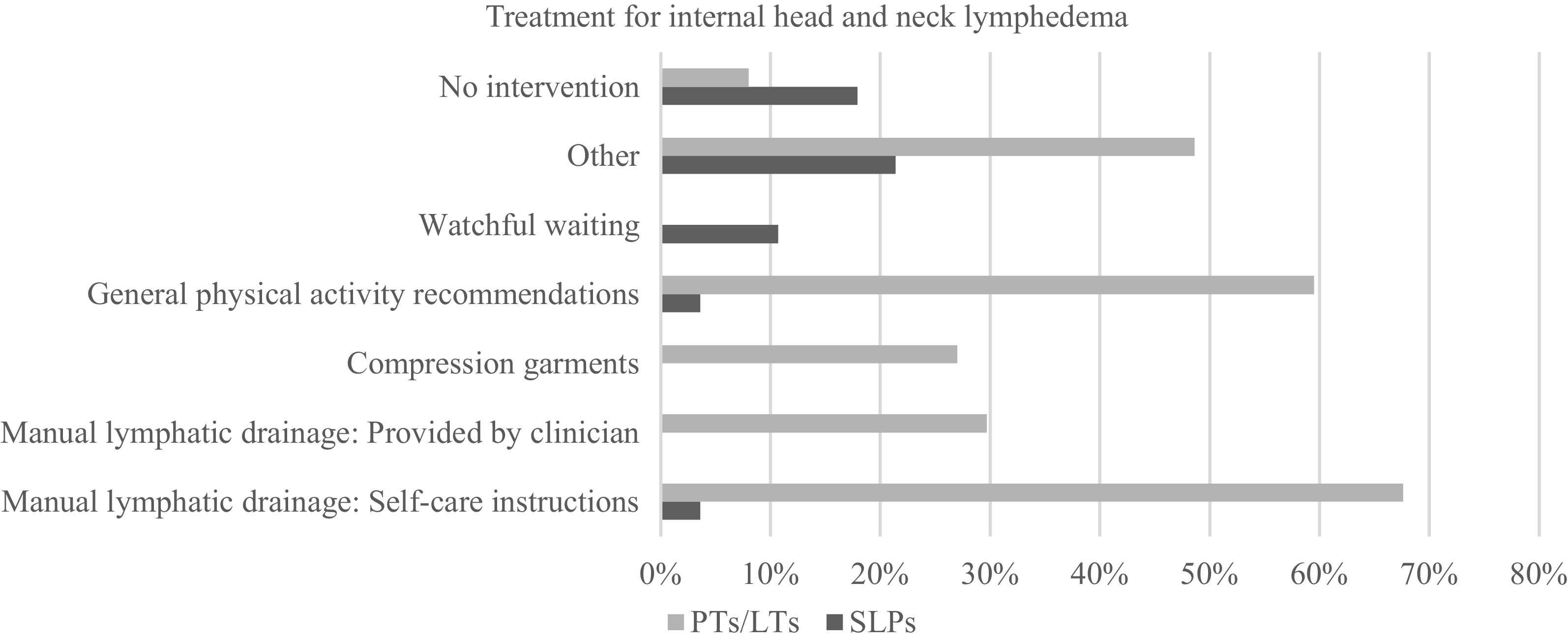
Figure 2.
Reported treatment methods for internal head and neck lymphedema. Multiple responses were allowed. SLPs, speech and language pathologists; PTs/LTs, physiotherapists/lymphedema therapists. Analyzed sample (n = 58); missing data from 4 SLPs and 3 PT/LTs.
PT/LTs provided treatments consistent with E-HNL protocols, including manual drainage techniques and recommendations regarding general physical activity and compression garments. Free-text responses included scar mobilization, chewing, deep breathing, stretching, toothbrush massage, and oral motor exercises. Another action was to refer the patient to a physician (21%) or an SLP (19%).
In the additional survey questions for SLPs, they were asked if the presence of an I-HNL affected their dysphagia or voice rehabilitation strategies. Among those working with dysphagia, 54% reported that I-HNL affected their approach; among those working with voices, 89% reported that it affected their treatment. However, the responses varied: Some increased the exercise intensity, whereas others postponed rehabilitation ("watchful waiting"). Expiratory muscle strength training and straw phonation in water were cited as the preferred methods for dysphagia or voice rehabilitation for patients with I-HNL.
Competence and education
-
Self-reported competence in I-HNL was predominantly rated as "none" or "limited" in both groups; see Table 2. A strong desire for further education was expressed by 89% of SLPs and 86% of PT/LTs. All SLPs and 94% of PT/LTs indicated a need for professional development in the assessment and treatment of I-HNL. A minority, namely 11% of SLPs and 8% of PT/LTs, stated that I-HNL was not part of their job description.
Table 2. Self-rated competence in HNC management and I-HNL management.
Perceived competence in HNC Nonexistent Limited Good Very good SLPs, n (%) 0 (0%) 11 (39%) 12 (43%) 5 (18%) PTs/LTs, n (%) 0 (0%) 7 (19%) 28 (76%) 2 (5%) Perceived competence in I-HNL Nonexistent Limited Good Very good SLPs, n (%) 15 (54%) 11 (39%) 1 (4%) 1 (4%) PTs/LTs, n (%) 9 (24%) 24 (65%) 3 (8%) 1 (3%) Self-rated competence in head and neck cancer (HNC) and internal head and neck lymphedema (I-HNL), based on responses to "How do you grade your competence regarding head and neck cancer?" and "How do you grade your competence regarding internal head and neck lymphedema?" SLPs, speech and language pathologists; PTs/LTs, physiotherapists/lymphedema therapists. SLPs, n = 28; PTs/LTs, n = 37. No missing data. Qualitative analysis
-
The qualitative analysis was based on free text answers to the questions "What do you see as the biggest challenge concerning assessment and treatment of I-HNL?" and "Is there anything you would like to add?" Four themes were identified: Lack of awareness, tricky location, methods and guidelines, and multidisciplinary collaboration.
Lack of awareness
-
SLPs, albeit able to observe the pharynx during endoscopic examinations of swallowing, raised concerns related to assessment. For example, one SLP reported "I'm not sure what internal lymphedema is. Being swollen after treatment is one thing – I haven't associated that with lymphedema. It seems like I might have a gap in my knowledge here." Two SLP respondents pointed out that this survey was the first time they had heard of internal lymphedema. For that reason, they had never thought of I-HNL as something that might affect a patient's articulation or swallowing, and therefore not as a topic concerning them as SLPs working with patients treated for HNC. One respondent wrote that their referrers never asked them to assess lymphedema during FEES, and hence they never saw a reason to look for it.
Tricky location
-
Problems identifying I-HNL were raised in other ways by PTs and LTs. Rather than a lack of knowledge, PTs and LTs highlighted that it is "hard to see it if it sits below the base of tongue in the pharynx/larynx". I-HNL in the throat is obscured in the clinical setting without access to instrumental assessments such as endoscopy. I-HNL in the oral cavity can also be hard to visualize and palpate, as many patients experience trismus (reduced jaw opening).
Methods and guidelines
-
Many of the respondents voiced that they did not know which treatment method to recommend for a patient with I-HNL and a common approach was to wait and see: "Sometimes it goes away with time – but sometimes it doesn't". One respondent expressed a fear of causing harm, having experienced that compression treatment for external lymphedema had made their patients' I-HNL worse. The respondents underlined the need for more research to better help their patients. One stated that "I find this field to be difficult since evidence is lacking compared to lymphedema after other cancers, e.g., breast cancer." Some PT/LTs mentioned that they rarely came across patients treated for HNC and it took a long time to build experience. Not having much evidence or detailed guidelines to support assessment and treatment plans made it even more difficult.
Multidisciplinary collaboration
-
Consistent with the themes above, many rehabilitation professionals described a lack of clear routines and collaboration regarding I-HNL. Often, patients were referred to rehabilitation too rarely or too late because doctors and nurses did not assess or even recognize I-HNL. Several respondents emphasized the difficulty of conveying to physicians that I-HNL exists and can substantially affect patients' function and quality of life. Others pointed to the long waiting times for appointments with LTs or SLPs. Some SLPs stated that they would not even know where to refer a patient with I-HNL. Many SLPs noted that lymphedema assessment falls outside of their job description, whereas PTs and LTs called for closer collaboration with SLPs in assessing I-HNL. As one PT/LT respondent wrote: "It would be good to collaborate with SLPs, but they are often hard to reach. It's difficult to know who should do what. They often refer the patient to us…"
Collectively, these accounts reveal a gap in care. As one important exception, a respondent described a well-functioning HNC rehabilitation team where "we have lymphedema therapists at our unit who routinely meet all of our HNC patients."
-
This cross-sectional study explored how 28 SLPs and 37 PTs and/or LTs in Sweden assess and/or treat I-HNL and how they perceive their competence in this area.
Only one in four SLPs, PTs, and LTs routinely note the presence of I-HNL or self-reported symptoms from I-HNL in patients' charts. Although SLPs have good access to endoscopic evaluations, which are necessary to assess I-HNL using the revised Patterson Edema Scale[7], only 7.1% used the scale. PTs and LTs primarily rely on patients' self-reports and visual observations of the oral cavity to assess I-HNL, and stress this as a limitation. They describe a lack of awareness and a lack of I-HNL assessment by professions that make endoscopic evaluations, such as SLPs and otorhinolaryngologists, and highlight a need for multidisciplinary assessments. This aligns with the findings from McGarvey et al.[19] and Mullan et al.[22], who noticed insufficient identification and referrals from physicians despite a high expected prevalence.
Compared with data from the UK presented by Smith et al.[21], Swedish SLPs appear to be less likely to treat I-HNL than UK SLPs. Some will watchfully wait in hope that the edema will pass before starting any rehabilitation, whereas others report choosing specific dysphagia rehabilitation techniques and voice training exercises. In theory, these exercises could target edematous structures, but randomized controlled trials are needed to evaluate if they influence the degree of I-HNL. This hypothesis would be of interest to investigate further.
PTs and LTs reported treating I-HNL to some extent, drawing on general lymphedema therapy principles such as manual lymphatic drainage, compression, and physical activity. A need for clinical guidelines as well as an arsenal of evidence-based treatment methods is highlighted by the respondents as a way forward. This is consistent with the Delphi study[17], which highlighted a lack of consensus on optimal treatment methods, partly resulting from the limited number of studies. Although they are possibly effective for E-HNL, methods such as manual therapy and compression have not been shown to reduce I-HNL[18]. Together, these findings underscore the need for research to support evidence-based decision making in I-HNL management.
Many respondents highlight the need for basic education on the lymphatic system and lymphedema after HNC to better understand their patients' needs. Only 8% of SLPs and 11% of PT/LTs rated their competence in I-HNL as "good" or "very good". The low level of self-rated competence in the area aligns with the qualitative study by Mullan et al.[22]. This is important from a quality of care perspective; moreover, low self-perceived competence might be linked to stress-related health problems among health care professionals[25].
The current state of I-HNL awareness as described in this study resembles dysphagia rehabilitation 20 years ago when swallowing problems after HNC treatment were underdiagnosed and undertreated[26,27]. Decades of research and active clinical advocacy have established international standardized practices and a broad expert consensus regarding the management of dysphagia[28−30]. Further research on assessment and treatment methods is needed to reach a similar level for I-HNL rehabilitation. Although raising awareness can begin immediately through professional associations, advocacy initiatives, and university education, the development of more formalized clinical training would benefit from a clearer evidence base regarding how I-HNL should be assessed and managed in practice.
Methodological considerations
Quantitative methodology
-
Nonprobability sampling was selected to facilitate recruitment of professionals working with HNC rehabilitation. There is a risk of selection bias. Participating respondents could be either the ones most knowledgeable in HNL or those most eager to learn more about the topic. The responses indicate a mix.
Professional inclusion criteria were based on previous surveys on HNL[19−22]. A few of the LT respondents added that they also worked as occupational therapists. This, as well as "nurse", could have been added as a selectable option in the survey. Still, nurses and occupational therapists working as LTs were able to respond to the survey as it was phrased.
The distributed survey was not validated, and hence, there is a risk of the questions being misinterpreted. To limit this, the survey was reviewed by one SLP and one PT/LT prior to distribution. Another risk of bias is that questions investigating negative and positive experiences were not equally weighted. Possibilities of treatment were measured quantitatively with the opportunity to comment in free text, whereas limitations were only evaluated qualitatively in the free-text question "What challenges do you experience regarding patients with internal head and neck lymphedema?" This could have prompted the respondents to elaborate more on obstacles in their clinical practice. In retrospect, elaborating on the challenges has been useful in detecting actions needed to improve care and clinical practice, which was crucial for the clinical relevance of the study.
To safeguard respondents' confidentiality, information regarding their geographical location was not collected. The absence of geographical identifiers limits the possibility of verifying regional representativeness. Nonetheless, it was deemed to be methodologically more important to reduce potential bias in clinicians' self-assessments of competence. The sample size obtained supports the assumption of a reasonably broad national coverage.
Qualitative methodology
-
STC ensured a rigorous analysis, facilitating the extraction of nuanced insights that were grounded in the data. Theoretical triangulation was applied by initially examining the emerging categories from a phenomenological standpoint, but some aspects of the data were inevitably interpreted in relation to structural features of the Swedish healthcare system. Although the free-text responses varied considerably in length and detail, TMN and KS considered them to be sufficient to provide the level of information power required by the SCT model[24].
-
The data suggest that PTs/LTs bring expertise in lymphatic physiology and lymphedema therapy, whereas SLPs contribute specialized knowledge of oral, laryngeal, and pharyngeal function, as well as access to videoendoscopic assessments. Rather than falling into a gap between these professions, a multidisciplinary approach combined with specialized training in I-HNL could substantially advance the field and improve patients' access to assessment and rehabilitation. This is particularly critical, considering the current lack of research and clinical guidelines. This study contributes with a baseline overview of clinical practice and provider needs, offering a platform for developing targeted interventions and educational strategies to enhance support for both patients and professionals in I-HNL care.
-
In the words of one of the respondents, "The challenges are huge! I have no assessment methods, no thoughts on treatment methods, is it really possible for us to reach the swollen areas in the neck and if so how, when and with what? I'm very interested in learning more."
This survey shows that Swedish SLPs, PTs, and LTs working with patients treated for HNC report lacking both competence and evidence-based methods for managing I-HNL. Instead of benefiting from a multidisciplinary overlap, I-HNL appears to fall into a gap between different professional domains, although I-HNL is addressed to some extent through general lymphedema therapy, dysphagia rehabilitation, or voice therapy. Targeted research, clinical training, and interprofessional collaboration are needed to close this gap.
This work was supported by the Sjöberg Foundation and Swedish Association of Chronic Oedema. The authors are very grateful to Sara Wiberg for sharing her experiences in mixed-method survey design and to all the respondents who took the time to participate in this study.
-
This study was performed in accordance with the principles of the Declaration of Helsinki. The ethical approval application was waived by the Swedish Ethical Review Authority (231220, dnr 2023-07158-01). When accessing the survey, all respondents provided informed consent to participate and for the results to be published. The study was reported following the STROBE and SRQR reporting guidelines.
-
During the preparation of this publication, Karin Sjögren used ChatGPT (OpenAI, GPT-4 era version) for translation of the Swedish-language survey into English (Supplemental File S1). The authors reviewed and edited all content produced with the assistance of this tool, verified its accuracy, and take full responsibility for the integrity and originality of the final manuscript. This work represents the authors own intellectual contribution, and no AI tool is credited as an author.
-
The authors confirm their contributions to the paper as follows: study conception and design: Sjögren K, Mikoczy Nilsson T, Grenner E, Ekvall Hansson E; data collection: Sjögren K, Mikoczy Nilsson T; analysis and interpretation of results: Sjögren K, Mikoczy Nilsson T; draft manuscript preparation: Sjögren K. Sjögren K, Mikoczy Nilsson T, Sjövall J, Grenner E, Ekvall Hansson E reviewed the results, commented on previous versions of the manuscript, and approved the final version of the manuscript.
-
Datasets generated and analyzed during the current study are available from the corresponding author on reasonable request.
-
The authors have no relevant financial or nonfinancial interests to disclose.
-
accompanies this paper online at: https://doi.org/10.48130/ejcc-0026-0005.
- Supplemental File S1 SLP PT LT Survey questions in English.
- Copyright © 2026 by the author(s). European Journal of Cancer Care by Maximum Academic Press on behalf of John Wiley & Sons Ltd. This is an open access article under the terms of the Creative Commons Attribution License, which permits use, distribution and reproduction in any medium, provided the original work is properly cited.
-
About this article
Cite this article
Sjögren K, Mikoczy Nilsson T, Grenner E, Sjövall J, Ekvall Hansson E. 2026. Assessment and treatment of internal head and neck lymphedema in Sweden – a cross-sectional survey of practice. European Journal of Cancer Care 2026: e005 doi: 10.48130/ejcc-0026-0005 

Assessment and treatment of internal head and neck lymphedema in Sweden – a cross-sectional survey of practice
- Received: 23 February 2026
- Revised: 24 April 2026
- Accepted: 08 May 2026
- Published online: 14 July 2026
Abstract: Internal head- and neck lymphedema (I-HNL) is a common side effect after head and neck cancer treatment, but the current assessment and rehabilitation practices remain unclear. The purpose of this study was to explore how Swedish speech and language pathologists (SLPs), physiotherapists (PTs), and lymphedema therapists (LTs) assess and treat I-HNL and how they perceive their competence in doing so. Web-based surveys were distributed in January 2024 to SLPs, PTs, and LTs in Sweden working with patients treated for head and neck cancer. The surveys included 14 and 16 multiple choice questions in the PT/LT and SLP versions, respectively, as well as two open-ended questions. Nonprobability sampling was used, with initial distribution through professional networks followed by snowball recruitment. Multiple choice questions were summarized using descriptive statistics, and open-ended questions were analyzed by systematic text condensation. In total, 65 SLPs, PTs and LTs returned the survey. PTs and LTs assessed I-HNL primarily on the basis of unaided visual observation of the oral cavity and neck, as well as patients' self-reports. Methods used for treatment of external head and neck lymphedema were used to indirectly treat I-HNL. SLPs rarely assessed or treated I-HNL. The qualitative analyses of the two open-ended questions identified four final themes: Lack of awareness, tricky location, methods and guidelines, and multidisciplinary collaboration. This study highlights the need for professional development as well as more research on assessment and treatment methods for I-HNL. Rehabilitation related to I-HNL in Sweden could benefit from combining knowledge and experiences across professions.