











-
The evaluation of food freshness and spoilage has traditionally relied on sensory assessment, microbiological enumeration, and physicochemical indices, including pH, total volatile basic nitrogen (TVB-N), K-value, thiobarbituric acid reactive substances (TBARS), and peroxide value. These approaches are well-established, operationally simple, and widely accepted by both industry and regulatory agencies. However, their fundamental limitation lies in their retrospective nature, as they identify quality deterioration only after perceptible sensory, chemical, or microbial changes have occurred. In modern food systems characterized by extended supply chains, dynamic storage conditions, and growing consumer demand for minimally processed products, reactive quality assessment strategies are increasingly inadequate. Small deviations in temperature or handling early in the distribution process can irreversibly compromise product quality long before conventional indices detect a meaningful change. Against this backdrop, omics technologies, particularly proteomics and peptidomics, offer a paradigm shift, enabling the detection of molecular events that precede visible spoilage. This viewpoint focuses on whether protein biomarkers can realistically replace conventional freshness and spoilage indices and whether they are poised to redefine food quality assessment through predictive, mechanistically informed complementarity.
-
Proteins and peptides play a central role in the biochemical pathways governing post-harvest deterioration, as structural proteins, metabolic enzymes, and stress-response proteins respond rapidly to endogenous enzymatic activity, oxidative stress, and microbial colonization (Table 1)[1]. As a result, protein modifications and degradation products often emerge at the earliest stages of quality loss, preceding the accumulation of secondary metabolites or the manifestation of perceptible sensory defects[2,3]. Across diverse food matrices, including seafood, meat, dairy products, fruit, and vegetables, proteomic investigations have consistently identified early appearing molecular signals, such as myofibrillar degradation peptides, microbial exoproteases, oxidatively modified proteins, heat-shock and other stress-response proteins, and enzyme inactivation patterns associated with autolytic processes[4]. These molecular signatures may arise hours to days before detectable changes in odour, texture, or conventional physicochemical indices, conferring a clear temporal advantage for early quality assessment. This predictive capacity positions protein biomarkers as particularly valuable tools for monitoring perishable and high-value foods, where timely intervention can substantially reduce economic losses and food waste (Fig. 1). Also, the molecular resolution offered by proteomics aligns with the ongoing evolution of food quality science toward precision and systems-level frameworks, in which freshness is understood not as a binary sensory attribute but as a dynamic biochemical trajectory[5].
Table 1. Comparative value of conventional freshness indices and representative protein/peptide biomarkers in food quality assessment.
Food matrix/case study Traditional indices used Representative protein or peptide biomarker(s) How early or valuable relative to conventional indices Interpretation for replacement vs integration Ref. Turbot (Scophthalmus maximus), chilled postmortem storage QIM, pH, K-value, TVB-N, TVC Phosphoglucomutase-1, pyruvate kinase, kinesin-1 heavy chain, troponin T, desmin-like protein, actin. Protein abundance changes were significantly correlated with QIM, K-value, TVB-N, and TVC. Strong case for pathway-linked freshness markers, but still species- and storage-specific. [16] Sea bass (Lateolabrax japonicus), ice storage TVB-N, TVC, sulfhydryl and carbonyl content Structural proteins, metabolic enzymes, protein-turnover proteins; calpain-linked degradation patterns, PGK1 After 8 d, TVB-N, TVC, and carbonyl content increased; 708 DAPs were identified, and treatment delayed protein degradation. Shows that proteomics can explain textural and biochemical changes, but markers require targeted validation. [17] Pork, storage at −2, 4, 10, and 25 °C Color, pH, TVB-N, TVC Peptide MVHMASKE Peptide intensity correlated with basic freshness indicators and showed ROC-based discrimination of fresh, accelerated-spoilage, and spoiled states. Promising peptide marker across temperatures; still needs multi-site commercial validation. [18] Pork exudate during storage Fresh vs spoiled classification; conventional spoilage context LDB3, EEF1A1, AMPD1, NEB, GYG1, NDUFA4, myoglobin Shared DAPs in exudates distinguished fresh from spoiled pork under different storage temperatures. Exudate sampling is practical and less destructive, but translation requires simple targeted assays. [19] Mandarin fish (Siniperca chuatsi), refrigerated storage pH, water-holding capacity, color, texture, MFI Beta-enolase, phosphoglycerate kinase 1, triosephosphate isomerase B, hemoglobin subunits, cytoskeletal proteins Day 5 refrigeration was identified as a critical quality-change point; 66 DEPs were linked to endogenous enzyme-mediated proteolysis and glycolysis/gluconeogenesis. Useful for mechanistic prediction of texture deterioration; not yet a regulatory marker set. [20] Shewanella putrefaciens in chilled spoiled bigeye tuna model TVB-N, TMA, extracellular protease activity, protein degradation Cysteine desulfurase IscS, sulfite reductase, ATP-dependent protease ATPase subunit HslU, S-ribosylhomocysteine lyase Higher-spoilage strain produced more TVB-N and TMA and showed upregulated spoilage-related proteins. Useful for microbial mechanism and spoilage-risk modeling rather than direct product-level freshness replacement. [21] 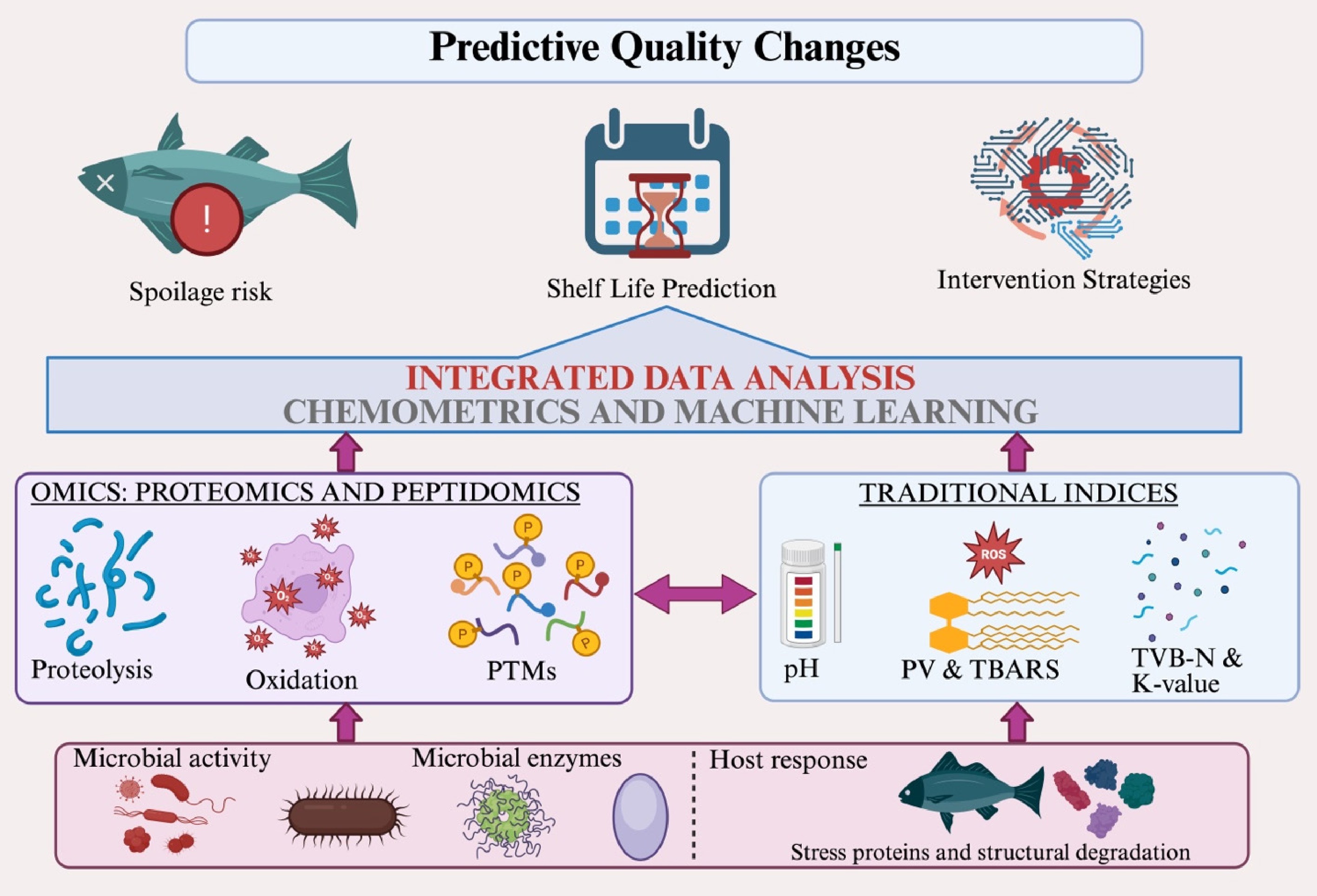
Figure 1.
Integrating omics and conventional indices for predictive shelf-life assessment (created in Biorender).
-
Despite their considerable promise, protein biomarkers are not yet capable of replacing established indicators of freshness and spoilage[6]. The right replacement would require broad applicability across food matrices, regulatory acceptance, economic feasibility, and operational simplicity, criteria that current proteomic approaches have yet to fully satisfy. Although molecular biomarkers provide unparalleled mechanistic insight, their translation into routine quality assessment frameworks remains constrained by biological variability, limited validation, and technological complexity. Food matrices are intrinsically heterogeneous, and spoilage kinetics are influenced by multiple interacting factors, including species or cultivar, diet, seasonality, post-harvest handling, packaging atmosphere, storage temperature, and microbiome composition[7]. Consequently, a peptide biomarker that reliably predicts spoilage in salmon under chilled aerobic storage may perform poorly in other species, such as cod, shrimp, or vacuum-packaged products[8,9]. Even within a single species, biomarker behavior can vary substantially across processing and storage conditions, underscoring the difficulty of identifying universal protein indicators applicable across diverse supply chains. This lack of generalizability remains a critical obstacle to biomarker replacement of conventional indices.
Additionally, most protein biomarker discovery studies are conducted under controlled laboratory conditions, using limited sample sizes and narrowly defined storage conditions[10]. While these approaches are essential for mechanistic understanding, they do not adequately capture the complexity of commercial food systems, where temperature fluctuations, handling variability, and dynamic microbial succession strongly shape deterioration pathways. Regulatory authorities require consistent performance under real-world conditions, supported by large-scale, multi-site validation, which protein biomarkers have not yet demonstrated at the necessary scale. Technological constraints further limit the feasibility of full replacement. High-resolution proteomic platforms, such as liquid chromatography–tandem mass spectrometry (LC–MS/MS), provide rich molecular information but are costly, time-intensive, and require specialized expertise and infrastructure[11]. As a result, routine quality control laboratories are unable to readily integrate such techniques into day-to-day operations. Although significant progress has been made in translating biomarkers into rapid and cost-effective formats, including immunoassays, aptamer-based sensors, microfluidic devices, and portable mass spectrometry, these technologies remain under development and currently lack the simplicity, robustness, and accessibility of conventional assessments such as sensory evaluation or TVB-N measurements[12].
-
A more scientifically grounded and constructive perspective is that protein biomarkers will complement, rather than replace, traditional freshness indices in the foreseeable future[13]. Their greatest strength lies in early detection and mechanistic insight, while conventional methods retain advantages in simplicity, standardization, and regulatory familiarity. In an integrated framework, proteomic markers can serve as early warning signals, identifying incipient quality loss before irreversible sensory deterioration occurs. Traditional indices then confirm end-stage spoilage and ensure compliance with regulatory thresholds. This hybrid approach is particularly valuable for products with short shelf lives, high economic value, or vulnerability to temperature fluctuations, where even modest predictive gains translate into substantial reductions in waste and financial loss[13,14]. Importantly, such integration aligns with the broader transition toward data-driven food quality systems. Machine-learning models can combine proteomic features with temperature history, microbial counts, sensory scores, and physicochemical parameters to predict remaining shelf life with greater accuracy than any single metric[15]. Within this context, protein biomarkers function not as standalone replacements but as informative variables within predictive decision-support systems. Over the next few years, the field should focus on more biomarker discovery, validation of existing biomarkers, and their simplification. The most realistic progress will come from targeted biomarker panels using advanced targeted LC-MS/MS rather than untargeted whole-proteome screening. Candidate markers should be prioritized only when they meet three criteria: biological relevance to spoilage pathways, statistical association with conventional indices, and reproducibility across independent sample sets.
-
For proteomics to have a meaningful impact on food quality evaluation, efforts must extend beyond biomarker discovery toward standardization, large-scale validation, and practical implementation. The right analytical workflows and multi-site studies are essential to establish biomarker robustness under commercial conditions, while expanded food-specific proteomic databases will support broader applicability. Early engagement with regulatory agencies and continued development of cost-effective, field-deployable analytical tools will be critical for translating molecular insights into routine quality assessment. Protein biomarkers provide predictive insight into early molecular events preceding conventional spoilage indicators; however, variability across food matrices, analytical complexity, and regulatory constraints currently limit their capacity to replace established methods. The most realistic and productive path forward lies in the integration and validation of protein biomarkers, where omics-derived protein markers complement traditional sensory, chemical, and microbiological indices. As validation and technology advance, proteomics will become an essential component of modern, predictive food quality systems, not as a replacement, but as a transformative enhancement.
The authors acknowledge the Kerala University of Fisheries and Ocean Studies for providing facilities. No funding was received for this publication.
-
The authors confirm their contributions to the paper as follows: conceptualization, writing − original draft: Baraiya R; visualisation, writing − review and editing: Sharma A; writing − review and editing: Prakash S, Gorakh SS, Ngasotter S; supervision, writing − review and editing: Ravindranath RRS, Renuka V. All authors reviewed the results and approved the final version of the manuscript.
-
Data sharing is not applicable to this article as no datasets were generated or analysed during the current study.
-
All authors declare that they have no competing interests.
- Copyright: © 2026 by the author(s). Published by Maximum Academic Press on behalf of Nanjing Agricultural University. This article is an open access article distributed under Creative Commons Attribution License (CC BY 4.0), visit https://creativecommons.org/licenses/by/4.0/.
-
About this article
Cite this article
Baraiya R, Sharma A, Prakash S, Ravindranath RRS, Renuka V, et al. 2026. Omics as a predictive tool for food quality: can protein biomarkers replace traditional freshness and spoilage indices? Food Materials Research 6: e014 doi: 10.48130/fmr-0026-0014 

Omics as a predictive tool for food quality: can protein biomarkers replace traditional freshness and spoilage indices?
- Received: 11 March 2026
- Revised: 25 May 2026
- Accepted: 15 June 2026
- Published online: 25 August 2026
Abstract: Conventional assessment of food freshness relies on sensory evaluation, microbiological counts, and physicochemical indices such as pH, TVB-N, and lipid oxidation markers. Although widely standardized, these approaches are inherently retrospective and detect deterioration after significant biochemical changes have occurred. Proteomics provides a mechanistically driven alternative by identifying early protein modifications, degradation peptides, and stress-associated molecular signatures that precede detectable spoilage. Such protein biomarkers offer temporal sensitivity and a systems-level insight into post-harvest biochemical trajectories. However, matrix-specific variability, limited large-scale validation, regulatory constraints, and analytical complexity currently restrict their replacement potential. A more feasible framework lies in integration, where proteomic markers complement conventional indices within predictive, data-driven shelf-life models. As analytical workflows become standardized and field-deployable platforms mature, protein biomarkers are positioned to enhance, rather than replace, existing quality monitoring systems.