












-
The Tree of Life serves as a core concept in evolutionary biology. However, resolving deep and recalcitrant phylogenetic relationships remains challenging due to complex processes such as incomplete lineage sorting (ILS), introgression/hybridization (IH), and gene flow[1,2]. Here we use IH broadly to include introgression or gene flow via hybridization. A previous study by Qu et al.[3] suggested the presence of widespread and high levels of both ILS and IH among suborders within the Pluteineae (Basidiomycota, Agaricales). In response, a suite of methodological advances has been developed to quantify such phylogenetic conflicts and infer the underlying biological processes. These developments provide a chance for re-examining and clarifying the systematic relationships within the family Pluteaceae Kotl. & Pouzar. Species, as the core units of biological study, represent the most fundamental metric for delineating ecosystems, assessing global biodiversity patterns, and reconstructing evolutionary history[4,5]. Therefore, accurate species delimitation constitutes the foundational step in phylogenetic, evolutionary, biogeographic, and biodiversity conservation studies. Despite some differences among contemporary alternative species concepts and definitions, a consensus exists that species are separately evolving lineages[6−8]. Species delimitation seeks to establish biologically meaningful boundaries between divergent evolutionary lineages, determining when they warrant recognition as separate species[6].
Due to the limited morphological characteristics of fungi and the complexity of their evolutionary processes, defining fungal species remains particularly challenging. Progress in molecular phylogenetic methodologies has greatly enhanced the rate of species discovery[9−14]. However, factors such as the choice of molecular markers, phylogenetic reconstruction methods, and dataset composition can significantly influence species delimitation results. Species delimitation within Pluteaceae also remains a challenge. This is particularly true in a few worldwide-spread species complexes, and species boundaries are becoming increasingly ambiguous[15−18]. Therefore, establishing a systematic evaluation for novel species status is essential for taxonomic entities to avoid excessive delineation.
Pluteaceae is a well-known, globally distributed family of saprotrophic fungi with considerable ecological and potential economic importance. The genera Pluteus, Volvariella, Chamaeota, and Volvopluteus were historically included in Pluteaceae[19−23]. The genus Chamaeota is no longer widely accepted. This is due to the loss of the type specimen of its type species, C. xanthogramma (Ces.) Earle, and the subsequent reclassification of its two most representative species, C. mammillata (Longyear) Murrill and C. fenzlii (Schulzer) Singer, into the genus Pluteus[24,25]. Chamaeota sinica J.Z. Ying, originally described from China, was transferred to the genus Candelolepiota as Candelolepiota sinica. Consequently, Chamaeota now contains no widely accepted species[26−28]. As early as Justo et al., molecular phylogenetic evidence suggested that Volvariella might not belong to Pluteaceae[19]. Subsequent studies have further supported this view. Recent molecular phylogenetic analyses showed that Volvariella forms a sister clade to Melanoleucaceae, rather than clustering within Pluteaceae. Recent molecular phylogenetic analyses indicated that it is an independent family-level lineage, namely Volvariellaceae[21]. However, the phylogenetic position of Volvariellaceae remains uncertain[3,29].
This study aims to reconstruct a robust phylogenetic framework for the family Pluteaceae and to explore species delimitation within the family using evidence from integrative taxonomy based on morphological characteristics, ecological features, and phylogenetic analyses. Our results enabled us to: (i) reconstruct a robust phylogenomic framework for Pluteaceae; (ii) investigate causes of gene conflict; (iii) propose a systematic evaluation for novel species within Pluteaceae; (iv) summarize the species diversity of Pluteaceae in China.
-
Specimens of Pluteaceae were mainly collected between 2000 and 2025 in China, Japan, Austria, Germany, Canada, Laos, Thailand, Italy, and North Macedonia. The fresh basidiomes were dehydrated using a drying oven at temperatures between 45 and 50 °C, and molecular materials were desiccated with silica gel. Locations, substrates, and altitudes were documented, and photographs of the basidiomes were also captured. 725 specimens of Pluteaceae were collected for this study. Voucher specimens were deposited in the Cryptogamic Herbarium of the Herbaria of Kunming Institute of Botany, Chinese Academy of Sciences (KUN-HKAS).
Morphological observations
-
Macroscopic characters of basidiomes were described based on fresh specimens and photographs. The color codes cited in the descriptions are from Kornerup & Wanscher[30]. Sections of different parts of dried specimens were mounted in 5% KOH solution. The size of basidiospores is presented as (a–) b–c (–d). The range b–c contains a minimum of 90% of the measured values, whereas a and d refer to the extremities of all measurements. Q value indicates the length/width ratio of basidiospores, with Qm representing the average Q of all basidiospores ± standard deviation, avl for average length, and avw for average width. The generic names used in this study are abbreviated as follows: 'M.' for Melanoleuca, 'P.' for Pluteus, 'V.' for Volvariella, and 'Vp.' for Volvopluteus.
DNA extraction, PCR amplification, and sequencing
-
Genomic DNA was extracted from specimens using the Ezup Column Fungi Genomic DNA Purification Kit (Sangon Biotech, Shanghai, China). The primer pairs ITS1F/ITS4 for the internal transcribed spacer (ITS)[31] and 983F/1567R for the translation elongation factor 1-α (tef1)[32]. Amplified products were subsequently purified and sequenced at Sangon Biotech (Shanghai, China). The samples were sent to Personalbio (Shanghai) for library construction and then sequencing on the Novaseq platform. Over 5 Gb of sequence data for each sample were obtained. Sequencing of the types of P. diettrichii and P. poliocnemis was performed at the Czech Agrifood Research Centre following the molecular methods described[33].
Quality assessment of genome assemblies
-
Fastp was employed for quality control and preprocessing of raw FASTQ files[34]. De novo genome assembly was performed using SPAdes[35] with automatic k-mer selection based on insert size and read length. To assess the completeness of the assembled genome, Benchmarking Universal Single-Copy Orthologs (BUSCO)[36] was used with the agaricales_odb10 database as a reference.
Sequence data matrix construction
-
Two datasets were assembled for species identification and phylogenetic analysis, respectively. Dataset I contained combined ITS-tef sequences for species identification in the Pluteaceae. For dataset I, a total of 856 sequences, including 796 ITS and 98 tef1, were newly generated in this study and deposited in GenBank and CNCB-NGDC. These newly generated sequences and additional sequences retrieved from GenBank were detailed in Supplementary Tables S1 and S2. Phylogenetic reconstructions of dataset I were performed for three subdatasets (sect. Hispidoderma, sect. Celluloderma, and sect. Pluteus).
Dataset II contained single-copy orthologs from 121 Pluteineae and outgroup genomes to establish the Pluteaceae phylogenetic framework. A total of 672 single-copy orthologous genes were retained after filtering for presence in ≥ 90% of samples and a protein length > 50 amino acids. Each gene was separately aligned with MAFFT 7[37], and ambiguously aligned regions of genes were eliminated using trimAI 1.5[38]. MrModeltest 2.3 and IQ-TREE 2 were used to identify the best-fit model for each gene[39,40].
Molecular phylogenetic analyses
-
For dataset I, before constructing the multi-locus concatenated phylogeny, we first generated individual gene trees to assess potential topological conflicts. A tanglegram tree was inferred by SplitsTree 6[41]. The concatenated matrix was partitioned by genes. The Bayesian phylogenetic inference analysis was performed using MrBayes 3.2[42]. Maximum Likelihood analysis was computed in IQ-TREE 2[39]. All phylogenetic analysis files are available in GitHub (
https://github.com/chenjuanjuan89 ). For dataset II, single-gene trees were inferred using IQ-TREE2 under the best-fit model chosen automatically using the '-MFP' option. To improve the accuracy of ASTRAL, low-support branches (BS < 30%) in each gene tree were collapsed using Newick Utilities v1.6[43]. The coalescence-based species tree was constructed by ASTRAL5.7.8[44]. We additionally performed a Weighted-ASTRAL analysis, which incorporates threshold-free weighting into quartet-based species tree estimation[45]. Topological robustness was evaluated based on local posterior probability (LPP), with values above 0.95 indicating confident support.Divergence time estimation
-
Divergence times were estimated using the MCMCTree program within the PAML package[46], and r8s v1.2[47]. The divergence times were calibrated using the TimeTree database[48].
The 672 single-copy orthologs and the coalescence-based species tree were used as input. Bayesian molecular clock dating was conducted using the mcmctree program implemented in PAML. We employed the correlated-rates clock model, the WAG amino acid substitution model, and approximate likelihood calculation. The birth rate, death rate, and sampling fraction of the birth-death process were set to 1, 1, and 0, respectively. The gamma prior for the drift rate coefficient (σ2) was specified with shape and scale parameters of 1 and 10. The substitution rates of each gene were estimated using codeml under a global clock model to inform the gamma prior for the overall rate across genes. Based on the mean substitution rate across loci and the distribution of rate estimates, the shape and scale parameters of the overall rate prior were set to 2 and 2, respectively, providing a biologically reasonable fit to the data. The time unit was set to 100 million years, and a safe uniform constraint was applied to the root age (Root Age < 1.0). The MCMC analysis was run for 40,000 generations (nsample = 20,000 × sampfreq = 2), with the first 2,000 generations discarded as burn-in and sampling every second generation. To assess convergence, multiple independent runs were performed, and the log-likelihood values and estimated node ages were compared across replicates.
Bayesian species delimitation
-
The multispecies coalescent model-based program Bayesian Phylogenetics and Phylogeography (BPP) method integrates species phylogeny and lineage sorting from ancestral polymorphism, estimating the posterior distribution of different species delimitation models. Dataset I was used to test species delimitation hypotheses using the BPP v4.8.0[49−51]. We used uniform rooted trees as the species model prior. The MCMC chains were run for 2 × 10⁵ generations, with parameter samples collected every two generations and a burn-in period of 2 × 10⁴ generations. Four different combinations of priors were employed: (i)θ = (1, 10) τ = (1, 10), infering large ancestral population sizes and large divergences between species, suitable for most eukaryotic organisms (e.g., insects, fungi) to avoid excessive species splitting or excessive lumping; (ii)θ = (2, 2,000) τ = (2, 2,000), infering small ancestral populations and shallow divergences, suitable for recently rapidly radiating species, but may lead to excessive species lumping; (iii) θ = (1, 10) τ = (2, 2,000), infering large ancestral populations and shallow divergences, suitable for recently rapidly radiating species, but may lead to excessive species splitting. (iv) θ = (2, 2,000) τ = (1, 10), assuming small ancestral populations and deep divergences, with a tendency toward lumping recently diverged species[52−54].
Phylogenetic discordance analysis
-
To assess phylogenetic conflict, we used Phyparts, which maps discordant gene tree signals onto coalescence-based species tree topology[55]. Lowest quartet internode certainty (LP-IC), quadripartition internode certainty (QP-IC), and the extended quadripartition internode certainty (EQP-IC) were calculated using QuartetScores to evaluate phylogenetic incongruence from quartet frequencies[56]. Phytop analyses were employed to detect and visualize signals of incomplete lineage sorting (ILS) and introgression/hybridization (IH)[57]. Phytop analyses identified nodes with ILS-i < 50% and IH-i < 10% as well-resolved and highly confident (quantifying ILS and IH, respectively).
Potential IH was inferred with PhyloNet v3.6.1[58] using a pseudomaximum likelihood framework. Due to computational constraints, we focused our analysis on 22 clades from sect. Pluteus that showed a distinct signal of conflict. We streamlined our sampling to 22 clades, which included both sect. Pluteus and outgroup taxa. We employed QuIBL to search for IH signals[59]. Because QuIBL requires that all taxa be present in every gene tree, we constructed a reduced dataset containing only the 221 gene trees that were present in all species of sect. Pluteus.
-
In this study, genome assemblies with a completeness of less than 70% based on BUSCO assessment results were excluded, and a final set of 121 high-quality genomes was selected for subsequent phylogenetic analysis. Based on the dataset of 672 single-copy orthologs, both coalescent and concatenation-based phylogenetic analyses supported the monophyly of Pluteaceae (Figs 1 and 2; UFBS = 100% and LPP = 1.00). Within the genomic-level phylogenetic framework of the Pluteaceae, both Pluteus and Volvopluteus form distinct, well-supported monophyletic clades (Figs 1 and 2; UFBS = 100% and LPP = 1.00). Both topologies consistently reveal that Volvariella and Limnoperdon incarnatum together form a sister clade to the clade comprising Pluteus and Volvopluteus (Figs 1 and 2; UFBS = 100% and LPP = 1.00). Incongruence between the coalescent-inferred species tree and the concatenated tree was primarily observed in branches below the genus level, especially with sect. Pluteus (Fig. 1).
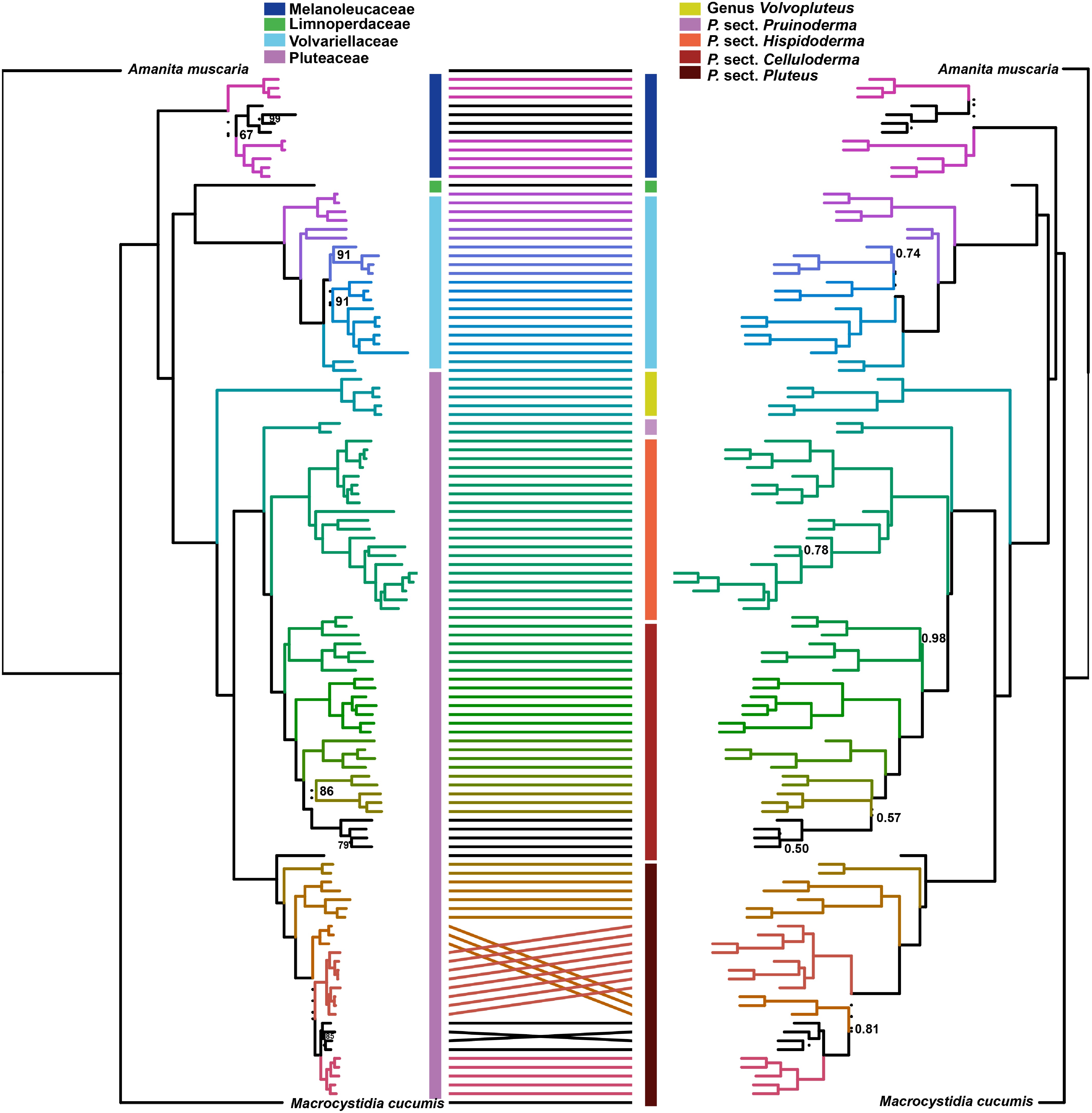
Figure 1.
Comparison of the concatenated tree (left) and the coalescent tree (right) of the Pluteineae based on the 672 single-copy orthologs. Ultrafast bootstrap (UFBS) and local posterior probability (LPP) values are presented with nodes. Nodes without values indicate 100% support (UFBS = 100, LPP = 1.00).
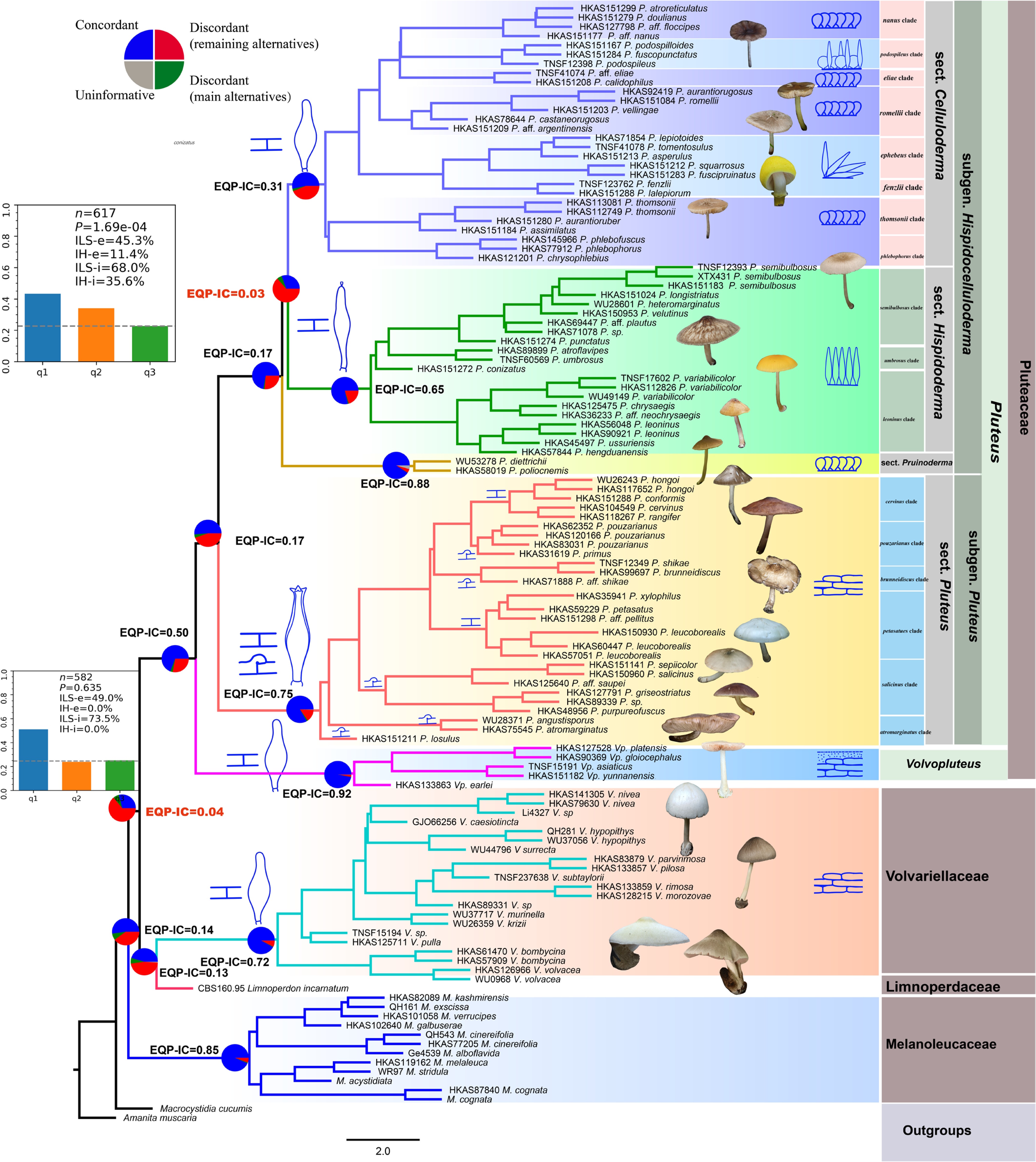
Figure 2.
Species tree topology of Pluteineae based on the 672 single-copy orthologs inferred by ASTRAL, with patterns of gene-tree concordance and conflict based on the PhyParts analysis and QuartetScores. The pie charts at the main clades show the proportion of genes that are in concordance (blue), in conflict (green for the most frequent alternative topology; red for remaining alternatives), or without enough information (gray). Macromorphology in different lineages is shown by images of basidiomes. Possible microscopic synapomorphies are illustrated with blue line drawings.
Testing potential IH
-
To investigate potential reticulate evolution within sect. Pluteus, we reconstructed a phylogenetic network using PhyloNet based on the 672 single-copy ortholog dataset. The possibility of introgression/hybridization (IH) events (reticulation = 1–6) within sect. Pluteus was evaluated using PhyloNet. Based on the maximum total log probability, a model with reticulation events (reticulation = 4) was identified as the optimal scenario (Table 1, Fig. 3). The inferred network consistently indicates that IH events involve P. aff. pellitus, P. pouzarianus, P. primus, the P. shikae clade, and the P. cervinus clade. Among these, the most significant IH event was identified between the ancestral lineage of the P. aff. pellitus clade (γ = 0.151) and the lineage leading to a major clade containing P. pouzarianus and the P. shikae group (γ = 0.849) (Fig. 3d).
Table 1. Network likelihoods derived from PhyloNet. The optimal network is in bold.
Topology Maximum number of reticulations Number of inferred reticulations Total log probability Network1 1 1 −472762.955509285 Network2 2 2 −472369.897910938 Network3 3 3 −472467.954269825 Network4 4 4 −470555.613078405 Network5 5 4 −472758.227455935 Network6 6 4 −472333.380005369 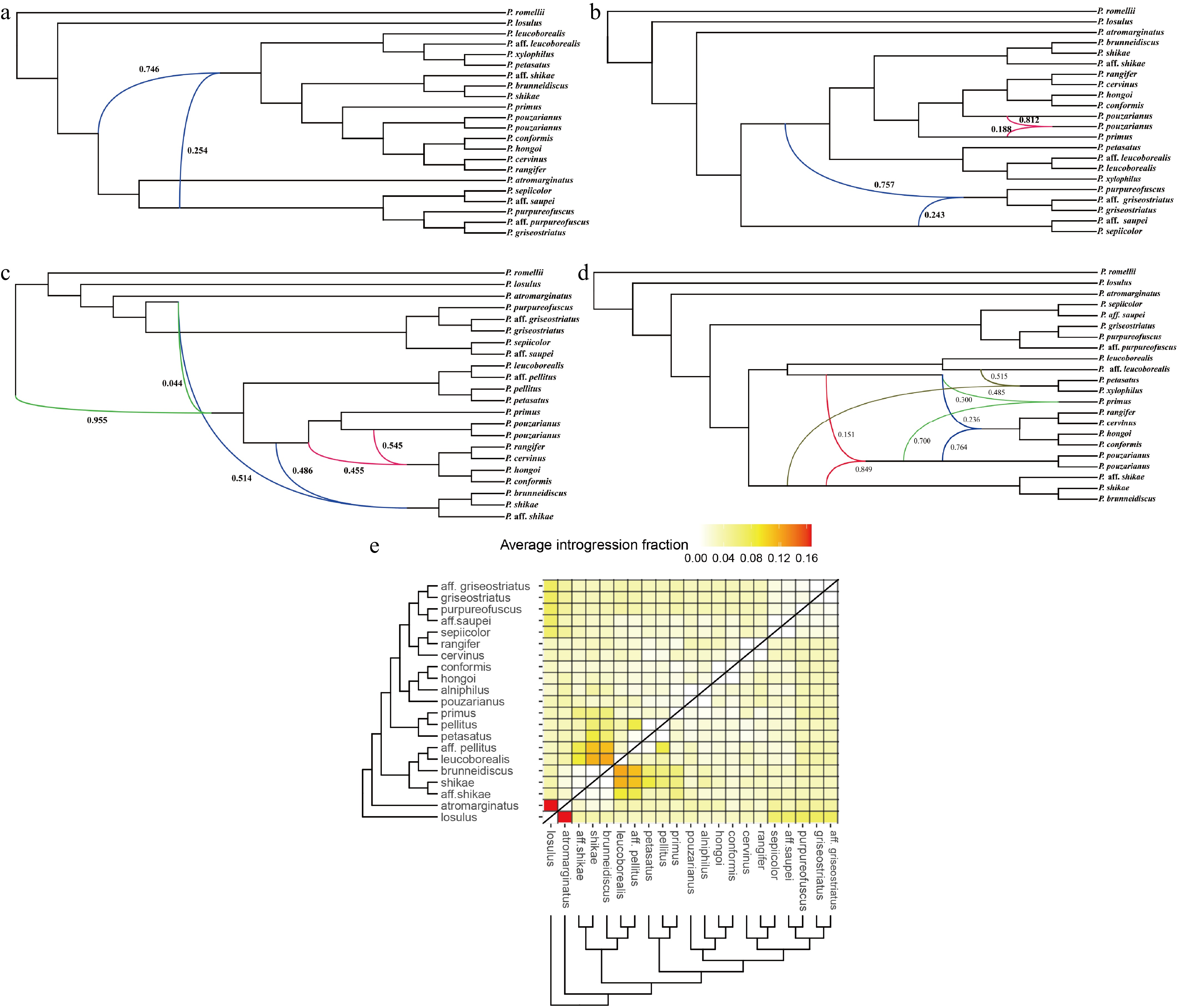
Figure 3.
The species network inference of sect. Pluteus estimated by the PhyloNet. (a) Reticulation = 1. (b) Reticulation = 2. (c) Reticulation = 3. (d) Reticulation = 4. Numerical values indicate inheritance probabilities. (e) QuIBL identified IH events based on branch lengths in 221 gene trees with single individuals from each taxon.
In contrast, QuIBL analyses identified the most significant IH event between the shared ancestors of P. atromarginatus and P. losulus. Additionally, IH was also detected within the P. shikae/P. brunneidiscus clade, which is consistent with the results obtained from PhyloNet (Fig. 3e).
Phylogenetic inference discordance
-
Within the suborder Pluteineae, incongruence among gene trees is widespread. Based on the work by Vizzini et al., we analyzed phylogenetic conflicts among the major lineages—Pluteaceae, Volvariellaceae, Limnoperdaceae, and Melanoleucaceae—using the species tree topology inferred under the coalescent-based method ASTRAL. Phyparts analysis suggested that 628 out of 672 informative gene trees supported Melanoleucaceae as monophyletic (Fig. 2).
However, the node delimiting the sister relationship between Limnoperdon and Volvariella shows a high phylogenetic conflict, with only 45.5% concordance. At the familial phylogenetic level, the topological conflict between the clade containing Limnoperdon and Volvariella and the clade containing Pluteaceae is particularly striking. Only 195 out of 672 genes support the topology presented in the current species tree (Fig. 2). Within the Limnoperdon and Volvariella clade, relatively high ILS-i and IH-i values were measured as 49.7% and 17.4%. The relationship between the clade containing Limnoperdon and Volvariella and the clade containing Pluteaceae shows a high level of incomplete lineage sorting as detected by Phytop (Fig. 2, ILS-i = 73.5, IH-i = 0).
To investigate the independence of sect. Pruinoderma and the reliability of the phylogenetic tree reconstructed in this study, three alternative topologies for the phylogenetic relationships among sect. Pruinoderma (P), sect. Hispidoderma (H), and sect. Celluloderma (C) within subgen. Hispidocelluloderma were evaluated (Fig. 4). Among these, only topology 2 (T2) was accepted, whereas the other two topologies were rejected by all topology tests (Table 2). This indicates that sect. Pruinoderma is indeed an independent lineage and further supports the robustness of our phylogenetic reconstruction.
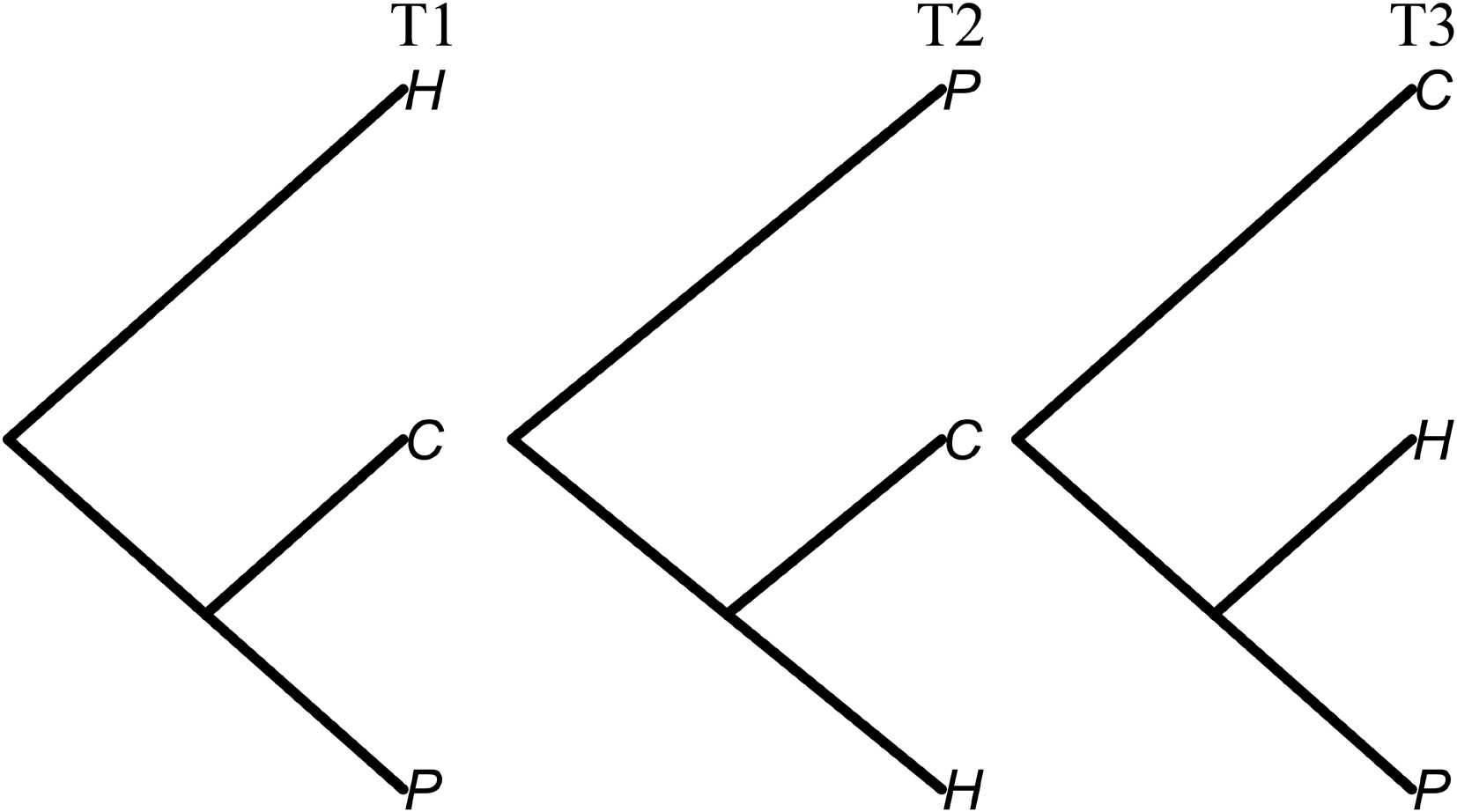
Figure 4.
Three alternative topologies of sect. Pruinoderma (P), sect. Hispidoderma (H), and sect. Celluloderma (C) within subgen. Hispidocelluloderma.
Table 2. Topology tests of three alternative hypotheses for the relationships within subgen.
Tree Topology logL deltaL bp-RELL p-KH p-SH p-WKH p-WSH c-ELW p-AU T1 ((P,C),H) −9085525 710.46 0− 0− 0− 0− 0− 2.36E-154− 7.89E-06− T2 ((H,C),P) −9084814 0 1+ 1+ 1+ 1+ 1+ 1+ 1+ T3 ((P,H),C) −9085858 1043.2 0− 0− 0− 0− 0− 1.05e-312− 1.63E-104− Hispidocelluloderma. logL, log likelihood; deltaL: logL difference from the maximal logl in the set. bp-RELL, bootstrap proportion using RELL method; p-KH, p-value of one-sided Kishino-Hasegawa test; p-SH, p-value of Shimodaira-Hasegawa test; c-ELW, expected likelihood weight; p-AU, p-value of approximately unbiased (AU) test. All tests were performed with 10,000 resamplings using the RELL method. '+' signs denote the 95% confidence sets; '-' signs denote significant exclusion. Species delimitation in Pluteaceae
-
A total of 856 sequences of two loci were successfully sequenced. Separate analyses of ITS and tef1 provided generally compatible phylogenetic topologies for the major clades of Pluteus (Figs 5,7, and 9). However, limited incongruence between the ITS and tef1 gene trees was observed among some closely related species in sect. Pluteus (Fig. 9), mainly involving the placement of terminal taxa rather than the relationships among major clades. The BI and ML analyses of the concatenated data supported the same topology. The collections from China clustered into seven novel lineages with high support values, each of which represents a new species.
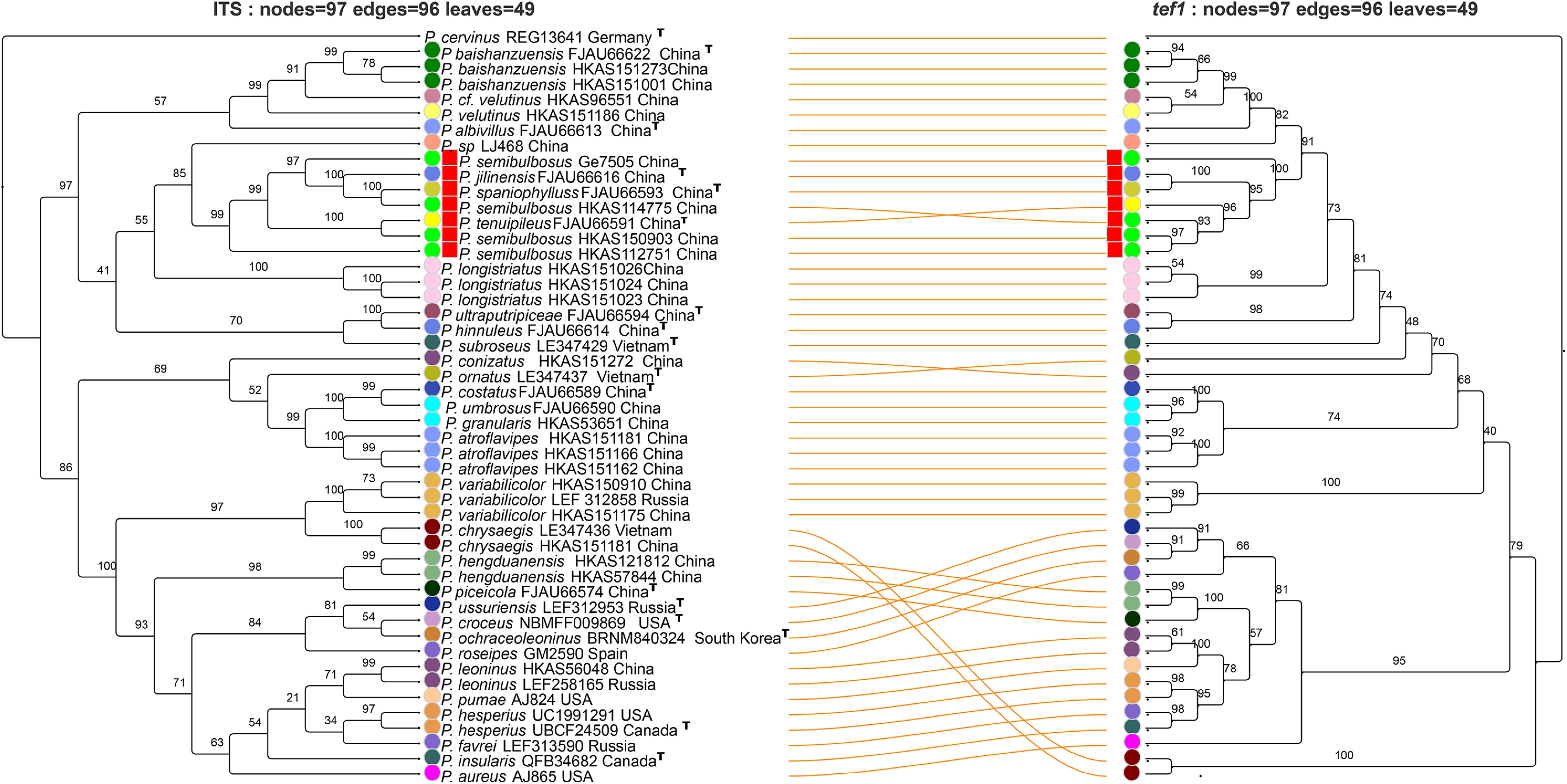
Figure 5.
Maximum likelihood tanglegram tree based on nrDNA ITS (left) and tef1 (right). Red squares indicate inconsistent sect. Hispidoderma species.
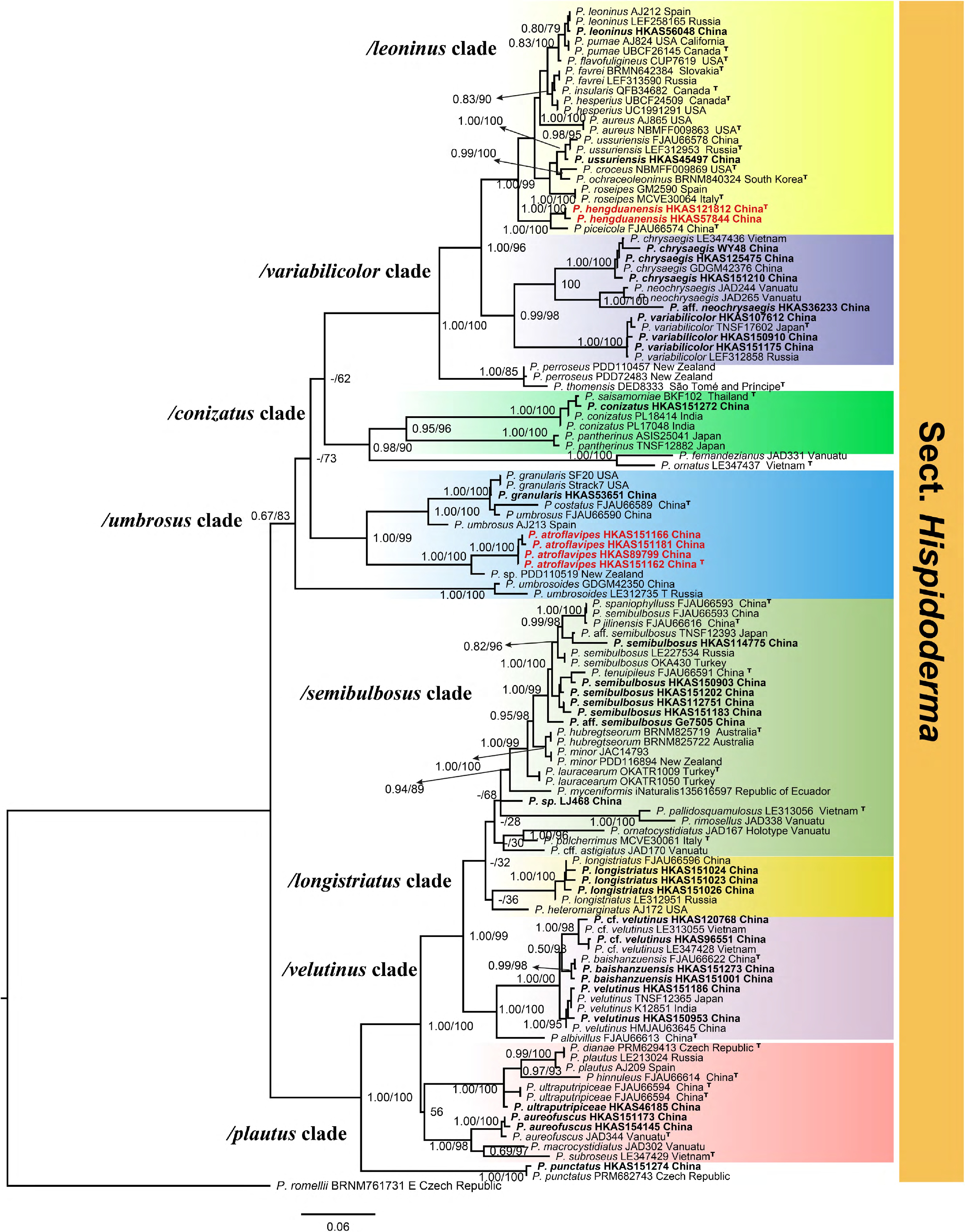
Figure 6.
The best tree from the ML analysis of Pluteus sect. Hispidoderma based on the combined data (ITS-tef1). Bayesian posterior probabilities (PP) and Bootstrap values (BS) are shown along the branches in the format PP/BS. The tree is rooted to P. romellii. Specimens examined in this study are in bold.
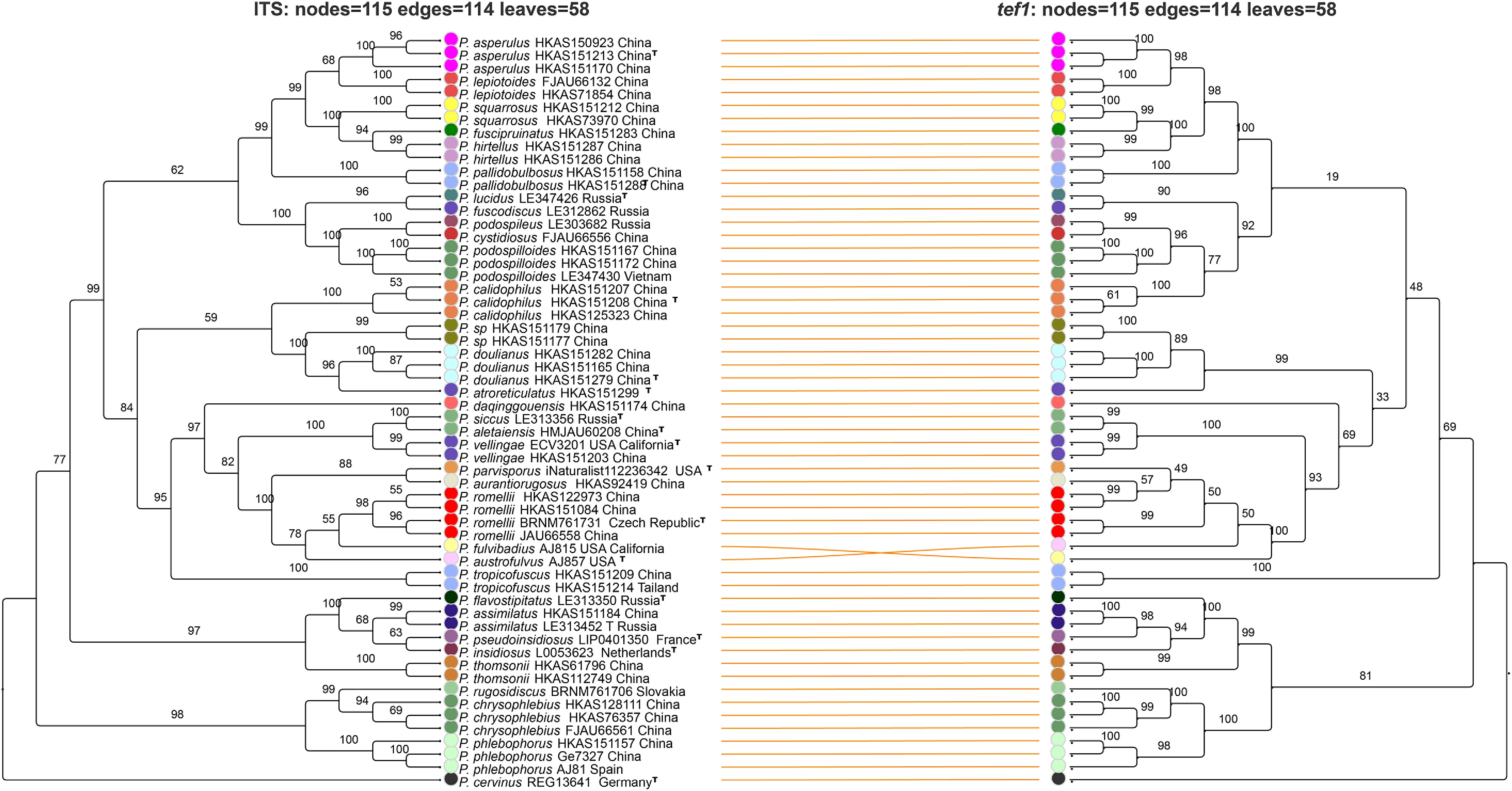
Figure 7.
Maximum likelihood tanglegram tree based on nrDNA ITS (left) and tef1 (right) of Pluteus sect. Celluloderma.
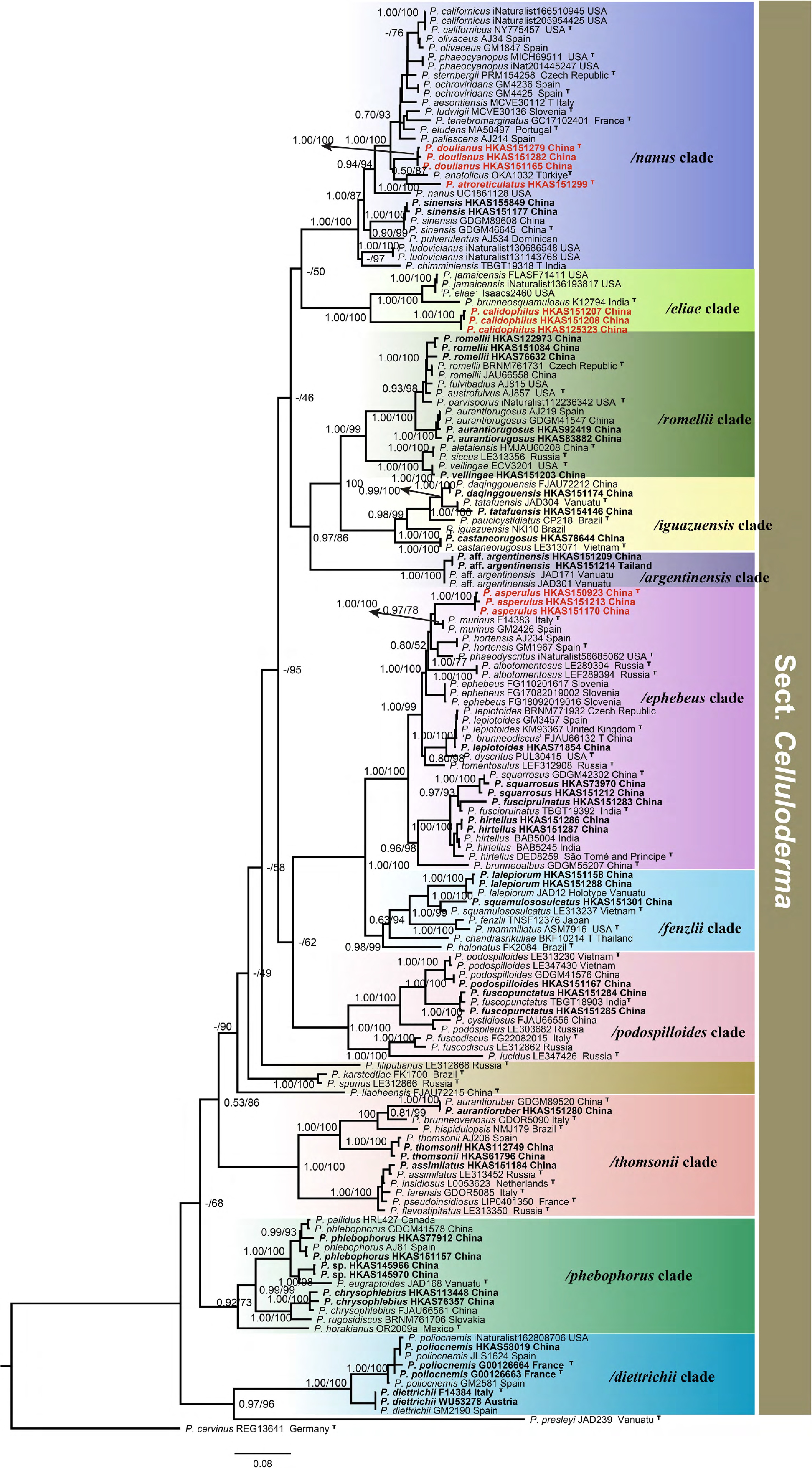
Figure 8.
The best tree from the ML analysis of Pluteus sect. Celluloderma based on the combined data (ITS-tef1). Bayesian posterior probabilities (PP) and Bootstrap values (BS) are shown along the branches in the format PP/BS. The tree is rooted to P. cervinus. Specimens examined in this study are in bold.
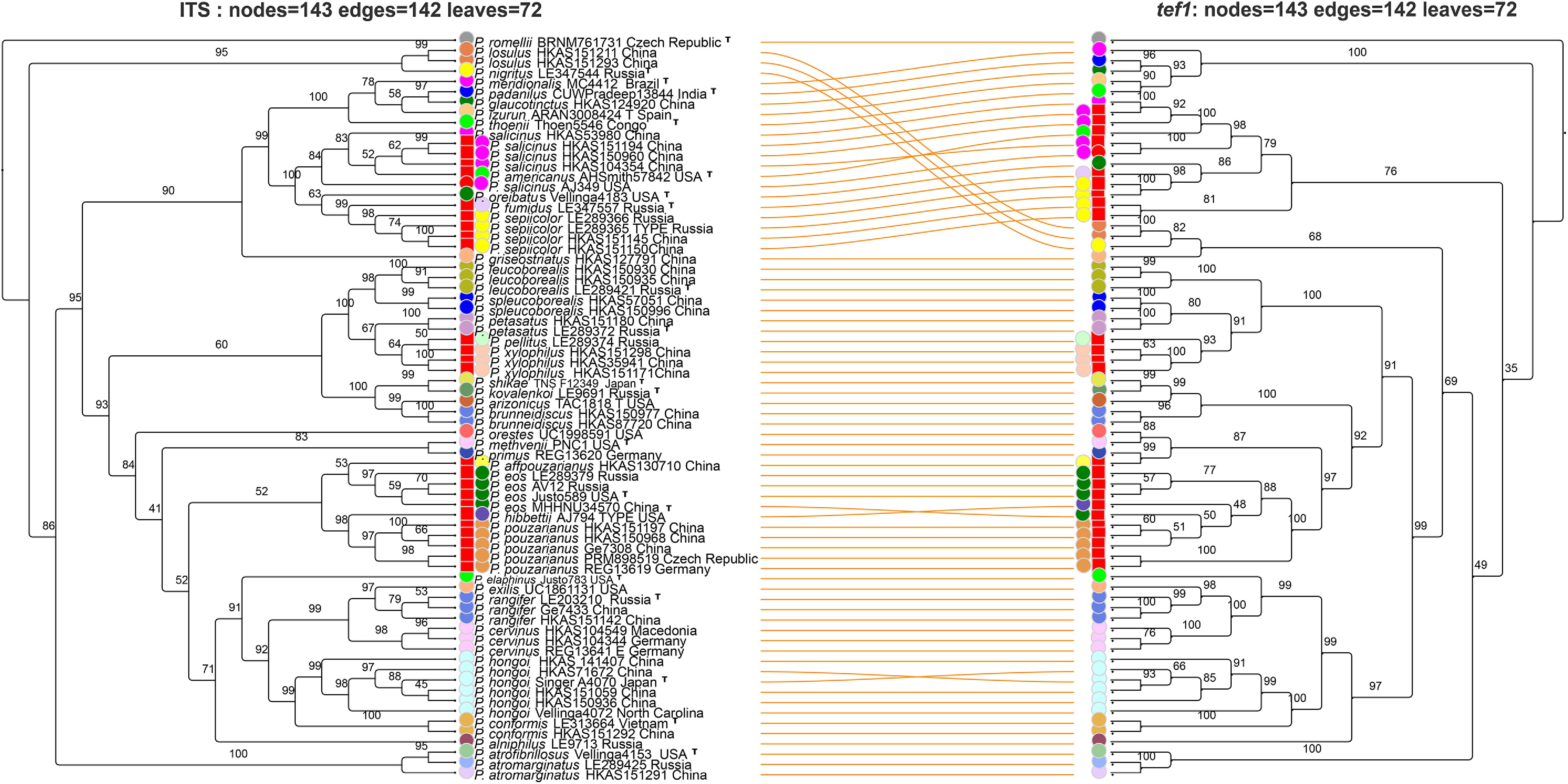
Figure 9.
Maximum likelihood tanglegram tree based on nrDNA ITS (left) and tef1 (right) of Pluteus sect. Pluteus. Red squares indicate inconsistent sect. Pluteus species.
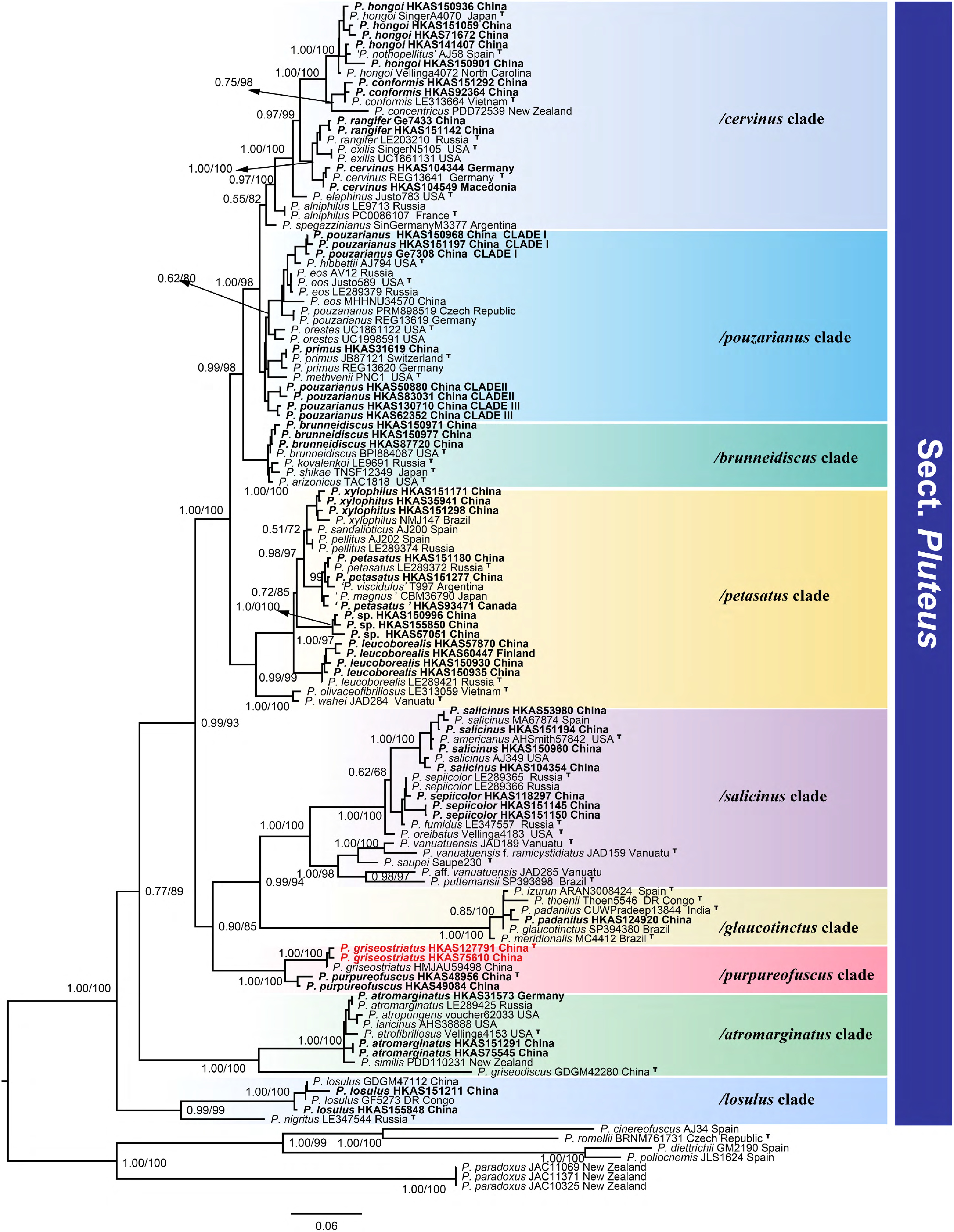
Figure 10.
The best tree from the ML analysis of Pluteus sect. Pluteus based on the combined data (ITS-tef1). Bayesian posterior probabilities (PP) and Bootstrap values (BS) are shown along the branches in the format PP/BS. Specimens examined in this study are in bold.
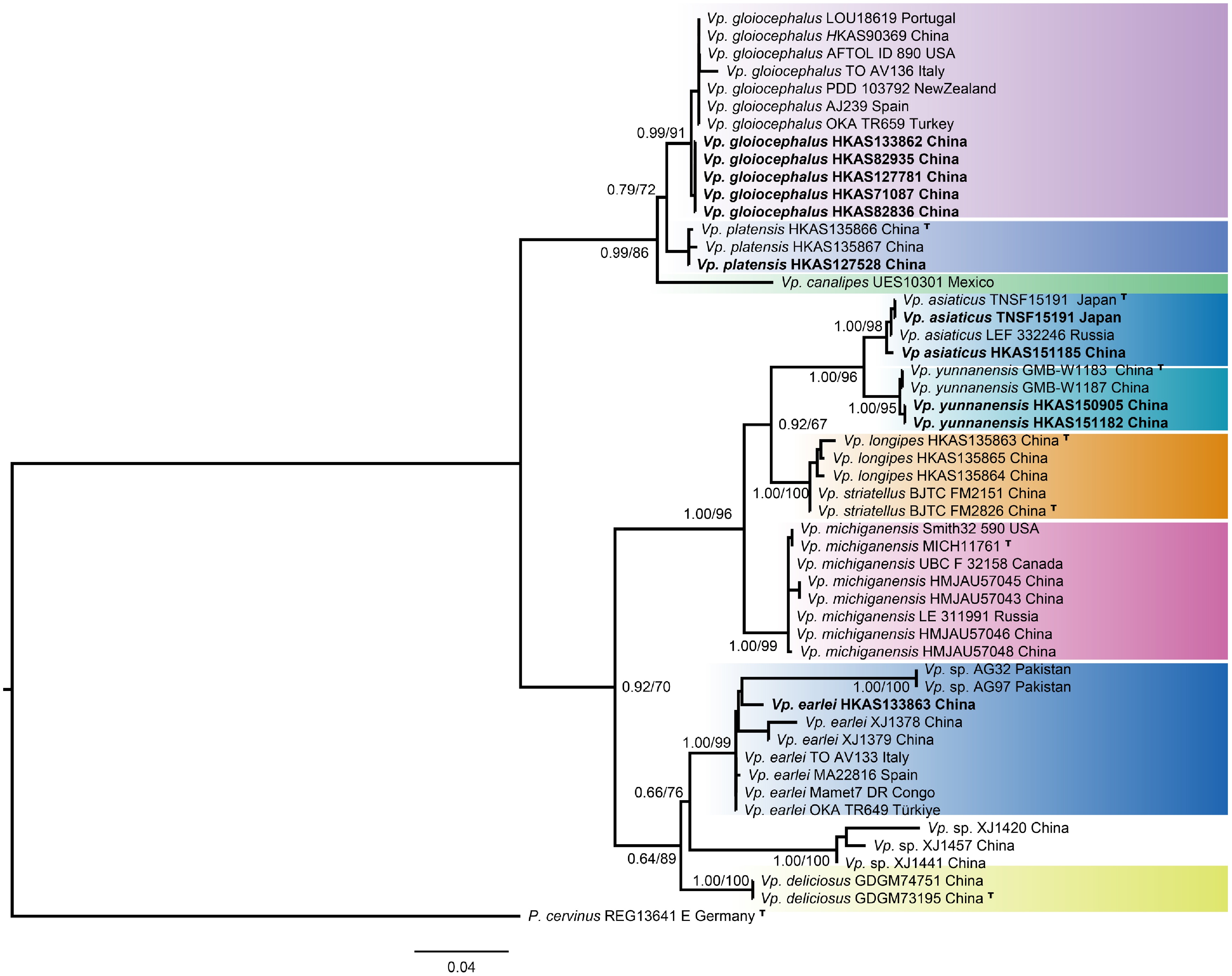
Figure 11.
The best tree from the ML analysis of Volvopluteus based on the ITS data. Bayesian posterior probabilities (PP) and Bootstrap values (BS) are shown along the branches in the format PP/BS. The tree is rooted to P. cervinus.
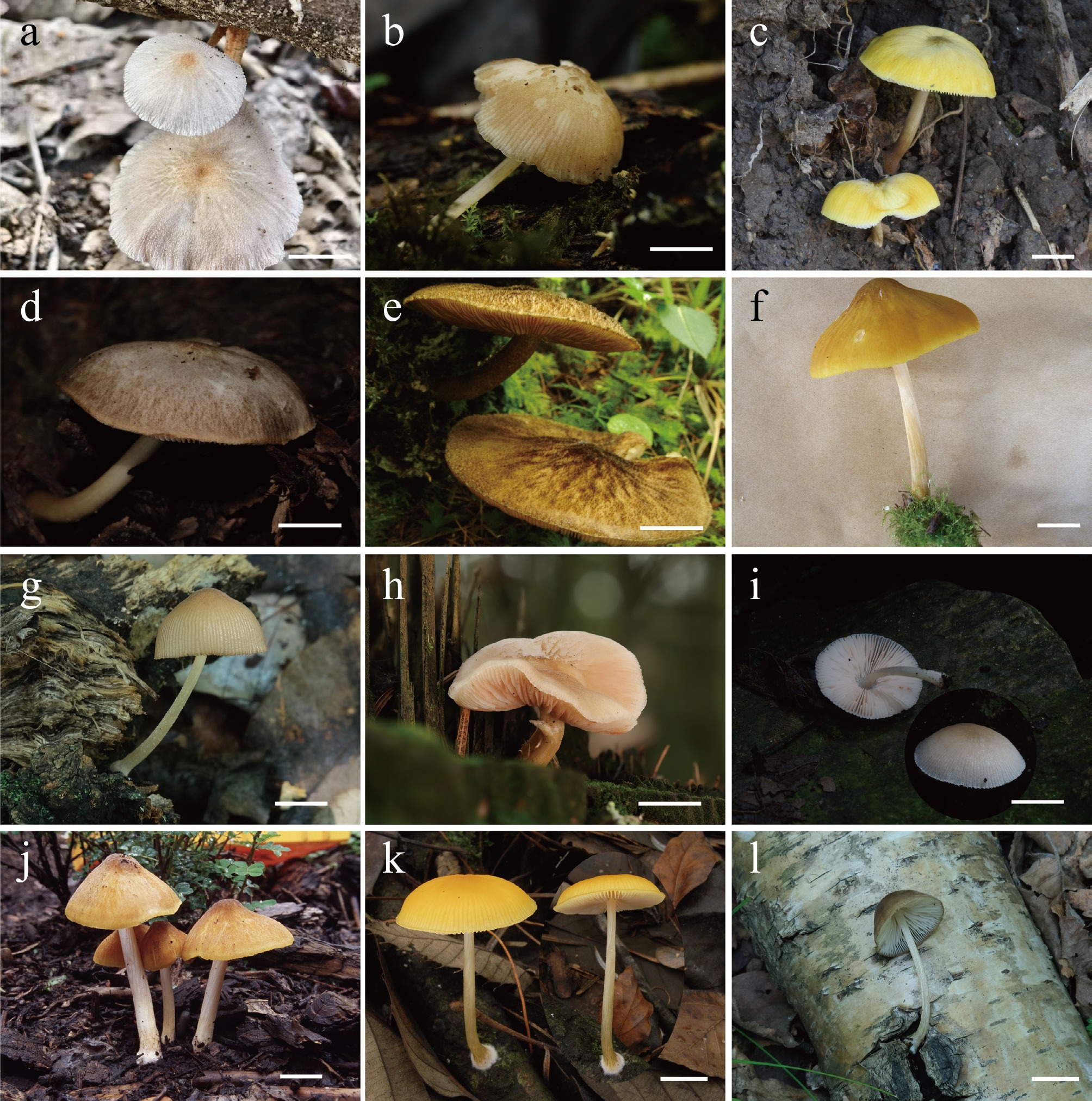
Figure 12.
Fresh basidiomes of Pluteus sect. Hispidoderma from China. (a) P. aureofuscus (HKAS 154145). (b) P. baishanzuensis (HKAS 151004). (c) P. chrysaegis (HKAS 125475). (d) P. conizatus (HKAS 151272). (e) P. granularis (HKAS 53651). (f) P. leoninus (HKAS 56048). (g) P. longistriatus (HKAS 151026). (h) P. punctatus (HKAS 151274). (i) P. semibulbosus (HKAS 114775). (j) P. ussuriensis (HKAS 45497). (k) P. variabilicolor (HKAS 107612). (l) P. velutinus (HKAS 151186).
For species delimitation, the alignment was divided into three matrices by section. We employed the Bayesian Phylogenetics and Phylogeography (BPP) program to validate putative species, using a prior hypothesis derived from morphological results, and maximum likelihood phylogenies of concatenated datasets as integrated priors for species delimitation and phylogenetic relationships. Prior (iii) demonstrated poor applicability in sect. Pluteus and Celluloderma (Supplementary Table S3). While BPP analyses yielded high support for most species across all prior combinations, the following taxa showed weak probabilities: Pluteus fuscopunctatus, P. fenzlii, P. mammillatus, and others (Supplementary Table S3). Based on consensus results of species delimitation methods and morphological evidence in ambiguous species, we recognized 16 species in sect. Hispidoderma (including two new species and 14 known species), 24 species in sect. Celluloderma (including four new species and 20 known species), 17 species in sect. Pluteus (including one new species and 16 known species), one species in sect. Pruinoderma, and five species in the genus Volvopluteus.
-
Based on our phylogenetic, morphological, and ecological data, we provide a modified supra-sectional classification for Pluteaceae and treat the species of the family from China below.
Pluteaceae
I. Genus Pluteus Fr. 1836
Type: Pluteus cervinus (Schaeff.) P. Kumm. 1871
i. Subgen. Pluteus
Type: Pluteus cervinus (Schaeff.) P. Kumm. 1871
1. Sect. Pluteus
Type: Pluteus cervinus (Schaeff.) P. Kumm. 1871
ii. Subgen. Hispidocelluloderma Wasser 1992
Type: Pluteus leoninus (Schaeff.) P. Kumm. 1871
1. Sect. Hispidoderma Fayod 1889
Type: Pluteus leoninus (Schaeff.) P. Kumm. 1871
2. Sect. Celluloderma Fayod 1889
Type: Pluteus nanus (Pers.) P. Kumm. 1871
3. Sect. Pruinoderma Zhu L. Yang & X. Chen
Type: Pluteus diettrichii Bres. (see below)
II. Genus Volvopluteus Vizzini, Contu & Justo 2011
Type: Volvopluteus gloiocephalus (DC.) Vizzini, Contu & Justo 2011
Key to the species of Pluteus sect. Hispidoderma from China
1. Basidiomes small (pileus usually ≤ 3 cm in diam.); pileus thin and surface hygrophanous 2 1. Basidiomes medium to large (pileus usually > 3 cm in diam.); pileus not thin and not hygrophanous 5 2. Stipe base bulbose P. semibulbosus 2. Stipe base not bulbose 3 3. On decaying coniferous wood; pleurocystidia apex mucronate or rostrate with up to 2–6 μm long projection P. tenuipileus 3. On decaying deciduous wood; pleurocystidia not mucronate or rostrate 4 4. Pileus burnt yellow with distinct squamules or rugose-venose around the center; lamellae dense; basidiospores 7.0–8.0 × 6.0–7.0 μm P. jilinensis 4. Pileus white to pale yellow with brown velvety or pruinose surface; lamellae sparse; basidiospores 7.0–7.5 × 6.0–6.5 μm P. spaniophyllus 5. Pileus surface with brownish glandular dots P. baishanzuensis 5. Pileus surface without glandular dots 6 6. Pileus surface densely covered with white villi P. albivillus 6. Pileus surface not villose 7 7. Pleurocystidia apex without digitiform projections 8 7. Pleurocystidia with digitiform projections 9 8. Pileus orange-brown to fleshy brown, velvety to squamulose; basidiospores 7.5–8.7 × 5.6–6.8 μm P. velutinus 8. Pileus clay-buff to earthy yellow; basidiospores 6.5–7.5 × 5.5–6.5 μm P. hinnuleus 9. Pileus densely with dark brown granules, sometimes wrinkled or veined or almost reticulate at the center; lamellar edge dark brown or concolorous 10 9. Pileus covered without dark brown granules; lamellar edge pale or concolorous 14 10. Lamellar egde concolorous; stipe white P. umbrosoides 10. Lamellar edge dark brown; stipe with dark brown squamules 11 11. Pleurocystidia with 1−3 horns with distinct apical mucilage P. granularis 11. Pleurocystidia with 1−4 horns without apical mucilage 12 12. Temperate in distribution P. umbrosus 12. Subtropical in distribution 13 13. Lignicolous on deciduous wood; stipe yellow with dark brown squamules P. atroflavipes 13. Lignicolous on gymnosperm wood; stipe white with dark brown squamules P. costatus 14. Pileus predominantly yellow to golden yellow 15 14. Pileus pale grey-brown, grey or brown 19 15. Caulocystidia absent 16 15. Caulocystidia present P. variabilicolor 16. Tropical in distribution 17 16. Subtropical or temperate in distribution 18 17. Pileus golden-cream, finely fibrillose-flocculose; basidiospores 6–8× 6–8 μm P. aureofuscus 17. Pileus brilliant golden yellow, with darker and rugulose center; basidiospores 5.0–5.5 × 4.5–5.0 μm P. chrysaegis 18. Pileus yellow to orange or brown; basidiospores 6.0‒8.0 ×5.0‒6.5 μm P. leoninus 18. Pileus overall yellow; basidiospores 6.0–7.0 ×4.5–5.5 μm P. ussuriensis 19. Pileus cream or dark brown; pileipellis with broadly clavate or fusiform elements 20 19. Pileus yellow-brown or dark brown; pileipellis with elongate, fusoid terminal elements (>100 μm) 21 20. Cheilocystidia thin walled 22 20. Cheilocystidia thick-walled P. conizatus 21. Terrestrial on coniferous litter substrates in subalpine habitat; pileus dark brown; basidiospores 7–7.5 × 5.5–6.5 μm P. hengduanensis 21. Lignicolous on decaying spruce dead wood; pileus yellow-brown; basidiospores 7.0–8.0 × 5.5–6.0 μm P. piceicola 22. Pileus not long radial striae 23 22. Pileus long radial striae P. longistriatus 23. Pleurocystidia absent P. nankungensis 23. Pleurocystidia present 24 24. Pleurocystidia clavate to broadly clavate 25 24. Pleurocystidia fusiform P. ultraputripiceae 25. Pileus pale grey-brown, velvety to squamulose; large basidiospores 5–8.5 × 4.5–7.0 μm P. punctatus 25. Pileus dark brown, densely short-hairy; small basidiospores 4–5.5 ×3–3.5 μm P. fenghuangensis Pluteus atroflavipes Zhu L. Yang & X. Chen, sp. nov. Fig. 13
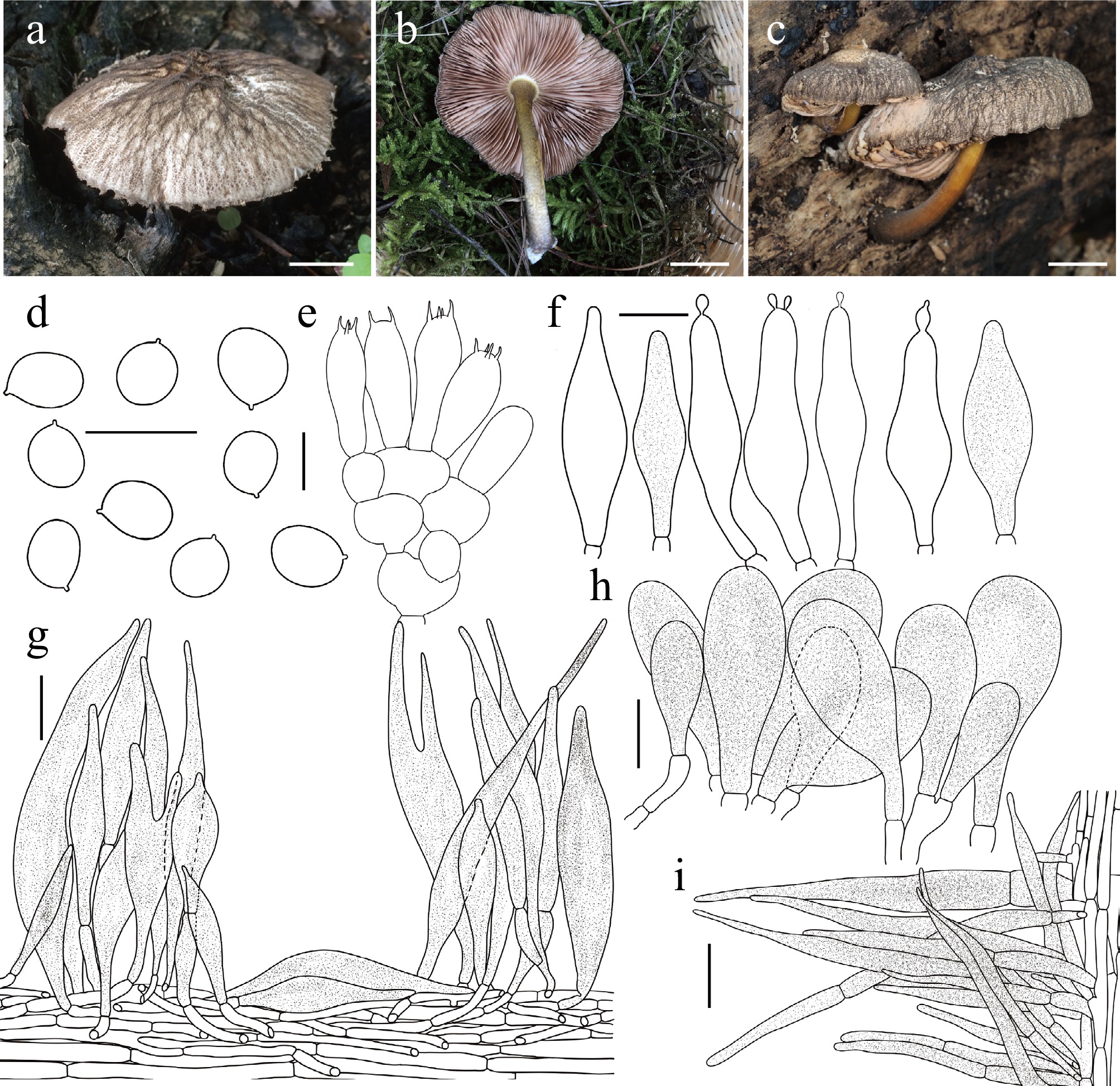
Figure 13.
Pluteus atroflavipes (HKAS 151162). (a)–(c) Basidiomes in natural habitat. (d) Basidiospores. (e) Basidia. (f) Pleurocystidia. (g) Pileipellis with terminal elements. (h) Cheilocystidia. (i) Stipitipellis with caulocystidia. Scale bars: (a)–(c) = 1 cm, (d), (e) = 10 μm, (f), (h) = 20 μm, (g), (i) = 40 μm.
Fungal Name: FN 573105
Chinese name: 暗褐黄柄光柄菇
Etymology – atroflavipes (Lat.), referring to blackish yellow stipe.
Diagnosis – Pluteus atroflavipes differs from P. umbrosus (Pers.) P. Kumm. by its blackish-yellow stipe and subtropical habitat.
Basidiomes medium-sized. Pileus 55–60 mm diam., hemispherical then plano-convex, with low umbo; surface non-hygrophanous, brown to blackish-brown, covered by erect tapered squamules, with densely venose at center. Lamellae free, pale pinkish brown (8A2–4), with small brown dots (under lens), ventricose, moderately crowded, with lamellulae, with flocculose brown edge. Stipe 60–65 mm × 6–8 mm, slender, cylindrical, often with enlarged or bulbous base, solid; surface blackish-yellow (4F7), with dark brown squamules. Context in pileus unchanging, white (1A1), in stipe brownish-yellow (3B4). Smell and taste unknown.
Basidiospores [80/2/2] (5)5.5–7 × 4–6 μm, avl × avw = 6.17 × 5.02 μm, Q = 1.10–1.36, Qm = 1.23. ±0.08, subglobose to ellipsoid, slightly thick-walled (0.5–0.7 μm), smooth. Basidia 15–26 × 5–8 μm, 4-spored, clavate, thin-walled. Cheilocystidia crowded, 30–60 × 12–18 μm, clavate, with brown intracellular pigment, thin-walled. Pleurocystidia fairly abundant, 41–82 × 13–22 μm, narrowly lageniform to narrowly utriform, apex with one to four short, digitiform projections, colorless or often with brown intracellular pigment, thin walled. Pileipellis a trichohymeniderm, differentiated, composed of loose fascicles of erect, elongate, fusoid terminal elements, often furcate, 110–280 × 20–35 μm, with brown intracellular pigment, thin- or thick-walled. Stipitipellis trichohymeniderm, composed of fascicles of erect, cylindrical, fusoid caulocystidia, 70–235 × 10–25 μm, with brown intracellular pigment, thin-walled. Clamp connections absent in all tissues.
Habitat and distribution – lignicolous, on decaying Quercus wood in subtropical habitats. Known from China.
Materials examined – CHINA. Yunnan Province: Dali City, Yinqiao Town, Cangshan Mountain, altitude 2,590 m, 12 June 2024, ZCJ16 (HKAS 151162, holotype). Henan Province: Luoyang City, Luanchuan County, Tantou Town, Xiaohe Village, altitude 1,778 m, 11 August 2015, Bo Li 23 (HKAS 89899). Jiangsu Province: Nanjing City, Zijin Mountain National Scenic Area, altitude 300 m, 19 May 2023, Xia Chen 183 (HKAS 151166); ibid., 23 October 2023, Xia Chen 828 (HKAS 151181).
Notes – Pluteus atroflavipes is characterized by a brown to blackish-brown umbrinous veined pileus, dark lamella edge, blackish-yellow stipe, and subglobose to ellipsoid basidiospores ([5]5.5–7 × 4–6 μm, avl × avw = 6.17 × 5.02 μm, Q = 1.10–1.36, Qm = 1.23 ± 0.08). The general morphological characters are similar to those of P. granularis Peck, P. ornatus E.F. Malysheva, P. umbrosus, and P. umbrosoides E.F. Malysheva and P. perroseus E. Horak. Molecularly, their ITS similarity is less than 95%.
Pluteus granularis, a common North American species, is recognized by a velvety dark pileus with pilose granules, radially rugose in the center, crenulate or fimbriate on the margin, blackish stipe, and lageniform or fusiform, mostly hyaline pleurocystidia, with irregularly shaped one to three small excrescences and apical mucilage; a few have brown pigment[60−63], typically found in temperate regions. Although they share morphological similarities in spore characteristics and others, they can still be distinguished by the yellow stipe and subtropical habitat.
Pluteus ornatus, originally described in Vietnam, is characterized by its large basidiomes with densely squamulose, dark brown pileus, lamellae with brown edges, pale colored stipe, and larger ellipsoid basidiospores 6.5–9.5 × 5.3–7.7 um, avl × avw = 7.7 × 6.3 μm, Q= 1.1–1.3(1.4), Qm = 1.2[64]. Pluteus umbrosus, usually found in temperate regions, is distinguished by its dark granular pileus, veined pileus surface, and dark stipe[61,63,65]. Pluteus umbrosoides, originally described in Vietnam, also distributed in China[66], possesses lamellae without brown edges, absence of overhanging floccules on the pileus margin, and a smooth stipe without brown squamules[67]. Pluteus perroseus, originally described in New Zealand, is characterized by a dark brown or black granular pileus, dark squamulose stipe, larger basidiospores (7–8[8.5] × 5.5–6.5 μm), pleurocystidia rarely with finger-like projections and absent caulocystidia[68]. The phylogenetic analyses indicate that all species form well-supported distinct clades (Fig. 6).
Pluteus aureofuscus J.A. del Rosario & B.A. Perry, Phytotaxa 709(1): 38 (2025) Figs 12a and 14
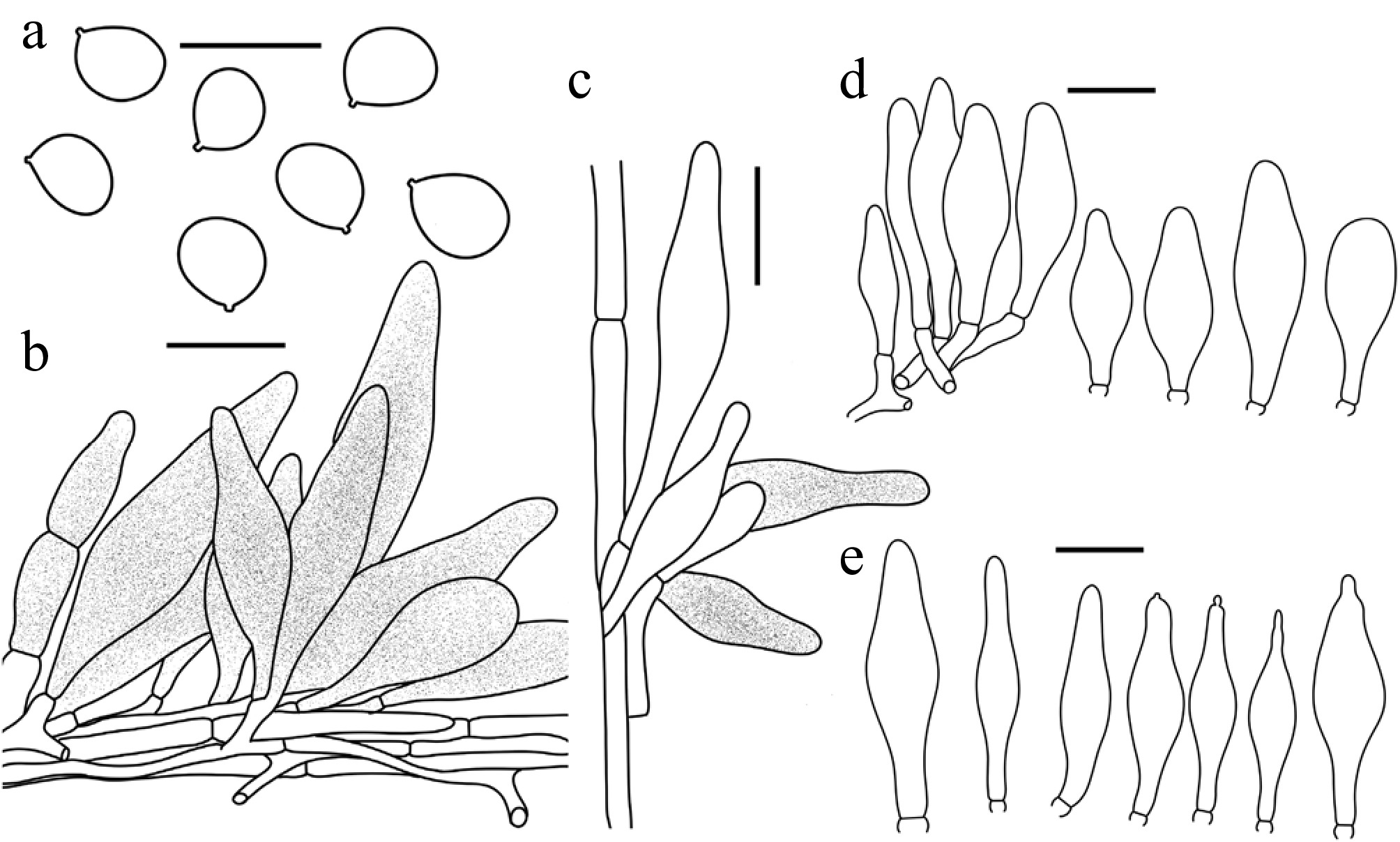
Figure 14.
Pluteus aureofuscus (HKAS 154145). (a) Basidiospores. (b) Pileipellis with terminal elements. (c) Stipitipellis with caulocystidia. (d) Cheilocystidia. (e) Pleurocystidia. Scale bars: (a) = 10 μm, (b)–(e) = 20 μm.
Habitat and distribution – lignicolous, on decaying deciduous wood. Known from Vanuatu and northern China.
Materials examined – CHINA. Guangxi Zhuang Autonomous Region: Nanning City, Jiangnan District, Qipo Forest Farm, altitude 93 m, 20 September 2025, De-De Jiang (HKAS 154145).
Notes – Pluteus aureofuscus, recently described from Vanuatu, is characterized by a golden-cream pileus turning gray with age, frequent apically mucronate pleurocystidia, clavate to sphaeropedunculate cheilocystidia, and a pileipellis composed of clavate, fusoid-ventricose and subglobose elements[69]. The ITS sequence of the Chinese specimen shows 99.53% sequence similarity to that of specimens from Vanuatu, and the specimens are also highly similar morphologically. The occurrence in southern China of P. aureofuscus suggests that Guangxi Province represents an important biogeographical crossroads, harboring both tropical and subtropical elements.
Pluteus baishanzuensis Z.X. QI, B. Zhang & Y. Li Figs 12b and 15
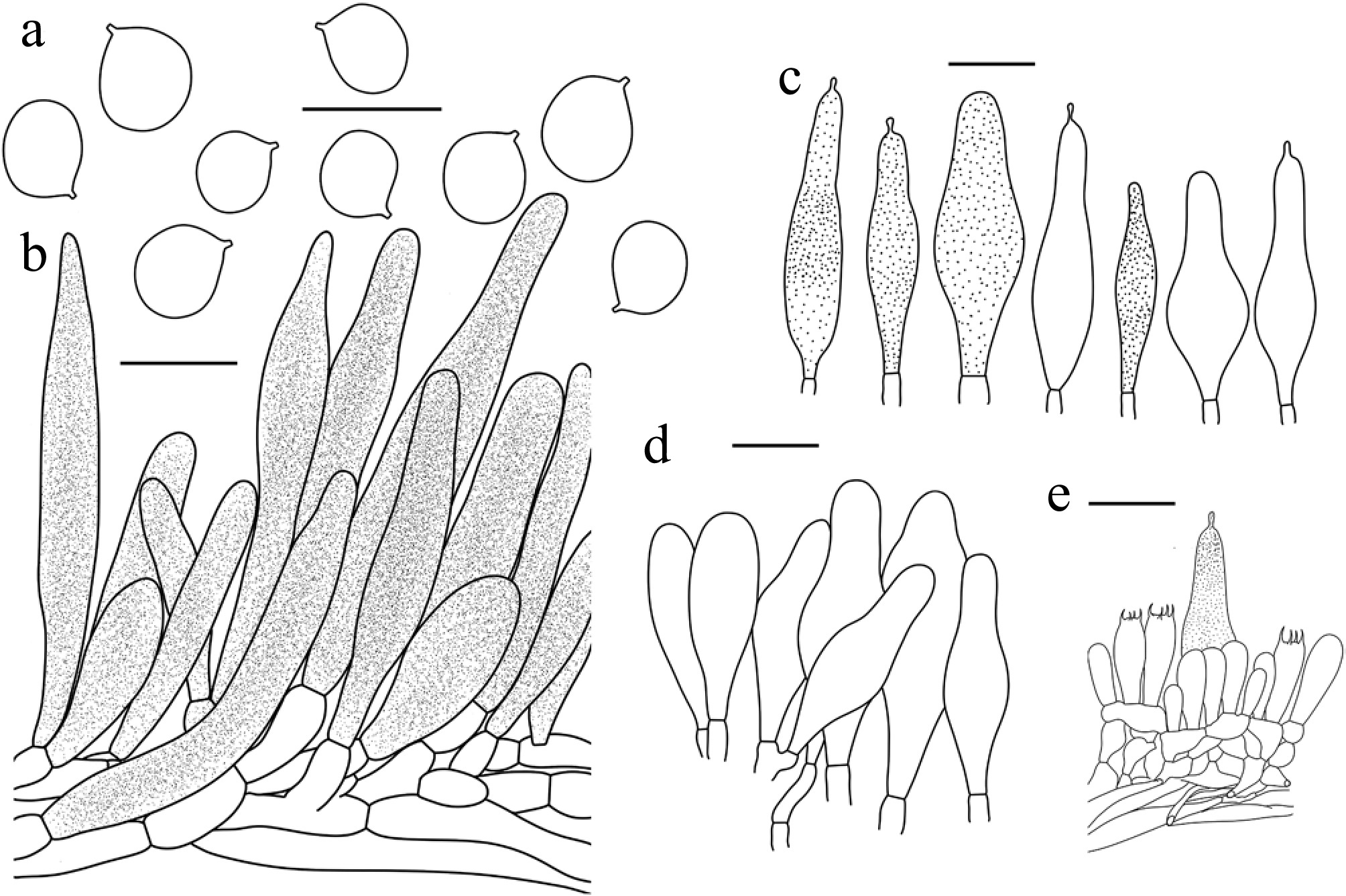
Figure 15.
Pluteus baishanzuensis (HKAS 151001). (a) Basidiospores. (b) Pileipellis with terminal elements. (c) Pleurocystidia. (d) Cheilocystidia. (e) Basidia. Scale bars: (a) = 10 μm, (b)–(e) = 20 μm.
Habitat and distribution – lignicolous, on deciduous decaying wood. Known from China.
Materials examined – CHINA. Chongqing City: Pengshui Miao and Tujia Autonomous County, Jianxi Town, Mowei Mountain, in forests with Fagaceae, altitude 1,288 m, 30 May 2024, Xuan Chen 399 (HKAS 151273); Shanxi Province: Yuncheng City, Yuanqu Town, Shunwang Ping Scenic Area, in forests with Fagaceae, altitude 1,370 m, 29 July 2024, Xuan Chen 561 (HKAS 151001).
Notes – Pluteus baishanzuensis was recently described in China[70], and it is characterized by small or medium-sized basidiomes, subglobose to broadly ellipsoid basidiospores (6–8 × 5–7[7.5] μm, avl × avw = 7.05 × 6.62 μm Q = 1.07–1.25), fusoid to narrowly utriform pleurocystidia, often with apical papilla and clavate or narrowly fusiform pileipellis elements. However, morphological characters of P. baishanzuensis observed in this study showed some differences from the original description of the type species[70]. For instance, some specimens exhibited pigmented pleurocystidia. In our study, P. baishanzuensis seems to share similar characteristics with P. velutinus (Fig. 15), a species originally described from India[71] and widely distributed worldwide, possesses the shallowly depressed, hygrophanous, orange-brown, velvety to squamulose pileus, larger basidiospores (5.5–9.5 × 5–7 μm, avl × avw = 7.7 × 6.2 μm, Q = 1.17–1.50, Qm = 1.29), and clavate caulocystidia[71]. Comparing the characteristics from different regions such as Italy, Slovenia, Russia, Brazil, and China[67,72−74], the major differences were observed in pleurocystidia pigmentation and apical morphology in our study. Regarding the discussion of the two species, a detailed comparison has already been provided in the original description of the species[70]. Pluteus baishanzuensis and P. velutinus showed 97.8%–98.7% ITS sequence identity. Furthermore, phylogenetic analyses indicated that the two species are close to each other. The BPP analysis strongly supported P. baishanzuensis as a separate species, with high support (BPP = 1.00). Morphologically, P. baishanzuensis looks like P. longistriatus (Peck) Peck, a species distributed in North America, South America, and Eurasia[63,73,75]. However, P. longistriatus differs from P. baishanzuensis by the long striate pileus margin and mixed epicutis with elongated-fusiform and short clavate elements[63,76].
Pluteus chrysaegis (Berk. & Broome) Petch, Ann. R. bot. Gdns Peradeniya 5(4): 271 (1912) Figs 12c and 16
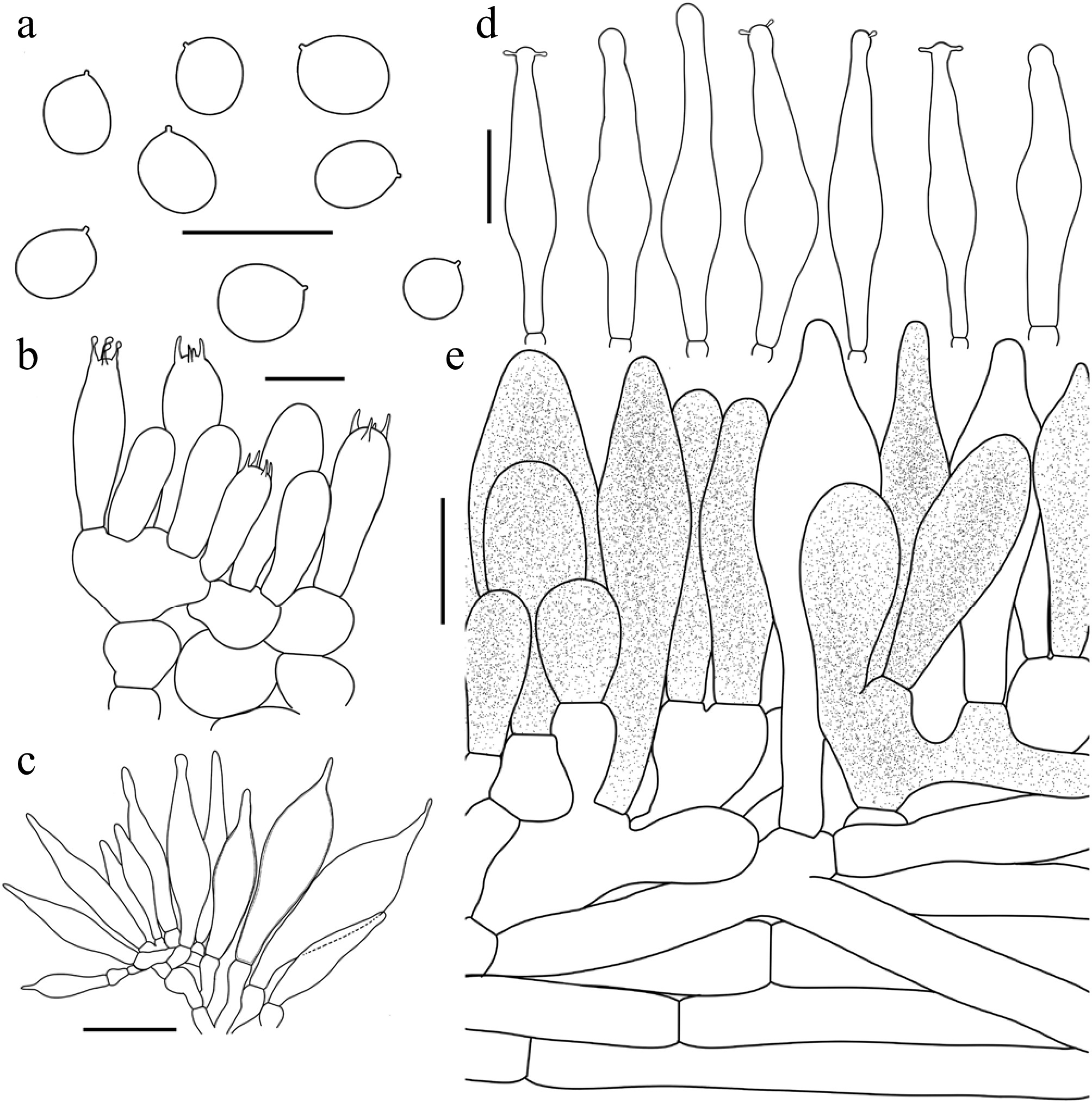
Figure 16.
Pluteus chrysaegis (HKAS 151210). (a) Basidiospores. (b) Basidia. (c) Cheilocystidia. (d) Pleurocystidia. (e) Pileipellis with terminal elements. Scale bars: (a), (b), (e) = 10 μm, (c), (d) = 20 μm.
Habitat and distribution – solitary, lignicolous on deciduous decaying wood or terrestrial in tropical habitats. Pluteus chrysaegis is known from India[71,77], the Democratic Republic of Sao Tome and Principe[78], Vietnam[64], Florida, Puerto Rico[18], and tropical China[66].
Materials examined – CHINA. Yunnan Province: Xishuangbanna Dai Autonomous Prefecture, Mengla County, Yi-Meng Road, Xishuangbanna Tropical Rainforest National Park Wangtianshu Scenic Area, in forests with Dipterocarpaceae, altitude 668 m, 14 June 2024, Yang-Yang Cui 828 (HKAS 151210); Menghai County, Daluo Town, Manzhuang village, altitude 642 m, 22 August 2019, Liu-Kun Jia 652 (HKAS 125475).
Notes – Pluteus chrysaegis, originally described from Sri Lanka[18,79], possesses a yellow pileus with a dark rugulose or venose center, subglobose to globose basidiospores, fusiform pleurocystidia with obtuse apex, lageniform to fusoid cheilocystidia with long appendages, a hymeniderm pileipellis composed of clavate to subfusiform cells. Pluteus chrysaegis exhibits a distinctly tropical distribution pattern, and also occurs in China, with its distribution restricted to tropical regions in the country.
Pluteus conizatus (Berk. & Broome) Sacc., Syll. Fung. (Abellini) 5: 674 (1887) Figs 12d and 17
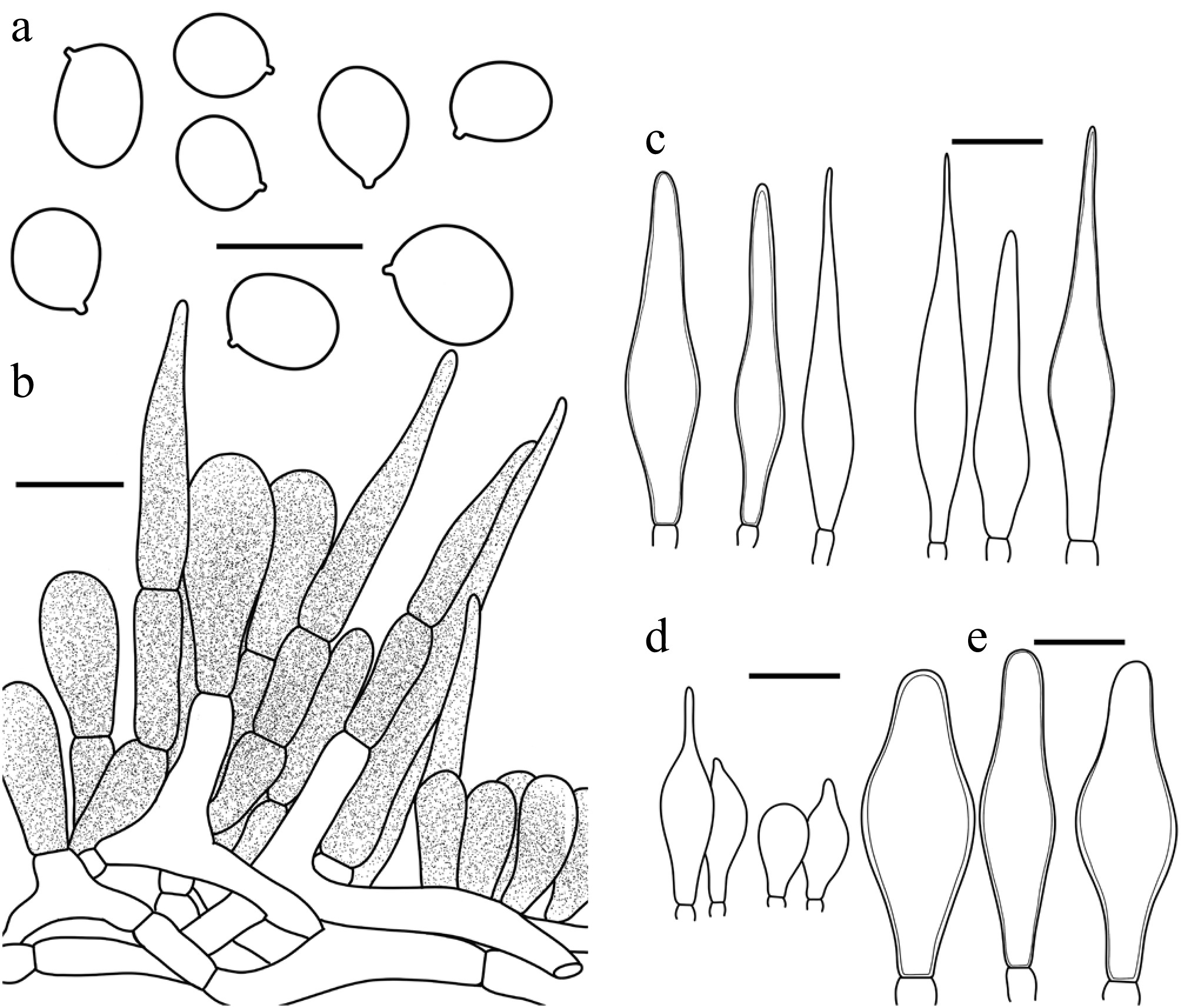
Figure 17.
Pluteus conizatus (HKAS 151272). (a) Basidiospores. (b) Pileipellis with terminal elements. (c) Cheilocystidia. (d) Caulocystidia. (e) Pleurocystidia. Scale bar: (a) = 10 μm. (b)–(e) = 20 μm.
Habitat and distribution – solitary, lignicolous on deciduous decaying wood. So far known from Thailand and southern China.
Material examined – CHINA. Guangxi Zhuang Autonomous Region: Nanning City, Liangfengjiang National Forest Park, altitude 200 m, 4 July 2023, Jun-Jie Liu 182 (HKAS 151272).
Notes – Pluteus conizatus is characterized by medium-sized basidiomes, pileus with tiny dark brown squamules, greyish orange stipe covered with brown granules, narrowly conical or setiform cheilocystidia, fusiform or lageniform pleurocystidia, a trichohymeniderm pileipellis with narrowly fusoid, cylindrical terminal elements and fusiform caulocystidia with papillate apex. Pluteus conizatus was originally described from Sri Lanka[18,79,80], and also occurs in Guangxi Province, southern China — a region located in the transitional zone between tropical and subtropical floras and characterized by strong tropical floristic elements, where it inhabits ecologically similar habitats to those of the type locality.
Pluteus granularis Peck, Ann. Rep. N.Y. St. Mus. nat. Hist. 38: 135 (1885) Figs 12e and 18
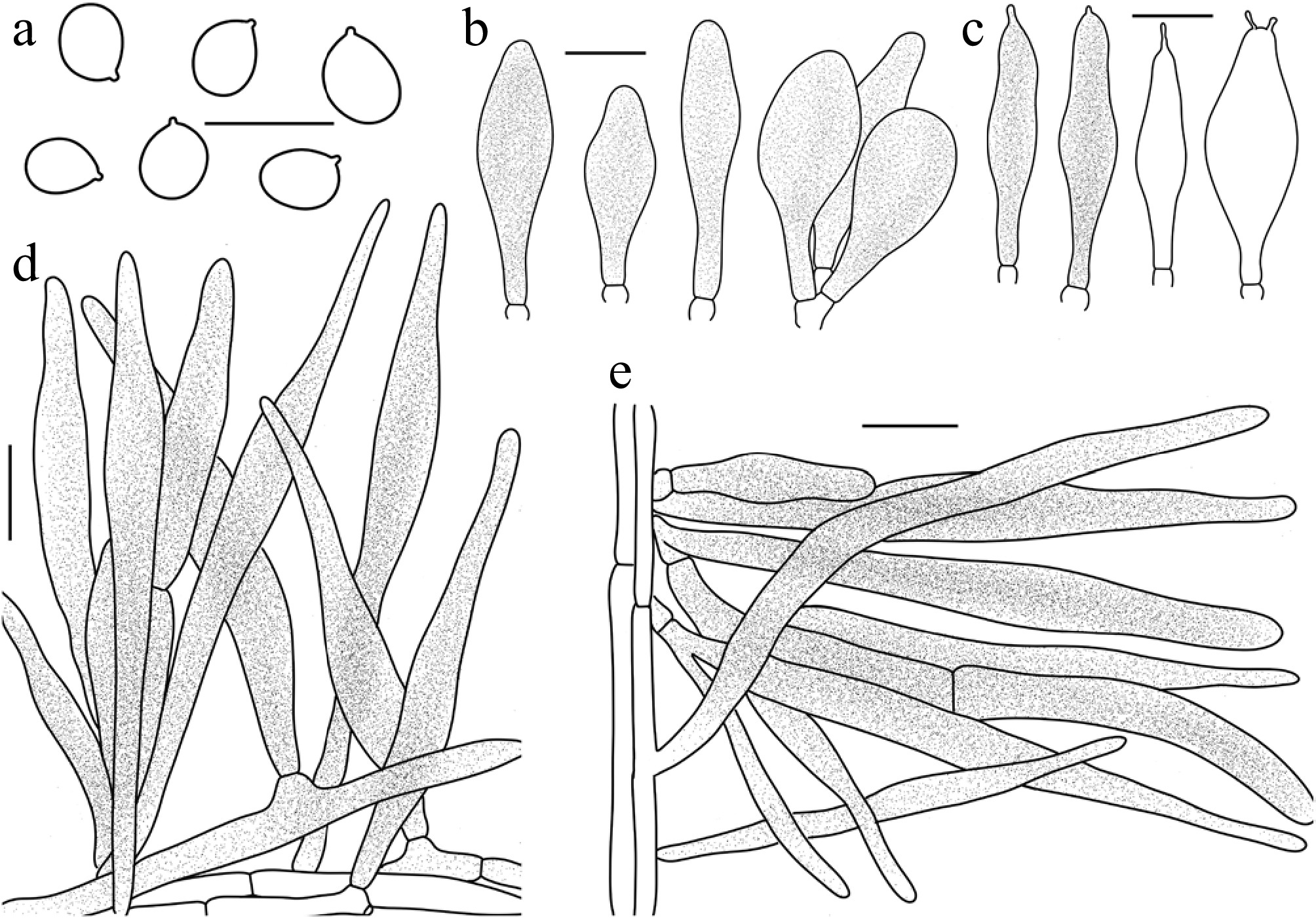
Figure 18.
Pluteus granularis (HKAS 53651). (a) Basidiospores. (b) Cheilocystidia. (c) Pleurocystidia. (d) Pileipellis with terminal elements. (e) Stipitipellis with caulocystidia. Scale bars: (a) = 10 μm, (b), (c) = 20 μm, (d)–(e) = 40 μm.
Habitat and distribution – Solitary, lignicolous on deciduous decaying wood. It is known from USA[19,81], Türkiye[61] and China[70] (this study).
Materials examined – CHINA. Sichuan Province: Aba Tibetan and Qiang Autonomous Prefecture, Xiaojin County, Meiwo Township, altitude 2,902 m, 27 July 2007, Zai-Wei Ge 1565 (HKAS 53651).
Notes – Pluteus granularis was initially described from USA[81], then reported in Türkiye[61] and characterized by rugose-wrinkled, granulose pileus, intense dark brown granular stipe, broadly ellipsoid basidiospores, clavate pigment cheilocystidia, narrowly lageniform or utriform pleurocystidia often with one to three digitiform projections and brown pigment, elongated narrowly cylindrical or narrowly fusiform caulocystidia often grouped in clusters and with brown intracellular pigment. It is close to P. umbrosus (Pers.) P. Kumm. phylogenetically and morphologically (Fig. 6), a species reported from most European countries[19,61] and Russia[67]. The difference between these two species is discussed in that study[61].
Pluteus hengduanensis Zhu L. Yang & X. Chen, sp. nov. Fig. 19
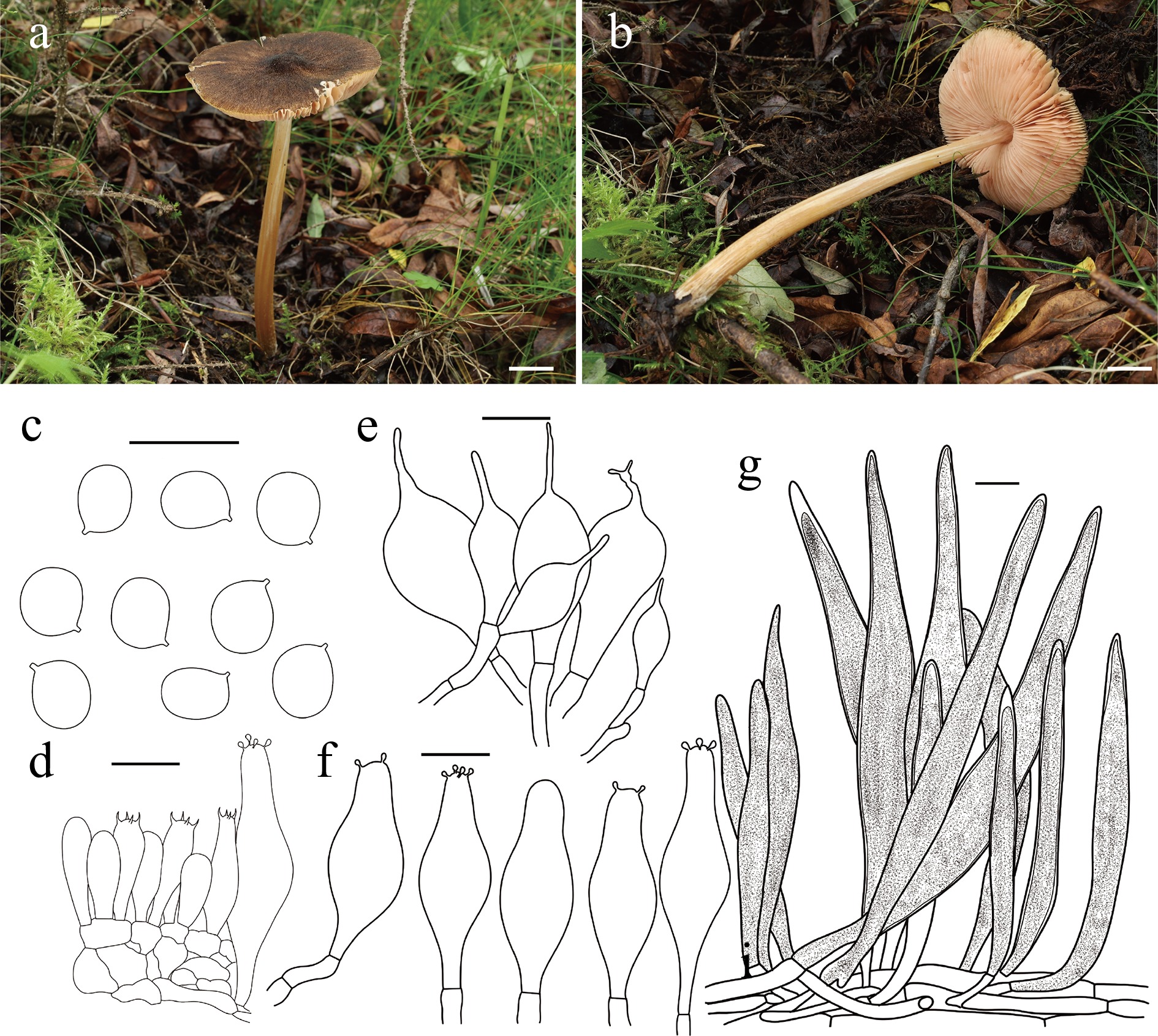
Figure 19.
Pluteus hengduanensis (HKAS 121812). (a), (b) Basidiomes in natural habitat. (c) Basidiospores. (d) Basidia. (e) Cheilocystidia. (f) Pleurocystidia. (g) Pileipellis with terminal elements. Scale bars: (a), (b) = 1 cm, (c) = 10 μm, (d)–(g) = 20 μm.
Fungal Name: FN 573106
Chinese name: 横断山光柄菇
Etymology – hengduanensis (Lat.), referring to its distribution in the Hengduan Mountains, southwestern China.
Diagnosis – Pluteus hengduanensis differs from P. piceicola by a darker brown pruinose and squamulose pileus, yellow brown stipe, smaller basidiospores, and a terrestrial and subalpine habitat.
Basidiomes medium-sized. Pileus 30–50 mm diam., hemispherical then plano-convex to applanate, with low obtuse umbo in center; surface non-hygrophanous, yellow brown to dark brown (5E4), squamulose to pruinose. Lamellae free, pale pinkish brown (8A2–4), ventricose, moderately crowded, with lamellulae, edges flocculose, concolorous. Stipe 40–55 × 3–5 mm, slender, cylindrical, solid; surface dark yellow (5A2), slightly greyish (5B5) at base, towards base often pale yellow-brown (5C6), glabrous, with lengthwise striate. Context in pileus very thin, unchanging, pale yellow (5A1), in stipe concolorous with surface. Smell and taste unknown.
Basidiospores [80/2/2] 7–7.5(8) × (5)5.5–6.5(7) μm, avl × avw = 7.12 × 6.08 μm, Q = 1.08–1.27, Qm = 1.17 ± 0.06, subglobose to broadly ellipsoid, slightly thick-walled (0.6–0.7 μm), smooth. Basidia 20–36 × 8–10 μm, 4-spored, broadly clavate, thin-walled. Cheilocystidia crowded, 25–63 × 10–25 μm, lageniform, broadly fusoid, often with an elongated rostrum at apex, colorless, thin-walled. Pleurocystidia scattered to fairly abundant, 60–75 × 20–26 μm, fusoid to utriform, apex with two to four short, digitiform projections, colorless, thin-walled. Pileipellis a trichohymeniderm, differentiated, composed of loose fascicles of erect, elongate, fusoid terminal elements, 60–120 × 10–20 μm, with brown intracellular pigments, thick-walled. Stipitipellis a cutis, composed of cylindrical hyphae, 5–20 μm wide, colorless, thin-walled. Caulocystidia not found. Clamp connections absent in all tissues.
Habitat and distribution – terrestrial, on coniferous twigs or litter substrates in subalpine habitat. Known from southwestern China.
Materials examined – CHINA. Sichuan Province: Aba Tibetan and Qiang Autonomous Prefecture, Jiuzhaigou County, Jiuzhaigou Nature Reserve, in forests with Fagaceae, altitude 2,750 m, 20 July 2020, Geng-shen Wang 1173 (HKAS 121812, holotype). Xizang Autonomous Region: Zuogong County, Wangda Town, Make Village, in spruce forests, altitude 3,500 m, 14 July 2009, Zhu-Liang Yang 5302 (HKAS 57844)
Notes – This species is characterized by dark brown pruinose pileus, yellow-brown stipe with lengthwise striate, subglobose basidiospores (7–7.5[8] × [5]5.5–6.5[7] μm, avl × avw = 7.12 × 6.08 μm, Q = 1.08–1.27, Qm = 1.17 ± 0.06), lageniform cheilocystidia with elongated rostrum at apex and thick-walled pileipellis terminal elements. Pluteus hengduanensis is similar to P. piceicola in both molecular and morphological characteristics, a species newly described in Xinjiang Uygur Autonomous Region (China). However, the two species can be readily distinguished by the color of their basidiomes and pleurocystidia. Pluteus hengduanensis possesses a distinctly darker brown pileus and pleurocystidia mostly with short, digitiform projections at the apex, whereas P. piceicola exhibits a pale yellowish-brown pileus and pleurocystidia with mostly obtusely rounded apexes. They share 98.25%–99.04% ITS similarity and 97.8% tef1 similarity. Phylogenetic analyses revealed that they are independent sister clades. Ecologically, P. hengduanensis is terrestrial, while P. piceicola occurs on decayed wood.
In the phylogenetic analysis, P. hengduanensis is related to P. leoninus (Schaeff.) P. Kumm, P. hesperius Justo et al., P. insularis Justo & Lebeuf, and P. roseipes (Fig. 6, BS = 99, PP = 1.00). Morphologically, they exhibit significant differences and can be easily distinguished by the basidiome colors. Pluteus leoninus is characterized by yellow velvety pileus, white stipe with yellow tones near base, larger basidiospores (6.0–8.5[9.5] × [4.5]5.0–7.5 μm, avl × avw = 6.4–7.4 × 5.5–6.1 μm, Q = 1.00–1.50, Qm = 1.15–1.24) and thin-walled to slightly thick-walled pileipellis terminal elements[18,61,65]. Pluteus hesperius, distributed in western North America, possesses velvety-squamulose orange-brown pileus and thin-walled pileipellis terminal elements[18]. Pluteus insularis is characterized by a dark brown pileus without yellow tinges, habitat on angiosperm wood, and distribution in eastern North America[18]. Pluteus roseipes, described from Austria[82] is characterized by a blackish brown pileus and the pink stipe or at least pinkish hue in the lower part of the stipe, clavate, (narrowly) fusiform or narrowly utriform cheilocystidia, some of them mucronate or with rostrum only up to 7(–11) μm long and thin-walled or slightly thick-walled pileipellis terminal elements[18,61]. Pluteus ochraceoleoninus, a species known from South Korea, possesses a smooth to slightly velvety, ocher-brown pileus, a white stipe with pale brown longitudinally striate, smaller basidiospores measuring (5.0‒)5.5‒7.5(‒8.5) × (4.5‒) 5.0‒6.5, a habitat on well-decayed wood of angiosperms[18]. Pluteus hengduanensis can be easily differentiated from P. ochraceoleoninus by smaller basidiospores and a terrestrial habitat. Phylogenetic analyses show that P. hengduanensis forms a separate clade (Fig. 6).
Pluteus leoninus (Schaeff.) P. Kumm., Führ. Pilzk. (Zerbst): 98 (1871) Figs 12f and 20
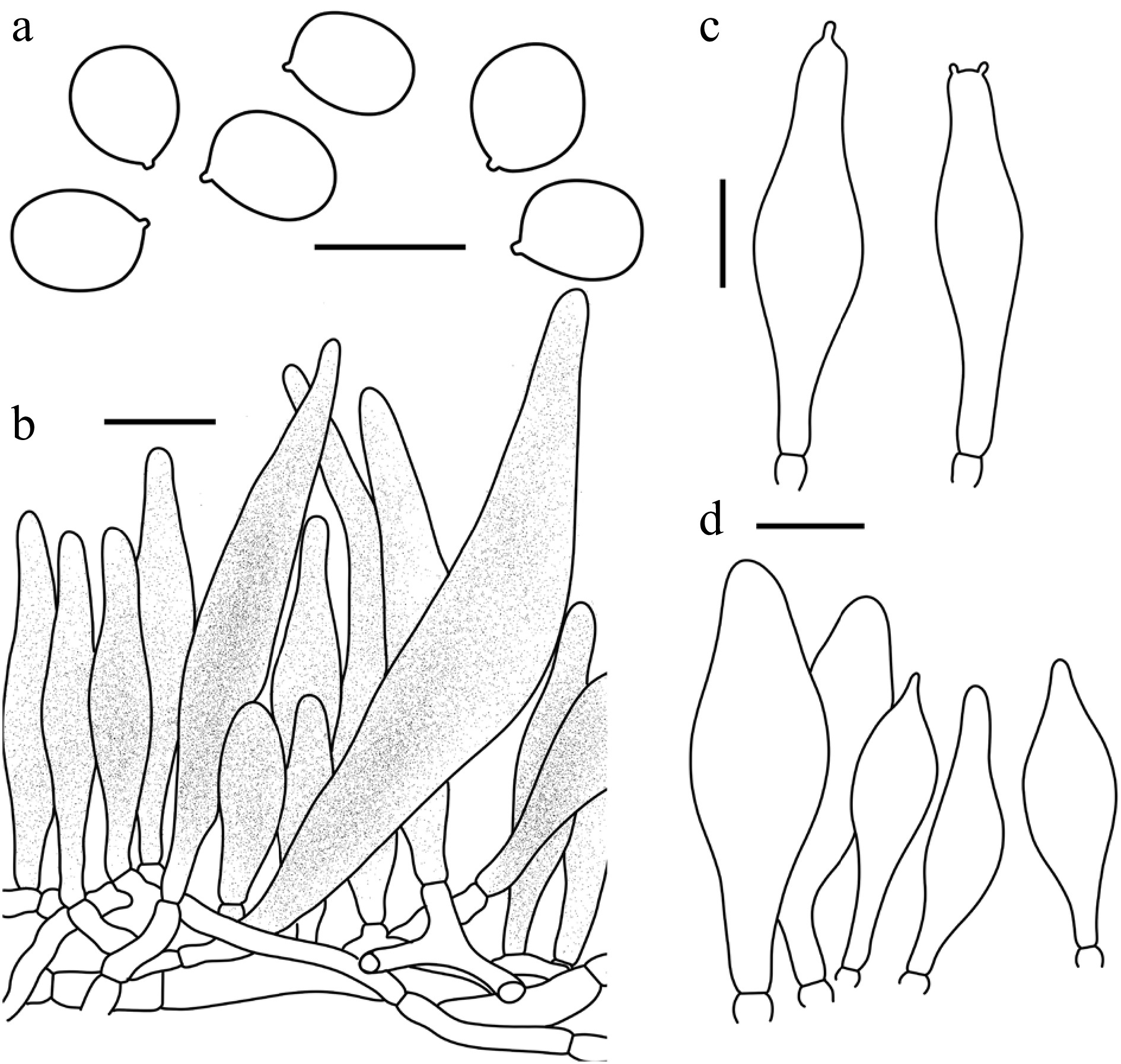
Figure 20.
Pluteus leoninus (HKAS 56048). (a) Basidiospores. (b) Pileipellis with terminal elements. (c) Pleurocystidia. (d) Cheilocystidia. Scale bars: (a) =10 μm, (b)–(d) = 20 μm.
Habitat and distribution – solitary to subgregarious, lignicolous on decaying deciduous wood. Widespread from Eurasia (European countries[18,61] Russia[18,65], Japan[83], China[70] and so on).
Materials examined – CHINA. Sichuan Province: Aba Tibetan and Qiang Autonomous Prefecture, Jiuzhaigou County, altitude 1,904 m, 23 July 2014, Jian-Wei Liu 127 (HKAS 90921). Jilin Province, not detailed, 3 August 2008, Yan-Chun Li 1194 (HKAS 56048).
Notes – Previous study had extensively treated Pluteus leoninus and described several species within the P. leoninus complex[18]. Pluteus leoninus is characterized by a yellow-brown, velvety pileus with dark brown veins at the center, a stipe with twisting lengthwise striations, subglobose to broadly ellipsoid basidiospores, broadly clavate to utriform cheilocystidia, narrowly lageniform or utriform pleurocystidia with one to three digitiform projections, and a trichoderm pileipellis with elongated cylindrical or narrowly fusiform elements. Here we report a novel temperate subalpine collection from Hengduan Mountains, southwestern China (HKAS 90921), distinguished by its dark brown (rather than yellow) pileus. Morphologically, HKAS 90921 matches P. leoninus in all diagnostic characters. While similar to P. pumae, during examinations of P. pumae specimens, researchers also noted color variability[18], but the tef1 gene similarity is only 97.05%. This suggests that the P. leoninus complex may exhibit geographically structured phenotypic plasticity, particularly in pileus pigmentation. We therefore recognize both Chinese specimens as P. leoninus, suggesting the brown pileus represents infraspecific variation within P. leoninus.
Pluteus longistriatus (Peck) Peck, Ann. Rep. N.Y. St. Mus. nat. Hist. 38: 137 (1885) Figs 12g and 21
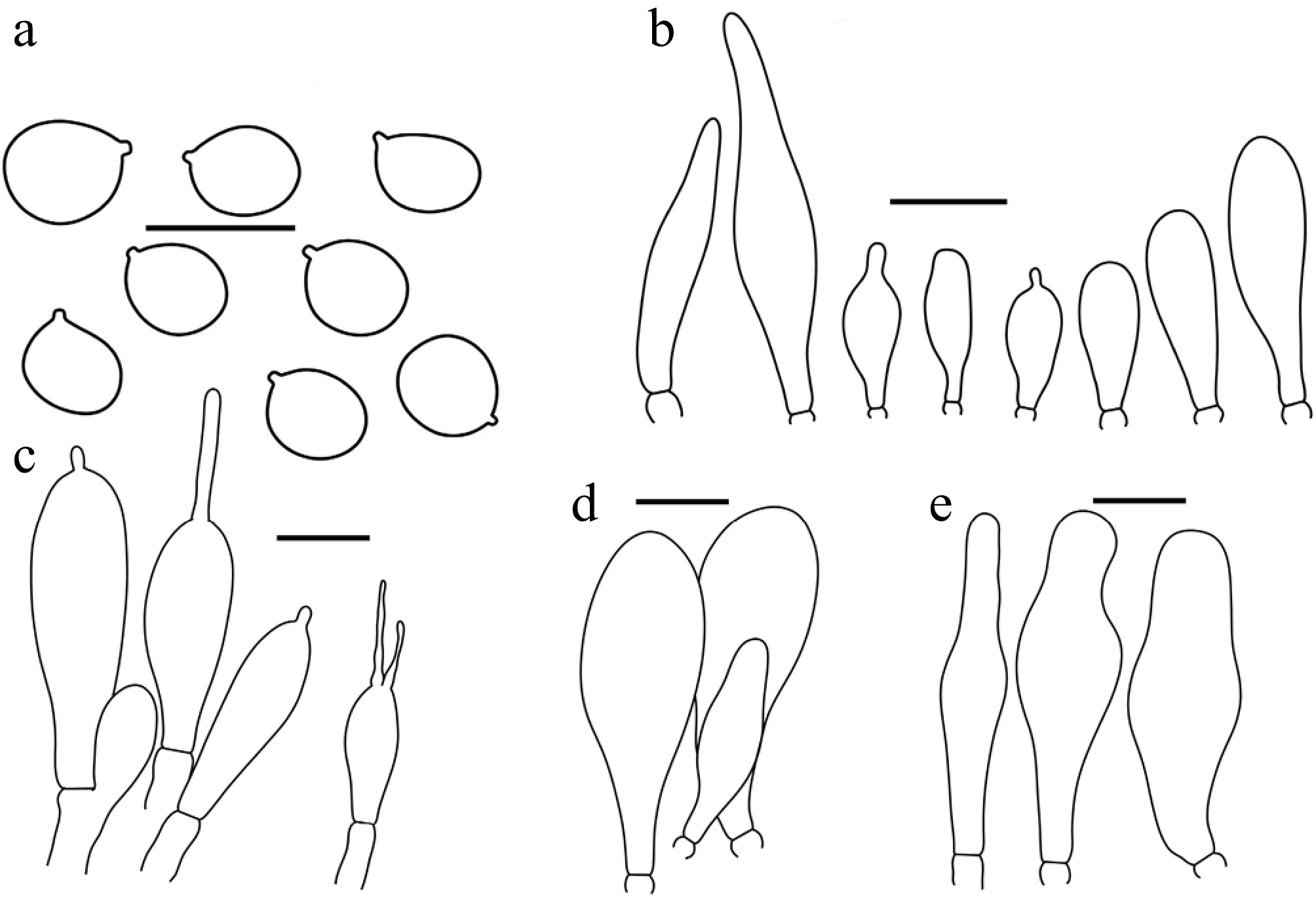
Figure 21.
Pluteus longistriatus (HKAS 151024). (a) Basidiospores. (b) Pileipellis terminal elements. (c) Caulocystidia. (d) Cheilocystidia. (e) Pleurocystidia. Scale bars: (a) =10 μm, (b)–(e) = 20 μm.
Habitat and distribution – solitary, lignicolous, on decaying deciduous wood in subtropical habitats. Widely distributed in North and South America[63,75,76,81] (USA, Argentina, Brazil, Paraguay and so on), Eurasia[67,70,73] (Italy, Slovenia, Russia, China and so on).
Materials examined – CHINA. Henan Province: Jiyuan City, Wangwu Town, Wangwushan National Geopark, altitude 551 m, 1 August 2024, Xuan Chen 611 (HKAS 151023), Xuan Chen 612 (HKAS 151024), Xuan Chen 614 (HKAS 151026).
Notes – Pluteus longistriatus, initially described in New York, USA, and also recorded from Argentina, Brazil, Paraguay, Italy, Slovenia, Russia, and China[63,67,70,73,75,76,81], possesses small-sized basidiomes, radially fibrillose pileus often with a slightly rugulose center, deeply sulcate margin, ventricose pleurocystidia, ventricose, clavate to sphaeropedunculate cheilocystidia, and clavate caulocystidia. Singer observed three pileipellis cell types in Argentine specimens: spheropedunculate-shaped, elongated cystidioid, and a transitional type between elongated and spheropedunculate. In recent research, sphaerocytes or short-clavate cells were rarely observed[76]. In our study, short-clavate and elongated cystidioid pileipellis elements were observed, but sphaerocytes were rarely observed. While Menolli Jr & Capelari reported caulocystidia with a rare narrow papillate apex[76], our specimens predominantly exhibited an elongated rostrate apex. In our phylogenetic analyses, Chinese specimens clustered within a clade containing Russian collections with strong support (Fig. 6, BS = 100, PP = 1.00). BPP analyses strongly supported this species delimitation (BPP = 1.00).
Pluteus punctatus Wichanský, C.C.H. 49(1-2): 1 (1972) Figs 12h and 22
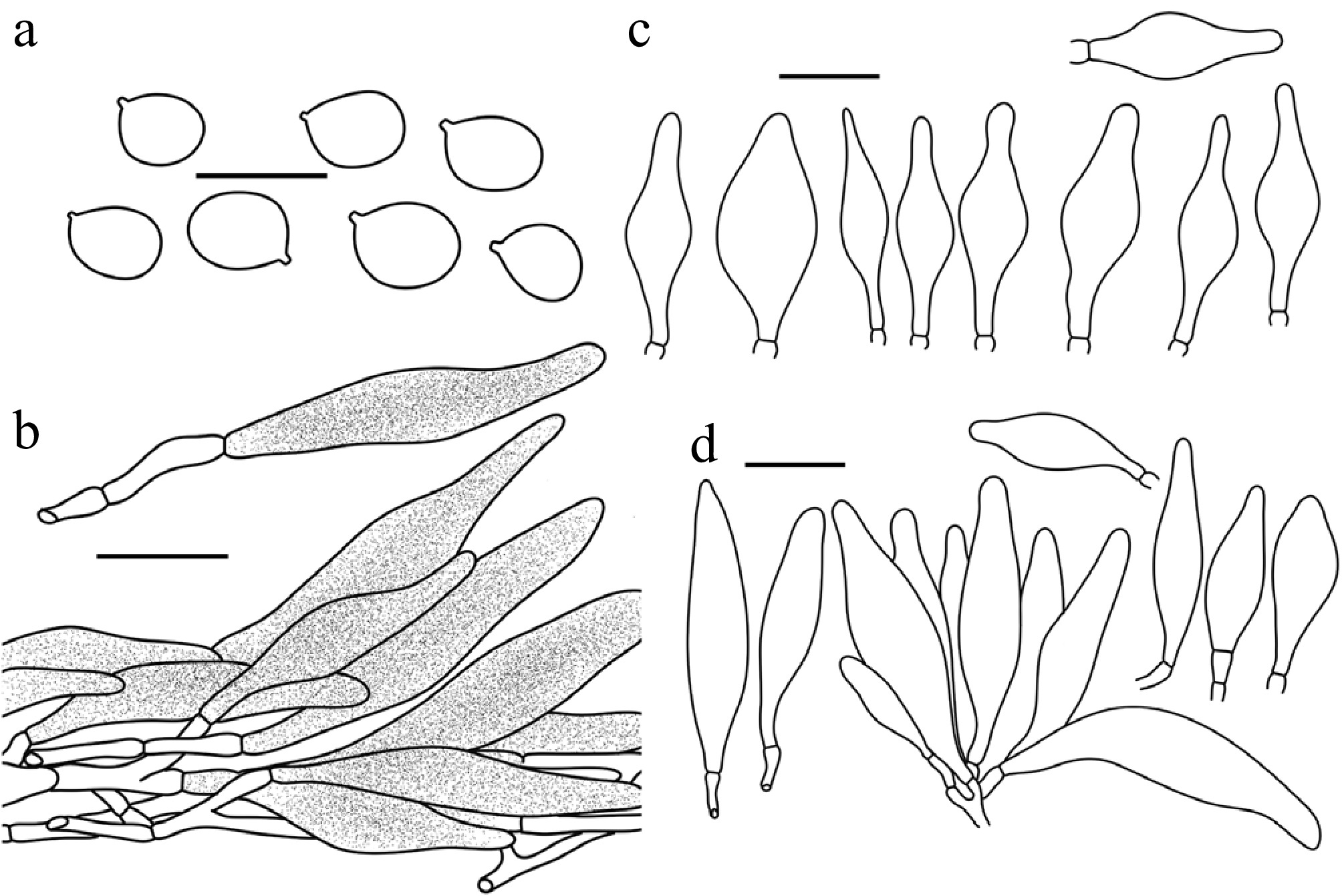
Figure 22.
Pluteus punctatus (HKAS 151274). (a) Basidiospores. (b) Pileipellis with terminal elements. (c) Pleurocystidia. (d) Cheilocystidia. Scale bars: (a) =10μm, (b)–(d) = 40 μm.
Habitat and distribution – solitary, lignicolous on deciduous decaying wood.
Material examined – CHINA. Yunnan Province: Chuxiong Yi Autonomous Prefecture, Guangtong County, Lufeng Town, Shanjian Mountain, altitude 2,300 m, 13 June 2024, Xue-Lian Gao (HKAS 151274).
Notes – Pluteus punctatus exhibits medium-sized basidiomes featuring a pale grey-brown pileus with floccose squamules, and a whitish stipe that bears brown tomentose squamules[84]. Both morphological and molecular evidence from the Chinese specimens confirm their identity as this species (Fig. 6). This species is known from Europe, and North America, and this is the first record in Asia.
Pluteus semibulbosus (Lasch) Quél., Mém. Soc. Émul. Montbéliard, Sér. 2 5: 543 (1875) Figs 12i and 23
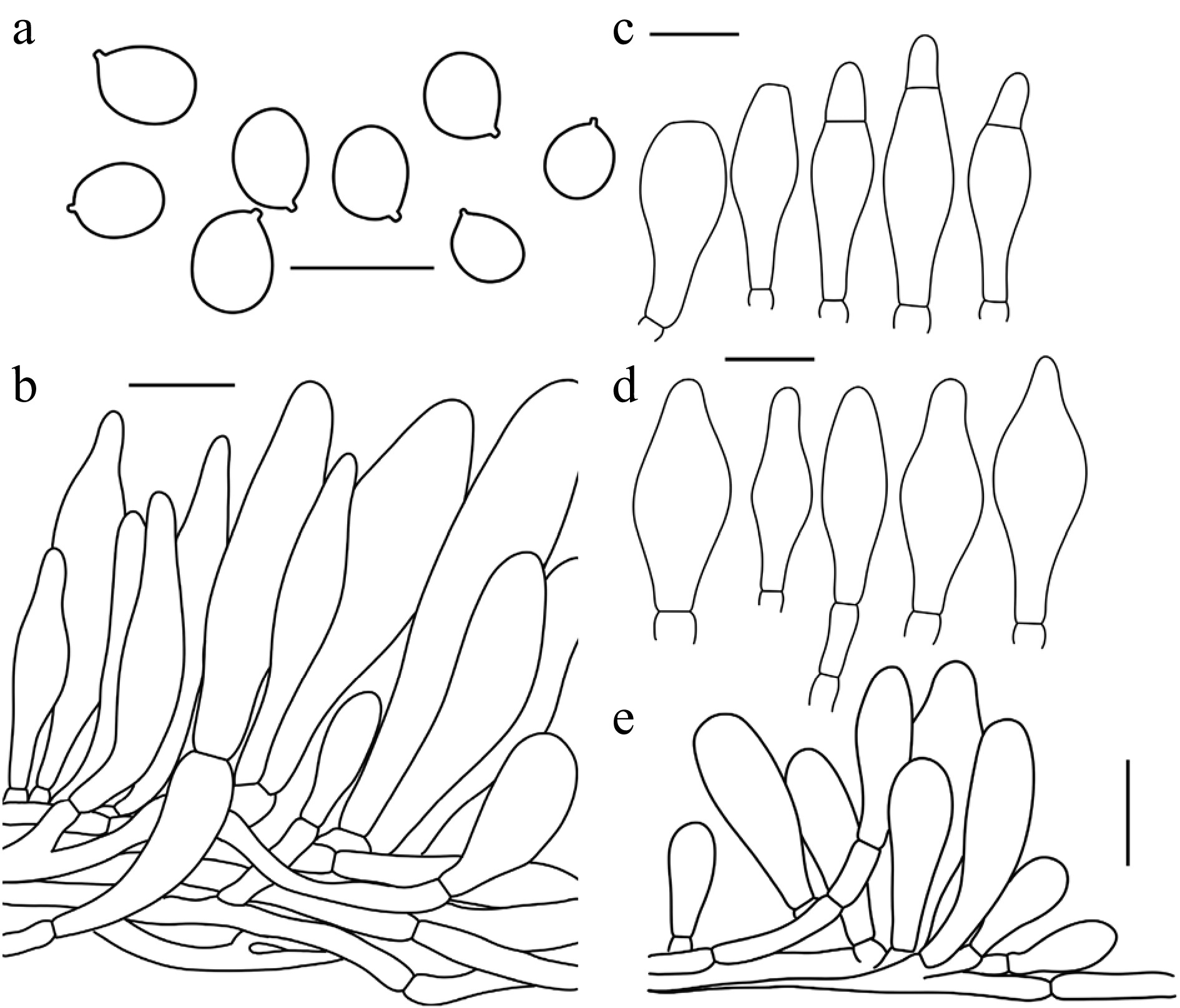
Figure 23.
Pluteus semibulbosus (HKAS 112751). (a) Basidiospores. (b) Pileipellis with terminal elements. (c) Pleurocystidia. (d) Cheilocystidia. (e) Stipitipellis with caulocystidia. Scale bars: (a) = 10 μm, (b)–(e) = 20 μm.
Habitat and distribution – solitary, lignicolous, on the broken trunks of deciduous trees. Widespread in European countries[61,85−87], Vietnam[64], Russia[67], and China.
Materials examined – CHINA. Yunnan Province: Kunming City, Panlong District, Kunming Botanical Garden, altitude 1,967 m, 14 July 2023, Xuan Chen 64; ibid., 6 September 2024, Zhu-Liang Yang 7157 (HKAS 151183); ibid., 25 September 2021, Liu-Kun Jia 2024 (HKAS 128113); ibid., Hei long tan park, altitude 1,970 m, 7 August 2020, Zhu-Liang Yang 6355 (HKAS 112751); Changchong Mountain Ecological Park, altitude 1,988 m, 30 June 2024, Xuan Chen 453 (HKAS 150906); Chongqing Municipality: Beibei District, Jinyun Mountain National Nature Reserve, Dai Lake, altitude 565 m, 29 May 2024, Xuan Chen 378 (HKAS 151278).
Notes – Pluteus semibulbosus is characterized by small-sized basidiomes, sulcate pileus, slightly granulose center, stipe with a distinctly bulbous base, utriform or fusiform cheilocystidia, narrowly utriform to lageniform pleurocystidia[61,88]. In our observations, although pleurocystidia were occasionally observed, the majority of those present had one septum.
The taxonomic status of P. semibulbosus has long been contentious, with historical treatments considering it as a synonym of the variable taxon of P. plautus (Weinm.) Gillet[65]. Modern studies have discussed these two taxa[61,86] comprehensively and recognized P. plautus and P. semibulbosus as distinct species. In our phylogenetic analyses, Chinese P. semibulbosus specimens segregated into three phylogenetic clades. While exhibiting 1%–1.5% ITS sequence differences, these groups showed > 99.5% similarity in tef1 sequences. BPP analyses strongly supported the separation of the sampled lineages under the tested delimitation model (posterior probability = 1.00), providing molecular evidence consistent with our taxonomic treatment. There is no consistent morphological differentiation within them. Therefore, we conservatively treat these three clades as a single species to avoid taxonomic oversplitting.
Pluteus ussuriensis E.F. Malysheva,in Justo, Malysheva, Bulyonkova et al., Mycologia. 20 (2025) Figs 12j and 24
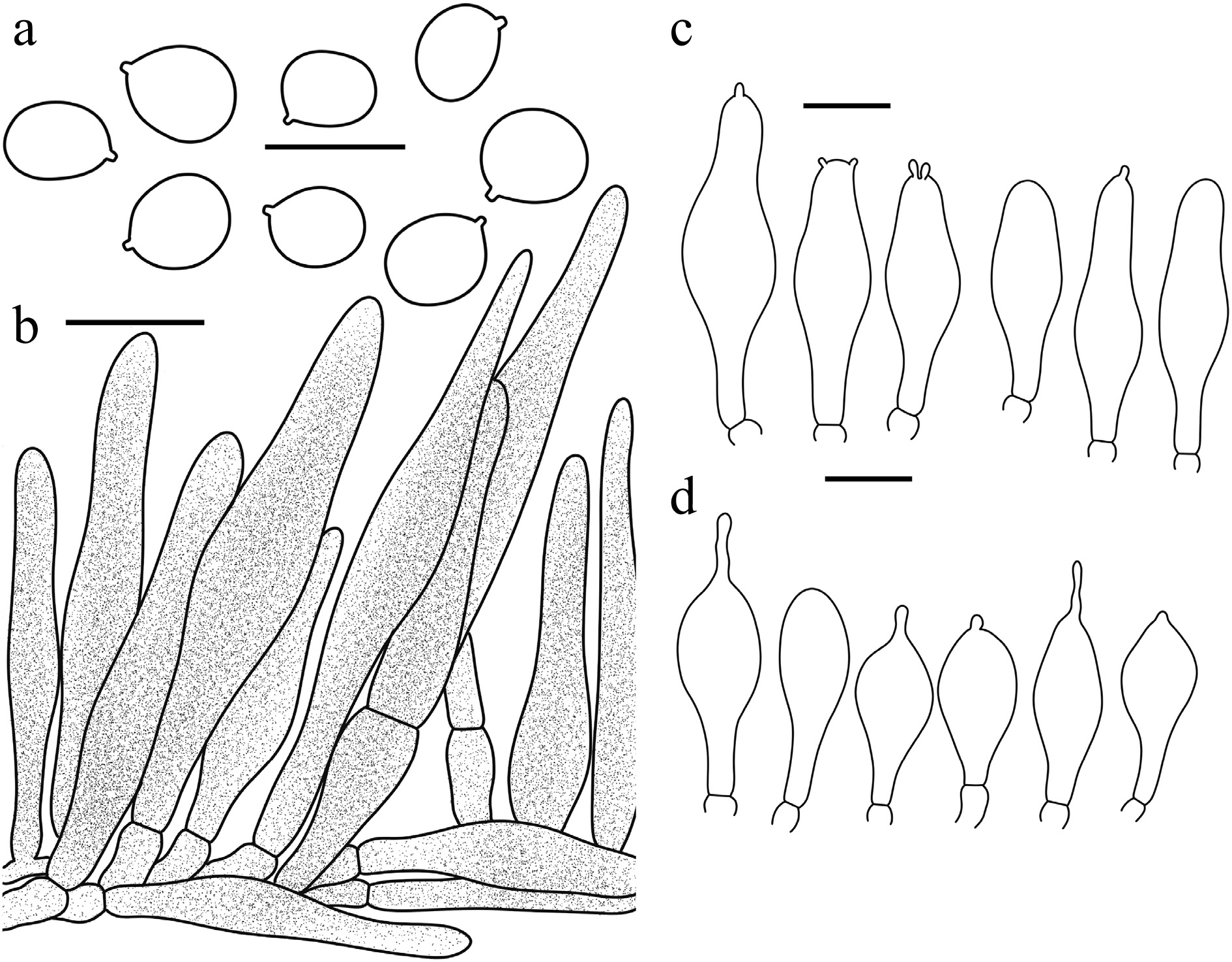
Figure 24.
Pluteus ussuriensis (HKAS 45497). (a) Basidiospores. (b) Pileipellis with terminal elements. (c) Pleurocystidia. (d) Cheilocystidia. Scale bars: (a) = 10 μm, (b)–(d) = 20 μm.
Habitat and distribution – solitary to subgregarious, lignicolous on angiosperm decaying wood. So far known from Russia, Hengduan Mountains region and northeastern China.
Material examined – CHINA. Sichuan Province: Ganzi Tibetan Autonomous Prefecture, Xiangcheng County, 108 Valleys, altitude 3,130 m, 12 July 2004, Zhu-Liang Yang 4112 (HKAS 45497).
Notes – Pluteus ussuriensis, originally described from Russia[18], is characterized by its yellow-brown basidiomes, velvety to squamulose pileus, fusiform pleurocystidia with one to four digitiform excrescences at the apex, narrowly to broadly fusiform cheilocystidia and cylindrical or clavate caulocystidia. Pluteus ussuriensis is a temperate species. It has also been recorded in the Hengduan Mountains region and northeastern China[70].
Pluteus variabilicolor Babos, Annls hist.-nat. Mus. natn. hung. 70: 93 (1978) Figs 12k and 25
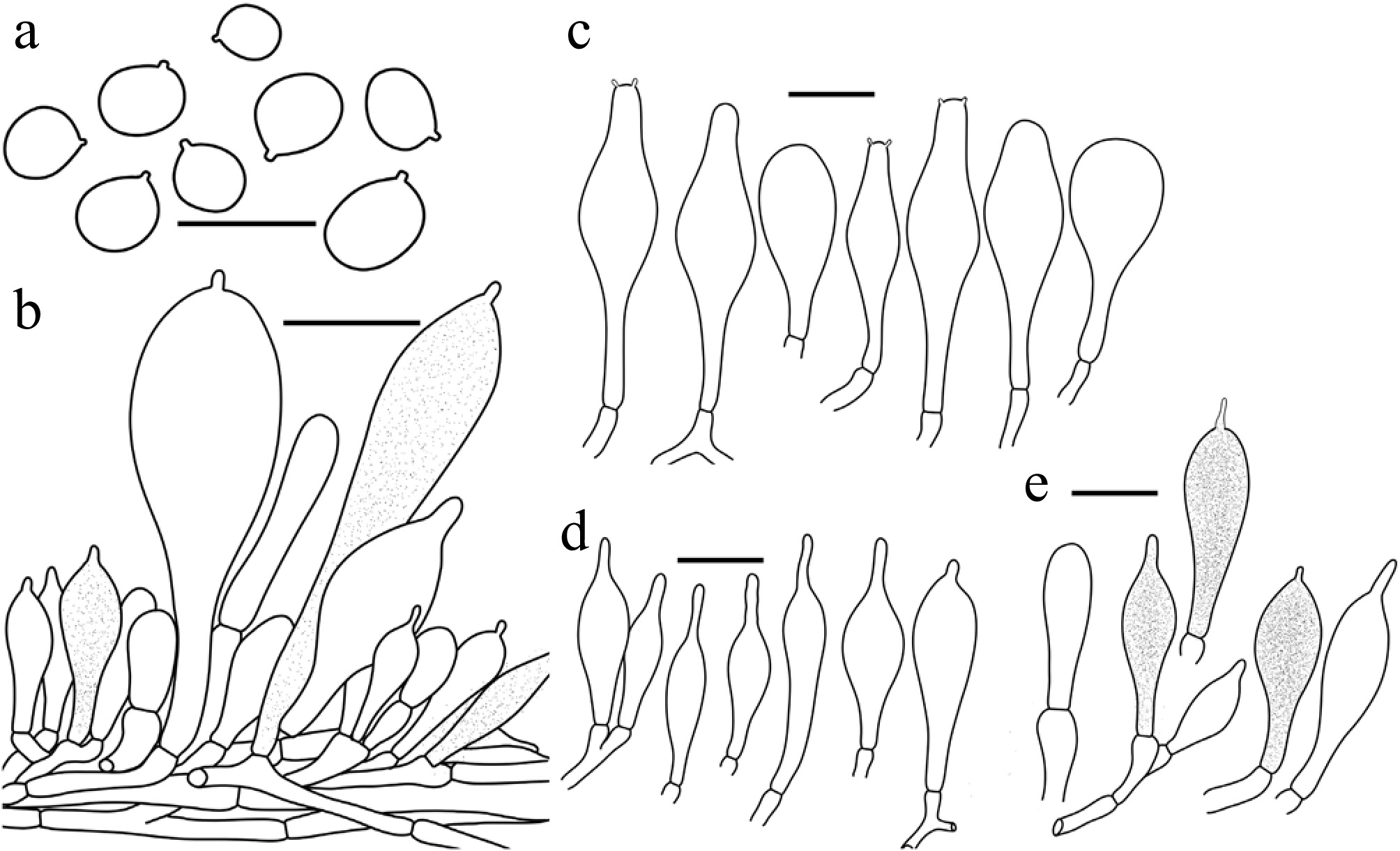
Figure 25.
Pluteus variabilicolor (HKAS 150910). (a) Basidiospores. (b) Pileipellis with terminal elements. (c) Pleurocystidia. d Cheilocystidia. (e) Caulocystidia. Scale bars: (a) = 10 μm, (b)–(e) = 20 μm.
Habitat and distribution – solitary to subgregarious, lignicolous on deciduous decaying wood. Widely distributed in Eurasia, and reported Italy[89], Hungary, Austria, Romania, Slovakia, Spain[90], Czech Republic[91], Russia, Republic of Korea, Japan[92,93], Pakistan[94], China[93].
Materials examined – CHINA. Yunnan Province: Kunming City, Panlong District, Yeya Lake, altitude 1,944 m, 9 September 2016, md.Iqbal.Hose 636 (HKAS 81604); ibid., Kunming Botanical Garden, altitude 1,927 m, 20 August 1998, Xiang-Hua Wang 695 (HKAS 35020); ibid., 23 June 2000, Zhu-Liang Yang 2886 (HKAS 35976); ibid., 20 July 2020, Zhu-Liang Yang 6327 (HKAS 107612); ibid., Xuan Chen 457 (HKAS 150910); ibid., Hei long tan park, altitude 1967 m, 15 September 1991, Mu Zang 11897 (HKAS 23527); ibid., Chuxiong Yi Autonomous Prefecture, Chuxiong City, Zixi Mountain Forest Park, altitude 2,365 m, 12 July 2014, Yan-Jia Hao 1254 (HKAS 83045); ibid., Dali Bai Autonomous Prefecture, Jianchuan County, Shibao Mountain Scenic Area, altitude 2,616 m, 20 August 1999, Q. B. Wang 202 (HKAS 44476); ibid., Eryuan County, Qiaohou Township, Hexi Village, altitude 2,065 m, 12 August 2010, Jie Zhang183 (HKAS 61594); Baoshan City, Tengchong City, Datang Town, 4 May 2004, altitude 1,967 m, Han-Chen Wang 170 (HKAS 41963); Jiangsu Province: Nanjing City, Zijin Mountain National Scenic Area, altitude 309 m, 18 September 2023, Xia Chen 724 (HKAS 151175); Shandong Province: Qingdao City, Laoshan District, Beijiushui Scenic Area, altitude 363 m, 18 August 2011, Xiang-Hua Wang 2988 (HKAS 73544).
Notes – Pluteus variabilicolor, initially described in Hungary[95], is characterized by a pileus which is first orange-yellow and then becomes chrome-yellow, often with a rugose center, pileipellis consisting of spheropeduncolate-vesiculose and elongated elements, and the presence of caulocystidia. The nomenclature, description, and synonyms of this species have been thoroughly discussed in previous studies[18,89,93]. Pluteus variabilicolor is widely distributed, with records ranging from southwestern to northeastern China. It is easily confused with P. leoninus externally, and many Chinese collections of P. variabilicolor have been misidentified as P. leoninus. Although P. variabilicolor is macroscopically similar to P. leoninus, the two can be easily distinguished by pileipellis and the presence/absence of caulocystidia. Pluteus variabilicolor possesses dimorphic pileipellis elements consisting of elongated cylindrical and clavate-round terminal elements. P. leoninus has a trichohymeniderm pileipellis made up of elongated narrowly fusiform elements. In China, P. leoninus is mainly distributed in northeastern regions and subalpine areas of southwestern China, where it occurs predominantly in temperate habitats. In contrast, P. variabilicolor has a much broader distribution, ranging from subtropical to temperate regions, and is widespread and common across these areas.
Pluteus velutinus C.K. Pradeep, Justo & K.B. Vrinda, Mycol. Progr. 11 (4): 871 (2012) Figs 12l and 26
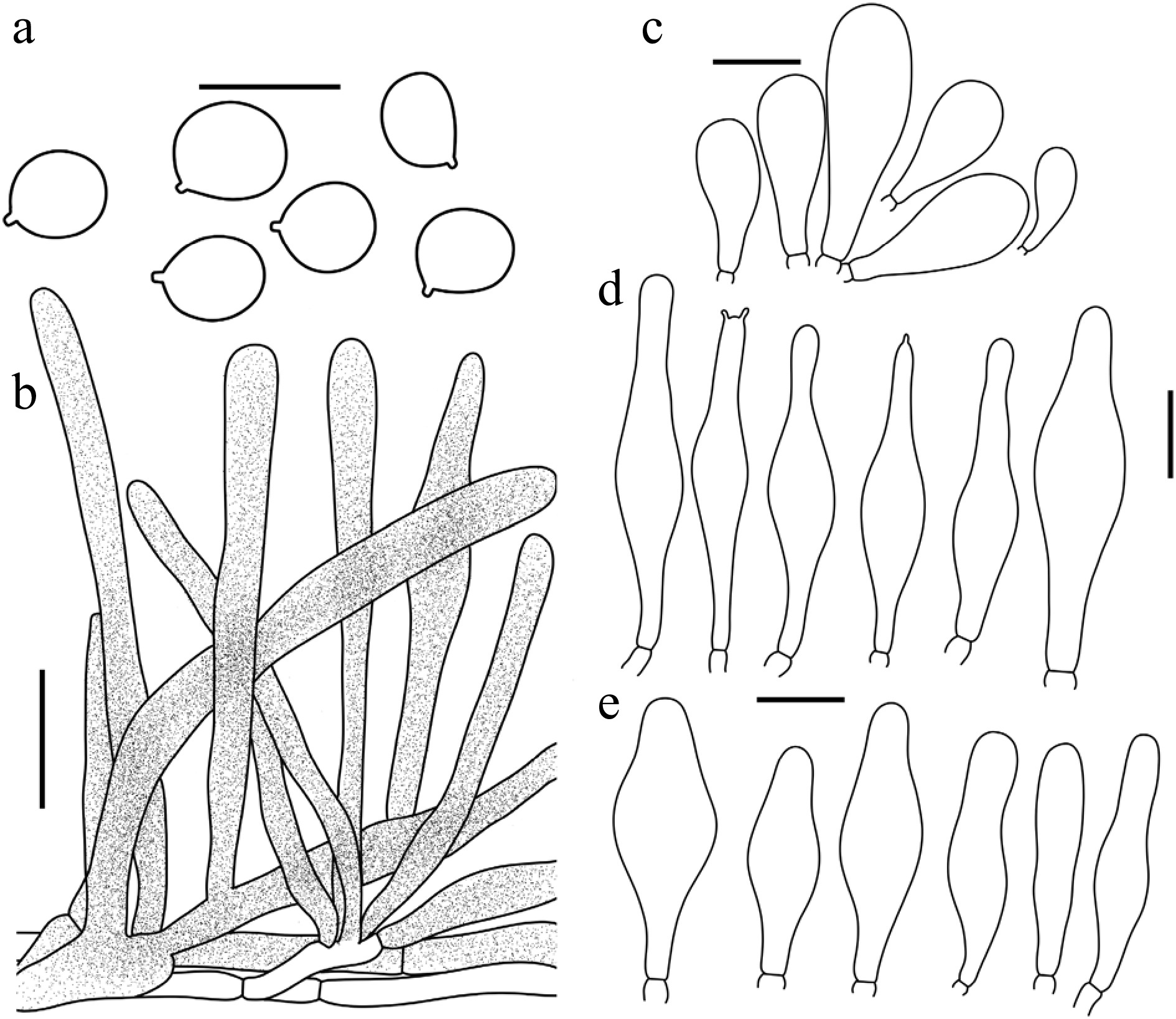
Figure 26.
Pluteus velutinus (HKAS 151186). (a) Basidiospores. (b) Pileipellis with terminal elements. (c) Caulocystidia. (d) Pleurocystidia. (e) Cheilocystidia. Scale bars: (a) = 10 μm, (b)–(e) = 20 μm.
Habitat and distribution – solitary to subgregarious, lignicolous on deciduous decaying wood. Widespread in Eurasia and Central America, so far reported in Japan, India[71], Russia[67], Italy[72], Brazil[74], and China.
Materials examined – CHINA. Yunnan Province: Nujiang Lisu Autonomous Prefecture, Gongshan County, Gaoligong Mountains, near Dulong River, altitude 2,280 m, 8 September 2024, Dong-Mei Li 833 (HKAS 151186); Shanxi Province: Lvliang City, Jiaocheng County, Pangquangou National Nature Reserve, altitude 1,500 m, 26 July 2024, Xuan Chen 502 (HKAS 150953).
Notes – Pluteus velutinus, originally described from India[71], possesses an orange-brown, velvety to squamulose pileus, lageniform or clavate pleurocystidia with digitate projections, and clavate caulocystidia. Pluteus velutinus has been recorded in temperate Eurasia and Central America, and has also been reported from various regions across China, reflecting its broad distribution. There are minor morphological differences regarding the pigmentation and the apical shape of pleurocystidia among different regions. The pleurocystidia in the Brazilian collection exhibit apical or lateral knob-shaped projections[74], while the type collections studied by Pradeed et al. are colourless and often with an apical digitate projection at the apex. The Chinese specimens possess colorless pleurocystidia, align with those of the type material. Despite these micromorphological differences, phylogenetic analyses confirm these populations represent a single species (Fig. 6).
Pluteus cf. velutinus
Habitat and distribution –lignicolous on deciduous decaying wood. So far known from Vietnam and southwestern China.
Materials examined – CHINA. Yunnan Province: Wenshan Zhuang and Miao Autonomous Prefecture, Maguan County, Jiabanqing Township, Dabao Village, altitude 1,260 m, 13 August 2016, Xiang-Hua Wang 3962 (HKAS96551); Dali Bai Autonomous Prefecture, Yunlong County, Nuodeng Town, Tianchi Nature Reserve, altitude 2,665 m, 22 July 2019, Zhen Wang 43 (HKAS 120768).
Notes – Examined specimens of P. velutinus exhibit substantial morphological plasticity and a broad transcontinental distribution, occurring across both tropical and temperate zones. Pluteus cf. velutinus exhibits a distribution overlapping with that of P. velutinus. Vietnamese collections formed a clade together with the collection from southwestern China. We cannot differentiate these collections from P. velutinus morphologically. We tentatively assign P. cf. velutinus to the P. velutinus complex rather than recognizing it as a distinct species, pending further morphological examination of type material and additional molecular data.
Pluteus sect. Pruinoderma Zhu L. Yang & X. Chen, sect. nov.
Fungal Name: FN 573523
Chinese name: 粉霜状皮层组
Type species – Pluteus diettrichii Bres. Annls mycol. 3(2): 160, 1905
Etymology – Pruinoderma (Lat.), referring to the granulose, frost-like pileus that forms a pruinose coating on the surface.
Diagnosis – Pluteus sect. Pruinoderma is distinguished from other sections of Pluteus by the combination of the pruinose pileus surface, often cracking into granules showing white context or remaining intact, the absence of pleurocystidia. Species of this section are saprotrophic, typically occurring on soil or on the litter layer in broad-leaved forests.
Description – Basidiomes medium-sized. Pileus initially campanulate, then applanate, with umbo; surface non-hygrophanous, deep greyish, or grey-brown, darker at the center, pruinose, often cracking into granules showing white context or remaining intact, without sulcate-striate margin. Lamellae free, pale pinkish brown, ventricose, crowded, with lamellulae, edges concolorous. Stipe cylindrical, solid; surface white, glabrous, with or without lengthwise fibrils. Context in pileus thin, unchanging, white; in stipe pale dirty white. Smell and taste unknown.
Basidiospores ellipsoid to oblong, slightly thick-walled, smooth, 8.0–10.9(–11.5) × (5–)5.5–6.5(–6.7) μm, Q = 1.35–1.75(–1.85), Qm = 1.57 ± 0.08). Basidia 4-spored, clavate, thin-walled. Cheilocystidia, 23–38 × 9–16 μm, narrowly clavate to narrowly utriform, colorless, thin-walled. Pleurocystidia absent. Pileipellis an euhymeniderm with transitions to an epithelioid hymeniderm, composed of thin-walled, ellipsoid, spheropedunculate to subglobose elements, with brown intracellular pigments. Stipitipellis a cutis. Caulocystidia mostly absent or very rare. Clamp connections absent.
Notes – Species of sect. Pruinoderma were previously assigned to sect. Celluloderma based on morphological characters and molecular analysis[96−98]. However, several phylogenetic analyses based on multilocus sequence data have demonstrated that this group and its allies form a distinct clade with sect. Celluloderma[99−102]. In this study, the genome-sequenced specimen of P. diettrichii WU53278 showed 99.85% ITS similarity to the lectotype of this species, while P. poliocnemis HKAS 58019 showed 99.69% ITS similarity to its type specimen. Our phylogenomic analyses based on 672 single-copy orthologous genes further indicate that Pluteus sect. Pruinoderma represents an independent lineage, clearly separated from sect. Celluloderma and sect. Hispidoderma, with full support (Fig. 2). In addition, topology tests of three alternative phylogenetic hypotheses concerning the relationships among sect. Pruinoderma, sect. Celluloderma and sect. Hispidoderma significantly supported the topology recovered in the present study (Fig. 4). Species within this clade also share common morphological characters, notably the absence of pleurocystidia. We therefore recognize sect. Pruinoderma as a distinct section.
In the phylogenetic tree constructed based on ITS-tef1 sequence data in this study, P. presleyi and sect. Pruinoderma formed a sister group. However, in the original description of P. presleyi, this species was recovered as a distinct clade separate from sect. Pruinoderma. Furthermore, P. presleyi possesses a cutis pileipellis and pleurocystidia with apical lateral mucilage, suggesting that it likely represents a new section. Therefore, this species cannot be confidently placed in sect. Pruinoderma.
Pluteus diettrichii Bres., Annls mycol. 3 (2): 160 (1905) Fig. 27
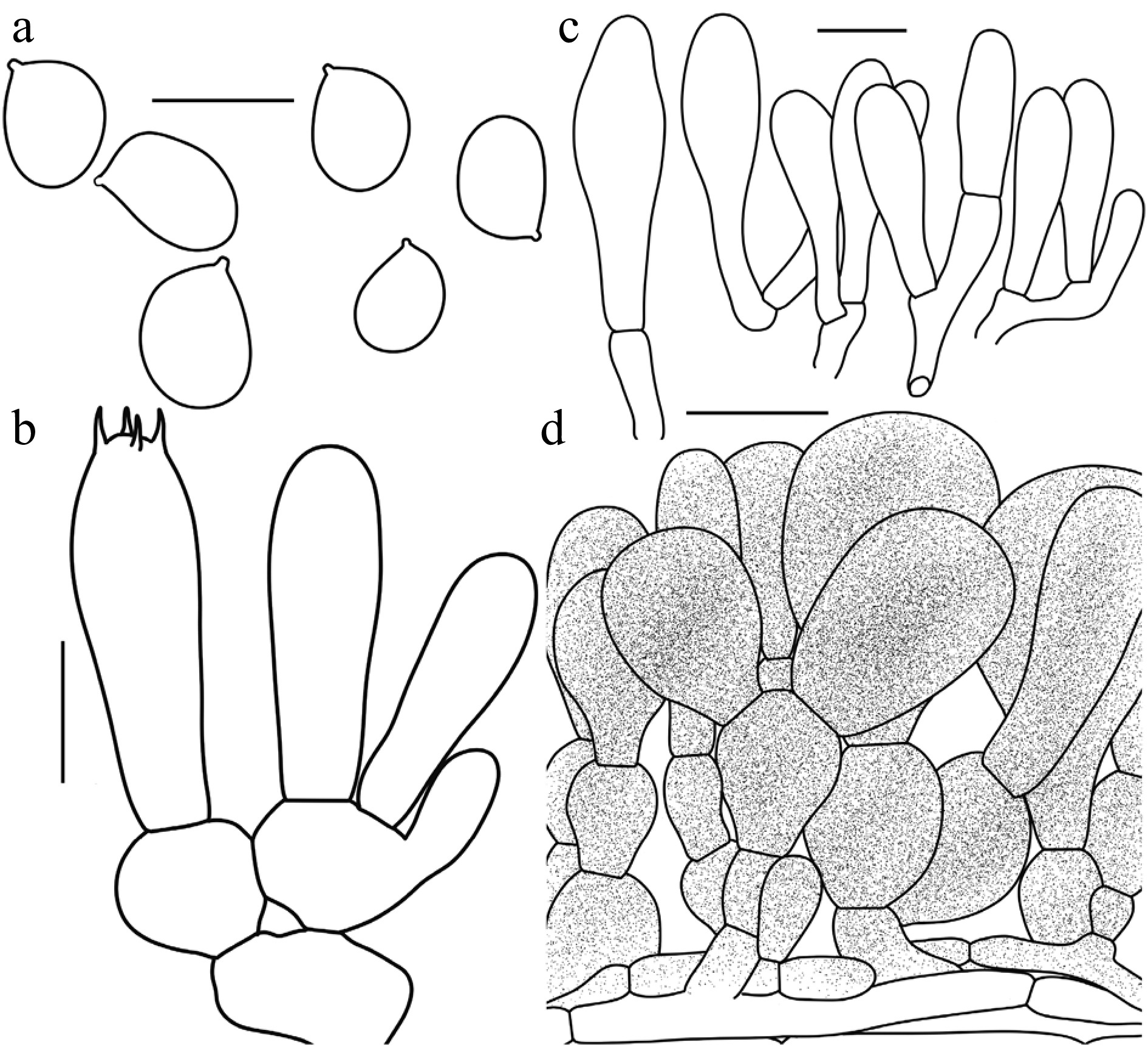
Figure 27.
Pluteus diettrichii (WU-MYC 0053278). (a) Basidiospores. (b) Basidia. (c) Cheilocystidia. (d) Pileipellis with terminal elements. Scale bars: (a), (b) = 10 μm, (c), (d) = 20 μm.
Habitat and distribution –on soil or on the litter layer of deciduous forests in temperate European area.
Material examined – ITALY. Trento, Gocciadoro, on soil, oct. 1904 leg. D.E. Diettrich (S-F14384, lectotype). AUSTRIA. Vienna: near Scheiblingstein, between Roman milestone and Bildeiche, altitude 476 m, 26 May 2024, I. Krisai-Greilhuber & ÖMG s.n. (WU-MYC 0053278).
Notes – Pluteus diettrichii is primarily distributed in Europe and is characterized by a pileus surface cracking into granules, exposing the underlying white context[65]. The ITS sequence of the lectotype (S-F14384) match European herbarium specimen (WU-MYC 53278). Type study confirm all microscopical features described by Vellinga[65,98]. Morphologically, the specimen lacks pleurocystidia, a diagnostic feature consistent with the circumscription of P. diettrichii.
Pluteus poliocnemis Kühner, in Kühner & Romagnesi, Bull. Trimestriel Soc. Mycol. France 72(3): 182 (1956) Fig. 28g
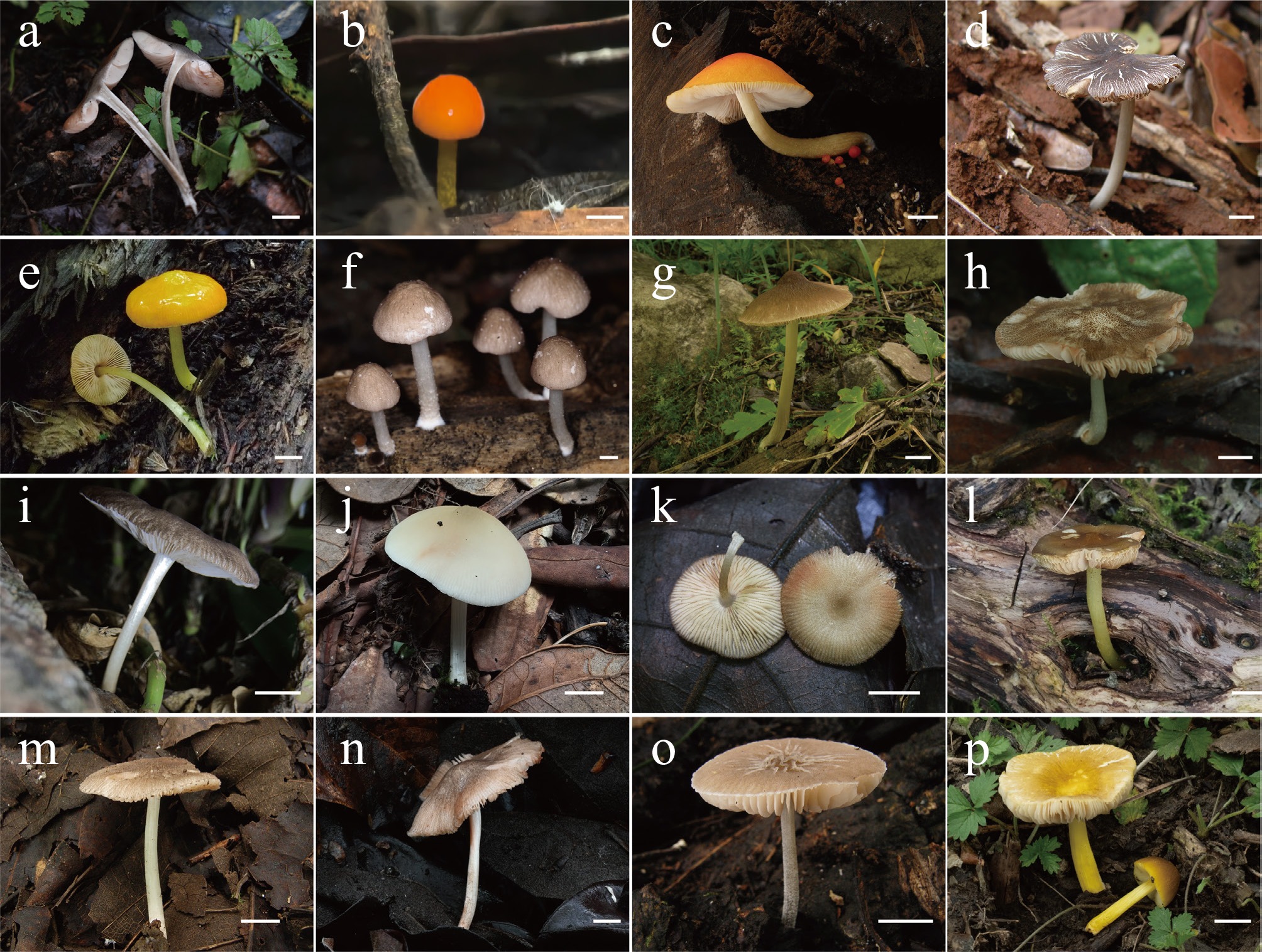
Figure 28.
Fresh basidiomes of Pluteus sect. Celluloderma and Pruinoderma from China. (a) P. assimilatus (HKAS 151184). (b) P. aurantioruber (HKAS 151280). (c) P. aurantiorugosus (HKAS 83882). (d) P. castaneorugosus (HKAS 78644). (e) P. chrysophlebius (HKAS 76357). (f) P. daqinggouensis (HKAS 151174). (g) P. poliocnemis (HKAS 58019). (h) P. fuscipruinatus (HKAS 151283). (i) P. fuscopunctatus (HKAS 151284). (j) P. phlebophorus (HKAS 151157). (k) P. podospilloides (HKAS 125335). (l) P. romellii (HKAS 151084). (m) P. squamulososulcatus (HKAS 151301). (n) P. squarrosus (HKAS 151212). (o) P. thomsonii (HKAS 112749). (p) P. vellingae (HKAS 151203).
Habitat and distribution – on soil or on the litter layer of deciduous forests in temperate European area and subalpine zones of the southwestern China.
Material examined – FRANCE. Haute-Savoie, route Samoens to the Germans, on the ground in a place where wood has been cut, together with Pluteus roseipes, 9 Sept. 1950 leg. R. Kuhner (G00126662, G0012663, G0012664, isotypes). CHINA. Xizang Autonomous Region: Qamdo City, Jomda County, Jinsha River Bank Area, altitude 3,470 m, 5 August 2009, Zhu-Liang Yang 5477 (HKAS 58019).
Notes – Pluteus poliocnemis is very close to P. diettrichii and characterized by non-cracking pileipellis, broadly ellipsoid, rarely subglobose or ellipsoid basidiospores and the presence of caulocystidia when young[65]. A specimen collected from Xizang, China, is morphologically consistent with P. poliocnemis in having a non-cracking pileus. Although typical caulocystidia were not observed due to the mature condition of the basidioma, the combination of absent pleurocystidia, clavate cheilocystidia, and basidiospores measuring 7.0–8.5 × 5.5–6.0 μm aligns well with the diagnostic features of P. poliocnemis. Molecularly, the ITS sequence exhibits 99.03%–99.71% similarity to isotypes sequences of P. poliocnemis. Ecologically, the collection originates from a subalpine area in Xizang with a temperate climate, a habitat type consistent with that known for P. poliocnemis.
Key to the species of Pluteus. sect. Celluloderma from China
1. Pileipellis cutis 2 1. Pileipellis hymeniderm, trichoderm 11 2. Terminal cells elongated oblong cylindrical 3 2. Terminal cells shortly cylindrical or narrowly cylindrical 4 3. Basidiomes medium-sized; Pileus dark gray with a fuliginous striate; stipe with gray longitudinally-striate fibrils; basidiospores 5–7 × 5–7 μm P. aff. argentinensis 3. Basidiomes small-sized; pileus brown to dark brown with fibrils; stipe white; basidiospores 6–7 × 5–6.5 μm P. brunneoalbus 4. Terminal cells cylindrical 5 4. Terminal cells narrowly clavate 6 5. Pileus surface white, with brown floccules P. lalepiorum 5. Pileus pale brown to brown 9 6. Pileus fibrillose 7 6. Pileus with squamulose granules 8 7. Pileus surface without erect fibrils; stipe with lengthwise grey-brown fibrils; basidiospores 6–7.5 × 5–6.5 μm P. asperulus 7. Pileus surface with erect fibrils; stipe without lengthwise grey-brown fibrils; basidiospores 5.6–6.8 × 5.2–6.2 μm P. liaoheensis 8. Pileus white with cracking brown granules; basidiospores 7.0–7.5 (–8.0) × 5.0–6.0 (–6.5) μm P. lepiotoides 8. Pileus pale gray, squamulose; basidiospores 5.0‒6.5 × 4.3‒5.5(6) μm P. squamulososulcatus 9. Pileus with squarrose squamules P. squarrosus 9. Pileus not squarrose 10 10. Pileus dark brown; pileipellis a trichoderm, composed of narrowly clavate, cylindro-clavate, to fusiform elements P. fuscipruinatus 10. Pileus brown, pileipellis a cutis to trichodermium, composed of fusoid to fusoid-ventricose elements P. hirtellus 11. Cheilocystidia with 5–10 μm rostrum at apex 12 11. Cheilocystidia without 5–10 μm rostrum at apex 13 12. Pileus overall greyish brown, without transparent reticulate-venose over the surface P. assimilatus 12. Pileus blackish-grey, with strongly transparent reticulate-venose over the surface P. thomsonii 13. Pileus yellow, orange, or brownish-yellow 14 13. Pileus dark brown to grey 18 14. Pileus yellow, or brown, stipe yellow or white 15 14. Pileus yellow, or orange, not brown; stipe white 16 15. Often lignicolous on conifer wood (but not exclusively); basidiospores 5.7–6.2 × 5.1–5.6 μm P. vellingae 15. Often lignicolous on deciduous wood; basidiospores 6.5–7.3 × 5.3–6.1 μm P. aletaiensis/P. romellii 16. Pileus bright yellow with rugulose surface P. chrysophlebius 16. Pileus orange-red 17 17. Temperate or subalpine distribution; cheilocystidia without a short to long apical rostrum; basidiospores 6–7 × 4.5–5 μm P. aurantiorugosus 17. Subtropical distribution; cheilocystidia with a short to long apical rostrum; basidiospores 6.0–8.0 × 5.5–7.0 μm P. aurantioruber 18. Pileipellis hymeniderm, composed of two types of elements 19 18. Pileipellis euhymeniderm or hymeniderm; composed of one types of elements 22 19. Pileipellis with globose and short narrowly clavate terminal elements P. tatafuensis 19. Pileipellis with globose and oblong narrowly clavate terminal elements 20 20. Pileus with dark pruinose squamules .P. fuscopunctatus 20. Pileus without pruinose squamules 21 21. Lamellar edges colorless; pleuro- and cheilocystidia colorless P. podospileus/ P. cystidiosus 21. Lamellar edges dark brown; pleuro- and cheilocystidia colored P. podospilloides 22. Terminal cells fusiform or clavate elements 23 22. Terminal cells spheropedunculate to subglobose 24 23. Pileus brown, growing on woody debris P. daqinggouensis 23. Pileus brown with rugose surface P. castaneorugosus 24. Pileus dark brown with venose or rugose surface 25 24. Pileus not venose-rugose 26 25. Pileus rugose; stipe without fibrils; basidiospores (5.5)7–8 × (4.5)5–7 μm P. phlebophorus 25. Pileus distinctly venose; stipe with fibrils; basidiospores 6–7 ×5–6 μm P. atroreticulatus 26. Terrestrial P. doulianus 26. Lignicolous on wood chips P. calidophilus Pluteus assimilatus E.F. Malysheva, et al., J. Fungi 8 (6, no. 623): 16 (2022) Figs 28a and 29
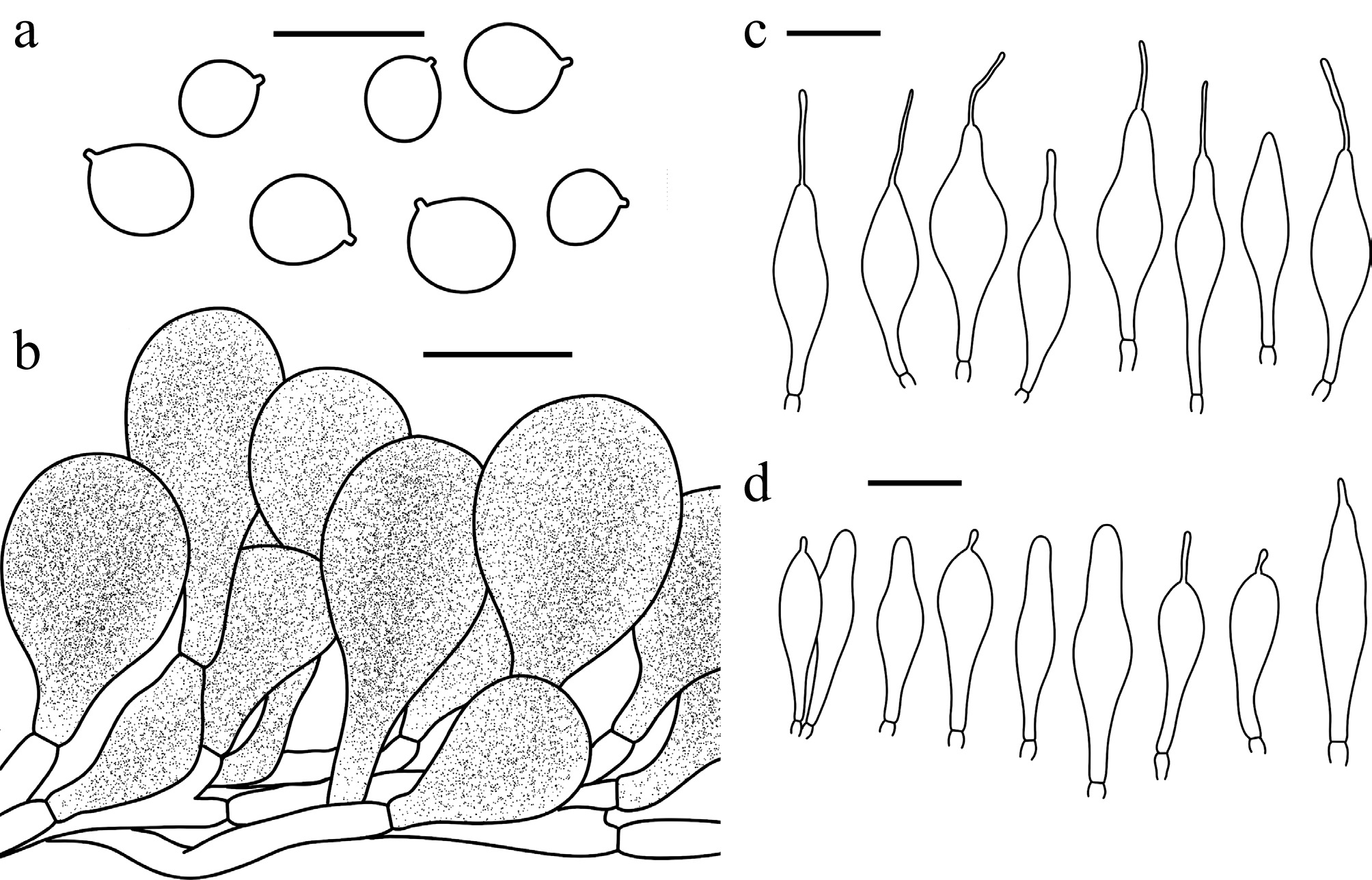
Figure 29.
Pluteus assimilatus (HKAS 151184). (a) Basidiospores. (b) Pileipellis with terminal elements. (c) Pleurocystidia. (d) Cheilocystidia. Scale bars: (a) = 10 μm, (b)–(d) = 20 μm.
Habitat and distribution – solitary, lignicolous on deciduous wood. So far known from Russia, Estonia[103] and northern China.
Materials examined – CHINA. Hebei Province: Shijiazhuang City, Pingshan County, Tuoliang Mountain, altitude 1,623 m, 11 September 2024, Guan-Rui Li 967 (HKAS 151184).
Notes – Pluteus assimilatus, a species recently described from Russia in the P. insidiosus complex[103], is characterized by dark brown pileus, narrowly utriform cheilocystidia with or without rostrum at apex, narrowly utriform to lageniform, pleurocystidia mostly with rostrum at apex, a hymeniderm pileipellis with sphaeropedunculate or narrowly to broadly clavate terminal elements. This species was originally reported as restricted to Northern Europe, but has since been reported in northern China, which likely represents a temperate distribution species.
Pluteus asperulus Zhu L. Yang & X. Chen, sp. nov. Fig. 30
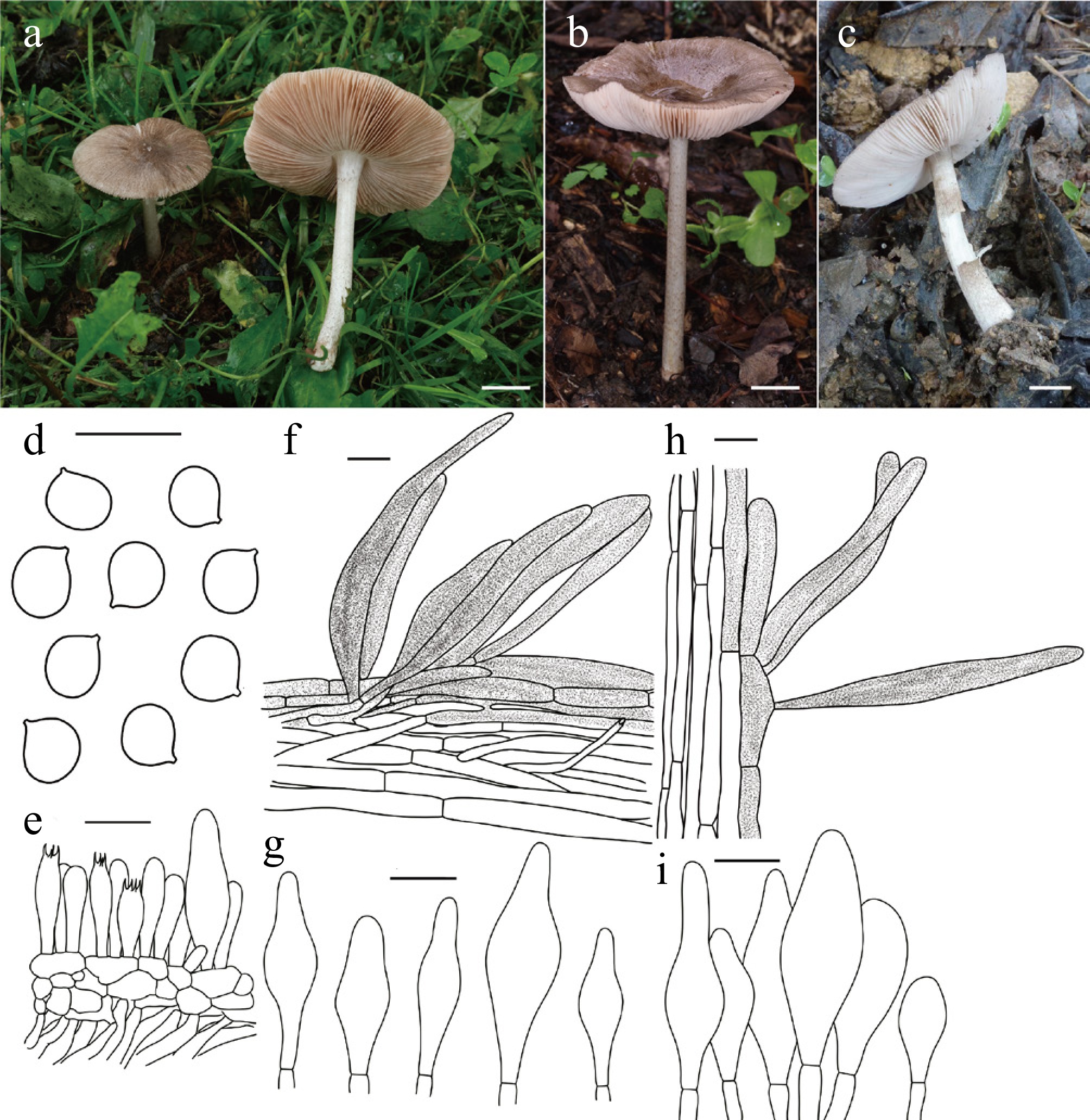
Figure 30.
Pluteus asperulus (HKAS 150923). (a)–(c) Basidiomes in natural habitat. (d) Basidiospores. (e) Basidia. (f) Pileipellis with terminal elements. (g) Pleurocystidia. (h) Stipitipellis with caulocystidia. (i) Cheilocystidia. Scale bars: (a)–(c) = 1 cm, (d) = 10 μm, (e)–(i) = 20 μm.
Fungal Name: FN 573107
Chinese name: 麻柄光柄菇
Etymology – asperulus (Lat.), referring to stipe with lengthwise dark grey-brown fibrils.
Diagnosis – Pluteus asperulus differs from P. lepiotoides by its deep greyish pileus, squamulose stipe with lengthwise grey-brown fibrils and smaller basidiospores measuring 6–7.5 × 5–6.5 μm.
Basidiomes medium-sized. Pileus 45–55 mm diam., initially hemispherical, applanate then center depressed, with low umbo; surface non-hygrophanous, deep greyish (6E3), or grey-brown (6E4), darker at the center, tomentose to delicately squamulose, gradually more fibrillose towards margin, with sulcate-striate margin. Lamellae free, pale pinkish brown (8A2–4), ventricose, crowded, with lamellulae, edges concolorous. Stipe 80–90 × 8–12 mm, cylindrical, solid; surface pale white (1A1), not glabrous, with lengthwise dark grey-brown (6E2) fibrils or squamules. Context in pileus thin, unchanging, pale white (1A1); in stipe pale dirty white (1A1). Smell and taste unknown.
Basidiospores [160/4/4] 6–7.5 × 5–6.5 μm, avl × avw = 6.72 × 5.82 μm, Q = 1.08–1.27, Qm = 1.16 ± 0.05, subglobose to broadly ellipsoid, slightly thick-walled (0.5–0.6 μm), smooth. Basidia 15–32 × 6–9 μm, 4-spored, clavate, thin-walled. Cheilocystidia crowded, 22–87 × 10–25 μm, narrowly clavate or narrowly utriform, colorless, thin-walled. Pleurocystidia scattered, 30–70 × 12–30 μm, predominantly narrowly utriform to narrowly lageniform, occasionally narrowly clavate, with 5–μm wide ovoid-conical apex, thin-walled. Pileipellis a differentiated cutis with especially at centre ascending bundles of hyphae, composed of narrowly cylindrical terminal elements, 50–250 × 15–25 μm, with intracellular brown pigment, thin-walled. Stipitipellis a cutis, composed of narrowly conical terminal caulocystidia, 50–80 × 7–15 μm wide hyphae, with intracellular brown pigment, thin-walled. Clamp connections absent.
Habitat and distribution – terrestrial, on deciduous remnants or litter substrates in subtropical habitats. Known from southwestern China and eastern China
Materials examined – CHINA. Yunnan Province: Kunming City, Panlong District, Kunming Botanical Garden, altitude 1,967 m, 2 July, 2025, Xuan Chen 470 (HKAS 150923, holotype); Jiangsu Province: Nanjing City, Xuanwu District, Zijin Mountain National Scenic Area, altitude 250 m, 26 May 2023, Xia Chen 220 (HKAS 151168) and Xia Chen267 (HKAS151170); ibid., 31 May 2023, Xia Chen 267. Chongqing City: Beibei District, Jinyun Mountain, Jingangbei Village, altitude 323 m, 24 September 2022, FCNU24, collected by Xi-Hui Du (HKAS 151213).
Notes – Pluteus asperulus is characterized by its deep greyish pileus, stipe with lengthwise grey-brown fibrils, subglobose basidiospores measuring 6–7.5 × 5–6.5 μm, avl × avw = 6.72 × 5.82 μm, Q = 1.08–1.27, Qm = 1.16 ± 0.05. In the phylogenetic analysis, P. asperulus is related to P. ephebeus (Fr.) Gillet, P. lepiotoides A. Pearson, P. murinus Bres, P. albotomentosus E.F. Malysheva & Malysheva, and P. hortensis Justo G. Muñoz, Sammut, Ševčíková & Tatti but shares less than 94.5% ITS sequence similarity with these taxa. Pluteus brunneodiscus, a species recently described from northwestern China[104], shows high sequence similarity with P. lepiotoides in both ITS and tef1, and has already been confirmed be synonym with P. lepiotoides[105]. Pluteus asperulus can be well distinguished from P. lepiotoides by its distinctively brown stipe. Pluteus ephebeus, initially described from Europe, is characterized by its grey-brown pileus, not glabrous stipe with mostly dark fibrils and larger basidiospores measuring 5.5–8.5 × 4.5–6.0 (7.0) μm, Q =1.05–1.55[65]. Pluteus asperulus can be differentiated by rounder basidiospores and subtropical habitat. P. murinus differs by pleurocystidia 44–90(–100) × 15–30(–32) μm, fusiform to broadly fusiform, lageniform or utriform, less frequently clavate to broadly subclavate; and by more variable cheilocystidia: narrowly clavate to clavate, broadly utriform or utriform, (broadly) lageniform or (broadly) fusiform, some mucronate, rarely tortuous. Although P. asperulus is shown to be closely related to P. albotomentosus in phylogenetic analyses, P. albotomentosus has a typically white pileus surface and is distributed in temperate regions[106]. The ITS similarity is only 93% or less. Morphology and habitat also allow clear distinction. Pluteus hortensis[105], recently described from the European Mediterranean region, possesses distinctly shorter pileipellis terminal elements (36–91(–102) × (2.5–)5–20 μm), while P. asperulus possesses distinctly longer ones (usually over 180 μm).
The phylogenetic analyses indicate that all species form well-supported distinct clades (Fig. 8 and Supplementary Fig. S1). Morphologically, Pluteus asperulus is similar to P. psichiophorus (Berk. & Broome) Sacc. described from Sri Lanka, is distinguished by its tiny basidiomes (< 20 mm), fibrillose-squamulose, rimose pileus, glabrous stipe, larger ovoid basidiospores (6–8 × 5–6.5 μm).
Pluteus atroreticulatus Zhu L. Yang & X. Chen, sp. nov. Fig. 31
Figure 31.
Pluteus atroreticulatus (HKAS 151299). (a), (b) Basidiomes in natural habitat. (c) Basidiospores. (d) Basidia. (e) Pleurocystidia. (f) Cheilocystidia. (g) Pileipellis with terminal elements. (h) Stipitipellis with caulocystidia. Scale bars: (a), (b) =1 cm, (c), (d) = 10 μm, (e)–(h) = 20 μm.
Fungal Name: FN 573108
Chinese name: 暗褐网盖光柄菇
Etymology – atroreticulatus (Lat.), referring to pileus with dark brown and wrinkled venation.
Diagnosis – Pluteus atroreticulatus is molecularly similar to P. anatolicus, but can be distinguished from the latter by its uniquely wrinkled-veined pileus, rounder basidiospores, and clavate pleurocystidia without rounded to obtuse or subcapitate apex.
Basidiomes small-sized. Pileus 15–20 mm diam., hemispherical or convex, then plano-convex, with low umbo in center; surface hygrophanous, dark brown (6F1), coarsely venose, wrinkled at center, without sulcate-striate margin. Lamellae free, pale pinkish brown (8A2–4), ventricose, slightly crowded, with lamellulae, edges concolorous. Stipe 30–42 mm × 2–7 mm, slender, cylindrical, solid; surface white (1A1), glabrous, with fibrils, brown (6E2), slightly greyish at base. Context in pileus very thin, hygrophanous, unchanging, white (1A1); in stipe concolorous with surface. Smell and taste unknown.
Basidiospores [40/1/1] 6–7 ×5–6 μm, avl × avw = 6.58 × 5.25 μm Q = 1.15–1.40, Qm = 1.19 ± 0.07, broadly ellipsoid to ellipsoid, slightly thick-walled (0.6–0.7 μm), smooth. Basidia 28–45 × 7–8 μm, 4-spored, broadly clavate, thin-walled. Cheilocystidia crowded, 30–62 × 14–30 μm, ovoid to narrowly clavate, colorless, thin-walled. Pleurocystidia scattered to fairly abundant, 45–87 × 15–28 μm, clavate, colorless, thin-walled. Pileipellis an euhymeniderm with transitions to an epithelioid hymeniderm, differentiated, composed of ellipsoid-pedicellate, spheropedunculate to subglobose elements, 20–40 × 20–35 μm, with brown intracellular pigments,thin-walled. Stipitipellis a cutis, composed of cylindrical hyphae, 5–20 μm wide, colorless, thin-walled. Caulocystidia present, narrowly clavate, narrowly cylindrical, 30–55 × 7–15 μm, with brown intracellular pigments, thin-walled. Clamp connections absent in all tissues.
Habitat and distribution – lignicolous on deciduous wood in subtropical habitats. Known from southwestern China.
Material examined – CHINA. Yunnan Province: Puer City, Jingdong Yi Autonomous County, Taizhong Town, Xujiaba Village, Ailao Mountain Forest Ecosystem Research Station, in forests with Fagaceae, altitude 2,504 m, 3 September 2020, Geng-Shen Wang 1413 (HKAS 151299, holotype).
Notes – Pluteus atroreticulatus is characterized by its unique dark brown and wrinkled venose pileus, discontinuously fibrillose-striate stipe, subglobose to ellipsoid basidiospores, measuring 6–7 × 5–6 μm, avl × avw = 6.58 × 5.25 μm Q = 1.15–1.40, Qm = 1.19 ± 0.07, and clave hymenial cystidia. According to our results, P. atroreticulatus is placed within the P. nanus clade, but forms an external branch that is not closely related to any other species in the clade (Fig. 8). This clade mainly includes P. californicus, P. multiformis, P. ludwigii, P. eludens, P. sternbergii, and P. olivaceus, P. ochroviridans. Pluteus atroreticulatus differs from P. ludwigii and P. californicus in having clavate pleurocystidia without a broad obtuse apex.Pluteus eludens, also strongly rugose-venose species, possesses larger basidiospores ( (5.5–) 6.0–8.2 × 5.2–7.3 μm) and mucronate pileipellis elements[107]. Pluteus atroreticulatus differs from P. multiformis by its strongly rugulose pileus, less variable pileipellis cells, fairly abundant pleurocystidia, and broadly ellipsoid basidiospores[107].Pluteus sternbergii is characterized by a brown, smooth to rugulose pileus and is macroscopically similar to P. atroreticulatus. However, P. atroreticulatus differs in having a not smooth pileus surface, yellow stipe and pleurocystidia without a broad obtuse apex[16]. Pluteus atroreticulatus can be readily distinguished from P. olivaceus by its brown pileus surface, a European species characterized by distinct green or olive tones in the pileus[108,109]. Pluteus atroreticulatus can be distinguished from P. ochroviridans, a recently described species distributed in Spain and the USA, by its wrinkled-veined pileus and smaller basidiospores. Many collections of P. ochroviridans have olive or greenish tones.
In our phylogenetic analyses, P. atroreticulatus and P. anatolicus formed a highly supported clade (BS = 96, PP = 1.0). They share 97.7% ITS similarity. However, P. anatolicus, a holarctic region species, originally described on Türkiye, possesses small-sized basidiome, cracked pileus, broadly ellipsoid to ellipsoid basidiospores (5.5‒)5.7‒7.2(‒8.1) × (4.3‒)4.5‒5.3(‒6.0) μm), pleurocystidia with rounded to obtuse or subcapitate apex[100]. Among species with venose pileus, P. thomsonii (Berk. & Broome) Dennis and P. phlebophorus are somewhat similar. However, P. thomsonii, originally described in Europe, is characterized by its translucent net-like venose pileus, subglobose to ellipsoid basidiospores (5.5)6.0−8.0(9.0) × 5.0−7.0(7.5) μm and clavate cheilocystidia with refractive rostrum apex[65]. Pluteus phlebophorus originally described from Europe, possesses its distinctly rugose-venose pileus and larger subglobose to ellipsoid basidiospores measuring (5.5)7–8 × (4.5)5–7 μm, but differs by lageniform and fusiform pleurocystidia, larger basidiospores and usually also lacking caulocystidia[65]. The phylogenetic analyses indicate that P. atroreticulatus form well-supported distinct clades (Fig. 8 and Supplementary Fig. S1).
Pluteus aurantioruber Jiang Xu et al., Phytotaxa 629 (1): 68 (2023) Fig. 28b
Habitat and distribution – solitary to scattered, terrestrial. Known from southern China[110].
Material examined – CHINA. Guangdong Province: Shenzhen City, Futian District, Futian Sports Park, altitude 7 m, 23 August 2024, Cheng Cheng (HKAS 151280).
Notes – Pluteus aurantioruber, a recently described species from southern China[110], is characterized by distinctly orange-red pileus, striate margin, rimose when mature and often rugose at center, clavate to broadly clavate cheilocystidia with long rostrate apex, clavate to broadly clavate pleurocystidia and terrestrial habitat. Since the specimens examined in our study were immature, spore data could not be observed. A detailed discussion can be found in this study[110].
Pluteus aurantiorugosus (Trog) Sacc., Hedwigia 35(Suppl.): V (1896) Figs 28c, d, and 32
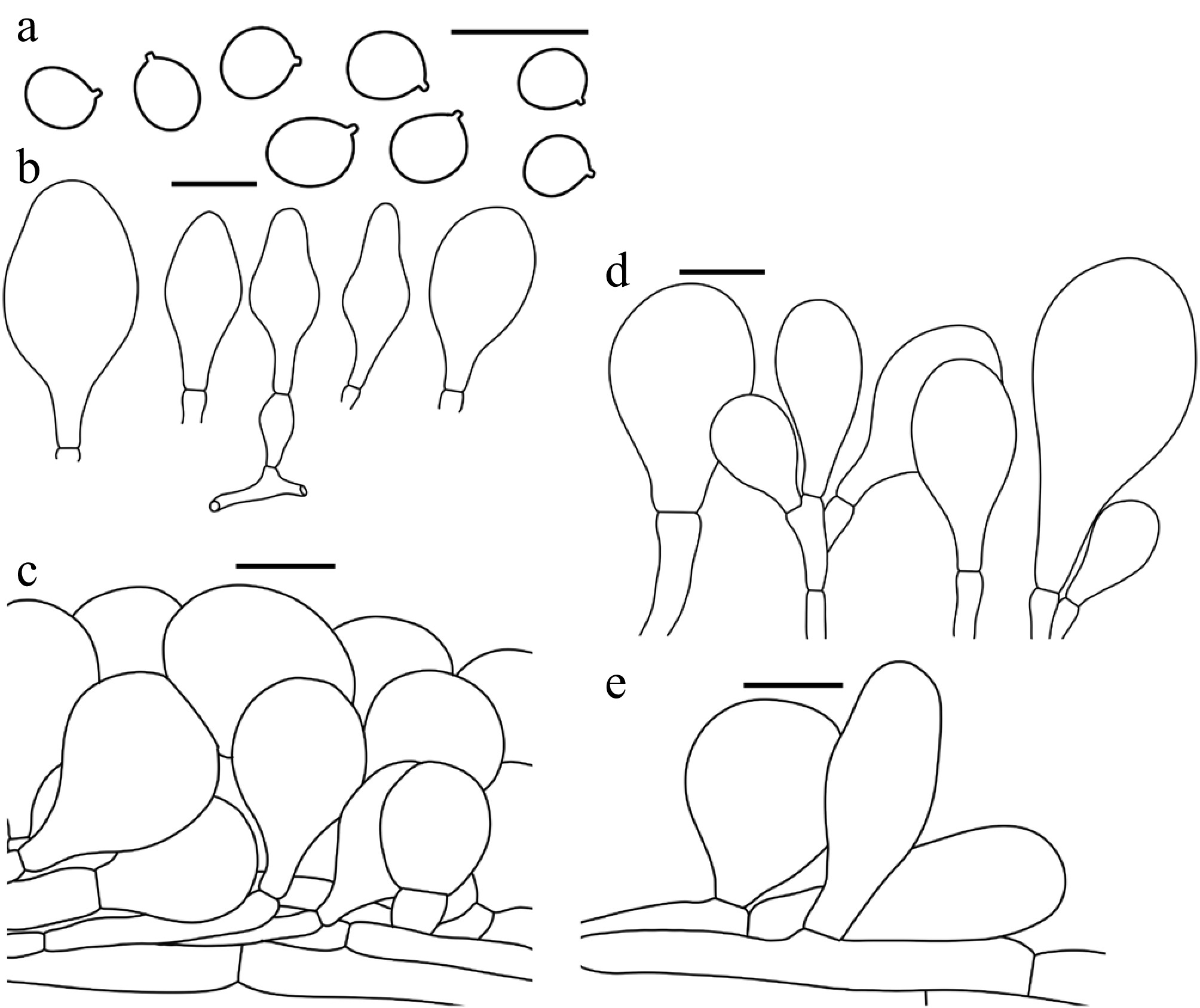
Figure 32.
Pluteus aurantiorugosus (HKAS 83882). (a) Basidiospores. (b) Pleurocystidia. (c) Pileipellis with terminal elements. (d) Cheilocystidia. (e) Stipitipellis with caulocystidia. Scale bars: (a) = 10 μm, (b)–(e) = 20 μm.
Habitat and distribution – solitary to subgregarious, lignicolous on deciduous decaying wood. Distributed across Eurasia like Romania[111], Netherlands[65], Poland[112], Denmark, Germany, Czech Republic, Sweden, Slovakia, China and also distributed in North America[65].
Materials examined – CHINA. Yunnan Province: Kunming City, Panlong District, Kunming Botanical Garden, altitude 1,927 m, 16 August 2014, Zhu-Liang Yang 5802 (HKAS 83882); ibid., Dali Bai Autonomous Prefecture, Nanjian Yi Autonomous County, Gonglang Town, Zinile River area, Huangcaoping Mountain, altitude 2,009 m, 30 June 2015, Kuan Zhao 789 (HKAS 92419); Heilongjiang Province: Yichun City, Daqingshan County (former Dailing District), altitude 418 m, 15 August 2010, Xiang-Hua Wang 2633 (HKAS 61830); Jilin Province: Yanbian Korean Autonomous Prefecture, Antu County, Erdaobaihe Town, near Beauty Pine Garden, altitude 700 m, 15 September 2014, Xiao-Bin Liu 720 (HKAS 87268).
Notes – Pluteus aurantiorugosus, widely distributed in Eurasia and North America, is characterized by its reddish orange pileus, not striate or sulcate margin, clavate or spheropedunculate cheilocystidia, utriform or broadly clavate pleurocystidia. This species has also been recorded in China, occurring in subalpine zones of the northeastern and southwestern regions. Its distribution pattern may suggest a temperate affinity. Pluteus aurantioruber, a species described in southern China and narrowly distributed from southern China, shares similarity by reddish orange pileus. But they can be easily differentiated by geographic distribution.
Pluteus calidophilus Zhu L. Yang & X. Chen, sp. nov. Fig. 33
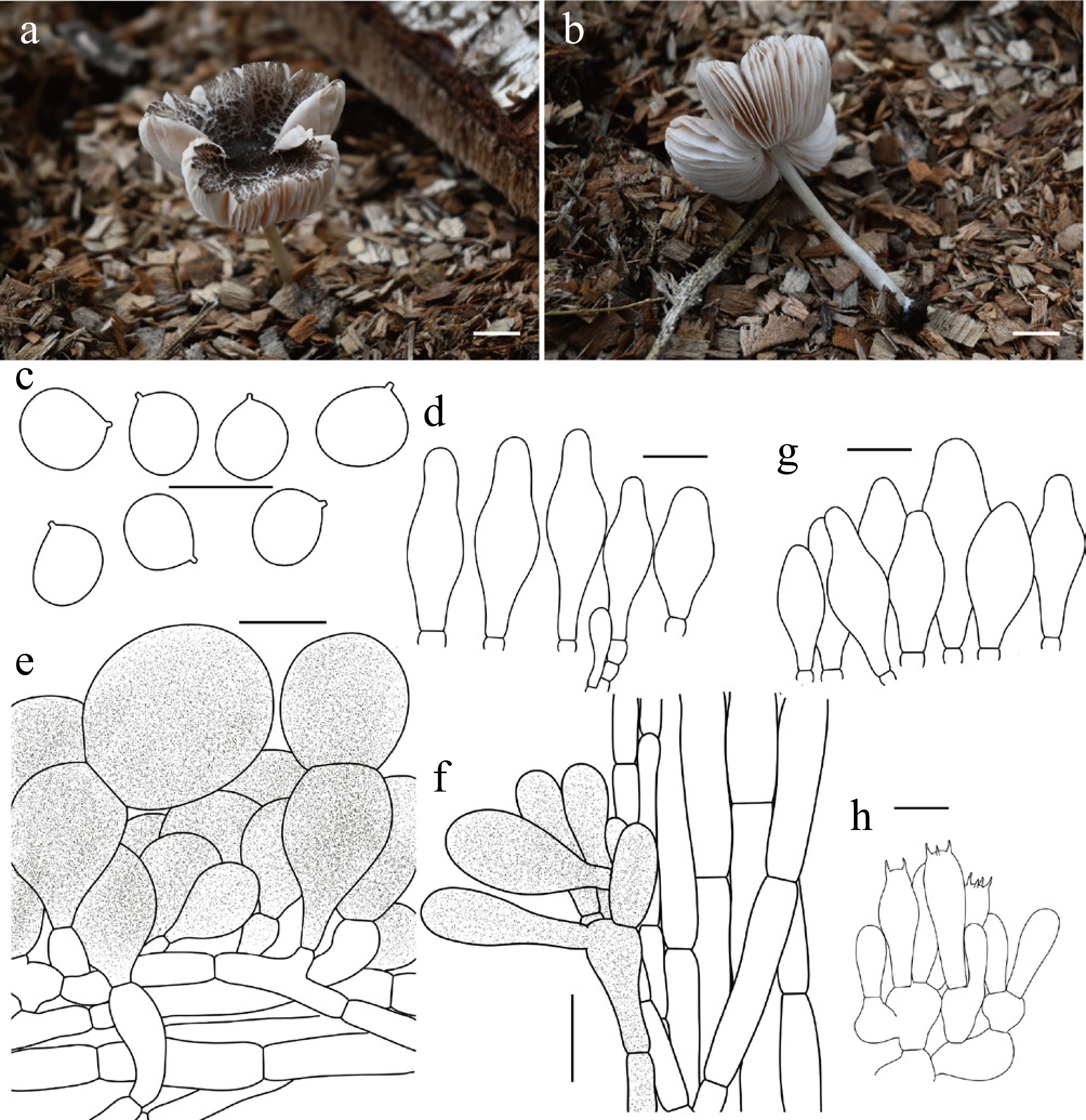
Figure 33.
Pluteus calidophilus (HKAS 151208). (a), (b) Basidiome in natural habitat. (c) Basidiospores. (d) Pleurocystidia. (c) Basidiospores. (d) Pleurocystidia. (e) Pileipellis with terminal elements. (f) Stipitipellis with terminal elements. (g) Cheilocystidia. (h) Basidia and subhymenium. Scale bars: (a), (b) = 1 cm, (c), (h) = 10 μm, (d)–(g) = 20 μm.
Fungal Name: FN 573109
Chinese name: 喜热光柄菇
Etymology – calidophilus (Lat.), reflecting its tropical habitat.
Diagnosis – Pluteus calidophilus differs from P. brunneosquamulosus Pradeep & Vrinda by its medium-sized basidiome, granulose and squamulose pileus, and larger subglobose basidiospores (7–8 × 6–7 μm vs 4.5–7 × 4.5–6 μm).
Basidiomes medium-sized. Pileus 35–40 mm diam., initially hemisphcrical to applanate then center depressed, with low umbo; surface slightly hygrophanous, deep greyish (6E2), darker at the center, surface granulose and squamulose, usually areolate-rimose when old, exposing the white context. Lamellae free, pale pinkish brown (8A2–4), ventricose, slightly crowded, with lamellulae, edgesconcolorous. Stipe 55–70 × 25 mm, cylindrical, solid; surface dirty white (1A1), glabrous. Context in pileus thin, unchanging, dirty white (1A1); in stipe concolorous with surface. Smell and taste unknown.
Basidiospores [120/3/3] 7–8 × 6–7 μm, avl × avw = 7.28 × 6.38 μm, Q = 1.07–1.25, Qm = 1.14 ± 0.05, subglobose, slightly thick-walled (0.5–0.6 μm), smooth. Basidia 20–30 × 7–9 μm, 4-spored, clavate, thin-walled. Cheilocystidia crowded, 30–60 × 10–20 μm, lageniform, clavate, narrowly utriform, colorless, thin-walled. Pleurocystidia scattered, similar to cheilocystidia, 40–64 × 10–22 μm, clavate, narrowly utriform, colorless, thin-walled. Pileipellis an euhymeniderm with transitions to an epithelioid hymeniderm, differentiated, composed of ellipso-pedicellate, spheropedunculate to subglobose elements, 35– 65 × 20–50 μm, with brown intracellular pigments,thin-walled. Stipitipellis a cutis, composed of cylindrical hyphae, 5–20 μm wide, colorless, thin-walled. Caulocystidia present, narrowly clavate, with brown intracellular pigments, thin-walled, 25–40 × 10–20 μm. Clamp connections absent.
Habitat and distribution – lignicolous on deciduous wood chips in tropical habitats. Known from southwestern China.
Materials examined – CHINA. Yunnan Province: Pu'er City, Jiangcheng Hani and Yi Autonomous County, National Highway G219, Daguoling Timber Factory, altitude 929 m, 11 June 2024, Cui Yang-Yang 767 (HKAS 151208, holotype); ibid., 11 June 2024, Cui Yang-Yang 757 (HKAS 151207); Xishuangbanna Dai Autonomous Prefecture, Mengla County, Menglun Town, Xishuangbanna Tropical Botanical Garden, altitude 570 m, 23 August 2019, Liu-Kun Jia 409 (HKAS 125323).
Notes – Pluteus calidophilus is characterized by medium-sized basidiome, granulose and squamulose pileus larger subglobose basidiospores, measuring 7–8 × 6–7 μm, avl × avw = 7.28 × 6.38 μm, Q = 1.07–1.25, Qm = 1.14 ± 0.05 and its tropical habitat. The phylogenetic analysis indicates that P. calidophilus forms a unique lineage with P. brunneosquamulosus, another tropical species[71]. Pluteus brunneosquamulosus is characterized by the medium sized basidiomes with brown squamulose pileus, subglobose to broadly ellipsoid basidiospores, measuring 4.5–7 × 4.5–6 μm, alv × alw = 5.4 × 4.8 μm, Q = 1.05–1.33, Qm = 1.16, and lageniform cheilocystidia with a long flexuous neck. Pluteus calidophilus is quite similar to Pluteus squarrosus Iqbal Hosen & T.H. Li morphologically, a species in the associated area. However, P. squarrosus possesses squamulose pileus, a trichoderm to trichohymeniderm pileipellis (cylindrical and clavate elements), a dull white to grayish white pruinose stipe with surface covered by caulocystidial elements, globose to subglobsoe basidiospores, measuring 5.5–6.5(–7) × (4.8–)5–6(6.5) μm, alv × alv = 6.01 × 5.38 μm, Q = (1.03)1.07–1.12(1.15); Qm = 1.08 ± 0.03, and distribution in the temperate zone[113]. Pluteus jamaicensis, a tropical species, described from Jamaica, was close to P. calidophilus. Pluteus jamaicensis was originally described without cystidia. The presence of both pleurocystidia and cheilocystidia has been consistently observed in subsequent studies[63,79,114]. It is characterized by the combination of a rugose pileus, a subsulcate margin, and a white basal tomentum, whereas P. calidophilus lacks a subsulcate margin. Since the sequence of the type material of P. jamaicensis is not publicly available, we included NCBI sequences identified as occurrences of P. jamaicensis from USA in the present study. ITS sequence comparison showed that our material shared only 87.8–88.4% similarity, indicating that it is clearly distinct from P. jamaicensis. Additionally, the molecular phylogenetic analyses indicated that P. calidophilus separated from other known species of sect. Celluloderma (Fig. 8).
Pluteus castaneorugosus E.F. Malysheva & A.V. Alexandrova, Phytotaxa 461 (2): 95 (2020) Figs 28d and 34
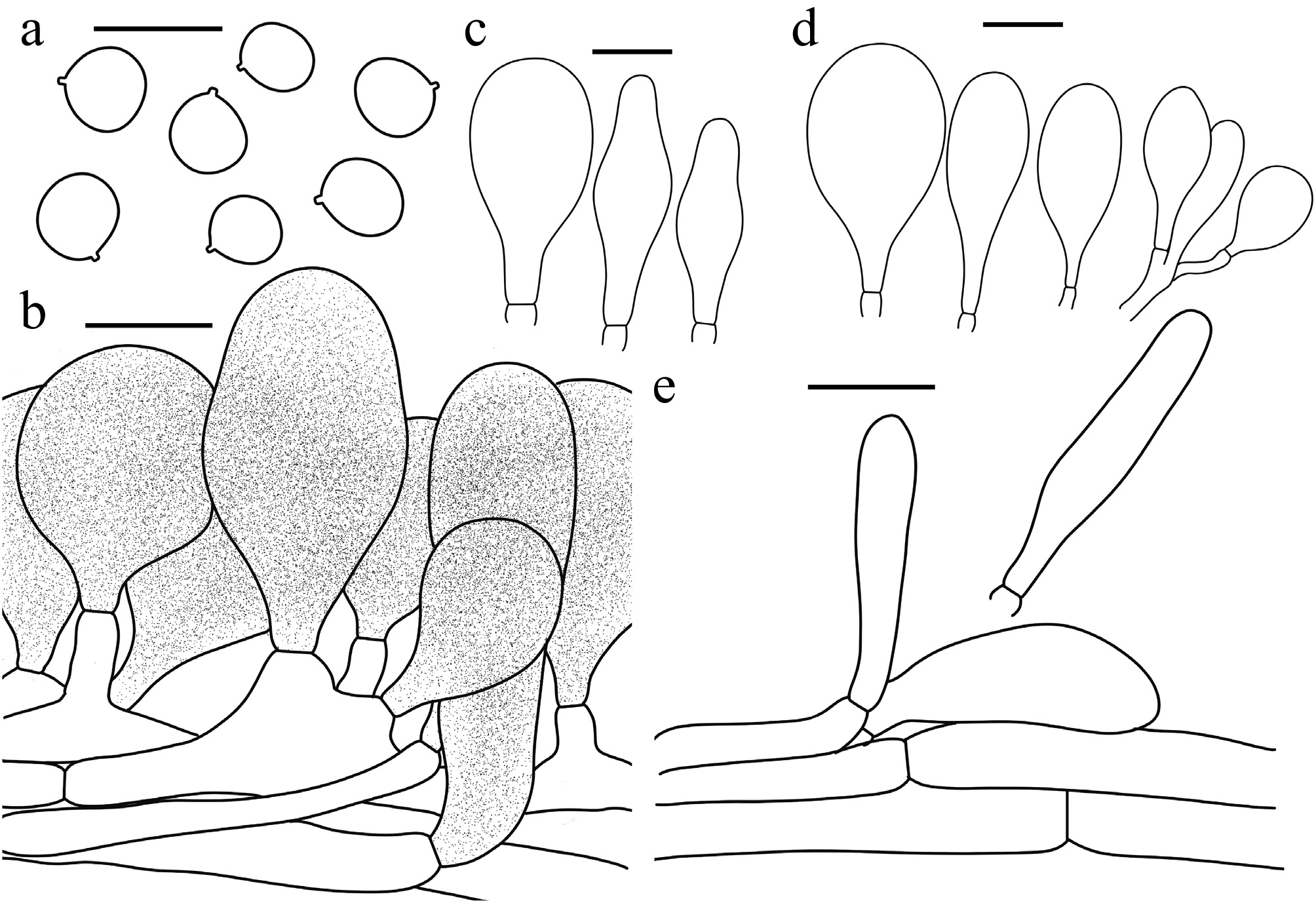
Figure 34.
Pluteus castaneorugosus (HKAS 78644). (a) Basidiospores. (b) Pileipellis with terminal elements. (c) Pleurocystidia. (d) Cheilocystidia. (e) Stipitipellis with caulocystidia. Scale bars: (a) = 10 μm, (b)–(e) = 20 μm.
Habitat and distribution – solitary to subgregarious, lignicolous on deciduous decaying wood, so far known from Vietnam[115], Laos, and southwestern China.
Materials examined – CHINA. Yunnan Province: Dehong Dai and Jingpo Autonomous Prefecture, Yingjiang County, Nalong Village, river valley near Nabang Town, altitude 358 m, 4 September 2025, Zhu-Liang Yang 7823 (HKAS 151300). LAOS. Attapeu Province: Medicinal Biodiversity Conservation Area, altitude 228 m, 28 April 2013, Zhu-Liang Yang 5686 (HKAS 78644).
Notes – This species is originally described from Vietnam and characterized by rugose, brown pileus, small globose or subglobose basidiospores measuring 5.0–6.0 × 4.5–5.5 μm, thick-walled and septate cheilocystidia and the presence of caulocystidia[115]. The specimens for this study were collected in Laos. It is speculated that this species may also occur in the tropical areas of southwestern China, which have a habitat similar to its type locality. During a recent field survey, we discovered the distribution of this species in the Tongbiguan Nature Reserve, located in the southwestern border region of China. This represents the first record of this species in China.
Pluteus chrysophlebius (Berk. & M.A. Curtis) Sacc., Syll. fung. (Abellini) 5: 678 (1887) Figs 28e and 35
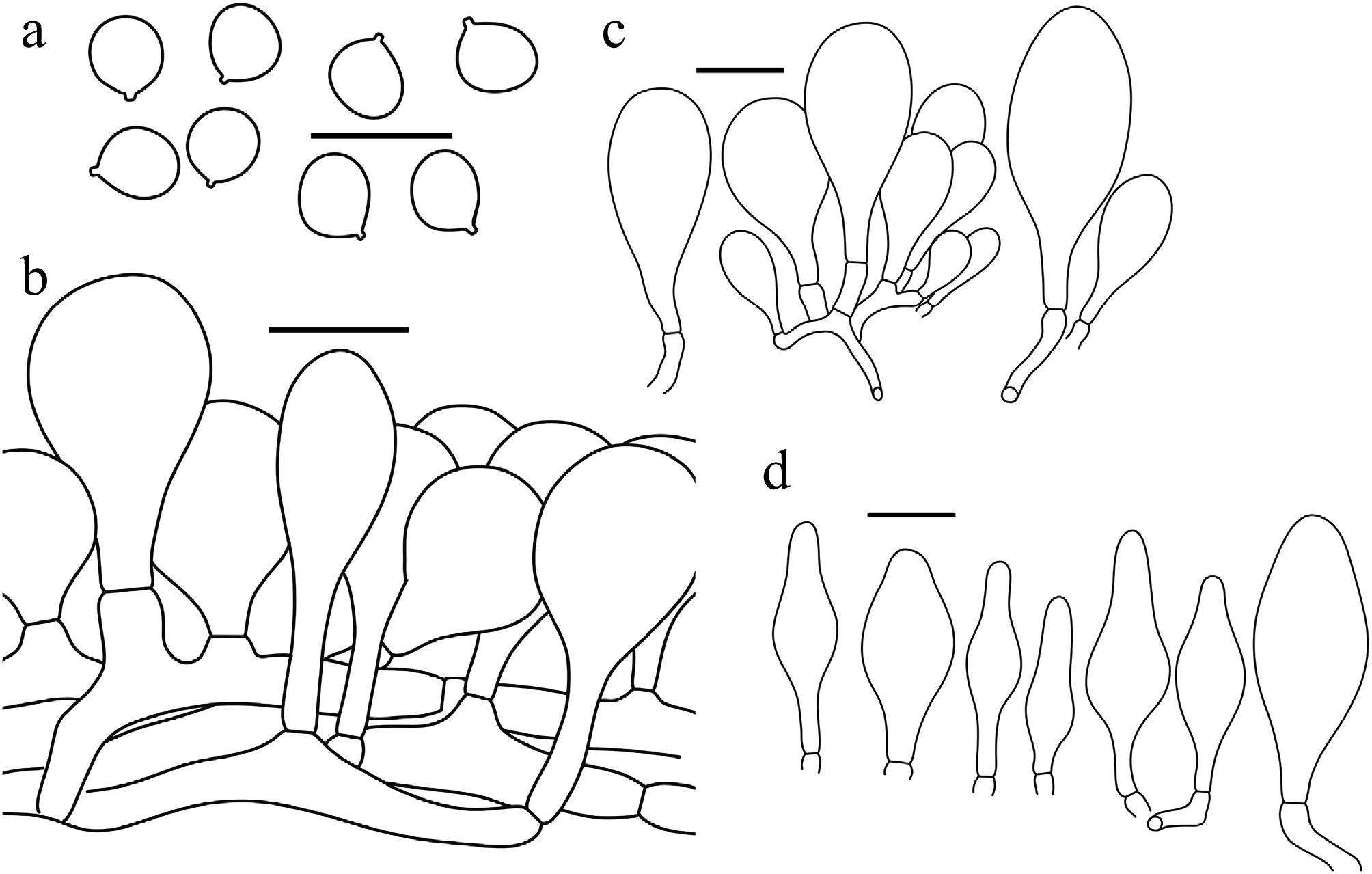
Figure 35.
Pluteus chrysophlebius (HKAS 128111). (a) Basidiospores. (b) Pileipellis with terminal elements. (c) Cheilocystidia. (d) Pleurocystidia. Scale bars: (a) = 10 μm, (b)–(d) = 20 μm.
Habitat and distribution – solitary to subgregarious, lignicolous on deciduous wood, widespread in and wide distributed in North America[92], Brazil[114], South Korea[116], Russia and China[104].
Materials examined – CHINA. Sichuan Province: Liangshan Yi Autonomous Prefecture, Muli Tibetan Autonomous County, S216 Provincial Highway from Muli County Town to Daocheng Direction, altitude 3,549 m, 1 August 2012, Yan-Jia Hao 699 (HKAS 76357); Yunnan Province: Lijiang City, Yulong Naxi Autonomous County, Jade Dragon Snow Mountain Nature Reserve, Spruce Meadow, altitude 3,240 m, 17 September 2021, Liu-Kun Jia 2022 (HKAS 128111); Kunming City, Panlong District, Wild Duck Lake Scenic Area, Sanjia Village, altitude 2,113 m, 17 September 2008, Xi-Hui Du 40 (HKAS 55497); ibid., 13 October 2012, Jiao Qin 651 (HKAS 78053). Xizang Autonomous Region: Nyingchi City, Bomi County, G318 National Highway at Kilometer Marker 4000, altitude 2,980 m, 30 June 2014, Yan-Jia Hao 1164 (HKAS 82955) and Qing Cai 1110 (HKAS 83570); Nyingchi City, Zayu County, Cibagou National Nature Reserve, altitude 1,834 m, 7 November 2020, Zai-Wei Ge 4265 (HKAS 113448).
Notes – The taxonomic nomenclature of P. chrysophlebius differs between continents. In North America, it is identified as P. chrysophlebius or P. admirabilis (Peck) Peck[114,117], whereas in Europe and Asia, it is recognized as P. chrysophaeus (Schaeff.) Quél[65,83]. We adopted the previous taxonomic affiliation of P. chrysophlebius to recognize our collections[92].
Pluteus daqinggouensis T. Bau & Mu Liu, in Liu & Bau, Phytotaxa 684 (2): 210 (2025) Figs 28f and 36
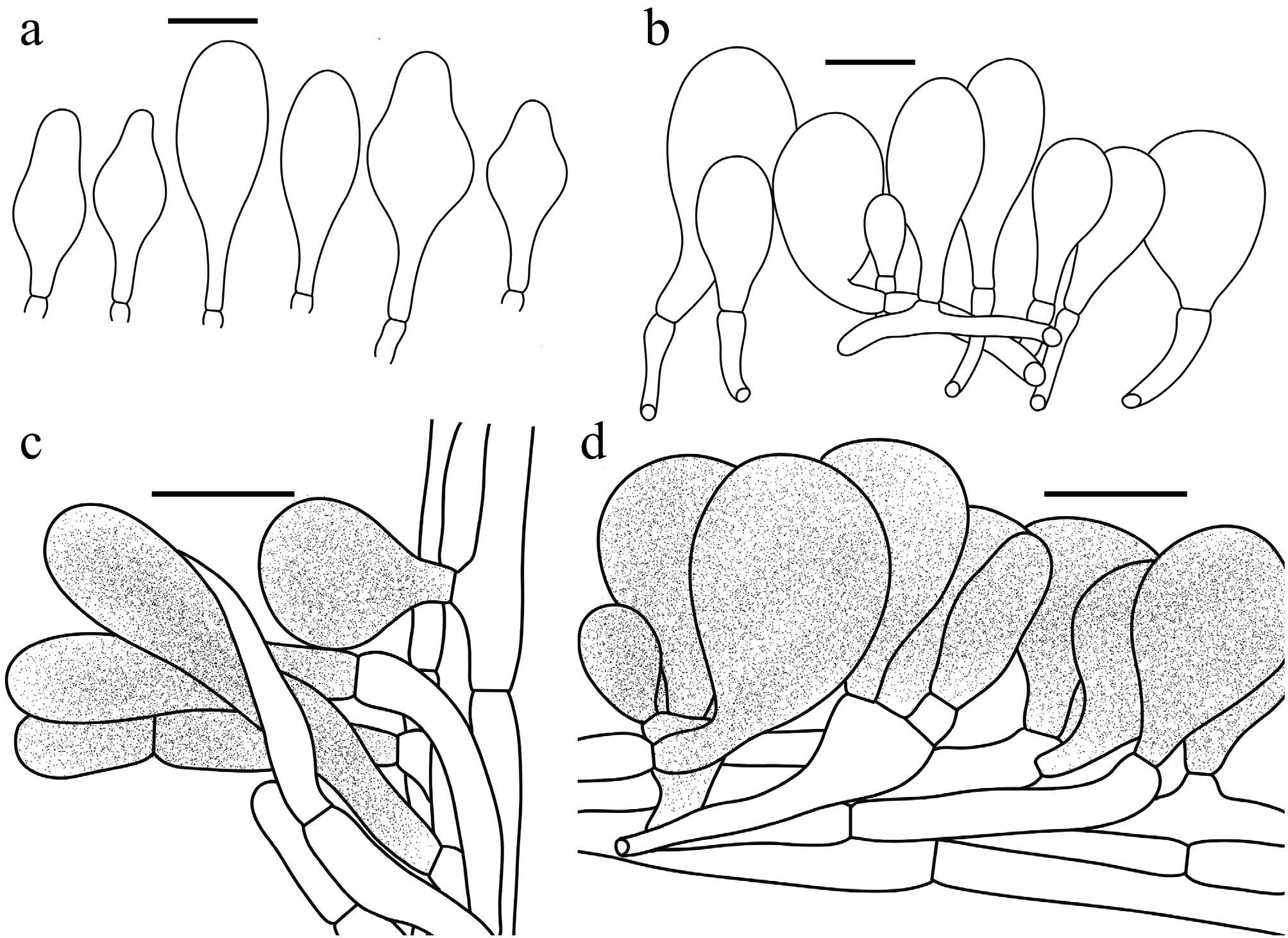
Figure 36.
Pluteus daqinggouensis (HKAS 151174). (a) Pleurocystidia. (b) Cheilocystidia. (c) Stipitipellis with caulocystidia. (d) Pileipellis with terminal elements. Scale bars: (a)–(d) = 20 μm.
Habitat and distribution – solitary to subgregarious, lignicolous on deciduous decaying wood, so far reported from northeastern China[96] and eastern China (this study).
Material examined – CHINA. Jiangsu Province: Nanjing City, Zijin Mountain National Scenic Area, altitude 309 m, 24 June 2023, Xia Chen 417 (HKAS 151174).
Notes – Pluteus daqinggouensis is characterized by dark brown rugose pileus with striate margin, fusiform pleurocystidia, and broadly clavate or ellipsoid cheilocystidia. Although the species was originally described as lacking caulocystidia, our examination confirmed their presence, suggesting that this character may be variable.
Pluteus doulianus Zhu L. Yang & X. Chen, sp. nov. Fig. 37
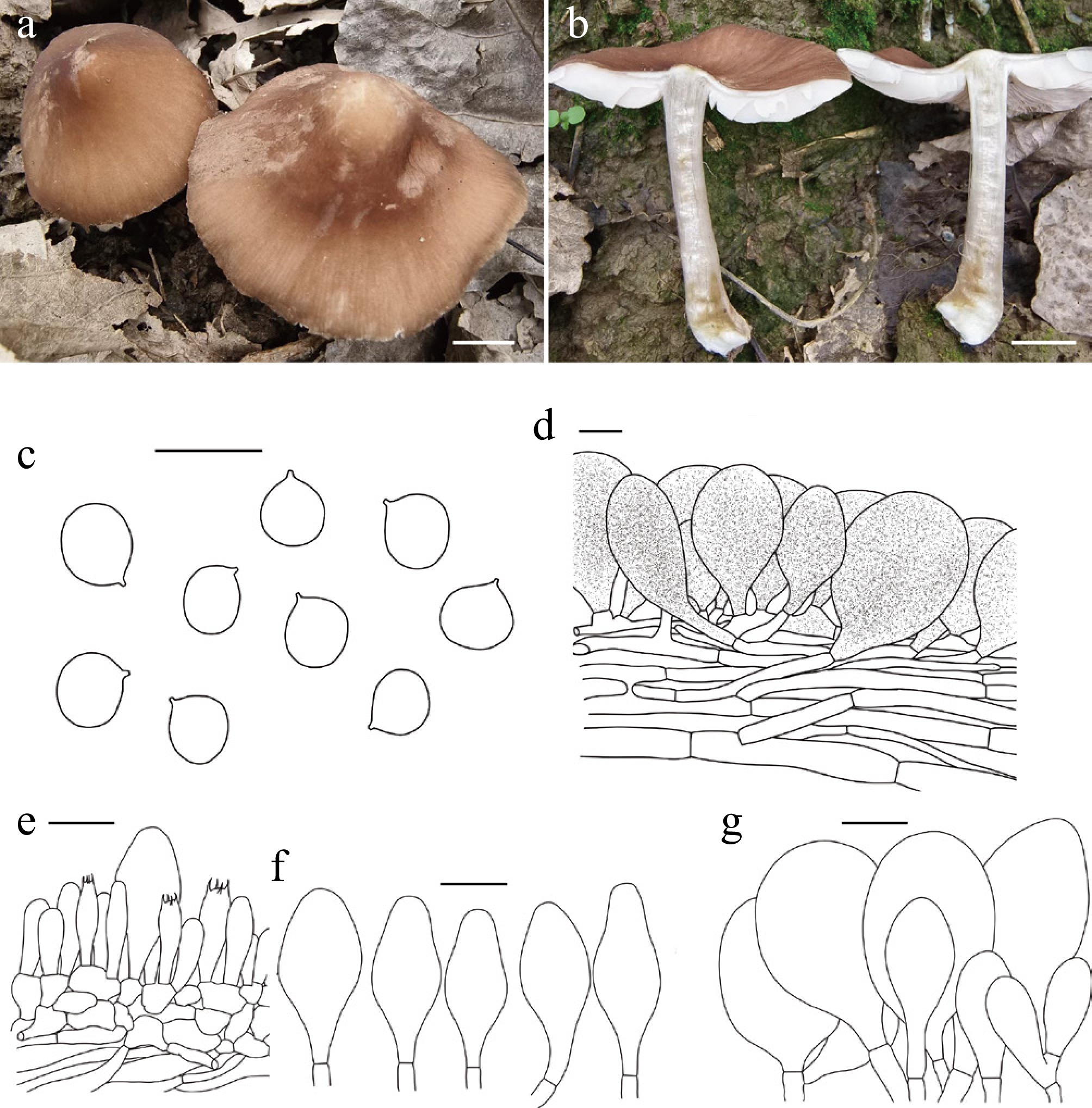
Figure 37.
Pluteus doulianus (HKAS 151279). (a), (b) Basidiome in natural habitat. (c) Basidiospores. (d) Pileipellis with terminal elements. (e) Basidia and subhymenium. (f) Pleurocystidia. (g) Cheilocystidia. Scale bars: (a), (b) = 1 cm, (c) = 10 μm, (d)–(g) = 20 μm.
Fungal Name: FN 573110
Chinese name: 斗笠光柄菇
Etymology – doulianus (Lat.), is derived from the Chinese word "斗笠" (dǒulì), the traditional bamboo rain hat of China. The specific epithet refers to the pileus, which is strikingly similar to that of a traditional Chinese conical rain hat.
Diagnosis – Pluteus doulianus differs from P. nanus (Pers.) P. Kumm by its medium-sized basidiomes, brown subglabrous pileus with conical umbo and smaller subglobose basidiospores (5.5)6–7(8) × 5–(6.5)7 μm vs (6.5)7.0–9.5(10.0) × 5.5(7.0)) μm.
Basidiomes medium-sized. Pileus 40–55 mm diam., initially hemisphcrical to applanate then center depressed, with conical umbo; surface not hygrophanous, yellowish brown (6E7) or dark brown (6F8), rugose and darker at the center, surface subglabrous, usually areolate-rimose when old, exposing the white context. Lamellae free, pale pinkish brown (8A2–4), ventricose, slightly crowded, with lamellulae, edges concolorous. Stipe 55–75 × 10–15mm, cylindrical, solid; surface dirty white (1A1), glabrous. Context in pileus thin, unchanging, dirty white (1A1); in stipe concolorous with surface. Smell and taste unknown.
Basidiospores [160/4/4] (5.5)6–7(8) × 5–7 μm, avl × avw = 6.54 × 5.92 μm, Q = 1.00–1.24, Qm = 1.11 ± 0.07, subglobose, slightly thick-walled (0.5–0.6 μm), smooth. Basidia 16–35 × 6–10 μm, 4-spored, clavate, thin-walled. Cheilocystidia crowded, 30–80 × 15–50 μm, broadly fusiform to broadly clavate, colorless, thin-walled. Pleurocystidia scattered, 35– 75 × 15–37 μm, narrowly utriform or clavate, colorless, thin-walled. Pileipellis an euhymeniderm with transitions to an epithelioid hymeniderm, differentiated, composed of ellipso-pedicellate, spheropedunculate to subglobose elements, 50– 75 × 30–60 μm, with brown intracellular pigments,thin-walled. Stipitipellis a cutis, caulocystidia not found. Clamp connections absent.
Habitat and distribution – terrestrial (among broadleaved woody remnants and organic matter) in subtropical habitats. Known from center and eastern China.
Materials examined – CHINA. Hubei Province: Shishou City, Taohua Mountain Natural Scenic Area, altitude 200 m, 23 October 2023, collected by Ke Li (HKAS 151279, holotype); Jiangsu Province: Nanjing City, Zijin Mountain National Scenic Area, altitude 300 m, 29 April 2023, Xia Chen 78 (HKAS 151163); ibid., 16 May 2023, Xia Chen 162 (HKAS 151165); Hunan Province: Yiyang City, Nan twon, altitude 5 m, 6 May 2024, Yu Zhong (HKAS 151282).
Notes – Pluteus doulianus is characterized by its medium-sized basidiomes, brown subglabrous pileus with conical umbo and subglobose basidiospores measuring (5.5)6–7(8) × 5–7 μm, avl × avw = 6.54 × 5.92 μm, Q = 1.00–1.24, Qm = 1.11 ± 0.07. It shares less than 97% ITS similarity with members of the nanus complex including P. aesontiensis Ferisin Justo & Dovana, P. cinereofuscus J.E. Lange, P. eludens E.F. Malysheva, Minnis & Justo, P. ludwigii Ferisin, Justo & Dovana, P. sternbergii Velen. and P. tenebromarginatus Corriol and forms a highly supported independent clade (BS = 100, PP = 1.00). However, P. aesontiensis, originally described in Italy, possesses a smaller-sized basidiomes, white pubescent stipe and rounder basidiospores measuring 6.1–7.1 × 5.0–6.2 μm, Q = 1.10–1.34[118]. Pluteus cinereofuscus, originally described from Europe, is characterized by grey-brown pileus, larger subglobose to ellipsoid basidiospores measuring (6.5)7.0–9.0(10.5) × (5.0)5.5–7.0(7.5) μm[65,119]. Pluteus eludens, distributed in Madeira Island (Portugal), Russia and USA[107], possesses grey-brown pileus, utriform or narrowly utriform pleurocystidia with long pedicel, fusiform cheilocystidia with brown intracellular pigment or hyaline and subglobose basidiospores ([5.5] 6.0–8.2 × 5.2–7.3 μm, avl × avw = 6.4–6.6 × 5.8–6.0 μm, Q = 1.00–1.23, Qm = 1.06–1.12)[107]. Pluteus ludwigii is characterised by its smaller basidiomes with a brown, venose pileus centre, smaller basidiospores ((5.3–)5.8–6.6(–6.9) × (4.9–)5.2–5.7(–6) μm), and its occurrence on twigs of broadleaved trees[120]. In contrast, Pluteus doulianus has medium-sized basidiomes and grows on the leaf litter of broadleaved forests rather than on twigs. Pluteus doulianus is distributed in central China and may have affinities with North American taxa. Pluteus californicus McClatchie is a North American species, closely related to the cinereofuscus/nanus clade. It is characterized by a hygrophanous pileus that is greenish drab becoming cinnamon-drab, a pale drab stip, few pleurocystidia, which are lageniform with short, broad necks[117]. According to available literature, Pluteus doulianus differs in having larger basidiomes and lacking a rugose-venose pileus surface. Recently Justo et al. obtained ITS sequences of this species[108], and sequence comparison showed that our material is distinct from P. californicus. (the two species show 96.65% ITS similarity and 90.62% tef1 similarity). Morphologically, P. doulianus closely resembles P. ludovicianus Murrill, in having medium-sized basidiomes. However, P. doulianus is distinguished by its non-hygrophanous, yellowish-brown pileus surface, whereas P. ludovicianus has a hygrophanous pileus that changes from dark tan to pale fuliginous, a distinctly striate margin, and a stipe that is pallid to pale brown[117]. Pluteus homolae Minnis & Sundb., described from the USA, is characterized by its distinctly dark lamellar edges, which readily distinguish it from P. doulianus, the latter having colourless lamellar edges.
We analyzed all publicly available sequences of the Pluteus nanus clade from NCBI and also unpublished type sequences of poorly known species belonging to Pluteus nanus clade, and the results show that Pluteus doulianus forms an independent lineage (Fig. 8 and Supplementary Fig. S1).
Pluteus fuscipruinatus V. Keerthi & C.K. Pradeep, Phytotaxa 670(3): 165 (2024) Fig. 28h
Habitat and distribution – solitary to subgregarious on dead decaying angiosperm twig. It is known from India[121] and southwestern China
Material examined – CHINA. Yunnan Province: Xishuangbanna Dai Autonomous Prefecture, Mengla County, Yaozu Yao Ethnic Township, naer Nangan River, altitude 302 m, 23 August 2023, Geng-Shen Wang 2105 (HKAS 151283).
Notes – Pluteus fuscipruinatus, originally described from India, is characterized by brownish pruinose pileus and stipe, broadly clavate or lageniform cheilocystidia, fusiform to lageniform pleurocystidia, clavate or cylindro-clavate caulocystidia and a trichoderm pileipellis with cylindro-clavate terminal elements[121]. This species possesses a unique trichoderm pileipellis. Unlike the spheropedunculate cells found in other pileipellis structures, its terminal cells are clavate.This species is currently only known to distribute in Xishuangbanna Dai Autonomous Prefecture, China, a region that shares a similar habitat with its type locality. The poor quality of the collected specimen, made microscopic illustration difficult. This collection was identified as P. fuscipruinatus based on morphological similarities including a brownish pruinose pileus and occurrence on decaying angiosperm twigs in tropical habitats. And it is also supported by phylogenetic analysis, which placed it within the same clade (Fig. 7, PP = 0.70, BS = 98).
Pluteus fuscopunctatus C.K. Pradeep & V. Keerthi, in Keerthi & Pradeep, Nordic J. Bot.(e03974): 2 (2023) Figs 28i and 38
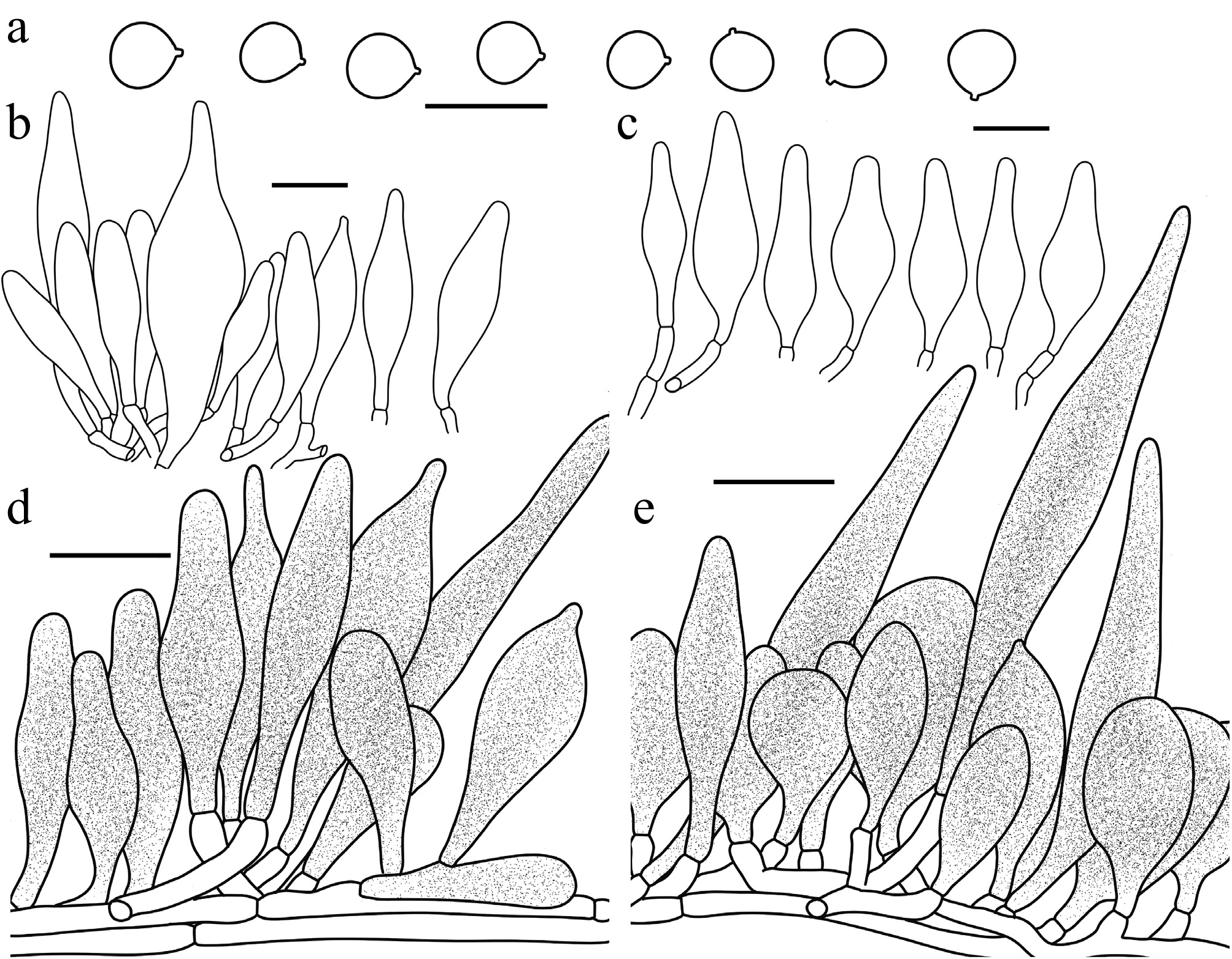
Figure 38.
Pluteus fuscopunctatus (HKAS 151284). (a) Basidiospores. (b) Cheilocystidia. (c) Pleurocystidia. (d) Stipitipellis with caulocystidia. (e) Pileipellis with two types of terminal elements. Scale bars: (a) = 10 μm, (b)–(e) = 20 μm.
Habitat and distribution – solitary to subgregarious, terrestrial, on dead decaying angiosperm twig or on soil. So far known from India[102] and northern China.
Materials examined – CHINA. Guangdong Province: Shenzhen City, Futian District, Bijia Mountain Urban Central Park, altitude 178 m, 10 June 2024, Cheng Chen (HKAS 151285); Zhaoqing City, altitude 210 m, 24 August 2024, Yan Fu (HKAS 151284).
Notes – Pluteus fuscopunctatus is recently described from India[102], and characterized by medium-sized basidiomes, brown pruinose pileus, white stipe with brown pruinae, fusiform cheilocystidia, broadly lageniform pleurocystidia, trichoderm pileipellis with two types terminal elements, long cylindrical elements and spheropedunculate elements, presence of abundant cylindrical to subfusiform caulocystidia, and terrestrial habitat. It is only known from India and southern China, indicating it might be a locally distributed tropical species.
Pluteus hirtellus Desjardin & B.A. Perry, Mycosphere 9(3): 612 (2018) Fig. 39
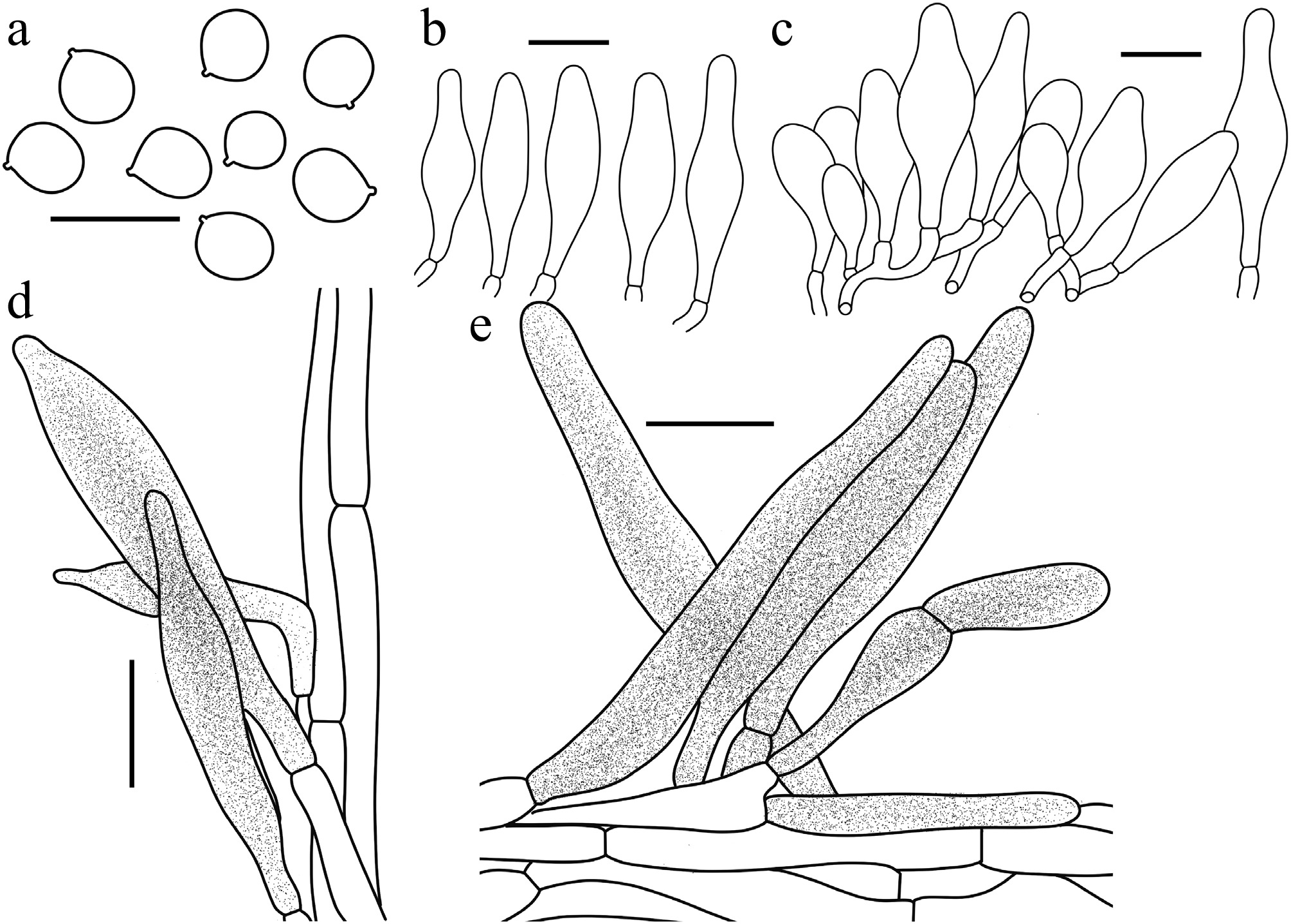
Figure 39.
Pluteus hirtellus (HKAS 151286). (a) Basidiospores. (b) Cheilocystidia. (c) Pleurocystidia. (d) Pileipellis with terminal elements. (e) Stipitipellis with caulocystidia. Scale bar: (a) =10 μm, (b)–(e) = 20 μm.
Habitat and distribution – subgregarious to gregarious, lignicolous on deciduous decaying wood. So far known from Africa[78] and northern China.
Materials examined – CHINA. Guangxi Zhuang Autonomous Region: Nanning City, Jiangnan District, Qipo Forest Farm, altitude 93 m, 2 August 2024, De-De Jiang (HKAS 151286); ibid., 21 August 2024, De-De Jiang (HKAS 151287).
Notes – Pluteus hirtellus, recently described from Africa, is characterized by a relatively small pileus with dark brown minutely hair at center, broadly clavate to ventricose cheilocystidia, clavate pleurocystidia, a cutis to trichoderm pileipellis and absence of caulocystidia. Although specimens from China are general similar to this description, we observed a single major difference: the presence of caulocystidia. The phylogenetic result shows that the specimens from China and the type sequences form sister clades. In the Bayesian Poisson Tree Processes (BPP) species delimitation test, there was fully support (BPP = 1.00) for recognizing the Chinese specimens as a new species. However, across the genus Pluteus, the presence or absence of caulocystidia is highly variable in some species and cannot be considered a key diagnostic character. No reliable differences were observed in the pileipellis structure or cheilocystidia, pleurocystidia morphology. They also share a similar habitat, with a preference for tropical habitat. Therefore, we designate the Chinese material as P. hirtellus.
Pluteus lalepiorum J.A. del Rosario & B.A. Perry, Phytotaxa 709(1): 85 (2025) Fig. 40
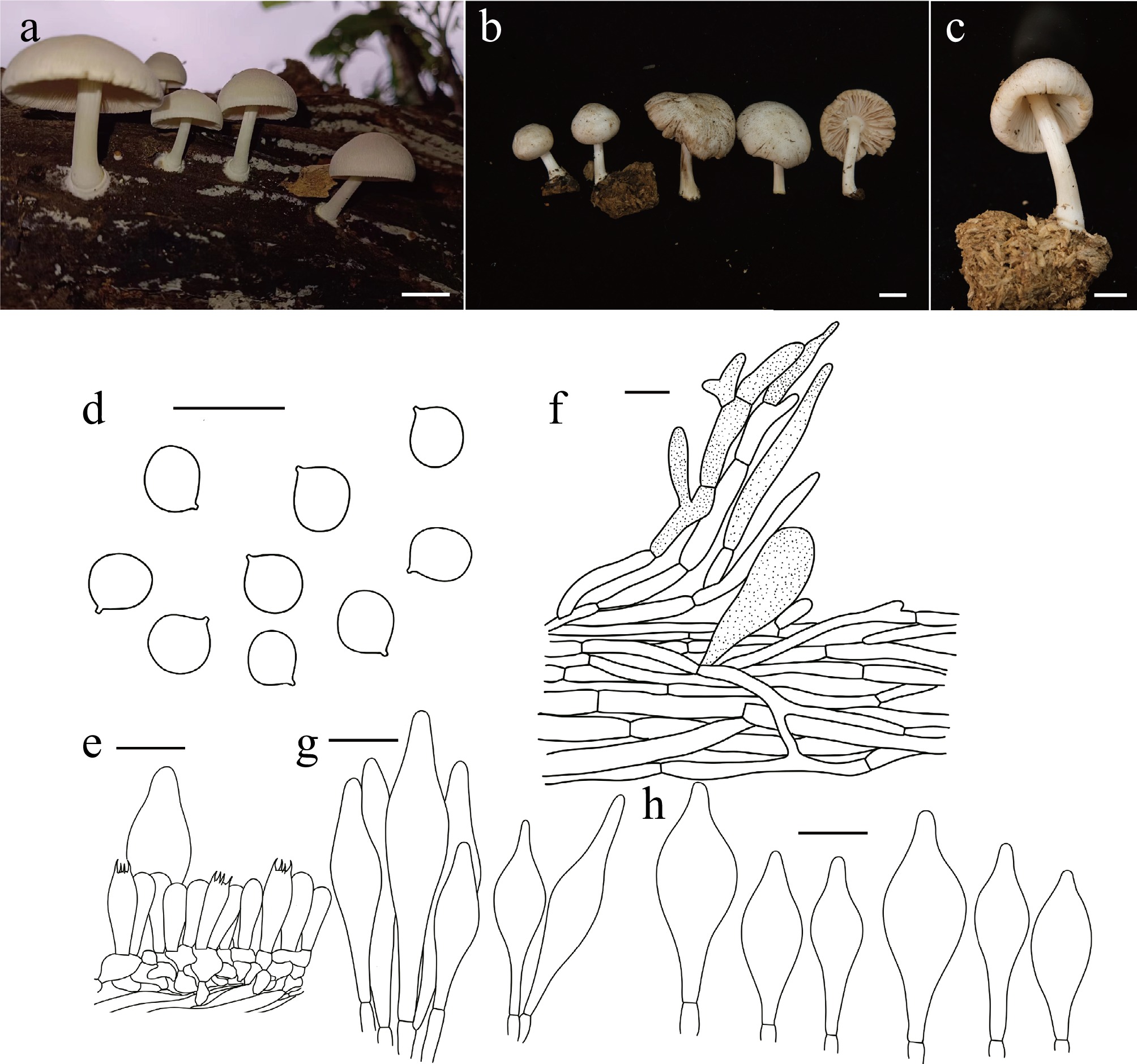
Figure 40.
Pluteus lalepiorum (HKAS 151288). (a)–(c) Basidiomes in natural habitat. (d) Basidiospores. (e) Basidia and subhymenium. (f) Pileipellis with ascending elements. (g) Cheilocystidia. (h) Pleurocystidia. Scale bars: (a)–(c) = 1 cm, (d) = 10 μm, (e)–(h) = 20 μm.
Habitat and distribution – lignicolous, on deciduous decaying wood in the transitional zone between tropical and subtropical habitats. Known from Republic of Vanuatu[69] and southern China.
Materials examined – CHINA. Guangxi Zhuang Autonomous Region: Chongzuo City, Pengxiang City, Jinji Mountain, on decaying Cinnamomum camphora wood, altitude 200 m, 15 April 2024, Guo-Wei Liu 01 (HKAS 151288). Guangxi Zhuang Autonomous Region: Chongzuo City, Pengxiang City, Jinji Mountain, on decaying Cinnamomum camphora wood, altitude 200 m, 15 April 2024, Xuan Chen 794 (HKAS 151158).
Notes – In China, P. lalepiorum is primarily distributed in Guangxi Province—a region situated at the transitional zone between tropical and subtropical flora, characterized by tropical floristic elements. Both morphological features and molecular sequences show high similarity to those of the species reported in Vanuatu. Although their ITS sequence similarity is 98.9%, indicating some divergence, we identify this specimen as P. lalepiorum based on similar morphological characteristics and habitat in order to avoid excessive species splitting. Pluteus lalepiorum is phylogenetically close to P. squamulososulcatus, which also possesses cutis pileipellis with some ascending elements and lignicolous habit[115]. Pluteus squamulososulcatus differs in having strongly plicate-sulcate greyish pileus with small appressed dark grey-brown fibrils, and lageniform cheilocystidia with subcapitate apex. Morphologically, P. lalepiorum looks like P. albidus Beeli, a white species in sect. Hispidoderma which possesses smaller white basidiomes, pruinose, subbulbous stipe, a cutis type pileipellis with clavate to ventricose terminal cells[78,122]. Detailed discussion on this species can be found in this paper[69].
Pluteus lepiotoides A. Pearson, Trans. Br. mycol. Soc. 35(2): 109 (1952) Fig. 41
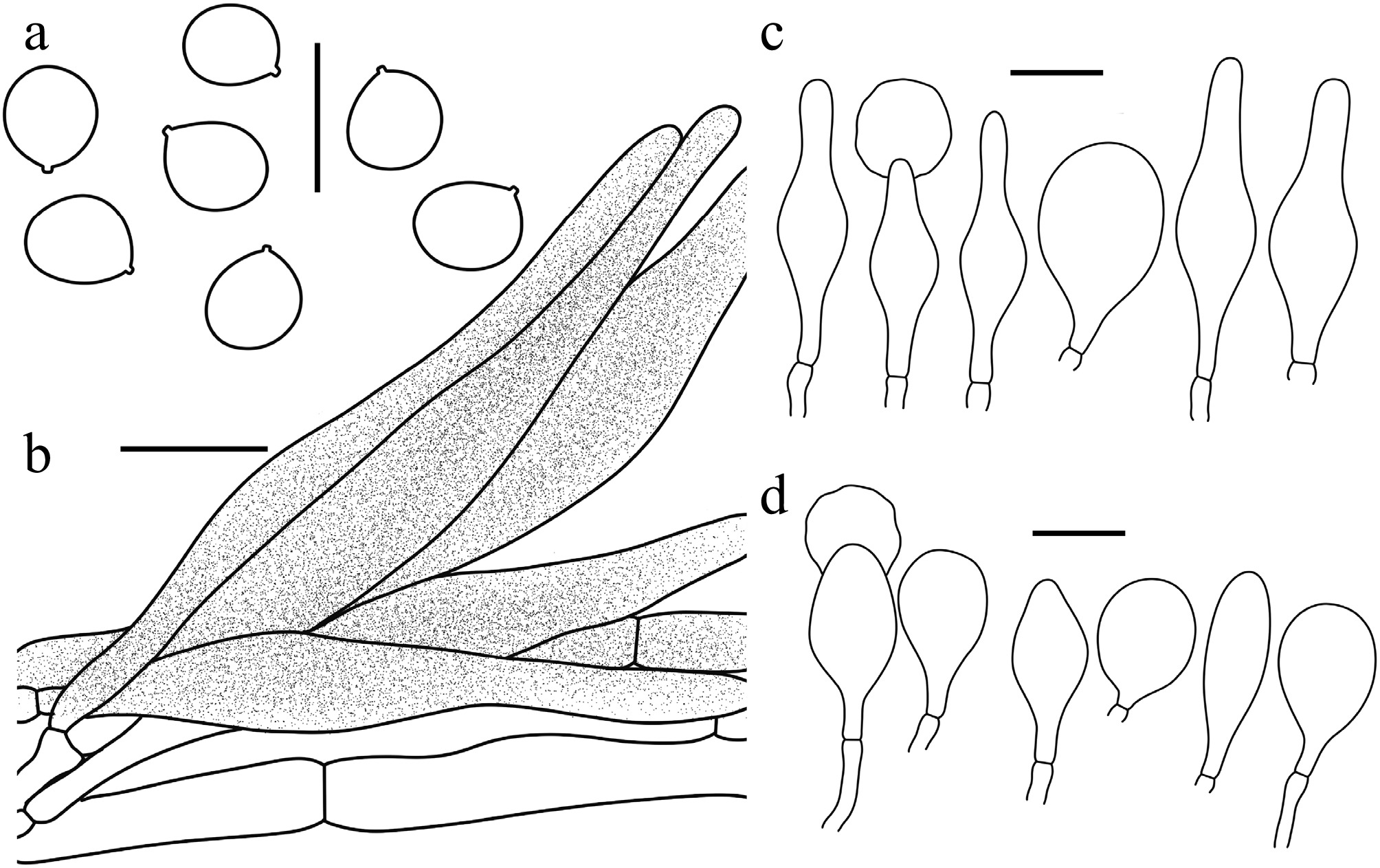
Figure 41.
Pluteus lepiotoides (HKAS 71854). (a) Basidiospores. (b) Pileipellis with terminal elements. (c) Pleurocystidia. (d) Cheilocystidia. Scale bars: (a) = 10 μm, (b)–(d) = 20 μm.
Habitat and distribution – solitary to subgregarious, lignicolous on deciduous decaying wood. Widely distributed in Europe and north-western Asia (Türkiye)[105]. Known also from northwestern China[104].
Material examined – CHINA. Shaanxi Province: Baoji City, Mei County, Yingtou Town, Haoping Dali Village, altitude 1,450 m, 4 September 2010, Xiao-Fei Shi 662 (HKAS 71854).
Notes – Pluteus brunneodiscus, recently described from China[104], and later regarded as a synonym of P. lepiotoides, has been treated as an invalidly published name in a recent study[105]. Pluteus lepiotoides possesses medium-sized to large basidiomes, brown pileus, transitioning to paler tones toward the margins, a white stipe, a cutis to trichoderm pileipellis and terrestrial habit, and it is one of the species within the ephebeus clade, which features hairy scales pileus. This species is widely distributed in Europe. In Asia, this species has been reported from North-western Asia (Türkiye) and in the northwestern regions of China to date[104,105].
Pluteus phlebophorus (Ditmar) P. Kumm., Führ. Pilzk. (Zerbst): 98 (1871) Figs 28j and 42
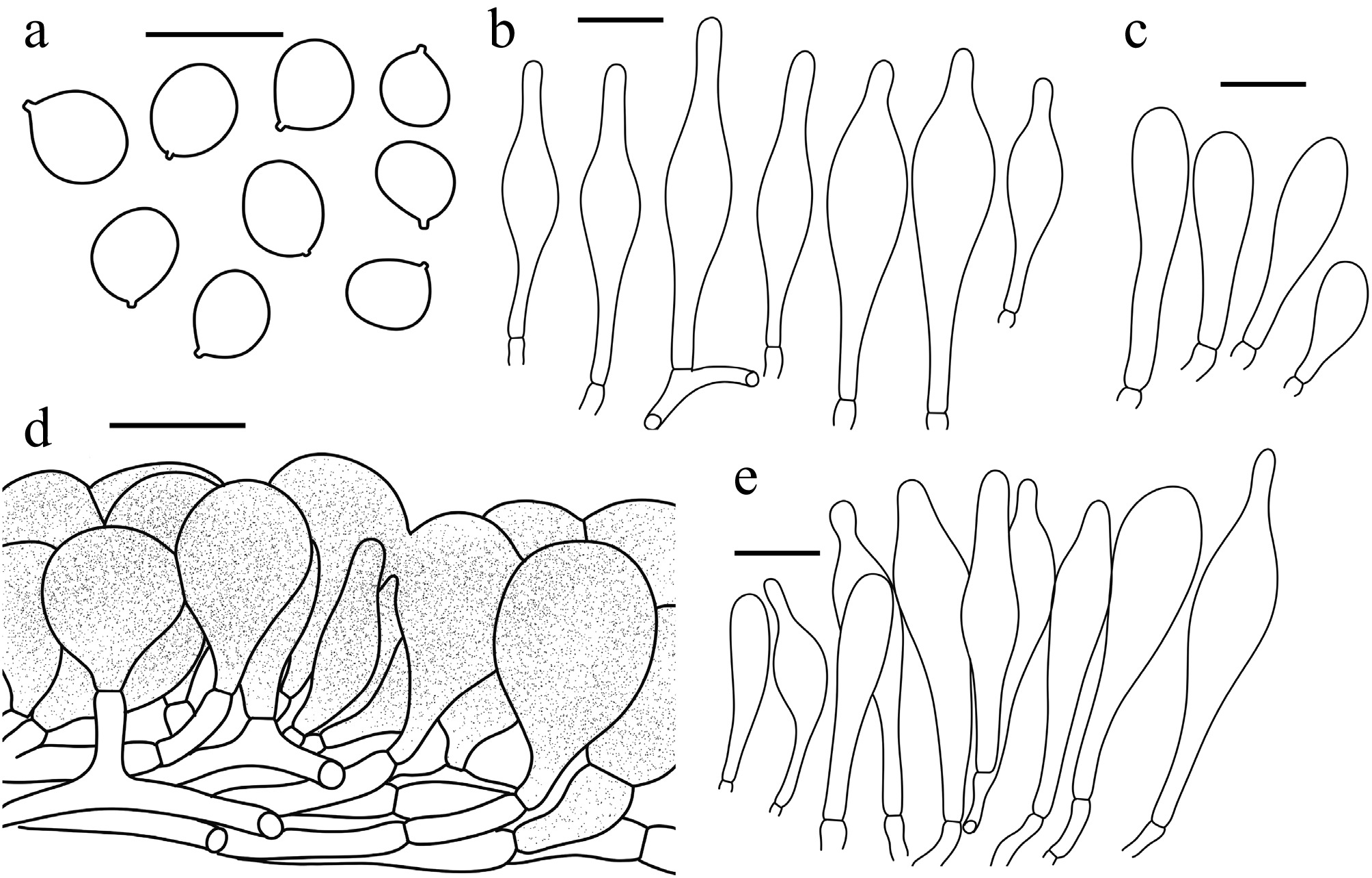
Figure 42.
Pluteus phlebophorus (HKAS 77912). (a) Basidiospores. (b) Pleurocystidia. (c) Caulocystidia. (d) Pileipellis with terminal elements. (e) Cheilocystidia. Scale bars: (a) = 10 μm, (b)–(e) = 20 μm.
Habitat and distribution – Solitary to subgregarious, lignicolous on deciduous wood. So far known from Eurasia.
Materials examined – CHINA. Yunnan Province: Lijiang City, Yulong Naxi Autonomous County, altitude 2,647 m, 8 September 2024, Xuan Chen 793 (HKAS 151157); Hubei Province: Shennongjia Forestry District, Muyu Town, Mountain Area near Shennong Hotel, altitude 1,011 m, 13 July 2012, Jiao Qin 511 (HKAS 77912).
Notes – Pluteus phlebophorus, originally described from Europe, Vellinga proposed the morphological concept[65], reported that it is distinguished by its distinctly dark brown rugose-venose pileus, colorless lamellar edges, narrowly clavate, fusiform cheilocystidia, and lageniform to narrowly utriform pleurocystidia. phylogenetically, the species delimitation was comprehensively discussed in view of the molecular data[92], which proposed that this species should expanded the species concept with white fruiting bodies as well as those exhibiting dark brown lamellar edges. One of the specimen from China are very correspond to this concept[92]. A collection with white basidiocarps (HKAS151157), clustered in the same clade with P. phlebophorus.
Pluteus podospilloides E.F. Malysheva et al., Phytotaxa 461 (2): 100 (2020) Figs 28k and 43
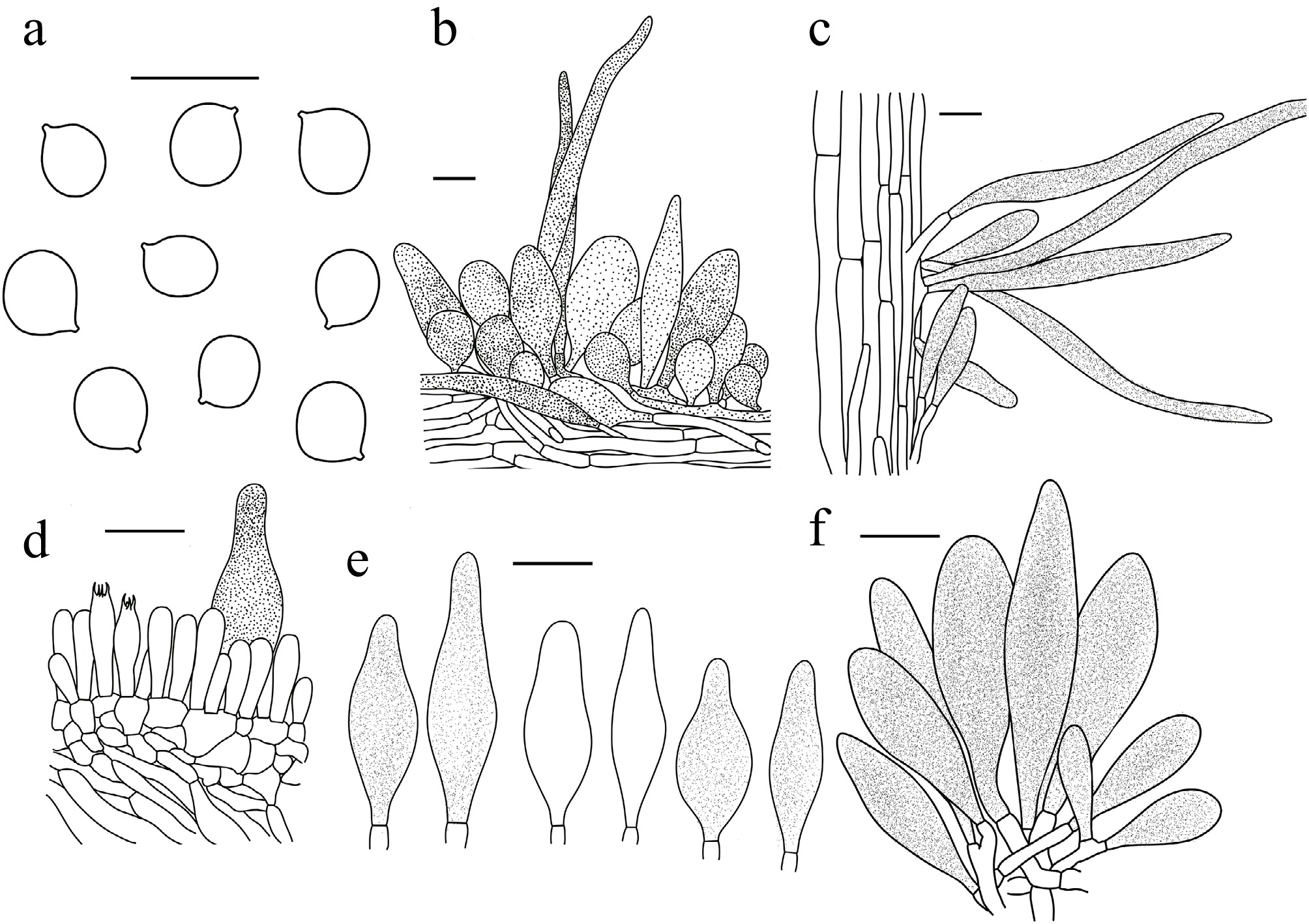
Figure 43.
Pluteus podospilloides (HKAS 151167). (a) Basidiospores. (b) Pileipellis with two types of terminal elements. (c) Stipitipellis with caulocystidia. (d) Basidia. (e) Pleurocystidia. (f) Cheilocystidia. Scale bars: (a) = 10 μm, (b)–(f) = 20 μm.
Habitat and distribution – Solitary, lignicolous on deciduous decaying wood. So far reported in Vietnam[115] and China.
Materials examined – CHINA. Jiangsu Province: Nanjing City, Zijin Mountain National Scenic Area, altitude 309 m, 25 May 2023, Xia Chen 212 (HKAS 151167); ibid., 12 August 2023, Xia Chen 621 (HKAS 151172). Yunnan Province: Xishuangbanna Dai Autonomous Prefecture, Jinghong City, Protected Area near Manmei Xinzhai, altiude 873m, 25 August 2019, Liu-Kun Jia 424 ( HKAS 125335).
Notes – Pluteus podospilloides, initially described from Vietnam, possesses felty-hairy, densely floccose-squamulose pileus, dark brown lamellar edges, stipe with dark brown squamules, narrowly fusiform cheilocystidia, utriform or broadly lageniform pleurocystidia, some with brown intracellular pigment, narrowly fusiform caulocystidia and trichoderm pileipellis composed elongated clavate and spheropedunculate terminal elements[115]. In the phylogenetic analysis, specimens from China (including GDGM 41576 and GDGM 42371) grouped together with the type specimen of P. podospilloides. In the Bayesian Poisson Tree Processes (BPP) species delimitation test, there was moderate support (BPP < 0.995) for recognizing the Chinese specimens as a new species. Although they formed two separate clades in the phylogenetic analysis, their morphological characteristics are largely consistent with the description of P. podospilloides and they are therefore identified as P. podospilloides.
Pluteus romellii (Britzelm.) Lapl., Dict. iconogr. champ. sup. (Paris): 533 (1894) Figs 28l and 44
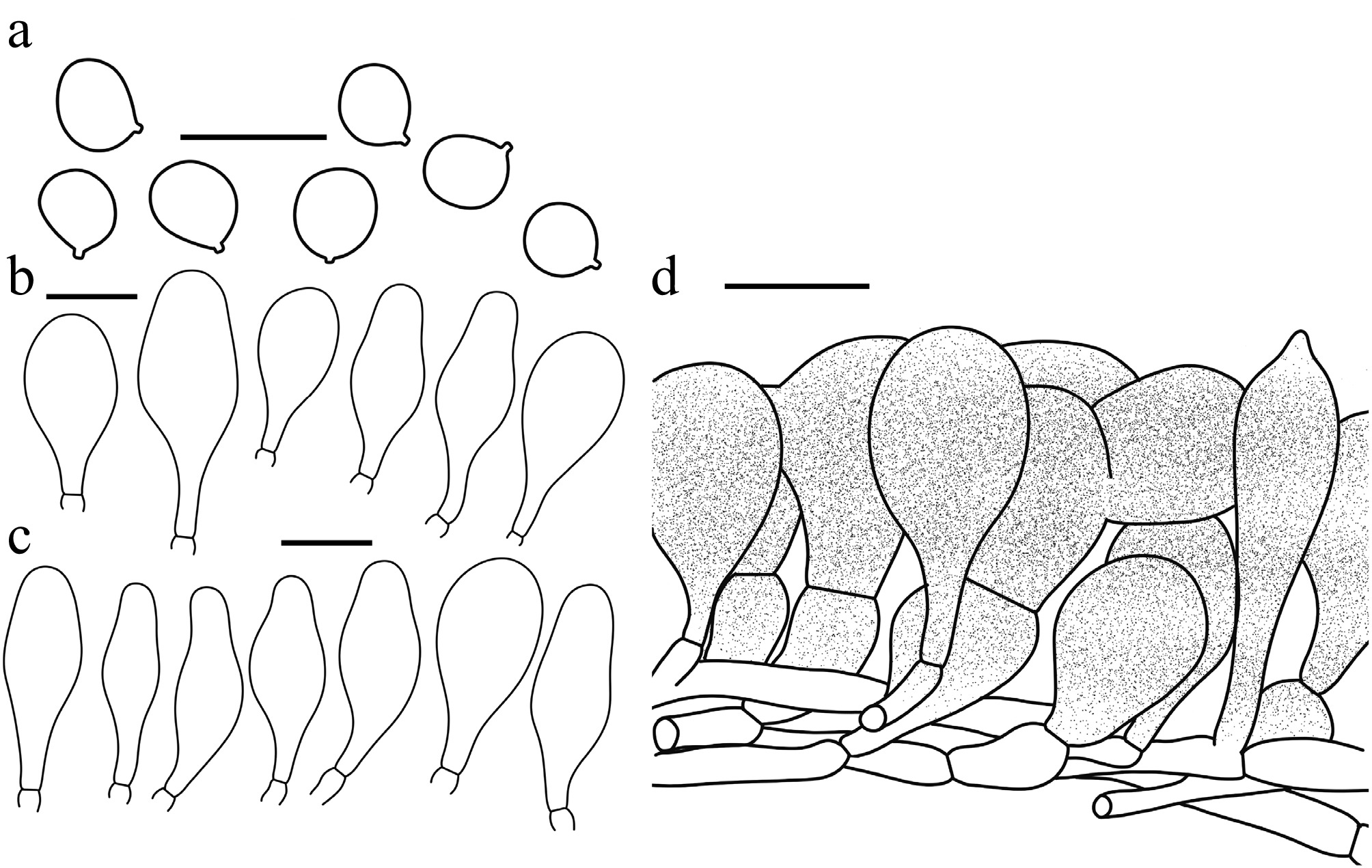
Figure 44.
Pluteus romellii (HKAS 151084). (a) Basidiospores. (b) Cheilocystidia. (c) Pleurocystidia. (d) Pileipellis with terminal elements. Scale bars: (a) = 10 μm, (b)–(d) = 20 μm.
Habitat and distribution – Solitary, lignicolous on deciduous decaying wood. Widely distributed in Eurasia[16,65,104]and North America[92]
Materials examined – CHINA. Yunnan Province: Kunming City, Panlong District, Shuanglong Township, Sanjia Village, altitude 1,984 m, 13 October 2012, Xue-Tai Zhu 784 (HKAS 76632); Xizang Autonomous Region: Qamdo City, Zogang County, Zhayu Town, Chengde Village, near Rural Road 563, west bank of Yuqu River, altitude 3,451 m, 15 September 2021, Hua Qu 577 (HKAS 122073); Gansu Province: Gannan Tibetan Autonomous Prefecture, Lintan County, Yeliguan Town, Yeliguan National Forest Park, altitude 2,717 m, 24 August 2024, Xuan Chen 706 (HKAS 151084).
Notes – The taxonomic status of P. romellii has been extensively studied[16,65,92,104,109], resulting in a clear consensus. Modern taxonomy consistently recognizes P. romellii within section Celluloderma as a species characterized by a yellow brown pileus, yellow stipe, and the spheropedunculate elements in the pileipellis[65]. The specimens from China are very similar to this concept morphologically. The phylogenetic analysis shows that it clustered with the epitype (BRNM 761731).
Within the romellii clade, which includes P. parvisporus, P. fulvibadius, and P. austrofulvus, the genetic distances between species are exceptionally near, resulting in poorly defined species boundaries. In species delimitation analyses, all three species received BPP support values below 0.99. A detailed discussion on the delimitation of these three species was presented in their original publications[16].
Pluteus sinensis Iqbal Hosen, J. Xu & T.H. Li, New Zealand Journal of Botany 64(2): e70085 (2026)
Habitat and distribution – Solitary to subgregarious, terrestrial. So far known from China.
Materials examined – CHINA. Guangxi Zhuang Autonomous Region: Nanning City, Jiangnan District, Qipo Forest Farm, altitude 93 m, 24 August 2024, De-De Jiang (HKAS 155849); Jiangsu Province: Nanjing City, Xuanwu District, Zijin Mountain National Scenic Area, altitude 250 m, 1 September 2023, Xia Chen 683 (HKAS 151177) and Xia Chen 687 (HKAS151178).
Notes – Pluteus sinensis, a recently described species from China[123], was reported in the original literature to be distributed only in Guangzhou City. In this study, this species is found in both southern China and eastern China, which supplements its geographical distribution.
Pluteus squamulososulcatus E.F. Malysheva & O.V. Morozova, Phytotaxa 461(2): 99 (2020) Figs 28m and 45
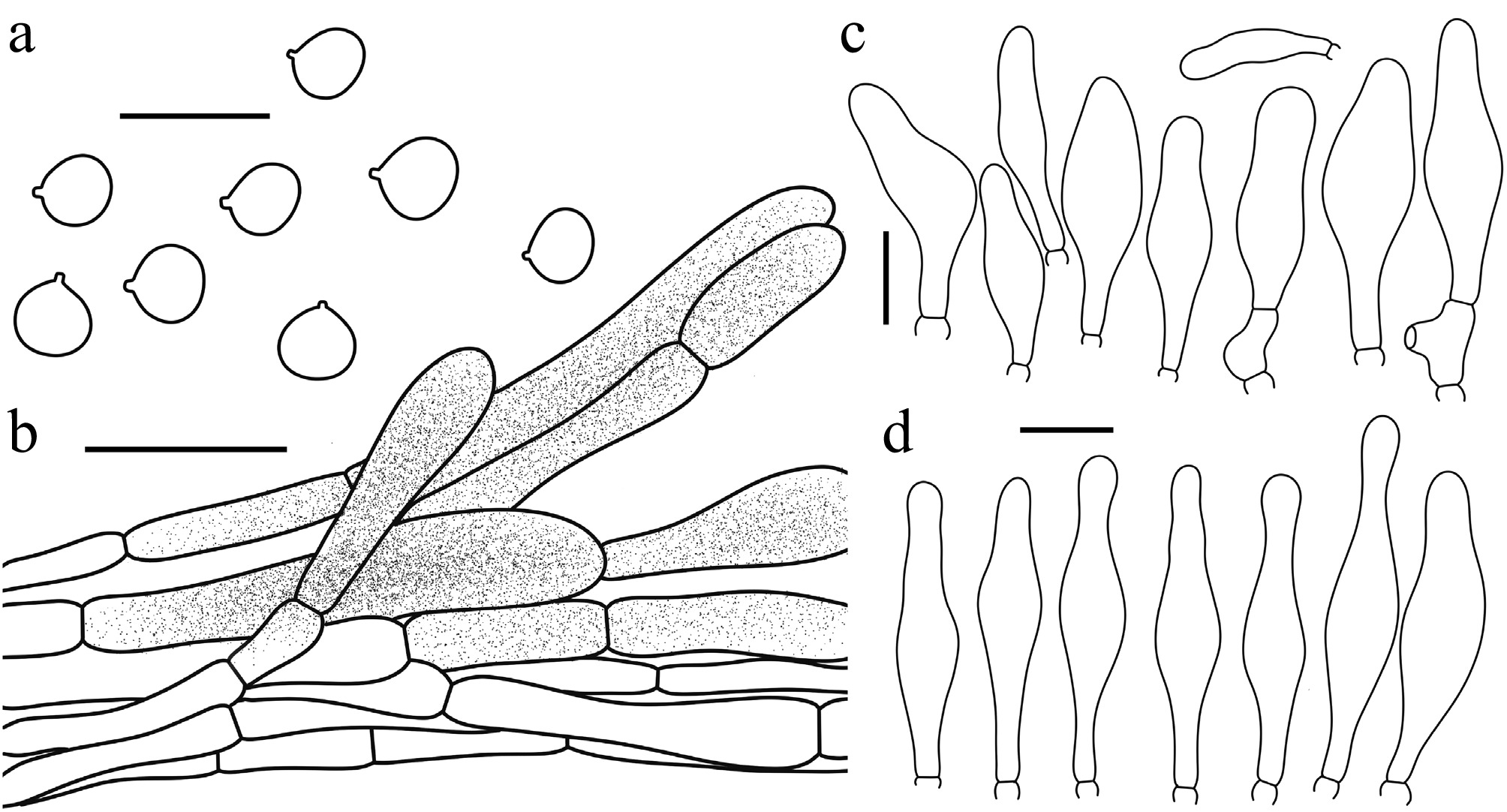
Figure 45.
Pluteus squamulososulcatus (HKAS 151301). (a) Basidiospores. (b) Pileipellis with terminal elements. (c) Cheilocystidia. (d) Pleurocystidia. (c) Scale bars: (a) = 10 μm, (b)–(d) = 20 μm.
Habitat and distribution – Solitary to subgregarious, lignicolous on deciduous decaying wood, on the broken trunks of deciduous trees. So far known from southwestern China and Vietnam[115].
Material examined – CHINA. Yunnan Province: Dehong Dai and Jingpo Autonomous Prefecture, Yingjiang County, Nalong Village, river valley near Nabang Town, altitude 358 m, 4 September 2025, Zhu-Liang Yang 7808 (HKAS 151301).
Notes – Pluteus squamulososulcatus, originally described from Vietnam, is characterized by small basidiocarps, squamulose, strongly plicate-sulcate pileus, a white, glabrous stipe, broadly lageniform or utriform pleurocystidia, and cheilocystidia that are mostly broadly lageniform with a short neck and frequently subcapitate apex[115]. The Chinese specimens correspond morphologically to the type, we observed that the cheilocystidia exhibit considerable variation in shape, ranging from broadly lageniform to irregularly elongated forms. Digitate appendages were rarely observed in the Chinese collection. Molecular data show that the Chinese specimen clusters with the type sequence and shares a similar geographical distribution. Therefore, it is confidently identified as this species.
Pluteus squarrosus Hosen & T.H. Li, Nordic J. Bot. 37 (8, e02427): 3 (2019) Figs 28n and 46
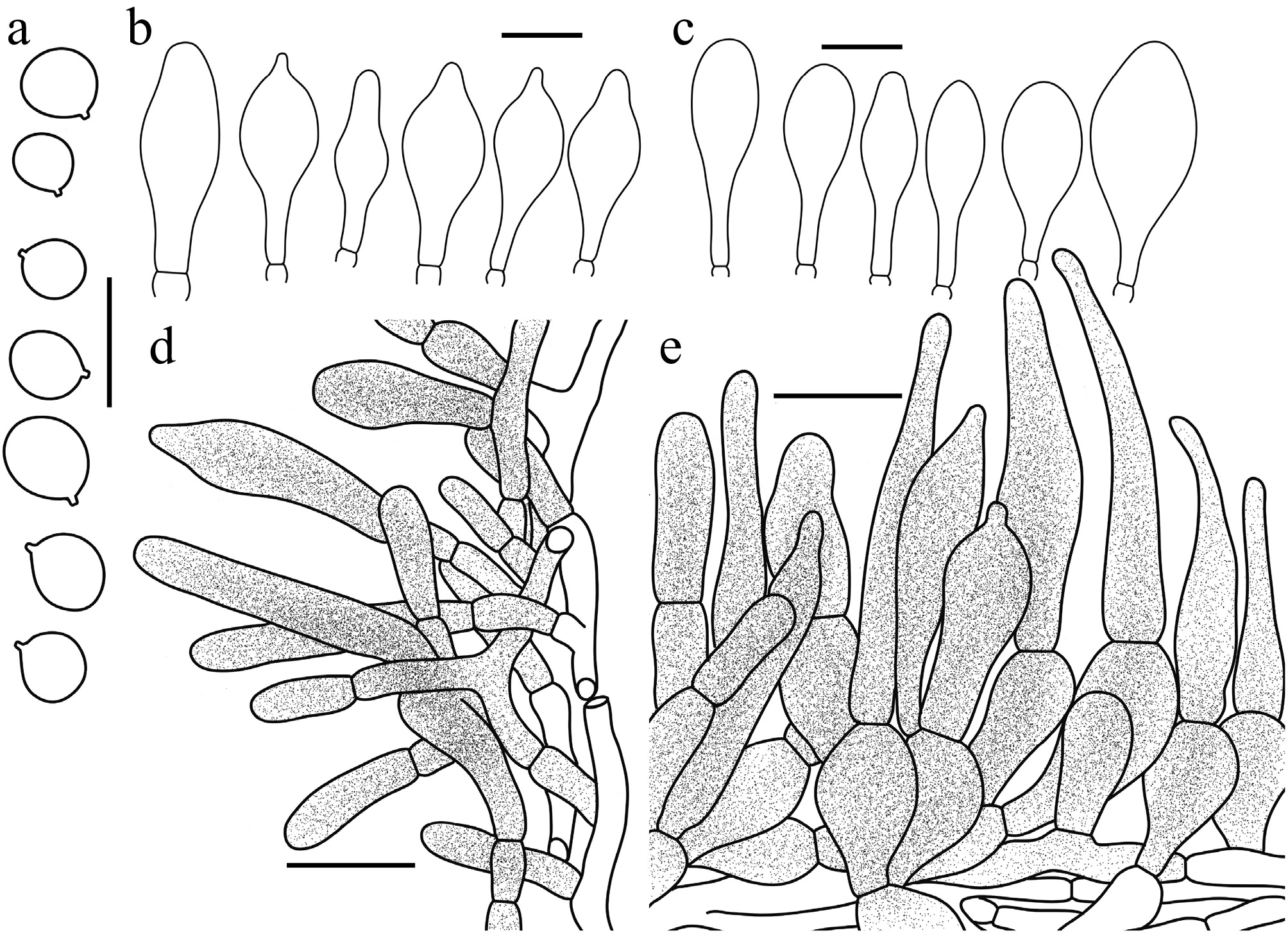
Figure 46.
Pluteus squarrosus (HKAS 151212). (a) Basidiospores. (b) Cheilocystidia. (c) Pleurocystidia. (d) Stipitipellis with caulocystidia. (e) Pileipellis with terminal elements. Scale bars: (a) = 10 μm, (b)–(e) = 20 μm.
Habitat and distribution – Solitary to subgregarious, lignicolous, on the broken trunks of deciduous trees. So far known from China[113].
Materials examined – CHINA. Yunnan Province: Xishuangbanna Dai Autonomous Prefecture, Mengla County, Menglun Town, Xishuangbanna Tropical Botanical Garden, altitude 528 m, 17 June 2024, Yang-Yang Cui 1129 (HKAS 151212); Gansu Province: Longnan City, Wen County, Chengguan Town, Jiachang Village Back Mountain, altitude 1,823 m, 26 August 2011, Xue-Tai Zhu 575 (HKAS 73970).
Notes – Pluteus squarrosus, recently described from northeastern China, possesses squarrose to verrucose pileus, squamulose stipe, fusoid to narrowly utriform cheilocystidia, narrowly utriform pleurocystidia and presence of caulocystidia. This species is morphologically similar to Pluteus fuscipruinatus, which was originally described from India. Phylogenetic results further indicate a very close relationship between them (Fig. 8). Both species also share the same ecological habit of growing on broken branches. Both species are distributed in China, their taxonomic distinction requires careful examination. For a detailed discussion on their delimitation, see this study[121].
Pluteus tatafuensis J.A. del Rosario & B.A. Perry, Phytotaxa 709(1): 94 (2025) Fig. 47
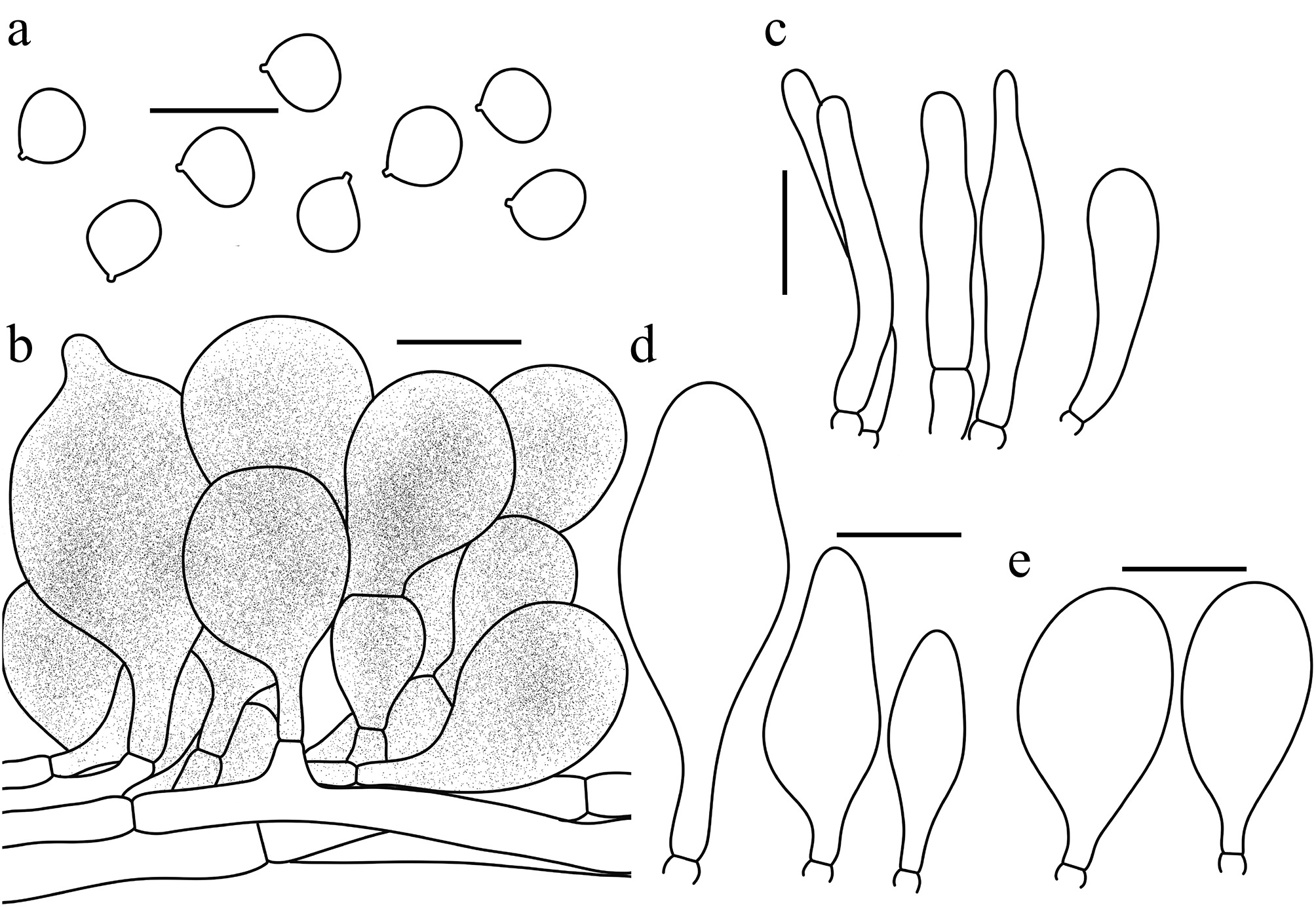
Figure 47.
Pluteus tatafuensis (HKAS 154146). (a) Basidiospores. (b) Pileipellis with terminal elements. (c) Caulocystidia. (d) Pleurocystidia. (e) Cheilocystidia. Scale bars: (a) = 10 μm, (b)–(e) = 20 μm.
Habitat and distribution – Solitary, lignicolous on deciduous wood. So far known from Vanuatu[69] and northern China.
Materials examined – CHINA. Guangxi Zhuang Autonomous Region: Nanning City, Jiangnan District, Qipo Forest Farm, altitude 93 m, 17 September 2025, De-De Jiang (HKAS154146).
Notes – Pluteus tatafuensis recently described from Vanuatu[69], is characterized by rugose-venulose, rimose, marginally sulcate, and fuliginous pileus clavate to broadly clavate cheilocystidia, clavate to broadly clavate pleurocystidia with apical mucilage, and tropical habitant. The ITS sequence of the Chinese specimen shows 98.91% similarity to specimens from Vanuatu. Although there are slight differences in the ITS sequence, Guangxi Province in China represents a transitional zone between subtropical and tropical floras, with ecological conditions similar to those of Vanuatu. The observed genetic differences may therefore be attributed to long-term geographic isolation. Given the high morphological similarity to this species, the Chinese material is here identified as P. tatafuensis.
Pluteus thomsonii (Berk. & Broome) Dennis, Trans. Br. mycol. Soc. 31 (3-4): 206 (1948) Figs 28o and 48
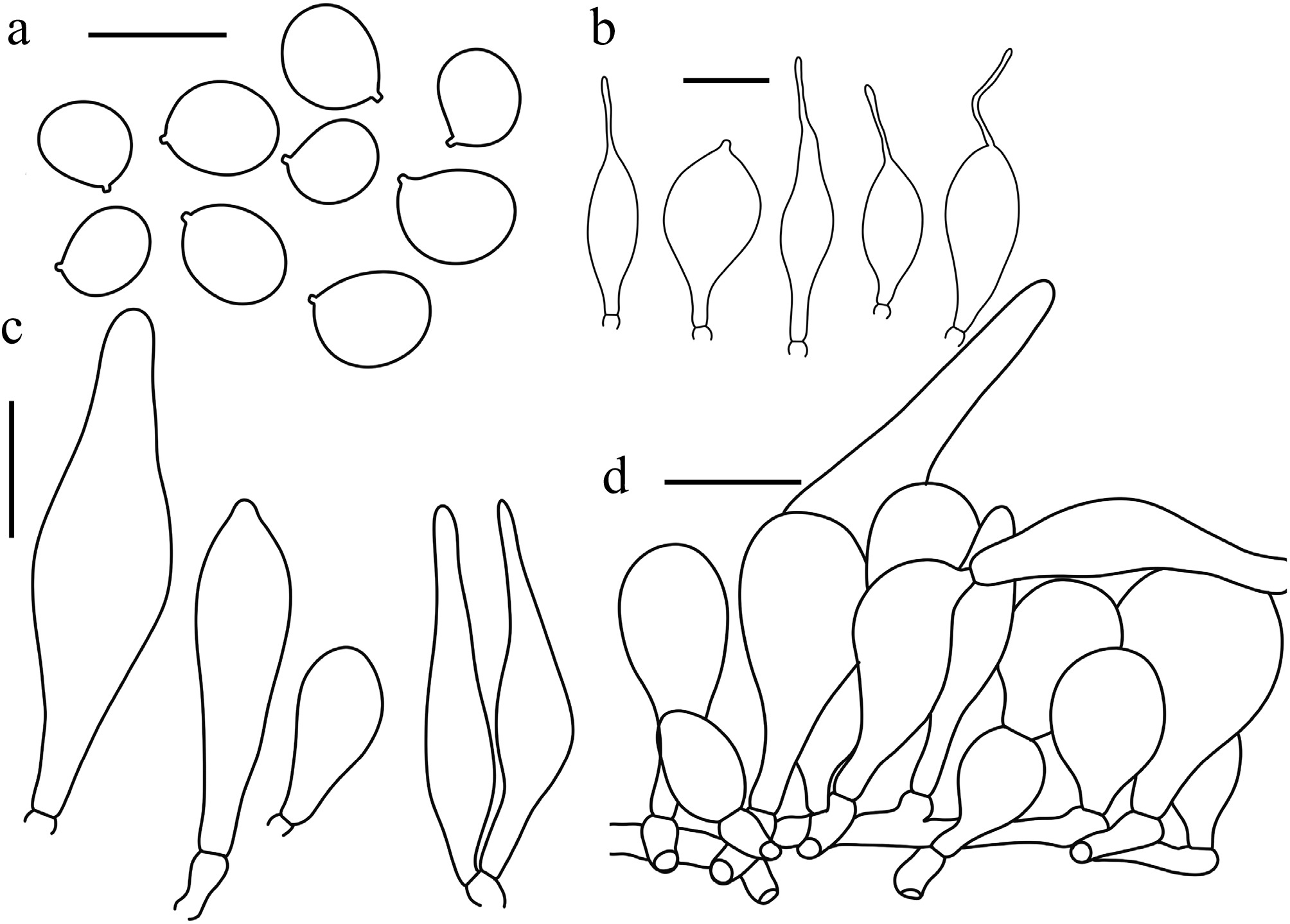
Figure 48.
Pluteus thomsonii (HKAS 112749). (a) Basidiospores. (b) Cheilocystidia. (c) Caulocystidia. (d) Pileipellis with terminal elements. Scale bars: (a) = 10 μm, (b)–(d) = 20 μm.
Habitat and distribution – Solitary, lignicolous on deciduous wood. Widespread in Europe countries such as Germany, Spain[19,65], South America like Brazil[124], Russia[67], Japan[125], and China.
Materials examined – CHINA. Heilongjiang Province: Harbin City, Mulan County, Dagui Town, Youyi Village, altitude 183 m, 11 August 2010, Xiang-Hua Wang 2595 (HKAS 61796); Yunnan Province: Kunming City, Panlong District, Black Dragon Pool Park, altitude 1,920 m, 5 August 2020, Zhu-Liang Yang 6352 (HKAS 112749); Beijing Municipality: Changping District, not detailed,19 August 2024, Jing Kang (HKAS 151289).
Notes – Pluteus thomsonii is recognised by a strongly reticulate-venose pileus surface, a grey stipe with floccules, dimorphic pileipellis elements consisting of fusiform and spheropedunculate terminal elements, mostly absent but sometimes very scarce pleurocystidia, rostrate cheilocystidia, and the presence of caulocystidia[65,109]. A South American record attributed to P. thomsonii reported abundant pleurocystidia[124]. However, pleurocystidia were absent or very scarce in the specimens examined in our study, which is consistent with descriptions in the European literature[65].
Pluteus aff. argentinensis Fig. 49
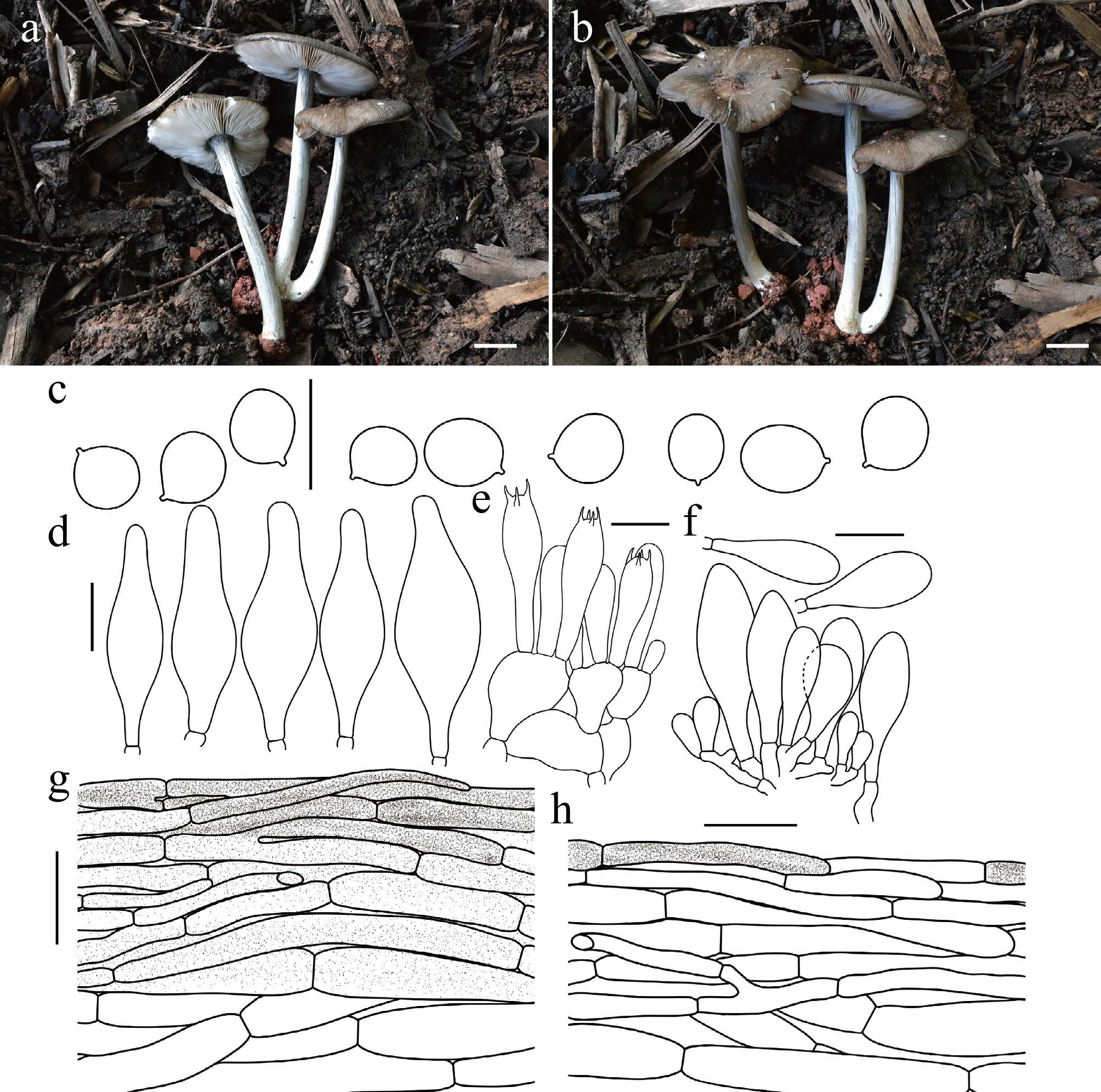
Figure 49.
Pluteus aff. argentinensis (HKAS 151209). (a), (b) Basidiome in natural habitat. (c) Basidiospores. (d) Pleurocystidia. (e) Basidia and subhymenium. (f) Cheilocystidia. (g) Pileipellis. (h) Stipitipellis. Scale bars: (a), (b) = 1 cm, (c), (e) = 10 μm, (d), (f)–(h) = 20 μm.
Basidiomes medium-sized. Pileus 35–52 mm diam., initially hemispherical then applanate, with low umbo; surface non-hygrophanous, deep greyish (6E2), darker at the center, radially fibrillose, with sulcate-striate margin. Lamellae free, pale pinkish brown (8A2–4), ventricose, crowded, with lamellulae, edges concolorous. Stipe 90–95 × 6–7 mm, cylindrical, solid; surface greyish (6C1), glabrous, with lengthwise striate. Context in pileus thin, unchanging, pale greyish (6A1); in stipe pale greyish (6A1). Smell and taste unknown.
Basidiospores [80/2/2] 6–7.5(8) × 5–7 μm, avl × avw = 6.81 × 6.20 μm, Q = 1.00–1.19, Qm = 1.10 ± 0.06, subglobose, slightly thick-walled (0.5–0.6 μm), smooth. Basidia 20–30 × 7–9 μm, 4-spored, clavate, thin-walled. Cheilocystidia crowded, 30–60 × 12–18 μm, clavate or narrowly clavate, colorless, thin-walled. Pleurocystidia scattered, 55–82 × 13–25 μm, narrowly clavate or narrowly utriform, thin-walled. Pileipellis a cutis, composed of oblong-celled, thin-walled, non-gelatinous hyphae, 50–85× 5–15 μm, with intracellular brown pigment. Stipitipellis a cutis, composed of cylindrical, thin-walled, 5–15 μm wide hyphae, with intracellular brown pigment. Caulocystidia not found. Clamp connections absent.
Habitat and distribution – terrestrial, on the litter substrates in tropical habitats. Known from southern China and Thailand.
Materials examined – CHINA. Yunnan Province: Puer City, Jiangcheng Hani and Yi Autonomous County, National Highway G227, Timber Factory. Altitude 799 m, 11 June 2024, Yang-Yang Cui 774 (HKAS 151209). THAILAND. Chiang Rai Province: Mueang Chiang Rai District, Nang Lae Subdistrict, altitude 404 m, 4 April 2024, collected by Jian-Wei Liu (HKAS 151214 and HKAS 151215).
Notes – Molecular data show that the Chinese specimen shares 99.11% similarity with the species reported from Vanuatu[69], and their morphological characteristics are highly consistent.This species is also distributed across Southeast Asia, including tropical China and Thailand. Pluteus aff. argentinensis, a distinctly tropical taxon, is characterized by its greyish fibrillose pileus, greyish stipe, subglobose basidiospores (6–7.5[8] × 5–7 μm, avl × avw = 6.81 × 6.20 μm, Q = 1.00–1.19, Qm = 1.10 ± 0.06), and clavate or narrowly clavate cheilocystidia. Our phylogenetic analysis indicates that P. aff. argentinensis forms a distinct lineage without any closely related species. Morphologically, it looks like P. varius and P. squamulososulcatus E.F. Malysheva & O.V. Morozova. However, P. varius a species described in Vietnam, possesses fibrillose-squamulose pileus varying in colouration from greyish to reddish brown, the subglobose basidiospores (5.5‒7.0[7.8] × 5.2‒6.5[6.8] μm, avl × avw = 6.5 × 5.9μm, Q = 1.0‒1.3; Qm = 1.2), epithelioid pileipellis and hymenial cystidia with mucous caps[115]. Pluteus squamulososulcatus, a species distributed in Vietnam, possesses a greyish squamulose pileus with small appressed dark grey-brown squamules, a whitish stipe, and lageniform cheilocystidia with a subcapitate apex[115]. Rosario & Perry have provided a comprehensive and detailed discussion of this species with P. argentinensis. We fully agree with this viewpoint and thus will await the revision of the type species before proposing further taxonomic treatment.
Pluteus vellingae Justo et al., J. Fungi 8 (8, no. 773): 25 (2022) Figs 28p and 50
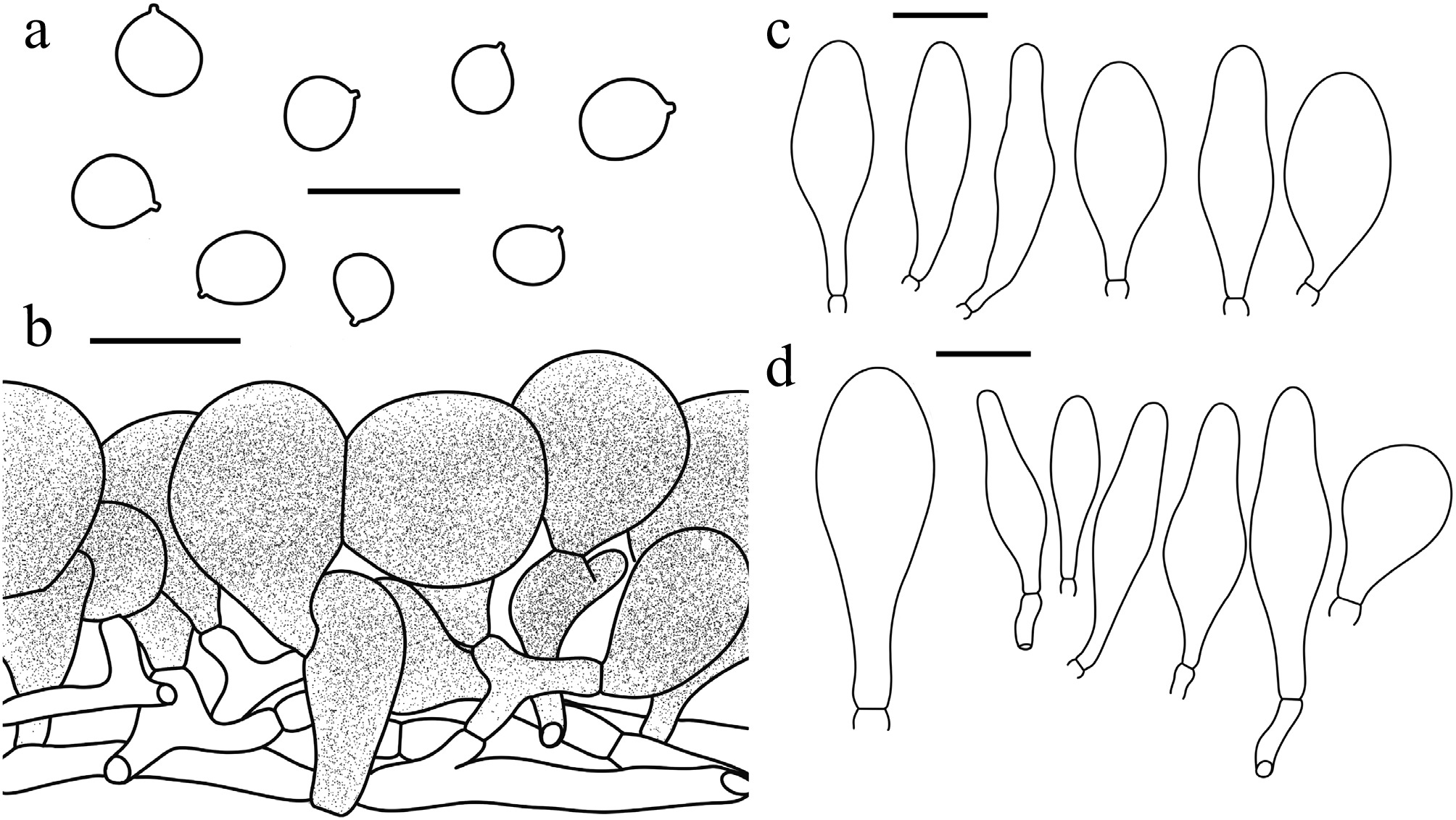
Figure 50.
Pluteus vellingae (HKAS 151203). (a) Basidiospores. (b) Pileipellis with terminal elements. (c) Pleurocystidia. (d) Cheilocystidia. Scale bars: (a) = 10 μm, (b)–(d) = 20 μm.
Habitat and distribution – Solitary, lignicolous. On well-decayed coniferous wood or woodchips. So far known from North America, Europe, Western Asia[16], and China.
Materials examined – CHINA. Shanxi Province: Lvliang City, Fangshan County, Pangquangou National Nature Reserve, North Wudang Mountain Scenic Area, altitude 1,555 m, Yang Wang 422 (HKAS 151203); Yunnan Province: Lijiang City, Yulong Naxi Autonomous County, altitude 2,647 m, 8 September 2024, Xuan Chen 789 (HKAS 151153).
Notes – Pluteus vellingae, a recently described species, is distinguished by a yellow-brown to brown, often rugose pileus; broadly clavate to clavate or ovoid pleurocystidia (scarce to numerous); narrowly to broadly clavate or narrowly utriform cheilocystidia, and growth on wood chips[16]. This species exhibits a broad distribution, occurring from Europe to the Americas, with additional records from subalpine regions of China. This is likely closely related to the species' ecological habits. It can grow not only on large, decaying logs but also on small wood chips. These fine wood fragments may facilitate the species' dispersal, thereby further expanding its geographical distribution.
Key to the species of Pluteus sect. Pluteus from China
1. Lamellar edge dark brown (distinctly pigmented) 2 1. Lamellar edge colorless (non-pigmented) 3 2. Pileus smooth or innately radially fibrillose; basidiospores 6.0–9.5 × 4.0–6.2 μm; pileipellis with small lateral outgrowths on the terminal elements P. pouzarianus sensu lato 2. Pileus strongly radially fibrillose- squamulose; basidiospores 6.0–8.5 × 4.0–6.0 μm; pileipellis without small lateral outgrowths on the terminal elements P. atromarginatus 3. Pleurocystidia non-metuloid P. padanilus 3. Pleurocystidia metuloid 4 4. Clamp-connections present 5 4. Clamp-connections absent 11 5. Pileus surface with distinct squamules 6 5. Pileus surface strongly radially fibrillose 7 6. Lignicolous on deciduous wood; context turning blue on bruising; basidiospores 7.0–10.0 ×5.0–7.5 μm P. salicinus 6. Lignicolous on conifer wood; context without turning blue on bruising; basidiospores 7.8–8.6 × 5.0–6.2 μm P. sepiicolor 7. Pileus purple P. purpureofuscus 7. Pileus grey, brown to dark brown 8 8. Tropical distribution 9 8. Subtropical distribution 10 9. Terrestrial on grassy layers; pileus drak brown covered with radially arranged dark brown fibrils P. losulus 9. Lignicolous on deciduous wood; pileus pale brown, glabrous or with some innately fibrils at center P. griseodiscus 10 Pileipellis without small lateral outgrowths on the terminal elements; basidiospores 7–8 × 5.5–7 μm P. griseostriatus 11 Pileipellis with small lateral outgrowths on the terminal elements; basidiospores 6.5–9.6×5.0–7.1 μm P. brunneidiscus 11. Intermediate cystidia Magnus-type only P. petasatus 11. Intermediate cystidianot purely Magnus-type 12 12. Intermediate cystidia Cervinus type only 13 12. Intermediate cystidia type mixed (Cervinus type and Magnus-type) 14 13. Stipe longitudinally fibrillose; pleurocystidia commonly bifid; basidiospores 5.5–9.0 × 4.5–7.0 μm P. hongoi* 13. Stipe longitudinally fibrillose; pleurocystidia entire; basidiospores 5.4–7.5 × 4.4–5.7 μm P. conformis 14. Stipe brown P. rangifer 14. Stipe white 15 15. Lignicolous on Betula and Alnus wood; pileus white without radially arranged fibrils P. leucoborealis 15. Lignicolous not on Betula and Alnus wood; pileus brown with radially arranged fibrils P. xylophilus *If bifid pleurocystidia are not developed, it is difficult to distinguish between P. hongoi and P. conformis without sequences.
Pluteus atromarginatus (Konrad) Kühner, Bull. mens. Soc. linn. Soc. Bot. Lyon 4 (1): 51 (1935) Figs 51a and 52
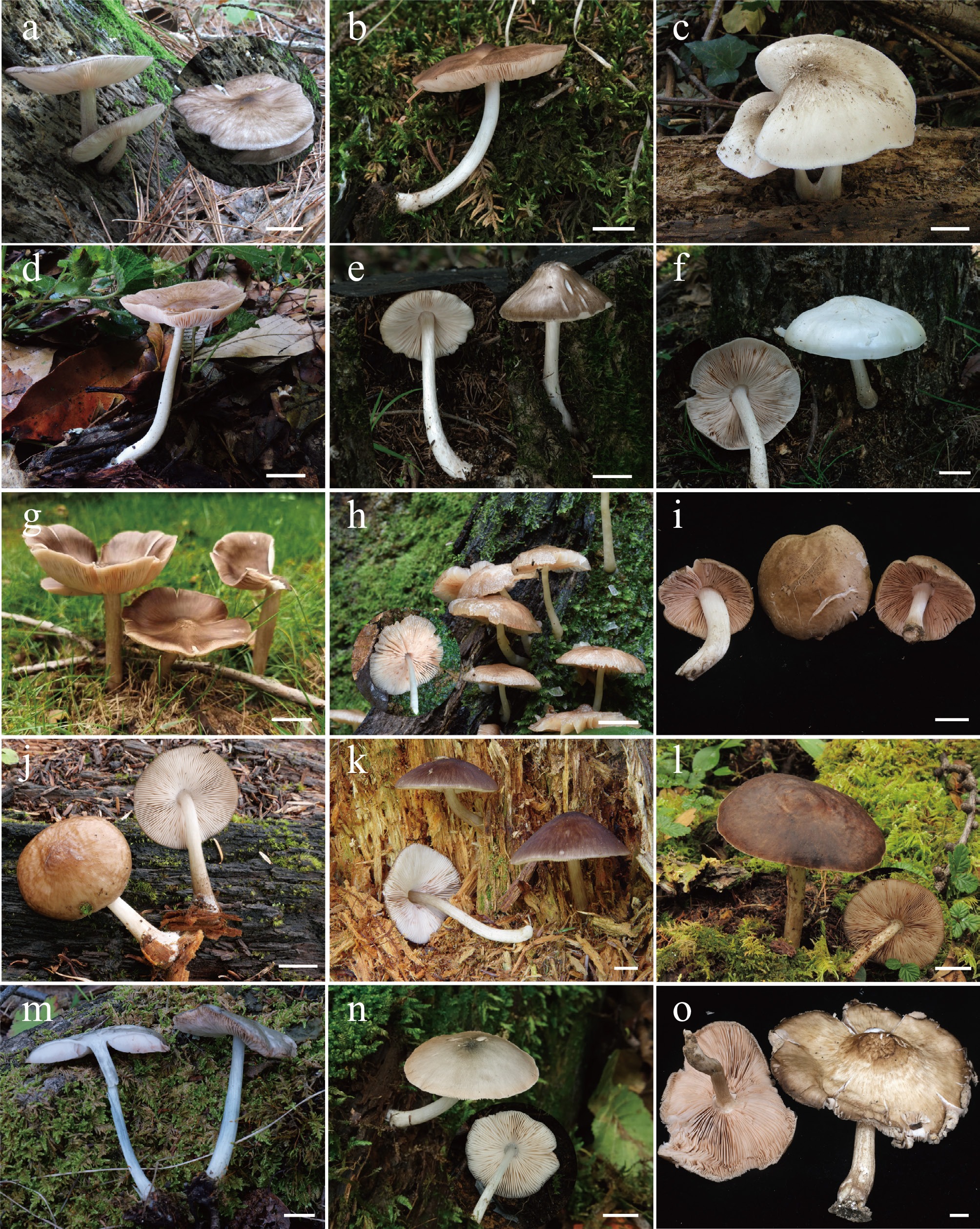
Figure 51.
Fresh basidiomes of Pluteus sect. Pluteus. (a) P. atromarginatus (HKAS 755545). (b) P. brunneidiscus (HKAS 150971). (c) P. cervinus (HKAS 104344). (d) P. conformis (HKAS 92364). (e) P. hongoi (HKAS 150936). (f) P. leucoborealis (HKAS 150930). (g) P. losulus (HKAS 151293). (h) P. padanilus (HKAS 124920). (i) P. petasatus (HKAS 151295). (j) P. pouzarianus (HKAS 119955). (k) P. purpureofuscus (HKAS 48956). (l) P. rangifer (HKAS 113167). (m) P. salicinus (HKAS 151194). (n) P. sepiicolor (HKAS 151145). (o) P. xylophilus (HKAS 151298).
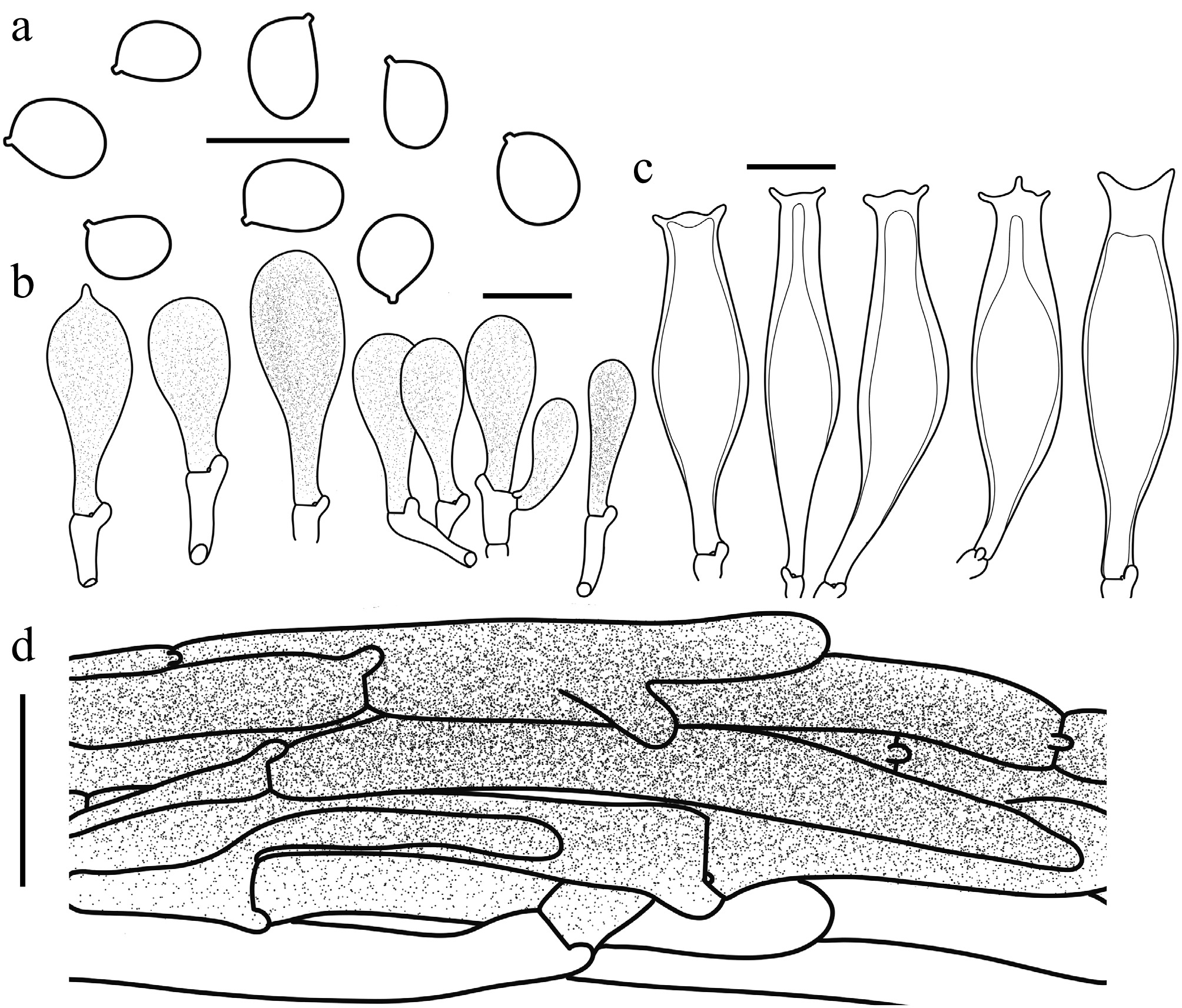
Figure 52.
Pluteus atromarginatus (HKAS 151291). (a) Basidiospores. (b) Cheilocystidia. (c) Pleurocystidia. (d) Pileipellis. Scale bars: (a) = 10 μm, (b)–(d) = 20 μm.
Habitat and distribution – Solitary to subgregarious, lignicolous on deciduous decaying wood. Widespread from Europe[65], North America[126], and Asia[127]
Materials examined – CHINA. Hubei Province: Yichang City, Shennongjia Forestry District, Hongping Town, Donggou Area, altitude 1,717 m, 15 July 2012, Qing Cai 791 (HKAS 75545); Yunnan Province: Lijiang City, Yulong Naxi Autonomous County, Jade Dragon Snow Mountain Nature Reserve, Spruce Meadow, altitude 3,240 m, 17 September 2021, Geng-Shen Wang 1398 (HKAS 151291).
Notes – Pluteus atromarginatus is a species with large basidiomes, dark brown pileus, dark pigmented lamellar edges, hooked metuloid pleurocystidia, pigmented cheilocystidia and clamp-connections in all tissues[65]. The species P. atromarginatus, P. atropungens, P. pseudoroberti, P. laricinus, P. atrofibrillosus, and P. similis are highly similar in morphology. Previous studies have demonstrated that P. atropungens, P. laricinus, and P. pseudoroberti are synonyms of P. atromarginatus[127]. Consistent with these findings, our phylogenetic analysis shows that these taxa form a well-supported clade. Furthermore, in the Bayesian Poisson Tree Processes (BPP) species delimitation analysis, P. atrofibrillosus and P. similis received moderate support (BPP = 0.98) as distinct species. Pluteus atromarginatus is a widely distributed species, occurring across Eurasia and North America. Such a broad geographical range is likely to harbour some degree of molecular variation. Therefore, a more rigorous approach is essential for its species delimitation.
Pluteus brunneidiscus Murrill, N. Amer. Fl. (New York) 10(2): 131 (1917) Figs 51b and 53
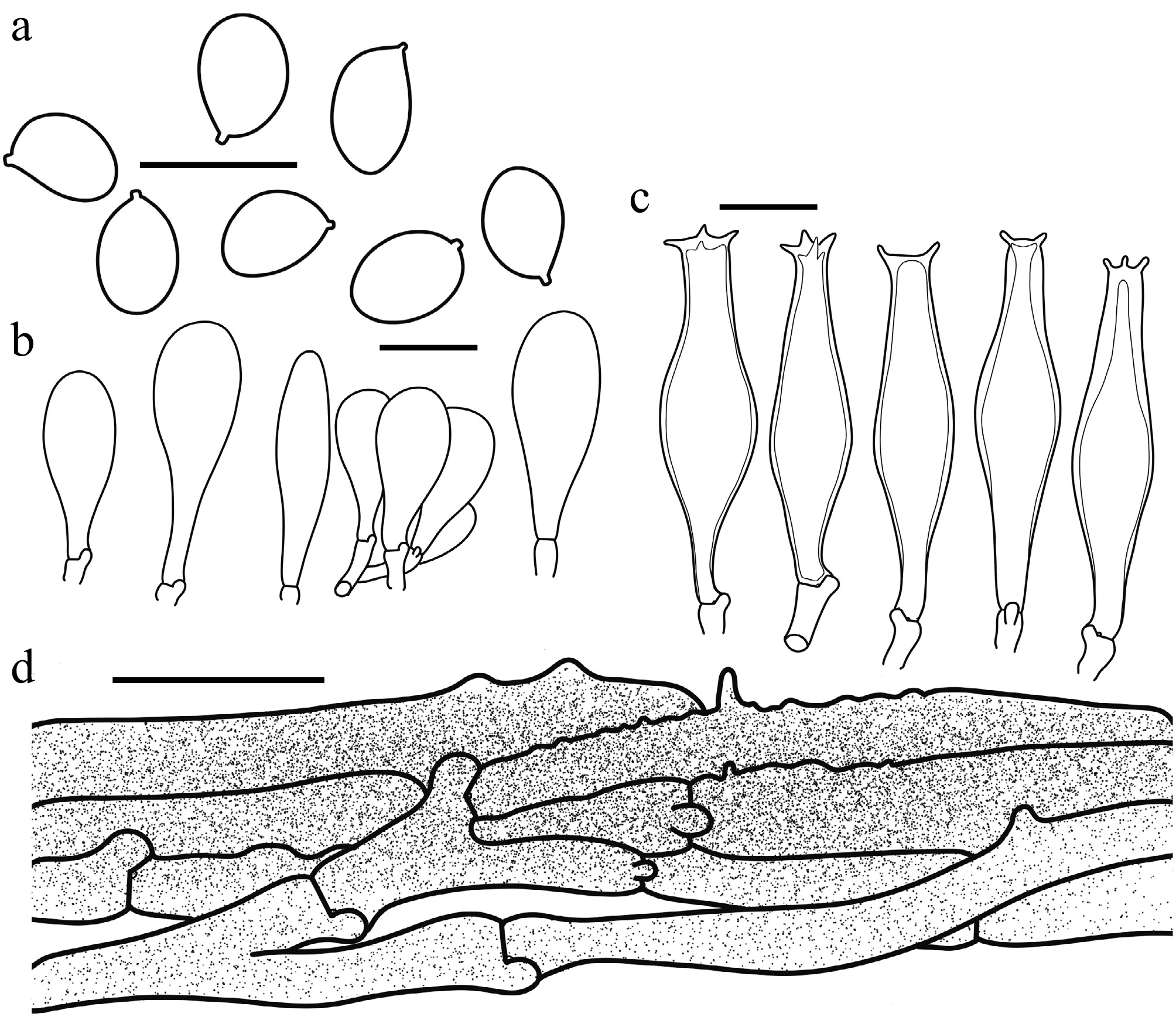
Figure 53.
Pluteus brunneidiscus (HKAS 150971). (a) Basidiospores. (b) Cheilocystidia. (c) Pleurocystidia. (d) Pileipellis. Scale bars: (a) = 10 μm, (b)–(d) = 20 μm.
Habitat and distribution – Solitary or gregarious, lignicolous on deciduous decaying wood. It is widely distributed across Eurasia and North America[127−129], including areas such as Northwest Russia, Siberia, China, and the United States of America.
Materials examined – CHINA. Sichuan Province: Mianyang City, Pingwu County, Wanglang National Nature Reserve, altitude 2,440 m, 19 June 2014, Qi Zhao 2040 (HKAS 87720); ibid., Aba Tibetan and Qiang Autonomous Prefecture, Xiaojin County, Siguniang Mountain Scenic Area, Changping Valley, altitude 3,468 m, 1 August 2024, Rui Wu (MHHNU 34326); Gansu Province: Gannan Tibetan Autonomous Prefecture, Tewo County, Zirun Mountain, altitude 2,702 m, 24 July 2014, Bang Feng 1633 (HKAS 94017); ibid., Dega Town, altitude 2,421 m, 25 July 2024, Yang Wang 31 (HKAS 151192); Shanxi Province: Lvliang City, Jiaocheng County, Pangquangou National Nature Reserve, Badagou Area along Provincial Highway S320, altitude 1,700 m, 25 July 2024, Xuan Chen 492 (HKAS 150943); ibid., 26 July 2024, Xuan Chen 524 (HKAS 150971); Qinghai Province: Huangnan Tibetan Autonomous Prefecture, Zekog County, Maixiu Township, Provincial Highway S203, altitude 3,315 m, 21 July 2020, Liu-Kun Jia 1173 (HKAS 127459); Xinjiang Uygur Autonomous Region: Tacheng Prefecture, Shawan County, Dongdatang Scenic Area, altitude 2,258 m, 17 July 2021, Liu-Kun Jia 1750 (HKAS 127854).
Notes – Pluteus brunneidiscus is morphologically similar to many other species in sect. Pluteus, with brown basidiomes, radially fibrillose pileus, often without squamules at center, white stipe, narrowly clavate, metuloid pleurocystidia and presence of clamp connections[127]. This species shows no significant morphological differences from others in section Pluteus. However, in our study, we observed small lateral outgrowths on the terminal hyphae of the pileipellis, which is consistent with the findings of Justo et al.. Such outgrowths are considered a rare characteristic within section Pluteus and can serve as a diagnostic feature for species identification.
Pluteus cervinus (Schaeff.) P. Kumm., Führ. Pilzk. (Zerbst): 99 (1871) Fig. 51c
Habitat and distribution – Solitary or gregarious, lignicolous on deciduous decaying wood. Known from European countries and the United States of America[15,65,92].
Materials examined – NORTH MACEDONIA. Ohrid-Prespa Transboundary Biosphere Reserve: Galichica Mountain, St. Naum Springs, altitude 700 m, 6 October 2018, Zhu-Liang Yang, MK17 (HKAS 104344); ibid., Debarca Municipality: Belchishko Blato Wetland, altitude 768 m, 6 October 2018, Gang Wu 2784 (HKAS 104549).
Notes – Pluteus cervinus is the type species of the genus Pluteus. In China, all collections with gray fruiting bodies and metuloid pleurocystidia have historically been identified as P. cervinus. However, upon re-examination of all currently available specimens labelled under this name in Chinese collections, none were confirmed to belong to the true P. cervinus. Only two specimens collected from Europe matched the type material both molecularly and morphologically (Fig. 10).
The taxonomy and morphology of this species have been extensively discussed and described in numerous publications. For detailed descriptions and discussions, please see[65,92]. It remains uncertain whether this species is present in China, and more comprehensive sampling is needed to address this question.
Pluteus conformis E.F. Malysheva, et al., J. Fungi 9 (5, no. 584): 6 (2023). Figs 51d and 54
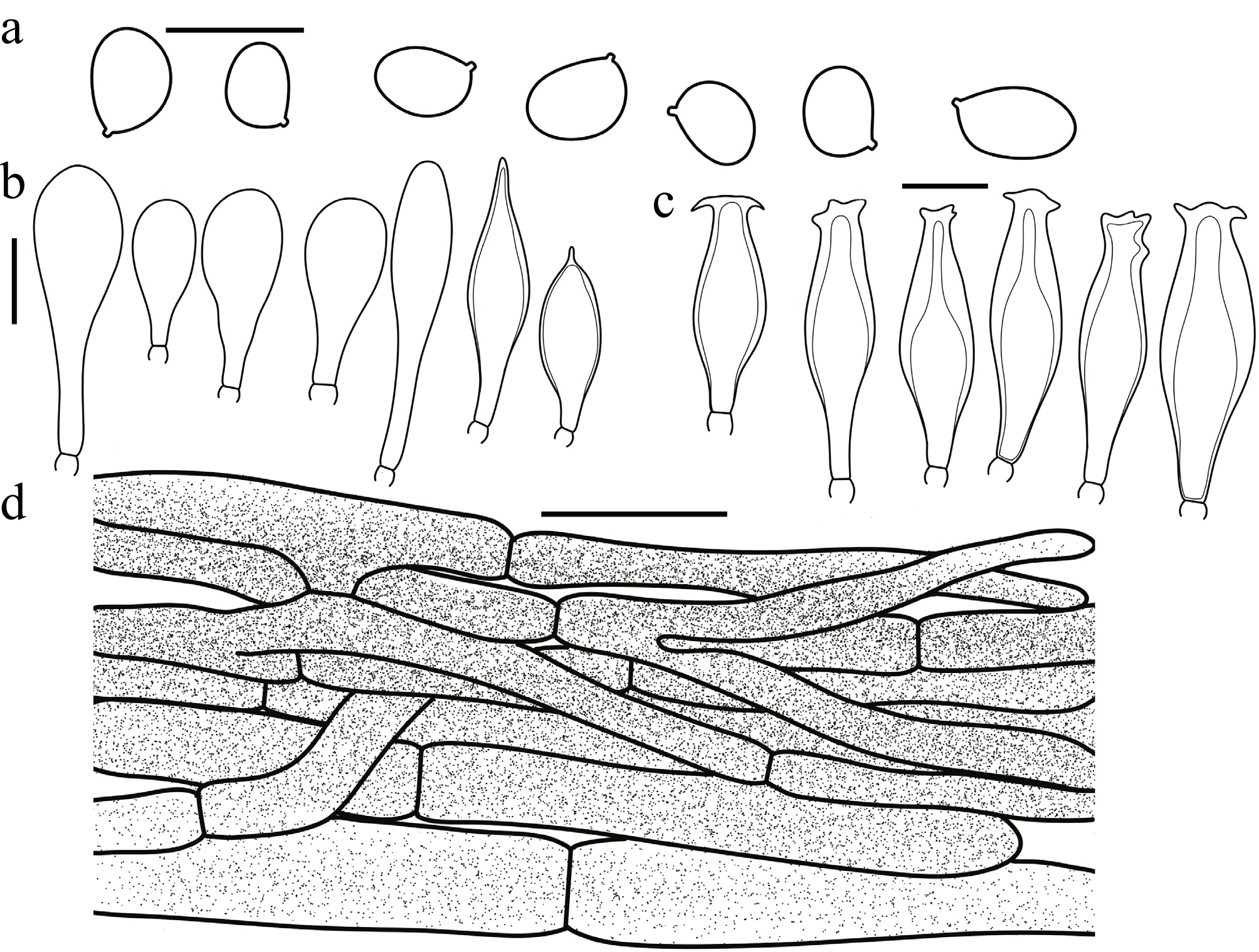
Figure 54.
Pluteus conformis (HKAS 151292). (a) Basidiospores. (b) Cheilocystidia. (c) Pleurocystidia. (d) Pileipellis. Scale bars: (a) = 10 μm, (b)–(d) = 20 μm.
Habitat and distribution – solitary or gregarious, lignicolous on deciduous decaying wood. So far known from Vietnam[64] and China.
Materials examined – CHINA. Yunnan Province: Baoshan City, Longling County, near Gaoligong Mountain National Forest Park, altitude 2,120 m, 18 June 2014, Jiao Qin 909 (HKAS 83326); ibid., 19 June 2014, Jiao Qin 929 (HKAS 83346); ibid., Nujiang Lisu Autonomous Prefecture, Lushui City, Pianma Town, Area near Border Inspection Station, altitude 1,966 m, 6 August 2011, Jiao Qin 228 (HKAS 73214); ibid., Honghe Hani and Yi Autonomous Prefecture, Pingbian Miao Autonomous County, Qiche Village, altitude 2,043 m, 9 May 2011, Yan-Chun Li 2273 (HKAS 89302); ibid., Dali Bai Autonomous Prefecture, Nanjian Yi Autonomous County, Baohua Town, Yongzheng Village Committee, Gezhila Village Back Mountain, altitude 2,072 m, 27 June 2015, Kuan Zhao 736 (HKAS 92364); Hunan Province: Zhangjiajie City, Wulingyuan District, Camel Peak, altitude 602 m, 24 March 2025, Wei-Qiang Qin (HKAS 151292).
Notes – Pluteus conformis, originally described from montane tropical broad-leaved forests of northern Vietnam, possesses brown basidiomes, a stipe with brown fibrils over the surface, narrowly clavate cheilocystidia, metuloid pleurocystidia, and absence of clamp connections[64]. Given their strong morphological and molecular consistency with the original description, the Chinese specimens are assigned to this species. Originally described from the tropics, this species is here reported for the first time as widely distributed in subtropical China and newly recorded for China.
Pluteus griseostriatus Zhu L. Yang & X. Chen, sp. nov. Fig. 55
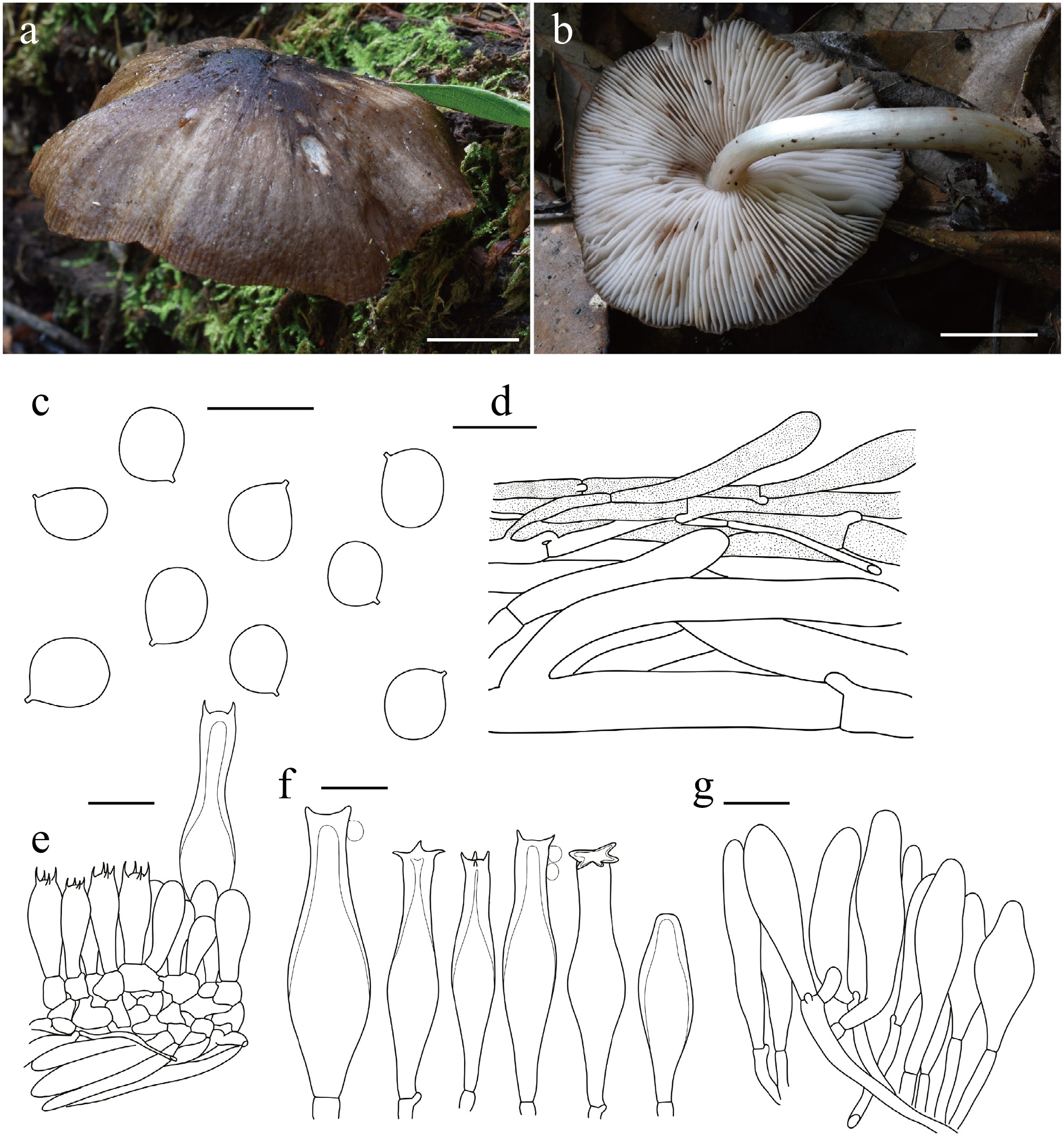
Figure 55.
Pluteus griseostriatus (HKAS 127791). (a)–(b) Basidiome in natural habitat. (c) Basidiospores. (d) Pileipellis. (e) Basidia, pleurocystidium and subhymenium. (f) Pleurocystidia. (g) Cheilocystidia. Scale bars: (a)–(b) = 1 cm, (c) = 10 μm; (d)–(g) = 20 μm.
Fungal Name: FN 573113
Chinese name: 缘纹灰光柄菇
Etymology – griseostriatus (Lat.), referring to the distinctive grayish-brown pileus with 0.5–1 cm striate margin.
Diagnosis – Pluteus griseostriatus differs from P. purpureofuscus Jiang Xu, T.H. Li & Z.W. Ge by its grayish-brown pileus with short striate margins and white stipe.
Basidiomes medium-sized. Pileus 50–70 mm diam., initially hemisphcrical then convex, with umbo; surface non-hygrophanous, deep greyish (5C2), darker at the center, radially fibrillose, with sulcate-striate margin. Lamellae free, pale pinkish brown, ventricose, slightly crowded, with lamellulae, edges concolorous. Stipe 55–60 mm ×10 mm, cylindrical, solid; surface dirty white (1A1), glabrous. Context in pileus thin, unchanging, dirty white (1A1); in stipe concolorous with surface. Smell and taste unknown.
Basidiospores [80/2/2] (6)7–8(8.5) × 5.5–7 μm, avl × avw = 7.56 × 6.83 μm, Q = 1.08–1.33, Qm = 1.18 ± 0.07, subglobose to ellipsoid, slightly thick-walled (0.5–0.6 μm), smooth. Basidia 18–30 × 8–10 μm, 4-spored, clavate, thin-walled. Cheilocystidia crowded, 40–60 × 9–20 μm, lageniform, clavate, narrowly utriform, colorless, thin-walled. Pleurocystidia metuloid, very abundant, 63–95 × 13–21 μm, narrowly fusiform to shortly pedunculate and narrowly cylindrical, with two to four small hooks at apex, with up to 4 um thick, thick-walled. Pileipellis a cutis, 50–80 μm thick, composed of oblong-celled, thin-walled, non-gelatinous hyphae, 50–65 × 10–15 μm, with intracellular brown pigment. Stipitipellis a cutis, composed of cylindrical, colorless, thin-walled, 5–15 μm wide hyphae. Caulocystidia not found. Clamp connections present.
Habitat and distribution – on Fagaceae rotten wood in subtropical forests. Known from northern China.
Materials examined – CHINA. Yunnan Province: Pingbian County, Dawei Mountain Nature Reserve, on decaying wood of Quercus augustinii, altitude 2,109 m, 22 May 2021, Liu-Kun Jia 1555 (HKAS 127791, holotype); Guangxi Zhuang Autonomous Region: Guilin City, Xingan County, Huajiang Yao Ethnic Township, Maoer Mountain National Nature Reservein, in forests with Fagaceae, altitude 1,520 m, 24 July 2012, Qing Cai 876 (HKAS 75610)
Notes – Pluteus griseostriatus possesses distinctive grayish-brown pileus with shortly striate margins, white stipe, subglobose to ellipsoid basidiospores measuring (6)7–8(8.5) × 5.5–7 μm, avl × avw = 7.56 × 6.83 μm, Q = 1.08–1.33, Qm = 1.18 ± 0.07, presence of clamp connections and habitat on Fagaceae wood. In the phylogenetic analysis, P. griseostriatus forms a distinct lineage with P. purpureofuscus, a species originally described from southwestern China, and they share 95.73% ITS similarity. However, P. purpureofuscus is differentiated by its purple pileus without striate margin, pale purplish brown stipe, relatively bigger broadly ellipsoid to ellipsoid basidiospores measuring 6.0–8.0(–9.0) × 5.0–6.0(–6.5) μm, avl × avw = 7.4 × 5.5 μm, Q = 1.20–1.60, Qm = 1.34 and habitat on coniferous wood[130].
Although morphologically similar to most grayish-brown species whose pileus has radial fibrils in the Puteus sect. Pluteus such as P. cervinus, P. hongoi, P. pouzarianus, and P. primus. Pluteus griseostriatus can be readily distinguished by its distinctly striate pileal margin, presence of clamp connections, and rounder basidiospores, while P. cervinus and P. hongoi lack clamp connections. Pluteus pouzarianus also possesses clamp connections, but grows on conifer wood and lacks a sulcate pileus margin. Collections known from China often have brown lamellar edges. In contrast, P. griseostriatus has colourless lamellar edges. Pluteus primus is morphologically very similar to P. griseostriatus. However, P. primus grows on conifer wood and is characterized by a white stipe with brown or gray-brown fibrils and broadly ellipsoid to ellipsoid basidiospores (Q = 1.25–1.60)[15,127], whereas P. griseostriatus has more rounded basidiospores (Q = 1.08–1.33, Qm = 1.18 ± 0.07) and a white stipe. The molecular analysis also fully supported P. griseostriatus as a distinct species (Fig. 10).
Pluteus hongoi Singer, Fieldiana, Bot. 21: 95 (1989) Figs 51e and 56
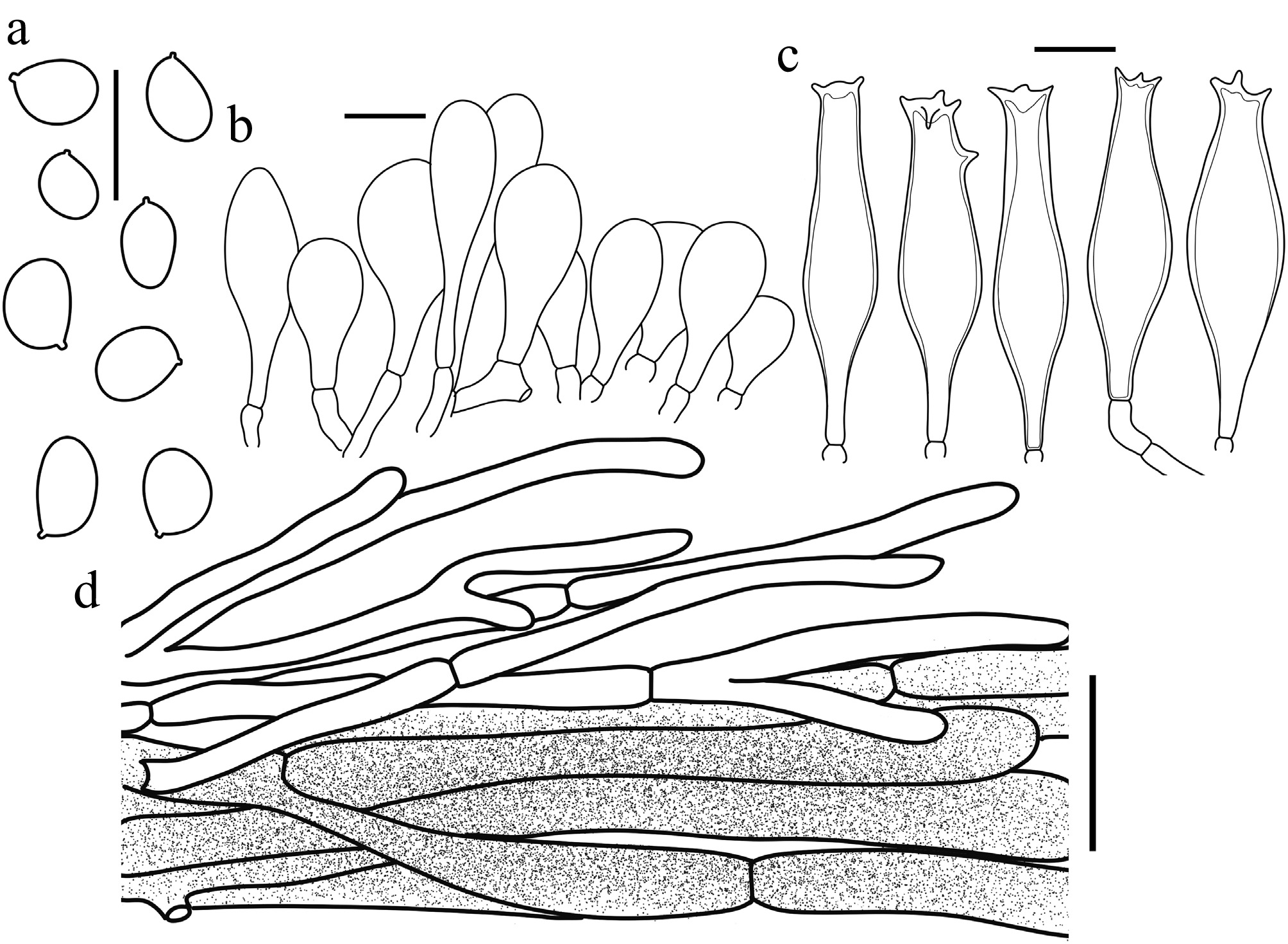
Figure 56.
Pluteus hongoi (HKAS 150974). (a) Basidiospores. (b) Cheilocystidia. (c) Pleurocystidia. (d) Pileipellis. Scale bars: (a) = 10 μm, (b)–(d) = 20 μm.
Habitat and distribution – Solitary to subgregarious, lignicolous on deciduous decaying wood. Widespread from Europe (Czech Republic, Germany, Slovakia, Spain, Türkiye), North America[15,127,131,132], Asia (China, Japan and Russia)[128,129,133].
Materials examined – CHINA. Gansu Province: Gannan Tibetan Autonomous Prefecture, Tewo County, Dega Town, altitude 2,421 m, 25 July 2024, Yang Wang 20 (HKAS 151190), Yang Wang 30 (HKAS 151191) and Yang Wang 49 (HKAS 151195); Shanxi Province: Yuncheng City, Yuanqu County, Lishan Town, Shunwangping Scenic Area, altitude 1,370 m, 29 July 2024, Xuan Chen 566 (HKAS 151004); Lvliang City, Jiaocheng County, Pangquangou National Nature Reserve, Badagou Area along Provincial Highway S320, altitude 1,700 m, 25 July 2024, Xuan Chen 485 (HKAS 150936); ibid., 26 July 2024, Xuan Chen 527 (HKAS 150974); Henan Province, Henan Province: Nanyang City, Neixiang County, Baotianman National Nature Reserve, altitude 600 m, 4 August 2024, Xuan Chen 676 (HKAS 151059); Sichuan Province: Ganzi Tibetan Autonomous Prefecture, Xiangcheng County, 108 Valleys Area, altitude 3,022 m, 10 July 2004, Zai-Wei Ge 76 (HKAS 45842); ibid., Reda Township, Niding Canyon; ibid., Reda Area, altitude 3,000 m,16 July 1998, Zhu-Liang Yang 2341 (HKAS 32302); Yunnan Province: Nujiang Lisu Autonomous Prefecture, Lushui City, Pianma Town, Gaoligong Mountains Nature Reserve, altitude 1,952 m, 27 July 2003, Zhu-Liang Yang 3886 (HKAS 42879); ibid., 13 August 2023, Xue-Ping Fan 1648 (HKAS 141407); Dali Bai Autonomous Prefecture, Nanjian Yi Autonomous County, Wuliang Mountain Area, Sanjiao Village, altitude 2,467 m, 2 August 2015, Xiao-Xia Ding 15 (HKAS 96958); Lijiang City, Ninglang Yi Autonomous County, Zhanhe Township, altitude 2,733 m, 16 July 2010, Jiao Qin 83 (HKAS 67769) and Yan-Jia Hao 69 (HKAS 68041); Kunming City, Wuhua District, Qiongzhu Temple, altitude 2,197 m, 6 September 2012, Bang Feng 1232 (HKAS 82374).
Notes – Pluteus hongoi, initially described from Japan[133], possesses pale brown or white basidiomes, a gelatinous pileus, a stipe without longitudinal brown fibrils, and the absence of clamp connections. Within this species, both brown and white fruiting body morphs exist a grayish-white morph (HKAS151059) was found among Chinese collections. In the era preceding molecular evidence, white morphs were described as a new species, namely Pluteus nothopellitus Justo & M.L. Castro. Subsequent molecular analyses have demonstrated that P. nothopellitus is a synonym of P. hongoi[127]. Although this species closely resembles P. cervinus in having a gray or brown pileus and a white stipe, and it lacks clamp connections. A better feature is the predominant presence of pleurocystidia with bifid hooks in P. hongoi, but in some collections these pleurocystidia are scarce. In this case, it appears challenging to identify a stable morphological character to distinguish between P. hongoi and P. cervinus. Pluteus cervinus is predominantly found in temperate regions such as Europe, whereas P. hongoi has a broader distribution, ranging from temperate areas to subtropical forests. The distinction between these two species was discussed by Justo et al.. In China, nearly all such specimens are identified as P. hongoi.
Pluteus leucoborealis Justo et al., Phytotaxa 180 (1): 58 (2014) Figs 51f and 57
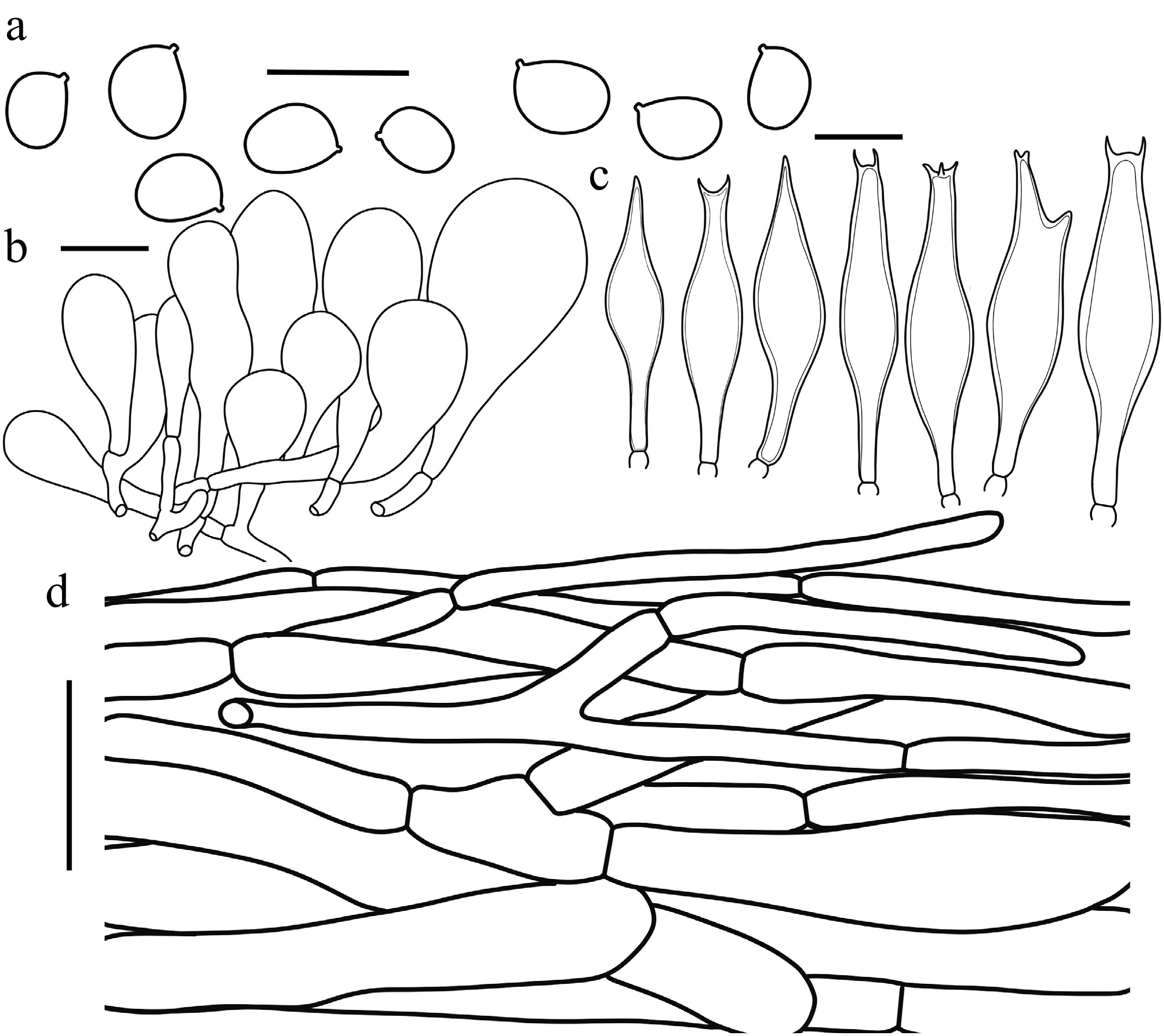
Figure 57.
Pluteus leucoborealis (HKAS 150935). (a) Basidiospores. (b) Cheilocystidia. (c) Pleurocystidia. (d) Pileipellis. Scale bars: (a) = 10 μm, (b)–(d) = 20 μm.
Habitat and distribution – Solitary, lignicolous, often growing on decayed wood of Betuloideae. Widespread from Eurasia (from Slovakia, north-western Russia to Siberia, Mongolia and China), North America (the United States of America)[67,127,134].
Materials examined – CHINA. Xizang Autonomous Region: Qamdo City, Riwoqê County, altitude 4,091 m, 24 July 2009, Zhu-Liang Yang 5328 (HKAS 57870); Shanxi Province: Lvliang City, Jiaocheng County, Pangquangou National Nature Reserve, altitude 1,800 m, 25 July 2024, Xuan Chen 479 (HKAS 150930), Xuan Chen 482 (HKAS 150933), Xuan Chen 483 (HKAS 150934), and CX484 (HKAS 150935); Gansu Province: Gannan Tibetan Autonomous Prefecture, Tewo County, Dega Town, altitude 2,421 m, 25 July 2024, Yang Wang 36 (HKAS 151193).
Notes – Pluteus leucoborealis, a recently described species from the Holarctic region, is characterized by its pure white pileus, sometimes with brown fibrils, white stipe, Magnus-type and Cervinus-type pleurocystidia near the lamellar edge – intermediate cystidia, and absence of clamp connections. Pluteus leucoborealis is morphologically highly similar to P. petasatus, but they can be distinguished by their ecological preferences and larger basidiospores[127]. Pluteus leucoborealis typically grows on decaying wood of Betuloideae. For example, several Chinese collections (HKAS150930, HKAS150933, HKAS150934, HKAS150935) were found on Betula albosinensis. In contrast, P. petasatus occurs frequently on decaying wood of Populus, Betula, Quercus, and Fagus.
Pluteus losulus Justo et al., Mycol. Progr. 10 (4): 473 (2011) Figs 51g and 58
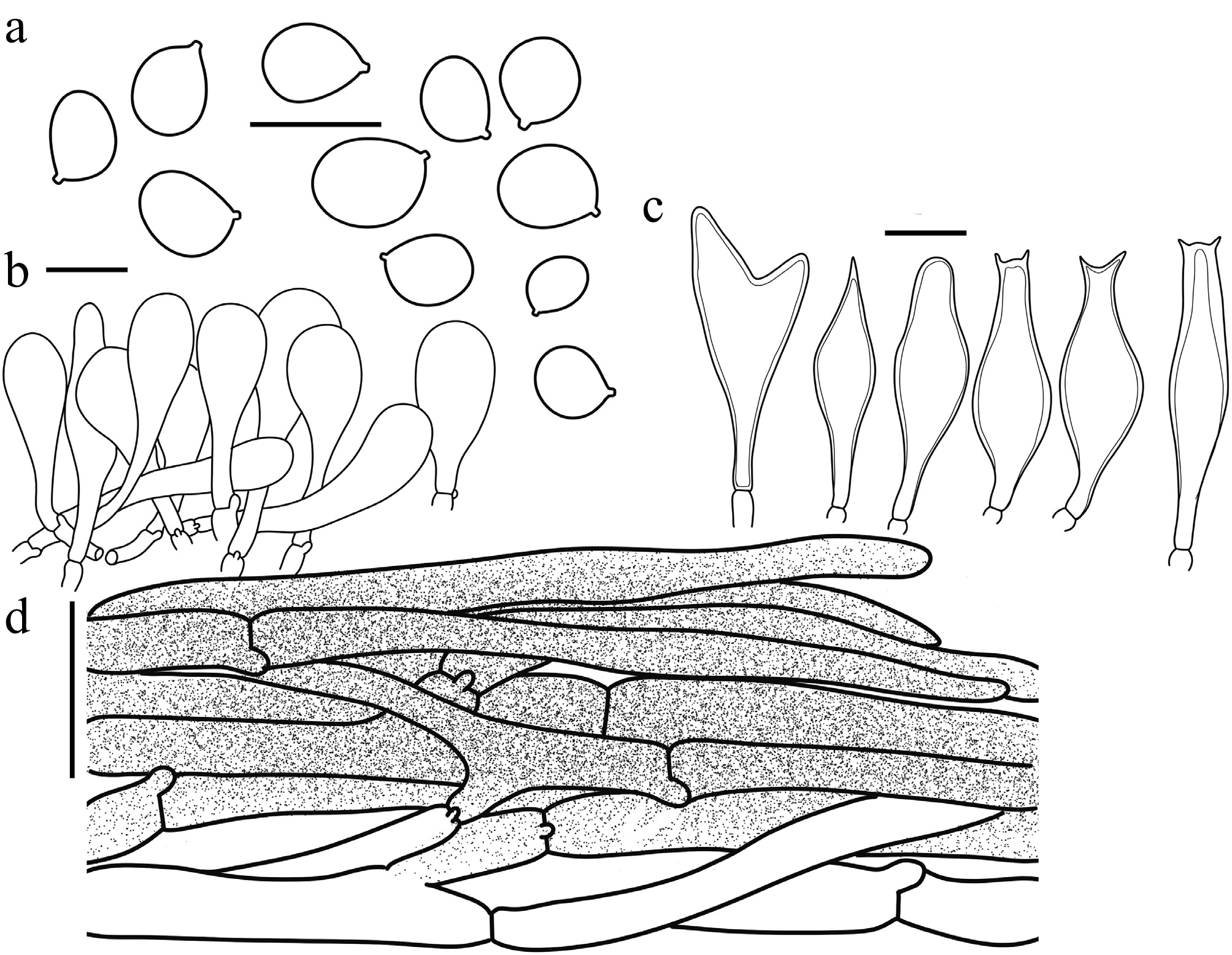
Figure 58.
Pluteus losulus (HKAS 151293). (a) Basidiospores. (b) Cheilocystidia. (c) Pleurocystidia. (d) Pileipellis. Scale bars: (a) = 10 μm, (b)–(d) = 20 μm.
Habitat and distribution – Solitary, terrestrial or lignicolous. So far reported from tropical regions, like Democratic Rep. of Congo[92], the Democratic Republic of Sao Tome and Principe[78], Thailand[80], and southern China[135].
Materials examined – CHINA. Yunnan Province: Xishuangbanna Dai Autonomous Prefecture, Mengla County, Mengla Village, Bubang Nature Reserve Sample Plot, altitude 698 m, Yang-Yang Cui 979 (HKAS 151211); Fujian Province: Fuzhou City, altitude 69 m, Qi Huang (HKAS 151293).
Notes – Pluteus losulus, initially described from Africa, is characterized by its relatively large basidiomes, a pileus covered with radially arranged greyish-brown fibrils, a white to greyish-brown stipe, clavate cheilocystidia, Magnus-type and Cervinus-type intermediate cystidia, and the presence of clamp connections[92]. Both molecular and morphological evidence from the specimens examined in this study align with the characteristic features of this species. However, while previous studies consistently documented it growing on decaying woody stumps, all specimens observed in our investigation were either terrestrial or grew on grassy humus layers—representing a difference from the typical ecological habit described for P. losulus. Furthermore, since the Chinese specimens were predominantly collected from tropical habitats[135], it may be inferred that this species is likely a tropical endemic.
Pluteus padanilus Justo et al., Phytotaxa 118 (2): 86 (2014) Figs 51h and 59
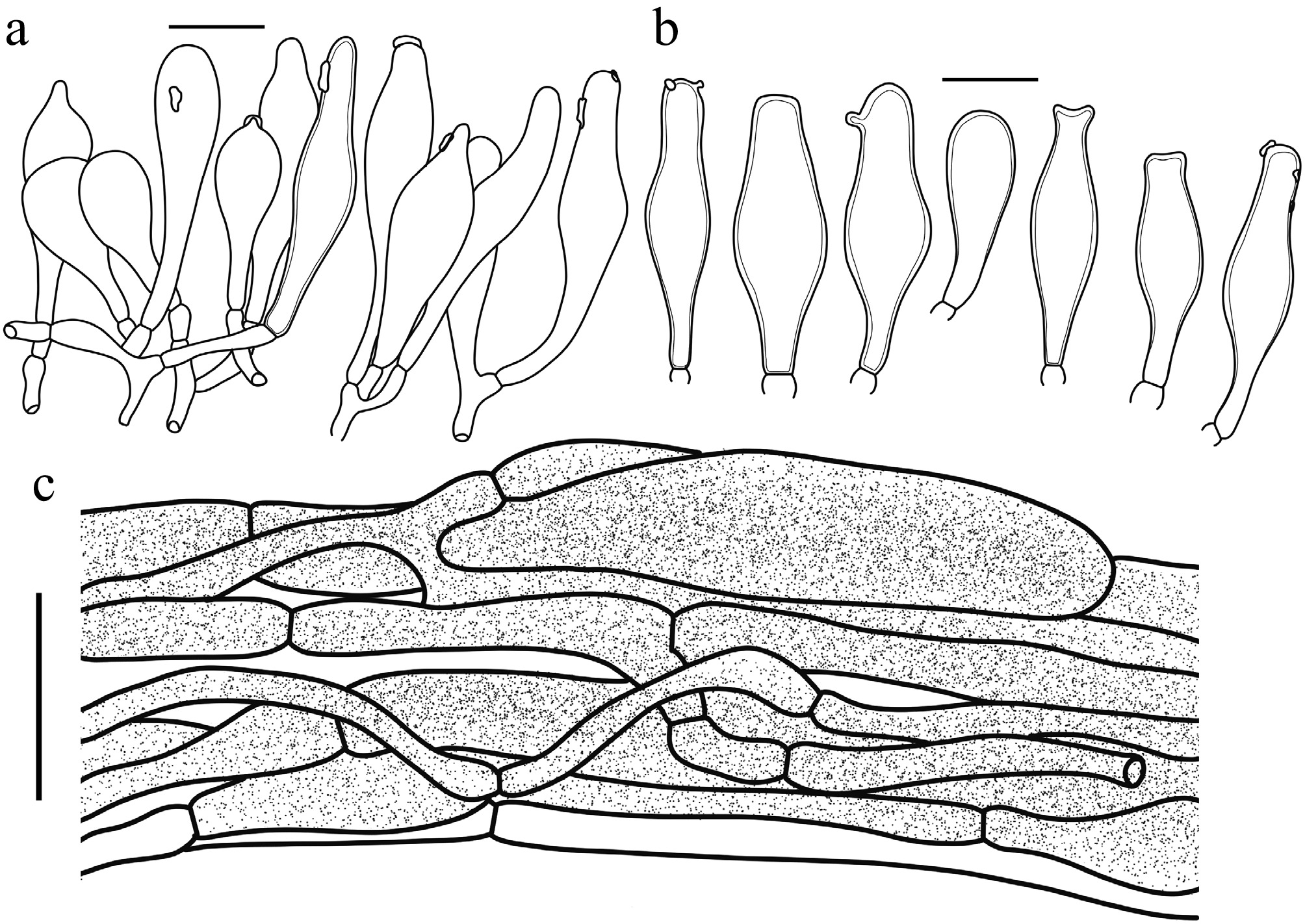
Figure 59.
Pluteus padanilus (HKAS 124920). (a) Cheilocystidia. (b) Pleurocystidia. (c) Pileipellis. Scale bars: (a)–(c) = 20 μm.
Habitat and distribution – Solitary, lignicolous, on decaying deciduous wood in subtropical habitats.
Material examined – CHINA. Yunnan Province: Xishuangbanna Dai Autonomous Prefecture, Menghai County, Bulang Mountain Nature Reserve, altitude 1,434 m,18 August 2019, Liu-Kun Jia 296 (HKAS 124920).
Notes – Pluteus padanilus, initially described from India, is characterized by a pileus covered with radially arranged greyish-brown fibrils, cheilocystidia, a few of which bear a short apical appendage; pleurocystidia with truncate to subcapitate or occasionally two to three indistinct short apical projections; and the absence of clamp connections[136].
The Chinese specimen examined in this study belongs to the Pluteus glaucotinctus complex. Taxa within this complex share several common characteristics: their pleurocystidia represent an intermediate form toward the metuloid type, often lacking typically hooked metuloid pleurocystidia, and lageniform cheilocystidia have rounded or occasionally truncate apices. Menolli Jr et al. proposed a detailed taxonomic study to better understand species delimitation in this species complex. Based on their findings, both molecular and morphological traits of the Chinese specimen show closer affinity to Pluteus padanilus.
It is noteworthy, however, that when we applied the BPP analyses following their classification[120], the results provided weak support for the recognition of each lineage within the clade as separate species, with all posterior probabilities below 0.97. This may indicate that the taxonomy of this group has not yet been fully resolved.
Pluteus petasatus (Fr.) Gillet, Hyménomycètes (Alençon): 395 (1876) Figs 51i and 60
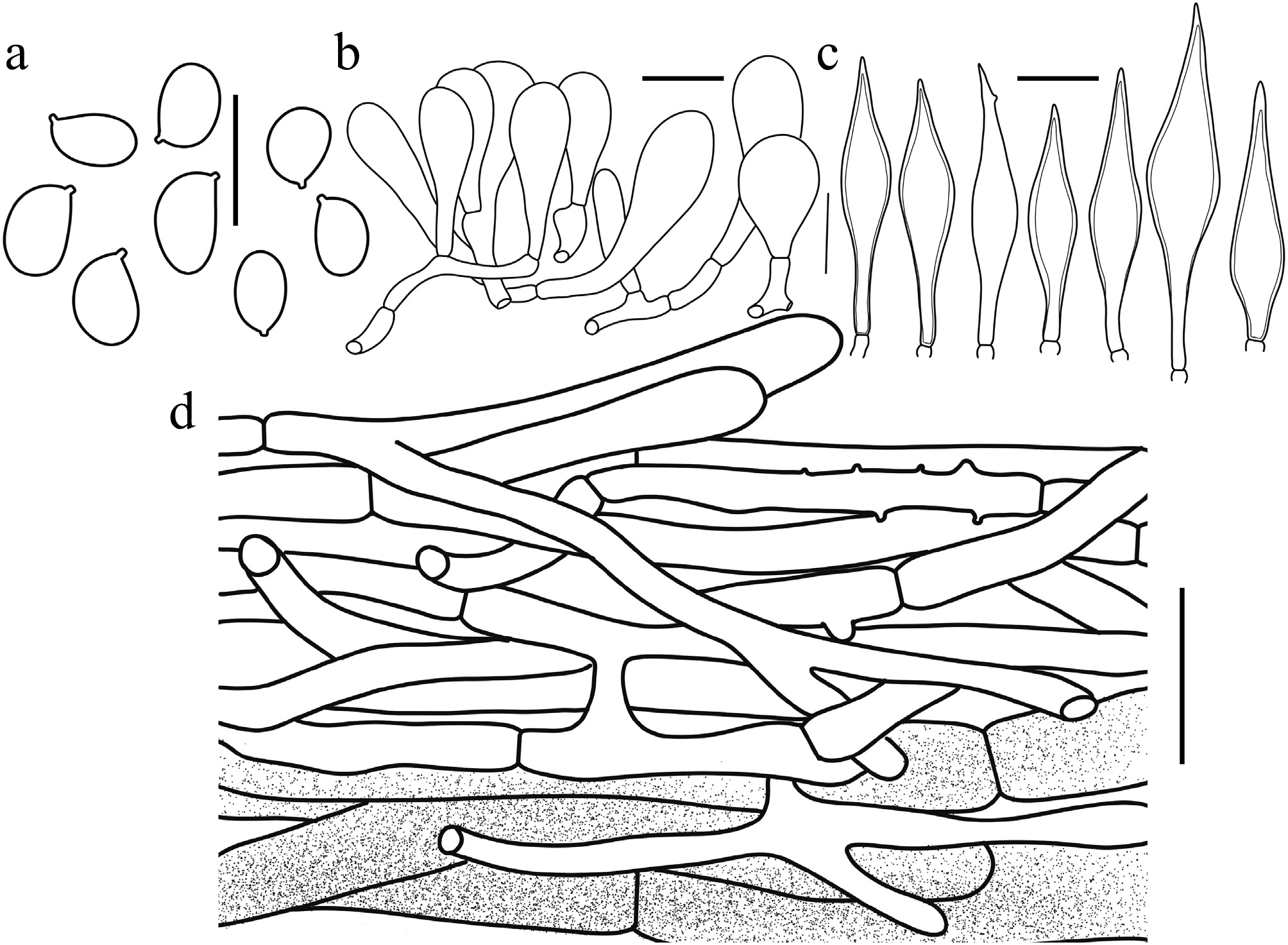
Figure 60.
Pluteus petasatus (HKAS 151276). (a) Basidiospores. (b) Cheilocystidia. (c) Pleurocystidia. (d) Pileipellis. Scale bars: (a) = 10 μm, (b)–(d) = 20 μm.
Habitat and distribution – Solitary to gregarious, lignicolous on deciduous decaying wood, Widespread from Eurasia (e. g. Spain, Türkiye, Russia, China, Japan)[63,75,127], and America (Paraguay, Argentina)[75].
Materials examined – CHINA. Jiangsu Province: Nanjing City, Zijin Mountain National Scenic Area, altitude 300 m, 23 October 2023, Xia Chen 819 (HKAS 151180); ibid., 18 August 2023, Xia Chen 634 (HKAS 151037); ibid., Yangzhou City, Gaoyou City, Gaoshayuan Residential Area, altitude 3 m, 12 December 2023, Xuan Chen 376 (HKAS 151276); ibid., Taizhou City, Xinghua City, Lincheng Subdistrict, Zhangyang South Area, altitude 6 m, 18 March 2024, Ming-Xuan Zhu (HKAS 151296); ibid., Yangzhou City, Baoying County, Guangyanghu Town, altitude 6 m, 18 March 2024, Xiao Wu (HKAS 151297); Zhejiang Province: Hangzhou City, Lin'an District, Dendrobii Cultivation Greenhouse, altitude 30 m, 26 September 2010, Xing-Hua Han (HKAS 59229); Shanghai Municipality: Pudong New District, Zaozhuang Road Lawn, altitude 3 m, 26 February 2024, Meng-Meng Wang (HKAS 151294); Yunnan Province: Kunming City, Xundian Hui and Yi Autonomous County, Yangzonghai Lake Area, altitude 1,905 m, 22 July 1991, Mu Zang 11883 (HKAS 23397). CANADA. Ontario Province: Hamilton City, Dundas Valley Conservation Area, altitude 138 m, 15 September 2015, Bang Feng 1979 (HKAS 94371).
Notes – Pluteus petasatus is characterized by medium to large basidiomes, a pileus ranging from smooth and slightly viscid to distinctly scaly, predominantly Magnus-type metuloid pleurocystidia near the lamellar edge (intermediate cystidia) and the absence of clamp connections[65]. The taxonomy of P. petasatus has been investigated through morphological and molecular studies of samples from multiple geographic locations[65,75,127]. According to Justo et al., P. viscidulus, P. magnus, and P. australis are considered synonyms of P. petasatus, with a specimen from Russia designated as the neotype. Both molecular and morphological data indicate that the Chinese specimens correspond precisely to the type. The species is common in eastern China and occurs in a wide range of habitats, including both anthropogenic environments (urban parks, lawns, roadsides) and natural, undisturbed forests.
Pluteus pouzarianus Singer, Sydowia 36: 283 (1983) Figs 51j and 61
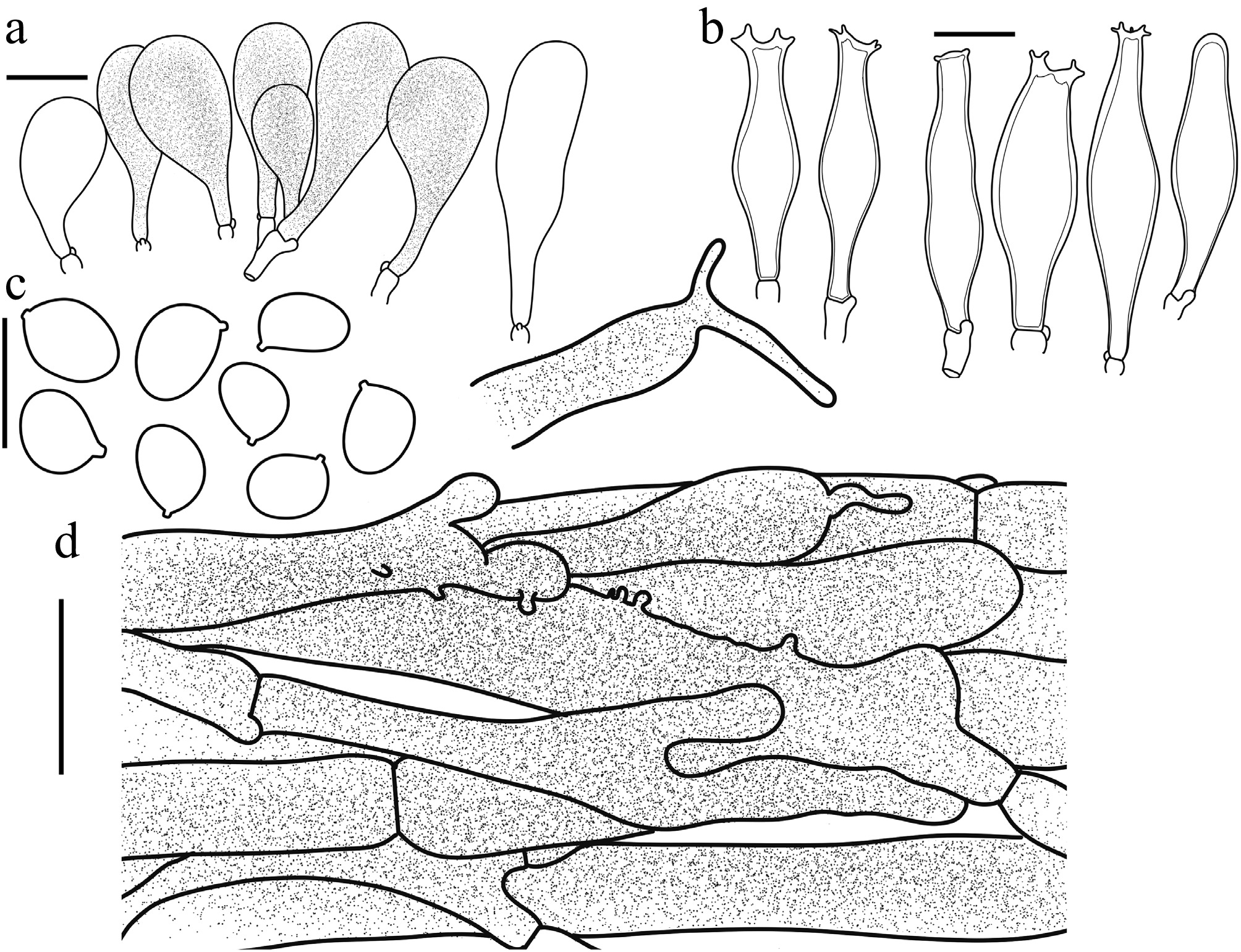
Figure 61.
Pluteus pouzarianus (HKAS 119955). (a) Cheilocystidia. (b) Pleurocystidia. (c) Basidiospores. (d) Pileipellis. Scale bars: (c) = 10 μm, (a), (b), (d) = 20 μm.
Habitat and distribution – Solitary or gregarious, lignicolous on deciduous decaying wood. Widespread in Europe (Spain, Portugal, Italy, Germany, Czech Republic, The Netherlands, Sweden, European Russia)[65,127], and Asia (Japan and China)[92].
Materials examined – CHINA. CLADE I: Yunnan Province: Nujiang Lisu Autonomous Prefecture, Lanping Bai & Pumi Autonomous County, Lanping Town, Yunling Nature Reserve, 22 September 2019, Xiang-Hua Wang 7234 (HKAS 120166); ibid., Lijiang City, Ninglang Yi Autonomous County, Red Bridge Town, Mianmian Mountain, altitude 2,546 m, 26 September 2019, Xiang-Hua Wang 6971 (HKAS 119955); ibid., Yulong Naxi Autonomous County, Jade Dragon Snow Mountain Nature Reserve, Spruce Meadow, altitude 2,647 m, 8 September 2024, Xuan Chen 788 (HKAS 151152); ibid., Diqing Tibetan Autonomous Prefecture, Shangri-La City, Southern Route of Bita Lake, altitude 3,685 m, 16 September 2010, Xiao-Fei Shi 128 (HKAS 62319); ibid., Chuxiong Yi Autonomous Prefecture, Chuxiong City, Zixi Mountain, altitude 2,417 m, 17 August 2024, Rui Wu (MHHNU 34570). Gansu Province: Gannan Tibetan Autonomous Prefecture, Zhouqu County, Grand Canyon National Forest Park, altitude 2,810 m, 26 July 2024, Yang Wang 57 (HKAS 151197); ibid., Lintan County, Yeliguan Town, Yeliguan National Forest Park, altitude 2,877 m,25 August 2024, Xuan Chen 719 (HKAS 151096); Shanxi Province: Lvliang City, Jiaocheng County, Pangquangou National Nature Reserve, Badagou Area along Provincial Highway S320, altitude 1,700 m, 26 July 2024, Xuan Chen 498 (HKAS 150949) and Xuan Chen 520 (HKAS 150968); Sichuan Province: Ganzi Tibetan Autonomous Prefecture, Jiulong County, Tanggu Township, altitude 3,210 m, 17 July 2005, Zai-Wei Ge 530 (HKAS 49026); ibid., Kangding City, Pusharong Township, Lotus Lake Village Nature Reserve, altitude 3,700 m, 7 September 2016, Xiao-Xia Ding 71 (HKAS 97152); Heilongjiang Province: Yichun City, Wuying National Forest Park, altitude 368 m, 17 August 2010, Xiao-Fei Shi 572 (HKAS 63393).
CLADEII: Sichuan Province: Ganzi Tibetan Autonomous Prefecture, Dege County, Yulong Latso Lake East Shore, altitude 4,019 m, 17 August 2006, Zai-Wei Ge 1300 (HKAS 50880); Aba Tibetan and Qiang Autonomous Prefecture, altitude 3,400 m, 21 August 1991, Min-Sheng Yuan 1631 (HKAS 24923); Yunnan Province: Diqing Tibetan Autonomous Prefecture, Shangri-La City, Sanba Township, altitude 2,601 m, 10 July 2014, Yan-Jia Hao 1240 (HKAS 83031).
CLADE III: Yunnan Province: Diqing Tibetan Autonomous Prefecture, Shangri-La City, Southern Route of Bita Lake, altitude 3,685 m, 16 September 2010, Xiang-Hua Wang 172 (HKAS 62352); Xizang Autonomous Region: Nyingchi City, Zayü County, Tsawarong Township, Jiaxing Village, altitude 3,805 m, 11 August 2022, Xiang-Hua Wang 10500 (HKAS 130710), Along the Rangshe River on the Zayü–Chawalong Highway, altitude 3,800 m, 13 August 2022, Xiang-Hua Wang 10694 (HKAS 130903).
Notes – Pluteus pouzarianus possesses brown basidiomes, a stipe with or without brown fibrils over the surface, narrowly clavate cheilocystidia, metuloid pleurocystidia, and the presence of clamp connections[65,127]. According to the literature, the lamellar edge of this species is described as colorless. However, among the Chinese specimens examined, lamellar edge coloration varied within Clade I, with both colorless and brown edges observed (Supplementary Fig. S2). By contrast, the available specimens of Clade II had colorless lamellar edges, whereas those of Clade III had dark lamellar edges. Given the limited sampling of Clades II and III, however, the taxonomic significance and stability of these color differences remain uncertain. The color of the lamellar edge may have limited diagnostic value for species delimitation within these three clades. According to the phylogenetic results, all Chinese specimens belong to the P. pouzarianus clade. The P. pouzarianus clade includes seven species: Pluteus pouzarianus, Pluteus hibbettii Justo, E.F. Malysheva & Bulyonkova, Pluteus eos Justo & E.F. Malysheva, Pluteus orestes Vellinga & Justo, Pluteus primus Bonnard, Pluteus methvenii Minnis & Justo, and Pluteus spegazzinianus Singer. Among them, P. orestes, P. primus, P. methvenii, and P. spegazzinianus can be more easily distinguished using molecular sequences. Justo et al. provided a detailed differentiation of these species. The Chinese specimens show only minor morphological differences from the above-mentioned species.
In addition, phylogenetic reconstructions using ITS, tef1, and concatenated ITS-tef1 revealed significant incongruence for species delimitation (Fig. 9). The topological structure among these species was highly unstable and easily influenced by sequence alignment and trimming methods. Based on the individual ITS and tef1 datasets, as well as the concatenated ITS-tef1 matrix, the Chinese specimens morphologically associated with P. pouzarianus were resolved into three distinct clades (Figs 9 and 10). In the present study, these three clades were further analyzed using a phylogenomic dataset. The phylogeny inferred from 672 loci showed that the three clades are closely related and together form a single well-supported clade (Fig. 2). Due to the absence of clear morphological differences from the P. pouzarianus clade and considering the complex phylogenetic relationships within this group together with the current phylogenomic results, we conservatively and provisionally treat these three clades as P. pouzarianus sensu lato.
Pluteus purpureofuscus Jiang Xu et al., Phytotaxa 233 (1): 66 (2015) Fig. 51k
Habitat and distribution – lignicolous, on deciduous decaying wood in subtropical habitats.
Materials examined – CHINA. Sichuan Province: Liangshan Yi Autonomous Prefecture, Mianning County, Lamagetou Nature Reserve, altitude 3,110 m, 12 July 2005, Zai-Wei Ge 460 (HKAS 48956); Ganzi Tibetan Autonomous Prefecture, Jiulong County to Kangding Direction, altitude 2,986 m, 21 July 2005, Zai-Wei Ge 589 (HKAS 49084).
Notes – The specimens studied herein are the original type material used for the description of this species. For detailed morphological descriptions and further discussion, please refer to this study[130].
Pluteus rangifer Justo et al., Phytotaxa 180 (1): 25 (2014) Figs 51l and 62
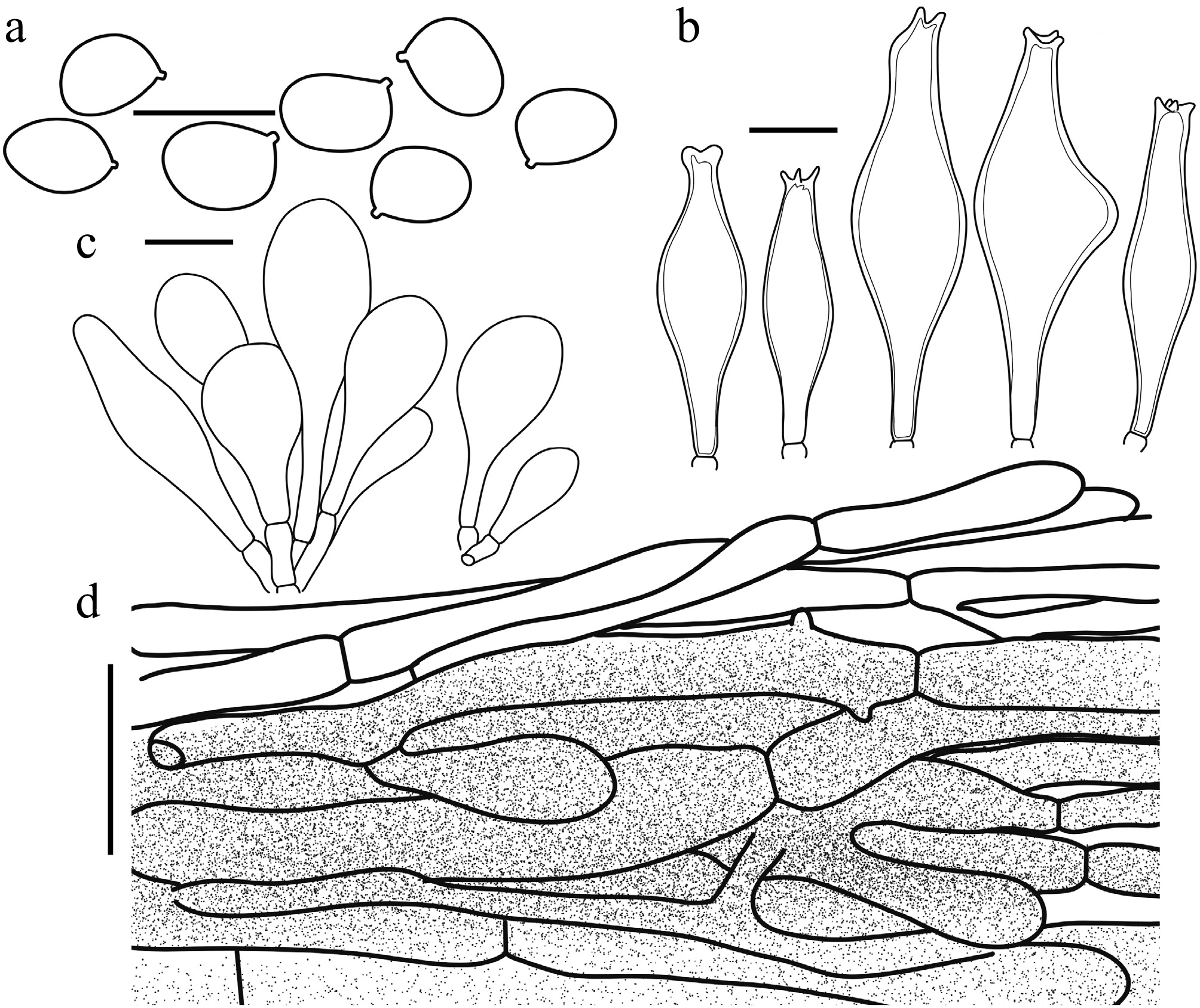
Figure 62.
Pluteus rangifer (HKAS 118267). (a) Basidiospores. (b) Pleurocystidia. (c) Cheilocystidia. (d) Pileipellis. Scale bars: (a) = 10 μm, (b)–(d) = 20 μm.
Habitat and distribution – Solitary, lignicolous on angiosperms decaying wood. So far reported from Eurasia (northwestern Russia, Japan and China) and North America.
Materials examined – CHINA. Yunnan Province: Lijiang City, Ninglang Yi Autonomous County, Zhanhe Township, altitude 2,733 m,16 July 2010, Qi Zhao 748 (HKAS 69469); ibid., Diqing Tibetan Autonomous Prefecture, Deqin County, Yunling Township, Yubeng Village, Meili Snow Mountain Area, altitude 3,270 m, 26 August 2020, Xiang-Hua Wang 8587 (HKAS 118201); ibid., Yunling Township, Nanzong Pass to Xidang Village, altitude 3,100 m, 27 August 2020, Xiang-Hua Wang 8657 (HKAS 118267); ibid., Shangri-La City, Pudacuo National Park, altitude 3,580 m, 31 August 2020, Fei-Fei Liu 262 (HKAS 113167); Heilongjiang Province: Daxing'anling Prefecture, Jiagedaqi District, altitude 383 m, 30 August 2010, Xiang-Hua Wang 2726 (HKAS 61922); Jilin Province: Yanbian Korean Autonomous Prefecture, Antu County, Erdaobaihe Town, near Beauty Pine Garden, altitude 700 m, 15 September 2014, Xiao-Bin Liu 722 (HKAS 87270); Hubei Province: Shennongjia Forestry District, Muyu Town, Golden Monkey Ridge, altitude 2,469 m, 17 July 2012, Xiao-Bin Liu 106 (HKAS 75718); Gansu Province: Gannan Tibetan Autonomous Prefecture, Zhouqu County, Dayu Township, Shatang Forest Farm, altitude 2,712 m, 29 August 2024, Xuan Chen775 (HKAS 151142).
Notes – Pluteus rangifer, recently described from Russia and first reported in China, is characterized by brown basidiomes, smooth to radially fibrillose pileus usually with a silky sheen, narrowly clavate cheilocystidia, metuloid pleurocystidia and absence of clamp connections[127]. The specimens examined in this study are almost identical to the type material. However, we observed small lateral outgrowths on the terminal hyphae of the pileipellis, a feature not reported in the original description. Furthermore, we found that only a single specimen (HKAS 151142) differed from the others by possessing brown lamellar edges, whereas all other specimens exhibited white edges. This further demonstrates that lamellar edge color is a variable character within this species.
Pluteus salicinus (Pers.) P. Kumm., Führ. Pilzk. (Zerbst): 99 (1871) Figs 51m and 63
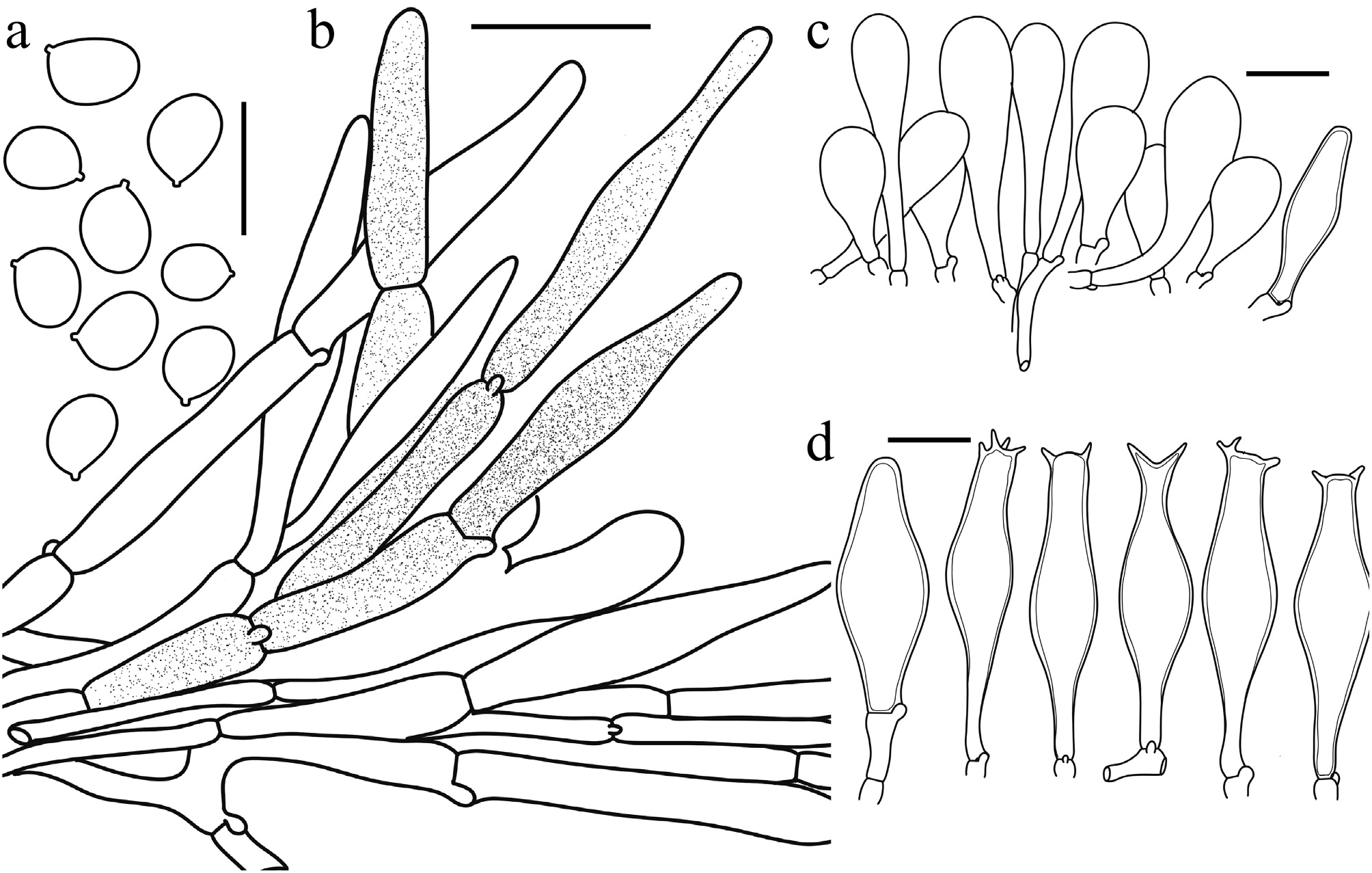
Figure 63.
Pluteus salicinus (HKAS 150960). (a) Basidiospores. (b) Pileipellis with terminal elements. (c) Cheilocystidia. (d) Pleurocystidia. Scale bars: (a) = 10 μm, (b) = 40 μm, (c), (d) = 20 μm.
Habitat and distribution – Solitary, lignicolous on deciduous wood; Known from Europe to Siberia[15,65,98,127] and China.
Materials examined – CHINA. Sichuan Province: Aba (Ngawa) Tibetan and Qiang Autonomous Prefecture, Barkam City, Jueba Township, Yinlang Village, altitude 3,392 m, 17 August 2007, Zai-Wei Ge 1895 (HKAS 53980); Yunnan Province: Dali Bai Autonomous Prefecture, Yangbi Yi Autonomous County, Longtianchi Nature Reserve, altitude 2,606 m, 22 July 2019, Xiang-Hua Wang 5981 (HKAS 116626); Gansu Province: Gannan Tibetan Autonomous Prefecture, Tewo County, Dega Town, altitude 2,618 m, 25 July 2024, Yang Wang 46 (HKAS 151194); Shanxi Province: Lvliang City, Jiaocheng County, Pangquangou National Nature Reserve, altitude 1,786 m, 26 July 2024, Xuan Chen 512 (HKAS 150960).
Notes – Pluteus salicinus can be easily distinguished from species in sect. Pluteus. It is characterized by its blue-green staining reaction when injured, bluish grey pileus with squamules at center, metuloid pleurocystidia with hooks, and presence of clamp-connections. However, the amount of tryptamine alkaloids in P. salicinus varies and thus, the blue-green staining reaction when injured may not be evident in some collections[137,138]. In our phylogeny analysis, P. americanus and P. salicinus formed a well-supported clade (Fig. 10, PP = 1.00, BS = 100). Moreover, when the species delimitation method (BPP) was applied under the classification scheme of Justo et al., the results provided only weak support (BPP < 0.95) for their recognition as separate species.
Pluteus sepiicolor E.F. Malysheva et al., Phytotaxa 180 (1): 64 (2014) Figs 51n and 64
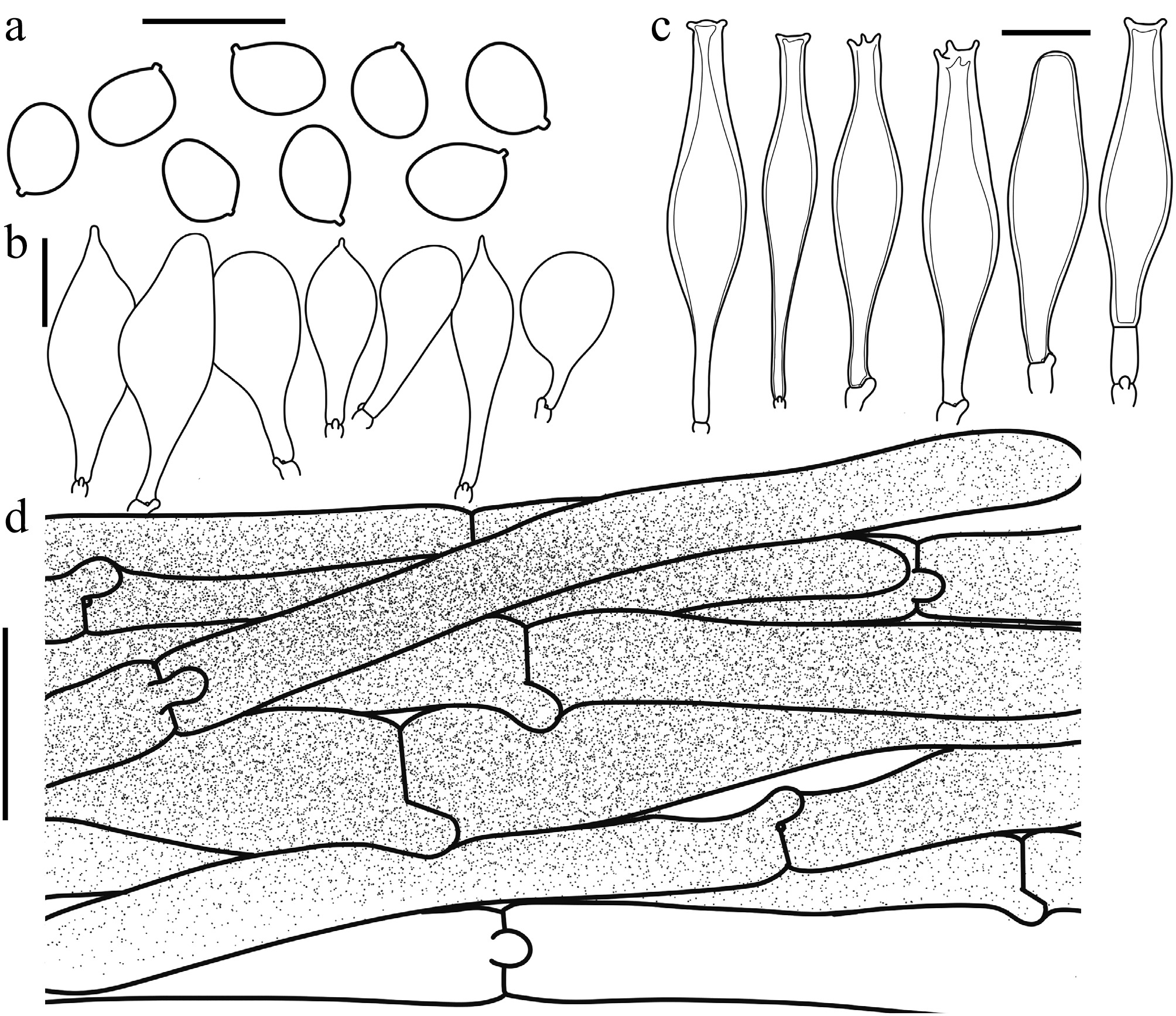
Figure 64.
Pluteus sepiicolor (HKAS 151143). (a) Basidiospores. (b) Cheilocystidia. (c) Pleurocystidia. (d) Pileipellis. Scale bars: (a) = 10 μm, (b)–(d) = 20 μm.
Habitat and distribution – Solitary, lignicolous on conifer wood in subtropical habitats.
Materials examined – CHINA. Yunnan Province: Diqing Tibetan Autonomous Prefecture, Deqin County, Yanmen Township, Yugong Village, West Slope of Baima Snow Mountain, altitude 3,296 m, 23 August 2020, Xiang-Hua Wang 8299 (HKAS 117923); ibid., Yunling Township, Nanzong Pass to Xidang Village, altitude 3,100 m, 27 August 2020, Xiang-Hua Wang 8689 (HKAS 118297); Lijiang City, Yulong Naxi Autonomous County, Jade Dragon Snow Mountain Nature Reserve, Spruce Meadow, altitude 3,240 m, 20 September 2019, Xiang-Hua Wang 6734 (HKAS 119751); Honghe Hani and Yi Autonomous Prefecture, Lvchun County, altitude 1,752 m, 2 July 2007, L. S. Wang (HKAS 51993); Gansu Province: Gannan Tibetan Autonomous Prefecture, Zhouqu County, Dayu Township, Shatang Forest Farm, altitude 2,712 m, 29 August 2024, Xuan Chen 772 (HKAS 151140), Xuan Chen 773 (HKAS 151141), Xuan Chen776 (HKAS 151143), Xuan Chen 777 (HKAS 151144), Xuan Chen 785 (HKAS 151150); ibid., Bailongjiang Forest Farm, altitude 1,947 m, 29 August 2024, Yang Wang 346 (HKAS 151200).
Notes – Pluteus sepiicolor originally described from Russia and first reported in China, is characterized by grey pileus with dark brown squamules at center, metuloid with hooks pleurocystidia, and presence of clamp-connections[127]. It is morphologically similar to P. salicinus but can be distinguished by its lack of a bluing reaction when injured, deep brown pileus, metuloid pleurocystidia with predominant bifid apical hooks, and growth on conifers. The specimens from China correspond closely to the original species description. Phylogenetic analysis confirms that these specimens form a strongly supported clade with the type sequence (BS = 98, PP = 0.97).
Pluteus xylophilus (Speg.) Singer, Lilloa 22: 405 (1951) Figs 51o and 65
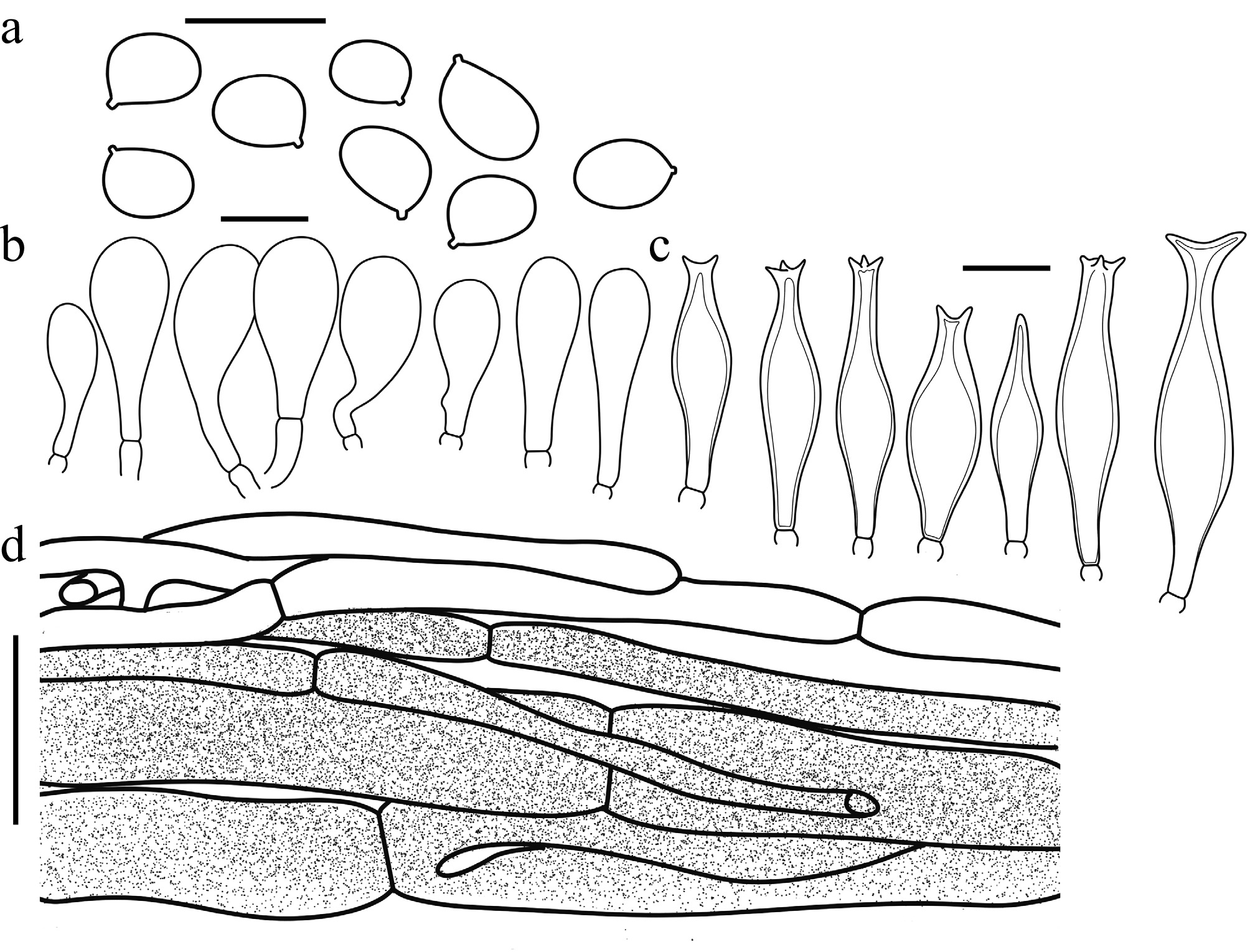
Figure 65.
Pluteus xylophilus (HKAS 151298). (a) Basidiospores. (b) Cheilocystidia. (c) Pleurocystidia. (d) Pileipellis. Scale bars: (a) = 10 μm, (b)–(d) = 20 μm.
Habitat and distribution – Solitary, lignicolous on deciduous wood in subtropical habitats.
Materials examined – CHINA. Yunnan Province: Kunming City, Panlong District, Kunming Botanical Garden, altitude 1,967 m, 15 May 2000, Xiang-Hua Wang 920 (HKAS 35941); ibid., Dali Bai Autonomous Prefecture, Nanjian Yi Autonomous County, Gonglang Town, Zinile River Area, Huangcaoping Back Mountain, altitude 1,768 m, 30 June 2015, Kuan Zhao 779 (HKAS 92407); Zhejiang Province: Wenzhou City, Longgang City, Shanqian Village, altitude 9 m, 27 February 2024, Li-Xia Ye (HKAS 151298); Jiangsu Province: Nanjing City, Zijin Mountain National Scenic Area, altitude 300 m, 26 May 2023, Xia Chen 228 (HKAS 151169); ibid., 13 June 2023, Xia Chen 342 (HKAS 151171).
Notes – Phylogenetic analysis based on the combined ITS-tef1 dataset revealed that the Chinese specimens belong to the /petasatus clade and these specimens form a sister clade with P. pellitus (PP = 0.51, BS = 72). However, P. pellitus is primarily characterized by its white pileus and stipe, Magnus-type and Cervinus-type intermediate cystidia, and the presence of clamp connections[15,63]. The specimens examined in this study possess a pale brown pileus, a smooth to indistinctly innately fibrillose surface, a stipe covered with brown fibrils, and absence of clamp connections. These characteristics appear to differ significantly from those of P. pellitus. Instead, they show greater morphological similarity to P. xylophilus[63,114,139]. Given the absence of clamp connections in these specimens, we identify them as P. xylophilus.
Key to the species of Volvopluteus from China
1. Cheilocystidia absent Vp. platensis 1. Cheilocystidia present 2 2. Pleurocystidia absent 3 2. Pleurocystidia present 4 3. Distributed in southern China Vp. earlei 3. Distributed in northern China Vp. longipes/ Vp. striatellus 4. Cheilocystidia without long rostrum at apex Vp. deliciosus 4. Cheilocystidia with long rostrum at apex 5 5. Margin of pileus rimose .Vp. michiganensis 5. Margin of pileus not rimose 6 6. Pileus predominantly dark grey or grey-brown; pleurocystidia with long apical excrescence (up to 10 μm) Vp. asiaticus 6. Pileus predominantly pale grey or grey-brown; pleurocystidia without long apical excrescence, often with short apical papilla 7 7. Pileus without radially appressed silky fibrils; basidiospores 10–15 × 7–8 μm Vp. gloiocephalus 7. Pileus with radially appressed silky fibrils; basidiospores 11.3–12.9 × 6.0–6.9 μm Vp. yunnanensis Volvopluteus asiaticus Justo & Minnis, Mycol. Progr. 10 (4): 475 (2011) Fig. 66a
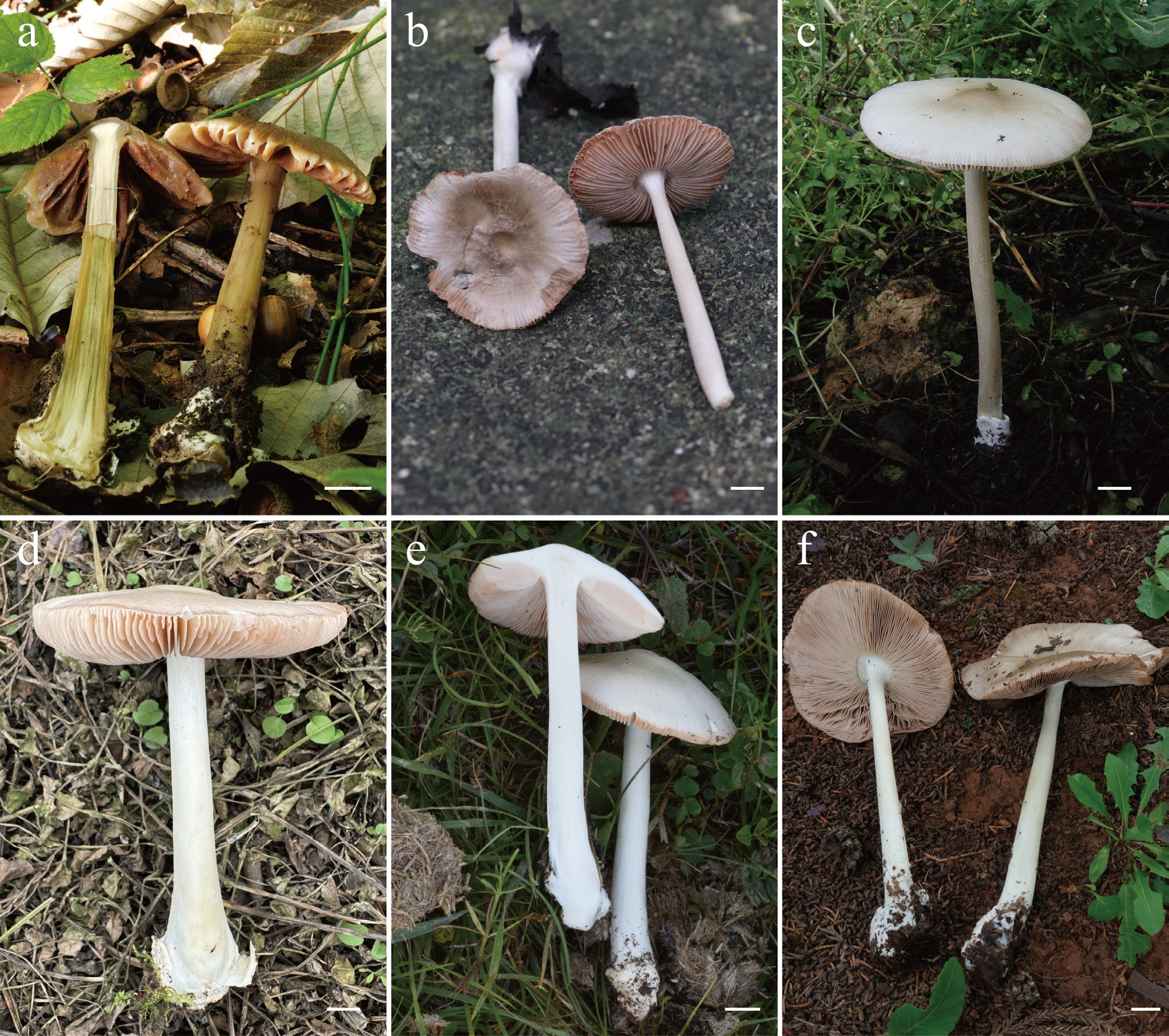
Figure 66.
Fresh basidiomes of Volvopluteus from China. (a) Vp. asiaticus (HKAS 151185). (b) Vp. earlei (HKAS 133863). (c)–(d) Vp. gloiocephalus (HKAS 71087). (e) Vp. platensis (HKAS 127528). (f) Vp. yunnanensis (HKAS 151182).
Habitat and distribution – terrestrial. So far reported from Russia, China and Japan.
Material examined – CHINA. Shanxi Province: Lvliang City, Jiaocheng County, Pangquangou National Nature Reserve, altitude 1,700 m, 22 October 2024, Guan-Rui Li 1023 (HKAS 151185).
Notes – Volvopluteus asiaticus is characterized by a dark brown, viscid pileus, large ellipsoid to oblong basidiospores, an ixocutis-type pileipellis and the absence of clamp connections[92,140]. This species is extremely rare and has only been recorded in Asia to date. Its occurrence reported here also represents the first record in China. Unfortunately, due to the poor condition of the specimen at the time of collection, its quality was insufficient for detailed microscopic examination. In this study, we can only provide photographic documentation of the specimen and its ITS sequence. For a comprehensive morphological description and detailed characteristic illustrations, please refer to previous studies[92,140].
Volvopluteus earlei (Murrill) Vizzini, Contu & Justo, Fungal Biology 115 (1): 15 (2011) Figs 66b and 67
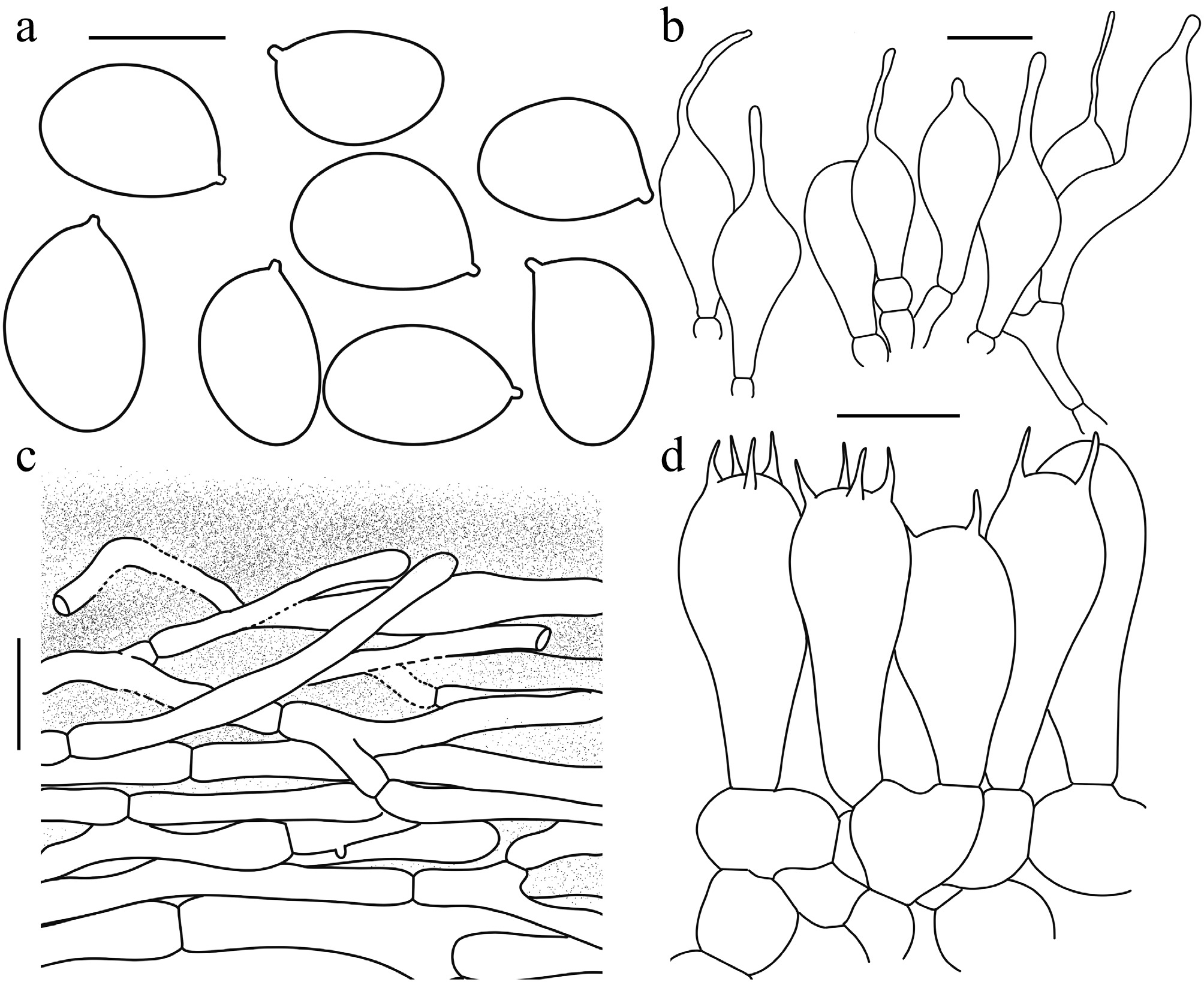
Figure 67.
Volvopluteus earlei (HKAS 133863). (a) Basidiospores. (b) Cheilocystidia. (c) Pileipellis. (d) Basidia. Scale bars: (a) = 10 μm, (b)–(d) = 20 μm.
Habitat and distribution – terrestrial. Solitary, wide spread around the world.
Material examined – CHINA. Yunnan Province: Xishuangbanna Dai Autonomous Prefecture, Mengla County, Xishuangbanna Tropical Botanical Garden, Bamboo Garden, altitude 900 m, 8 July 2021, Tian Gao 65 (HKAS 133863); Guangxi Zhuang Autonomous Region: Chongzuo City, Longzhou County, Longzhou Town, Guangxi Nonggang National Nature Reserve, altitude unknown, 18 June 2026, collected by Xing-Liang Wu (HKAS 155213).
Notes – Volvopluteus earlei, originally described from Cuba[141] possesses small, dry to viscid white pileus, white volva, rare or absent pleurocystidia, rostrate cheilocystidia. It has been reported from North America including USA[142] and Mexico[143], and parts of Europe[144,145], Western Australia[146],and Asia including Pakistan, Japan, China[94,147]. Volvopluteus earlei is a tropical species[145]. While this species does occur in tropical regions of China, its presence in temperate zones such as Japan and Europe indicate that it cannot be definitively classified as a tropical species. This study suggests that its distribution may extend to northern China, though more extensive surveys are needed to clarify its full geographic range.
Volvopluteus gloiocephalus (DC.) Vizzini, Contu & Justo Fungal Biology 115 (1): 15 (2011) Figs 66c, d and 68
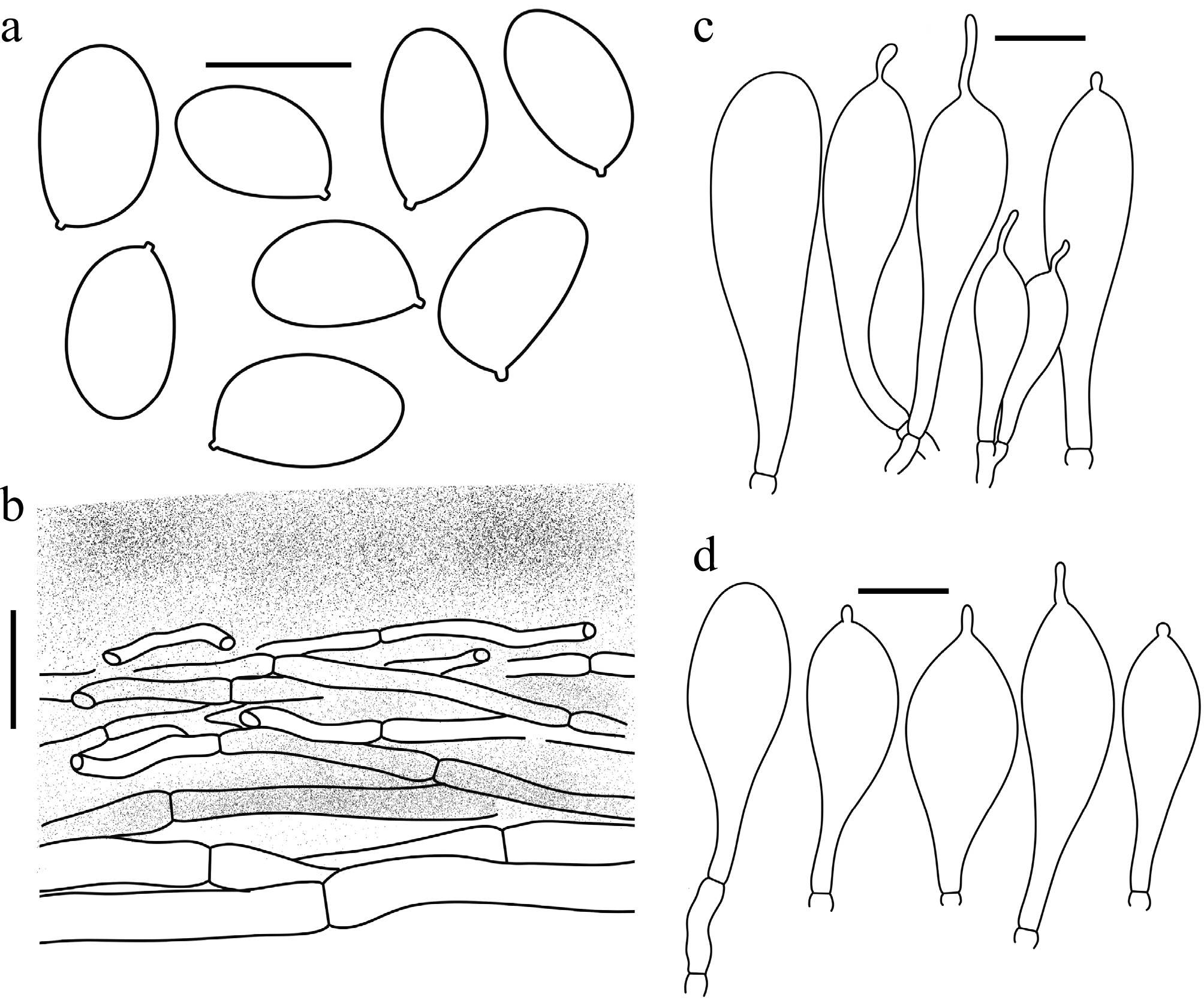
Figure 68.
Volvopluteus gloiocephalus (HKAS 133862). (a) Basidiospores. (b) Pileipellis. (c) Cheilocystidia. (d) Pleurocystidia. Scale bars: (a) = 10 μm, (b)–(d) = 20 μm.
Habitat and distribution – terrestrial. Solitary, wide spread around the world.
Materials examined – CHINA. Yunnan Province: Kunming City, Panlong District, Yeya Lake, altitude 1,944 m, 22 October 2011, Zhu-Liang Yang 5602 (HKAS 71087); ibid., 10 August 2013, Yan-Jia Hao 1045 (HKAS 82836); ibid., Kunming Botanical Garden, altitude 1,967 m, 5 November 2020, Liu-Kun Jia 1543 (HKAS 127781); Xizang Autonomous Region: Nyingchi City, Bomi County, Yupu Township, Mimei Village, altitude 3,533 m, 29 June 2014,Yan-Jia Hao 1144 (HKAS 82935); Xinjiang Uygur Autonomous Region: Altay Prefecture, Fuyun County, Fuyun Forest Farm, altitude 1,274 m, 17 July 2015, Qi Zhao 2495 (HKAS 90369); Shanxi Province: Yuncheng City, Zhongtiao Mountain Area, altitude 1,045 m, collected by Miss Lv (HKAS 133862).
Notes – Volvopluteus gloiocephalus, is characterized by large, viscid gray-white pileus, white volva, clavate cheilocystidia and clavate to fusiform pleurocystidia often with apical papilla. It is widely distributed around the world[19,65,148]. The species was once classified under the genus Volvariella. It was reclassified into the genus Volvopluteus with a very detailed taxonomic treatment[19]. In specimens collected from China, both the fruiting time and distribution range are very extensive. In our phylogenetic analysis, all specimens collected from various regions of China clustered within a single clade (BS = 92, PP = 0.95). The morphological characteristics were also consistent with previous literature records, showing no significant differences.
Volvopluteus platensis Xue T. Zhu & L. J. Liu Phytotaxa 718 (2): 133 (2025) Fig. 60e
Habitat and distribution – terrestrial. Solitarily. Distributed in the alpine meadows of the Tibetan Plateau.
Material examined – CHINA. Qinghai Province: Hainan Tibetan Autonomous Prefecture, Gonghe County, Erlangjian Scenic Area, Near Flower Sea Attraction, altitude 3,300 m, 25 July 2020, Liu-Kun Jia1248 (HKAS 127528).
Notes – The material used in this study is contemporaneous and sympatric with the type specimen[149]. A comprehensive taxonomic treatment and discussion are provided therein.
Volvopluteus yunnanensis D.G. Zheng. & Karun, Phytotaxa 706 (3): 138 (2025) Figs 66f and 69
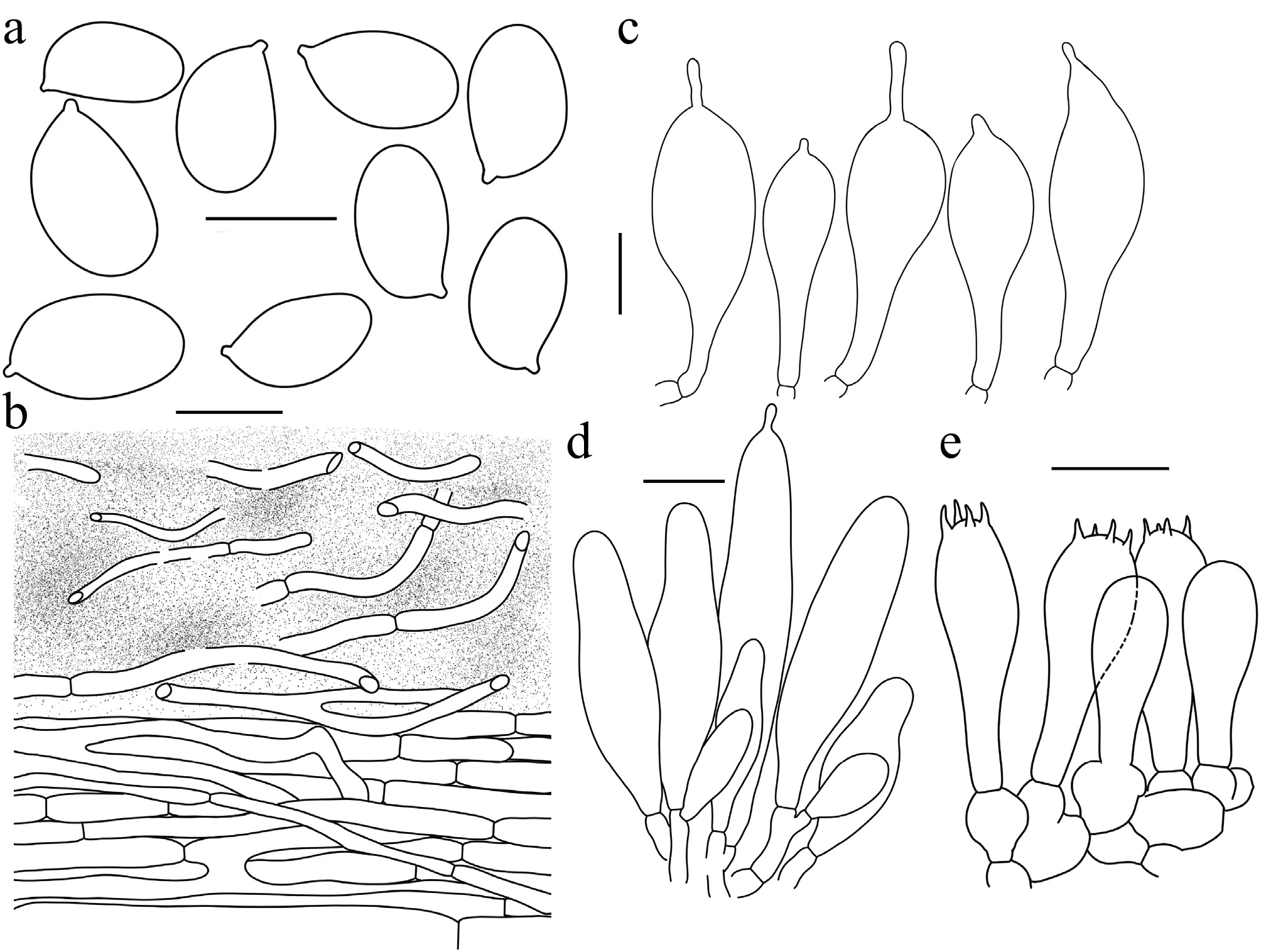
Figure 69.
Volvopluteus yunnanensis (HKAS 151182). (a) Basidiospores. (b) Pileipellis. (c) Pleurocystidia. (d) Cheilocystidia. (e) Basidia. Scale bars: (a) = 10 μm, (b)–(e) = 20 μm.
Habitat and distribution – terrestrial. Solitarily. Reported from southwestern China.
Materials examined – CHINA. Yunnan Province: Kunming City, Panlong District, Kunming Botanical Garden, altitude 1,967 m, terrestrial in forest dominant with Quercus franchetii, 24 June 2024, Zhu-Liang Yang 7151 (HKAS 151182); ibid., 29 June 2024, Xuan Chen 452 (HKAS 150905).
Notes – All specimens in this study were collected from the same province as the type. For a full description see the study[150], and only line drawings are provided here.
After the publication of Vp. yunnanensis, several species belonging to this clade have recently been described from China[149,151]. Our phylogenetic analysis (Fig. 11) indicated that Vp. longipes Xue T. Zhu & L. J. Liu and Vp. striatellus L. Fan & Jia He Li shows a high level of similarity in the ITS region, with a sequence similarity of up to 99.18%, and both species have been reported from northern China. Based on the original descriptions of these two taxa, their morphological characters are highly consistent, except that Zhu et al. did not observe pleurocystidia in Vp. longipes.
-
Modern taxonomy recognizes Pluteus and Volvopluteus as members of the Pluteaceae[20,63], whereas Volvariella is currently placed outside the family[19]. Since the advent of the molecular phylogeny, Moncalvo et al. reconstructed the framework of euagarics using nuclear large ribosomal subunit gene (nLSU) data, in which Volvariella was recovered as a sister group to the /schizophyllum and /fistulinoid fungi clades[152]. In the systematic study of Pluteaceae by Justo et al., Volvariella clustered within the Cantharocybe clade. Recent phylogenomic studies based on three loci (nSSU-ITS-nLSU), however, reveal that Volvariella forms a clade sister to Pluteus and Volvopluteus[3,29]. A case study reconstructed the phylogeny of the suborder Pluteineae using six genes, and Volvariellaceae was proposed to accommodate Volvariella, yet its phylogenetic relationships with the other families within the suborder were largely unsolved[21], the phylogenetic reconstruction indicated that Volvariella clusters with Melanoleuca. Their study proposed raising Volvariella to the family level. Our genome-based phylogeny suggested that Volvariellaceae is close to Limnoperdaceae, with this clade collectively forming the sister lineage to Pluteaceae (Figs 1 and 2).
Divergence time serves as additional criterion for fungal classification[153−156]. The divergence time estimation indicated that the divergence between Pluteaceae and the clade comprising Volvariellaceae and Limnoperdaceae occurred at 98.49 Mya, while the divergence between Volvariellaceae and Limnoperdaceae occurred at 93.66 Mya. These results consistently demonstrate a closer phylogenetic relationship between Limnoperdon and Volvariella (Supplementary Fig. S3).
Based on the genomic phylogenetic analyses (Figs 1 and 2), we detected strong phylogenetic conflicts in the backbone relationship between Pluteaceae and Volvariellaceae/Limnoperdaceae. Qu et al. introduced the extended quadripartition internode certainty (EQP-IC) value as a criterion for suprageneric fungal classifications, with a recommended threshold of 0.1 for each taxonomic rank, and stated that higher EQP-IC values indicate fewer conflicts[3], In our analysis the clade containing Limnoperdon and Volvariella had a low EQP-IC value of 0.04. Consistent with other analytical approaches in this study (Fig. 2), significant phylogenetic conflict was detected, which we attribute primarily to incomplete lineage sorting (ILS).
In the family Pluteaceae, Pluteus is conventionally divided into three sections and the structure of the pileipellis is widely recognized as a key diagnostic character for sectional division[19,20,65,98,157]. Our phylogenetic analysis indicates yet that there are two major clades in Pluteus, which is consistent with the subgeneric classification proposed by Wasser[158], and the hymeniderm pileipellis may have evolved multiple times (Fig. 2). On the basis of prior studies and evidence found in the present work, we propose a modified classification system that divides the genus Pluteus into two subgenera and four sections (Fig. 2).
An important limitation of the present study is the absence of P. paradoxus, P. presleyi, P. brunneovelutinus, and P. neotropicalis in the phylogenomic sampling. Pluteus paradoxus is of particular interest for the infrageneric taxonomy of Pluteus because it possesses an unusual pileipellis structure and previous molecular study has suggested that it may represent an independent lineage distinct from sections Pluteus, Celluloderma, and Hispidoderma[97]. Pluteus presleyi, which is characterized by a cutis pileipellis, also forms an independent clade in the phylogenetic analyses[69]. This result suggests that pileipellis structure alone may not fully reflect the phylogenetic relationships within sect. Celluloderma and related lineages. Pluteus brunneovelutinus is characterized by an epithelioid pileipellis, a feature that clearly distinguishes from most species in sect. Celluloderma. Previous studies have shown that the nrITS sequence of P. brunneovelutinus is closely related to the /diettrichii clade, suggesting that this species may represent an independent lineage rather than a member of sect. Celluloderma. Therefore, its precise systematic position requires further evaluation based on additional collections and multi-locus phylogenetic data.
Pluteus neotropicalis also shows an unusual pileipellis structure, composed of two types of elements. This feature is reminiscent of species in the /podospilloides clade of sect. Celluloderma, in which the pileipellis may include more than one type of terminal cell. Nevertheless, P. neotropicalis differs markedly from members of that clade by its distinctive pleurocystidia, which are subcylindrical or slender fusoid. These characters indicate that P. neotropicalis may represent a morphologically isolated taxon within or near sect. Celluloderma.
Unfortunately, genomic data for the above-mentioned four species are currently unavailable and suitable material was not accessible for sequencing during the course of this study. The inclusion of these taxa will therefore be crucial for future phylogenetic or phylogenomic analyses of the genus.
ILS and IH: contribution to phylogenetic complexity in Pluteaceae particularly in section Pluteus
-
Reconstructing phylogenetic relationships during rapid speciation is challenging, often leading to phylogenetic conflicts between gene and species trees, primarily due to ILS and IH[1]. This challenge is also occur in Pluteineae[3]. We found widespread gene tree incongruence, evidenced by extremely low EQP-IC values in some nodes (near zero), high portion of conflict, and high portion of ILS-i and IH-i (Fig. 2). Our analysis dissected the impacts of ILS and IH on phylogenetic conflicts, thereby resolving key processes in evolution. Our integrative analyses demonstrated that incomplete lineage sorting (ILS) and introgression/hybridization (IH) were the primary drivers of phylogenetic discordance. First, 16 nodes exhibited high ILS indices (>50%), this ILS is in concert with rapid evolutionary radiation. The detection of ILS explains the inconsistent placements of Volvariella in previous studies[3,19,21,29]. However, not all ILS and IH events cause significant phylogenetic conflicts. The species trees and gene trees were largely consistent across other clades except within sect. Pluteus. According to Phylonet result (Fig. 3), extensive IH events occurred within this clade. Introgression/hybridization (IH) creates evolutionary networks that cannot be accurately represented by tree-like models[159−161]. This reticulate evolution manifests directly as phylogenetic conflicts among gene trees. Therefore, reconstructing the evolutionary history of rapidly radiating groups like sect. Pluteus requires moving beyond strictly binary tree-based thinking and incorporating phylogenetic network analyses to further evaluate the extent to which reticulate evolution has shaped the diversification of sect. Pluteus.
Determination of species boundaries in Pluteaceae
-
Speciation is a continuous process that often results in ambiguous taxonomic boundaries[162]. More than 20 distinct species concepts have been proposed[6] due to its efficiency in delimiting species[163]. It should be noted, however, that a species represents only a segment of an evolving lineage rather than its entirety[6]. To avoid over-splitting and excessive lumping, we propose adopting integrative taxonomy with a Bayesian species delimitation threshold of BPP > 0.995 as the standard for testing new species in Pluteaceae. Particularly when describing new species within species complexes, where morphological characters are often subtle, species distinction relies heavily on molecular data. In such cases, phylogenetic analyses require both high-quality sequences and rigorous analytical methods; otherwise, proposing new species within complexes is not recommended.
In terms of molecular marker selection, as universal DNA barcodes for fungi, ITS and tef1 have been extensively employed in both species identification and delimitation[32,164−167]. Within the genus Pluteus, the ITS and tef1 demonstrate high concordance in delimiting the majority of species. However, incongruent species delimitation results were observed between the ITS and tef1 markers in some closely related species such as /semibulbosus clade and /pouzarianus clade. Different datasets produced conflicting topological structures, a common phenomenon in phylogenetic analyses[168,169]. Until the underlying causes of such incongruence are thoroughly investigated, caution should be exercised when describing new species in closely related clades. Recent studies have described several new taxa within species complexes based on morphological and molecular data[18,70]. However, some of these newly proposed species lack support from Bayesian species delimitation analyses (BPP < 0.995) (Supplementary Table S3). Integrated with phylogenetic tree results showing short branch lengths and lack of stable independent clades, these four species require more rigorous evidence to substantiate their reliability as newly described species.
Considering all evidence, comprehensive analysis of Chinese collections of Pluteaceae revealed 59 species. This represents the first comprehensive systematic study of Pluteaceae in China. Finally, incorporating recently described species from China[70,96,113,130,149,150,170,171], 82 species of Pluteaceae in China can be recognized (Supplementary Table S4). The taxonomic significance of these morphological features was thoroughly examined by some researchers[63,127]. We revealed that several macrocopic and microscopic characteristics could be useful for the species delimitation including the color of the basidiomes, the arrangement of fibrils or squamules on the pileus, the size and the shape of basidiospores, the morphology of pleurocystidia and cheilocystidia, and the presence of clamp connections.
In addition, substrate preference could potentially serve as a diagnostic character for Pluteus species. While a few species are terrestrial, the majority are lignicolous. Among these wood decayers, several exhibit distinct substrate preferences. Pluteus leucoborealis on wood of Betuloideae, while P. semibulbosus P. variabilicolor and P. atroflavipes on Fagaceae. Qi et al. also discussed the substrate preferences of Pluteus sect. Hispidoderma and suggested that the preference for angiosperms has, to some extent, promoted the species diversification within this section[70]. Apart from sect. Hispidoderma, species of the remaining two sections also exhibit distinct substrate preferences: they can rot trunks, stumps, branches, or buried limbs of living or dead trees, or grow terrestrial. Furthermore, the shift in substrate preference from angiosperms/gymnosperms to ground and grasslands may provide a plausible explanation for the radiation and ecological niche differentiation observed in Pluteus to some extent.
-
Based on our comprehensive phylogenetic analysis of 121 genome skimming datasets across 98 Pluteineae species, we have reconstructed the most robust phylogenetic framework for Pluteaceae to date. The evidence of widespread lineage sorting (ILS) and introgression/hybridization (IH) among Pluteaceae, especially within Pluteus sect. Pluteus, highlights the complex evolutionary processes shaping their genetic relationships. The phylogenetic network analysis identified multiple IH events, contributing to the high level of phylogenetic conflicts observed within this section. Our divergence time analysis revealed that most species in the Pluteaceae evolved between 50 and 15 Ma, offering new insights into its evolutionary history. Furthermore, the integrative taxonomic approach combining Bayesian phylogenetics and phylogeography (BPP) with morphological and ecological methods allowed for a more accurate species delimitation. We recommend using a BPP support threshold (> 0.995) for testing the independence of new species within Pluteaceae to avoid over-splitting. As a result of this study, we have documented 82 species of Pluteaceae in China, significantly contributing to the understanding of the species diversity and evolution.
-
The specimens used in this study were provided by the Herbarium of Cryptogams of Kunming Institute of Botany, Chinese Academy of Sciences (KUN-HKAS) and collected by The Fungal Diversity and Molecular Evolution Research Group. Therefore, no ethics committee approval was required for this study.
-
The authors confirm contribution to the paper as follows: study conception and design: Yang ZL; data collection: Chen X, Qu H, Qin WQ; analysis and interpretation of results: Chen X; draft manuscript preparation: Chen X, Yang ZL; type studies of Pluteus diettrichii and P. poliocnemis: Ševčíková H. All authors reviewed the results and approved the final version of the manuscript.
-
The data that support the findings of this study are available in the NCBI and CNCB-NGDC repository (Supplementary Table S1). Newly sequenced genomes were deposited in the National Genomics Data Center (NGDC) database under BioProject accession number PRJCA054433 and PRJCA036671.
-
All authors declare that there are no competing interests.
-
accompanies this paper online at: https://doi.org/10.48130/mycosphere-0026-0015.
- Supplementary Table S1 Sequences used for the phylogenetic analysis of Pluteus based on ITS and tef1.
- Supplementary Table S2 Sequences used for the phylogenetic analysis of Volvopluteus based on ITS.
- Supplementary Table S3 Bayesian posterior probability support probability inferred by Bayesian Phylogenetics & Phylogeography (BPP) for species independence within the genus Pluteus. * indicates that the species includes sequences from type material.
- Supplementary Table S4 Checklist of Pluteaceae species reported from China.
- Supplementary Fig. S1 ML tree generated from nrITS dataset of the /cinereofuscus clade and nanus clade.
- Supplementary Fig. S2 Lamella edge of the three clades within Pluteus pouzarianus sensu lato.
- Supplementary Fig. S3 Time-calibrated tree generated using PAML.
- Copyright: © 2026 by the author(s). Published by Maximum Academic Press, Fayetteville, GA. This article is an open access article distributed under Creative Commons Attribution License (CC BY 4.0), visit https://creativecommons.org/licenses/by/4.0/.
-
About this article
Cite this article
Chen X, Qu H, Ševčíková H, Qin WQ, Yang ZL. 2026. Phylogeny and species delimitation of Pluteaceae (Agaricales) with documentation on the species from China. Mycosphere 17: e016 doi: 10.48130/mycosphere-0026-0015 

Phylogeny and species delimitation of Pluteaceae (Agaricales) with documentation on the species from China
- Received: 16 December 2025
- Revised: 02 July 2026
- Accepted: 05 July 2026
- Published online: 24 August 2026
Abstract: Resolving deep phylogenetic relationships remains a central challenge in evolutionary biology due to processes like incomplete lineage sorting (ILS) and introgression/hybridization (IH). Incorporating newly generated genomic data from 121 genome skimming datasets across 98 Pluteineae species, we reconstructed the most robust phylogenetic framework for Pluteaceae, using 672 single-copy orthologs and systematically investigated the underlying causes of hard phylogenetic conflicts. Our data provide evidence for widespread high-level ILS and IH among Pluteaceae. Specifically in Pluteus sect. Pluteus, phylogenetic network analyses revealed extensive introgression events. These complex IH events may account for the high degree of phylogenetic conflicts within sect. Pluteus. A divergence time analysis was performed to reconstruct the evolutionary history and revealed that most species emerged between 50 and 15 Ma. We revised the framework for the genus Pluteus, which comprises two subgenera and four sections. In addition, we employed a taxonomic approach that, based on a multispecies coalescent model inferred by Bayesian phylogenetics and phylogeography (BPP) combined with morphological and ecological criteria, further explores the species delimitation within Pluteaceae. To avoid excessive species splitting, we recommend adopting a BPP support (> 0.995) as a criterion for testing the independence of new species in Pluteaceae, incorporating molecular, ecological, and morphological traits. Having implemented the above-mentioned approaches, this study has recognized and documented a total of 82 species of Pluteaceae in China, with descriptions of a new section and seven new species. Keys for identification of the species are provided.
-
Key words:
- Integrative taxonomy /
- New taxa /
- Phylogenetic conflicts /
- Systematics