











-
Plastics have become an integral component of modern life. However, unsustainable production and disposal practices have led to the release of considerable quantities of plastic waste into the environment, causing severe plastic pollution. Currently, plastic pollution, including microplastic contamination and associated chemical contaminants, has emerged as one of the most urgent environmental challenges globally, posing significant threats to both ecosystems and human health. The UNEA-5[1] endorsed a landmark resolution to address the serious and growing issue of plastic pollution, calling for establishing a legally binding international agreement in the foreseeable future.
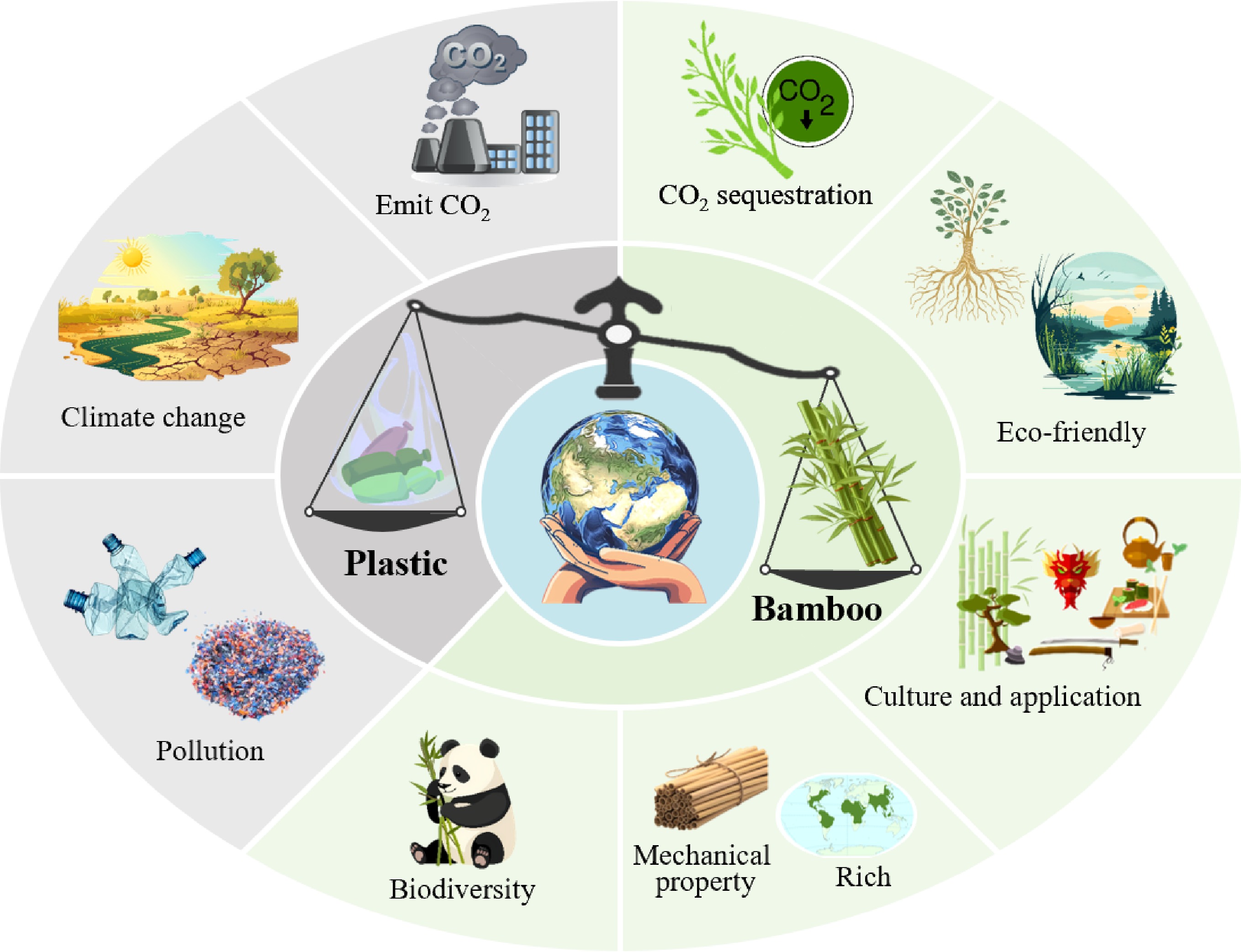
Indeed, there is no 'one-size-fits-all' solution to plastic pollution; instead, it is essential to incorporate all contributors into the strategy, such as the development of sustainable material alternatives. As a promising alternative, natural materials could reduce traditional plastic usage, while simultaneously meeting consumer demand. For instance, polylactic acid, a typical biodegradable plastic, has been successfully used in biomedical devices as an alternative to fossil-based plastics. The Chinese government and the International Network for Bamboo and Rattan have recently co-launched the 'Bamboo as a Substitute for Plastic (BASP) Initiative' to promote a global shift from plastic to bamboo, particularly in daily life and packaging. This initiative presents a promising solution to plastic pollution, leveraging bamboo's extensive distribution and renewability (Table 1). As expected, transitioning from plastic to bamboo would contribute to realizing the Goals designed in the 2030 Agenda for Sustainable Development (
https://sdgs.un.org/goals ).Table 1. Bamboo distribution and species diversity on a global scale
Region Subregion Country Area (× 104 hm2) Species Asia East Asia China 682 700[2] 857[2] Japan 16 230[2] Korea 2 19[2] South Asia India 1,742 1,871.2[2,3] 136[2] Bangladesh 49 33[2] Nepal 6 53[2] Sri Lanka 74 19[2] Southeast Asia Laos 224 1,236.5[2,3] 86[2] Indonesia 210 160[2] Vietnam 153 216[2] Cambodia 12 Data not available Malaysia 500 70[2] Philippines 25.6 62[2] Myanmar 85.9 102[2] Thailand 26 72[2] Africa East Africa Ethiopia 148 179 42 Kenya 14 41 Tanzania 13 6 Uganda 5 13 West Africa Nigeria 159 245 2 Senegal 66 2 Ghana 20 22 Central Africa Cameroon 122 122 8 South Africa Madagascar 112 162 33 Mozambique 50 8 North America Caribbean region 13[3] 39[3] South America Brazil 537 691[3] 258 Colombia 4 105 Ecuador 60 47 Chile 90 14 Given the inherent dualities present in each solution, this study critically evaluates the dual advantages and limitations of bamboo-based materials as a substitute for plastic by analyzing its technical, ecological, and sociocultural benefits while addressing key challenges to its global adoption (Fig. 1). This study seeks to provide comprehensive insights into this promising alternative, and enhance its application in mitigating plastic pollution at international, regional, and national scales.
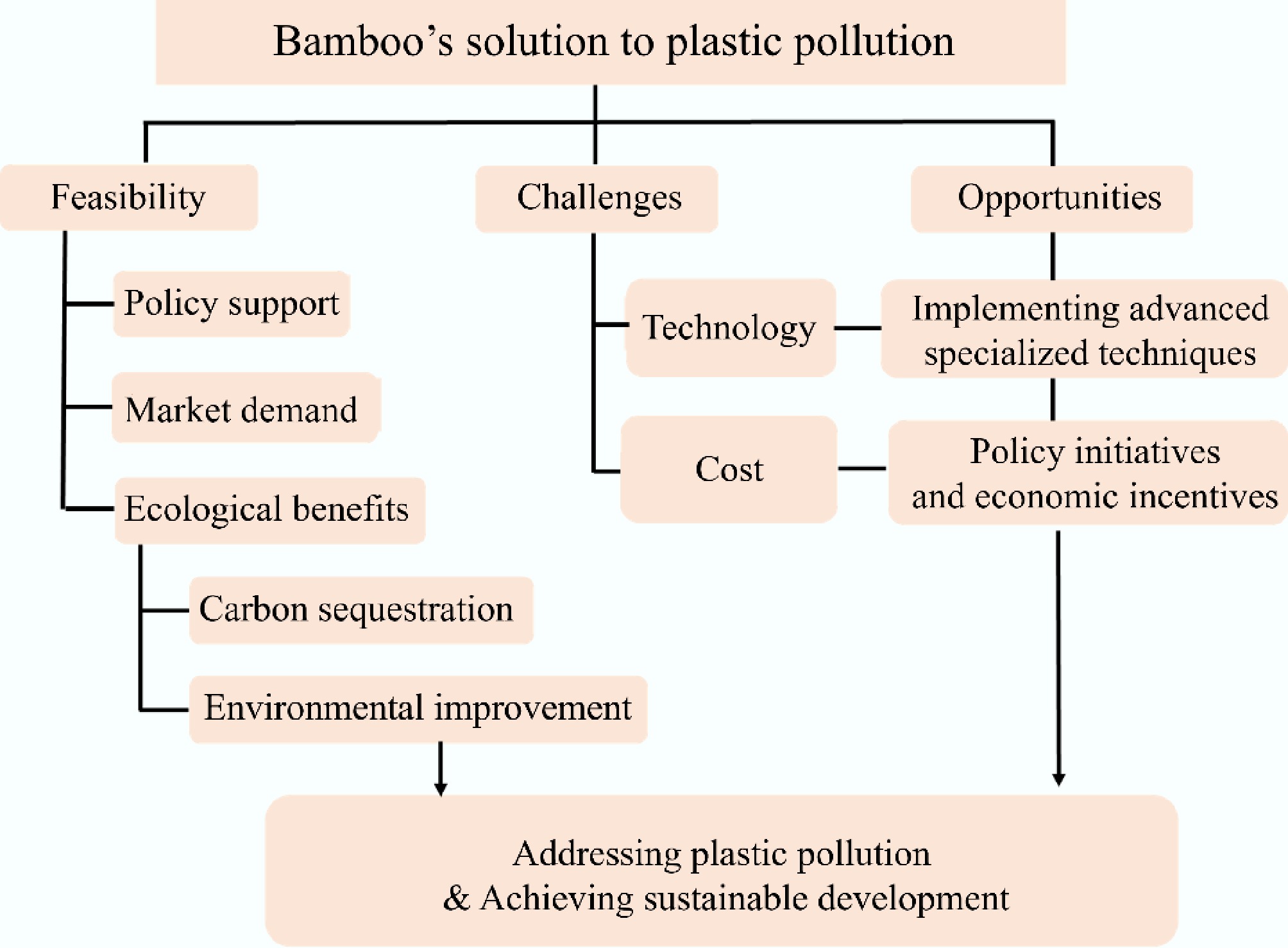
Figure 1.
Framework scheme for the bamboo strategy.
HTML
-
Since 2016, a total of 88 countries/regions and four international/regional organizations have implemented strict regulations and policies to ban or restrict the use of single-use plastic bags, and 175 representatives—accounting for more than 90% of the world's total number of countries—have also co-signed a resolution in 2022 to end plastic pollution. These actions indicate that most countries are intensifying their efforts to combat plastic pollution. These initiatives provide a robust policy foundation for the global implementation of the BASP initiative. Furthermore, prohibiting or restricting traditional plastic products, particularly single-use plastics, will inevitably stimulate a heightened demand for non-plastic alternatives. This shift presents a significant market opportunity for BASP, which aims to transition from plastic to bamboo-based materials.
Technical advancements boosting bamboo performance
-
Bamboo fiber exhibits excellent mechanical properties, including low shrinkage, remarkable elasticity, and toughness. For instance, the tensile strength of the fiber is two to three times greater than that of steel[4]. Recently, a high-density engineered bamboo composite was developed, with a tensile strength of up to 1 GPa, and a flexural strength of 400 MPa while maintaining a lightweight profile; its tensile properties significantly surpass those of conventional plastics and even some metals[5]. The rapid advancement of bamboo product processing technologies has expanded the applicability of bamboo beyond traditional uses. Advances in research have also facilitated the development of engineered bamboo materials, which are now widely used in pipelines, housing, and various construction sectors. Notably, the service life of bamboo-based pipes can exceed 50 years, positioning them as viable alternatives to conventional plastic pipes and even metal piping systems.
Cultural connotation enhances global recognition
-
Bamboo is deeply rooted in many regions' cultural heritage and historical traditions, with widespread acceptance and recognition of bamboo-based products worldwide. In China, South Korea, and some African countries, bamboo-based materials have a long history of use in daily necessities and construction, such as writing materials and furniture. At the same time, some regions in Europe and the United States have also adopted bamboo-based materials for building and decoration. Integrating performance and cultural acceptance is more conducive to fostering global adoption of the initiative, promoting a more expansive use of bamboo-based materials. Moreover, an increase in bamboo-based production could improve the well-being of women and communities by fostering job creation in developing nations.
Plastic-ban policy boosting market demand
-
Bamboo exhibits a remarkable capacity for carbon sequestration in comparison to other types of vegetation, resulting in low carbon emissions across its entire life cycle. For instance, moso bamboo sequesters approximately 5.09 t/hm2 of atmospheric carbon and can absorb up to 12,000 kg of CO2 per hectare annually during its growth phase[6]. This is 1.46 times higher than fir forests, and 1.33 times higher than tropical rainforests[7]. Furthermore, bamboo requires less energy during its processing than plastics, reducing carbon emissions. Particularly during its end-of-life disposal, carbon stored in bamboo can be sequestered through environmentally friendly landfill treatment. In contrast, the production of 1 kg of fossil-based plastics emits 2.3 kg of CO2-equivalent greenhouse gases[8], and global plastic production and usage contribute to the annual emission of approximately 1,700 billion kg of CO2-equivalent throughout their entire life cycle[9]. Most notably, bamboo's substantial carbon sequestration potential is in alignment with global climate agreements, thereby reinforcing the advantages associated with its widespread application.
Bamboo cultivation improves environmental quality
-
Bamboo, an herbaceous plant with a deep and extensive root system, can stabilize soil structure, minimize moisture loss, and reduce water evaporation. The fallen branches and leaves of trees provide a rich source of organic matter for the soil[10], which effectively restores soil fertility and prevents land degradation. Furthermore, bamboo planting can effectively capture precipitation and replenish groundwater resources, thereby reducing surface runoff to prevent flooding risks and enhancing the sequestration of water resources. As the most common plant in Sri Lanka, bamboo is extensively used in nature-based adaptation strategies to combat soil erosion and flooding[11]. Bamboo forests also play a crucial role in regulating local microclimates by effectively absorbing and sequestering atmospheric CO2, thereby improving regional ecosystem quality. Additionally, bamboo cultivation requires minimal fertile soil and can effectively utilize the resources available in barren mountain areas. In turn, this land utilization pattern could significantly boost the sustainability of the bamboo plantation industry.
Bamboo cultivation enriches food and medicinal resources
-
Bamboo plantations can not only supply substantial manufacturing materials but also offer diverse food sources for wildlife and humans. For instance, pandas rely upon bamboo as their primary source of nutrition. Moreover, bamboo forests serve as habitats for various wildlife species. A notable example can be observed in the bamboo forests of Peru, which serve as a habitat for a rich diversity of mammals and birds. Twenty-five of 440 bird species in the Amazon rainforest are exclusively endemic to these unique ecosystems[11]. Bamboo leaves have also been historically employed as a traditional medicine for treating various diseases, such as fever, due to their diverse bioactive components.
Bamboo cultivation boosts carbon sequestration
-
Bamboo has a multi-component structure in which cellulose, hemicellulose, and lignin are intricately crosslinked through strong hydrogen and covalent bonds[12]. Processing bamboo in bulk through heating, melting, or softening is challenging. Additionally, bamboo is highly rigid and brittle and lacks the self-adhesion property of traditional plastics[13]. These features result in frequent splitting during processing, thereby increasing production costs. Moreover, bamboo fibers form agglomerates during processing due to their large aspect ratio and surface roughness. Consequently, implementing advanced specialized techniques is essential to address these critical issues. For instance, a bamboo informatics approach has recently been proposed for engineered bamboo-based materials, aiming to shift bamboo from a non-conventional material to a fundamental one within construction applications.
Relatively high cost of production
-
Bamboo plantations are often located in remote mountainous areas, leading to high harvesting and transportation costs—a geographical disadvantage that hinders price competitiveness against plastic alternatives. It is estimated that the cost of disposable bamboo fiber food containers is two to three times higher than that of plastic containers. Consequently, market consumption favors the more affordable traditional plastic because of the elevated prices associated with substituting plastic with bamboo products. This preference limits market demand for bamboo-based materials and significantly challenges their promotion and application. The BASP is an emerging industry grappling with uneven mechanization and low automation in bamboo processing. Policymakers, including the Chinese government, are implementing robust strategies to promote bamboo-based production and its applications through policy initiatives and economic incentives. These efforts will drive the rapid development of the bamboo-based industry and are expected to significantly reduce the costs of bamboo-based materials in the coming years.
Recommendations for future work
-
As an emerging natural alternative to fossil fuel-derived plastics, it is imperative to dedicate further efforts toward conducting a comprehensive feasibility assessment. For instance, the potential carbon emissions and associated environmental risks arising from various aspects such as wastewater discharge, odor, and gaseous emissions, as well as solid residues produced during the processing of bamboo materials, should be thoroughly evaluated. Particularly, future research should encompass region-specific Life Cycle Assessments (LCA) that evaluate the carbon footprint, water consumption, and end-of-life scenarios associated with bamboo products. This assessment must consider various factors, including carbon footprint, water usage, land efficiency, and end-of-life implications. Simultaneously, international standards for the production of bamboo materials should be established to ensure quality consistency and cost competitiveness. After all, the quality and pricing of these products are the two fundamental factors that influence the adoption of bamboo-based materials. Furthermore, strengthening global coordination and cooperation is also essential in addressing technical challenges and expanding market applications for bamboo products. This aligns with the collective objectives designed to tackle global plastic pollution.
In conclusion, BASP presents a landmark opportunity amid global efforts to control plastic pollution and promote sustainable development. In particular, the bamboo initiative would be a model for identifying other natural solutions. However, transitioning from plastic to bamboo still faces various challenges, including technical processing difficulties and high production costs. Addressing these issues requires balancing economic development and environmental protection through close global collaboration and continuous technological innovation. Through strengthened international collaboration, technological innovation, and supportive policy frameworks, bamboo has the potential to make a substantial contribution to mitigating plastic pollution and promoting the objectives of a circular economy. Despite numerous technological and market challenges, the prospects for BASP continue to be encouraging, especially considering the pressing necessity to tackle global plastic pollution and achieve sustainable development goals worldwide.
Technical limitations in bamboo processing
We thank anonymous reviewers for their helpful comments during the review process.
-
Not applicable.
-
The authors confirm their contributions to the paper as follows: methodology, investigation, formal analysis, writing − original draft: Jiao H; funding acquisition: An L; supervision: Wu F; data curation: Zhao T, Wang Y; conceptualization: Zhao S, An L; writing − review and editing: Zhao S, LeBlanc GA, An L. All authors reviewed the results and approved the final version of the manuscript.
-
Data sharing is not applicable to this article as no datasets were generated or analyzed during the current study.
-
This work was supported by the National Natural Science Foundation of China (22276179).
-
The authors declare that they have no conflict of interest.
-
Full list of author information is available at the end of the article.
- Copyright: © 2025 by the author(s). Published by Maximum Academic Press, Fayetteville, GA. This article is an open access article distributed under Creative Commons Attribution License (CC BY 4.0), visit https://creativecommons.org/licenses/by/4.0/.
Jiao H, Zhao T, Wang Y, Zhao S, LeBlanc GA, et al. 2025. Bamboo's solution to plastic pollution: feasibility and challenges ahead. New Contaminants 1: e008 doi: 10.48130/newcontam-0025-0008


|