












-
Microorganisms occupy an extraordinary range of extreme environments, from hydrothermal vents to hypersaline lakes, where they withstand elevated temperatures, acidity, salinity, or pressure. These adaptations reflect remarkable genetic and physiological strategies for survival[1−4]. Thermophilic species are well studied among Archaea and Bacteria[5], yet fungi remain comparatively neglected in extremophile research. In fungi, thermophilic species are typically defined as those with a minimum growth temperature at or above ~20 °C, and an optimum at ≥ 45–50 °C, with little or no growth at lower temperatures. In contrast, thermotolerant fungi can grow at elevated temperatures, but also grow well below 20 °C, indicating tolerance rather than dependence on heat[6]. A third category, thermoresistant fungi, refers to taxa that can survive short-term exposure to high temperatures without sustaining active growth at those temperatures[7]. This trait is commonly associated with resistant propagules such as conidia or ascospores rather than thermophilic metabolism.
Fewer than 50 truly thermophilic fungal species have been described worldwide[2,8], whereas thermotolerant fungi are more broadly distributed and frequently encountered in environments subject to episodic heat stress, such as composts and soils. Recent comparative genomics reveal convergent evolutionary adaptations in thermophilic fungi, such as expansions of thermostable enzyme families and gene losses incompatible with high temperatures[9]. Together, these distinctions underscore that thermophily, thermotolerance, and thermoresistance represent biologically distinct strategies, each with different ecological and evolutionary implications, highlighting the functional as well as taxonomic diversity of heat-associated fungi.
Caves represent distinctive subterranean ecosystems that support unique fungal assemblages, including taxa adapted to darkness, high humidity, oligotrophy, and in some cases, thermal stress. Here we use 'hot caves' to refer to caves maintaining persistently elevated temperatures (often ≥ 30 °C) and high humidity, commonly associated with restricted ventilation and metabolic heat release from dense bat colonies and guano decomposition[10]. Hot caves in Puerto Rico have been reported to host bat assemblages dominated by species such as Artibeus jamaicensis, Brachyphylla cavernarum, Erophylla bombifrons, Eptesicus fuscus, Mormoops blainvillei, Monophyllus redmani, Noctilio leporinus, Pteronotus portoricensis, and Pteronotus quadridens[11]. Global surveys have shown caves to harbor high fungal diversity: in Taiwan, thermotolerant species such as Aspergillus niger, A. tamarii, and Byssochlamys sp. were recovered[12], while in southern Spain, communities included Fusarium, Arthroderma, Aspergillus, and Penicillium, with guano and tourism introducing coprophilic and entomopathogenic fungi[13]. More recently, a sequence-based synthesis cataloged over 1,400 fungal sequences from caves worldwide, dominated by Ascomycota and especially Eurotiomycetes, with Aspergillus and Penicillium showing particularly high richness[14]. Complementary reviews of subterranean microbial communities emphasize that guano and arthropod inputs act as strong filters structuring cave fungal assemblages, and that substantial beta-diversity exists both between, and within caves[15].
In addition to soils and guano, cave air has emerged as an overlooked niche for fungal dispersal and colonization. In Portugal, a surprisingly broad taxonomic spectrum of airborne fungi was demonstrated using culture-dependent and metabarcoding approaches, underscoring the value of aerobiological monitoring in conservation contexts[16]. This complements work on bat guano, which serves as a hotspot for microbial activity and diversity. Guano harbors coprophilic, saprotrophic, and sometimes pathogenic fungi, and its composition is shaped by bat diet and environmental conditions[17]. Since bat populations are central to hot cave ecology, their biology and microbiome strongly influence cave fungal communities. Indeed, reviews of bat gut microbiota show how host ecology and roosting behavior can structure associated microbial assemblages, with implications for cave ecosystems and potential zoonotic interfaces[18].
In Puerto Rico, surveys have revealed guanophilic and coprophilic fungi from caves, including Circinella umbellata and numerous basidiomycetes and ascomycetes[19], as well as abundant Aspergillus and Rhodotorula in Cueva Los Culebrones[20]. Functional potential has also been documented, as protease-producing species of Aspergillus, Penicillium, and Trichoderma have been reported from cave isolates[21]. Most recently, an ITS-based survey across seven northern karst caves revealed clear differences in fungal community composition among sites, highlighting the ecological distinctiveness of Puerto Rican cave microbiomes[22]. Yet, despite these advances, no study has specifically focused on thermoresistant fungi in Puerto Rican caves, even though hot caves combine elevated temperature, organic enrichment, and intense microbial activity. These conditions are likely to favor both cosmopolitan thermotolerant species and novel lineages.
Beyond their taxonomic novelty, thermotolerant fungi contribute significantly to organic matter decomposition, nutrient cycling, and the maintenance of guano-rich microhabitats that support other cave biota. At the same time, caves are fragile ecosystems, increasingly threatened by human disturbance, tourism, and climate change[15,16]. Documenting fungal diversity is therefore essential, not only for understanding microbial adaptation in extreme subterranean environments, but also for informing conservation strategies. While thermophilic fungi have attracted attention as agents of industrial processes[23], their ecological roles and unexplored diversity in cave habitats remain underrepresented.
The present study addresses this knowledge gap by providing the first targeted inventory of thermoresistant fungi from three hot caves in Puerto Rico: Cueva Culebrones, Cueva Matos, and Cueva Tuna. By integrating morphology and sequencing of the nuclear ribosomal internal transcribed spacer (ITS) region, we characterize their cultivable diversity, identify taxa potentially representing undescribed lineages, and discuss their ecological significance. In doing so, this work expands the understanding of fungal diversity in Caribbean caves and highlights their importance as reservoirs of both ecological novelty and biotechnological potential.
-
Soil samples were collected from three cave sites in Puerto Rico: Cueva Matos and Cueva Culebrones (Arecibo), and Cueva Tuna (Cabo Rojo) (Fig. 1). At each site, ten soil samples were obtained at randomly selected points using sterile scoops and Whirl-Pak® bags. Samples were immediately placed in a cooler for transport and processed within 24 h of collection. For each sample, 10 g of soil was suspended in sterile distilled water and agitated for 30 min at 200 rpm using a mechanical shaker. Each sample was processed in a triplicate. Resulting suspensions were subdivided into three treatment groups: (1) incubation at 25 °C (control); (2) incubation at 75 °C; and (3) incubation at 90 °C for 30 min in separate water baths. Heat exposure for 30 min was used as a standardized selection step to enrich for heat-adapted propagules and reduce the abundance of non–heat-tolerant fungi. Comparable heat-shock selection conditions (e.g., 75 °C for 30 min) are widely used to isolate heat-adapted/heat-resistant fungi from environmental matrices[24], though the optimal duration may vary across taxa and substrates. Therefore, our results are interpreted as 'heat-selected/thermoresistant' under the conditions tested. Following incubation, 1 mL of each suspension was plated onto Czapek Yeast Extract Agar (CYA), supplemented with chloramphenicol (50 mg L−1), and gentamicin (100 mg L−1) to suppress bacterial growth. Plates were incubated at 25 ± 2 °C for 7 d. After incubation, fungal colonies were enumerated, and distinct morphotypes were isolated onto Czapek–Dox Agar supplemented with the same antibiotics to obtain pure cultures. Preliminary identification of fungal isolates was based on macroscopic colony characteristics and microscopic morphology using lactophenol cotton-blue staining.
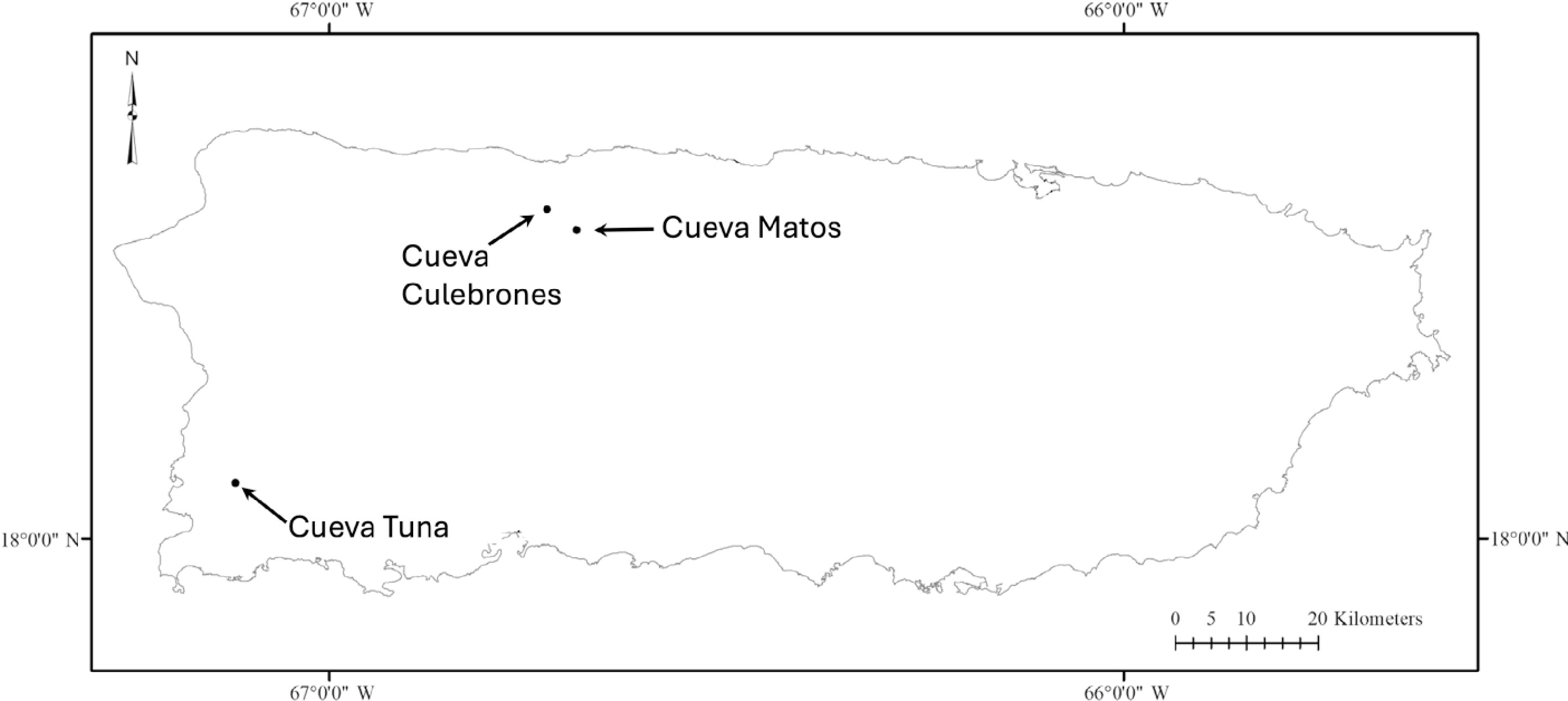
Figure 1.
Map of Puerto Rico showing the caves included in this study. Modified from Rodríguez-Durán et al.[11].
DNA extraction
-
Genomic DNA was extracted from fresh fungal cultures using a modified rapid extraction protocol[25]. Selected morphotypes were cultured on Sabouraud Dextrose Agar (SDA) and incubated at 25 °C for 5 d. Mycelium was carefully scraped from the agar surface with a sterile spatula and transferred into 1.5 mL microcentrifuge tubes containing 300 µL of extraction buffer (200 mM Tris–HCl, pH 8.5; 250 mM NaCl; 25 mM EDTA; 0.5% SDS). Samples were homogenized by sonication with three 10 s pulses, with 10 s rest intervals between pulses. Subsequently, 150 µL of 3 M sodium acetate (pH 4.5) were added, and samples were gently inverted three to six times and incubated at −20 °C for 20 min. Samples were centrifuged at 14,000 rpm for 2 min, and the supernatant was transferred to a clean tube. DNA was precipitated by adding one volume (~500 µL) of molecular-grade isopropanol and incubating at room temperature for 5 min. After centrifugation (14,000 rpm, 2 min), the DNA pellet was washed with 500 µL of ice-cold 70% ethanol, centrifuged again, and air-dried overnight in a biosafety cabinet. Pellets were resuspended in 50 µL of molecular-grade water and stored at −20 °C until further use.
Polymerase chain reaction (PCR)
-
The nuclear ribosomal internal transcribed spacer (ITS) region was amplified using the universal fungal primers ITS1 (5′-TCC GTA GGT GAA CCT GCG G-3′), and ITS4 (5′-TCC TCC GCT TAT TGA TAT GC-3′)[26]. PCR reactions were prepared using GoTaq® Green Master Mix (Promega Corporation; Cat. No. M7122). Thermal cycling conditions were as follows: initial denaturation at 94 °C for 2 min; 30 cycles of denaturation at 94 °C for 30 s, annealing at 54 °C for 30 s, and extension at 72 °C for 1 min, followed by a final extension at 72 °C for 5 min.
PCR products were visualized by electrophoresis on 1.5% agarose gels stained with ethidium bromide (0.5 µg mL−1) and photographed using a GelDoc Go Imaging System (Bio-Rad Laboratories, CA, USA). Amplicons of the expected size (~450 pb) were purified and sequenced bidirectionally using ITS1 and ITS4 primers by Molecular Cloning Laboratories (MCLAB, San Francisco, CA, USA).
DNA sequence analysis
-
Sequence chromatograms were inspected, trimmed, and assembled into consensus sequences using Geneious® v.2025.2.1 (Biomatters, Auckland, New Zealand;
www.geneious.com ). Taxonomic assignments were performed using the UNITE database (https://unite.ut.ee ) with default search parameters to identify the closest matching fungal taxa based on ITS sequences[27]. All newly generated ITS sequences were deposited in GenBank under accession numbers PV882463–PV882482. ITS is an effective primary barcode for broad fungal identification[28−30]. However, ITS alone may not resolve species boundaries in some genera (e.g., Aspergillus, Penicillium, Trichoderma). Accordingly, identifications were reported conservatively when sequence similarity was insufficient for confident species assignment, and future work will incorporate secondary loci (e.g., BenA/CaM/TEF1α) for species-level resolution where needed. -
A total of 34 thermoresistant fungal isolates were recovered, comprising eight isolates from the 75 °C treatment and 26 from the 90 °C treatment. The recovered fungi included filamentous species belonging to the genera Aspergillus and Penicillium, as well as a single yeast species from the genus Rhodotorula. The distribution of isolates obtained per treatment for each cave is summarized in Table 1. In the control groups, the identified fungi included species from the genera Penicillium, Aspergillus, Purpureocillium, Cladosporium, Trichoderma, and Sporulariopsis. Taxonomic annotation of representative isolates based on the UNITE database is presented in Table 2.
Table 1. Fungal isolates recovered from cave soil samples following temperature treatments.
Temperature treatment Number of fungal isolates Cueva Culebrones Cueva Matos Cueva Tuna 25 °C (control) 27 9 18 75 °C 4 0 4 90 °C 5 10 11 Table 2. Molecular identification and taxonomic annotation of representative fungal isolates using the UNITE database.
Isolate Locationa Heat toleranceb UNITE Blastn annotation Species Max. ID percent GenBank accesion number MP7-2-25 CC N Arachnotheca glomerata 89.48 MH860158 MP6-5c-25 CC N Arachnotheca glomerata 88.66 MH860158 CT3-1-75 CT Y Aspergillus 96.28 MT732784 CT8-3-25 CT N Aspergillus sydowii 100 PQ637414 MP1-3-25 CC N Aspergillus tamarii 99.74 PQ804337 CT8-6-25 CT N Aspergillus terreus 100 PQ789219 MP6-2-90 CC Y Aspergillus versicolor 99.66 OR259030 MP6-1-90 CC Y Aspergillus versicolor 100 PQ637403 MP6-5-25 CC N Blastobotrys mokoenaii 100 OM904991 CM4-2-90 CM Y Cladosporium xanthochromaticum 99.81 PQ037767 CT8-2-25 CT N Geosmithia pallida 99.46 MH426779 CT9-2-90 CT Y Paecilomyces formosus 100 PP191151 MP9-6-25 CC N Penicillium 100 KX961209 MP8-1-25 CC N Penicillium 100 PQ268904 CM5-2-25 CM N Penicillium 100 PQ268904 B8 CM N Penicillium citrinum 100 UDB023806 CT2-1-90 CT Y Periconia macrospinosa 100 PP069923 MP6-1-75 CC Y Talaromyces allahabadensis 100 UDB035160 CT3-2-90 CT Y Trichoderma 100 PQ784313 CM5-1-25 CM N Trichoderma virens 99.62 UDB0802761 a CC = Cueva Culebrones; CM = Cueva Matos; CT = Cueva Tuna.
b Y = yes; N = no. -
A total of 88 fungal isolates were recovered from soil samples collected in Tuna Cave (Cabo Rojo), Matos Cave (Arecibo), and Mata de Plátano Cave (Arecibo). Of these, 34 isolates demonstrated thermoresistance, comprising eight isolates from the 75 °C treatments and 26 from the 90 °C treatments. The majority of thermoresistant isolates belonged to the genera Aspergillus and Penicillium, while a single yeast assigned to Rhodotorula was also recovered. The numerical dominance of Aspergillus and Penicillium aligns with repeated cave fungal surveys that have documented Eurotialean taxa as common and frequently abundant in subterranean mycobiomes[31,32]. Experimental and genomic studies further indicate that heat tolerance in some Aspergillus lineages is supported by specific adaptive genetic mechanisms, including traits associated with stress response and protein stability[9,33,34]. The presence of a thermoresistant Rhodotorula isolate is also consistent with observations demonstrating capacity for oxidative stress protection in this yeast[35].
Several taxa recovered following heat treatment belong to fungal groups previously reported as thermotolerant or capable of surviving transient exposure to elevated temperatures. Members of the order Eurotiales, including Aspergillus, Penicillium, and Talaromyces, are well documented for producing heat-resistant propagules and have been frequently isolated from thermally influenced environments such as composts, warm soils, and caves. These genera are also among the most commonly reported fungi from bat guano and cave sediments worldwide, suggesting that their recovery from Puerto Rican hot caves is ecologically consistent rather than incidental.
The detection of Talaromyces allahabadensis and Paecilomyces formosus among thermoresistant isolates further supports the presence of stress-tolerant, but non-obligate, heat-associated fungi in cave soils. Species within these genera have been reported from warm substrates and, less frequently, from cave ecosystems, although they are not typically considered obligate thermophiles. Similarly, Periconia macrospinosa and Cladosporium xanthochromaticum are widely distributed environmental fungi that have been documented in caves and other low-light habitats, and their survival following heat treatment suggests the presence of resistant propagules rather than active high-temperature growth.
Importantly, several thermoresistant isolates recovered in this study exhibited low ITS sequence similarity to described taxa (see Table 2), indicating that hot cave environments may harbor poorly sampled or potentially undescribed fungal lineages. While ITS alone does not permit formal taxonomic resolution, these findings highlight limitations in current reference databases for cave-associated and thermoresistant fungi, and emphasize the need for expanded taxonomic and genomic characterization of subterranean mycobiota.
As expected, the control groups (25 °C) yielded the highest apparent species richness, although in several instances fungal recovery was limited by bacterial and fungal overgrowth. Caves are known to support diverse fungal assemblages under ambient conditions, including saprobic and guanophilic species[19,36]. In caves influenced by tourism or animal activity, fungal communities may reflect environmental inputs[37], and bat-associated environmental microbiology has been shown to influence fungal exposure, dispersal, and substrate availability[17,18]. In Puerto Rican caves, prior studies have documented diverse soil- and guano-associated fungi, indicating that the regional subterranean mycobiome is not depauperate[20,22].
Taken together, these patterns suggest that thermoresistant fungi in Puerto Rican karst caves are not randomly distributed, but instead are concentrated within lineages repeatedly associated with heat tolerance and thermophily[2,8,23]. The predominance of Aspergillus and Penicillium spp. across all three caves, particularly in the 90 °C treatments, supports the existence of a core guild heat-resistant fungi capable of persisting under extreme thermal stress in subterranean environments. The detection of Talaromyces allahabadensis, Paecilomyces formosus, Periconia macrospinosa, and Cladosporium xanthochromaticum further indicates that cave soils may harbor thermoresistant taxa beyond those classically associated with compost and hot substrate model systems[1,3,5].
In contrast, the detection of Arachnotheca glomerata and Blastobotrys mokoenaii exclusively in control samples suggests that some cave fungi are highly sensitive to thermal stress and may represent mesophilic or cave-adapted lineages. Overall, these results represent a targeted but preliminary characterization of thermoresistant fungi in Puerto Rican caves. To our knowledge, this study constitutes the first focused survey of heat-selected fungi from hot caves in Puerto Rico, providing new insight into the composition and ecological filtering of fungal communities in thermally influenced Caribbean cave systems. Future work will benefit from refined multilocus identification[38], expanded taxonomic reference frameworks, and integrated culture-dependent and culture-independent approaches, which have proven informative in other subterranean environments[16,39]. Given the recognized potential of caves as reservoirs of unexplored metabolic and taxonomic diversity[14,15], coupling physiological assays with genomic analyses will be essential to understanding whether thermoresistance in Caribbean caves reflects conserved evolutionary strategies, convergent adaptations, or strong environmental filtering.
Not applicable.
-
The authors confirm their contributions to the paper as follows: study conception and design: Nieves-Lozano SA, Chabrán-Colón PC, Ginard-Pacheco AI, Hernández-Soto LG, Rosado-Rodríguez G; data collection, analysis and interpretation of results, draft manuscript preparation: Nieves-Lozano SA, Chabrán-Colón PC, Ginard-Pacheco AI, Hernández-Soto LG, Ruiz-Mercado B, Rosado-Rodríguez G; final manuscript revision: Rosado-Rodríguez G. All authors reviewed the results and approved the final version of the manuscript.
-
The datasets generated during and/or analyzed during the current study are available from the corresponding author upon reasonable request.
-
The authors declare that they have no conflict of interest.
- Copyright: © 2026 by the author(s). Published by Maximum Academic Press, Fayetteville, GA. This article is an open access article distributed under Creative Commons Attribution License (CC BY 4.0), visit https://creativecommons.org/licenses/by/4.0/.
-
About this article
Cite this article
Rosado-Rodríguez G, Nieves-Lozano SA, Chabrán-Colón PC, Ginard-Pacheco AI, Hernández-Soto LG, et al. 2026. Survey and characterization of heat-resistant fungi from cave ecosystems in Puerto Rico. Studies in Fungi 11: e017 doi: 10.48130/sif-0026-0009 

Survey and characterization of heat-resistant fungi from cave ecosystems in Puerto Rico
- Received: 08 November 2025
- Revised: 09 January 2026
- Accepted: 03 March 2026
- Published online: 27 May 2026
Abstract: Hot caves represent thermally influenced subterranean habitats where microbial communities may be shaped by elevated temperature and guano-driven nutrient inputs. We surveyed cultivable heat-selected fungi from three Puerto Rico caves (Cueva Culebrones, Cueva Matos, and Cueva Tuna) by incubating soil suspensions at 25 °C (control), 75 °C, or 90 °C for 30 min, followed by cultivation on antibiotic-supplemented media and ITS rDNA sequencing. We recovered 34 thermoresistant isolates, including eight from 75 °C, and 26 from 90 °C treatments, dominated by Eurotialean taxa (e.g., Aspergillus, Penicillium, Talaromyces), along with Cladosporium, Paecilomyces, Trichoderma, Periconia, and one Rhodotorula. Several isolates showed < 95% ITS similarity to described taxa, suggesting potentially undescribed lineages, and some identifications were conservatively retained at the genus level where ITS resolution was limited. This study provides the first targeted inventory of heat-selected fungi from Puerto Rico hot caves and highlights these habitats as reservoirs of unexplored fungal diversity.
-
Key words:
- Thermoresistant fungi /
- Cave mycobiota /
- Fungal biodiversity /
- Puerto Rico karst /
- Hot caves