









Search
2025 Volume 4
Article Contents
PERSPECTIVE   Open Access    

Soil organic carbon storage from biochar addition falls over time: a perspective of shifts in soil extracellular enzyme activity

More Information
  • The effects of biochar addition on soil organic carbon storage vary across different ecosystems and temporal scales due to the poor mechanistic understanding of the microbially mediated soil organic carbon cycling with biochar addition. Extracellular enzymes produced by plants and soil microorganisms play a crucial role in the decomposition of organic matter and the regulation of soil organic carbon cycling. Biochar addition may affect cellulase and ligninase enzyme activities through altered soil organic matter chemistry and microbial community restructuring. This perspective proposes that biochar addition generally enhances ligninase activity targeting complex carbon macromolecules while suppressing cellulase activity targeting readily decomposable carbon compounds. These contrasting responses help explain the reductions in soil organic carbon storage associated with long-term biochar addition. It is important to note that soil organic carbon sequestration is influenced by both carbon inputs and outputs, in addition to changes in soil extracellular enzyme activity. Consequently, the effectiveness of biochar in enhancing soil organic carbon storage depends on various factors related to biochar production and environmental conditions, which complicates the development of universal management strategies. Overall, by focusing on soil extracellular enzymes, a deeper understanding can be gained of the complex interactions among biochar, soil microorganisms, and soil organic carbon cycling.
  • 加载中
  • Chen J, Luo Y, García-Palacios P, Cao J, Dacal M, et al. 2018a. Differential responses of carbon-degrading enzyme activities to warming: Implications for soil respiration. Global Change Biology 24:4816−26 doi: 10.1111/gcb.14394

    CrossRef   Google Scholar

    Chen J, Luo Y, Li J, Zhou X, Cao J, et al. 2017. Costimulation of soil glycosidase activity and soil respiration by nitrogen addition. Global Change Biology 23:1328−37 doi: 10.1111/gcb.13402

    CrossRef   Google Scholar

    Chen J, Luo Y, van Groenigen KJ, Hungate BA, Cao J, et al. 2018b. A keystone microbial enzyme for nitrogen control of soil carbon storage. Science Advances 4:eaaq1689 doi: 10.1126/sciadv.aaq1689

    CrossRef   Google Scholar

    Chen J, Sinsabaugh RL. 2021. Linking microbial functional gene abundance and soil extracellular enzyme activity: implications for soil carbon dynamics. Global Change Biology 27:1322−25 doi: 10.1111/gcb.15506

    CrossRef   Google Scholar

    Chen J, van Groenigen KJ, Hungate BA, Terrer C, van Groenigen JW, et al. 2020. Long-term nitrogen loading alleviates phosphorus limitation in terrestrial ecosystems. Global Change Biology 26:5077−86 doi: 10.1111/gcb.15218

    CrossRef   Google Scholar

    Chen W, Meng J, Han X, Lan Y, Zhang W. 2019. Past, present, and future of biochar. Biochar 1:75−87 doi: 10.1007/s42773-019-00008-3

    CrossRef   Google Scholar

    Du Z, Wang Y, Huang J, Lu N, Liu X, et al. 2014. Consecutive biochar application alters soil enzyme activities in the winter wheat–growing season. Soil Science 179:75−83 doi: 10.1097/SS.0000000000000050

    CrossRef   Google Scholar

    Feng J, Yu D, Sinsabaugh RL, Moorhead DL, Andersen MN, et al. 2023. Trade-offs in carbon-degrading enzyme activities limit long-term soil carbon sequestration with biochar addition. Biological Reviews 98:1184−99 doi: 10.1111/brv.12949

    CrossRef   Google Scholar

    German DP, Marcelo KRB, Stone MM, Allison SD. 2012. The Michaelis–Menten kinetics of soil extracellular enzymes in response to temperature: a cross-latitudinal study. Global Change Biology 18:1468−79 doi: 10.1111/j.1365-2486.2011.02615.x

    CrossRef   Google Scholar

    Gunina A, Kuzyakov Y. 2022. From energy to (soil organic) matter. Global Change Biology 28:2169−82 doi: 10.1111/gcb.16071

    CrossRef   Google Scholar

    Han M, Zhao Q, Li W, Ciais P, Wang YP, et al. 2022. Global soil organic carbon changes and economic revenues with biochar application. Global Change Biology Bioenergy 14:364−77 doi: 10.1111/gcbb.12915

    CrossRef   Google Scholar

    Herath HMSK, Camps-Arbestain M, Hedley M, Van Hale R, Kaal J. 2014. Fate of biochar in chemically- and physically-defined soil organic carbon pools. Organic Geochemistry 73:35−46 doi: 10.1016/j.orggeochem.2014.05.001

    CrossRef   Google Scholar

    Lehmann J, Cowie A, Masiello CA, Kammann C, Woolf D, et al. 2021. Biochar in climate change mitigation. Nature Geoscience 14:883−92 doi: 10.1038/s41561-021-00852-8

    CrossRef   Google Scholar

    Lehmann J, Kuzyakov Y, Pan G, Ok YS. 2015. Biochars and the plant-soil interface. Plant and Soil 395:1−5 doi: 10.1007/s11104-015-2658-3

    CrossRef   Google Scholar

    Lehmann J, Joseph S. 2015. Biochar for environmental management: an introduction. In Biochar for Environmental Management: Science, Technology and Implementation. 2nd Edition. London: Routledge. pp. 1−13. doi: 10.4324/9780203762264

    Google Scholar

    Liang C, Schimel JP, Jastrow JD. 2017. The importance of anabolism in microbial control over storage. Nature Microbiology 2:17105 doi: 10.1038/nmicrobiol.2017.105

    CrossRef   Google Scholar

    Liu C, Tian J, Chen L, He Q, Liu X, et al. 2024. Biochar boosted high oleic peanut production with enhanced root development and biological N fixation by diazotrophs in a sand-loamy Primisol. Science of The Total Environment 932:173061 doi: 10.1016/j.scitotenv.2024.173061

    CrossRef   Google Scholar

    Liu S, Zhang Y, Zong Y, Hu Z, Wu S, et al. 2016. Response of soil carbon dioxide fluxes, soil organic carbon and microbial biomass carbon to biochar amendment: a meta-analysis. Global Change Biology Bioenergy 8:392−406 doi: 10.1111/gcbb.12265

    CrossRef   Google Scholar

    Lorenz K, Lal R. 2014. Biochar application to soil for climate change mitigation by soil organic carbon sequestration. Journal of Plant Nutrition and Soil Science 177:651−70 doi: 10.1002/jpln.201400058

    CrossRef   Google Scholar

    Luo Y, Schuur EAG. 2020. Model parameterization to represent processes at unresolved scales and changing properties of evolving systems. Global Change Biology 26:1109−17 doi: 10.1111/gcb.14939

    CrossRef   Google Scholar

    Maillard É, Angers DA. 2014. Animal manure application and soil organic carbon stocks: a meta-analysis. Global Change Biology 20:666−79 doi: 10.1111/gcb.12438

    CrossRef   Google Scholar

    Manna S, Singh N, Singh SB. 2018. In-vitro evaluation of rice and wheat straw biochars' effect on pyrazosulfuron-ethyl degradation and microbial activity in rice-planted soil. Soil Research 56:579 doi: 10.1071/sr18014

    CrossRef   Google Scholar

    Margida MG, Lashermes G, Moorhead DL. 2020. Estimating relative cellulolytic and ligninolytic enzyme activities as functions of lignin and cellulose content in decomposing plant litter. Soil Biology and Biochemistry 141:107689 doi: 10.1016/j.soilbio.2019.107689

    CrossRef   Google Scholar

    Mašek O, Brownsort P, Cross A, Sohi S. 2013. Influence of production conditions on the yield and environmental stability of biochar. Fuel 103:151−55 doi: 10.1016/j.fuel.2011.08.044

    CrossRef   Google Scholar

    Masson-Delmotte V, Zhai P, Pörtner HO, Roberts D, Skea J, et al. 2019. Global warming of 1.5 °C. Report. IPCC. pp. 93−174. www.ipcc.ch/sr15

    Google Scholar

    Muhammad N, Dai Z, Xiao K, Meng J, Brookes PC, et al. 2014. Changes in microbial community structure due to biochars generated from different feedstocks and their relationships with soil chemical properties. Geoderma 226:270−78 doi: 10.1016/j.geoderma.2014.01.023

    CrossRef   Google Scholar

    Nan Q, Fang C, Cheng L, Hao W, Wu W. 2022. Elevation of NO3-N from biochar amendment facilitates mitigating paddy CH4 emission stably over seven years. Environmental Pollution 295:118707 doi: 10.1016/j.envpol.2021.118707

    CrossRef   Google Scholar

    Ren C, Zhao F, Shi Z, Chen J, Han X, et al. 2017. Differential responses of soil microbial biomass and carbon-degrading enzyme activities to altered precipitation. Soil Biology and Biochemistry 115:1−10 doi: 10.1016/j.soilbio.2017.08.002

    CrossRef   Google Scholar

    Sarfraz R, Hussain A, Sabir A, Ben Fekih I, Ditta A, et al. 2019. Role of biochar and plant growth promoting rhizobacteria to enhance soil carbon sequestration — a review. Environmental monitoring and assessment 191:251 doi: 10.1007/s10661-019-7400-9

    CrossRef   Google Scholar

    Schmidt HP, Kammann C, Hagemann N, Leifeld J, Bucheli TD, et al. 2021. Biochar in agriculture – a systematic review of 26 global meta-analyses. Global Change Biology Bioenergy 13:1708−30 doi: 10.1111/gcbb.12889

    CrossRef   Google Scholar

    Schmidt MWI, Noack AG. 2000. Black carbon in soils and sediments: analysis, distribution, implications, and current challenges. Global biogeochemical cycles 14:777−93 doi: 10.1029/1999GB001208

    CrossRef   Google Scholar

    Smith P. 2016. Soil carbon sequestration and biochar as negative emission technologies. Global Change Biology 22:1315−24 doi: 10.1111/gcb.13178

    CrossRef   Google Scholar

    Sun J, Li H, Zhang D, Liu R, Zhang A, et al. 2021. Long-term biochar application governs the molecular compositions and decomposition of organic matter in paddy soil. Global Change Biology Bioenergy 13:1939−53 doi: 10.1111/gcbb.12896

    CrossRef   Google Scholar

    Tian J, Wang J, Dippold M, Gao Y, Blagodatskaya E, et al. 2016. Biochar affects soil organic matter cycling and microbial functions but does not alter microbial community structure in a paddy soil. Science of the total environment 556:89−97 doi: 10.1016/j.scitotenv.2016.03.010

    CrossRef   Google Scholar

    Tian K, Zhao Y, Xu X, Hai N, Huang B, et al. 2015. Effects of long-term fertilization and residue management on soil organic carbon changes in paddy soils of China: a meta-analysis. Agriculture, Ecosystems & Environment 204:40−50 doi: 10.1016/j.agee.2015.02.008

    CrossRef   Google Scholar

    Weber K, Quicker P. 2018. Properties of biochar. Fuel 217:240−61 doi: 10.1016/j.fuel.2017.12.054

    CrossRef   Google Scholar

    Wood SA, Bradford MA, Gilbert JA, McGuire KL, Palm CA, et al. 2015. Agricultural intensification and the functional capacity of soil microbes on smallholder African farms. Journal of Applied Ecology 52:744−52 doi: 10.1111/1365-2664.12416

    CrossRef   Google Scholar

    Woolf D, Lehmann J. 2012. Modelling the long-term response to positive and negative priming of soil organic carbon by black carbon. Biogeochemistry 111:83−95 doi: 10.1007/s10533-012-9764-6

    CrossRef   Google Scholar

    Wu J, Cheng X, Luo Y, Liu W, Liu G. 2022. Identifying carbon-degrading enzyme activities in association with soil organic carbon accumulation under land-use changes. Ecosystems, 25:1219−33 doi: 10.1007/s10021-021-00711-y

    CrossRef   Google Scholar

    Wu P, Ata-Ul-Karim ST, Singh BP, Wang H, Wu T, et al. 2019. A scientometric review of biochar research in the past 20 years (1998–2018). Biochar 1:23−43 doi: 10.1007/s42773-019-00002-9

    CrossRef   Google Scholar

    Xia X, Zhao Z, Ding Y, Feng X, Chen S, et al. 2024. Crop residue biochar rather than manure and straw return provided short term synergism among grain production, carbon sequestration, and greenhouse gas emission reduction in a paddy under rice-wheat rotation. Food and Energy Security 13(5):e70009 doi: 10.1002/fes3.70009

    CrossRef   Google Scholar

    Xiang Y, Deng Q, Duan H, Guo Y. 2017. Effects of biochar application on root traits: a meta-analysis. Global Change Biology Bioenergy 9:1563−72 doi: 10.1111/gcbb.12449

    CrossRef   Google Scholar

    Xie T, Sadasivam BY, Reddy KR, Wang C, Spokas K. 2016. Review of the effects of biochar amendment on soil properties and carbon sequestration. Journal of Hazardous, Toxic, and Radioactive Waste 20:04015013 doi: 10.1061/(ASCE)HZ.2153-5515.0000293

    CrossRef   Google Scholar

    Xiong L, Liu X, Vinci G, Sun B, Drosos M, et al. 2021. Aggregate fractions shaped molecular composition change of soil organic matter in a rice paddy under elevated CO2 and air warming. Soil Biology and Biochemistry 159:108289 doi: 10.1016/j.soilbio.2021.108289

    CrossRef   Google Scholar

    Xu G, Long Z, Ren P, Ren C, Cao Y, et al. 2020. Differential responses of soil hydrolytic and oxidative enzyme activities to the natural forest conversion. Science of the total environment 716:136414 doi: 10.1016/j.scitotenv.2019.136414

    CrossRef   Google Scholar

    Zhang H, Voroney RP, Price GW. 2015. Effects of temperature and processing conditions on biochar chemical properties and their influence on soil C and N transformations. Soil Biology and Biochemistry 83:19−28 doi: 10.1016/j.soilbio.2015.01.006

    CrossRef   Google Scholar

    Zhang L, Jing Y, Xiang Y, Zhang R, Lu H. 2018. Responses of soil microbial community structure changes and activities to biochar addition: a meta-analysis. Science of The Total Environment 643:926−35 doi: 10.1016/j.scitotenv.2018.06.231

    CrossRef   Google Scholar

  • Cite this article

    Chen J, Zhou J, Smith P, Pan G. 2025. Soil organic carbon storage from biochar addition falls over time: a perspective of shifts in soil extracellular enzyme activity. Soil Science and Environment 4: e002 doi: 10.48130/sse-0025-0001
    Chen J, Zhou J, Smith P, Pan G. 2025. Soil organic carbon storage from biochar addition falls over time: a perspective of shifts in soil extracellular enzyme activity. Soil Science and Environment 4: e002 doi: 10.48130/sse-0025-0001

Figures(2)

Article Metrics

Article views(1722) PDF downloads(530)

Other Articles By Authors

PERSPECTIVE   Open Access    

Soil organic carbon storage from biochar addition falls over time: a perspective of shifts in soil extracellular enzyme activity

Soil Science and Environment  4 Article number: e002  (2025)  |  Cite this article

Abstract: The effects of biochar addition on soil organic carbon storage vary across different ecosystems and temporal scales due to the poor mechanistic understanding of the microbially mediated soil organic carbon cycling with biochar addition. Extracellular enzymes produced by plants and soil microorganisms play a crucial role in the decomposition of organic matter and the regulation of soil organic carbon cycling. Biochar addition may affect cellulase and ligninase enzyme activities through altered soil organic matter chemistry and microbial community restructuring. This perspective proposes that biochar addition generally enhances ligninase activity targeting complex carbon macromolecules while suppressing cellulase activity targeting readily decomposable carbon compounds. These contrasting responses help explain the reductions in soil organic carbon storage associated with long-term biochar addition. It is important to note that soil organic carbon sequestration is influenced by both carbon inputs and outputs, in addition to changes in soil extracellular enzyme activity. Consequently, the effectiveness of biochar in enhancing soil organic carbon storage depends on various factors related to biochar production and environmental conditions, which complicates the development of universal management strategies. Overall, by focusing on soil extracellular enzymes, a deeper understanding can be gained of the complex interactions among biochar, soil microorganisms, and soil organic carbon cycling.

  • Biochar is a charcoal-like substance, which is a lightweight black residue, highly porous with a relatively large surface area, and often fine-grained when applied (Chen et al., 2019). It is produced by burning biomass, such as crop or forest residues, in an oxygen-limited environment – a process called pyrolysis. During pyrolysis, the unstable carbon in the biomass is mostly converted into a stable form of carbon that is then stored in the biochar (Mašek et al., 2013). Due to the high temperature and low oxygen environment during pyrolysis, biochar contains high levels of carbon and low levels of hydrogen and oxygen, making it resistant to biodegradation (Schmidt & Noack, 2000). Thus, converting waste biomass into biochar is regarded as a potential carbon-negative process, likely contributing to carbon dioxide removal from the atmosphere (Wu et al., 2019).

  • Adding biochar to the soil has been identified by the Intergovernmental Panel on Climate Change as one of the most cost-effective and environmentally friendly solutions towards managing soils as carbon sinks (Masson-Delmotte et al., 2019). While biochar is not in itself a fertilizer, its porous structure and large surface area allow it to absorb up to five times its weight in nutrients and water, which enhances plant productivity and soil health for more soil organic carbon sequestration (Lehmann & Joseph, 2015). When biochar is added to soil, it stores carbon in a secure condition for decades, hundreds or even thousands of years since biochar is biologically non-attackable (Lehmann et al., 2015). Despite the fact that biochar addition is one of the most promising technologies for enhancing soil organic carbon storage, the effects of biochar addition on soil organic carbon storage vary across different temporal and spatial scales, limiting the evaluation and prediction of soil organic carbon storage over various ecosystem types (Liu et al., 2016; Schmidt et al., 2021; Han et al., 2022). For example, biochar addition decreased soil organic carbon decomposition within one year in both Alfisol and Andisol (Herath et al., 2014), while it tended to increase recalcitrant soil organic carbon decomposition after seven years of continuous application in an alluvial soil (Sun et al., 2021). To apply biochar technology over large areas, we need to better understand the effects and underlying mechanisms of biochar addition on soil organic carbon storage across various ecosystems.

    Recent studies have shown that soil microorganisms play crucial roles in determining the direction and magnitude of the effects of biochar addition on soil organic carbon storage (Zhang et al., 2018; Sarfraz et al., 2019). For example, biochar-induced shifts in soil microorganisms can enhance plant nutrient acquisition, improve stress tolerance, and reduce soil organic matter decomposition (Liu et al., 2024). However, since a spoonful of soil contains billions of microorganisms, the task of linking the dynamics of specific soil microorganisms with soil organic carbon dynamics is daunting, especially when considering the intricate interactions between plants and soil microorganisms (Lehmann et al., 2015). For example, there was no significant relationship between the abundance of functional genes and the soil organic carbon decomposition in fertilized farmland (Wood et al., 2015). Therefore, it remains challenging to establish direct linkages between the specific soil microorganisms and soil organic carbon cycling (Chen & Sinsabaugh, 2021).

  • Soil extracellular enzymes are produced by plant roots and microorganisms to break down organic matter and acquire nutrients and energy in the soil. Plant roots and soil microorganisms preferentially invest metabolic resources for extracellular enzyme production to acquire nutrients that are limiting their growth and proliferation (Chen et al., 2018b). Soil extracellular enzymes catalyze the decomposition of soil organic matter, which deconstruct plant and microbial residues and break down large macromolecules into simple molecules. Furthermore, extracellular enzymes are basically proteins, and their production is carbon-, nitrogen- and energy-costly, having crucial direct and indirect effects on soil organic carbon cycling (Chen et al., 2018b; Chen et al., 2020; Gunina & Kuzyakov, 2022). Thus, these enzymes will likely provide us with a novel window for understanding the intricate nature of plant-soil-microbial feedback.

    Various kinds of extracellular enzymes are synthesized to target the decomposition of different soil organic carbon pools, including ligninase (e.g. phenol oxidase and peroxidase) targeting structural complex macromolecules and cellulase (e.g., β-1,4-Glucosidase and α-1,4-glucosidase) degrading simple micro-molecules (Margida et al., 2020). For example, several recent studies have found that cellulase and ligninase responded differently to experimental warming (Chen et al., 2018a), enhanced nitrogen deposition (Chen et al., 2017), altered precipitation (Ren et al., 2017), and natural forest conversion (Xu et al., 2020). The activities of these enzymes can serve as indicators for monitoring the decomposition of different soil organic carbon pools. Therefore, an improved understanding of these extracellular enzymes, particularly, cellulase and ligninase, will help advance the mechanistic understanding of microbially mediated soil organic carbon cycling.

    Biochar addition may have differential impacts on cellulase and ligninase activities because of variations in the chemical composition of soil organic matter and shifts in microbial community structure resulting from biochar addition (Muhammad et al., 2014; Tian et al., 2016; Zhang et al., 2018). For instance, the condensation of cellulose and hemicellulose into humic-like macromolecules on the surface of biochar could induce the secretion of ligninase but suppress cellulase activity, as enzyme-catalyzed reactions are commonly assumed to follow the Michaelis-Menten mechanism (German et al., 2012). This shift in carbon-degrading enzyme activity may have substantial but understudied effects on soil organic carbon storage following biochar addition. Although some recent studies indicated that soil organic carbon storage can vary significantly with biochar addition duration, biochar production conditions, and site-specific conditions (e.g. climate and soil as well as plant/crop properties), the comprehensive understanding of the underlying mechanisms remains largely underexplored (Zhang et al., 2015; Xie et al., 2016; Feng et al., 2023). In particular, direct evidence is lacking on biochar-induced changes in key soil extracellular enzymes (e.g. cellulase and ligninase), as well as the implications for the long-term performance of biochar on soil organic carbon storage across wide environmental gradients.

    To explore the links between soil extracellular enzyme and soil organic carbon storage under biochar addition, Feng et al. (2023) built a global database with more than 900 observations on the effects of biochar addition on soil organic carbon storage and soil extracellular enzyme activity across different ecosystems (Fig. 1). In their analysis, biochar addition increased the extracellular enzyme activity targeting the degradation of complex carbon macromolecules and suppressed the extracellular enzyme activity targeting the decomposition of readily decomposable carbon compounds. The contrasting responses of extracellular enzymes targeting the decomposition of different soil organic carbon pools accounted for the majority of variations of changes in soil organic carbon storage across various climatic and edaphic regions (Feng et al., 2023). Due to the shifts in plant and microbial enzyme production over time with biochar addition, long-term biochar addition had a smaller positive effect on soil organic carbon storage compared to short-term biochar addition. Their results indicate that biochar addition is likely effective for short-term soil organic carbon storage. However, in the long term, more carbon compounds are broken down and released than previously estimated due to the significant increase in enzyme activity targeting the decomposition of relatively recalcitrant carbon pools, leading to lower soil organic carbon storage capacity with long-term biochar addition (Du et al., 2014; Suman et al., 2018). Previous studies may have overestimated soil organic carbon storage capacity with long-term biochar addition if they did not consider changes in soil microorganisms and extracellular enzymes over time.
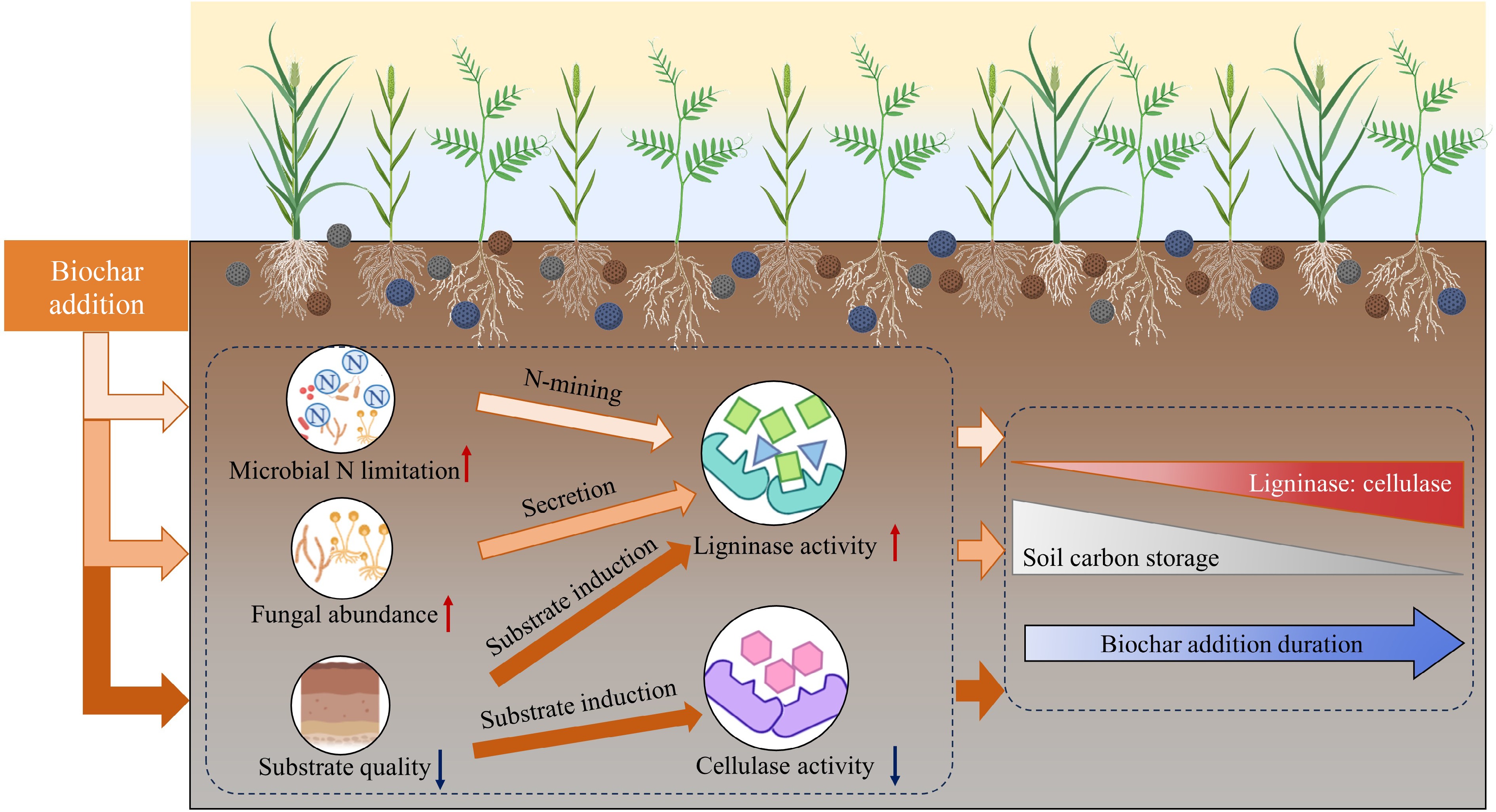
    Figure 1. 

    Responses of cellulase and ligninase enzyme activity to biochar addition and their effects on soil organic carbon storage. Different sizes and colors of these dots indicate various types of biochar.

  • Shifts in soil extracellular enzyme activity alone cannot fully account for the variations in soil organic carbon sequestration since the net change in soil organic carbon storage is determined by the balance of carbon inputs and outputs. Vegetation-derived carbon inputs can directly contribute to soil organic carbon formation through rhizo-deposition of diverse compounds, including low molecular weight compounds, while these processes were independent of microbial and enzymatic transformations (Liang et al., 2017; Xiong et al., 2021). Thus, changes in soil extracellular enzyme activity may advance the mechanistic understanding of soil organic carbon decomposition rather than revealing the full picture of soil organic carbon dynamics. To further clarify soil organic carbon dynamics, more research on the carbon input and output processes is needed.

    There are many variables that can potentially affect the biochar performance on soil organic carbon storage, including the selected raw organic material, pyrolysis temperature and residence time in pyrolysis flow (Fig. 2). For example, biochar produced at higher temperatures commonly has a larger degree of recalcitrance than biochar produced at lower temperatures (Zhang et al., 2015). Meanwhile, biochar made from wood fibers is likely to have a higher degree of aromaticity than biochar derived from crop residues (Weber & Quicker, 2018). In addition, a range of other factors can affect the direction and magnitude of the impact of adding biochar on soil organic carbon storage, including soil type, vegetation type, and initial soil organic carbon content (Maillard & Angers, 2014; Tian et al., 2015) (Fig. 2). Furthermore, these above-mentioned variables will likely have interactive effects on the biochar-induced changes in soil organic carbon dynamics. It will, therefore, be challenging to give universal suggestions for future biochar management strategies since the performance of biochar will likely depend on a range of variables relevant to climatic, edaphic, environmental and biochar production procedures. It becomes even more complex if the interactions between these variables are considered. These divergent impacts suggest that there will be a large potential to improve the role of biochar on soil organic carbon storage if we can better understand the interactive effects of biochar properties in relation to the surrounding environmental factors.
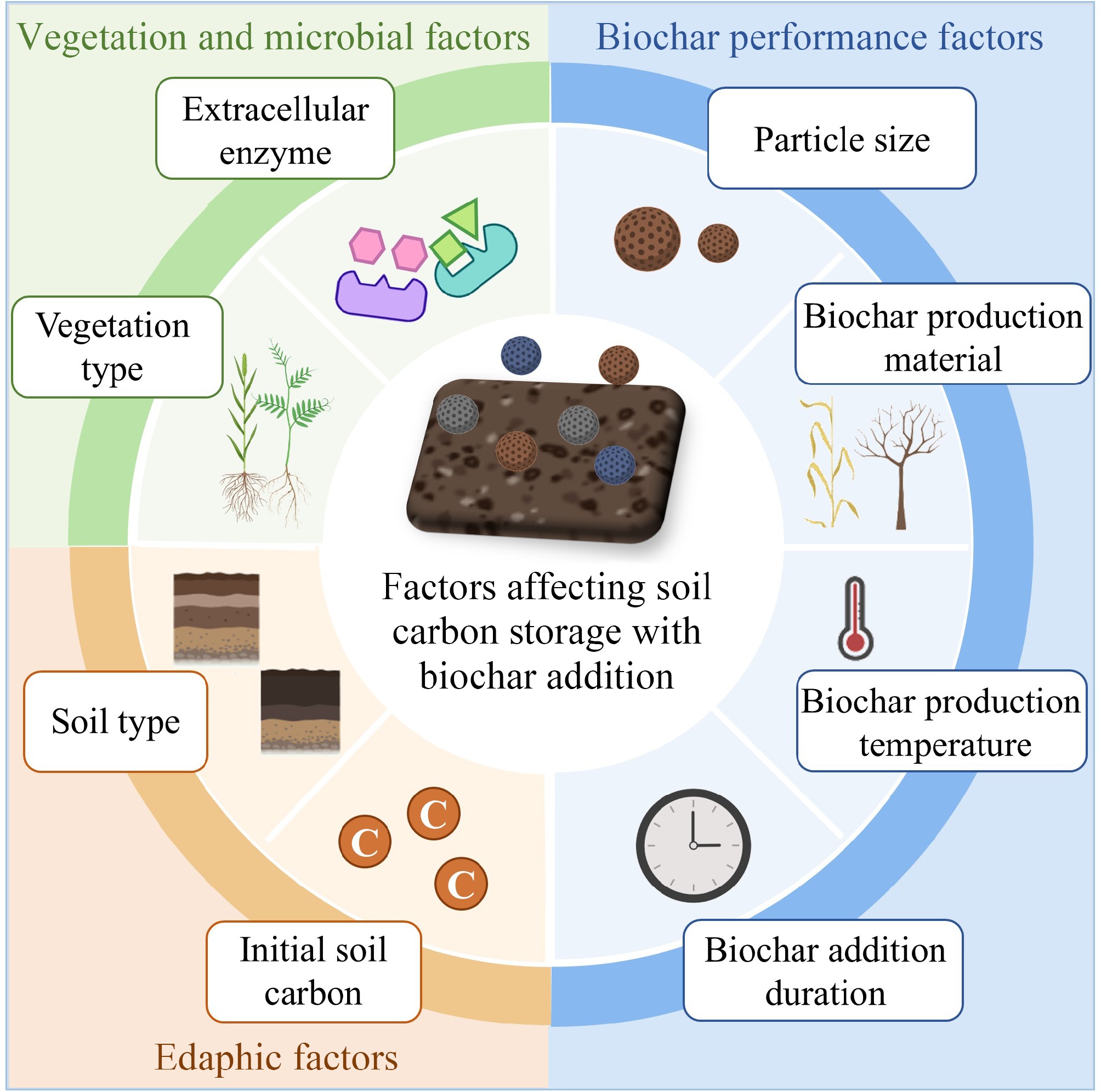
    Figure 2. 

    Factors affecting soil organic carbon storage with biochar addition.

    In addition to soil organic carbon storage, biochar is beneficial to soil health by modifying a range of soil physiochemical properties. For example, biochar addition can alleviate soil acidification, increase soil cation exchange capacity, enhance soil water holding capacity and nutrient availability, and reduce greenhouse gas emissions (Weber & Quicker, 2018). Considering these advantages, biochar addition can also increase crop yield, representing a potential win-win strategy to meet the dual challenges of climate mitigation and food security facing the current cropping systems (Xiang et al., 2017; Nan et al., 2022; Xia et al., 2024). In addition, biochar is also recommended as a cost-effective solution for ameliorating soil and water pollution. Taken together, biochar technology indicates a promising future in mitigating climate change, improving food security, improving soil physiochemical properties, recycling organic waste, and producing clean energy. From this standpoint, biochar technology should be added to the global climate change toolkit of carbon-negative, energy-saving, and renewable options (Lorenz & Lal, 2015; Smith, 2016). With the worldwide application of biochar across different ecosystems, it will be possible to lower the cost of biochar production. Given the wide range of expertise required, extensive interdisciplinary collaborations between engineers, agronomists, microbiologists, and data analysts are urgently needed.

  • Several implications were proposed for investigating soil organic carbon storage with biochar addition in future. First, the contrasting responses of cellulase and ligninase to biochar addition revealed distinct microbial nutrient acquisition strategies that regulate soil organic carbon storage. However, establishing mechanistic linkages between carbon-degrading enzyme activities and microbial community structure and diversity remains challenging. Thus, the necessity for future studies is emphasized to employ novel methodologies such as advanced genomic sequencing and probe-based techniques to improve understanding of microbial controls on soil organic carbon storage with biochar addition. Second, current models for predicting biochar-induced carbon sequestration exhibit substantial discrepancies (Lehmann et al., 2021). These uncertainties likely stem from variations in representations of soil carbon mineralization processes and simulated temporal scales. Thus, we propose integrating enzyme-mediated catalytic processes of fast- versus slow-cycling organic carbon fractions into biochar models (Chen et al., 2021; Wu et al., 2022) rather than treating soil carbon mineralization as a first-order reaction (Woolf & Lehmann, 2012). This advancement would enhance realism in modeling mineralization processes. In addition, incorporating temporal dynamics of extracellular enzyme activities could substantially improve model predictions of biochar-induced carbon sequestration. Thus, expanded datasets documenting extracellular enzyme activities and soil organic carbon dynamics across diverse ecosystems and temporal scales under biochar addition are strongly encouraged. Such multidimensional data would enable parameter optimization and ultimately strengthen model robustness in predicting soil organic carbon (Luo & Schuur, 2020).

    • This study is granted by the National Natural Science Foundation of China (Grant No. 42361144886) and the Shaanxi Province Natural Science Foundation for Distinguished Young Scholar (Grant No. 2024JC-JCQN-32).

    • The authors confirm contribution to the paper as follows: study conception and design: Chen J, Zhou J, Smith P, Pan G; draft manuscript preparation: Chen J (lead), Zhou J, Smith P, Pan G. All authors reviewed the results and approved the final version of the manuscript.

    • Data sharing is not applicable to this article as no new data were created or analyzed in this study.

    • The authors declare that they have no conflict of interest.

    • Copyright: © 2025 by the author(s). Published by Maximum Academic Press, Fayetteville, GA. This article is an open access article distributed under Creative Commons Attribution License (CC BY 4.0), visit https://creativecommons.org/licenses/by/4.0/.
Figure (2)  References (47)
  • About this article
    Cite this article
    Chen J, Zhou J, Smith P, Pan G. 2025. Soil organic carbon storage from biochar addition falls over time: a perspective of shifts in soil extracellular enzyme activity. Soil Science and Environment 4: e002 doi: 10.48130/sse-0025-0001
    Chen J, Zhou J, Smith P, Pan G. 2025. Soil organic carbon storage from biochar addition falls over time: a perspective of shifts in soil extracellular enzyme activity. Soil Science and Environment 4: e002 doi: 10.48130/sse-0025-0001

  • Catalog

      /

      DownLoad:  Full-Size Img  PowerPoint
      Return
      Return