












-
Postpartum amenorrhea (PPA) is the temporary absence of menstruation following childbirth. It is a natural physiological response to pregnancy and childbirth, influenced by hormonal changes that regulate reproductive functions. During pregnancy, elevated levels of estrogen and progesterone suppress ovulation and the menstrual cycle. After childbirth, these hormone levels gradually decline, allowing the body to return to its pre-pregnancy menstrual pattern. However, the duration of PPA varies significantly among women, ranging from a few weeks to several months or even years. Several factors influence the length of PPA. Breastfeeding is one of the most critical determinants, as the production of prolactin, a hormone necessary for lactation, suppresses ovulation, and delays the return of menstruation. Other factors such as maternal age, parity, and health status also contribute to variations in PPA duration. The resumption of menstruation marks the end of PPA and signals the restoration of fertility.
Understanding the duration and determinants of PPA is essential for reproductive health planning and family planning strategies. In this context, this study aims to assess the status of PPA among Nepalese mothers, examine the differences in its mean duration based on various socio-demographic factors, and identify a suitable probability distribution to describe its pattern. Researchers in Asian countries pay little attention to modeling demographic variables; however, modeling these variables has received significant attention among demographers around the world. The distribution used to fit the pattern of PPA research depends on the specific study and the characteristics of the population being used. However, some skewed models and mixture distributions for bi-model-shaped curves are commonly used to model the duration of PPA. Several statistical distributions have been applied to describe the pattern of PPA, Talwar[1] utilized the Triangular distribution. Lesthaeghe & Page[2] applied the Logit model, whereas Potter & Kobrin[3] used a mixture of binomial and geometric distribution. Ford & Kim[4] modeled the bimodal nature of amenorrhea duration in Bangladesh and India using a mixture of type I Extreme value distribution. Additionally, Rahman[5] adopted the modified exponential distribution to analyze the PPA data of Bangladesh. More recently, Holman et al.[6] used the four mixture models to fit the PPA distribution in Bangladesh, including a mixture of log normal, a mixture of Weibull, a mixture of gamma, and a mixture of Gumbel distribution. Aryal[7] estimated the PPA duration indirectly through breastfeeding duration, while Aryal[8] explored the Type I extreme value distribution for Nepalese PPA data. Mishra et al.[9] applied a mixture of Gumbel distribution to smooth PPA data across four states of India, utilizing the expectation-maximization algorithm for parameter estimation.
From the observations it was found that the PPA duration of Nepalese mothers is found to be uni-modal and right-skewed in nature. To model such right-skewed nature data of the PPA of Nepalese mothers, the Log-logistic distribution and its generalized versions have been employed to fit the PPA data of Nepal. The density function of LLog distribution is uni-modal with heavy right tails, the hazard function also increases fast along with the uni-modality. It decreases slowly, creating a right skew curve. The Rayleigh Generated Log Logistic (RG-LLog) distribution has been identified as a suitable model for Nepalese PPA data, effectively capturing its distributional characteristics.
Three important proximate determinants of fertility change are nuptiality or marriage, contraception, and postpartum fecundability[10]. Additionally, three key variables-intercourse, conception, and gestation-affected the entire fertility dynamics of women. Demographical and ecological factors also influence the duration of PPA. Among these, breastfeeding has been widely recognized as the most significant determinant. Other factors include maternal age, income level, maternal anthropometric measures, and parity, with studies indicating that women who have had more children tend to experience a shorter duration of PPA malnourished women, on the other hand, may experience longer durations of PPA. Jain et al.[11] identified age, education, place of residence, and cultural variations as significant factors influencing breastfeeding behaviors, which in turn affect the duration of PPA. Huffman et al.[12] found that maternal nutritional status and age were major determinants of PPA among Bangladeshi breastfeeding women. Similarly, Hajian-Tilaki[13] noted that the pattern of breastfeeding frequency of suckling, and duration of breastfeeding significantly delayed the resumption of menstruation and ovulation.
In Ethiopia, Ahmed[14] highlighted that PPA plays a crucial role in natural fertility control. The literature consistently supports the notion that the intensity of breastfeeding is positively associated with the duration of PPA[12,13,15]. Aryal[8] examined the duration of PPA in relation to maternal and child characteristics. Additionally, postpartum hemorrhage, smoking, and hormonal contraceptive use have been associated with variations in PPA durations, with smoking and postpartum hemorrhage linked to shorter durations, while hormonal contraceptives have been found to extend the period of amenorrhea. Cultural beliefs and postpartum recovery practices also influence PPA duration. In this study, a chi-square test of independence was conducted to assess the statistical association between PPA duration and key socio-demographic variables, including maternal education, family income, and place of residence in ecological regions of Nepal. The findings provide further evidence of the complex interplay between biological, behavioral, and socio-economic factors in determining PPA duration among Nepalese women.
-
In this article, we use quantitative data on the duration of PPA (moths) of Nepalese women after the delivery to analyze the distributional pattern, so the ontological position of this research is objectivism. We try to establish the probabilistic relationship between the duration of PPA as the independent variable and the probability of occurrence of PPA at that duration as the dependent variable. So, the epistemological position of this research is positivism. To answer the research question of this study, we propose the objective reality, the duration of PPA for Nepalese mothers, which is the realistic ontology. The reality of this research is the status, differential in the duration of PPA across sub-populations, determinants, and the distributional pattern of duration of PPA of Nepalese mothers. The PPA period and the distributional pattern are real and universal phenomena that can be observed using scientific methods. This research proposed a new mathematical model and applied it to real data sets. So, it is a theory-testing, and the ontological position of this research is objectivism.
The duration of the PPA of women is independent of our knowledge about them. The data on the duration of PPA are a reality, and a survey of women can obtain that; this can be observed as the reality of the cause and effect between the duration of PPA and the probability or relative frequency of occurrence of PPA. The duration of PPA is the effect of their previous demographic, socio-economic, and cultural background. These are the social realities of mothers, which are real and the main cause of the present duration of PPA. Their background may have a different effect on the present situation. This research aims to find the probabilistic causal relationship between the duration of PPA and the probability of occurrence of PPA at particular months among mothers. By this, we claim to attain objectivity. We will choose the quantitative method as a research tool and the deductive method to test the hypotheses that the distributional pattern follows a specified probability distribution and that there is a significant difference in the mean duration of PPA among sub-populations of Nepal. We believe there is a single reality, and valid and reliable statistical tools can measure the reality of PPA, so our research philosophy is positivism.
Data
-
To analyze Nepalese mothers' PPA duration, we consider the secondary data set from the national representative Nepal Demographic and Health Survey[16]. It includes 721 women who provide data from Nepalese mothers' PPA duration. Among them 37.38 % of women provide the information at the first birth of a child, 34.47% are of the second birth of a child, 16.34 % are of the third birth of a child, and the remaining more than the third birth. It also includes data regarding the birth order, age at menarche, body mass index of mother, sex of children at birth, total children ever born, income level of family, duration of breastfeeding, smoking habit of mothers, size of the child at birth, educational attainment of females, place of resident in ecological regions, provinces, etc.
Test statistics
-
Descriptive statistics and a box and whisker plot are used to present the status of the duration of PPA of Nepalese mothers. To test the significant difference between the mean duration of PPA for Nepalese sub-populations, the t-test statistic is used to compare the mean duration of PPA among subgroups. Since the duration of PPA data showed a right-skewed in nature, the Independent-Samples Kruskal-Wallis Test (a non-parameter test) is used to compare the difference in mean among sub-populations. The Bonferroni correction test is applied to control the family-wise error rate. The Karl Pearson correlation coefficient and chi-square test of independence are used to find the factors that are significantly associated with the duration of PPA.
Probability distribution models
-
The mathematical expressions of the proposed models to fit the distributional pattern of duration of Nepalese mothers have been expressed in the following section. The Log-Logistic (LLog) and its generalized distributions are chosen to fit the duration of the PPA data of Nepalese mothers. Since the density function of the LLog is a uni-modal with heavy right tails. Similarly, the hazard function increases fast along with the uni-modality and decreases slowly, creating a right-skewed nature curve. Also, the data on the duration of PPA shows outliers and a right-skewed nature; to capture such data, LLog distribution and its generalized versions were used.
Log-Logistic distribution
-
If X denotes the duration of PPA of the mothers that follow the Log-Logistic (LLog) distribution, then the density function with three parameters α, β, and γ is given as:
$ f_1\left(x\right)=\dfrac{\dfrac{\alpha}{\beta}\left(\dfrac{x-\gamma}{\beta}\right)^{\alpha-1}}{\left(1+\left(\dfrac{x-\gamma}{\beta}\right)^{\alpha}\right)^2},\mathrm{\ \ \ f}\mathrm{o}\mathrm{r}\; x \gt \gamma $ (1) where, α > 0 is the shape parameter, and β > 0 is the scale parameter. And the third parameter γ is a threshold parameter.
Rayleigh Generated Log-Logistic distribution
-
The PDF of Rayleigh Generated Log-Logistic distribution proposed and studied by Gaire & Gurung[17] as:
$ f_2\left(x\right)=\dfrac{2\alpha\theta}{\beta\left\{1-exp\left(-\theta\right)\right\}}\times\dfrac{\left(\dfrac{x-\gamma}{\beta}\right)^{2\alpha-1}exp\left(-\mathrm{\theta}\dfrac{\left(\dfrac{x-\gamma}{\beta}\right)^{2\alpha}}{\left(1+\left(\dfrac{x-\gamma}{\beta}\right)^{\alpha}\right)^2}\right)}{\left(1+\left(\dfrac{x-\gamma}{\beta}\right)^{\alpha}\right)^3} $ (2) Skew Log-Logistic distribution
-
The density and the distribution function of the Skew Log-Logistic (SLLog) distribution introduced by Gaire & Thapa[18], and studied by Gaire & Gurung[19] are expressed as:
$ f_3\left(x\right)=\frac{2\alpha}{\beta}\dfrac{\left(\dfrac{x-\gamma}{\beta}\right)^{2\alpha-1}}{\left(1+\left(\dfrac{x-\gamma}{\beta}\right)^{\alpha}\right)^3},\mathrm{\ \ \ f}\mathrm{o}\mathrm{r}\; x \gt \gamma $ (3) Kumaraswamy Log-Logistic distribution
-
The density and the distribution function of Kumaraswamy LLog (KuLLog) distribution introduced by De-Santana et al.[20] as:
$ {f}_{4}\left(x\right)=\dfrac{\alpha \theta \lambda }{\beta }{\left(\dfrac{x}{\beta }\right)}^{\alpha \theta -1}{\left(1+{\left(\dfrac{x}{\beta }\right)}^{\alpha }\right)}^{-(\theta +1)}{\left[1-{\left\{\dfrac{{\left(\dfrac{x}{\beta }\right)}^{\alpha }}{1+{\left(\dfrac{x}{\beta }\right)}^{\alpha }}\right\}}^{\theta }\right]}^{\lambda -1} $ (4) Transmuted LLog distribution
-
Finally, the Transmuted Log-Logistic (TrLLog) distribution proposed by Aryal[21] has the density and distribution functions as:
$ {f}_{5}\left(x\right)=\dfrac{\alpha }{\beta }{\left(\dfrac{x-\gamma }{\beta }\right)}^{\alpha -1}\left\{\dfrac{\left(1+\lambda \right)+(1-\lambda ){\left(\dfrac{x-\gamma }{\beta }\right)}^{\alpha }}{{\left(1+{\left(\dfrac{x-\gamma }{\beta }\right)}^{\alpha }\right)}^{3}}\right\} $ (5) Model validation tools
-
The mean duration of PPA for Nepalese mothers has been compared by using t-test statistics for different groups such as ecological regions, provinces, ethnicities, and educational level attainment, and data for these groups, and total data are presented by using box-and-whisker plots. Using the above-listed probability distributions, the duration of PPA data is fitted. The negative log-likelihood (NLL) value of the probability distribution, Akaike's Information Criteria (AIC), the Bayesian Information Criteria (BIC), the chi-square test statistics, the SSE, and the coefficient of determination (R2) between the observed and theoretical duration of PPA of women, which have been used to test the validity and suitability of proposed models. To fit the model, numerical simulation was used to minimize the SSE. The Chi-square test statistics are calculated as follows:
$ \chi^2=\sum_{i=0}^n\left(\dfrac{\left(O_i-E_i\right)^2}{E_i}\right) $ (6) where, Qi is the observed number of women with PPA at different ages and Ei is the expected or theoretical number of women having PPA at different ages obtained from the fitting distribution for Nepalese women.
Similarly, the formulae of AIC and BIC for the fitted models are given as:
$ AIC= 2v- 2LL $ (7) $ BIC=vLn(n) - 2LL $ (8) where, v is the number of parameters associated with the probability distribution, n is the number of observations, and LL is the log-likelihood function at the maximum likelihood estimate of that distribution.
-
The duration of PPA data consists of 721 Nepalese mothers from Nepal demographic health survey[16]. The mean duration of PPA for Nepali mothers is found to be 5.89 ± 6.643 months, with a skewness of 1.955 and a kurtosis of 4.058. Figure 1 illustrates the right-skewed nature of the duration of PPA data of Nepalese mothers using a box and whisker plot.
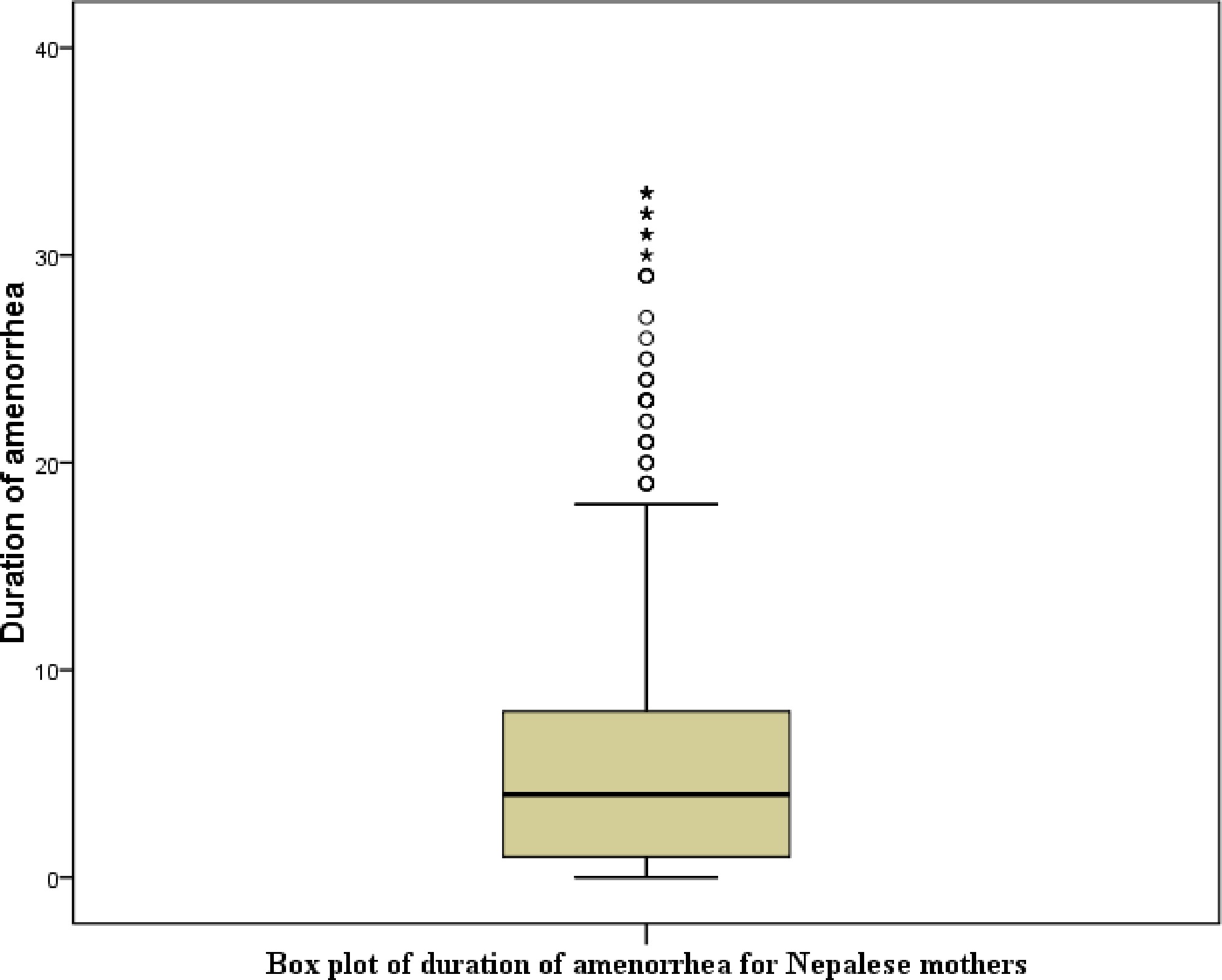
Figure 1.
Box and whisker plot of the duration of amenorrhea for Nepalese mothers.
Distribution fitting of duration of PPA for Nepalese mothers
-
The analysis of the duration of PPA among Nepalese mothers reveals a right-skewed nature with the presence of outliers. Such characteristics suggest that the data is not symmetrically distributed, with a significant portion of observations clustered at lower durations and a long tail extending toward higher durations. Five skewed probability models were employed to appropriately model this distributional pattern: (LLog distribution and its generalizations). Fitted results and different test statistics are presented in Table 1.
Table 1. Observed and expected number of mothers for duration of PPA by different distributions.
Duration of PPA Observed Expected number of women LLog SLLog Tr-LLog KuLLog RG-LLog 0−1 102 84.095 74.572106 99.611 99.391 93.792 1−3 175 184.719 190.463529 173.489 180.143 182.120 3−6 183 167.887 155.884902 179.800 176.676 174.085 6−9 101 88.191 79.859153 99.240 100.989 96.196 9−12 53 51.009 47.416113 53.422 58.688 55.688 12−15 31 32.226 31.142130 30.082 35.198 34.150 15−18 28 21.790 21.923420 17.997 21.841 22.055 18−21 11 15.518 16.226545 11.399 14.006 14.885 21−24 13 11.507 12.471816 7.585 9.261 10.424 24−27 6 8.812 9.871832 5.260 6.298 7.531 27−30 7 6.926 7.999844 3.776 4.394 5.587 30−33 11 5.562 6.608797 2.791 3.138 4.240 α 1.370 1.072 2.049 0.568 1.210 β 4.386 2.006 7.723 42.028 8.777 γ 0.000 0.000 − 0.000 0.000 θ − − 0.478 10.632 1.000 λ − − 1.071 − − χ2 17.161 30.266 12.474 21.698 12.252 R2 0.980 0.950 0.993 0.995 0.995 NLL −49.889 −49.649 −48.060 −52.046 −47.040 AIC 105.778 105.298 104.121 112.093 102.081 BIC 107.233 106.753 106.060 114.032 104.021 The values of the Chi-square test statistic, AIC, and BIC for the RGLLog distribution are found to be minimum, while the values of R2 and NLL are found to be maximum. These results are presented in boldface. For the distribution fitting of the duration of PPA, the rationale for choosing RG-LLog distribution is that the nature of PPA duration showed a positively skewed, non-negative, and biologically bounded variable. The RG-LLog distribution, as a generalized and flexible extension of the log-logistic model, is particularly adept at capturing such characteristics due to the following reasons:
(1) Behavioral Relevance: PPA duration is influenced by multiple demographic, behavioral, and physiological factors (e.g., breastfeeding duration, parity, and nutritional status), which can introduce asymmetry and heterogeneity into the distribution of time until menstruation resumes. The RG-LLog's flexibility in accommodating skewness and tail behavior makes it well-suited to represent such variability.
(2) Hazard Function Shape: The RG-LLog distribution allows for a wide range of hazard function shapes, including increasing, decreasing, unimodal, and non-monotonic, which aligns with empirical findings that PPA hazard rates are not constant and may vary with time postpartum. This makes RG-LLog preferable over simpler distributions that impose stricter hazard shapes. And finally,
(3) Empirical Fit and Interpretability: Analysis and model comparison based on AIC and BIC and other diagnostic tests show that the RG-LLog provides a better empirical fit to PPA data compared to traditional models. Furthermore, its parameters retain interpretable connections to median and spread, which facilitates demographic interpretation.
The findings of the distribution fit of PPA data show that the RG-LLog distribution was found to be significantly better fitted for the duration of PPA data than other distributions. The observed value multiple test statists such as NLL, AIC, BIC, and chi-square tests have been found minimum for RG-LLog distribution and R2 is found to be maximum. From all the test statistics and the graph of fitted results, the RG-LLog distribution was found to fit the duration of PPA of Nepalese mothers better.
The graphical representation between the observed and expected frequency distribution of time to termination of the amenorrhea period is presented in Fig. 2. This provided a good approximation for describing the distribution of females according to the duration of PPA.
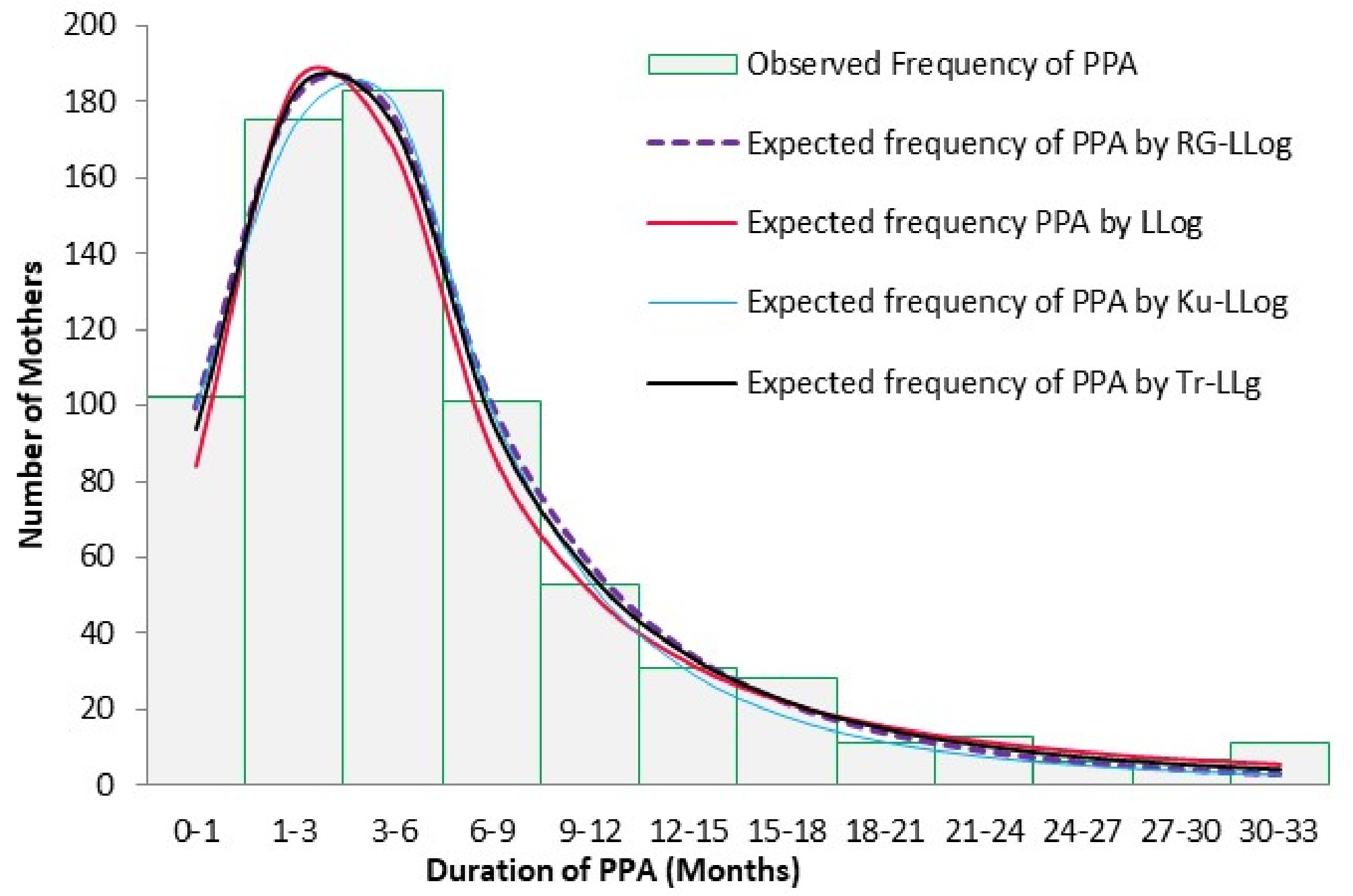
Figure 2.
Observed and expected value of the number of mothers for the duration of PPA.
From the analysis and graphical presentation, the RG-LLog distribution is found to be a better fit for the PPA data of Nepalese mothers. Therefore, it is recommended to use this distribution to describe the current and future distributional patterns of time to the termination of the amenorrhea period of women.
Comparison of mean duration of PPA for different sub-populations of Nepal
-
The mean duration of PPA for different sub-groups is computed and compared for different provinces, ecological regions, ethnic groups, and educational levels attained groups. The detailed results are presented in Supplementary Tables S1−S4. It is observed that the mean duration of PPA is highest for Karnali province at 8.09 ± 7.706 months and least in the Lumbini province at 4.31 ± 3.639 months. The Karnali province is the least developed province according to Human Development Index. People who live in less developed parts of countries show a higher duration of PPA than those who live in developed parts. The box and whisker plots of the duration of PPA for Nepalese mothers from different provinces of Nepal are presented in Fig. 3. The ANOVA as well as the Kruskal Wallis test show significant differences in the mean duration of PPA among different provinces. The multiple comparisons of the mean duration of PPA are performed using a t-test by applying the Bonferroni correction test. This analysis shows that the highest mean duration of PPA difference is 3.785 months in the Karnali and the Lumbini provinces. The difference in the mean duration of PPA for different provinces, its standard error (S.E.), and the 95% confidence interval are presented in Supplementary Table S5.
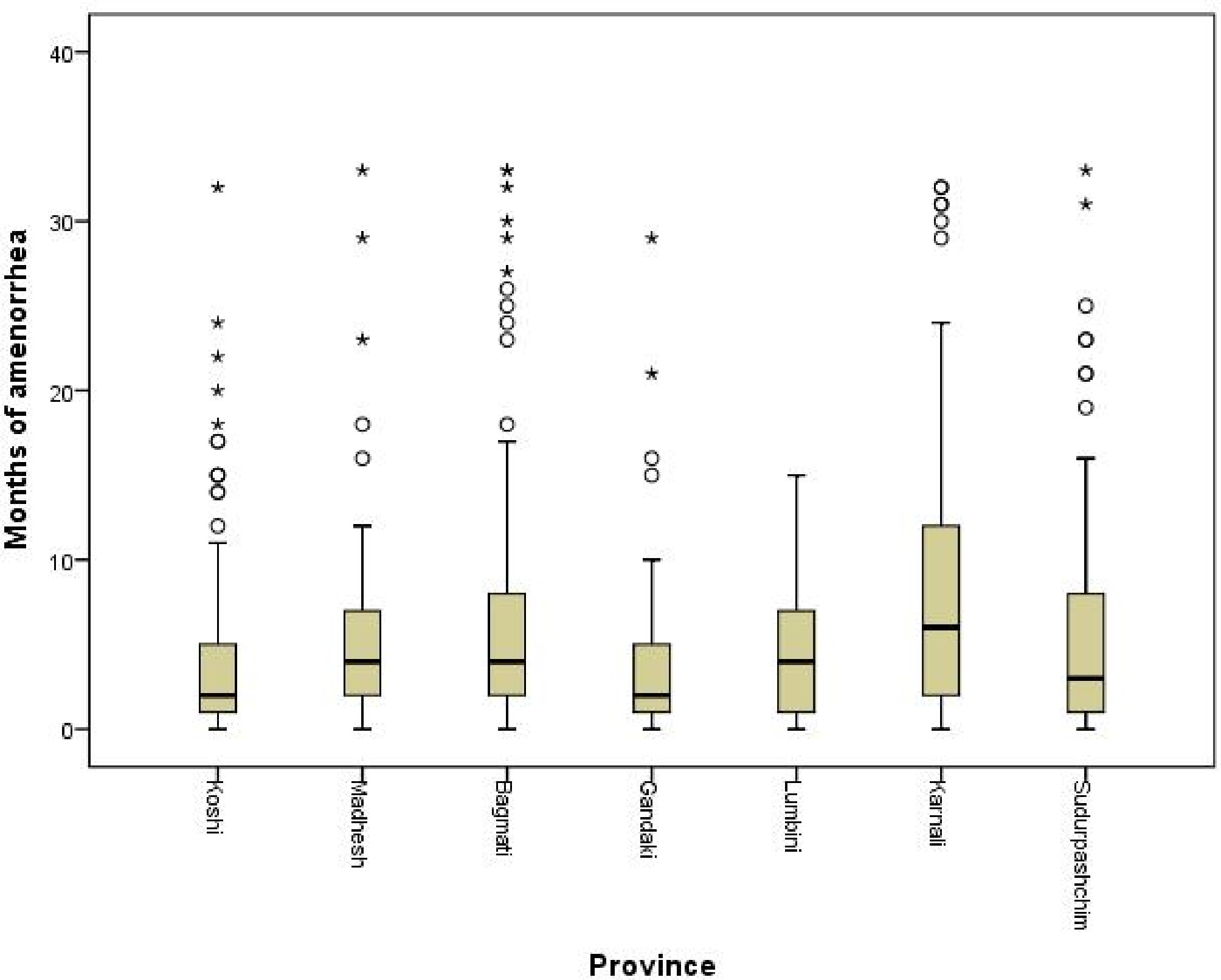
Figure 3.
Box and whisker plot of duration of PPA for different provinces in Nepal.
A similar analysis is performed for different ecological regions of Nepal. These ecological regions are divided according to geographical location. The Terai region is a plain region in the southern part of Nepal where the climate remains hot throughout the year; Hill is the central hills, and the Himalayas climate is mild, and the Mountain region is the Northern part of Nepal with high Himalayas including Mount Everest where there is cold climate throughout the year. The mountain shows the highest duration of PPA with a mean of 8.50 ± 7.493 months and the Terai region shows the least duration with a mean of 4.72 ± 5.295 months. It shows that climate has an inverse effect on the duration of PPA. The PPA data for different ecological regions are presented in Fig. 4. The ANOVA as well as the Kruskal Wallis test show a significant difference in mean Duration of PPA among different ecological regions of Nepal. Multiple comparisons of the mean duration of PPA for different ecological regions of Nepal were performed using t-test statistics using the Bonferroni correction test and the results are shown in Supplementary Table S6. It is found that the Mountain and Terai region shows the highest 3.78 months of difference in the mean duration of PPA with p < 0.01, and all other regions show a significant difference in the mean duration of PPA.
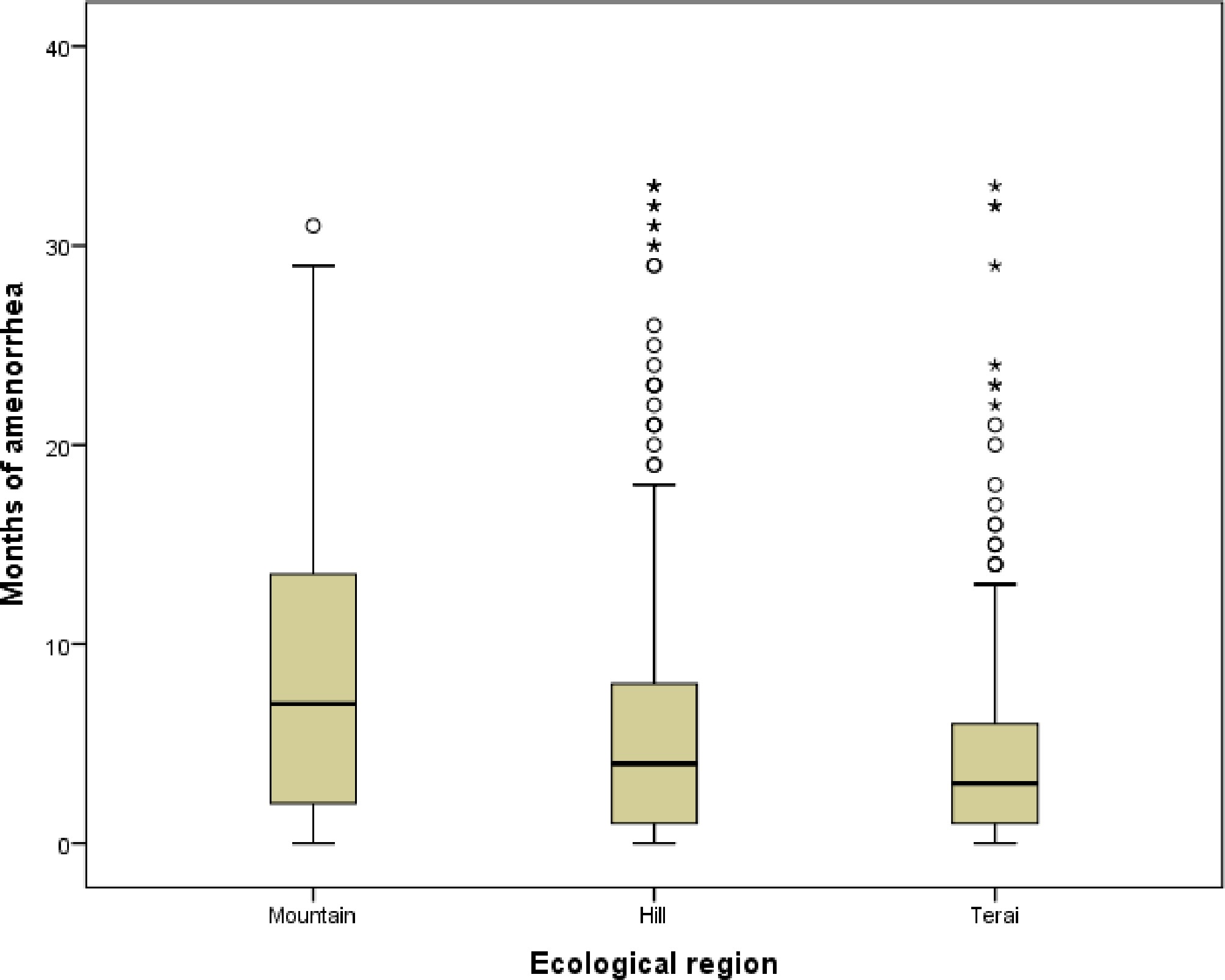
Figure 4.
Box and whisker plot of duration of PPA for Nepalese women for different ecological regions.
Further, analysis is performed for different ethnic groups in Nepal. It was observed that Terai Brahmin/Chhetri has the highest mean duration of 9.25 ± 8.118 months, and Terai Dalit shows a minimum mean duration PPA of 4.48 ± 4.623 months. Marginalized and minority groups show a smaller duration than the groups that were considered major groups. The box and whisker plots of the duration of PPA in different ethnic groups of Nepalese mothers are presented in Fig. 5. The comparison of the duration of PPA for different ethnic groups by using both ANOVA as well as the Kruskal Wallis test (with p = 0.409) shows no significant differences in the mean duration of PPA among different ethnic groups of Nepal.
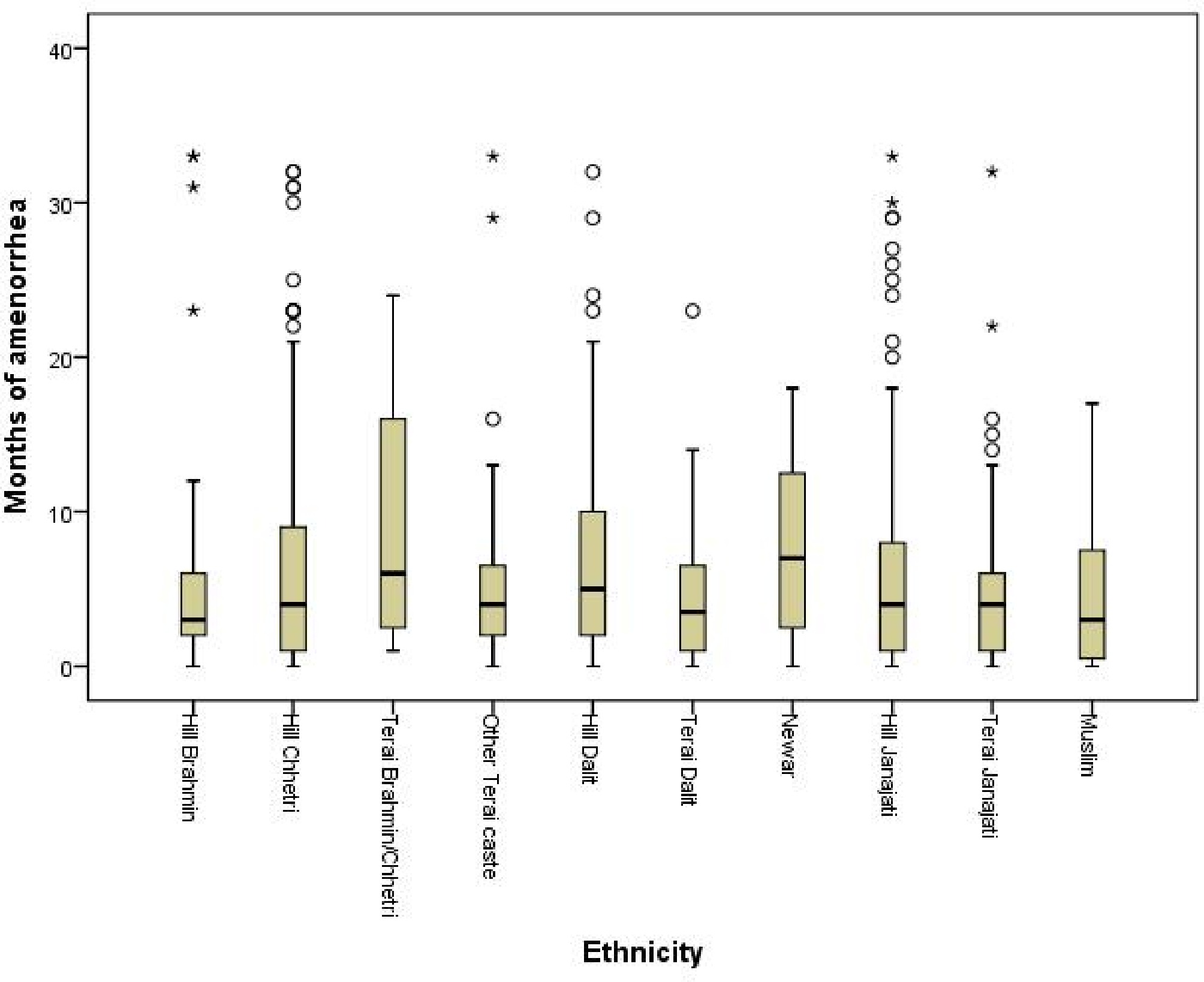
Figure 5.
The box-and-whisker plot of the duration of PPA for different ethnicities of Nepal.
Furthermore, an analysis was performed on different educational attainment groups of women in Nepal. Mothers with no education show the highest mean duration of PPA of 8.71 ± 8.667 months, and mothers with incomplete secondary show the least mean duration of PPA of 4.55 ± 5.252 months. The mean duration of PPA for different educational attainment groups of women are presented in Supplementary Table S3. The graphical presentation by box plot is presented in Fig. 6. For different educational attainment groups of women in Nepal, both ANOVA, as well as the Kruskal Wallis test (with p = 0.000), show a significant difference in the mean duration of PPA. Multiple comparisons of the mean duration of PPA were performed using t-test statistics by applying the Bonferroni correction test, and the results are shown in Supplementary Table S7. The highest difference in the mean duration of PPA of 4.158 months with p < 0.01 is found between groups of incomplete secondary with no educated group. There is a significant difference in the mean of no-educated groups from other groups except for higher-educated groups. And the remaining pairs of groups show no significant difference in mean.
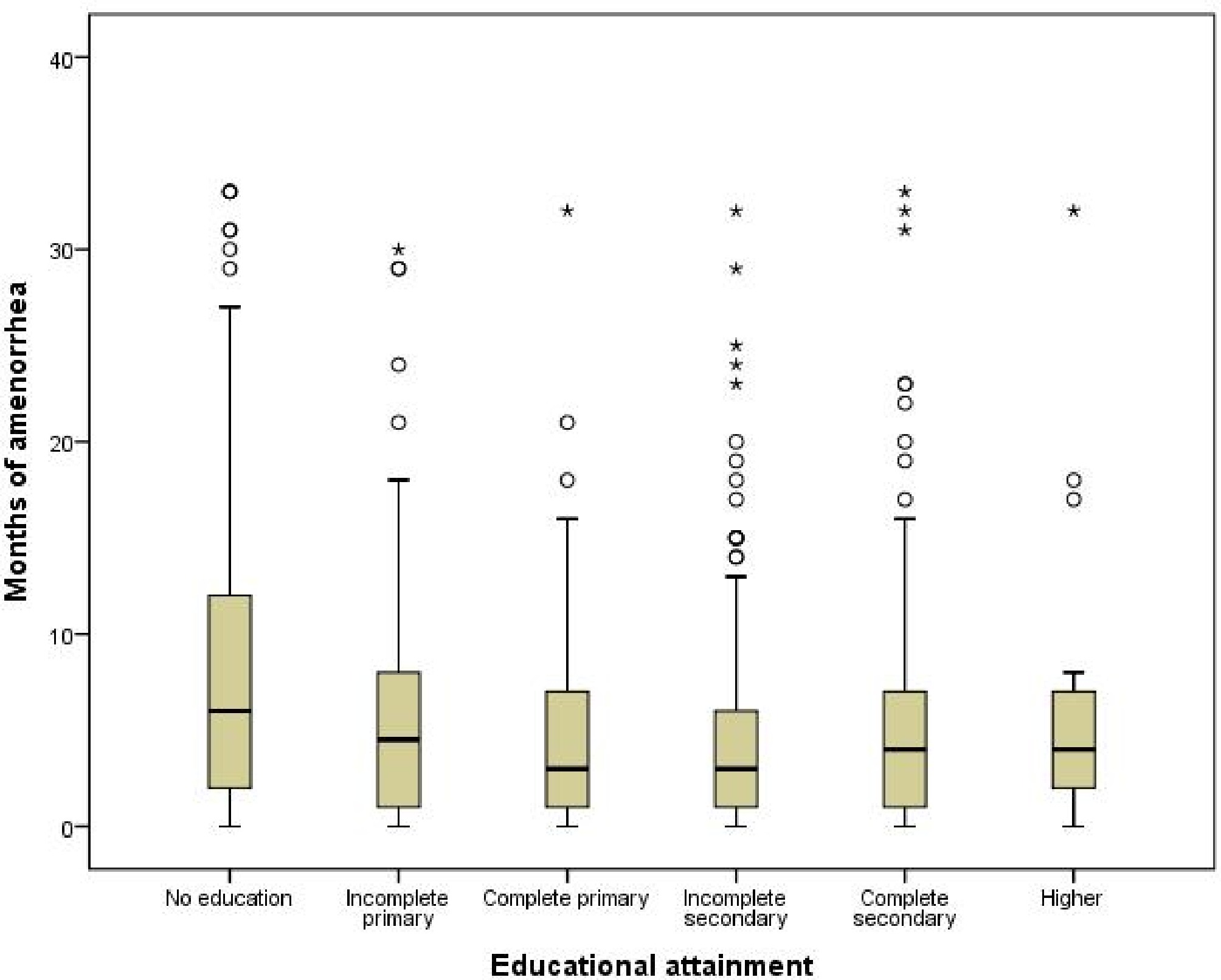
Figure 6.
Box and whisker plot of duration of PPA for different educational attainment groups of Nepalese mothers.
The measure of associated factors of duration of PPA
-
An analysis of a measure of the association of the duration of PPA with different demographic, and socio-economic factors were performed. The Karl Pearson correlation coefficient indicates several statistically significant associations between the PPA and various socio-demographic factors. Specifically: the body mass index (BMI) of the mother shows a positive but weak correlation with PPA duration (r = 0.146, with a p < 0.01) while this relationship is statistically significant, the small magnitude suggests that BMI has only a modest practical effect on the duration of PPA. Mother's education level also exhibits a statistically significant positive correlation with PPA duration (r = 0.166, with a p < 0.01). Although the strength of this association is again weak, it may reflect broader socio-behavioral patterns associated with reproductive health awareness and postpartum care among more educated mothers. The sex of children at birth shows a very weak positive correlation with PPA duration (r = 0.086, with a p < 0.05). Despite being statistically significant, the practical impact of this factor is minimal and likely negligible in terms of policy or program design. The total number of children ever born has a weak but statistically significant positive correlation (r = 0.159, with a p < 0.01 ). This may suggest that women with more children tend to experience slightly longer durations of PPA, possibly due to cumulative breastfeeding or physiological changes. The income level of the family demonstrates a weak negative correlation with PPA duration (r = –0.169 with a p < 0.01). Although significant, the practical implication is modest; however, it might indicate that women in higher-income households tend to return to fertility sooner, possibly due to reduced breastfeeding duration or different lifestyle patterns. On the other hand, there is no significant correlation found between PPA duration with the duration of breastfeeding, the smoking habit of mothers, and the size of the child at birth. The finding of the association result of PPA with breastfeeding is not consistent with the previous research results[12,13,15]. The lack of significant association between PPA and breastfeeding duration contradicts earlier studies, which have typically shown a strong positive link. This inconsistency may be due to measurement error, cultural variations in breastfeeding practices, or unmeasured confounding variables in the data sets. Further investigation using more granular breastfeeding data is suggested.
Three hypotheses were tested using the Pearson Chi-square test of independence to examine the association between the duration of PPA and various socio-economic variables. It shows that there is a significant association between the duration of PPA of Nepalese females and the income level of the family (χ2 = 59.9 with a p < 0.01), educational attainment of females (χ2 = 38.275 with a p < 0.01), place of resident in ecological regions (χ2 = 40.972 with a p < 0.01) consistent with the findings of Aryal[22].
-
The status of the duration of PPA for Nepalese mothers is examined. The variation in the mean duration of PPA for Nepalese mothers is evaluated for different subgroups, viz. province, ecological regions, ethnicities, and educational attainment groups. Further, the income level of the family, body mass index of mothers, mother's education, sex of a child, place of residence in ecological regions, and age at menarche were found to be significantly correlated with the duration of PPA Nepalese mothers. The distributional pattern of Nepalese mothers' PPA duration is analyzed using the LLog distribution and its generalized versions. The RG-LLog distribution is found to fit the duration of amenorrhea of Nepalese mothers better. These findings can be helpful in identifying the trends and patterns of duration of PPA behavior in a particular population. These findings could help to develop policies and programs related to family planning, reproductive health, and women's empowerment, consequently addressing social disparities.
-
This study is based on secondary data from the Nepal Demographic and Health Survey (NDHS, 2022), which is publicly available and anonymized. The NDHS data were collected following ethical standards approved by the Nepal Health Research Council (NHRC), ICF Institutional Review Board, and relevant national authorities. Permission to access and use the dataset was obtained from the DHS Program website upon email request. As the data are de-identified, no ethical approval was required from the authors' institution. All analyses were conducted in accordance with ethical research practices and the principles of the Declaration of Helsinki.
-
The author confirms sole responsibility for the following: study conception and design, data collection, analysis and interpretation of results, and manuscript preparation.
-
The datasets generated during and/or analyzed during the current study are available from the survey website on reasonable request after email registration (https://dhsprogram.com).
-
The author declares that there is no conflict of interest.
- Supplementary Table S1 Descriptive measure of duration of PPA for Nepalese mothers (provinces).
- Supplementary Table S2 The mean duration of PPA for different ecological regions of Nepal.
- Supplementary Table S3 Mean duration of PPA for different ethnic groups of Nepal.
- Supplementary Table S4 The mean duration of PPA (Educational attainment groups).
- Supplementary Table S5 Multiple Comparison of mean duration of PPA by t-test (Provinces).
- Supplementary Table S6 Multiple comparisons of mean duration of PPA for different ecological regions.
- Supplementary Table S7 Multiple comparisons of mean duration of PPA for different educational levels.
- Copyright: © 2025 by the author(s). Published by Maximum Academic Press, Fayetteville, GA. This article is an open access article distributed under Creative Commons Attribution License (CC BY 4.0), visit https://creativecommons.org/licenses/by/4.0/.
-
About this article
Cite this article
Gaire AK. 2025. Duration and pattern of postpartum amenorrhea of Nepalese mothers: a statistical analysis. Statistics Innovation 2: e002 doi: 10.48130/stati-0025-0002 

Duration and pattern of postpartum amenorrhea of Nepalese mothers: a statistical analysis
- Received: 06 February 2025
- Revised: 25 April 2025
- Accepted: 20 May 2025
- Published online: 26 May 2025
Abstract: Postpartum amenorrhea (PPA) is the absence of menstrual periods in the mother after the birth of a child. The length of PPA can vary widely among women, ranging from a few weeks to several months or even years. Duration of PPA is significant in the fertility life of women since it is one of the natural methods of contraception. In this research, the status of the PPA of Nepalese mothers and the differential mean duration of PPA among different sub-populations of Nepal are evaluated. The variation in the duration of PPA and the probabilistic distributional pattern is fitted by using Log-Logistic and some generalization of this distribution. The AIC and BIC at the maximum log-likelihood value are used to validate the model fitting. A dataset of NDHS-2022 is taken for these findings. The mean duration of PPA for Nepalese mothers is found to be 5.89 months. These findings can have significant implications for the health of mothers and children. It would also be helpful for the research personnel, medical personnel, and policymakers who are interested in women's general and reproductive health to develop policies and programs related to family planning, reproductive health, and women's empowerment.
-
Key words:
- Postpartum /
- Amenorrhea /
- Rayleigh /
- Nepal