











-
Nanomaterials, which usually have at least one dimension smaller than 100 nm, can be made from a variety of materials such as carbon, polymers, ceramics and metals[1]. Theoretically, nanomaterials can be potentially used in nearly all scientific disciplines because of its high compatibility of modulating physical, chemical, and biological properties[2]. For example, nanomaterials have been used as delivery vehicles for targeted drug supply. In cancer therapy, Zhang et al. developed a novel nanomaterial, namely NP-NH-D5, which can undergo structural transformation in tumor cells, destroy lysosomes, and activate immune response, thereby effectively inhibiting the growth, metastasis, and recurrence of orthostatic 4T1 tumors without obvious side effects[3]. This material can also be used to enhance the effect of existing immunotherapy, providing a new strategy for cancer treatment[3]. Additionally, for curing genetic diseases, Wang et al. developed a fluorinated lipid nanoparticle (F6 mtLNP) that can efficiently deliver therapeutic genes into the mitochondrial matrix, wherein F6 mtLNP could restore Complex I activity and alleviate lesions, effectively improving visual impairment and providing a new delivery tool for gene therapy in treating mitochondrial diseases[4].
In plant species, the cell wall is the main constraining element preventing most foreign biomolecules from entering them, except those lower than 10 nm in diameter[5]. Mainly because of their small size, nanomaterials have been used as sensing materials, nanofertilizers, pesticides, herbicides, and carriers for controlled release of pesticides and nutrients etc., in plants[6]. Additionally, the utilization of nanomaterials has been reported for improving plant adaptation capacity under various unfavorable environmental conditions, such as salt and temperature stress[7]. These materials have also been demonstrated to play important roles in plant tissue culture, such as callus induction, somatic embryogenesis, organogenesis, and secondary metabolite generation[8]. More recently, the usage of nanomaterials is reported for nuclear acid delivery, including DNAs and RNAs, in the model plant Arabidopsis thaliana and cash crops such as tomato (Solanum lycopersicum), and some research progress has been achieved.
In this review, we first introduce the synthesis strategy and classification of nanomaterials, and the possible absorption routes of nanomaterials by plants are subsequently discussed. Thereafter, we summarize new findings on the application of nanomaterials and nano-based carriers for genetic transformation, growth and development regulation, and pest or disease control in plants, with a particular focus on key cash crops. Finally, we offer perspectives on future directions in this promising field.
-
According to the International Union of Pure and Applied Chemistry (IUPAC), nanomaterials are defined as substances with at least one dimension in the scale of 1−100 nm. At this scale, they commonly exhibit distinct physical and chemical properties from macroscopic bulk ones, including surface effect, small-size effect, and quantum effect[9]. These properties, which are determined, to a great extent, by multiple factors such as the method of synthesis and the original sources, lay the foundation for their wide-ranging applications.
Strategies of synthesizing nanomaterials
-
As shown in Fig. 1, two main strategies are generally used for the synthesis of nanomaterials: the top-down strategy and the bottom-up strategy. Within each strategy, a variety of methods have been developed, which complement each other in terms of product controllability, environmental compatibility, and large-scale potential.
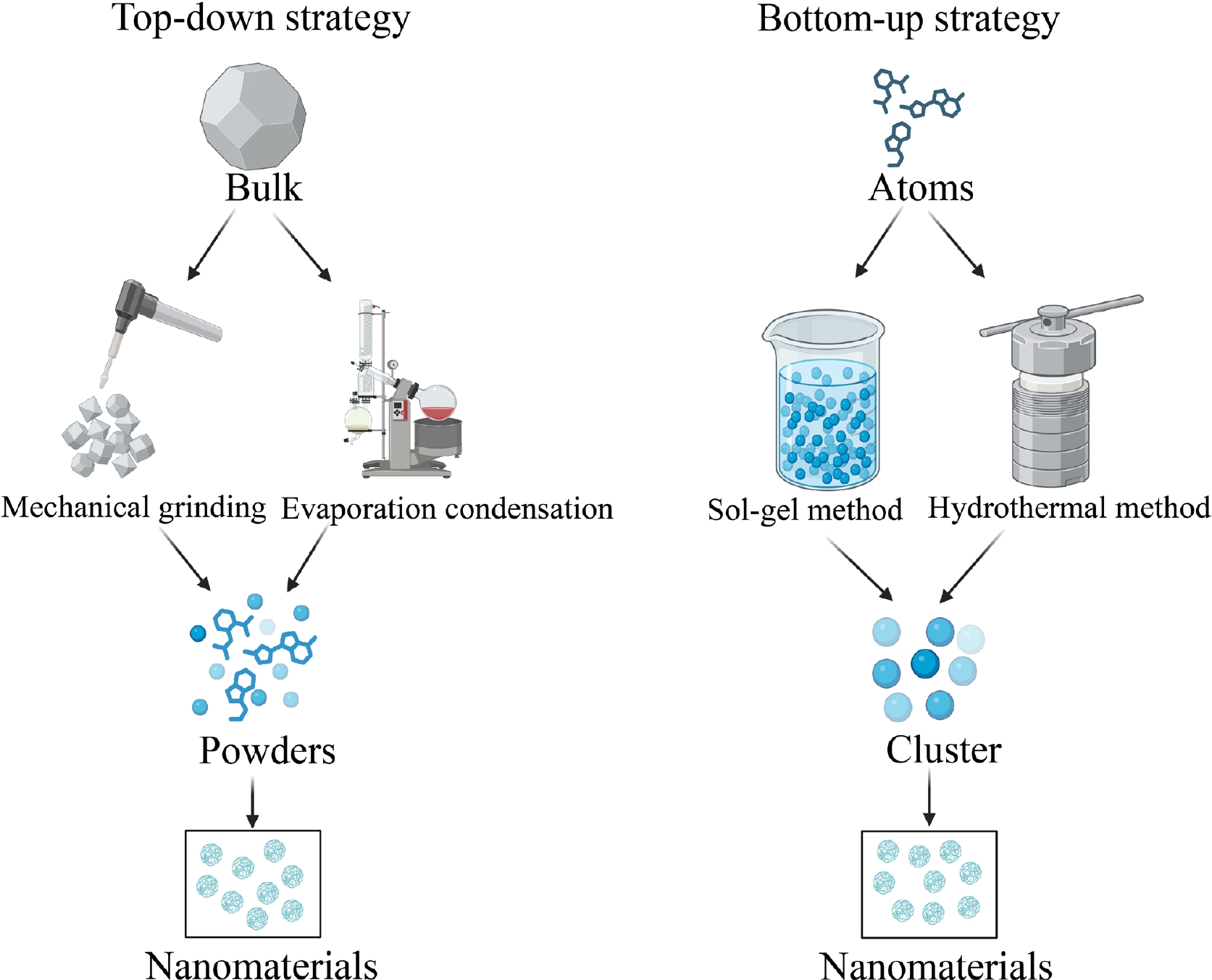
Figure 1.
Strategies for synthesizing nanomaterials. Two main strategies are adopted for synthesizing nanomaterials: (I) the top-down strategy, wherein macroscopic bulk materials are used as the initial materials and broken down into nanoscale powders through physical or chemical processes such as mechanical milling or evaporation-condensation; and (II) bottom-up strategy, wherein techniques like sol-gel synthesis or the hydrothermal method are used to guide the self-assembly and growth of microscopic units into atomic clusters, ultimately forming nanomaterials.
Top-down strategy
-
In this strategy, macroscopic raw materials are decomposed into nanoscale ones through step-by-step physical processes, and the inherent properties of the raw materials can thus be mostly retained, making it suitable for large-scale preparation. Mechanical grinding is a commonly used method to prepare nanomaterials, such as nanocalcium carbonate and nanozinc oxide, from raw materials through collision and friction applied by a ball mill[10]. As an alternative, in the evaporation–condensation method, raw materials are first heated to a gaseous state under high-vacuum conditions, followed by low-temperature condensation to form high-purity metal nanoparticles (NPs) such as nanogold and silver NPs[11]. The sputtering method is used for producing nanomaterials as well, wherein high-energy particles are used to bombard the target material, causing atoms to detach and be deposited elsewhere. Through the sputtering method, metal and semiconductor nanofilms with strong bonding to the substrate can be prepared in the field of electronic devices[12].
Bottom-up strategy
-
This strategy can yield nanostructures through the nucleation and growth of atoms and molecules. For example, the sol-gel method, one of the most common methods in this strategy, can be used to prepare oxide nanomaterials such as TiO2 and SiO2 through hydrolysis–polycondensation reactions of metal alkoxides[13]. In the hydrothermal/solvothermal method, water or organic solvents are often used as media in a closed autoclave, enabling the preparation of high-crystallinity sulfide and nitride nanomaterials[14]. The microemulsion method limits the reaction space through oil–water interfaces, achieving precise control of the size of particles such as SiO2 from 5 to 50 nm. In recent years, green synthesis methods based on biological processes have been developed. Bacteria and fungi can reduce metal ions to prepare silver and gold NPs through their metabolic activities, with mild reaction conditions and excellent biocompatibility[15]. Biomass rich in silicon, such as rice husks and bamboo leaf ash[15], can be used as precursors to synthesize high-purity SiO2 NPs through alkali treatment and grinding, with a low raw material cost and a small carbon footprint. Plant extracts, such as flavonoids from green tea and mint, can be used as reducing agents to synthesize metal nanomaterials with a controllable size as well, conforming to the concept of sustainable development[16].
Classification of nanomaterials
-
Nanomaterials can be classified into different groups according to their properties and applications. Dimension, chemical composition and function are three commonly used bases for their classification.
Classification by dimension
-
Dimension-based classification can connect material spatial structures directly to functional properties. By following the rules of this method, nanomaterials can be generally divided into zero-, one-, two- and three-dimensional groups[17]. Zero-dimensional materials are confined in all three dimensions at the nanoscale. This category includes NPs, quantum dots, and nanoclusters[17]. For one-dimensional (1D) materials, their size extends macroscopically in one dimension but remains at the nanoscale in the other two. Nanomaterials in this category include nanowires and nanotubes, which possess distinct electronic properties[17]. Two-dimensional (2D) materials are characterized by atomic-scale thickness and macroscopic lateral dimensions. This group encompasses graphene and transition metal dichalcogenides like molybdenum disulfide (MoS2)[17]. Finally, three-dimensional (3D) materials are bulk structures assembled from lower-dimensional building blocks. Ordered mesoporous silica materials, such as MCM-41 and SBA-15, exemplify this category[17].
Classification by chemical composition
-
Chemical composition-based classification can reflect the intrinsic properties and chemical activities of materials. According to the rules of this method, carbon-based nanomaterials include carbon nanotubes (CNTs), graphene, and carbon quantum dots. Inorganic nanomaterials cover metals like Au, Ag, and Fe; metal oxides like TiO2 and ZnO; semiconductors like CdS; and ceramics like SiO2[18]. Organic nanomaterials include natural biomolecules like proteins and lipids, as well as synthetic polymers like micelles and liposomes[19]. Composite nanomaterials, such as core–shell architectures and doped systems, can achieve synergistic enhancement of their functional properties[19].
Classification by agricultural application
-
This is a classification system based on practical application. Nutrient delivery nanomaterials, such as Fe2O3 and ZnO nanofertilizers, can increase the utilization rate of nitrogen, phosphorus, and potassium to 60%−80%, which is twice that of traditional fertilizers[20]. Nanomaterials for regulating stress resistance, such as nano-SiO2, can alleviate drought and saline or alkaline stress by activating the antioxidant system, increasing the photosynthetic rate of broad beans (Vicia faba) by 40%[21]. Smart pesticide carriers, such as reactive oxygen species (ROS)-responsive carriers, can achieve the targeted release of fungicides, with a control effect 2.4 times higher than that of conventional formulations[22]. Gene delivery nanomaterials, such as guanidine small interfering RNA (Gu+-siRNA) NPs, can achieve long-term gene silencing across multiple species[23].
Additionally, nanomaterials can be classified according to their morphology. Product shape has a profound influence on multiple properties of nanomaterials, like their reactivity, strength and interaction capacity with cells. By following the rules of this classification, nanomaterials can be divided into sphere-, rod-, triangle/prism-, star-, hollow-, and core–shell-structured groups[24].
-
The cell wall and membrane form a double barrier for the entry of exogenous substances into plants. Because of their size advantages and designability, nanomaterials can overcome the limitations of conventional delivery. Their delivery efficiency depends on the synergy of pathway selection, carrier properties, and environmental regulations[25].
Carbon nanotubes
-
CNTs are long, thin cylindrical molecules that consist of rolled-up sheets of graphene, and generally fall into two categories: single-walled CNTs (SWCNTs) and multiwalled CNTs (MWCNTs)[26]. SWCNTs are made up of a graphene layer that is rolled into a cylindroid nanostructure with a diameter of 0.7−3.0 nm, whereas MWCNTs are formed with multiple SWCNTs and have a diameter of approximately 220 nm[27]. CNTs have widely been applied to deliver exogenous DNAs, siRNAs, biomolecules, or other therapeutic agents in mammalian cells[26]. In plant cells, CNTs can pierce through the membrane of protoplasts and enter into subcellular compartments such as the nucleus, plastid, or vacuole[27]. Intriguingly, it has been reported that SWCNTs can pierce through mesophyll cell walls and protoplasts in an energy-free manner, thereby opening up their potential application for genetic engineering in plants[28]. Further studies on CNTs in plants have demonstrated that DNA/RNA–CNT conjugates not only carry DNAs/RNAs into plant cells but also avoid polynucleotide decomposition, thereby resulting in high-efficiency gene silencing[29]. When a CNT–cellulase complex is incubated inside plant cells, the cellulase can create nanoholes on plant cell walls to allow the delivery of biomolecules[30]. Burlaka and colleagues optimized the density of noncovalently functionalized SWCNTs and MWCNTs for the successful delivery of DNAs into plant cells[31]. Recently, multiple reports have demonstrated that chitosan-coated SWCNTs can pass through the lipid bilayers of isolated chloroplasts, and this process is independent of air temperature and light but is largely determined by surface patterning and charge[27]. Nevertheless, there is a set of challenge during the utilization of CNTs, such as their low water dispersibility, entangled bundle formation, inert peculiarity, and particularly, potential environmental toxicity.
Silicon-based nanomaterials
-
Although silica NPs are not considered essential for plant growth and development, a growing body of evidence indicates that they can enhance plant tolerance of both abiotic and biotic stress. Mesoporous silica nanoparticles (MSNs) can be transported across mammalian cell membranes via endocytosis[32]. According to this observation, researchers have synthesized various types of MSNs and functionalized their surfaces with groups like triethylene glycol to facilitate DNA delivery in plant cells[33]. A previous study reported that surface-functionalized MSNs can complex with plasmids harboring the green fluorescent protein (GFP) gene, and GPF expression is observed after 36 h of incubation with tobacco (Nicotiana tabacum) protoplasts[33]. To augment their density and transfer capacity in plant cells, MSNs can be further covered with surface-functionalized gold NPs, which help to prevent exogenous DNAs from leaching out of MSNs. As a result, high-efficiency expression of GFP is observed in targeted plant cells when these elementary NP–plasmid complexes are bombarded onto tobacco cotyledons[33]. Chang and colleagues developed an MSN-mediated DNA delivery system to investigate the transient expression of target genes without mechanical force, and the results show that the reporter gene expression is detected in the epidermal and cortical cells of Arabidopsis roots after 24 h of incubation, indicating the force-free distribution of this system[34]. These findings lay a solid theoretical and practical foundation for nano-mediated genetic transformation of plant species, particularly crop plants with agronomic importance such as tomato.
Other nanomaterials
-
Recently, layered double hydroxide (LDH), a type of synthetic clay with assorted potential applications, has been developed as the carrier for genetic materials in plants[35]. This dsRNA–LDH complex is usually prepared by loading dsRNAs on the surface of cationic LDH through electrostatic interaction[35]. When being sprayed onto the surface of Arabidopsis leaves, the complex can deliver dsRNAs into plant cells and enhance plant resistance to viral infection through RNA interference (RNAi)-mediated systemic protection[35]. Peptide vectors are classified as nonviral carriers developed quickly in the past few years, as they have several distinct advantages for gene delivery in plant cells, including cell wall/membrane penetration, extracellular stability, and controlled intracellular DNA release[36]. Several studies have reported that organelle-targeting peptides can transport DNAs into specific organelles of intact plants. For example, Thagun et al. fused cell-penetrating and chloroplast-targeting peptides with DNAs to generate peptide–DNA complexes that could carry DNAs through the cell membrane and effectively deliver genetic materials into plant plastids, paving a new way for transiently regulating gene expression in plant organelles[37]. Despite advances in the effective delivery and release of DNAs from peptide–DNA complexes, several challenges remain unresolved and require further investigation.
-
As shown in Fig. 2, the interactions between nanomaterials and plants mainly include following steps: (1) nanomaterials are deposited or adsorbed on plant surfaces, such as roots, stems, and leaves; (2) nanomaterials are adsorbed and penetrated into the cuticle and epidermis, and then migrated to different vascular tissues through either symplasts or exomeric pathway; (3) nanomaterials are transported through the vascular tissues to other parts of plants.
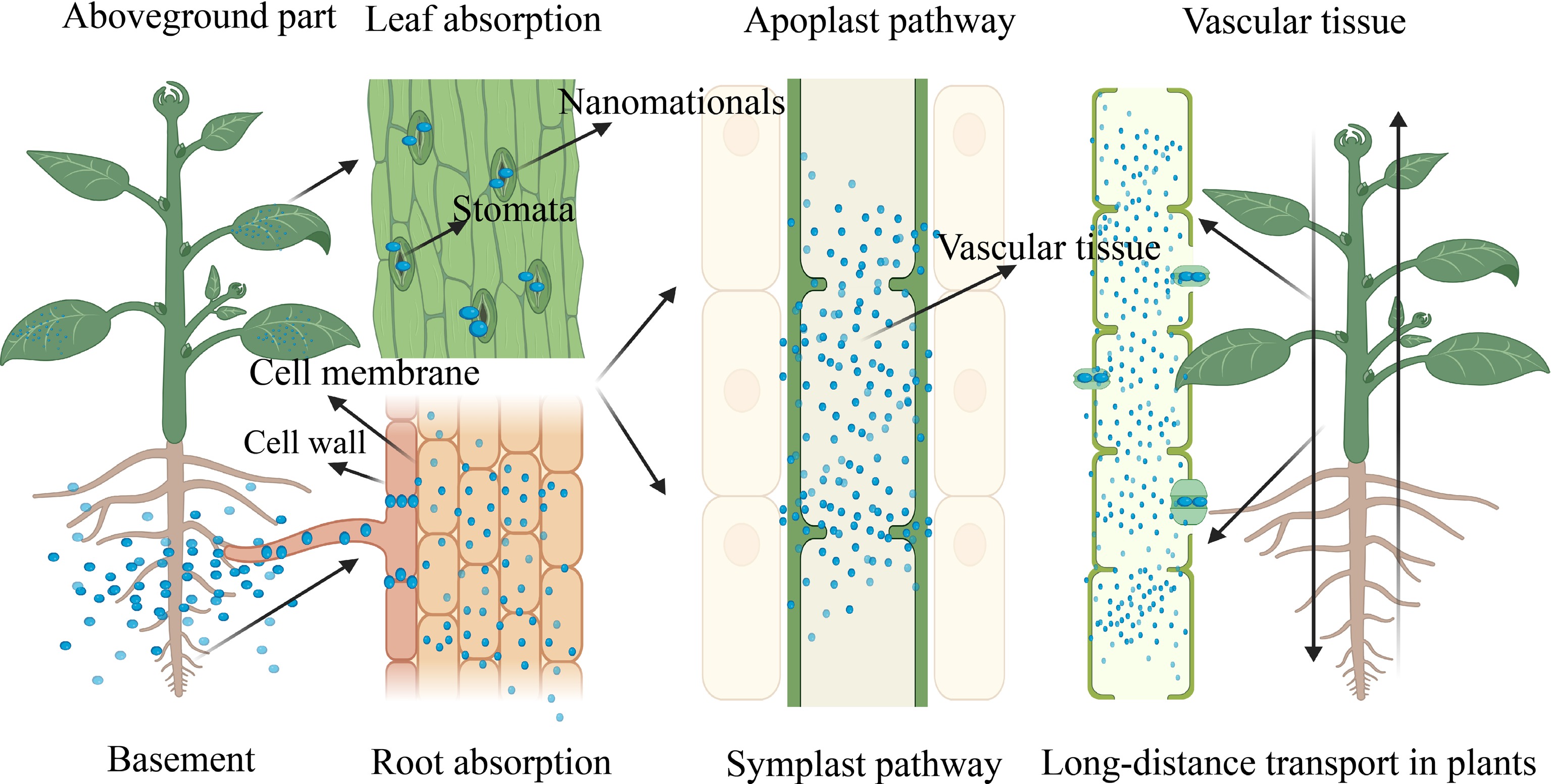
Figure 2.
Absorption routes of nanomaterials in plants. There are two primary routes for nanomaterial absorption in plants: (I) root absorption, wherein nanomaterials can penetrate the cell wall and membrane to enter root cells, and (II) foliar absorption, wherein nanomaterials enter through the leaf stomata or the epidermis into mesophyll cells. Once inside the roots or leaves, nanomaterials reach the vascular tissues via the apoplastic or symplastic pathway, and are then distributed upward to aerial tissues or downward to underground parts through long-distance transport in the vascular system, enabling plant-wide dispersion.
Absorption route by plant roots
-
Nanomaterials can be translocated to the aerial parts of plants through the interaction with roots and the accumulation in cellular or subcellular organelles. This process is facilitated by transpiration, with previous studies demonstrating a positive correlation between the water uptake rate and nanomaterial absorption[38]. Because of their high surface area and reactivity, nanomaterials can also be adsorbed or aggregated on the outer epidermis of plants through electrostatic interactions, mechanical adhesion, hydrophobic affinity and so on[39]. Root mucous secretions, which are rich in organic acids and amino acids, can strongly contribute to the adsorption of nanomaterials on root surfaces, making them resistant to removal by washing[40]. Moreover, lateral root formation can create new adsorption surfaces and offer an additional pathway for nanomaterials to reach the central vascular tissues[41].
Previous studies have reported that nanomaterials with diameters of 3−5 nm can penetrate root tissues under osmotic pressure or via capillary forces through the root epidermal cells[42]. Although the semipermeable epidermal cell wall contains small pores that restrict larger nanomaterials[41], some NPs can induce the formation of new pores, thereby enhancing their uptake[42]. After passing through the cell wall, nanomaterials may move apoplastically through extracellular space toward the central vascular cylinder, wherein they further enter the xylem and are subjected to upward transport with the aid of root pressure and transpiration pull[41,42].
Absorption route by plant leaves
-
Nanomaterials applied to the leaves primarily enter plants through the stomata or by penetrating the cuticle. The cuticle acts as a principal barrier, generally restricting the entry of particles larger than approximately 5 nm[41,42]. In contrast, particles larger than 10 nm can gain access via the stomatal openings. Once inside, their subsequent cellular transport occurs through either the apoplastic or symplastic route in a size-dependent manner, ultimately reaching the plant vascular system[43]. The former typically facilitates the movement of materials that are up to about 200 nm in diameter, whereas the latter is more suitable for transporting nanomaterials that are generally less than 50 nm in diameter[44].
The efficacy of nanomaterial adsorption following foliar application is governed by several critical factors. These include the application method, as well as particle size and concentration[45]. Furthermore, leaf surface characteristics, including leaf morphology, chemical composition, the presence of trichomes, and the existence of surface exudates and waxes, are all key factors that influence the initial trapping and retention of nanomaterials on leaf surface[46].
-
Nanomaterials have documented remarkable effectiveness in agriculture, with applications spanning genetic modification, growth and development regulation, and pest and disease management. Their unique properties, including high-efficiency targeting and controlled release, enhance nutrient use efficiency, minimize pesticide and fertilizer losses, and boost crop stress tolerance, thereby contributing to crop production enhancement.
Genetic transformation of plants
-
Although conventional genetic transformation methods, such as Agrobacterium-mediated transformation, gene gun bombardment, polyethylene glycol (PEG)-mediated transfection, liposome-based methods, and pollen tube-mediated gene transfer, have enabled significant advances in plants, each of them remains constrained by several notable limitations[47]. For example, Agrobacterium-mediated transformation requires plant varieties that can be cultivated and regenerated in vitro, and this process is further limited by random DNA integration, tissue damage, a narrow range of host plants, and low transformation efficiency for organelles such as chloroplasts and mitochondria[48]. Gene gun bombardment often results in multicopy insertion and localized expression of transgenes, significant tissue damage, and low transformation efficiency, though it is theoretically applicable to a much broader range of species. These challenges highlight the necessitation of developing more precise, efficient, and universally applicable transformation technologies.
Compared with the abovementioned conventional methods, nanomaterials offer a powerful alternative by leveraging their small size to deliver foreign substances into plant cells while protecting these cargos from degradation. As shown in Table 1, nanomaterial delivery can effectively accomplish gene delivery and editing. Regarding this context, SWCNTs have emerged as promising gene-delivery vehicles because of their high biocompatibility and aspect ratio, substantial surface area-to-volume ratio, and significant tensile strength[15]. The high surface area allows SWCNTs to be loaded with an amount of DNAs for efficient delivery[14]. Research has demonstrated the efficacy of this approach, with modified SWCNTs successfully delivering foreign genes encoding GFP and yellow fluorescent protein (YFP) into N. benthamiana leaves and even into chloroplasts via injection or co-culture and expressing them[49]. Furthermore, SWCNTs can facilitate gene knockdown by delivering siRNAs, as supported by the observation of up to 95% silencing of a constitutively expressed GFP gene in N. benthamiana[50].
Beyond carbon-based structures, MSNs also show significant potential for targeted gene delivery because of their tunable surface properties[51]. For example, MSNs have been used to mediate the delivery of plasmid DNAs (pDNAs) into Arabidopsis through root co-culture and into tomato plants via leaf spraying and shoot injection[51]. Moreover, gold NP-modified MSNs (Au-MSNs) have been used to co-deliver plasmids and proteins into onion (Allium cepa) epidermal cells via gene gun bombardment, and these Au-MSNs were found to successfully traverse cell walls and release their cargoes, yielding a detectable green fluorescent signal within 24 h. Actually, gold NPs (AuNPs) themselves are effective delivery vectors as well[52]. Zhang et al. used AuNPs with various sizes and shapes to deliver DNA-Cy3 into plant cells by injection, and the results reveal that although rod-shaped AuNPs could be internalized, 10-nm spherical AuNPs exhibit the highest efficiency for targeted gene silencing via RNAi[53].
Table 1. Applications of nanomaterials for genetic transformation in plants.
Class Nanomaterial Genetic element Utilization method Treatment target Plant species Refs Metal nanoparticles SWCNTs siRNA Injection Leaf Tobacco [54] Inorganic nanomaterials Gold nanoclusters siRNA Injection Leaf Tobacco [55] Mesoporous silica pDNA Spraying and injection Leaf and shoot Tomato [51] LDH dsRNA Soaking Mature pollen grain Tomato [53] Carbon nanomaterials Functional graphene oxide NPs siRNA Injection Leaf Tobacco [56] SWCNTs pDNA-GFP Soaking Root Tobacco [57] Regulation of plant growth and development
-
Nanomaterials possess unique physicochemical properties that can significantly enhance plant growth and development. Upon entering tissues, they are able to interact with target plants at cellular and subcellular levels, inducing alterations in plant morphology and physiological states. As shown in Table 2, nanomaterials can promote growth and development of multiple plants. For example, tobacco cells treated with MWCNTs at varying concentrations display the apparent promotion of cell growth and stimulation of multiple processes such as cell division, cell wall formation, and aquaporin-related gene expression[58]. Similarly, 20−80 nm silver-based NPs (AgNPs) in size have been applied to Arabidopsis plants grown hydroponically, and the inhibited expression is found for pathogen-activated genes in salicylic acid-mediated systemic acquired resistance (SAR) pathway, along with other abiotic stress-responsive genes like those encoding defensin-like proteins, plant thionins, β-glucosidases, cytochrome P450 proteins, and glutathione S-transferase (GST) members[59].
Foliar application of metal NPs has been reported to increase chlorophyll content in plants, thereby enhancing the synthesis of light-harvesting complexes. This improvement allows plants, particularly crop species, to capture more light energy and increase their photosynthetic efficiency, thus benefiting final yield and quality. Among these NPs, nano-TiO2 has been extensively studied because of its good photocatalytic properties, which could activate redox reactions and facilitate electron transfer between Photosystem II and nano-TiO2[60]. However, some negative effects, including inhibited seed germination and lowered root length and biomass, have been observed in tobacco treated with nano-TiO2. Intriguingly, transcriptomic analysis for nano-TiO2-treated tobacco plants reveals significantly elevated expression of miR395 and miR399, two miRNA members that are profoundly involved in plant acclimation to nutrient stress, implying their potential roles in tobacco responses to nano-TiO2 exposure[61].
In addition to normal growth conditions, biological significance of nanomaterials has been documented in regulating the growth and development of plants, particularly crop species, under environmental stress. Soil salinization is considered to be a global crisis severely threatening agricultural production, and salt tolerance enhancement has been observed across numerous crop species upon nanomaterial application, including rice (Oryza sativa), wheat (Triticum aestivum), barley (Hordeum vulgare), potato (Solanum tuberosum), rapeseed (Brassica napus), cotton (Gossypium hirsutum), and cucumber (Cucumis sativus)[62,63]. A notable example is nanoceria, wherein the coexistence of Ce3+ and Ce4+ creates oxygen vacancies capable of neutralizing hydrogen peroxide (H2O2), superoxide anions (O2−), and hydroxyl radicals (OH˙)[64], making it an effective ROS scavenger. The mechanisms underlying nanoceria-induced salt tolerance are primarily associated with the maintenance of ROS homeostasis to mitigate oxidative damage, improved potassium retention and exclusion of sodium to sustain an optimal K+/Na+ ratio, enhanced production of gas signaling molecules such as nitric oxide, and modulation of plant hormone levels and α-amylase activity[65].
Developing strategies to reduce reliance on conventional fertilizers is crucial for sustainable agriculture, as global demand for these nutrients is projected to continuously rise over the upcoming decades[66]. Regarding this context, nanotechnology offers promising alternatives in the form of nanofertilizers, which can improve crop uptake efficiency by delivering nutrients that are encapsulated, adsorbed or directly nanonized. These engineering methods of fertilizers not only allow for controlled nutrient release but also enhance their solubility and bioavailability, reduce nutrient loss, and increase absorption rate in plants[67].
It should be noted that high concentration of accumulated nanomaterials could impose negative effects on crop plants, including arrested growth, lowered product quality and seed germination, decreased fresh and dry weight, and inhibited root and shoot elongation[68]. Therefore, although nanomaterials present considerable advantages for promoting crop growth and development under normal and environmental stress conditions, their potential risks must be carefully evaluated.
Table 2. Applications of nanomaterials for regulating plant growth and development.
Class Nanomaterial Utilization method Treatment target Plant species Biological process Refs Carbon nanomaterials MWCNTs Spraying Leaf Tomato Antioxidant system [69] SWCNTs and MWCNTs Irrigation Root Tomato Early growth, flowering time, and phytohormones [70] SWCNTs Spraying Leaf Pea (Pisum sativum) Leaf micromorphology, chloroplast ultrastructure, and photosynthetic activity [71] Nanocrystalline
metal oxideNano-Fe3O4 Hydroponics Root Tobacco Physio-biochemical and ultrastructural traits [72] Nano-γ-Fe2O3 and Nano-Fe3O4 Irrigation Fruit Melon (Cucumis melo) Physiological process and fruit quality [73] Nano-TiO2 Hydroponics Root, leaf, stem, and fruit Tomato Light acclimation [74] Nano-CuO Irrigation Leaf Brassica rapa Growth and development [75] Nano-CuO Droplet Leaf Lettuce (Lactuca sativa) Growth and development [76] Nano-TiO2 Tissue culture Leaf Tobacco Ultraviolet-B stress tolerance [77] Nano-CeO2 Hydroponics Leaf and root Cucumber Salt tolerance [63] Nano-CeO2 Priming Seed Rapeseed Salt tolerance [78] SeNPs Irrigation Root Cucumber Lateral root growth [79] Inorganic nanomaterials MSNs Spraying Leaf Tomato Defense response [80] Metal nanoparticles AgNPs and FeNPs Irrigation Whole plant Soybean (Glycine max) Seedling development [81] TiO2 NPs and GNPs Water culture Root and stem Lettuce Phytotoxic effects [82] Utilization of nanomaterials in pest and disease control
-
In a global context wherein pests and diseases account for 20%−40% of annual yield loss, nanopesticides that commonly refer to nanoscaled materials with pest control properties have emerged as a promising and environmentally friendly measure to improve plant resilience against various biotic challenges[83]. Pesticides of this kind include NPs with inherent antimicrobial, pesticidal, or herbicidal activity, and NPs that have been engineered to encapsulate and enable the slow, sustained release of synthetic active ingredients[84]. For example, a chitosan-based nanofungicide, encapsulating hexaconazole and/or dazomet within 2−168 nm NPs, has been designed to combat basal stem rot caused by Ganoderma boninense in oil palm (Elaeis guineensis). This formulation demonstrates reduced phytotoxicity, as evidenced by the maintenance of chlorophyll content, photosynthetic rate, root elongation, and seedling height in comparison to the application of conventional, nonencapsulated fungicides[85]. Moreover, nanomaterials can be used to enhance the solubility of insecticides and potentially reduce their overall toxicity. Modified chitosan- and silica-based NPs have been successfully loaded with insecticides that are less water-soluble, leading to the improved formulation and application efficacy.
As shown in Table 3, the antimicrobial potentials of various nanomaterials further underscore their agricultural utilization. Ocsoy et al. developed a composite of DNA-directed Ag-NPs grown on graphene oxide (GO), which significantly lowers the viability of Xanthomonas perforans, a causal pathogen responsible for bacterial spot in tomato, at a concentration of 16 mg L−1[86]. Similarly, photocatalytically active nano-TiO2 exhibits strong antimicrobial properties, which are supported by Paret et al.'s observations of its high photocatalytic activity and effectiveness against X. perforans in tomato plants[87]. In a study carried out by Adisa et al., nano-CeO2 -mediated suppression of Fusarium wilt is revealed in tomato plants after both root and foliar application, though the precise fungistatic mechanisms remain unclear[88].
Among the most widely studied and beneficial NPs for bactericidal applications are chitosan, silica, and polymeric blends[89]. For example, chitosan–lactide copolymers that are loaded onto NPs at varying concentrations have demonstrated a controlled release, resulting in effective inhibition of growth in Colletotrichum gossypii[90]. Furthermore, the good management of viral diseases by nanomaterials has been reported in previous studies. For example, clay nanosheets have been used to deliver PMMoV IR54-dsRNAs that target the replicase gene of pepper mild mottle virus in Arabidopsis, cowpea (Vigna unguiculata), and tobacco by foliar spraying, and apparently improved resistance to this viral disease is observed in these plants, including a measurable reduction in virus loading and the sustained expression of protective genes[91].
Table 3. Applications of nanomaterials in plant pest/disease control.
Nanomaterial Characteristics Size Treatment target Plant species Pest/disease Refs Clay nanosheets Light weight, stable shape 45 nm Leaf Cucumber Cytomegalovirus [35] Multilayer CNTs Small diameter, high aspect ratio 30−50 nm Leaf Tomato Fusarium oxysporum f. sp. lycopersici [69] Graphene Zero-dimensional semiconductor, high adsorption, stable structure 2 μm Leaf Tomato Fusarium oxysporum f. sp. lycopersici [69] Nano-Fe3O4 Morphological plasticity, high thermal stability 10−30 nm Leaf Tobacco Tobacco mosaic virus [92] Nano-CuO Antibacterial capacity, enhanced catalysis 30 nm Root Tomato Fusarium oxysporum f. sp. lycopersici [93] Nano-CeO2 High loading efficiency, carboxyl modification, antioxidation 8 ± 1 nm Root and leaf Tomato Fusarium oxysporum f. sp. lycopersici [88] Nano-SiO2 Anti-ultraviolet, water insolubility 20 nm Root Tomato Helicoverpa armigera [94] sLDH clay nanosheets Multifunctional, sustainable, and environmentally friendly 40 nm Leaf and stem Lettuce Botrytis cinerea [95] ECNs Safe, stable, and efficient 180 nm Leaf Tomato Phytophthora infestans [96] -
Nanotechnology represents a rapidly developing field of research with diverse applications and significant potential for crop production improvement. Nanomaterial-mediated gene transformation is a promising new approach that overcomes plant cell wall barrier and reduces the limitations of conventional methods, particularly in crop species that are difficult to be genetically transformed. Certain nanomaterial-based methods can achieve targeted delivery of foreign DNAs or RNAs to specific organelles such as chloroplasts and mitochondria without requiring chemical or biological assistance. Furthermore, nanomaterials can enhance photosynthetic efficiency, pigment synthesis, and enzyme activity, all of which can contribute to improve crop productivity.
To develop effective application strategies, key factors must be taken into careful consideration, including the optimal nanomaterial dosage, exposure duration, translocation and accumulation patterns, and their mechanisms of action within plants. Despite existing research on nanomaterial interactions with crops, substantial heterogeneity among nanomaterials, in terms of their structure, size, chemical composition, and surface area, complicates general understanding about nanomaterial–crop interactions. The precise ways by which nanomaterials influence plant physiological processes remain largely unclear. To balance the technological benefits with ecological safety, a nanobiotechnology system that is suitable for sustainable agriculture should be established. Green synthesis processes based on plant extracts, microorganisms, and agricultural waste should be also developed to reduce the use of toxic chemical reagents. Thus, future mechanistic studies will focus on elucidating their effects on plant modes of action, gene expression, and signal transduction pathways.
Evaluating the safety of nanomaterials in plants also presents a considerable challenge. CNTs, metal-based NPs, silica, and similar materials can be adsorbed on the surface of colloids in soil. Subsequently, they may enter groundwater through leaching or be transported to surface water bodies via runoff. These materials do not degrade rapidly under natural conditions, and their long-term accumulation may lead to unexpected pollution. Particularly, the small size of nanomaterials may complicate the efficiency of detecting them, and therefore, their environmental behaviors, including accumulation, degradation, and transformation, are not able to be fully understood, highlighting the urgent need for more robust safety and risk assessment.
Another critical concern is the phytotoxicity of nanomaterials, which can induce a range of adverse effects in plants. These may include reduced photosynthetic activity, abnormal ROS production, DNA damage, pore blockage, and disruption of apoplastic flow, all of which can impair nutrient uptake and fluid balance. For example, CNT suspensions have been shown to trigger ROS accumulation in cell wall and plasma membrane, leading to apoptotic cell death in Arabidopsis leaves[97]. Similarly, Ag-NPs have been demonstrated to impose genotoxic effects on the root tip cells of onion plants, including visible chromosomal alterations[98]. Nano-TiO2, when being applied at high concentration, has also been found to inhibit sprouting and growth in onion[99]. Additionally, nanomaterials can be absorbed by plants through their roots and leaves, transported over long distances via vascular tissues, and distributed to various parts of plants. These materials can also be transferred to higher trophic levels through food chain. However, systematic risk assessment remains largely restricted regarding the residual levels of nanomaterials in edible parts of plants and their potential impacts on food safety. These issues underscore the importance of advancing nanomaterial application alongside a rigorous evaluation of their safety and environmental impacts.
This work was supported by the Innovation Capability Improvement Project of Scientific and Technological Small and Medium-sized Enterprises in Shandong Province (2024TSGC0572), the Agricultural Variety Improvement Project of Shandong Province (2023LZGCQY021), the National Natural Science Foundation of China (32272795), and the Earmarked Fund for SDARS (SDARS-05).
-
The authors confirm their contributions to the paper as follows: manuscript conception and design: Yang X, Shi Q, Guo Y; data collection: Guo Y, Yuan H, Zhang Z; technical assistance: You D, Wang L; draft manuscript preparation: Guo Y, Yuan H, Zhang Z; manuscript revision: Yang X. All authors reviewed and approved the final version of the manuscript.
-
Data sharing is not applicable to this article, as no datasets were generated or analyzed during the current study.
-
The authors declare that they have no conflict of interest.
-
# Authors contributed equally: Yongjie Guo, Huixi Yuan, Zhijun Zhang
- Copyright: © 2026 by the author(s). Published by Maximum Academic Press, Fayetteville, GA. This article is an open access article distributed under Creative Commons Attribution License (CC BY 4.0), visit https://creativecommons.org/licenses/by/4.0/.
-
About this article
Cite this article
Guo Y, Yuan H, Zhang Z, You D, Wang L, et al. 2026. Recent advances in nanomaterials and nano-mediated delivery systems for improved crop production. Vegetable Research 6: e016 doi: 10.48130/vegres-0026-0010 

Recent advances in nanomaterials and nano-mediated delivery systems for improved crop production
- Received: 25 January 2026
- Revised: 17 March 2026
- Accepted: 20 March 2026
- Published online: 09 May 2026
Abstract: Nanomaterials, a group of novel materials with at least one dimension smaller than 100 nm, display great usage potential in multiple scientific disciplines such as drug design, cancer therapy, and improved crop production. This review focuses on nanomaterials and their applications in the plant field. The synthesis and classification of nanomaterials are first introduced, and the possible absorption and transport routes of nanomaterials in plants are discussed. Subsequently, the article summarizes recent advances in the utilization of nanomaterials and nano-mediated delivery systems in genetic transformation, growth and development regulation, and disease and pest insect control in plants, particularly those with agronomic importance. Several key research directions are finally proposed to advance the future application of nanobiotechnology in crop production.