











-
Climate change has emerged as a severe challenge to global agricultural production systems[1]. Ongoing climate change, manifested as more frequent extreme weather events, is exacerbating the severity and spatial extent of various abiotic stresses, such as extreme temperatures (high/low temperatures), water imbalances (drought/waterlogging), abnormal light conditions (high/low light intensity), and soil salinization[2]. Abiotic stresses caused by extreme temperatures and water imbalances not only disrupt plant cellular, tissue, and morphological structures but also trigger a series of complex physiological responses and molecular regulatory mechanisms within plants, enhancing their adaptability and tolerance to adverse conditions[3,4]. When the intensity of stress exceeds the plant's acclimation capacity, it will hinder their normal growth and development, or even lead to plant mortality[5]. Consequently, these stress-induced effects significantly impair crop biomass accumulation, yield formation, and quality trait development, thereby adversely affecting the stability and economic profitability of agricultural production[6].
Single stress refers to the condition where only one stress factor affects plant growth and development, while combined stress denotes the simultaneous or sequential occurrence of two or more stress factors, subjecting plants to multiple adversities and significantly intensifying their survival pressure[7]. Importantly, plant physiological and molecular responses to combined stress are not merely the additive outcomes of responses to individual stresses[8]. For instance, under drought stress alone, Arabidopsis primarily accumulates proline as an osmoprotectant, whereas sucrose becomes the predominant accumulated compound under combined heat and drought stress[9]. When different stress factors co-occur, they may interact in a synergistic or antagonistic manner[9−11]. Antagonistic interactions are commonly observed when individual stresses impose opposing physiological regulation[12]. Heat promotes stomatal opening in tomato leaves to enhance transpiration and reduce leaf temperature; conversely, drought stress induces stomatal closure to minimize water loss[12]. Under concurrent heat and drought stress, these opposing regulatory effects lead to an antagonistic interaction at the stomatal regulation level, ultimately causing stomatal closure and suppressing gas exchange in tomato plants as drought intensifies[12]. By contrast, synergistic interactions may occur when multiple stresses converge on similar physiological targets[13,14]. Individual drought or salinity stress can reduce photosynthetic efficiency by restricting carbon dioxide diffusion into chloroplasts and suppressing carbon assimilation[13,14]. When these two stresses occur simultaneously, the inhibitory effect is often synergistically intensified, leading to more severe physiological damage to plants[13,14]. As the number of interacting abiotic stress factors—such as heat, salinity, high light, low pH, heavy metals, and oxidative stress—increases, the complexity of plant stress responses also rises[15]. Moreover, different stress combinations often induce specific gene expression profiles, further underscoring the mechanistic specificity of plant responses to combined abiotic stresses[15].
As a vital component of global agricultural production systems, vegetable crops serve as primary sources of vitamins, minerals, dietary fiber, and diverse bioactive compounds in human diets, playing an irreplaceable role in ensuring global food security and nutritional health[16]. During vegetable production, multiple growth and developmental stages are often subjected to combined abiotic stresses, which cause significant yield losses and quality deterioration, ultimately resulting in substantial economic damage[17]. In vegetables, synergistic or antagonistic interactions between abiotic stresses under combined conditions cause physiological damage, such as growth inhibition, photosynthetic decline, oxidative stress, and osmotic imbalance[13,14]. These effects extend to the molecular level, where combined stresses activate unique regulatory networks that encompass stress-responsive genes, transcription factors, non-coding RNAs, and hormone signaling[15,18]. This review focuses on the effects of combined stress on various vegetables at the physiological and molecular levels, as well as potential strategies to improve the tolerance of vegetables. To enhance vegetables' resilience, strategies such as genetic engineering and application of exogenous substances (e.g., melatonin, glycine betaine, and selenium) are discussed. Overall, this review provides a theoretical foundation for advancing the breeding of vegetables with enhanced tolerance to combined abiotic stresses and for developing sustainable cultivation practices under changing climatic conditions.
-
Although knowledge of individual abiotic stresses is relatively well established, plants under escalating climate change often face more complex combined abiotic stress environments during growth[19]. Before detailing the responses of vegetable crops, it is instructive to briefly consider key findings from model and cereal crops. In Arabidopsis thaliana, multifactorial stress combinations (e.g., salinity, high light, heat, and paraquat) induce specific transcriptomic changes distinct from single stresses, with only a small fraction of genes being commonly shared across different combinations[15]. In rice, the ALKALI-THERMAL TOLERANCE 1/2 (ATT1/2) genes have been identified as important regulators that fine-tune gibberellin levels to balance growth and tolerance under alkali–thermal stress[20]. These examples highlight the importance of studying stress combinations and offer potential target genes for breeding vegetable crops with enhanced multi-stress tolerance.
Combinations of two abiotic stresses
Combined heat and drought stress
-
Temperature and water availability are two indispensable environmental factors for plant growth and development that often interact synergistically[21,22]. Heat can exacerbate drought conditions, while water status also influences a plant's thermotolerance[10]. For most vegetable crops, combined heat and drought stress significantly inhibits normal growth and development[23−25]. For example, after 6 d of combined stress (38 °C/30 °C, no irrigation), tomato canopy area and stem diameter were both significantly reduced compared with the non-stress control (Table 1)[23]. Similarly, following 21 d of combined stress (30 ± 1 °C, watered with Hoagland solution + PEG-8000 at 0.39 g/g H2O), potato plants exhibited slower height increment, cell membrane integrity, relative water content, smaller leaf area, and severe wilting than the control (Table 1)[24]. In contrast to these inhibitory effects, chlorophyll content was observed to increase under individual drought and the combined stress treatment when compared to the control[24]. This may be attributed to reduced leaf expansion and the concentrating effect of water loss[24]. In pepper, 2 weeks of combined heat and drought stress (ambient temperature +5 °C, 40% pot capacity) significantly reduced plant height, leaf area, fruit length, and fruit diameter, ultimately leading to a decline in yield (Table 1)[25]. In addition, lentil plants exposed to combined heat and drought stress (32−40 °C/21−27 °C, fully irrigated until 75% podding followed by maintaining soil moisture at 50% field capacity) exhibited delayed development, significantly shortened flowering and podding duration, and reduced seed size and weight, with sensitive genotypes showing greater decreases than tolerant ones (Table 1)[26]. Compared with the control, individual drought and combined stress treatments caused a sharp decline in starch content in lentil seeds[26]. These treatments also increased starch hydrolysis in both leaves and seeds, leading to the accumulation of reducing sugars[26]. Photosynthesis, a key process in plant growth and development, relies on the coordinated function of multi-component systems[27]. Combined heat and drought stress typically causes greater photosynthetic impairment than individual stresses, as reported in species such as tomato[12,28], pepper[25], and lentil[26]. These detrimental effects are manifested by the significant reduction in key photosynthetic parameters, including photosynthetic rate, photosynthetic pigment content, leaf stomatal conductance, and photosystem II (PSII) efficiency (Fig. 1a)[12,25,26,28]. Under combined abiotic stresses, reactive oxygen species (ROS) often accumulate excessively in plants, triggering oxidative damage[23,29]. Combined heat and drought stress (38 °C/30 °C, no irrigation, 6 d of treatment) induces a distinct ROS response in tomato, characterized by a significant increase in hydrogen peroxide (H2O2) content and production rate of superoxide anion (O2·−) compared with the control (Table 1)[23]. Similarly, combined heat and drought stress (42 °C, no irrigation, 7 d of treatment) causes more severe physiological damage to purslane compared to individual stresses, as reflected by increased malondialdehyde (MDA) content, elevated electrolyte leakage (EL) and O2·− production rates, as well as enhanced activities of peroxidase (POD) and superoxide dismutase (SOD) (Table 1)[29]. Collectively, combined heat and drought stress inflict multiple physiological damages on vegetable crops, including growth restriction, stomatal closure, photosynthetic inhibition, and excessive accumulation of ROS[23,29]. Notably, the extent of damage is generally greater under the combined stress than under individual heat or drought stresses[23,30].
Table 1. Physiological and molecular responses of vegetable crops to combined heat and drought stress.
Vegetable crop Treatment Physiological/molecular response Ref. Solanum lycopersicum L. (1) Control: 26 °C/18 °C, irrigated once daily;
(2) Drought stress: 26 °C/18 °C, not irrigated;
(3) Heat stress: 38 °C/30 °C, irrigated once daily;
(4) Combined stress: 38 °C/30 °C, not irrigated.
The 24-d-old plants were treated for 6 d.After 6 d of combined stress, tomato plants exhibited significant reductions in canopy area and stem diameter, alongside a distinct reactive oxygen species (ROS) response characterized by a significant increase in hydrogen peroxide (H2O2) content and superoxide anion (O2·−) production rate compared to the control. [23] Solanum tuberosum L. (1) Control: 24 ± 1 °C, irrigated with Hoagland solution;
(2) Drought stress: 24 ± 1 °C, irrigated with Hoagland solution supplemented with PEG-8000 at a concentration of 0.39 g/g H2O;
(3) Heat stress: 30 ± 1 °C, irrigated with Hoagland solution;
(4) Combined stress: 30 ± 1 °C, irrigated with Hoagland solution supplemented with PEG-8000 at a concentration of 0.39 g·g−1 H2O.
The plants were treated to stress for 21 d.Exposure to combined stress triggered a significant inhibition of growth and physiological function in potato plants, characterized by a marked reduction in plant height, leaf area, cell membrane integrity, and relative water content. In contrast to these inhibitory effects, chlorophyll content was observed to increase under both drought alone and the combined stress treatment when compared to the control. [24] Capsicum annuum L. (1) Control: ambient temperature (AT) + 100% pot capacity (PC);
(2) Combined stress: (AT + 3 °C, 80% PC), (AT + 5 °C, 80% PC), (AT + 3 °C, 60% PC), (AT + 5 °C, 60% PC), (AT + 3 °C, 40% PC), (AT + 5 °C, 40% PC);
The flowering plants were treated to stress for 14 d.Two weeks of combined stress significantly reduced pepper plant height, leaf area, fruit length, and fruit diameter, while also impairing photosynthesis by decreasing the photosynthetic rate, transpiration rate, and stomatal conductance. This disruption of gas exchange, carbon fixation, and allocation ultimately led to a decline in yield compared with the control. [25] Lens culinaris Medik. (1) Control: 22−30 °C/16−19 °C, 100% field capacity;
(2) Drought stress: 22−30 °C/16−19 °C, 50% field capacity;
(3) Heat stress: 32−40 °C/21−27 °C, 100% field capacity;
(4) Combined stress: 32−40 °C/21−27 °C, 50% field capacity.
The 75% podding plants were treated to stress for 15 d.Lentil plants exposed to combined heat and drought stress exhibited delayed development, significantly shortened flowering and podding duration, and reduced seed size and weight, with sensitive genotypes showing greater decreases than tolerant ones. Compared with the control, individual drought and combined stress treatments resulted in a sharp decline in starch content within lentil seeds, accompanied by an increased rate of starch hydrolysis in both leaves and seeds, which led to the accumulation of reducing sugars. [26] Portulaca oleracea L. (1) Control: 28 °C, routinely irrigated;
(2) Drought stress: 28 °C, non-irrigated;
(3) Heat stress: 42 °C, routinely irrigated;
(4) Combined stress: 42 °C, non-irrigated.
The 21-d-old plants were treated to stress for 7 d.Combined heat and drought stress causes more severe physiological damage to purslane compared to individual stresses, as reflected by increased malondialdehyde (MDA) content, elevated electrolyte leakage (EL) and O2·− production rates, as well as enhanced activities of peroxidase (POD) and SOD. [29] Solanum lycopersicum L. (1) Control: 25 °C, water daily with a full-strength Hoagland solution (200 mL);
(2) Drought stress: irrigate with full-strength Hoagland solution (200 mL) for 7 d, then withhold irrigation for 10 d until the soil relative water content drops to 60%;
(3) Heat stress: subjected to 45 °C for 7 d;
(4) Combined stress: the plants were first subjected to severe drought stress, followed by exposure to 45 °C high temperature for 24 h.
The 15-d-old plants were treated for 6 d.Under combined stress, the transcript levels of key enzymes in the AsA–GSH pathway—superoxide dismutase (SOD), ascorbate peroxidase (APX), glutathione reductase (GR), dehydroascorbate reductase (DHAR), and monodehydroascorbate reductase (MDHAR)—were upregulated by 8- to 12-fold compared with the control. The relative expression levels of heat-shock proteins HSP70 and HSP90 increased by 7- to 8-fold under the combined stress. Compared with individual stresses, the expression of the Rubisco large subunit gene (rbcL) and Rubisco activase (RCA) was downregulated in tomato under combined heat and drought stress. [28] Solanum lycopersicum L. (1) Control: 26 °C, regular irrigation;
(2) Drought stress: after 3 d of withholding irrigation, the plants were treated to 26 °C for 2 d;
(3) Heat stress: 38 °C for 2 d, regular irrigation;
(4) Combined stress: after 3 d of withholding irrigation, the plants were treated to 38 °C for 2 d.
The 24-d-old plants were treated to stress.Compared with the control, individual drought and heat stress, combined stress specifically induced 61, 74, and 37 miRNAs, respectively, among which growth-regulating factor 3 (GRF3) was upregulated, but growth-regulating factor 4 (GRF4) was downregulated in tomato plants. [18] Solanum lycopersicum L. (1) Control: 26 °C, regular irrigation;
(2) Drought stress: after 3 d of withholding irrigation, the plants were treated to 26 °C for 36 h;
(3) Heat stress: 38 °C, regular irrigation;
(4) Combined stress: after 3 d of withholding irrigation, the plants were treated to 38 °C for 36 h.
The 24-d-old plants were treated to stress.The expression levels of 9, 14, and 8 circRNAs were significantly higher in tomato plants under combined stress than under the control, heat, and drought stress. [33] 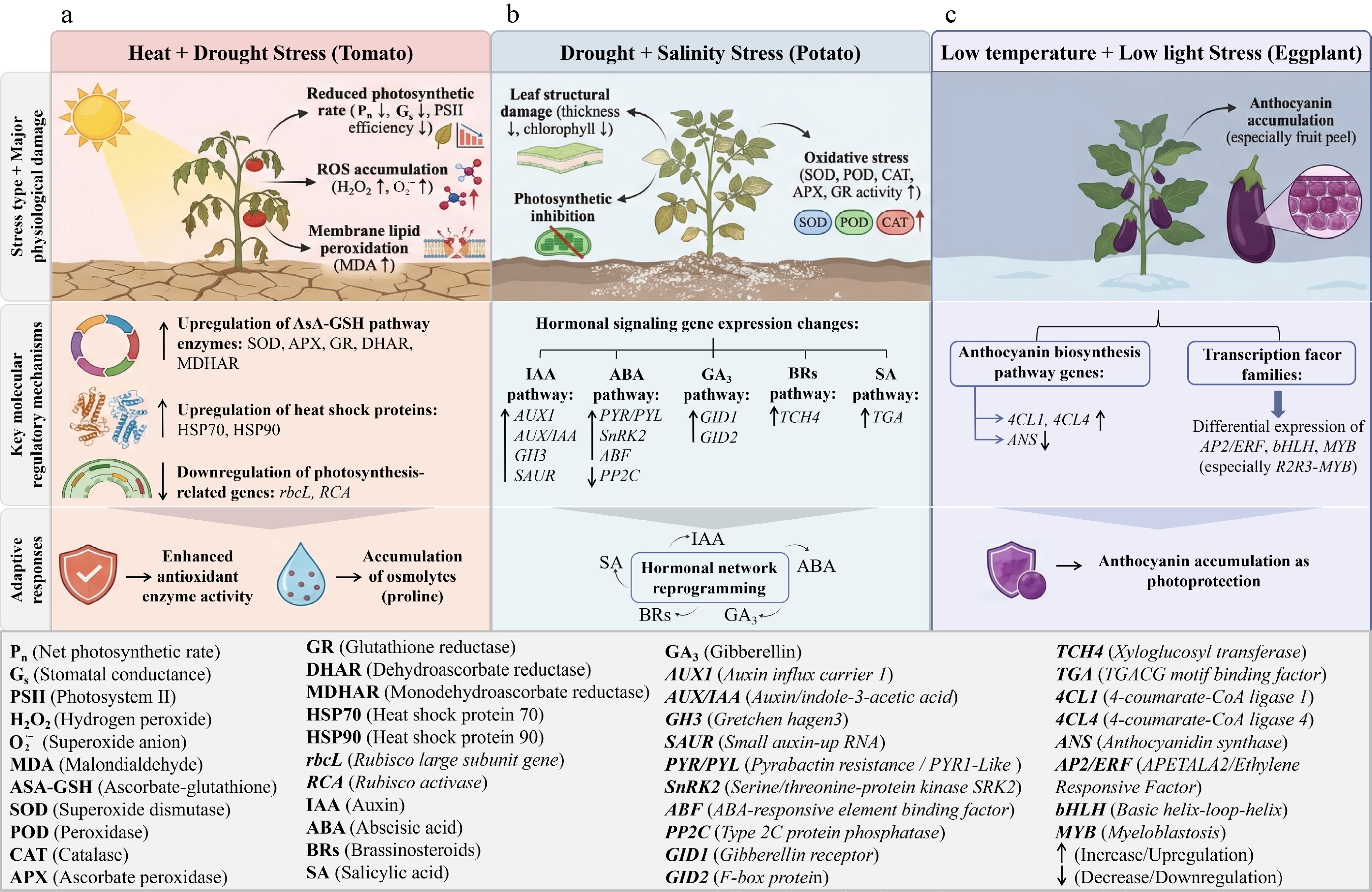
Figure 1.
Physiological and molecular responses of vegetable crops to combined abiotic stress: insights from tomato, potato, and eggplant. (a) The response of tomato to combined heat and drought stress. (b) The response of potato to combined drought and salinity stress. (c) The response of eggplant to combined low temperature and low light stress.
Under combined heat and drought stress, tomato plants activate or suppress specific molecular regulatory mechanisms[28]. The ascorbate–glutathione (AsA-GSH) pathway in plants comprises both enzymatic and non-enzymatic antioxidants, playing a critical role in scavenging ROS[28]. For instance, under combined heat and drought stress (initial severe drought followed by exposure to 45 °C for 24 h), the transcript levels of key enzymes in the AsA-GSH pathway—SOD, ascorbate peroxidase (APX), glutathione reductase (GR), dehydroascorbate reductase (DHAR), and monodehydroascorbate reductase (MDHAR)—were upregulated by 8- to 12-fold compared with the control (Fig. 1a; Table 1)[28]. In contrast, under individual heat or drought stress, these genes were upregulated 6- to 9-fold, indicating that the combined stress triggers a synergistic transcriptional activation of the AsA–GSH pathway[28]. Although the expression of AsA–GSH-related genes was substantially upregulated, the ROS level remained significantly elevated, suggesting that this defense system is insufficient to fully counteract the oxidative damage induced by combined heat and drought stress[28]. Similarly, the relative expression levels of heat-shock proteins HSP70 and HSP90 increased by 7- to 8-fold under the combined stress[28]. In contrast, compared with individual stresses, the expression of the Rubisco large subunit gene (rbcL) and Rubisco activase (RCA) was downregulated in tomato under combined heat and drought stress[28]. These stress-responsive transcriptional changes contribute to enhancing tomato tolerance and provide important insights into the molecular mechanisms underlying plant responses to combined heat and drought stress[28]. MicroRNAs (miRNAs) are a class of short, endogenously initiated non-coding RNAs that suppress gene expression by binding to highly complementary sites in target mRNAs[31]. Compared with the control and individual drought and heat stress, combined stress specifically induced 61, 74, and 37 miRNAs, respectively, among which growth-regulating factor 3 (GRF3) was upregulated, but growth-regulating factor 4 (GRF4) was downregulated in tomato plants (Table 1)[18]. GRFs (growth-regulating factors) are known regulators of leaf growth and stress responses; their differential expression may contribute to growth–defense trade-offs under combined stress. The upregulation of GRF3 is involved in the fine-tuning of stress response regulation (coordinating the growth–defense balance), whereas the downregulation of GRF4 may redirect resources to the defense system by suppressing growth as an adaptive strategy[18]. Circular RNAs (circRNAs), another class of endogenous non-coding RNAs, can act as miRNA sponges, participate in splicing and transcriptional regulation, and modify the expression of their parental genes[32]. Furthermore, circRNAs are also involved in photosynthesis, starch and sucrose metabolism, RNA transport, RNA degradation, spliceosome function, and ribosome biogenesis[33]. The expression levels of 9, 14, and 8 circRNAs were significantly higher in tomato plants under combined stress than under the control, and heat and drought stress (Table 1)[33]. Altogether, the transcriptional and post-transcriptional regulation plays a key role in the response of vegetable crops to combined heat and drought stress[18,28,33].
Despite these advances, several inconsistencies remain across studies. For example, Handayani & Watanabe[24] reported increased chlorophyll content under combined stress in potato, while most other studies found decreased chlorophyll in tomato and pepper[23,25,28]. This discrepancy may arise from species-specific responses, stress duration, or the confounding effect of reduced leaf expansion. Additionally, while Raja et al. observed a substantial upregulation of AsA–GSH pathway genes under combined stress, the ROS level remained high, indicating that transcriptional activation alone is insufficient to counteract oxidative damage. Future studies should investigate post-translational regulation and the efficiency of antioxidant enzyme complexes[28].
Combined drought and salinity stress
-
In some regions, summer drought and reduced precipitation, coupled with improper field management or the use of brackish water for irrigation, can easily trigger concurrent soil drought and salinity stress[34]. Water deficit and root-zone salt accumulation can disrupt vegetable metabolism and osmotic balance, leading to impaired growth and development, reduced yield, and compromised quality[22,34]. Individual drought (25% PEG-6000) or salinity stress (200 mmol·L−1 NaHCO3) inhibits potato growth and development by disrupting leaf anatomical structure, suppressing photosynthesis, and inducing the accumulation of osmoregulatory substances (Fig. 1b)[35]. Notably, these adverse effects are further intensified under combined stress conditions[35]. Similarly, combined stress aggravates chlorosis and reduces leaf thickness in potato, while significantly increasing the activity of enzymes including SOD, POD, catalase (CAT), thioredoxin peroxidase (TPX), APX, GR, glutathione peroxidase (GPX), and DHAR (Fig. 1b; Table 2)[35]. Hormonal changes are also observed in potato, with combined stress increasing abscisic acid (ABA), salicylic acid (SA), and brassinosteroid (BRs) content, while significantly reducing gibberellin (GA3) and auxin (IAA) levels in leaves[35]. However, the functional interplay between BRs and ABA under combined stress is complex; elevated BRs may fine-tune ABA signaling to balance stress tolerance and growth maintenance. In pepper, combined drought and salinity stress (50% field capacity, 100 mM NaCl) exerted more pronounced negative effects than individual stresses, primarily reflected in the decline of photosynthetic capacity, suppression of stomatal conductance and transpiration rate, and accumulation of proline and soluble sugars (Table 2)[36]. In cabbage, compared to the non-stress treatment, both individual and combined stresses (60% field capacity, 150 mM NaCl) significantly reduce morphological parameters such as plant height, stem diameter, leaf area, and leaf number, while notably increasing oxidative stress indices including EL, MDA, and H2O2 (Table 2)[14]. Photosynthetic indicators, including chlorophyll content, leaf relative water content, stomatal conductance (Gs), net photosynthetic rate (Pn), intercellular CO2 concentration (Ci), and transpiration rate, were also markedly decreased[14]. In tomato, compared to drought alone, the combined drought and salinity stress (cessation of irrigation + 20 mL of 600 mM NaCl) significantly reduced stomatal length in the wild-type genotype 'LA1598' and decreased stomatal width as well as pore width in the cultivated genotype 'TGTB' after 8 d of treatment (Table 2)[37]. Compared with salt stress alone, the combined stress significantly promoted Na+ accumulation in leaves of ‘LA1598' on days 4 and 8, while significantly suppressing K+ accumulation in both leaves and roots on day 8[37]. After 8 d of combined stress treatment, H2O2 content in both tomato genotypes was significantly higher than that in the control[37]. These results indicate that combined drought and salinity stress triggers specific physiological responses in tomato, including induced stomatal closure and disruption of leaf ion homeostasis, with damage being more severe under the combined stress than under individual stresses[37].
Table 2. Physiological and molecular responses of vegetable crops to combined drought and salinity stress.
Vegetable crop Treatment Physiological/molecular response Ref. Solanum tuberosum L. (1) Control: freshwater;
(2) Drought stress: 25% PEG-6000;
(3) Salinity stress: 200 mmol/L NaHCO3;
(4) Combined stress: 25% PEG-6000, 200 mmol·L−1 NaHCO3.
The plants were treated with stress until the full flowering stage.Compared with the control, combined stress aggravates chlorosis and reduces leaf thickness in potato, while significantly increasing the activity of enzymes. Additionally, combined stress decreased the contents of gibberellins (GAs) and auxin (IAA), while increasing the contents of abscisic acid (ABA), salicylic acid (SA), and brassinosteroids (BRs). Compared with the control, under single and combined stresses, the expression of genes related to the IAA pathway, including the auxin influx carrier (AUX1), Auxin/indole-3-acetic acid (AUX/IAA), Gretchen Hagen3 (GH3), and small auxin-up RNA (SAUR); the ABA pathway, including the ABA receptor pyrabactin resistance/PYR1-like (PYR/PYL) family genes, the positive regulator serine/threonine-protein kinase SRK2 (SnRK2), and the ABA-responsive element binding factor (ABF); the BRs pathway, including xyloglucosyl transferase (TCH4); the GA3 pathway, including gibberellin receptor (GID1) and F-box protein (GID2); and the SA pathway, including the TGACG motif binding factor (TGA) transcription factor were all upregulated in potato leaves. In contrast, the expression of PP2C, which encodes protein phosphatase 2C in the ABA pathway, was downregulated. [35] Capsicum annuum L. (1) Control: full irrigation to field capacity (FC);
(2) Drought stress: 75% of FC, 50% of FC;
(3) Salinity stress: 50 mM NaCl, 100 mM NaCl;
(4) Combined stress: 75% of FC + 50 mM NaCl, 75% of FC + 100 mM NaCl, 50% of FC + 50 mM NaCl, 50% of FC + 100 mM NaCl.
The 30-d-old plants were treated for 45 d.Combined stress exerted the more pronounced negative effects than individual stresses, primarily reflected in the decline of photosynthetic capacity, suppression of stomatal conductance and transpiration rate, and accumulation of proline and soluble sugars. [36] Brassica oleracea L. var. capitata L. (1) Control: full irrigation to field capacity;
(2) Drought stress: 80% of field capacity, 60% of field capacity;
(3) Salinity stress: 75 mM NaCl, 150 mM NaCl;
(4) Combined stress: 80% of field capacity + 75 mM NaCl, 80% of field capacity + 150 mM NaCl, 60% of field capacity + 75 mM NaCl, 60% of field capacity + 150 mM NaCl.
The plants were treated during the growth period.Compared with the non-stress control, both individual and combined stresses significantly decreased morphological parameters such as plant height, stem diameter, leaf area, and leaf number, as well as photosynthetic indicators including chlorophyll content, leaf relative water content, stomatal conductance (Gs), net photosynthetic rate (Pn), intercellular CO2 concentration (Ci), and transpiration rate, while notably increasing oxidative stress indices including electrolyte leakage (EL), malondialdehyde (MDA), and hydrogen peroxide (H2O2). [14] Solanum lycopersicum L. (1) Control: irrigation with 60 mL of water per day;
(2) Drought stress: irrigation with 20 mL of water per day;
(3) Salinity stress: irrigation with 60 mL of 200 mM NaCl solution was applied daily;
(4) Combined stress: irrigation with 20 mL of 600 mM NaCl solution was applied daily.
The 25-d-old plants were treated to stress for 8 d.Compared to drought alone, the combined drought and salinity stress significantly reduced stomatal length in the wild-type genotype 'LA1598' and decreased stomatal width as well as pore width in the cultivated genotype 'TGTB' after 8 d of treatment. Compared with salt stress alone, the combined stress significantly promoted Na+ accumulation in leaves of 'LA1598' on days 4 and 8, while significantly suppressing K+ accumulation in both leaves and roots on day 8. After 8 d of combined stress treatment, H2O2 content in both tomato genotypes was significantly higher than that in the control. [37] Compared to non-stress treatment, drought, salt, and their combined stress can induce or suppress the expression and protein activity of key genes involved in multiple hormone signaling pathways in potato plants[35]. Such regulation of hormone signaling pathways may enhance plant stress adaptability by influencing metabolic activity, osmotic balance, and water regulation in potato plants[35]. Specifically, compared with the control, under single and combined stresses, the expression of genes related to IAA pathway, including the auxin influx carrier (AUX1), auxin/indole-3-acetic acid (AUX/IAA), Gretchen Hagen3 (GH3), and small auxin-up RNA (SAUR); the ABA pathway, including the ABA receptor pyrabactin resistance/PYR1-like (PYR/PYL) family genes, the positive regulator serine/threonine-protein kinase SRK2 (SnRK2), and the ABA-responsive element binding factor (ABF); the BRs pathway, including xyloglucosyl transferase (TCH4); the GA3 pathway, including gibberellin receptor GID1 and F-box protein (GID2); and the SA pathway, including the TGACG motif binding factor (TGA) transcription factor was upregulated in potato leaves[35]. In contrast, the expression of PP2C, which encodes protein phosphatase 2C in the ABA pathway, was downregulated (Fig. 1b; Table 2)[35]. Collectively, these findings suggest that potato plants enhance their survival and adaptability to drought and salinity stress by coordinately regulating stress-responsive genes involved in multiple hormone pathways (including the IAA, ABA, BRs, and SA pathways)[35].
Despite the insights provided by the above studies, notable inconsistencies exist across different reports. For example, it was found that combined drought and salinity stress significantly increased abscisic acid (ABA), salicylic acid (SA), and brassinosteroids (BRs) levels in potato, while reducing gibberellin (GA3) and auxin (IAA)[35]. However, the hormonal response patterns in tomato under similar stress conditions are not fully consistent, possibly due to differences in stress intensity, treatment duration, and genotype. Future studies should systematically compare ion balance, hormone signaling networks, and antioxidant systems across multiple genotypes and investigate the dynamic changes of these regulatory pathways under long-term combined stress.
Combined low temperature and low light stress
-
Low temperature and low light are key limiting factors for off-season vegetable cultivation in winter greenhouses, adversely affecting normal plant growth and development[38]. Under combined low temperature and low light stress, plants often exhibit traits such as thinner and enlarged leaves, reduced photosynthetic efficiency, accumulation of ROS, and membrane lipid peroxidation[38]. Pepper plants subjected to combined low temperature and low light stress (15 °C/5 °C, 100 μmol·m−2·s−1, 12 h/12 h) for 20 d exhibited significant decreases in chlorophyll a, chlorophyll b, and carotenoid contents compared to the control[39]. The transpiration rate, Gs, Pn, actual quantum yield of PSII (Y(II)), photochemical quenching coefficient (qP), and photochemical quenching (qL) are reduced, while Ci, quantum yield of regulated energy dissipation (Y(NPQ)), non-photochemical quenching coefficient (qN), and non-photochemical quenching (NPQ) are increased (Table 3)[39]. Excessive accumulation of ROS also occurred, leading to oxidative damage[39]. In eggplant, compared with the control, anthocyanin content increased under both individual low temperature stress and combined low temperature and low light stress (18 °C/13 °C, 120 μmol·m−2·s−1, 12 h/12 h), whereas it decreased under individual low light stress (Fig. 1c; Table 3)[40]. In tomato, combined low temperature and low light stress (15 °C/7 °C, 180 μmol·m−2·s−1, 12 h/12 h) inhibited photosynthesis, primarily manifested as significant decreases in light saturation point (LSP), maximum net photosynthetic rate (Amax), and dark respiration rate (Rd), along with significant increases in light compensation point (LCP) and apparent quantum efficiency (AQE) compared with the control (Table 3)[41]. In summary, combined low temperature and low light stress impairs the photosynthetic apparatus and the activity of photosynthesis-related enzymes in vegetable crops, thereby disrupting physiological processes such as pigment synthesis and photosynthesis, and ultimately inhibiting plant growth[39−41].
Table 3. Physiological and molecular responses of vegetable crops to combined low temperature and low light stress.
Vegetable crop Treatment Physiological/molecular response Ref. Capsicum annuum L. (1) Control: 28 °C/18 °C, 300 μmol·m−2·s−1, 12 h/12 h;
(2) Low light stress: 28 °C/18 °C, 100 μmol m−2·s−1, 12 h/12 h;
(3) Combined stress: 15 °C/5 °C, 100 μmol·m−2·s−1, 12 h/12 h.
The plants at the seven-fully-expanded-leaf stage were treated to stress for 20 d.Compared with the control, the transpiration rate, stomatal conductance (Gs), net photosynthetic rate (Pn), actual quantum yield of photosystem II (Y(II)), photochemical quenching coefficient (qP), and photochemical quenching (qL) are reduced in pepper under combined stress, while intercellular CO2 concentration (Ci), quantum yield of regulated energy dissipation (Y(NPQ)), non-photochemical quenching coefficient (qN), and non-photochemical quenching (NPQ) are increased. [39] Solanum melongena L. (1) Control: 25 °C/20 °C, 250 μmol·m−2·s−1, 12 h/12 h;
(2) Low temperature stress: 18 °C/13 °C, 250 μmol·m−2·s−1,
12 h/12 h;
(3) Low light stress: 25 °C/20 °C, 120 μmol·m−2·s−1, 12 h/12 h;
(4) Combined stress: 18 °C/13 °C, 120 μmol·m−2·s−1, 12 h/12 h.
The plants at the three-leaf-one-bud stage were treated to stress for 8 d.Compared with the control, anthocyanin content increased under both individual low temperature stress and combined stress, whereas it decreased under individual low light stress.
Compared with the control, combined stress promoted the upregulation of 4-coumarate-CoA ligase 1 (4CL1) and 4-coumarate-CoA ligase 4 (4CL4), as well as the downregulation of anthocyanidin synthase (ANS) in the anthocyanin biosynthesis pathway of eggplant, thereby inducing anthocyanin accumulation.[40] Solanum lycopersicum L. (1) Control: 25 °C/16 °C, 500 μmol·m−2·s−1, 12 h/12 h;
(2) Combined low temperature and low light stress:
15 °C/7 °C, 180 μmol·m−2·s−1, 12 h/12 h.
The plants at the three-fully-expanded-leaf stage were
treated to stress for 15 d.Combined stress inhibited photosynthesis, primarily manifested as significant decreases in light saturation point (LSP), maximum net photosynthetic rate (Amax), and dark respiration rate (Rd), along with significant increases in light compensation point (LCP) and apparent quantum efficiency (AQE) compared with the control. [41] Capsicum annuum L. (1) Control: 28 °C/18 °C, 300 μmol·m−2·s−1, 12 h/12 h;
(2) Combined stress: 10 °C/5 °C, 100 μmol·m−2·s−1, 12 h/12 h.
The plants at the six-fully-expanded-leaf stage were treated
to stress for 7 d.Compared with the control, eight key differentially expressed genes (DEGs) in the photosynthetic antenna–protein pathway were activated in pepper under combined stress. Among them, seven were downregulated, while only the gene encoding chlorophyll a-b binding protein 21 (CAB) was upregulated. Compared with the control, the expression of zeatin O-glucosyltransferase (ZOG) in the zeatin biosynthesis pathway, as well as four genes encoding zinc finger proteins (ZFPs), four genes encoding REVEILLE proteins (RVEs), and four genes encoding cyclic DOF factors (CDFs) in the circadian rhythm pathway, were all upregulated in pepper under combined stress. [38] From a molecular perspective, combined low temperature and low light stress (10 °C/5 °C, 100 μmol·m−2·s−1, 12 h/12 h) induces changes in the expression of key genes involved in photosynthetic antenna proteins, zeatin biosynthesis, and circadian rhythm regulation pathways in pepper (Table 3)[38]. Compared with the control, eight key differentially expressed genes (DEGs) in the photosynthetic antenna–protein pathway were activated in pepper under combined low temperature and low light stress[38]. Among them, seven were downregulated, while only the gene encoding chlorophyll a-b binding protein 21 (CAB), which may help maintain photosynthetic light capture under stress, was upregulated[38]. Furthermore, the expression level of CAB was higher in a tolerant pepper variety than in a sensitive one, indicating a critical role for this gene in enhancing pepper tolerance to combined low temperature and low light stress[38]. In addition, compared with the control, the expression of zeatin O-glucosyltransferase (ZOG) in the zeatin biosynthesis pathway, as well as four genes encoding zinc finger proteins (ZFPs), four genes encoding REVEILLE proteins (RVEs), and four genes encoding cyclic dof factors (CDFs) in the circadian rhythm pathway, were all upregulated in pepper under combined low temperature and low light stress[38]. These results suggest that these genes contribute to mitigating the damage caused by the combined stress in pepper[38]. It was found that, compared with the control, combined low temperature and low light stress promoted the upregulation of 4-coumarate-CoA ligase 1 (4CL1) and 4-coumarate-CoA ligase 4 (4CL4), as well as the downregulation of anthocyanidin synthase (ANS) in the anthocyanin biosynthesis pathway of eggplant, thereby inducing anthocyanin accumulation (Fig. 1c; Table 3)[40]. The ANS gene that catalyzes the final key step of the anthocyanin biosynthesis pathway is downregulated, suggesting that anthocyanin accumulation may be regulated by other branches of the phenylpropanoid metabolic pathway or may involve post-transcriptional regulation under combined stress[40]. Under combined low temperature and low light stress, the transcription factor families with the most members regulating anthocyanin biosynthesis in eggplant (compared with the control) were APETALA2/ethylene responsive factor (AP2/ERF), basic helix-loop-helix (bHLH), and myeloblastosis (MYB)[40]. Among them, most differentially expressed genes in the MYB family belonged to the R2R3-MYB subtype[40]. Therefore, R2R3-MYB transcription factors likely play an important role in anthocyanin biosynthesis in eggplant peel under combined low temperature and low light stress[40].
Research on combined low temperature and low light stress also reveals several inconsistencies and knowledge gaps. For example, it was found that anthocyanin content in eggplant peel significantly increased under both low temperature alone and combined low temperature and low light stress, but decreased under low light alone, suggesting that low temperature was the dominant factor inducing anthocyanin accumulation[40]. However, whether this response pattern is conserved in other vegetable crops such as pepper or tomato remains unknown. Furthermore, most existing studies focus on short-term stress exposure, and little is known about physiological and molecular regulation during the recovery phase after combined low temperature and low light stress. Future research should address the conservation and specificity of anthocyanin biosynthesis pathways across different vegetable crops and the repair mechanisms of photosynthetic and antioxidant systems during post-stress recovery.
Combination of more than two abiotic stresses
-
Multifactorial stress refers to the simultaneous or sequential exposure of plants to multiple stress factors during their growth and development[42]. In terms of plant growth, multifactorial stress reduces plant biomass, affects physiological parameters, plant metabolism, and signal transduction, leading to a decline in plant survival rate[42]. In agricultural production, the impact of a single stress on crop yield is not significant; however, the interactive effects of multiple stress factors—such as global warming, changes in precipitation, and water pollution—can exert a substantial impact on agricultural productivity[42]. In ecosystems, complex and variable climatic conditions disrupt ecosystem stability and, in extreme cases, reduce species diversity in forests, oceans, and fields[42]. Current studies on combined abiotic stresses in vegetable crops have largely focused on dual stress, such as combined heat and drought, combined low temperature and low light, etc. However, under natural field conditions, plants usually encounter multiple stresses simultaneously, yet only a few studies have investigated plant responses to combinations of more than two abiotic stresses[15].
When plants face multiple environmental stresses, especially under increasing concurrent stresses, they trigger specific physiological response mechanisms that significantly exacerbate oxidative damage and impair the photosynthetic system, among other injuries[15,43,44]. Pascual et al. systematically assessed tomato responses to individual and combined applications of six stress factors, including paraquat (PQ), heat stress (HS), salinity (S), high light (HL), heavy metal (Cd), and nitrogen deficiency (N−)[44]. Compared to other stress treatments, combinations of five (PQ + HS + S + HL + N− and PQ + HS + S + HL + Cd) or all six (PQ + HS + S + HL + Cd + N−) factors caused more severe leaf damage in tomato plants, significantly reduced PSII efficiency, and gradually increased MDA content with the number of stress factors (Table 4)[44]. In contrast, proline content showed an opposite trend, decreasing with increasing stressor richness[44]. Regarding hormonal responses, ABA, SA, and jasmonic acid (JA) accumulated or decreased to different extents under different stress treatments relative to the control, highlighting the complexity of plant responses to multifactorial stress combinations[44]. In Arabidopsis thaliana, increasing the number of combined stress factors also led to gradual declines in survival rate, root growth, and leaf chlorophyll content[15]. The responses of plants to multifactorial stress combinations differ from those to single stresses[43]. Brachypodium distachyon exhibited distinct physiological and morphological characteristics under single, double, and triple stresses involving heat, drought, and salinity, with both the identity and the number of differentially expressed genes (DEGs) varying depending on specific stress combinations[43]. Notably, only 37% of the commonly stress-responsive DEGs maintained similar expression patterns across triple stress (combined high temperature, drought, and salinity) and the corresponding double-stress treatments, highlighting the uniqueness of multifactorial stress responses (Table 4)[43]. It was observed that when Arabidopsis thaliana seedlings were subjected to single and combined stresses involving salinity (salt), paraquat (PQ), high light (HL), and heat stress (HS), 65%–85% of genes showed common responses across different single stresses, whereas different stress factor combinations induced the expression of specific genes (Table 4)[15]. Among these combinations, PQ + HL + HS, salt + PQ + HL, and salt + PQ + HL + HS triggered the highest number of uniquely expressed genes[15]. Moreover, 432 upregulated genes and 428 downregulated genes were unique in response to the six-factor stress combination (salt + PQ + HL + HS + acidity + heavy metal)[15]. These findings indicate that each distinct stress combination may trigger specific gene expression responses[15]. In contrast to the stress combination-specific gene expression patterns, 136 genes were consistently upregulated, and 127 genes consistently downregulated across all multifactorial stress conditions examined in this study[15]. Collectively, the molecular responses of plants to multifactorial combined stress are not simply additive outcomes of responses to individual stresses[15,43]. Instead, plants employ specific transcriptional regulatory networks to adapt to or defend against different types of combined abiotic stresses[15,43].
Table 4. Physiological and molecular responses of vegetable crops to a combination of more than two abiotic stresses.
Plant species Treatment Physiological/molecular response Ref. Solanum lycopersicum L. Control: 25 °C/18 °C, 200 μmol·m−2·s−1.
Single stress:
(1) High light (HL): 700 μmol·m−2·s−1;
(2) Heat stress (HS): 37 °C;
(3) Salinity (S): 75 mM NaCl;
(4) Herbicide paraquat (PQ): 1 µM PQ.
(5) Nitrogen deficiency (N-): Ca(NO3)2 concentration was reduced by 90%;
(6) Heavy metal stress (Cd): using Cd, 10 µM CdSO4;
Combined stress:
HL, HS, S, and PQ were combined to generate different pairwise, two-, triple-, and quadruple-stress combinations.
N- and Cd- were added as single stresses, as well as in combination with HL + HS + S + PQ to generate two different five-stress and one six-stress combination.
The plants were treated to stress for 15 d.Compared to other stress treatments, combinations of five or six factors caused more severe leaf damage in tomato plants, significantly reduced photosystem II efficiency, and gradually increased malondialdehyde (MDA) content with the number of stress factors. In contrast, proline content showed an opposite trend, decreasing as the number of stressors increased. Regarding hormonal responses, abscisic acid (ABA) accumulation was observed under the S + PQ, HL + HS + S, HL + HS + S + PQ, HL + HS + S + PQ + N− and HL + HS + S + PQ + Cd + N− treatments, while a decrease in ABA levels was observed under the PQ, N−, PQ + HS, HL + HS, HL + S, HL + PQ, and HL + HS + PQ treatments. With the exception of the S + PQ and the HL + PQ treatments, salicylic acid (SA) levels decreased in tomato plants under all other stress treatments. Jasmonic acid (JA) accumulated only under the HL, HL + S, HL + PQ, and the HL + S + PQ treatments. [44] Brachypodium distachyon (L.) P.Beauv. Control: 22 °C/16 °C.
Single stress:
(1) Salt (S): for plants at the five-leaf stage, soil salinity was gradually increased to 100 mM NaCl over 4 weeks;
(2) Drought (D): for plants at 12 weeks after germination, the soil relative water content was maintained at 40% for 17 d;
(3) Heat (H): the plants at the flowering stage were treated to heat stress (34 °C/28 °C) for 4 d.
Combined stress: S + D, S + H, D + H, S + D + H.Only 37% of the commonly stress-responsive differentially expressed genes maintained similar expression patterns across triple stress and the corresponding double-stress treatments, highlighting the uniqueness of multifactorial stress responses. All stress treatments, with the exception of drought, significantly downregulated BdWAK2 (BRADI3G49170) expression. With the exception of the S + D combination, BdPTAC3 (BRADI3G28060) and BdPRORP1 (BRADI5G27596) were significantly upregulated across combined stresses. [43] Arabidopsis thaliana L. Control: 21 °C, 50 μmol·m−2·s−1, pH 5.8;
Single stress:
(1) High light (HL): 21 °C, 700 μmol·m−2·s−1, pH 5.8;
(2) Heat stress (HS): 33 °C, 50 μmol·m−2·s−1, pH 5.8;
(3) Salt: 21 °C, 50 μmol·m−2·s−1, pH 5.8, 50 mM NaCl;
(4) PQ: 21 °C, 50 μmol·m−2·s−1, pH 5.8, 0.05 μM paraquat;
Combined stress:
HL, HS, salt, and PQ were combined to generate different pairwise, triple, and quadruple stress combinations.
Acidity (21 °C, 50 μmol·m−2·s−1, buffered to pH 5.0) and Cd
(21 °C, 50 μmol·m−2·s−1, pH 5.8, 5 μM CdCl2) were added as single stresses, as well as in combination with HL + HS +
salt + PQ to generate two different five-stress and one
six-stress combination.
For stress combinations involving HL and/or HS, seeds were allowed to germinate and grow in the presence or absence of the other stress conditions (CT, acidity, Cd, salt, and/or PQ) for 6 d and then subjected to a 3-d treatment of HL and/or HS.Increasing the number of combined stress factors led to gradual declines in survival rate, root growth, and leaf chlorophyll content. 65%–85% of genes showed common responses across different single stresses, while different stress factor combinations induced the expression of specific genes. Among these combinations, PQ + HL + HS, salt + PQ + HL, and salt + PQ + HL + HS triggered the highest numbers of uniquely expressed genes. Although each stress combination exhibited unique expression signatures, a common set of genes displayed consistent responses across all multifactorial stress treatments. Among the representative conditions analyzed, 136 genes showed significant upregulation and 127 genes showed significant downregulation universally in response to the various multifactorial stress combinations. 432 upregulated genes and 428 downregulated genes were unique in response to the six-factor stress combination. [15] The findings from Arabidopsis and Brachypodium provide important guidance for future studies on vegetable crops[15,43]. First, only a small fraction of differentially expressed genes (e.g., 37% in Brachypodium distachyon) are shared between double and triple stresses, highlighting the need for stress combination-specific transcriptomic strategies[43]. Second, the consistently up- and downregulated genes identified in Arabidopsis thaliana under six-factor stress serve as core candidates for multi-stress tolerance, which should be validated in vegetables via homology and co-expression analyses[15]. Third, constructing multi-stress co-expression databases for vegetables will enable the identification of hub genes and their functional validation by CRISPR/Cas9, ultimately supporting the breeding of vegetable varieties with broad-spectrum stress tolerance[43]. Notably, most multi-stress studies have been conducted in Arabidopsis thaliana or Brachypodium distachyon, with very limited data in vegetable crops[15,43]. Moreover, the stress intensities and combinations used vary widely across studies, making cross-comparison difficult. Standardized stress protocols and more vegetable-specific multi-stress research are urgently needed.
-
In recent years, many key regulators associated with abiotic stress responses and natural allelic variation in crops have been identified through QTL mapping and GWAS, providing a theoretical foundation for breeding crop varieties with combined stress resistance[45]. For instance, natural variation in the tomato salt overly sensitive 1 gene (SlSOS1) has been shown to contribute to phenotypic differences in salt tolerance[46]. Utilizing the genetic resources of wild relatives serves as another effective approach to enhance the adaptability of vegetable crops to harsh environmental conditions[47]. Wild relatives often harbor genes conferring tolerance to multiple stresses, which can be transferred into cultivated varieties through conventional breeding or biotechnological approaches[47]. For example, a wild relative of carrot exhibiting strong tolerance to combined heat and drought stress has been successfully selected for breeding[48]. Similarly, the tolerance of wild relatives in Cucurbitaceae to combined abiotic stresses also demonstrates their potential application value in breeding programs[49].
Transgenic technology has also demonstrated significant efficacy in enhancing plant stress tolerance[50−52]. Studies have shown that transgenic ABRC1-CBF1 tomato plants exhibit enhanced tolerance to low temperature, drought, and salt stress compared to non-transgenic plants[50]. Furthermore, co-knockout of the negative regulators SlHyPRP1 and SlDEA1 effectively enhances tomato tolerance to drought and salt stress[51]. Downregulation of the cytokinin receptor gene SIHK2 confers enhanced tolerance to combined heat and drought stress in tomato, primarily through improved membrane stability, accumulation of osmoregulatory substances, enhanced antioxidant enzyme activity, and protection of photosynthetic function[52]. Together, the precise engineering of key genes within stress-response pathways—either by enhancing the function of positive regulators or suppressing the activity of negative regulators—enables the systematic improvement of crop adaptability to multiple abiotic stresses[50−52]. This approach provides a feasible molecular breeding strategy for designing crops with multi-stress resilience[50−52].
Physiological regulation through exogenous substance application
-
Application of exogenous substances is another effective strategy to improve plant tolerance to combined stress[41,53−55]. These exogenous substances can be broadly classified into organic and inorganic groups[56]. Accumulating evidence indicates that exogenous application of these substances effectively alleviates the adverse effects of combined abiotic stresses in vegetable crops by protecting the photosynthetic system, enhancing antioxidant enzyme activity, and inducing the synthesis and accumulation of osmoregulatory substances[41,53−55].
Melatonin (MEL)
-
Melatonin (MEL), as a typical plant endogenous hormone, plays a unique role in enhancing the abiotic stress tolerance of vegetable crops[53,57]. This effect is not only reflected in the regulation of photosynthesis in cucumber under single high temperature stress, but has also been reported in studies under combined abiotic stresses[58]. Its functions primarily involve regulating plant growth and development, protecting the photosynthetic system, delaying leaf senescence, maintaining normal root structure and function, activating antioxidant defense mechanisms, and promoting the accumulation of osmotic regulators[53,57]. The study revealed that foliar application of 100 μM MEL to tomato plants under combined heat and drought stress—induced by first reducing soil water content by 20% followed by exposure to ambient temperature +5 °C for 10 d—significantly reduced thylakoid membrane damage, enhanced the activities of antioxidant enzymes (SOD, CAT, POD, APX, and GR), increased photosynthetic rate, improved relative water content and proline accumulation, and ultimately led to higher fruit yield compared to untreated plants (Fig. 2a; Table 5)[59]. Furthermore, compared to the combined heat and salinity stress treatment (35 °C, 75 mM NaCl) without MEL application, foliar spraying of 100 μM MEL for 10 consecutive days upregulated ascorbate peroxidase (SlcAPX), glutathione reductase 1 (SlGR1), glutathione-S-transferase (SlGST), and phospholipid hydroperoxide glutathione peroxidase (SlPh-GPX), while downregulating dehydroascorbate reductase 1 (SlDHAR1), thereby reducing ROS accumulation and improving photosynthetic parameters and photosystem stability (Table 5)[60]. Collectively, these findings indicate that exogenous MEL alleviates physiological and biochemical damage caused by combined abiotic stresses by enhancing antioxidant enzyme activity to scavenge free radicals and stabilizing the photosynthetic system to support plant growth and development[59,60].
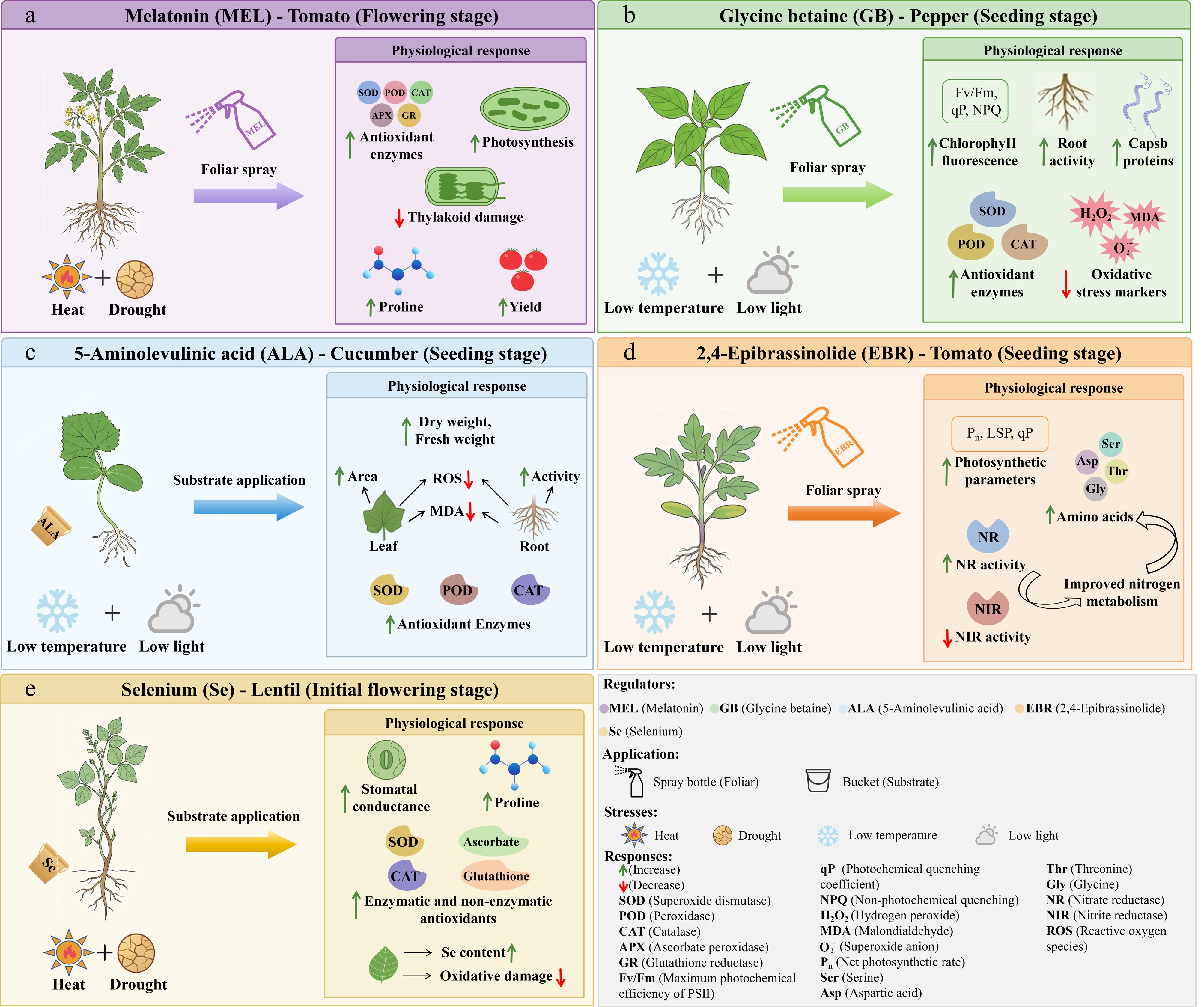
Figure 2.
Mitigation of combined abiotic stress in vegetable crops by exogenous regulators. (a) Melatonin (MEL) alleviates the combined heat and drought stress in tomato. (b) Glycine betaine (GB) alleviates the combined low temperature and low light stress in pepper. (c) 5-Aminolevulinic acid (ALA) alleviates the combined low temperature and low light stress in cucumber. (d) 2,4-Epibrassinolide (EBR) alleviates the combined low temperature and low light stress in tomato. (e) Selenium (Se) alleviates the combined heat and drought stress in lentil.
Table 5. Application of exogenous substances in enhancing the resilience of vegetable crops to combined abiotic stress.
Substance Vegetable crop Method of application Treatment Function Ref. Melatonin (MEL) Solanum lycopersicum L. Plant status: 50% flowering stage;
Application method: foliar spray applied once after stress.(1) Control: absolute control (not sprayed with MEL) and stress control (not sprayed with MEL);
(2) Heat stress: ambient temperature (AT) +5 °C;
(3) Heat stress + MEL: AT + 5 °C, 80 μM MEL/100 μM MEL;
(4) Drought stress: a 20% reduction in soil water content;
(5) Drought stress + MEL: a 20% reduction in soil water content, 80 μM MEL/100 μM MEL;
(6) Combined heat and drought stress: after a 20% reduction in soil water content, the plants were exposed to AT + 5 °C;
(7) Combined heat and drought stress + MEL: after a 20% reduction in soil water content, the plants were exposed to AT + 5 °C, 80 μM MEL/100 μM MEL.Foliar application of 100 μM MEL to tomato plants under combined stress significantly reduced thylakoid membrane damage, enhanced the activities of antioxidant enzymes (superoxide dismutase, catalase, peroxidase, ascorbate peroxidase, and glutathione reductase), increased photosynthetic rate, improved relative water content and proline accumulation, and ultimately led to higher fruit yield compared with untreated plants. [59] Melatonin (MEL) Solanum lycopersicum L. Plant status: two true-leaf stage;
Application method: foliar spray applied 10 d before stress, once every other day.(1) Control: 25 °C;
(2) Control + MEL: 25 °C, 100 μM MEL;
(3) Combined heat and salinity stress: 35 °C, 75 mM NaCl;
(4) Combined heat and salinity stress + MEL: 35 °C, 75 mM NaCl, 100 μM MEL.Compared with the combined stress treatment without MEL application, foliar spraying with 100 μM MEL enhanced the antioxidant capacity of tomato plants by upregulating ascorbate peroxidase (SlcAPX), glutathione reductase 1 (SlGR1), glutathione-S-transferase (SlGST), and phospholipid hydroperoxide glutathione peroxidase
(SlPh-GPX), while downregulating dehydroascorbate reductase 1 (SlDHAR1), thereby reducing reactive oxygen species (ROS) accumulation and improving photosynthetic parameters and photosystem stability.[60] Glycine betaine (GB) Capsicum annuum L. Plant status: the sixth true leaf fully expanded;
Application method: sprayed before stress for 5 consecutive days.(1) Ambient temperature and light: day/night temperature of 28 °C/18 °C, light intensity 300 μmol·m−2·s−1;
(2) Ambient temperature and light + GB: 28 °C/18 °C, 300 μmol·m−2·s−1,
20 mM GB;
(3) Combined low temperature and
low light stress: 10 °C/5 °C,
100 μmol·m−2·s−1;
(4) Combined low temperature and
low light stress + GB:10 °C/5 °C,
100 μmol·m−2·s−1, 20 mM GB.Under combined stress, compared with the treatment without GB application, foliar spraying of GB improved photosynthetic parameters in pepper plants, including the maximum photochemical efficiency of PSII (Fv/Fm), photochemical quenching coefficient (qP), and nonphotochemical quenching (NPQ). It also enhanced root activity, increased the expression levels of genes encoding proteins Capsb A, Capsb B, Capsb C, Capsb D, Capsb S, Capsb P1, and Capsb P2, and upregulated the expression of genes for CaSOD, CaPOD, and CaCAT in pepper leaves. [54] 5-Aminolevulinic acid (ALA) Cucumis sativus L. Plant status: the first true leaf fully expanded;
Application method: root application (mixed with substrate), stress lasted for 21 d.Substrates were mixed with ALA at different concentrations: 0 (no ALA),
10, 20, and 30 mg·kg−1;
Combined low temperature and low light stress: day/night temperature of 16 °C/8 °C, light intensity
180 μmol·m−2·s−1.Compared with the control, ALA treatment reduced the accumulation of ROS and malondialdehyde (MDA) in both the roots and leaves of cucumber seedlings. It also enhanced root activity and increased antioxidant enzyme activities, thereby promoting seedling growth. Among all treatments, the application of ALA at a rate of 20 mg·kg−1 resulted in the most pronounced positive effects. [63] 24-Epibrassinolide (EBR) Solanum lycopersicum L. Plant status: the third true leaf fully expanded;
Application method: sprayed daily during stress for 15 d.(1) Ambient temperature and light: day/night temperature of 27 °C/16 °C, light intensity 500 μmol·m−2·s−1, sprayed with distilled water;
(2) Ambient temperature and light + EBR: 27 °C/16 °C, 500 μmol·m−2·s−1,
0.1 μM EBR;
(3) Combined low temperature and
low light stress: 15 °C/7 °C,
180 μmol·m−2·s−1, sprayed with
distilled water;
(4) Combined low temperature and
low light stress: 15 °C/7 °C,
180 μmol·m−2·s−1, 0.1 μM EBR.Under combined stress, compared with the untreated control, foliar application of 0.1 μM EBR significantly enhanced the activity of nitrate reductase (NR) and suppressed the activity of nitrite reductase (NIR) in tomato plants. This treatment also increased the accumulation of aspartate, threonine, serine, and glycine, while reducing the content of cysteine, methionine, arginine, and proline. Furthermore, it led to significant improvements in leaf net photosynthetic rate (Pn), light saturation point (LSP), and qP. [41] Selenium (Se) Lens culinaris Medik. Plant status: early flowering stage (101–104 d after sowing);
Application method: root application (mixed with substrate), stress lasted for 17 d.Substrates were mixed with Se at different concentrations: 0, 1.0, 2.5,
and 5.0 mg·kg−1 dry soil.
(1) Control: day/night temperature of 25 °C/15 °C, 70% of field capacity;
(2) Combined heat and drought stress: 32 °C/20 °C, 50% of field capacity.Compared with the control, Se treatment significantly increased the endogenous selenium concentration in leaves, the number of pods, and the seed yield of hyacinth bean plants. It also enhanced both enzymatic and non-enzymatic antioxidant activities, stabilized the cellular membrane structure, and improved leaf water status and functional state. Among all treatments, the addition of 2.5 mg·kg−1 dry soil Se resulted in the most significant effects. [66] Glycine betaine (GB)
-
Glycine betaine (GB), as a compatible solute, induces the expression of certain stress-responsive genes and plays a key role in regulating osmotic balance and scavenging ROS accumulation in plants under abiotic stress conditions[61]. When plants are exposed to combined low temperature and low light stress, exogenous application of GB induces the expression of genes involved in oxidative stress response, thereby reducing the accumulation of ROS[54]. For example, foliar application of 20 mM GB in pepper alleviated the inhibitory effect of combined low temperature and low light stress (10 °C/5 °C day/night, 100 μmol·m−2·s−1 light intensity) on seedling growth[54]. This treatment also improved photosynthetic parameters such as the maximum photochemical efficiency of PSII (Fv/Fm), qP, and NPQ, enhanced root activity, and increased the expression levels of the encoded proteins Capsb A, Capsb B, Capsb C, Capsb D, Capsb S, Capsb P1, and Capsb P2 in pepper seedling leaves (Fig. 2b; Table 5)[54]. Moreover, it coordinated the activities of antioxidant enzymes in mitochondria, chloroplasts, and the cytoplasm to scavenge ROS accumulation, reduce the contents of H2O2, O2·−, and MDA, and mitigate biomembrane damage[54]. These findings indicate that application of GB can enhance the tolerance of pepper seedlings to combined low temperature and low light stress, an effect likely mediated through the regulation of photosynthetic performance and antioxidant-related pathways[54]. Although foliar spraying with 60 µM 3-deazaneplanocin A hydrochloride (an m6A methylation inhibitor) under the same conditions reduced the enzymatic activities and gene expression levels of SOD, CAT, GR, MDHAR, and the ascorbic acid/dehydroascorbic acid (AsA/DHA) ratio, while increasing those of APX and DHAR compared to the control, co-application of 20 mM GB effectively alleviated these inhibitory effects[62]. This suggests that GB may act as a methyl donor, partially substituting S-adenosylmethionine (SAM) in the m6A methylation process, thereby enhancing the tolerance of pepper seedlings to combined low temperature and low light stress through involvement in m6A methylation modification[62]. Nevertheless, this conclusion is based solely on the use of a methylation inhibitor, which may have off-target effects. Direct evidence, such as m6A immunoprecipitation sequencing or quantification of SAM levels, is needed to confirm the proposed mechanism.
5-Aminolevulinic acid (ALA)
-
5-Aminolevulinic acid (ALA), a naturally occurring non-protein amino acid, has been widely reported to enhance plant tolerance to abiotic stresses by enhancing photosynthetic performance, increasing antioxidant enzyme activity, and promoting osmoregulation[55,63]. Under low temperature and low light conditions (16 °C/8 °C, 180 μmol·m−2·s−1, 12 h photoperiod), compared to the control group (no ALA), ALA treatment promotes the growth of cucumber seedlings with increased leaf area, dry weight, fresh weight, and root activity, enhanced antioxidant enzyme activity, and reduced the accumulation of H2O2, O2·−, and MDA (Fig. 2c; Table 5)[63]. Furthermore, ALA is a key precursor for chlorophyll synthesis. Exogenous application of ALA significantly increased the contents of chlorophyll a, chlorophyll b, and total chlorophyll a + b in the leaves of cucumber seedlings under low temperature and low light stress[63]. This indicates that exogenous ALA plays an important role in protecting normal photosynthesis of plants under abiotic stress[63]. Therefore, incorporating ALA into the substrate can alleviate the adverse effects of low temperature and low light stress on cucumber seedlings[63].
2,4-Epibrassinolide (EBR)
-
2,4-Epibrassinolide (EBR), a highly physiologically active compound of brassinosteroids, activates multiple physiological and molecular response mechanisms to counteract abiotic stress[41]. Under low temperature and low light conditions (15 °C/7 °C day/night temperature, 180 μmol·m−2·s−1 light intensity), foliar application of 0.1 μM EBR in tomato significantly alleviated growth inhibition compared with untreated plants[41]. This treatment enhanced photosynthetic capacity by increasing leaf Pn, LSP, and qP (Fig. 2d; Table 5)[41]. In addition, it significantly increased nitrate reductase (NR) activity while decreasing nitrite reductase (NIR) activity, promoting the conversion of nitrate to organic nitrogen and reshaping amino acid profiles[41].
Selenium (Se)
-
Selenium (Se), an essential trace nutrient for both humans and animals, has recently attracted increasing attention for its regulatory role in plant stress tolerance[64,65]. Under combined heat and drought stress (32 °C/20 °C day/night temperature, 50% soil field capacity), compared to the control group (no Se), appropriate Se addition to the cultivation substrate markedly alleviated damage to leaves and flowers in lentil (Table 5)[66]. This treatment also enhanced leaf Se accumulation, stomatal conductance, and water status through the accumulation of osmoregulatory substances (e.g., proline, glycine betaine, and reducing sugars) (Fig. 2e)[66]. Furthermore, Se supplementation significantly boosts the activity of both enzymatic antioxidants (SOD, CAT) and non-enzymatic antioxidants (ascorbate, glutathione), alleviates oxidative damage in leaf tissues, and thereby protects the photosynthetic system from stress-induced impairment[66]. Thus, exogenous application of Se offers a promising approach to mitigate damage caused by the adverse effects of combined heat and drought stress on plants[66].
The application of exogenous substances provides new perspectives for enhancing the ability of plants to resist combined stress[41,53−55]. The aforementioned exogenous substances share common roles in enhancing antioxidant enzyme activity, protecting the photosynthetic system, and promoting osmotic regulation under combined stress[41,53−55]. Furthermore, MEL can regulate the stability of thylakoid membranes[59]. GB participates in m6A methylation modification[62]. ALA, as a precursor for chlorophyll synthesis, maintains normal physiological functions of leaves[63]. EBR promotes the production of organic nitrogen[41]. Se, as a trace element, can participate in the synthesis of antioxidant enzymes[66]. To date, almost all studies have applied exogenous substances individually. However, given that different regulators act through distinct mechanisms, their combined application might produce synergistic effects. This remains an unexplored but promising direction.
-
In summary, under complex and fluctuating climatic conditions, vegetable cultivation is more often challenged by combined abiotic stresses rather than single abiotic stress. This review primarily introduces the physiological and molecular response mechanisms of vegetable crops under several types of combined abiotic stresses, as well as research progress in strategies to enhance vegetable stress resistance under such conditions. The effects of combined abiotic stresses on vegetable crops mainly include a series of physiological damages, such as limiting growth, reducing photosynthesis, accumulating ROS and MDA, and disrupting membrane and osmotic regulation systems. Additionally, combined stresses lead to differential expression of stress-responsive genes. To mitigate yield losses in vegetable crop production caused by combined abiotic stresses, current research has explored multiple approaches, including the breeding of stress-tolerant varieties, exogenous application of protective substances, and molecular and biotechnological strategies to enhance combined stress resistance, with encouraging progress achieved. Nevertheless, several critical challenges remain. First, research on multiple combined abiotic stresses remains limited, highlighting an urgent need to explore the complex interactions among multiple stress factors and their unique regulatory networks. Second, genes related to enhancing combined abiotic stress resistance in vegetable crops still require further identification and functional validation, which will facilitate the development of transgenic plants for practical production in the future. Finally, integrated and innovative strategies for improving resistance to combined abiotic stresses are urgently needed. These strategies should incorporate interdisciplinary advances from microbiology, breeding science, and other related fields, such as mining natural resistance genes from wild relatives of vegetable crops (e.g., Solanum pennellii for tomato, Cucumis hystrix for cucumber) through QTL mapping or GWAS, followed by marker-assisted introgression or gene editing to create multi-resistant germplasm. Overall, this review provides a solid theoretical foundation for a deeper understanding of the physiological and molecular regulatory mechanisms underlying combined abiotic stresses in vegetable crops, as well as methods to enhance their combined stress resistance.
We acknowledge the funding from the National Key Research and Development Program of China (2023YFF1002000), the earmarked fund for China Agriculture Research System (CARS-23) and the Hainan Provincial Natural Science Foundation of China (326MS0229), as well as the support from the Bioinformatics Center of Nanjing Agricultural University.
-
The authors confirm their contributions to the paper as follows: conception and design: Zhou R, Li G; draft manuscript preparation: Li G, Zhou R; reviewing and editing with valuable comments: Xiao D, Wu Z, Li J, Li Y, Cui G, Jiang F, Song X. All authors reviewed the results and approved the final version of the manuscript.
-
This article does not involve data sharing, as no datasets were generated or analyzed during the current study.
-
The authors declare that they have no conflict of interest.
- Copyright: © 2026 by the author(s). Published by Maximum Academic Press, Fayetteville, GA. This article is an open access article distributed under Creative Commons Attribution License (CC BY 4.0), visit https://creativecommons.org/licenses/by/4.0/.
-
About this article
Cite this article
Li G, Li J, Li Y, Cui G, Jiang F, et al. 2026. Physiological and molecular responses of vegetable crops under combined abiotic stresses. Vegetable Research 6: e030 doi: 10.48130/vegres-0026-0021 

Physiological and molecular responses of vegetable crops under combined abiotic stresses
- Received: 21 March 2026
- Revised: 11 June 2026
- Accepted: 06 July 2026
- Published online: 28 August 2026
Abstract: Global climate change has increased the frequency and intensity of combined abiotic stresses, posing severe threats to vegetable production worldwide. Unlike single stressors, combined abiotic stresses, such as simultaneous heat and drought, drought and salinity, or low temperature and low light, often interact synergistically or antagonistically. This review systematically examines the physiological and molecular responses of vegetable crops under these combined abiotic stress conditions. At the physiological level, combined abiotic stresses commonly lead to vegetable crops exhibiting inhibited growth, reduced photosynthetic efficiency, accumulation of reactive oxygen species (ROS), and osmotic imbalance. At the molecular level, combined abiotic stresses activate distinct signaling pathways and regulatory networks involving stress-responsive transcription factors, hormone signaling (e.g., abscisic acid, auxin, and brassinosteroids), non-coding RNAs (e.g., miRNAs and circRNAs), and key metabolic genes in vegetable crops. To enhance the resilience of vegetables to combined abiotic stresses, various strategies have been explored. Molecular techniques, including QTL (Quantitative Trait Locus) mapping, GWAS (Genome-Wide Association Study), and transgenic approaches, have identified and leveraged key genes for improving combined abiotic stress tolerance. Additionally, the application of exogenous substances such as melatonin, glycine betaine, 2,4-epibrassinolide, 5-aminolevulinic acid, and selenium has been shown to effectively alleviate combined stress-induced damage by enhancing antioxidant capacity, protecting the photosynthetic apparatus, and promoting osmotic adjustment. Future research should focus on deciphering complex stress interaction networks, identifying novel tolerance genes from wild relatives, and developing integrated management practices. This review provides a comprehensive theoretical foundation for breeding tolerant vegetable varieties to combined abiotic stresses and designing sustainable cultivation strategies under increasing climate variability.