











-
Meristems constitute populations of undifferentiated cells that retain the capacity for continuous or periodic division at specific sites within the plant. To adapt to terrestrial environments, plants have evolved meristem-dependent organogenesis[1]. In vascular plants, the shoot apical meristem (SAM) and root apical meristem (RAM) generate aerial and subterranean organs, respectively, through sustained cell division and differentiation[2]. A suite of genes, including those belonging to the WOX, CLE, KNOX, PLT, and CUC families, have been identified as pivotal regulators of meristem development[3]. Through intricate signaling networks and molecular interactions, these genes precisely control the meristem's size and activity, thus underlying plant growth, development, and regeneration.
The WUSCHEL-related homeobox (WOX) gene family belongs to the Homeobox superfamily, which is defined by a conserved homeobox sequence encoding a DNA-binding homeodomain of approximately 60 amino acids[4]. Homeobox genes were initially discovered in animals, including fruit flies (Drosophila melanogaster), planarians, zebrafish (Danio rerio), mice (Mus musculus), and humans[4,5]. The Homeobox superfamily comprises a substantial and functionally diverse set of genes. Comprehensive classification has identified 11 homeobox classes in animals and 14 homeobox classes in plants[5−7]. Among these, the WOX gene family is plant-specific and encodes transcription factors that typically possess a homeodomain of 65–66 amino acids. The founding member, WUSCHEL (WUS), was the first to be identified and has been shown to be essential for maintaining the structural and functional integrity of shoot and floral meristems in Arabidopsis thaliana[8]. Fourteen additional WUS-homologous genes were subsequently identified in the A. thaliana genome, and these 15 genes were collectively designated the WOX family[9]. Phylogenetic analysis revealed three clades within plant WOX proteins: The Ancient clade, the Intermediate clade, and the WUS clade. The Ancient clade encompasses the broadest taxonomic distribution and uniquely includes WOX proteins from green algae and mosses. By contrast, the WUS clade is restricted to flowering plants. Phylogenetically situated between the other two clades, the Intermediate clade contains WOX members from both flowering plants and lycophytes (vascular plants)[10]. To date, WOX members have been identified and analyzed in the genomes of numerous species, including A. thaliana[11], rice (Oryza sativa)[11], wheat (Triticum aestivum)[12], barley (Hordeum vulgare)[13], soybean (Glycine max)[14], cucumber (Cucumis sativus)[15], and apple (Malus domestica)[16]. Following genome-wide identification, the functional characterization of WOX genes has become a major research focus. WOX family members are extensively involved in plant growth and development and play critical roles in processes ranging from embryonic patterning and stem cell maintenance to organ formation[10]. For instance, in Picea abies, downregulation of PaWOX2 during early embryogenesis results in the production of abnormal early embryos with defective protoderms[17]. In rice, OsWOX11 recruits the ADA2-GCN5 histone acetyltransferase complex to establish the cell division program of crown root meristems[18]. Notably, in Lilium lancifolium, LlWOX9 and LlWOX11 are positive regulators of bulbil formation, and LlWOX11 may drive this process through the LlWOX11–LlLRP1 and LlWOX11–LlDOF1.7 regulatory modules[19−21]. In addition to their developmental functions, WOX genes play crucial regulatory roles in plants' responses to abiotic stresses. Under salt stress, the overexpression of PagWOX11/12a in 84K poplar (Populus alba × P. glandulosa) led to an increase in the ability to scavenge reactive oxygen species (ROS) and a reduction in H2O2 accumulation compared with those in wild-type plants[22]. By modulating vascular development, GhWOX4 contributes to enhanced drought tolerance in cotton (Gossypium hirsutum)[23].
Given the pivotal role of the WOX gene family in plant development and stress responses, identifying its members in Lanzhou lily (Lilium davidii var. unicolor) and elucidating their functions will help consolidate fundamental research and provide theoretical support for germplasm improvement. Lanzhou lily is a species of lily that is both edible and medicinal. It is indigenous to China and is recognized as the only sweet-tasting edible lily in the country[24]. The bulb of Lanzhou lily is valued for its pure white appearance and fine texture, making it a premium culinary ingredient. Medicinally, the bulb is rich in bioactive compounds such as glycosides, colchicine, phenols, and polysaccharides, which are associated with anti-inflammatory, immunomodulatory, antitumor, and other therapeutic properties[25−27]. Additionally, owing to its particular geographical distribution, Lanzhou lily is considered to be a drought-tolerant plant[28]. Despite this, the WOX gene family in Lanzhou lily remains largely uncharacterized, and no systematic identification or comprehensive analysis has been reported. In this study, bioinformatics approaches were used to identify putative LdWOX genes in the Lanzhou lily genome and to characterize their physicochemical properties, chromosomal locations, phylogenetic relationships, gene structures, conserved protein motifs, cis-acting elements, tissue expression patterns, and responses to abiotic stresses. These results constitute a theoretical foundation for subsequent functional studies of LdWOX genes and provide insights into their roles in growth, development, and stress defense.
-
Through the platform of the China National GeneBank Database (
https://db.cngb.org ), the genomic data of Lanzhou lily were retrieved. The screening of LdWOX members was carried out by using HMMER 3.0 with the hidden Markov model (HMM) of the conserved homeodomain (PF00046) from the Pfam database (http://pfam.xfam.org ). The LdWOX candidates were subsequently submitted to the NCBI Batch CD-Search tool (www.ncbi.nlm.nih.gov/Structure/bwrpsb/bwrpsb.cgi ) and the SMART database (http://smart.embl-heidelberg.de ) to verify the presence of the homeodomain; sequences with incomplete homeodomains were then discarded[29]. Finally, the putative members of the WOX gene family in Lanzhou lily were obtained and renamed on the basis of their homologous relationships with AtWOX family members.Analysis of proteins' physicochemical properties and chromosome locations of LdWOXs
-
The ExPASy ProtParam tool (
https://web.expasy.org/protparam ) was used to examine the physicochemical attributes of the LdWOX proteins[30]. The subcellular locations of the LdWOXs were predicted by two online tools: WoLF PSORT (https://wolfpsort.hgc.jp ) and Cell-PLoc (www.csbio.sjtu.edu.cn/bioinf/Cell-PLoc-2 ). In the TBtools software, the genomic annotation information (GFF3 file) and the IDs of the identified members were input simultaneously to generate a chromosomal distribution map of the LdWOX family genes.Phylogenetic analysis of WOX family members among several representative species
-
To elucidate the phylogenetic and evolutionary relationships of the WOX gene family among different species, a phylogenetic tree was generated with MEGA 7.0 software. The phylogenetic tree comprises the complete WOX protein sets from Lanzhou lily, A. thaliana[11], O. sativa[11], and Dendrobium catenatum[31], along with an incomplete set from L. lancifolium[19] (Supplementary Table S1). In the absence of nuclear genome data for L. lancifolium, its full WOX family members remain unidentified. Nevertheless, given its close relationship with Lanzhou lily and the available functional data for two WOXs, LlWOX9 and LlWOX11 were included in the phylogenetic tree. Multiple sequence alignment was achieved for the WOX proteins using the ClustalW tool. A phylogenetic tree was subsequently constructed by applying the neighbor-joining (NJ) approach. The bootstrap procedure was executed with 1,000 replications[32]. Finally, the EvolView online tool (
https://evolgenius.info//evolview-v2/#login ) was used to visualize the phylogenetic tree.Gene structure, conserved domain, and conserved motif analysis of LdWOXs
-
On the basis of the GFF3 annotation file, TBtools was used to acquire the details of the exon–intron organization of the LdWOXs. Conserved domains in the LdWOX proteins were predicted with the NCBI Batch CD-Search tool. Multiple sequence alignment of the conserved domains of 143 WOX proteins was performed using DNAMAN. The MEME web server (
https://meme-suite.org/meme/index.html ) was used to identify the conserved motifs in the LdWOXs[33]. Finally, all the results were visualized and integrated using TBtools.Investigation of cis-acting elements in LdWOX promoter regions
-
The 2,000-bp sequences upstream of the transcription start sites (TSSs) of the LdWOX family genes were extracted as promoter regions with TBtools. Potential cis-acting elements within these promoters were predicted via the PlantCARE database (
http://bioinformatics.psb.ugent.be/webtools/plantcare/html )[34]. The predicted elements were then visualized using TBtools and ChiPlot (www.chiplot.online ).Tissue expression patterns of LdWOX family members
-
Transcriptome data for 10 tissues of Lanzhou lily, namely the bulb root, stem root, stem, leaf, outer petal, inner petal, anther, filament, style, and ovary, were obtained from the China National GeneBank Database (
https://db.cngb.org ) (Project ID: CNP0005511)[35]. Utilizing the reference transcriptome derived from the reference genome (Assembly ID: CNA0139751), gene expression levels were quantified as TPM (transcripts per million) with Kallisto to achieve normalization. The tissue expression matrix of LdWOX family members was extracted, and a heatmap was generated using TBtools. In TBtools, the expression values were first transformed by the formula log2(x + 1), and then each gene was individually normalized to a 0–1 scale across the 10 tissues.Plant materials and abiotic stress treatments
-
Lanzhou lily bulbs (12–14 cm in circumference) were procured from a local plantation in Qilihe District, Lanzhou, Gansu Province, China. The bulbs were planted and cultivated in the greenhouse of the Plant Science Center, Beijing Forestry University. Forty to fifty days after planting, healthy plants that exhibited uniform growth were selected for the abiotic stress treatments. The stress treatments included high-temperature, low-temperature, drought, and salt stresses, each with three independent biological replicates. The root system is a vital organ for the perception of and response to abiotic stress signals. Lily possesses both bulb roots and stem roots, yet only the stem roots serve as the primary absorptive organs during the mid- to late developmental stages. Therefore, stem root samples were uniformly collected for subsequent research.
For the high-temperature treatment, the plants were acclimated for 1 week in a growth chamber at 24 °C and 60% relative humidity under a 16/8 h light/dark photoperiod and subsequently exposed to 37 °C under the same humidity and photoperiod. Stem root samples were collected at 0 (control), 1, 3, 6, 12, and 24 h after the onset of the treatment[36]. The low-temperature treatment was performed in an identical manner, except that the temperature was 4 °C and the samples were harvested at 0, 3, 6, 12, 24, and 48 h[37].
For the drought treatment, all the pots were watered thoroughly to soil saturation, after which irrigation was withheld. The relative soil water content (R) was gauged, and stem root samples were gathered at 0, 7, 14, and 21 d after the commencement of withholding water[28]. The definition of drought severity is as follows: R ≥ 60%, no drought; 50% ≤ R < 60%, mild drought; 40% ≤ R < 50%, moderate drought; 30% ≤ R < 40%, severe drought; R < 30%, extreme drought.
To determine an appropriate NaCl concentration for the salt stress treatment, a preliminary experiment was conducted with four concentrations: 150, 200, 250, and 300 mM. Each concentration was applied to three independent pots (biological replicates) by irrigation with 300 mL of the corresponding NaCl solution, and the plant phenotypes were observed 24 h later. On the basis of the observation that 300 mM NaCl caused mild leaf wilting without severe growth inhibition, this concentration was selected for the formal experiment. For the salt stress treatment, each pot was irrigated with 300 mL of the 300 mM NaCl solution, ensuring complete absorption of the solution by the substrate. Stem root samples were collected at 0, 3, 6, 12, and 24 h after treatment.
Finally, the stem root samples harvested from the four abiotic stress treatments were immediately flash-frozen in liquid nitrogen and stored at −80 °C.
RNA extraction, reverse transcription and quantitative real-time PCR
-
Total RNA was extracted from stem root samples using the Aidlab EASYspin Plus Plant RNA Kit (RN3801), and first-strand cDNA was synthesized using the TOYOBO cDNA synthesis kit (FSQ-301). Quantitative real-time polymerase chain reaction (qRT-PCR) was performed using the SYBR Green Premix Pro Taq HS qPCR Kit (Accurate Biology, AG11701). LdActin served as the internal reference gene. A list of all primer sequences is provided in Supplementary Table S2. The relative gene expression was calculated in accordance with the 2−ΔΔCᴛ method.
Statistical analysis
-
qRT-PCR was performed on samples from three biological replicates, each analyzed in three technical replicates. Technical replicates were averaged prior to statistical analysis, and biological replicates served as the statistical unit. Data are presented as the mean ± standard deviation (SD). Normality and homogeneity of variance were assessed using the Shapiro–Wilk and Levene's tests, respectively. Group comparisons were performed using one-way analysis of variance (ANOVA) followed by Fisher's least significant difference (LSD) post hoc test. Differences were considered statistically significant at p < 0.05. Analyses were performed using IBM SPSS Statistics 23.0. Graphs were generated using ChiPlot.
-
The HMM profile of the conserved homeodomain (Pfam: PF00046) was used to identify putative WOX family members in the Lanzhou lily genome. In total, 24 LdWOX genes were identified and designated on the basis of their phylogenetic relationships with A. thaliana WOX (AtWOX) members (Supplementary Table S1). The chromosomal distribution of the 24 LdWOX genes was subsequently visualized using a genome annotation file (GFF3). The results revealed that 24 LdWOX genes are unevenly distributed across seven chromosomes and two contigs and form four clusters of tandemly duplicated genes (CTDGs): Two two-gene clusters (LdWOX3b and LdWOX3c; LdWOX4a and LdWOX4b), one four-gene cluster (LdWOX5a, LdWOX5b, LdWOX5d, and LdWOX5e), and one eight-gene cluster (LdWOX2a–h) (Fig. 1). Notably, among the CTDGs in green plants, only approximately 3% consist of 6–10 genes[38]. Furthermore, the CTDGs tend to be associated with biological functions that require a rapid response, high yield, or diverse output. Given this, the eight-gene cluster LdWOX2a–h merits particular attention in future functional characterization.
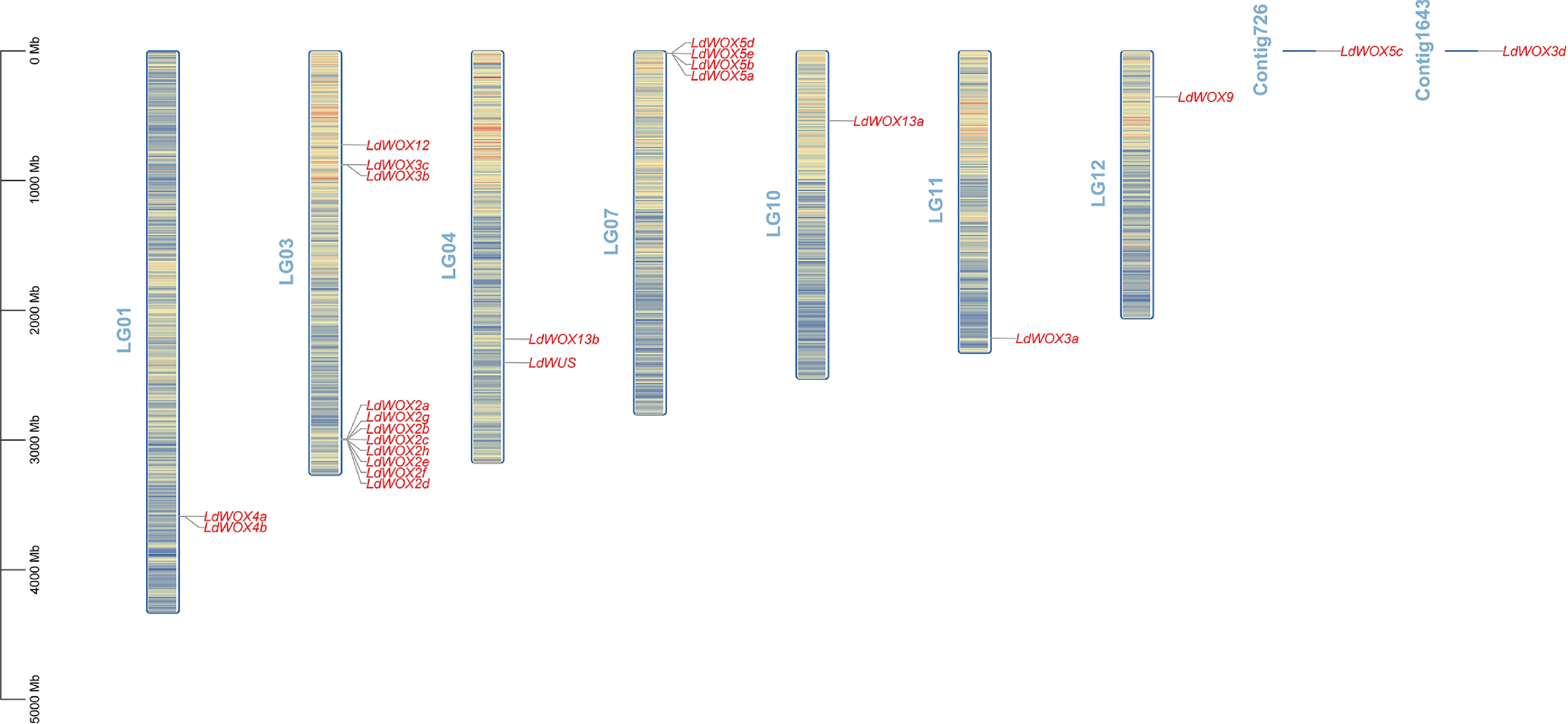
Figure 1.
Distribution of 24 LdWOX genes in the chromosomes of Lanzhou lily.
The physicochemical properties of the 24 LdWOX proteins were predicted and are comprehensively summarized in Supplementary Table S3. The protein lengths range from 144 amino acids (LdWUS) to 337 amino acids (LdWOX9). The molecular weight (MW) varies from 16.53 kDa (LdWOX2f) to 36.32 kDa (LdWOX9). The theoretical isoelectric point (pI) values range from 5.27 (LdWOX2d) to 10.47 (LdWOX2f). Among the LdWOXs, seven proteins are acidic (pI < 7), and 17 proteins are basic (pI > 7). All LdWOX proteins exhibit instability indices greater than 40 (minimum 48.61 in LdWOX2e; maximum 76.29 in LdWOX2c) and are therefore classified as unstable proteins. The aliphatic indices of the LdWOXs range from 51.05 (LdWOX2f) to 74.97 (LdWOX2e). The grand average of hydropathicity (GRAVY) values are all negative, ranging from –1.051 (LdWUS) to –0.401 (LdWOX2e), demonstrating that all the LdWOX proteins are hydrophilic. Subcellular localization prediction revealed that all 24 LdWOX proteins are localized in the nucleus, which is consistent with their anticipated roles as transcription factors.
Phylogenetic analysis of WOX genes in A. thaliana, O. sativa, D. catenatum, L. lancifolium and Lanzhou lily
-
To explore the evolutionary relationships among WOX family members of different species, 64 WOX protein sequences of five species were collected for construction of a phylogenetic tree: 15 AtWOXs from A. thaliana[11], 13 OsWOXs from O. sativa[11], 10 DcWOXs from D. catenatum[31], 2 LlWOXs from L. lancifolium[19], and 24 LdWOXs from Lanzhou lily (Fig. 2; Supplementary Table S1). Despite the absence of nuclear genome data for L. lancifolium, which precludes systematic identification of the WOX gene family, the functionally characterized LlWOX9 and LlWOX11 genes were incorporated into the phylogenetic analysis because of the close phylogenetic affinity between L. lancifolium and Lanzhou lily. Following the classical classification system proposed by van der Graaff et al.[10], the 64 WOX members were allocated to three clades: The Ancient clade, the Intermediate clade, and the WUS (modern) clade. A striking finding is the significantly larger size of the LdWOX family than that of the other three complete WOX families. This phenomenon is attributed to a marked expansion of the WUS clade in Lanzhou lily. Specifically, three subclades, namely LdWOX2a–h, LdWOX3a–d, and LdWOX5a–e, have undergone expansion. This species-specific expansion suggests subfunctionalization or neofunctionalization of the duplicated genes, and the presumed neofunctionalization is likely to be associated with the morphological structures or physiological processes characteristic of Lilium. Furthermore, the functions of several LdWOX members located in highly conserved branches, such as LdWOX9, LdWOX12, and LdWUS, may be inferred from existing functional studies on their orthologs. LlWOX9 and LlWOX11 have been identified as positive regulators of bulbil formation in L. lancifolium[19], and LdWOX9 is orthologous to LlWOX9, whereas LdWOX12 is orthologous to LlWOX11. Although Lanzhou lily does not naturally form aerial bulbils in its leaf axils, this phylogenetic relationship implies that LdWOX9 and LdWOX12 are key candidate genes for regulating vegetative propagation or lateral organ development. AtWUS is a central regulator of stem cell maintenance in the A. thaliana SAM and modulates the aboveground morphogenesis of plants[8]. This suggests a conserved role for LdWUS, which is the ortholog of AtWUS, in stem cell niche maintenance. Lanzhou lily sustains perennial growth through its bulb apical meristem (BAM), and it is speculated that LdWUS plays a critical role in processes such as the dormancy release of the BAM and floral transition.
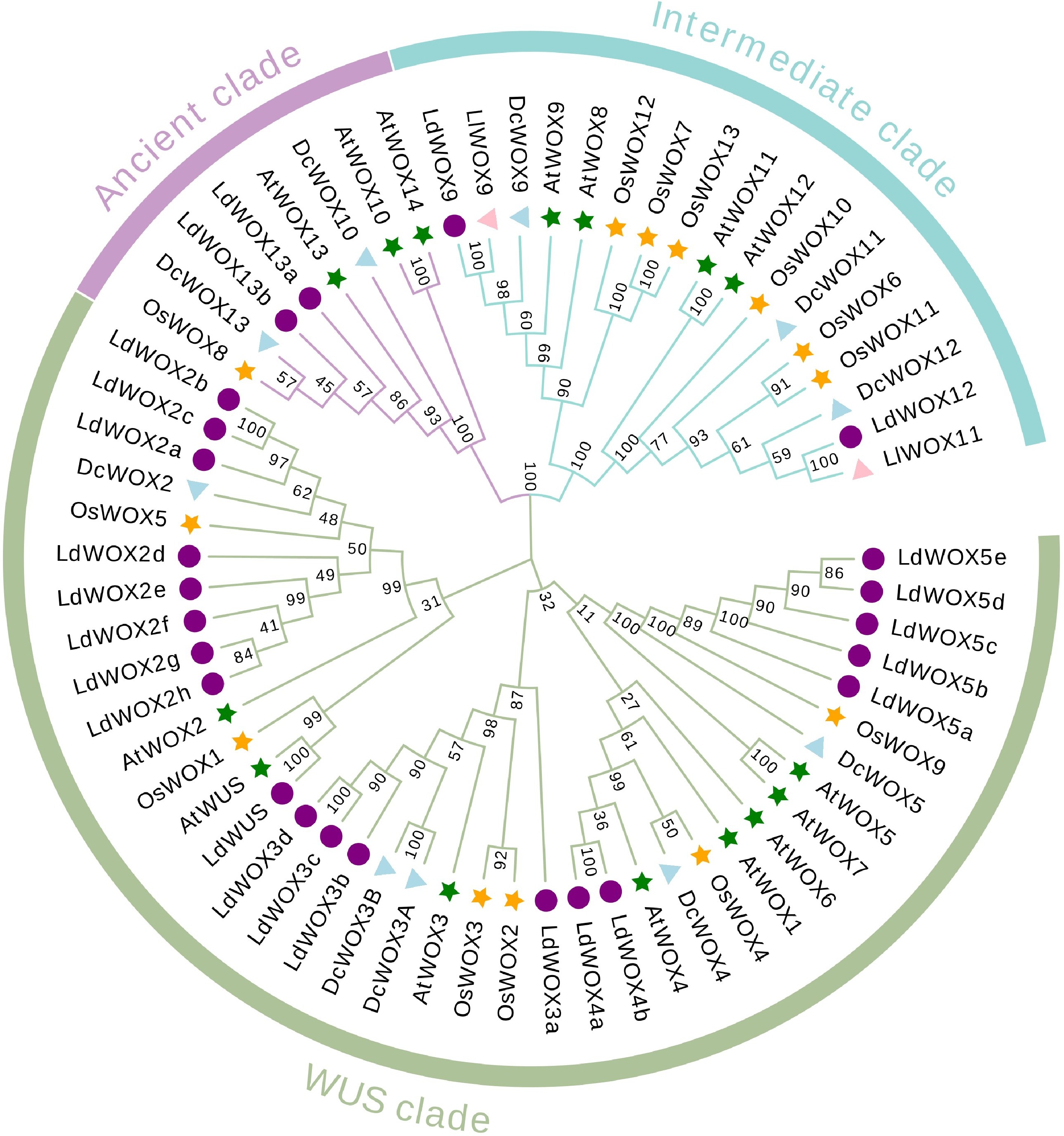
Figure 2.
Phylogenetic tree of WOX proteins. Complete members are shown for Lanzhou lily, A. thaliana, O. sativa, and D. catenatum; only partial members are shown for L. lancifolium. The LdWOXs, AtWOXs, OsWOXs, DcWOXs and LlWOXs are marked respectively with purple circles, green stars, orange stars, blue triangles, and pink triangles.
Gene structure, conserved domain, and conserved motif exploration of LdWOX members
-
To further explore the structural basis of LdWOX functions, the gene structures, conserved domains, and conserved motifs of the members were analyzed. The exon–intron organizations of the LdWOX genes were visualized using TBtools (Fig. 3a, b). Notably, some LdWOX genes exhibit ultra-long introns. This observation is not unique to the WOX gene family, but rather represents a gene-level microcosm of the giant genome of Lanzhou lily. Existing research indicates that the explosive insertion of transposons, especially long terminal repeat retrotransposons, is the primary cause of such ultra-long introns[35]. Furthermore, considerable variation is observed in the intron lengths. The longest intron (264,555 bp) is found in LdWOX2g, and the shortest (74 bp) is found in LdWOX13b. The LdWOX genes contain one to three introns of varying lengths, resulting in the formation of two to four exons. Among the 24 genes, 12 have two exons, 10 have three exons, and only 2 have four exons.
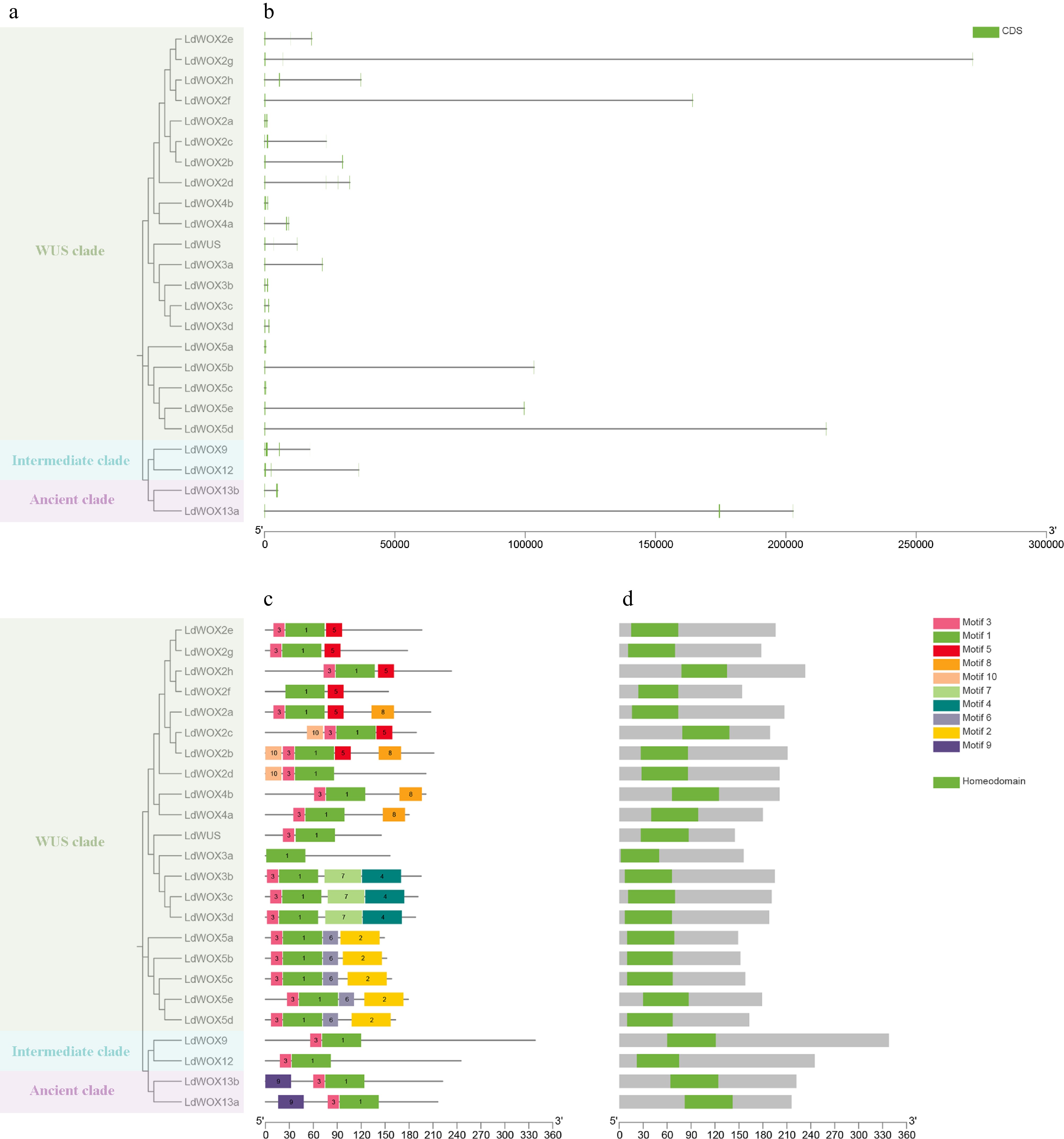
Figure 3.
Phylogenetic relationships, gene structures, conserved motifs, and conserved domains of the LdWOX family. (a) Phylogenetic tree and clade classification of the 24 LdWOX proteins. (b) Exon–intron structures of LdWOX genes. (c) Distribution of conserved motifs in LdWOX proteins. (d) Identification of homeodomains in LdWOX members.
Using the MEME online tool, 10 conserved motifs (designated Motif 1 to Motif 10) were identified in the LdWOX proteins, and each protein contained one to five motifs (Fig. 3c; Supplementary Fig. S1). Motif 1 is present in all 24 LdWOXs, indicating that it is the most conserved motif within this family. Motif 3 was detected in all the members except LdWOX2f and LdWOX3a. Conserved domain analysis revealed that all LdWOX proteins possess a homeodomain, which comprises Motif 1 alone or in combination with the C-terminal portion of Motif 3 (Fig. 3d). Moreover, the types and quantities of conserved motifs are highly similar within each clade. For instance, Motif 9 is restricted to the Ancient clade. Within the WUS clade, distinct motif combinations distinguish different subgroups: Motifs 6 and 2 are confined to LdWOX5a–e, Motifs 7 and 4 to LdWOX3b–d, and Motif 8 to LdWOX2a/2b/4a/4b. These characteristic motif patterns may provide evidence of divergent functions for the corresponding genes.
Multiple sequence alignment of the homeodomains in LdWOX proteins
-
A conserved domain is a core unit that has been maintained in proteins throughout long-term evolution. Investigations into these domains are conducive to elucidating key information regarding proteins' function, structure, and evolution. The homeodomain, a conserved domain in the WOX transcription factor family, consists of approximately 60 amino acid residues and folds into a helix–loop–helix–turn–helix structure[7]. It binds specific DNA sequences to activate or repress target gene expression. The alignment of the homeodomain sequences of 24 LdWOX proteins revealed high overall conservation and eight fully conserved amino acid residues (Fig. 4). However, a previously reported conserved residue, asparagine (N) in Helix 3[39,40], is substituted in a few LdWOX proteins. In contrast to the generally conserved N, this position is occupied by serine (S) in LdWOX2e–h. To further assess the rarity and uniqueness of this substitution, in addition to those of Lanzhou lily, the homeodomain sequences of WOX family members from 11 other species, namely, A. thaliana[11], rice[11], D. catenatum[31], Phalaenopsis equestris[31], Asparagus officinalis[31], barley[13], cucumber[15], sunflower (Helianthus annuus) [39], Paeonia ostii[41], Pinus yunnanensis[42], and L. lancifolium[19], were also collected for alignment (Supplementary Figs S2 and S3). All species are represented by their full complement of WOX members, except L. lancifolium, for which only a subset is shown. Among the 143 WOX proteins, only 6 exhibit substitutions at the conserved N site. In addition to the four LdWOX2e–h proteins, the remaining two are DcWOX10 and PeWOX10. In both of these proteins, the conserved N site in the homeodomain is replaced by a lysine (K). Amino acid substitutions at conserved sites within a functional domain can alter proteins' binding properties or perturb protein conformation, potentially leading to functional aberration or innovation. Targeted experimental studies are therefore warranted to elucidate the functional consequences of these residue substitutions in LdWOX2e-h.
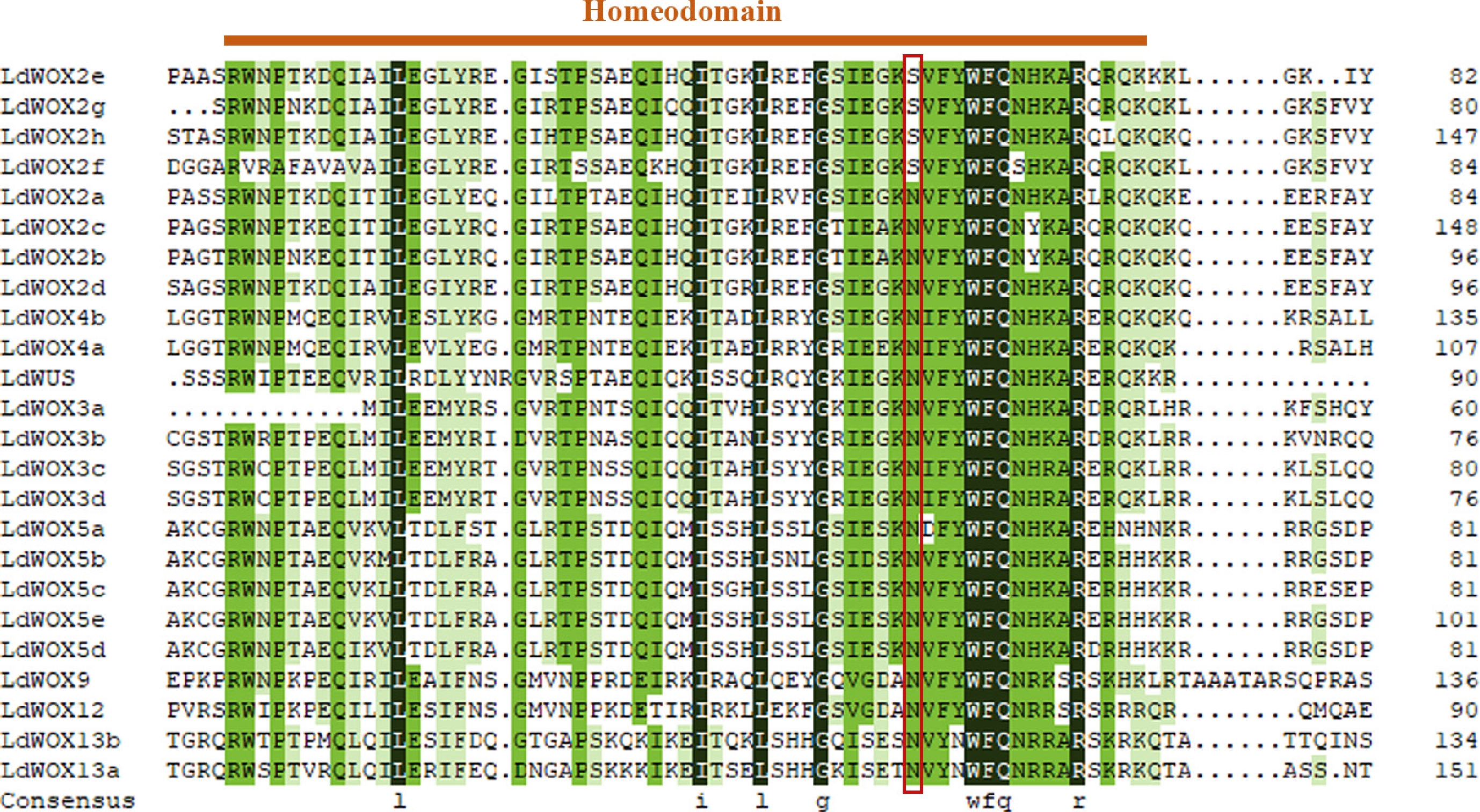
Figure 4.
Multiple sequence alignment of the homeodomains from 24 LdWOX proteins. The LdWOX members are arranged according to their phylogenetic relationships. The letters below the alignment denote the eight absolutely conserved amino acid residues. The red box highlights the variable residue site mentioned in the main text.
Investigation of cis-acting elements in the promoter sequences of LdWOX family genes
-
From the extracted 2,000-bp promoter sequences of the LdWOX family members, the types and numbers of the transcription factor binding sites were predicted, which provided deeper insight into the signal transduction and biological functions of these genes (Fig. 5a; Supplementary Tables S4-S7). Among the 24 LdWOX members, the identified cis-acting elements were classified by function into four major categories (with 18 subcategories): Light responsiveness, phytohormone responsiveness, stress responsiveness, and plant growth and development (Fig. 5b). Cis-acting elements involved in light responsiveness were identified in the promoters of all 24 LdWOX members. Of these, 14 members contain a minimum of 10 such elements, with LdWOX3d containing the most, at 16 (Supplementary Fig. S4). Furthermore, LdWOX promoters possess cis-acting elements that respond to multiple phytohormones. The numbers of members harboring these elements are as follows: Abscisic acid (ABA), 19; methyl jasmonate (MeJA), 18; gibberellin (GA), 14; auxin, 11; and salicylic acid (SA), 9 (Fig. 5d). Within the set of stress-responsive cis-acting elements, anaerobic induction elements were detected in all the LdWOX members except LdWUS, indicating a broad distribution. In contrast, wound-responsive elements were found exclusively within the promoters of LdWOX2e and LdWOX13a. Elements related to defense and stress responsiveness, drought inducibility, and low-temperature responsiveness are present in seven, eight, and nine LdWOX members, respectively (Fig. 5c). Cis-acting elements associated with plant growth and development were predicted and classified. Notably, LdWOX2f is the sole member that lacks these elements, whereas LdWOX5b is the sole member that contains elements related to cell cycle regulation, and LdWOX12 is the sole member that contains elements linked to seed-specific regulation (Fig. 5e). These findings lend support to the hypothesis that LdWOX family genes may play a vital regulatory role in plants' stress responses, as well as growth and development.
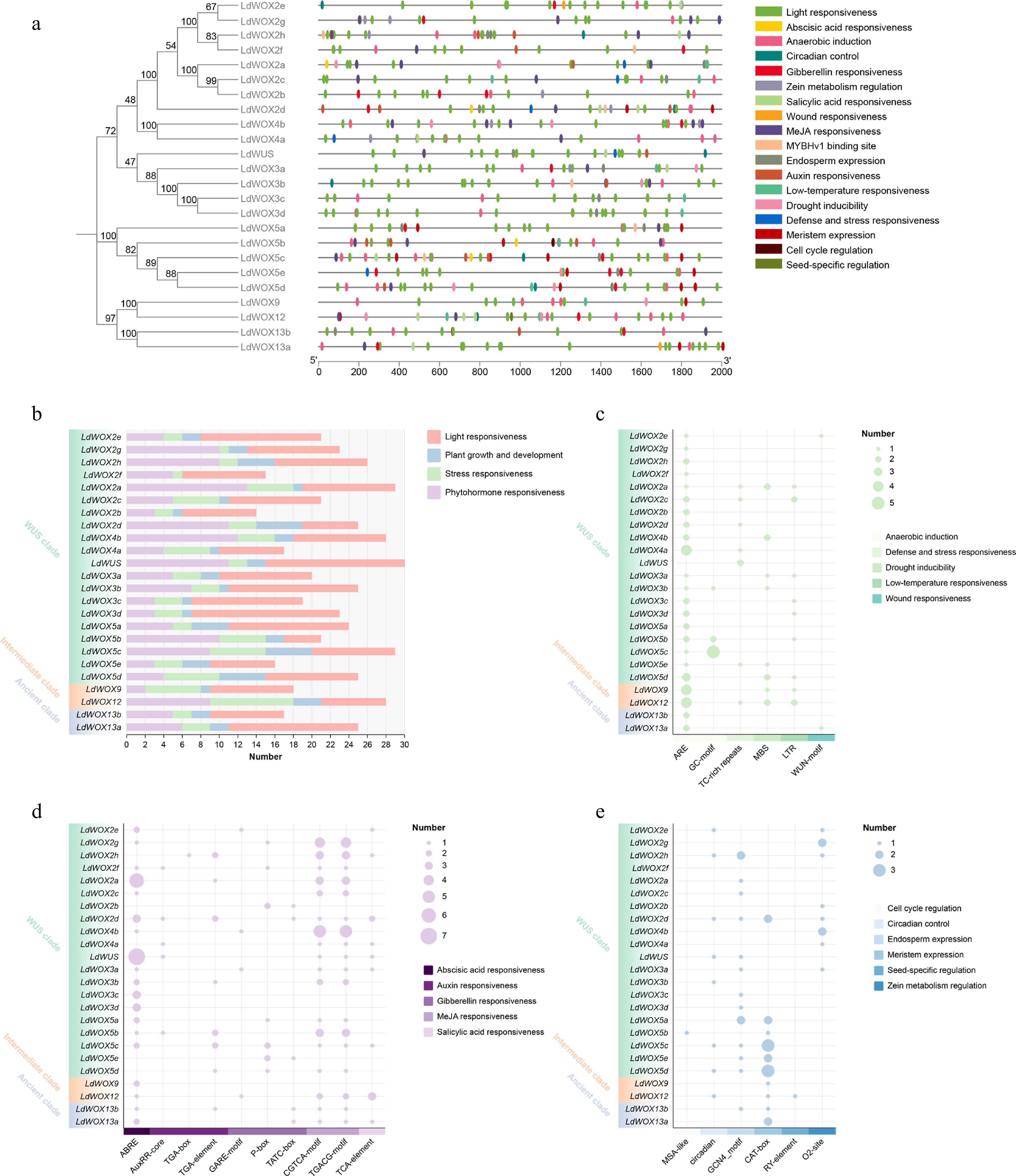
Figure 5.
Comprehensive analysis of cis-acting elements in the LdWOX promoters. (a) Distribution of cis-acting elements in the promoters. (b) Counts of the four major categories of cis-acting elements: Light responsiveness, plant growth and development, stress responsiveness, and phytohormone responsiveness. (c) Counts of stress-responsive cis-acting elements. (d) Counts of phytohormone-responsive cis-acting elements. (e) Counts of cis-acting elements related to plant growth and development.
Expression pattern analysis of LdWOX family members in 10 different tissues
-
To elucidate the functional roles of LdWOX family members, the expression patterns of the 24 LdWOX genes were examined across 10 tissues, including bulb roots, stem roots, stems, leaves, outer petals, inner petals, anthers, filaments, styles, and ovaries (Fig. 6; Supplementary Table S8). Seven LdWOX members demonstrated no detectable expression in any of the 10 tissues. The remaining members exhibited tissue-specific expression patterns and could be classified into two categories. The first category comprises members that were expressed in multiple tissues but manifested distinctly elevated levels in specific tissues. For instance, LdWOX2d, LdWOX2h, LdWOX4a, and LdWOX9 displayed peak expression levels in the ovary, whereas LdWOX4b, LdWOX12, and LdWOX13b were predominantly expressed in the bulb roots and stem roots. The second category encompasses members that showed strict tissue specificity and were expressed exclusively in a single tissue type. LdWUS, LdWOX2a, LdWOX2e, LdWOX2f, and LdWOX2g were detected only in the ovary, whereas LdWOX5b and LdWOX5d exhibited stem root-specific expressions. These results suggest that LdWOX family members may contribute to the development of root systems and floral organs in Lanzhou lily.
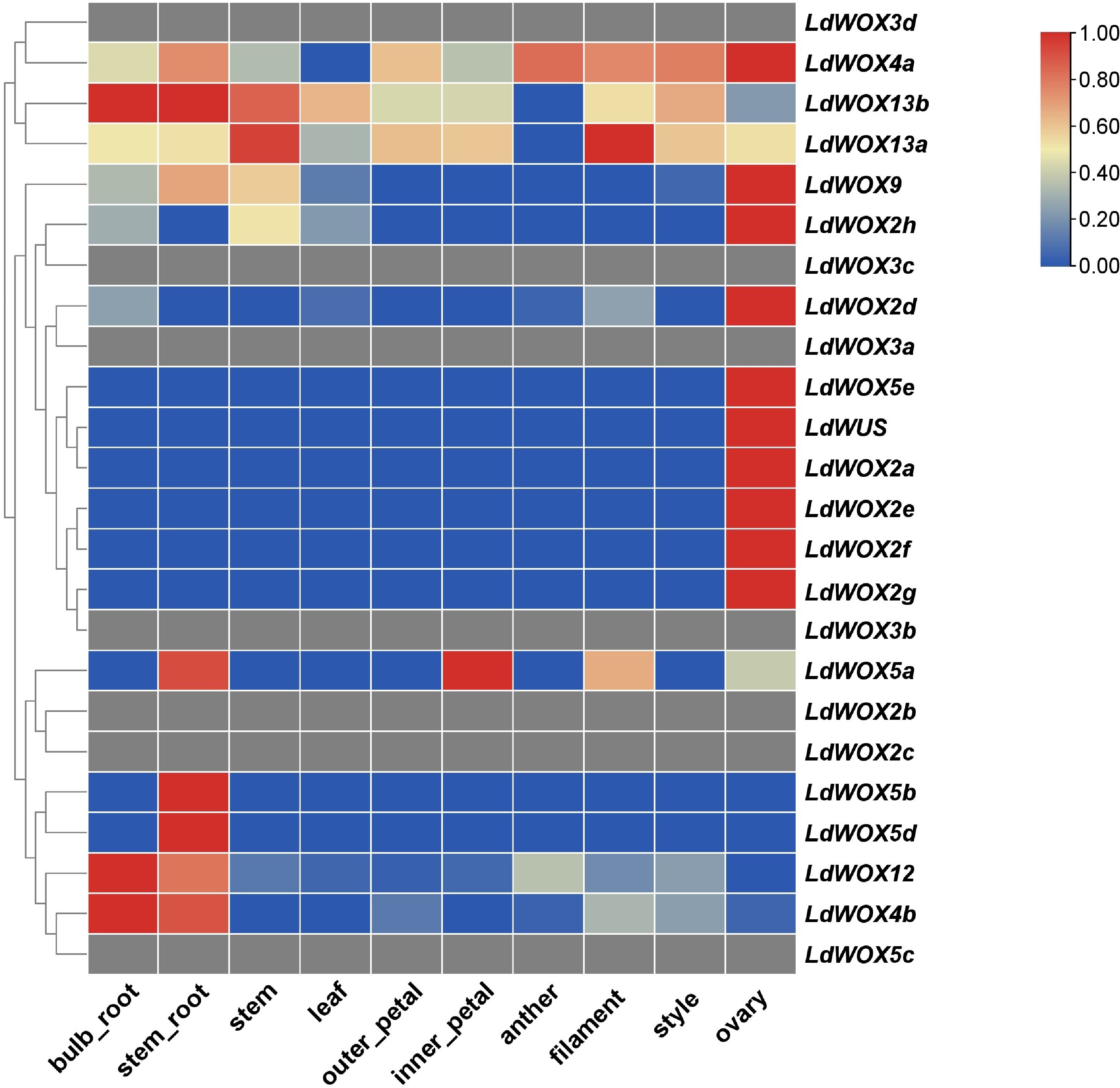
Figure 6.
Expression patterns of LdWOX family members in the 10 tissues of Lanzhou lily. The color scale represents row-normalized expression levels, where log2(x + 1)-transformed TPM values were linearly scaled to a 0–1 range for each gene.
Expression analysis of LdWOXs in stem roots under abiotic stresses
-
Abiotic stresses, such as extreme temperatures, drought, flooding, high salinity, and nutrient deficiency, are adverse environmental conditions that impair plants' growth and development. Studies in rice[43], poplar[22], and cotton[23] have revealed the involvement of WOX family members in response to diverse abiotic stresses. It is therefore necessary to investigate whether the LdWOX genes in Lanzhou lily also contribute to abiotic stress tolerance. Tissue expression profiling indicated that LdWOX family members exhibited low overall transcript levels in the leaves, whereas more members were expressed in the stem roots, with some showing stem root-specific expression. Nine LdWOX members expressed in the stem roots were selected for further study (LdWOX4a, 4b, 5a, 5b, 5d, 9, 12, 13a, and 13b), whereas LdWOX5c and LdWOX5e, although undetected in the stem roots, were included as paralogs of LdWOX5a, LdWOX5b, and LdWOX5d. Altogether, 11 LdWOX members were chosen for the abiotic stress response study. Healthy, uniformly grown Lanzhou lily plants were subjected to four abiotic stress treatments: high temperature (37 °C), low temperature (4 °C), salinity (300 mM NaCl), and drought (withholding water). Stem root samples were collected at multiple time points; in the drought treatment, the relative soil water content was also measured simultaneously. The results revealed that mild drought was reached after 7 days of treatment, and extreme drought was reached after both 14 and 21 days (Supplementary Table S9). Under all four stress treatments, by at least the final sampling point, the plants had displayed evident stress phenotypes, including leaf curling and wilting as well as stem root browning and atrophy. The temporal expression profiles of 11 LdWOX genes in the stem roots of Lanzhou lily under the four abiotic stresses were determined by qRT-PCR.
After the results of the qRT-PCR analysis, genes whose expression did not significantly vary were excluded (Supplementary Figs S5–S8). Ultimately, four LdWOX genes responded to low-temperature, salt, and drought stresses (each with a different four-gene composition), whereas five LdWOX genes responded to high-temperature stress (Fig. 7). Notably, the sets of responsive genes overlapped considerably among the different abiotic stresses. Specifically, LdWOX4b and LdWOX12 responded to all four stresses; LdWOX5c to three; and LdWOX4a, LdWOX13a, and LdWOX13b to two. This may be attributed to the presence of multiple convergence nodes in the signal transduction pathways of different abiotic stresses or to the functional versatility of the LdWOX genes. With the exception of LdWOX4a, the promoters of LdWOX4b, LdWOX5c, LdWOX12, LdWOX13a, and LdWOX13b all contain cis-acting elements involved in ABA responsiveness, and ABA is a pivotal stress-responsive hormone (Fig. 5d). Nevertheless, the promoter of LdWOX4a harbors cis-acting elements that are relevant to defense and stress responsiveness (Fig. 5c). These cis-element predictions further support the role of LdWOX genes in abiotic stress responses. Furthermore, homologous genes in other species play similar roles. In terms of low-temperature stress, the transcript levels of OsWOX12A and OsWOX12B, homologs of LdWOX12, increased continuously in rice seedlings during 12 h of cold treatment[43]. With respect to salt stress, PdbWOX4 negatively regulates salt tolerance in Shanxin poplar (Populus davidiana × Populus bolleana)[44], which is consistent with the overall downregulated expression trends of LdWOX4a and LdWOX4b. In contrast, the expressions of LdWOX12 and LdWOX13b increased overall under salt stress, and their respective homologs, PagWOX11/12a and HvWOX13, have been confirmed to be positive regulators of salt tolerance[22,45]. In terms of drought stress, SlWOX4, a homolog of LdWOX4b, was significantly downregulated upon drought treatment[46]. The overexpression of JcWOX5, another homolog of LdWOX4b, diminishes drought tolerance in plants[47]. Taken together, the LdWOX genes may exhibit diverse functions and unique defense mechanisms in response to abiotic stresses.
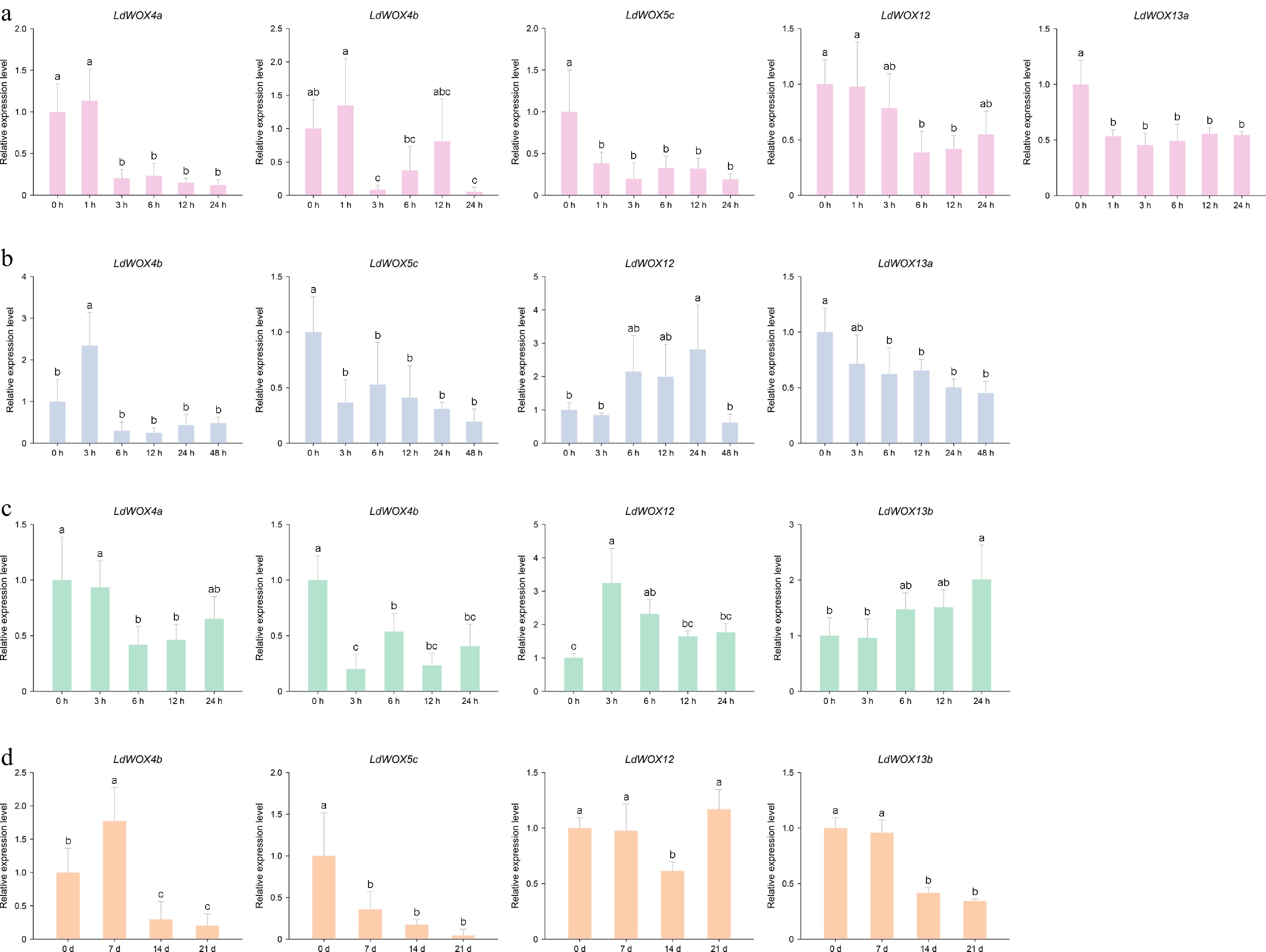
Figure 7.
Expression dynamics of LdWOX genes in the stem roots of Lanzhou lily under (a) high-temperature stress, (b) low-temperature stress, (c) salt stress, and (d) drought stress. Only genes showing significant expression changes over time are displayed. Data are presented as the means ± SD (n = 3). One-way ANOVA followed by an LSD post hoc test was used. Different lowercase letters indicate significant differences (p < 0.05).
-
The WOX gene family encodes a group of plant-specific transcription factors that play pivotal roles in diverse physiological processes, including hormone signal transduction, growth and development, and stress responses[48]. As morphogenic regulators, WOX genes are essential for maintaining stem cell identity, orchestrating organ morphogenesis, and promoting plant regeneration[49,50]. In this study, the LdWOX family members in Lanzhou lily were rigorously identified and analyzed, providing a preliminary exploration of their potential functions.
Phylogenetic analysis revealed that the ancestral WOX2 gene underwent pronounced lineage-specific expansion in Lanzhou lily, resulting in the generation of eight paralogous copies, designated LdWOX2a–h, through multiple rounds of duplication events (Fig. 2). Chromosomal localization further revealed that LdWOX2a–h constitute a rare cluster of eight tandemly duplicated genes (Fig. 1). With the exception of LdWOX2b and LdWOX2c, whose expression was not detected by RNA sequencing (RNA-seq) in the 10 tissues examined, the remaining six genes were expressed specifically in the ovaries of Lanzhou lily (Fig. 6). Consistent with the essential roles of WOX2 genes in embryonic patterning and morphogenesis[9,17], this tissue expression pattern supports the hypothesis that LdWOX2a, LdWOX2d, LdWOX2e, LdWOX2f, LdWOX2g, and LdWOX2h regulate embryonic development in Lanzhou lily. In one scenario, the copies may exhibit coordinated high expression, thus ensuring the robustness of embryonic development through a dosage effect. In another scenario, these copies may have undergone subfunctionalization, with the ancestral functions being partitioned among different members for complementary execution and finer regulation. Moreover, AtWOX2 is highly expressed during seed development and positively regulates seed germination[51]. In Amorphophallus bulbifer, AbWOX2 functions as a key driver of somatic embryogenesis and is involved in related developmental processes, such as callus proliferation and shoot regeneration[52]. In light of these findings, the absence of detectable expression of LdWOX2b and LdWOX2c in the 10 tissues may be explained by their expression being confined to other tissues.
In the phylogenetic tree, five LdWOX members (LdWOX5a–e) cluster with the AtWOX5–AtWOX7 sister pair, OsWOX9, and DcWOX5 into a highly supported subclade, suggesting that this subclade has undergone lineage-specific expansion in Lanzhou lily (Fig. 2). The expanded paralogous genes may have experienced functional divergence during long-term evolution, an inference supported by their expression patterns in different tissues and under abiotic stresses (Figs 6 and 7). Specifically, LdWOX5b and LdWOX5d were expressed only in the stem roots; LdWOX5e was expressed exclusively in the ovaries; LdWOX5a was highly expressed in the stem roots and inner petals and was also expressed in the filaments and ovaries; and only LdWOX5c responded to abiotic stress, but its expression was not detected in any of the 10 tissues assayed by transcriptome sequencing. The potential functions of LdWOX5a–e can be further extrapolated from the functions of homologous genes in other species. AtWOX5 is expressed in the quiescent center of the root tip, thereby ensuring stem cell maintenance in the root apical meristem[53]. AtWOX7 represses lateral root growth[54]. During the process of adventitious root regeneration from excised leaves, the upstream transcription factors AtWOX11 and AtWOX12 directly activate the expression of AtWOX5 and AtWOX7, thereby promoting root primordium formation and development[55]. PtoWOX5a also participates in adventitious root development[56]. In addition, AtWOX5 and AtWOX7 maintain pluripotency in the callus[57]. Overall, the functions of WOX5 and WOX7 in root development and plant regeneration are highly conserved. On the basis of the abovementioned expression patterns and homologous gene functions, the following potential functions of LdWOX5a–e can be proposed. LdWOX5b and LdWOX5d are likely to play conserved regulatory roles in initiating the stem root primordium and maintaining the root apical meristem. LdWOX5a may have dual functions in both root and floral organ development. LdWOX5c and LdWOX5e may have undergone neofunctionalization, with the former involved in the abiotic stress response and the latter specialized in ovary-related biological processes. In conclusion, this potential functional divergence merits further investigation, which would provide new insights into the functional evolution of WOX genes in Lanzhou lily.
The tissue expression profiles of LdWOX family members revealed that in the 10 tissues examined, the expression of seven members, namely LdWOX2b, LdWOX2c, LdWOX3a, LdWOX3b, LdWOX3c, LdWOX3d, and LdWOX5c, was not detected (Fig. 6). This phenomenon may result from the strict spatiotemporal-specific or inducible expression of these genes, i.e., their expression is restricted to particular developmental stages, tissues, or conditions. Furthermore, the RNA-seq data analyzed in this study did not cover all the organ types of Lanzhou lily. The absence of data for organs such as bulbs, fruits, and seeds may also account for the inability to detect the expression of certain LdWOX genes. As discussed above, LdWOX2b and LdWOX2c may be expressed in the seeds or during somatic embryogenesis induced by specific conditions. The functions of the homologs of LdWOX3a–d in other species are primarily associated with lateral organs' morphogenesis. AtWOX3 (also known as PRS1/PRESSED FLOWER1) specifies the formation of lateral domains in vegetative and floral organs; accordingly, prs1 mutants lack lateral stipules, lateral sepals, and stamens[58]. In rice, the duplicated WOX3 genes NAL2 and NAL3 (also known as OsPRS or OsNS) regulate leaf width, and their overexpression increases leaf width and vein number[59]. The barley WOX3 ortholog NLD1 contributes to the establishment of marginal tissues in lateral organs[60]. It can thus be inferred that the LdWOX3a–d genes are likely expressed during the development of lateral organs and are consequently undetectable in mature samples of roots, leaves, and tepals. Notably, although the expression of LdWOX5c in the stem roots was undetected by RNA-seq, it was detected by qRT-PCR, which may be explained by its extremely low abundance. In RNA-seq, low-abundance transcripts may be missed because of insufficient sequencing depth or overly stringent filtering criteria, whereas the more sensitive qRT-PCR can often capture such weak signals.
Expression profiling of LdWOX genes under four abiotic stresses revealed extensive overlap among the sets of genes that were responsive to different stresses, indicating that individual LdWOX genes can respond to multiple abiotic stresses (Fig. 7). This observation is not unique; several PeuWOX[61] and LuWOX[62] genes have also been reported to respond to multiple abiotic stresses. Such cross-responsiveness likely represents an efficient, energy-conserving regulatory strategy shaped by long-term evolution, arising from concerted mechanisms including promoter architecture, stress signaling pathway convergence, and transcription factors' versatility. The molecular basis for the ability of WOX genes to respond to multiple abiotic stresses lies primarily in the cis-acting element composition of their promoters. In this study, the promoters of LdWOX4a, LdWOX4b, LdWOX5c, LdWOX12, LdWOX13a, and LdWOX13b contained various hormone-responsive and abiotic stress-responsive elements, such as ABA-responsive, SA-responsive, drought-responsive, and low-temperature-responsive elements (Fig. 5). When plants perceive different abiotic stresses, transcription factors activated downstream of the respective stress signaling pathways may converge on the same set of LdWOX genes via these cis-acting elements. Multiple convergence nodes among distinct abiotic stress signaling pathways likely represent a core mechanism underlying the extensive overlap of stress-responsive genes. ABA, ROS, and Ca2+ signals interact to form a central signaling hub that integrates diverse abiotic stress responses and activates downstream transcriptional regulatory networks[63]. Within this network, WOX genes may act as key integration nodes and consequently exhibit broad-spectrum abiotic stress responsiveness. This responsiveness may also stem from the functional pleiotropy of proteins encoded by WOX genes. WOX transcription factors serve pivotal functions in plant growth and development and in stress responses[48], suggesting the intrinsic potential to decode multiple upstream stress signals and drive downstream adaptive responses. Notably, although the qRT-PCR data demonstrated that the six LdWOX genes responded to multiple abiotic stresses, they did not directly establish that these genes confer stress resistance. Their precise functions need to be verified in future studies through genetic approaches such as gene knockout or overexpression.
-
To fill the knowledge gap concerning the WOX gene family in Lanzhou lily, 24 putative LdWOX genes in total were identified from the genome, and their physicochemical properties, chromosomal localization, phylogenetic relationships, gene structures, conserved domains and motifs, cis-acting elements, and expression patterns were systematically characterized. Phylogenetic analysis revealed a notable expansion of the WUS clade in Lanzhou lily relative to A. thaliana, O. sativa, and D. catenatum, implying that the amplified members have undergone subfunctionalization or neofunctionalization. Moreover, an alteration of a highly conserved homeodomain residue was detected in four LdWOX proteins, which may result in the acquisition of new functional properties. The tissue-specific expression patterns of the LdWOX genes suggested their potential regulatory functions in the roots and floral organs. LdWOX4a, LdWOX4b, LdWOX5c, LdWOX12, LdWOX13a, and LdWOX13b responded to multiple abiotic stresses, although the molecular mechanisms underlying these responses remain to be elucidated. In conclusion, this study provides a comprehensive understanding of the LdWOX gene family and provides a theoretical foundation for future functional investigations of its regulatory mechanisms.
This research was funded by the National Natural Science Foundation of China (No. 32371951).
-
Not applicable.
-
The authors confirm their contributions to the paper as follows. Study conception and design: He H, Zhang S; data collection: Zhang S, Nie Y, Lan T, Wang X, Ma C, Wang J; analysis and interpretation of the results: Zhang S, Zhu Y; draft manuscript preparation: Zhang S, He H, Zhao Y. All authors reviewed the results and approved the final version of the manuscript.
-
The genome data of Lanzhou lily are available in the China National GeneBank Database (https://db.cngb.org). All data generated or analyzed during this study are included in this published article and its supplementary information files.
-
The authors declare that they have no conflict of interest.
-
accompanies this paper online at: https://doi.org/10.48130/vegres-0026-0031.
- Supplementary Table S1 The protein sequences of WOX family members in Lanzhou lily, Arabidopsis thaliana, Oryza sativa, Dendrobium catenatum and Lilium lancifolium.
- Supplementary Table S2 Primers used for qRT-PCR.
- Supplementary Table S3 The detailed information of LdWOX genes.
- Supplementary Table S4 Quantities of cis-acting elements related to light responsiveness in the LdWOX promoter regions.
- Supplementary Table S5 Quantities of cis-acting elements related to phytohormone responsiveness in the LdWOX promoter regions.
- Supplementary Table S6 Quantities of cis-acting elements related to stress responsiveness in the LdWOX promoter regions.
- Supplementary Table S7 Quantities of cis-acting elements related to plant growth and development in the LdWOX promoter regions.
- Supplementary Table S8 TPM expression values of 24 LdWOX genes across ten tissues of Lanzhou lily.
- Supplementary Table S9 Relative soil water contents after different drought stress durations.
- Supplementary Fig. S1 Conserved motifs of the LdWOX proteins.
- Supplementary Fig. S2 Phylogenetic tree of 143 WOX proteins.
- Supplementary Fig. S3 Conserved domain sequence alignment of 143 WOX proteins from 12 species.
- Supplementary Fig. S4 Analysis of cis-acting elements related to light responsiveness in the promoter regions of LdWOX genes.
- Supplementary Fig. S5 Expression dynamics of LdWOX genes in stem roots of Lanzhou lily under high-temperature stress.
- Supplementary Fig. S6 Expression dynamics of LdWOX genes in stem roots of Lanzhou lily under low-temperature stress.
- Supplementary Fig. S7 Expression dynamics of LdWOX genes in stem roots of Lanzhou lily under salt stress.
- Supplementary Fig. S8 Expression dynamics of LdWOX genes in stem roots of Lanzhou lily under drought stress.
- Copyright: © 2026 by the author(s). Published by Maximum Academic Press, Fayetteville, GA. This article is an open access article distributed under Creative Commons Attribution License (CC BY 4.0), visit https://creativecommons.org/licenses/by/4.0/.
-
About this article
Cite this article
Zhang S, Zhu Y, Nie Y, Lan T, Wang X, et al. 2026. Genome-wide identification and expression pattern analysis of the WOX gene family in Lanzhou lily (Lilium davidii var. unicolor). Vegetable Research 6: e038 doi: 10.48130/vegres-0026-0031 

Genome-wide identification and expression pattern analysis of the WOX gene family in Lanzhou lily (Lilium davidii var. unicolor)
- Received: 12 April 2026
- Revised: 15 July 2026
- Accepted: 10 August 2026
- Published online: 10 November 2026
Abstract: As plant-specific transcription factors, the WUSCHEL-related homeobox (WOX) family regulates cell division, organogenesis, and stress adaptation. Here, we identified and systematically characterized 24 LdWOX genes in the Lanzhou lily (Lilium davidii var. unicolor) genome, including a rare eight-gene tandem array (LdWOX2a–h). Phylogenetic reconstruction resolved these genes into three clades, revealing a notable WUSCHEL-clade expansion unique to Lanzhou lily. Structural analyses showed pronounced intron–exon length disparity, with introns generally being far longer than the neighboring exons, and detected a conserved residue substitution in the homeodomain of LdWOX2e–h. Expression profiling across tissues highlighted predominant LdWOX activity in roots and flowers, whereas quantitative real-time polymerase chain reaction implicated LdWOX4a/4b/5c/12/13a/13b in abiotic stress responsiveness, often with pleiotropic roles across pathways. This study provides a comprehensive framework for future functional investigations of the LdWOX family.