











-
Tropical horticulture, characterized by its diverse range of fruits, vegetables, and ornamental plants, plays a crucial role in the livelihoods of millions across tropical regions. However, this vital sector faces significant challenges, including high pest pressure, soil degradation, and the impacts of climate change. Sustainable practices in tropical horticulture are essential to building resilient agricultural systems that help to adapt to these challenges while ensuring long-term productivity, environmental health, and food security. This commentary explores the critical need for sustainable horticultural practices and potential strategies currently being implemented in tropical horticulture. Additionally, the opportunities and challenges of these practices are also discussed to promote long-term ecological and economic sustainability.
HTML
-
Tropical regions are endowed with favorable climatic conditions that support the cultivation of a wide variety of horticultural crops. However, these climates are also characterized by increased temperatures, erratic rainfall patterns, and the heightened incidence of pests and diseases. In areas like South Florida, agricultural soils often have low organic matter content (less than 2%), which contributes to reduced crop yields and economic losses. Traditional farming practices, which heavily rely on chemical inputs and monoculture, exacerbate these vulnerabilities by further depleting soil fertility and diminishing biodiversity, which in turn, increases disease frequency, leading to greater economic damage and amplifying environmental concerns.
In many tropical regions, agricultural areas are closely interwoven with natural habitats, e.g., wetlands, which are highly susceptible to contamination from agricultural runoff. During the long rainy summer, nutrients from overused chemicals leach into the soil, and when combined with the shallow aquifers, lead to eutrophication in both surface and groundwater. This process can result in harmful algal blooms, degrade water quality, and pose serious environmental threats to these delicate ecosystems and human communities relying on these natural resources.
Sustainable horticulture offers a viable solution to these problems. By adopting practices that conserve natural resources, enhance ecosystem services, and reduce environmental footprints, farmers can improve the resilience of their agricultural systems[1]. Moreover, sustainable practices can provide socio-economic benefits by reducing input costs, improving crop yields, and creating opportunities for value-added products.
-
In pursuing resilient agricultural systems, sustainable practices in tropical horticulture offer a comprehensive approach to addressing environmental, social, and economic challenges. Figure 1 illustrates the key strategies essential to achieving this sustainability. These include the use of agricultural biologicals such as biofertilizers and biopesticides, which reduce reliance on chemical inputs while promoting plant health. Integrated pest and disease management techniques further enhance this balance by utilizing natural predators, pheromones, and resistant plant varieties to mitigate pest pressures without harming the ecosystem. Additionally, sustainable intensification practices, such as regenerative and precision agriculture, optimize resources to increase productivity while conserving environmental integrity[2].
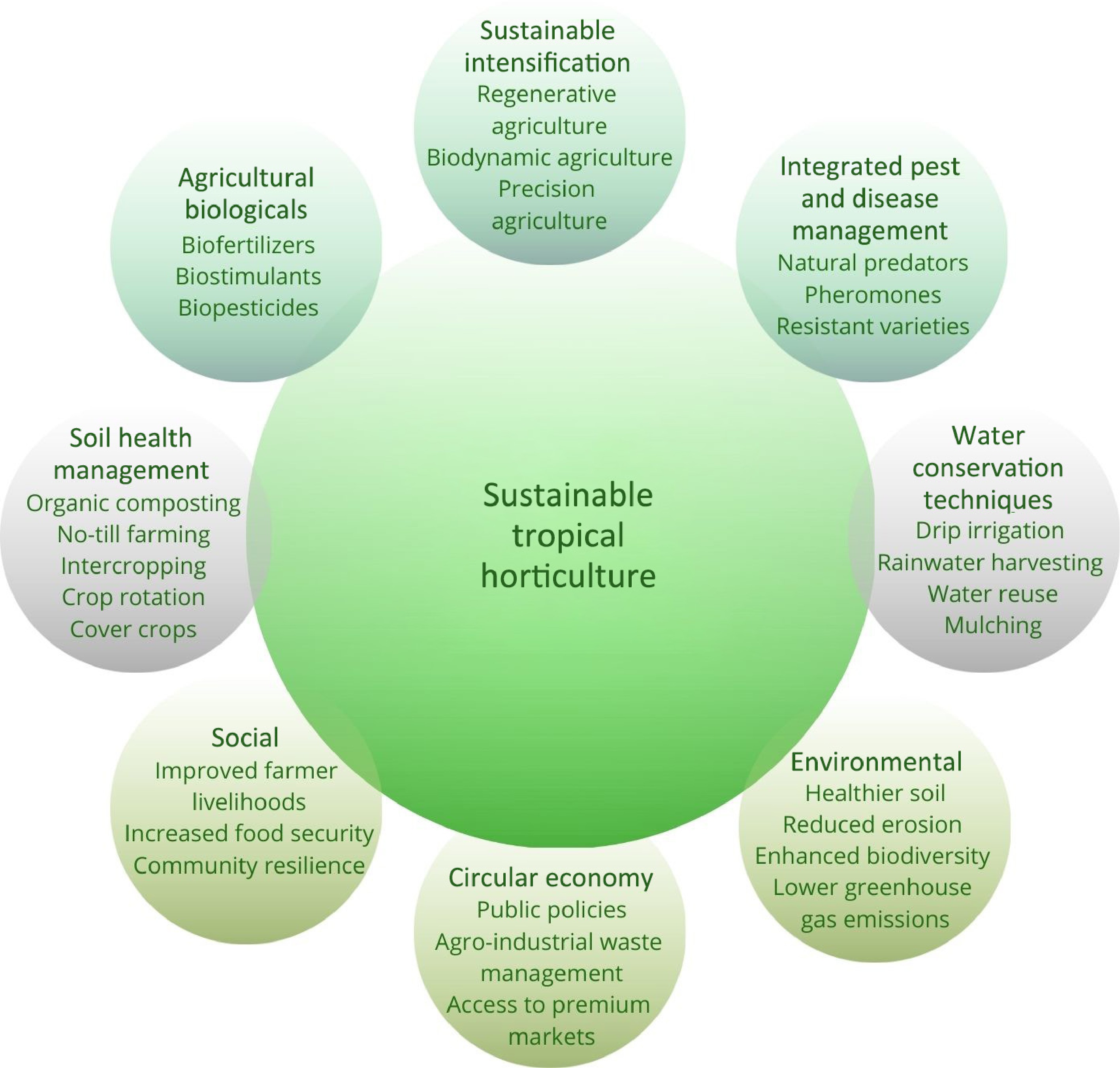
Figure 1.
Strategies for the path to sustainable tropical horticulture and understanding the interconnected benefits (circles with the same colors are strongly interrelated).
Water conservation techniques like drip irrigation, rainwater harvesting, and water reuse are critical to managing scarce water resources in tropical climates. Soil health management, which includes organic composting, no-till farming, and crop rotation, strengthens the foundation of agricultural systems by improving soil structure and fertility[3]. These strategies are closely linked to the circular economy, promoting waste management and access to premium markets, while ensuring social benefits such as improved farmer livelihoods and increased food security. By adopting these interconnected strategies, tropical horticulture can become more resilient, enabling long-term productivity and environmental sustainability.
-
Despite the clear benefits of sustainable practices, their adoption in tropical horticulture still faces several challenges. These challenges include limited access to knowledge and resources, market barriers, and policy constraints, which often hinder farmers from transitioning to sustainable systems. Addressing these challenges requires a multifaceted approach involving research, education, and supportive policies.
Preliminary data from the Food and Agriculture Organization of the United Nations (FAO) indicate that the volume of global trade in major tropical fruits in 2023 reached a new peak of USD
${\$} $ ${\$} $ ${\$} $ ${\$} $ To feed a global population projected to reach 9 billion by 2050, agricultural production must increase by 70% worldwide and nearly 100% in developing countries, according to FAO estimates[6]. However, with limited natural resources and the negative impacts of traditional methods threatening agricultural productivity, a shift towards sustainable intensification is crucial. This is particularly important in rural areas of developing countries, where some of the highest rates of population growth is expected, and where innovation will be key. By enabling smallholder and family farmers to adopt more productive and sustainable practices, innovation can address the dual challenges of hunger and environmental conservation, while providing profitable employment opportunities for younger generations[7].
Investment in research, capacity building, market access, and policy support are all critical to advancing sustainable horticulture. Collaborative research efforts can drive innovation tailored to local conditions, while training programs empower farmers with the skills needed for sustainable practices. Enhancing market access through value chains, certification schemes, and direct marketing can provide financial incentives for farmers. Additionally, supportive policies from governments and international organizations are essential to create an enabling environment that promotes sustainable land management and accelerates the adoption of best practices.
This study was conducted without external funding support. We would like to acknowledge the support provided by the University of Florida Institute of Food and Agricultural Sciences (UF IFAS), the Horticultural Sciences Department, and the Tropical Research and Education Center (TREC).
-
The authors confirm contribution to the paper as follows: draft manuscript preparation: Lacerda VR; final manuscript preparation: Lacerda VR, Costa BNS, Li X. All authors reviewed the results and approved the final version of the manuscript.
-
Data sharing not applicable to this article as no datasets were generated or analyzed during the current study.
-
The authors declare that they have no conflict of interest.
- Copyright: © 2025 by the author(s). Published by Maximum Academic Press, Fayetteville, GA. This article is an open access article distributed under Creative Commons Attribution License (CC BY 4.0), visit https://creativecommons.org/licenses/by/4.0/.
Lacerda VR, Costa BNS, Li X. 2025. Sustainable practices in tropical horticulture: a path to resilient agricultural systems. Technology in Horticulture 5: e004 doi: 10.48130/tihort-0024-0033


|