











-
Hainan Island, the southernmost province of China (Fig. 1a), exhibits a distinctive tropical and subtropical climate that significantly influences its biodiversity and agricultural practices. Unlike other southern regions with tropical fragments (e.g., southern Yunnan and Guangxi), 42.5% of Hainan Island's land area falls within the tropical and subtropical zone. The island experiences an annual average temperature of 23–25 °C and mean annual rainfall exceeding 1,600 mm, creating favorable conditions for diverse plant species, including native and economically significant crops such as coconuts[1]. Hainan's unique geographical and climatic conditions also shape its ecological landscape. The island hosts the most extensive and well-preserved tropical forests in China, supporting higher levels of native plant endemism and diversity than fragmented tropical areas in Yunnan and Guangxi. For instance, Hainan is home to over 6,000 vascular plant species (of which about 15% are endemic), far surpassing the tropical plant diversity of Guangxi's coastal areas and exceeding the endemic species ratio of Yunnan's Xishuangbanna[2,3].
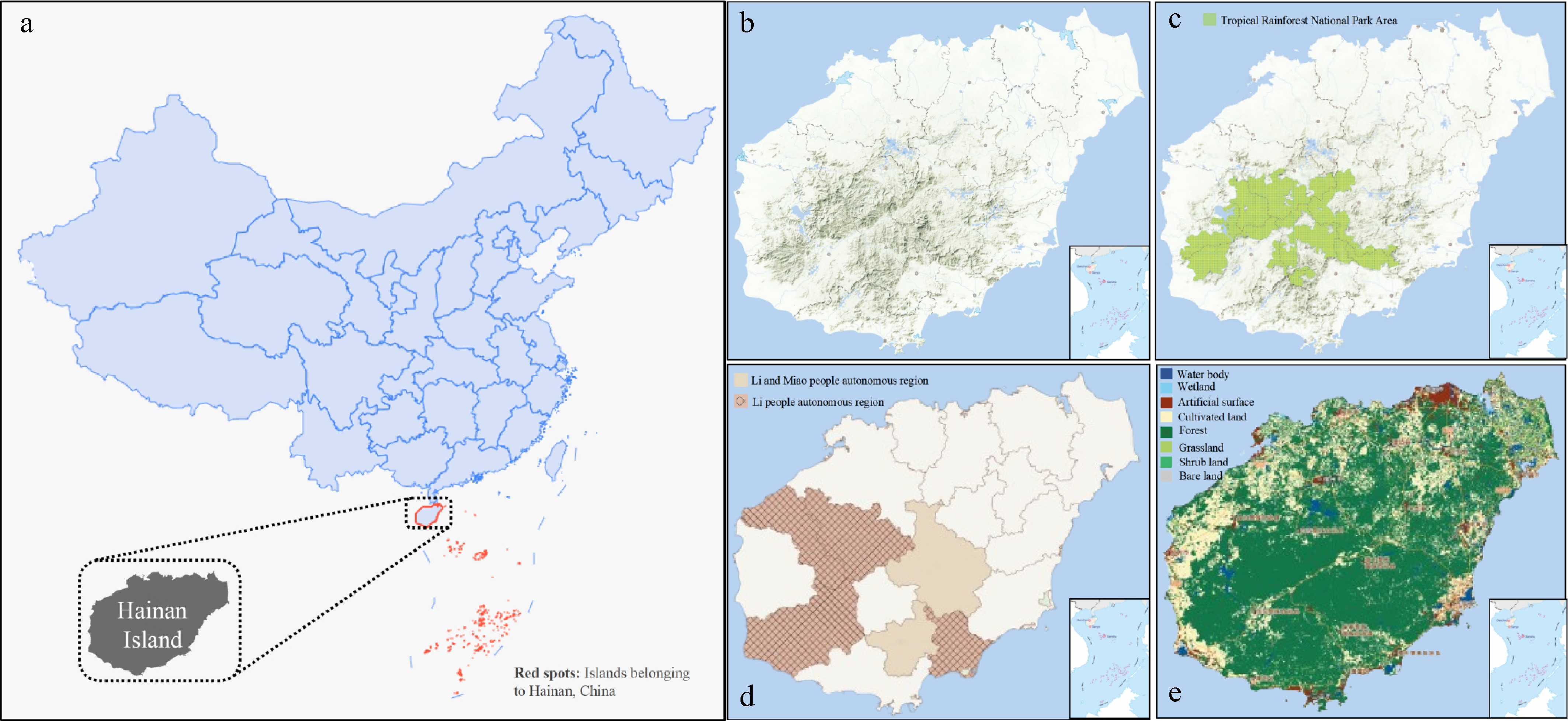
Figure 1.
Maps of Hainan Province: terrain, ethnic groups, forest coverage, ethnic population, and its location in China. (a) The location of Hainan in China. (b) Topographic map of Hainan. (c) Distribution of tropical rainforest national parks in Hainan. (d) Map of minority languages in Hainan. (e) Surface coverage map of Hainan. The map inspection number of (a) is GS (2024) 0650, and this map was supervised by the Ministry of Natural Resources of China. The inspection numbers of (c) and (d) are GS(2024)056 -survey qualification certificate No. 1100471, and these maps were supervised by Hainan Provincial Bureau of Surveying, Mapping, and Geographic Information, data acquired from the National Platform for Common Geospatial Information Services of China. All maps used in this figure are based on the official Chinese map provided by the Standard Map Service System of the Ministry of Natural Resources of China (
http://bzdt.ch.mnr.gov.cn ).Culturally, Hainan's ethnic diversity further enhances its uniqueness. Unlike Yunnan's diverse ethnic groups with cross-border cultural connections or Guangxi's Zhuang-dominated ethnic landscape, Hainan is home to the Li people and Miao, Hui, and Yao communities that have developed isolated, island-specific ethnobotanical knowledge over millennia[4]. For example, the Li people's utilization of over 500 plant species for medicine, food, and crafts—such as Mallotus furetianus (Zhegu tea) and Broussonetia papyrifera (Li bark cloth raw material)—is distinct from the ethnobotanical practices of Yunnan's Dai or Guangxi's Zhuang, which are shaped by continental cultural exchanges[5,6]. This unique blend of intact tropical ecosystems and isolated ethnic traditions makes Hainan a globally significant site for ethnobotanical research—offering insights into human-plant interactions.
Ecologically, Hainan's central and southern mountainous areas (e.g., Wuzhishan and Jianfengling) are identified as key hotspots for plant endemism[2]. Hainan's unique geographical and climatic conditions also shape its ecological dynamics. The spatial distribution of plant diversity is largely driven by environmental factors such as temperature, precipitation, and soil composition. Notably, climate change is influencing agricultural suitability on the island, with studies predicting shifts in optimal cultivation zones for crops like green oranges[3]. Additionally, the presence of non-native species, mainly introduced through human activities, poses ecological challenges, as these species compete with native flora and alter biodiversity patterns[7].
These ecological cultural characteristics highlight Hainan's irreplaceable value: it is not only a repository of China's most intact tropical biodiversity but also a living archive of unique ethnic botanical knowledge, making it a critical focus for ethnobotanical research and conservation.
-
Besides these unique plantations, Hainan is home to 55 officially recognized ethnic minorities, including the Li, Miao, Hui, Zhuang, and Yao, which significantly enriches the region's cultural diversity, traditional craftsmanship, and economic activities[8]. The Li, the island's earliest settlers with a population exceeding 1.2 million, are renowned for their UNESCO-listed Li ethnic brocade (Li Jin), traditional agriculture, and medicinal plant knowledge[9]. The Miao, descendants of Ming Dynasty soldiers, excel in silverware processing, brocade weaving, and herbal medicine[9]. The Hui, with roots tracing back to Persian and Arab merchants, maintain Islamic traditions in religion, cuisine, and clothing, primarily in Yanglan Town, Sanya[10]. The Zhuang, engaged in agriculture, are culturally known for their folk songs and dances, sharing affinities with their Guangxi counterparts[11]. The Yao, residing in the northwest, are experts in traditional embroidery and medicinal plant knowledge, contributing to local healthcare practices[4]. Despite modernization and tourism challenges, these communities play a vital role in preserving Hainan's cultural and ecological heritage, necessitating increased conservation efforts[12].
These ethnic minorities have developed extensive traditional knowledge regarding plant utilization, particularly in food, medicine, and material culture. The Li people have a rich ethnobotanical tradition, utilizing over 500 species of plants for medicinal, culinary, and utilitarian purposes[6]. Among these, medicinal plants play a significant role, with 282 species identified in Li traditional medicine, used primarily for treating ailments such as rheumatism, gastrointestinal disorders, and traumatic injuries[13]. The Miao and Hui also employ plant-based medicine, with many species shared with traditional Chinese medicine (TCM) and local folk practices[14]. In addition to medicinal uses, plants play a crucial role in food and cultural practices. The Li people cultivate indigenous crops such as mountain rice (Shanlan upland rice) and use wild plants to create traditional rice dishes, including herbal soups and fermented foods. The Miao ethnic group is known for using wild herbs and spices in cuisine, while the Hui integrate their Islamic dietary customs with local plant resources[5]. Furthermore, many ethnic groups in Hainan utilize plant materials for handicrafts, such as bamboo weaving, textile dyeing, and wood carving, preserving traditional craftsmanship and cultural heritage[15]. Despite the richness of ethnobotanical knowledge, modernization and environmental degradation pose challenges to the preservation of traditional practices. The increasing commercialization of ethnic cultural heritage, particularly in tourism, has altered the way indigenous knowledge is transmitted, with some concerns over the authenticity and sustainability of cultural preservation efforts[12]. Efforts to document and protect traditional botanical knowledge remain crucial to maintaining the cultural and ecological diversity of Hainan.
Situated within the tropical zone, Hainan Province represents China's most biodiverse region and harbors several distinctive ethnic minority groups. The areas where ethnic minorities live in compact communities in Hainan Province highly overlap with the mountainous regions with high biodiversity in Hainan Province, as demonstrated in Fig. 1b–e. To investigate the traditional botanical knowledge and plant utilization patterns among these indigenous communities, researchers in Hainan have implemented ethnobotanical approaches, establishing a novel framework for studying the intricate relationships between local ethnic groups and their floristic environment. Ethnobotany is an interdisciplinary field that examines the complex relationships between humans and plants. The term was first introduced by John William Harshberger in 1896, originally defined as 'the study of plants used by aborigines'[16]. Over time, its scope has expanded significantly, encompassing various dimensions of human-plant interactions.
-
The development of global ethnobotany can be summarized as follows: In its early stages (19th to early 20th century), ethnobotany emerged from natural history and plant taxonomy, with scientists beginning to document indigenous traditional knowledge of plants and applying it to medical and agricultural research[17]. During the modern phase (mid-20th to early 21st century), ethnobotany integrated with disciplines such as ecology, chemistry, and pharmacology, driving research on traditional medicinal plants and the development of new drugs[18]. In the contemporary era (21st century to present), ethnobotany has increasingly focused on sustainable development, biodiversity conservation, and cultural preservation, while utilizing modern technologies such as DNA analysis and remote sensing to enhance research depth[19]. This evolution reflects the field's growing interdisciplinary nature and its critical role in addressing global challenges related to environmental and cultural sustainability.
Based on the historical development of ethnobotanical research in Hainan, the earliest systematic studies can be traced back to the late 1980s. The pioneering work by Pei Shengji laid the theoretical foundation for ethnobotanical research in southern China, although it primarily focused on Yunnan Province[20]. Subsequently, scientists from Hainan conducted the first specialized ethnobotanical investigation on the Li people's medicinal plant use in Hainan Island, published in Economic Botany, marking a significant milestone in Hainan's regional ethnobotany[21]. These seminal works collectively established the academic framework for understanding the traditional botanical knowledge systems of Hainan's ethnic minorities, which have been developed and preserved over centuries. It also explores how different ethnic groups perceive, utilize, conserve, and manage plant resources. It includes research on the economic, medicinal, ecological, and cultural significance of plants across diverse communities.
The people of Hainan make extensive use of the region's unique plants in various aspects of life. These plants are employed in clothing, food, shelter, transportation, and medicine, which reflects the residents' deep understanding and utilization of the natural resources. Several highly representative ethnobotanical plants were selected and presented in Fig. 2 below.
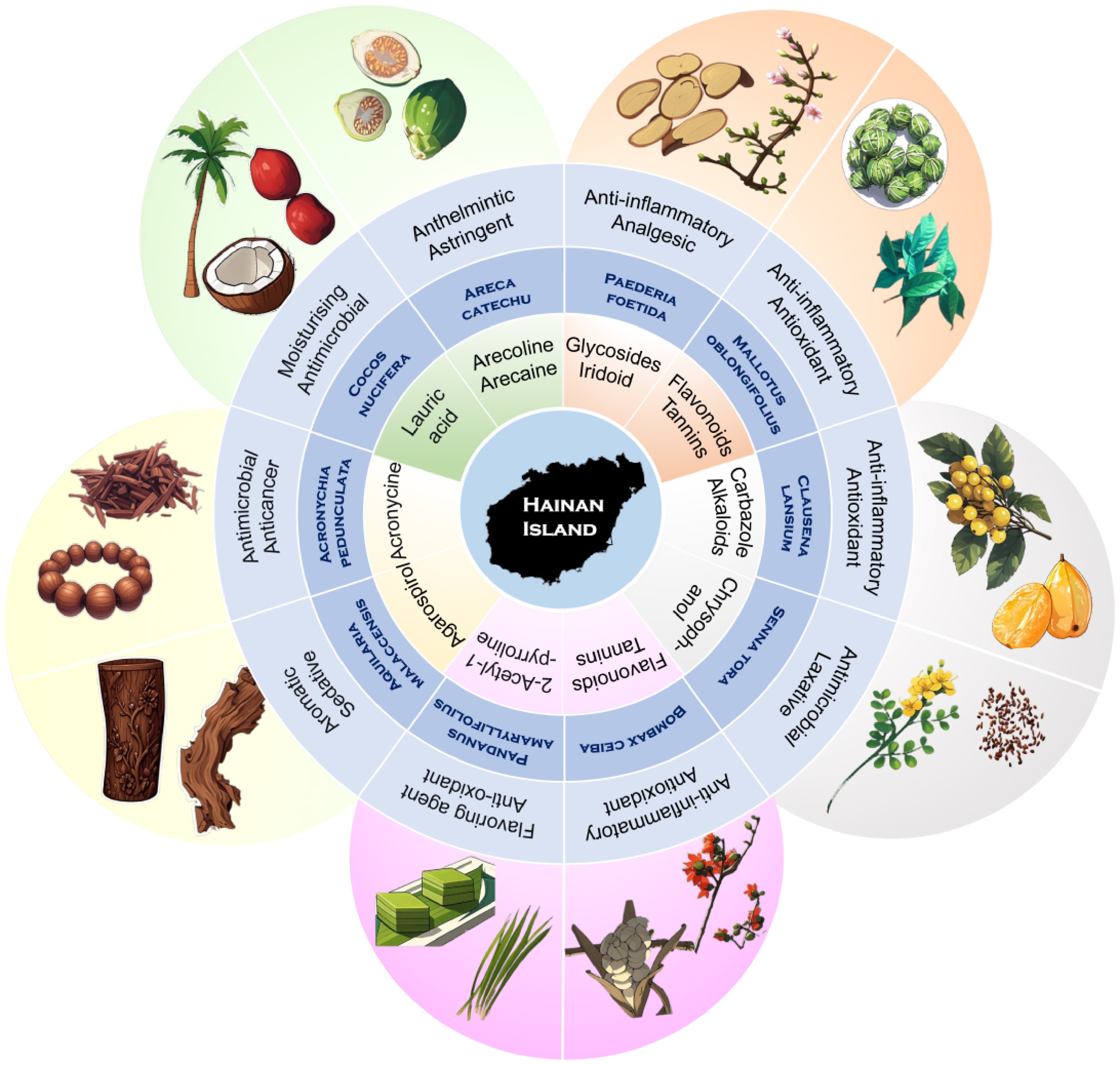
Figure 2.
Diagram of the ten representative ethnic plants in Hainan. All edible plants listed can act both as medicine and food in the traditional Hainan medicine system.
-
In Hainan Island, China, ethnic minority groups, such as the Li and Miao people, have a long tradition of using local plants for medicinal purposes. Their knowledge, passed down through generations, is deeply rooted in the island's rich biodiversity[22]. These communities rely on wild herbs, roots, leaves, and barks to treat various ailments, from common colds to chronic conditions[23]. Their practices often combine spiritual beliefs with natural remedies, emphasizing harmony with nature[23]. While modern medicine is increasingly accessible, many still prefer traditional plant-based treatments due to their cultural significance and perceived effectiveness[14]. However, this indigenous knowledge faces challenges from deforestation and cultural erosion. Efforts are being made to document and preserve these practices as part of Hainan's intangible cultural heritage. In recent years, remarkable progress has been made in the study of medicinal ethnobotany in Hainan Province, mainly focusing on the Li ethnic group and other ethnic groups. The Li people have a long-standing history of using medicinal plants. Studies show that they utilize 50 species from 36 families, and the Run dialect group of the Li people uses 282 species from 89 families and 222 genera[13]. The most common families are Leguminosae (14%), Compositae (6%), and Euphorbiaceae (6%). The main preparation methods are decoction (84%), crushing (38%), and ointment (34%), mainly for treating bleeding, pain, gastrointestinal diseases, and trauma[5]. This paper summarizes the ethnic minority medicinal plants recorded in various historical materials in Hainan Province, as shown in Table 1. The core differences in rheumatism-treating medicinal plant selection between the Li and Miao ethnic groups stem from their distinct ecological niches and cultural practices. The Li, residing in Hainan's central-southern mountains, favor Leguminosae and Euphorbiaceae plants, prepared as decoctions/ointments to adapt to damp-heat environments. In contrast, the Miao inhabit more isolated highlands with shamanistic traditions, emphasizing diverse herbaceous plants with spiritual elements, showing unique anti-inflammatory preferences alongside overlaps[24]. The Li's tropical forest proximity supports endemic damp-resolving shrubs, while the Miao, influenced by Ming migrations, integrate cross-regional herbs linked to their weaving/silverware cultures to combat humid-island parasitic infections. Yet overall similarity remains high due to shared biodiversity hotspots, reflecting the common adaptation of local ethnic groups to the island's unique ecological and climatic conditions[24].
Table 1. Medicinal plants recorded in historical materials in Hainan Province.
Scientific name/
Chinese name/PinyinMain distribution regions Medical main chemical components Pharmacological activity Ref. Bidens pilosa L. 三叶鬼针草
(sān yè guǐ zhēn cǎo)Cities and counties, including Haikou, Sanya, Danzhou, Wenchang, and Qionghai, wastelands, roadsides, farmlands Flavonoids, triterpenoids, and volatile oils Diarrhea [25] Polyalthia suberosa (Roxb.) Thwaites 暗罗 (àn luó) Southern and western cities and counties, including Qiongzhong, Baoting, Lingshui, Wuzhishan, Ledong, sparse forests, thickets Alkaloids, flavonoids, and terpenoids Clearing heat and detoxifying Zanthoxylum nitidum (Roxb.) DC.
两面针 (liǎng miàn zhēn)Mountainous areas in central and southern regions, including Qiongzhong, Wuzhishan, Baoting, Lingshui, and Wanning, sparse forests, bushwood Alkaloids, flavonoids, and coumarins Anti-inflammatory, stopping bleeding Polygonum Chinense (L.) H. Gross
火炭母 (huǒ tàn mǔ)Cities and counties, including Haikou, Danzhou, Chengmai, Ding'an, and Qionghai, shady and moist areas Flavonoids, anthraquinones, and phenolic acids Hepatitis B Equisetum ramosissimum Desf.
节节草 (jié jié cǎo)Cities and counties, including Haikou, Danzhou, Chengmai, Ding'an, and Qionghai, wetlands
Alkaloids, flavonoids, and triterpenoidsHypertension Polygonum perfoliatum L.
杠板归 (gàng bǎn guī)Southern and western cities and counties, including Sanya, Ledong, Dongfang, and Changjiang, valleys, roads Flavonoids, anthraquinones, and phenolic acids Relieving cough, sore throat [26] Ludisia discolor (Ker-Gawl.) A. Rich.
血叶兰 (xuè yè lán)Central and southern mountainous areas, including Qiongzhong, Wuzhishan, Baoting, and Jiangfengling(Ledong), terrestrial habitats Flavonoids, terpenoids, phenolic acids, polysaccharides Clearing heat and nourishing yin- deficiency (a TCM syndrome characterized by dryness, fatigue, and heat intolerance), hepatitis B Pholidota chinensis Lindl.
石仙桃 (shí xiān táo)Central mountainous areas, including Qiongzhong, Wuzhishan, Baoting, and Jiangfengling(Ledong), epiphytes on plants Flavonoids, terpenoids, phenolic acids, and polysaccharides Clearing heat and moistening the lung Cleisostoma paniculatum (Ker Gawl.) Garay 大序隔距兰 (dà xù gé jù lán) Southern cities and counties, including Sanya, Lingshui, Baoting, and Ledong, epiphytes on plants Flavonoids, terpenoids, phenolic acids, and trace alkaloids Rheumatoid joint pain Dendrobium williamsonii Day & Rchb. f. 黑毛石斛 (hēi máo shí hú) Central mountainous areas, including Qiongzhong, Wuzhishan, Baisha, and Baoting, epiphytes on plants Dendrobine-type alkaloids, flavonoids, triterpenoids, and polysaccharides Joint pain Eulophia graminea Lindl.
美冠兰 (měi guàn lán)Northern and western cities and counties, including Haikou, Wenchang, Danzhou, Lingao, and Chengmai, terrestrial habitats Alkaloids, flavonoids, terpenoids, and phenolic acids Reproductive system disease Flickingeria fimbriata (Blume) Hawkes 流苏金石斛 (liú sū jīn shí hú) Cities and counties, including Sanya, Baoting, and Qiongzhong, epiphytes on plants Flavonoids, terpenoids, phenolic acids, and polysaccharides Thyroid, hepatitis Eria corneri Rchb. f.
半柱毛兰 (bàn zhù máo lán)Jiangfengling Mountain region, Ledong, stone Flavonoids, terpenoids, phenolic acids, and trace polysaccharides Gout [26] Dendrobium nobile Lindl.
石斛 (shí hú)Cities and counties, including Sanya, Lingshui, Qiongzhong, Changjiang, Baisha Li, and Ding'an, plants or stone dendrobine-type alkaloids, flavonoids, terpenoids, polysaccharides, and phenolic acids Clearing heat and detoxifying Acampe rigida (Buch. -Ham. ex Sm.) P. F. Hunt
多花脆兰 (duō huā cuì lán)cities and counties, including Lingshui, Sanya City, Chengmai, Ledong, Lingao, and Qiongzhong, epiphytes on plants Flavonoids, terpenoids, phenolic acids, polysaccharides Stimulating appetite and aiding digestion Arundina graminifolia (D. Don) Hochr. 竹叶兰 (zhú yè lán) Central and southern mountainous areas, including Sanya, Lingshui, Baoting, Dongfang, Ledong, Baisha, and Qiongzhong, terrestrial habitats Flavonoids, alkaloids, terpenoids, phenolic acids, polysaccharides Clearing heat and detoxifying Dendrobium densiflorum Lindl.
密花石斛 (mì huā shí hú)Central and southern mountainous areas, including Sanya, Lingshui, Baoting, Dongfang, Ledong and Qiongzhong, epiphytes on plants Dendrobine-type alkaloids, flavonoids, terpenoids, polysaccharides, phenolic acids Snake bites and sores, bone fracture Dendrobium lindleyi Steud.
聚石斛 (jù shí hú)Cities and counties, including Sanya, Lingshui, Baisha, Qiongzhong, and Chengmai, epiphytes on plants Dendrobine-type alkaloids, flavonoids, terpenoids, polysaccharides, phenolic acids Icteric hepatitis, gastrointestinal disease Phalaenopsis deliciosum Rchb. f.
大尖囊兰 (dà jiān náng lán)Cities and counties, including Ledong, Changjiang, and Sanya, epiphytes on plants Flavonoids, terpenoids, phenolic acids Arthritis Habenaria rhodocheila Hance
橙黄玉凤花 (chéng huáng yù fèng huā)Cities and counties, including Ledong, Changjiang, Wuzhishan, and Baisha, terrestrial habitats Alkaloids, flavonoids, phenolic acids, polysaccharides Stomach ache, scald Bulbophyllum ambrosia (Hance) Schltr. 芳香石豆兰 (fāng xiāng shí dòu lán) Wuzhi mountain region, Ledong, plants or stone Flavonoids, terpenoids, phenolic acids, volatile oils, polysaccharides Clearing heat and detoxifying Dendrobium loddigesii Rolfe
美花石斛 (měi huā shí hú)Baisha, epiphytes on plants Alkaloids, bibenzyls Nourishing and tonifying Liparis viridiflora Lindl. 长茎羊耳蒜 (cháng jìng yáng ěr suàn) Cities and counties, including Sanya, Lingshui, Baoting, Ledong, plants or stone Flavonoids, phenanthrenes, triterpenoid saponins Clearing heat and detoxifying Pholidota cantonensis Rolfe
细叶石仙桃 (xì yè shí xiān táo)Cities and counties, including Wuzhishan, Sanya, Lingshui, Baoting, Wanning, plants or stone Stilbenoids, phenols, diterpenoids, triterpenoids Clearing heat and detoxifying [26] Goodyera procera Rchb. f.
高斑叶兰 (gāo bān yè lán)Jiangfengling Mountain region, Ledong, terrestrial habitats Phenolic acids, coumarins, fatty acid glycerides Pulmonary tuberculosis, and hepatitis Appendicula cornuta Bl.
牛齿兰 (niú chǐ lán)Lingshui, and Baoting, plants or stone Flavonoids, terpenoids, phenolic acids, polysaccharides Setting bones, anti-inflammatory and relieving cough Cymbidium bicolor (Roxb.) Sw.
硬叶吊兰 (yìng yè diào lán)Cities and counties, including Sanya, Lingshui, Changjiang, Baisha, epiphytes on plants Flavonoids, terpenoids, phenolic acids, polysaccharides, alkaloids, volatile Oils Stop bleeding Dendrobium chrysanthum Lindl.
束花石斛 (shù huā shí hú)Wuzhi Mountain, Jianfengling Mountain, and Diaoluo Mountain areas, epiphytes on plants Dendrobine-type alkaloids, flavonoids, terpenoids, polysaccharides, phenolic acids Nourishing and tonifying Dendrobium sinense Tang & F. T. Wang 华石斛 (huá shí hú) Cities and counties, including Baoting, Ledong, Baisha, Qiongzhong, epiphytes on plants Dendrobine-type alkaloids, flavonoids, terpenoids, polysaccharides, phenolic acids Curing cough Liparis cespitosa (Thouars) Lindl.
丛生羊耳蒜 (cóng shēng yáng ěr suàn)Cities and counties, including Baoting, Lingshui, Qiongzhong, plants or stone Flavonoids, terpenoids, phenolic acids, polysaccharides Clearing heat and detoxifying Cymbidium eburneum Lindl.
独占春 (dú zhàn chūn)Cities and counties, including Yazhou(Sanya), and Changjiang, terrestrial habitats Flavonoids, phenolic acids, polysaccharides, alkaloids Scald Renanthera coccinea Lour.
火焰兰 (huǒ yàn lán)Cities and counties, including Sanya, Lingshui, Baoting, Ledong, Danzhou, Qiongzhong, plants or stone Flavonoids, phenolic acids, polysaccharide Traumatic injury Spiranthes sinensis (Pers.) Ames
盘龙参 (pán lóng shēn)Li ethnic mountainous areas, Hainan, terrestrial habitats Flavonoids, polysaccharides, alkaloids Nourishing yin and cooling blood, relieving cough, and moistening the lung Cleisostoma striatum (Rchb. f.) Garay
短序隔距兰 (duǎn xù gé jù lán)Cities and counties, including Baoting, and Qiongzhong, epiphytes on plants Phenolic acids, Lignan glycosides, Nucleosides Reducing swelling and relieving pain Flickingeria angustifolia (Blume) Hawkes
狭叶金石斛 (xiá yè jīn shí hú)Wuzhi Mountain region, epiphytes on plants Phenanthrenes, bibenzyls, fluorenones, phenolic acids Nourishing and tonifying Robiquetia spathulata (Blume) J. J. Sm. 大叶寄树兰 (dà yè jì shù lán) Cities and counties, including Sanya, Lingshui, Baoting, Qionghai, Qiongzhong, and Lingao, epiphytes on plants Triterpenoids, steroids, alkaloids Curing fracture Rhynchostylis gigantea (Lindl.) Ridl. 海南钻喙兰 (hǎi nán zuàn huì lán) Cities and counties, including Lingshui, Sanya, Changjiang, Baisha, and Chengmai, epiphytes on plants Triterpenoids, phenanthrenes Nourishing and tonifying Ania penangiana (Hook. f.) Summerh.
绿花安兰 (lǜ huā ān lán)Cities and counties, including Yazhou(Sanya), and Changjiang, terrestrial habitats Phenanthrenes, bibenzyls Clearing heat and draining dampness Cymbidium dayanum Rchb. f.
冬凤兰 (dōng fèng lán)Jiangfengling Mountain region, Ledong, plants or stone Phenanthrenes, bibenzyls, flavonoids Reducing swelling Schoenorchis juncifolia (Lindl.) J. J. Sm. 匙唇兰 (chí chún lán) Cities and counties, including Wanning, Lingshui, Sanya, Ding'an, and Baoting, epiphytes on plants Phenanthrenes, bibenzyls Lung disease and hepatopathy Thelasis pygmaea (Griff.) Blume
矮柱兰 (ǎi zhù lán)Distributed throughout Hainan, epiphytes on plants Phenanthrenes, bibenzyls Curing cold Tainia ruybarrettoi (S.Y.Huet Barretto) Z.H.Tsi 南方带唇兰 (nán fāng dài chún lán) Li ethnic mountainous areas, Hainan, epiphytes on plants Phenanthrenes, bibenzyls, triterpenoids Epilepsy, uterine inflammation Acronychia pedunculata (Linn.) Miq. 降真香 (jiàng zhēn xiāng) Mountainous areas around Sanya, Lingshui, Baoting, forests Alkaloids, flavonoids, coumarins, volatile oils Snake bites, intoxication, and Angio cardiopathy [27] Wikstroemia indica (L.) C. A. Mey.
了哥王 (le gē wáng)Widely distributed in Hainan, forests, and on roads Flavonoids, coumarins, lignans, diterpenoids Clearing heat and detoxifying [28] Clerodendrum cyrtophyllum Turcz.
大青 (dà qīng)Widely distributed in Hainan, shady and moist areas Phenylethanoid glycosides, flavonoids, triterpenoids, iridoid glycosides Curing cold, snake bites, hepatitis, and mumps Andrographis paniculata (Burm. f.) Wall. ex Nees in Wallich
穿心莲 (chuān xīn lián)Western and southwestern mountain areas, Hainan, shady areas Diterpene lactones, flavonoids Clearing heat and detoxifying Aphanamixis grandifolia Bl.
大叶山楝 (dà yè shān liàn)Cities and counties, including Danzhou, Dongfang, Ledong, Sanya, and Lingshui, wet areas Limonoids, triterpenoids Stomach ache Aporosa chinensis (Roxb.) Müll. Arg. 银柴 (yín chái) Cities and counties, including Wenchang, Qionghai, Wanning, Danzhou, sparse forests, bushwood Tannins, flavonoids, triterpenoids Constipation, extracting toxins and promoting tissue regeneration Asclepias curassavica L.
马利筋 (mǎ lì jīn)Cities and counties, including Haikou, Wenchang, Sanya, Danzhou, abundant sunlight areas Cardenolides, pregnanes, flavonoids Rheumatoid arthritis, heating toxic and bleeding [28] Cayratia japonica (Merr.) G. Parmar & L. M. Lu 节毛乌蔹莓 (jié máo wū liǎn méi) Cities and counties, including Qiongzhong, Baoting, Ledong, Dongfang, sparse forests, thickets Flavonoids, triterpenoid saponins, polysaccharides Curing scald Crotalaria hainanensis L. 海南野百合 (hǎi nán yě bǎi hé) Wuzhi Mountain and Diaoluo Mountain areas, forests, roads Pyrrolizidine alkaloids Curing blister Cyperus diffusus L. 绿穗莎草 (lǜ suì shā cǎo) Cities and counties, including Haikou, Wenchang, Qionghai, forests, roadsides, stream Volatile oils, flavonoids, triterpenoids Rheumatism Markhamia stipulata (Wall.) Seem.
猫尾木 (māo wěi mù)Baoting county, villages, low-lying wastelands Iridoids, phenylethanoid glycosides, flavonoids Rheumatism Justicia ventricosa Wall. Ex Hook. F. 黑叶接骨草 (hēi yè jiē gǔ cǎo) Southeastern mountainous areas, Hainan, thickets Alkaloids, flavonoids, triterpenoids Traumatic swelling and pain Helicia hainanensis Hayata 海南山龙眼 (hǎi nán shān lóng yǎn) Cities and counties, including Dongfang, Baisha, Wuzhishan, Baoting, and Danzhou, shady and moist areas Tannins, flavonoids Stomach ache, hematochezia, constipation Lygodium circinnatum (Burm. f.) Sw. 海南海金沙 (hǎi nán hǎi jīn shā) Yazhou (Sanya), moist areas Flavonoids, triterpenoids Liver diseases Neocinnamomum lecomtei H. Liu 海南新樟 (hǎi nán xīn zhāng) Jianfengling Mountain areas (Ledong), thickets, dense forests Volatile oils, alkaloids, flavonoids Traumatic injury, chills, and fever Randia hainanensis Merr. 海南山黄皮 (hǎi nán shān huáng pí) Bawangling Mountain region, Changjiang, limestone mountain Triterpenoids, iridoids, alkaloids Snake bites, arthrophlogosis Scleria elata (L.) Fassett 高秆珍珠茅 (gāo gǎn zhēn zhū máo) Li ethnic mountainous areas, Hainan, forests, roads Tannins, flavonoids, phenolic acids Rheumatism Ophiopogon bodinieri H. Lév.
高节沿阶草 (gāo jié yán jiē cǎo)Distributed throughout Hainan, shady and moist habitats Steroidal saponins, homoisoflavonoids, polysaccharides Rheumatism Pogonatherum crinitum (Thunb.) Kunth 金丝草 (jīn sī cǎo) Distributed throughout Hainan, wet places, forests, roads Flavonoids, triterpenoids, phenolic acids Rheumatism Kyllinga brevifolia Kunth
水蜈蚣 (shuǐ wú gōng)Distributed throughout Hainan, villages, and roads Volatile oils, flavonoids, triterpenoids Rheumatis Gardenia stenophylla Merr. 狭叶栀子 (xiá yè zhī zi) Distributed throughout Hainan, shady and moist habitats, stream Iridoids, triterpenoids, flavonoids Rheumatis Adiantum flabellulatum L. 扇叶铁线蕨 (shàn yè tiě xiàn jué) Widely distributed in Hainan, thickets Triterpenoids, flavonoids, phenolic acids Nail loss [29] Adiantum caudatum L. 鞭叶铁线蕨 (biān yè tiě xiàn jué) Cities and counties, including Dongfang, Sanya, Baoting, rocks, valley Flavonoids, triterpenoids Nail loss Blechnum orientale L.
乌毛蕨 (wū máo jué)Distributed throughout Hainan, shady and moist habitats Tannins, flavonoids, triterpenoids Carbuncles, malignant sores, and pustules Palhinhaea cernua (L.) Franco et Vasc. 铺地蜈蚣 (pū dì wú gōng) Wuzhi Mountain region, Hainan, grasslands, sparse forests Alkaloids, triterpenoids Kidney stones, rheumatic joint pain, and sciatica Helminthostachys zeylanica (L.) Hook 七指蕨 (qī zhǐ jué) Wuzhi Mountain region, Hainan, wet areas, forested areas Flavonoids, triterpenoids, steroids Lung - heat cough, asthma, whooping cough, and syphilis Lygodium japonicum (Thunb.) Sw. 海金沙 (hǎi jīn shā) southern Hainan, thickets, forest edges, roads Flavonoids, triterpenoids, phenolic acids Hepatitis, gallstones, high-fever colds, and fractures Cinnamomum porrectum (Roxb.) Kosterm. 黄樟 (huáng zhāng) Distributed throughout Hainan, forests, and valleys Volatile oils, alkaloids, flavonoids Postpartum wind, liver cirrhosis, nephritis edema, cold - induced fevers Litsea cubeba (Lour.) Pers.
山苍子 (shān cāng zǐ)Distributed throughout Hainan, sunny slopes, forest edges, thickets Volatile oils, alkaloids, flavonoids Liver ascites, nephritis edema, and various types of stone diseases Litsea glutinosa (Lour.) C. B. Rob. 潺槁木姜 (chán gǎo mù jiāng) Distributed throughout Hainan, forest margins, streams, sparse forests Alkaloids, flavonoids, triterpenoids Bruises, uterine inflammation, mumps, and mastitis Cyclea barbata (Wall) Miers. 毛叶轮环藤 (máo yè lún huán téng) Distributed throughout Hainan, shrubs, trees Alkaloids, triterpenoids Colds, pharyngitis, coughs, and bruises Stephania succifera H. S. Lo et Y. Tsoong. 小叶地不容
(xiǎo yè dì bù róng)Wuzhi mountain region, Hainan, valleys, streams, forests Alkaloids, triterpenoids Gastritis, duodenal ulcers, and lung–heat coughs Piper nigrum L. 胡椒 (hú jiāo) Widely cultivated throughout Hainan, warm, humid, shaded environments Alkaloids, volatile oils, amides Warm the stomach, promote digestion, and relieve indigestion Piper sarmentosum Roxb.
假蒟 (jiǎ jū)Distributed throughout Hainan, wet places, forests, roads Volatile oils, amides, flavonoids Cold pain in the stomach and abdomen, coughs, and indigestion [29] Sarcandra hainanensis (Pei.) Swamy et Bailey. 海南草珊瑚
(hǎi nán cǎo shān hú)Distributed throughout Hainan, shady and moist areas Flavonoids, coumarins, triterpenoids Fractures, rheumatic arthritis, and pneumonia Portulaca oleracea L.
马齿苋 (mǎ chǐ xiàn)Eastern and southern cities and counties, including Wenchang, Wanning, Lingshui, vegetable gardens, farmlands, roadsides Alkaloids, flavonoids, organic acids, polysaccharides Hematuria, mastitis, hemorrhoid bleeding, and enteritis Polygonum chinense L.
火炭母 (huǒ tàn mǔ)Distributed throughout Hainan, streams, wetlands, mountain slopes Flavonoids, tannins, anthraquinones Swollen sores, eczema, enteritis, and snake bites Achyranthes aspera L.
土牛膝 (tǔ niú xī)Distributed throughout Hainan, mountain slopes, roadsides, villages Triterpenoid saponins, ecdysterones, alkaloids Malaria, kidney stones, and dog bites Aquilaria sinensis (Lour.) Cilg.
白木香 (bái mù xiāng)Distributed throughout Hainan, mountain rainforests, semi-evergreen monsoon forests Volatile oils, chromones, triterpenoids, aromatic compounds Chest and abdominal pain, poliomyelitis, and rheumatism Passiflora cochinchinensis Spreng.
蛇王藤 (shé wáng téng)Distributed throughout Hainan, mountain valleys Flavonoids, cyanogenic glycosides, alkaloids Snake bites and sores Carica papaya L.
番木瓜 (fān mù guā)Li ethnic areas, Hainan, courtyards, and orchards Alkaloids, terpenoids, flavonoids, proteases, glycosides Indigestion, insufficient milk in women, excessive leucorrhea Hylocereus undatus (Haw.) Britt. et Rose 量天尺 (liáng tiān chǐ) Distributed throughout Hainan, various habitats Flavonoids, alkaloids, terpenoids, polysaccharides, steroids Coughs, bronchitis, mumps, prolapse of the anus, and hypertension Rhodomyrtus tomentosa (Ait.) Hassk. 桃金娘 (táo jīn niáng) Distributed throughout Hainan, mountainous regions Flavonoids, triterpenoids, tannins, phenols Anemia - related dizziness and weakness after illness Syzygium jambos (L.) Alston
蒲桃 (pú táo)Distributed throughout Hainan, sparse forests The bark contains tannins and flavonoids; the leaves contain volatile oils Dysentery, knife - wound bleeding, and dermatitis Melastoma candidum D. Don.
野牡丹 (yě mǔ dān)Mountainous areas and hills throughout Hainan, bushwood, sparse forests Flavonoids, tannins, sterols Bruises, burns, and gastric bleeding Melastoma sanguineum Sims.
毛稔 (máo rěn)Cities and counties, including Sanya, Lingshui, Baoting, Ledong, mountainous region, sparse forests Flavonoid glycosides, phenols, tannins Gastrointestinal flatulence, menstrual pain, and traumatic bleeding Cratoxylum cochinchinense (Spach.) Blume
黄牛木 (huáng niú mù)Distributed throughout Hainan, mountainous region, sparse forests The bark contains flavonoids and triterpenoids; the leaves contain volatile oils, tannins Cough, trachitis, dysentery, and skin allergy Garcinia oligantha Merr. 单花山竹子 (dān huā shān zhú zi) Cities and counties, including Sanya, Lingshui, Baoting, Ledong, Dongfang, sparse forests, bushwood The fruits contain flavonoids and organic acids; the bark contains tannins and triterpenoid Empyrosis, fracture, and metrorrhagia Microcos paniculata L.
布渣叶 (bù zhā yè)Distributed throughout Hainan, thickets, roads Flavonoids, organic acids, volatile oils Curing fever Sterculia lanceolata Cav.
假苹婆 (jiǎ píng pó)Distributed throughout Hainan, wet areas, forested areas The roots contain triterpenoids; the leaves contain flavonoids and sterol Prostatitis, urocystitis Gossampinus malabarica (DC.) Merr. 木棉 (mù mián) Distributed throughout Hainan, wet places, forests, roads The flowers contain flavonoids and organic acids; the roots contain triterpenoid saponins Fracture, cough Hibiscus tiliaceus L.
黄木槿 (huáng mù jǐn)Coastal areas, including Wenchang, Wanning, and Lingshui, saline-alkali shrublands, coastal sandy beaches The flowers contain flavonoids and polysaccharides; the leaves contain sterols Sorethroat Urena lobata L.
肖梵天花 (xiāo fán tiān huā)Distributed throughout Hainan, mountain slopes, roads Triterpenoid saponins, flavonoids, volatile oils Snake bites, hepatitis, and mastitis Breynia fruticosa (L.) Hook. f.
黑面神 (hēi miàn shén)Distributed throughout Hainan, mountainous regions Alkaloids, triterpenoids, and flavonoids Lithiasis, gunshot wound Euphorbia hirta L.
飞扬草 (fēi yáng cǎo)Distributed throughout Hainan, sparse forests, roads Flavonoids, triterpenoids, tannins, phenolic acids, and sterols Dyspepsia, dermatitis Flueggea virosa (Roxb. ex Will.) Baill. 白饭树 (bái fàn shù) Cities and counties, including Danzhou, Qionghai, and Wanning, mountainous regions Flavonoids, triterpenoids, and alkaloids Rheumatism, neurasthenia, and hypertension Jatropha curcas L.
麻疯树 (má fēng shù)Cultivated or grows wild throughout Hainan, mountainous regions, roads Alkaloids, tannins, flavonoids and triterpenoids Eczema, ulcer [29] Mallotus apelta Lour.
白背叶 (bái bèi yè)Distributed throughout Hainan, thickets, roads The seeds contain phorbol esters, triterpenoids, and fatty acids Cirrhotic ascites, metroptosis, and enteritis Phyllanthus urinaria L.
叶下珠 (yè xià zhū)Distributed throughout Hainan, mountainous regions The roots contain triterpenoids and flavonoids; the leaves contain volatile oils and tannins Hepatitis, enteritis, and odynuria [29] Ricinus communis L. 蓖麻 (bì má) Widely cultivated throughout Hainan, wetlands, mountain slopes, grasslands Lignans, flavonoids, and alkaloids Gunshot wound, stomach distension Triadica cochinchinensis Loureiro
山乌桕 (shān wū jiù)Cities and counties, including Qiongzhong, Wuzhishan, and Baoting, mountainous regions The seeds contain fatty oils, and the bark contains tannins and triterpenoids Snake bites, dermatitis Duchesnea indica (Andr.) Focke.
蛇莓 (shé méi)Distributed throughout Hainan, shady and moist habitats, stream Flavonoids, triterpenoids, and organic acids Furuncle and toxic swelling, eczema, and mumps Crotalaria mucronata Desv.
猪屎豆 (zhū shǐ dòu)Distributed throughout Hainan, wastelands, roads Alkaloids, flavonoids, and triterpenoids Deficiency of the kidney, fever Dalbergia odorifera T. Chen
降香檀 (jiàng xiāng tán)Cities and counties, including Sanya, Ledong, Dongfang, and Changjiang, sparse forests, wastelands volatile oil, including baicalein, β-bisabolene, and trans-β-farnesene Liver cirrhosis, hysteritis, and pneumonia Desmodium triquetrum (L.) DC.
葫芦茶 (hú lu chá)Distributed throughout Hainan, wastelands, roads Flavonoids, triterpenoids, and tannins Fever, swollen sore throat Erythrina variegata L.
刺桐 (cì tóng)Cultivated or growing wild throughout Hainan, wet areas, sparse forests, courtyards The bark contains alkaloids, flavonoids, and triterpenoid saponins; the leaves contain volatile oils Cold, cough, and rheumatic bone pain Mimosa pudica L.
含羞草 (hán xiū cǎo)Distributed throughout Hainan, shady and moist areas Flavonoids, alkaloids, and triterpenoid saponins Metroptosis, neurasthenia Liquidambar formosana Hance
枫香树 (fēng xiāng shù)Centeral mountainous areas, including Qiongzhong, Wuzhishan, and Baoting, mountainous regions The resin contains volatile oil and flavonoids, the leaves contain tannins and phenols Arthralgia, edema Broussonetia papyrifera (L.) L.Her. ex Vent. 构树 (gòu shù) Distributed throughout Hainan, grasslands, sparse forests The fruits contain saponins, flavonoids, the leaves contain proteins and amino acids Edema, dermatitis, bleeding,and tinea corporis Ficus hirta Vahl.
粗叶榕 (cū yè róng)Centeral and Southern mountainous areas, forested areas, bushwood Flavonoids, triterpenoids, polysaccharides Hypogalactosis, postpartum blood stasis, and deficiency of the kidney Ficus pumila L. 薜荔 (bì lì) Distributed throughout Hainan, villages, rocks Polysaccharides, flavonoids, steroid compounds, organic acids Strangury with turbid discharge, breast milk stoppage Zanthoxylum avicennae (Lam.) DC.
土花椒 (tǔ huā jiāo)Cities and counties, including Danzhou, Qionghai, and Wanning, forested areas, shrubs Volatile oil, alkaloids, flavonoids Gall-stone, kidney stone Lannea grandis (Dennst.) Engl.
厚皮树 (hòu pí shù)Western Cities and counties, including Dongfang, Changjiang and Ledong, mountain slopes, shrubs, sparse forests Tannins, flavonoids, and triterpenoid, volatile oils and organic acids Gastritis, enteritis Alangium salviifolium (L. f.) Wanger. 土坛树 (tǔ tán shù) Cities and counties, including Sanya, Lingshui and Baoting, mountain forests, valleys The bark contains alkaloids, tannins, triterpenoids; the fruits contain oils, flavonoid Fracture Ardisia densilepidotula Merr.
密鳞紫金牛 (mì lín zǐ jīn níu)Central Cities and counties, including Wuzhishan, Qiongzhong, and Baoting, dense forests, valleys Bergenin, flavonoids, triterpenoid Dysentery, diarrhea, and anemia Maesa perlarius (Lour.) Merr.
鲫鱼胆 (jì yú dǎn)Mountainous areas throughout Hainan, dense forests, valleys Flavonoids, triterpenoids, organic acids Knife wound, bleeding, rheumatism Buddleja asiatica Lour.
驳骨丹 (bó gǔ dān)Mountainous areas throughout Hainan, sparse forests, roads Flavonoids, triterpenoid saponins, alkaloids Nephritic edema, psoriasis Wrightia pubescens R. Br.
倒吊笔 (dào diào bǐ)Mountainous areas throughout Hainan, sparse forests, roads The bark contains alkaloids, triterpenoids, and flavonoid; the leaves contain volatile oils, tannins Rheumatism, fever Lasianthus chinensis Benth.
鸡屎树 (jī shǐ shù)Cities and counties, including Qiongzhong, Wuzhishan, and Baoting, mountain forests, shrubs Alkaloids, iridoids, flavonoids, triterpenoids Fracture, knife-wound bleeding Nauclea officinalis (Pierre. ex Pitard.) Merr. et Chun.
乌檀 (wū tán)Southern Cities and counties, including Sanya, Lingshui, and Ledong, dense forests, valleys Alkaloids, flavonoids, triterpenoid Fever, sore thorat, cholehepatitis, acute bronchitis Psyochotria rubra (Lour.) Poir.
九节 (jiǔ jíe)Southern mountainous areas, thickets, Triterpenoid saponins, flavonoids, sterols Snake bites, bruises and swelling Elephantopus tomentosus L. 白花地胆草 (bái huā dì dǎn cǎo) Distributed throughout Hainan, thickets, roads Sesquiterpene lactones, flavonoids, alkaloids Cold, snake bites, and hepatitis Xanthium strumarium L.
苍耳 (cāng ěr)Distributed throughout Hainan, wetlands, mountain slopes, grasslands, fields Xanthiin, alkaloids, volatile oils Hypertension, metrorrhagia, and wind-cold headache Physalis peruviana L. 小酸浆果 (xiǎo suān jiāng guǒ) Central mountainous areas, including Qiongzhong, and Wuzhishan, wet areas Steroidal saponins, organic acids, flavonoids Sore skin, cholecystitis, and cough Solanum coagulans Forsk.
野茄 (yě qié)Southern mountainous areas, thickets, sparse forests Steroidal alkaloids, flavonoids, triterpenoids Rheumatism, hepatitis B Gendarussa ventricosa (Wall.) Nees.
大驳骨 (dà bó gǔ)Cultivated or growing wild throughout Hainan, sparse forests Flavonoids, triterpenoid saponins, phenols Arthrophlogosis, fracture [29] Verbena officinalis L.
马鞭草 (mǎ biān cǎo)Distributed throughout Hainan, wet areas, grasslands. roads Verbenalin, flavonoids, volatile oils Malaria, edema, heat strangury, and hepatitis Anisomeles indica (L.) Rothm.
广防风 (guǎng fáng fēng)Central and southern mountainous areas, valleys, wat areas Triterpenoids, flavonoids, alkaloids Dermatitis, rheumatism Hyptis decurrens (Blanco) Epling.
吊球草 (diào qiú cǎo)Southern coastal areas, including Sanya, and Lingshui, wastelands, roads Volatile oils, flavonoids Abscesses and toxic swellings, hepatitis Leucas aspera (Willd.) Link.
蜂巢草 (fēng cháo cǎo)Eastern coastal cities and counties, thickets, saline-alkali land Triterpenoids, sterols, organic acids Cold, cough, and toothache Alpinia katsumadai Hayata
草豆蔻 (cǎo dòu kòu)Central mountainous areas, wet areas, including Qiongzhong, Baoting, and Wuzhishan, forested areas Volatile oils, lavonoids Stomach cold, emesis Costus speciosus (Koen.) Smith.
闭鞘姜 (bì qiào jiāng)Distributed throughout Hainan, sparse forests, thickets Steroidal saponins, flavonoids, organic acids Fracture, urinary tract infection, and pyogenic infections Kaempferia galanga L.
沙姜 (shā jiāng)Cultivated throughout Hainan, especially abundant in places including Danzhou and Chengmai, mountainous regions Volatile oils, coumarins Dyspepsia, coldness in stomach Asparagus cochinchinensis (Lour.) Merr. 天门冬 (tiān mén dōng) Distributed throughout Hainan, thickets, sparse forests Steroidal saponins, polysaccharides Lung dryness, cough, constipation Smilax glabra Roxb.
土茯苓 (tǔ fú líng)Central and southern mountainous areas, sparse forests, shady and moist areas Steroidal saponins, flavonoids, polysaccharides Fracture, pyogenic infections Acorus gramineus Soland.
石菖蒲 (shí chāng pú)Distributed throughout Hainan, shady and moist areas Volatile oils, flavonoids Nephritis, nephrolithiasis, and urinary tract infection Crinum asiaticum L. var. sinicum (Roxb. ex Herb.) Baker
文殊兰 (wén shū lán)Cultivated throughout Hainan, courtyard, coastal sandy areas, moist grasslands Alkaloids, steroidal saponins Fracture, snake bites, and mastitis Stemona tuberosa Lour.
对叶百部 (duì yè bǎi bù)Central mountainous areas, including Qiongzhong and Wuzhishan, wet areas, valleys Alkaloids, flavonoids Cough, eczema, pediculosis capillitii, and scabies Dracaena angustifolia Roxb.
龙血树 (lóng xuè shù)Western cities and counties, including Sanya, Dongfang, and Ledong, shady and moist areas Loureirin (flavonoid), triterpenoid Hemoptysis, constipation Cyperus rotundus L.
香附子 (xiāng fù zǐ)Distributed throughout Hainan, grasslands, fields, roads Volatile oils, flavonoids Cold, nephritic edema, and urinary tract infection Hypericun japonicum Thunb.
田基黄 (tián jī huáng)Distributed throughout Hainan, fields, wet grasslands Flavonoids, coumarins, organic acids Clearing heat and detoxifying [30] Elephantopus scaber L.
地胆头 (dì dǎn tóu)Distributed throughout Hainan, coastal sandy areas, roadsides Sesquiterpene lactones, flavonoids, alkaloids Clearing heat and detoxifying Hypericum japonicum Thunb. ex Murray 地耳草 (dì ěr cǎo) Distributed throughout Hainan, fields, wet grasslands, fields Flavonoids, phenols, organic acids Clearing heat and detoxifying Abrus cantoniensis Hance
鸡骨草 (jī gǔ cǎo)Southern cities and counties, including Sanya and Lingshui, thickets, sparse forests Flavonoids, triterpenoids, sterols Clearing heat and detoxifying Bryophyllum pinnatum (L. f.) Oken 落地生根 (luò dì shēng gēn) Cultivated throughout Hainan, courtyard, coastal rock crevices, hillside shrublands Flavonoids, triterpenoids, organic acids Stop bleeding and promote tissue regeneration Cardiospermum halicacabum L.
倒地铃 (dǎo dì líng)Southern mountainous areas, sparse forests, roads, villages Triterpenoid saponins, flavonoids, alkaloids Relieve swelling and pain The application of ethnobotanical plants in a health-promoting diet
-
In Hainan, ethnic minorities have long utilized local plants not only as medicine but also as tea, food, and flavorings, blending nutrition and health, as shown in Table 2. Wild herbs, leaves, and roots are often brewed into herbal teas, believed to aid digestion, detoxification, and general well-being. Many plants are incorporated into daily meals, either as staple ingredients or seasonal supplements, enhancing both flavor and nutritional value[31]. Some aromatic or pungent plants serve as natural condiments, adding unique tastes to traditional dishes. In Baoting and Lingshui in Hainan Province (both are minority-inhabited regions), a recent ethnobotanical survey documented 26 species of wild edible vascular plants, encompassing 24 genera and 16 families. The majority (84.62%) of these species were identified as annual or perennial herbs, demonstrating a strong reliance on herbaceous flora in local dietary practices[32]. Aboveground plant parts, such as leaves, stems, and young shoots, were the most frequently utilized components, suggesting a sustainable harvesting approach that allows for plant regeneration. Among various preparation methods, stir-frying emerged as the predominant culinary technique, reflecting both traditional cooking preferences and the practical suitability of these plants for high-heat preparation[32].
Table 2. Hainan plants function as both food and medicine.
Scientific name/
Chinese name/PinyinLocations Usage/edible parts Medical main chemical components Ref. Mallotus furetianus (Miq.) Muell. Arg. 鹧鸪茶 (zhè gū chá) Central and southern mountainous areas, including Wuzhishan, Qiongzhong, Baisha, Baoting, Ledong, Changjiang, Wanning, and Sanya, various areas Herbal tea, leaves Flavonoids, volatile oils, triterpenoids, phenolic acids [37] Abelmoschus esculentus (L.) Moench
咖啡黄葵 (kā fēi huáng kuí)Southern, western, and eastern Hainan, with major production areas including Sanya, Ledong, Lingshui, Dongfang, Qionghai, and Chengmai, shady and moist areas Stir fry, soup base, tender leaves, fruit Polysaccharides, flavonoids, selenium, plant sterols, caffeine [38] Acalypha australis L.
铁苋菜 (tiě xiàn cài)A widespread distribution across all cities and counties, wastelands, sprase forests Stir fry, tender stem, tender leaves Alkaloids, flavonoids, tannins, phenolic compounds Acanthopanax trifoliatus (L) Merr. 白簕花 (bái lè huā) Central and southern mountainous counties, including Wuzhishan, Qiongzhong, Baisha, Baoting, Ledong, and Changjiang, bushwood, mountain slopes Stir fry, Soup base, tender leaves Flavonoids, polysaccharides, triterpenoid saponins, phenylpropanoids Amaranthus spinosus L.
刺苋 (cì xiàn)Both rural and suburban areas across all cities and counties, wastelands, courtyards Stir fry, tender stem, tender leaves Flavonoids, alkaloids, saponins, plant sterols A.viridis L. 野苋 (yě xiàn) Across all cities and counties, with particularly high abundance in the farmlands and vegetable gardens of Wenchang, Chengmai, Lingao, and Dongfang, wastelands, grasslands, roads Stir fry, tender stem, tender leaves Flavonoids, vitamins (A, C), dietary fiber, beet pigments Aporosa chinensis (Roxb.) Müll. Arg. 银柴 (yín chái) Throughout the forested areas, notably in the forest regions of Wuzhishan, Qiongzhong, Baisha, and Diaoluoshan, sparse forests, bushwood Stir fry, tender leaves, root Triterpenes, tannins, flavonoids Blechnum orientale L.
乌毛蕨 (wū máo jué)Across mountainous regions, including the areas of Shuiman(Wuzhishan), Yinggeling, and Bawangling, sprase forests, hills Stir fry, tender leaves Phlorophenol derivatives, flavonoids, fern polysaccharides Broussonetia papyrifera (L.) L'Hér. ex Vent. 构树 (gòu shù) Across all cities and counties, wastelands, grasslands, roads Stir fry, tender leaves Flavonoids, alkaloids, polysaccharides Capparis hainanensis Oliv.
山柑 (shān gān)Coastal cities and counties, including Sanya, Lingshui, Wanning, Ledong, and Dongfang, wastelands, hills Stir fry, tender leaves Glucosinolates, flavonoids (such as rutin), mountain tangerine alkaloids Capsella bursa-pastoris (L.) Medic. 荠 (jì) Throughout Hainan, being especially common in northern and central areas such as Haikou, Ding'an, and Tunchang, fields Stir fry, aerial parts Choline, acetylcholine, potassium shepherd's purse acid, alkaloids, flavonoids Capsicum frutescens L.
米椒 (mǐ jiāo)Throughout Hainan Island, with major cultivation areas including Sanya, Ledong, Lingshui, and Qionghai, courtyards and orchards Seasoning, fruits Capsaicin, vitamin C, volatile oil Caryota mitis Lour. 短穗鱼尾葵 (duǎn suì yú wěi kuí) An ornamental across Hainan, being particularly ubiquitous in urban landscapes of Sanya and Haikou, with wild populations documented in botanical gardens including Xinglong and Danzhou, shady and moist areas Stir fry, pith of the stem Tannins, flavonoids, polysaccharides, saponins Cassia tora L. 决明 (jué míng) Across Hainan Island, particularly in the western and northwestern counties and cities such as Danzhou, Changjiang, Dongfang, and Baisha, mountain slopes, wastelands Stir fry, tender leaves, seed Anthraquinones (emodin, emodin, etc.), naphthopyranone, fatty acids Centella asiatica (L.) Urban
积雪草 (jī xuě cǎo)Throughout all cities and counties, including Haikou, Sanya, Qionghai, Wanning, Wenchang, and Danzhou, shady and moist areas Soup base, aerial parts Triterpenoid saponins (centella asiatica glycoside, hydroxycentella asiatica glycoside), flavonoids Gynandropsis gynandra (L.) Briq. 白花菜 (bái huā cài) Western and southern counties and cities, including Sanya, Ledong, Dongfang, and Changjiang, roads, valleys Stir fry, aerial parts White cauliflower glycosides, alkaloids, volatile oils, flavonoids Colocasia antiquorum Schott
野芋 (yě yù)Central mountainous counties, including Wuzhishan, Qiongzhong, Baisha, and Baoting, shady and moist areas Stir fry, tender stem Calcium oxalate needle crystals, saponins C. tonoimo (L.) Schott
紫芋 (zǐ yù)Rural areas throughout Hainan, with higher frequency in eastern villages such as Qionghai and Wanning, lacustrine wetlands Stir fry, tender stem Anthocyanins, saponins, polysaccharides Chrysopogon aciculatus (Retz.) Trin. 竹节草 (zhú jié cǎo) Throughout Hainan Island, including Haikou, Ding'an, Chengmai, and Lingao, wastelands, grasslands Stir fry, tender stem, tender leaves Flavonoids, saponins, polysaccharides, alkaloids Corchorus aestuans L.
甜麻 (tián má)Western and northwestern regions, including Danzhou, Changjiang, Dongfang, and Baisha, grasslands, mountain slopes, roads Stir fry, tender stem, tender leaves Flavonoids, tannins, polysaccharides, alkaloids Costus speciosus (J. Koenig) S. R. Dutta 闭鞘姜 (bì qiào jiāng) Southern and eastern regions, including Sanya, Baoting, Lingshui, and Wanning, dense forests, roads Stir fry, pickle, tender stem Steroid saponins, diarylheptanes, volatile oils Crateva religiosa G. Forster
鱼木 (yú mù)Coastal cities and counties, including Sanya, Ledong, and Dongfang, forest margins Pickle sauerkraut, tender leaves Alkaloids, flavonoids, triterpenoids, saponins Daemonorops margaritae (Hance) Becc.
黄藤 (huáng téng)Central mountainous tropical rainforests, including Wuzhishan, Qiongzhong, Baisha, Diaoluoshan, and Bawangling, hills, bushwood Stir fry, pith of the stem Alkaloids (such as palmatine), flavonoids Dicliptera chinensis (L.) Juss.
狗肝菜 (gǒu gān cài)Throughout Hainan, including Haikou, Wenchang, Qionghai, and Wanning, sparse forests, roads Stir fry, tender stem, tender leaves Flavonoids, alkaloids, polysaccharides, amino acids [38] Dioscorea polystachya Turcz.
薯蓣 (shǔ yù)Across mountainous areas of all counties and cities, including Wuzhishan, Qiongzhong, and Baisha, valleys, mountain slopes, roads Soup base, earthnut Diosgenin, mucin polysaccharide (Mannan), Allantoin Eichhornia crassipes (Mart.) Solms 凤眼莲 (fèng yǎn lián) Static water bodies across all cities and counties, including Haikou, Ding'an, and Qionghai, shady and moist areas, river Stir fry, flower, tender leaves Flavonoids, terpenes, alkaloids, phenolic acids Eleutherine americana Merr. ex K. Heyne 红葱 (hóng cōng) Specific areas, including Wanning and Qionghai, courtyards Stir fry, bulb Flavonoids (such as anthocyanins), phenolic acids, volatile oils, polysaccharides Emilia sonchifolia (L.) DC.
一点红 (yì diǎn hóng)Throughout Hainan Island, including Haikou, Sanya, Danzhou, and Dongfang, valleys, mountain slopes Stir fry, aerial parts Alkaloids, flavonoids, phenols, volatile oils Enydra fluctuans Lour.
沼菊 (zhǎo jú)Eastern coastal regions, including Wenchang, Qionghai, and Wanning, shady and moist areas Stir fry, aerial parts Flavonoids, triterpenoids, volatile oils Ficus hirta Vahl
粗叶榕 (cū yè róng)Low to mid-altitude forests throughout Hainan, including Sanya, Baoting, Ledong, and Changjiang, forest margins Soup base, root Psoralen, bergamot lactone, polysaccharides, alkaloids Floscopa scandens Lour.
聚花草 (jù huā cǎo)Central mountainous counties, including Wuzhishan, Qiongzhong, Baisha, and Baoting, river valleys Stir fry, tender leaves Flavonoids, alkaloids, saponins Trichosanthes scabra Lour.
凤瓜 (fèng guā)Throughout Hainan Island, including Haikou, Sanya, and Danzhou, mountain slopes, bushwood Stir fry, tender leaves Flavonoids, saponins, polysaccharides, vitamins flavonoids, saponins, polysaccharides, vitamins Gynura bicolor (Roxb. ex Willd.) DC. 两色三七草 (liǎng sè sān qī cǎo) Southern Hainan, including Sanya, Lingshui, Ledong, and Baoting, bushwood Stir fry, tender stem, tender leaves Alkaloids, flavonoids, polyacetylenes, volatile oils Crassocephalum crepidioides (Benth.) S. Moore
野茼蒿 (yě tóng hāo)Extremely common throughout all counties and cities, including Haikou, Sanya, Danzhou, Qionghai, and Wanning, bushwood Stir fry, tender stem, tender leaves Flavonoids, alkaloids, volatile oils, vitamins Gynura divaricata (L.) DC.
白子菜 (bái zǐ cài)Southern and central regions, including Sanya, Lingshui, Ledong, Baoting, and Wuzhishan, shady and moist areas, mountain slopes Stir fry, tender stem, tender leaves Flavonoids, alkaloids, triterpenoids, polysaccharides G. Procumbens (Lour.)Merr
蔓三七 (màn sān qī)Southern Hainan, including Sanya, Lingshui, and Ledong, sprase forests, valleys Stir fry, tender stem, tender leaves Flavonoids, saponins, polysaccharides Hylocereus undatus (Haw.) Britt. et Rose 量天尺 (liáng tiān chǐ) Western and southern coastal cities and counties, including Sanya, Ledong, Dongfang, and Changjiang, roads Stir fry, soup base, flower, stem, fruit Flavonoids, triterpenoids, plant sterols, mucopolysaccharidesc Kleinhovia hospita L.
鹧鸪麻 (zhè gū má)Western and southern coastal areas, including Changjiang, Dongfang, Ledong, and Sanya, hills, sprase forests Stir fry, tender leaves Flavonoids, alkaloids, triterpenoids Leonurus japonicus Houtt.
益母草 (yì mǔ cǎo)Throughout Hainan Island, with notable occurrences in the northern and eastern regions, including Haikou, Chengmai, Ding'an, and Wenchang, moist areas Stir fry, soup base, tender stem, tender leaves Alkaloids (such as motherwort alkaloids and sophocarpine), flavonoids, and volatile oils Merremia umbellata subsp.orientalis (Hall.f.) V. Ooststr. 山猪菜 (shān zhū cài) Eastern and southern coastal regions, including Sanya, Lingshui, Wanning, Qionghai, and Wenchang, sprase forests, valleys Stir fry, tender leaves Flavonoids, alkaloids, saponins Monochoria vaginalis (Burm. f.) C. Presl 鸭舌草 (yā shé cǎo) Aquatic habitats across all cities and counties, including Haikou, Ding'an, Qionghai, and Wanning, courtyards, wastelands Stir fry, tender stem, tender leaves Flavonoids, phenolic acids, polysaccharides, alkaloids Morinda officinalis How
巴戟天 (bā jǐ tiān)Central mountainous counties, including Qiongzhong, Baisha, Wuzhishan, and Baoting, sprase forests, valleys Stir fry, tender leaves Anthraquinones (such as emodin methyl ether), iridoid glycosides, oligosaccharides Mucuna bracteata DC.
黄毛黎豆 (huáng máo lí dòu)Western and southern regions, including Sanya, Ledong, Dongfang, and Changjiang, mountain slopes, valleys, roads Stir fry, inflorescence Levodopa, alkaloids, flavonoids Musa balbisiana Colla
野蕉 (yě jiāo)Central and southern mountainous regions, including Wuzhishan, Qiongzhong, Baisha, Baoting, and Ledong, moist areas, valleys Stir fry, inflorescence, pith of the stem Polyphenols, carotenoids, vitamins, serotonin Oenanthe javanica (Blume) DC.
水芹 (shuǐ qín)Aquatic habitats throughout all cities and counties, including Haikou, Ding'an, Qionghai, and Wenchang, river valleys, stream Stir fry, tender stem, tender leaves Flavonoids (such as apigenin), volatile oils, coumarins, phenolic acids Opuntia dillenii (Ker Gawl.) Haw. 仙人掌 (xiān rén zhǎng) Western and southern coastal counties, including Sanya, Ledong, Dongfang, and Changjiang, sprase areas Stir fry, tender stem Polysaccharides, flavonoids, alkaloids, plant sterols Ottelia balansae (Gagnep.) Dandy 水车前 (shuǐ chē qián) Northern and eastern regions, including Haikou, Wenchang, Qionghai, Wanning, and Ding'an, river, stream Stir fry, tender stem, tender leaves Flavonoids, terpenes, phenolic acids Oxalis corniculata L.
酢浆草 (cù jiāng cǎo)Across all cities and counties, bushwood, river valleys, roads Stir fry, aerial parts Oxalates, flavonoids, organic acids such as citric acid and tartaric acid [38] Paederia foetida L.
鸡矢藤 (jī shǐ téng)Across all cities and counties, bushwood, valleys, roads Stir fry, tender leaves Cycloterpenoid glycosides (such as chicken arrow vine glycosides), volatile oils (including nonanal, etc.), alkaloids Pentaphragma spicatum Merr. 直序五膜草 (zhí xù wǔ mó cǎo) Central mountainous regions, including Wuzhishan, Qiongzhong, Baisha, and Diaoluoshan, dense forests Stir fry, tender leaves Flavonoids, saponins Phoenix loureiroi Kunth
刺葵 (cì kúi)Western and southern coastal regions, including Sanya, Ledong, Dongfang, and Changjiang, hills, valleys Stir fry, soup base, pith of the stem Flavonoids, tannins, polysaccharides, saponins Phyllostachys elegans McClure
甜笋竹 (tián sǔn zhú)Across all regions, particularly in areas including Qionghai, Wanning, Baisha, and Wuzhishan, wastelands, roads Stir fry, bamboo shoot Dietary fiber, polysaccharides, amino acids, flavonoids Piper sarmentosum Roxb.
假蒟 (jiǎ jū)Common throughout all cities and counties, shady and moist areas Stir fry, tender stem, tender leaves soup base Volatile oils (such as eugenol methyl ether), amides, flavonoids Pollia siamensis (Craib) Faden ex Hong 长柄杜若 (cháng bǐng dù ruò) Southern Hainan, including Sanya, Baoting, Lingshui, and Ledong, valleys Stir fry, aerial parts Flavonoids, saponins, polysaccharides Polygala chinensis L.
华南远志 (huá nán yuǎn zhì)Western and central Hainan, including Danzhou, Changjiang, Baisha, and Qiongzhong, moist areas Stir fry, aerial parts Saponins, ketones, alkaloids Polygonum chinense L.
火炭母 (huǒ tàn mǔ)Common throughout all counties and cities, notably in Haikou, Wenchang, and Qionghai, wastelands Stir fry, tender stem, tender leaves Flavonoids (such as quercetin), anthraquinones, tannins Persicaria lapathifolia (L.) Delarbre
酸模叶蓼 (suān mó yè liǎo)Northern Hainan, including Haikou, Chengmai, Ding'an, and Wenchang, courtyards, roads Stir fry, soup base, tender stem, tender leaves Anthraquinone, flavonoids, tannins, organic acids Portulaca oleracea L.
马齿苋 (mǎ chǐ xiàn)Extremely common in farmlands and wastelands across all cities and counties, courtyards and orchards Stir fry, aerial parts soup base Norepinephrine, omega-3 fatty acids, flavonoids, polysaccharides Pueraria montana (Lour.) Merr.
野葛 (yě gě)Throughout Hainan, commonly found in cities and counties such as Sanya, Ledong, Baisha, and Qiongzhong, dense or sprase forests Soup base, earthnut Isoflavones (puerarin, daidzein), saponins, polysaccharides Sauropus androgynus (Linn.) Merr. 树仔菜 (shù zǎi cài) Central mountainous regions, including Wuzhishan, Qiongzhong, Baisha, and Baoting, dense or sprase forests Stir fry, tender stem, tender leaves Vitamins (rich in A and C), proteins, flavonoids, alkaloids Senecio scandens Buch.-Ham. ex D. Don
千里光 (qiān lǐ guāng)Central and western regions, including Wuzhishan, Qiongzhong, Baisha, and Changjiang, sprase forests, bushwood Stir fry, tender stem, tender leaves Pyrrolidine alkaloids (hepatotoxic) Smilax riparia A. DC.
牛尾菜 (niú wěi cài)The higher elevation mountainous areas of central Hainan, including Wuzhishan, Qiongzhong, Baisha, and Diaoluoshan, dense or sprase forests Stir fry, tender stem, tender leaves Saponins, flavonoids, polysaccharides, alkaloids Solanum americanum Mill.
少花龙葵 (shǎo huā lóng kúi)Across all cities and counties, shady and moist areas Stir fry, tender stem, tender leaves Solanine, saponins, flavonoids Sonchus arvensis L.
野苦荬 (yě kǔ mài)Northern and eastern regions, including Haikou, Chengmai, Wenchang, and Qionghai, forest margins, sparse forests, roads Stir fry, tender stem, tender leaves Flavonoids, triterpenoids, sesquiterpene lactones, volatile oils [38] Talinum paniculatum (Jacq.) Gaertn. 土人参 (tǔ rén shēn) A broad distribution across all regions, wastelands Stir fry, tender stem, tender leaves Flavonoids, saponins, polysaccharides, alkaloids Tetragonia tetragonioides (Pall.) Kuntze 番杏 (fān xìng) In coastal cities and counties, including Sanya, Ledong, and Dongfang, wastelands Stir fry, tender stem, tender leaves Saponins, flavonoids, polysaccharides, vitamins Youngia japonica (L.) DC.
黄鹌菜 (huáng ān cài)Across all cities and counties, mountain slopes, valleys, wastelands Stir fry, tender leaves Flavonoids, triterpenoids, sesquiterpene lactones, phenolic acids Zehneria japonica (Thunb.) H. Y. Liu 马交儿 (mǎ jiāo er) Eastern and northern regions, including Haikou, Wenchang, Qionghai, and Wanning, grasslands, sparse forests Stir fry, fruit Flavonoids, saponins, alkaloids Zingiber zerumbet (L.) Roscoe ex Sm. 红球姜 (hóng qiú jiāng) Southern and central regions, including Baoting, Sanya, Ledong, and Wuzhishan, wastelands Stir fry, tender stem Diarylheptanes, volatile oils (such as gingerene), flavonoids Dracaena angustifolia Roxb.
龙血树 (lóng xuè shù)Limestone mountainous areas of Sanya, Ledong, and Dongfang, shrub Stir fry, tender stem Flavonoids (dragon blood extract A/B/C), triterpenoids, phenolic resins [39] Bidens pilosa L. 三叶鬼针草 (sān yè guǐ zhēn cǎo) Throughout all administrative divisions, wastelands, roads Stir fry, leaves Flavonoids, phenolic acids, polyacetylenes, volatile oils Thladiantha dubia Bunge
赤瓟 (chì páo)Central high-altitude mountainous regions, with significant presence documented in Wuzhishan, Qiongzhong, and Baisha, river valley Stir fry, leaves Triterpenoid saponins, flavonoids, polysaccharides, alkaloids Phyllanthus emblica L.
余甘子 (yú gān zǐ)Dry-hot valleys of western and southern Hainan, including Changjiang, Dongfang, Ledong, and Sanya, sparse forests, bushwood Stir fry, leaves Phenolic acids (gallic acid, tannic acid), vitamin C, flavonoids Ricinus communis L.
蓖麻 (bì má)Throughout Hainan in both cultivated and naturalized states, wetlands, mountain slopes, grasslands Stir fry, seed Ricin toxin protein, ricinine, fatty oil Conandron ramondioides S. et Z. 苦苣苔 (kǔ jù tái) Central mountainous regions, including Wuzhishan, Qiongzhong, Baisha, and Diaoluoshan, dense forests, valleys Stir fry, tender leaves Flavonoids, terpenes, alkaloids Thysanolaena latifolia (Roxb. ex Hornem.) Honda
粽叶芦 (zòng yè lú)Throughout Hainan, used for zongzi in Qiongzhong, Baisha, and Baoting, mountain slopes, valleys Stir fry, flowers Flavonoids, polysaccharides, saponins Garcinia yunnanensis H. H. Hu 云南藤黄 (yún nán téng huáng) Southern Hainan, including Sanya, Baoting, and Ledong, mountain slopes, hills Stir fry, fruit, tender leaves, fruits Ketones (such as rattan flavonoids), polycyclic isoprenoidization Litsea pungens Hemsl.
木姜子 (mù jiāng zǐ)The higher elevation mountainous areas of central Hainan, including Wuzhishan, Qiongzhong, Baisha, and Diaoluoshan, stream, forest Fruit, fruits Volatile oils (citral, eucalyptus oil), alkaloids, flavonoids Tamarindus indica L.
罗晃子 (luó huàng zǐ)In multiple counties and cities, including Sanya, Ledong, Changjiang, and Dongfang, valleys Fruit, fruits Organic acids (tartaric acid, citric acid), flavonoids, polysaccharides Lygodium longifolium (Willd.) Sw. 掌叶海金沙 (zhǎng yè hǎi jīn shā) Southern and eastern Hainan, including Sanya, Baoting, Lingshui, and Wanning, forest, thickets Stir fry, tender leaves Flavonoids, phenolic acids, triterpenoids Ardisia densilepidotula Merr.
密鳞紫金牛 (mì lín zǐ jīn niú)Central mountainous regions, including Wuzhishan, Qiongzhong, Baisha, and Bawangling, dense forests, valleys Fruit, fruits Cabbage extract, saponins, flavonoids, phenolic acids Ardisia crenata Sims
朱砂根 (zhū shā gēn)Understory of central mountainous forests, including Wuzhishan, Qiongzhong, Baisha, and Diaoluoshan, sparse forests, wastelands Fruit, fruits Saponins, colchicine, flavonoids, quinones Syzygium jambos (L.) Alston.
蒲桃 (pú táo)Across Hainan, particularly around villages in Haikou, Wenchang, and Qionghai, various regions Fruit, fruits Flavonoids, tannins, volatile oils (including eugenol), triterpenoids Mussaenda pubescens W. T. Aiton 玉叶金花 (yù yè jīn huā) All regions of Hainan, mountain slopes, roadsides, villages Herb tea, leaves, flowers Saponins, flavonoids (such as aucubin), alkaloids Solanum torvum Sw.
水茄 (shuǐ qié)Throughout Hainan Island, roadsides, villages Fruit, fruits Steroid alkaloids (such as solanine), saponins, flavonoids Additionally, certain plants function as both food and medicine, consumed for their therapeutic benefits while providing sustenance, as shown in Table 2. For example, herbal teas (liáng chá), represent an important category of functional beverages widely consumed in southern China, especially in Hainan, Guangdong, and Guangxi. Documentation revealed that 222 ethnotaxa (representing 238 botanical taxa at species, variety, and subspecies levels) were utilized in liáng chá preparations[33]. These taxa span 209 genera from 86 plant families, demonstrating significant biodiversity in this traditional pharmacopeia[33]. Coconut water, a refreshing beverage documented by various ethnic minorities in Hainan, is widely cherished by the local people[34]. These practices reflect a deep connection to nature, where diet and health are intertwined. However, modernization and habitat loss threaten this knowledge, prompting efforts to preserve these traditions as part of Hainan's cultural heritage.
Heavy metal content and toxic secondary metabolite testing have been conducted on the food safety of 'medicinal food homologous' plants like purslane (Portulaca oleracea) and fake konjac (Amorphophallus konjac) in Table 2. For purslane, studies in China have assessed bioaccumulation of metals like Cd, Pb, and Zn in contaminated soils, showing its phytoremediation potential but highlighting risks of elevated levels in edible parts, with recommendations for safe harvesting thresholds[35]. For fake konjac, analyses have evaluated secondary metabolites such as alkaloids and their potential toxicity, confirming anti-tumor benefits but noting reductions in harmful compounds like β-glucuronidase through processing, ensuring safety in traditional uses[36].
Heritage and cultural significance of ethnobotanical plants in Hainan
-
In Hainan, ethnobotanical plants play a vital role in the religious and cultural life of indigenous communities such as the Li and Miao peoples. These plants possess not only practical functions but also profound symbolic meanings, deeply embedded in rituals and traditional medicine, reflecting a worldview rooted in the harmonious coexistence between humans and nature. Archaeologists believe that coconuts were introduced and utilized by the ancient people of Hainan over two thousand years ago. With its majestic and tall appearance, the coconut tree is regarded by the people of Hainan as the 'hero tree', embodying justice and strength[40]. These ethnobotanical traditions form the foundation of local religious practices and everyday life, while also representing a significant area of inquiry in ethnobotany and cultural anthropology[14]. However, this invaluable knowledge is increasingly endangered by modernization and the erosion of traditional lifestyles. Therefore, systematic documentation, research, and preservation of Hainan's ethnobotanical heritage are essential for safeguarding indigenous wisdom, revitalizing ethnic cultures, and promoting sustainable ecological development. In ancient times, due to its geographical remoteness and distance from the Central Plains, Hainan failed to produce systematic medical books. Nevertheless, the knowledge passed down orally among the people has been preserved. However, the rapid social and economic development in Hainan poses a threat to the protection of Li ethnic medicines, leading to a decline in the use of medicinal plants and traditional knowledge. In the future, it is necessary to conduct a more comprehensive investigation of medicinal plant resources, study their chemical components and pharmacological effects, protect and inherit traditional knowledge, and explore sustainable utilization methods. Also, comparative studies with other ethnic groups' medicinal botany and research on the cultural connotations of medicinal plants are needed to further enrich the research in this field.
Hainan ethnic medicinal plants, primarily utilized by indigenous groups such as the Li and Miao, diverge markedly from TCM in their ethnobotanical foundations, therapeutic paradigms, and ecological adaptations. These distinctions arise from Hainan's unique tropical insular environment, contrasting with the mainland's heterogeneous monsoon climates, diverse ethnic amalgamations, and transitional floristic assemblages. Hainan's perennial tropical monsoon climate and oceanic influences foster plants adapted to damp-heat pathologies, emphasizing heat-clearing and dampness-resolving properties. This climatic divergence underscores Hainan's uniqueness in tropical resilience, complementing TCM by augmenting interventions for endemic humid ailments.
Ethnically, Hainan's isolated Li and Miao communities perpetuate oral, shamanistic traditions. This insular oral heritage imparts a distinctive shamanic vitality, enriching TCM with dynamic 'living prescriptions' for parasitic infections prevalent in island ecosystems. Floristically, Hainan's continental-island flora favors herbaceous and shrubby taxa in acidic, humid rainforests, diverging from TCM's root-rhizome dominance in subtropical transitions. These Southeast Asian-affiliated endemics form a 'maritime tropical pharmacopeia,' uniquely bolstering TCM's northern tonics with southern damp-resolving polysaccharides.
-
The current situation of ethnobotany in Hainan Island reflects a rich heritage of over 6,000 vascular plant species, with ethnic minorities like Li and Miao utilizing more than 500 species for medicine and diet, but facing threats from modernization, habitat loss, and cultural erosion. Progress includes biotechnological integrations like multi-omics for validating active compounds and conserving endangered species, supported by policies for sustainable development. From our perspective, the future lies in interdisciplinary collaborations to bridge traditional knowledge with precision ethnobotany, ensuring equitable benefit-sharing and climate-resilient practices to preserve this biodiversity hotspot.
The design and implication of policies
-
Current policies inadequately integrate traditional knowledge protection with biodiversity conservation, hindering the integration of culture-ecology. For instance, the cultural significance of Hainan Li's 'sacred forests' remains excluded from legal frameworks, leading to encroachment during development[23]. The absence of legally binding benefit-sharing mechanisms further exacerbates inequities, as Li's medicinal knowledge is commercially exploited without fair community compensation. Furthermore, research funding and expertise are disproportionately concentrated in regions like Yunnan and Beijing, marginalizing critical areas such as Hainan[41]. This spatial imbalance delays documentation of Li's 'swidden agriculture' and undermines evidence-based policymaking. Insufficient investment in academic infrastructure, evidenced by ethnobotany's exclusion from university core curricula, aggravates disciplinary marginalization and impedes talent cultivation[42,43]. Finally, government efforts to communicate ethnobotany's socioecological value remain inadequate, perpetuating public perception of traditional practices as 'outdated customs'[42,43]. Misconceptions about Li's swidden agriculture as 'primitive' overshadow its ecological merits, skewing policy toward modern intensive farming[23]. Additionally, the lack of community empowerment mechanisms excludes Li residents from decision-making in sacred forest management, stifling integration of traditional governance into modern conservation systems[23].
Hainan Province has established a comprehensive policy framework covering the entire industrial chain of medicinal ethnobotanical plants and southern medicinal herbs. The Hainan Provincial Development Plan for Southern Medicinal Herbs and Li Medicine Industry (2023–2030) explicitly aims to build the 'Top Ten Southern Medicinal Herbs' brand, with a target of exceeding 100,000 hectares of planting area by 2030. The Three-Year Action Plan for Accelerating High-Quality Development of Traditional Chinese Medicine Industry (2025–2027) proposes the construction of high-quality seed breeding bases and local processing centers, aiming to expand the planting area to over 66,667 hectares. The Interim Measures for the Protection and Management of Wild Plants regulates resource utilization, while standards such as the Geographical Indication Certification Trademark: Hainan Agarwood (Medicinal Agarwood) strengthen quality control. In terms of scientific research and innovation, the Implementation Plan for Comprehensively Deepening the Supervision Reform of Drugs, Medical Devices, and Cosmetics supports the research and development of in-hospital preparations, with a plan to promote the registration and filing of more than 15 preparations by 2027. In the evolving discipline of ethnobotany, quantitative metrics are paramount to elevating indigenous knowledge from anecdotal lore to empirical science, necessitating the establishment of standardized evaluation frameworks. Traditional indices such as the Use Value (UV) and Fidelity Level (FL) must be augmented with advanced quantitative ethnobotany indicators, including the Relative Importance Index (RI) and Informant Consensus Factor (ICF), to systematically assess plant utility across cultures. These metrics, calibrated against global databases like the Useful Plants Database, enable cross-cultural comparisons and validate therapeutic claims, fostering a robust, replicable paradigm that bridges ethnobotanical surveys with pharmacognostic validation.
Lagging research and technology related to ethnobotany
-
Critical gaps in the systematicness and technical depth of current ethnobotanical research in Hainan further constrain resource protection: (i) Lack of Systematic Research Frameworks. Current studies are largely scattered and topic-specific, failing to form a comprehensive research system. Research on ethnic plant use (e.g., Li bark cloth raw materials, Miao herbal tea) is often isolated from ecological and genetic studies. For example, while over 500 plant species used by the Li have been documented[12], there is no systematic database linking their cultural use, genetic traits, and ecological functions—unlike Yunnan's Xishuangbanna, which has established a 'cultural-ecological-genetic' integrated ethnobotanical database[38]. (ii) Insufficient Technical Depth in Research. Modern quantitative methods and biotechnologies are underutilized, limiting the scientific validation and application of traditional knowledge. For example, the hemostatic mechanisms of Dracaena cambodiana (used in Li medicine) remain unverified due to insufficient metabolomic studies, hindering its integration into modern pharmacology[23]. Endangered endemic plants in Li sacred forests face extinction risks without tissue culture-based propagation[43], while limited genomic sequencing obscures the genetic traits and adaptability of traditional crops[44]. Despite its interdisciplinary nature (spanning botany, anthropology, and ecology), ethnobotany remains dominated by qualitative descriptions, lacking robust quantitative models. The carbon sequestration potential of Li swidden agriculture, for instance, cannot be quantified without integrating GIS spatial analysis and ecological-economic modeling[23]. Disparities in disciplinary paradigms, such as anthropology's focus on cultural symbolism versus botany's species-centric approach, further fragment research outcomes[43]. Key technologies for transforming traditional wisdom into sustainable productivity are underdeveloped. The eco-friendly fiber processing of Li bark cloth, though aligned with low-carbon principles, faces scalability challenges due to unresolved fiber modification techniques[45]. Additionally, lagging digital technologies (e.g., blockchain) heighten risks of database tampering and resource exploitation, impeding intellectual property protection[44]. Among the technologies mentioned, modern biotechnology brings the greatest benefits to ethnobotany and represents the future of this discipline. The following part will focus on introducing the potential applications of biotechnologies, especially multi-omics in ethnobotany.
-
As one of the most cutting-edge technologies in contemporary biological research, multi-omics synthesizes information from genomics, transcriptomics, proteomics, and metabolomics and provides a powerful toolkit for the innovation of plant germplasm resources in ethnobotany, with significant application value in the following aspects. By leveraging artificial intelligence and machine learning algorithms, such as graph neural networks, for predicting bioactive pathways. These approaches dissect polypharmacological interactions, as exemplified in studies correlating Ayurvedic formulations with molecular docking simulations. Such data-driven correlations not only substantiate empirical uses but also accelerate lead compound discovery, mitigating the translational gap between folklore and clinical trials. Ensuring the fidelity of germplasm conservation demands rigorous genetic stability assessments for regenerated plants, encompassing phenotypic diversity via morphometric analyses and molecular profiling through SSR and SNP markers. Comprehensive reviews underscore that SSR-based genotyping reveals clonal fidelity in micropropagated medicinal species like Withania somnifera, while SNP arrays detect subtle allelic variations, safeguarding against somaclonal mutations and preserving chemotypic integrity in ex situ repositories. Looking ahead, frontier research in medicinal plants converges on bioactive compounds and heritable traits, propelled by CRISPR-Cas9 gene editing for enhanced secondary metabolite yields, synthetic biology for de novo pathway engineering, and GWAS to map quantitative trait loci (QTLs) underpinning pharmacological potency. These innovations herald a precision ethnobotany era, harmonizing cultural heritage with biotechnological stewardship to sustain biodiversity and therapeutic innovation.
The rapid development of multi-omics technologies offers a completely new perspective for ethnobotany research, enabling the molecular-level elucidation of the pharmacological basis and mechanisms of traditional herbal medicines. Metabolomics, when integrated with genomics, transcriptomics, and proteomics data, is becoming a core methodology in ethnopharmacology research by leveraging multi-dimensional integration to analyze the biosynthesis pathways and metabolic networks of plant active compounds. Scholars in the eethnobotany field in Hainan have started to use this method in their research. The application of multi-omics technologies in Hainan ethnobotany spans multiple domains, including molecular identification of medicinal plants, active compound characterization, genetic improvement, and ecological conservation, thereby providing a scientific foundation for the modernization of ethnobotanical resources. For instance, Dracaena cambodiana, historically used for promoting blood circulation, has its resin (dragon's blood) documented in the Compendium of Materia Medica. Recent metabolomic studies employing LC-MS/MS have identified loureirin B as a key active compound, confirming its anti-inflammatory and anti-tumor properties[46]. Furthermore, genomic research has elucidated the biosynthetic pathway of loureirin B and completed the whole-genome sequencing of D. cambodiana, revealing that the CYP450 gene family plays a pivotal role in the biosynthesis of its active constituents[47]. Additionally, evolutionary studies suggest that D. cambodiana underwent rapid diversification during the Pleistocene epoch, significantly influenced by climatic fluctuations[48].
The combination of Gas Chromatography-Mass Spectrometry (GC-MS), Liquid Chromatography-Mass Spectrometry (LC-MS), and Nuclear Magnetic Resonance (NMR) techniques allows researchers to accurately analyze the complex secondary metabolite profiles within plants. For instance, scientists utilized LC-MS and GC-MS in their study to delineate the spectral characteristics of medicinal plant metabolites, revealing key enzymatic nodes for terpenes, flavonoids, and alkaloids in antibacterial and antioxidant processes[49]. Similarly, Karalija et al. systematically elucidated how exogenous elicitors activate defense metabolic pathways and promote the accumulation of medicinal secondary metabolites (such as phenolic acids and alkaloids) through a multi-omics and tissue culture integration strategy[50].The combined analysis of LC-MS and transcriptomics further clarifies the pharmacological mechanisms of plant active components. For example, Omics Studies of Medicinal Plants pointed out that multi-omics can reveal the regulatory roles of MAPK and PI3K/Akt signaling pathways in medicinal plants, providing molecular evidence for their anti-inflammatory and anticancer activities[51]. In a specific case, metabolomic research on Dracaena cambodiana (dragon's blood) showed that the dracorhodin-type compounds in its resin, confirmed by GC-MS and NMR, exert significant anti-inflammatory and hemostatic activity by inhibiting the NF-KB signaling pathway. This provides a scientific basis for the modernization of traditional Li ethnic medicine in Hainan. Furthermore, fusing ethnobotanical databases with multi-omics data can construct a 'metabolic fingerprint' of medicinal plants, achieving a leap from traditional empirical knowledge to precision pharmacology[49].
Beyond medicinal plants, other ethnobotanical resources in Hainan also benefit from multi-omics approaches. Broussonetia papyrifera, the primary raw material for traditional Li bark cloth, has been a focus of genetic improvement[6]. Whole-genome sequencing has identified CesA genes associated with fiber length, providing a basis for molecular breeding[52], while metabolomic studies have demonstrated a correlation between phenolic compounds in B. papyrifera bark and its resistance to degradation, enhancing its durability[53]. Similarly, Hainan's traditional upland rice (Shanlan rice), which has played a crucial role in ecological agriculture, was recorded as early as the Ming Dynasty[30]. Genomic resequencing has identified DREB genes conferring drought resistance, offering valuable genetic resources for breeding stress-tolerant rice varieties[54]. Moreover, population genetics studies have revealed gene introgression between Shanlan rice and wild rice, underscoring its retention of critical resistance traits during evolution[55].
In the realm of food plants, Curcuma longa (turmeric) is widely used in traditional Li cuisine, particularly in yellow rice, known for its anti-inflammatory and digestive properties[14]. Metabolomic analysis has quantified curcumin levels and validated its antioxidant activity[14], while transcriptomic studies have uncovered regulatory mechanisms of curcumin biosynthesis under heat stress, providing insights for breeding heat-tolerant turmeric varieties[56]. Additionally, Ficus spp. holds significant cultural symbolism in Li communities, particularly in fengshui forests, where it plays an essential ecological role. Recent metagenomic analyses have characterized nitrogen-fixing microbial communities in the aerial roots of Ficus, contributing to a deeper understanding of biological nitrogen fixation[57]. Furthermore, ecological genomics, combined with GIS-based analysis, has confirmed the correlation between Ficus distribution patterns and village site selection, offering scientific support for sustainable land-use planning[58]. Coconut is a crop of significant ethnobotanical importance to Hainan; multi-omics research was designed to address dwarfing and high-yield breeding needs. In a study on Cocos nucifera, 20 tall (traditional Li-grown) and 20 dwarf coconut varieties were selected, with three biological replicates per variety; samples included young leaves (for genomics/transcriptomics) and endosperm (for metabolomics), which were sampled at three developmental stages: one, three, and six months after pollination. Integrated multi-omics analysis revealed that altered gibberellin metabolism underlies the height differences between tall and dwarf coconuts, demonstrating convergent evolution in plant height selection across domesticated coconut species. The GA2ox gene, identified in this screen, has been adopted as a molecular marker for marker-assisted selection (MAS), shortening the breeding cycle of dwarf coconut from eight years to three years and increasing yield by 15% in pilot plantations[59]. Moreover, the Palm Crop Database (MDB) serves as a valuable resource for ethnobotanical research by providing comprehensive genomic, metabolomic, and ecological datasets, thereby facilitating the conservation, genetic improvement, and medicinal compound exploration of traditional palm species in Hainan and beyond[60].
Ethnobotanical plants in Hainan, particularly those used by indigenous communities such as the Li and Miao, present significant potential for biotechnological applications, including tissue culture and genetic transformation. Native ethnobotanical plant species, such as Horsfieldia hainanensis, have been identified as promising candidates for tissue culture-based propagation to support both in situ and ex situ conservation efforts[61]. The tissue culture technology of Areca catechu has achieved positive results. An in vitro culture system has been successfully established using various explants, enabling asexual rapid propagation[62]. As one of the most important ethnobotanical species in Hainan Province, the coconut holds great potential for the application of in vitro biotechnologies. The automation of coconut tissue culture, incorporating deep learning, temporary immersion systems, and other automated techniques, has significantly enhanced the efficiency of coconut in vitro propagation, providing innovative solutions for the rapid multiplication of elite coconut seedlings[63−65]. The success of coconuts can also be replicated in other Hainan ethnobotanical plants. The use of these techniques on ethnobotanical species faces significant barriers. Key challenges include species-specific physiological responses that complicate protocol optimization, high contamination rates due to field-collected explants, and somaclonal variation that compromises genetic stability[66]. Furthermore, limited infrastructure, technical expertise, and financial resources in local regions hinder large-scale implementation[67]. A critical gap also exists in integrating traditional ethnopharmacological knowledge with standardized scientific methodologies, impeding the selection and authentication of suitable plant materials for culture[30]. Examples illustrate the technical references and promoted development from research on other medicinal plants like ginseng and Fritillaria. For ginseng (Panax ginseng), multi-omics analyses, including transcriptomics and metabolomics, have revealed key mechanisms underlying phenotypic differences such as root morphology and ginsenoside accumulation, providing technical references for marker-assisted breeding and enhancing secondary metabolite yields through CRISPR-Cas9 editing, which promotes industrial scalability and sustainable cultivation[68]. Similarly, for Fritillaria (e.g., Fritillaria cirrhosa), integrated multi-omics approaches have elucidated cadmium toxicity responses and alkaloid biosynthesis pathways under stress, offering insights into detoxification mechanisms and callus proliferation under different light qualities, thereby advancing propagation techniques and metabolite optimization for pharmaceutical applications[69].
These new tools mentioned above enable the discovery of novel functional genes and bioactive compounds in traditionally utilized plant species, thus unlocking untapped resources for agriculture, medicine, and industry. Genomic analyses can unravel the evolutionary history and adaptive traits of ethnobotanical plants, providing insights into their resilience under climate change and guiding sustainable breeding strategies. Transcriptomic and metabolomic data further facilitate the identification of key regulatory networks underlying desirable traits (e.g., stress tolerance, secondary metabolite biosynthesis), supporting marker-assisted selection and precision breeding. Moreover, multi-omics approaches can assess the conservation status of endangered germplasm by quantifying genetic diversity and ecological interactions, ensuring the preservation of culturally and ecologically vital plant resources. In conclusion, multi-omics technologies, including genomics, metabolomics, and ecological genomics, offer a systematic and integrative approach to ethnobotanical research in Hainan, fostering the modernization of traditional medicinal and agricultural resources while contributing to global biodiversity conservation. Interdisciplinary collaborations between ethnobotanists, biotechnologists, and policymakers are essential to translate these insights into actionable strategies for climate-smart agriculture, bioprospecting, and the revitalization of indigenous knowledge systems. This framework not only bridges traditional practices with modern science but also paves the way for equitable and sustainable utilization of plant biodiversity.
The limitations of multi-omics include challenges in data integration due to a lack of standardized pre-processing, high computational demands requiring specialized bioinformatics expertise, potential biases from sample heterogeneity, and difficulties in functional validation of omics results, such as spatial resolution and causal inference in complex plant systems. Despite these, current progress in ethnic medicine in China emphasizes policy-driven integration of traditional knowledge with modern science, with advancements in protecting minority medicinal resources through expanded planting areas and innovations in drug development, though regional disparities persist[69].
-
This study highlights Hainan Island's rich ethnobotanical heritage, shaped by its unique tropical biodiversity and the traditional knowledge of ethnic minorities like the Li and Miao, who utilize plants extensively in medicine, diet, and crafts. However, this knowledge faces threats from modernization and environmental changes. The research demonstrates that integrating traditional plant wisdom with multi-omics and biotechnologies offers solutions: it validates medicinal compounds, identifies adaptive traits, and supports conservation of endangered species. Ultimately, bridging indigenous knowledge with advanced biotechnologies is key to safeguarding Hainan's cultural and ecological diversity, fostering sustainable utilization of plant resources, and ensuring the longevity of this unique ethnobotanical legacy.
This paper was sponsored by the Technology and Innovation Project for Talent of Hainan (KJRC2023L09) and the Project of Sanya Yazhou Bay Science and Technology City (Grant No. SCKJ-JYRC-2024-35).
-
The authors confirm contribution to the paper as follows: study conception and design: Mu Z, Zhao L; information collection: Xu W, Deng K; draft manuscript preparation: Yang S, Mu Z; figure presentation: Yang S, Mu Z, Zhao L; manuscript review: Fan H, Hu X. All authors reviewed the results and approved the final version of the manuscript.
-
Data sharing is not applicable to this article as no datasets were generated or analyzed during the current study.
-
The authors declare that they have no conflict of interest.
-
# Authors contributed equally: Shuya Yang, Ke Deng
- Copyright: © 2026 by the author(s). Published by Maximum Academic Press, Fayetteville, GA. This article is an open access article distributed under Creative Commons Attribution License (CC BY 4.0), visit https://creativecommons.org/licenses/by/4.0/.
-
About this article
Cite this article
Yang S, Deng K, Fan H, Zhao L, Hu X, et al. 2026. From traditional knowledge to multi-omics: the future of biotechnology-driven ethnobotany in Hainan Island, China. Medicinal Plant Biology 5: e006 doi: 10.48130/mpb-0026-0002 

From traditional knowledge to multi-omics: the future of biotechnology-driven ethnobotany in Hainan Island, China
- Received: 09 September 2025
- Revised: 10 December 2025
- Accepted: 13 January 2026
- Published online: 28 February 2026
Abstract: Hainan Island, with its unique tropical climate and rich biodiversity, is home to diverse ethnic minorities, including the Li, Miao, and Hui, who possess profound traditional knowledge of plant utilization in medicine and diet. However, this knowledge is increasingly threatened by modernization and environmental changes, highlighting the need to integrate traditional wisdom with modern science for conservation and sustainable use. This study explores the role of biotechnology-driven medicinal ethnobotany in Hainan, combining ethnobotanical surveys, field investigations, and advanced biotechnologies such as multi-omics (genomics, metabolomics) and tissue culture. It documents extensive plant use by ethnic groups: over 500 plant species utilized by the Li, including 282 medicinal species for treating rheumatism and gastrointestinal disorders, and 26 wild edible species in minority regions. Multi-omics analyses revealed key active compounds and genetic traits, while tissue culture techniques supported propagation of endangered species. These findings show that the use of traditional medicinal plants is linked to ecological sustainability, and integrating multi-omics with traditional knowledge enhances resource conservation and utilization. This approach bridges cultural heritage and scientific innovation, offering a framework to safeguard Hainan's ethnobotanical diversity and promote low-carbon, sustainable development.
-
Key words:
- Medicinal plants /
- Ethnobotany /
- Biotechnology /
- Multi-Omics /
- Hainan