











-
Soil, as a critical environmental compartment, faces the dual challenges of mitigating climate change through carbon sequestration and remediating widespread contamination from heavy metals[1,2]. Biochar (a carbon-rich solid substance produced via the pyrolysis of biomass under high temperatures and limited or no oxygen conditions) has emerged as a promising multifunctional material capable of addressing both issues simultaneously, owing to its proven ability to immobilize heavy metals and enhance soil organic carbon (SOC) storage[3,4]. The capacity of biochar for carbon sequestration in the soil is primarily achieved through its stability in soil and its impact on the mineralization of native SOC (i.e., the priming effect). The mechanisms through which biochar influences native SOC mineralization are multifaceted, primarily involving the direct adsorption of SOC onto its extensive surface, the promotion of soil aggregate formation that physically protects SOC, and modulation of the microbial community's structure and activity[5,6]. These pathways, however, are profoundly influenced by environmental conditions and microbial community structures[7]. Current studies have well proven that heavy metals such as Cd can alter the soil's physicochemical conditions and the microbial community's structure, thereby potentially modifying SOC mineralization and biochar's stability[8,9]. Furthermore, cation bridging mediated by polyvalent ions is a vital chemical mechanism for stabilizing SOC[10]. These cations link negatively charged functional groups to form stable organo-mineral associations, effectively reducing carbon's bioavailability[11].
Given Cd's high toxicity and widespread occurrence in agricultural soils[12], this study selected it as a representative heavy metal to investigate its influence on biochar's carbon sequestration performance in soils. We hypothesized that (1) similar to Ca2+ and Mg2+, which have been proven to enhance the formation of organic complexes via cation bridging[11,13], Cd2+ would facilitate native SOC adsorption by biochar and promote aggregate formation in biochar soils, thus protecting native SOC from microbial decomposition; and (2) Cd toxicity suppresses microbial activity, reducing the mineralization of biochar. To verify these hypotheses, we performed a 60-day incubation experiment using δ13C isotopic tracing (C4-biochar in C3-soil) with Cd pollution (0, 1.2, 2.4 and 3.6 mg kg−1) to (a) quantify the effects of Cd on biochar's stability and priming direction and (b) elucidate the underlying mechanisms via analyses of soil aggregation, dissolved organic carbon (DOC) sorption, and the microbial community's composition. Furthermore, Cd2+-induced cation bridging between biochar and SOC was verified by density functional theory (DFT) calculations. The findings aim to advance the synergistic use of biochar for simultaneous metal immobilization and carbon sequestration in contaminated soils.
-
Soil samples were collected from the plow layer (0–10 cm) of paddy fields in Anqing, Anhui province, China (30°36′ N, 116°59′ E). The basic properties of the soil samples are presented in Supplementary Text S1. The soil was air-dried, homogenized, and passed through a 2-mm sieve. Subsequently, a CdCl2 solution was added to the soil and mixed thoroughly to prepare samples with total Cd concentrations of 1.2, 2.4, or 3.6 mg kg−1 in the soil. These three concentrations were designated to represent low, medium, and high Cd contamination levels, respectively, in accordance with the risk control standard for soil contamination of agricultural land and relevant literature[14−16]. Given the trace concentrations used, the incidental addition of Cl− remained well below the thresholds for salinity-induced microbial inhibition or interference with organic carbon dynamics in this acidic paddy soil (pH 5.13). The prepared Cd-contaminated soil was subjected to indoor aging for 30 days under constant temperature and dark conditions. The aging period was implemented to allow for the initial equilibration between the soil solution and the solid phases. This duration is consistent with established protocols for assessing metals' behavior in amended soils, striking a balance between achieving chemical stability and maintaining experimental feasibility[17].
Biochar was prepared by slow pyrolysis of corn straw with heating to 450 °C at 5 °C min−1 under oxygen-limiting conditions. Subsequently, biochar particles were milled into small pieces (1 mm) and were used for subsequent incubation experiments. The basic properties of biochar are listed in Supplementary Tables S1 and S2.
Incubation experiment
-
To investigate the interactive effects of Cd levels and biochar amendment on soil carbon mineralization, a laboratory incubation experiment was conducted. The soil samples included eight treatment groups (n = 6 for each group; a set from each group was monitored for CO2 emissions, and another set from each group was incubated for an analysis of soil properties). Group 1 was composed of soil samples without biochar or Cd (no Cd). Groups 2, 3, and 4 were soil samples containing 1.2 mg kg−1 Cd (low Cd), 2.4 mg kg−1 Cd (medium Cd), and 3.6 mg kg−1 Cd (high Cd), respectively. Groups 1–4 are collectively referred to as the control group. Groups 5, 6, 7, and 8 were soil samples amended with biochar and without Cd (BC + no Cd) or with 1.2 mg kg−1 Cd (BC + low Cd), 2.4 mg kg−1 Cd (BC + medium Cd), or 3.6 mg kg−1 Cd (BC + high Cd), respectively. Groups 5–8 are collectively referred to as the biochar-amended group. The biochar application rate was 2% of the soil weight[7]. All samples were incubated for 60 d in the dark at 25 °C, and the soil moisture content was maintained at 60% of water-holding capacity. To determine the CO2 concentration and its δ13C value, gas samples were collected from the headspace of each bottle on Days 1, 3, 7, 14, 21, 30, 40, 50, and 60 of incubation. The incubation period was set at 60 days because the CO2 emission rates in all treatments had reached a steady state by this time. The cumulative CO2 emissions, biochar-derived CO2, native SOC-derived CO2, and priming effects were computed using the methods described in Supplementary Text S2.
Sample characterization and adsorption experiments
-
At the end of the incubation, soil samples were collected. A portion of each soil sample was air-dried and was used to determine the soil pH, bioavailable Cd, and soil aggregation (Supplementary Text S3). Biochar particles were manually isolated from the amended soils under an inverted fluorescence microscope (AE2000, Motic, China) using sterile tweezers. The particles were repeatedly rinsed with sterile water until no adhered soil was visually discernible, then they were transferred to a sterile centrifuge tube. For surface characterization, a portion of the biochar particles was used for scanning electron microscopy with energy dispersive spectroscopy (SEM-EDS) analysis (LYRA 3 XUM, Tescan, Brno, Czech Republic). Any trace soil remaining on the biochar after extraction was considered to be part of the biochar–soil interface[18]. The microbial biomass carbon (MBC) content of isolated biochar particles (BC-amended group) and the soil (control group) was determined via the chloroform fumigation–extraction method[19]. The microbial communities of biochar particles and soils were evaluated using phospholipid fatty acid (PLFA) analysis (Supplementary Text S4). To evaluate the effect of Cd on DOC adsorption by biochar, batch sorption experiments were conducted across a gradient of DOC concentrations (0–15 mg L−1) with or without 0.2 mg L−1 CdCl2, as detailed in Supplementary Text S5.
Molecular model calculation
-
DFT calculations were performed using Gaussian 09 software. Geometry optimizations were conducted at the ωB97XD level of theory. Considering the acidic nature of the soil (pH 5.1), Cd was predominantly present in its free ionic form (Cd2+), which was therefore selected as the representative species for the DFT calculations. The 6-311G (d,p)[20] basis set was used for C, H, O, and N atoms, and the Lanl2DZ[21] basis set was used for Cd2+ metal ions. A model of biochar prepared at 450 °C was constructed, based on information on its basic characteristics (Supplementary Tables S1 and S2), and a Temple–Northeastern–Birmingham (TNB) model was used to represent DOC (Supplementary Fig. S1). After obtaining the lowest-energy configurations, preliminary visualization was performed using GaussView 5.0, followed by comprehensive electron density difference analyses and molecular orbital calculations using Multiwfn[22,23]. The final graphical representations were rendered with VMD software.
Data analysis
-
One-way analysis of variance with Tukey's test (p < 0.05) was conducted to determine the significance of differences in the basic soil properties, CO2 emissions, priming effects, SOC-derived CO2, and biochar-derived CO2 between the control and treatment soils at 60 days. It was also used to compare the MBC contents, enzymatic activities, soil bioavailable Cd, proportions of aggregates, and PLFA concentrations.
-
Over the 60-day incubation period, cumulative CO2 emissions decreased with increases in the Cd concentration in both the control and biochar-amended groups (Supplementary Fig. S2). In biochar-amended soil, medium and high Cd concentrations significantly suppressed native SOC mineralization and reduced the mass fraction of mineralized C by 37.3% and 43.4% (p < 0.05), respectively (Fig. 1a). The mineralization of biochar itself also decreased by 5.8%–30.0% with increases in the Cd concentration (Fig. 1b). Overall, Cd enhanced biochar carbon sequestration via a shift from positive to negative priming and an increase in biochar's stability. The relatively low CO2 efflux is consistent with observations in previous studies[24,25], likely stemming from the intrinsic recalcitrance of biochar and the oligotrophic nature of the tested soil. To elucidate the underlying mechanisms, we investigated changes in soil aggregation, biochar's adsorption behavior, and microbial activity.
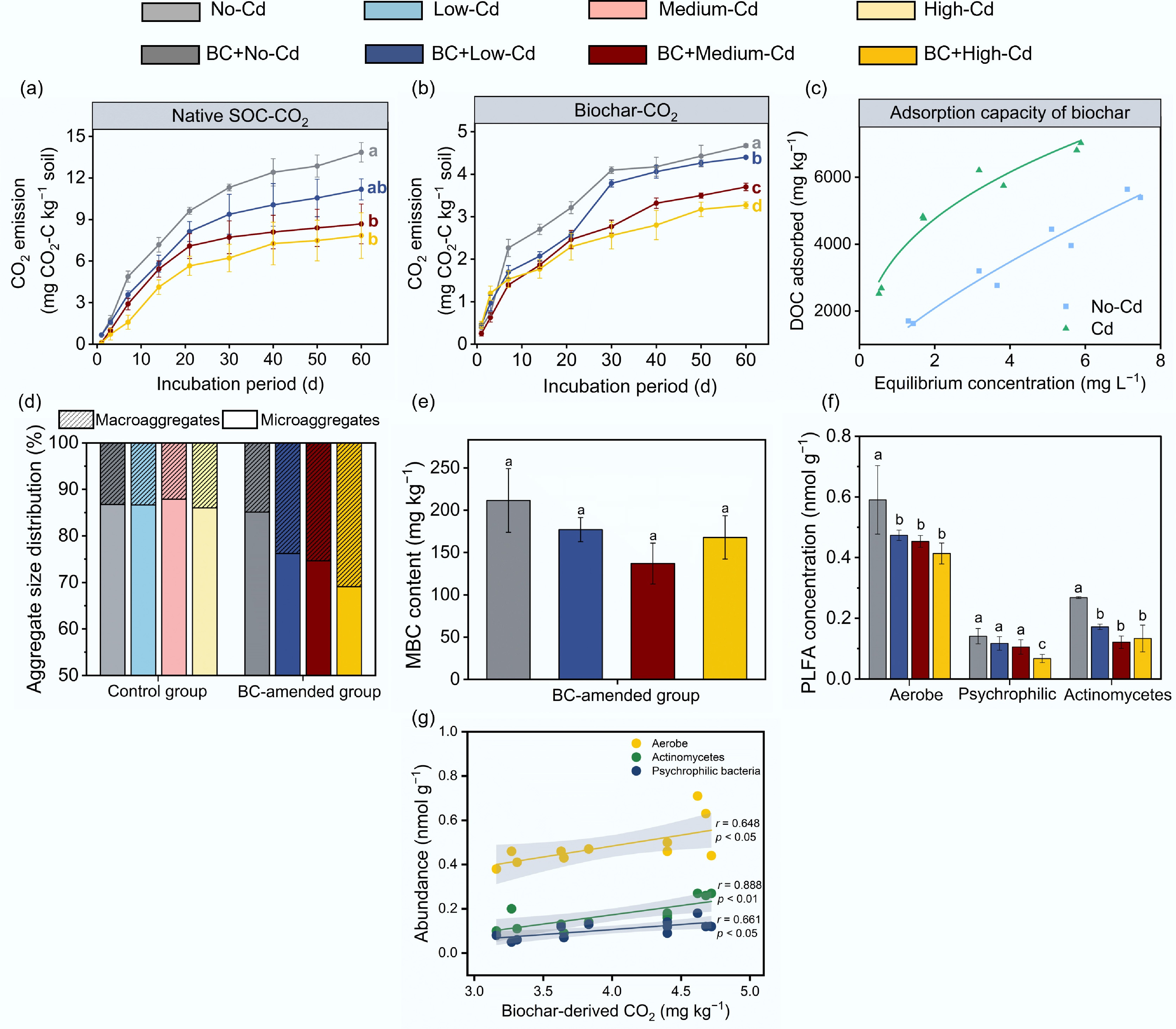
Figure 1.
The cumulative amounts of CO2 evolved from (a) native SOC and (b) biochar. (c) Sorption of soil DOC by biochar components. Solid lines indicate the Freundlich fitting results. (d) The proportions of macroaggregates (250–2,000 µm) and microaggregates (< 250 µm) in the soils. (e) Content of soil microbial biomass carbon of biochar particles. (f) Absolute concentrations of PLFA of typical microbial groups in biochar particles. (g) Correlation between biochar-derived CO2 and microbial abundance. No Cd, low Cd, medium Cd, and high Cd represent the soils without added Cd and soils with the addition of low, medium, and high concentrations of Cd, respectively. BC + no Cd, BC + low Cd, BC + medium Cd, BC + high Cd represent the soils amended with biochar without added Cd and those with the addition of low, medium, and high concentrations of Cd, respectively. Error bars indicate standard deviations (n = 3). Different lowercase letters indicate significant differences (p < 0.05).
Protection of SOC by cation bridging
-
It has been demonstrated that biochar can adsorb SOC to decrease its leaching and mineralization, thereby increasing SOC's stability[26,27]. Given that cation bridging by Ca2+ and Mg2+ is a well-established mechanism for enhancing SOC stabilization through the formation of interorganic or organic–mineral associations[11,13], we hypothesized that Cd2+ could similarly facilitate the adsorption of SOC onto biochar's surfaces. Although direct in situ speciation of Cd in complex soil matrices is challenging, the soil pH (5.13) favors the existence of bioavailable and reactive Cd2+ species. As expected, Cd2+ significantly enhanced the adsorption affinity of biochar for soil DOC (Fig. 1c and Supplementary Table S3), and the Freundlich coefficient increased from 1,256 mg0.27 L0.73 kg−1 (no Cd) to 3,676 mg0.63 L0.37 kg−1 (Cd added). DFT calculations further corroborated this hypothesis: Cd2+ formed coordinate bonds with the oxygen atoms of carboxylate groups on both the TNB model (representing DOC) and the biochar's surfaces (Fig. 2a, b). Further evidence could be found from the electron density difference map (Fig. 2c, d). At an isosurface value of −0.08, a pronounced region of depleted electron density (red region) was observed between Cd2+ and the oxygen atoms, suggesting that electron outflow occurred during bond formation. At an isosurface value of 0.01, an area of electron accumulation (blue region) emerged along the Cd–O bond path, indicating electron sharing and providing direct evidence of coordinate bond formation. Additionally, the molecular orbital diagram revealed strong electron density between Cd and O atoms (green region, Fig. 2e), which further confirmed there was a covalent-like interaction[28]. Such covalent-like interactions provided greater binding stability than the simple electrostatic forces characteristic of common base cations. Collectively, these computational results offered robust molecular-level evidence that Cd2+ facilitated the formation of cation bridges between biochar and DOC to enhance its adsorption.
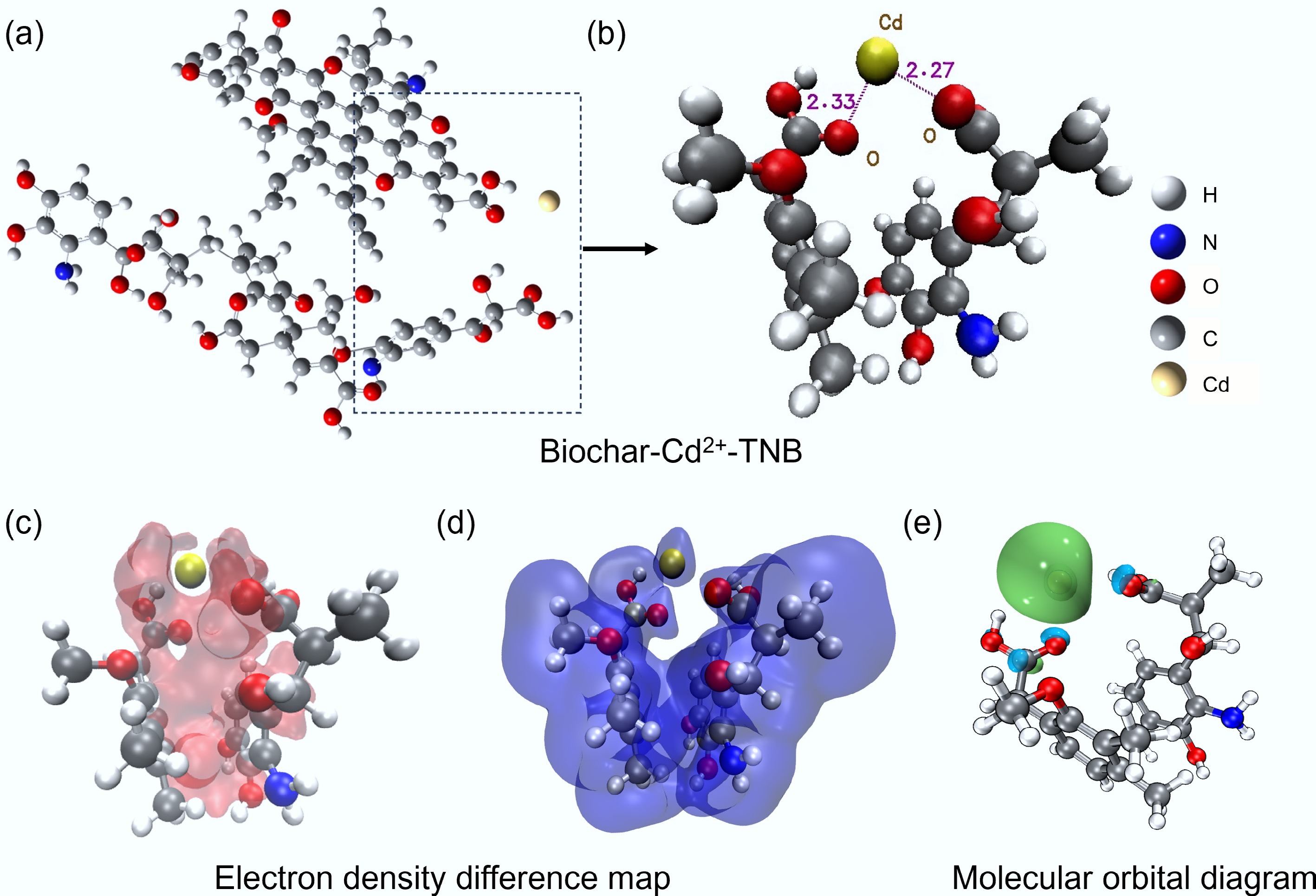
Figure 2.
(a, b) Snapshots of biochar–Cd2+–TNB equilibrium after simulated of the molecular dynamics. The numbers annotated in the figure are in units of Å. (c, d) Isosurface maps of the electrostatic potential for Biochar–Cd2+–TNB, where red and blue represent isosurfaces with values of −0.08 and 0.01, respectively. (e) Differences in charge density for the adsorption of biochar–Cd2+–TNB. Blue and green colors denote holes and electrons.
Our results also showed that Cd2+ promoted the formation of soil macroaggregates, and this promotion was much stronger in biochar-amended soils, as evidenced by an increase (p < 0.05) in the number of macroaggregates in control (0.9%–5.5%) and biochar-amended soils (59.6%–107.4%) in the presence of Cd2+ (Fig. 1d and Supplementary Table S4). This is consistent with the understanding that Cd2+ could act as a cationic bridge between negatively charged particles to facilitate the aggregation of soil organo-mineral complexes[29,30]. The resulting physical encapsulation within aggregates could limit microbial access to SOC and biochar, thereby reducing the mineralization of both SOC and biochar[31,32]. Thus, the cation bridging effect exerted by Cd2+ enhanced both the adsorption and aggregation-mediated physical protection of organic carbon and contributed significantly to the suppressed mineralization of SOC and biochar observed here.
Potential effect of Cd toxicity on microorganisms on biochar's surface
-
SEM-EDS analysis indicated the adsorption of Cd on the biochar's surface (Supplementary Fig. S3), which contributed to the obvious reduction in the soil-available Cd concentration after biochar treatment (Supplementary Fig. S4). Given that microorganisms directly colonizing the biochar's surface would be in direct contact with the sorbed Cd, we postulated that even in nonexchangeable form, this close-range exposure of Cd could induce inhibitory effects through surface interactions and localized high concentrations, ultimately impacting the activity and community structure of the attached microbes. To verify this assumption, we measured the MBC of the isolated biochar particles and soils after incubation. Consistently, with increasing Cd contamination levels, the MBC on biochar particles demonstrated a decreasing trend from 211.6 to 137.0 mg kg−1, whereas no similar reduction trend was observed for the MBC in bulk soil (Fig. 1e and Supplementary Table S5). Because MBC is an indicator of microbial biomass and activity[33,34], this decrease under Cd stress, combined with the decline in the indicators of viable cells (PLFA, Fig. 1f), demonstrates that the Cd adsorbed on the biochar surface exerted a toxic effect on the microorganisms. These changes are likely to contribute to the decreased mineralization of biochar and even the surrounding SOC.
PLFA biomarker analysis also revealed that Cd stress induced a progressive decline in the abundance of aerobic bacteria, psychrophilic bacteria, and actinomycetes on biochar particles across the applied Cd concentration gradients (p < 0.05) (Fig. 1f and Supplementary Fig. S5). These microbial groups are known to decompose refractory organic compounds[35,36]. Consistent with their functional importance, correlation analysis (Fig. 1g) revealed significant positive relationships between biochar mineralization and the abundance of actinomycete/psychrophilic bacteria. Thus, the Cd-induced suppression of these key decomposers likely contributed to the observed reduction in the mineralization of biochar in Cd-contaminated soils.
Mechanism of cadmium on biochar-induced carbon sequestration
-
In summary, the enhanced carbon sequestration under Cd stress was primarily driven by the dual mechanisms of cation bridging and microbial toxicity. Specifically, cation bridging mediated by Cd2+ promoted the adsorption of DOC onto the biochar's surfaces and facilitated the formation of macroaggregates, thereby creating a protective barrier for both native SOC and biochar. Simultaneously, the toxicity of Cd adsorbed on the biochar's surfaces suppressed microbial activity, decreasing the mineralization of both the biochar and the surrounding SOC. As the incubation progressed, the role of Cd in carbon mineralization intensified, leading to a gradual weakening of the initial positive priming effect. The critical turning point occurred when these stabilizing and inhibitory processes collectively surpassed the initial substrate-induced stimulation, shifting the priming effect from positive to negative. Together, these processes outweighed the positive priming effect typically observed in uncontaminated soil, leading to reduced net mineralization and, consequently, enhanced soil carbon sequestration.
-
In conclusion, our results demonstrated that Cd enhanced the carbon sequestration potential of biochar in soils through the dual mechanisms of cation bridging and microbial toxicity. Moving beyond the conventional view that examines biochar's Cd remediation and carbon sequestration effects in isolation, these findings uncover their synergistic interaction in Cd-contaminated soils. This reciprocal enhancement, where biochar remediates Cd and Cd reinforces biochar's carbon sequestration potential in soils, is a win–win scenario that underscores the utility of biochar for the sustainable remediation of Cd-contaminated soils. Despite the insights gained, the 60-day laboratory incubation presents a temporal limitation, necessitating future long-term field studies to further validate the persistence of these mechanisms under complex environmental conditions.
We thank Gabrielle David, PhD, from Liwen Bianji (Edanz) (
www.liwenbianji.cn/ ) for editing the English text of a draft of this manuscript.-
It accompanies this paper at https://doi.org/10.48130/bchax-0026-0016.
-
During the preparation of this work, the authors used DeepSeek for language polishing only. No AI tools were used for data analysis, result interpretation, figure design, content creation, or manuscript drafting. The authors have fully reviewed, revised, and verified all content in the manuscript; confirmed the accuracy and originality of the full text; and take complete responsibility for the final manuscript. This work is the independent intellectual achievement of the authors, and no AI tool shall be regarded as an author of this article.
-
The authors confirm their contributions to the paper as follows: Huayue Nie performed the main experiments and drafted the manuscript. Chang Shen, Xuliang Han, Zikai Lai, Mingwei Chen, and Chenxiao Hu participated in the experimental work and analyzed the results. Lanfang Han designed the research scheme and revised the manuscript. Huan Tang and Zhifeng Yang reviewed and revised the manuscript. All authors reviewed the results and approved the final version of the manuscript.
-
The datasets generated during and/or analyzed during the current study are available from the corresponding author on reasonable request.
-
This research was supported by the National Natural Science Foundation of China (Grant Nos. 42422708 and 42277203) and Guangdong Basic and Applied Basic Research Foundation (Grant No. 2024B1515020103).
-
The authors declare that they have no financial interests.
-
Full list of author information is available at the end of the article.
- The supplementary files can be downloaded from here.
- Copyright: © 2026 by the author(s). Published by Maximum Academic Press, Fayetteville, GA. This article is an open access article distributed under Creative Commons Attribution License (CC BY 4.0), visit https://creativecommons.org/licenses/by/4.0/.
-
About this article
Cite this article
Nie H, Shen C, Han X, Lai Z, Chen M, et al. 2026. Cadmium enhances biochar-based carbon sequestration in soils via cation bridging and microbial toxicity. Biochar X 2: e019 doi: 10.48130/bchax-0026-0016 

Cadmium enhances biochar-based carbon sequestration in soils via cation bridging and microbial toxicity
- Received: 20 April 2026
- Revised: 12 May 2026
- Accepted: 28 May 2026
- Published online: 11 June 2026
Abstract: Biochar is acclaimed for its dual capacity to sequester carbon and immobilize heavy metals in soils. Here, through a 60-day incubation using δ13C isotopic tracing with cadmium (Cd) pollution, we demonstrated that Cd contamination enhanced biochar's carbon sequestration capability by suppressing the mineralization of both biochar and native soil organic carbon. Mechanistic investigations revealed that Cd promoted macroaggregate formation in biochar soils and enhanced biochar's adsorption capacity for dissolved organic carbon via cation bridging, as evidenced by density functional theory calculations; the adsorbed Cd exhibited toxicity to microbes residing on the biochar particles, resulting in decreased microbial biomass carbon. These synergistic mechanisms likely drive the enhanced biochar-based carbon sequestration observed in Cd-contaminated soils.
-
Key words:
- Biochar /
- Cadmium /
- Carbon sequestration /
- Cation bridging /
- Microbial toxicity