












-
Bumblebees (Bombus) comprise ~250 species across 15 subgenera[1,2]. They function as essential pollinators for both wild and greenhouse plants, while displaying remarkable variation in social organization, ranging from primitively eusocial colonies to obligate social parasitism in Psithyrus, which lack a worker caste and exploit host colonies[3,4]. This diversity has made Bombus a powerful model for testing hypotheses about the genomic basis of eusociality, particularly regarding whether features once viewed as hallmarks of advanced eusociality (e.g., in honey bees) are universal or lineage-specific.
Their exceptional geographic and elevational breadth, from Arctic regions to over 5,600 m in the Himalayas, further positions the genus as an ideal system for dissecting the molecular architecture of local adaptation and diversification[5]. Concurrently, widespread population declines[6,7] underscore the urgency of genomic tools to diagnose drivers such as habitat loss, pathogens, pesticides, and climate change, with direct implications for ecosystem services and food security.
Over the past decade, the rapid accumulation of high-quality genomic resources has begun to address these questions. This mini-review critically synthesizes progress in Bombus genomics, moving beyond cataloging assemblies to evaluate their quality, biological utility, and collective impact. We ask: What long-held assumptions about social evolution and adaptation have been overturned? What unifying genomic mechanisms emerge across disparate traits? And what critical gaps must be filled to realize the full potential of these resources for both basic science and conservation?
-
The first two bumblebee genomes, Bombus terrestris and Bombus impatiens, were published in 2015[3]. These ~250 Mb assemblies showed extensive synteny, low repetitive content (< 20%), and a markedly depauperate set of genes involved in detoxification and immunity, indicating that this reduction is ancestral to the bee lineage rather than a derived feature of advanced eusociality[8].
In 2021, a genus-wide effort released 17 additional genomes representing all 15 subgenera[9]. These chromosome-level assemblies enabled robust comparative analyses, demonstrating remarkable conservation in genome size, gene content, and overall chromosomal structure, while highlighting dynamic transposable element evolution. Particularly striking were large-scale chromosomal rearrangements in the parasitic subgenus Psithyrus, which possesses 25 chromosomes (vs the ancestral 18) arising from fission, fusion, and retention events[9]. These rearrangements, now resolved at high resolution thanks to improved assemblies, provide a compelling example of how structural variation may facilitate the evolutionary shift to social parasitism, an insight that earlier fragmented resources could not reliably detect.
Subsequent adoption of long-read technologies (PacBio HiFi, Oxford Nanopore) and advanced assemblers has further elevated assembly contiguity, resolving previously ambiguous regions, improving gene annotation accuracy, and enabling detection of structural variants critical for functional studies. To date, 52 genomes have been generated, with 31 at chromosome-level resolution spanning all subgenera (Fig. 1).
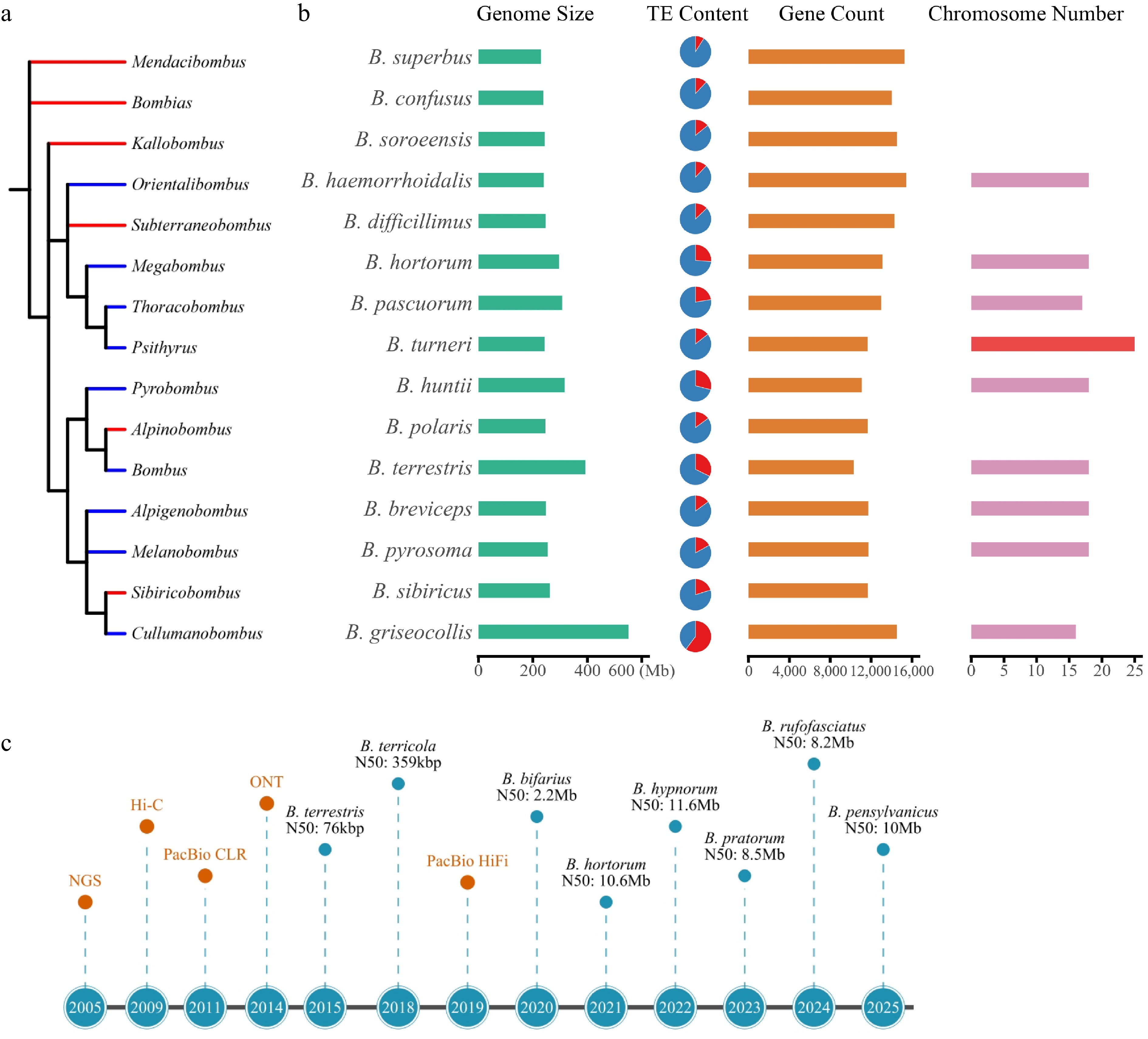
Figure 1.
Genomic landscape of bumblebees. (a) A phylogenetic tree of all 15 bumblebee subgenera, with branches color-coded by the highest level of genome assembly available (blue, chromosome-level; red, scaffold-level). (b) Key genomic features of representative species for each subgenus (TE, transposable element). (c) Timeline of annual representative species genome releases and advances in sequencing technology (N50, contig N50; NGS, next generation sequencing; Hi-C, high-throughput chromatin conformation capture; PacBio CLR, pacific biosciences continuous long read; ONT, oxford nanopore technologies; PacBio HiFi, pacific biosciences high-fidelity).
Complementing these assemblies, the iBumblebee database (
https://ngdc.cncb.ac.cn/ibumblebee/ ) serves as a centralized, publicly accessible multi-omics platform integrating genomes, transcriptomes, and epigenomic datasets. While it enhances usability through centralized access and search functionalities, opportunities remain to expand community uptake, improve tools for cross-species queries, and address underrepresentation of certain lineages or biases in assembly quality. -
Advances in Bombus genomics have moved the field from descriptive catalogs to mechanistic understanding, revealing recurring themes of chromosomal architecture (rearrangements, inversions) and regulatory evolution as drivers of diversification across sociality, adaptation, mimicry, and decline (Fig. 2).
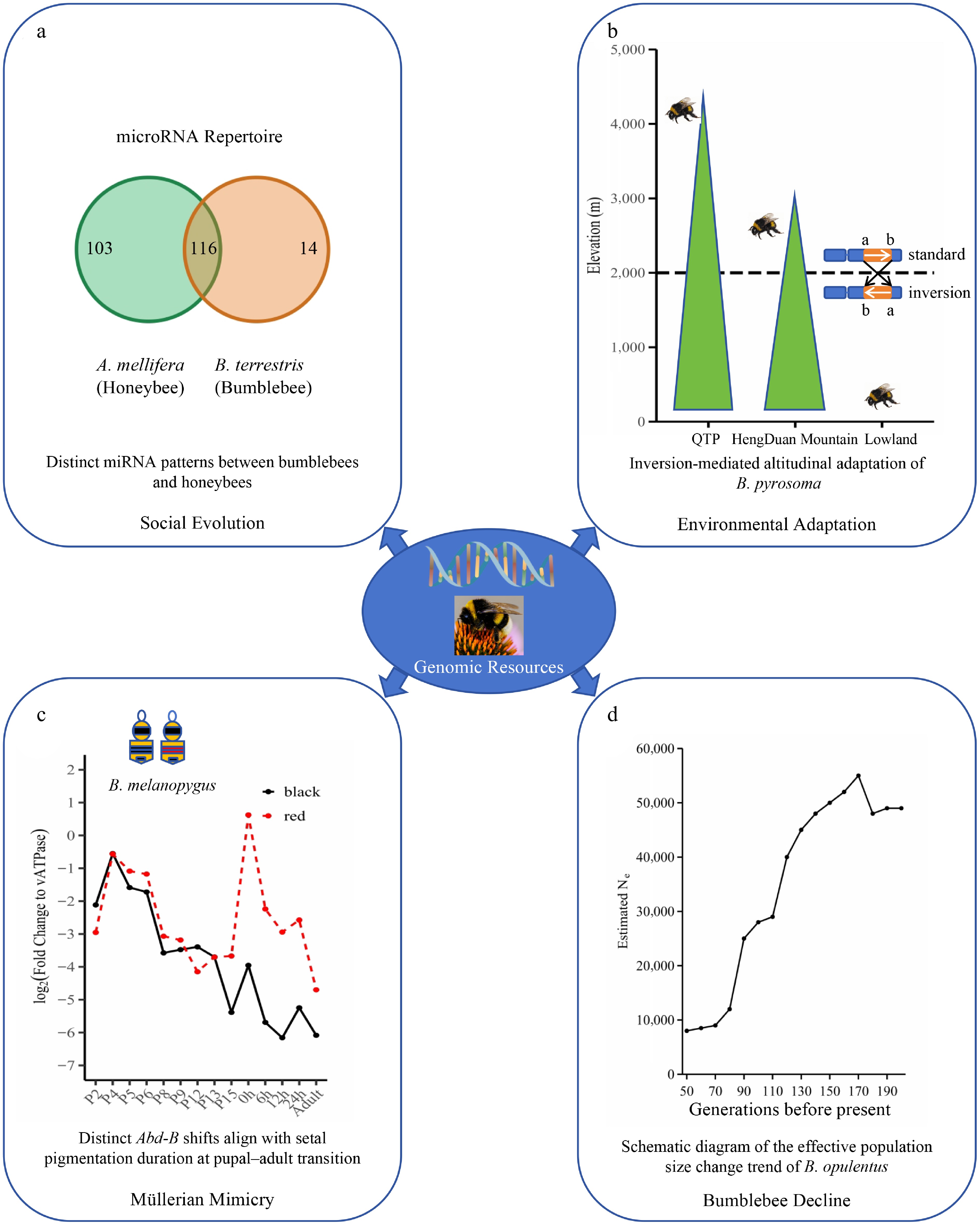
Figure 2.
Schematic diagram of representative studies illustrating biological insights into bumblebees derived from genomic resources. (a) The unique profiles of miRNAs may contribute to the complex behaviors and social organization observed in honey bees. (b) A chromosomal inversion mediates the adaptation of B. pyrosoma to lowland areas (QTP, Qinghai–Tibet Plateau). (c) Differential expression of the Abd-B gene during setae pigmentation results in the black and red phenotypes in the mid-abdominal segments of B. melanopygus. (d) The change trends of effective population size (Ne) for B. opulentus LN populations (LN, LongNan).
-
Bumblebees occupy an intermediate position on the eusocial spectrum, offering a valuable contrast to advanced eusocial honey bees and enabling tests of the generality of eusocial genomic signatures[3]. Comparative analyses of the initial genomes revealed that reduced complements of xenobiotic detoxification and immunity genes are not unique to advanced eusociality but ancestral within bees[3,8]. In contrast, differences in miRNA complement and functionality highlight potential regulatory innovations associated with complex social behaviors in honey bees[3].
More recent synteny analyses have illuminated chromosomal evolution in social parasites. Psithyrus species exhibit 25 chromosomes derived from the ancestral 18 through fission, fusion, and rearrangement events, changes that may have facilitated the loss of independent colony founding and the evolution of obligate parasitism[9]. Additionally, Zhu et al. used integrated RNA-seq, PacBio sequencing, and single-base-resolution DNA methylation profiling in B. terrestris to show that pre-imaginal caste differentiation is driven primarily by differential gene expression, with limited roles for alternative splicing or genome-wide DNA methylation, contrasting with patterns in honey bees and underscoring the diversity of regulatory mechanisms even within primitively eusocial systems[10].
-
Population and landscape genomic studies have begun to map the genomic basis of resilience and local adaptation across broad environmental gradients. In B. terrestris, one of the most widely distributed and commercially important species[11], population genomics across Great Britain revealed extensive genetic diversity and signatures of recent adaptation in genes related to neurobiology and wing development, supporting its resilience to ongoing selective pressures[12]. Comparative resequencing of Asian and European populations identified strong genetic differentiation and 331 genes under selection in Asian lineages, likely contributing to adaptation to high UV radiation, low temperatures, and low precipitation[13].
Similar landscape-genomic approaches in North American species (B. vosnesenskii and B. vancouverensis) identified SNPs associated with climatic variables, affecting genes involved in neural function, ion transport, cuticle formation, and respiratory homeostasis[14,15].
On the Qinghai-Tibet Plateau, a global diversity hotspot, chromosomal inversions in B. pyrosoma have been shown to facilitate local adaptation and subsequent dispersal, illustrating how structural variants contribute to diversification[16]. Collectively, these studies demonstrate that both standing genetic variation and structural changes underpin adaptive potential, though many inferences would benefit from larger sample sizes and functional validation.
-
Bumblebees display extraordinary color pattern diversity (> 400 patterns worldwide) shaped by Müllerian mimicry, providing an excellent model for understanding regulatory control of adaptive phenotypes[17]. In western North America, B. melanopygus exhibits a discrete red/black dimorphism on the mid-abdomen[18]. Genome-wide association and transcriptomic analyses pinpointed a cis-regulatory locus between the Hox genes abd-A and Abd-B as the primary switch, with downstream changes in nubbin and melanin-synthesis genes consolidating the eumelanin/pheomelanin ratio[18,19]. In South Asia, B. breviceps and its comimics converge on orange-to-black abdominal setae through a long intergenic non-coding RNA at the same Hox locus that triggers a late developmental homeotic shift[20]. Population genomic analysis of B. breviceps and B. trifasciatus further showed that coevolution in glacial refugia cannot fully explain the observed mimicry patterns[21].
These findings integrate mimicry with broader themes of regulatory evolution and Hox-mediated diversification, linking it to adaptation and speciation processes.
-
Many bumblebee species have declined sharply in recent decades, threatening both food security and critical ecosystem services[6,7]. Genomic data have begun to move beyond correlative ecology to pinpoint mechanistic drivers of decline, though the section remains limited by small sample sizes in some studies.
In B. terricola, resequencing of 22 individuals revealed a dramatic Holocene reduction in effective population size, inbreeding, and positive selection on immune-related genes, implicating pathogen spillover as a key driver[22]. In B. opulentus, analysis of 51 individuals identified population-specific declines associated with selection on genes involved in high-temperature tolerance, immunity, and detoxification, suggesting synergistic effects of climate warming, pathogens, and pesticides[23]. Additionally, genome sequencing of seven montane bumblebee species in Scandinavia showed relatively high levels of intraspecific genetic variation despite predicted range contractions under climate change[24].
These studies illustrate how genomic data can pinpoint species-specific threats and inform targeted conservation strategies. Future studies should incorporate concepts such as mutational load, inbreeding depression, and comparative analyses between declining and stable species to strengthen these inferences.
-
A decade of progress has transformed Bombus into one of the best-genomically characterized insect genera, yielding insights that both refine and challenge broader models of social evolution, adaptation, and vulnerability. Recurring roles for chromosomal rearrangements and regulatory elements (miRNAs, lncRNAs, cis-regulatory loci) emerge as unifying mechanisms across traits.
Nevertheless, key gaps remain. Telomere-to-Telomere (T2T) assemblies would enable studies of genome stability, repetitive elements, and species-specific adaptations previously obscured by gaps. Functional validation lags due to inefficient gene-editing tools; improved CRISPR approaches, potentially combined with AI-driven gene annotation and protein structure prediction (e.g., AlphaFold), are needed to test candidate loci linked to social parasitism, adaptation, and decline. Finally, integrating genomics with behavioral assays could illuminate the genetic basis of complex cognition and social learning.
Addressing these priorities, through expanded sampling of underrepresented lineages, critical assessment of data limitations, and deeper human-AI collaborative frameworks, will accelerate discovery and support evidence-based conservation of this ecologically vital genus.
This research was funded by the National Natural Science Foundation of China (No. 32270445).
-
During the preparation of this work, the authors used DeepSeek (DeepSeek-V3) for language refinement. The authors reviewed and edited all content produced with the assistance of this tool, verified its accuracy, and take full responsibility for the integrity and originality of the final manuscript. This work represents the authors' own intellectual contribution, and no AI tool is credited as an author.
-
The authors confirm contribution to the paper as follows: study conception and design: Sun C; draft manuscript preparation: Sun C, Xue Y, Sheikh UAA. All authors reviewed the results and approved the final version of the manuscript.
-
Data sharing is not applicable to this article as no datasets were generated or analyzed in this review.
-
The authors declare that they have no conflict of interest.
- Copyright: © 2026 by the author(s). Published by Maximum Academic Press, Fayetteville, GA. This article is an open access article distributed under Creative Commons Attribution License (CC BY 4.0), visit https://creativecommons.org/licenses/by/4.0/.
-
About this article
Cite this article
Xue Y, Sheikh UAA, Sun C. 2026. Bumblebee genomics: a decade of progress and the biological insights unlocked by genomic resources. Genomics Communications 3: e014 doi: 10.48130/gcomm-0026-0012 

Bumblebee genomics: a decade of progress and the biological insights unlocked by genomic resources
- Received: 07 March 2026
- Revised: 29 April 2026
- Accepted: 19 May 2026
- Published online: 23 June 2026
Abstract: Bumblebees (genus Bombus) are keystone pollinators that sustain wild plant communities, ecosystem stability, and agricultural productivity, while serving as valuable models for the evolution of social behavior and local adaptation across diverse environments. Amid ongoing global pollinator declines that threaten biodiversity and food security, the past decade has seen a rapid expansion of genomic resources for the genus. Since the first two high-quality genomes in 2015, chromosome-level or near-chromosome-level assemblies now exist for 52 species (~20% of global diversity) spanning all 15 subgenera. This review offers the first genus-wide critical synthesis of these genomic resources and the biological insights they have unlocked. By integrating phylogenomic, population genomic, and functional data, we highlight recurring genomic mechanisms, particularly chromosomal rearrangements and regulatory evolution, which drive social transitions, local adaptation, Müllerian mimicry, and vulnerability to decline. These advances have refined or overturned assumptions about eusocial genomic signatures and illuminated species-specific threats under environmental change. We identify persistent gaps and propose a forward-looking roadmap that positions high-quality Bombus genomics as a powerful platform for evolutionary biology, conservation strategies, and pollinator resilience in an era of rapid global change.
-
Key words:
- Bombus /
- Genomic resources /
- Social evolution /
- Environmental adaptation /
- Population decline