











-
Wheat (Triticum aestivum L.) is a staple crop worldwide, providing essential nourishment to a large portion of the global population. However, its productivity and quality are often constrained by environmental stresses, notably zinc (Zn) deficiency in soils. Zn is a vital micronutrient involved in key physiological processes such as seed germination and early seedling growth[1]. Zn plays an essential role in early plant growth and development, particularly during seed germination and seedling establishment. Traditional methods to counter Zn deficiency, including soil amendments and foliar sprays with Zn salts, face limitations in efficiency and environmental sustainability[2]. This highlights the pressing need for innovative, more effective, and environmentally friendly strategies to combat Zn deficiency in wheat and other crops.
Nanotechnology offers innovative solutions to combat nutrient deficiencies by enabling targeted nutrient delivery in plants. Nanoparticle-based formulations, due to their unique physico-chemical properties and high surface area-to-volume ratio, have emerged as efficient carriers for essential nutrients[3]. Among these, Zn-based nanoparticles show particular promise in enhancing Zn uptake and utilization efficiency in wheat seedlings, especially under Zn-deficient conditions. These nanoparticles enable the controlled and direct delivery of Zn to plant tissues, ensuring optimal availability during critical growth stages. Leveraging these properties, researchers aim to improve crop resilience and productivity in Zn-deficient soils. This study focuses on evaluating the effectiveness of Zn-based nanoparticle formulations in mitigating Zn deficiency stress, and uncovering the mechanisms behind their positive effects on wheat seedling growth and development.
Seed priming, a pre-sowing technique, has been increasingly investigated for its ability to enhance seed vigour, improve germination rates, and increase stress tolerance in various crops[4]. Recent advancements have focused on nutrient-targeted priming strategies to address deficiencies and environmental challenges during germination and early growth. One such strategy involves priming wheat seeds with Zn-bionanocrystals, offering a promising solution to combat Zn deficiency during the critical early stages of seedling establishment. As a vital micronutrient, Zn supports key physiological and metabolic processes within seeds. Delivering Zn directly via bionanocrystals during priming ensures its optimal availability when most needed. This approach may induce beneficial changes in seed physiology, metabolism, and gene expression, leading to enhanced seedling vigour and potentially higher crop yields. This study examines the mechanisms underlying these benefits and evaluates the potential of Zn-bionanocrystals priming as a sustainable approach for enhancing crop performance in Zn-deficient soils.
In this study, our objective was to investigate the impact of seed priming with synthesized Zn-bionanocrystals on various germination parameters of wheat seedlings. Specifically, we aim to assess the effects of Zn-bionanocrystals priming on key parameters, including seed germination percentage, germination rate, seedling growth parameters, and some biochemical attributes associated with early seedling development. Through a comprehensive array of physiological and biochemical analyses, we endeavor to unravel the underlying mechanisms responsible for the observed enhancements in germination and early growth of wheat seedlings induced by Zn-bionanocrystals priming. By elucidating the intricate interactions between Zn-bionanocrystals and wheat seedlings, this research not only advances our understanding of nanotechnology-based approaches to enhance crop productivity, but also provides valuable insights for developing sustainable strategies to alleviate Zn deficiency in wheat crops. The implications of our findings are significant, as they hold the potential to bolster the resilience and productivity of wheat cultivation, thereby making substantial contributions to global initiatives aimed at ensuring food security and promoting agricultural sustainability.
-
The production process involves a detailed ionotropic gelation technique that employs chitosan, the TPP cross-linker, and ZnSO4[5]. After fabrication, the Zn-bionanocrystals underwent a range of characterization methods to elucidate their physicochemical properties[6]. Dynamic light scattering (DLS) was employed to determine the particle size distribution, polydispersity index (PDI), and zeta-potential, providing insights into the colloidal stability and surface charge of the Zn-bionanocrystals. Morphological examination was performed using scanning electron microscopy (SEM) and transmission electron microscopy (TEM), revealing nanoscale structural features. Surface area determination via Brunauer-Emmett-Teller (BET) analysis provided valuable information on the available surface area for potential applications. Chemical analysis techniques, including Fourier transform infrared (FTIR) spectroscopy, uncovered the functional groups and interactions present within the Zn-bionanocrystals, providing insights into their chemical composition and bonding. Atomic absorption spectroscopy (AAS) has played a pivotal role in quantifying Zn content and assessing parameters such as yield potential (YP), loading capacity (LC), and complexation efficiency (CE), which are imperative for evaluating the efficacy of the encapsulation process.
Application of Zn-bionanocrystals for in-vitro seed germination
-
Wheat seeds were sterilized with 2% sodium hypochlorite, then primed in different solutions for 14 h and subsequently dried at 40 °C for 24 h. The treatments consisted of hydropriming (T1), 100 ppm bulk chitosan (T2), 100 ppm bulk Zn sulphate heptahydrate (T3), a combination of T2 and T3 (T4), as well as various concentrations of Zn-bionanocrystals: 200 ppm (T5), 400 ppm (T6), 600 ppm (T7), 800 ppm (T8), and 1,000 ppm (T9). The primed seeds were divided into two groups. The first group underwent hydro-conditioning on germination paper in a growth chamber maintained at 25 ± 1 °C. Sampling was conducted at specific intervals up to 9 d after germination (DAG). Parameters such as germination percentage, seed vigour indices (SVI-I and SVI-II), mean length of incubation time (MLIT), coefficient of velocity (COV), germination index (GI) and vitality index (VI) were recorded for this group. The second group was allowed to grow until measurable lengths were achieved, and measurements were taken for various parameters including root length, shoot length, chlorophyll content, and carotenoid content on the 15th DAG[7]. The study was conducted under controlled laboratory conditions during a single experimental period. Each treatment consisted of three biological replicates, with each replicate comprising an independent set of seeds subjected to identical priming and germination conditions. All measurements were recorded independently for each replicate, and the experiment was performed following a completely randomized design to ensure reproducibility and minimize experimental bias.
Seed and seedling reserves
Starch
-
Starch content was estimated using a modified version of Clegg's method[8]. Germinating seeds (200 mg) were homogenized in 80% ethanol, boiled for 10 min, and centrifuged. The pellet was then treated with 2 mL distilled water and 3 mL of 52% perchloric acid, stirred continuously, and centrifuged to extract the starch. This extraction was repeated 4 to 5 times, and all supernatants were pooled. A 50 µL aliquot of the pooled extract was mixed with 950 µL distilled water and 4 mL of anthrone reagent (0.2% anthrone in ice-cold 95% H2SO4), heated in a boiling water bath for 10 min, cooled, and the absorbance was recorded at 630 nm.
Soluble protein
-
Protein content was measured using the Lowry method[9]. To extract soluble proteins, a 200 mg sample was homogenized in 4 mL of 100 mM phosphate buffer (pH 7.6) and then centrifuged. The supernatant was collected, and this process was repeated three times. The total protein content was quantified by comparing the absorbance values to a standard curve made with bovine serum albumin (BSA) concentrations ranging from 0 to 100 µg/mL.
Chlorophyll and carotenoid content
-
To assess the impact of Zn-bionanocrystals on seedling photosynthetic potential, chlorophyll and carotenoid contents were measured in fresh leaf tissue at 15 d after germination (DAG) using the Hiscox & Israelstam method[10]. A 0.05 g leaf sample was incubated in 5 mL dimethyl sulfoxide (DMSO) for 24 h for pigment extraction, followed by absorbance measurements at 480, 645, and 663 nm. The chlorophyll and carotenoid contents were then calculated using the corresponding formulas based on these absorbance values.
$ {{\mathrm{Chl}}\;{\text{'}}{\mathrm{a}}}{\text{'}}\;(\text{mg/g FW})=\dfrac{(\text{12.3}\times {A}_{663}-0.86\times {A}_{645})V}{\text{1,000}\times W}\times 100 $ $ {{\mathrm{Chl}}\; {\text{'}}{\mathrm{b}}{\text{'}}}\;(\text{mg/g FW})=\dfrac{(\text{19.3}\times {A}_{645}-3.6\times {A}_{663})V}{\text{1,000}\times W}\times 100 $ $ {{\mathrm{Carotenoid}}\; (\text{µ}{\mathrm{g/g}} \;{\mathrm{FW}})}=\dfrac{\text{1,000}\times ({A}_{480}-2.14)\times (Chl.a-70.16)\times (Chl.b)}{\text{220}} $ where, V = volume of DMSO used, and W = weight of the leaf tissue.
Seed reserve food-mobilizing enzymes
α-Amylase
-
α-Amylase activity at various days after germination (DAG) was measured using a modified method of Shuster & Gifford[11]. The assay employed 0.2 M sodium phosphate buffer (pH 7.4), iodine reagent, and soluble starch. For extraction, 200 mg of germinating seeds were ground in 4 mL chilled phosphate buffer with a pre-chilled mortar and pestle. In the assay, 1 mL enzyme extract was incubated with 1 mL starch solution at 37 °C for 10 min, followed by termination with 1 mL iodine reagent and dilution with 4 mL water. Absorbance was recorded at 620 nm against a blank. Enzyme activity was expressed as units per gram of fresh weight (units g−1 FW), where one unit corresponded to the utilization of 1 µg starch per min.
Protease
-
Reagents were prepared and utilized according to the protein estimation method. For the protease assay, the crude extract from protein extraction was mixed with 1% BSA and incubated at 37 °C for 30 min. The reaction was stopped by adding 20% TCA, and 2 mL of the supernatant was combined with an alkaline copper reagent. Then, 0.5 mL of Folin-Ciocalteu reagent was added, and the mixture was incubated in the dark at room temperature for 30 min. The absorbance of the resulting blue color was measured at 660 nm using a spectrophotometer[9].
Seedling morpho-physiological studies
-
The experiment followed the International Seed Testing Association (ISTA) protocols[12]. Radicle, plumule, and total seedling lengths (from root tip to shoot apex) were measured in cm using a scale. Post-germination, fully developed seedlings were gently removed from germination paper, blotted with tissue to remove moisture, and weighed using a high-sensitivity balance (Mettler Toledo) to record fresh weight. The seedlings were then dried in an oven at 60 °C for 24 h until a constant weight was reached, and dry weight was recorded. Germination frequency was defined as the percentage of seeds that germinated within the specified time during the experiment. This count was then used in the following formula:
$ \mathrm{Germination\ freq\ (\%)=\frac{Number\ ofseeds\ germinated}{Total\ number\ ofseeds}\times100} $ To compute the seed vigor indices, two formulas devised by Abdul-Baki & Anderson[13] were used. These formulas involve multiplying the germination percentage by either the seedling length (SVI-I), or the seedling dry weight (SVI-II).
SVI-I = (Germination %) × (Seedling length)
SVI-II = (Germination %) × (Seedling dry weight)
The mean length of incubation time (MLIT) is a crucial parameter in germination experiments. It refers to the average time it takes for germinating seeds to emerge, or fully display visible signs of growth.
$ MLIT=\dfrac{{G}_{1}{T}_{1}+{G}_{2}{T}_{2}+{G}_{3}{T}_{3}+\cdots +{G}_{n}{T}_{n}}{{G}_{1}+{G}_{2}+{G}_{3}+\cdots +{G}_{n}} $ where, G = germination count on any counting period, T = time (d).
In a germination experiment, the coefficient of velocity is a parameter used to evaluate the speed and efficiency of seed germination. It reflects the rate at which seeds germinate and develop into viable seedlings.
$ \mathrm{COV}=\dfrac{1}{\text{MLIT}}\times 100 $ The germination index provides a quantitative measure of overall seed germination performance. A lower index may reflect poor seed quality, adverse environmental conditions, or other factors negatively affecting germination.
$ \mathrm{GI}=\sum \limits_{t}\left(\dfrac{{G}_{t}}{{D}_{t}}\right) $ where, Gt = no. of seeds germinated on tth day, Dt = time (d) to germination.
The vitality index serves as a parameter for evaluating the overall vigor and health of germinating seeds, offering a quantitative measure of their physiological quality. It is determined by multiplying the percentage of germinated seeds by either the average length of the seedlings, or the combined growth of roots and shoots.
$ \mathrm{VI}=\sum \limits_{t}\left(\dfrac{{G}_{t}}{{D}_{t}}\right)\times \text{SL} $ where, Gt = no. of seeds germinated on tth day, Dt = time (d) to germination, SL = seedling length.
Statistical analysis
-
All experiments were conducted in triplicate, and data are expressed as mean ± SD (n = 3). Overall treatment effects were analyzed using one-way analysis of variance (ANOVA) at a significance level of p ≤ 0.05.
-
The synthesized Zn-bionanocrystals exhibited average hydrodynamic diameters ranging from 374 to 396 nm, zeta-potentials between +39.7 and +44.6 mV, and low PDI values (0.13–0.22), indicating uniform size distribution and colloidal stability consistent with our previous report[5]. SEM and TEM analyses presented here primarily confirm the morphology and structural integrity of the Zn-bionanocrystals, consistent with detailed characterization reported previously[5] (Fig. 1). BET analysis showed a surface area of 16.04 m2/g, suggesting significant adsorption potential. The BJH desorption profile indicated a pore volume of 0.181 cc/g and a pore radius of 19.517 Å, implying broad pores suitable for molecular and ionic accommodation. FTIR analysis revealed shifts in peak positions and intensities, reflecting chemical changes and interactions, and providing insights into their structural and functional properties. Zn, a key component, displayed CE and LC values of 84% and 3.36%, respectively, with a yield of 53.9%, highlighting the Zn-bionanocrystals' efficiency in encapsulating and delivering Zn to plants. The Zn-bionanocrystals used in the present study were previously synthesized and comprehensively characterized in our earlier work[5]. These results emphasize the potential of Zn-bionanocrystals for agricultural applications.
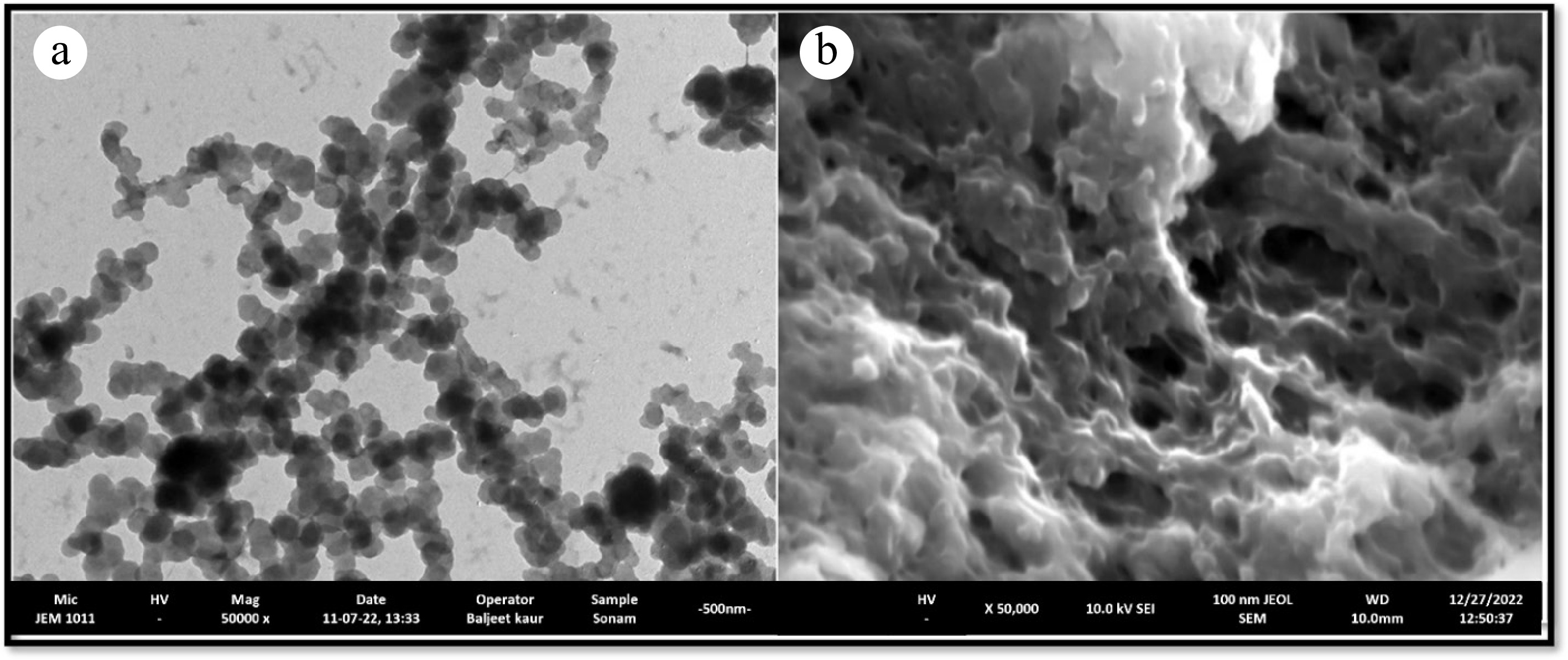
Figure 1.
Representative SEM (a) and TEM (b) images showing morphology of Zn-bionanocrystals, consistent with previously reported structural characteristics[5].
Effects of Zn-bionanocrystals on physiological and biochemical responses during seed germination
-
The impact of Zn-bionanocrystals on wheat seedling growth parameters was scrutinized up to the 10th day after germination (DAG) in petri plates, where root-shoot length, seedling length, fresh weight, and dry weight were meticulously gauged on germination paper. Remarkably, wheat seedling growth exhibited significant augmentation across all treatments, except for bulk chitosan (T2) and bulk Zn (T4), which failed to sprout, and were therefore excluded from subsequent growth and biochemical analysis. By the 10th DAG, seeds primed with Zn-bionanocrystals at concentrations ranging from 200 to 1,000 ppm showed significant differences in germination frequency, mean length of incubation time (MLIT), coefficient of velocity (COV), germination index (GI), and vitality index (VI), with plateauing beyond 800 ppm. The most substantial increase in shoot and root lengths was observed at 600 ppm Zn-bionanocrystals, with a remarkable 74% surge in shoot length compared to the control. Furthermore, seedling length increased significantly with treatments of bulk Zn and Zn-bionanocrystals at 200−1,000 ppm compared to the control, peaking at 32.1 cm with Zn-bionanocrystals. A notable 40% rise in fresh weight was also recorded compared to the control, with marked improvements in both SVI-I and SVI-II (Table 1).
Table 1. Effect of Zn- bionanocrystals on germination-relatedparameters of wheat seedlings.
Treatment ShL (cm)* RL (cm)* SL (cm)* FW (/SL)* DW (/SL)* GF (%)** SVI-I** SVI-II** MLIT** COV** GI** VI** T1 7.91 ± 0.12 15.29 ± 0.25 23.20 ± 0.59 0.187 ± 0.005 0.027 ± 0.001 99.8 ± 0.5 2,315.36 ± 36.56 2.65 ± 0.11 3.25 30.77 39.50 916.40 T3 8.96 ± 0.09 16.46 ± 0.28 25.41 ± 0.62 0.203 ± 0.007 0.029 ± 0.002 99.9 ± 0.8 2,538.86 ± 38.56 2.92 ± 0.08 3.02 33.11 42.80 1,087.72 T5 9.86 ± 0.11 17.54 ± 0.24 27.41 ± 0.58 0.229 ± 0.006 0.034 ± 0.002 99.8 ± 0.6 2,735.32 ± 37.59 3.36 ± 0.09 2.86 34.97 48.50 1,329.29 T6 11.23 ± 0.08 18.38 ± 0.23 29.61 ± 0.53 0.247 ± 0.007 0.037 ± 0.001 99.9 ± 0.8 2,957.64 ± 41.26 3.69 ± 0.08 2.71 36.90 51.30 1,518.79 T7 12.40 ± 0.08 19.78 ± 0.24 32.18 ± 0.57 0.277 ± 0.004 0.041 ± 0.002 100 ± 0.0 3,218.12 ± 39.65 4.08 ± 0.07 2.95 33.90 55.60 1,789.21 T8 11.72 ± 0.10 18.98 ± 0.26 30.70 ± 0.59 0.264 ± 0.005 0.039 ± 0.001 100 ± 0.0 3,070.64 ± 37.98 3.86 ± 0.09 2.91 34.36 54.20 1,663.94 T9 11.42 ± 0.08 18.64 ± 0.25 30.06 ± 0.55 0.254 ± 0.006 0.037 ± 0.002 99.8 ± 0.8 2,999.99 ± 42.65 3.69 ± 0.09 2.84 35.21 53.50 1,608.21 ShL: shoot length; RL: root length; SL: seedling length; FW: fresh weight; DW: dry weight; GF: germination frequency; SVI: seed vigour index(SVI-I and II); MLIT: mean length of incubation time; COV: coefficient of velocity; GI: germination index; VI: vitality index; T1: control (hydropriming); T2: 100 ppm bulk chitosan; T3: 100 ppm bulk zinc sulphate heptahydrate; T4: 100 ppm bulk chitosan + 100 ppm bulk zinc sulphate heptahydrate; T5: 200 ppm Zn-bionanocrystals; T6: 400 ppm Zn-bionanocrystals; T7: 600 ppm Zn-bionanocrystals; T8: 800 ppm Zn-bionanocrystals; T9: 1,000 ppm Zn-bionanocrystals. (* at 15th DAG, ** at regular interval of 24 h for 10 d). Significant disparities were also noted in MLIT, COV, GI, and VI, underscoring the positive influence of Zn-bionanocrystals on wheat seedling growth parameters and overall vigor. Collectively, Figs 2, 3 provide a comprehensive insight into the effects of Zn-bionanocrystals on seedling growth parameters in wheat.
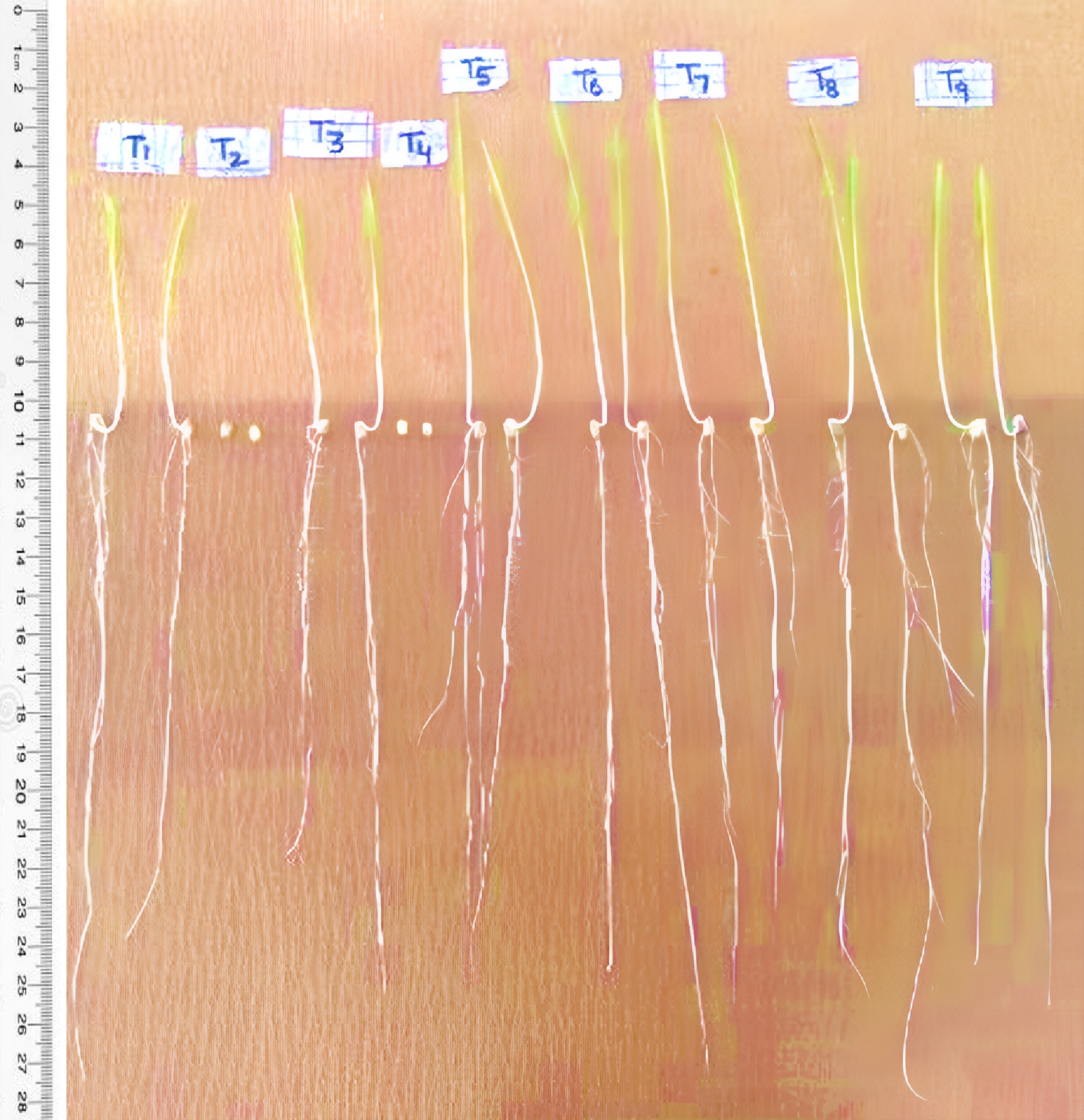
Figure 2.
Representative images of wheat seedlings (12th DAG) under different treatments showing phenotypic variations after priming.
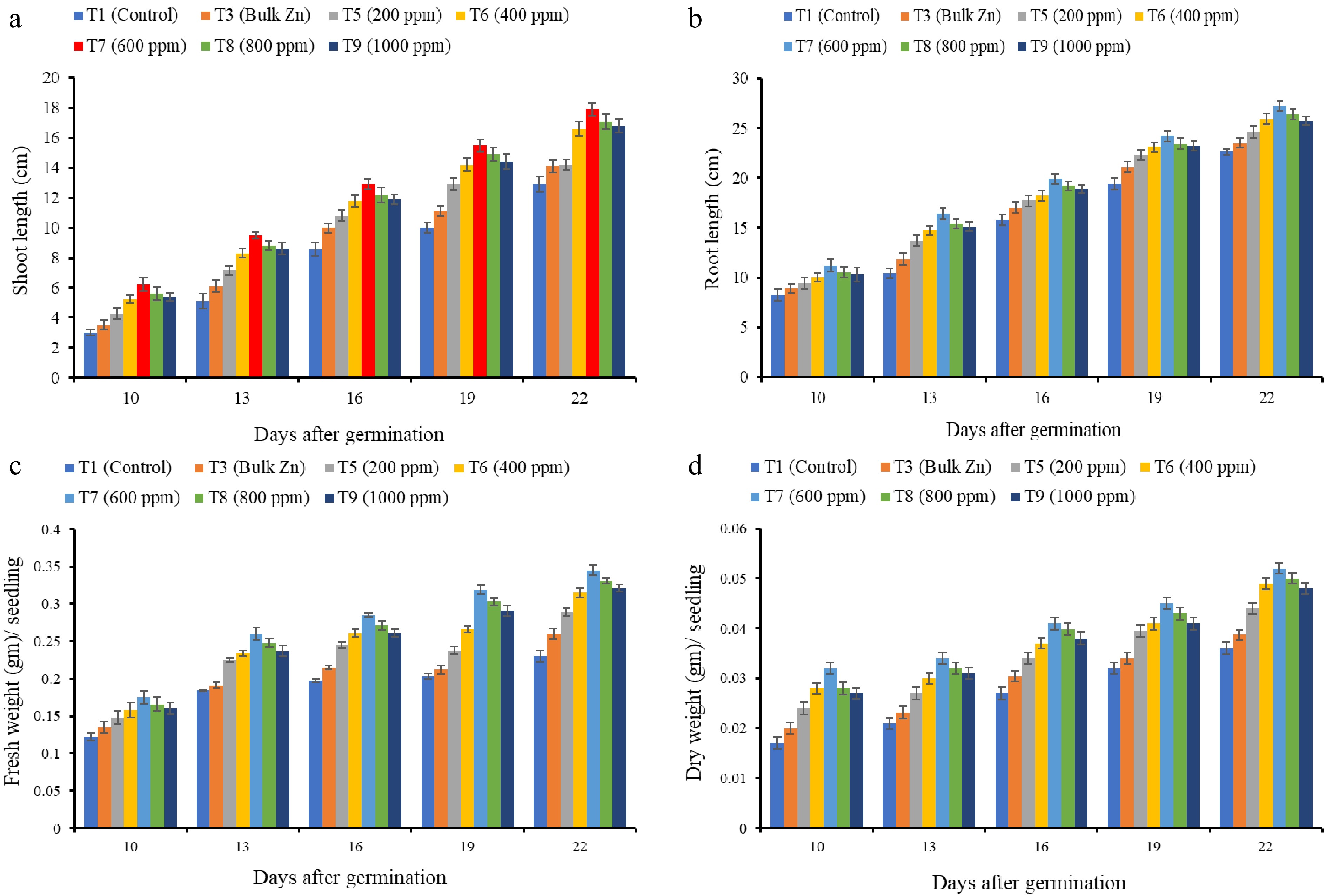
Figure 3.
Change in wheat seedlings at regular intervals after priming with Zn-bionanocrystals. (a) Shoot length, (b) root length, (c) fresh weight, and (d) dry weight. Values represent mean ± SD (n = 3). Error bars indicate standard deviation. Overall treatment effects were evaluated using one-way ANOVA (p ≤ 0.05).
Seedling reserves
Starch
-
In contrast to the control cohort, seedlings subjected to 600 ppm Zn-bionanocrystals exhibited the most pronounced starch utilization, surpassing levels observed in the control group by a significant margin (Fig. 4a).
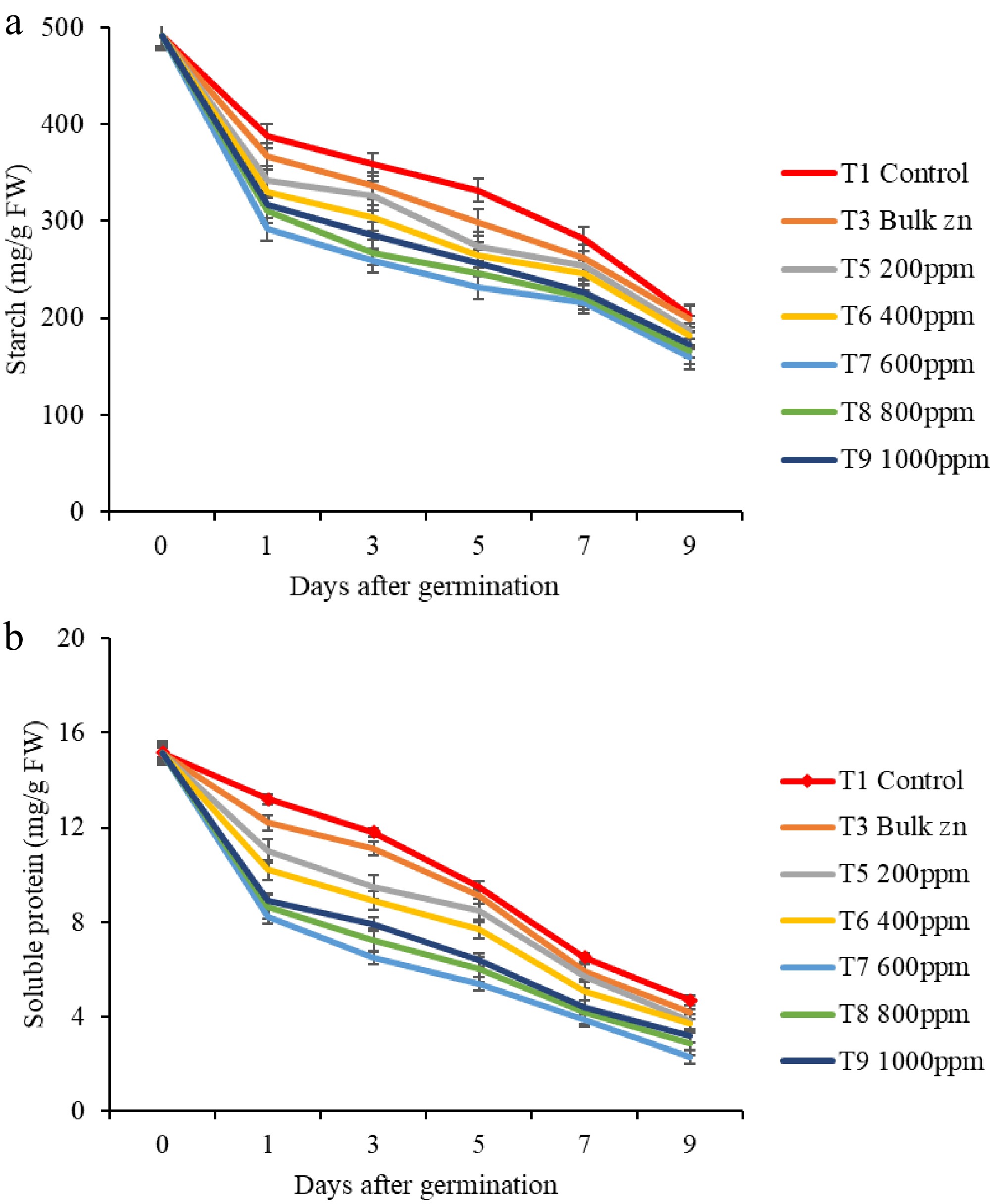
Figure 4.
Change in (a) starch content, and (b) soluble protein in wheat seedlings at regular intervals after priming with Zn-bionanocrystals. Values represent mean ± SD (n = 3). Error bars indicate standard deviation. Overall treatment effects were evaluated using one-way ANOVA (p ≤ 0.05).
Soluble protein
-
Protein content changes mirrored the starch content pattern (Fig. 4b). From the start to the 9th DAG, bulk Zn treatment caused a slight decrease in soluble protein, while seedlings treated with 600 ppm Zn-bionanocrystals exhibited the most significant reduction. In contrast, the control group maintained the highest protein levels, reaching 4.70 mg/g FW by day 9.
Chlorophyll and carotenoid content
-
Zn-bionanocrystals significantly impacted chlorophyll content in wheat seedlings (Fig. 5a). Seeds treated with 600 ppm Zn-bionanocrystals had the highest total chlorophyll content, 9.5 mg/g FW, compared to 5.44 mg/g FW in the control group. This suggests Zn-bionanocrystals enhance chlorophyll synthesis during seedling development. Additionally, seedlings treated with Zn-bionanocrystals showed a marked increase in carotenoid content (Fig. 5b). Among treatments, 600 ppm Zn-bionanocrystals (T7) exhibited the highest carotenoid content at 37.9 μg/g FW, while the control had the lowest at 20.1 μg/g FW.
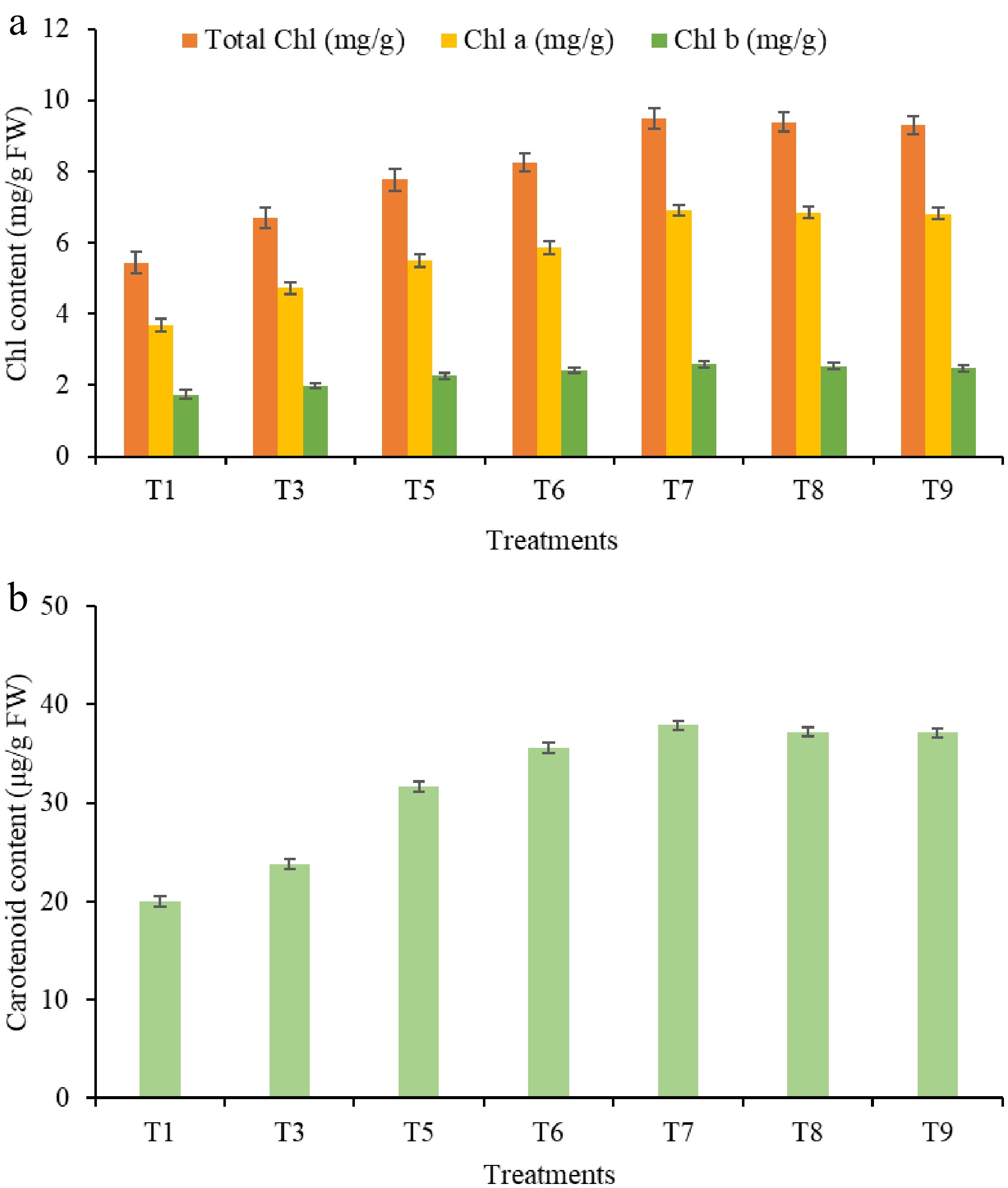
Figure 5.
Change in (a) chlorophyll, and (b) carotenoid content in wheat seedlings after priming with Zn-bionanocrystals. Values represent mean ± SD (n = 3). Error bars indicate standard deviation. Overall treatment effects were evaluated using one-way ANOVA (p ≤ 0.05).
Seed reserve food-mobilizing enzymes
α-Amylase
-
The effect of Zn-bionanocrystals on α-amylase activity in wheat seeds is elucidated in Fig. 6a. Initially, minimal α-amylase activity was observed across all treatments on day 0. However, as germination progressed, a marked increase in α-amylase activity was seen in Zn-bionanocrystals-treated seeds, particularly from the 3rd to 5th DAG. The control group showed a 2.7-fold increase in α-amylase activity, while seeds treated with 600 ppm Zn-bionanocrystals demonstrated a 4-fold increase.
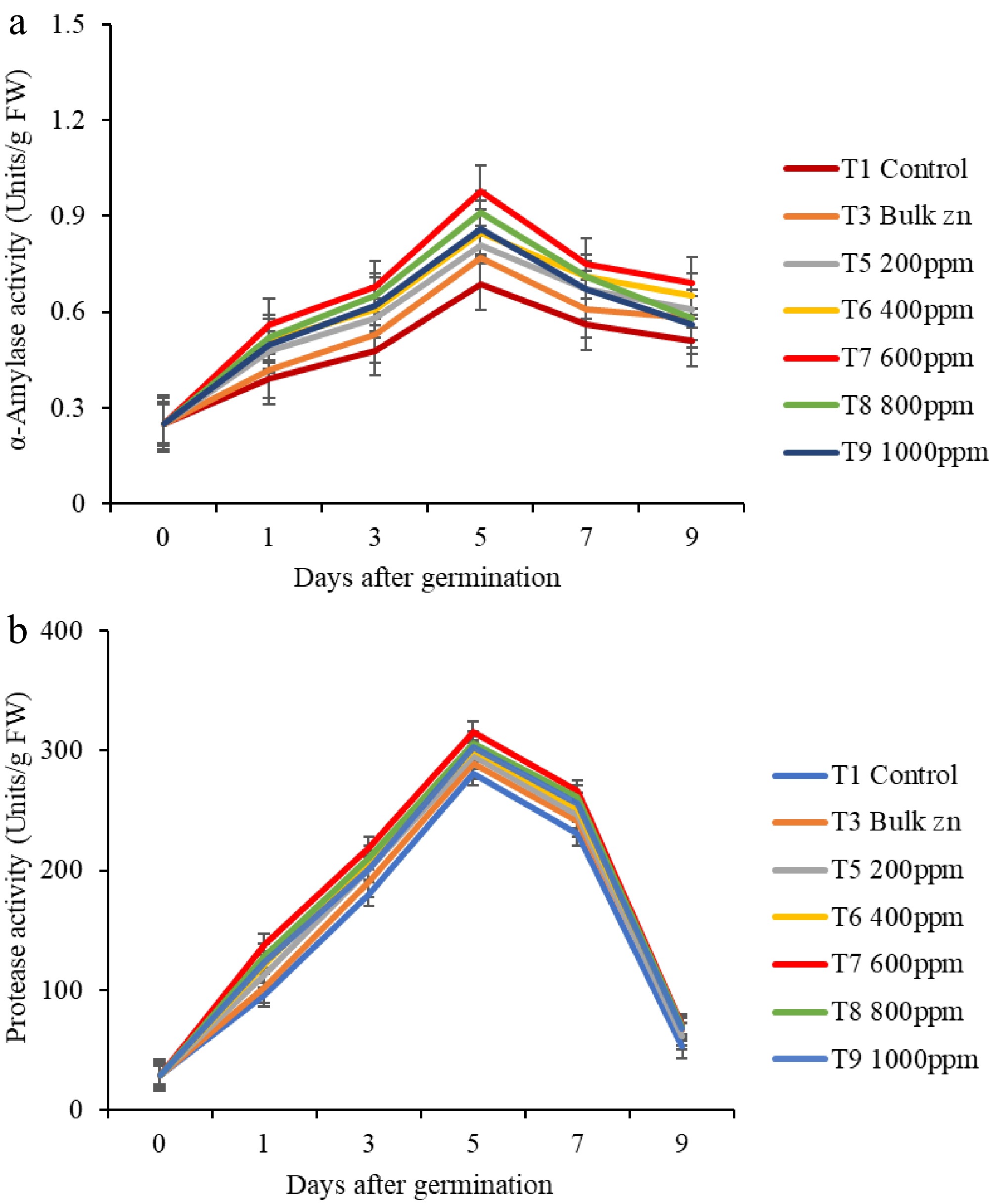
Figure 6.
Change in (a) α-amylase, and (b) protease activity in wheat seedlings at regular intervals after priming with Zn-bionanocrystals. Values represent mean ± SD (n = 3). Error bars indicate standard deviation. Overall treatment effects were evaluated using one-way ANOVA (p ≤ 0.05).
Protease
-
The effect of Zn-bionanocrystals treatment on protease activity is delineated in Fig. 6b. From the 0 to the 5th DAG, a significant increase in protease activity was observed, with the highest surge (11-fold) recorded in seeds treated with 600 ppm Zn-bionanocrystals. This was notably higher than the control (9-fold) and the bulk Zn treatment (10-fold). Seeds treated with 600 ppm Zn-bionanocrystals exhibited the greatest protease activity, indicating the positive influence of this treatment on enzyme activity. In contrast, the control group showed the lowest protease activity, underscoring the role of Zn-bionanocrystals in enhancing proteolysis during seed germination.
-
The Zn-bionanocrystals employed in the present study were previously synthesized and comprehensively characterized in our earlier work[5]. The hydrodynamic diameter obtained through DLS reflects the particle size distribution in colloidal form, which is critical for stability and interaction with biological systems. The positive zeta potential values indicate good colloidal stability due to electrostatic repulsion between particles. FTIR analysis confirms the interaction between Zn ions and chitosan functional groups, indicating successful formation of Zn-bionanocrystals. Furthermore, the BET-derived surface area and pore characteristics contribute to enhanced adsorption and interaction potential during seed priming. The present study demonstrates that Zn-bionanocrystals priming influences wheat seed germination and early seedling growth in a concentration-dependent manner. While lower to moderate concentrations (200–600 ppm) enhanced germination parameters, growth traits, and enzyme activities, higher concentrations (800 and 1,000 ppm) did not confer additional benefits. These findings indicate that Zn-bionanocrystals modulate early physiological processes during germination, with implications discussed below. The pronounced enhancement in seedling performance under Zn-bionanocrystal treatments highlights their effectiveness in supporting early plant establishment. Improved shoot and root development at optimal concentrations suggests that these nanostructures may facilitate better nutrient mobilization, which is critical for sustained plant growth and productivity. In contrast, the failure of germination observed in bulk chitosan–based treatments can be attributed to the unfavourable chemical environment induced by prolonged exposure, underscoring the importance of formulation and dosage in seed treatment applications.
Although Zn and chitosan are both present in the bulk mixture treatment (T4), the physiological responses observed with Zn-bionanocrystals were markedly different, indicating that the enhanced effects cannot be attributed solely to the presence of Zn or chitosan. In the T4 treatment, Zn supplied as ZnSO4 is likely available to the seed in a single, relatively concentrated exposure during early imbibition. In contrast, in the Zn-bionanocrystal system, Zn is encapsulated within the chitosan-based nanostructure, which may facilitate a more gradual, sustained release of Zn during germination. Such controlled release could enhance Zn availability over a longer time window, improve synchronization with metabolic activation during early seedling development, and reduce the likelihood of transient ionic stress associated with sudden Zn exposure. Therefore, the superior performance of Zn-bionanocrystals appears to arise from altered Zn delivery kinetics and nanoscale integration, rather than from Zn concentration alone.
The superior biomass accumulation observed in nano-treated seedlings further indicates improved metabolic efficiency and cellular activity. Additionally, the consistent improvement in vigor- and germination-related indices suggests that Zn-bionanocrystals positively influence both the speed and uniformity of germination, thereby enhancing overall seedling quality. Collectively, these findings demonstrate that Zn-bionanocrystals offer a promising alternative to conventional treatments by promoting robust seedling growth while avoiding the inhibitory effects associated with bulk materials.
Previous studies have demonstrated that nanomaterials can positively influence early seedling growth across diverse crop species. Ananda et al.[14] reported that copper oxide nanoparticles significantly enhanced tomato seedling growth, including shoot and root length, biomass accumulation, and physiological parameters. Similarly, Yang et al.[15] observed improved shoot and root growth, biomass, and chlorophyll content in soybean seedlings treated with iron oxide nanoparticles. At the same time, Salama[16] reported that silver nanoparticles enhanced maize seedling growth, fresh weight, and nutrient uptake efficiency. Singh et al.[17] further demonstrated that zinc oxide nanoparticles positively affected rice seedling growth by enhancing biomass accumulation, photosynthetic activity, and nutrient uptake.
In the present study, wheat seedlings primed with 600 ppm Zn-bionanocrystals exhibited the highest starch utilization (Fig. 4a). Starch is the primary energy reserve supporting germination and early seedling growth[18], and its enhanced utilization suggests accelerated starch breakdown and improved energy conversion efficiency in Zn-bionanocrystals-treated seedlings[19]. This enhanced reserve mobilization likely supports more efficient seedling development by synchronizing energy supply with growth demand. Similar enhancements in starch utilization following nanomaterial treatments have been reported by Sagadevan et al.[20] in maize seedlings treated with TiO2 nanoparticles, and by Mahakham et al.[21] in rice seedlings treated with AgNPs, further supporting the role of nanomaterials in modulating starch metabolism during early growth stages. Collectively, these findings indicate that Zn-bionanocrystals may enhance seedling growth primarily by improving metabolic activation rather than through a generalized growth-promoting effect alone[22,23].
The alterations in soluble protein content observed under Zn-bionanocrystals priming represent an essential aspect of reserve mobilization during early seedling growth. The pattern of protein depletion closely paralleled that of starch utilization, indicating a coordinated regulation of the major storage macromolecules during germination. As shown in Fig. 4b, seedlings treated with 600 ppm Zn-bionanocrystals exhibited the greatest reduction in soluble protein content, suggesting enhanced proteolytic activity and accelerated utilization of stored proteins to meet the metabolic demands of rapid seedling development. In contrast, seedlings in the control treatment retained higher residual protein levels by day 9, indicating comparatively slower reserve mobilization. These findings highlight the capacity of Zn-bionanocrystals to modulate protein metabolism in coordination with carbohydrate utilization. Similar alterations in protein dynamics have been reported following nanomaterial exposure in other crops; for instance, Zulfiqar et al.[24] observed significant changes in protein content and composition in maize seedlings treated with gold nanoparticles, while Ijaz et al.[25] reported modifications in protein metabolism and expression patterns in rice seedlings following silicon nanoparticle treatment.
The notable increase in photosynthetic pigment content further supports the physiological benefits of Zn-bionanocrystals during early seedling development. A substantial increase in total chlorophyll content was recorded in seedlings treated with 600 ppm Zn-bionanocrystals (Fig. 5a), indicating improved chloroplast development and photosynthetic preparedness. In addition, the elevated carotenoid content observed in Zn-bionanocrystals-treated seedlings (Fig. 5b) suggests enhanced photoprotective capacity during early growth stages. Carotenoids play a critical role in protecting the photosynthetic apparatus from oxidative damage associated with rapid metabolic activation, and their coordinated increase alongside chlorophyll reflects improved physiological stability. Comparable increases in chlorophyll and carotenoid contents following nanomaterial treatments have been reported in tomato, mustard, and maize seedlings treated with silver, zinc oxide, and gold nanoparticles, respectively[26−28]. Collectively, these findings suggest that Zn-bionanocrystals priming supports early seedling vigor by enhancing both metabolic reserve utilization and photosynthetic pigment accumulation.
The modulation of α-amylase activity by Zn-bionanocrystals highlights their role in regulating enzymatic processes central to seed germination and starch mobilization. The low α-amylase activity observed at day 0 across all treatments reflects the dormant metabolic state of dry seeds prior to germination. Following imbibition, seeds treated with Zn-bionanocrystals exhibited a pronounced increase in α-amylase activity between the 3rd and 5th day of germination (Fig. 6a), indicating enhanced activation of starch-hydrolyzing pathways. Notably, the highest α-amylase activity was recorded in seeds treated with 600 ppm Zn-bionanocrystals, suggesting that this concentration optimally supports enzyme induction and function. Enhanced α-amylase activity facilitates the rapid conversion of starch reserves into soluble sugars, thereby ensuring an adequate energy supply for early seedling growth and development[29]. The subsequent decline in enzyme activity after the 5th day likely reflects the depletion of readily available starch reserves and a metabolic transition toward other energy-generating pathways as seedlings establish autotrophic growth.
Comparable stimulation of α-amylase activity by nanomaterials has been reported in other crop species. Spanos's team[30] observed enhanced α-amylase activity and accelerated starch hydrolysis in maize seeds treated with graphene oxide nanoparticles, while Wankhade et al.[31] reported increased enzyme activity and improved germination in chickpea seeds following zinc oxide nanoparticle treatment. Similarly, Nile et al.[32] demonstrated stimulated α-amylase activity and enhanced starch degradation in rice seeds treated with silver nanoparticles, and Jampílek & Kráľová[33] reported increased starch hydrolysis and improved seedling vigor in barley seeds exposed to copper nanoparticles. Together, these findings support the conclusion that Zn-bionanocrystals enhance early seedling establishment primarily by promoting enzymatic activation and efficient reserve mobilization during germination.
The response of protease activity to Zn-bionanocrystals priming provides further insight into the regulation of protein metabolism during wheat seed germination. Across all Zn-bionanocrystals-treated samples, protease activity increased markedly, with the highest enhancement observed at 600 ppm on the 5th day of germination (Fig. 6b). At this concentration, protease activity increased approximately 11-fold relative to the initial level, exceeding the responses observed in the control (9-fold) and bulk Zn treatment (10-fold). Enhanced protease activity facilitates the efficient hydrolysis of storage proteins into amino acids and small peptides, which serve as essential substrates for metabolic processes and early seedling growth. When considered alongside the observed reduction in soluble protein content, these findings indicate that Zn-bionanocrystals promote coordinated protein mobilization to support rapid seedling establishment.
Similar stimulation of protease activity by nanomaterials has been reported in other crop species. Prasad et al.[34] observed accelerated protease activity and protein degradation in tomato seeds treated with titanium dioxide nanoparticles, while Husain[35] reported increased enzyme activity in soybean seeds exposed to gold nanoparticles. Enhanced protease activity and protein hydrolysis following silver nanoparticle treatment were also documented in maize seeds by Gupta et al.[36], and Jampílek & Kráľová[33] reported improved protein degradation and seedling growth in rice seeds treated with copper oxide nanoparticles. Collectively, these studies support the conclusion that Zn-bionanocrystals enhance early seedling growth by promoting enzymatic activation and efficient protein reserve mobilization during germination.
The promotive effects of Zn-bionanocrystals observed in the present study appears to be closely linked to improved reserve mobilization during germination. The enhanced activities of α-amylase and protease under Zn-bionanocrystals priming indicate accelerated breakdown of starch and storage proteins, consistent with the observed reduction in starch and protein content, and the concurrent improvement in seedling growth parameters. Zn is known to function as a structural or catalytic cofactor for several enzymes involved in carbohydrate and protein metabolism, and improved Zn availability during early imbibition may therefore facilitate more efficient metabolic activation. This coordinated response suggests that Zn-bionanocrystals influence early seedling vigor by synchronizing reserve mobilization with rapid seedling growth rather than acting through isolated effects. Although the present study was conducted under controlled in-vitro conditions, the observed enhancement in germination, reserve mobilization, and enzymatic activities suggest that Zn-bionanocrystals could be particularly advantageous during early crop establishment when Zn availability is limited. However, extrapolation of these findings to soil-based systems, especially Zn-deficient or alkaline soils, requires validation through greenhouse and field experiments. Future studies should therefore evaluate the performance, Zn-use efficiency, and environmental safety of Zn-bionanocrystals under agronomically relevant soil conditions.
-
In conclusion, our study demonstrates the promising potential of seed priming with synthesized Zn bionanocrystals as a novel strategy to enhance the germination characteristics and early growth of wheat seedlings. Through careful in-vitro assays, we explored the effects of Zn-bionanocrystals on key parameters of seed germination and seedling development. The results highlighted the efficacy of Zn-bionanocrystals in priming for improved germination frequency, seedling vigour, root and shoot growth, as well as biochemical attributes such as starch utilisation, soluble protein content, chlorophyll, and carotenoid levels. Notably, Zn-bionanocrystals outperformed both bulk Zn and bulk chitosan treatments, with optimal effects observed at 600 ppm. Furthermore, our findings revealed the mechanisms underlying these improvements, emphasizing the role of Zn-bionanocrystals in stimulating enzymatic activities critical to seedling development, including α-amylase and protease. These findings provide valuable insights into the potential of nanotechnology-based approaches to improve crop productivity and resilience by enhancing early germination performance and seedling physiological competence. Moving forward, further studies are needed to evaluate the long-term effects, field-scale applicability, and potential environmental impacts of Zn-bionanocrystals priming to fully harness their benefits and facilitate their integration into sustainable agricultural practices. Overall, this study establishes Zn-bionanocrystals priming as a mechanistically supported and environmentally relevant approach for improving early wheat establishment, with strong potential for future translation to Zn-deficient soil systems.
-
The authors confirm their contributions to the paper as follows: experimentation, data curation, formal analysis, writing − original draft: Sihag S; conceptualization, software, supervision, review and editing: Pal A; experimentation, data curation: Sahewalla S; formal analysis, review and editing: Tak Y; visualization, supervision: Saharan V. All authors reviewed the results and approved the final version of the manuscript.
-
All data generated or analyzed during this study are included in this published article.
-
This research was supported by the CCS Haryana Agricultural University, Hisar, and CSIR.
-
The authors declare that they have no conflict of interest.
- Copyright: © 2026 by the author(s). Published by Maximum Academic Press, Fayetteville, GA. This article is an open access article distributed under Creative Commons Attribution License (CC BY 4.0), visit https://creativecommons.org/licenses/by/4.0/.
-
About this article
Cite this article
Sihag S, Pal A, Sahewalla S, Tak Y, Saharan V. 2026. Zinc-bionanocrystals priming unlocks potential for enhancing wheat seed germination for sustainable agriculture. Technology in Agronomy 6: e008 doi: 10.48130/tia-0026-0004 

Zinc-bionanocrystals priming unlocks potential for enhancing wheat seed germination for sustainable agriculture
- Received: 09 November 2025
- Revised: 13 January 2026
- Accepted: 10 February 2026
- Published online: 29 June 2026
Abstract: This study investigates the efficacy of seed priming with synthesized zinc-bionanocrystals (Zn-bionanocrystals) to enhance wheat (Triticum aestivum L.) germination and early seedling development. Zn-bionanocrystals were fabricated using ionotropic gelation with chitosan and a TPP cross-linker, exhibiting hydrodynamic diameters of 374–396 nm, zeta potentials of +39.7 to +44.6 mV, and low polydispersity indices (0.13–0.22). In-vitro experiments compared hydropriming, bulk zinc sulfate, and five Zn-bionanocrystal concentrations (200–1,000 ppm). Among all treatments, 600 ppm Zn-bionanocrystals yielded the most substantial improvements: a 74% increase in shoot length, 40% increase in fresh weight, and up to 4.08 seedling vigor index (SVI-II)—surpassing the control (2.65). Germination frequency reached 100%, and vitality index rose to 1,789, compared to 916 in the control. Enhanced biochemical responses were evident through increased chlorophyll content (9.5 mg/g FW vs 5.4 mg/g in the control), carotenoid levels (37.9 μg/g FW), α-amylase activity (4-fold increase), and protease activity (11-fold increase). The treatment also significantly reduced the mean length of incubation time and boosted the coefficient of velocity and germination index. These findings demonstrate the potential of Zn-bionanocrystal priming as an eco-friendly strategy to improve seed vigor, metabolic activity, and early establishment of wheat under controlled germination conditions, thus contributing to sustainable agriculture and food security.
-
Key words:
- Seed priming /
- Zinc bionanocrystals /
- Germination enhancement /
- Wheat seedlings /
- α-Amylase /
- Protease.