












-
Brassica juncea is a significant vegetable of the Brassicaceae family, widely cultivated in China. On the basis of its edible parts, it is classified into the root, leaf, stem, and heading types. Its processed products, such as pickled B. juncea and preserved B. juncea tubers, demonstrate distinct industrial characteristics, holding significant economic value and broad market prospects[1,2]. In the production of B. juncea, the common diseases in cruciferous vegetables, such as turnip mosaic virus, downy mildew, and clubroot, can cause serious losses. However, there are very few resistant resource lines among the B. juncea germplasm resources. Breeders usually introduce resistance genes from B. rapa or B. nigra into B. juncea through methods of distant hybridization, such as B. juncea (AABB genome) × B. rapa (AA genome) or B. juncea × B. nigra (BB genome)[3]. However, this method can take a relatively long time and has very low efficiency. Moreover, with the exploration of functional genes in B. juncea, the interpretation of gene functions has become increasingly important. Therefore, an efficient B. juncea genetic transformation system is needed to provide a rapid tool for precise improvement of target traits, the creation of characteristic germplasm materials, and interpretation of gene functions, thereby serving the development of the B. juncea industry.
Genetic transformation technology could enable targeted improvement of specific traits by directly introducing genes for the desired characteristics or editing endogenous genes. Although this technology has been applied in several brassica crops, including B. napus[4], B. oleracea[5], and B. rapa[6], it currently relies predominantly on the Agrobacterium tumefaciens-mediated system and still faces some challenges in B. juncea, such as low transformation efficiency and unstable regeneration systems (Supplementary Fig. S1). Therefore, exploring a stable and efficient genetic transformation method is of critical importance. Agrobacterium rhizogenes is a Gram-negative soil bacterium from the Rhizobiaceae family that induces the formation of extensively branched hairy roots at wound sites in plants[7], and these hairy roots are widely used for functional gene validation and the production of plant secondary metabolites. To date, hairy root induction has been successfully achieved in various plant species, primarily in herbaceous plants belonging to the Solanaceae[8], Brassicaceae[9], and Fabaceae family[10], as well as in some woody plants such as poplar (Populus spp.)[11] and Citrus[12]. However, the application of A. rhizogenes-mediated transformation in B. juncea has not been reported yet.
To improve transformation and screening efficiency, researchers have often used fluorescent genes as markers, such as YFP[13], DsRed2[14], mCherry[15], and eGFP[16]. However, these traditional marker methods require observation with a fluorescence microscope. In recent years, the RUBY gene has emerged as a new type of visual reporter gene that can be observed directly with the naked eye. This gene originates from plants of the order Caryophyllales[17] and mediates the synthesis of a class of vivid natural pigments called betalains, which can cause plant tissues to visibly appear red or purple, significantly enhancing the screening efficiency of genetic transformation. This marker has been successfully applied in species such as Arabidopsis thaliana[18], tomato (Solanum lycopersicum)[19], cotton (Gossypium hirsutum)[20], and B. rapa[21]. In addition, the beet pigments coded by the RUBY gene exhibit significant antioxidant activity, demonstrating potential health benefits such as cancer prevention, lipid reduction, and anti-inflammatory effects, thereby expanding the possibilities for cultivating new functional germplasm[22]. Consequently, utilizing the RUBY gene as a visual marker for genetic transformation not only significantly enhances screening efficiency and accuracy but also provides a novel technical approach for germplasm innovation. However, the application of the RUBY gene in B. juncea has not been reported yet.
In this study, an efficient transformation system was established based on A. rhizogenes-mediated transformation and a visual screening marker, namely the RUBY gene, which followed the pathway of hairy roots to callus to regenerated buds. We constructed a RUBY overexpression vector (Fig. 1a), introduced it into A. rhizogenes strain K599, and transformed two B. juncea genotypes, '50#' and '89#', using 6-day-old rootless seedlings as explants (Fig. 1b, c; Supplementary Table S1). First, the explants were soaked in a resuspension solution with an optical density (OD) value of 0.6 for approximately 15 min. After air-drying, the explants were placed on a cocultivation medium (Fig. 1d) and cultured in the dark for about 40 h. Subsequently, they were transferred to hormone-free Murashige and Skoog (MS) medium containing 300 mg/L of timentin and cultured for about 14 d. During this period, red hairy roots were observed (Fig. 1e). The red hairy roots were cut into 5−8-mm segments (Fig. 1f) and transferred to a callus induction medium (MS + sucrose 30 g/L + 2.7 g/L phytagel + 300 mg/L timentin + 5.0 mg/L 6-BA + 0.5 mg/L naphthyl acetic acid [NAA]). After approximately 20 d, they were transferred to a shoot induction medium (MS + 30 g/L sucrose + 2.7 g/L phytagel + 300 mg/LTimentin + 0.5 mg/L 6-BA + 0.5 mg/L NAA) (Supplementary Table S2), a distinct red callus with red roots was observed (Fig. 1g). After continuing the culture for about 20 d, the positive shoots became visible (Fig. 1h). When the positive shoots developed three to four leaves, they were transferred to nutrient pots for acclimatization (Fig. 1i, Supplementary File 1). Once the seedlings grew seven or eight leaves, they underwent acclimatization and transplantation, ultimately yielding transgenic B. juncea plants carrying the RUBY gene. Compared with the control, the transgenic plants exhibited obvious red coloration in the entire leaves (Fig. 1j-n). Moreover, quantitative real-time polymerase chain reaction (qRT-PCR) results demonstrated the high expression levels of the RUBY and SPC gene in the transgenic plants (SPC: Approximately 0.30-fold for Line '50' and 0.15-fold for Line '89'; RUBY: Approximately 0.35-fold for Line '50' and 3-fold for Line '89') (Fig. 1o).
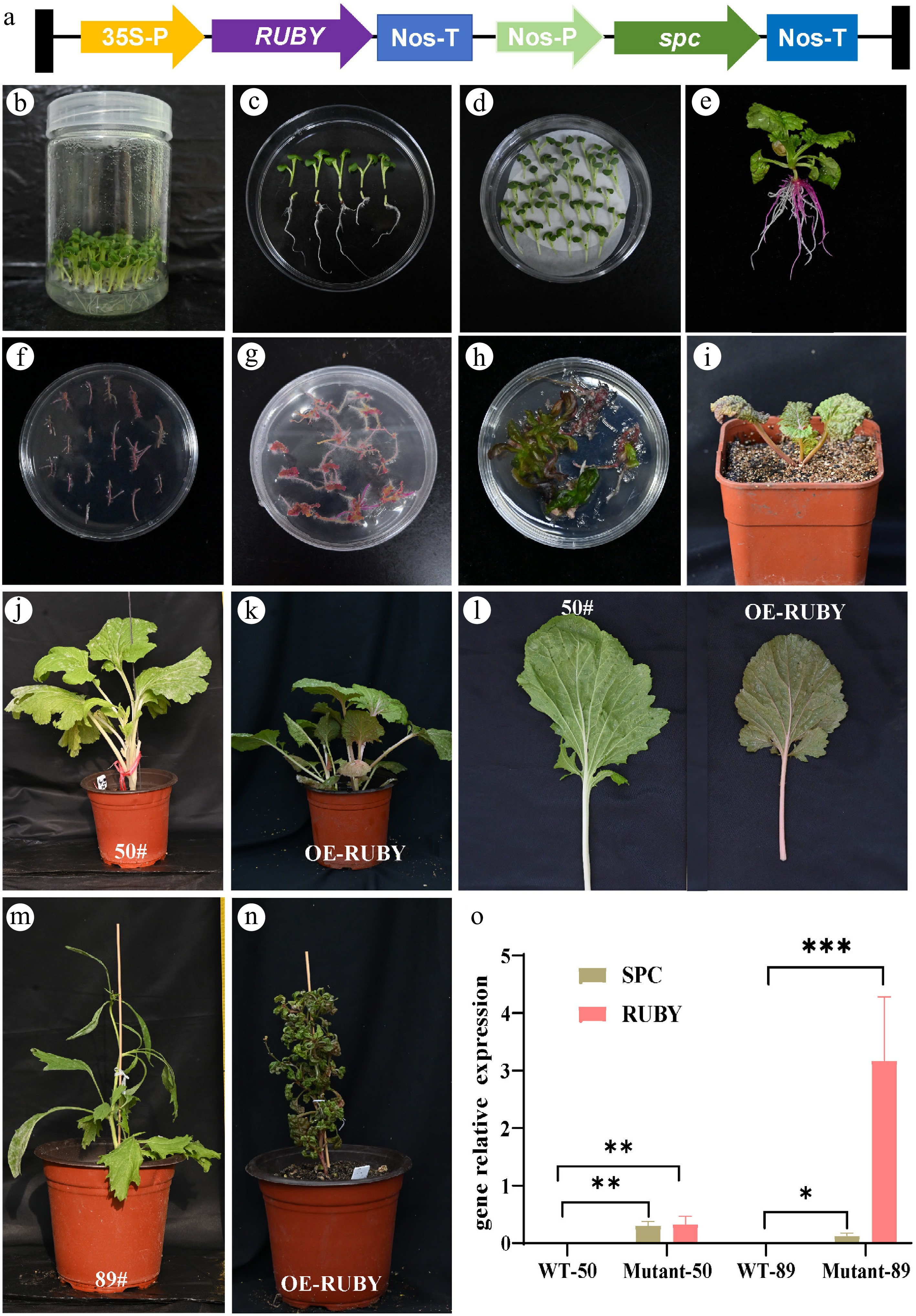
Figure 1.
Protocol for an efficient genetic transformation system in B. juncea. (a) The RUBY overexpression vector. The RUBY gene driven by the 35S promoter is co-expressed with the spc gene controlled by the nopaline synthase (NOS) promoter. (b)−(i) Genetic transformation procedure. (b) 6-d-old seedlings of B. juncea; (c) explant preparation; (d) cocultivation; (e) seedlings developing positive roots; (f) culture of positive root segments; (g). induction of callus from positive roots; (h) shoot regeneration from positive callus; (i) acclimatization of positive seedlings) (j)−(l) Phenotypic comparison of wild-type and transgenic RUBY overexpression plants from Line 50#. (j) Wild-type plant; (k) RUBY transgenic plant. (l) Comparison of leaves between the RUBY transgenic plant and the wild-type) (m),(n) Phenotypic comparison of wild-type and transgenic RUBY overexpression plants from Line 89#. (m) Wild-type plant; (n) RUBY transgenic plant). (o) Expression level of the RUBY gene in wild-type and the transgenic lines.
Plant roots generally have a weaker regenerative capacity than cotyledons and hypocotyls. A. rhizogenes-mediated transformation is typically limited to hairy root induction and rapid gene validation, making it difficult to obtain intact plants from hairy roots (Supplementary Fig. S2). However, this study demonstrated that exogenous hormone induction can promote callus formation from positive transgenic roots, leading to plant regeneration. Moreover, with the RUBY visual marker, shoots emerging from positive roots are directly identifiable as positive transformants. However, it was worth noting that overexpression of the RUBY gene may lead to plant abnormalities; for example, the '89#' line exhibited leaf wrinkling (Fig. 1n). Similar phenomena resulting from the RUBY gene, have also been observed in other plants, such as maize (Zea mays)[23], carrot (Daucus carota)[24], and cotton[25]. This may be related to the synthetic pathway of the RUBY gene, which included three enzyme-coding sequences (CYP76AD1, DODA, and glycosyltransferase, expressed in tandem via 2A peptides), mediating betalain synthesis in Caryophyllales, and its heterologous overexpression in other plants could trigger growth abnormalities via tyrosine depletion and intermediate accumulation[26]. According to the qRT-PCR results, it was speculated that exceeding a certain threshold of RUBY gene expression may impair normal plant development, indicating that the use of this visual RUBY marker for screening has limitations. We will further explore the use of weak or inducible promoters to drive RUBY's expression, aiming to reduce its expression level and thus mitigate its adverse effects on plants while preserving the convenience of visual screening.
In summary, we have established an efficient transformation system for hairy roots–callus–regenerated shoots using A. rhizogenes and the RUBY visual marker gene, and obtained RUBY transgenic plants, providing both technical and resource foundations for the genetic improvement of B. juncea. We will clone the marker gene into a clustered clustered regularly interspaced short palindromic repeats (CRISPR)/CRISPR-associated protein 9 (Cas9) expression vector for coexpression with Cas9 and the corresponding sgRNA. This will allow the selection and tracking of successfully transformed cells or individuals using the marker gene while editing the target gene, and thus will further enable subsequent gene editing experiments.
HTML
-
The authors confirm their contributions to the paper as follows: conceived the study and reviewed the manuscript: Li G, Zhang S, Zhang R; performed the experiments: Zeng X; wrote the manuscript: Wei Y; editing the manuscript: Li F, Zhang H, Zhang S, Sun R. All authors reviewed the results and approved the final version of the manuscript.
-
Data sharing is not applicable to this article because no new data were created or analyzed in this study.
-
This work was funded by the Natural Science Foundation of Chongqing (CSTB2025NSCQ-GPX0681), China Agriculture Research System (CARS-23-A-14), and the Agricultural Science and Technology Innovation Program of the Chinese Academy of Agricultural Sciences (CAAS-ASTIP-IVFCAAS). This work was performed at the Key Laboratory of Biology and Genetic Improvement of Horticultural Crops, Ministry of Agriculture, Beijing, China.
-
The authors declare that they have no conflict of interest
-
accompanies this paper online at https://doi.org/10.48130/vegres-0026-0016.
- Supplementary Table S1 Agrobacterium rhizogenes-mediated transformation efficiency of Brassica juncea lines 50# and 89#.
- Supplementary Table S2 Genetic transformation workflow of Brassica juncea.
- Supplementary Fig. S1 Vitrification status of Agrobacterium tumefaciens-mediated and Agrobacterium rhizogenes-mediated transformations.
- Supplementary Fig. S2 Shoot induction status of lines 7#, 91#, 92# (non-receptor materials) and lines 50#, 89# (receptor materials).
- Supplementary File 1 Additional materials and methods to this study.
- Copyright: © 2026 by the author(s). Published by Maximum Academic Press, Fayetteville, GA. This article is an open access article distributed under Creative Commons Attribution License (CC BY 4.0), visit https://creativecommons.org/licenses/by/4.0/.
Zeng X, Wei Y, Li F, Zhang H, Zhang S, et al. 2026. Establishment of an efficient genetic transformation system based on Agrobacterium rhizogenes and the RUBY marker in Brassica juncea. Vegetable Research 6: e023 doi: 10.48130/vegres-0026-0016


|