












-
The apple (Malus domestica), a member of the Rosaceae family and the Malus genus, is one of the most widely cultivated fruits globally, with an annual production exceeding 93.14 million tons[1]. Apples are highly valued for their nutritional and economic significance, being rich in bioactive compounds such as phenols, vitamin C (VC), dietary fiber, and essential minerals, including potassium and magnesium, which contribute to various health benefits[2]. Among these, catechins and chlorogenic acid have been shown to exhibit strong antioxidant activity, support immune function, regulate metabolism, and potentially reduce the risk of chronic diseases such as cardiovascular disorders and certain cancers[3].
Not-from-concentrate (NFC) apple juice is a popular apple-derived product, appreciated for its fresh flavor and high nutritional value. However, it is particularly vulnerable to enzymatic browning during processing and storage, leading to undesirable changes in color, flavor, and nutritional content[4]. This browning primarily arises from mechanical disruption of plant tissue during juice extraction, which brings polyphenol oxidase PPO into contact with its phenolic substrates. PPO catalyzes the oxidation of phenolic substrates into quinones, which subsequently polymerize into brown pigments[5]. Therefore, effective control of enzymatic browning is essential to ensure product quality and consumer acceptance.
Conventional strategies for browning inhibition include thermal processing, chemical additives, enzymatic inhibition, cold storage, and high-pressure processing (HPP). While thermal treatments and chemical preservatives can retard browning, they may also degrade heat-sensitive nutrients or have negative effects on human health[6]. HPP, a non-thermal pasteurization technology, inactivates microorganisms and enzymes by applying isostatic pressures (300–600 MPa) through a water medium, better preserving the fresh characteristics of fruit and vegetable products[7]. However, effective PPO inactivation in apples typically requires pressures ≥ 600 MPa, due to the enzyme's resistance at lower pressure and temperature conditions[8]. Zhou et al.[9] reported that at 200 MPa, PPO activity increased due to a shorter Cu-His 61 distance and an expanded substrate channel, which enhanced active-site accessibility. In contrast, at 600 MPa, the increased Cu-His separation and water infiltration buried the active site, reducing catalytic efficiency. High-pressure thermal processing (HPTP), which combines HPP with moderate heat (60–90 °C), enhances PPO inactivation, but still compromises thermolabile compounds[10]. Furthermore, the technique is also limited by equipment drawbacks, including its inherently discontinuous operation and high processing expenses[11]. It highlights the need for alternative, milder strategies to control browning while maintaining nutritional integrity.
A variety of anti-browning agents have been investigated to inhibit PPO activity, including sulfites, reducing agents (e.g., glutathione, L-cysteine), PPO-specific inhibitors (e.g., aromatic acids, substituted resorcinols), chelators (e.g., phosphates, EDTA), acidulants (e.g., citric acid), and certain enzymes[12]. However, growing consumer demand for clean-label, additive-free products has driven interest in natural alternatives. For instance, Yu et al.[13] found that adding 0.25% to 1.25% (w/w) Rosa roxburghii juice to apple juice significantly inhibited enzymatic browning and reduced PPO activity to 47.5% of the control. This effect was mainly attributed to the high ascorbic acid (AA) content of Rosa roxburghii juice, which possesses strong reducing capacity (up to 1.67 g/100 g). Similarly, Mostafa et al.[14] found that supplementing sugarcane juice with 6% or 8% pasteurized kiwifruit juice almost completely inactivated PPO activity, primarily due to the presence of heptacosane, oleic acid, and melezitose in kiwi fruit. In line with these findings, Supapvanich et al.[15] demonstrated that soaking apple wedges in coconut water markedly delayed browning and reduced their PPO activity, which may be related to the abundant phenolic compounds, such as catechin and salicylic acid, naturally present in coconut water. Compared with the addition of isolated compounds, supplementation with phenolic-rich fruit juice better aligns with clean-label strategies, as the native food matrix provides a spectrum of coexisting antioxidants and organic acids that may act synergistically to enhance PPO inhibition. Moreover, ingredients derived from whole foods are generally more acceptable to consumers than purified additives.
Phyllanthus emblica (PE), a medicinal and edible fruit native to Yunnan Province and surrounding regions, is rich in phenols, including gallic acid, ellagic acid, and catechins, as well as flavonoids and tannins[16]. These bioactive compounds contribute to its strong antioxidant, anti-inflammatory, and cytoprotective activities[17]. Although previous studies have primarily focused on the browning mechanisms occurring within PE itself, its application as a natural anti-browning agent in other fruit-based systems remains insufficiently explored[18,19].
To date, the combined potential of HPP and PE juice supplementation for PPO inactivation in NFC apple juice has not been systematically investigated. Moreover, the molecular mechanism by which PE-derived phenolics inhibit PPO activity remains unclear. We hypothesized that PE-derived phenolics would competitively inhibit residual PPO activity post-HPP through active site occupation, thereby delaying browning more effectively than HPP treatment alone while enhancing antioxidant capacity.
To the best of our knowledge, this study is the first study to (1) investigate the synergistic application of HPP and PE juice within a fruit juice matrix, (2) employ UHPLC-ESI-HRMS/MS to identify specific PE phenolics associated with anti-browning activity, and (3) elucidate their inhibitory mechanisms through molecular docking analysis with PPO. This integrated strategy links macroscopic quality attributes with molecular-level interactions, thereby providing a more comprehensive understanding of clean-label browning inhibition.
-
Red Fuji apples were sourced from Zhaotong, Yunnan Province, China. Uniform fruit at approximately 80% maturity, free from visible defects, were selected and stored at 4 °C until use. The 'Boli' cultivar of PE was obtained from Honghe, Yunnan Province. Fresh, green fruit of uniform quality were similarly selected and also stored at 4 °C prior to experimentation.
PVPP and Triton X-100 were purchased from Solarbio (Beijing, China). Tris (2-carboxyethyl) phosphine (TCEP), 1,1-diphenyl-2-picrylhydrazyl (DPPH), 2,2′-azino-bis (3-ethylbenzothiazoline-6-sulfonic acid) diammonium salt (ABTS), gallic acid standard, rutin standard, and AA standard were supplied by Aladdin (Shanghai, China). P-phenylenediamine, catechol, and Folin-Ciocalteu phenol reagent were obtained from Macklin (Shanghai, China). Methanol and acetonitrile (chromatography grade) were obtained from Sigma-Aldrich (MO, USA). Ultrapure water was used for UPLC-MS analyses, whereas distilled water was employed for all other experiments.
Sample preparation and collection
-
Apples were washed, peeled, cored, and cut into pieces before juicing using a pre-cooled and screw-type (auger) juice extractor. The juice was immediately filtered through a single layer of 400-mesh gauze to remove visible particulates. PE fruit underwent similar pretreatment—washing, pitting, and juicing—and the supernatant was collected after settling.
The experimental samples were categorized into four groups: (1) pure apple juice (Control); (2) apple juice with 2.5% (v/v) PE juice (2.5% PE); (3) 5% (v/v) PE juice (5% PE); and (4) 10% (v/v) PE juice (10% PE). All samples were placed in 50 mL polyethylene bottles and subjected to high-pressure processing (HPP) (SHPPDZ-600, Shanxi Sanshuihe Tech. Co., Ltd., Shanxi, China) at 20 °C. The pressure was increased at approximately 15 MPa/s to reach 600 MPa within 1 min, maintained for 5 min, and then rapidly released.
Following HPP, the samples were stored for 35 d. Juice samples were collected on days 0, 3, 7, 14, 21, 28, and 35. Each collected sample was divided into two portions: one portion was stored at 4 °C for the measurement of color, soluble solid content, particle size, and rheological properties, while the other portion was immediately frozen in liquid nitrogen and stored at −40 °C for subsequent analyses of other parameters.
pH, total titratable acidity (TA), and total soluble solids (TSS)
-
The pH of the samples was measured at room temperature using a pH meter (FE28-Standard, Mettler Toledo, Shanghai, China). TA was determined with an automatic pH-stat titrator (907 Titrando, Metrohm, China) by titrating with 0.1 M NaOH until the pH reached 8.1, and results were expressed as % citric acid. TSS were measured in °Brix using a digital refractometer (TD-45, Jinkelida, China).
Color properties
-
The color of apple juice was evaluated using a spectrophotometer (Agera, HunterLab Inc., Virginia, USA). Measurements were expressed in the CIELAB color space, where L* represents lightness, a* indicates the red-green coordinate, and b* corresponds to the yellow-blue coordinate. The total color difference (ΔE) was calculated according to Eq. (1), to quantify the extent of color change during storage:
$ \Delta E=\sqrt{{\left({L}^{*}-L_{0}^{*}\right)}^{2}+{\left({a}^{*}-a_{0}^{*}\right)}^{2}+{\left({b}^{*}-b_{0}^{*}\right)}^{2}} $ (1) where, L*, a*, and b* are color parameters at a given time, while L0*, a0*, and b0* are the corresponding values at day 0.
Polyphenol oxidase (PPO) and peroxidase (POD)
-
PPO and POD activities were determined following the method of Zou et al.[20] with modifications. Equal volumes of apple juice and pre-chilled 0.2 M NaH2PO4 buffer (pH 6.5) were thoroughly mixed, followed by sequential addition of 4% (w/v) PVPP, 1% (v/v) Triton X-100, and 1 M NaCl. The mixture was shaken vigorously, incubated at 4 °C for 10 min, and centrifuged at 11,000 × g for 20 min at 4 °C. The supernatant was collected for enzymatic assays. PPO activity was determined by mixing 2 mL of 0.05 M NaH2PO4 buffer (pH 6.5) containing 0.07 M catechol with 200 µL of enzyme extract and recording absorbance at 420 nm for 1 min at room temperature. POD activity was determined by mixing 200 µL of enzyme extract, 200 µL of 1% p-phenylenediamine in 0.05 M NaH2PO4 buffer (pH 6.5), and 200 µL of 1.5% H2O2 with 1.5 mL of 0.05 M NaH2PO4 buffer (pH 6.5), and measuring absorbance at 485 nm for 1 min.
A blank control without enzyme extract was included. The relative activity (RA) was calculated according to Eq. (2):
$ {\text{R}}_{\text{A}}({\text{%}})={\text{A}}_{\text{t}}/{\text{A}}_{0}\times 100 $ (2) where, At represents the enzyme activity of the treated sample, and A0 denotes the initial enzyme activity of the untreated sample.
Particle size distribution (PSD)
-
PSD was analyzed at 25 °C using a laser diffraction system (Mastersizer 3000, Malvern Instruments Ltd., Worcestershire, UK) based on the dynamic light scattering principle[21]. Samples were dispersed in distilled water under continuous stirring until the obscuration reached approximately 20%. PSD was expressed as particle size distribution plots using three parameters: median particle diameter (Dx50), volume mean diameter (D[4,3]), and surface area mean diameter (D[3,2]).
Rheological properties
-
Rheological properties were measured following Li et al.[22] with minor modifications. Measurements were performed using a modular compact rheometer (Anton Paar, Austria) equipped with a CC27 concentric cylinder geometry and an ST22-4V-40 four-blade vane rotor. Samples were equilibrated to room temperature before measurement and then loaded into the preheated instrument maintained at 25 °C to ensure thermal stability. A 20 mL aliquot of the sample was gently transferred into the measuring cell, ensuring complete submersion and wetting of the rotor. Shear rate sweeps were carried out from 0.1 to 100 rad/s in a logarithmic ramp, collecting 30 data points. Apparent viscosity (mPa·s) as a function of shear rate (s−1) was recorded in real time using the instrument's software, and flow curves were subsequently constructed.
Total vitamin C (VC) determination
-
Total VC, including AA and dehydroascorbic acid (DHAA), was quantified according to Yi et al.[23] with minor modifications. Briefly, 5 mL of apple juice was mixed with 10 mL of extraction buffer A (10 g/L metaphosphoric acid and 5 g/L oxalic acid, pH 2.0, adjusted with 0.1 M NaOH), vortexed, and centrifuged at 10,000 × g for 30 min at 4 °C. The supernatant was divided into two portions for AA and DHAA analyses. For AA determination, one portion was diluted (1:2) with buffer B (20 mM NaH2PO4 and 1 mM EDTA-Na2, pH 3.5, adjusted with phosphoric acid). For DHAA determination, the other portion was treated with 2.5 mM TCEP in phosphate buffer (pH 3.5, prepared using buffer B) to reduce DHAA to AA. Both solutions were centrifuged at 10,000 × g for 15 min at 4 °C and filtered through a 0.22 µm membrane before analysis.
High-performance liquid chromatography (HPLC) was performed on a TC-C18 column (250 mm × 4.6 mm, 5 µm) with UV detection at 245 nm. The mobile phase consisted of solvent A (HPLC-grade methanol) and solvent B (1 mM disodium EDTA and 10 mM ammonium acetate in HPLC-grade water, pH 3.0 adjusted with acetic acid). Isocratic elution (5% solvent A) was applied at 0.8 mL/min for 10 min. Quantification was based on calibration curves prepared with AA standard solutions.
Total phenol content (TPC) and total flavonoid content (TFC)
-
TPC was determined using the Folin–Ciocalteu method[24]. Apple juice (1 mL) was mixed with 3 mL of 80% methanol, vortexed for 1 min, and sonicated for 30 min. The mixture was centrifuged at 8,000 × g for 15 min at 4 °C, and the supernatant (methanol extract of apple juice) was collected. In a microplate well, 100 µL of Folin–Ciocalteu reagent (1:9, v/v, in distilled water) was combined with 10 µL of methanol extract and 90 µL of 7.5% Na2CO3, vortexed for 5 s, and incubated in the dark at room temperature for 1 h. Absorbance was measured at 765 nm using a microplate reader. Gallic acid (1 mg/mL in 80% methanol) was used to construct a calibration curve, and results were expressed as gallic acid equivalents (GAE, mg/mL).
TFC was determined using the aluminum chloride colorimetric method, with the same sample preparation as for TPC. In a centrifuge tube, 200 µL of methanol extract of apple juice from the TPC determination was mixed with 30 µL of 5% NaNO2 and incubated in the dark for 5 min. Then, 30 µL of 5% AlCl3 was added, followed by a 6 min incubation. Subsequently, 200 µL of 1 M NaOH was added, and the mixture was incubated for 30 min in darkness. The reaction solution was transferred to a microplate well, and absorbance was recorded at 510 nm. Rutin (1 mg/mL in 80% methanol) was used for calibration, and results were expressed as rutin equivalents (RE, mg/mL).
Determination of antioxidant activity
-
The DPPH radical scavenging activity was determined following the method of Peng et al.[25] with slight modifications. Briefly, a 0.1 mM DPPH solution was prepared in 80% methanol, and the apple juice was diluted to the desired concentration with 80% methanol. An aliquot of 40 µL of methanol extract of apple juice was mixed with 160 µL of DPPH solution and incubated in the dark for 30 min. Absorbance was then measured at 517 nm using a microplate reader, with tocopherol (VE) as the positive control.
The ABTS radical scavenging assay was performed by mixing 7 mM ABTS with 2.45 mM potassium persulfate in 80% methanol, followed by incubation in the dark at room temperature for 12−16 h. Before use, the solution was diluted with 80% methanol to an absorbance of 0.70 ± 0.02 at 734 nm. Then, 40 µL of diluted methanol extract of apple juice was added to 160 µL of ABTS working solution, incubated in the dark at room temperature for 6 min, and the absorbance was measured at 734 nm, with VE as the positive control.
UHPLC-ESI-HRMS/MS analysis
-
Phenolic compounds were extracted from samples according to Yan et al.[26], with minor modifications. In brief, 20 mL of juice was mixed with an equal volume of ethyl acetate, ultrasonicated for 1 h, and allowed to stand for phase separation. The upper organic phase was collected, and the extraction was repeated three times under the same conditions. The combined extracts were concentrated to dryness under vacuum at 40 °C using a rotary evaporator. The residue was dissolved in 2 mL of pure methanol and stored at −20 °C until analysis. Prior to injection, the sample was filtered through a 0.22 µm membrane.
UHPLC-ESI-HRMS/MS analysis was performed on a Thermo Fisher Ultimate 3000 system with a TC-C18 column. The mobile phase consisted of 0.1% formic acid in ultrapure water (solvent A) and 0.1% formic acid in acetonitrile (solvent B) under the following gradient: 0−1 min, 5% B; 1−6 min, 5%−10% B; 6−13 min, 10%−20% B; 13−21 min, 20%−30% B; 21−23 min, 30%−40% B; 23−24 min, 40%−5% B; and 24−25 min, 5% B. The flow rate was 0.2 mL/min, column temperature 30 °C, injection volume 2 µL, and detection wavelength 280−360 nm. Chromatographic separation was performed under optimized conditions, and negative ion mode mass spectra were acquired. Tentative identification of phenolic compounds was achieved by comparing mass spectral data with literature reports and available databases.
Molecular docking
-
The molecular docking procedure was as follows: Three-dimensional ligand structures were obtained from the PubChem database (
http://pubchem.ncbi.nlm.nih.gov ) and energy-minimized in Avogadro software using the GAFF force field. The crystal structure of apple PPO (PDB ID: 6ELS) was used as the template to construct the three-dimensional (3D) model. The modeled PPO structure was subsequently optimized using molecular mechanics. Hydrogen protonation correction (addition of nonpolar hydrogens) and Gasteiger charge assignment were conducted using AutoDock Tools. Docking simulations between PPO and each ligand were performed in AutoDock Vina. Multiple binding poses were generated via a local search algorithm, and the pose with the highest C-Score was selected. Hydrogen-bonding networks between ligands and amino acid residues in the PPO active site were visualized with PyMOL. Additional interaction mapping, including π-π stacking, hydrophobic contacts, and electrostatic interactions, was further analyzed using Discovery Studio.Statistical analysis
-
In this study, all juice samples used during the storage period were aliquots obtained from a single batch, which may limit the broader applicability of the results. Measurements were repeated at least three times, and results were presented as mean ± standard deviation. Experimental data were analyzed using analysis of variance (ANOVA), and significance was tested using Duncan's test (p < 0.05). Analysis was performed using SPSS 26.0 software (International Business Machines Corp., New York, USA). All graphs in this paper were plotted using Origin 2021 software (Origin Lab Inc., Massachusetts, USA).
-
As shown in Fig. 1a, apparent color changes occurred in both the control and PE-treated groups during storage. The control group exhibited rapid browning at day 0, likely due to severe cellular disruption during processing, which facilitated enzyme–substrate interactions and enhanced endogenous metabolic activity[27]. This observation also indicated that HPP alone was insufficient to suppress enzymatic browning in apple juice, as residual PPO and POD activities can still induce browning during or after processing[28,29]. In contrast, the addition of PE juice markedly improved the initial color without changing the original color and significantly retarded browning in a concentration-dependent manner. Higher PE levels provided stronger protection and better overall color stability. Both the 5% and 10% PE groups maintained a bright appearance up to day 7, while visible browning emerged after day 14. Moreover, the 10% PE group consistently exhibited superior color retention compared with the 5% PE group.
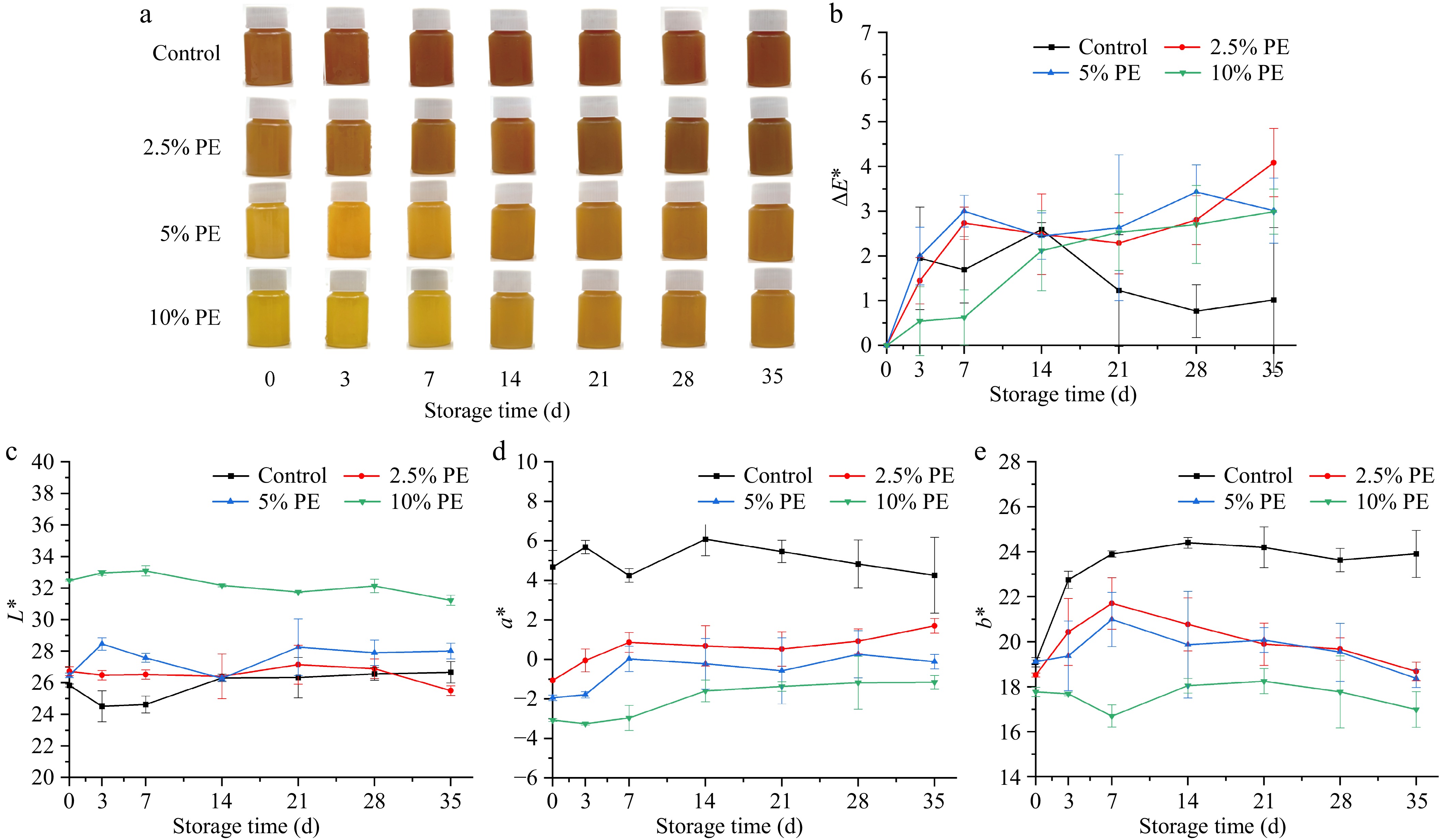
Figure 1.
Apparent color changes and chromatic difference analysis of apple juice treated with HPP after adding Phyllanthus emblica juice during storage for 35 d at 4 °C. Each experiment in the figure included three replicate groups.
The anti-browning effect of PE juice was most pronounced during the early stages of storage, likely owing to the initial high levels of reducing agents such as AA and phenols capable of reducing quinones or scavenging free radicals. As storage prolonged, however, this protective capacity diminished as these redox-active constituents were gradually consumed through oxidation, polymerization, and incorporation into high-molecular-weight or insoluble phenolic complexes[30]. Simultaneously, residual PPO/POD activity, along with the potential pro-oxidant behaviour of oxidized phenols, may have further contributed to the decline in anti-browning efficacy[18,31].
Color changes in apple juice under different treatments during 35 d of storage at 4 °C were evaluated using CIELAB parameters and total color difference (ΔE*). As shown in Fig. 1b–e, the control group on day 0 exhibited the lowest L* value (25.83 ± 0.10) and the highest a* (4.67 ± 0.85) and b* (19.10 ± 0.21) values, indicating a dark color with strong red-yellow saturation. In contrast, all PE-treated groups showed significantly higher L* and lower a* and b* values, particularly in the 10% PE group, indicating a brighter and more appealing color. By day 3, the control group displayed a rapid increase in b*, a decrease in L*, and a further rise in a*, resulting in darker coloration, intensified red-yellow tones, and noticeable browning (ΔE* = 1.95 ± 1.15). In comparison, color variation in the PE-treated samples was negligible (ΔE* < 2). By day 7, noticeable color changes (ΔE* > 2) appeared in the 2.5% PE and 5% PE groups, which maintained relatively stable L* values but displayed increases in a* and b*. By day 14, the 10% PE group exhibited significant browning (ΔE* > 2), characterized by a slight decline in L* and a continued increase in a*, whereas the color parameters of the control group stabilized (ΔE* < 2).
Throughout the 35-d storage period, L* values of all PE-treated groups fluctuated only slightly, while a* gradually increased and b* decreased after 14 d, indicating progressive reddening, increased blue, and browning. After 35 d, the 10% PE group maintained superior color quality, with L* (31.24 ± 0.32) being 0.17-fold higher than the control (26.66 ± 0.67), and a* (−1.16 ± 0.34) and b* (16.99 ± 0.79) being 1.27- and 0.29-fold lower, respectively. These variations in L*, a*, b*, and ΔE* were consistent with the visual appearance shown in Fig. 1. Overall, the color changes strongly suggested that residual enzymatic oxidation persisted in HPP-treated juice.
Notably, the PE supplementation levels tested here (2.5%–10%, v/v) represented practically relevant fortification ranges rather than merely laboratory-scale concentrations. Within this range, PE addition achieved effective anti-browning while maintaining acceptable physicochemical stability, supporting the feasibility of the HPP-PE strategy beyond proof-of-concept.
pH, total titratable acidity (TA), and total soluble solids (TSS)
-
As shown in Fig. 2a, on day 0, the pH of the 10% PE (3.55 ± 0.03) was 9.2% lower than that of the control (3.91 ± 0.12), while its TA (0.29% ± 0.00%) was 52.63% higher than that of the control (0.19% ± 0.02%) (Fig. 2b). These initial differences were primarily reflected the intrinsically lower pH and higher organic acid content of PE juice. As the proportion of PE increased, the pH of the blended juice shifted progressively toward that of pure PE juice. No significant differences in TSS were detected among treatments at day 0, indicating that the addition of up to 10% PE juice did not markedly modify the initial soluble-solids content of the apple juice matrix (Fig. 2c).
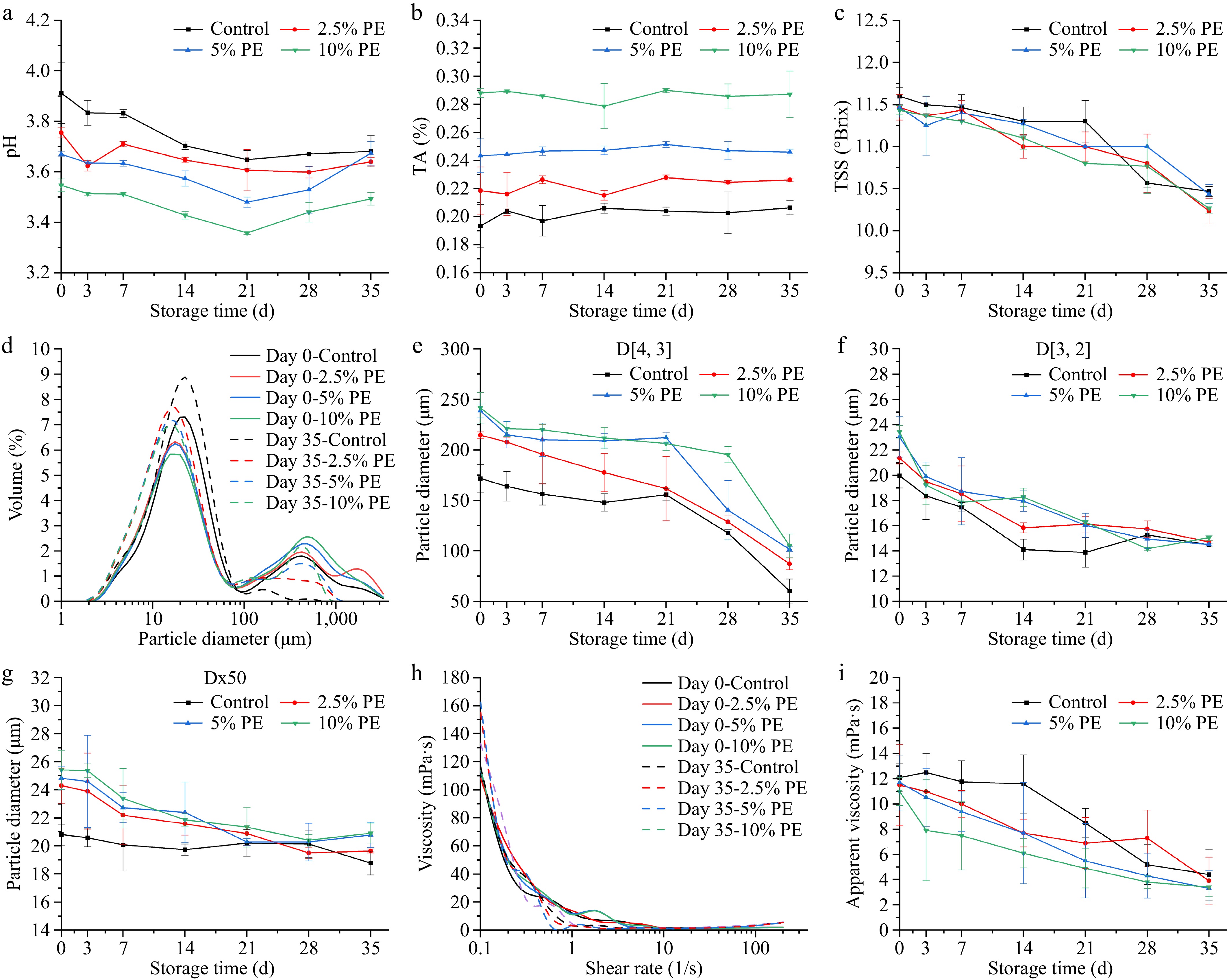
Figure 2.
Changes in pH, total titratable acidity (TA), total soluble solids (TSS), particle size distribution (PSD), particle diameters, and rheological properties of apple juice treated with HPP after adding Phyllanthus emblica juice during storage for 35 d at 4 °C. (a) pH; (b) TA; (c) TSS; (d) PSD; (e) volume-based mean diameter (D[4,3]); (f) surface-area-based mean diameter (D[3,2]); (g) mode diameter (Dx50); (h) changes of the apparent viscosity; and (i) apparent viscosity at the shear rate of 1 s−1. Each experiment in the figure included three replicate groups.
During storage, all samples exhibited a gradual decline in pH (ΔpH ≤ 0.23), which can be attributed to pectin hydrolysis releasing galacturonic acid, along with organic acid formation associated with residual microbial metabolism[32]. TA values remained relatively stable across treatments throughout storage. The modest TA variations may reflect the high maturity level of the apple and PE raw materials, as well as the limited metabolic and hydrolytic reactions. Among all treatments, the 10% PE group consistently exhibited the lowest pH and the highest TA. Regarding TSS, all samples showed a slight decrease during storage (ΔTSS ≤ 1.25 °Brix). In line with earlier studies, HPP does not achieve complete microbial inactivation; thus, the observed reduction likely reflects residual microbial activity leading to the consumption of sugars and other soluble nutrients over time[33].
Particle size distribution (PSD) and rheological properties
-
A stable cloudy juice typically contains small suspended particles (1–100 μm) capable of remaining dispersed over time, whereas larger particles (> 100 μm) tend to settle rapidly, resulting in turbidity loss and sediment formation[34]. The PSD profiles of the control and PE-treated samples (Fig. 2d) displayed a bimodal distribution. On day 0, the control group exhibited a dominant peak in the small-size region, indicating that most suspended particles were fine, accompanied by a secondary peak corresponding to a minor population of coarse particles. The PE-treated juices showed a similar bimodal distribution; however, they contained fewer fine particles and a higher proportion of large particles. With increasing PE concentration, the system pH decreased, thereby weakening electrostatic repulsion between particles and promoting aggregation into larger agglomerates, as reflected by a rightward shift of the large-particle peak toward larger diameters[35]. Concurrently, the lower pH and altered ionic environment likely induced a more compact pectin conformation, reducing its hydrodynamic size and charge density. This conformational change diminished pectin's ability to stabilize or bridge small flocs, facilitating their disruption into finer dispersed particles under shear and collisional forces, which contributed to a leftward shift of the small-particle peak toward smaller diameters[36]. After 35 d of storage, all groups exhibited an increased peak in the small-size region and a reduced peak in the larger-size region relative to day 0. This shift may be attributed to sedimentation and disruption of coarse aggregates, as well as storage-induced cell wall degradation, starch hydrolysis, and pectin solubilization, all of which contribute to the formation of finer, more stable cloud particles[37].
As shown in Fig. 2e–g, the 10% PE group displayed the highest Dx50 (25.43 ± 1.40 μm), D[3,2] (23.43 ± 0.51 μm), and D[4,3] (241.67 ± 15.18 μm) values on day 0, whereas the control group showed the lowest values for these indices. These results corroborate the PSD findings, confirming that higher PE concentrations promoted the formation of larger particle aggregates. During storage, all three size parameters declined across treatments, with D[4,3] showing the most pronounced reduction. Because D[4,3] is strongly influenced by the presence of large particles and aggregates, sedimentation or structural breakdown substantially impacts this parameter, whereas D[3,2] and Dx50, which reflect fine to medium-sized particles, are less sensitive to changes in the coarse fraction[38]. This trend aligns with previous findings in apple juice stored at 40 °C for 120 d, where turbidity loss and aggregation lead to decreases in particle-size indices[39].
As shown in Fig. 2h, all samples exhibited typical shear-thinning behavior, with apparent viscosity decreasing markedly as shear rate increased, indicative of pseudoplastic flow under shear. Viscosity differences among treatments were relatively small, though all groups showed a gradual decline in viscosity over 35 d. At a shear rate of 1 s−1 (Fig. 2i), apparent viscosity decreased progressively with storage, likely due to macromolecular degradation, dissociation of colloidal complexes, and residual enzyme-mediated pectin demethylation, which weakens intercellular cross-linking within the cell matrix[40]. PE-treated samples exhibited slightly lower apparent viscosity than the control, attributable in part to the low pectin concentration in PE juice, which reduces the strength of the continuous-phase polymer network. Furthermore, the lower pH of PE and noncovalent polyphenols–pectin interactions, such as hydrogen bonding and hydrophobic associations, may alter pectin conformation and intermolecular associations, thereby influencing rheological properties[41].
Despite minor fluctuations, viscosities of all samples converged to comparable levels by day 35. This convergence is consistent with the PSD results and suggests that the systems reached a dynamic equilibrium in which aggregation, sedimentation, and related colloidal processes approached a balanced state. Consequently, the structural determinants governing rheology stabilized, resulting in steady viscosity values. These findings were consistent with previous reports showing that juice viscosity is closely linked to PSD and compositional attributes; for instance, Kahraman et al.[42] observed that increasing filtration levels reduced suspended particle counts and particle size, thereby altering the apparent viscosity of apple juice.
Polyphenol oxidase (PPO) and peroxidase (POD)
-
As expected, the addition of PE juice markedly suppressed the activities of the browning-related enzymes PPO and POD in HPP-treated apple juice (Fig. 3). On day 0, the PE-treated groups showed significantly lower initial activities of both enzymes, and the extent of inhibition increased with rising PE concentration. In the 10% PE group, PPO and POD activities were reduced by 28% and 24%, respectively, relative to the control. During storage, PPO and POD activities in the control steadily declined, ultimately decreasing by 37% and 20% from their initial levels. A similar downward trend was observed in the PE-treated samples. By day 35, PPO and POD activities in the 10% PE group were 23.81% and 26.25% lower than those in the control, respectively, consistent with the reduced browning intensity observed in this group.
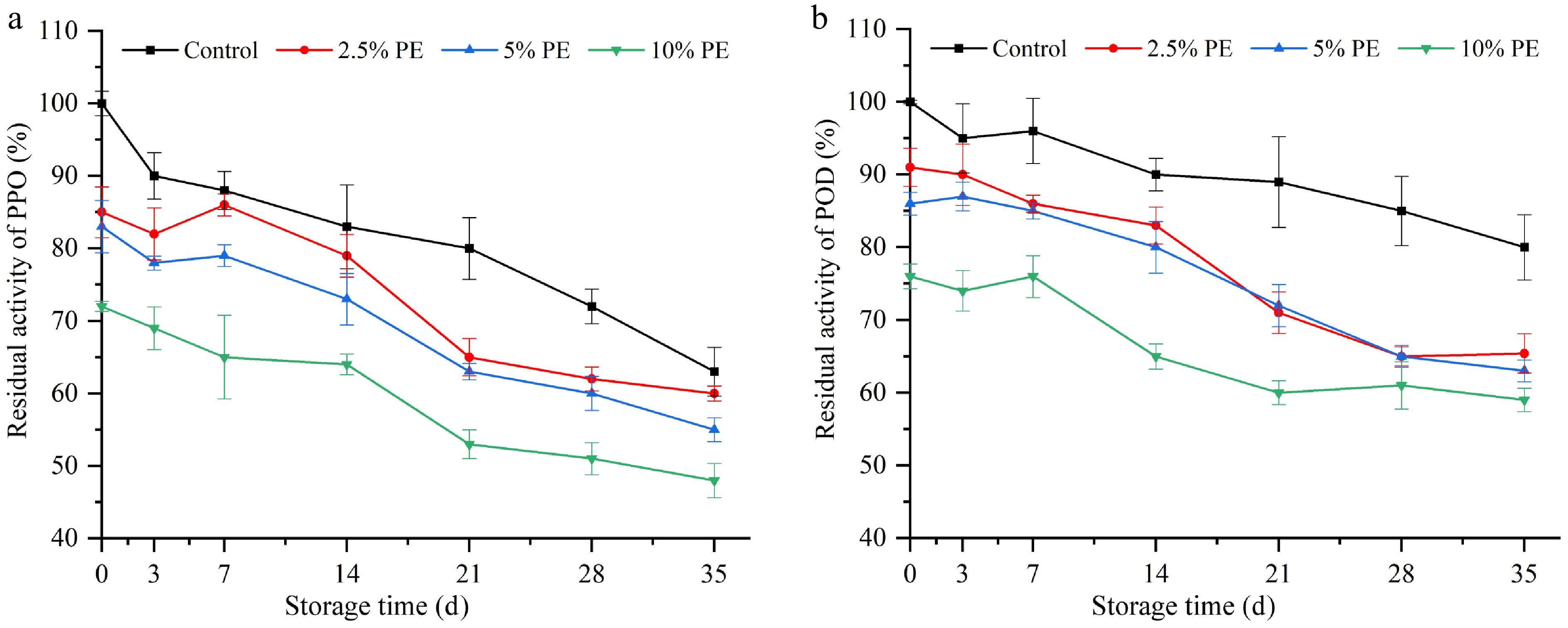
Figure 3.
Changes in (a) polyphenol oxidase (PPO), and (b) peroxidase POD of apple juice treated with HPP after adding Phyllanthus emblica juice during storage for 35 d at 4 °C. Each experiment in the figure included three replicate groups.
It should be noted that HPP (< 800 MPa) cannot completely inactivate PPO. For instance, white grape PPO retained 61.6% of its activity after treatment at 300–600 MPa, while mushroom PPO maintained around 60% activity even after exposure to 800 MPa for 10 min[43]. Therefore, the browning inhibition observed in PE-treated samples can be partly attributed to the phenolic-rich composition of PE juice, whose phenolics may competitively bind to the enzyme's active sites or reduce quinone intermediates[19]. As storage progressed, the gradual depletion or transformation of these phenols weakened their inhibitory effect, thereby contributing to enhanced browning over time.
Total vitamin C (VC)
-
VC plays a crucial role in maintaining color stability. As shown in Fig. 4, on day 0, the control group exhibited its intrinsic VC level (10.63 ± 0.01 mg/mL), with DHAA accounting for 8.53 ± 0.18 mg/mL, substantially higher than the AA fraction (2.10 ± 0.18 mg/mL). As a reducing agent, AA converts enzymatically generated o-quinones back to their corresponding diphenols, thereby inhibiting browning through a mechanism known as 'reaction deactivation'. However, this protective reaction occurs at the expense of AA[44]. Upon PE addition, the total phenolic load of the system increased, resulting in the formation of a greater amount of enzymatically generated quinones. Consequently, higher amounts of AA were required for quinone reduction, and both the rate and extent of AA depletion increased with increasing PE concentration. This explains the progressive decline in AA content with PE addition, which became undetectable at 10% PE. The DHAA content was jointly regulated by PE concentration and the concomitant pH reduction[45].
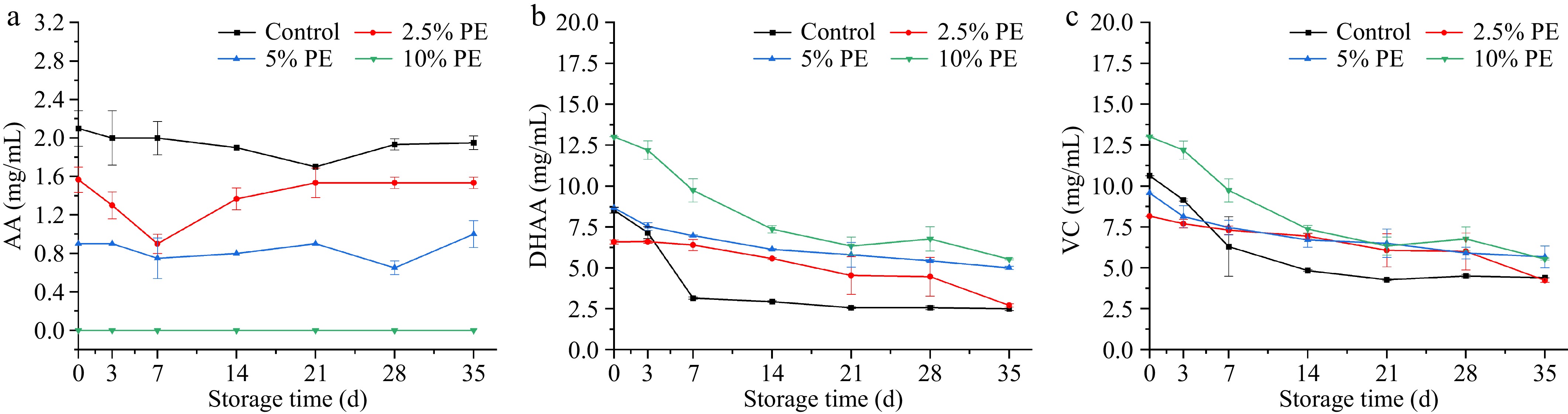
Figure 4.
Changes in (a) ascorbic acid (AA), (b) dehydroascorbic acid (DHAA), and (c) total vitamin C (VC) of apple juice treated with HPP after adding Phyllanthus emblica juice during storage for 35 d at 4 °C. Each experiment in the figure included three replicate groups.
Although the control group exhibited a higher pH than the 2.5% PE group, the latter did not show elevated DHAA levels, as DHAA behaves as a transient intermediate whose steady-state concentration is governed by the balance between its formation from AA and its further degradation[46]. At 2.5% PE, the modest pH decrease was insufficient to substantially stabilise DHAA, while the increased phenolic content enhanced oxidative and pro-oxidant reactions, thereby accelerating DHAA degradation to 2,3 diketo-gluconic acid. As a result, DHAA did not accumulate, and its concentration was even lower than that of the control despite the slightly reduced pH. In contrast, the 5% and 10% PE treatments markedly promoted AA oxidation through elevated phenolic-induced redox cycling while simultaneously lowering the pH into a range more favorable for DHAA stability, leading to pronounced DHAA accumulation despite the extensive AA depletion.
During storage, the decline in total VC content was slower in PE-treated samples than in the control, likely due to the antioxidant protection provided by PE phenolics, which can suppress oxidation of VC. Moreover, the slight pH reduction induced by PE addition may have further stabilized VC by decreasing its oxidative rate[47]. By the end of storage, no significant difference in total VC content was observed between the control and the 2.5% PE group, whereas the 5% and 10% PE treatments retained significantly higher total VC levels than the control (p < 0.05).
Antioxidants and antioxidant activity
-
As shown in Fig. 5a, b, the control group exhibited the lowest initial TPC (0.10 ± 0.00 mg/mL) and TFC (0.09 ± 0.02 mg/mL) on day 0, both of which gradually declined during storage, reflecting progressive oxidative and/or degradative loss. In contrast, supplementation with PE juice, which is rich in phenolic compounds and flavonoids, markedly enhanced both TPC and TFC in a clear dose-dependent manner. Among all treatments, the 10% PE group exhibited the highest TPC (1.45 ± 0.02 mg/mL) and TFC (0.43 ± 0.01 mg/mL), corresponding to 13.5- and 3.78-fold increases relative to the control, respectively. Over the 35-d storage period, TPC in the 10% PE group showed a slight downward trend, whereas TPC in the other PE-treated groups remained largely stable. This modest decline at higher concentrations may be attributed to mild oxidation, polymerization, or self-association of phenolic compounds during prolonged storage, leading to the formation of insoluble complexes[41]. The transient fluctuation in TFC observed at day 14 likely reflects an initial decrease caused by oxidative polymerization or complex formation, followed by a subsequent increase associated with acid-catalyzed hydrolysis of flavonoid conjugates during low-pH conditions[48].
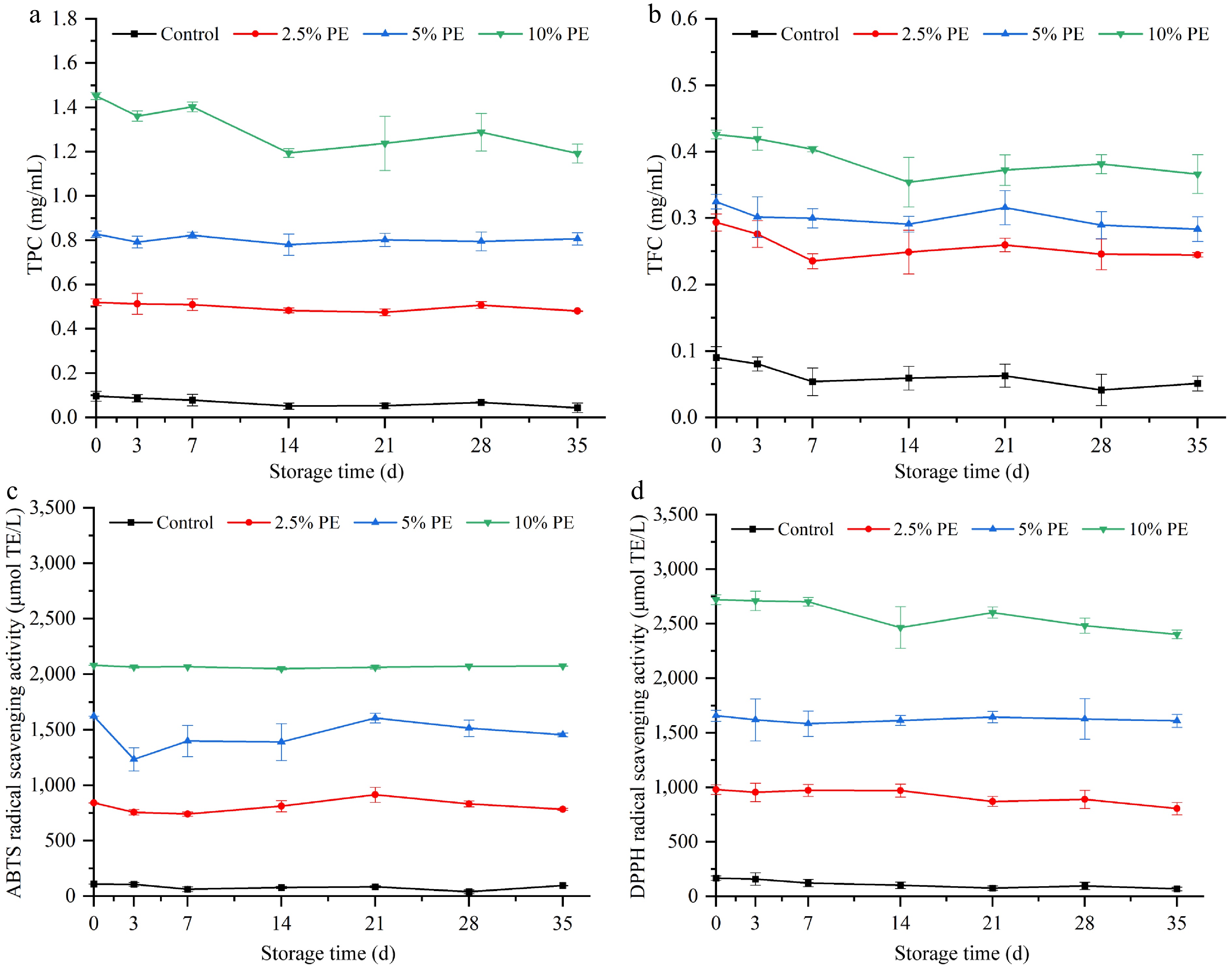
Figure 5.
Changes in (a) total phenolic content (TPC), (b) total flavonoid content (TFC), (c) ABTS, and (d) DPPH radical scavenging activities of apple juice treated with HPP after adding Phyllanthus emblica juice during storage for 35 d at 4 °C. Each experiment in the figure included three replicate groups.
These quantitative changes were consistent with the compositional patterns revealed by hierarchical clustering heat map analysis (Fig. 6), which clearly separated samples primarily according to PE concentration rather than storage time, indicating that PE fortification was the dominant factor shaping the phenolic profile. A cluster dominated by hydrolysable tannins and gallic/ellagic acid derivatives (e.g., geraniin, trigalloyl hexose, gallic acid, and ellagic acid glucoside) was virtually absent in the control group but increased progressively with PE concentration, reaching the highest relative abundances in the 10% PE group at both day 0 and 35, in line with the markedly elevated TPC. Conversely, a second cluster mainly comprising apple-derived phenolics, including phlorizin, phloretin-2'-O-xyloside, chlorogenic acid, and catechin, was most abundant in the control and decreased with increasing PE addition, reflecting dilution of the apple matrix as well as possible oxidative degradation and/or complexation with PE tannins during storage.
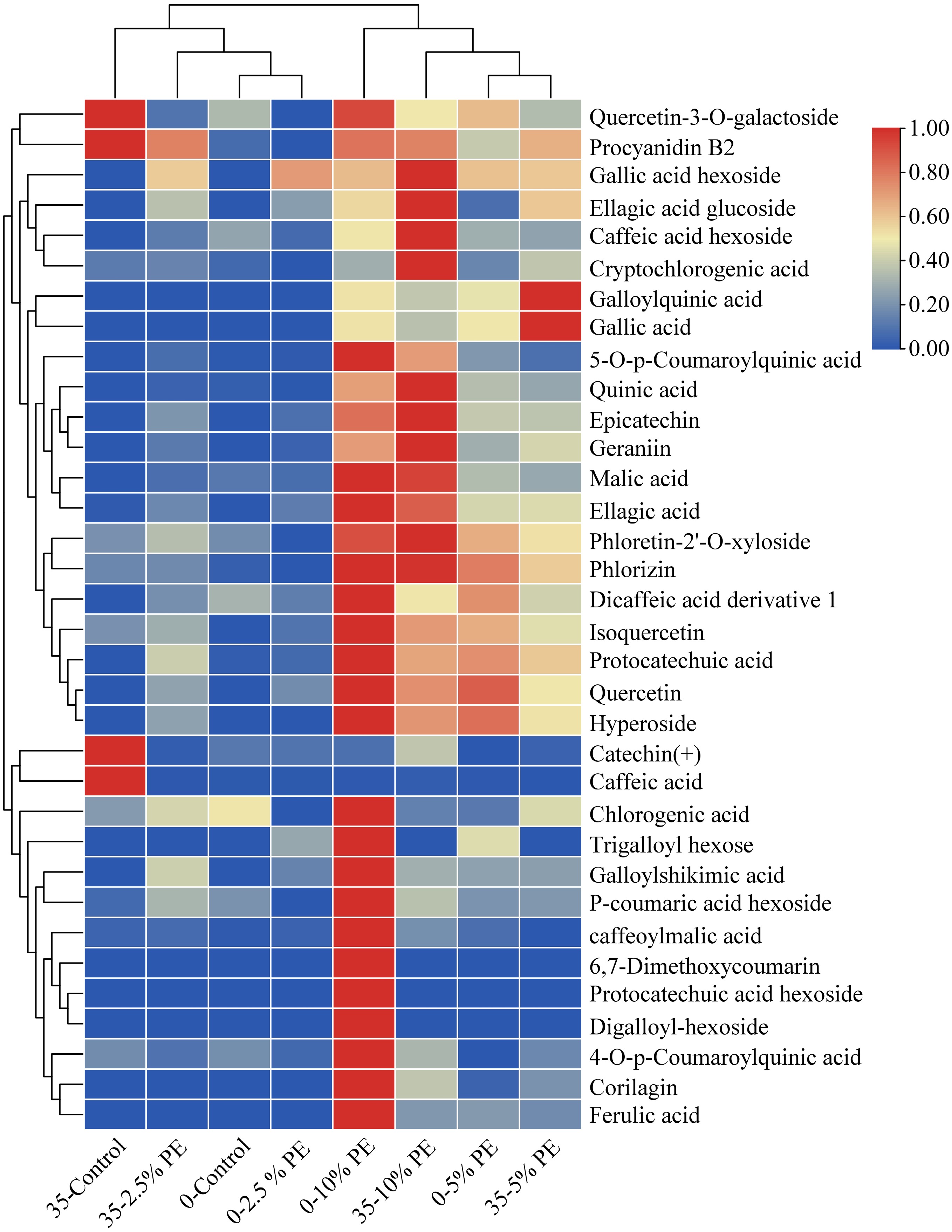
Figure 6.
Heatmap visualization of phenolics at day 0 and day 35 of apple juice treated with HPP after adding Phyllanthus emblica juice during storage for 35 d at 4 °C. The color intensity was based on a normalized scale from the maximum of 1 (red) to the minimum of 0 (blue), which indicated the abundance of the phenolics from high to low. Each experiment in the figure included three replicate groups.
Given the strong correlation between phenolic content and antioxidant capacity, changes in antioxidant activity were further evaluated (Fig. 5c, d). On day 0, the control group exhibited the lowest ABTS and DPPH radical scavenging activities (108.27 ± 0.05 and 166.41 ± 20.18 μmol TE/L, respectively), indicating the inherently limited antioxidant potential of apple juice. In contrast, PE-treated groups showed significantly higher antioxidant activities than the control, with a clear dose-dependent enhancement. Notably, the 10% PE treatment exhibited the strongest radical scavenging activities, with ABTS (2,082.08 ± 0.02 μmol TE/L) and DPPH (2,721.17 ± 43.97 μmol TE/L) values that were 18.23- and 15.35-fold higher than those of the control, respectively. Previous studies have shown that the high phenolic content of PE, particularly tannins, constitutes the primary source of its strong antioxidant activity, and that bound (non-extractable) phenols may be released under appropriate conditions, thereby contributing further to antioxidant capacity[49]. This likely explains the substantially enhanced antioxidant activity observed in PE-treated samples compared with the control.
During 35 d of storage, both ABTS and DPPH scavenging activities exhibited minor fluctuations but remained generally stable across all groups, consistent with the relatively stable TPC and TFC levels. The intrinsic stability of phenolic compounds under refrigerated conditions helps maintain antioxidant activity, while low temperature inhibits oxidation, thereby minimizing the degradation of antioxidant constituents. For instance, Kahraman et al.[42] reported that storage at 4 °C markedly slowed polyphenol oxidation, maintained DPPH scavenging activity at 82.81%, and kept ABTS scavenging nearly unchanged after 30 d. Moreover, PE is rich in hydrolyzable tannins such as gallic acid, which exhibit high stability under refrigerated conditions and may compensate for the partial degradation of other antioxidants, thereby sustaining overall antioxidant capacity.
Identification of phenolic compounds in PE
-
The chromatograms obtained from UHPLC-ESI-HRMS/MS analysis under negative ion mode revealed the phytochemical profile of PE juice (Fig. 7). Based on the combined results of Fig. 7 and Supplementary Table S1, a total of 21 phytochemicals were qualitatively identified in PE juice, including 20 phenolic compounds and one carboxylic acid. The phenolic compounds were categorized into nine phenolic acids, seven tannins, three flavonoids, and one pyranone. These findings were consistent with previous studies, which identified 24 phytochemicals in PE fruit extracts[26]. Among the detected compounds, ellagic acid, trigalloyl-hexoside, ellagic acid 4-O-β-D-glucoside, and geraniin exhibited the largest peak areas, suggesting that PE juice was particularly rich in phenolic acids and tannins, consistent with earlier findings. Liu et al.[50] identified six phenolic compounds in PE, including geraniin, while Rose et al.[51] reported 10 phenolic constituents in PE juice powder, mainly gallic acid and ellagic acid derivatives. These results collectively support the phytochemical profile observed in the present study. Such a composition provides strong chemical evidence for the potent antioxidant potential of PE juice.
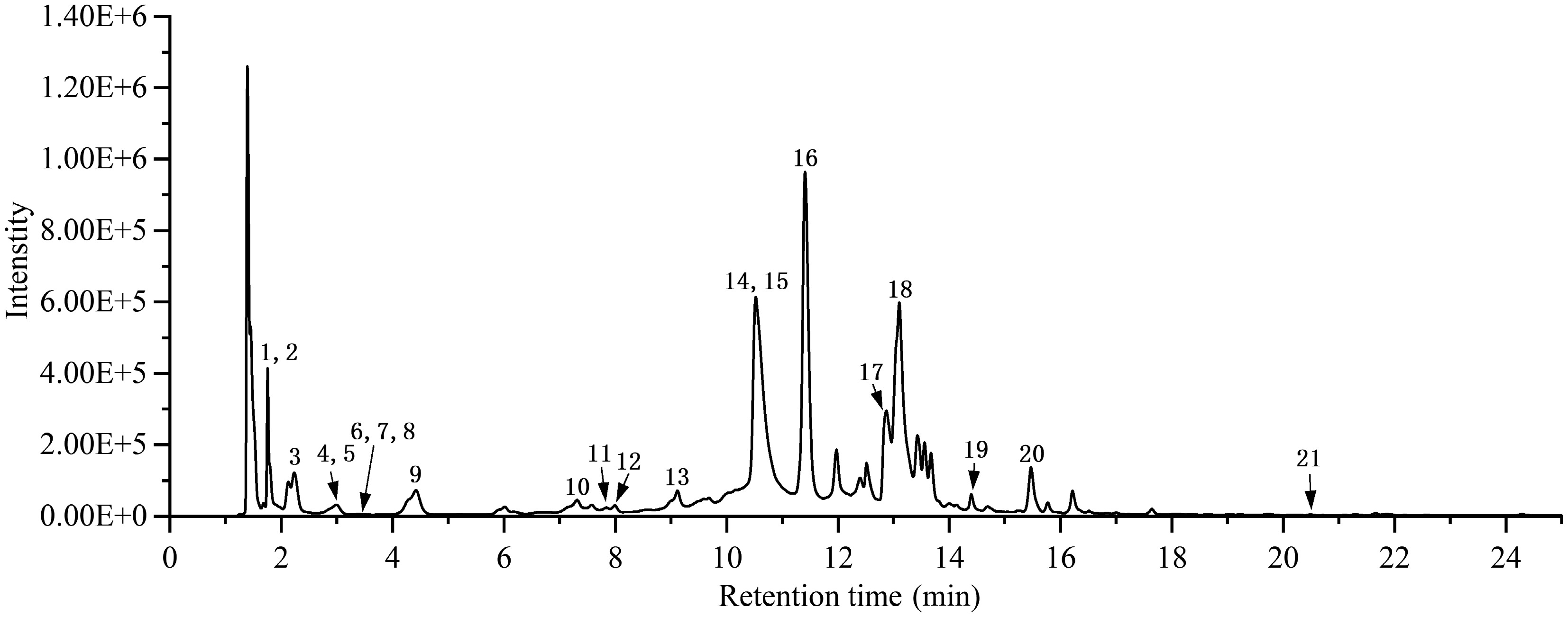
Figure 7.
The negative ion current chromatograms of the Phyllanthus emblica juice after HPP treatment.
Furthermore, phenolic compounds have been widely reported as natural enzyme inhibitors. Yu et al.[13] demonstrated that seven phenolic constituents from Rosa roxburghii juice effectively inhibited PPO activity, with quercetin showing the strongest inhibitory effect (IC50 = −29.5 μmol/L) in apple juice. Similarly, Hong et al.[52] reported that hesperetin, a dietary flavonoid, suppressed PPO activity by inhibiting the oxidation of L-tyrosine and L-dopa catalyzed by PPO. In addition, Aksoy[53] showed that natural phenols such as curcumin and quercetin effectively inhibited potato PPO activity. These findings collectively suggest that the phenolic constituents present in PE juice may likewise contribute to its anti-browning effect, not only by enhancing antioxidant capacity but also by directly modulating enzymatic browning reactions.
Molecular docking
-
Molecular docking simulations (Fig. 8; Supplementary Table S2) revealed that ellagic acid 4-O-β-D-glucoside, ellagic acid, geraniin, and trigalloyl-hexoside were all able to access and stably occupy the catalytic pocket of PPO, exhibiting relatively low binding energies indicative of stable ligand-enzyme complex formation[54]. Notably, the distribution of binding sites showed that these inhibitors predominantly targeted the hydrophobic pocket of PPO, an area enriched in hydrophobic and aromatic residues and widely recognized as a major anchoring domain for phenolic inhibitors[55]. Such binding patterns suggested that inhibition likely arose from direct occupation of the substrate-binding channel and steric obstruction of molecular oxygen or catechol substrates.
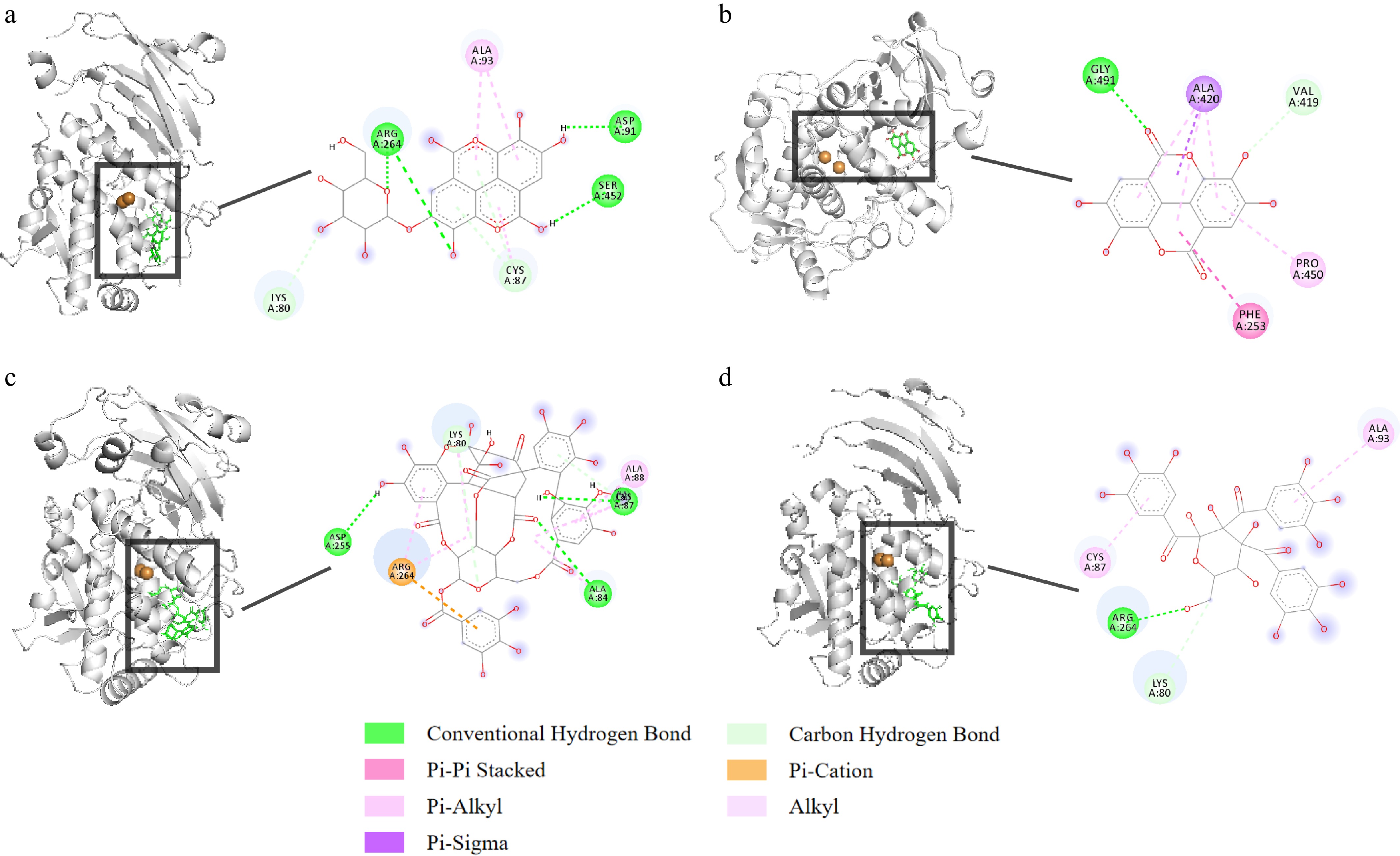
Figure 8.
Molecular docking results of (a) ellagic acid 4-O-β-D-glucoside, (b) ellagic acid, (c) geraniin, and (d) trigalloyl-hexoside with PPO.
Ellagic acid 4-O-β-D-glucoside presented the most structurally elaborate interaction profile, forming seven hydrogen bonds (with Arg264, Lys80, Cys87, Ser452, and Asp91), complemented by π-alkyl interactions with Ala93. The multiplicity and spatial complementarity of these hydrogen bonds indicate strong geometric compatibility between the ligand and the polar microenvironment of the PPO active site. This agrees with the general principle that an increased number of hydrogen bonds enhances binding affinity by improving polar complementarity at the protein–ligand interface[56]. Ellagic acid, by contrast, formed only two hydrogen bonds (Gly491 and Val419), with its binding predominantly stabilized through π−π stacking with Phe253 and π-alkyl/π−σ interactions with Pro450 and Ala420; its reduced hydrogen-bond capacity and stronger reliance on hydrophobic and π-based interactions imply a weaker binding affinity compared with ellagic acid 4-O-β-D-glucoside[57]. Geraniin demonstrated a more extensive interaction network, forming four hydrogen bonds (with Cys87, Ala84, Lys80, and Asp255), accompanied by multiple π-alkyl/alkyl contacts (with Arg264, Lys80, Cys87, and Ala84) and a π-cation interaction with Arg264. This combination of hydrogen bonding, hydrophobic packing, and electrostatic attraction reflects a multimodal binding pattern characteristic of high-affinity polyphenol–enzyme interactions. Similarly, trigalloyl-hexoside formed two hydrogen bonds (with Arg264 and Lys80) along with π-alkyl interactions involving Cys87 and Ala93.
Among all ligands, geraniin exhibited the greatest number and diversity of interactions, suggesting the strongest binding affinity and the highest inhibitory potential toward PPO[58]. Nithitanakool et al.[59] also demonstrated that pentagalloylglucopyranose (PGG) formed eight more hydrogen bonds than methyl gallate (MG) and gallic acid (GA), which corresponded to its superior tyrosinase-inhibitory activity.
-
This study demonstrated that the combination of HPP and PE juice addition effectively inhibited enzymatic browning and preserved the quality of NFC apple juice during 35 d of refrigerated storage. The combined treatments markedly reduced PPO and POD activities, delayed color deterioration, and maintained physicochemical stability, while simultaneously enhancing the retention of bioactive compounds and antioxidant capacity. Molecular docking revealed that key phenolics may strongly interact with the PPO active site through hydrogen bonding and ionic interactions, thus explaining their inhibitory effect. However, the current understanding of the enzyme inhibition mechanism of PE juice remains limited. Future studies should integrate enzyme inhibition kinetics, fluorescence quenching analysis, and molecular dynamics simulations to further identify the key active components, binding sites, and the interaction mechanisms between polyphenols and enzymes. Overall, the HPP-PE combination offers a promising clean-label approach to retard enzymatic browning, enhance nutritional and functional quality, and extend the shelf life of NFC apple juice. This strategy may further provide valuable insights for developing natural and additive-free preservation systems in fruit juice processing.
-
The authors confirm their contributions to the paper as follows: investigation, formal analysis, visualization, writing − original draft: Zhang X; data curation, methodology: Zhang X, Li Z, Zhu L; conceptualization, writing − review and editing: Zhang X, Zhou L; resources, supervision: Zhou L; funding acquisition: Yi J, Zhou L; project administration: Yi J. All authors reviewed the results and approved the final version of the manuscript.
-
The datasets generated during and/or analyzed during the current study are available from the corresponding author upon reasonable request.
-
The authors declare that they have no conflict of interest.
-
accompanies this paper online at: https://doi.org/10.48130/fia-0026-0030.
- Supplementary Table S1 Phytochemical compounds identified in the Phyllanthus emblica juice after HPP treatment by UHPLC-ESI-HRMS/MS in negative ion mode.
- Supplementary Table S2 The binding patterns and numbers of phenolic inhibitors in polyphenol oxidase (PPO).
- Copyright: © 2026 by the author(s). Published by Maximum Academic Press on behalf of China Agricultural University, Zhejiang University and Shenyang Agricultural University. This article is an open access article distributed under Creative Commons Attribution License (CC BY 4.0), visit https://creativecommons.org/licenses/by/4.0/.
-
About this article
Cite this article
Zhang X, Li Z, Zhu L, Yi J, Zhou L. 2026. High pressure processing combined with Phyllanthus emblica juice effectively inhibits enzymatic browning and enhances nutritional quality of NFC apple juice. Food Innovation and Advances 5(3): 419−431 doi: 10.48130/fia-0026-0030 

High pressure processing combined with Phyllanthus emblica juice effectively inhibits enzymatic browning and enhances nutritional quality of NFC apple juice
- Received: 24 March 2026
- Revised: 12 May 2026
- Accepted: 21 May 2026
- Published online: 26 August 2026
Abstract: This study investigated the combined effects of high-pressure processing and Phyllanthus emblica (PE) juice supplementation on enzymatic browning and nutritional quality of apple juice. All PE-treated groups delayed enzymatic browning. After 35 d, the 10% PE group showed a 0.17-fold higher L* value, and 1.27- and 0.29-fold lower a* and b* values, respectively. The HPP-PE treatment suppressed polyphenol oxidase (PPO) and peroxidase (POD), with 10% PE reducing initial PPO and POD activities by 28% and 24%, respectively, and remaining 23.81% and 26.25% lower by day 35. PE supplementation enhanced biofunctional activities. In the 10% PE group, total phenol and flavonoid contents increased by 13.5- and 3.78-fold on day 0, and by 28.75- and 6.4-fold on day 35, respectively. Correspondingly, ABTS and DPPH radical scavenging activities increased by 18.23- and 15.35-fold on day 0, and by 20.56- and 33.81-fold on day 35. Twenty phenols were identified in PE juice, predominantly ellagic acid, trigalloyl-hexoside, ellagic acid 4-O-β-D-glucoside, and geraniin. Molecular docking indicated that hydrogen bonding and ionic interactions were the key forces inhibiting PPO activity. By integrating high-resolution metabolite profiling with molecular docking, this study elucidated the structure–function relationships underlying PE-derived browning inhibition, offering a mechanistically grounded, clean-label strategy for NFC juice preservation.