












-
Cryopreservation of semen is a cornerstone technique in animal breeding and genetic resource conservation, enabling the long-term storage and distribution of superior male genetics[1]. However, the freeze-thaw cycle during cryopreservation exposes sperm to oxidative stress, which can impair structural integrity and reduce motility, viability, membrane stability, and fertilizing ability[2]. This effect is mainly due to the generation of reactive oxygen species (ROS), which cause lipid peroxidation of the plasma membrane, DNA fragmentation, and depletion of intracellular antioxidant reserves[3].
To mitigate cryodamage, extenders are frequently supplemented with antioxidants such as vitamin E, glutathione, or catalase[4−6]. Among natural antioxidants, green tea (Camellia sinensis) extract (GTE), rich in polyphenolic catechins, notably epigallocatechin-3-gallate (EGCG), demonstrates potent ROS-scavenging activity, metal-chelation capacity, and upregulation of endogenous antioxidant enzymes[7,8]. In addition, green tea is a rich source of anthocyanins, gallic acid derivatives, tannins, and essential vitamins such as vitamins C and E. It also provides carotenoids and trace elements, including selenium and zinc, which contribute to various physiological functions. Its other biologically active compounds comprise tea polyphenols, such as catechins, flavanols, flavanones, glycosides, phenolic acids, and pigment aglycones, along with caffeine, saponins, and amino acids[9]. In bovine and caprine semen, the incorporation of green tea extract (GTE) into semen extenders has been reported to enhance sperm motility and membrane integrity while lowering malondialdehyde (MDA) concentrations[10,11].
The use of nanoparticle-based delivery systems has gained increasing attention as a strategy to enhance the bioavailability and cellular absorption of antioxidant compounds. Compared with conventional GTE, chitosan nanoparticle encapsulation increases the surface-area-to-volume ratio, enhances aqueous dispersion stability, slows polyphenol release, and facilitates receptor-independent endocytosis into sperm cells[12]. These properties allow nano green tea extract (NGTE) to deliver a sustained antioxidant load directly to the sperm plasma membrane during the freeze-thaw cycle, a potential delivery advantage not achievable with free GTE at equivalent concentrations. Elshamy[13] suggested that chitosan nanoparticle systems may influence ram sperm characteristics after cryopreservation. Meanwhile, GTE in its conventional form has also been evaluated in ram semen with some positive outcomes[14].
However, to date, no study has systematically investigated the dose-response relationship of chitosan-encapsulated NGTE in a Tris-soybean lecithin (TSL) extender for ram semen cryopreservation, particularly with respect to computer-assisted sperm analysis (CASA)-derived sperm kinematics and concurrent antioxidant indices. Therefore, the present study was designed to address this gap by evaluating the effects of four concentrations of NGTE (50–200 μg/mL) in comparison with an untreated control on the post-thaw quality of ejaculated ram semen. Specifically, sperm motility was assessed using CASA, in addition to viability, membrane integrity, morphology, antioxidant indices (total antioxidant capacity [TAC] and MDA), and enzyme leakage markers (aspartate aminotransferase [AST], the release of alanineaminotransferase [ALT], and [lactate dehydrogenase] LDH). We hypothesized that an optimal intermediate dose of NGTE would enhance antioxidant defense, reduce cryo-induced oxidative damage, and consequently improve sperm membrane integrity, motility, and overall cryosurvival compared with the control extender.
-
Between August 2024 and February 2025, the experiment was conducted at the Animal Production Research Station in Karada, Kafr El-Sheikh Governorate, situated in Egypt's Northern Nile Delta (31°15′ N, 31°45′ E). The station operates under the supervision of the Animal Production Research Institute (APRI), part of the Agricultural Research Center (ARC), Ministry of Agriculture, Egypt. All animal procedures complied with the World Organization for Animal Health (WOAH) guidelines (Chapter 4.7 of the Terrestrial Animal Health Code, covering semen collection and handling in rams, small ruminants, and pigs) and followed the recommendations of Susilowati et al.[15]. Ethical approval was obtained from the College of Agriculture Committee for Animal Care, Tanta University, Egypt (Protocol No.: AY2019-2020/Session 6/2020.01.13–2025/12). All experimental techniques adhered to the Animal Research: Reporting of In Vivo Experiments (ARRIVE) guidelines, v2.0.
Preparation of NGTE
-
Green tea (Camellia sinensis) leaves were extracted with ethanol following the procedure described by Susilowati et al.[16]. The obtained extract was filtered and freeze-dried, then stored at −20 °C until use. Nanoparticles were synthesized using a chitosan coating technique as described by Sulistyo et al.[17] with minor modifications. Briefly, 0.5 mL of green tea extract was mixed with 0.5 mL of chitosan solution (pH 5.0) and vortexed for 20 s. Then, 0.03% sodium tripolyphosphate (TPP) solution was added as a crosslinking agent, and the mixture was vortexed again for 20 s. The resultant NGTE was stored at 4 °C in a dark container until further use.
The physicochemical properties of the synthesized NGTE were characterized using Dynamic Light Scattering (DLS) and Transmission Electron Microscopy (TEM). NGTE nanoparticles were examined by TEM (JEOL-JEM-2100, Japan), confirming spherical, welldispersed particles with sizes of 40–100 nm (Fig. 1). Hydrodynamic size and zeta potential were measured using a Zetasizer Nano ZS (USA). DLS showed a mean diameter of 83.6 nm with a low PDI (0.18) and a zeta potential of −28.7 mV, indicating good uniformity and stability. Encapsulation efficiency was 78.4%, and nanoparticles remained stable at 4 °C for 30 d with minimal changes. These properties confirm the suitability of NGTE for use in sperm cryopreservation.
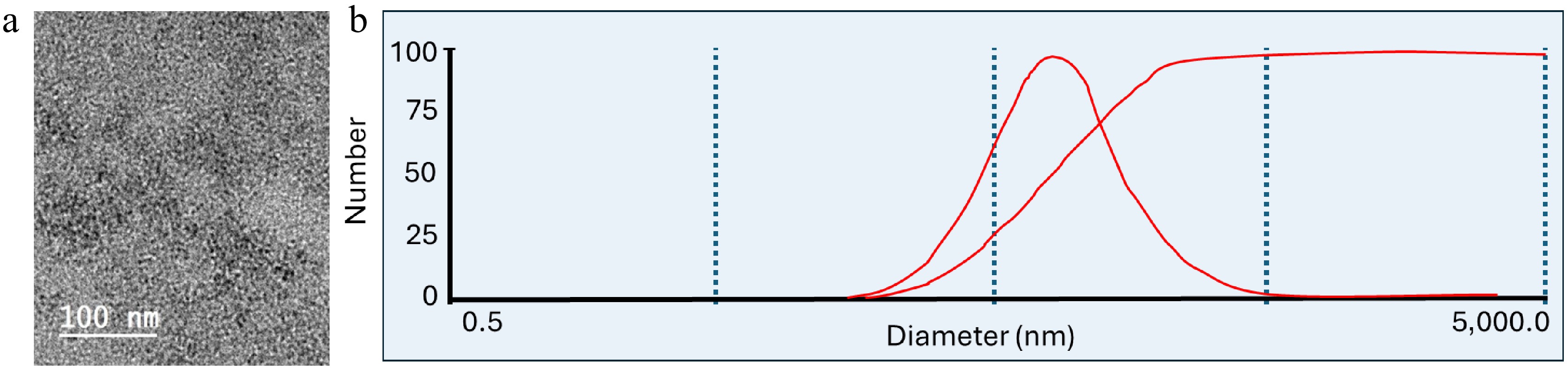
Figure 1.
The physicochemical characteristics of the synthesized NGTE were analyzed using transmission electron microscopy (TEM) and dynamic light scattering (DLS). (a) The TEM image shows the morphology and particle distribution, while the (b) DLS profile presents the log-normal particle size distribution.
Extender preparation and experimental design
-
The extender was prepared using a TSL base. Specifically, 3.025 g of Tris, 1.66 g of citric acid monohydrate, and 1.25 g of glucose were dissolved in distilled water, followed by the addition of 1% soybean lecithin, 7% glycerol, lincomycin (100 µg/mL), and streptomycin (100 µg/mL). The stability of NGTE within the glycerolated extender was confirmed by DLS analysis immediately after preparation, which showed no signi-ficant change in mean particle diameter (85.1 ± 3.9 vs 83.6 ± 4.2 nm pre-mixing; p > 0.05), indicating that glycerol did not induce nanoparticle aggregation under the conditions used. The final volume was adjusted to 100 mL with distilled water, resulting in an extender with a pH of 6.8–7.0 and an osmolarity ranging from 280 to 300 mOsmol/L. Ejaculated semen was allocated into five groups: a control without supplementation and four experimental groups supplemented with NGTE at concentrations of 0 (control), 50, 100, 150, and 200 μg/mL. These concentrations were selected based on reports that GTEs in conventional or nano form exert beneficial effects on post-thaw sperm quality[14,18]. The extended semen was loaded into 0.25 mL mini-straws (IMV, France), equilibrated at 5 °C for 4 h, frozen in liquid nitrogen (−196 °C) for 1 week, and then thawed at 37 °C for 30 s before evaluation.
Semen collection and processing
-
Semen was collected from five healthy Ossimi rams (2–4 years old; 70–80 kg) maintained under consistent housing and feeding conditions. Using a sterilized artificial vagina maintained at 42–45 °C, ejaculates were obtained once weekly over a period of 10 consecutive weeks. Each ejaculate was immediately assessed for volume, sperm concentration, motility, and morphology. Only samples with progressive motility ≥ 75%, viability ≥ 80%, abnormal morphology ≤ 15%, and sperm concentration ≥ 2.5 × 10⁹/mL were selected for inclusion in the study.
To minimize individual variability, selected ejaculates were pooled and diluted with the extender at a 1:20 ratio (semen:extender), yielding a final sperm concentration of 125–150 × 106/mL. This provided approximately 30–40 × 106 sperm per 0.25 mL straw, suitable for ovine artificial insemination. The diluted semen was loaded into 0.25 mL mini-straws (IMV, France), equilibrated at 5 °C for 4 h, and then cryopreserved by initial exposure to liquid nitrogen vapor (−140 °C) for 10 min, followed by immersion in liquid nitrogen (−196 °C) for at least 1 week. For evaluation after thawing, straws were thawed at 37 °C for 30 s.
Semen evaluation
Conventional semen parameters
-
Progressive motility of sperm was evaluated by first diluting 10 μL of semen in 1 mL of 0.9% (w/v) NaCl. A drop of the resulting suspension was placed on a slide, and 100 spermatozoa were examined at 400× magnification using a phase-contrast microscope (Olympus BX-53, Tokyo, Japan) with a warming stage maintained at 37–38 °C. Sperm viability was assessed using the eosin-nigrosin staining technique[19]. For this, frozen-thawed semen was mixed with pre-warmed stain, smeared onto a clean slide, and air-dried. Under microscopic observation, live sperm remained unstained, whereas dead sperm took up the red stain. Approximately 300 sperm cells were counted per sample by scanning zig-zag fields across the smear. Sperm abnormalities were assessed on the same slides by evaluating 300 spermatozoa for head (microcephalic, pear-shaped, short, loose, double) and tail (coiled, broken, terminally coiled, double) defects, expressed as percentages[20]. The integrity of the sperm plasma membrane was assessed using the hypo-osmotic swelling (HOS) test. In brief, 0.1 mL of semen was mixed with 1 mL of hypo-osmotic solution, consisting of 7.35 g sodium citrate dihydrate and 13.52 g fructose dissolved in 1 L of distilled water, and incubated at 37 °C for 30 min. Following incubation, 100 sperm cells were examined at 400× magnification. Sperm showing curled tails were interpreted as having intact membranes, while those with straight tails were considered damaged[16].
CASA
-
Sperm motility was evaluated using a CASA after thawing two straws from each treatment group at 37 °C. The CASA system was calibrated prior to analysis using manufacturer-recommended settings, with standardized illumination, focus, frame rate, and detection thresholds to ensure consistency and minimize operator bias. All analyses were performed using the same settings throughout the experiment. For each sample, around 200 spermatozoa were analyzed and classified into total motile, progressive, non-progressive, or immotile fractions. The CASA system recorded both distance-based and velocity-based kinematic parameters. Distance along the average path (DAP, µm), distance along the curved line (DCL, µm), and distance along the straight line (DSL, µm) represent cumulative displacement over a fixed analysis window of 1 s. Velocity parameters (VAP, VCL, VSL, in µm/s) represent time-normalized equivalents. Both parameter sets were reported to provide a comprehensive kinematic profile.
Total antioxidant capacity and enzyme activity of post-thawed sperm medium
-
Post-thaw semen samples were first centrifuged at 3,000 rpm for 10 min to pellet the sperm cells, and the resulting cell-free supernatant was collected for biochemical analysis. All assays were therefore performed on the extracellular medium fraction using commercial kits from Nanjing Jiancheng Bioengineering Institute (China). Antioxidant status was evaluated by measuring total antioxidant capacity (TAC) at 520 nm (Cat. No. A015-1) and MDA at 532 nm (Cat. No. A003-1) in the supernatant. Metabolic enzyme activities, including aspartate aminotransferase (AST) at 505 nm (Cat. No. C010-1-1), alanine aminotransferase (ALT) at 510 nm (Cat. No. C009-2-1), and lactate dehydrogenase (LDH) at 440 nm (Cat. No. A020-1-2), were also determined in the cell-free supernatant.
Statistical analysis
-
All data were processed using SPSS v23. Before analysis, data normality and homogeneity of variances were assessed using the Shapiro–Wilk and Levene’s tests, respectively. The experimental unit was a pooled ejaculate batch, prepared from the semen of five rams collected once weekly over 10 consecutive weeks, yielding 10 replicate batches per treatment group (n = 10). Each pooled batch was simultaneously allocated to all five treatment groups (control and NGTE at 50, 100, 150, and 200 µg/mL), so that all treatment comparisons were made within the same ejaculate batch. Comparisons of sperm quality parameters among the different nanoparticle treatment groups were performed using one-way analysis of variance (ANOVA), followed by Duncan’s multiple range test to identify significant differences. Results are presented as mean ± standard error, with statistical significance defined at p < 0.05.
-
As shown in Table 1, supplementation of the TSL extender with NGTE produced a significant (p < 0.05) enhancement in several semen quality parameters, both after equilibration and following thawing. Rams whose semen was extended with 100 μg/mL NGTE exhibited the highest progressive motility and membrane integrity values, accompanied by the lowest proportion of abnormal spermatozoa. Specifically, progressive motility increased by approximately 18%–22% over the control, while abnormal forms declined by nearly 30%. The positive effects of NGTE were concentration-dependent, with improvements becoming evident at 50 μg/mL and peaking at 100 μg/mL. However, at 200 μg/mL, these benefits were partially reversed, suggesting that excessive supplemen-tation might exert mild cytotoxic or osmotic stress effects on sperm cells.
Table 1. Post-equilibration and post-thaw sperm viability, membrane integrity, and abnormality (%) after NGTE supplementation.
Items Control NGTE50 μg/mL NGTE100 μg/mL NGTE150 μg/mL NGTE200 μg/mL Post-equilibration PM 75.30 ± 0.30e 84.80 ± 0.24b 85.70 ± 0.26a 82.40 ± 0.26c 80.10 ± 0.23d livb 76.30 ± 0.33e 85.90 ± 0.23b 86.70 ± 0.26a 83.50 ± 0.26c 81.20 ± 0.24d MbinT 76.50 ± 0.26d 86.80 ± 0.32a 87.10 ± 0.31a 84.20 ± 0.29b 82.20 ± 0.35c Abn 7.70 ± 0.26c 7.70 ± 0.15c 7.30 ± 0.15c 9.00 ± 0.2b 10.10 ± 0.31a Post-thawing PM 41.50 ± 0.22c 43.20 ± 0.32b 46.30 ± 0.21a 43.90 ± 0.27b 40.60 ± 0.22d livb 42.80 ± 0.24c 44.20 ± 0.29b 47.10 ± 0.27a 44.80 ± 0.29b 41.70 ± 0.21d MbinT 43.90 ± 0.27c 44.80 ± 0.32c 47.60 ± 0.26a 46.10 ± 0.31b 42.50 ± 0.40d Abn 20.70 ± 0.26b 17.10 ± 0.34c 16.30 ± 0.15d 21.10 ± 0.23b 22.70 ± 0.33a Values are presented as mean ± SE. Means within a row followed by different superscripts (a–e) differ significantly (p < 0.05). Abbreviations: NGTE = nano green tea extract; PM = progressive motility; Livb = livability; MbinT = membrane integrity; Abn = abnormality. Post-thaw motility fractions and total motility profile
-
The detailed distribution of motility fractions following thawing is presented in Table 2. Spermatozoa preserved with 100 μg/mL NGTE displayed the greatest proportion of rapid and progressive cells, as well as the highest total motility (p < 0.05). The rapid progressive velocity (RPV) and total progressive velocity (TPV) were increased by about 20%–25% relative to control samples, indicating improved energy status and flagellar activity. Meanwhile, the percentage of immotile sperm decreased significantly (p < 0.05) in all NGTE-treated groups, confirming the protective role of NGTE against cryogenic damage. In contrast, semen extended with 200 μg/mL NGTE showed slightly reduced motility fractions compared to the optimal 100 μg/mL level, reinforcing the dose-dependent response.
Table 2. Distribution of motility fractions (%) and progressive motility in frozen–thawed ram semen with NGTE.
Item Control NGTE50 μg/mL NGTE100 μg/mL NGTE150 μg/mL NGTE200 μg/mL RPV 25.40 ± 0.63c 27.50 ± 0.65b 33.80 ± 0.53a 27.20 ± 0.61b 22.50 ± 0.26d SPV 7.30 ± 0.55a 7.40 ± 0.45a 4.90 ± 0.31b 7.90 ± 0.31a 8.30 ± 0.26a TPV 32.70 ± 0.36c 34.90 ± 0.37b 38.70 ± 0.39a 35.10 ± 0.31b 30.80 ± 0.20d NPV 6.80 ± 0.24b 6.30 ± 0.15b 5.60 ± 0.26c 6.80 ± 0.20b 7.80 ± 0.20a TMY 39.50 ± 0.22c 41.20 ± 0.32b 44.30 ± 0.21a 41.90 ± 0.27b 38.60 ± 0.30d IMM 60.50 ± 0.22b 58.80 ± 0.32c 55.70 ± 0.21d 58.10 ± 0.27c 61.40 ± 0.22a Values are presented as mean ± SE. Means within a row followed by different superscripts (a–e) differ significantly (p < 0.05). Abbreviations: NGTE = nano green tea extract; RPV = rapid progressive; SPV = slow progressive; TPV = total progressive; NPV = non-progressive; TMY = total motility; IMM = immotile. CASA kinematic parameters
-
The effect of NGTE supplementation on sperm motion kinematics is illustrated in Table 3. Distance- and velocity-based parameters (DAP, DCL, DSL, VAP, VCL) were highest in the 150 µg/mL group, whereas overall sperm viability, progressive motility, and antioxidant capacity (TAC) were maximized at 100 µg/mL, with reduced MDA levels (Table 1; Fig. 2). Beat-cross frequency (BCF) reached its highest, statistically equivalent values in both the 150 and 200 µg/mL groups. The amplitude of lateral head displacement (ALH) was particularly elevated at 50 μg/mL, indicating more vigorous sperm head movement at lower doses, whereas ALH at 200 µg/mL returned to a value statistically comparable to the control. Interestingly, the straightness (STR) and linearity (LIN) indices did not increase monotonically with NGTE concentration: both rose modestly at 50–100 μg/mL, declined toward control-like values at 150 μg/mL, and then increased sharply to their highest values of the entire experiment at 200 μg/mL. A similar pattern was observed for wobble (WOB), which was lowest (i.e., most stable trajectories) at 100–150 μg/mL but returned to control-like, high values at 200 μg/mL.
Table 3. CASA kinematic parameters of post-thaw ram sperm with NGTE.
Item Control NGTE50 μg/mL NGTE100 μg/mL NGTE150 μg/mL NGTE200 μg/mL DAP 16.60 ± 0.22d 20.20 ± 0.20b 27.20 ± 0.20a 19.70 ± 0.21b 17.60±0.26c DCL 24.40 ± 0.37e 28.80 ± 0.20c 29.80 ± 0.29b 34.00 ± 0.33a 26.30±0.21d DSL 11.40 ± 0.22d 13.30 ± 0.15b 13.40 ± 0.22b 15.70 ± 0.15a 12.40±0.16c VAP 40.00 ± 0.33d 46.20 ± 0.24b 46.10 ± 0.23b 54.80 ± 1.01a 43.80±0.46c VCL 57.90 ± 0.23d 72.90 ± 0.23b 72.70 ± 0.33b 82.60 ± 0.22a 63.10±0.34c VSL 24.90 ± 0.23d 31.80 ± 0.20b 30.60 ± 0.26c 34.70 ± 0.36a 32.10±0.37b STR 62.26 ± 0.50c 68.84 ± 0.47b 66.39 ± 0.65b 63.32 ± 1.5c 73.32±0.89a LIN 43.01 ± 0.43bc 43.62 ± 0.20b 42.09 ± 0.42c 42.01 ± 0.47c 50.89±0.72a WOB 69.09 ± 0.67a 63.37 ± 0.31c 63.42 ± 0.39c 66.35 ± 1.28b 69.44±0.92a ALH 4.50 ± 0.16b 5.20 ± 0.20a 5.00 ± 0.21ab 3.70 ± 0.15c 4.49±0.17b BCF 14.80 ± 0.24c 18.20 ± 0.24b 17.80 ± 0.24b 23.30 ± 0.33a 23.10±0.27a Values are presented as mean ± SE. Means within a row followed by different superscripts (a–e) differ significantly (p < 0.05). Abbreviations: CASA = computer-assisted sperm analysis; NGTE = nano green tea extract; DAP = distance average path (µm); DCL = distance curved line (µm); DSL = distance straight line (µm); VAP = velocity average path (µm/s); VCL = velocity curved line (µm/s); VSL = velocity straight line (µm/s); STR = straightness (VSL/VAP, %); LIN = linearity (VSL/VCL, %); WOB = wobble (VAP/VCL, %); ALH = amplitude of lateral head displacement (µm); BCF = beat cross frequency (Hz). Sperm morphology and abnormal forms
-
As summarized in Table 4, NGTE addition notably improved the proportion of morphologically normal spermatozoa (p < 0.05). The extender containing 100 μg/mL NGTE yielded the highest percentage of normal forms, while the 200 μg/mL treatment showed the lowest percentage of normal forms and increased head and tail abnormalities, suggesting a biphasic effect at higher doses. Conversely, 100 μg/mL supplementation resulted in balanced improvement, maxi-mizing normal morphology while minimizing specific abnormalities. These findings indicate that NGTE enhances membrane stabilization during freezing and thawing, thereby preserving structural integrity.
Table 4. Sperm morphology: normal/abnormal forms and head/neck/tail abnormalities (%) after NGTE treatment.
Item Control NGTE50 μg/mL NGTE100 μg/mL NGTE150 μg/mL NGTE200 μg/mL NFm (%) 77.3 ± 0.26c 80.9 ± 0.34b 81.7 ± 0.15a 76.9 ± 0.23c 75.3 ± 0.33d AFm (%) 22.7 ± 0.26b 19.1 ± 0.34c 18.3 ± 0.15d 23.1 ± 0.23b 24.7 ± 0.33a NAb (%) 7.3 ± 0.53b 6.5 ± 0.22c 6.7 ± 0.26c 8.2 ± 0.29ab 8.6 ± 0.40a HAb (%) 5.7 ± 0.30c 6.8 ± 0.20a 6.7 ± 0.21a 8.4 ± 0.34a 8.5 ± 0.40a TAb (%) 9.7 ± 0.74a 5.8 ± 0.24cd 4.9 ± 0.43d 6.5 ± 0.52bc 7.6 ± 0.49b Values are expressed as mean ± SE. Means within a row followed by different superscripts (a–e) indicate significant differences (p < 0.05). Abbreviations: NGTE = nano green tea extract; NFm = normal forms; AFm = abnormal forms; NAb = neck abnormalities; HAb = head abnormalities; TAb = tail abnormalities. Antioxidant indices and enzyme leakage
-
Figure 2 presents the effects of different concentrations of NGTE (0, 50, 100, 150, and 200 µg/mL) on antioxidant indices (TAC, MDA) and enzyme activities (LDH, AST, ALT) in post-thaw ram semen. TAC was significantly affected by NGTE supplementation (p < 0.05). The highest TAC value was observed at 100 µg/mL NGTE, which differed significantly from all other groups. The 150 µg/mL group showed a moderate but significantly lower TAC compared to 100 µg/mL, while the 50 µg/mL group exhibited a further reduction. Both the control and 200 µg/mL groups recorded the lowest TAC values, with no significant difference between them. MDA levels showed significant differences among treatments (p < 0.05). The control group exhibited the highest MDA concentration. Supplementation with 50, 100, and 150 µg/mL NGTE significantly reduced MDA levels compared to the control, with no significant differences among these three groups. In contrast, the 200 µg/mL group showed a significant increase in MDA compared to the intermediate NGTE levels, approaching the control value.
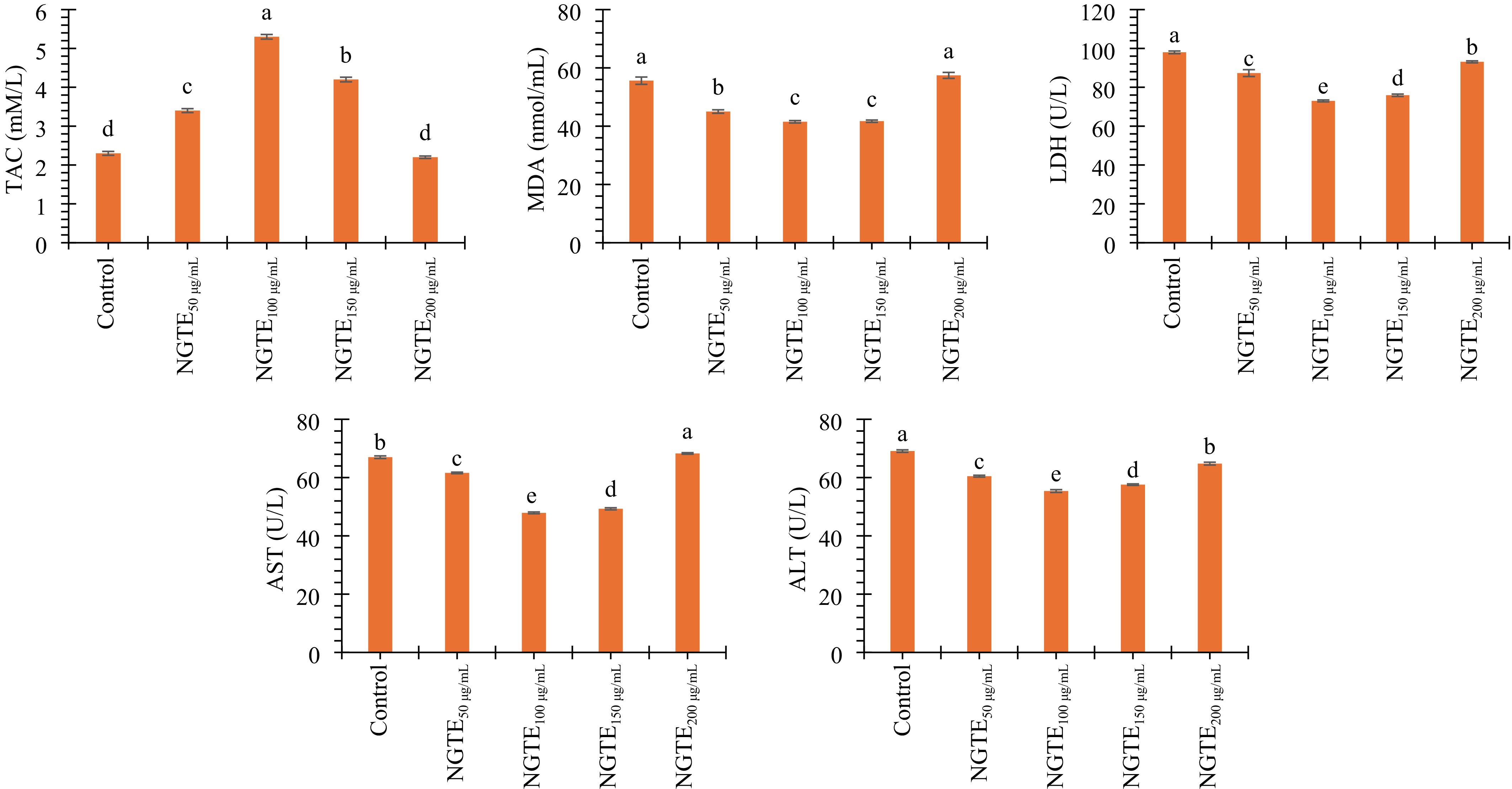
Figure 2.
Antioxidant indices and enzyme activities (TAC, MDA, AST, ALT, LDH) in post-thaw sperm medium with NGTE. NGTE = nano green tea extract; TAC = total antioxidant capacity; MDA = malondialdehyde; LDH = lactate dehydrogenase; AST = aspartate aminotransferase; ALT = alanine aminotransferase.
Lactate dehydrogenase (LDH) activity differed significantly among groups (p < 0.05). The control group had the highest LDH activity. All NGTE-treated groups showed significantly lower LDH levels than the control. The lowest LDH activity was recorded at 100 µg/mL NGTE, followed by 150 µg/mL, while 50 and 200 µg/mL treatments showed intermediate values, with 200 µg/mL significantly higher than 100 and 150 µg/mL. AST activity was significantly influenced by NGTE concentration (p < 0.05). The highest AST activity was observed at 200 µg/mL, followed by the control group. The 50 µg/mL treatment showed a moderate decrease compared to the control. The lowest AST activity was recorded at 100 µg/mL, with 150 µg/mL showing slightly higher but still significantly reduced values compared to the control. ALT activity also showed significant variation among treatments (p < 0.05). The control group exhibited the highest ALT activity. All NGTE-supplemented groups demonstrated significantly lower ALT levels than the control. The lowest ALT activity was observed at 100 µg/mL, followed by 150 µg/mL, while 50 and 200 µg/mL treatments showed relatively higher values among the treated groups, with 200 µg/mL significantly higher than 100 µg/mL.
-
Sperm quality is negatively affected by cryopreservation due to two main causes: disruption of the plasma membrane and mitochondrial dysfunction[21]. Particles with sizes ranging from 0.1 to 1,000 nm may now be created thanks to nanotechnology[22]. Higher chemical reactivity, improved cellular penetration, and greater biological activity are all displayed by nanoparticles (0.001 μm)[23]. They enhance the dispersion of active compounds within the medium and allow more accurate cellular targeting than microparticles[24]. GTE, rich in EGCG contains ortho-dihydroxy or keto-hydroxyl groups with strong anti-oxidant activity[12,25].
The findings show that supplementing the Tris extender with NGTE markedly enhanced ram semen quality. In particular, 100 μg/mL NGTE substantially improved post-equilibration and post-thaw sperm quality, as shown by increased progressive motility, viability, and membrane integrity, along with reduced sperm abnormalities.
Findings from previous studies in other species do fully align with the present results. Supplementation of chilled dog semen extenders with green tea polyphenols significantly maintained sperm motility and viability over a 4-week period[26]. Similar enhancements in motility were observed in boar semen and at low concentrations in human sperm with GTE[14]. In addition, Khan et al.[27] reported that enriching extenders with rosemary, a natural antioxidant, improved sperm plasma membrane integrity. Ali et al.[28] demonstrated that supplementing extenders with 0.5% GTE enhanced cryopreservation outcomes in cattle bull spermatozoa. Similarly, previous studies reported that significant improvements in semen quality of ram spermatozoa occurred when GTE was included in the ex-tender[29,30]. The protective effects of plant extracts during the freeze-thaw process have been reported in boar[31] and ram spermatozoa[32].
Moreover, chilled dog semen, supplemented with green tea polyphenols, preserved motility and viability for up to 4 weeks, while improvements in motility were also noted in boar and at low concentrations in human sperm. Moreover, supplementing boar semen cryo-extenders with GTE did not improve sperm motility, viability, acrosome integrity, or membrane stability[33]. Another study on chilled boar spermatozoa found no toxic effects of the GTE, yet semen quality parameters remained unchanged across treatments. Nevertheless, subsequent studies have yielded results inconsistent with ours, with evidence from other species indicating that supplementation with natural antioxidants does not invariably produce beneficial effects[34].
Macroscopic and microscopic assessments confirmed that fresh Simmental bull semen was suitable for cryopreservation. Sperm motility, which differs from viability since living cells are not always motile, whereas motile cells are inherently alive, is a key indicator of fertilizing potential[35]. Motility depends on ATP generated by mitochondria and the dynein motor of the flagellum, regulated by Ca2+ and cAMP signaling[36]. An intact plasma membrane is also essential, as it controls the exchange of substances between the intracellular and extracellular environments; damage to the membrane disrupts metabolism, reduces motility, and impairs fertilization capacity[37]. Cryopreservation-induced stress, including cold shock, ice crystal formation, and oxidative damage, is known to impair membranes, mitochondria, and chromatin integrity[38]. Wittayarat et al.[26] found that the addition of green tea polyphenols to extenders provided substantial protection to chilled dog spermatozoa, maintaining motility and viability for as long as 4 weeks.
CASA provides a modern and precise method for evaluating semen quality[39]. In the present study, supplementation with Tris–extender and NGTE significantly enhanced several motility traits, particularly rapid, slow, and total progressive motility. CASA analysis showed that supplementation of the Tris-extender with 100–150 µg/mL NGTE produced the greatest improvements in post-thaw sperm motility and velocity-based kinematic parameters, whereas 200 μg/mL resulted in the weakest overall motility response (Table 2) despite retaining, or even exceeding, control-level values for certain trajectory-shape parameters (STR, LIN, WOB, BCF; Table 3), a dissociation attributed to the stress-associated kinematic signature of the surviving subpopulation discussed above. Comparable findings of reduced overall motility with preserved or altered trajectory-shape indices at supra-optimal antioxidant doses have been reported in rabbit semen[40].
Concerning CASA parameters, progressive motility, particularly slow motility, serves as a useful predictor of sperm fertility, with both showing significant correlations with pregnancy outcomes[41]. Motility assessment remains a key element of semen evaluation in both routine diagnostics and experimental work. The use of CASA has improved the objectivity of such measurements, though its results may still be influenced by several external factors[42].
Camellia sinensis (green tea) is a rich source of dietary antioxidants, particularly polyphenols such as epicatechin, epicatechin gallate, epicatechin-3-gallate, epigallocatechin, and epigallocatechin gallate, which are known for their potent free radical-scavenging properties[43]. Beyond these compounds, green tea contains anthocyanins, gallic acid derivatives, tannins, vitamins C and E, carotenoids, and trace minerals including selenium and zinc[44], along with caffeine, amino acids, saponins, and a variety of other polyphenols such as catechins, flavanones, phenolic acids, and glycosides[45]. Research has demonstrated that green tea improves canine sperm quality during storage at 5 °C[26], and protects boar sperm from oxidative damage during the freezing process[31].
The assessment of CASA-derived motility parameters is recognized as a dependable predictor of rams' sperm fertility. Assessing sperm motion is essential, as it is closely linked with male fertility and is among the most compromised traits following cryopreservation[46]. Nevertheless, tracking sperm movement is technically challenging due to issues such as collisions, occlusions, and missed detections. Since motility enables sperm to progress from the site of deposition to the fertilization site, it remains a critical factor for artificial insemination[36], and an indispensable marker of sperm function. These findings are in line with previous studies that highlighted the role of antioxidants in preserving motility during cryopreservation[29,30].
In this study, adding 150 µg/mL of GTE to the Tris-extender significantly improved sperm parameters, including DCL, DSL, VAP, VCL, VSL, BCF, and STR, aligning with a previous report[47]. Contri et al.[48] observed that samples with higher sperm concentrations exhibited increased total motility, ALH, and velocity parameters (VAP, VCL), while showing a decrease in progressive motility and related indices such as PM, BCF, STR, and LIN. Similarly, Palacín et al.[49] observed increased motility and ALH but reduced progressiveness when more sperm were present per microscopy field. In contrast, velocity measures (VCL, VSL, VAP) declined as sperm density per field increased. This may be because fewer cells per field allow more natural movement, while higher densities increase collisions and trajectory reconstruction errors in CASA analysis, thereby altering kinematic values[48].
The important aspect relates to the objectivity of VCL vs the subjectivity of VAP measurements. The VAP parameter is influenced by the degree of trajectory smoothing, yet no standardized criterion exists for this low-pass filtering step. Consequently, different systems apply distinct approaches, potentially producing varying results from the same sample. This subjectivity also extends to parameters derived from VAP, such as ALH and BCF[50]. Different methods have been proposed: Hidayatullah et al.[51] applied a moving average filter with a fixed five-point window. Rojas et al.[52] used a Bezier Plane approximation, while Wilson-Leedy & Ingermann[53] adjusted the moving average filter size according to frame rate. In contrast, VSL is determined solely by the initial and final coordinates of a trajectory and can be directly validated by tracking performance. Therefore, when comparing results across different laboratories or CASA systems, caution is needed, since variations in acquisition settings may affect motility measurements. Parameters such as VAP, ALH, and BCF remain particularly sensitive to the type of smoothing filter applied, and no universal standard has yet been established[50].
Supplementation of the Tris-extender with NGTE on sperm normality parameters (CASA analysis) in post-thawed semen improved normal forms, abnormal forms, and tail abnormalities. Additionally, the Tris-extender supplemented with NGTE showed the highest percentage of viable spermatozoa. Spermatozoa with more than 20% abnormalities are unsuitable for fertilization[54]. Head defects, such as post-nuclear cap or acrosomal damage often arise during spermatogenesis or ejaculation and can lead to sterility, particularly in Friesian cattle[55]. Neck abnormalities, caused by heat stress or handling, may result in head–tail separation within the epididymis[56]. Severe structural defects, including short heads, truncated tails, or pseudo droplets from twisted necks, significantly reduce sperm viability when present at levels of 15%–50%[57]. High GTEs (15 mg/L) impaired sperm quality, while lower doses (5–10 mg/L) improved it[14].
The decline in sperm parameters at 200 µg/mL is likely attributable to pro-oxidant auto-oxidation of EGCG at suprathreshold concentrations, excessive ROS scavenging below the minimum required for flagellar activation, and pro-apoptotic signaling, consistent with the biphasic dose–response pattern documented for catechin-rich extracts[58,59]. Notably, this decline was most consistent across viability, membrane integrity, and antioxidant/enzymatic endpoints, whereas certain CASA trajectory-shape parameters (STR, LIN, WOB, BCF) remained elevated in the surviving sperm fraction at 200 µg/mL, a dissociation that further supports the interpretation of a stress-induced, hyperactivation-like motion pattern rather than a uniform recovery of function at this concentration. In other words, high levels of antioxidant supplementation may disrupt intracellular signaling mechanisms, since the elimination of ROS beyond the required threshold can impair normal sperm physiological functions[59]. EGCG, a primary bioactive compound in green tea, has been shown to inhibit the activation of pro-apoptotic genes while also decreasing the expression of anti-apoptotic genes[25]. Weinreb et al.[58] demonstrated that treatment with low doses of GTE promoted an anti-apoptotic gene expression profile, enhancing cell survival, while higher doses triggered pro-apoptotic expression, resulting in cell death across different cellular models.
Supplementation of the Tris-extender with NGTE at 100 μg/mL markedly enhanced the antioxidant status of post-thawed semen, as evidenced by increased TAC and improved enzyme profiles. This effect reflects the strong antioxidant properties of NGTE, which contribute to reduced lipid peroxidation and improved sperm membrane stability during cryopreservation. The decrease in MDA, AST, ALT, and LDH levels further supports its protective role against oxidative damage. These improvements are likely attributed to the catechin-rich polyphenols in GTE, which help mitigate oxidative stress generated during semen freezing and thawing across different animal models[14,27]. Although the exact mechanisms are not fully elucidated, it has been suggested that these polyphenols interact with sperm membrane components, thereby protecting lipids from ROS-induced peroxidation and preserving membrane integrity[60].
-
Supplementing a Tris-soybean lecithin semen extender with NGTE improved cryosurvival of ram spermatozoa in a dose-dependent manner, with 100 μg/mL producing the largest gains in progressive motility, viability, membrane integrity, and antioxidant status (increased TAC, reduced MDA) of post-thaw semen. These results indicate that NGTE can mitigate cryo-induced oxidative damage and enhance key CASA kinematic traits associated with fertilizing potential. However, higher NGTE doses (200 µg/mL) showed reduced benefits for overall motility, viability, and antioxidant status, even though certain trajectory-shape kinematic parameters remained elevated in the smaller surviving sperm fraction at this concentration. Despite the promising in vitro findings, several translational considerations merit attention. First, the chitosan-based synthesis protocol, while reproducible in laboratory settings, requires standardization for field-scale production to ensure batch-to-batch consistency. Second, the immunogenic potential of nanoparticles in the female reproductive tract following intrauterine insemination has not been evaluated and represents a safety priority for future research. Third, the regulatory classification of chitosan nanoparticles as a semen extender additive varies across jurisdictions and must be addressed prior to commercial application. Future studies should include: (i) in vivo pregnancy rate assessments via laparoscopic AI, (ii) evaluation of nanoparticle fate in the female reproductive tract, and (iii) economic analysis of NGTE production relative to conventional antioxidant additives.
This research received no external funding.
-
Ethical approval was obtained from the College of Agriculture Committee for Animal Care, Tanta University, Egypt (Protocol No.: AY2019–2020/Session 6/2020.01.13–2025/12). All experimental tech-niques adhered to the Animal Research: Reporting of In Vivo Experiments (ARRIVE) guidelines, version 2.0.
-
The authors confirm their contributions to the paper as follows: conceptualization: El Basuini MF, Abdellatif MA, Gabr SA; methodology, validation: El Basuini MF, Abdellatif MA, Yousif AI, Gabr SA; supervision: El Basuini MF; formal analysis: Abdellatif MA, Elsherbieny MA, Mohamed TM, Shehata AI; investigation: Abdellatif MA, Yousif AI, Elsherbieny MA, Mohamed TM, Shehata AI; data curation: Abdellatif MA, Yousif AI, Elsherbieny MA, Mohamed TM, Shehata AI; writing − original draft: Abdellatif MA, Mohamed TM, Shehata AI; writing − review andediting: El Basuini MF, Abdellatif MA, Yousif AI, Elsherbieny MA, Mohamed TM, Shehata AI, Gabr SA. All authors reviewed the results and approved the final version of the manuscript.
-
The datasets generated and/or analyzed in the current study are available from the corresponding author upon reasonable request.
-
The authors declare they have no conflict of interest.
- Copyright: © 2026 by the author(s). Published by Maximum Academic Press on behalf of Nanjing Agricultural University. This article is an open access article distributed under Creative Commons Attribution License (CC BY 4.0), visit https://creativecommons.org/licenses/by/4.0/.
-
About this article
Cite this article
El Basuini MF, Abdellatif MA, Yousif AI, Elsherbieny MA, Mohamed TM, et al. 2026. Nano green tea extract (NGTE) in a Tris-soybean lecithin extender improves post-thaw ram sperm motility, kinematics and antioxidant status. Animal Advances 3: e025 doi: 10.48130/animadv-0026-0013 

Nano green tea extract (NGTE) in a Tris-soybean lecithin extender improves post-thaw ram sperm motility, kinematics and antioxidant status
- Received: 01 April 2026
- Revised: 27 April 2026
- Accepted: 25 May 2026
- Published online: 11 September 2026
Abstract: The present study investigated the influence of incorporating nano green tea extract (NGTE) into a tris-soybean lecithin (TSL) extender on post-thaw sperm quality and antioxidant defense in ram semen. Ejaculates from healthy mature rams were obtained using an artificial vagina, pooled, and allocated into five experimental groups: a control (0 µg/mL) and four NGTE concentrations of 50, 100, 150, and 200 µg/mL. After dilution and equilibration, semen samples were cryopreserved and subsequently thawed to assess sperm motility, morphology, plasma membrane integrity, and motion characteristics through computer-assisted sperm analysis (CASA). Antioxidant markers, malondialdehyde (MDA), total antioxidant capacity (TAC), and the release of alanine aminotransferase (ALT), aspartate aminotransferase (AST), and lactate dehydrogenase (LDH), were also quantified. Supplementation with NGTE significantly (p < 0.05) enhanced post-thaw sperm viability, progressive motility, and membrane integrity relative to the control. The extender containing 150 µg/mL NGTE yielded the most favorable outcomes in sperm kinematic velocity traits, including velocities along the average path, curvilinear and straight-line trajectories, and beat-cross frequency, while the extender containing 100 µg/mL NGTE produced the greatest overall improvement in post-thaw viability, progressive motility, membrane integrity, and oxidative stability, evidenced by elevated TAC and decreased MDA concentrations. However, increasing NGTE to 200 µg/mL diminished these benefits, indicating an optimal response at moderate supplementation levels. In conclusion, supplementation of a TSL extender with NGTE at 100 µg/mL improved post-thaw semen quality by mitigating oxidative stress and preserving sperm membrane functionality. NGTE may serve as a natural antioxidant additive to enhance ram semen cryopreservation efficiency. Further research should include in vivo fertility assessment and detailed nanoparticle characterization to confirm its practical application.