










-
Meicha (Ampelopsis grossedentata), also known as vine tea, is a distinctive botanical resource for herbal tea native to the Wuling Mountain region of China. Rich in flavonoids such as dihydromyricetin (DMY), it is characterized by a notably astringent taste and exhibits significant bioactive properties, including antioxidant, anti-inflammatory, and lipid-lowering effects[1−3]. Due to these health-promoting qualities, it has become a preferred herbal beverage among consumers. Currently, Meicha products are processed using the yellow tea yellowing process, which effectively mitigates bitterness and astringency. However, the resulting infusion lacks distinct umami. Primary processed samples contain relatively high levels of characteristic grassy odor compounds, such as (Z)-6-nonenal and (E,Z)-2,6-nonadienal[4]. Previous studies have shown that high-temperature re-roasting of primarily processed Meicha reduces some of these grassy notes, yet the developed aroma quality remains far less appealing than the pleasant roasted and floral-fruity aromas typically formed during the re-roasting of oolong tea[5,6]. The deficiencies in both aroma and umami significantly limit the broader promotion and consumption of Meicha.
Fermentation with Eurotium cristatum has been shown to effectively improve the flavor quality of tea. During dark tea processing, fermentation using E. cristatum strain LJSC.2001 transforms the tea infusion taste from bitter and astringent to mellow and thick, accompanied by a pronounced fungal-flowery aroma[7]. Strain LJSC.2005 effectively modulates the tea infusion taste, converting the original floral, fruity, and smoky notes of the raw material into a rich and pure fungal-flowery aroma, while significantly increasing the variety of aroma components[8]. Strain LJSC.2006 enhances the content of volatile components in tea through metabolic transformation, increases the diversity of aroma substances, and promotes the formation of the characteristic fungal-flowery aroma[9]. Owing to differences in their metabolic enzyme profiles, different E. cristatum strains exert distinct regulatory effects on the sensory quality and volatile composition of tea infusion during fermentation[10]. Building on these findings, fermentation with E. cristatum was applied to Meicha, where it reduced its original bitterness, imparted a distinctive fungal-flowery aroma, attenuated the grassy notes, and developed characteristic floral-fruity notes[11]. However, it still lacks a pleasant nutty roasted aroma and pronounced umami. Therefore, the key to enhancing the taste quality and improving the palatability of Meicha lies in jointly optimizing the roasting and fermentation processes to develop both a rich roasted aroma and a pleasantly refreshing umami taste.
Molecular docking predicts the optimal ligand-receptor binding mode by simulating spatial conformation matching and calculating binding energy through chemometric approaches. A lower binding energy corresponds to a more stable complex conformation[12]. The T1R1/T1R3 heterodimer serves as the core taste receptor for umami perception. It is highly expressed in taste buds on the anterior tongue, and its functional mechanisms have been extensively characterized in the context of food-derived umami peptides[13,14]. In Longjing tea infusion, umami peptides initiate taste signal transduction by specifically binding to T1R1/T1R3. Free amino acids and other taste-active compounds interact with these peptides to collectively contribute to umami perception[15]. Maillard reaction products (MRPs), generated from various tea samples under high-temperature roasting, also bind specifically to T1R1/T1R3. This interaction stabilizes the complex structure, effectively enhancing receptor activity and intensifying umami sensation[16]. During Fu brick tea processing of different grades of Meicha materials, total amino acid content decreases, yet sensory evaluation still indicates a perceptible level of umami[11]. However, the molecular mechanisms underlying umami formation in the fermentation of high-flavonoid Meicha remain poorly understood.
Therefore, this study employed conventionally roasted Meicha as the control and introduced an additional high-temperature re-roasting treatment. Both the control and re-roasted samples were individually inoculated with either single strains of E. cristatum (LJSC.2001, LJSC.2005, or LJSC.2006) or a mixed culture of all three for the fermentation of loose Meicha, generating a series of fer-mented products. The influence of different fungal strains on the sensory quality and physicochemical characteristics of Meicha produced under the two roasting regimes was then systematically compared. Key umami-associated amino acids were screened by taste activity value (TAV) and orthogonal partial least squares-discriminant analysis (OPLS-DA). Furthermore, molecular docking was employed to analyze the binding sites of these amino acids with the T1R1/T1R3 receptor, thereby elucidating the molecular-level mechanism of umami perception mediated by amino acid compounds. These findings collectively provide a theoretical foundation for optimizing Meicha processing and enhancing its final quality.
-
The solvents, reagents, and reference standards were sourced from various commercial suppliers. Ninhydrin, anthrone, concentrated sulfuric acid, glucose, and other general chemical reagents were purchased from Sinopharm Chemical Reagent Co., Ltd (Shanghai, China). Acetonitrile, methanol, and formic acid (all chromatographic grade) were obtained from Anhui Tiandi High Purity Solvents Co., Ltd (Anhui, China). The reference standard dihydromyricetin (DMY, purity > 98%) was supplied by Sigma-Aldrich (St. Louis, MO, USA). Amino acid derivatization kits, 18 amino acid standards, and AccQ.Tag™ reagent (chromatographic grade) were sourced from Waters Technology (Shanghai) Co., Ltd (Shanghai, China).
Preparation of fermented Meicha
Roasting of Meicha
-
Conventionally roasted Meicha (sample C) was prepared from Grade 2 Meicha following DB43/T 2227-2021 (Yongshun Meicha Processing Technology Regulation). The roasting process was carried out at 100 °C for 10 min with a leaf spreading thickness of 3–5 cm. The leaves were initially dried until the moisture content reached 10%–15%, then removed and turned over once. After that, they were further dried until the moisture content fell below 7%, at which point the stems could be snapped when bent, and the leaves could be crushed into powder by hand. Finally, the roasted Meicha was taken out of the roaster and allowed to cool to room temperature. High-temperature re-roasted Meicha (sample R) was obtained by re-roasting sample C: initially roasted at 140 °C for 10 min, cooled to 110–120 °C, and then roasted at 120 °C for 15 min.
Activation and scale-up cultivation of strains
-
E. cristatum strains LJSC.2001 (L1), LJSC.2005 (L5), and LJSC.2006 (L6) were isolated from premium Fu brick tea and preserved on M40Y agar slants at the Key Laboratory of Tea Science of the Ministry of Education, Hunan Agricultural University. Each strain was cultured separately in PDA liquid medium to obtain spore suspensions (1 × 10⁶ – 1 × 10⁷ CFU/mL). Equal volumes of these suspensions were mixed (v/v 1:1:1) to prepare the mixed-strain fermentation (MF).
Inoculation and fermentation
-
Samples C and R were sterilized, hydrated to 15%–18% moisture, and inoculated with 15–18 mL per 100 g of Meicha using either the L1, L5, L6, or MF spore suspension. After thorough mixing, the samples were subjected to solid-state fermentation in a constant-temperature and humidity incubator (28 °C, 85% relative humidity) for 16 d. Following fermentation, the samples were dried at 50 °C to a final moisture content of 6%–7%, yielding eight fermented products: CL1, CL5, CL6, CMF, RL1, RL5, RL6, and RMF.
Sensory evaluation and quantitative descriptive analysis (QDA) of Meicha
-
A panel of 12 experienced tea scientists (six male, six female) evaluated all Meicha samples for appearance, aroma, tea infusion color, taste, and infused leaves per GB/T 23776-2018 (Tea sensory evaluation method) and T/ZMX 002-2020 (Zhangjiajie Ampelopsis grossedentata sensory evaluation standard).
QDA was conducted with reference to the characteristic keywords described by Li et al.[17]. Five taste descriptors (umami, fungal flavor, mellow, sweet, and astringent), and six aroma descriptors (fungal-flowery, floral, fruity, sweet, herbal, and roasted) were defined. Intensity of taste and aroma was scored on a 10-point scale, where '0' indicated absence, '2' represented weak, '5' denoted moderate, and '10' signified the strongest intensity. Each sample was infused and evaluated three times, and the average score was recorded as the intensity value for its taste and aroma profile.
Color difference measurement
-
Two grams of Meicha sample were weighed and infused with 250 mL of boiling distilled water at a 1:125 ratio for 4 min. After cooling to room temperature, the color parameters (L*, a*, b*) of the tea infusion were measured using a YS6003-TS colorimeter, with commercially available purified water as the blank. Higher L* values indicate greater brightness; a* values represent the red-green component (positive for red, negative for green); and b* values correspond to the yellow-blue component (positive for yellow, negative for blue).
Physicochemical components and DMY quantification
-
Meicha samples were ground, passed through a 40-mesh sieve, and the resulting powder was collected for analysis. Water-extract content was determined according to GB/T 8305-2013, and free amino acid content was measured following GB/T 8314-2013. Soluble sugar content was quantified by the anthrone-sulfuric acid colorimetric method using a UV-2600 UV-Vis spectrophotometer. DMY content was analyzed with an LC-20AT HPLC system according to the method of Liu et al.[18].
Amino acid profiling and taste activity value (TAV) calculation
-
The HPLC elution conditions for analyzing 18 amino acids were adapted from the method of de Sousa Fontes et al.[19]. Derivatization was carried out using a Waters ACCQ·Tag™ reagent kit. Chromatographic analysis was performed under the following conditions: a Waters ACCQ·Tag™ column (3.9 mm × 150 mm, 5 μm); detection at 248 nm; injection volume of 10 μL; column temperature of 37 °C; and a flow rate of 1.0 mL/min. Mobile phases consisted of (A) 10% ACCQ·Tag™ Eluent A, and (B) 60% acetonitrile. The gradient elution for mobile phase B was programmed as follows: 2% (initial), increased to 7% at 15 min, 10% at 19 min, 33% at 32 min, and 100% at 34 min (held for 3 min), then returned to 0% at 39 min to complete the run.
The TAV was calculated according to Warmke et al.[20] using the formula:
$ TAV = \frac{\text{C}}{\text{T}} $ (1) where, C is the compound concentration (mg/mL), and T is its taste threshold (mg/mL).
Homology modeling of umami receptor T1R1/T1R3
-
The amino acid sequences of T1R1 (UniProt: Q7RTX1) and T1R3 (UniProt: Q7RTX0) were obtained from the UniProtKB database. Homology modeling was subsequently performed on the SWISS-MODEL server, using the structure of the metabotropic glutamate receptor mGluR1 (PDB: 1EWK, Chain A) as the template. The quality of the generated model was validated with the SAVES v6.0 server. A Ramachandran plot was generated to visualize the distribution of backbone dihedral angles (φ/ψ), and residues were categorized into favored, allowed, generously allowed, and disallowed regions to evaluate the model's stereochemical quality[21].
Preparation of the 18 amino acid ligands
-
The 3D structures of 18 standard L-amino acids were downloaded from the PubChem database (
https://pubchem.ncbi.nlm.nih.gov ) in SDF or MOL2 format. To account for the influence of protonation state on electrostatic interactions at physiological oral pH (≈ 7.0), their most stable protonated forms and tautomers were generated using Open Babel. Next, Gasteiger atomic charges were assigned, and the structures were exported in pdbqt format for docking[22]. All amino acids were kept in their natural L-configuration to reflect their native state in tea and corresponding sensory properties.Molecular docking of amino acids with T1R1/T1R3
-
Semi-flexible molecular docking was carried out using AutoDock Vina 1.1.2, in which the ligand molecules were permitted conformational flexibility while the receptor was held rigid[23]. The resulting complexes were visualized and analyzed in PyMOL 2.5.7.
Data processing
-
All experimental data were obtained from three independent replicates and processed using Microsoft Excel 2019. Statistical analyses were performed in SPSS 27.0, and results are presented as mean ± SD. Visualizations including bubble matrix plots, radar charts, and clustered heatmaps were prepared using OriginPro 2021 and TBtools-II. Multivariate statistical analysis and corresponding graphics were generated with SIMCA 14.1 and the OmicStudio platform (
www.omicstudio.cn/tool ). -
Sensory evaluation was performed on conventionally roasted Meicha (C) and high-temperature re-roasted Meicha (R), which were fermented with individual spore suspensions (L1, L5, L6) and their mixed spore suspension (MF) of E. cristatum. Results revealed that all fermented samples exhibited a distinct fungal aroma, maintained a bright liquor color, and showed improved taste and thick mellowness (Supplementary Table S1). Fermented C group samples appeared yellowish-brown, while R group samples exhibited a deeper, dark yellowish-brown hue. Aromatically, CL1 combined floral-fruity notes with fungal character, whereas CMF presented a distinct herbal scent. In contrast, RL1 maintained a roasted aroma alongside fungal notes, and RMF displayed a more intense and persistent fungal aroma. In terms of taste, CL5 was sour and CL6 bitter in the C group, while RUF was sweet with a lingering aftertaste and RMF purely sweet in the R group. Following high-temperature re-roasting, RL5, RL6, and RMF showed reduced astringency alongside enhanced mellowness and umami. In summary, fermentation with individual or mixed (MF) spore suspensions yielded distinct aroma and taste profiles under each roasting treatment, with the MF mixture exerting the most pronounced and characteristic influence on the fermentation quality of the re-roasted (R) group.
To elucidate the taste characteristics of Meicha fermented with different strains of E. cristatum under two roasting treatments, QDA was employed to evaluate the tea infusion for umami, sweetness, mellowness, fungal flavor, and astringency (Fig. 1a; Supplementary Table S2). High-temperature re-roasting significantly altered the taste profile. Compared to CUF, RUF exhibited significantly elevated sweetness and umami intensity, along with a marked reduction in astringency. Although RL1 displayed a slightly more pronounced fungal flavor than CL1, it also showed significantly increased astringency, with no notable enhancement in umami or mellowness. CL5 marginally surpassed RL5 in umami, sweetness, and fungal flavor, while RL5 was slightly lower in mellowness; both shared similar astringency. RL6 achieved significantly higher ratings than CL6 in umami, sweetness, and mellowness, accompanied by a pronounced decrease in astringency. RMF exceeded CMF significantly in fungal flavor, umami, and mellowness, while displaying lower astringency. Collectively, these results demonstrate that combining high-temperature re-roasting with mixed-culture fermentation enhances fungal flavor and mellowness, thereby increasing overall taste complexity.
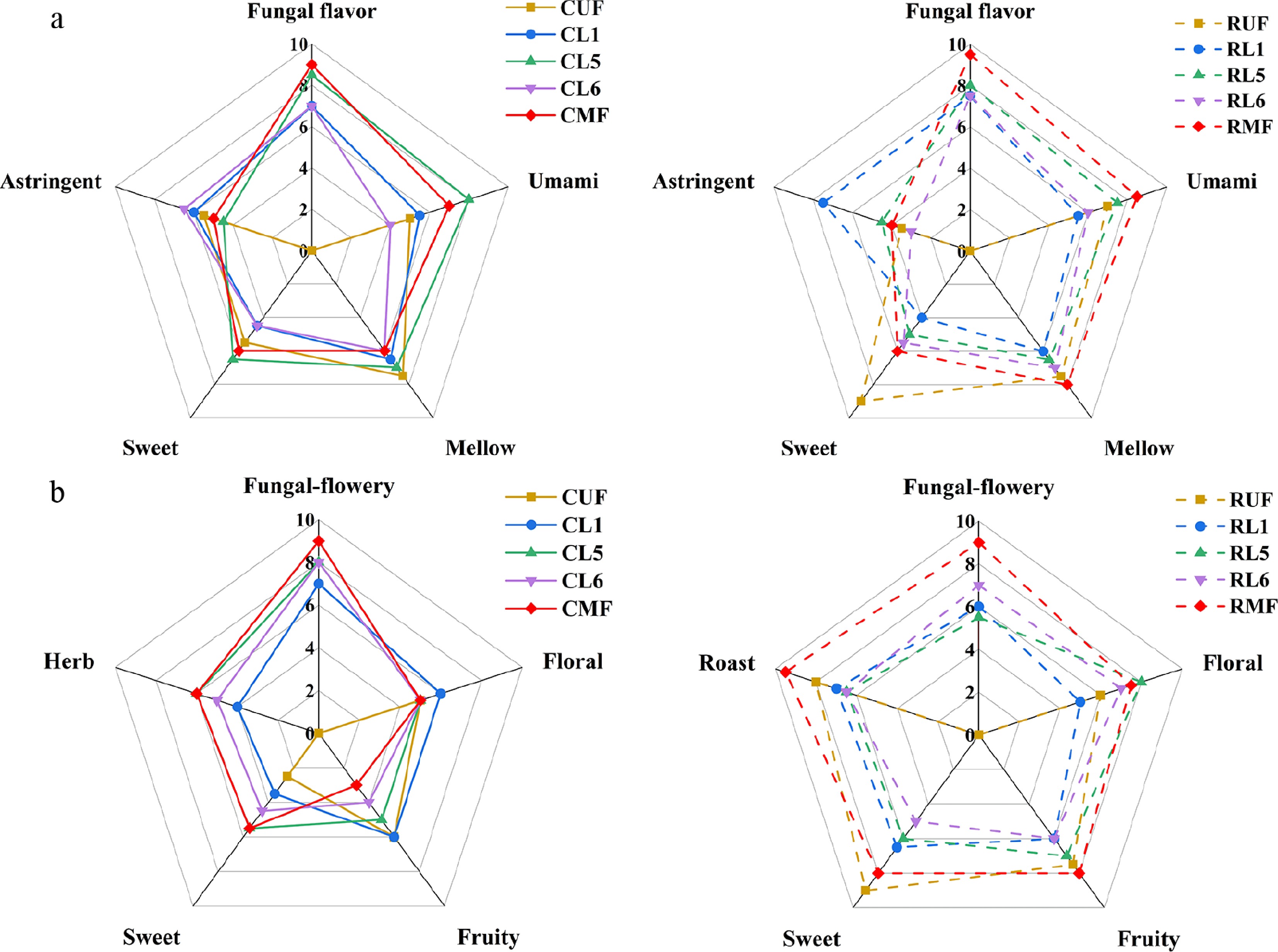
Figure 1.
QDA of loose Meicha fermented with E. cristatum under different roasting treatments. (a) Taste profiles. (b) Aroma profiles. C and R represent conventionally roasted and high-temperature re-roasted Meicha, respectively. For conventionally roasted Meicha: CUF (unfermented), CL1 (LJSC.2001-fermented), CL5 (LJSC.2005-fermented), CL6 (LJSC.2006-fermented), and CMF (mixed-strain-fermented). For high-temperature re-roasted Meicha: RUF (unfermented), RL1 (LJSC.2001-fermented), RL5 (LJSC.2005-fermented), RL6 (LJSC.2006-fermented), and RMF (mixed-strain-fermented). These abbreviations are used consistently throughout.
Six key aroma attributes—fungal-flowery, floral, fruity, sweet, herbal, and roasted—were evaluated by QDA (Fig. 1b; Supplementary Table S3). High-temperature re-roasting imparted a distinct roasted aroma to RUF, which showed significantly higher sweet and fruity aromas than the conventionally roasted CUF, while also introducing a roasted aroma as a signature characteristic. CUF was characterized by basic floral-fruity aromas with relatively weak sweetness. After fermentation, RL1 showed a slightly weaker fungal-flowery aroma than CL1, yet its sweet aroma was significantly enhanced by the roasted note from re-roasting. While CL1 retained a fresher, more floral character, RL1 developed a blended 'roasted-fungal-sweet' profile with diminished floral prominence. CL5 was characterized by dominant fungal-flowery, sweet, and herbal notes, while RL5 showed a marked reduction in fungal-flowery aroma but exhibited the highest floral intensity in its group, along with significantly enhanced fruity notes—shifting from a 'fungal-sweet-herbal' to a 'floral-fruity-roasted' profile. RL6, compared to CL6, displayed a slight decrease in fungal-flowery aroma but an increase in fruity, roasted, and sweet notes. RMF maintained a fungal-flowery level similar to CMF, yet achieved significantly higher roasted, sweet, and fruity aromas, forming a well-blended 'rich fungal-flowery, rounded roasted, harmonious sweet-fruity' profile with far greater aromatic layering. In summary, high-temperature re-roasting combined with mixed-culture fermentation enhanced the aromatic quality of Meicha, increasing its overall complexity and depth.
Physicochemical composition analysis
-
The taste divergence in fermented Meicha produced under the two roasting treatments is fundamentally attributed to variations in the composition of critical physicochemical components (Table 1).
Table 1. Variations in major physicochemical properties of loose Meicha fermented with E. cristatum under different roasting treatments.
Tea sample number Contents (%) Lab Water-soluble extract Free amino acids Soluble sugars Dihydromyricetin L* a* b* CUF 46.18 ± 1.28a 2.16 ± 0.02a 5.44 ± 0.13b 11.62 ± 0.60ef 92.74 ± 0.05e −3.25 ± 0.02c 21.50 ± 0.05d CL1 44.17 ± 0.58b 2.06 ± 0.01d 3.08 ± 0.16ef 11.93 ± 0.61de 93.73 ± 0.3b −2.75 ± 0.07a 20.92 ± 0.27e CL5 43.72 ± 1.04bc 2.06 ± 0.02d 3.05 ± 0.06ef 12.45 ± 0.32cd 90.41 ± 0.38g −2.98 ± 0.02b 26.35 ± 0.08c CL6 42.76 ± 0.74cd 2.06 ± 0.01d 3.15 ± 0.10ed 11.53 ± 0.46ef 92.17 ± 0.10f −2.78 ± 0.02a 29.44 ± 0.05a CMF 42.31 ± 0.43d 2.07 ± 0.01d 3.23 ± 0.16cd 11.06 ± 0.54f 93.24 ± 0.05cd −2.73 ± 0.03a 26.79 ± 0.10b RUF 43.89 ± 1.58b 2.11 ± 0.02c 6.47 ± 0.06a 12.65 ± 0.70c 94.07 ± 0.01a −4.07 ± 0.04d 13.02 ± 0.03i RL1 44.05 ± 0.71b 2.15 ± 0.02a 3.15 ± 0.14ed 14.55 ± 0.46b 93.26 ± 0.23c −4.09 ± 0.02d 14.89 ± 0.15h RL5 46.68 ± 0.62a 2.13 ± 0.01b 3.35 ± 0.08c 15.30 ± 0.73a 92.93 ± 0.03de −4.31 ± 0.01e 19.85 ± 0.19f RL6 44.35 ± 1.12b 2.10 ± 0.01c 3.00 ± 0.17f 15.17 ± 0.37ab 93.15 ± 0.09cd −4.49 ± 0.01g 19.93 ± 0.05f RMF 41.65 ± 0.29d 2.04 ± 0.01e 3.24 ± 0.16cd 15.05 ± 0.62ab 93.40 ± 0.01c −4.37 ± 0.02f 18.35 ± 0.22g Different lowercase letters within the same colum indicate significant differences (p < 0.05). Compared to unfermented conventionally roasted Meicha (CUF), the CL1 sample displayed decreases in both free amino acid and water-soluble extract contents. CL5 exhibited a 5.3% reduction in water-soluble extract content. In contrast, compared to unfermented high-temperature re-roasted Meicha (RUF), RL1 showed a 1.9% increase in free amino acid content, while its water-soluble extract content remained stable. RL5 demonstrated a significant 6.36% rise in water-soluble extract content. Notably, RL5's dihydromyricetin (DMY) content increased by 21.0%, approximately threefold that of CL5. RL6 showed a sharper decline in soluble sugar content compared to CL6. CMF exhibited reduced DMY relative to CUF, whereas RMF's DMY content increased significantly by 36.0% compared to CMF. After fermentation, all groups showed a decreasing trend in soluble sugar content, with the R groups (48.2%–53.6%) exhibiting significantly greater declines than the C groups (40.6%–43.9%). The combination of high-temperature re-roasting and fermentation promoted DMY accumulation, as all the R fermented samples had significantly higher DMY content than their C counterparts (7.1%–31.6% increases). These results highlight the combined effect of roasting treatment and fungal fermentation in enhancing DMY enrichment in Meicha.
Tea liquor color is an important indicator for evaluating tea quality. Color difference analysis revealed that different roasting and fermentation treatments significantly influenced the liquor color of Meicha. Compared with the conventionally roasted sample (CUF), high-temperature re-roasting (R group) itself increased the brightness (L* value) of the tea liquor. After fermentation, however, the brightness of the R group decreased significantly, while that of the C group showed inconsistent changes. In terms of hue, high-temperature re-roasting generally resulted in lower a* values than those of the corresponding C group, indicating a more pronounced green tone. Moreover, fermentation exerted opposite trends on the a* values of the C and R groups. In addition, high-temperature re-roasting significantly reduced the yellow tone (b* value) of the liquor. After fermentation, most samples in the C group exhibited increased b* values and enhanced yellow tones, whereas the high-temperature re-roasted samples (e.g., RL5, RL6) showed only partial recovery in b* values, remaining significantly lower than those of the fermented C group samples. This indicates that although fermentation after high-temperature re-roasting can restore the yellow tone to some extent, it does not reach the level achieved by fermentation after conventional roasting. These findings are consistent with the sensory evaluation results.
Quantitative analysis and taste profiles of 18 amino acids
-
Amino acids are closely related to the refreshing taste and umami of tea liquor, significantly influencing its overall quality. Different amino acids exhibit distinct flavor characteristics[24]. This study quantified 18 amino acids in C and R inoculated with single E. cristatum strains (L1, L5, L6) and mixed-strain fermentation (MF) via HPLC (Supplementary Table S4). Based on their taste profiles, these amino acids were categorized into four groups: umami, sweet, bitter, and aromatic amino acids (Fig. 2a).
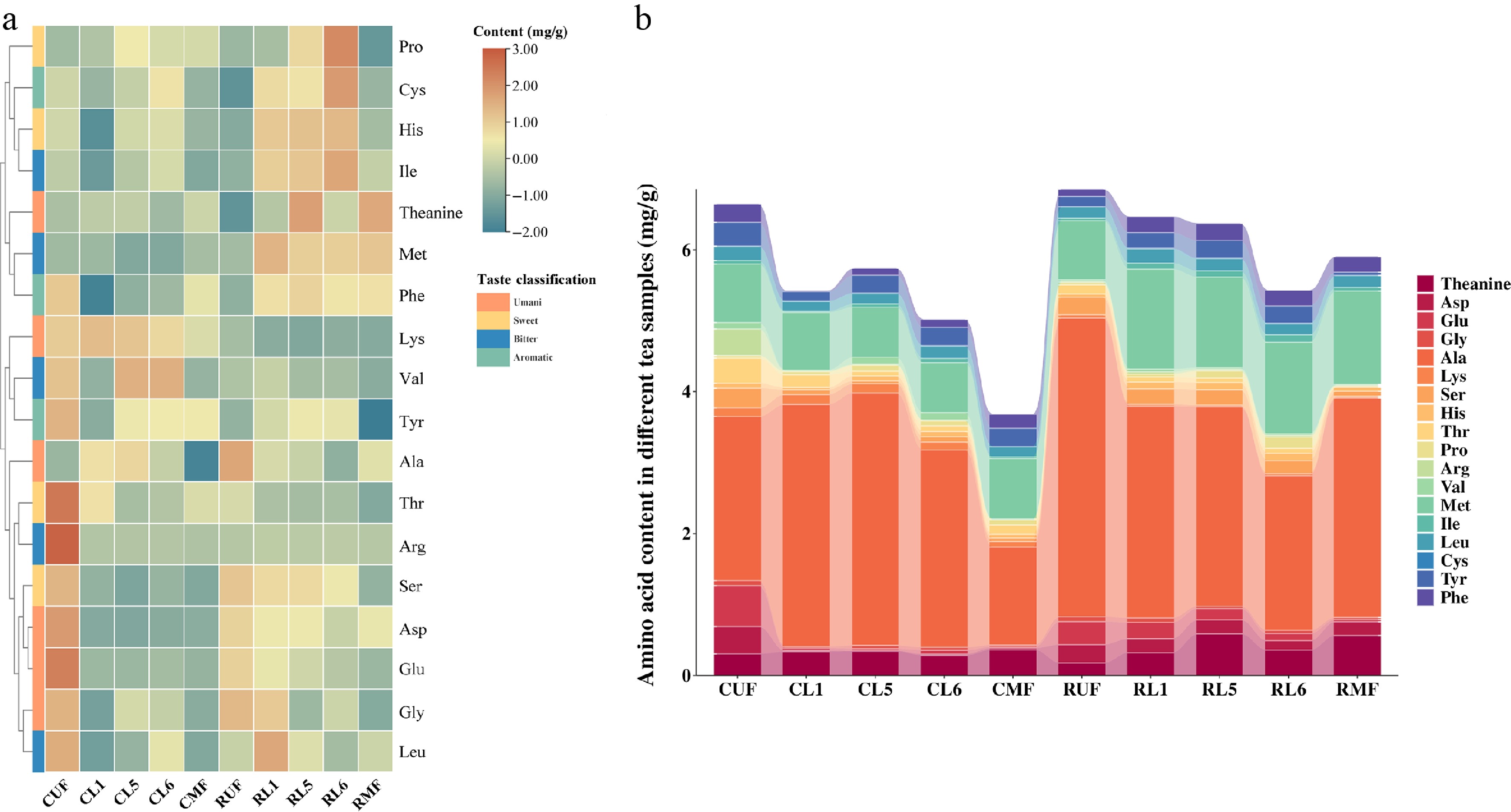
Figure 2.
Analysis of 18 amino acid components in loose Meicha fermented with E. cristatum under different roasting treatments. (a) Classification heat map of amino acids. (b) Average relative content of amino acid components.
As shown in Fig. 2b, the amino acid contents varied significantly between the fermented groups and their corresponding unfermented samples (CUF, RUF). Among umami amino acids, aspartic acid (Asp) and glutamic acid (Glu) decreased sharply in CL1 (by 97% and 93%, respectively), while RL1 decreased by only 23% and 30%, respectively, indicating that high-temperature re-roasting effectively inhibited their degradation. Regarding sweet amino acids, CL1 showed reductions of 75% in serine (Ser) and 48% in threonine (Thr), whereas RL1 exhibited a markedly smaller decrease in Ser and a comparable reduction in Thr. The theanine content in CL5 (0.34 mg/g) was similar to that in CUF, while it increased significantly in RL5 compared to RUF.
The aromatic amino acid phenylalanine (Phe) decreased by 53% in CL6 compared to CUF, but increased by 120% in RL6 compared with RUF. Under identical L6 strain fermentation, RL6 also exhibited significantly higher contents of proline (Pro) and methionine (Met) than CL6, with increases of 129% and 84%, respectively. These results suggest that high-temperature re-roasting not only inhibits the degradation of Pro but may also promote the accumulation of aromatic and sulfur-containing amino acids.
In mixed-strain fermentation, alanine (Ala) in CMF dropped sharply to 1.38 mg/g, whereas it remained stable in RMF at 3.10 mg/g, reflecting more stable Ala metabolism under high-temperature re-roasting. Moreover, tyrosine (Tyr) decreased by 21% in CMF and 73% in RMF relative to their unfermented counterparts, while phenylalanine (Phe) content in RMF increased by 120% compared with RUF. Collectively, the combination of high-temperature re-roasting and mixed-culture fermentation enhances the amino acid content in fermented Meicha products.
Integrated OPLS-DA and taste activity value (TAV) analysis of 18 amino acids
-
To investigate the impact of E. cristatum on amino acid composition of Meicha under conventional roasting (C group) and high-temperature re-roasting (R group), an Orthogonal Partial Least Squares Discriminant Analysis (OPLS-DA) model was constructed based on the data of 18 amino acids from 10 samples (Fig. 3a).
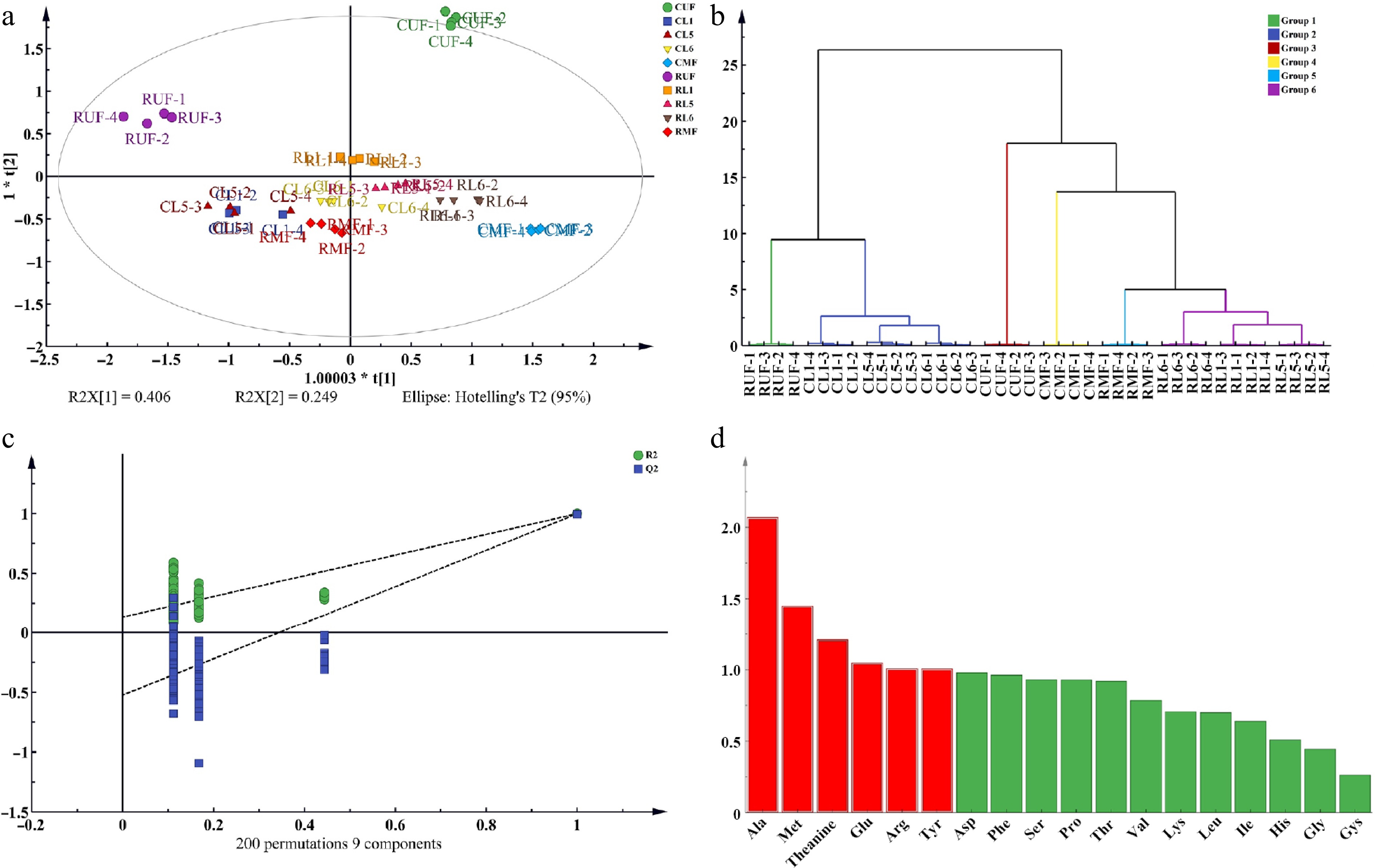
Figure 3.
Multivariate statistical analysis of 18 amino acid profiles in loose Meicha fermented with E. cristatum under different roasting treatments. (a) OPLS-DA. (b) HCA. (c) Permutation test. (d) VIP values.
The model parameters (R2Y = 0.942, Q2 = 0.904) indicate excellent fitting and predictive capability. Hierarchical cluster analysis (HCA, Fig. 3b) showed that the samples clustered into six groups, with both roasting treatments exhibiting a consistent grouping pattern: the unfermented group and the mixed-culture fermentation group each formed independent clusters, while the single-strain fermentation samples also clustered separately. This suggests high similarity in amino acid profiles among single-strain treated samples, whereas mixed-culture fermentation significantly altered the amino acid composition, showing clear differentiation from both unfermented and single-strain groups. The model's stability was validated by 200 permutation tests (Q2 intercept < 0, R2 = 0.135, Q2 = −0.524; Fig. 3c). VIP analysis (Fig. 3d) identified six key amino acids (VIP > 1)—Ala, Met, Theanine, Glu, Arg, and Tyr—which can serve as characteristic markers to effectively distinguish between samples fermented with single strains and those treated with mixed cultures of E. cristatum.
TAV is an effective taste-evaluation method that quantifies a compound's contribution to tea infusion taste by calculating the ratio of its concentration to its taste threshold; a TAV > 1 indicates a significant taste impact[20]. Using the contents and thresholds of 18 amino acids in Meicha fermented with single or mixed cultures, TAVs were calculated (Table 2). Results revealed distinct taste characteristics between roasting treatments under the same fermentation strain. Theanine TAV increased significantly in RL5 and RMF compared to their C-group counterparts (CL5 and CMF), reflecting enhanced umami intensity. Alanine (Ala) TAV rose notably in high-temperature re-roasted unfermented (RUF) and mixed-culture fermented (RMF) samples but decreased in single-strain fermented RL1 and RL5. Methionine (Met) TAV was consistently higher in all fermented R-group samples than in the C group, suggesting strengthened sweet/bitter modulation. Overall, high-temperature re-roasting combined with mixed-culture (MF) fermentation enhances the taste contribution of theanine and reinforces the taste-modulating role of methionine.
Table 2. TAVs of 18 amino acid in loose Meicha fermented with E. cristatum under different roasting treatments.
Amino acid Taste threshold (mg/mL) Taste characteristic TAV CUF CL1 CL5 CL6 CMF RUF RL1 RL5 RL6 RMF Theanine 0.06 Umami 5.07 ±
0.73de5.61 ±
0.26bc5.71 ±
0.11bc4.74 ±
0.13e6.02 ±
0.33b2.92 ±
0.08f5.37 ±
0.04cd9.75 ±
0.20a5.97 ±
0.03b9.40 ±
0.36aAsp 0.03 Umami/Sour 12.76 ±
0.30a0.42 ±
0.03fg0.10 ±
0.00g0.58 ±
0.03ef0.78 ±
0.06e8.63 ±
0.38b6.57 ±
0.13c6.55 ±
0.28c4.36 ±
0.35d6.46 ±
0.20cGlu 0.05 Umami/Sour 11.58 ±
0.18a0.72 ±
0.04g0.63 ±
0.00g1.07 ±
0.05f0.34 ±
0.11h6.51 ±
0.45b4.55 ±
0.14c3.20 ±
0.04d2.04 ±
0.14e0.63 ±
0.26gGly 1.3 Umami/Sweet 0.05 ±
0.00a0.02 ±
0.00g0.04 ±
0.00c0.03 ±
0.00d0.02 ±
0.00f0.05 ±
0.00a0.05 ±
0.00b0.03 ±
0.00e0.03 ±
0.00cd0.02 ±
0.00fgAla 0.6 Umami/Sweet 3.86 ±
0.06e5.69 ±
0.32b5.93 ±
0.45b4.64 ±
0.35d2.30 ±
0.07f7.02 ±
0.27a4.98 ±
0.19cd4.70 ±
0.16d3.64 ±
0.25e5.16 ±
0.17cLys 0.5 Sweet/Bitter 0.25 ±
0.01c0.27 ±
0.00a0.26 ±
0.01b0.22 ±
0.01d0.16 ±
0.00e0.09 ±
0.00f0.05 ±
0.00gh0.04 ±
0.00i0.05 ±
0.01g0.04 ±
0.01hiSer 1.5 Sweet 0.18 ±
0.01a0.05 ±
0.00e0.03 ±
0.01f0.05 ±
0.01e0.03 ±
0.00f0.17 ±
0.01b0.14 ±
0.00c0.14 ±
0.01c0.12 ±
0.01d0.05 ±
0.00eHis 0.2 Sweet/Bitter 0.35 ±
0.01c0.14 ±
0.01f0.35 ±
0.02c0.37 ±
0.01c0.26 ±
0.01d0.22 ±
0.00e0.48 ±
0.02b0.50 ±
0.01ab0.51 ±
0.05a0.27 ±
0.01dThr 2.6 Sweet 0.14 ±
0.01a0.07 ±
0.00b0.03 ±
0.00e0.03 ±
0.00d0.05 ±
0.00c0.05 ±
0.00c0.03 ±
0.00de0.02 ±
0.00e0.03 ±
0.00de0.01 ±
0.00fPro 3 Sweet 0.01 ±
0.00fg0.02 ±
0.00e0.03 ±
0.00c0.02 ±
0.00d0.02 ±
0.00d0.01 ±
0.00g0.01 ±
0.00f0.03 ±
0.00b0.05 ±
0.00a− Arg 0.5 Bitter/Sweet 0.75 ±
0.05a0.02 ±
0.00d0.02 ±
0.00d0.02 ±
0.00d0.01 ±
0.00d0.03 ±
0.00cd0.06 ±
0.00b0.05 ±
0.00bc0.05 ±
0.00bc0.03 ±
0.00cdVal 0.4 Sweet/Bitter 0.23 ±
0.01b0.03 ±
0.00ef0.26 ±
0.02a0.26 ±
0.01a0.03 ±
0.01e0.06 ±
0.01d0.10 ±
0.02c0.05 ±
0.01d0.05 ±
0.01d0.01 ±
0.00fMet 0.3 Sweet/Bitter 2.75 ±
0.11c2.72 ±
0.16c2.35 ±
0.05d2.34 ±
0.12d2.83 ±
0.08c2.78 ±
0.07c4.70 ±
0.03a4.27 ±
0.06b4.29 ±
0.05b4.40 ±
0.09bIle 0.9 Bitter 0.05 ±
0.01cd0.02 ±
0.00f0.05 ±
0.00d0.07 ±
0.01c0.03 ±
0.00ef0.03 ±
0.00e0.09 ±
0.00b0.10 ±
0.00b0.11 ±
0.02a0.06 ±
0.00cdLeu 1.9 Bitter 0.11 ±
0.00a0.07 ±
0.00e0.08 ±
0.00cd0.09 ±
0.00b0.08 ±
0.00de0.09 ±
0.01b0.11 ±
0.00a0.09 ±
0.00b0.08 ±
0.00c0.09 ±
0.00bCys 0.02 Bitter 0.27 ±
0.01c0.15 ±
0.02d0.25 ±
0.04c0.37 ±
0.03b0.14 ±
0.02d0.02 ±
0.01e0.40 ±
0.05b0.37 ±
0.06b0.58 ±
0.07a0.15 ±
0.01dTyr 2.6 Bitter 0.13 ±
0.01a0.05 ±
0.00f0.10 ±
0.00bc0.10 ±
0.00b0.10 ±
0.00b0.06 ±
0.00e0.08 ±
0.00d0.10 ±
0.01bc0.09 ±
0.00c0.02 ±
0.00gPhe 0.9 Bitter 0.29 ±
0.02a0.01 ±
0.00e0.11 ±
0.07d0.13 ±
0.00d0.22 ±
0.00c0.11 ±
0.00d0.25 ±
0.00bc0.27 ±
0.00ab0.24 ±
0.01bc0.25 ±
0.01bcTaste threshold value (mg/mL) and taste of free amino acids in water[25,26]. Different lowercase letters within the same row indicate significant differences (p < 0.05). Homology modeling of the umami receptor T1R1/T1R3
-
The A chain of the metabotropic glutamate receptor (mGluR1, PDB: 1EWK) was selected as the homology modeling template to construct the T1R1/T1R3 heterodimeric umami receptor structure (Fig. 4a). T1R1/T1R3 and mGluR1 both belong to the class C G protein-coupled receptor (GPCR) family and share critical functional similarities, including ligand recognition through the extracellular Venus flytrap (VFT) domain. This template has been successfully applied in previous studies for modeling the umami receptor structure[21,27].
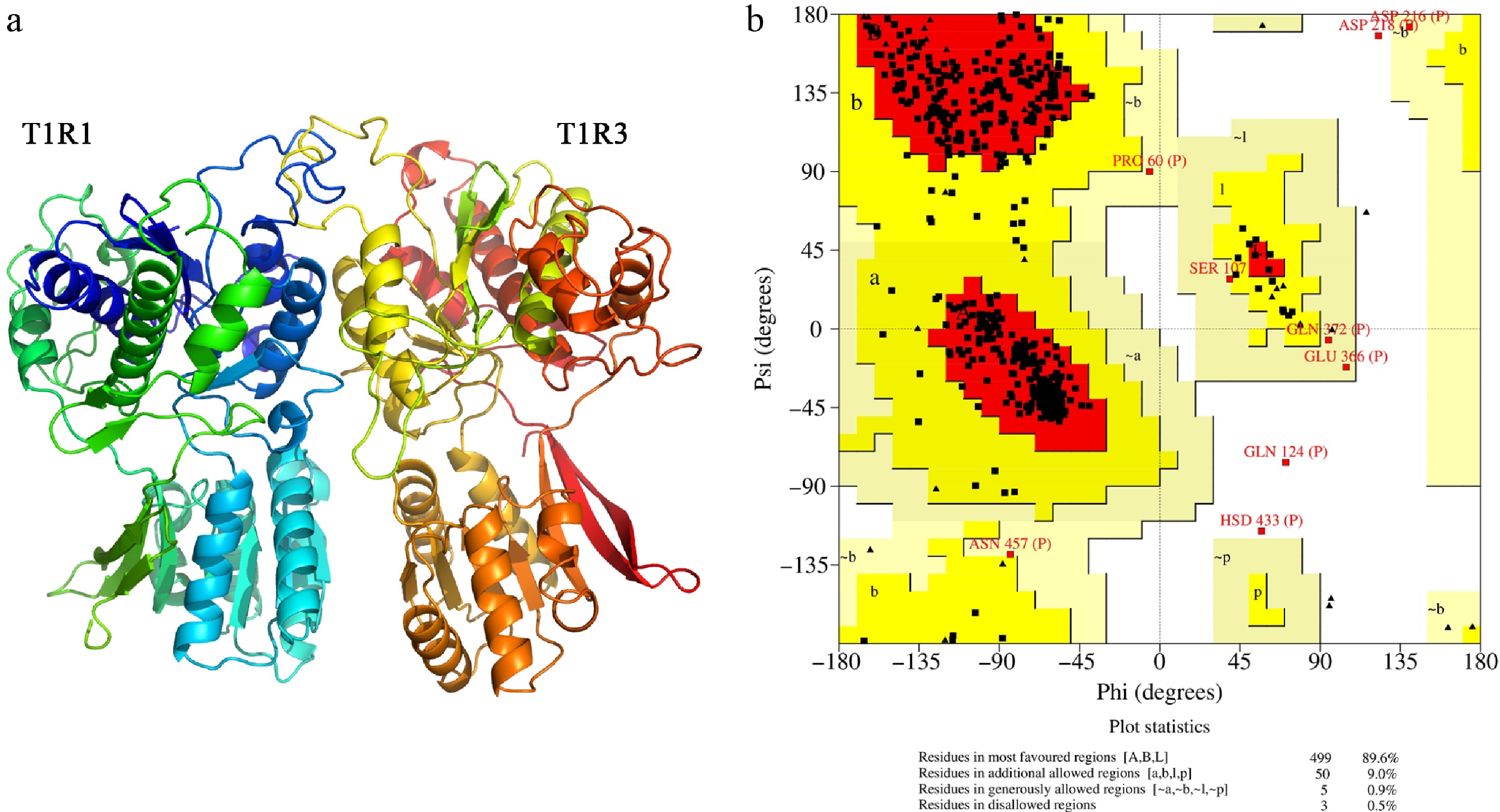
Figure 4.
Homology modeling of T1R1/T1R3 and Ramachandran plot validation.
The model demonstrated high reliability based on validation with QMEANDisCo and SAVES v6.0. The overall QMEANDisCo global score was 0.61 ± 0.05, indicating that the model's folding closely resembles native proteins. Ramachandran plot analysis showed 89.6% of residues in the core region (optimal), 9.0% were in allowed regions, and only 0.5% fell into disallowed regions (Fig. 4b). These results exceed the standard criteria for homology models (typically requiring > 90% of residues in allowed regions, with a higher proportion in the core region being preferable), demonstrating excellent local atomic geometry. Overall, the validation metrics confirm that the constructed T1R1/T1R3 receptor model is structurally reasonable and reliable, making it suitable for subsequent molecular docking studies.
Molecular docking and visualization of amino acids with T1R1/T1R3
-
Based on HPLC quantification and TAV calculations, key amino acids contributing to Meicha's umami profile were selected for molecular docking with the T1R1/T1R3 umami receptor. Binding free energy (ΔG) results revealed interaction energies ranging from −3.1 to −5.6 kcal/mol. For further analysis, amino acids with ΔG ≤ −4.2 kcal/mol were considered potential active molecules. Eight amino acids—Phe, Tyr, arginine (Arg), theanine, Glu, histidine (His), Asp, and leucine (Leu)—were identified as strong interactors, suggesting their combined role in umami perception.
Visualization of the binding modes between the eight amino acids and the T1R1/T1R3 receptor (Fig. 5) confirmed hydrogen-bond interactions in all cases. Phe and Tyr displayed the lowest binding energies (−5.6 and −5.5 kcal/mol, respectively), suggesting the strongest receptor affinity. Although the binding energy of theanine (−4.7 kcal/mol) was not the lowest, it formed an extensive hydrogen bond network with multiple key residues in the active pocket, indicating that specific, strong interactions underlie its stable binding and notable taste-contributing role. Docking conformation analysis revealed that the binding pockets of most amino acid ligands involved the key residues SER147 and SER170, consistent with previous studies identifying these two sites as core binding positions of the T1R1/T1R3 receptor[21]. These two residues form a hydrogen-bond network with ligands via their side-chain hydroxyl groups, playing a crucial role in complex stability and umami signal transduction. In summary, various amino acids in fermented Meicha products under different roasting treatments can also bind to T1R1/T1R3 through the mediation of SER147 and SER170, thereby revealing the molecular mechanism underlying umami formation in Meicha and its fermented products.
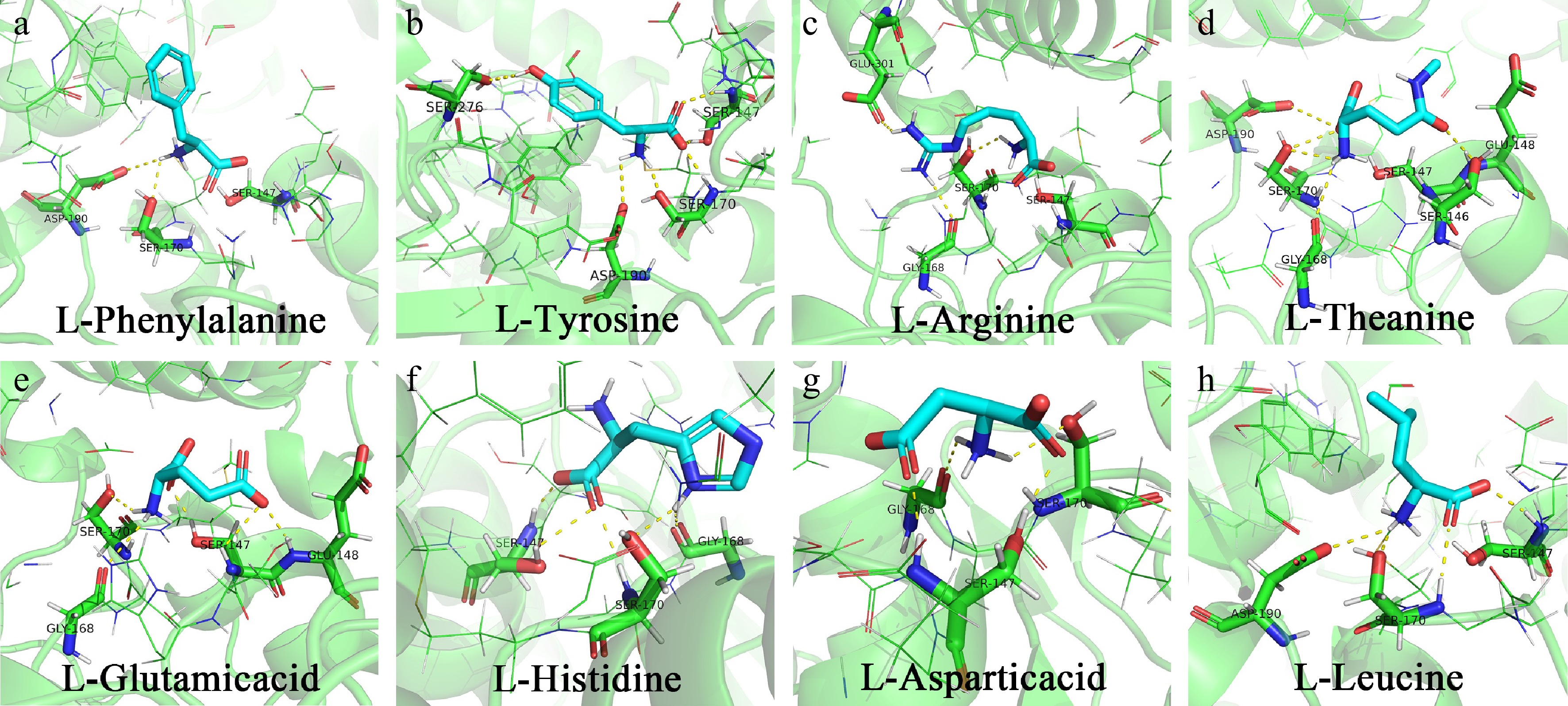
Figure 5.
Validation of molecular docking of eight taste-active amino acids with the T1R1/T1R3 heterodimer.
Comparative analysis of amino acid content and umami receptor binding affinity
-
This study revealed that high-temperature re-roasting selectively enriches key taste-active amino acids through comparative analysis of amino acid content and molecular docking binding affinity (Fig. 6). In the fermented R group samples, the content of Met increased significantly by 55%–80% compared to the C groups. Theanine content also increased significantly in RL5 and RMF, with an increase of 56%–74%. With binding energies of −3.8 kcal/mol (Met) and −4.7 kcal/mol (Theanine), their combined effect represents the direct biochemical basis for the superior sensory quality of the fermented R group products over those of the C group.
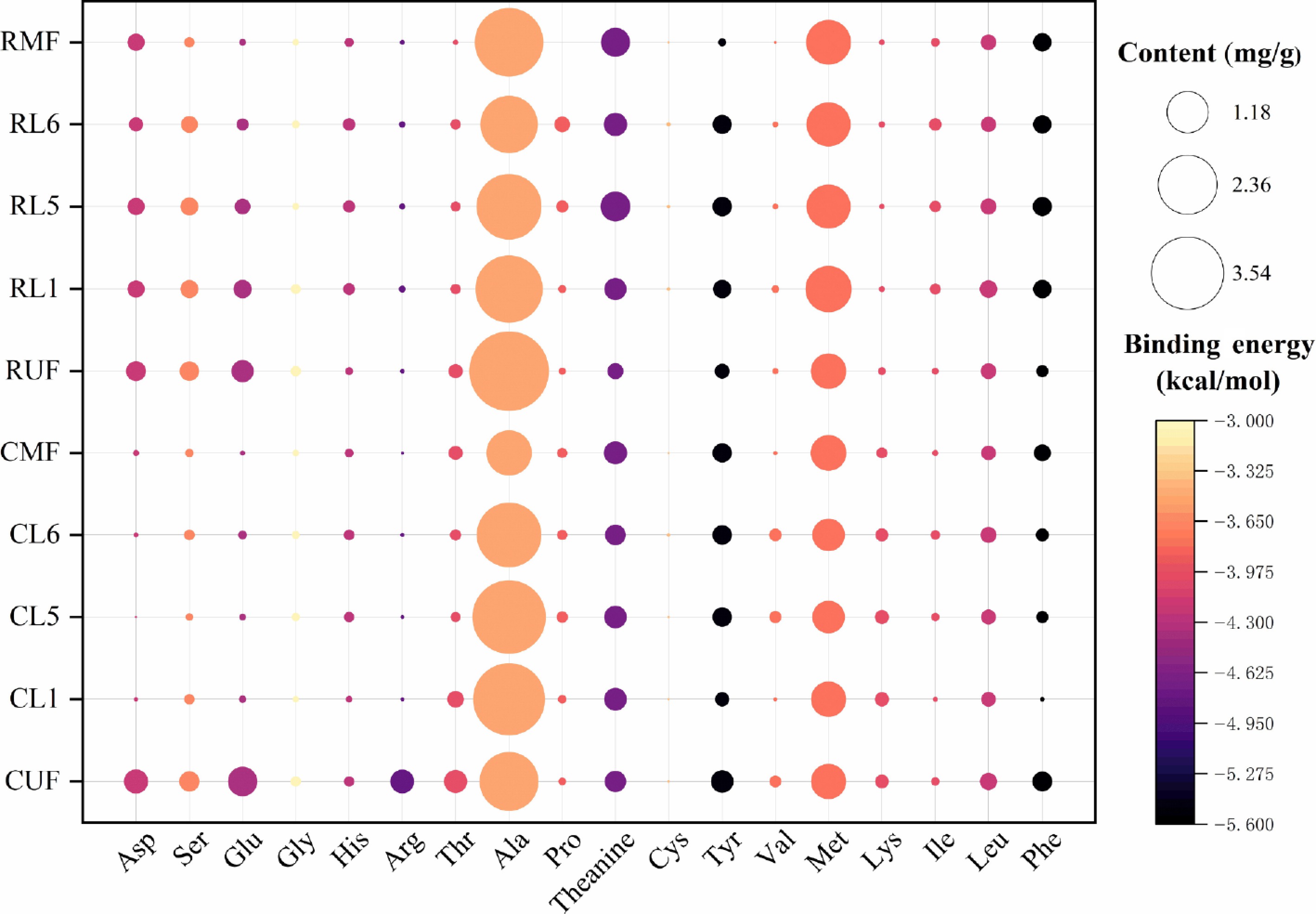
Figure 6.
Comparative visualization of binding energies and amino acid concentration changes in E. cristatum fermented loose Meicha under different roasting treatments.
Molecular docking results demonstrated that the eight amino acids (Phe, Tyr, Arg, theanine, etc.) with ΔG ≤ −4.2 kcal/mol interacted with critical receptor residues SER147 or SER170, indicating strong umami contributions. Phenylalanine (Phe) and tyrosine (Tyr) exhibited the strongest binding affinities, classifying them as high-efficacy taste molecules whose content fluctuations could significantly impact overall flavor intensity. In contrast, although more abundant, Ala and glycine (Gly) exhibited weaker binding energies and were positioned outside the core VFT region, lacking interactions with SER147/SER170. Consequently, these amino acids contribute minimally to umami, primarily imparting sweet background notes and mouthfeel. Collectively, these results establish SER147 and SER170 as key interaction hotspots that mediate strong binding between amino acids and the T1R1/T1R3 receptor.
-
The combination of high-temperature re-roasting and E. cristatum fermentation is crucial for enhancing the flavor quality of Meicha. High-temperature re-roasting significantly reduces bitterness and astringency while intensifying the aromatic richness, which aligns with findings from studies on traditional teas. Research by Jiang et al.[28] on Wuyi rock tea demonstrated that high-temperature roasting not only degrades astringent compounds such as catechins but also promotes the formation of pyrazines and furans via the Maillard reaction and caramelization, thereby contributing to characteristic roasted aromas. In this study, Meicha exhibited a similar shift in aroma profile after high-temperature re-roasting, suggesting that the improvement in its taste quality likely also stems from the transformation of flavonoids and the combined effects of Maillard reaction products.
Fermentation with E. cristatum optimizes the balance of the tea infusion's taste. In Fu brick tea, Zhang & Zhang[29] reported that the growth of E. cristatum strongly consumes soluble sugars and amino acids, while degrading bitter and astringent polyphenols even more significantly. This selective metabolism leads to a relative increase in the sugar/phenol ratio, thereby reducing astringency and enhancing a sweet, mellow sensation. In this study, although the high-temperature re-roasted group had a higher initial soluble sugar content before fermentation—which was substantially consumed during the process—the final content was similar to that of the conventionally roasted fermented samples. This result aligns with the metabolic pattern of E. cristatum described by Xu et al.[30]. Therefore, the improvement in the sweet, mellow taste of fermented Meicha is likely due to the rebalancing of taste components resulting from this selective metabolism.
High-temperature re-roasting also significantly increased the content of the key active ingredient, dihydromyricetin (DMY), which was markedly higher than that in the conventionally roasted group, indicating that this treatment promotes the release of DMY, likely due to structural changes in the stems and leaves of Meicha induced by high temperature[31,32]. This structural change may subsequently facilitate the conversion of bound polysaccharides, proteins, and lipids into soluble small-molecule sugars, amino acids, and fatty acids[33,34], thereby providing more readily utilizable carbon sources, nitrogen sources, and aroma precursors for E. cristatum[35]. Meanwhile, high-temperature treatment can inhibit certain heat-sensitive contaminating microorganisms, creating a favorable microecological niche for the rapid colonization and metabolic dominance of E. cristatum[36]. Therefore, high-temperature re-roasting is not merely a direct processing step for the raw material but rather a pre-conditioning procedure that enriches the substrate with additional nutrients and diverse aroma precursors for subsequent microbial transformation, thus laying the material foundation for the combined effect of roasting and fermentation. Direct observation of changes in tissue microstructure using scanning electron microscopy (SEM) and other techniques is required in future studies to validate the above speculation.
It is particularly noteworthy that, after fermentation, the DMY content in the high-temperature re-roasted samples further increased significantly from an already elevated baseline, consistent with the conclusion reported by Yang et al.[11] that fermentation with E. cristatum can enhance DMY biosynthesis. This demonstrates a combined effect between high-temperature re-roasting and fermentation in elevating DMY content. Despite its inherent bitterness and astringency, the increased DMY content did not intensify these attributes in the tea infusion. This is attributed to the fermentation process, which rebalances key flavor components—such as the sugar-to-phenol ratio—and reshapes the overall taste profile[37]. Within this modified flavor context, the taste contribution of elevated DMY is effectively modulated, thereby collectively reducing perceived astringency and shifting the sensory profile toward mellowness and a lingering sweet aftertaste.
Meanwhile, the Maillard reaction products generated during high-temperature re-roasting exhibit umami-enhancing activity and can act together with free amino acids. Studies have shown that the L-theanine-D-galacturonic acid Maillard reaction product formed during the thermal processing of tea exhibits umami taste and strongly binds to the T1R1/T1R3 umami receptor[16]. Furthermore, research by Chen et al.[38] demonstrated that fermentation treatment can enrich peptides and free amino acids, increase the content of umami/sweet amino acids, and thereby optimize the precursor composition for the Maillard reaction. Therefore, Maillard reaction products and free amino acids may act in combination through the dual pathways of 'product-derived umami enhancement' and 'precursor enrichment', collectively contributing to the 'umami, mellow, and thick' taste characteristic of Meicha.
Amino acid content and composition are other key factors determining the umami quality of Meicha liquor, with their taste contribution evaluated through the combination of TAV and receptor-binding efficiency (binding energy). In high-temperature re-roasted fermented samples, the concurrent increase in TAV of theanine and methionine (Met) reinforced the 'umami, mellow, and thick' taste profile. Specifically, as a core umami contributor, theanine showed TAVs of 9.75 in RL5 and 9.40 in RMF (TAV > 1). Molecular docking indicated a binding energy of −4.7 kcal/mol to T1R1/T1R3 and the formation of seven hydrogen bonds with key residues (e.g., SER147 and SER170), reflecting significantly higher stability than glycine (Gly). This aligns with the mechanism reported by Deng et al.[27] for umami peptides, where specific binding to the receptor's VFT domain enhances signal transduction via hydrogen bonds and electrostatic interactions. The present study validates this mechanism in Meicha and is the first to show that combining high-temperature re-roasting with specific E. cristatum fermentation increases theanine content and strengthens its binding to the umami receptor.
As a taste modulator, Met showed TAV > 4.0 in all fermented R group samples, significantly higher than that in the C group (2.34–2.83). This suggests that Met may partially mask or neutralize bitterness and astringency through taste interactions, thereby enhancing mellowness and reducing astringency. These results demonstrate that specific amino acids can balance and refine the flavor profile of complex food systems via their inherent taste properties and combined effects[39,40]. Notably, although Ala showed the highest content in RUF (4.21 mg/g) and a relatively high TAV (7.02), its binding energy was only −3.5 kcal/mol, and lack of interaction with key residues SER147/SER170, indicating that Ala mainly provides a sweet background rather than direct umami enhancement. Together, these findings correct the notion that 'high content implies high umami contribution' and aligns with the view of Warmke et al.[20] that accurate taste assessment requires integrating TAV with molecular-interaction mechanisms. Homology modeling and molecular docking identified SER147 and SER170 of the T1R1/T1R3 receptor as key residues for amino acid binding. All amino acids with binding energies ≤ −4.2 kcal/mol (e.g., Phe, theanine) formed hydrogen bonds with these residues, while those with weaker binding (e.g., Ala, Gly) fell outside this interaction region. This aligns with Wang et al.[21], further supporting the conservation of SER147/SER170 in Class C GPCRs. Their side-chain hydroxyl groups stabilize the ligand-receptor complex via hydrogen bonds, serving as core sites that initiate umami signal transduction.
High-temperature re-roasting selectively enriches eight amino acids with potential umami-modulating activity (e.g., Phe, Tyr, theanine). Theanine, whose content rises notably in re-roasted fermented samples and which forms a stable hydrogen-bond network with key residues SER147/SER170, acts as the core umami contributor, while Met enhances overall taste complexity by balancing sweet and bitter notes. Moreover, amino acids including Phe, Tyr, theanine, Arg, Glu, His, Asp, and Leu—present in single-culture or mixed-culture fermented samples across roasting treatments—showed effective docking with the T1R1/T1R3 receptor. Further characterization of amino acid profiles and related metabolites could be pursued using high-resolution mass spectrometry (HRMS) and comprehensive nuclear magnetic resonance (NMR) techniques. Furthermore, the combined process of high-temperature re-roasting and mixed-strain E. cristatum fermentation developed herein features clearly defined parameters and operational controllability, demonstrating industrial application potential and providing a technical reference for the large-scale production of high-quality Meicha products.
-
The combination of high-temperature re-roasting and E. cristatum fermentation markedly enhanced the taste quality of Meicha. This combined process effectively regulated the metabolism and conversion of key components such as DMY and amino acids, significantly increasing the mellowness and umami of the Meicha infusion while reducing astringency. In particular, RL5 and RMF samples exhibited more intense roasted and fungal aromas, lower astringency, and higher mellowness scores. The high-temperature re-roasting with mixed-culture fermentation (RMF) showed the strongest combined effect, generating a distinctive 'fungal-roasted-sweet fruity' blended aroma. These results provide a theoretical foundation for optimizing deep-processing strategies and developing high-quality Meicha products.
-
The authors confirm contributions to the paper as follows: study conception and design: Rong Z; experiments performed: Rong Z, Su Z; analysis and interpretation of results: Rong Z; draft manuscript preparation: Rong Z; review: Huang J, Liu Z, Lin Y, Zhu M, Yu L; funding acquisition: Liu Z, Yu L. All authors reviewed the results and approved the final version of the manuscript.
-
All data generated or analyzed during this study are included in this published article and its supplementary information files.
-
The authors declare that they have no conflict of interest.
-
accompanies this paper online at: https://doi.org/10.48130/bpr-0026-0021.
- Supplementary Table S1 Sensory evaluation results of loose Meicha fermented with Eurotium cristatum under different roasting treatments.
- Supplementary Table S2 QDA scores for taste attributes of loose Meicha fermented with Eurotium cristatum under different roasting treatments.
- Supplementary Table S3 QDA scores for aroma attributes of loose Meicha fermented with Eurotium cristatum under different roasting treatments.
- Supplementary Table S4 Amino acid composition of 18 amino acids in tea samples with different Eurotium cristatum fermentation treatments.
- Copyright: © 2026 by the author(s). Published by Maximum Academic Press, Fayetteville, GA. This article is an open access article distributed under Creative Commons Attribution License (CC BY 4.0), visit https://creativecommons.org/licenses/by/4.0/.
-
About this article
Cite this article
Rong Z, Su Z, Huang J, Lin Y, Zhu M, et al. 2026. Effect of Eurotium cristatum fermentation combined with high-temperature re-roasting on Meicha (Ampelopsis grossedentata) quality: insights from taste characteristic components and umami receptor molecular docking. Beverage Plant Research 6: e038 doi: 10.48130/bpr-0026-0021 

Effect of Eurotium cristatum fermentation combined with high-temperature re-roasting on Meicha (Ampelopsis grossedentata) quality: insights from taste characteristic components and umami receptor molecular docking
- Received: 12 February 2026
- Revised: 27 April 2026
- Accepted: 14 May 2026
- Published online: 13 October 2026
Abstract: To systematically elucidate the effects of Eurotium cristatum on the fermentation quality of re-roasted Meicha (Ampelopsis grossedentata), this study integrated sensory omics, physicochemical analysis, amino acid taste activity value (TAV), orthogonal partial least squares discriminant analysis (OPLS-DA), and molecular docking to characterize quality differences and explore umami formation mechanisms between re-roasted and conventionally roasted fermented Meicha. Results showed that a mixed-culture fermentation with three E. cristatum strains optimized the quality of re-roasted tea, yielding a distinctive 'fungal-roasted-sweet fruity' aroma. This treatment also led to higher dihydromyricetin content and significantly enhanced infusion mellowness and umami compared to other fermentations. OPLS-DA analysis identified six marker amino acids with VIP > 1: alanine, methionine, theanine, glutamic acid, arginine, and tyrosine. Molecular docking revealed that eight amino acids, including alanine, tyrosine, theanine, and methionine, interact with key residues SER147 and SER170 of the umami receptor T1R1/T1R3, with binding energies ≤ −4.2 kcal/mol, indicating their potential as umami modulators. Comparative visualization further demonstrated that theanine may contribute to core umami perception by forming stable hydrogen bonds, while methionine likely enhances flavor complexity by modulating sweet and bitter taste interactions. In conclusion, high-temperature re-roasting combined with E. cristatum fermentation effectively improves Meicha flavor quality, providing a theoretical basis for process optimization and targeted quality regulation.