









Search
2020 Volume 7
Article Contents
RESEARCH ARTICLE   Open Access    

Why Cannot BCLC 0- or A-Stage Patients Receive Curative Treatment?

More Information
  • Corresponding author: Tse-Ming Kuo Division of Gastroenterology and Hepatobiliary Disease, Department of Internal Medicine, Koo Foundation Sun Yat-Sen Cancer Center 125 Lih-Der Road, Peitou District, Taipei 11259 (Taiwan, ROC) edberg@kfsyscc.org 
  • Introduction: Barcelona Clinic Liver Cancer (BCLC) staging has been an important clinical guideline for the management of hepatocellular carcinoma (HCC). BCLC 0 and A stages (BCLC 0/A) have been designated as the early-stage HCC, and the curative treatment is recommended as the primary therapeutic modality. However, a recent study indicated that a significant number of BCLC 0/A patients were not initially managed with the curative treatment without knowing why.
    Methods: We, therefore, conducted a study on BCLC 0/A patients who had and had not received initial curative treatment cared at our cancer center from January 2011 to December 2015 and analyzed causes contributing to not having the initial curative treatment.
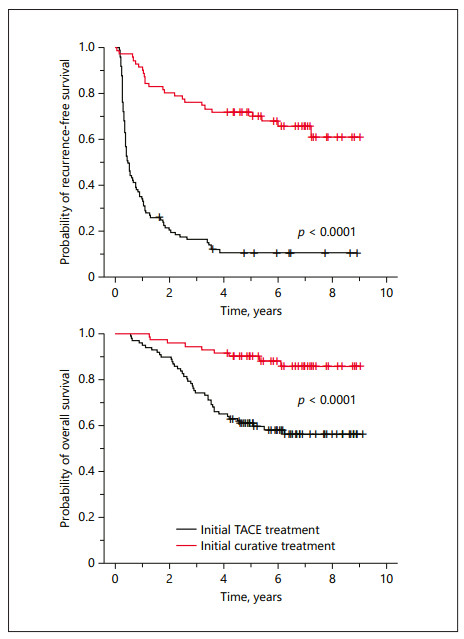
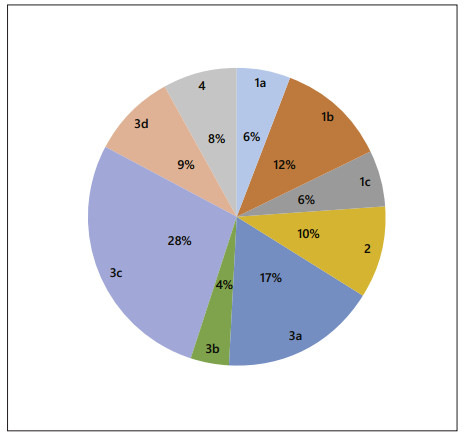
    Results: One hundred and sixty-nine BCLC 0/A patients were identified and included in the study. Seventy two patients (43%) received the initial curative treatment and 97 patients (57%) did not. After careful review of medical records, all 97 patients without the initial curative treatment had identifiable reasons for not having the initial curative treatment. Two main reasons for not having the initial curative treatment were "probable presence of additional HCC and requiring diagnostic angiography" (28%) and "difficult or complicating anatomical location of tumors" (17%). When the relevant clinical parameters were compared between the 2 groups of patients, it was found that patients without the initial curative treatment had more serious clinical conditions and worse overall and recurrence-free survival outcomes compared with those who had the initial curative treatment.
    Discussion/Conclusion: Our finding indicates that a significant fraction of the BCLC 0/A HCC patients is unable to have initial curative treatment as recommended by BCLC guidelines. These early stages of HCC patients represent a distinctive subpopulation and are in need of further investigation to improve their survival outcomes.
  • Cite this article

    Tse-Ming Kuo, Kai-Ming Chang, Kuo-Jang Kao. 2020. Why Cannot BCLC 0- or A-Stage Patients Receive Curative Treatment?. Gastrointestinal Tumors. 7:824 doi: 10.1159/000509824
    Tse-Ming Kuo, Kai-Ming Chang, Kuo-Jang Kao. 2020. Why Cannot BCLC 0- or A-Stage Patients Receive Curative Treatment?. Gastrointestinal Tumors. 7:824 doi: 10.1159/000509824

Figures(2)  /  Tables(3)

Article Metrics

Article views(956) PDF downloads(602)

Other Articles By Authors

Research Article   Open Access    

Why Cannot BCLC 0- or A-Stage Patients Receive Curative Treatment?

  • Corresponding author: Tse-Ming Kuo Division of Gastroenterology and Hepatobiliary Disease, Department of Internal Medicine, Koo Foundation Sun Yat-Sen Cancer Center 125 Lih-Der Road, Peitou District, Taipei 11259 (Taiwan, ROC) edberg@kfsyscc.org 
Gastrointestinal Tumors  7 Article number: 10.1159/000509824  (2020)  |  Cite this article

Abstract: 

Introduction: Barcelona Clinic Liver Cancer (BCLC) staging has been an important clinical guideline for the management of hepatocellular carcinoma (HCC). BCLC 0 and A stages (BCLC 0/A) have been designated as the early-stage HCC, and the curative treatment is recommended as the primary therapeutic modality. However, a recent study indicated that a significant number of BCLC 0/A patients were not initially managed with the curative treatment without knowing why.
Methods: We, therefore, conducted a study on BCLC 0/A patients who had and had not received initial curative treatment cared at our cancer center from January 2011 to December 2015 and analyzed causes contributing to not having the initial curative treatment.
Results: One hundred and sixty-nine BCLC 0/A patients were identified and included in the study. Seventy two patients (43%) received the initial curative treatment and 97 patients (57%) did not. After careful review of medical records, all 97 patients without the initial curative treatment had identifiable reasons for not having the initial curative treatment. Two main reasons for not having the initial curative treatment were "probable presence of additional HCC and requiring diagnostic angiography" (28%) and "difficult or complicating anatomical location of tumors" (17%). When the relevant clinical parameters were compared between the 2 groups of patients, it was found that patients without the initial curative treatment had more serious clinical conditions and worse overall and recurrence-free survival outcomes compared with those who had the initial curative treatment.
Discussion/Conclusion: Our finding indicates that a significant fraction of the BCLC 0/A HCC patients is unable to have initial curative treatment as recommended by BCLC guidelines. These early stages of HCC patients represent a distinctive subpopulation and are in need of further investigation to improve their survival outcomes.
  • About this article
    Cite this article
    Tse-Ming Kuo, Kai-Ming Chang, Kuo-Jang Kao. 2020. Why Cannot BCLC 0- or A-Stage Patients Receive Curative Treatment?. Gastrointestinal Tumors. 7:824 doi: 10.1159/000509824
    Tse-Ming Kuo, Kai-Ming Chang, Kuo-Jang Kao. 2020. Why Cannot BCLC 0- or A-Stage Patients Receive Curative Treatment?. Gastrointestinal Tumors. 7:824 doi: 10.1159/000509824

Catalog

    /

    DownLoad:  Full-Size Img  PowerPoint
    Return
    Return