







Search
2022 Volume 9
Article Contents
RESEARCH ARTICLE   Open Access    

Trends of Clinical Outcomes of Patients with Advanced Hepatocellular Carcinoma Treated with First-Line Sorafenib in Randomized Controlled Trials

More Information
  • Background: Sorafenib has consistently served as the control arm in multiple randomized clinical trials (RCTs) evaluating novel therapies for advanced hepatocellular carcinoma (HCC) for more than a decade. Analyzing trends in clinical outcomes of patients treated with sorafenib for the same indication over time offers the opportunity for unique insight into the evolution of clinical trial conduct and potential non-drug factors impacting outcomes.
    Methods: We identified RCTs in patients with treatment-naïve advanced HCC where sorafenib was compared to another systemic therapy or placebo. We extracted trial-level demographic, clinicopathologic, and outcome data (overall survival [OS], progression-free survival [PFS], objective response rate [ORR], and duration of therapy). Sample-weighted linear regression was used to identify temporal trends with significance set at p ≤ 0.05.
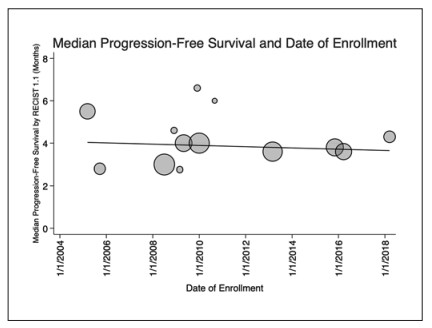
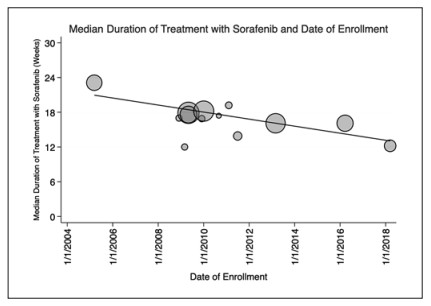
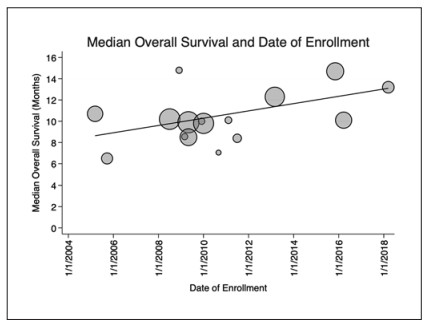
    Results: Sixteen RCTs (9 phase Ⅲ and 7 phase Ⅱ) enrolling 4,086 patients treated with sorafenib were included in the analysis. Included trials enrolled patients from 2005 to 2019. OS has significantly improved by 4.5 months from 2005 to 2019 (p = 0.048) over time. Thirteen studies provided data on PFS using Response Evaluation Criteria in Solid Tumors (RECIST) 1.1, with no significant change over time (p = 0.69). ORR assessed by RECIST 1.1 has significantly improved by 6.0% over time (p = 0.003). Median duration of therapy with sorafenib has decreased by 53% since the enrollment of the first clinical trial in 2005, from 23.1 weeks to 12.2 weeks (p = 0.0037). There was no significant change in patient demographics were identified over time to explain the OS findings.
    Conclusion: The median OS of patients with advanced HCC treated with sorafenib has improved significantly over 15 years. At the same time, the median duration of therapy with sorafenib has decreased. The reason for these findings was not explained by changing demographics of patients enrolled in these trials and has implications for ongoing clinical trials.
  • Cite this article

    Timothy J. Brown, Arjun Gupta, Ramy Sedhom, Muhammad S. Beg, Thomas B. Karasic, Mark Yarchoan. 2022. Trends of Clinical Outcomes of Patients with Advanced Hepatocellular Carcinoma Treated with First-Line Sorafenib in Randomized Controlled Trials. Gastrointestinal Tumors. 9:521625 doi: 10.1159/000521625
    Timothy J. Brown, Arjun Gupta, Ramy Sedhom, Muhammad S. Beg, Thomas B. Karasic, Mark Yarchoan. 2022. Trends of Clinical Outcomes of Patients with Advanced Hepatocellular Carcinoma Treated with First-Line Sorafenib in Randomized Controlled Trials. Gastrointestinal Tumors. 9:521625 doi: 10.1159/000521625

Figures(4)  /  Tables(1)

Article Metrics

Article views(947) PDF downloads(558)

Research Article   Open Access    

Trends of Clinical Outcomes of Patients with Advanced Hepatocellular Carcinoma Treated with First-Line Sorafenib in Randomized Controlled Trials

Gastrointestinal Tumors  9 Article number: 10.1159/000521625  (2022)  |  Cite this article

Abstract: 

Background: Sorafenib has consistently served as the control arm in multiple randomized clinical trials (RCTs) evaluating novel therapies for advanced hepatocellular carcinoma (HCC) for more than a decade. Analyzing trends in clinical outcomes of patients treated with sorafenib for the same indication over time offers the opportunity for unique insight into the evolution of clinical trial conduct and potential non-drug factors impacting outcomes.
Methods: We identified RCTs in patients with treatment-naïve advanced HCC where sorafenib was compared to another systemic therapy or placebo. We extracted trial-level demographic, clinicopathologic, and outcome data (overall survival [OS], progression-free survival [PFS], objective response rate [ORR], and duration of therapy). Sample-weighted linear regression was used to identify temporal trends with significance set at p ≤ 0.05.
Results: Sixteen RCTs (9 phase Ⅲ and 7 phase Ⅱ) enrolling 4,086 patients treated with sorafenib were included in the analysis. Included trials enrolled patients from 2005 to 2019. OS has significantly improved by 4.5 months from 2005 to 2019 (p = 0.048) over time. Thirteen studies provided data on PFS using Response Evaluation Criteria in Solid Tumors (RECIST) 1.1, with no significant change over time (p = 0.69). ORR assessed by RECIST 1.1 has significantly improved by 6.0% over time (p = 0.003). Median duration of therapy with sorafenib has decreased by 53% since the enrollment of the first clinical trial in 2005, from 23.1 weeks to 12.2 weeks (p = 0.0037). There was no significant change in patient demographics were identified over time to explain the OS findings.
Conclusion: The median OS of patients with advanced HCC treated with sorafenib has improved significantly over 15 years. At the same time, the median duration of therapy with sorafenib has decreased. The reason for these findings was not explained by changing demographics of patients enrolled in these trials and has implications for ongoing clinical trials.

  • About this article
    Cite this article
    Timothy J. Brown, Arjun Gupta, Ramy Sedhom, Muhammad S. Beg, Thomas B. Karasic, Mark Yarchoan. 2022. Trends of Clinical Outcomes of Patients with Advanced Hepatocellular Carcinoma Treated with First-Line Sorafenib in Randomized Controlled Trials. Gastrointestinal Tumors. 9:521625 doi: 10.1159/000521625
    Timothy J. Brown, Arjun Gupta, Ramy Sedhom, Muhammad S. Beg, Thomas B. Karasic, Mark Yarchoan. 2022. Trends of Clinical Outcomes of Patients with Advanced Hepatocellular Carcinoma Treated with First-Line Sorafenib in Randomized Controlled Trials. Gastrointestinal Tumors. 9:521625 doi: 10.1159/000521625

Catalog

    /

    DownLoad:  Full-Size Img  PowerPoint
    Return
    Return