







Search
2022 Volume 9
Article Contents
RESEARCH ARTICLE   Open Access    

Sequential Treatment Strategy Using Fluoropyrimidine plus Bevacizumab Followed by Oxaliplatin for Metastatic Colorectal Cancer: A Phase Ⅱ Study (OGSG 1107)

More Information
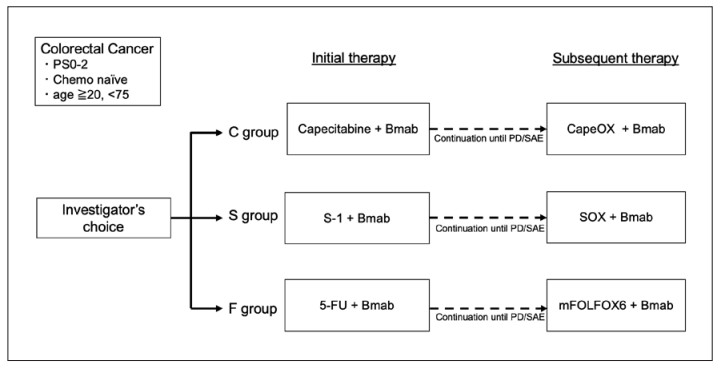
  • Introduction: Previous prospective studies suggest that the sequential use of cytotoxic agents, such as oxaliplatin, in patients with metastatic colorectal cancer (mCRC) has the potential to improve prognosis and maintain quality of life than combination chemotherapy. The purpose of this study was to investigate the feasibility and effectiveness of a sequential treatment strategy consisting of an initial therapy (capecitabine, S-1, or 5-fluorouracil with leucovorin [LV/5-FU] plus bevacizumab) and subsequent therapy (i.e., initial therapy plus oxaliplatin) for mCRC.
    Methods: The primary endpoint was second progression-free survival (2nd PFS) between the start of initial therapy and tumor progression after sequential therapy; secondary endpoints were PFS after initial treatment, overall survival (OS), objective response rate (ORR), and safety.
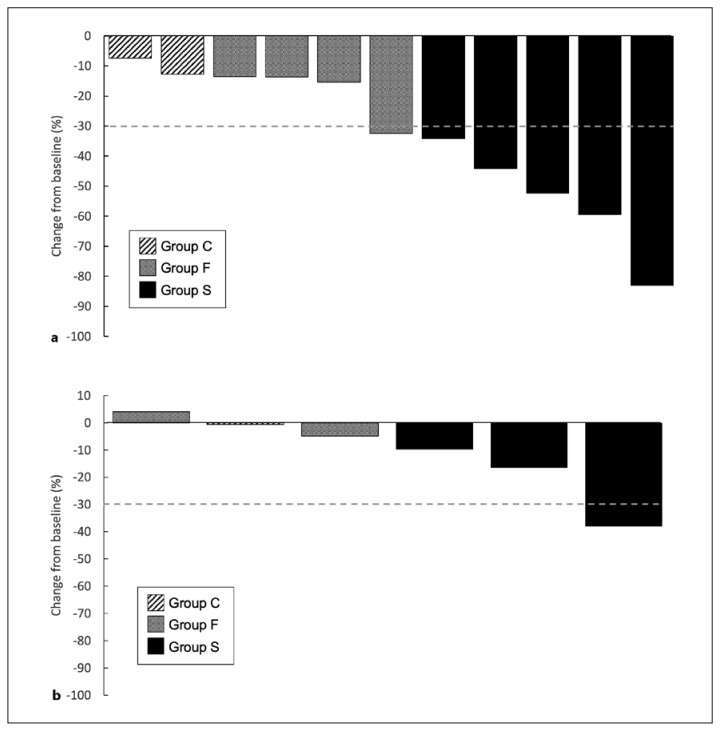
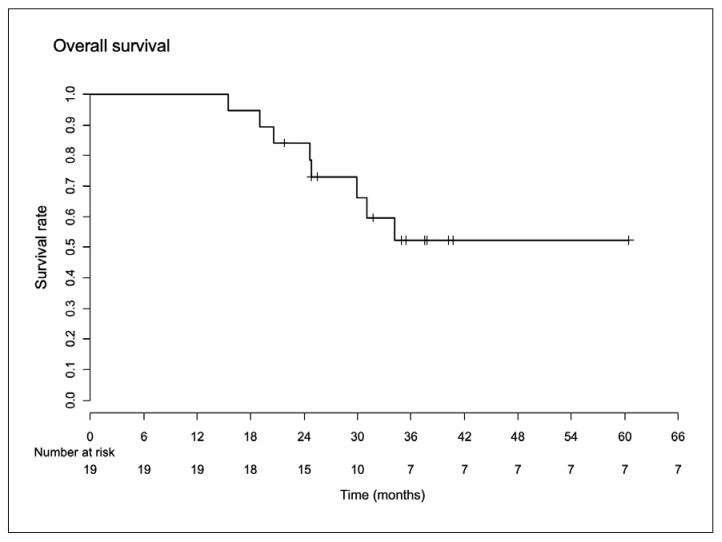
    Results: Sixty-six patients were planned to be recruited. However, owing to a slow accrual rate, recruitment was terminated when only 19 patients were enrolled between 2011 and 2015; 4, 10, and 5 patients were administered capecitabine plus bevacizumab, S-1 plus bevacizumab, and LV/5-FU plus bevacizumab, respectively. The proportions of those with a KRAS status (wild-type/mutant/unknown) were 26%, 21%, and 53%, respectively. The median 2nd PFS and OS were 19.1 months and not reached, respectively. The ORR was 45.5% in the initial therapy and 16.7% in the subsequent therapy. Grade 3/4 toxicities included neutropenia (5%), proteinuria (5%), and hypertension (47%).
    Conclusion: Although our data are limited and preliminary, the sequential treatment strategy may provide a survival benefit in patients with mCRC. Further investigation of this treatment approach is warranted.
  • Cite this article

    Toshifumi Yamaguchi, Motoki Yoshida, Hisato Kawakami, Takayuki Kii, Hiroko Hasegawa, Takahiro Miyamoto, Tetsuji Terazawa, Fukutaro Shimamoto, Masayoshi Yasui, Daisuke Sakai, Toshio Shimokawa, Yukinori Kurokawa, Masahiro Goto, Taroh Satoh. 2022. Sequential Treatment Strategy Using Fluoropyrimidine plus Bevacizumab Followed by Oxaliplatin for Metastatic Colorectal Cancer: A Phase Ⅱ Study (OGSG 1107). Gastrointestinal Tumors. 9: doi: 10.1159/000522610
    Toshifumi Yamaguchi, Motoki Yoshida, Hisato Kawakami, Takayuki Kii, Hiroko Hasegawa, Takahiro Miyamoto, Tetsuji Terazawa, Fukutaro Shimamoto, Masayoshi Yasui, Daisuke Sakai, Toshio Shimokawa, Yukinori Kurokawa, Masahiro Goto, Taroh Satoh. 2022. Sequential Treatment Strategy Using Fluoropyrimidine plus Bevacizumab Followed by Oxaliplatin for Metastatic Colorectal Cancer: A Phase Ⅱ Study (OGSG 1107). Gastrointestinal Tumors. 9: doi: 10.1159/000522610

Figures(4)  /  Tables(3)

Article Metrics

Article views(1086) PDF downloads(697)

Research Article   Open Access    

Sequential Treatment Strategy Using Fluoropyrimidine plus Bevacizumab Followed by Oxaliplatin for Metastatic Colorectal Cancer: A Phase Ⅱ Study (OGSG 1107)

Gastrointestinal Tumors  9 Article number: 10.1159/000522610  (2022)  |  Cite this article

Abstract: 

Introduction: Previous prospective studies suggest that the sequential use of cytotoxic agents, such as oxaliplatin, in patients with metastatic colorectal cancer (mCRC) has the potential to improve prognosis and maintain quality of life than combination chemotherapy. The purpose of this study was to investigate the feasibility and effectiveness of a sequential treatment strategy consisting of an initial therapy (capecitabine, S-1, or 5-fluorouracil with leucovorin [LV/5-FU] plus bevacizumab) and subsequent therapy (i.e., initial therapy plus oxaliplatin) for mCRC.
Methods: The primary endpoint was second progression-free survival (2nd PFS) between the start of initial therapy and tumor progression after sequential therapy; secondary endpoints were PFS after initial treatment, overall survival (OS), objective response rate (ORR), and safety.
Results: Sixty-six patients were planned to be recruited. However, owing to a slow accrual rate, recruitment was terminated when only 19 patients were enrolled between 2011 and 2015; 4, 10, and 5 patients were administered capecitabine plus bevacizumab, S-1 plus bevacizumab, and LV/5-FU plus bevacizumab, respectively. The proportions of those with a KRAS status (wild-type/mutant/unknown) were 26%, 21%, and 53%, respectively. The median 2nd PFS and OS were 19.1 months and not reached, respectively. The ORR was 45.5% in the initial therapy and 16.7% in the subsequent therapy. Grade 3/4 toxicities included neutropenia (5%), proteinuria (5%), and hypertension (47%).
Conclusion: Although our data are limited and preliminary, the sequential treatment strategy may provide a survival benefit in patients with mCRC. Further investigation of this treatment approach is warranted.

  • About this article
    Cite this article
    Toshifumi Yamaguchi, Motoki Yoshida, Hisato Kawakami, Takayuki Kii, Hiroko Hasegawa, Takahiro Miyamoto, Tetsuji Terazawa, Fukutaro Shimamoto, Masayoshi Yasui, Daisuke Sakai, Toshio Shimokawa, Yukinori Kurokawa, Masahiro Goto, Taroh Satoh. 2022. Sequential Treatment Strategy Using Fluoropyrimidine plus Bevacizumab Followed by Oxaliplatin for Metastatic Colorectal Cancer: A Phase Ⅱ Study (OGSG 1107). Gastrointestinal Tumors. 9: doi: 10.1159/000522610
    Toshifumi Yamaguchi, Motoki Yoshida, Hisato Kawakami, Takayuki Kii, Hiroko Hasegawa, Takahiro Miyamoto, Tetsuji Terazawa, Fukutaro Shimamoto, Masayoshi Yasui, Daisuke Sakai, Toshio Shimokawa, Yukinori Kurokawa, Masahiro Goto, Taroh Satoh. 2022. Sequential Treatment Strategy Using Fluoropyrimidine plus Bevacizumab Followed by Oxaliplatin for Metastatic Colorectal Cancer: A Phase Ⅱ Study (OGSG 1107). Gastrointestinal Tumors. 9: doi: 10.1159/000522610

Catalog

    /

    DownLoad:  Full-Size Img  PowerPoint
    Return
    Return