









-
Globally, capture fisheries and aquaculture collectively supply nearly 20% of the per capita animal protein for over 3.1 billion people, excluding subsistence fishing and illegal trade[1]. Despite their vital contribution to global food security and nutritional value as animal protein sources, shrimp and fish cultivation face significant challenges, among which feed cost is paramount[2]. Aquafeed pricing was principally determined by ingredient sourcing and nutritional composition[3], with fishmeal (FM) being a major cost driver. FM serves as the predominant protein source in aquafeeds due to its superior nutritional profile, which includes high protein content, balanced essential amino acids, essential fatty acids, and rich mineral and vitamin levels[4]. Although FM remains vital for aquafeed formulation owing to these unique characteristics, its price fluctuates unpredictably. Furthermore, FM production has declined due to fishing restrictions[5]. Consequently, finding sustainable FM alternatives that maintain shrimp growth and health represents a critical priority for the sector.
Given the demonstrated importance of identifying sustainable FM alternatives for the long-term viability of aquaculture[6], soybean meal (SBM) has emerged as a leading replacement candidate due to its high protein content (45%–48%), favorable amino acid profile, low cost, and wide availability. Successful partial FM substitution with SBM has been reported in diets for amberjack (Seriola dumerili)[7] and Nile tilapia (Oreochromis niloticus)[8]. However, replacing FM with 36% or 48% SBM in the diet of olive flounder (Paralichthys olivaceus) significantly impairs growth performance and muscle quality[9]. A major limitation of SBM is its content of antinutritional factors (ANFs)—including phytates, hemagglutinins, lectins, saponins, and oligosaccharides[10]—which can suppress growth and compromise immunity in aquatic species. For example, 25%–75% FM replacement with SBM significantly reduced growth and metabolic capacity in Litopenaeus vannamei[11]. To mitigate these adverse effects, recent studies indicate that functional additives can enhance SBM utilization. Taurine supplementation, for instance, improved 20%–60% FM replacement potential by SBM in largemouth bass (Micropterus salmoides) diets[12].
Therefore, developing alternative feed additives to promote SBM substitution for FM in aquaculture has always been a top priority[13]. Butyrate derivatives have emerged as promising functional additives, with tributyrin (TB, a triacylglycerol analogue esterifying glycerol with three butyrate molecules) showing particular potential[14]. To verify TB's ability to counteract the negative effects of ANFs, TB was added to a low-FM diet for the study. Empirical studies have confirmed TB's efficacy in aquatic species, demonstrating enhanced growth performance and gut health[15,16]. The addition of 0.1% TB was also found to significantly alleviate intestinal damage due to substitution in a study of FM replacement by SBM[17].
Oriental river prawn (M. nipponense), which belongs to the family Palaemonidae, holds substantial economic value in Chinese aquaculture[18]. The global production was estimated to reach about 237,100 tons, and a market value approaching 2.8 billion USD[19]. In light of its documented physiological roles, TB emerges as a promising feed additive[20]. Therefore, we evaluated the impact of TB on growth, digestive and antioxidant capacity, and non-specific immunity in FM-replaced M. nipponense. This study identifies the optimal level of TB supplementation for FM replacement, providing critical data to facilitate its adoption as a functional aquafeed additive.
-
Six isonitrogenous (40.3% crude protein) and isolipidic (8.7% crude lipid) diets were formulated for this experiment using conventional feed ingredients, with FM and SBM as the primary protein sources, adhering to the nutritional requirements for M. nipponense[21]. The positive control (PC) diet consisted of 30% FM and 22% SBM, whereas the negative control (NC) diet contained 25% FM and 30% SBM. Four experimental diets were then created by supplementing the NC diet with TB at 0.05%, 0.1%, 0.2%, and 0.4%, respectively. TB is obtained from Shanghai Menon Biotechnology Co., Ltd (Shanghai, China) and has a 50% purity.
Diet preparation involved finely grinding macro-ingredients, sieving through a 60-mesh sieve, and homogenizing with micro-ingredients using an electric mixer. Water and oil were incorporated during mixing. The mixture was processed into pellets via a twin-screw extruder (Model: 1.0 mm die pelletizer; Guangzhou, China), dried to ~10% moisture, and then vacuum-packed and frozen at −20 °C until use. Complete ingredient formulations with percentage inclusion rates are detailed in Table 1.
Table 1. Formulation and proximate composition of the experimental diets (% dry matter).
Ingredients Diets PC NC TB1 TB2 TB3 TB4 FM1 30.00 25.00 25.00 25.00 25.00 25.00 SBM1 22.00 30.00 30.00 30.00 30.00 30.00 Rapeseed meal2 10.00 10.00 10.00 10.00 10.00 10.00 Shrimp meal2 6.00 6.00 6.00 6.00 6.00 6.00 Squid paste2 3.00 3.00 3.00 3.00 3.00 3.00 α-Starch 20.48 17.48 17.43 17.38 17.28 17.08 Oil (fish 1:soy 1)3 1.50 1.50 1.50 1.50 1.50 1.50 Granulesten2 1.50 1.50 1.50 1.50 1.50 1.50 Cholesterol4 1.00 1.00 1.00 1.00 1.00 1.00 Monocalcium phosphate4 0.50 0.50 0.50 0.50 0.50 0.50 Premix5 2.00 2.00 2.00 2.00 2.00 2.00 Vitamin C5 1.00 1.00 1.00 1.00 1.00 1.00 Choline chloride4 0.50 0.50 0.50 0.50 0.50 0.50 Ecdysone2 0.50 0.50 0.50 0.50 0.50 0.50 DMPT2 0.02 0.02 0.02 0.02 0.02 0.02 Tributyrin 50%6 0.05 0.10 0.20 0.40 Total 100 100 100 100 100 100 Proximate composition (dry matter basis) Crude protein 40.31 40.36 40.35 40.35 40.34 40.31 Crude lipid 8.79 8.71 8.71 8.71 8.71 8.71 Ash 11.00 10.26 10.26 10.26 10.26 10.26 Note: 1 FM (fish meal), obtained from Wuxi Tongwei feedstuffs Co., Ltd, Wuxi, China, crude protein 61.3%, crude lipid 8.3%; SBM (soybean meal) obtained from Wuxi Tongwei feedstuffs Co., Ltd, Wuxi, China, crude protein 44.7% (db), crude lipid 1.1% (db); 2 provided by Tongwei Co., Ltd (Wuxi, China);3 oil consisted of a mixture of fish oil and soybean oil with a 1:1 ratio,4 provided by Wuxi Hanove Animal Health Products Co., Ltd (Wuxi, China); 5 vitamin C and mineral premix were produced for shrimps by Wuxi Hanove Animal Health Products; 6 50% efficiency, obtained from Shanghai Menon Biotechnology Co., Ltd (Shanghai, China). Experimental prawns and management
-
Healthy juvenile M. nipponense of uniform age and size (initial weight: 0.38 ± 0.01 g) were obtained from the Dapu breeding station (Wuxi, China). Before the trial, prawns were acclimatized and fed a commercial diet (Wuxi Tongwei Feedstuffs Co., Ltd, China) to apparent satiation twice daily. Nine hundred juveniles were then randomly stocked into each of 18 of the same model (1,000 L) tanks (three tanks per diet, 50 prawns per tank). Prawns were hand-fed their respective diets to apparent satiation three times daily (08:00, 12:00, and 16:00) at an initial rate of 5%–8% body weight for 8 weeks. Daily feed rations were adjusted based on consumption and mortality. Residual feed and feces were siphoned out 2 h post-feeding. Water exchange (20%–30%) occurred weekly. Environmental conditions were maintained as follows: natural photoperiod, water temperature 25–27 °C, pH 7.5–8.0, dissolved oxygen 6.0–8.0 mg/L, ammonia nitrogen < 0.1 mg/L, and nitrate < 0.01 mg/L. Water quality parameters were monitored using a Sunpu Test assay kit (Beijing Sunpu Biochem. Tech. Co., Ltd) according to the manufacturer's protocol.
Sample collection
-
The feeding trial lasted approximately 8 weeks, and all groups were treated under similar conditions. On the final day, a 24-h fasting period was implemented to clear the digestive tract before sample collection. Then, the prawns in every tank were counted and weighed to calculate growth performance. Nine prawns were then selected from each treatment group and dissected to collect samples. The separately collected intestines were cooled down to a frozen state using liquid nitrogen and then immediately stored at −80 °C for subsequent enzymatic activity laboratory analysis. Three samples from each experimental diet were taken for feed proximate chemical composition analysis.
Growth performance parameters
-
Growth performance, body index, and feed utilization parameters were determined as follows:
$ \mathrm{Weight\ gain\ rate\ (WGR,\ \%)=100\times\frac{Wt\ -\ Wi}{Wi}} $ $ \mathrm{Specific\ growth\ rate\ (SGR,\ \%/day)\ =\ 100\ \times\ \frac{Ln\ Wt\ -\ Ln\ Wi}{Experimental\ days}} $ $ \mathrm{Feed\ conversion\ ratio\ (FCR)=100\times\frac{Feed\ intake}{Wt\ -\ Wi}} $ $ \mathrm{Survival\ rate\ (SR,\ \%)\ =\ 100\ \times\ \frac{Final\ number\ of\ prawns}{Initial\ number\ of\ prawns}} $ $ \mathrm{Condition\ factor\ (CF,\ g/cm^3)\ =\ 100\ \times\ \frac{Wt}{Lt^3}} $ $ \mathrm{Protein\ efficiency\ ratio\ (PER)\ =\ \frac{Wt - Wi}{Protein intake}} $ where g is gram, Wi is initial body weight, Wt is final body weight, Lt is final body length, and cm is centimeter.
Diet proximate chemical composition analysis
-
The proximate composition (crude lipid, crude protein, and ash) of the six experimental diets was analyzed according to the official methods of the Association of Official Analytical Chemists International. Then the samples were ground into powder using a mortar and pestle for further analysis. After acid digestion, the Kjeldahl method was used to measure the nitrogen (N × 6.25) content to determine the crude protein content. As a Soxhlet extractor was used to determine the lipid content by extracting ether, the ash content of the diet was determined by combustion of the samples at 550 °C in a muffle furnace for 5 h.
Digestive enzyme assays
-
Total protein (A045-2-2), lipase (A054-1-1), and amylase (C016-2-1) activities were determined in intestinal tissue stored at −80 °C using respective assay kits (Nanjing Jiancheng Bioengineering Institute, Nanjing, China) strictly adhering to the manufacturer's protocols.
Hemolymph and hepatopancreatic antioxidant enzymatic capacity assay
-
The specific procedures for hemolymph collection, anticoagulant preparation, and hepatopancreas homogenisation should be carried out in accordance with Liu et al.[22]. Then, the activities of MDA (A003-1-2), CAT (A007-1-1), SOD (A001-3-2), T-AOC (A015-1-2), and NO (A012-1-2) were measured using a commercial test kit (Nanjing Jiancheng Bioengineering Institute, Nanjing, China), following the manufacturer's protocol.
Bacterial challenge test
-
On the final day of the feeding trial experiment, 13 prawns from each tank were randomly taken and used for the pathogenic bacterium challenge test against Vibrio cholerae (V. cholerae). The V. cholerae was obtained from the College of Animal Science and Technology, Yangzhou University, China. V. cholerae (GXFL1-X) was activated and cultured in an LB liquid medium at 28 °C with 180 rpm shaking for 18 h. Bacterial concentration was quantified via the plate count method, followed by adjustment to target bacterial suspensions using sterile saline. The randomly selected prawns were injected intramuscularly with 10 μL in the second abdominal segment from the head at a concentration of 1 × 10⁸ CFU/mL and reared in small containers at a controlled temperature (25 ± 1 °C) for 96 h. Mortalities in each treatment group were recorded at 6, 12, 24, 48, 72, and 96 h, and the dead prawns were removed promptly.
RNA extraction, cDNA synthesis, and real-time PCR analysis
-
The mRNA expression levels of heat shock proteins 70 (HSP70), immune deficiency (IMD), Relish, Toll-like receptors (TLRs), dorsal, and β-actin (Table 2) were determined in two major steps as mentioned in the study by Zhao et al.[23]. All primers were designed via Primer-BLAST using cDNA sequences from our transcriptome library and were commercially produced by Shanghai Biocolor BioScience & Technology Company (Shanghai, China).
Table 2. Real-time PCR primers.
Gene Primer sequences (5′-3′) Product length (bp) Amplification efficiency Tm (°C) XXX Ref. TLRs (F) CGACCTCCACGACAACAAGA 186 97.23% 59.97 MH178390 (Gu et al.,[24] 2017) (R) AAAGTTCCTGCACCAATGCG 59.69 Dorsal (F) TACGACCAACGGACAAGAGC 116 93.37% 60.04 OM066734 (Song et al.,[25] 2020) (R) CGCATTGTTGCTGTTTCCCA 59.97 IMD (F) GGCACCAAGCCTTCTTTTCAG 164 126.81% 60.00 (Li et al.,[26] 2018) (R) ATATCCTTCGGGTCGCATTTC 58.23 Relish (F) CGGGAAGTTTGGACGGCATA 198 100.26% 60.39 MZ466551 (Song et al.,[25] 2020) (R) TCGTTTAAGGCTGTCTGGCA 59.61 HSP70 (F) CTTTGAGGTGGCTGGATGGAA 112 100.54% 60.27 KC460343 (Song et al.,[25] 2020) (R) GCAGTTCCGTGAATTTTGGCA 60.27 β-actin (F) GTGCCCATCTACGAGGGTTA 247 110.27% 58.88 MH540111 (Luo et al.,[27] 2018) (R) CGTCAGGGAGCTCGTAAGAC 59.90 Note: the mRNA sequences for each gene were obtained from M. nipponense hepatopancreas transcriptome sequencing database of the Aquatic Disease and Nutrition Laboratory of Freshwater Fisheries Research Center, Chinese Academy of Fishery Sciences. Primers for RT-PCR were designed using Primer 5.0. Statistical analysis
-
The SPSS for Windows v25.0 was used for statistical analysis of the data. Using one-way analysis of variance, all the collected data from various parameters were subjected to a homogeneity test, and significant effects on the groups were determined by multiple range test analysis of Tukey's to see whether significant differences existed among the means of the treatment groups. All the data were expressed as a mean ± standard error of the mean (M ± SEM).
-
Results for the growth performance parameters of the experiment are provided in Table 3. In the 56-d feeding trial experiment, all the prawns fed with different treatments appeared to be healthy, and the survival rates (SR) were in the range of 86% to 92%, with no significant differences among the groups (p > 0.05). Likewise, in the indices final body weight (FBW), WGR, SGR, CF, PER, and FCR, there were no significant differences among all the groups (p > 0.05). In general, growth performance and feed utilization indices of M. nipponense were not affected by reducing FM content from 30% to 25%. Furthermore, supplementation of TB in low FM diets also has no significant effect on all the indices (p > 0.05).
Table 3. Growth performance and feed utilization of M. nipponense fed with diets of partially replaced fishmeal and supplemented with different levels of tributyrin.
Parameters Diets PC NC TB1 TB2 TB3 TB4 IBW (g) 0.39 ± 0.00 0.38 ± 0.00 0.38 ± 0.00 0.38 ± 0.00 0.38 ± 0.00 0.38 ± 0.00 FBW (g) 0.69 ± 0.02 0.67 ± 0.02 0.67 ± 0.02 0.68 ± 0.02 0.68 ± 0.01 0.68 ± 0.01 WGR (%) 79.71 ± 3.05 74.04 ± 3.70 75.93 ± 6.77 76.17 ± 3.95 77.61 ± 2.36 76.57 ± 3.44 SGR (%/day) 1.15 ± 0.03 1.09 ± 0.04 1.11 ± 0.07 1.11 ± 0.04 1.13 ± 0.03 1.11 ± 0.04 SR (%) 86.00 ± 1.15 89.33 ± 3.53 92.00 ± 3.06 88.00 ± 4.00 90.67 ± 0.67 87.33 ± 4.37 FCR 2.52 ± 0.13 2.70 ± 0.20 2.55 ± 0.16 2.54 ± 0.17 2.34 ± 0.12 2.68 ± 0.27 FI (g) 2.44 ± 0.02 2.44 ± 0.09 2.60 ± 0.03 2.67 ± 0.09 2.78 ± 0.14 2.77 ± 0.19 PER 0.92 ± 0.05 0.87 ± 0.07 0.92 ± 0.06 0.91 ± 0.06 1.00 ± 0.05 0.88 ± 0.10 CF (g/cm3) 1.18 ± 0.01 1.18 ± 0.02 1.16 ± 0.00 1.15 ± 0.01 1.13 ± 0.05 1.13 ± 0.02 Note: values are presented as mean ± SEM (n = 3). Different letters indicate significant differences between treatments (p < 0.05). IBW: initial body weight; FBW: final body weight; WGR: weight gain rate; SGR: specific growth rate; SR: survival rate; FCR: feed conversion ratio; FI: feed intake; PER: protein efficiency ratio; CF: condition factor. Digestive enzymatic activities
-
The digestive enzymatic activities tested in the intestine are provided in Fig. 1. No significant difference was observed in the amylase among the groups (p > 0.05). Concerning lipase activities, there was no significant difference in PC, NC, and TB1. However, it has substantially increased in the groups fed with higher TB concentrations (p < 0.05). Lipase activities significantly rose as dietary TB levels increased up to 0.2% and remained at a plateau up to the concentration of 0.4% (p < 0.05).
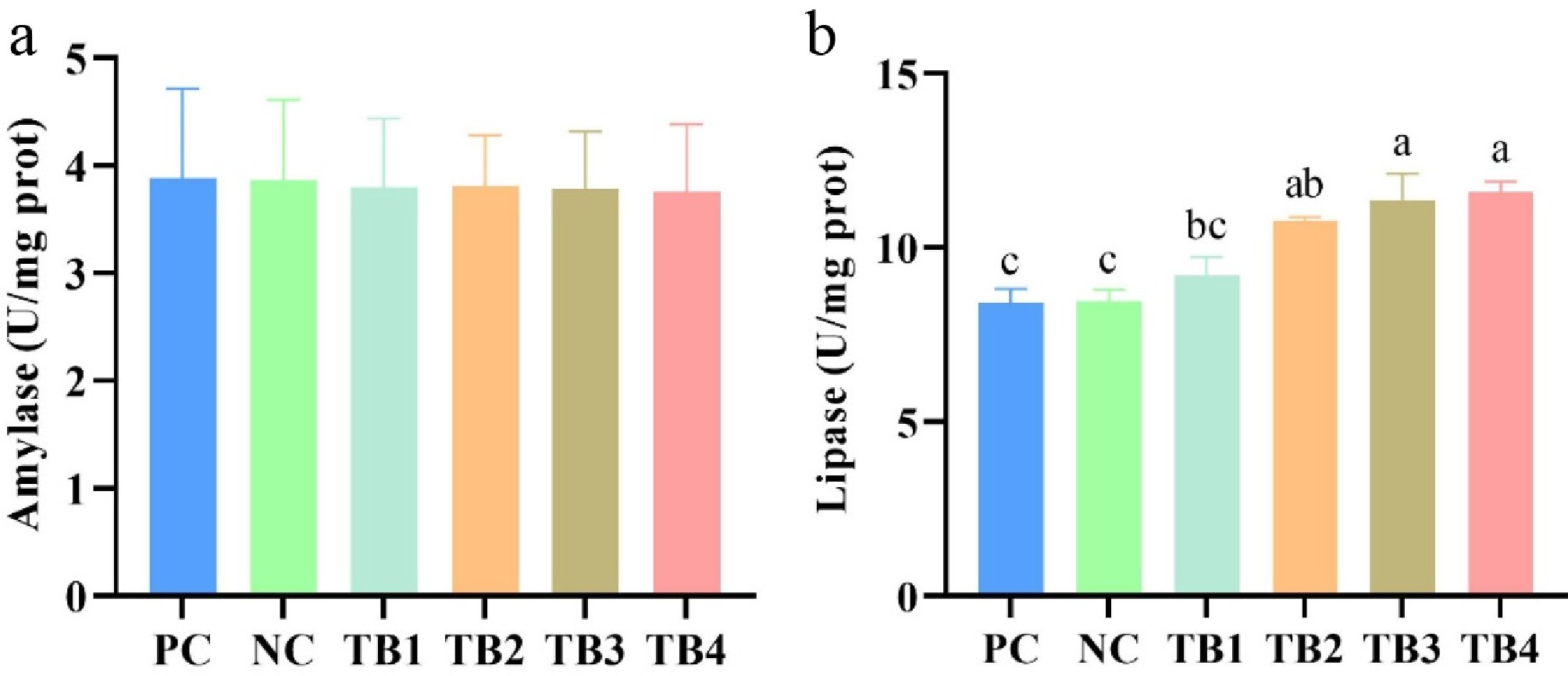
Figure 1.
The effect of substitution of fish meal and addition of different levels of tributyrin on intestinal enzymatic activities of M. nipponense. Note: (a) amylase; (b) lipase. Values are presented as mean ± SEM (n = 9). Different letters indicate significant differences between treatments (p < 0.05).
Hemolymph antioxidant enzymatic capacity
-
Hemolymph antioxidant enzyme activity results are presented in Fig. 2. Although MDA levels did not differ significantly (p > 0.05) between prawns fed the PC and NC diets, MDA was significantly reduced (p < 0.05) in all TB-supplemented diets. In contrast to MDA, CAT activity was unaffected by TB supplementation (p > 0.05) observed among dietary treatments.
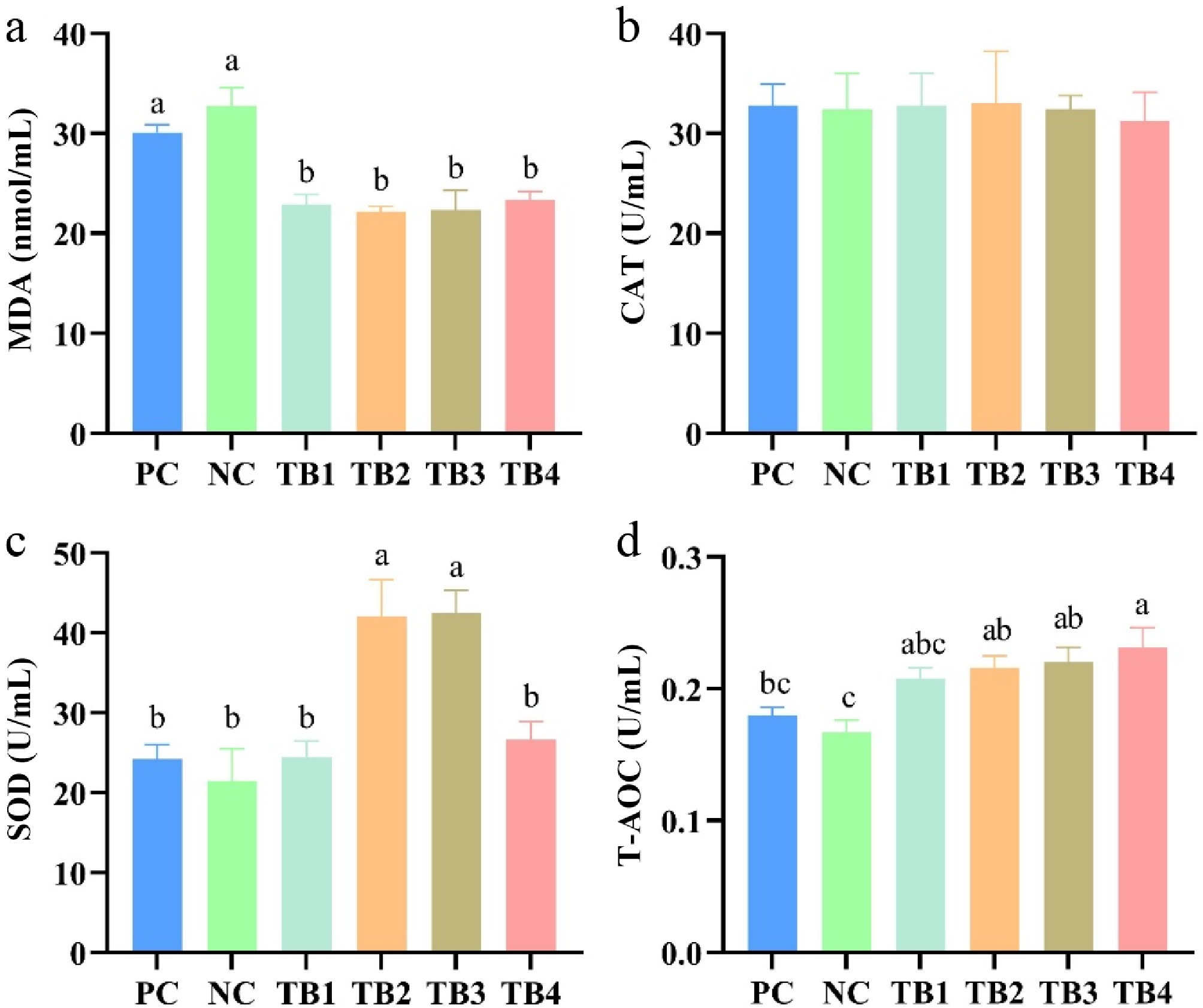
Figure 2.
The effect of substitution of fish meal and addition of different levels of tributyrin on antioxidant enzymatic capacity in hemolymph of M. nipponense. Note: (a) malondialdehyde (MDA); (b) catalase (CAT); (c) superoxide dismutase (SOD); (d) total antioxidant capacity (T-AOC). Values are presented as mean ± SEM (n = 9). Different letters indicate significant differences between treatments (p < 0.05).
SOD activity and T-AOC did not differ significantly (p > 0.05) between the NC and PC groups. However, SOD activity was significantly higher (p < 0.05) in the TB2 and TB3 groups compared to all other experimental groups. T-AOC was significantly elevated (p < 0.05) in the TB2, TB3, and TB4 groups relative to the NC group. Furthermore, the TB4 group exhibited significantly higher T-AOC (p < 0.05) than the PC group.
Hepatopancreatic antioxidant enzyme capacity
-
Hepatopancreatic antioxidant enzyme activity results are presented in Fig. 3. MDA levels did not differ significantly (p > 0.05) between the PC and NC groups. However, MDA levels were significantly lower (p < 0.05) in the TB2, TB3, and TB4 groups compared to both the PC and NC groups. NO levels remained unaffected by dietary treatments (p > 0.05). No statistically significant variation in SOD activity was observed between the two control groups (PC vs NC) (p > 0.05), whereas SOD activity was significantly elevated in the TB2, TB3, and TB4 groups relative to both control groups (p < 0.05).
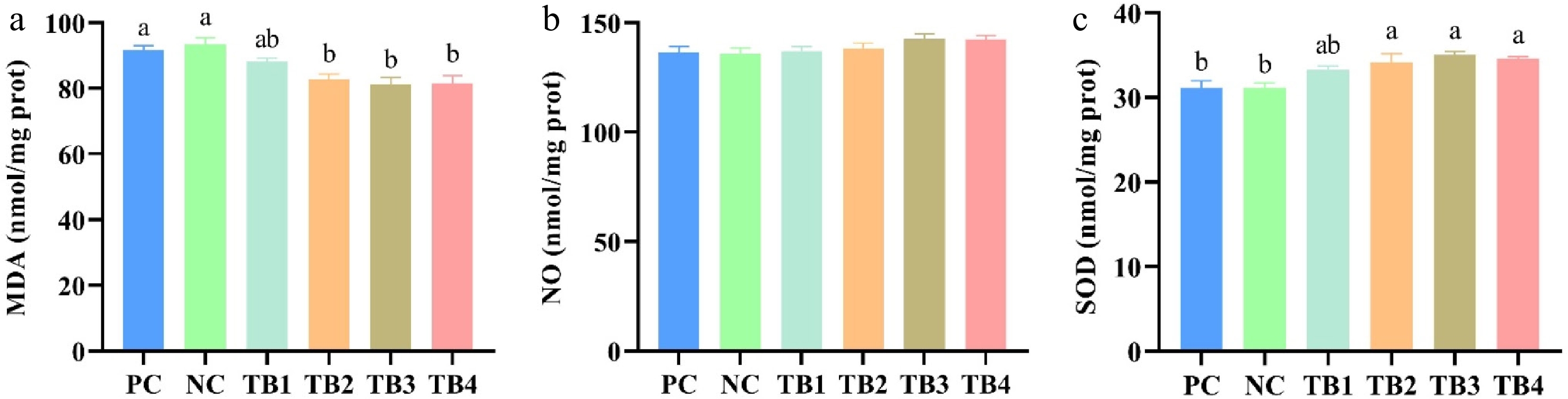
Figure 3.
The effect of substitution of fish meal and addition of different levels of tributyrin on antioxidant enzymatic capacity in hepatopancreas of M. nipponense. Note: (a) malondialdehyde (MDA); (b) superoxide dismutase (SOD); (c) nitrous oxide (NO). Values are presented as mean ± SEM (n = 9). Different letters indicate significant differences between treatments (p < 0.05).
Intestinal immune-related gene expression
-
Relative intestinal gene expression of HSP70, IMD, Relish, TLRs, and Dorsal in M. nipponense fed TB-supplemented diets for 8 weeks is presented in Fig. 4. HSP70 expression showed no significant difference (p > 0.05) between PC and NC control groups. However, TB1, TB2, and TB3 groups exhibited significantly elevated HSP70 expression (p < 0.05) relative to PC, NC, and TB4 groups. Dorsal, IMD, and Relish expression remained unaffected across all dietary treatments (p > 0.05). TLRs expression did not differ significantly (p > 0.05) between NC and PC groups but was significantly upregulated (p < 0.05) in TB2 and TB3 groups compared to both controls.
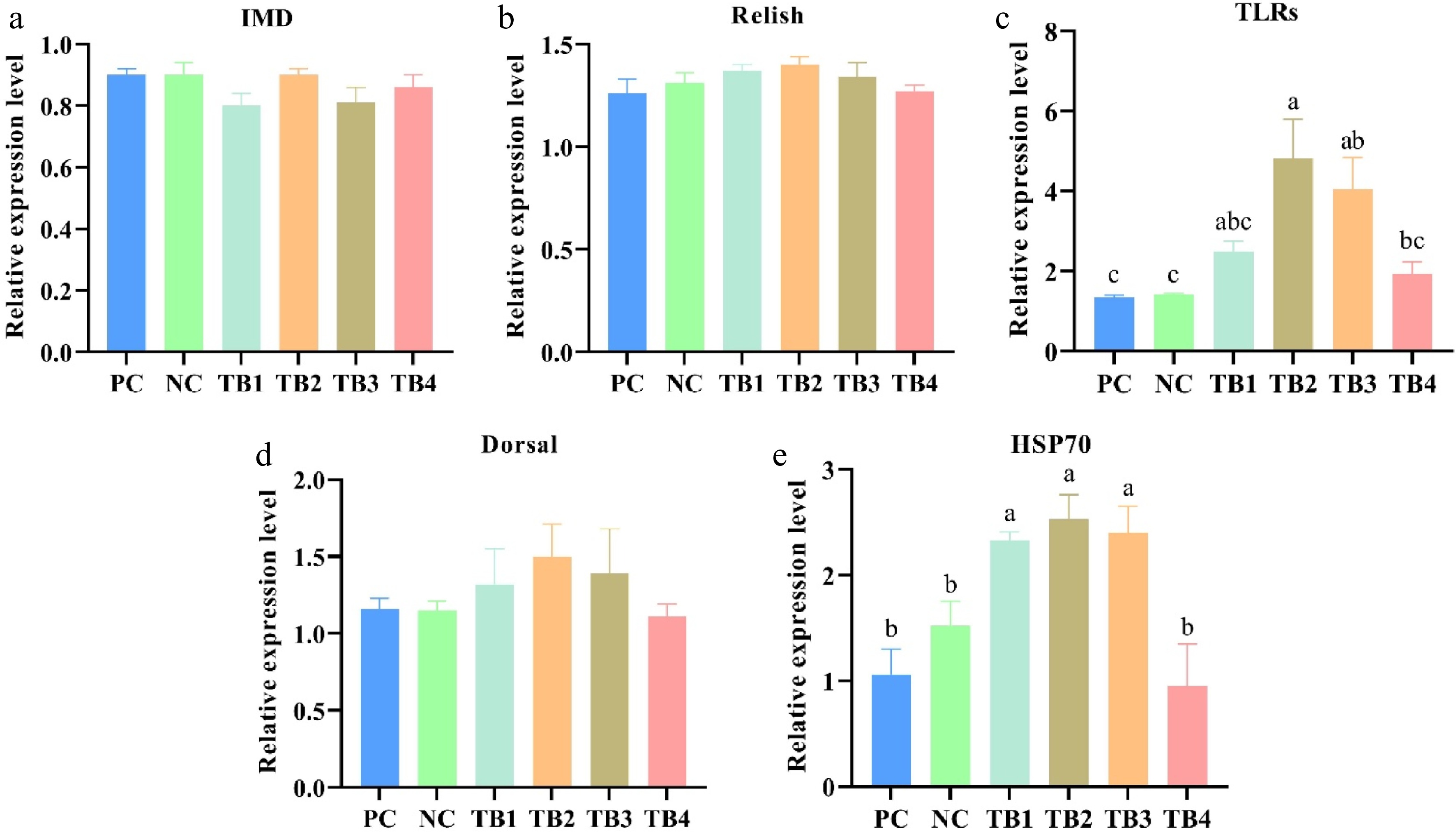
Figure 4.
The effect of substitution of fish meal and addition of different levels of tributyrin on immune related genes expression in hepatopancreas of M. nipponense. Note: (a) Immune deficiency (IMD); (b) Relish; (c) Toll-like receptors (TLRs); (d) Dorsal; (e) Heat shock protein 70 (HSP70). Values are presented as mean ± SEM (n = 9). Different letters indicate significant differences between treatments (p < 0.05).
Bacterial challenge test
-
The result of the bacterial challenge test of M. nipponense fed with diets of different TB supplementation levels is presented in Fig. 5. Statistical analysis indicated no significant disparity in cumulative survival between the control groups (p > 0.05). Prawns fed the TB3 diet exhibited significantly higher survival compared to both control groups (p < 0.05). The second-degree polynomial regression analysis based on survival rate or resistance of M. nipponense against V. cholerae and different supplementation levels estimated that the optimum TB requirement is 0.26% (Fig. 5c).
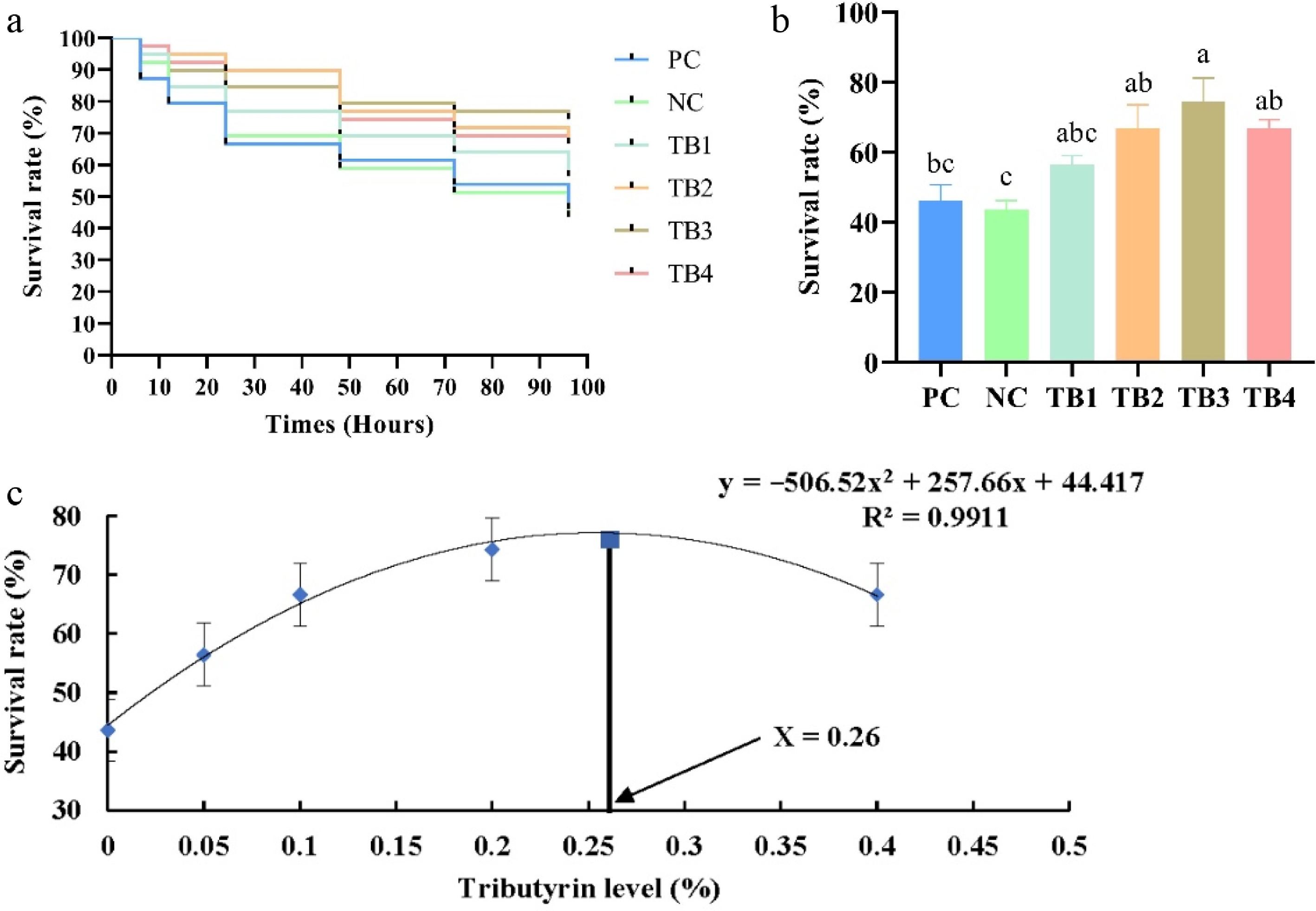
Figure 5.
Effect of dietary tributyrin on the survival rate of M. nipponense against Vibrio cholerae (2 × 10⁷ CFU/mL). Note: (a) the survival rate of M. nipponense at different time periods after injection of bacteria; (b) the survival rate of M. nipponense after 96 h of injection of bacteria; (c) the optimum level of ferulic acid supplementation based on second-order polynomial analysis on the survival rate of M. nipponense after 96 h of bacterial challenge. Values are presented as mean ± SEM (n = 39). Different letters indicate significant differences between treatments (p < 0.05).
-
FM, a critical but increasingly constrained aquafeed ingredient due to pricing and sustainability concerns, has prompted extensive research into alternative protein sources. Substantial evidence indicates that SBM substitution for FM often reduces growth performance in aquatic species, though dietary additives may mitigate these effects[28]. In the present study, replacing 5% FM with SBM (reducing total FM to 25%) with supplemental TB at 0.05%–0.4% elicited no significant differences in growth performance across treatments. This aligns with findings in Litopenaeus vannamei, where 20%–40% FM replacement with SBM yielded comparable WGR, specific growth rate (SGR), and protein efficiency ratio (PER)[29]. The reason for this may be closely related to quality and nutritional value, but sometimes it varies according to soybean composition. Besides the source, processing procedures also play an important role[3].
TB, a butyrate prodrug, has gained prominence in nutritional science for enhancing nutrient bioavailability and intestinal health in aquatic species[30]. However, the absence of growth enhancement in the current study contrasts with positive responses observed in juvenile black sea bream (Acanthopagrus schlegelii)[15], juvenile yellow drum (Nibea albiflora)[17], and Litopenaeus vannamei[31]. Notably, null growth effects align with findings in L. vannamei fed 50% SBM diets[32]. This interspecies variation likely reflects divergent digestive physiology and feeding behaviors. Butyrate liberation from TB exhibits compartment-specific kinetics: minimal during gastric digestion but extensive in the intestinal segment[33]. This site-specific metabolism enhances intestinal utilization efficiency over gastric absorption[34], potentially explaining the observed growth response disparities and warranting further mechanistic investigation.
Digestive enzyme activity in decapod crustaceans—particularly trypsin, lipase, and amylase—critically influences nutrient assimilation and has been extensively studied[35]. Unlike esterases (which hydrolyze simple alcohol esters), lipases require interfacial activation for full catalytic efficiency and specifically cleave glycerol esters. In M. nipponense, dietary TB significantly elevated lipase activity, suggesting TB stimulates lipase production to facilitate butyrate release, thereby enhancing nutrient absorption and health. This aligns with observations in Larimichthys crocea, where TB supplementation increased lipase activity[36]. Conversely, TB supplementation did not significantly affect amylase activity—consistent with the absence of growth or feed efficiency differences among treatments. While short-chain fatty acids (SCFAs) generally enhance digestive enzyme activity in aquaculture[37], such effects depend on rearing conditions. During the rearing time, if shrimps were not exposed to any stress in a clean water system with low density and good water quality and provided with ideal growth conditions, a significant difference might not be observed[38]. In our study, all the treatment groups of M. nipponense were not exposed to any stress, and the result correlates with this statement.
The antioxidant enzymatic system protects organisms from oxidative damage by neutralizing reactive oxygen species (ROS) and maintaining cellular homeostasis[39]. In crustaceans, key antioxidant enzymes—including SOD, CAT, and T-AOC—collectively mitigate oxidative stress[40]. MDA, a lipid peroxidation biomarker, reliably indicates oxidative injury severity[41]. In this study, MDA levels did not differ significantly between positive and NC groups. However, TB-supplemented diets significantly reduced MDA concentrations in hemolymph and hepatopancreas tissues. This aligns with findings in L. vannamei, where TB lowered MDA levels[31]. In crustaceans, SOD scavenges excess ROS during pathogen challenge, maintaining cellular metabolic homeostasis[42]. Analysis confirmed the absence of significant differences in SOD activity after replacing 5% FM with SBM, whereas the addition of 0.1% vs 0.2% of TB resulted in a significant increase in SOD activity in haemolymph and hepatopancreas, which was similar to the results of the pike crab study, where the addition of moderate amounts of TB prominently increased the activities of T-SOD, polyphenol oxidase, nitric oxide, acid phosphatase, and alkaline phosphatase[43]. While plant-protein substitution can compromise aquatic animal health, TB supplementation mitigates oxidative damage by enhancing antioxidant and immune capacity[15].
The T-AOC represents a comprehensive measure of an organism's ability to counteract oxidative stress[44]. In this study, T-AOC did not differ significantly between PC and NC groups. However, TB2, TB3, and TB4 groups exhibited substantially elevated T-AOC relative to NC. Relevant studies have found that dietary TB supplementation elevates intestinal T-AOC and SOD activities and concurrently lowers MDA and protein carbonylation contents in prawns[45]. Similarly, the addition of moderate amounts of TB was also found to improve antioxidant capacity in a grass carp study[46]. These findings collectively indicate that the addition of a moderate amount of TB improves the antioxidant capacity of M. nipponense by increasing SOD, T-AOC content, and reducing MDA levels after the replacement of 5% FM with SBM.
Nitric oxide (NO)—an evolutionarily conserved signaling mole-cule—mediates critical physiological functions in aquatic species, including neuromodulation, cardiovascular regulation, host defense, and developmental processes[47]. It further contributes to cellular homeostasis and oxidative stress mitigation[48]. In this study, NO levels did not differ significantly among dietary groups, indicating that TB supplementation does not primarily exert immunomodulatory or antioxidant effects through NO-dependent pathways. Given the unresolved mechanisms underlying TB's bioactivity, we conducted quantitative PCR analysis of immune-related genes and pathogenic challenge assays to elucidate alternative pathways.
Crustaceans, including M. nipponense, rely primarily on innate immunity to combat microbial pathogens through activation of cellular and humoral immune genes[49]. Within this system, heat shock protein 70 (HSP70) serves as a critical molecular chaperone with dual functions: facilitating cytoprotection in gut epithelial cells and mitigating inflammatory-oxidative stress in vivo and in vitro[50]. While HSP70 expression did not differ significantly between PC and NC groups, the TB1, TB2, and TB3 groups exhibited markedly upregulated HSP70 compared to both controls. This aligns with findings in juvenile common carp (Cyprinus carpio), where microencapsulated sodium butyrate enhanced intestinal HSP70 expression[51]. Collectively, these results indicate that optimal TB supplementation enhances non-specific immunity in M. nipponense through HSP70 induction.
The IMD and Toll pathways constitute the primary regulatory axes governing invertebrate immune responses[52]. Extensive studies confirm their critical roles in pathogen defense and stress adaptation in crustaceans[53], where these evolutionarily conserved pathways orchestrate antimicrobial peptide and immune effector expression to eliminate infections[54]. In this study, 5% FM substitution with SBM did not alter IMD or TLRs expression. However, 0.1%–0.2% TB supplementation significantly upregulated TLRs expression relative to both the PC and NC groups, while IMD remained unaffected. This aligns with findings in shrimp administered Clostridium butyricum (a butyrate-producing anaerobe), where TLRs expression increased significantly[55]. It was hypothesised that triglycerides are hydrolysed in the intestine by lipase, releasing butyric acid (the main active ingredient) and glycerol, which acts as a signalling molecule to enhance the body's non-specific immunity by activating immune receptor TLRs.
Upon pathogen invasion, pattern recognition receptors (e.g., TLRs or IMD) detect microbial ligands and initiate intracellular signaling cascades that ultimately activate the NF-κB transcription factor in the nucleus[56]. The NF-κB transcription factor family, comprising members such as Relish (IMD pathway) and Dorsal/Dif (Toll pathway), plays pivotal roles in governing immune and inflammatory responses[57,58]. While in this study there was no significant difference in the expression of Dorsal and Relish among the groups, the possible explanation is that the regulation of TLRs expression is not completely dependent on a single transcription factor, Dorsal, and that it is coupled with the lack of significant expression of the genes in the IMD-Relish pathway. To further investigate the effect of TB on non-specific immunity, a bacterial challenge test was performed.
V. cholerae, a pathogenic bacterium affecting both fish and humans, naturally inhabits brackish and estuarine environments[59]. Different studies have demonstrated that SCFAs and their salts contribute to disease mitigation in aquaculture by enhancing host health via significant antimicrobial effects[60]. Propionate, butyrate, and acetate salts, which have similar characteristics to TB, exhibited strong inhibitory capacity against Vibrio spp. in Litopenaeus vannamei[61]. In the present study, the bacterial challenge test revealed that there was no significant difference in survival between the PC and NC groups. However, TB2, TB3, and TB4 survival was significantly higher than that of the NC group. Similar results were found in the study of Litopenaeus vannamei, where dietary supplementation with an appropriate amount of TB significantly increased the survival rate against Vibrio harveyi[14]. As per the second-order polynomial regression analysis between the survival percentage and TB supplementation levels, the optimum level for M. nipponense was estimated to be 0.26%. Similar results were found in the study of juvenile black sea bream (Acanthopagrus schlegelii), where the optimum addition of TB was 0.24% based on the second-order polynomial regression analysis of the SGR[15], and likewise in the study of juvenile grass carp (Ctenopharyngodon idellus), where the optimum addition of butyric acid was found to be 0.2%[62]. These results demonstrate that supplementation with 0.2%–0.4% TB significantly enhances pathogen resistance, likely through immunomodulatory mechanisms.
-
In conclusion, this study investigated the effects of SBM replacement of FM and the addition of TB on the growth performance, digestive enzymes, antioxidant capacity, and non-specific immunity of M. nipponense. Interestingly, the replacement of FM by SBM at 5% did not cause significant adverse effects on M. nipponense. The addition of 0.1%–0.4% TB significantly enhances lipase activity and promotes digestive capacity, thereby improving antioxidant properties and non-specific immunity. Through bacterial challenge assays and second-order polynomial regression analysis, the optimal TB inclusion level was determined to be 0.26% in M. nipponense diets. These findings provided critical data supporting the useful information for the small-scale replacement of FM by SBM and the development of TB as an immunostimulant for M. nipponense.
-
All procedures were reviewed and preapproved by the Animal Care and Use Committee of Freshwater Fisheries Research Center, Chinese Academy of Fishery Sciences, identification number: LAECFFRC-2021-06-30, approval date: 30 June 2021. The research followed the 'Replacement, Reduction, and Refinement' principles to minimize harm to animals.
-
The authors confirm their contributions to the paper as follows: methodology, formal analysis, writing – original draft, data curation: Liu X; investigation, validation: Yossief GS, Liu B; supervision, writing – review and editing: Zhu L, Zheng X; resources, investigation, visualization: Jing X*, Yu Y; funding acquisition, writing – review and editing, project administration: Sun C, Liu B*. All authors reviewed the results and approved the final version of the manuscript.
-
The datasets generated and/or analyzed during the current study are available from the corresponding author upon reasonable request.
-
The authors declare they have no conflict of interest.
- Copyright: © 2026 by the author(s). Published by Maximum Academic Press on behalf of Nanjing Agricultural University. This article is an open access article distributed under Creative Commons Attribution License (CC BY 4.0), visit https://creativecommons.org/licenses/by/4.0/.
-
About this article
Cite this article
Liu X, Yossief GS, Zhu L, Liu B, Sun C, et al. 2026. The effects of dietary tributyrin in low fishmeal diets on the growth performance and health status of oriental river prawn (Macrobrachium nipponense). Animal Advances 3: e027 doi: 10.48130/animadv-0026-0012 

The effects of dietary tributyrin in low fishmeal diets on the growth performance and health status of oriental river prawn (Macrobrachium nipponense)
- Received: 07 January 2026
- Revised: 22 March 2026
- Accepted: 24 April 2026
- Published online: 08 October 2026
Abstract: To assess the effects of soybean meal (SBM) substitution for fishmeal (FM) and the tributyrin (TB) supplementation on the growth and health status of Macrobrachium nipponense, 900 prawns (initial weight 0.38 ± 0.01 g) were randomly assigned into six groups with three replicates. Six isonitrogenous (40.3% crude protein) and isolipidic (8.7% crude lipid) diets were formulated: positive control (PC: 30% FM, 22% SBM), negative control (NC: 25% FM, 30% SBM), and NC supplemented with 0.05% (TB1), 0.1% (TB2), 0.2% (TB3), or 0.4% TB (TB4). After 8 weeks, growth performance indicators showed no significant differences (p > 0.05). Digestive enzyme analysis revealed that lipase activity in TB2-TB4 was significantly higher than that of PC and NC (p < 0.05). Compared with the PC and NC groups, the T2-T4 group exhibited significantly reduced malondialdehyde (MDA) content and markedly elevated superoxide dismutase (SOD) activity (p < 0.05). Total antioxidant capacity (T-AOC) of hemolymph was substantially greater in the TB2-TB4 groups than in the NC group (p < 0.05). The gene expression levels of heat shock protein 70 (HSP70) in TB1-TB3 and toll-like receptors (TLRs) in TB2-TB3 were significantly upregulated compared to the PC and NC groups (p < 0.05). In the bacterial challenge test, resistance to Vibrio cholerae was significantly enhanced in the groups fed diets supplemented with TB, and the estimated optimum TB requirement was 0.26%, based on second-degree polynomial regression analysis. In conclusion, substituting 5% FM with SBM had no adverse effects, whereas supplementing TB at an optimal level of 0.26% in low-FM diets significantly enhanced key health parameters in M. nipponense. This study supports the use of TB as a viable functional additive to improve health outcomes in aquatic animals.
-
Key words:
- Low fish meal;
- Macrobrachium nipponense;
- Tributyrin;
- Vibrio cholerae