










-
Pomegranate (Punica granatum L.) represents one of the oldest significant fruit crops, especially in tropical and sub-tropical regions. The crop spread and consumption were very low until the end of the last century due to the difficulty of aril extractions for eating[1,2]. Pomegranate (Punica granatum L.) holds significant nutritional, economic, and medicinal importance globally. The fruit is rich in vitamin C, vitamin K, folate, potassium, various organic acids, and high concentrations of polyphenolic compounds such as flavonoids, tannins, and anthocyanins, which are responsible for its strong antioxidant capacity[3,4]. These phytochemicals play an important role in neutralizing free radicals and protecting cells from oxidative stress, which have potential effects as a strong antioxidant and anti-inflammatory[5,6]. Numerous studies have reported antimicrobial, anti-inflammatory, antidiabetic, cardioprotective, and anticancer properties associated with pomegranate extracts. These biological effects are largely attributed to its rich content of phenolic compounds and antioxidants that modulate multiple biochemical and cellular pathways[4].
Pomegranate consumption has difficulties related to its extraction from hard fruit husk, and the phenolic metabolite staining on hands from the arils and the fruit husk[7]. Minimally processed 'ready to eat' pomegranate arils provide a more convenient way for pomegranate eating[8], however, it is limited by difficulties associated with the rapid changes in aril physiological characteristics and microbiological spoilage during storage, which reflect on their color, odor, taste, and texture. The short shelf life of pomegranate arils mainly limits their distribution, supply, and accelerates their spoilage with fungi, yeasts, and bacteria[9]. Previous studies showed that fungal and bacterial counts rise quickly during pomegranate storage[10]. Moreover, fungal mycelia can cover arils within days at ambient temperatures, reaching uncountable levels without intervention[11].
Conventional preservation methods of pomegranate arils, such as chemical preservatives and synthetic packaging materials, may raise concerns regarding environmental sustainability and food safety[12]. Natural antimicrobial, eco-friendly agents of plant or animal origin represent the best solution for preserving food materials. Natural edible coatings are thin layers of edible materials applied directly to the surface of food products to enhance their shelf life and maintain quality[13,14]. The edible coatings should preserve the quality, nutritional value, and texture of food products by reducing moisture loss and oxygen, while maintaining adherence without altering the original taste and odor[13]. Furthermore, the combination of natural food-grade substances in the coating should improve the physical properties of the formed films[15]. These coatings act as barriers, helping to preserve the texture, flavor, nutritional value, and appearance of fruits and vegetables during storage[12].
Hibiscus (Hibiscus sabdariffa L.) represents a rich source in polysaccharides and pectin content, which makes it a main plant source that can be used as an edible fruit coating[16]. Hibiscus extract as an edible coating is stated to reduce fruit decay, microbial contamination, anthocyanin degradation, and even enzyme activities of blueberry, and improve the phenolic content[17]. Hibiscus (2%) edible coating was used for soursop fruit (Annona muricata L.) during storage at 15 °C and showed the lowest titratable acidity and weight loss, while increasing vitamin C, phenolic, and antioxidant content[16]. Licorice is a traditional therapeutic herb, which has antioxidant, anti-fungal, anti-inflammatory, and antiviral properties, and is used in traditional medicine for respiratory, inflammatory, and liver treatments[18,19]. It contains several important metabolites like coumarins, chalcones, saponins, and flavonoids[20]. Licorice extract combined with chitosan was utilized effectively as an edible coating for extending the shelf life and controlling blue mould during apple storage[21]. Moreover, licorice showed anti-microbial properties against Aspergillus niger, Candida albicans, and Aspergillus flavus, as was demonstrated in several studies[20,22]. Gelatin is characterized by a high molecular weight and is water-soluble, with good functional properties for coating, including gelling, thickening, stabilizing, emulsifying, encapsulating, and film forming[23]. It is obtained by denaturation of animal collagen and is stated as a renewable resource for bioplastics. It is low in price, readily available, and has good biodegradability and film-forming properties[24]. Despite the numerous benefits of Punica granatum L., ready-to-eat pomegranate aril consumption remains limited due to rapid physiological deterioration and microbiological spoilage during storage, adversely affecting color, odor, taste, and texture. This study therefore, investigates natural edible coatings enriched with antioxidants, phenols, flavonoids, minerals, and vitamins to extend aril shelf life, enhance nutritional quality, and inhibit fungal and bacterial growth while preserving overall quality during cold storage.
-
Manfalouty pomegranate (Punica granatum L.) were harvested at the commercial mature stage, from a private orchard at El Badary, Assiut Governorate, Egypt, in the 2024 and 2025 seasons, then transported to the laboratory of the Faculty of Science at Assuit University.
Natural extracts preparation
-
Hibiscus extracts (roselle calyxes Roselle) (Hibischus sabdariffa L.) with two concentrations, 3% and 6%, were prepared by soaking 30 and 60 g dried and ground Hibiscus calices in 1 L of sterilized distilled water, mixing for 15 min using an electric mixer, and then letting the mixture sit for 24 h, filtering several times using Whatman filter paper to remove any Hibiscus calices[25]. Licorice root extract with two concentrations, 3% and 6%, were prepared by soaking 30 and 60 g of licorice roots in 1 L of sterilized distilled water for 24 h, then filtering the solution by wringing using a mutton cloth. The obtained extract was refiltered through Whatman filter paper to remove any debris, following Mohamed et al.[26]. The gelatin solution was prepared by the hydration of 50 and 100 g of gelatin in 1 L of sterilized distilled water for 1 h at room temperature. The obtained extract was refiltered through Whatman filter paper to remove any debris.
Treatments and storage conditions
-
Uniform fruit that was free of damage and infection were selected and immediately washed with tap water, and then washed with distilled water for 2 min. Following surface drying, husks were carefully cut at the equatorial zone with sharpened knives, minimizing damage to the arils. Arils were manually extracted, maintaining quality. The arils were then put in a large, clean container. Defected arils were discarded. The arils were mixed and divided into seven uniform groups, which were then dipped in the following seven treatments: water (control), Hibiscus extract (3%), Hibiscus extract (6%), licorice extract (3%), licorice extract (6%), gelatin (5%), and gelatin (10%). The arils were dipped in each treatment for 5 min at room temperature for coating. After coating, the arils were separated from the solution using laboratory sieves and dried on paper towels for 30 min. Finally, 100 g of treated arils per treatment were placed in sterilized plastic containers with lids. Treatments were performed in a completely randomized design. The packages were stored at 4 ± 1 °C, with relative humidity ranging from 75% to 85%. Sampling was carried out every 7 d to evaluate the traits at 0, 7, 14, and 21 d.
Determination of fruit physical quality
-
Weight loss (%), total soluble solids (TSS%), titratable acidity percentage (TA%), vitamin C content (mg ascorbic acid/100 mL juice) and total anthocyanin content (mg/100g FW) were measured in all treated pomegranate arils. To measure the weight loss, the packages were weighed before storage, and at the end of each stage of storage (0, 7, 14, and 21 d). The weight loss of the packages was calculated using Eq. (1):
$ \rm{W}L\text{%}=[(Wi\times Ws)/Wi] $ (1) where, Wi and Ws are the initial weight and secondary weight of pomegranate arils, respectively.
The total soluble solids (TSS) were determined by using a hand refractometer. Titratable acidity percentage (TA%) was measured following AOAC[27]. Vitamin C content (mg of ascorbic acid/100 g FW) was measured in fruit juice using titration with 2,6-Dichlorophenol indophenol blue dye, according to AOAC[27]. Anthocyanin content (mg/100g FW) was measured using a spectrophotometer at 535 nm, following the Ranganna method[28].
Microbiological analysis
-
Nutrient agar medium (1% beef extract, 1% peptone, 0.5% NaCl, 1.8% agar, and 100 ml distilled water with initial pH 6.7) was used for bacterial isolation as the general medium[29]. Czapek's dextrose agar medium (1% dextrose, 0.1% KH2PO4, 0.3% NaNO3, 0.05% MgSO4, 0.001% FeSO4, and 1.8% agar with initial pH 5.6) was used for fungal isolation. The microbiological analysis was performed using direct plates after inoculating the sterilized nutrient agar and Czapek's plates with pomegranate arils (plates were prepared in three replicates for each treatment). The plates were incubated at 30 ± 1 °C for 48 h (for bacteria) and 7 d (for fungi). The developed colonies were counted, and the counts were calculated as colony-forming units (CFU) per g of pomegranate arils. The isolated fungi were identified morphologically based on the macroscopic and microscopic features following the identification keys of Moubasher[30] and Domsch et al.[31].
Sensory evaluation
-
The sensory evaluation for assessing the color, odor, taste, and texture was done by a semi-trained panel of judges with the help of a 10-point hedonic scale. The panel was composed of 10 panelists and staff from the Assiut Agricultural Research Station and Faculty of Science. Color, odor, taste, and texture of the pomegranate aril samples were determined using a 10-point scale (10 = excellent, and 1 = bad), as described by García et al.[32] and Suarez et al.[33]. The limit of the acceptability was set as 5. Samples were served in a randomized complete design.
Statistical analysis
-
All treatments of the experiment were arranged in a randomized complete design with three replicates. The data were analyzed using the one-way ANOVA, statistically analyzed using Statistics 8.1 software. Means were compared for significant differences using the LSD test at p ≤ 0.05. Data were presented as means ± standard deviation.
-
Data presented in Table 1 show weight loss (%) of pomegranate arils after treatment with Hibiscus extract, licorice extract, and gelatin, with a storage period of 3 weeks over two seasons in 2024 and 2025. A continued increase in pomegranate aril weight loss percentage was observed as the cold storage period increased. The lowest percentage of aril weight loss was obtained from the 6% Hibiscus extract treatment compared with other treatments, which were 1.44% and 1.35% after 7 d, 1.98% and 2.15% after 14 d; however, after 21 d of storage, it was 2.93% and 2.96% during the 2024 and 2025 seasons, respectively. In contrast, the control treatment was higher in aril weight loss percentage than the Hibiscus extract, licorice extract, and gelatin treatments; it recorded 1.74% and 1.76% after 7 d, 2.37% and 2.51% after 14 d storage, and after 21 d of cold storage, the highest weight loss was observed in the control was 3.89% and 3.84% during the 2024 and 2025 seasons, respectively. This was followed by 5% gelatin (3.90% and 3.73%), and 10% gelatin (3.96% and 3.79%) during the 2024 and 2025 seasons, respectively.
Table 1. Weight loss (%) of pomegranate arils after treatment with Hibiscus extract, licorice extract, and gelatin, with storage period over 21 d in two seasons, 2024 and 2025.
Treatments Storage period (d) 0 7 14 21 Season 2024 Control (water) 0.00 1.74 ± 0.06a 2.37 ± 0.06a 3.89 ± 0.21a Hibiscus extract (3%) 0.00 1.52 ± 0.06cd 2.01 ± 0.08d 3.02 ± 0.24bc Hibiscus extract (6%) 0.00 1.44 ± 0.04e 1.98 ± 0.10d 2.93 ± 0.19c Licorice extract (3%) 0.00 1.58 ± 0.03bc 2.07 ± 0.07c 3.09 ± 0.18b Licorice extract (6%) 0.00 1.47 ± 0.03de 2.11 ± 0.06bc 2.95 ± 0.20c Gelatin (5%) 0.00 1.63 ± 0.03b 2.12 ± 0.06bc 3.90 ± 0.10a Gelatin (10%) 0.00 1.52 ± 0.03cd 2.15 ± 0.05b 3.96 ± 0.05a Season 2025 Control (water) 0.00 1.76 ± 0.04a 2.51 ± 0.01a 3.84 ± 0.10a Hibiscus extract (3%) 0.00 1.46 ± 0.03cd 2.18 ± 0.10bc 2.99 ± 0.24bc Hibiscus extract (6%) 0.00 1.35 ± 0.05e 2.15 ± 0.10c 2.96 ± 0.24bc Licorice extract (3%) 0.00 1.50 ± 0.05c 2.20 ± 0.01bc 3.15 ± 0.28b Licorice extract (6%) 0.00 1.42 ± 0.02de 2.15 ± 0.10c 3.05 ± 0.27c Gelatin (5%) 0.00 1.65 ± 0.05b 2.25 ± 0.06b 3.73 ± 0.25a Gelatin (10%) 0.00 1.61 ± 0.04b 2.18 ± 0.07bc 3.79 ± 0.11a Different superscript letters indicate statistically significant differences among treatment with Hibiscus extract, licorice extract, gelatin and their interaction. Each value represents an average value of three replicates ± SD at p ≤ 0.05. Total soluble solids (TSS%) and titratable acidity percentage (TA%) of pomegranate arils
-
Total soluble solids (TSS%) and titratable acidity percentage (TA%) of pomegranate arils after treatment with Hibiscus extract, licorice extract, and gelatin, with a storage period of 3 weeks over two seasons, 2024 and 2025, are presented in Table 2. A 3% and a 6% Hibiscus extract recorded the highest values in TSS%, followed by a 3% or a 6% licorice extract, without significant differences between them during cold storage over both seasons. However, the untreated control recorded the least, without significant differences with the 5% and the 10% gelatin in both seasons. It was also observed that the rate of decrease in the percentage of TSS at the end of storage was highest with the 10% gelatin treatment (15.13% and 14.83%), followed by 5% gelatin (15.07% and 14.87%) in 2024 and 2025 seasons, respectively. The lowest rate of decrease in TSS was observed with the 6% Hibiscus extract treatment (16.17% and 16.23%) in the 2024 and 2025 seasons, respectively. The titratable acidity percentage (TA%) decreased from the beginning to the end of the storage period in all treatments (Table 2). The greatest TA% value was recorded when pomegranate arils were treated with Hibiscus extract during all storage periods. A 3% Hibiscus extract recorded 1.19% and 1.15%, and a 6% extract recorded 1.21% and 1.16%, after 21 d of storage in both seasons. However, 5% gelatin (0.86% and 0.92%), 10% gelatin (0.88% and 0.90%), and the control (0.91% and 1.07%) recorded the lowest values of TA% after 21 d of storage in both seasons, respectively.
Table 2. Total soluble solids (TSS %) and titratable acidity percentage (TA%) of pomegranate arils after treatment with Hibiscus extract, licorice extract, and gelatin, with storage period of 21 d in two seasons, 2024 and 2025.
Treatments TSS% - storage period (d) TA% - storage period (d) 0 7 14 21 0 7 14 21 Season 2024 Control (water) 15.30 ± 0.10d 15.27 ± 0.15b 15.17 ± 0.06b 15.00 ± 0.10c 1.24 ± 0.03c 1.06 ± 0.02c 1.02 ± 0.02c 0.91 ± 0.08d Hibiscus extract (3%) 16.20 ± 0.10a 16.17 ± 0.06a 16.13 ± 0.06a 16.03 ± 0.06ab 1.29 ± 0.02ab 1.28 ± 0.01a 1.24 ± 0.03a 1.19 ± 0.03ab Hibiscus extract (6%) 16.23 ± 0.06a 16.20 ± 0.10a 16.20 ± 0.10a 16.17 ± 0.06a 1.32 ± 0.04a 1.27 ± 0.03a 1.24 ± 0.03a 1.21 ± 0.02a Licorice extract (3%) 16.10 ± 0.10ab 16.07 ± 0.06a 16.03 ± 0.06a 15.90 ± 0.10b 1.25 ± 0.02bc 1.19 ± 0.02b 1.15 ± 0.02b 1.03 ± 0.06c Licorice extract (6%) 16.23 ± 0.06a 16.20 ± 0.10a 16.20 ± 0.10a 16.10 ± 0.10a 1.26 ± 0.02bc 1.22 ± 0.01b 1.19 ± 0.03ab 1.09 ± 0.09bc Gelatin (5%) 15.63 ± 0.06c 15.43 ± 0.21b 15.30 ± 0.26b 15.07 ± 0.12c 1.24 ± 0.03c 1.06 ± 0.04c 0.91 ± 0.08d 0.86 ± 0.05d Gelatin (10%) 16.00 ± 0.10b 15.47 ± 0.25b 15.27 ± 0.15b 15.13 ± 0.15c 1.24 ± 0.03c 1.04 ± 0.03c 0.93 ± 0.03d 0.88 ± 0.02d Season 2025 Control (water) 15.33 ± 0.15d 15.23 ± 0.15b 15.10 ± 0.10b 14.90 ± 0.10b 1.21 ± 0.03b 1.17 ± 0.06ab 1.14 ± 0.04abc 1.07 ± 0.03b Hibiscus extract (3%) 16.27 ± 0.06ab 16.27 ± 0.06a 16.20 ± 0.10a 16.10 ± 0.10a 1.27 ± 0.03a 1.22 ± 0.05a 1.18 ± 0.01a 1.15 ± 0.02a Hibiscus extract (6%) 16.33 ± 0.15a 16.33 ± 0.15a 16.30 ± 0.10a 16.23 ± 0.21a 1.29 ± 0.03a 1.21 ± 0.04a 1.17 ± 0.02ab 1.16 ± 0.01a Licorice extract (3%) 16.17 ± 0.06ab 16.17 ± 0.06a 16.10 ± 0.10a 16.00 ± 0.10a 1.21 ± 0.03b 1.13 ± 0.03b 1.10 ± 0.02c 1.07 ± 0.02b Licorice extract (6%) 16.30 ± 0.10a 16.30 ± 0.10a 16.20 ± 0.10a 16.10 ± 0.10a 1.21 ± 0.03b 1.13 ± 0.03b 1.13 ± 0.04bc 1.00 ± 0.01c Gelatin (5%) 15.67 ± 0.06c 15.33 ± 0.15b 15.10 ± 0.10b 14.87 ± 0.15b 1.21 ± 0.03b 1.00 ± 0.02c 0.98 ± 0.02d 0.92 ± 0.03d Gelatin (10%) 16.07 ± 0.15b 15.40 ± 0.10b 15.30 ± 0.26b 14.83 ± 0.15b 1.21 ± 0.03b 0.98 ± 0.02c 0.94 ± 0.02d 0.90 ± 0.02d Different superscript letters indicate statistically significant differences among treatment with Hibiscus extract, licorice extract, gelatin and their interaction. Each value represents an average value of three replicates ± SD at p ≤ 0.05. Vitamin C content (mg ascorbic acid/100 mL juice) and total anthocyanin content (mg/100g FW) of pomegranate arils
-
Results in Table 3 show vitamin C content (mg ascorbic acid/100 mL juice) and total anthocyanin content (mg/100 g FW) of pomegranate arils after treatment with Hibiscus extract, licorice extract, and gelatin, stored over a 3 week period over two seasons, 2024 and 2025. Vitamin C content was gradually decreased with an extended cold storage period in all experimental treatments. The greatest vitamin C content was obtained with the application of a 6% Hibiscus extract, giving 24.80 (26.07), 24.37 (25.83), 23.37 (24.67), 22.87 (23.53) mg ascorbic acid/100 mL juice after 0, 7, 14, and 21 d, in each season, respectively. A 3% Hibiscus extract was second with 24.27 (25.90), 24.13 (25.17), 23.47 (24.40), 22.33 (22.87) mg ascorbic acid/100 mL juice after 0, 7, 14, and 21 d, in each season, respectively. However, the lowest pomegranate aril vitamin C content was observed when treated with 5% and 10% gelatin, giving 23.07 (24.93), 22.26 (23.36), 21.53 (22.11), and 19.80 (20.06) using 5% gelatin, and 23.07 (24.93), 22.50 (23.06), 21.47 (21.96), and 19.87 (19.89) mg ascorbic acid/100 mL juice using 10% gelatin after 0, 7, 14, and 21 d, over two seasons, respectively. The anthocyanin content of pomegranate arils decreases as the storage period increases in all treatments (Table 3). The highest anthocyanin content was observed when pomegranate arils were treated with 6% Hibiscus extract, by 55.88, 55.23, 54.43, and 53.30 mg/100 g FW during the 2024 season, and 56.07, 55.29, 54.59, and 53.46 mg/100 g FW during the 2025 season, after 0, 7, 14, and 21 d, respectively. This was followed by the 3% Hibiscus extract; 54.97, 54.10, 52.97, and 51.60 mg/100 g FW during the 2024 season, and 55.13, 54.30, 53.24, and 51.80 mg/100 g FW during the 2025 season after 0, 7, 14, and 21 d, respectively. However, the lowest anthocyanin content was observed in the control samples in both seasons by 53.83, 52.23, 51.07, and 49.07 mg/100 g FW during the 2024 season, and 54.29, 52.93, 51.30, and 49.70 mg/100 g FW during the 2025 season after 0, 7, 14, and 21 d, respectively.
Table 3. Vitamin C content (mg ascorbic acid/100 mL juice) and total anthocyanin content (mg/100 g FW) of pomegranate arils after treatment with Hibiscus extract, licorice extract, and gelatin with a storage period 21 d in two seasons 2024 and 2025.
Treatments Vitamin C - storage period (d) Total anthocyanin - storage period (d) 0 7 14 21 0 7 14 21 Season 2024 Control (water) 23.07 ± 0.49b 22.16 ± 0.62b 21.49 ± 0.79b 19.92 ± 0.72b 53.83 ± 0.40c 52.23 ± 0.32c 51.07 ± 0.12d 49.07 ± 0.12e Hibiscus extract (3%) 24.27 ± 0.31a 24.13 ± 0.45a 23.47 ± 0.42a 22.33 ± 0.15a 54.97 ± 0.25b 54.10 ± 0.44b 52.97 ± 0.42b 51.60 ± 0.10b Hibiscus extract (6%) 24.80 ± 0.56a 24.37 ± 0.40a 23.37 ± 0.47a 22.87 ± 0.15a 55.88 ± 0.13a 55.23 ± 0.47a 54.43 ± 0.35a 53.30 ± 0.35a Licorice extract (3%) 23.07 ± 0.49b 22.33 ± 0.58b 21.57 ± 0.51b 20.10 ± 0.17b 53.83 ± 0.40c 52.77 ± 0.40c 51.43 ± 0.15cd 50.03 ± 0.15d Licorice extract (6%) 23.07 ± 0.49b 22.33 ± 0.58b 21.70 ± 0.36b 20.40 ± 0.53b 53.83 ± 0.40c 52.87 ± 0.35c 51.73 ± 0.15c 50.53 ± 0.47c Gelatin (5%) 23.07 ± 0.49b 22.26 ± 0.47b 21.53 ± 0.55b 19.80 ± 0.20b 53.83 ± 0.40c 52.43 ± 0.38c 51.07 ± 0.12d 49.10 ± 0.10e Gelatin (10%) 23.07 ± 0.49b 22.50 ± 0.69b 21.47 ± 0.42b 19.87 ± 0.12b 53.83 ± 0.40c 52.50 ± 0.46c 51.33 ± 0.42cd 49.33 ± 0.31e Season 2025 Control (water) 24.93 ± 0.60b 23.63 ± 0.03b 22.22 ± 0.48b 20.53 ± 0.54bc 54.29 ± 0.29c 52.93 ± 0.81c 51.30 ± 1.11c 49.70 ± 0.61e Hibiscus extract (3%) 25.90 ± 0.36a 25.17 ± 0.42a 24.40 ± 0.10a 22.87 ± 0.67a 55.13 ± 0.21b 54.30 ± 0.11b 53.24 ± 0.53b 51.80 ± 0.04b Hibiscus extract (6%) 26.07 ± 0.78a 25.83 ± 0.42a 24.67 ± 0.55a 23.53 ± 0.49a 56.07 ± 0.21a 55.29 ± 0.20a 54.59 ± 0.16a 53.46 ± 0.55a Licorice extract (3%) 24.93 ± 0.60b 23.25 ± 1.07b 22.18 ± 0.73b 20.66 ± 0.39bc 54.29 ± 0.29c 53.07 ± 0.59c 51.73 ± 0.59c 50.30 ± 0.36cd Licorice extract (6%) 24.93 ± 0.60b 23.93 ± 0.70b 23.03 ± 0.32b 21.06 ± 0.56b 54.29 ± 0.29c 53.13 ± 0.47c 51.80 ± 0.44c 50.40 ± 0.10c Gelatin (5%) 24.93 ± 0.60b 23.36 ± 0.77b 22.11 ± 1.00b 20.06 ± 0.31c 54.29 ± 0.29c 52.97 ± 0.76c 51.30 ± 0.20c 49.73 ± 0.55de Gelatin (10%) 24.93 ± 0.60b 23.06 ± 0.79b 21.96 ± 0.56b 19.89 ± 0.19c 54.29 ± 0.29c 53.00 ± 0.70c 51.40 ± 0.10c 49.77 ± 0.49de Different superscript letters indicate statistically significant differences among treatment with Hibiscus extract, licorice extract, gelatin and their interaction. Each value represents an average value of three replicates ± SD at p ≤ 0.05. Microbiological analysis of pomegranate arils
-
Pomegranate arils treated with Hibiscus extract (3% and 6%), licorice extract (3% and 6%), and gelatin (5% and 10%), compared with untreated samples, over storage periods of 0, 7, 14, and 21 d in the cold at 4 ± 1 °C in two seasons, 2024 and 2025, were analyzed microbiologically, and shown in Figs 1 and 2. The results showed significant variations between the treatments; however, the control treatment recorded the highest microbial counts for both bacteria and fungi. Bacteriological analysis showed that the Hibiscus extract (3% and 6%) decreased the bacterial counts significantly, with best results shown with a 6% Hibiscus extract, giving 0.67 (1.33), 4.67 (5.67), 9.6 (10.0), and 12.0 (16.0) CFU/g, compared with 6.33 (7.0), 38.0 (39.0), 44.33 (47.0), and 136.0 (142.67) CFU/g for the control samples (water) during 0, 7, 14, and 21 d of cold storage. The 3% Hibiscus extract came second with 2.33 (3.67), 14.6 (14.67), 20.0 (21.7), and 25.0 (27.7) CFU/g over 0, 7, 14, and 21 d of cold storage. However, 5% gelatin reveals higher bacterial counts: 5.6 (7.67), 23.3 (27.7), 60.0 (62.0), and 119.3 (123.0) CFU/g during 0, 7, 14, and 21 d cold storage (Fig. 1).
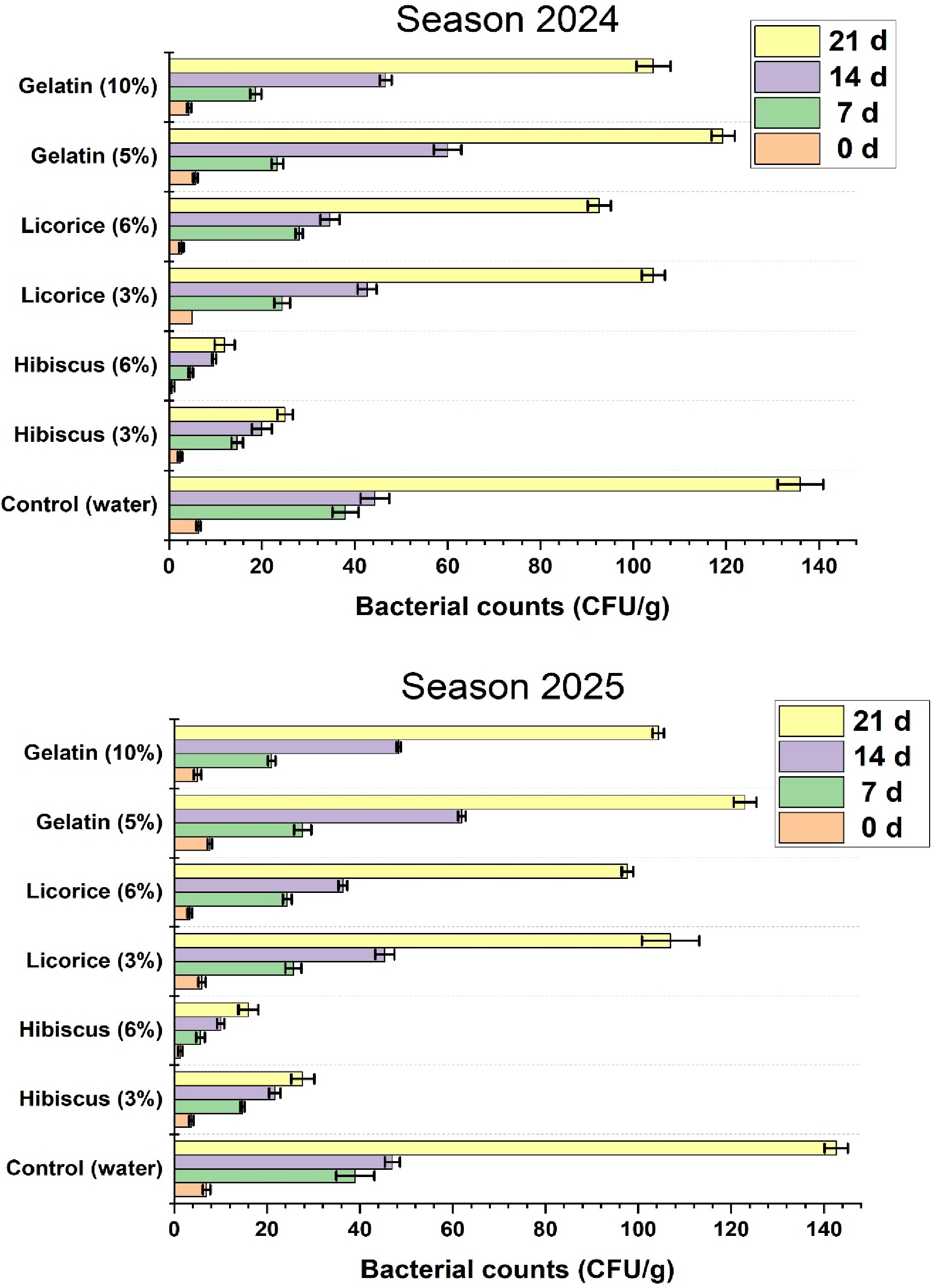
Figure 1.
Bacterial counts (CFU/g) on nutrient agar medium of pomegranate arils treated with Hibiscus extract (3% and 6%), licorice extract (3% and 6%), and gelatin (5% and 10%), compared with untreated samples during storage periods of 0, 7, 14, and 21 d.
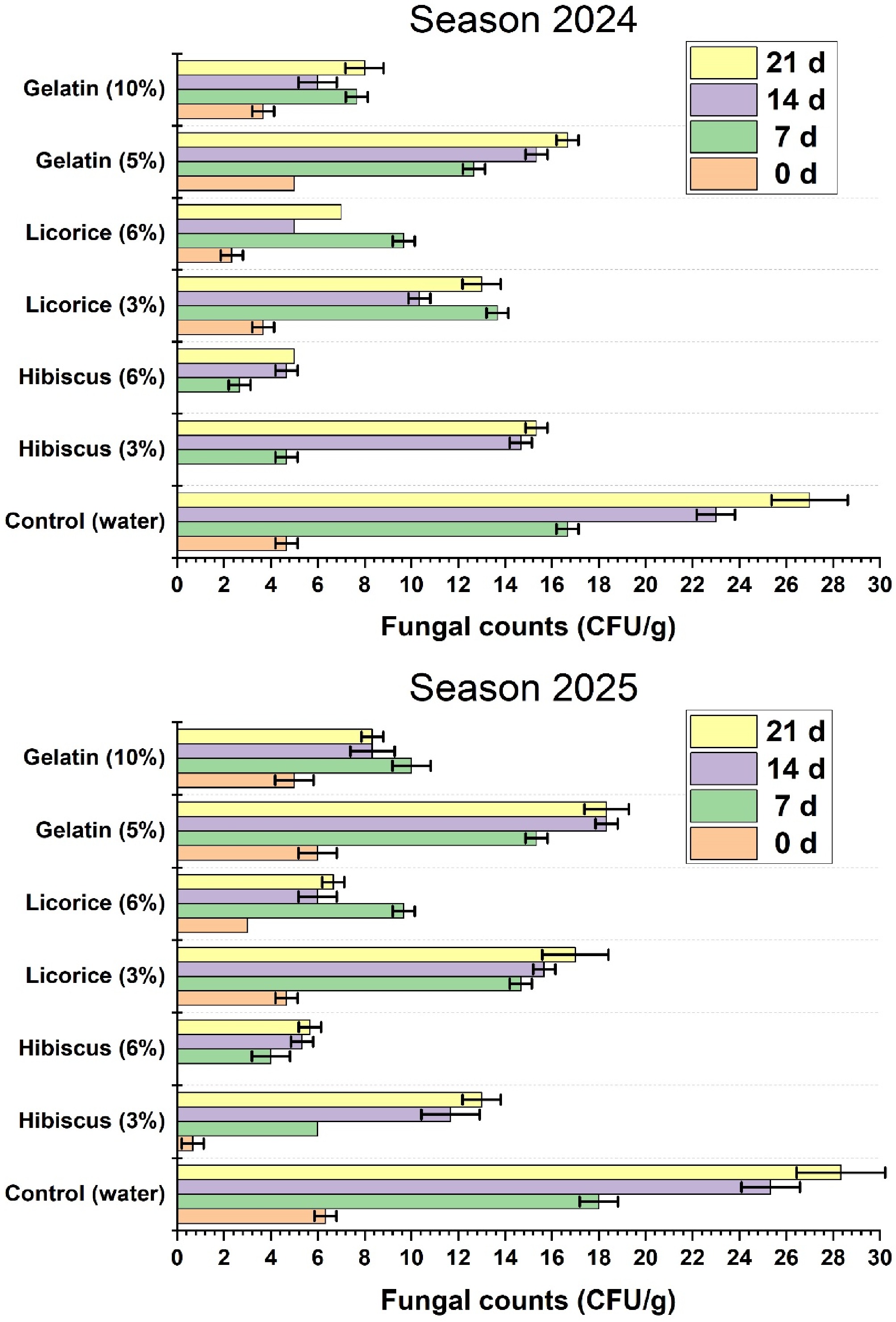
Figure 2.
Fungal counts (CFU/g) on Czapek's dextrose agar medium of pomegranate arils treated with Hibiscus extract (3% and 6%), licorice extract (3% and 6%), and gelatin (5% and 10%) comparing with untreated samples during storage periods of 0, 7, 14, and 21 d.
During this study, seven species belonging to four fungal genera were detected, including Aspergillus fumigatus, Aspergillus niger, Aspergillus terreus, Penicillium expansum, Penicillium chrysogenum, Fusarium oxysporum, and Rhizopus stolonifer, which were all isolated from the control (water) samples. Aspergillus niger was detected in all the treatments and even in the control sample, but with variable concentrations. Remarkably, two fungal species were detected in samples treated with the Hibiscus extract, including Aspergillus niger and Penicillium expansum, while three fungal species were detected through the licorice extract, namely Aspergillus niger, Rhizopus stolonifer, and Penicillium expansum. However, in the gelatin treatment, all the fungal species were detected except Penicillium expansum. Fungal analysis agreed with the bacteriological data that the Hibiscus extract (3% and 6%) decreased the fungal counts significantly (Fig. 2). The 6% Hibiscus extract demonstrated the highest efficiencies, with 0.0 (0.0), 2.67 (4.0), 4.7 (5.3), 5.0 (5.67) CFU/g, compared with the control samples (water) of 4.7 (6.3), 16.7 (18.0), 23.0 (25.3), and 27.0 (28.3) CFU/g, during 0, 7, 14, and 21 d cold storage. Moreover, the 3% Hibiscus extract came second with 0.00 (0.67), 4.6 (6.0), 14.7 (11.7), and 15.3 (13.0) CFU/g during 0, 7, 14, and 21 d cold storage. However, gelatin (5%) reveals high bacterial counts of 5.0 (6.0), 12.67 (15.3), 15.3 (18.3), 16.7 (18.3) during 0, 7, 14, and 21 d cold storage (Fig. 2).
Sensory evaluation of arils pomegranate
-
The sensory evaluation score of pomegranate aril samples after the previous transactions (before storage) and also at the end of storage (after 3 weeks) at 4 ± 1 °C, is presented in Table 4. The sensory characteristics tested (odor, taste, texture, and color) showed that pomegranate arils pretreated with 6% Hibiscus had maximum values after 21 d of storage of 7.83, 8.50, 8.00, and 8.50 in the 2024 season, and 8.00, 8.50, 8.00, and 8.17 in the 2025 season, for odor, taste, texture, and color, respectively. However, 5% gelatin pre-treated aril samples had minimum values of 3.83, 3.83, 3.50, and 4.17 in the 2024 season, and 4.00, 3.83, 3.50, and 3.50 in the 2025 season, for odor, taste, texture, and color, respectively. Gelatin at 10% recorded 3.50, 2.83, 3.67, and 3.50 in the 2024 season, and 3.50, 3.50, 3.33, and 3.50 in the 2025 season, for odor, taste, texture, and color, respectively.
Table 4. Changes in the odor, taste, texture, and color of pomegranate arils after treatment with Hibiscus extract, licorice extract, and gelatin with storage period over 21 d in two seasons, 2024 and 2025.
Treatments Storage period (d) Odor Taste Texture Color Pre-storage End storage Pre-storage End storage Pre-storage End storage Pre-storage End storage Season 2024 Control (water) 9.33 ± 0.58ab 7.33 ± 0.58ab 9.33 ± 0.29a 6.83 ± 0.29b 9.50 ± 0.50a 7.17 ± 0.29bc 9.50 ± 0.50ab 7.50 ± 0.50bc Hibiscus extract (3%) 9.33 ± 0.58ab 7.33 ± 0.29ab 9.50 ± 0.50a 7.50 ± 0.50b 9.67 ± 0.29a 7.67 ± 0.29ab 9.67 ± 0.29ab 8.17 ± 0.58ab Hibiscus extract (6%) 10.00 ± 0.00a 7.83 ± 0.29a 9.83 ± 0.29a 8.50 ± 0.50a 9.83 ± 0.29a 8.00 ± 0.50a 10.00 ± 0.00a 8.50 ± 0.50a Licorice extract (3%) 8.83 ± 0.29b 7.17 ± 0.29b 9.17 ± 0.29a 7.17 ± 0.29b 9.50 ± 0.50a 7.17 ± 0.29bc 9.17 ± 0.29bc 7.17 ± 0.29c Licorice extract (6%) 9.17 ± 0.29b 7.50 ± 0.50ab 9.33 ± 0.29a 7.67 ± 0.29ab 9.50 ± 0.50a 6.83 ± 0.29c 9.17 ± 0.29bc 7.50 ± 0.50bc Gelatin (5%) 7.33 ± 0.58c 3.83 ± 0.29c 6.50 ± 0.50b 3.83 ± 0.29c 7.00 ± 0.50b 3.50 ± 0.50d 8.50 ± 0.50cd 4.17 ± 0.76d Gelatin (10%) 6.50 ± 0.50d 3.50 ± 0.50c 6.00 ± 0.50b 2.83 ± 0.76d 6.83 ± 0.76b 3.67 ± 0.29d 8.17 ± 0.76d 3.50 ± 0.50d Season 2025 Control (water) 9.33 ± 0.58ab 7.17 ± 0.29b 9.67 ± 0.29ab 7.33 ± 0.58bc 9.67 ± 0.29a 7.00 ± 0.50bc 9.50 ± 0.50ab 7.33 ± 0.29ab Hibiscus extract (3%) 9.50 ± 0.50ab 7.83 ± 0.29ab 9.67 ± 0.29ab 7.50 ± 0.50bc 9.67 ± 0.29a 7.50 ± 0.50ab 9.67 ± 0.29ab 7.67 ± 0.76ab Hibiscus extract (6%) 10.00 ± 0.00a 8.00 ± 0.50a 10.00 ± 0.00a 8.50 ± 0.50a 9.83 ± 0.29a 8.00 ± 0.50a 10.00 ± 0.00a 8.17 ± 0.29a Licorice extract (3%) 9.33 ± 0.29ab 7.17 ± 0.29b 9.17 ± 0.29b 7.00 ± 0.50c 9.50 ± 0.50a 7.00 ± 0.50bc 9.17 ± 0.29bc 7.00 ± 0.50b Licorice extract (6%) 9.17 ± 0.29b 7.50 ± 0.50ab 9.50 ± 0.50ab 7.67 ± 0.29b 9.50 ± 0.50a 6.83 ± 0.29c 9.17 ± 0.29bc 7.17 ± 0.29b Gelatin (5%) 7.33 ± 0.58c 4.00 ± 0.50c 6.33 ± 0.58c 3.83 ± 0.29d 8.17 ± 0.29b 3.50 ± 0.50d 8.50 ± 0.50cd 3.50 ± 0.50c Gelatin (10%) 7.00 ± 0.50c 3.50 ± 0.50c 5.50 ± 0.87d 3.50 ± 0.50d 7.00 ± 0.50c 3.33 ± 0.29d 8.17 ± 0.76d 3.50 ± 0.50c Different superscript letters indicate statistically significant differences among treatment with Hibiscus extract, licorice extract, gelatin and their interaction. Each value represents an average value of three replicates ± SD at p ≤ 0.05. -
Pomegranate arils face significant handling and storage challenges, including quality degradation, flavor loss, and microbial proliferation. Thus, innovative solutions are essential to reduce microbial loads on arils and delay quality deterioration. Edible coating treatments offer a promising approach to extend shelf life and preserve the overall quality of fresh pomegranate arils. This coating helps to prevent moisture loss and also to protect the pomegranate arils from damage during transport[34]. Using biodegradable, natural edible coatings to maintain the quality of minimally processed products showed good results with consumers, who expect safe and healthy food products with excellent sensory properties[35]. Natural plant extracts have attracted considerable attention as eco-friendly alternatives to synthetic preservatives for maintaining fruit quality during postharvest storage[36−38]. Among these natural materials, the extract of Hibiscus sabdariffa has been investigated due to its rich content of phenolic compounds, organic acids, flavonoids, and anthocyanins that exhibit strong antioxidant and antimicrobial activities[16,39]. These bioactive compounds play an important role in delaying fruit deterioration and reducing microbial spoilage, thereby extending the shelf life of fresh produce[40].
From the results of this research, treating the pomegranate arils with Hibiscus extract reduced aril weight loss and also decreased the rate of decline in TSS%, TA%, and vitamin C, thus preserving the quality of pomegranate arils during storage. Following treatments with licorice extract, the control sample (untreated) recorded the highest aril weight loss. Fruit weight loss increased with the length of the storage period, which could be attributed to postharvest mass loss of fruit through moisture loss during transpiration; this accelerates the susceptibility of fruit to physiological disorders[41,42]. These results were in line with Santos-Santos et al.[16], who stated that a coating based on roselle mucilage (2%) prevents weight loss in soursop fruits. It was also confirmed by Ventura-Aguilar et al.[43], who used an edible film of chitosan combined with a roselle calyces extract decreased weight loss to 6%. Hibiscus coatings have been demonstrated to improve avocado's physical and chemical properties, giving higher fruit firmness, vitamin C, and chlorophyll, while reducing acidity and phenol content, extending the avocado's postharvest life during storage[44]. Martínez-Romero et al.[45] performed Aloe vera gel coatings, which maintain quality and even safety of pomegranate arils (ready-to-eat). However, licorice contains glycyrrhejel, gleserezin, and licorice acid, which give it its antioxidant and antimicrobial properties[46]. Licorice root extract contains sugars and gum substances that increase the total soluble solids in plant cells, and assist in water retention due to the presence of iron and magnesium[47]. Licorice extract could decrease the rate of transpiration, reduce water loss, and maintain cell fullness[48]. Natural edible coatings are recommended as post-harvest treatments, especially on fruit, as they enhance their quality and storability[49].
During the study, seven fungal species were detected, including Aspergillus fumigatus, Aspergillus niger, Aspergillus terreus, Penicillium expansum, Penicillium chrysogenum, Fusarium oxysporum, and Rhizopus stolonifer. However, Aspergillus niger was detected in all the treatments, and even in the control sample, but with variable concentrations. Aspergillus and Penicillium species are commonly isolated from rotted pomegranate fruit, acting as postharvest pathogens, causing fruit rot and mycotoxin contamination[50]. These fungi thrive in storage conditions, leading to economic losses through soft brown tissue decay, green mycelium, and conidia production[51−53]. Mincuzzi et al.[54] isolated fungi that caused postharvest rots of pomegranate, including Aspergillus niger, Penicillium brevicompactum, P. citrinum, and P. glabrum. Moreover, Rhizopus represents a major, rapidly spreading postharvest fungus causing soft rot in pomegranates[53]. Labuda et al.[51] isolated Penicillium implicatum, the causal rotting agent of stored pomegranate. Bardas et al.[50] and Spadaro et al.[52] isolated Penicillium glabrum from Punica granatum as a postharvest fungus causing fruit rot of pomegranate. Palou et al.[55] isolated Penicillium expansum, P. sclerotiorum, P. glabrum, and P. minioluteum from pomegranate fruit.
Microbiological analysis showed that Hibiscus extracts (3% and 6%) decreased bacterial counts significantly, followed by licorice extract. Hibiscus extract demonstrates antibacterial activity against common pathogens like Staphylococcus aureus and Escherichia coli[56]. Hibiscus extracts exhibit antifungal properties that can reduce fungal growth counts through inhibition of spores, hyphae, and biofilms[57]. Hibiscus extracts, particularly from Hibiscus sabdariffa calyces, demonstrate potent antifungal properties, supported by extensive in vitro and mechanistic studies. Phenolic compounds like anthocyanins and organic acids in Hibiscus disrupt fungal cell walls, inhibit enzymes, and prevent adhesion/biofilm formation, leading to fungistatic or fungicidal effects. Aqueous extracts of Hibiscus inhibited the growth of Candida, Aspergillus niger, and Penicillium spp[56]. Studies demonstrate that licorice extract inhibits fungal growth, such as Aspergillus parasiticus at concentrations of 500 mg/mL, and completely blocks aflatoxin B1 production at 10 g/mL by downregulating the aflR gene[22].
Licorice extract from Glycyrrhiza glabra exhibits notable antibacterial properties, particularly against Gram-positive bacteria like Staphylococcus aureus, Streptococcus pyogenes, and periodontal pathogens[58,59]. It effectively suppresses respiratory tract pathogens (Haemophilus influenzae, Moraxella catarrhalis), skin infection agents, and food spoilers like Bacillus subtilis and Pseudomonas aeruginosa, though efficacy varies against E. coli. These properties support its use in oral care, wound healing, and food preservation[60]. Licorice extract serves as a natural alternative to synthetic antifungals, effective against postharvest pathogens like Penicillium expansum at ≥ 500 mg/mL MIC, supporting its use in agriculture and medicine[61].
Aspergillus niger stands out as a dominant post-harvest spoilage agent in various fruit due to its ubiquity, resilience, and aggressive colonization strategies[62,63]. Its prevalence often exceeds that of other fungi in studies across mangoes, citrus, tomatoes, and pomegranates, driven by rapid spore germination and enzyme production that breaks down fruit tissues[63−65]. Gelatine coatings, lowly effective in the control of microbial spoilage in pomegranate arils, could be attributed to their inherent material limitations, as plain gelatine lacks intrinsic antimicrobial activities, allowing pathogens such as Aspergillus and Penicillium species to proliferate[66]. Moreover, its high hydrophilicity results in poor moisture barriers, enabling water vapor transmission that creates a favorable micro-environment for microbial growth on moist aril surfaces. Additionally, gelatin's weak mechanical strength and susceptibility to enzymatic degradation by fruit proteases compromise coating integrity over time[67,68], unlike the robust, bioactive matrices of plant extracts. Combining gelatine with antimicrobial agents could improve efficacy[69], but standalone use limits its postharvest preservation potential.
-
In conclusion, Hibiscus extract at 6% proved the most effective edible coating for Manfalouty pomegranate arils, significantly minimizing weight loss, microbial growth (bacteria and fungi), and deterioration of TSS, TA, vitamin C, and anthocyanins during 21-d cold storage across the 2024–2025 seasons. It restricted fungal diversity to Aspergillus niger and Penicillium expansum, outperforming licorice, gelatin, and controls. These natural coatings offer a sustainable, eco-friendly alternative to synthetic preservatives, enhancing postharvest shelf life, quality retention, and market value for Egyptian pomegranate growers. Future research could explore optimized formulations for commercial scaling.
Future perspectives
-
The promising results of Hibiscus extract as edible coating open avenues for advancing postharvest technology in pomegranate arils and other perishable fruits. Future research should prioritize optimizing coating formulations through statistic designs, and potentially incorporating nanotechnology for enhanced antifungal delivery and controlled release. Large-scale field trials across diverse pomegranate cultivars and storage conditions will validate efficacy and economic viability for commercial process.
We thank the Agricultural Research Center (ARC), Assiut, Egypt and Assiut University, Assiut, Egypt. No available funding support.
-
The authors confirm their contributions to the paper as follows: conceptualization, funding acquisition: Mansour AHA, Mahmoud GAE; review and editing: Mansour AHA, Ali GM, Mahmoud GAE; methodology, data curation: Mansour AHA, Mahmoud GAE; resources: Mahmoud GAE. All authors reviewed the results and approved the final version of the manuscript.
-
The datasets generated during and/or analyzed during the current study are available from the corresponding author on reasonable request.
-
The authors declare that they have no conflict of interest.
- Copyright: © 2026 by the author(s). Published by Maximum Academic Press, Fayetteville, GA. This article is an open access article distributed under Creative Commons Attribution License (CC BY 4.0), visit https://creativecommons.org/licenses/by/4.0/.
-
About this article
Cite this article
Mansour AHA, Ali GM, Mahmoud GAE. 2026. Efficacy of three edible coatings on postharvest quality, and microbiology of manfalouty pomegranate arils. Circular Agricultural Systems 6: e018 doi: 10.48130/cas-0026-0018 

Efficacy of three edible coatings on postharvest quality, and microbiology of manfalouty pomegranate arils
- Received: 11 March 2026
- Revised: 23 April 2026
- Accepted: 08 May 2026
- Published online: 10 August 2026
Abstract: Despite the numerous benefits of Punica granatum L., ready-to-eat pomegranate aril consumption remains limited due to rapid physiological deterioration and microbiological spoilage during storage. This study evaluated the efficacy of natural edible coatings, Hibiscus extracts (3% and 6%), licorice root extracts (3% and 6%), and gelatin solutions (5% and 10%) in preserving the postharvest quality of Manfalouty pomegranate (Punica granatum L.) arils harvested from El Badary, Assiut Governorate, Egypt, during the 2024 and 2025 seasons. Physical quality attributes (weight loss, total soluble solids [TSS%], titratable acidity [TA%], vitamin C, and anthocyanins) were assessed at 0, 7, 14, and 21 d. Microbiological analysis quantified bacterial and fungal counts (CFU/g) on nutrient agar and Czapek's dextrose agar. Sensory properties (color, odor, taste, and texture) were rated on a 10-point hedonic scale by a 10-member panel. Results demonstrated that higher concentrations of Hibiscus and licorice extracts significantly reduced weight loss, microbial loads, and sensory deterioration while enhancing TSS, TA, vitamin C, and anthocyanin levels compared to controls, extending shelf life effectively. After 21 d of cold storage, Hibiscus 6% minimized weight loss (2.93%–2.96%) vs control (3.89%–3.84%), TSS% (16.17%–16.23%) vs control (15.0%–14.9%), TA% (1.21%–1.16%) vs control (0.91%–1.07%), vitamin C (22.87–23.53 mg/100 mL) vs control (19.92–20.53 mg/100 mL), and anthocyanins (53.30–53.46 mg/100 g FW) vs control (49.07–49.8 mg/100 g FW) in the 2024 and 2025 seasons, respectively. Microbial counts were lowest with 6% Hibiscus extract (bacteria: 12–16 CFU/g; fungi: 5–5.67 CFU/g at 21 d vs control 136–142.67 and 27–28.3 CFU/g) in the 2024 and 2025 seasons, respectively. The 6% Hibiscus extract limited the fungal species number from seven species to Aspergillus niger and Penicillium expansum. Moreover, the control and gelatin showed the highest deterioration. These coatings, especially Hibiscus, effectively extend shelf life by reducing physiological and microbial losses, supporting sustainable preservation.
-
Key words:
- Gelatin /
- Hibiscus extracts /
- Licorice root extracts /
- Microbial spoilage /
- Shelf life