











-
The 2021 Global Assessment of Soil Pollution report highlights soil pollution as a critical threat to food security, human health, and the environment, underscoring the need for standardized methods to address this challenge[1]. Driven by decades of industrial expansion, intensive agriculture, and improper waste disposal, soil pollution has become an escalating environmental crisis that hinders progress towards multiple Sustainable Development Goals (SDGs)[2,3]. A wide range of pollutants accumulate in soil, including toxic metals and metalloids (TMs) such as cadmium (Cd), lead (Pb), mercury (Hg), chromium (Cr), and arsenic (As); radionuclides; organic contaminants, including persistent organic pollutants (POPs) such as polycyclic aromatic hydrocarbons (PAHs) and polychlorinated biphenyls (PCBs), as well as emerging organic pollutants (EOPs) like per- and poly-fluoroalkyl substances (PFAS) and pharmaceuticals; microplastics (MPs); antibiotic resistance genes (ARGs) such as beta-lactamase (bla) and tetracycline resistance (tet) genes; pathogens such as Escherichia coli and Salmonella species; and excess nutrients such as nitrate/ammonium and phosphate (N/P)[4,5]. These conventional and emerging contaminants (ECs) threaten food security, ecosystem stability, and public health[3]. Remediation approaches for conventional pollutants such as toxic metal(loid)s and POPs have seen limited progress over the past decades, while effective strategies for ECs remain underdeveloped.
Current remediation strategies often rely on costly and energy-intensive methods that disrupt soil structure and biodiversity[6]. Approaches such as excavation, thermal desorption, and chemical leaching require substantial energy inputs and infrastructure. Although phytoremediation and organic amendments are more environmentally benign, they tend to be slow, contaminant-specific, and limited in scalability. These constraints underscore the urgent need for alternative remediation strategies that are both effective and ecologically harmonious. While phytoremediation is well-studied as a nature-based solution (NbS), microbial processes with similar potential remain underexploited due to limited understanding of their mechanisms and field scalability[7,8]. For example, engineered microbes that perform well in labs often fail to survive or remain active in complex natural environments.
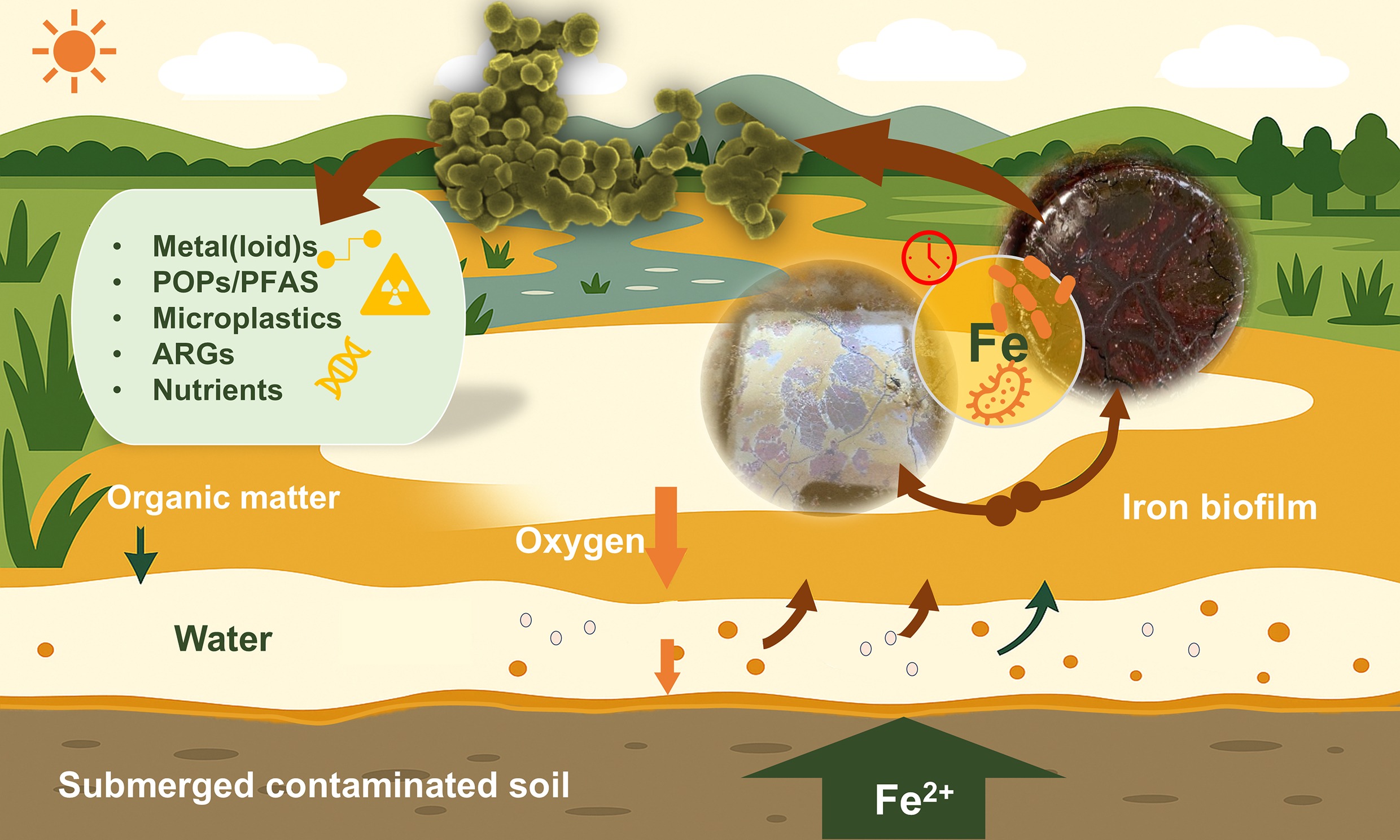
Harnessing natural biogeochemical processes, particularly those involving iron cycling, represents a promising alternative within the broader NbS framework[9,10]. Soils typically contain 1%–5% iron in the form of oxides that serve as the main sorbent for diverse pollutants, especially As[11]. Their reactivity is closely linked to surrounding biogeochemical conditions. In recent decades, interdisciplinary research has revealed that ecohydrological interfaces, such as soil–water boundaries, rhizospheres, and sediment–water interfaces, act as biogeochemical 'hotspots' where microbial metabolism, redox transformations, and hydrological flows converge to control the fate of contaminants[11−13]. Within these hotspots, iron biogeochemistry plays a pivotal role by mediating electron transfer processes that link microbial activity to the sequestration, transformation, and potential recovery of diverse pollutants, thereby underpinning ecosystem health and resilience. In particular, microbial iron cycling transforms ferric iron minerals into reactive secondary phases, forming distinctive rusty films, crusts, and nanoparticle assemblages across wetlands, paddy fields, and contaminated soils (Fig. 1)[11]. This natural process offers a scalable and environmentally harmonious pathway for soil remediation.
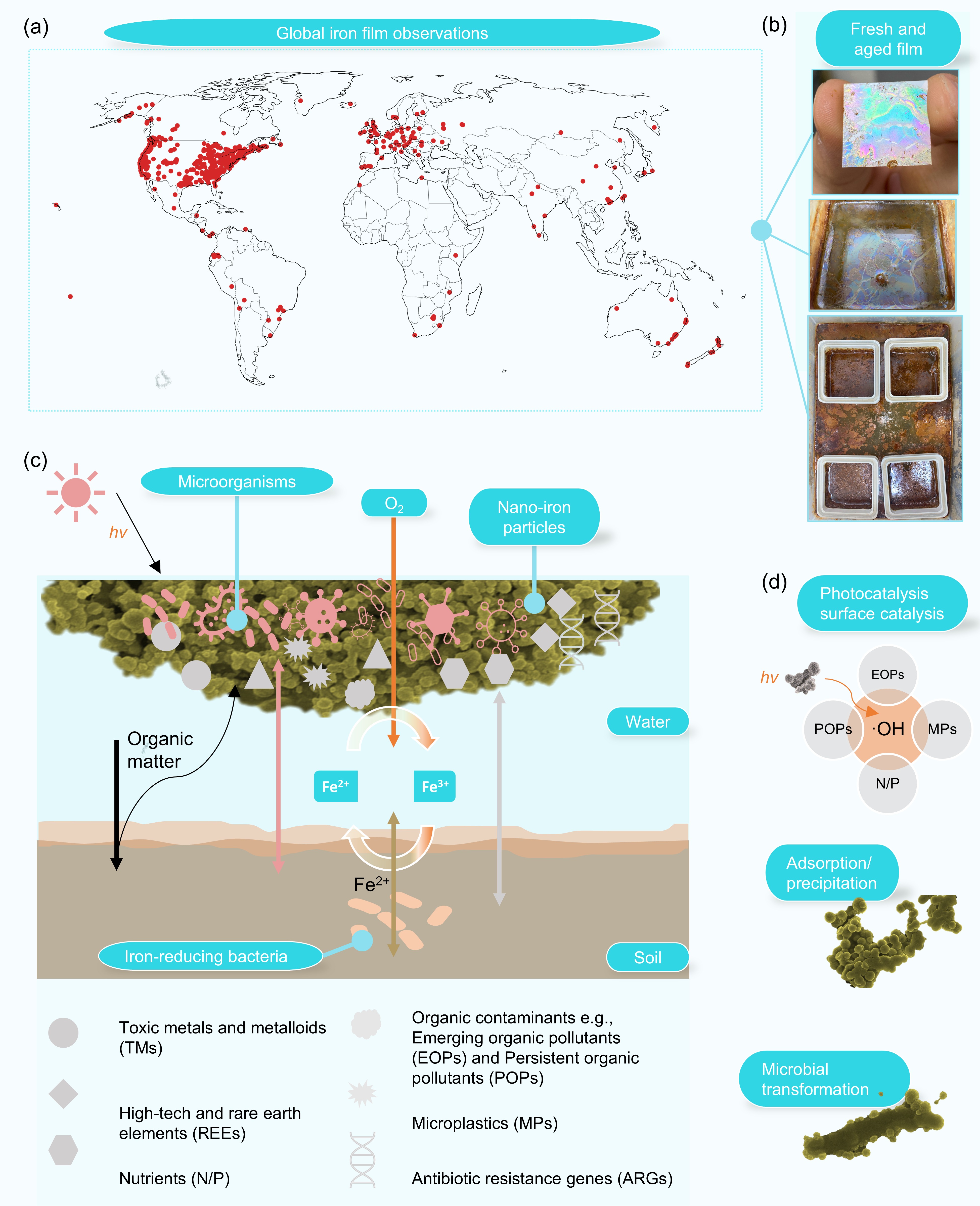
Figure 1.
Conceptual schematic of microbial iron mining for soil remediation. (a) Global observations of iron films in shallow water environments (n = 1,169; public data accessed from
www.inaturalist.org/observations on June 13, 2025). (b) Examples of iron films. (c) Cross-sectional view of a waterlogged soil profile illustrates key steps in microbial iron mining. In the anaerobic reduction zone within the soil, ferric oxides are reduced to ferrous ions (Fe2+) by iron-reducing bacteria. The Fe2+ then diffuses through porewater toward oxic zones. At the oxic overlying water surface, Fe2+ is oxidized by oxygen or iron-oxidizing bacteria to form mixed-valence iron minerals. (d) During these processes, contaminants such as TMs, organic pollutants, ARGs, and nutrients are captured or degraded via adsorption, precipitation, or catalytic reaction mechanisms.In the following sections, we explore how microbial iron mining—the intentional stimulation and control of natural iron cycling—can serve as a scalable, cost-effective, and environmentally benign solution for soil remediation and resource recovery. This approach is particularly valuable because the coupled transformation of pollutants, such as the simultaneous immobilization of toxic metals and degradation of organic contaminants, enhances overall soil detoxification and ecological restoration compared to single-contaminant remediation strategies. By leveraging the inherent multi-pollutant reactivity of iron minerals, microbial iron mining offers integrated benefits that align with the broader NbS framework. We highlight recent advances, engineering strategies, and future directions for this emerging technology within the broader context of sustainable land management.
-
In anaerobic environments such as wetlands, paddy fields, and contaminated soils, iron cycling emerges as a fundamental biogeochemical process that underpins ecosystem functioning and structure[11,14]. Iron cycling encompasses both reductive and oxidative processes that together mediate the transformation and mobility of iron within soils. Under reducing conditions, ferric oxides act as terminal electron acceptors for iron-reducing microorganisms such as Geobacter and Shewanella, which catalyze their reduction to soluble ferrous ions via extracellular electron transfer[15]. Diverse iron-oxidizing bacteria, including Gallionella, Leptothrix, and Sideroxydans, occupy distinct ecological niches at oxic–anoxic interfaces, further shaping iron cycling dynamics across environmental gradients. These ferrous ions diffuse through soil porewater, driven by concentration gradients and hydrological flows, traversing considerable vertical and lateral distances within the soil profile[11,14]. However, the efficiency of microbial iron mining can be affected by competing terminal electron-accepting processes, such as nitrate and sulfate reduction, which divert electron flow from iron reduction and alter contaminant removal rates.
Upon reaching oxic zones near soil surfaces, root interfaces, or sediment–water boundaries, ferrous iron undergoes rapid oxidation, either abiotically by molecular oxygen or biotically by aerobic and microaerophilic iron-oxidizing bacteria (Fig. 1c). This reoxidation produces mixed-valence iron minerals, including green rusts, lepidocrocite, and magnetite[11,16], which exhibit high surface reactivity, electron-shuttling capacity, and a propensity to adsorb, precipitate, or transform diverse contaminants.
Importantly, this coupled microbial–geochemical process operates ubiquitously across landscapes, from the rust-colored floodwaters of rice paddies to the shimmering iridescent iron biofilms that float atop wetland surfaces, and the extensive iron crusts that line acid mine drainage streams (Fig. 1a, b)[11,16]. Such phenomena underscore the universality of microbial iron cycling as a driver of landscape-scale geochemical gradients, shaping redox zonation, nutrient availability, contaminant mobility, and overall ecosystem functioning. Its widespread occurrence (n = 1,169) and robust mechanistic basis make microbial iron cycling an attractive and scalable NbS target for soil and water remediation.
-
Microbial iron mining enables pollutant removal through three key processes: migration, sequestration and transformation, and iron mineral removal. Reductive dissolution of ferric oxides simultaneously releases diverse organic and inorganic substances adsorbed on their surfaces. As reduced iron species diffuse and gas bubbles containing volatile organic compounds form during early iron reduction, these substances—as well as low-density pollutants such as microplastics—can be transported to the water–air interface[17].
Mixed-valence iron minerals[10] formed by microbial iron cycling function as natural sorbents and catalysts, capable of immobilization and transformation of a wide array of environmental contaminants (Fig. 1). Their pollutant removal mechanisms are multifaceted. Toxic metals and metalloids, including As, Cd, and Pb, are sequestered via surface complexation, co-precipitation, or direct redox reactions that reduce their mobility and toxicity[16]. Organic contaminants, such as PAHs, PCBs, dyes, phenols, some degradable microplastics, and antibiotics can be adsorbed onto mineral surfaces or degraded via radical-mediated oxidation and microbial co-metabolism, ultimately yielding less harmful transformation products[18]. Even for pollutants such as PFAS, which are strongly adsorbed onto iron biofilms yet resistant to degradation, the presence of iron minerals can facilitate PFAS degradation via enhanced electron transfer[19]. However, for some highly recalcitrant contaminants, subsequent treatment steps are required to achieve complete remediation.
Furthermore, ferric minerals exhibit a remarkable capacity to interact with mobile genetic elements. Antibiotic resistance genes, often embedded within extracellular DNA, can be effectively adsorbed onto or encapsulated within mineral matrices, thereby limiting their horizontal gene transfer and dissemination within microbial communities. In parallel, eutrophic nutrients such as phosphate are readily removed through adsorption or co-precipitation with ferric oxides, offering an ancillary benefit of mitigating nutrient-driven pollution in agricultural landscapes.
The exceptional reactivity of these secondary minerals arises from their dual physicochemical characteristics: their nanometer-scale dimensions confer a high specific surface area, while their mixed-valence states facilitate rapid electron transfer reactions[11,16]. This combination enables advanced abiotic redox processes, including Fenton-like reactions that degrade POPs into less toxic intermediates without requiring externally added oxidants. Such processes position microbial iron mining as a potential in situ advanced oxidation technology within contaminated soils and sediments.
Beyond porewater interfaces, emerging evidence indicates that floating Fe-based nanofilms formed at water–air boundaries function as reactive membranes with broad environmental implications. These ultrathin films exhibit high sorption capacities and catalytic reactivity, enabling them to adsorb, oxidize, or immobilize ARGs and other micropollutants, thus acting as natural biogeochemical barriers. By limiting contaminant fluxes across the soil–water–air continuum, these films provide an underappreciated ecosystem service that reduces pollutant mobility and attenuates public health risks associated with the dissemination of environmental antibiotic resistance.
-
Currently, there are no field-scale engineering applications for iron film removal. However, useful insights can be drawn from rice cultivation practices. Substantial iron plaques naturally form on rice root surfaces, accumulating significant amounts of arsenic. Harvesting rice roots after the growing season could therefore serve as a potential strategy for iron film collection. However, this approach essentially constitutes phytoremediation, and studies have shown that harvesting forage rice or pasture grasses can effectively remove arsenic from soils. Yet, due to agronomic constraints in rice production—including seasonal planting cycles, land use requirements, and water management demands—engineering-scale implementation remains lacking.
In scenarios without rice roots, it becomes necessary to artificially enhance iron reduction, diffusion, and oxidation processes. The practical implementation of microbial iron mining hinges on strategic interventions that stimulate microbial activity and mineral formation while aligning with local environmental conditions. One effective approach involves adding agricultural residues such as rice husks, straw, or green manure, which provide fermentable carbon substrates that fuel iron-reducing bacteria and accelerate ferric iron reduction. In iron-deficient soils, supplementing external iron sources, including ferrihydrite or hematite, may further boost reaction rates and increase the yield of reactive secondary minerals.
Maintaining appropriate water levels is also crucial, as controlled flooding preserves the redox zonation necessary for sustained iron cycling and prevents premature oxidation of ferrous iron before it reaches targeted treatment zones. Additionally, harvesting the pollutant-laden iron minerals allows for ex situ treatment, resource recovery, or safe disposal. While subsequent treatment or disposal is necessary, this approach concentrates pollutants into a smaller, separable mineral fraction, reducing the volume of contaminated material compared to bulk soil excavation or washing. Such post-treatment requirements are common across remediation technologies, including phytoremediation, where harvested biomass similarly requires appropriate management.
Integrating straw amendments, iron amendments, and water management has been shown to not only promote iron cycling but also substantially immobilize As and enhance grain safety[6,11]. Such integrated interventions exemplify the potential of microbial iron mining to serve as a dual-purpose strategy for agricultural sustainability and environmental remediation. By tailoring these approaches to site-specific geochemical and hydrological contexts, microbial iron mining can be optimized to achieve scalable, cost-effective, and ecologically harmonious soil cleanup across diverse contaminated landscapes.
-
Microbial iron mining presents a compelling engineering solution for sustainable soil cleanup, combining low cost with minimal environmental impact. Unlike traditional remediation techniques (e.g., thermal desorption and chemical leaching) that demand significant energy inputs and infrastructure, microbial iron mining leverages naturally occurring redox processes.
The use of agricultural waste residues as carbon sources not only stimulates iron-reducing bacteria[11] but also repurposes low-value materials, reducing operational costs. For instance, rice residue yields approximately 12 Mt of dry matter per hectare per year in south China. Compared to easily degradable carbon sources such as glucose or sodium acetate, which are 5−10 times more expensive, these readily available materials greatly lower costs, enhancing the economic feasibility of field-scale implementation. Moreover, integrating such carbon sources into microbial iron mining systems can improve soil organic matter levels and nutrient cycling, offering potential co-benefits for soil health and agricultural productivity. Furthermore, the ability to recover secondary iron minerals from contaminated soils provides an additional economic incentive for deployment.
From the perspective of environmental science, microbial iron mining avoids large-scale soil disturbance, thereby minimizing erosion risks and greenhouse gas emissions associated with excavation and transport. However, the controlled flooding required to maintain reducing conditions can potentially generate additional greenhouse gas emissions, particularly methane. However, strategic management of soil redox conditions near iron reduction zones can suppress methane emissions, as iron-reducing bacteria often outcompete methanogens for electron donors. The addition of organic carbon sources to stimulate microbial iron reduction may inadvertently fuel both processes. A recent study suggested that the presence of the floating iron biofilms can reduce methane emissions by 6.9-fold[11]. Therefore, careful optimization of carbon input rates, flooding intensity, and timing is essential to balance enhanced pollutant remediation with the risk of increased methane emissions.
-
Beyond contaminant removal, microbial iron mining also opens new avenues for resource recovery. Rare earth elements (REEs), which are essential for clean technologies such as batteries, wind turbines, and electronics, are often present in trace amounts in contaminated soils. However, conventional REE extraction faces numerous technical challenges and causes severe environmental pollution[20]. Employing iron mobilization strategies developed in microbial iron mining may help advance more sustainable REE recovery methods. While the selective adsorption of REEs onto iron minerals is generally less efficient than that for toxic metalloid (i.e., As), previous studies have shown that secondary iron and manganese oxides can act as important scavengers for REEs through surface adsorption and geochemical fractionation processes[20,21]. Nevertheless, the mechanisms governing REE interactions with iron minerals remain underexplored, representing a critical research gap for optimizing their enrichment and extraction.
This dual-purpose approach aligns with circular economy principles: rather than viewing polluted soils solely as environmental liabilities, they can be transformed into regenerative systems that simultaneously remove toxins and recover strategic resources. Compared to traditional mining, microbial iron mining requires significantly lower energy inputs and causes far less environmental impact, positioning it as a novel 'green metallurgy' pathway that bridges environmental remediation and sustainable materials supply.
-
Current research on microbial iron mining is limited to two laboratory-scale studies[11,14], both conducted in surface soils of rice paddies and wetlands, which are typically rich in organic matter and iron and host abundant native iron-reducing microbes. Its effectiveness in extreme or geologically complex environments, such as mine tailings, groundwater contamination zones, sandy soils, or areas with limited water availability, remains uncertain. Additionally, potential environmental burdens, including greenhouse gas emissions and odorous fermentation by-products from soil flooding and organic matter addition, remain unassessed. Practical evaluations of operational costs, pollutant removal efficiencies under field conditions, and the emerging concept of resource recovery are also lacking.
Despite these limitations, microbial iron mining represents a paradigm shift in soil remediation, moving from disruptive, chemical-intensive interventions to nature-based, regenerative solutions. By leveraging microbial iron cycling, this approach simultaneously removes diverse contaminants and recovers valuable resources, aligning with the goals of the Global Assessment of Soil Pollution (FAO & UNEP, 2021), supporting SDG 6 (Clean Water and Sanitation), and SDG 15 (Life on Land).
Advancing microbial iron mining from concept to field-scale implementation requires addressing several critical knowledge gaps. First, it is essential to evaluate whether this approach can effectively remove different pollutants under typical field conditions and to quantify its removal potential. Second, optimizing process parameters and assessing long-term performance under realistic conditions will be necessary to enhance its practical applicability. Third, understanding how soil physicochemical properties such as pH, alkalinity, and dissolved organic matter influence iron mineral formation and pollutant removal efficiency is critical for site-specific implementation. Additionally, elucidation of mineral–microbe–pollutant interactions under variable environmental conditions will inform predictive models needed for effective system design. Furthermore, the safe management, utilization, or disposal of iron mining products containing immobilized contaminants will require clear regulatory guidelines to ensure environmental and human health. Finally, interdisciplinary collaboration among microbiologists, geochemists, engineers, and policy makers will be crucial to translating laboratory insights into field applications that support international soil restoration and pollution mitigation targets.
-
Not applicable.
-
The authors confirm their contributions to the paper as follows: study conception and design: Zhang S, Zhu D; draft manuscript preparation, figures preparation: Zhang S; funding acquisition, project supervision, and critical review and revision of the manuscript: Zhu D. Both authors reviewed the results and approved the final version of the manuscript.
-
Global observations of iron films in shallow water environments (n = 1,169) were accessed from iNaturalist (www.inaturalist.org/observations) on June 13, 2025. All other data are available within the main text.
-
The authors declare that they have no conflict of interest.
-
Full list of author information is available at the end of the article.
- Copyright: © 2025 by the author(s). Published by Maximum Academic Press, Fayetteville, GA. This article is an open access article distributed under Creative Commons Attribution License (CC BY 4.0), visit https://creativecommons.org/licenses/by/4.0/.
-
About this article
Cite this article
Zhang S, Zhu D. 2025. Microbial iron mining: a nature-based solution for pollution removal and resource recovery from contaminated soils. Environmental and Biogeochemical Processes 1: e006 doi: 10.48130/ebp-0025-0002 

Microbial iron mining: a nature-based solution for pollution removal and resource recovery from contaminated soils
- Received: 01 July 2025
- Revised: 21 July 2025
- Accepted: 11 August 2025
- Published online: 14 October 2025
Abstract: Thousands of natural and synthetic compounds pollute soils and threaten ecosystems and human health. In 2021, the Food and Agriculture Organization and the United Nations Environment Programme (FAO/UNEP) declared soil pollution a global crisis. Remediation is essential to achieve the UN Decade on Ecosystem Restoration, the Global Biodiversity Framework, and the One Health approach. While cleaner production reduces emissions at the source, existing polluted soils require transformative solutions beyond conventional, resource-intensive methods. Soils host many self-organizing processes that remain underexplored as remediation strategies. Although soil contains only approximately 3% total iron, this relatively low content strongly influences the fate of pollutants. Here, we introduce a concept of microbial iron mining that refers to the process where microbes actively 'mine' iron (>40% purity by weight) from soil through reduction and dissolution of iron minerals, followed by re-oxidation. This dynamic iron cycling generates reactive iron species such as secondary iron nanoparticles that serve as powerful sorbents and redox mediators. They can scavenge and transform diverse pollutants, including toxic metals and metalloids (e.g., arsenic and mercury), rare earth elements (e.g., neodymium), organic contaminants (e.g., persistent organic pollutants and antibiotics), microplastics, antibiotic resistance genes, and eutrophic nutrients such as phosphate. This self-sustaining, redox-driven process aligns with the framework of nature-based solutions (NbS), offering environmental compatibility, cost-efficiency, and resource recovery benefits. Microbial iron mining thus offers a potential NbS pathway to transform polluted soils into self-purifying biogeochemical reactors for sustainable remediation.