










-
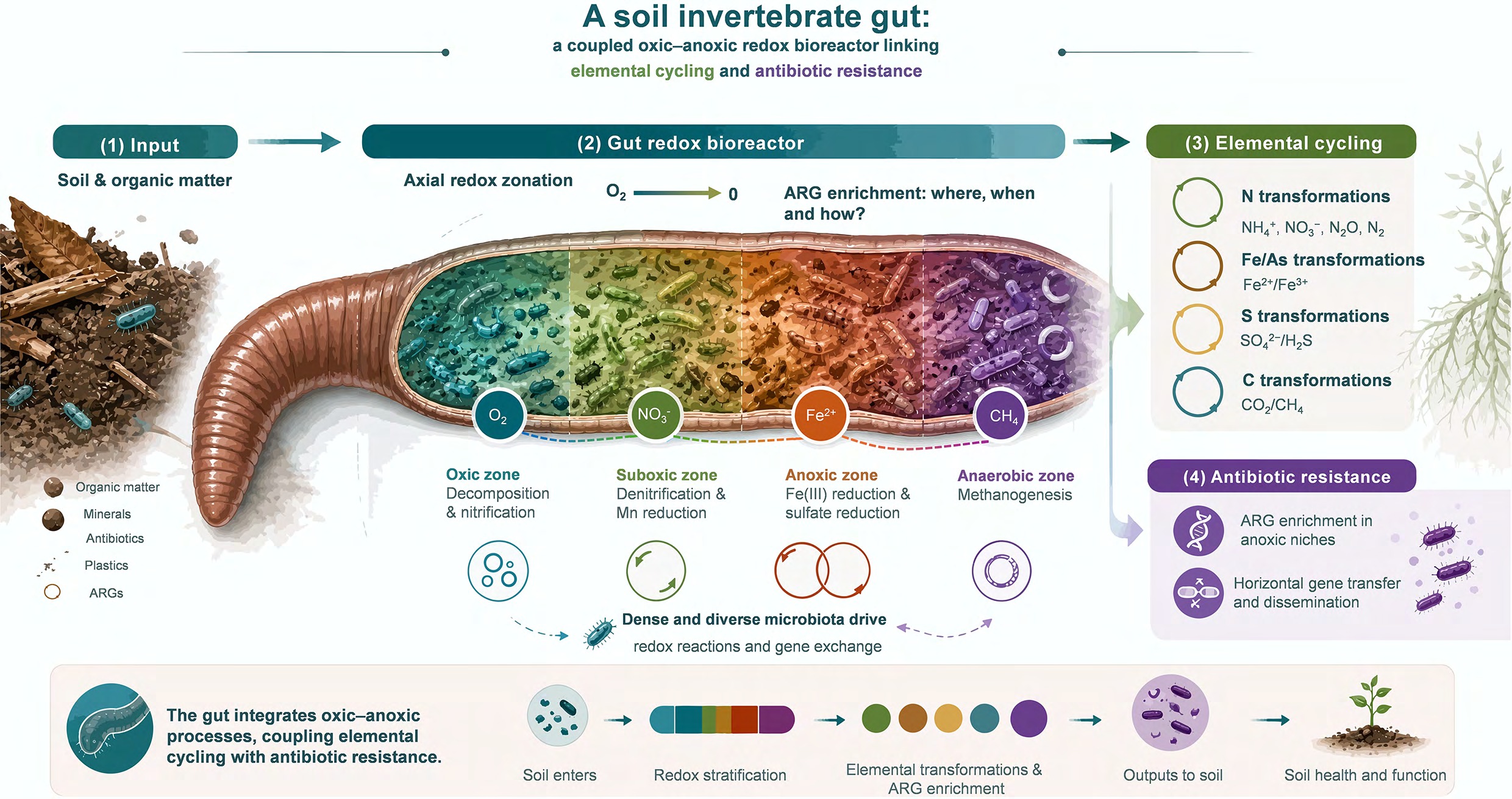
Soil invertebrates are abundant, and they move, feed, and egest across the soil profile. Their guts are compact chambers. Inside them, ingested microbes meet steep chemical gradients and a concentrated supply of labile organic matter. In earthworms, the gut interior becomes transiently anoxic and near neutral in pH, and ingested bacteria become active during passage[1,2]. The lumen is therefore a transient anaerobic habitat rather than a passive tube. Fermentative metabolism of ingested protein, nucleic acids, and polysaccharides proceeds during transit, and it depends on gut water content and the richness of dietary carbon[3−5]. Across many soil taxa, the gut microbiome is compositionally distinct from bulk soil and responds differently to diet, litter quality, and host identity[5−10]. Invertebrate host-produced metabolites shape this compartment further. The surfactant-like drilodefensins, for example, let the earthworm gut process otherwise inhibitory plant polyphenols[11].
Two research areas have emerged from these gut systems. The first documents nutrient transformation. Earthworm guts host fermentation that releases hydrogen and denitrification that releases nitrous oxide, and these processes can constitute a meaningful local source of soil nitrous oxide following gut passage[1,2]. The gut also acts as a mobile reactor for iron reduction and accelerates the cycling of potentially toxic elements[12−16]. Methanogenesis via acetoclastic and/or hydrogenotrophic pathways is also observed in earthworms[4,17,18]. The second research area documents the resistome and microbial evolution under co-contamination. Soil animal guts concentrate antibiotic resistance genes (ARGs), metal resistance genes (MRGs), and mobile genetic elements (MGEs). Exposure to antibiotics, metal(loid)s, plastics, and non-antibiotic chemicals then shifts the abundance and composition of these genes[19−23].
Although elemental transformation and the resistome are often studied separately[24], they are inextricably linked by the shared gut microenvironment. The environments that drive biogeochemical reactions with transient oxic-to-anoxic (redox) transitions, high microbial density, and a labile carbon supply are the same environments that enhance the opportunity for microbial interactions, horizontal gene transfer (HGT), and co-selection[25−27]. This spatial overlap implies that the functional enzymes and microbes driving element turnover are often the same. For instance, denitrifying taxa perform a key step in redox-driven element turnover[28,29], and a subset of the same guild can overlap with microbial groups that frequently harbor ARGs and MGEs[30]. This overlap has a physiological basis and is not only a statistical co-occurrence, because denitrification is widespread among facultatively anaerobic Proteobacteria, the same lineages that are among the most permissive hosts of broad host range plasmids and that carry most clinically relevant ARGs. We use the term coupled in a strict sense. Two outputs are coupled only when at least part of the microbial guild active in one is also active in the other, whereas outputs that depend on separate populations are parallel rather than coupled. This definition is applied literally throughout the review. Coupling is asserted only for the denitrification-linked overlap described above, where the same functional guild has been reported to carry out redox transformation and to harbor resistance genes. This assertion is not extended to the rhizosphere, soil–water and dryland–wetland analogues, which share similar oxic–anoxic physicochemical gradients but have not been shown to share active microbial guilds with the gut environment. These systems are therefore described as conceptual extensions rather than demonstrated instances of coupling. Using the plastisphere as a case example, whether carbon transformation and resistance dissemination arise from one mechanism or merely occupy the same surface is treated throughout as an open, testable question rather than an established coupling. This review also notes explicitly that causality and shared guild activity have so far been inferred from co-occurrence and functional gene annotation rather than demonstrated through paired isotope probing or host-resolved metagenomics, so the coupled reactor framework should be read as a mechanistic hypothesis motivated by guild overlap rather than a proven causal relationship.
Because redox transformations and HGT are mechanistically coupled within the gut reactor, environmental stressors rarely affect either process in isolation. Instead, perturbations such as antibiotics or toxic metal(loid)s simultaneously alter microbial metabolism, community composition, and resistance dynamics, generating nonlinear responses that often appear contradictory when interpreted from a single-process perspective[24,31−35]. A stressor might inhibit a specific elemental transformation pathway while simultaneously accelerating HGT within the surviving taxa[36−39]. Consequently, depending on the stressor, the animal host, and the scale of observation (discussion in later sections), studies often report conflicting trajectories for gut functions[40−42].
This review considers these contradictions as predictable ecological contingencies. We identify three major domains of contradiction in the current literature, namely contaminant toxicity, gut retention time, and the scale of observation, and demonstrate how each can be interpreted through this framework. By integrating these processes, we propose a redox-coupled bioreactor framework. Furthermore, because the gut shares fundamental redox dynamics with other critical ecological interfaces (e.g., the rhizosphere and terrestrial–aquatic transition zones), decoding this micro-site reactor provides a crucial mechanistic bridge for understanding field-scale environmental risks and guiding soil remediation engineering. This review makes four contributions. First, it identifies the transient oxic–anoxic interface as a single physicochemical variable that organizes both biogeochemical transformation and resistome dynamics in the gut. Second, it shows that the same interface recurs from the gut to the landscape, so that the gut, the rhizosphere, and terrestrial–aquatic fronts are instances of one class rather than separate systems. Third, it recasts three standing contradictions as predictable positions on shared axes of toxicity vs co-selection, amplification vs attenuation, and observation scale. Fourth, it converts the framework into falsifiable predictions and a single engineering constraint on any attempt to manage the interface.
-
The gut lumen has unique physical chemistry. In earthworms, the passage from foregut to hindgut moves ingested material into a transiently anoxic, near-neutral, carbon-rich, and enzyme-rich compartment[1,4,5,43,44]. Direct microsensor measurements revealed oxygen depletion within the first few millimeters of the midgut[43]. Compared with the surrounding soil, the gut provides a carbon-rich environment with a lower C:N ratio than surrounding soil, millimolar concentrations of glucose, and abundant fermentation acids. Nitrite and ammonium are also enriched by approximately 10-fold and 100-fold, respectively[1,43]. These conditions activate fermentative and anaerobic respiratory metabolism in bacteria that were otherwise quiescent in soil[18,43,44]. Similar dynamic host filtering occurs across other soil animals. The nematode gut assembles a characteristic community from diverse soil inocula; insect and collembolan guts select a distinct core, and a small set of gut-associated lineages recurs across soil taxa[6,10,45,46]. Although the surrounding soil provides the source community, host filtering strongly shapes which microorganisms establish and persist in the gut[6,8,47,48].
Three features of this microenvironment are critical for the proposed framework. First, the low oxygen tension and steep redox gradient set the thermodynamic stage for reductive and methylation reactions of nutrients and toxic elements alike[1,13,15,49]. Second, the high microbial density and physical confinement increase cell-to-cell contact, thereby increasing the opportunity for conjugation and other HGT[25,26]. Third, the labile carbon and altered pH (the earthworm gut is buffered towards neutral pH regardless of bulk soil pH) relieve certain constraints on microbial growth, which favors whichever population the incoming stressor selects[3,7]. These three features simultaneously influence elemental transformations and the dissemination of ARGs. This review therefore treats biogeochemical transformations and antibiotic resistance as two linked outcomes of the same gut bioreactor.
Crucially, the physical and chemical features emphasized above are not unique to the gut. Short-distance oxic–anoxic transitions also occur in the rhizosphere, at the soil–water interface, and across dryland–wetland boundaries (Fig. 1a–d)[29,50−52], where steep redox gradients can generate spatially structured biogeochemical hotspots[28,50]. A steady-state reaction-diffusion model provides a mechanistic basis for representing oxygen microprofile and the associated sequence of electron-acceptor transformations (Fig. 1e)[49,53,54]. Despite their large differences in physical size, these interfaces can be compared conceptually using dimensionless reaction-to-transport metrics that describe the relative importance of reaction and transport (Fig. 1f). We therefore use the gut as a compact, host-structured example of a broader class of redox interfaces[1,15,30], rather than as evidence that all such interfaces share identical kinetics or ecological functions. The proposed coupling between redox conditions, elemental transformations, and resistome dynamics should likewise be viewed as a testable extension across interface types.
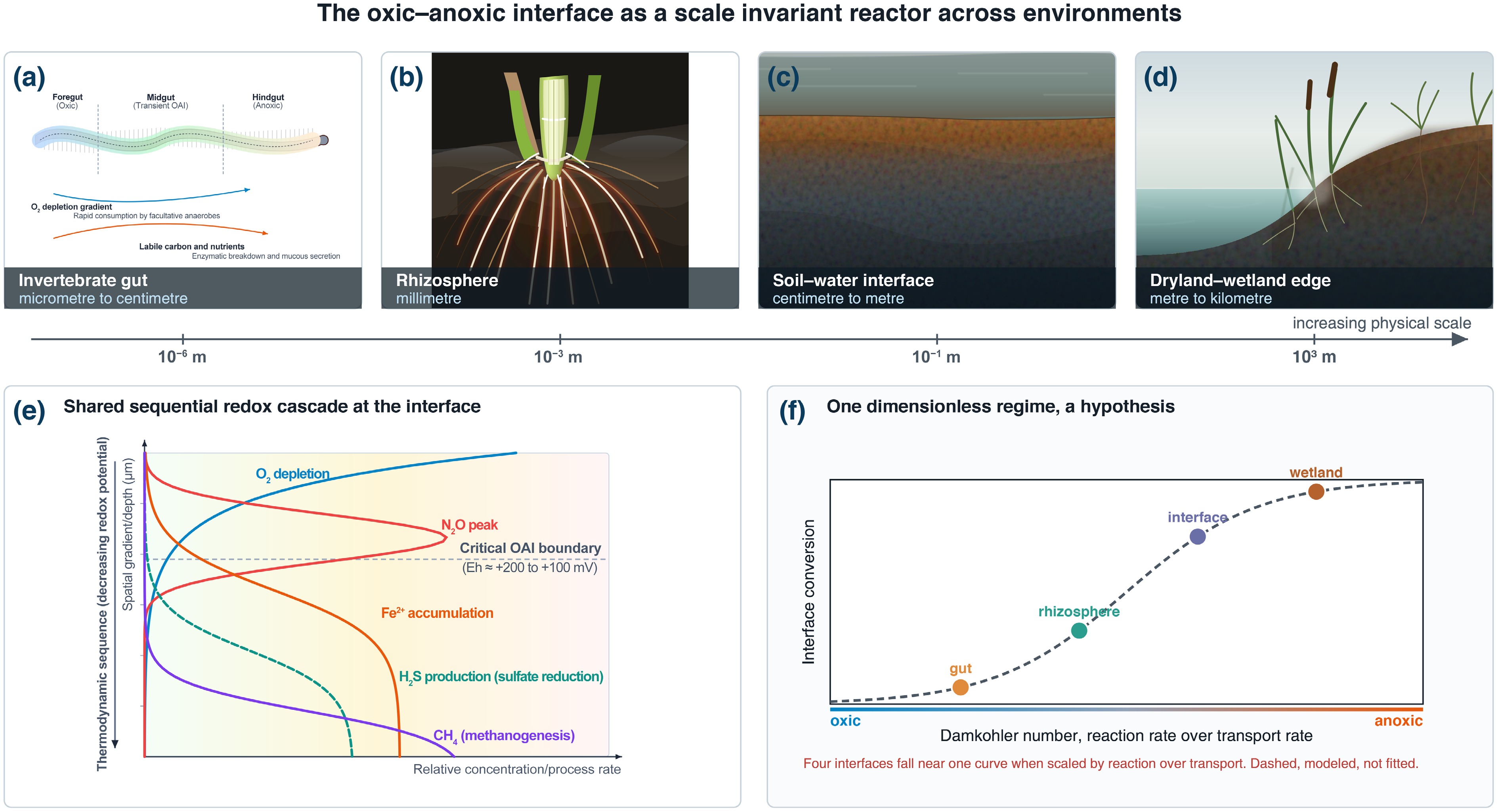
Figure 1.
The oxic–anoxic interface as a reactor across biological and environmental systems. Steep oxygen gradients and sequential redox reactions emerge across diverse oxic–anoxic interfaces despite large differences in physical scale. (a)–(d) Four representative interfaces spanning multiple spatial scales: the invertebrate gut (µm to cm), the rhizosphere (mm), the soil–water interface (cm to m), and the dryland–wetland boundary (m to km). (e) A shared redox sequence across the interface, with oxygen depletion followed by nitrate reduction, iron reduction, sulfate reduction, and methanogenesis. (f) The four interfaces are compared using a dimensionless reaction-to-transport ratio, a conceptual scaling hypothesis. Despite spanning several orders of magnitude in size, they are hypothesized to converge on a similar region in dimensionless space. The dashed curve only represents a conceptual scaling hypothesis rather than an empirical fit.
The two extensions here have different evidential status. The occurrence of transient oxic–anoxic transitions in the rhizosphere[55], at sediment/soil–water interfaces[56], and across dryland–wetland boundaries is supported by field and experimental observations of steep oxygen gradients, spatially structured redox conditions, and preferential or partially overlapping use of terminal electron acceptors[28,52,57]. In contrast, the placement of these interfaces within a common dimensionless reaction–transport space is a comparative hypothesis rather than an empirical relationship fitted across systems. Its interpretation depends on how reaction order, characteristic length, transport coefficient, and oxygen boundary conditions are defined[58]. Damköhler- and Péclet-type metrics provide established tools for reactive-transport analysis, but their transfer across pore, organismal, sedimentary, and landscape scales is complicated by preferential flow, spatial averaging, evolving pore structure, multiple coupled reactions, and scale-dependent effective parameters[58−60]. Local oxygen profiles and system-specific reaction or transport characteristics have been measured in individual systems, but obtaining comparable parameters in situ across interfaces that differ by orders of magnitude in size remains difficult[58−60]. A similar caution applies to the proposed redox-resistome coupling. Gut studies provide a basis for linking structured redox conditions, microbial activity, and resistance dynamics, whereas evidence from other interfaces remains sparse and system-specific[61]. Recent experimental work at sediment–water interfaces has also reported changes in ARG dynamics following redox perturbation[62]. Thus, observations from the rhizosphere, sediment–water interface, and dryland–wetland boundary can motivate testing whether redox organization influences resistance dynamics beyond the gut, but they do not yet establish a common coupling mechanism across these systems. The cross-interface framework in Fig. 1 is therefore intended as a comparative and testable framework, with its predictive value depending on future measurements that resolve reaction–transport processes and resistome dynamics at comparable spatial and temporal scales.
-
The gut bioreactor transforms nutrients and toxic elements through overlapping pathways. For nitrogen, ingested denitrifiers reduce nitrate during gut passage, producing nitrous oxide and dinitrogen[1,2]. Ferric iron is likewise reduced during transit through the gut[15], resulting in the release of iron-bound chemicals such as phosphorus and arsenic[63−65]. Potentially toxic trace metal(loid)s are also directly transformed by the gut microbiota, altering their chemical speciation, bioavailability and, consequently, toxicity[13,35,38]. Gut fermentation rapidly processes ingested organic matter. Key bacterial taxa regulate carbon metabolism during gut passage, and these processes may influence carbon turnover locally at the scale of the ingested column[4,12,14,16].
Contaminant fate is not separable from this element processing. Plastic particles, metal(loid)s, and organic pollutants that enter the gut are processed by the same microbial communities that mediate nutrient cycling[23,38,66,67], thereby mechanistically linking nutrient cycling with contaminant transformation. This coupling extends beyond microbial metabolism to whole-animal ecological function. Earthworm functional group identity can regulate litter processing and thus the flux of both carbon and sorbed contaminants through the animal[68,69]. These observations suggest that gut conditions governing nutrient transformation can also influence the processing of toxic elements and contaminants. Biogeochemical function and contaminant fate can therefore be considered coupled within the gut reactor, although the strength and mechanism of this coupling remain context-dependent. Current evidence is therefore better interpreted as associations between microbial community composition and resistance determinants than as direct evidence that the same individual cells perform both functions[70,71]. Causality could be tested by linking isotope-labelled substrate use to resistance gene carriage within the same cells, for example through stable-isotope probing combined with metagenomic or single-cell approaches.
-
The first recurring contradiction concerns whether contaminant exposure increases or decreases ARG abundance in the gut. Many contaminants enrich the gut resistome, including antibiotics, fungicides, herbicides, and plastic particles, although the strength of the evidence differs among contaminant classes[19,20,42,72−79]. For instance, carbendazim can enrich multidrug, glycopeptide, tetracycline, and rifamycin ARGs while increasing their association with MGEs, including cmx adjacent to a transposase and sul1 adjacent to an integron integrase[21]. By contrast, silver nanoparticles reduced the detection frequency of ARGs in soil collembolan guts under the tested conditions[80]. Outside animal gut systems, antibiotics and silver nanoparticles did not alter ARG abundance during anaerobic digestion[81] or in soils[82], indicating that bactericidal stress does not necessarily reduce ARG abundance through carrier removal alone, because surviving resistant taxa, extracellular DNA persistence, and other post-killing processes can maintain detectable ARG signals. These observations point to a genuine contradiction rather than a consistent directional response.
The contradiction reflects competing mechanisms rather than inconsistent observations. Two opposing processes govern the outcome. Co-selection can increase ARG abundance when a stressor is sublethal and when MRGs, or other genes conferring resistance to the stressor, are genetically linked to ARGs, and the exposure above which this becomes detectable has been formalized for metal(loid)s as a minimum co-selective concentration[35,83−85]. Such linkage may arise through co-resistance on shared MGEs, cross-resistance mediated by multidrug efflux pumps, or co-regulation through shared regulatory pathways[24,84,86,87]. By contrast, direct antimicrobial toxicity can decrease ARG abundance when a stressor is sufficiently bactericidal and not genetically linked to antibiotic resistance, because it removes carrier hosts together with susceptible populations[88,89]. The decrease observed under silver therefore fits toxicity dominating over genetic context at that exposure level[80]. Dose further shifts the balance between these two processes. Copper, for example, exerts relatively weak effects below the experimentally identified threshold but substantially reshapes gut microbial communities once that threshold is exceeded across different invertebrates[88,89]. Such a threshold is the gut-scale counterpart of a minimum co-selective concentration. The direction of the response therefore depends on three factors: (1) the balance between toxicity and co-selection, (2) the dose reaching the gut lumen, and (3) the genetic context of the resident microbial community. Figure 2 summarizes these relationships by positioning representative stressors on a toxicity-to-co-selection landscape and illustrating where increasing exposure is predicted to shift the net response from enrichment to depletion. Stressor positions in Fig. 2 were assigned qualitatively from the pattern of reported outcomes reviewed above, placing a stressor toward the toxicity-dominated region when bactericidal or growth-inhibitory effects were reported at the tested exposure and toward the co-selection-dominated region when genetic linkage to a co-occurring resistance determinant was documented at a sublethal exposure. These positions are illustrative rankings drawn from qualitative synthesis of the literature rather than coordinates derived from a quantitative dose-response model, and the framework should be read as conceptual until stressor-specific toxicity and co-selection thresholds are measured directly within gut systems.
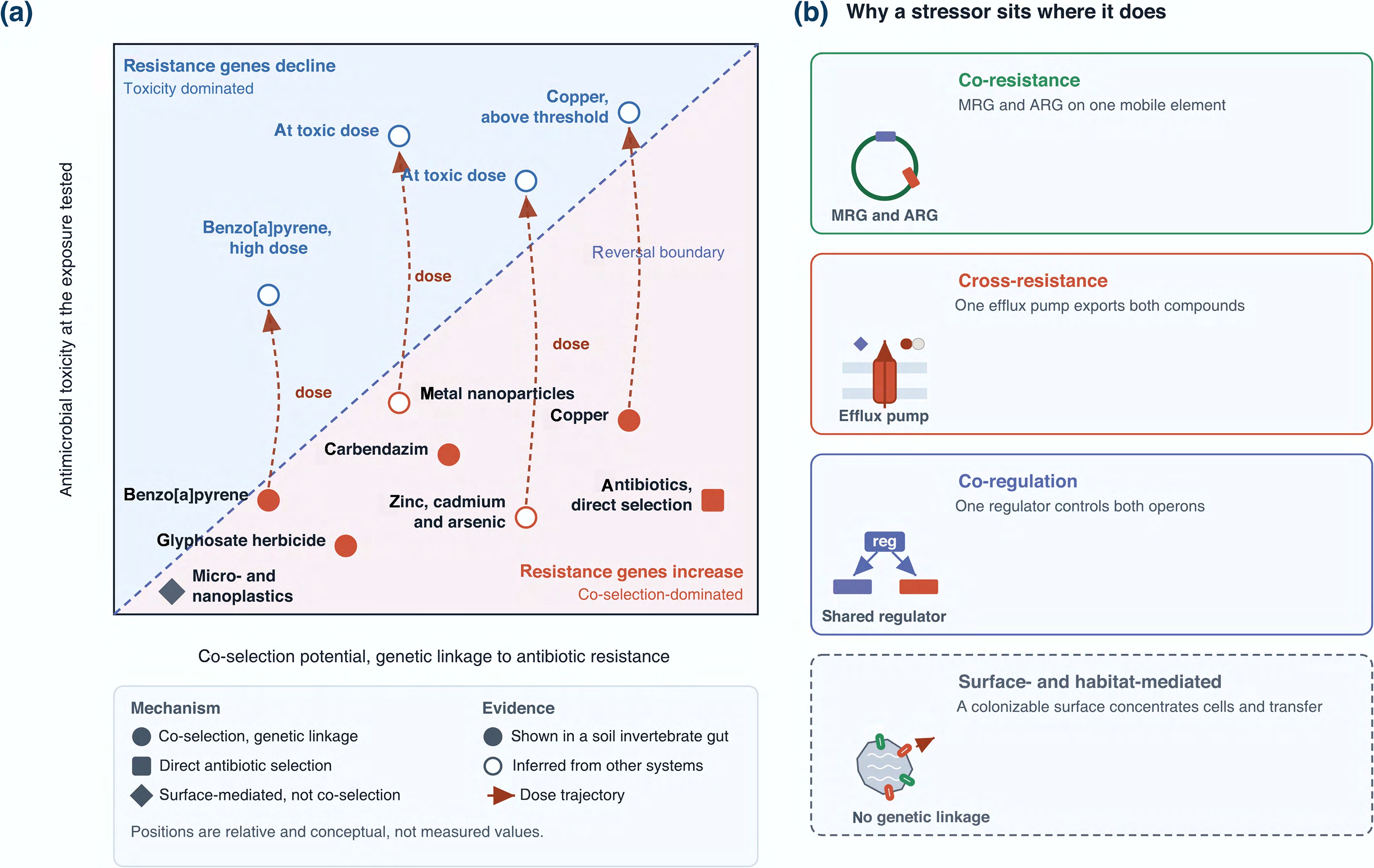
Figure 2.
Resolving contradiction domain one using a toxicity-to-co-selection framework. Representative stressors are positioned according to their antimicrobial toxicity and co-selection potential. (a) Toxicity-to-co-selection landscape described above. Silver is placed toward the toxicity-dominated region under the tested conditions, where ARG abundance can be predicted to decline. Carbendazim, sublethal metal(loid)s, and plastic particles occupy the co-selection-dominated region, where ARG abundance can be predicted to increase. The dashed boundary illustrates the conceptual transition at which increasing exposure shifts the dominant process from co-selection to toxicity. (b) Four molecular mechanisms that can place a stressor in the co-selection-dominated region: co-resistance through a shared mobile element, cross-resistance through a shared efflux pump, co-regulation through a shared regulator, and surface- or habitat-mediated co-occurrence without genetic linkage, together with the evidential basis, shown in a soil invertebrate gut or inferred from other systems, for each stressor position. Positions in both panels are relative and conceptual rather than measured coordinates.
This contradiction also highlights a methodological limitation: many studies quantify ARG abundance but provide limited information on their expression, mobility, or host association (Box 1)[20]. Recent methodological advances are beginning to address this gap. Function-resolved analyses of the active resistome, together with genome-resolved metagenomics and long-read approaches that link ARGs to genomic contexts and potential hosts, demonstrate that gene abundance and activity can diverge and that HGT should not be inferred solely from ARG occurrence or phylogenetic incongruence[79,90,91]. The apparent contradiction therefore reflects the decoupling between ARG abundance, functional activity, and ecological dissemination potential. Resolving these mechanisms will require function-resolved measurements beyond gene abundance alone.
Box 1 Why abundance alone does not indicate resistance risk Most evidence for contaminant effects on the gut resistome comes from measurements of ARG abundance. Such measurements provide valuable ecological information but should not be interpreted as direct evidence of increased resistance risk, defined here as a combined increase in ARG abundance, ARG mobility and the host range of ARG carriers. What abundance measurements show. Quantitative molecular surveys[20]. They establish whether resistance determinants become more or less common within a microbial community. What abundance measurements cannot show. Gene abundance alone does not demonstrate expression, horizontal transfer, association with pathogens or functional activity. Likewise, co-occurrence between MRGs and ARGs can be consistent with co-selection but does not prove it, because genomic linkage, shared hosts and shared environmental drivers can produce the same pattern[86,87]. What additional evidence is needed. Demonstrating increased resistance risk requires function-resolved evidence, including host attribution, physical linkage to MGEs and, where possible, direct evidence of HGT[72,90]. Interpretation. Throughout this review, enrichment and depletion refer to changes in ARG abundance unless functional evidence is available. Co-selection can be interpreted as a plausible mechanism supported by current evidence but requiring direct confirmation, and HGT can be considered supported only when evidence goes beyond ARG co-occurrence. Resistome risk, a term used later in this Review, denotes the combined increase in ARG abundance, ARG mobility and the host range of ARG carriers. This distinction between abundance and risk is maintained throughout the three contradiction domains that follow. Unless stated otherwise, enrichment and depletion in these domains refer to changes in ARG abundance rather than to demonstrated changes in mobility or host range. -
The second contradiction concerns the net effect of soil fauna on resistance dissemination beyond the gut. One set of findings casts fauna as amplifiers. The gut concentrates ARGs and their microbial carriers, and the high cell density and physical confinement of the lumen favor horizontal gene transfer. Genes also move bidirectionally between soil and gut, while repeated organic amendment can accumulate a resistome that animals subsequently transport through soil[10,26,79,92−94]. Another set of findings casts the same animals as attenuators. Earthworm activity reduced the dissemination potential of ARGs across diverse soils, whereas bioturbation reorganized microbial co-occurrence networks and disrupted associations that facilitate resistance dissemination[13,42,95,96]. These findings seem to point to opposite ecological roles for the same animals.
The contradiction can be resolved by separating two processes that operate at different spatial scales. Inside the gut, prolonged retention time, high cell density, and host selection increase microbial contact and favor horizontal gene transfer, thereby amplifying resistance dissemination. Outside the gut, bioturbation mixes and aerates soil, and gut passage reorganizes microbial communities, diluting local hotspots and disrupting the associations that underpin resistance dissemination[13,69,95]. The net outcome reflects the balance between within-gut amplification and soil-scale attenuation, which depends on faunal identity, gut retention time, bioturbation intensity, and the incoming ARG load. A gut can therefore act as a local amplifier even when the animal functions as a field-scale attenuator. Figure 3 summarizes these opposing pathways across spatial scales and identifies the transition where the dominant process is expected to shift. Attenuation is not inevitable, because environmental context remains a primary determinant of the net outcome. Resistance can persist despite active remediation, demonstrating that the balance can be governed by environmental conditions rather than by the presence of fauna alone[97]. Literature appears contradictory only when observations made at one spatial scale are generalized to another. The local amplifier–field-scale attenuator interpretation proposed here is therefore a synthesis of evidence from different scales, rather than a demonstrated causal sequence. Direct studies that track both within-gut amplification and field-scale attenuation in the same animals and under comparable conditions would provide a stronger test of this framework. Because most available evidence is abundance-based, amplification and attenuation here primarily refer to changes in ARG abundance and microbial associations potentially relevant to horizontal transfer, rather than demonstrated changes in ARG mobility or pathogen host range.
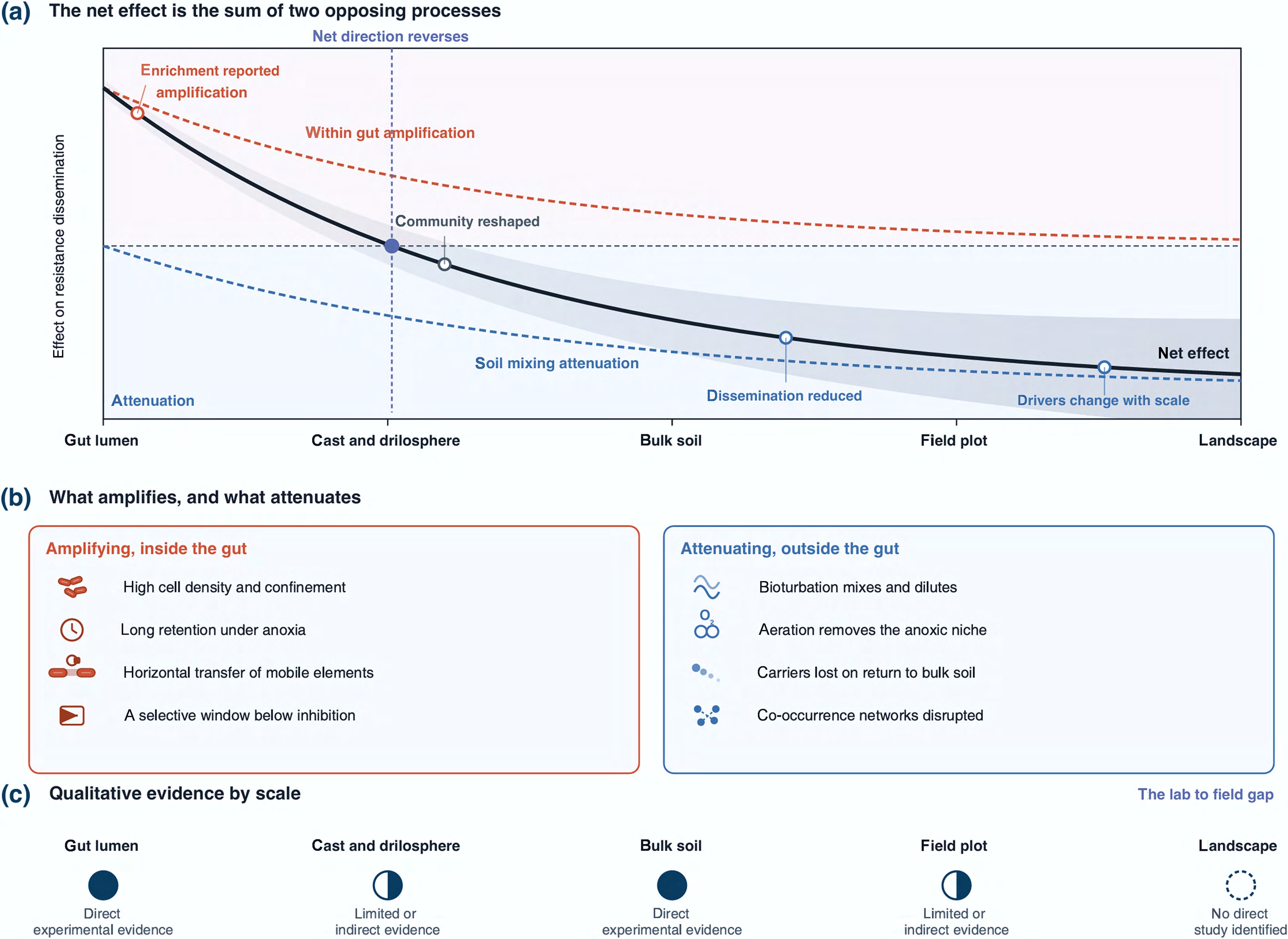
Figure 3.
Scale-dependent amplification and attenuation of resistance dissemination. (a) Plotting the net effect as the sum of an amplifying process inside the gut and an attenuating process outside the gut across this spatial axis. The horizontal axis represents spatial scales ranging from the gut lumen to the landscape. Within-gut concentration and horizontal transfer amplify resistance dissemination locally, whereas bioturbation and soil mixing attenuate dissemination at larger scales. The dashed curve illustrates the conceptual transition where the net outcome can be predicted to shift from amplification to attenuation. (b) Specific mechanisms that amplify resistance dissemination inside the gut and that attenuate it outside the gut. (c) Scale-by-scale summary of whether direct experimental evidence, indirect or limited evidence, or no identified study currently supports the curve shown in (a), which is the evidential gap discussed in the main text.
-
The third contradiction concerns whether the plastisphere should be viewed primarily as a reservoir of ecological risk or as an active participant in carbon cycling. Evidence supports both interpretations. On one hand, the plastisphere concentrates ARGs, MGEs, and potential pathogens, and plastic exposure increases their abundance and mobility in soil and in the animals that ingest particles[34,76,98−102]. On the other hand, plastics also participate in carbon turnover through microbial degradation. Microorganisms associated with plastics have been reported to transform certain polymers under specific conditions; earthworm gut microbiota harbor plastic-degrading potential, and biodegradable polymers can be mineralized with measurable consequences for the host[66,103−108]. The plastisphere can therefore be viewed as both a biogeochemical interface and a potential resistome reactor. This dual role connects to the gut bioreactor framework specifically through soil fauna. Earthworms and other soil invertebrates ingest, fragment, and gut-process plastic particles together with their attached biofilms, so any coupling between plastic-associated carbon turnover and resistance dynamics during gut passage would occur within the transient oxic–anoxic environment, rather than being intrinsic to the plastic surface alone. Outside the gut, where plastic debris is not ingested by fauna, carbon turnover and resistance dynamics on the plastisphere represent parallel processes whose interaction remains less clear.
The two functions need not arise from the same mechanism. They may instead be connected through a common substrate, spatial microhabitat, and transport pathway. The plastic surface can adsorb and concentrate co-occurring contaminants, thereby altering their bioavailability, microbial exposure, and toxicity[67]. These surfaces also provide colonizable microhabitats that support distinct microbial communities, while soil fauna ingest, fragment, and redistribute plastic particles and their associated microbiota throughout the soil profile[95,109−111]. Whether carbon transformation and resistance enrichment are mechanistically coupled, or simply co-localized on the same surface, therefore remains an open and testable question[112,113]. A useful experimental test would compare resistance transfer and carbon transformation on plastic-associated biofilms with matched non-plastic surfaces while controlling nutrient availability, biomass, and other major environmental conditions. If coupling emerges under these controlled comparisons, the plastisphere could be incorporated into the coupled gut–soil reactor framework shown in Fig. 4.
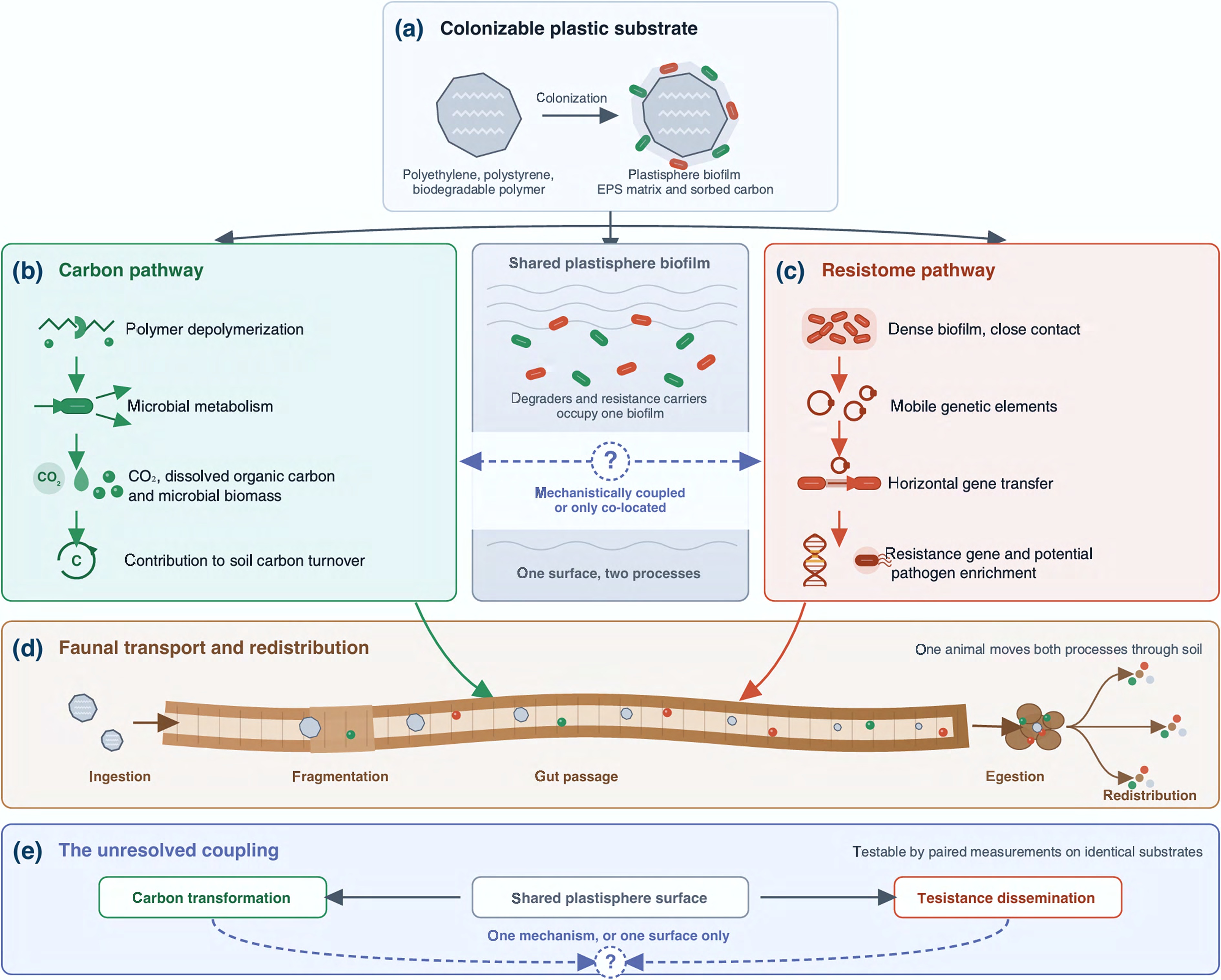
Figure 4.
The plastisphere as a mobile biogeochemical reactor. (a) A plastic particle presents a carbon-associated surface that can be colonized by a distinct biofilm held in an EPS matrix. (b) The carbon pathway, in which polymer depolymerization and microbial metabolism release carbon dioxide, dissolved organic carbon, and biomass, and contribute to soil carbon turnover. (c) The resistome pathway, in which a dense biofilm, mobile genetic elements, and HGT enrich ARGs and potential pathogens. The central column is the shared biofilm, where degraders and resistance carriers occupy one surface. (d) Soil fauna ingest, fragment, and redistribute the particles together with their associated microbiota, which carries both processes through soil. (e) The unresolved coupling. Whether carbon transformation and resistance dissemination arise from one mechanism or merely occur on one surface is drawn as a dashed link, and it remains an open and testable question.
-
The redox-coupled bioreactor is not an equilibrium system. Its oxygen profile may approach a quasi-steady state within a single gut passage, yet the overall system state remains responsive to external drivers. Warming raises the activity of the gut resistome, nutrient addition and land management establish conditions for co-selection between genetically linked MRGs and ARGs, and contaminant mixtures make the biogeochemical response depend on both the magnitude and the compositional complexity of pollution[86,92,94,114,115]. These drivers do not act independently. Each shifts the system along the toxicity–co-selection axis and the amplification–attenuation axis, thereby altering both the magnitude and direction of the coupled response. Evidence for warming specifically is currently limited to a single invertebrate species under controlled conditions[94], in which soil warming increased the active antibiotic resistance potential in the gut of an invasive land snail; this observation has not yet been replicated across other soil fauna, contaminant backgrounds, or field conditions. This broader proposition remains a testable hypothesis, informed by this single-species finding and by established co-selection and scale-dependence mechanisms.
Scale organizes the framework rather than complicating it. A single mechanism can raise ARG abundance inside the gut, lower dissemination at the plot scale once bioturbation mixes the soil, and produce a range of net effects across a heterogeneous landscape, because a landscape integrates many individual gut interfaces through transport and bioturbation. The reason the same mechanism can yield different signs can be that community structure, ecological interactions, and microbial function are reorganized at each of these scales by diet, litter quality, and land management[5,7,47,101,111]. Much of the apparent disagreement in the literature therefore arises from comparing observations made at different scales rather than from differences in the underlying biology.
-
The coupled reactor framework provides a single mechanistic explanation for the apparently disconnected observations reviewed above. The transient oxic–anoxic interface that develops during gut passage establishes the redox conditions of the lumen, and these shared physicochemical conditions simultaneously govern both biogeochemical transformations and the microbial processes that shape resistome dynamics. The three contradiction domains and the scale dependence discussed above are therefore not independent phenomena but different expressions of the same interface-controlled process. Figure 5 summarizes this framework by depicting the gut as a coupled reactor in which shared physicochemical inputs generate two interconnected outputs: element transformation and resistance dissemination. Their connection can be represented by the denitrifying guild, which is shown as an illustrative shared node within the reactor. Outside animal gut systems, the anaerobic process itself reduced ARG abundance by approximately 1 log (2 logs for intI1), irrespective of silver nanoparticle or antibiotic exposure[81]. This observation illustrates how changes in the underlying biogeochemical process can propagate to resistance dynamics, while also highlighting that the direction and magnitude of the response depend on system conditions.
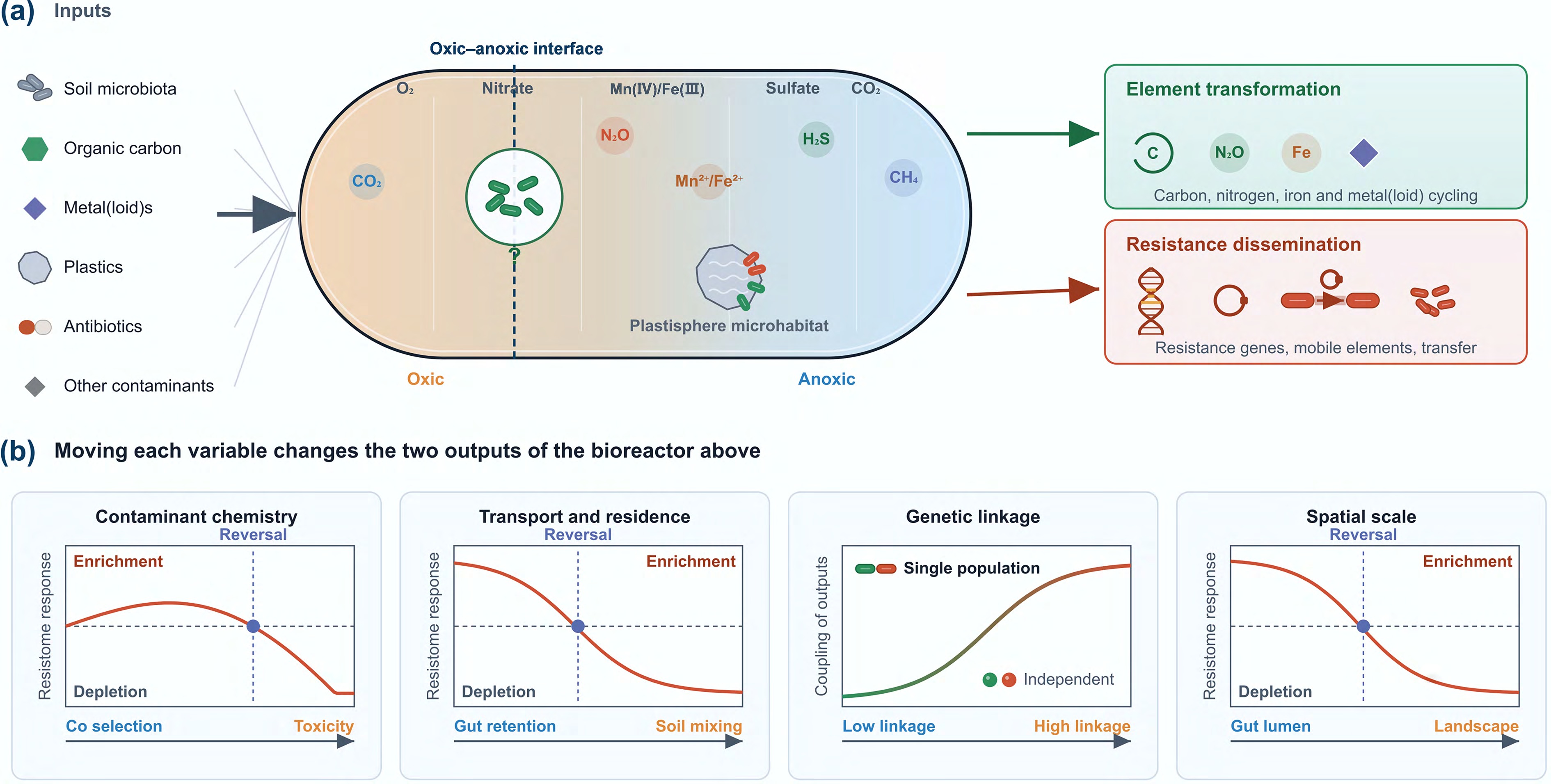
Figure 5.
The soil invertebrate gut as a coupled bioreactor. The transient oxic–anoxic interface created during gut passage functions as a shared physicochemical control that simultaneously regulates biogeochemical transformations and the microbial processes that shape resistome dynamics. (a) Ingested soil microbiota, organic carbon, metal(loid)s, plastics, and other contaminants enter the gut, where a steep redox gradient can promote sequential electron-accepting reactions. The denitrifying guild can be shown as an illustrative shared functional node, one of several candidate guilds, linking two coupled outputs: element transformation and resistance dissemination. (b) Four variables influence how the coupled reactor can be expressed: contaminant chemistry (toxicity vs co-selection), the balance between gut retention and soil mixing, genetic linkage between functional guilds and resistance determinants, and the spatial scale over which individual gut interfaces are integrated. Together, these variables explain the direction and magnitude of coupled ecological outcomes.
Within this framework, four factors determine how coupling is expressed: contaminant chemistry, including toxicity and co-selection; the balance between gut retention and soil mixing; the degree of overlap or genetic linkage between functional guilds and resistance determinants; and the spatial scale over which individual gut interfaces are integrated. These factors provide a basis for interpreting why the same soil fauna can amplify resistance locally while attenuating its dissemination at broader spatial scales, why contaminant exposure can produce divergent resistome responses, and why carbon transformation and resistance enrichment on the plastisphere may or may not be mechanistically coupled.
-
Future progress depends on moving from abundance-based observations to function-resolved evidence, and from isolated measurements to explicit cross-scale integration. Figure 6 summarizes the major knowledge gaps and the corresponding predictions that can be tested to evaluate the coupled reactor framework.
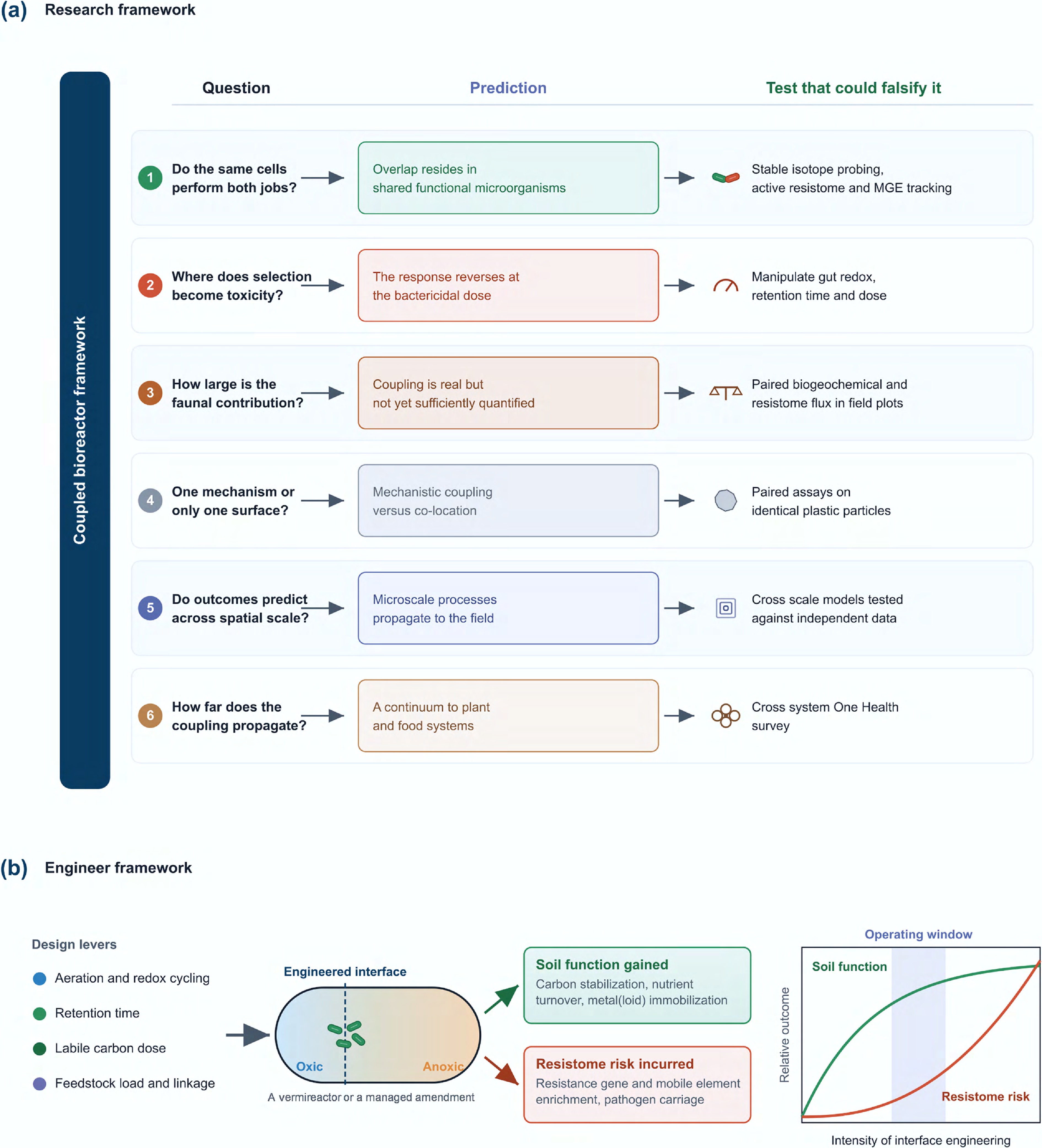
Figure 6.
From testable predictions to an engineering constraint. (a) Each prediction of the coupled reactor framework is placed beside the question it answers and the experiment that could falsify it, spanning function-resolved measurement, the transition from co-selection to toxicity, field-scale mass balance, the plastisphere mechanism, cross-scale modeling, and One Health integration. (b) The same coupling constrains any attempt to engineer the interface deliberately. Design levers such as aeration and redox cycling, retention time, labile carbon dose, and feedstock composition act on one engineered oxic–anoxic interface, which yields a gain in soil function and a resistome risk at the same time. Because benefit saturates while risk accelerates, the framework predicts an operating window in which the coupling remains favorable. This trade-off can be a prediction of the framework rather than a demonstrated result; no such reactor has been built or tested, and the prediction is falsifiable, since soil function raised without opening the selective window would show the coupling to be weaker than claimed.
Can the same microbial populations simultaneously mediate element transformation and resistance dissemination
-
The coupled reactor framework predicts that at least part of the overlap between these two functions resides within shared functional guilds. Testing this prediction requires function-resolved approaches that identify both microbial activity and host identity, including tracking mobile genetic elements, measuring the active rather than the total resistome, and linking stable-isotope-labelled substrates to resistance-carrying populations through stable isotope probing[30,79,90]. Beyond denitrification, future work should determine whether analogous coupling occurs in other functional guilds, including iron-reducing bacteria, sulfate reducers, and transient methanogens, by combining multi-isotope stable isotope probing with metalloproteomic or transcriptomic analyses.
Where does the transition from co-selection to toxicity occur
-
The framework predicts that individual stressors should shift from ARG enrichment to ARG depletion once bactericidal effects exceed selective advantages. This prediction can be tested by experimentally manipulating gut redox conditions, retention time, and contaminant dose while monitoring both microbial activity and resistance dynamics[80,89].
How large is the contribution of soil fauna to ecosystem-scale coupling
-
Current evidence demonstrates the existence of coupling but not its quantitative importance. Simultaneous measurements of biogeochemical fluxes and resistome fluxes across matched field plots are therefore needed to constrain the magnitude of fauna-mediated coupling within whole-soil systems[13,111]. An order-of-magnitude estimate is not yet possible from the available evidence because comparable gut-passage and bulk-soil fluxes are rarely reported for the same process at the same site. A useful first step would combine earthworm biomass and gut-passage rates, which can be quantified from field populations and egestion measurements[116], with per-gut-passage estimates of biogeochemical transformation rates such as N2O production[1,117] and resistance dissemination potential[1,116−118]. Until such paired measurements exist, whether gut-mediated coupling represents a negligible or substantial fraction of field-scale denitrification or resistance dissemination should remain unknown rather than being assumed to be either large or small.
Does the plastisphere couple carbon transformation and resistance dissemination through a shared mechanism or merely a shared substrate
-
Resolving this question requires paired measurements of carbon turnover, microbial function, and resistance dynamics on identical plastic particles under controlled and field conditions[66,98]. Distinguishing mechanistic coupling from simple co-localization represents one of the central unresolved questions arising from this review.
Can coupled outcomes be predicted across spatial scales
-
The framework predicts that microscale gut processes should propagate to field-scale patterns through transport, bioturbation, and ecological reorganization. Cross-scale models that explicitly couple biogeochemical transformations with resistome dynamics provide the most direct means of testing this prediction against independent datasets[47,111].
How does the coupled reactor propagate through the broader agroecosystem
-
The gut interface should be considered within a holobiont and One Health context rather than as an isolated system[114,119−126]. Defining the magnitude and continuity of these pathways remains an important challenge for future One Health research.
Can the interface be engineered without opening the selective window
-
The framework carries a practical consequence that follows directly from the coupling (Fig. 6b). If one interface can promote two outputs, then any deliberate attempt to engineer that interface for soil benefit, whether through a vermireactor[127−129], an organic amendment, or a managed redox cycle, should raise soil function and resistome risk together rather than separately. The framework predicts that benefits will eventually saturate while risks continue to accelerate, generating a favorable operating window that can be experimentally constrained. This has not been tested, and no such reactor has been built for this purpose. The prediction is nonetheless falsifiable, because a treatment that raised soil function without enriching resistance would show the coupling to be weaker than the framework claims. Evidence that resistance can persist through active remediation indicates that the risk output is not avoided by default[97].
-
This review proposes that the soil invertebrate gut can be best understood as a coupled reactor in which a shared physicochemical interface can simultaneously regulate biogeochemical transformations and the microbial processes that shape environmental resistome dynamics. Viewed through this framework, many of the apparent contradictions in the current literature become expected outcomes of the same underlying process expressed under different physicochemical conditions and spatial scales, rather than fundamentally conflicting observations. The framework therefore shifts attention from asking whether soil fauna is beneficial or harmful to identifying the environmental conditions under which different ecological outcomes emerge.
At present, two important uncertainties remain. Much of the evidence for resistome dynamics remains abundance-based, leaving functional activity, host linkage, and transfer potential incompletely resolved. Likewise, the quantitative contribution of gut-mediated coupling to ecosystem-scale biogeochemical and resistome fluxes remains largely unknown. These limitations do not weaken the framework; instead, they define the most direct opportunities for experimental validation and model refinement. By integrating microbial ecology, biogeochemistry, and environmental resistance biology within a single mechanistic framework, the coupled reactor concept provides a common language for interpreting processes that have traditionally been studied in isolation. More broadly, it offers a testable foundation for understanding how soil fauna influence ecosystem functioning and environmental health under accelerating global change.
Not applicable.
-
All conceptual figures in this review (Figs. 1–6 and the graphical abstract) were designed by the authors as original schematic vector graphics. Layout, drafting, and vector rendering were assisted by an AI-based drafting tool under direct author supervision, and no image-generation model was used to create photorealistic or generative biological imagery. Every biological structure, label, pathway, axis, and conceptual relationship shown was specified by the authors and checked against the cited primary literature for scientific accuracy prior to submission. This disclosure is provided in accordance with the journal policy on the use of generative AI tools in figure preparation; the authors remain fully responsible for the scientific content and accuracy of all figures.
-
The authors confirm their contributions to the paper as follows: Sha Zhang: conceptualization, investigation, formal analysis, methodology, visualization, writing – original draft, supervision; Sha Zhang, Yi-Fei Wang, Dong Zhu: writing – review & editing, funding. All authors reviewed the results and approved the final version of the manuscript.
-
Data sharing not applicable to this article as no datasets were generated or analyzed during the current study.
-
The authors declare that they have no known competing financial interests or personal relationships that could have appeared to influence the work reported in this paper.
-
Full list of author information is available at the end of the article.
- Copyright: © 2026 by the author(s). Published by Maximum Academic Press, Fayetteville, GA. This article is an open access article distributed under Creative Commons Attribution License (CC BY 4.0), visit https://creativecommons.org/licenses/by/4.0/.
-
About this article
Cite this article
Zhang S, Wang YF, Zhu D. 2026. Soil invertebrate guts as redox bioreactors linking biogeochemistry and the resistome. Environmental and Biogeochemical Processes 2: e023 doi: 10.48130/ebp-0026-0018 

Soil invertebrate guts as redox bioreactors linking biogeochemistry and the resistome
- Received: 27 July 2026
- Revised: 20 August 2026
- Accepted: 10 October 2026
- Published online: 06 November 2026
Abstract: The guts of soil invertebrates represent dynamic bioreactors where biogeochemical transformations and microbial evolution occur simultaneously, but knowledge about them has remained fragmented between nutrient and contaminant metabolism on one side and the gut resistome on the other. This fragmentation creates conflicting views on how guts affect antibiotic resistance gene profiles and the broader environmental dissemination risks. Here we suggest a concept based on the oxic–anoxic transition characteristic of guts as an element that defines bioreactor activity. Such a transient process creates spatial and temporal biogeochemical hotspots and imposes selective pressures on microorganisms. As a result, biogeochemical redox transformations and resistance selection are linked through a shared, active microbial community in the gut. Overall, gut resistome dynamics depend on contaminant toxicity (redox-dependent or intrinsic), gut retention time, and the spatial and temporal scales at which these processes are examined. Future research should experimentally test these mechanisms and extend this framework beyond individual guts to broader oxic–anoxic interfaces in the environment.