










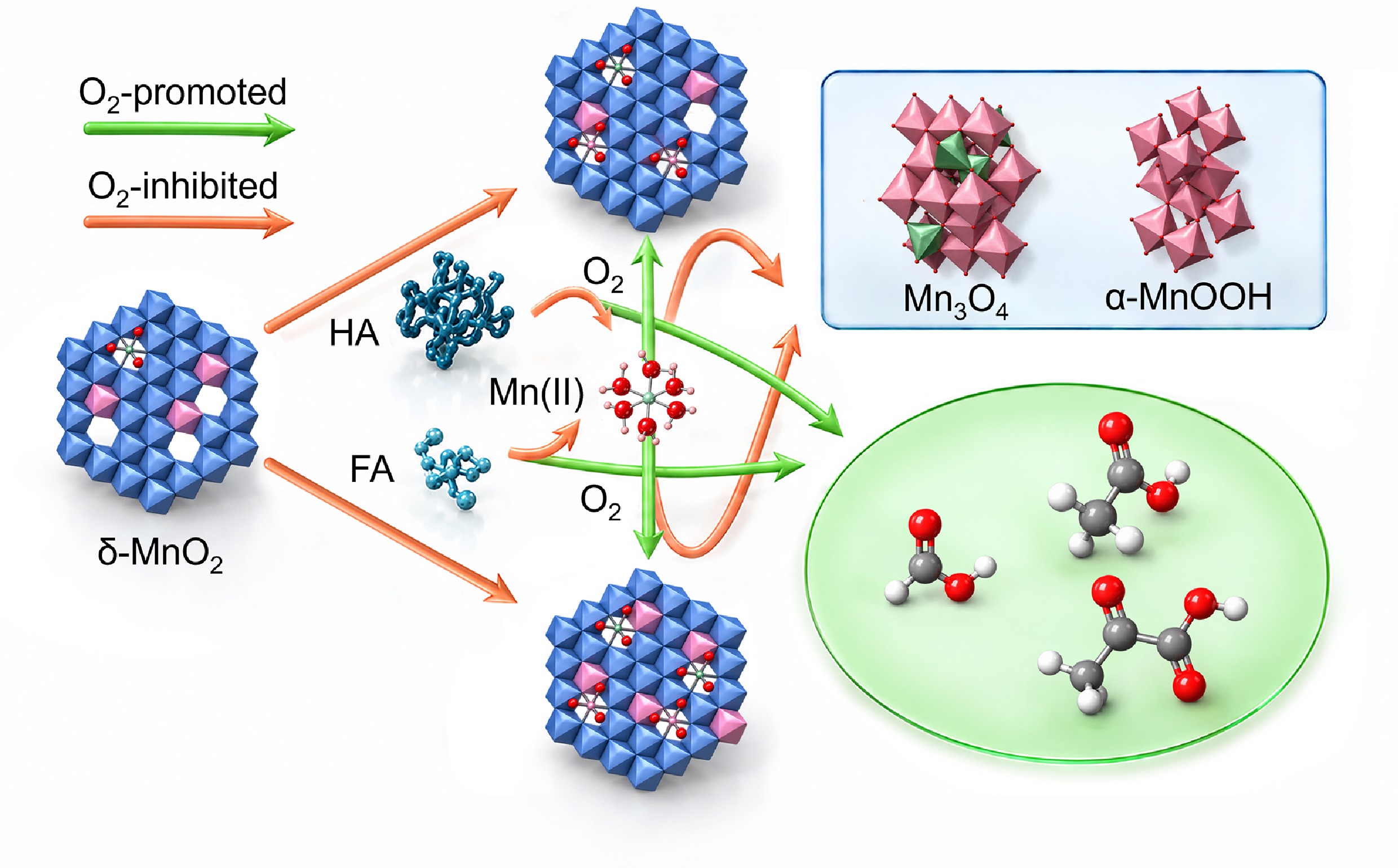



-
Birnessite is the most abundant and reactive manganese (Mn) oxide mineral in nature, affecting elemental cycling due to its exceptional sorption and oxidation capabilities[1−7]. The properties and reactivity of birnessite are primarily governed by Mn cation vacancies and Mn oxidation states, particularly the concentration and spatial arrangement of Mn(III) within its structure[6−11]. Partial reductive dissolution of birnessite can strongly modify its structural and chemical characteristics and may even induce transformation to other Mn oxide phases[7,9,12]. Such reduction can occur across a range of pH conditions, reductant-to-birnessite ratios, and in the presence of coexisting cations and anions[4,7,9,12,13].
Dissolved organic matter (DOM) is a ubiquitous and abundant reductant in soils and aquatic systems, including water columns, sediments, and porewaters. Redox reactions between DOM and Mn oxides influence not only Mn biogeochemical cycling but also DOM transformation, persistence, and reactivity[9,12−25]. On one hand, oxidation of DOM by Mn oxides can lead to degradation into high-molecular-weight segments, low-molecular-weight organic compounds, carbon monoxide, and CO2, promoting decomposition[9,12−15,20,26−28]. These reactions contribute to litter decomposition processes, which have been shown to correlate strongly with Mn concentrations in plant litter[29−32], although dissolved Mn(III) species may play a more dominant role. On the other hand, Mn oxides can promote oxidative polymerization of DOM components, including polyphenols and sugars, forming larger and more complex molecules, increasing the stability of organic matter[15,16,18,28,33,34].
Because DOM is chemically heterogeneous, studies of specific DOM fractions are needed to resolve the mechanisms governing its interactions with Mn oxides. Humic substances (HS), including humic acid, fulvic acid, and humin, constitute an important fraction of DOM[35] and are widely used as representative substrates for investigating these interactions. For example, biogenic Mn oxides exhibit higher reactivity toward organic carbon than ferromanganese cave deposits[36]. DOM–MnO2 interactions release uranium through coupled DOM oxidation and MnO2 reduction[37]. MnO2 oxidizes DOM to oxygen-depleting and aliphatic compounds[38], while coexisting cations inhibit phenol oxidation[39]. DOM reactions with Mn oxides also form carbon-Mn oxide colloids, whose stability depends on metal cations, with Mn(II) providing the greatest stabilization[40]. Moreover, δ-MnO2, a nano-particulate birnessie phase, promotes the humification of fulvic acid (FA), but not humic acid (HA)[41,42], likely through polymerization, with high-molecular-weight FA showing stronger adsorption and reducing capacity toward MnO2[43]. Our previous studies demonstrated that adsorption and oxidation of FA, a HS surrogate, by birnessite under anoxic conditions increased Mn(III) and Mn(II) concentrations in the birnessite structure or induced its transformation into hausmannite (Mn3O4) and MnOOH phases, depending on pH, FA/birnessite mass ratios, the type and concentration of coexisting cations, and reaction time[9,12]. Specifically, the δ-MnO2 structure became progressively enriched in both Mn(II) and Mn(III) at pH 8, but only Mn(II) at pH 4 and 6[12]. These findings contrast with other studies using X-ray photoelectron spectroscopy (XPS), which reported that solids contained 26%–56% Mn(III) after birnessite reacted with humate and low-molecular-weight organics (e.g., oxalate, triclosan, aniline, and phenol) at pH ~5 under oxic conditions[44−47]. In addition, a large portion of FA molecules were involved in degradation by Mn oxides under aerobic conditions, particularly polycyclic aromatic hydrocarbons, polyphenols, highly unsaturated and phenolic compounds, with more thorough degradation at pH 4 than at pH 6, whereas polymerization was not observed[48].
The reactions between Mn oxides and HS often occur in environments with variable levels of O2. However, as far as the authors know, there have been a very limited number of studies examining the effect of O2 on the coupled transformation of Mn oxides and HS. A recent study by Zou et al.[49] showed that O2 plays a key role in the humification of catechin and glycine to form HA and FA, and MnO2 and O2 synergistically enhance the formation of HA. In contrast, another study showed that O2 inhibits FA oxidation by δ-MnO2[50]. The observed high Mn(III) fractions in those Mn oxide–OM studies[44−47] may result from oxidation of adsorbed Mn(II) by O2 on birnessite surfaces or the formation of low-valence Mn oxide (LVMO) phases. Mn(III) incorporation into birnessite can occur via oxidation of adsorbed Mn(II) by atmospheric O2 at pH ≥ 7[51], whereas Mn(II) oxidation by O2 is negligible at pH < 6[52]. Similarly, studies by Mandernack et al.[53] and Tu et al.[54] showed that birnessite–Mn(II) interactions under oxic conditions produce various Mn(III)-containing phases, including feitknechtite (β-MnOOH), groutite (α-MnOOH), manganite (γ-MnOOH), and hausmannite at pH ≥ 6, which is attributed to surface-catalyzed Mn(II) oxidation by O2. However, some Mn(II,III) oxides, such as hausmannite, are unstable in alkaline media in the presence of O2, converting to birnessite[55] or manganite[56].
To examine how O2 affects the birnessite–HS reactions, we conducted batch experiments by reacting δ-MnO2 with HA or FA at pH 5 or 8 and HS/solid mass ratios of 0.1 or 1 in the presence or absence of atmospheric O2. HA and FA serve as HS surrogates and differ in chemical characteristics such as molecular weight and the abundance of carboxyl and phenolic OH groups[57−59]. HA extracted from soils is generally less acidic and contains fewer reducing functional groups (e.g., phenols and hydroquinones) than FA isolated from surface waters[60], likely resulting in lower reducing capacity for HA.
-
δ-MnO2 was synthesized by reducing KMnO4 with Mn(NO3)2 under basic conditions, following the procedure described in Wang et al.[12] Humic acid used in this study was extracted from soils collected at the Main Agricultural Experiment Station of the University of Arkansas (Fayetteville, AR, USA) using the method of He et al.[61], and subsequently purified according to the International Humic Substances Society protocol[62]. The HA material was used in our previous study[13]. Suwannee River fulvic acid was obtained from the International Humic Substances Society. All inorganic chemicals were of analytical grade.
Reaction of HS with δ-MnO2
-
The experiments were conducted in 500 mL capped polyethylene bottles containing 50 mmol/L NaCl to maintain background ionic strength under ambient air conditions or inside a COY vinyl anaerobic chamber (95% N2 + 5% H2) equipped with a Pd catalyst. HA or FA (0.3 g/L) was reacted with δ-MnO2 (3 or 0.3 g/L) in batch systems at pH 5 or 8 for up to 600 h, resulting in HS-to-solid mass ratios (R) of 0.1 or 1. The experimental procedures followed those described in our previous study[12]. At selected time intervals, 20 mL aliquots of the suspensions were withdrawn and filtered through 0.22 µm nitrocellulose membranes. Filtrates were analyzed for dissolved Mn ([Mn]dis) using inductively coupled plasma-optical emission spectrometry (ICP-OES), which had a detection limit of 0.1 µg/L (0.002 µmol/L). However, reported values were kept at 0.1 µmol/L precision for clarity. The retention of Mn(II) on nitrocellulose was expected to be negligible based on a previous study[63]; however, the concentration of Mn(III)-ligand complexes might be underestimated due to their stronger retention by the membranes[64]. Therefore, [Mn]dis should reflect more Mn(II) than dissolved Mn(III)-ligand species. The recovered solids were air-dried and ground before further characterization with synchrotron X-ray techniques.
Characterization of reacted solids
-
Both XRD and total X-ray scattering data for pair distribution function (PDF) analysis were collected from the air-dried solids using a 58.6772 keV X-ray (λ = 0.2113 Å) at beamline 11-ID-B of the Advanced Photon Source (APS), Argonne National Laboratory. The sample-to-detector distances were approximately 100 cm for XRD and 15 cm for total scattering PDF. Data collection and processing followed the procedures described in Wang et al.[12]. Briefly, two-dimensional XRD and PDF scattering images were integrated into one-dimensional scattering intensity vs scattering vector (Q) using FIT2D[65]. The integrated XRD data were directly used for phase identification after subtracting empty Kapton tubing for background correction. To obtain the PDF, the integrated one-dimensional total scattering data were converted into the reduced total structure function F(Q) using PDFgetX2[66], where F(Q) = Q[S(Q) – 1] and S(Q) is the structure function. Finally, the PDF, G(r), was obtained by Fourier transform of F(Q) through
$ G(r)=\dfrac{2}{\pi }\int\nolimits_{{Q}_{\min }}^{{Q}_{\max }}F\left(Q\right)\sin \left(Qr\right)dQ $ To estimate the content of Mn(II), Mn(III), and Mn(IV) in the reacted solids, selected samples were subjected to Mn K-edge X-ray absorption near-edge structure (XANES) spectroscopy and subsequent linear combination fitting (LCF) analysis. The LCF analysis was conducted over –20 and +30 eV of E0 in the derivative-normalized absorption coefficient (µ) using ATHENA[68] with standards including hureaulite [Mn(II)], pyroxmangite [Mn(II)], tephroite [Mn(II)], Mn2O3 [Mn(III)], groutite [Mn(III)], feitknechtite [Mn(III)], manganite [Mn(III)], pyrolusite [Mn(IV)], ramsdellite [Mn(IV)], KBi [Mn(IV)], Ca2Mn3O8 [Mn(IV)], and TcBi [Mn(III,IV)] from Manceau et al.[69]. Energy was not allowed to shift during the LCF analysis.
Characterization of reacted HA and FA
-
For the reacted HA and FA, the E2/E3 ratio (absorbance at 250 nm divided by that at 365 nm) was determined from the filtrate UV-vis spectra and used to assess compositional changes in the HA and FA.
In addition, concentrations of low-molecular-weight (LMW) organic molecules of HS oxidation, including acetate, formate, and pyruvate, were measured by ion chromatography (IC) equipped with a conductivity detector. Formate and pyruvate could not be differentiated; therefore, their concentrations were reported as combined values. Our previous work provides details for the IC measurement[13].
-
The release kinetics of dissolved Mn during HS-driven reduction of δ-MnO2 were influenced by R, HS type (HA vs FA), pH, and redox conditions (oxic vs anoxic). In the R = 0 experiments (i.e., in the absence of reductants), no dissolved Mn was detected (data not shown). At R = 0.1 and 1, [Mn]dis generally increased with time under anoxic conditions in HA-amended systems (Fig. 1a, b). For a given R, lower pH (pH 5 vs pH 8) resulted in higher [Mn]dis, indicating that MnO2 reduction is more favorable at lower pH. At pH 8, [Mn]dis was higher at R = 1 than at R = 0.1 (Fig. 1b), reflecting the greater availability of HA to reduce δ-MnO2. In contrast, at pH 5, the HA system with R = 0.1 yielded higher [Mn]dis at later reaction stages (Fig. 1a), attributable to the higher solid concentration used in the R = 0.1 experiments. Compared with anoxic systems, oxic conditions generally produced slightly lower [Mn]dis (Fig. 1a, b), with the difference becoming much more pronounced at pH 8 (Fig. 1b). Notably, at pH 8 and R = 1, [Mn]dis under oxic conditions increased initially but reached a plateau of 7.8 µmol/L after approximately 120 h, whereas under anoxic conditions [Mn]dis continued to increase throughout the experimental period, reaching 64.2 µmol/L by the end of the experiment (Fig. 1b).
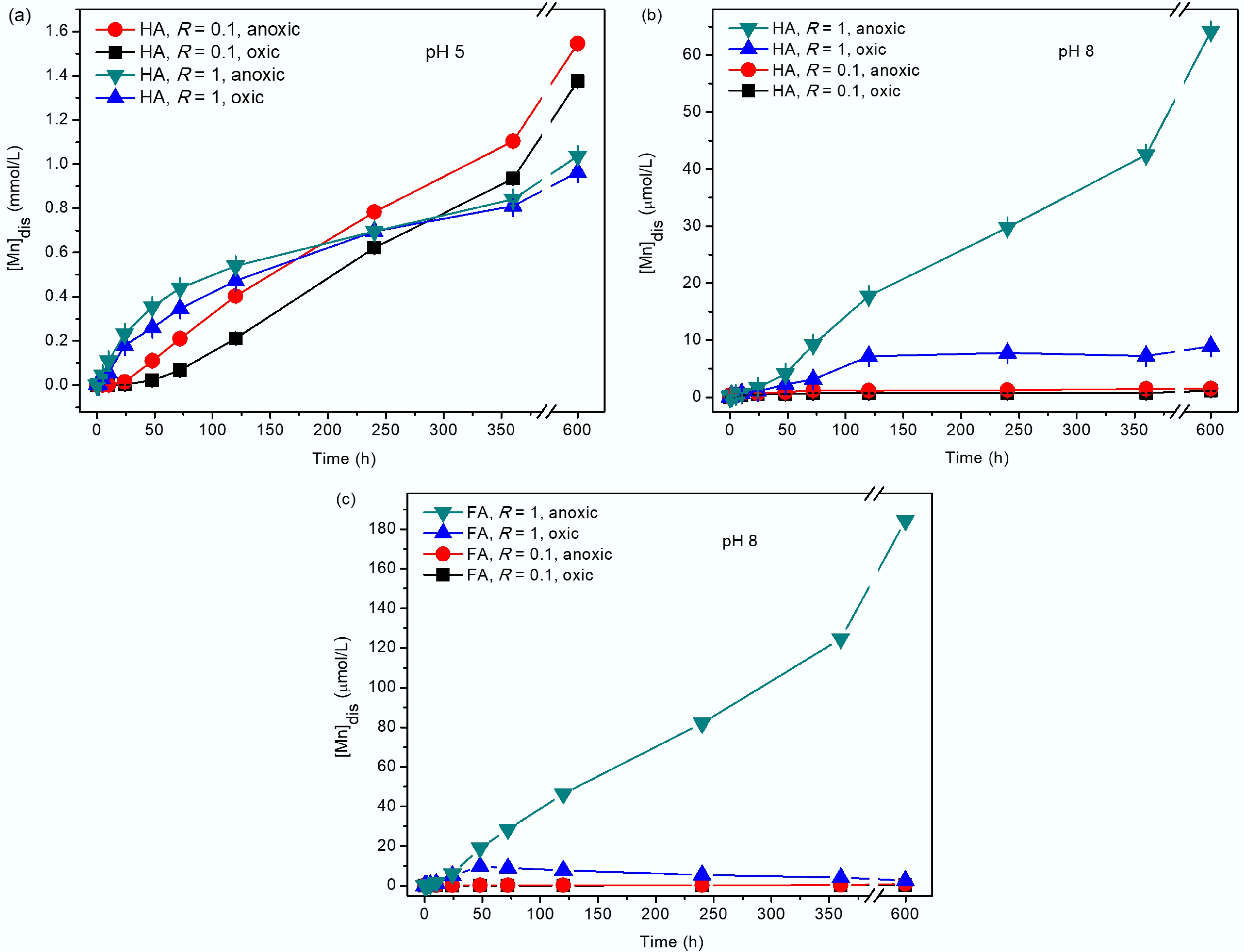
Figure 1.
Dissolved Mn concentration ([Mn]dis) during the reduction of δ-MnO2 by HA at (a) pH 5, (b) pH 8, and (c) FA at pH 8 with R = 0.1 and 1 under anoxic or oxic conditions. The errors resulted from repeated concentration measurements using ICP-OES.
In the FA systems, a similar trend was observed (Fig. 1c). At R = 1 under anoxic conditions, [Mn]dis increased continuously to 185.4 µmol/L by the end of the experiment, whereas under oxic conditions it increased to 9.9 µmol/L and subsequently decreased to 2.7 µmol/L. The higher [Mn]dis indicates that FA exhibited stronger reductive reactivity toward δ-MnO2 than HA. At R = 0.1, negligible dissolved Mn was detected.
HS removal and degradation
-
Adsorption onto solid particles was the primary pathway for HS removal, as indicated by the UV-vis spectra of the remaining HS during δ-MnO2 reduction (Supplementary Fig. S1a–S1h). Under anoxic conditions, the UV-vis absorbance of the remaining HA in the filtrates decreased across all wavelengths with increasing reaction time, indicating that HA removal was dominated by adsorption onto the solids[9,12,18]. The E2/E3 ratio, which is inversely correlated with the aromaticity of HA[70,71], generally increased over time (Fig. 2a, b). This increase indicates preferential removal of the more aromatic and higher-molecular-weight fractions of HA through adsorption and/or oxidation[9,12]. This pattern was more pronounced at lower R and lower pH (Fig. 2a, b). Compared with anoxic systems, E2/E3 values were slightly higher under oxic conditions regardless of R and pH (Fig. 2a, b), reflecting modestly stronger adsorption and/or oxidation in the presence of O2.
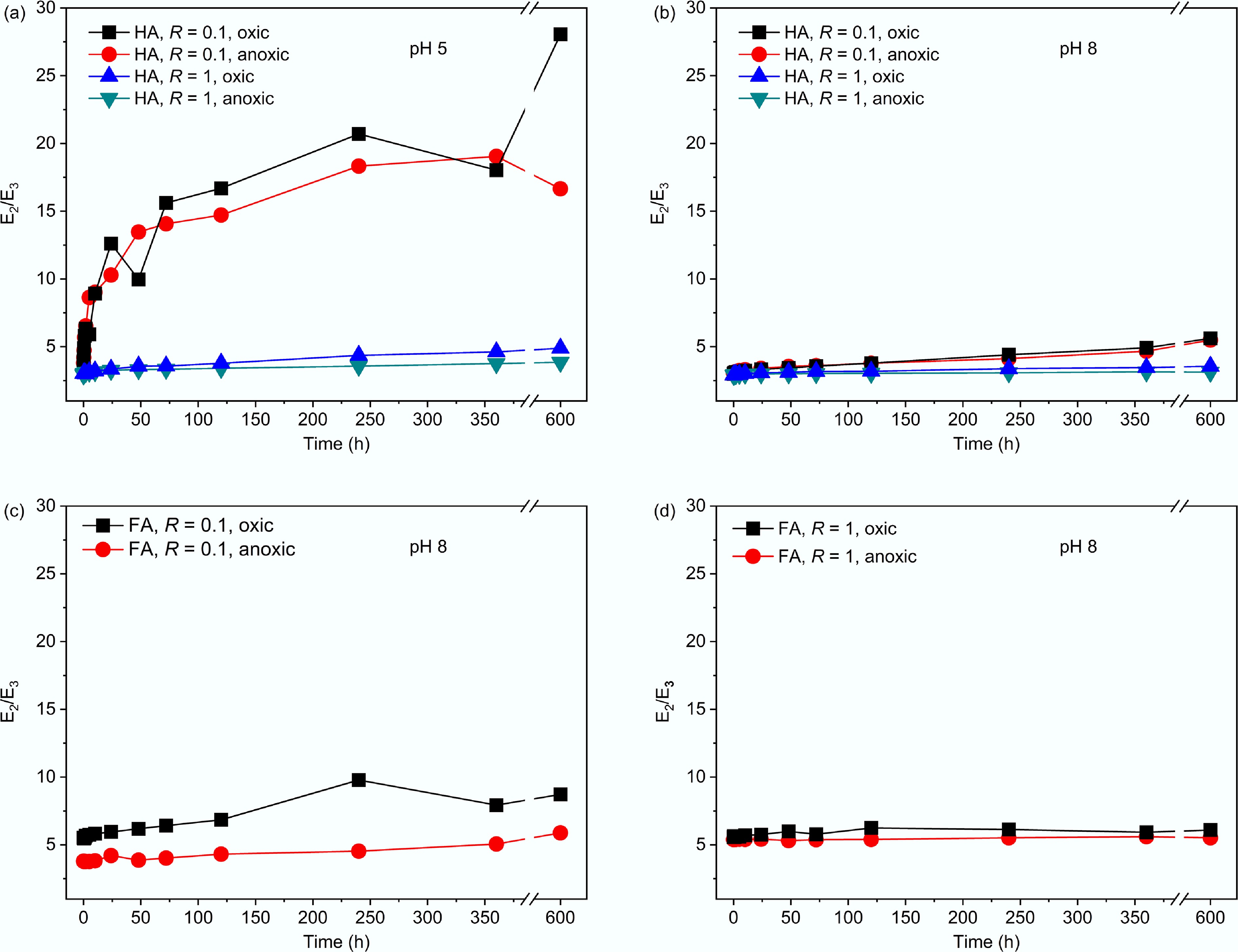
Figure 2.
E2/E3 of HA remained in the reactions with δ-MnO2 at (a) pH 5 and (b) pH 8 with R = 0.1 and 1 and FA remained at pH 8 with (c) R = 0.1 and (d) R = 1. Data for FA under anoxic conditions were adopted from Wang et al.[12].
HA was oxidized to LMW organic molecules by δ-MnO2 and/or O2 (Fig. 3a–d). However, no clear increase or decrease trend in LMW organic molecule concentrations was observed, suggesting that production and consumption processes occurred simultaneously. The production of LMW organic molecules was enhanced under oxic conditions for HA at pH 5, whereas the effect was not obvious or was even opposite at pH 8.
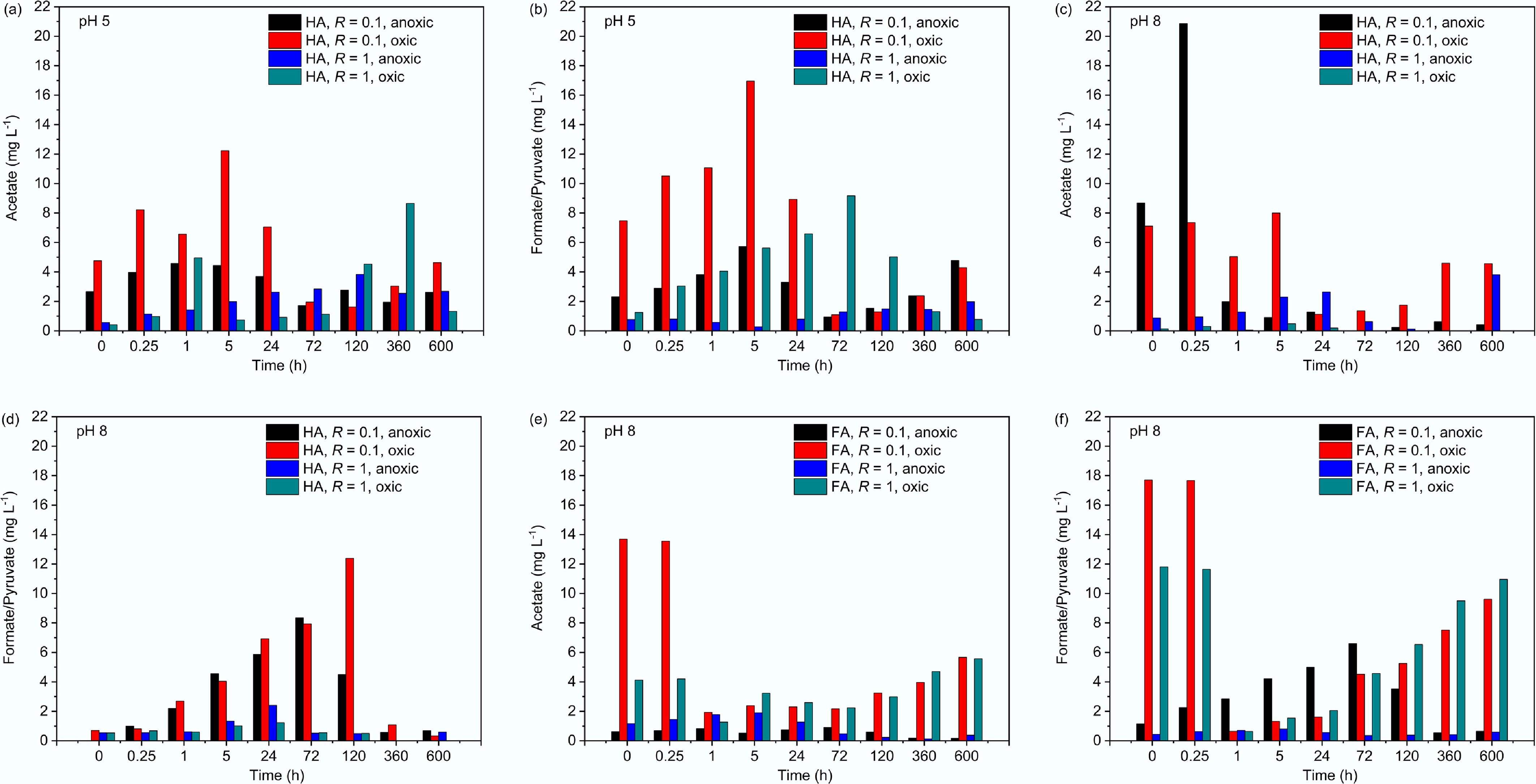
Figure 3.
(a), (c), (e) Concentrations of acetate and (b), (d), (f) formate/pyruvate at different reaction times at pH 5 and 8 with R = 0.1 and 1 under anoxic or oxic conditions. Note: pyruvate had a retention time similar to formate, which makes them indistinguishable by ion chromatography.
Compared with HA, FA showed similar patterns (Figs 2c, d, 3e, f; Supplementary Fig. S1i–S1l). The E2/E3 ratios of residual FA were greater than those of HA at pH 8, suggesting stronger oxidation. Another notable feature is that the enhancement of oxidation by oxygen was more pronounced for FA (Fig. 2c, d), as reflected by the larger differences in E2/E3 values between anoxic and oxic conditions and the much higher concentrations of LMW organic molecules under oxic conditions for most time points. Lastly, concentrations of LMW organic molecules were highest within the first 30 min and decreased sharply by 1 h, indicating rapid consumption after the initial production phase.
Structural alterations of δ-MnO2
-
The PDF analysis was used to evaluate the local structural evolution of δ-MnO2 during reactions with HS (Supplementary Fig. S2). As the reaction progressed, both Mn–Mn interatomic distances and correlation abundances changed. In particular, the Mn–Mn edge-sharing pairs within the layers (MnL–MnL) at ~2.9 Å and the second-nearest Mn–Mn corner-sharing pairs associated with vacancies (MnL–MnIL) at ~5.3 Å exhibited shifts in peak position and/or changes in peak intensity as the structural composition evolved over time (Supplementary Fig. S2). Specifically, the MnL–MnL distance shifts to larger r values with increasing Mn(III) content in the layers, whereas the MnL–MnIL peak area increases as more Mn(II,III) adsorb at vacancy sites[9].
These changes were quantified by tracking the MnL–MnL peak position and MnL–MnIL peak area as functions of time (Fig. 4). In HA systems at pH 5 and R = 0.1, the MnL–MnL distance decreased rapidly within the first 24 h and then decreased slightly thereafter under both oxic and anoxic conditions (Fig. 4a). The abundance of MnL–MnIL pairs increased and approached a plateau near 72 h (Fig. 4b). At R = 1, similar but smaller changes were observed (Fig. 4a, b).
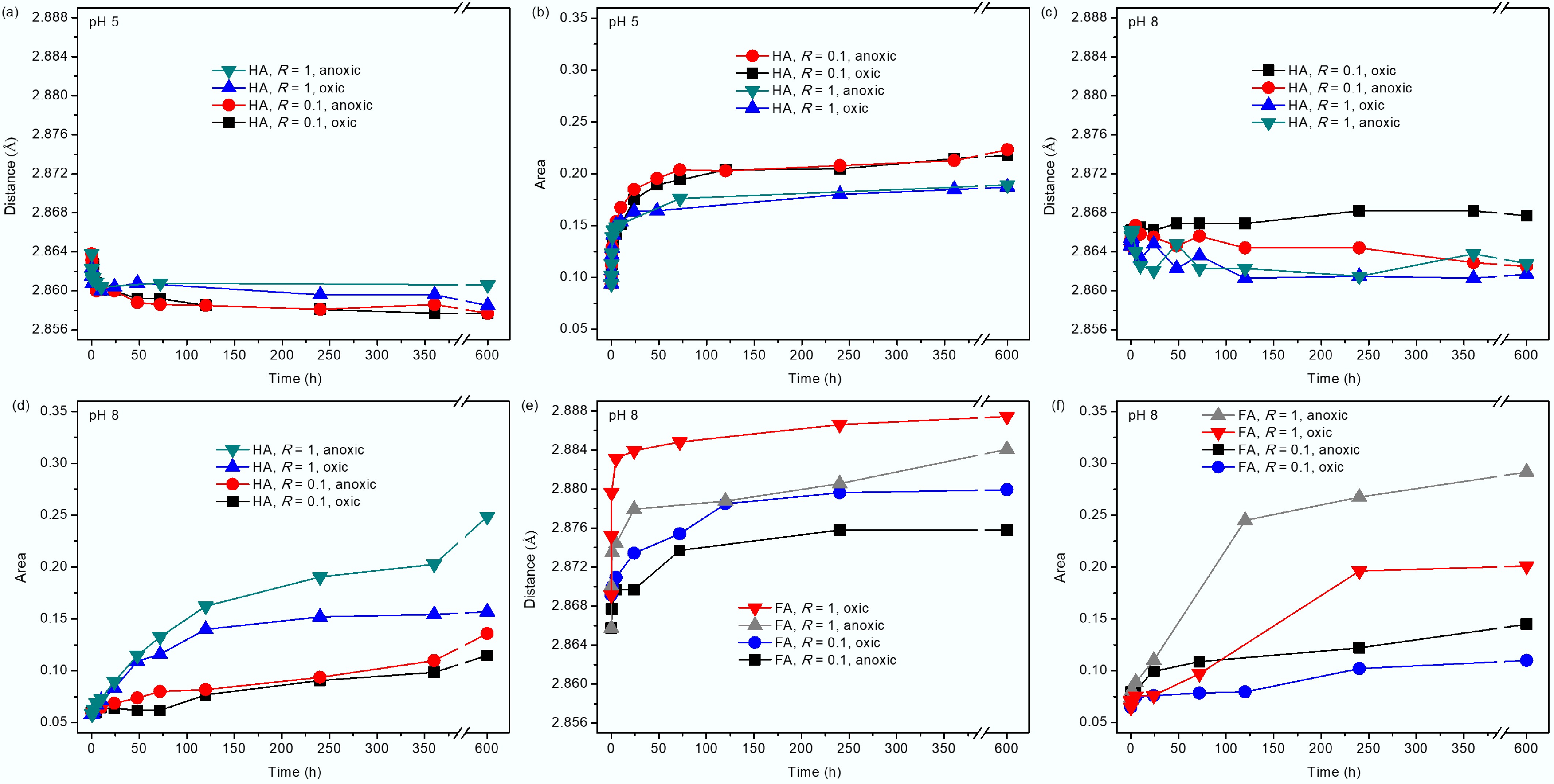
Figure 4.
(a), (c), (e) The MnL–MnL distance, and (b) (d), (f) the area of the MnL–MnIL peak at ~5.3 Å derived from PDF for δ-MnO2 reacted with HA or FA at pH 5 and 8 with R = 0.1 and 1. The results for the FA systems under anoxic conditions were reported in Wang et al.[12].
At pH 8 and R = 0.1, the MnL–MnL distance decreased slightly over 600 h under anoxic conditions but increased slightly under oxic conditions (Fig. 4c). Meanwhile, MnL–MnIL abundance increased steadily under both conditions (Fig. 4d). In contrast, at R = 1 the MnL–MnL distance generally decreased over time under both oxic and anoxic conditions, although some fluctuations were observed (Fig. 4c). The MnL–MnIL abundance increased under both conditions, with larger increases under anoxic conditions. Moreover, the extent of MnL–MnIL growth was greater at R = 1 than at R = 0.1 (Fig. 4d).
In FA systems at pH 8, both the MnL–MnL distance and MnL–MnIL abundance increased in all systems, with larger changes at R = 1 (Fig. 4e, f). The MnL–MnL distance was longer while MnL–MnIL abundance was smaller under oxic conditions, indicating greater Mn(III) incorporation in the layers but less Mn(II,III) adsorption at vacancy sites[9].
The XRD patterns of δ-MnO2 reacted with HS also provide evidence of subtle structural changes. In HA systems, the (002) reflection (d = 3.6 Å) progressively weakened with increasing reaction time (Fig. 5; Supplementary Fig. S3), indicating fewer stacked MnO6 layers and/or a reduced degree of layer parallelism[12,72]. In addition, a pronounced dip at ~2 Å developed in most cases, resulting from increasing numbers of vacancies capped by Mn(II,III)[9,12,73,74]. The presence of O2 inhibited both the decrease of the (002) reflection and the development of the dip. The evolution of this dip is consistent with the increase in the PDF peak area at r ≈ 5.3 Å described above. In FA systems, the weakening of the (002) reflection and the development of the dip were even more pronounced (Fig. 6).
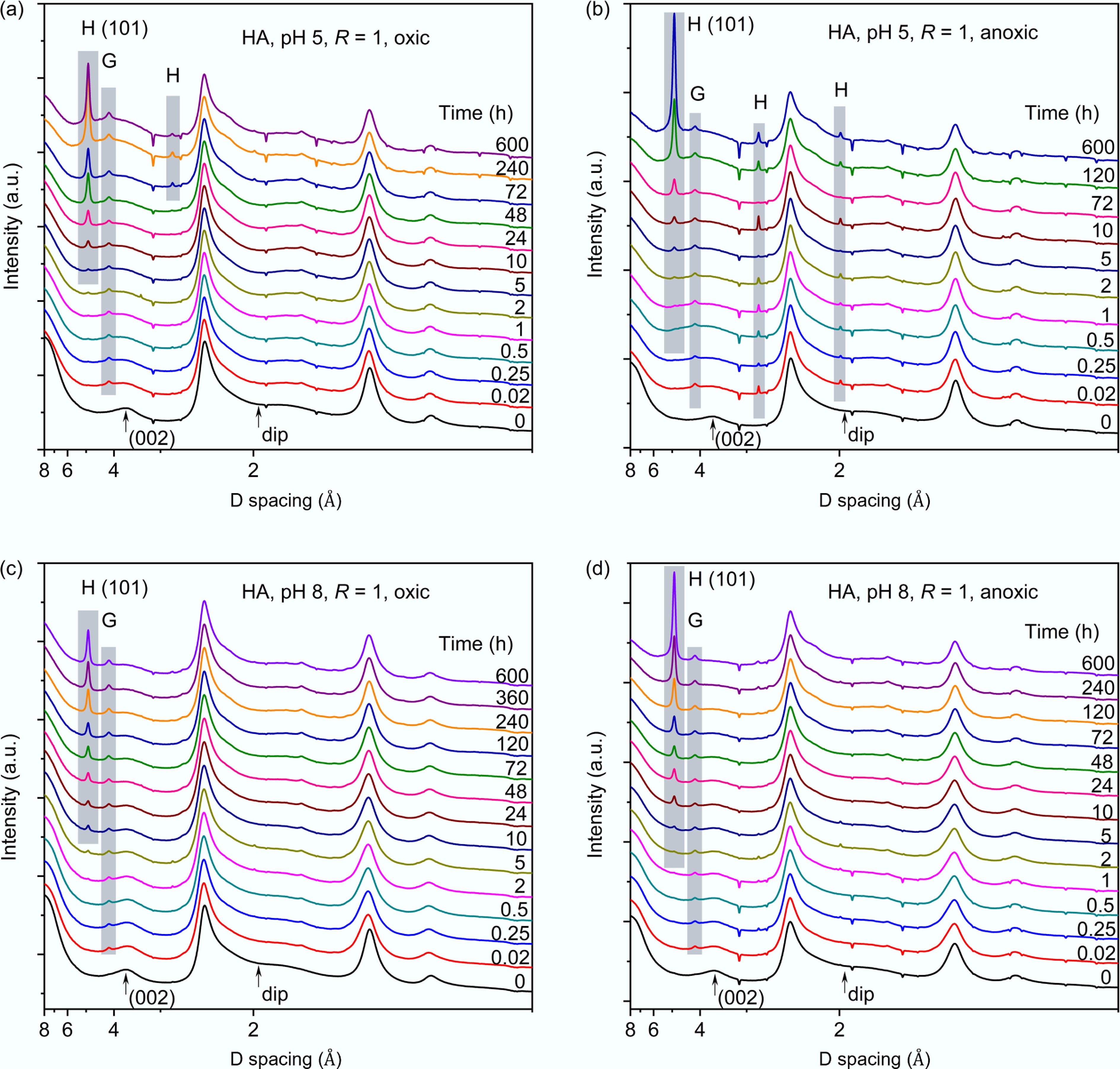
Figure 5.
Synchrotron-based XRD patterns of δ-MnO2 reacted with humic acid (HA) at (a), (b) pH 5 and (c), (d) pH 8 with R = 1. Labels H and G represent hausmannite and groutite, respectively. Note that the inverse peaks in the patterns were caused by subtracted by ceria (CeO2) standard signal remaining in the empty Kapton capillary.
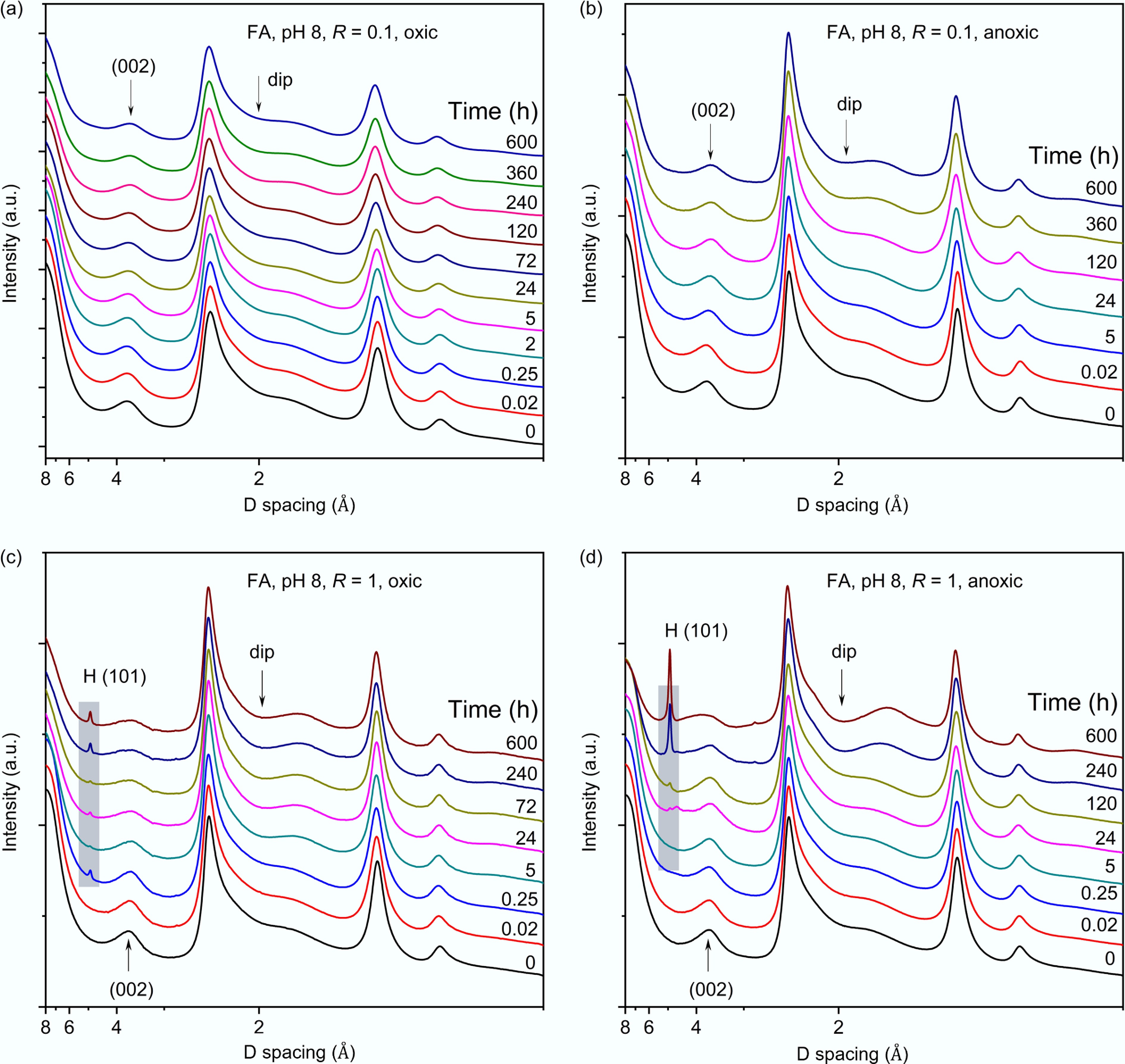
Figure 6.
Synchrotron-based XRD patterns of δ-MnO2 reacted with FA at (a), (b) pH 8 with R = 0.1, or (c), (d) R = 1, under oxic or anoxic conditions. The arrow and the label H indicate the position of the dip and the characteristic peak of hausmannite, respectively. Data for anoxic conditions were adopted from Wang et al.[12].
Mineral phases
-
The mineral transformations of reacted δ-MnO2 were characterized by XRD (Figs 5, 6; Supplementary Fig. S3). Hausmannite formed in all HA systems, and its abundance increased with time (Fig. 5; Supplementary Fig. S3). Higher pH, lower R, or O2 suppressed the formation of hausmannite, as shown by the decreased intensity of the hausmannite reflection peak. At R = 1 under oxic or anoxic conditions, groutite appeared as early as 0.02 h (Fig. 5). However, groutite remained low in abundance and showed little or no change over time compared with hausmannite (Fig. 5). In FA systems, hausmannite only formed at R = 1 (Fig. 6c, d), and the presence of O2 suppressed its formation.
Mn oxidation states in solids
-
The variations in Mn(II) and Mn(III) content in the solids, estimated by Mn XANES LCF analysis (Supplementary Fig. S4), differ between HA and FA systems. In the HA systems, Mn(III) content in the solids generally decreased, whereas Mn(II) content increased or remained relatively unchanged with reaction time (Fig. 7a–d). These variations are consistent with the decreasing MnL–MnL distance and the increasing abundance of MnL–MnIL atomic pairs observed in the PDF analysis above, indicating that most Mn(III) resides within the layers while most Mn(II) is adsorbed at vacancy sites. The presence of O2 seemed to inhibit Mn(III) production while showing little alteration in Mn(II) content except for the HA system at pH 5 and R = 1, where O2 enhanced Mn(II) production.
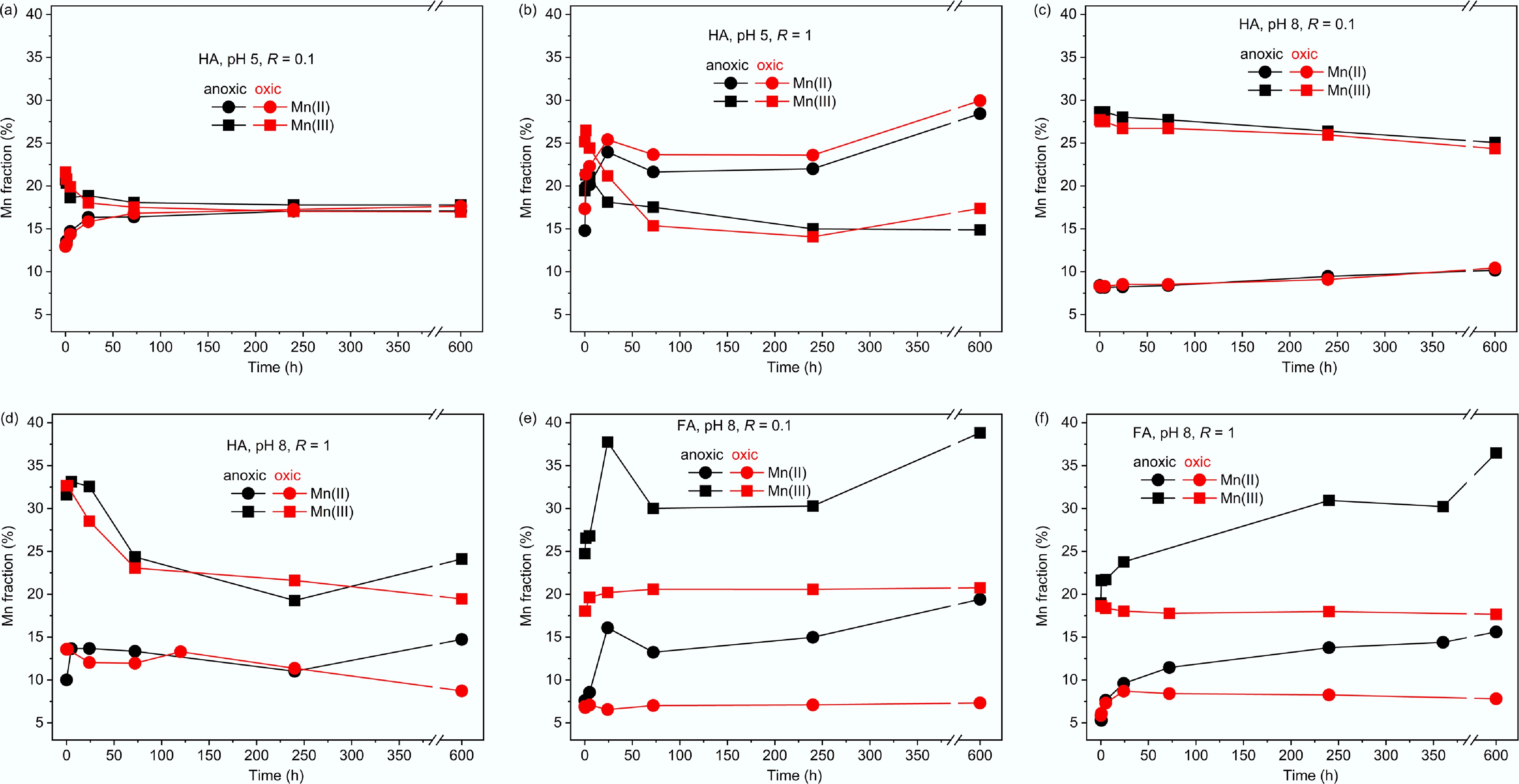
Figure 7.
Mn K-edge XANES LCF-estimated molar fractions of Mn(II) and Mn(III) in δ-MnO2 reacted with DOM at pH 5 and 8 with (a), (c), (e) R = 0.1 or (b), (d), (f) R = 1 under oxic or anoxic conditions. The molar fraction of Mn(IV) is omitted for clarity of Mn(II) and Mn(III) changes. Refer to Supplementary Fig. S4 for LCF analysis.
In the FA systems at R = 0.1 and 1 under anoxic conditions, both Mn(III) and Mn(II) increased over time (Fig. 7e, f), consistent with our previous study[12] and the PDF results discussed above. However, under oxic conditions, Mn(III) increased at R = 0.1 but slightly decreased at R = 1 over time, while Mn(II) showed little change at R = 0.1 but increased at R = 1. These variations do not align with the atomic distances and pair abundances observed in the PDF analysis, probably because of the interactions of Mn(III) with LMW organic acids (see discussion below). Another notable observation is that, except at pH 8 with R = 1, the Mn(II) and Mn(III) contents were lower than those in the HA systems. For both HA and FA systems, the starting material δ-MnO2 had about 10% Mn(II) and 16% Mn(III), which changed significantly at the beginning of the reactions, indicating a rapid compositional change during the interactions with HS.
-
The effects of O2 were manifested by decreased [Mn]dis (Fig. 1), inhibited solid Mn(III) production, enhanced Mn(III) accumulation within the layers (Fig. 4), suppressed formation of hausmannite and groutite (Figs 5, 6; Supplementary Fig. S3), and improved degradation of HS (Figs 2, 3; Supplementary Fig. S1). The following sections discuss each of these effects in detail.
Decreased [Mn]dis
-
The decrease in [Mn]dis may result from inhibited Mn(II) production and/or enhanced consumption of dissolved Mn by O2. First, O2 could directly degrade HS into partially oxidized HS and CO2[75,76], therefore suppressing the reduction of δ-MnO2 by HS and decreasing Mn(II) production. Second, O2 can oxidize dissolved Mn(II), further lowering [Mn]dis. Numerous studies show that dissolved Mn(II) can be oxidized by O2 into Mn(III) or hausmannite, MnOOH, or δ-MnO2 via surface-catalyzed mechanisms[77−81]. It was expected that Mn(II) released from HS oxidation in our systems would be oxidized into Mn(III,IV) by O2, especially at pH 8. Mn(II) oxidation may involve superoxide radical
$ {{{\mathrm{O}}_{2}}}^{\cdot -} $ Although the direct oxidation of HS by O2 is likely limited, its oxidative reactivity increases significantly at elevated pH due to deprotonation of phenolic and carboxylic groups, which enhances electron donation to reactive oxygen species[76]. Similarly, Mn(II) oxidation by O2 is strongly pH-dependent[79,80], as hydrolyzed Mn species are more readily oxidized[79], and Mn oxide formation becomes autocatalytic under alkaline conditions[77]. These coupled processes more effectively suppress the production of dissolved Mn at pH 8 than at pH 5. In addition, O2 may decrease the reactivity of δ-MnO2 by promoting particle agglomeration and surface passivation associated with enhanced Mn(III) formation from Mn(II)[85]. This effect reduces the reaction of HS with δ-MnO2, which is the primary pathway generating Mn(II).
Inhibited solid Mn(III) production
-
The abrupt changes in Mn(II) and Mn(III) from the as-synthesized δ-MnO2 to the beginning of the reactions suggest a rapid reduction of δ-MnO2, consistent with the greatest production of LMW organic molecules at the early stage for most of the systems (Fig. 3). These sharp changes may also partly result from the drying process after collecting the first sample when HS was not completely removed by filtration. Subsequent changes in solid Mn(II) and Mn(III) during the reactions are likely correlated with continued interactions between HS and δ-MnO2, in addition to the drying effects. The molecular differences between HA and FA may partly explain the decrease in Mn(III) accompanied by an increase in Mn(II) observed in all HA systems, but not in all FA systems. Compared with FA, HA contains fewer oxygen-containing functional groups (e.g., carboxylic and phenolic groups)[60], which may contribute to its lower reactivity toward δ-MnO2. The relatively slower reaction of HA with δ-MnO2 may allow Mn(III) formed during the initial reduction of Mn(IV) to undergo further transformation, including disproportionation to Mn(II) and Mn(IV), thereby contributing to the decrease in solid-phase Mn(III) and accumulation of Mn(II). The formation of hausmannite (see the section below) in HA systems provides additional evidence for processes involving Mn(II) and Mn(III), although the observed Mn(II) and Mn(III) changes alone do not establish disproportionation as the sole pathway. Mn(III) may also undergo further reduction by organic matter or become complexed by HA, particularly at alkaline pH[86−91]. In contrast, the faster reaction of FA with δ-MnO2 may sustain the production and accumulation of Mn(III) while simultaneously promoting Mn(IV) reduction and Mn(II) accumulation. This would result in the concurrent increases in both Mn(III) and Mn(II) observed in the FA systems, even under acidic conditions, consistent with previous observations[12].
Total solid-phase Mn(III) concentrations were lower in the presence of O2 than under anoxic conditions, with the largest decrease observed in the FA systems at pH 8. The oxidation of FA by O2 was likely significant, as evidenced by the enhanced production of LMW organic acids. These observations suggest that O2-promoted oxidation of HS reduced the availability of reactive HS for the reduction of δ-MnO2, thereby suppressing the generation of Mn(III). In addition, the O2-enhanced particle aggregation and surface passivation[85] would further inhibit the reaction between HS and Mn(IV) sites in δ-MnO2. At pH 8, the influence of O2 was less pronounced in the HA systems than in the FA systems, likely because the slower reaction kinetics of HA allowed the system to approach equilibrium more gradually, thereby diminishing the impact of O2.
An exception was observed in the FA system at R = 1, where the solid-phase Mn(III) concentration decreased slightly in the presence of O2. The O2-promoted degradation of HS was more pronounced in the FA systems than in the HA systems (Fig. 3). At R = 1, the higher FA concentration produced greater amounts of LMW organic compounds, which may have complexed with Mn(III), thereby facilitating the accumulation of Mn(II) in the solid phase. The complexation of Mn(III) by LMW organic ligands has been reported to be enhanced under alkaline conditions[92]. Furthermore, the higher abundance of oxygen-containing functional groups in FA[60] may have further stabilized Mn(III) through complexation[93]. In contrast, at R = 0.1, the reaction between FA and δ-MnO2 likely dominated over FA oxidation by O2. The lower FA concentration and reduced production of LMW organic compounds would have limited Mn(III) complexation, thereby favoring the oxidation of Mn(II) to Mn(III) by O2 and resulting in higher solid-phase Mn(III) concentrations.
Enhanced Mn(III) accumulation within the layers
-
The increasing MnL–MnL distance by PDF analysis should reflect the abundance of Mn(III) in the layers. It should be noted that new phases of hausmannite and groutite (see next section) also have edge-sharing Mn–Mn atomic pairs at distances of 2.88 and 2.82 Å that may also contribute to the change in the MnL–MnL distance (Fig. 4). However, the number of pairs in unit volume is much lower in hausmannite and groutite than in δ-MnO2; the contribution to the interatomic distance change from the new phase formation might be insignificant. In addition, the two distances will also cancel out the changes that have been observed between 2.858 and 2.886 Å. Therefore, the PDF-derived MnL–MnL distance should be positively correlated with the abundance of Mn(III) in the layers.
The higher abundance of layer Mn(III) under oxic conditions in the FA systems and the HA systems at pH 8 with R = 0.1 can be attributed to the oxidation of adsorbed Mn(II) at vacancies or edges by O2, producing Mn(III) that subsequently incorporates into the δ-MnO2 layers. As discussed above, the reduction of Mn(IV) by DOM generates Mn(III) through a single-electron transfer[34,94], elongating the MnL–MnL distance. Even if the generated Mn(III) can be further reduced to Mn(II) through a second single-electron transfer[86,94], Mn(II) adsorbs on the vacant or edge sites, which will be re-oxidized to Mn(III) and will subsequently incorporate into the layers. These processes leave fewer Mn(II,III) species at vacancies (Fig. 4d, f) but enrich the layers in Mn(III) (Fig. 4c, e). Although adsorbed Mn(II) can be oxidized by structural Mn(IV)[51,52], the presence of O2 enhanced the processes. For example, our previous study showed that O2 enhances the enrichment of Mn(III) in the layers during the Mn(II)–MnO2 reactions[51]. The weaker effects of O2 at pH 5 likely reflect the slower oxidation of Mn(II) by O2[51,79] and less efficient incorporation of Mn(III) into the layers[51] under more acidic conditions.
An apparent discrepancy exists between the elongated MnL–MnL distance and the slightly lower solid-phase Mn(III) concentration under oxic conditions in the FA system at R = 1. As discussed above, the slight decrease in solid Mn(III) concentration may result from the complexation of Mn(III) by LMW organic acids and FA. In contrast, the longest MnL–MnL distance observed under this condition, relative to other conditions, suggests that Mn(III) incorporation into the δ-MnO2 layers was most strongly favored despite the lower overall solid-phase Mn(III) concentration. The apparent discrepancy can be primarily explained by the decoupling between total solid-phase Mn(III) concentration and Mn(III) enrichment specifically within the δ-MnO2 layers. O2 can promote oxidation of Mn(II) and incorporation of the resulting Mn(III) into the δ-MnO2 structure, consistent with previous observations[51,79]. At the same time, complexation of Mn(III) by LMW organic acids and FA may decrease the amount of Mn(III) detected in the solid phase, particularly by removing Mn(III) associated with vacancy sites. This process could create additional vacant sites that favor subsequent incorporation of Mn(III) into the layers. In addition, O2 oxidation of FA decreases its reducing capacity, which may favor single-electron transfer during Mn reduction and thereby promote Mn(III) retention within the MnO2 layers[34].
Suppressed formation of hausmannite and groutite
-
Hausmannite formation was observed in all HA systems (Fig. 5; Supplementary Fig. S3). Its enhanced formation at higher R at both pH values was attributed to greater Mn(II,III) production at higher HA concentrations. Lower pH also promoted hausmannite formation due to favored HA oxidation, as observed in previous studies on humic substances[12,48] and other organic contaminants[4,95,96].
The suppressed formation of hausmannite under oxic conditions may be ascribed to: (1) oxidation of Mn(II) by O2[79]; (2) HA oxidation by O2 (Fig. 3)[97,98]; or (3) oxidative transformation of hausmannite back to δ-MnO2, which is favored under alkaline conditions[55]. Mn(II) oxidation decreases Mn(II) availability for hausmannite formation, and HA oxidation by O2 decreases HA availability to reduce δ-MnO2 to Mn(II). The decreased [Mn]dis (Fig. 1) and enhanced production of LMW organic molecules (Figs 2, 3) under oxic conditions suggest that Mn(II) and/or HA oxidation by O2 is the cause of the suppressed hausmannite formation.
Groutite formation was observed only in the HA systems at R = 1 at both pH 5 and 8 under oxic and anoxic conditions, occurring much earlier (~0.02 h) than hausmannite, likely because groutite is less thermodynamically stable than hausmannite[99] according to the Ostwald step rule[100]. Although groutite is metastable, its enthalpy relative to manganite is small, so transformation to manganite is not favored[101]. Groutite may transform into hausmannite in the presence of Mn(II) at a comparable rate to its formation, resulting in unchanged groutite diffraction peaks (Fig. 5).
The strong reducing capability of FA accounts for the inconsistent formation of hausmannite and groutite at R = 0.1 and 1. At low R, FA may reduce neo-formed hausmannite back to Mn(II), as our previous study showed[12], resulting in higher dissolved Mn at pH 8 than in HA systems. On the other hand, the degradation products of FA, e.g., (poly)phenols, highly unsaturated and phenolic compounds, saturated fatty acids, carbohydrates[28,48], and LMW organics (Fig. 3) such as formate, acetate, oxalate, pyruvate, hydroquinone, formaldehyde, and acetaldehyde[13,14,20,26], can reduce Mn(III) or hausmannite back to Mn(II)[102−104]. The significantly decreased concentrations of acetate and formate/pyruvate after 1 h (Fig. 3e, f) could reflect this effect.
Improved HS degradation
-
The degradation products of HA and FA included, but were not limited to, pyruvate, formate, and acetate (Fig. 3), consistent with previous studies[13,14,26]. High molecular-weight segments, however, cannot be measured by IC and require characterization by more advanced analytical approaches such as Fourier transform-ion cyclotron resonance mass spectrometry (FT-ICR-MS)[105,106]. Recent FT-ICR-MS studies revealed that polycyclic aromatic hydrocarbons, polyphenols, highly unsaturated carbon and phenolic compounds, aliphatic compounds, and carbohydrates in FA were all involved in reducing δ-MnO2, which were likely responsible for producing those LMW organic molecules[28,48].
One interesting phenomenon is that the concentrations of LMW organic molecules fluctuated throughout the entire reaction period. As discussed in the previous section, these LMW organic molecules could be oxidized by residual δ-MnO2 and/or neo-formed hausmannite[107−109]. Although hausmannite generally has a lower oxidation capacity than δ-MnO2[86,110], its oxidative capability can be enhanced by orders of magnitude in the presence of chelating ligands that complex Mn(III)[86]. In this system, such chelating ligands could include the LMW organic molecules themselves or oxidized HS fragments. By further oxidation, LMW organic molecules may convert to CO2 that escapes the system or modify the functional groups that change their residence time during IC measurements. For example, oxalate, pyruvate, and citrate can be oxidized to CO2 by birnessite, manganite, and pyrolusite[107−109], and citrate can be converted to 3-ketoglutarate and acetoacetate by birnessite[108].
Although the concentrations of LMW organic molecules fluctuated throughout the reactions, the presence of O2 generally enhanced their production. In addition to oxidation by δ-MnO2, HS can also be oxidized directly by O2 under oxic conditions[97,111,112], leading to greater production of LMW organic molecules than in anoxic systems. Conversely, O2 can further oxidize LMW organic molecules to inorganic carbon (CO2 and carbonate)[113−115]. The competing production and consumption pathways likely contributed to the observed fluctuations in LMW organic molecule concentrations.
For both HS fragments and LMW organic molecules, reactive oxygen species (ROS), such as superoxide (
$ {{{\mathrm{O}}_{2}}}^{\cdot -} $ $ {\mathrm{O}}^{\cdot -} $ Another phenomenon commonly observed during organic matter–mineral interactions is OM polymerization, including condensation of (poly)phenols[16,118] and Maillard-type reactions[17,119,120]. For example, DOM extracted from litter or paddy soils exhibited polymerization during interactions with δ-MnO2[34,121]. In contrast, our recent study of FA interacting with δ-MnO2 showed little evidence of polymerization[48]. This difference likely arises from compositional variations among DOM sources. The compositional complexity of DOM generally decreases in the order: litter-derived DOM > soil-derived DOM > HA > FA. DOM with greater compositional complexity may be more prone to polymerization due to a wider range of reactive compounds. For example, in litter-derived DOM, highly aromatic and HMW compounds containing oxygen-rich functional groups tend to decompose, whereas low-aromaticity compounds preferentially polymerize[34]. Soil-derived DOM also contains abundant phenolic compounds that can polymerize during interactions with δ-MnO2[121], which is also manifested by the polymerization of catechol, hydroquinone, and resorcinol[122]. In contrast, aquatic DOM typically contains fewer phenolic compounds[123] and is often dominated by FA[124−126], consistent with the limited polymerization observed in our previous study[48]. Moreover, the isolation and purification of FA as used in the present study involves an alkaline extraction and purification with 0.1 M NaOH[127]. Such alkaline conditions can induce polymerization[128,129], which might have already depleted all the polymerization potential of the organic matter. Such effects could also occur in the HA isolated from soils, as alkaline extraction is also used. However, whether HA underwent polymerization or not during reactions with δ-MnO2 requires characterization using advanced analytical techniques such as FT-ICR-MS[105,106] and/or fluorescence spectroscopy[130].
-
This study demonstrates that O2 affects the coupled redox transformation of δ-MnO2 and HS rather than simply suppressing Mn reduction. The presence of O2 redirected Mn–organic matter interactions toward enhanced HS degradation and Mn(III) incorporation into the birnessite structure, while limiting dissolved Mn release, total Mn(III) production, and the formation of secondary Mn minerals such as hausmannite and groutite. These effects were particularly pronounced in FA systems, demonstrating that the influence of O2 depends on the chemical nature and reactivity of organic matter. Collectively, our results reveal a trade-off in which oxic conditions constrain the structural destabilization and phase transformation of birnessite while promoting continued HS oxidation. This O2-dependent coupling provides a mechanistic basis for understanding how fluctuations between oxic and anoxic conditions regulate both Mn oxide mineralogy and organic matter stability in soils and sediments. More broadly, our findings demonstrate that redox conditions and organic matter composition jointly control Mn oxide reactivity and transformation pathways, as well as organic C stability, with important implications for coupled Mn and C cycling in natural environments.
The authors thank Janet Dewey at the Department of Geology and Geophysics, University of Wyoming, for her assistance in ion chromatography measurements. We acknowledge beamline scientists Olaf J. Borkiewicz, Kevin A. Beyer, and Karena W. Chapman at beamline 11-ID-B, Advanced Photon Source, for their assistance in XRD and PDF data collection, and Ryan Davis, Matthew J. Latimer, and Erik J. Nelson for their assistance in XAS data collection at beamline 4-1 at Stanford Synchrotron Radiation Lightsource (SSRL). This research used resources of APS, a US Department of Energy (DOE) Office of Science User Facility operated for the DOE Office of Science by Argonne National Laboratory under Contract No. DE-AC02-06CH11357. Use of SSRL, SLAC National Accelerator Laboratory, was supported by the US DOE, Office of Science, Office of Basic Energy Sciences, under Contract No. DE-AC02-76SF00515.
-
It accompanies this paper at: https://doi.org/10.48130/ebp-0026-0017
-
Not applicable.
-
The authors confirm their contributions to the paper as the following: Peng Yang: methodology, investigation, writing - original draft, writing − review & editing; Qian Wang: conceptualization, methodology, investigation, writing - original draft, writing - review & editing; Mengqiang Zhu: conceptualization, investigation, writing − review & editing, resources, funding acquisition. All authors reviewed the results and approved the final version of the manuscript.
-
The datasets generated and/or analyzed during the current study are available from the corresponding author upon reasonable request.
-
The authors declare that they have no known competing financial interests or personal relationships that could have appeared to influence the work reported in this paper.
-
# Authors contributed equally: Peng Yang, Qian Wang
Full list of author information is available at the end of the article. - The supplementary files can be downloaded from here.
- Copyright: © 2026 by the author(s). Published by Maximum Academic Press, Fayetteville, GA. This article is an open access article distributed under Creative Commons Attribution License (CC BY 4.0), visit https://creativecommons.org/licenses/by/4.0/.
-
About this article
Cite this article
Yang P, Wang Q, Zhu M. 2026. Effects of O2 on coupled structural transformation of birnessite and degradation of humic substances. Environmental and Biogeochemical Processes 2: e022 doi: 10.48130/ebp-0026-0017 

Effects of O2 on coupled structural transformation of birnessite and degradation of humic substances
- Received: 05 June 2026
- Revised: 25 August 2026
- Accepted: 24 September 2026
- Published online: 02 November 2026
Abstract: Manganese (Mn) oxides are reactive redox interfaces that can couple Mn cycling with the transformation of humic substances (HS). During these reactions, HS can reduce Mn oxides, while Mn oxides can oxidize and transform organic compounds. These reactions occur across environments with variable O2 availability, but the role of O2 in controlling coupled Mn-organic matter transformations remains unclear. Here, we investigated how a nano-particulate layered Mn oxide ($ \delta $-MnO2) reacts with different types of humic substances (fuvic versus humic acid) under varying environmental conditions. The results show that O2 is a key factor controlling Mn oxide transformation pathways and the fate of reduced Mn. Specifically, O2 shifts reaction pathways from secondary mineral formation toward Mn incorporation into layers, and promotes organic matter oxidation, ascribed to O2 interactions with HS and dissolved Mn. The extent and nature of these effects depend strongly on the type of humic substance and the degree of reducing conditions. Overall, these findings show that O2 actively regulates Mn oxide–HS reactions by altering the partitioning of reduced Mn among dissolved, structural, vacancy-associated, and secondary mineral phases, with reaction pathways strongly controlled by the type and loading of humic substances.
-
Key words:
- Manganese oxides /
- Redox /
- Mineral transformation /
- Organic matter degradation /
- Humic substances /
- Humic acid /
- Fulvic acid