












-
The transition to low-carbon energy systems urgently requires near-zero emissions and widely applicable renewable energy sources[1,2], such as hydrogen (H2)[3,4]. Due to its low volumetric energy density (~3 kW m–3)[5,6], H2 remains challenging to store and transport, restricting its widespread application[7,8]. Methanol stands out owing to its liquid nature under ambient conditions, high H2 content (12.5 wt%), and ease of conversion[9]. The predominant strategy for H2 production from methanol is gas-phase steam reforming, in which methanol vapor reacts with steam to generate CO2 and H2[10]. However, this process typically requires high operating temperatures (> 300 °C) and an additional vaporization unit[11,12]. Aqueous phase reforming of methanol (APRM, CH3OH(l) + H2O(l) → CO2 + 3H2) enables the release of H2 from the liquid phase at relatively low temperatures (150–250 °C), using compact reactors[13]. Moreover, this method exhibits a low by-product yield, particularly for CO and CH4, which is advantageous for H2 utilization in proton exchange membrane fuel cells (PEMFCs). Therefore, APRM is an emerging H2 release system, particularly attractive for distributed and mobile H2 supply, such as transportation applications[14].
APRM is limited by unfavorable thermodynamics at low temperatures and high kinetic constraints associated with C–H or O–H bond cleavage in methanol decomposition and water-gas shift[15,16]. Previous studies have shown that Pt nanoparticles supported on oxide supports (e.g., Pt/Al2O3, Pt/CeO2, Pt/NiAl2O4) are uniquely capable of promoting APRM activity via acid/alkaline sites[17−19], oxygen vacancies[20,21], or metal-support interaction[22−24]. For example, K+-doped Pt/Al2O3 catalysts (PtKx/Al2O3), which possess more alkaline sites, can affect the Pt d-band center and stabilize the *OH intermediates to improve the H2 production rate[17]. Pt single-atom-loaded oxygen-vacancy-rich CeO2 catalysts (Pt1/CeO2) showed excellent activity in APRM, attributed to the role of Ce3+ ions and oxygen vacancies in promoting water activation[20]. Pt/NiAl2O4 displayed superior activity and stability due to synergistic interaction between Pt and spinel, which facilitated the redox pathway of water-gas shift reaction (WGS, CO + H2O → CO2 + H2)[22]. Although considerable effort has been devoted to understanding metal active sites and reaction intermediates in APRM, the roles of oxygen species have not been fully understood.
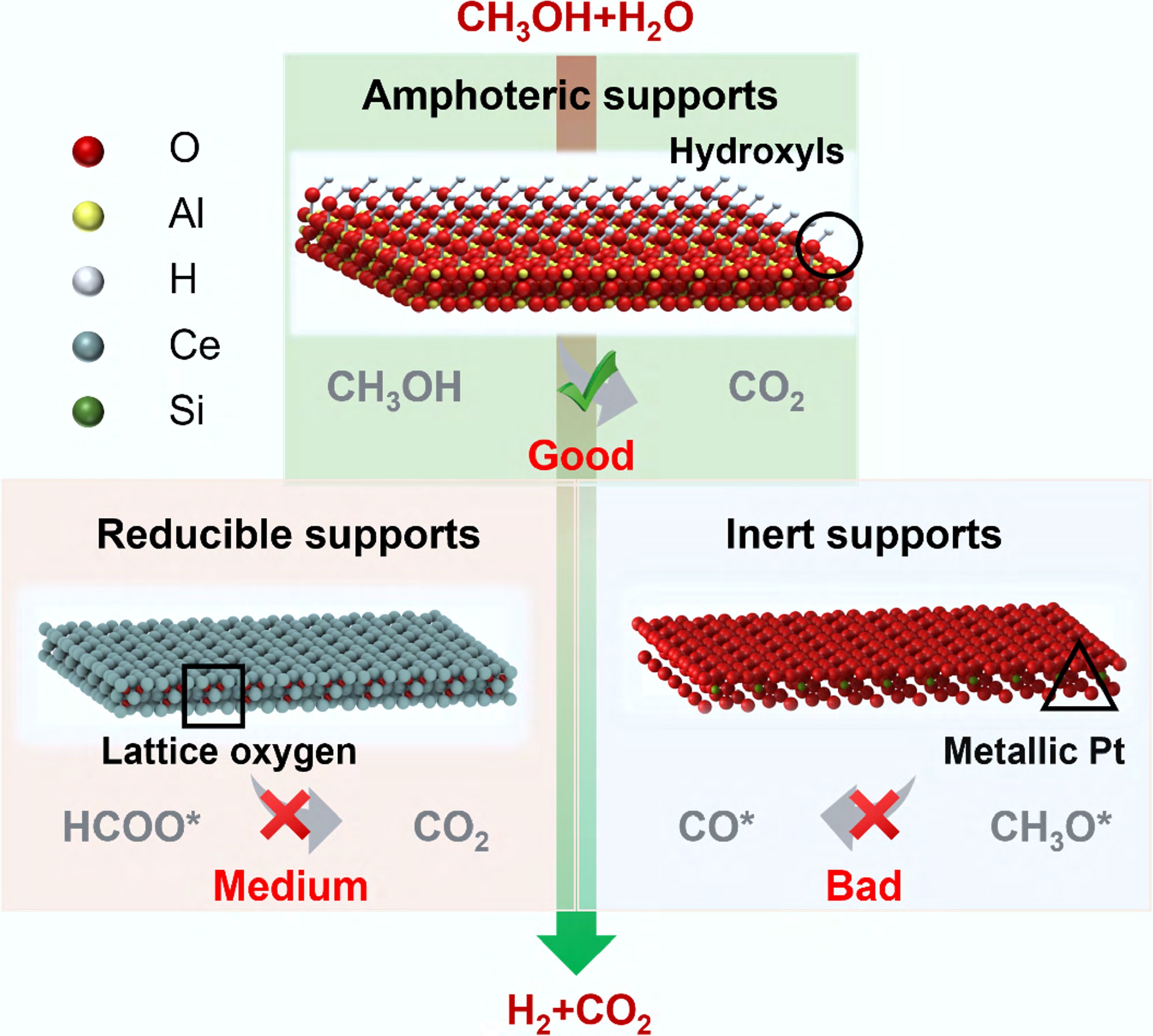
This study elucidates how surface oxygen species, including hydroxyls, lattice oxygen, and inert oxygen species, govern the catalytic performance of APRM. We find that inert oxygen species induce a weak metal-support interaction, and thus the ability of Pt sites to activate methanol toward CO* and H2 is limited. By contrast, catalysts with surface hydroxyls and reactive oxygen species promote methanol decomposition on Pt sites via strong metal-support interaction and enhance H2 generation by supplying OH* sources for CO* conversion. Collectively, these findings demonstrate that surface oxygen species dictate catalytic performance and provide mechanistic guidance for the rational design of oxide-supported catalysts for APRM.
-
A series of Pt-based catalysts supported on various oxides (Pt/Al2O3, Pt/ZrO2, Pt/CeO2, Pt/TiO2, and Pt/SiO2) was synthesized via the wet impregnation method. The Pt precursor was H2PtCl6∙6H2O (8 wt% in water), purchased from Shanghai Macklin Biochemical Co., Ltd. The information on the five supports used is as follows: Al2O3 (A766523, Shanghai Macklin Biochemical Co., Ltd), SiO2 (S861577, Shanghai Macklin Biochemical Co., Ltd), ZrO2 (J2211262, Shanghai Aladdin Biochemical Technology Co., Ltd), CeO2 (C103981, Shanghai Aladdin Biochemical Technology Co., Ltd), and TiO2 (T818930, Shanghai Macklin Biochemical Co., Ltd). Before the impregnation, all oxide supports were calcined at 500 °C for 4 h in air.
For the impregnation process, 1 g of pretreated supports was added to a beaker containing 0.27 g H2PtCl6∙6H2O solution. Then, 50 mL of deionized water was added to the beaker to obtain a homogeneous suspension. The mixture was continuously stirred at 80 °C overnight until the water had evaporated completely. Finally, the resulting powder was calcined in a muffle or tube furnace at 500 °C for 4 h.
Catalytic performance test
-
Prior to evaluating catalytic performance, the Pt-based catalysts were reduced in a 10% H2/N2 flow at 500 °C for 2 h. After the pretreatment process, 0.1 g of the pre-reduced catalysts and 30 mL of a methanol-water mixture (methanol/water molar ratio of 1:3) were loaded into an autoclave reactor. The sealed autoclave was purged using N2 to remove the remaining air in the reactor, after which a certain amount of N2 was introduced as the internal standard. The reactor was subsequently heated from room temperature to the target temperatures (190, 210, 230, or 250 °C) over approximately 30 min, and then maintained at the set temperature for 30 min. After the reaction, the gaseous product (N2, H2, CO2, CO, and CH4) in the reactor was collected in a gasbag and analyzed by micro gas chromatography (Inficon, Micro GC) using a thermal conductivity detector (TCD). The amount of gas products, including H2, CO, CO2, and CH4, was quantified using the ratio of their peak areas to the internal standard gas (N2).
To evaluate the catalytic activity, we calculated the average H2 production rate (
$R_{\rm{H}_2} $ $S_{ \rm{CH_4}} $ $ {R}_{\rm{H_2}}=\dfrac{{n}_{\rm{H_2}}}{t \times {{m}}_{\text{Pt}}} $ (1) $ {S}_{\text{reforming}}=\dfrac{{n}_{\rm{CO_2}}}{{n}_{\text{methanol}}} \times 100{\text{%}} $ (2) $ {S}_{\text{CO}}=\dfrac{{n}_{\text{CO}}}{{n}_{\text{methanol}}} \times 100{\text{%}} $ (3) $ {S}_{\rm{CH_4}}=\dfrac{{n}_{\rm{CH_4}}}{{n}_{\text{methanol}}} \times 100{\text{%}} $ (4) In Eqs (1)–(4), mPt (g) is the amount of Pt loaded on the surface per gram of catalyst (Supplementary Table S1), t (s) is the constant temperature time of the reactor. In the formula for CO, CH4, and CO2 selectivity, nCO (μmol),
$n_{\rm{CH_4}} $ $n_{\rm{CO_2}} $ Catalyst characterization
-
The morphology of Pt/oxides was investigated by scanning electron microscopy (SEM) and transmission electron microscopy (TEM), using JEOL JEM-2100 Plus and JSM-7900F, respectively. The Pt loading of Pt/oxide catalysts was quantified using inductively coupled plasma–optical emission spectroscopy (ICP-OES, iCAP 7400). Surface areas and pore-size distribution of supports were measured by N2 isothermal adsorption-desorption (Micromeritics ASAP 2460) using the Brunauer-Emmett-Teller (BET) model. X-ray diffraction (XRD) patterns were collected using a Malvern Panalytical Empyrean diffractometer with Cu Kα radiation over a 2θ range of 10–90° at a step size of 0.0133°. X-ray photoelectron spectroscopy (XPS) was carried out on a Thermo Fisher Scientific ESCALAB 250Xi instrument. The H2 temperature- programmed reduction (H2-TPR), CO2 or NH3 temperature-programmed desorption (CO2-TPD, NH3-TPD) were conducted on Micromeritics AutoChem II 2920. For in-situ diffuse reflectance infrared Fourier transform spectroscopy (DRIFTS), measurements were carried out using a Thermo Fisher Nicolet IS50 instrument with a Mercury Cadmium Telluride (MCT) detector. The pretreated catalysts were loaded into the chamber and exposed to N2, followed by heating to 230 °C. Subsequently, the reactants (CH3OH/H2O = 1:3 or pure CH3OH or H2O) were introduced to the chamber by N2 bubbling for 30 min, followed by N2 purging for another 30 min. Background spectra were collected after the target temperature was reached under an N2 atmosphere, and then the spectra were collected every 5 min while the reactants were introduced.
-
The catalytic activities of various 1 wt% Pt-based catalysts were evaluated across a temperature range of 190–250 °C at different pressures in an autoclave reactor (Supplementary Fig. S1). Regardless of oxide supports, the H2 production rate increases with increasing temperature (Fig. 1a), which can be attributed to the endothermic nature of APRM[15]. Pt-based catalysts supported on different oxides exhibit markedly different activities. The highest activity is observed for amphoteric oxides (Al2O3 and ZrO2)[25,26], followed by reducible oxides (CeO2 and TiO2), and inert SiO2 displays the lowest activity. At 190 °C, the H2 production rate over Pt/Al2O3 is nearly fourfold higher than that over Pt/CeO2 and approximately 20 times higher than that over Pt/SiO2. The activity advantage remained pronounced at 250 °C: Pt/Al2O3 exhibited an H2 production rate of 846.9 μmol gPt–1 s–1, which is nearly 2.5 times higher than Pt/CeO2 (329.8 μmol gPt–1 s–1), and 20 times higher than Pt/SiO2 (41.4 μmol gPt–1 s–1) at 250 °C.
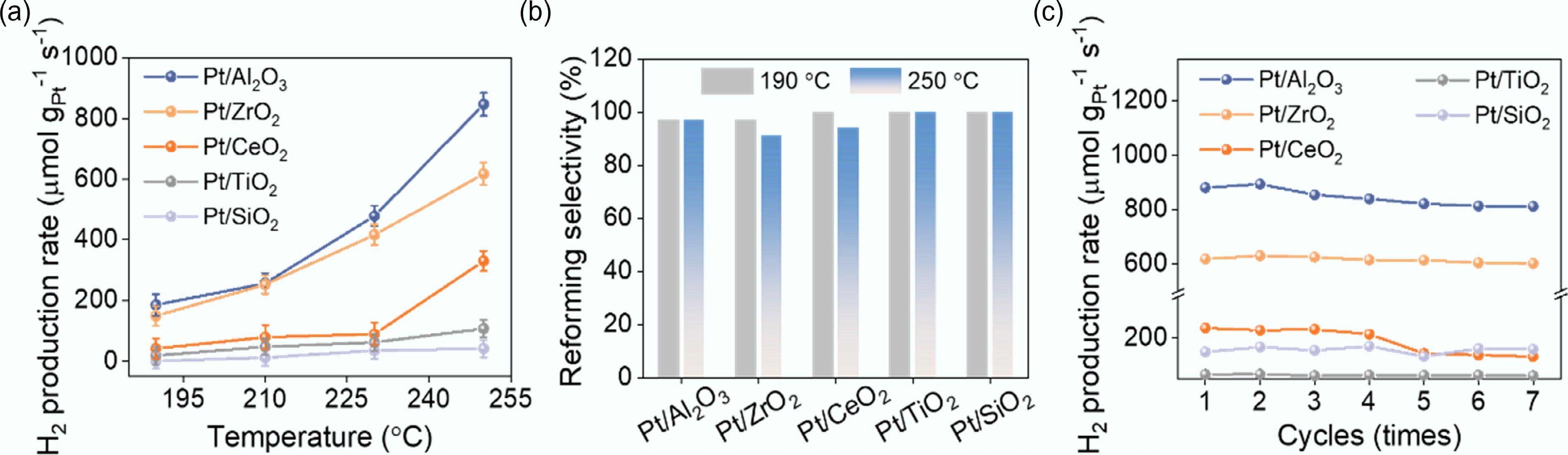
Figure 1.
Catalytic performance of 1 wt% Pt/oxide catalysts. (a) H2 production rates as a function of temperature. (b) Reforming selectivity at 190 and 250 °C. (c) Stability test over seven cycles at 250 °C. Reaction conditions: 30 mL methanol-water mixture (n[CH3OH] : n[H2O] = 1:3), 100 mg catalyst loading, 30 min, 0.5 MPa.
The reforming selectivity of Pt/oxide catalysts was evaluated at various temperatures, which shows that except for Pt/ZrO2, all catalysts exhibit reforming selectivity of around 95% even at 230 °C (Fig. 1b). Regarding hydrocarbon byproducts, trace amounts of CH4 can be detected over most Pt/oxide catalysts, while no detectable CH4 is observed over Pt/TiO2 and Pt/SiO2 (Supplementary Figs S2–S6). We propose that the formation of CH4 occurs under high pressure and H2-rich atmosphere via CO2 or CO methanation (CO2 + 4H2 → CH4 + 2H2O, CO + 3H2 → CH4 + H2O)[27]. CO byproducts can poison separation membranes and deactivate PEMFCs[28], making their suppression critically important. Pt/SiO2 exhibits the lowest CO selectivity, remaining below the detection range of GC from 190 to 250 °C, owing to its limited activity in methanol decomposition (Supplementary Fig. S7). However, as the H2 production rate increases, the CO selectivity of Pt/Al2O3, Pt/CeO2, Pt/TiO2, and Pt/ZrO2 reaches 0.6%, 1.9%, 0.7%, and 4.1%, respectively, at 250 °C. This variation is governed by the two-step mechanism of APRM, which includes methanol decomposition (MD, CH3OH → CO + 2H2) and water-gas shift (WGS, CO + H2O → CO2 + H2)[21,29]. Higher H2 production rates typically arise from the concurrent enhancement of MD and the WGS reaction, but an overly accelerated MD pathway may result in elevated CO selectivity[30]. The higher CO selectivity observed over Pt/ZrO2 originates from a mismatch between the rates of MD and WGS reaction.
Cycling tests were performed to assess the stability of the Pt/oxide catalysts (Fig. 1c). The result shows that most catalysts remain stable over seven cycles with minimal activity loss. Among the tested catalysts, Pt/ZrO2 shows the highest stability, followed by Pt/SiO2 and Pt/TiO2, with only minor activity losses of 2.7%, 6.8%, and 7.3%, respectively. The activity of Pt/CeO2 decreases sharply after four cycles, from 212.5 to 130.5 μmol gPt–1 s–1, owing to the buildup of the adsorbed intermediates[31]. The most active catalyst, Pt/Al2O3, shows a slight deactivation, with activity decreasing from 880.7 to 812.3 μmol gPt–1 s–1. This decline may be attributed to hydroxylation of the oxide support under reaction conditions, possibly leading to aggregation of Pt species[32,33].
Characterization of Pt/oxide catalysts
-
The different oxide supports all show a spherical morphology, as observed in the SEM images (Supplementary Figs S8–S12) with varying particle sizes. SiO2 and ZrO2 particles show the largest particle size (~20 nm), while Al2O3, TiO2, and CeO2 are significantly smaller (nearly 10 nm). Importantly, after Pt loading, the morphology and particle size of the supports remain largely unchanged (Fig. 2a–e). TEM images further confirm the packed spherical structures of the supports, with Pt nanoparticles uniformly distributed on their surfaces. Statistical analysis reveals that the Pt particles have a narrow size distribution (1.9–3.4 nm) with no evident aggregation. The average Pt particle size increases in the order: Pt/ZrO2, Pt/CeO2, Pt/TiO2, Pt/Al2O3, and Pt/SiO2 (Fig. 2f, Supplementary Figs S13–S17). Notably, Pt/Al2O3 shows the highest activity despite having the second-largest Pt particle size, while Pt/ZrO2 and Pt/CeO2 with smaller Pt particles exhibit lower activity. No clear correlation is observed between Pt particle size and catalytic activity, suggesting that the dispersion of exposed active sites is not the sole determining factor in catalytic performance.
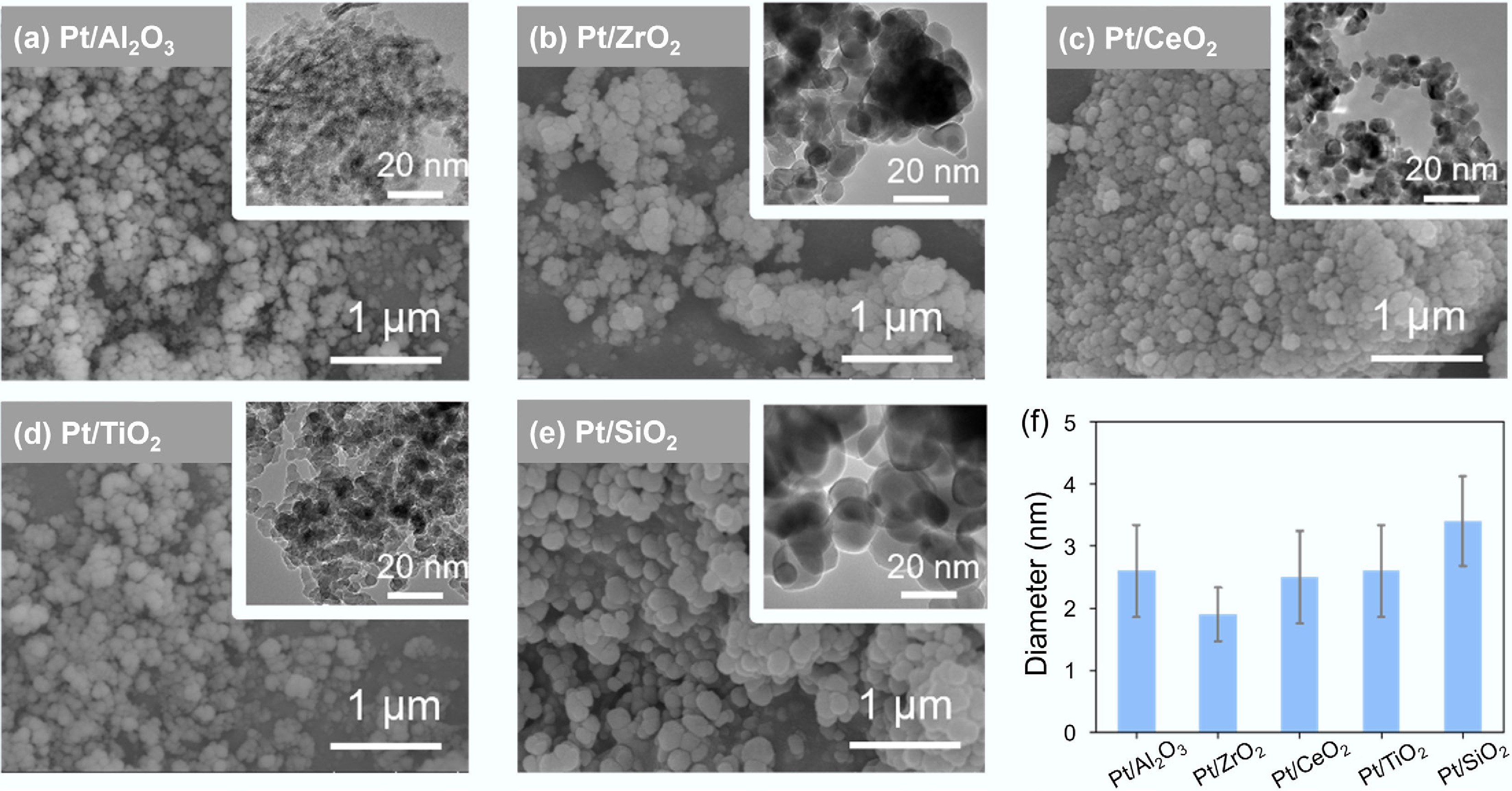
Figure 2.
The morphology characterization of catalysts. (a) Pt/Al2O3, (b) Pt/ZrO2, (c) Pt/CeO2, (d) Pt/TiO2, (e) Pt/SiO2, and (f) Pt particle size distribution.
Multiple characterizations were employed to investigate the physicochemical properties of catalysts, including XRD (Supplementary Fig. S18) and BET (Supplementary Fig. S19, Supplementary Table S2), EPR, XPS, etc. Electron paramagnetic resonance (EPR) spectroscopy was performed to probe unpaired electrons associated with oxygen vacancies. No distinct EPR signal was observed for Pt/Al2O3 and Pt/SiO2, suggesting a negligible concentration of oxygen vacancies (Fig. 3a). In contrast, distinct EPR signals were observed for other Pt/oxide catalysts, indicating the existence of oxygen vacancies. Pt/CeO2 showed the strongest EPR signal, followed by Pt/ZrO2, Pt/TiO2, suggesting a high concentration of oxygen vacancies and active lattice oxygen on Pt/CeO2, and a similar density of oxygen vacancies on Pt/ZrO2, Pt/TiO2.
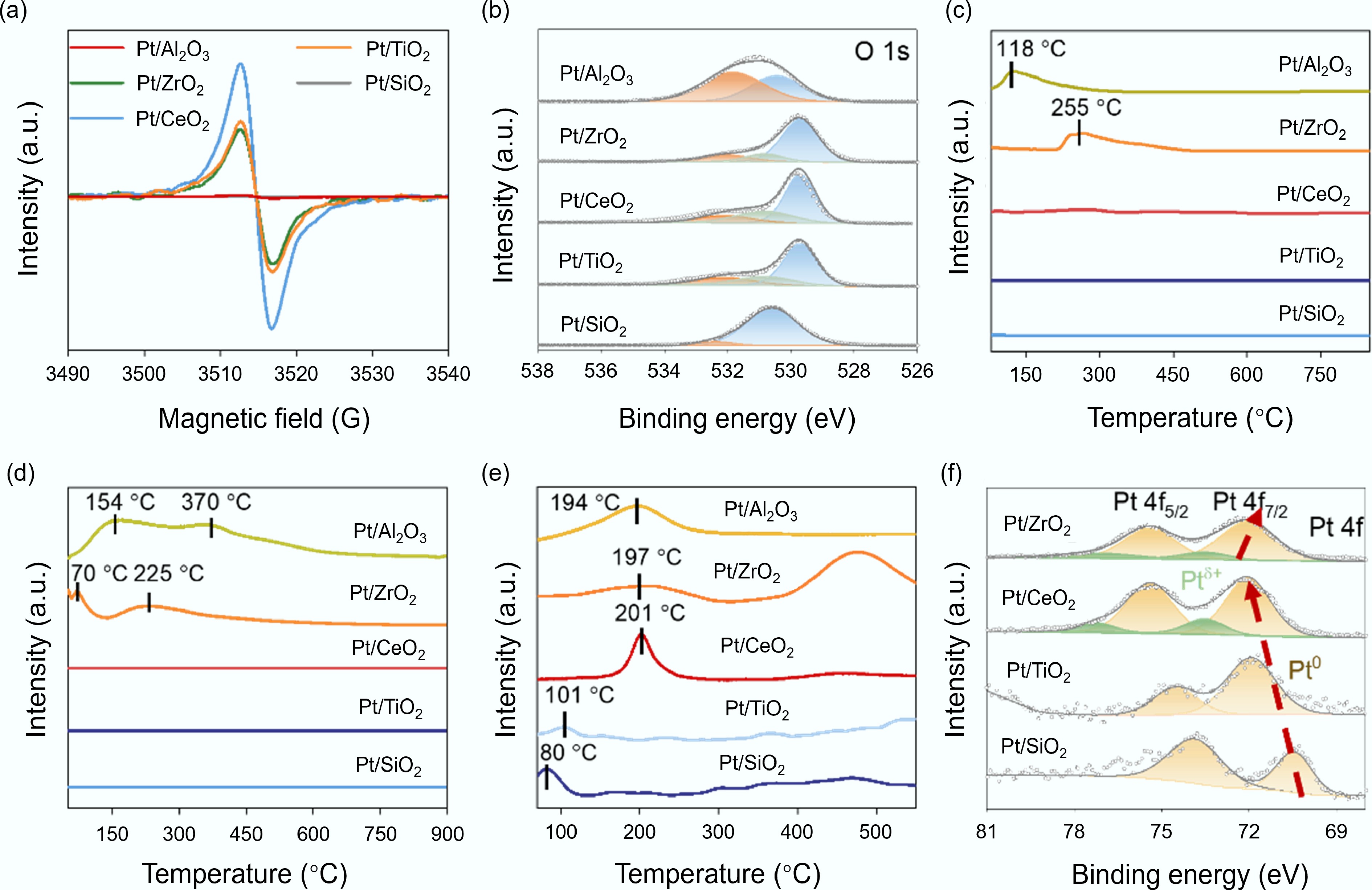
Figure 3.
The structural characterization of Pt/oxide catalysts. (a) EPR spectra, (b) O 1s XPS, (c) NH3-TPD, (d) CO2-TPD, (e) H2-TPR, and (f) Pt 4f XPS.
The O 1s XPS spectra reveal differences in oxygen species among the Pt/oxide catalysts (Fig. 3b). The low binding energy peaks at 529.7–530.8 eV are assigned to lattice oxygen, while the component at 530.8 eV is associated with oxygen vacancies, and the peak at 532.1 eV is attributed to hydroxyl groups[34]. Notably, all catalysts exhibit a lattice oxygen component, while O 1s peaks of Pt/Al2O3 and Pt/SiO2 shift to higher binding energy, suggesting a modification in the local chemical environment of surface oxygen species. Hydroxyls are observed on all catalysts, with the Pt/Al2O3 catalyst showing the highest abundance (48.7%), followed by Pt/ZrO2 (15.6%) (Supplementary Table S3). Oxygen vacancy-related species are detected on Pt/CeO2, Pt/TiO2, and Pt/ZrO2, with abundances decreasing in the order Pt/CeO2 > Pt/TiO2 > Pt/ZrO2, consistent with EPR results. Oxygen vacancies, which can serve as active sites for water dissociation, likely contribute to the improved catalytic activity.
The chemisorption techniques, such as NH3-TPD, CO2-TPD, and H2-TPR experiments, are efficient methods for probing the acid, basic, or reactive properties of catalysts. In the NH3-TPD profiles (Fig. 3c), obvious desorption peaks appear for Pt/Al2O3 and Pt/ZrO2, while no significant signals are detected for the other catalysts. The peak at 118 °C for Pt/Al2O3 corresponds to weak acidic sites, whereas the peak at approximately 255 °C for Pt/ZrO2 suggests the existence of medium acidic sites[35]. These acidic sites originate from unsaturated surface Al3+ and Zr4+ species (Lewis acid sites) and surface hydroxyls (Brønsted acid sites). By comparison, the absence of discernible peaks for the other catalysts suggests negligible acidity. Lewis acid sites have been widely associated with enhanced Pt dispersion and redox behavior[32,36], whereas Brønsted acid sites are known to facilitate the water adsorption in APRM.
The CO2-TPD profiles indicate that both Pt/Al2O3 and Pt/ZrO2 possess a measurable density of basic sites, while the other catalysts show negligible surface basicity (Fig. 3d). The CO2 desorption peaks for Pt/Al2O3 at 154 and 370 °C are assigned to weak and medium basic sites, respectively[37]. In comparison, Pt/ZrO2 exhibits weaker basicity, with desorption peaks at approximately 70 and 225 °C. It is worth noting that basic sites generally serve as active sites for the WGS reaction by stabilizing OH* intermediates derived from H2O dissociation[38]. Accordingly, Pt/Al2O3 is expected to exhibit a higher WGS capability, which may account for its relatively low CO selectivity.
The redox characteristics of catalysts, which significantly affect the catalytic performance in APRM, were investigated by H2-TPR and XPS. In the TPR graph, the H2 consumption peak below 150 °C corresponds to Pt species with weak metal-support interaction. The peak around 200 °C is typically attributed to the reduction of interfacial oxygen species interacting with Pt particles, indicating stronger metal-support interactions[39]. Pt/SiO2 and Pt/TiO2 feature the lowest reduction temperature at 80 and 101 °C, proving the existence of weak metal-support interaction (Fig. 3e). This behavior can be ascribed to the chemically inert nature of SiO2 and the limited redox participation of TiO2 under mild reduction conditions, which result in minimal electronic coupling between Pt and the supports. The H2 consumption peaks of Pt/CeO2, Pt/ZrO2, and Pt/Al2O3 are higher at 201, 197, and 194 °C, owing to the stronger metal-support interaction originating from unsaturated sites. In the case of CeO2 support, the strong metal-support interaction arises from the oxygen vacancies, whereas in ZrO2 and Al2O3, it is primarily associated with coordinatively unsaturated cationic sites[36].
The high-resolution Pt 4f XPS spectrum exhibits two peaks corresponding to the Pt 4f7/2 and Pt 4f5/2 orbitals (Fig. 3f). For Pt/Al2O3, the most intense Pt 4f photoemission signal cannot be clearly resolved due to overlap with the strong Al 2p peak[40,41]. Among the other four catalysts, the Pt/SiO2 shows the lowest binding energy, followed by Pt/TiO2, indicating a more electron-rich state of Pt species on these supports. The Pt 4f7/2 spectra of Pt/TiO2 and Pt/SiO2 can be deconvoluted into one component at approximately 71.1 and 70.3 eV, which are assigned to metallic Pt0 species (Supplementary Table S4). In contrast, the Pt 4f peaks of Pt/ZrO2 and Pt/CeO2 shift to higher binding energies, as evidenced by the deconvolution of the Pt 4f7/2 signal into components attributable to Pt0 and Ptᵟ+ at approximately 72.8 and 73.6 eV, respectively. This positive binding energy shift suggests electron transfer from Pt nanoparticles to the oxide supports, thereby strengthening the metal-support interaction, consistent with H2-TPR results. The Pt particles have been regarded as active species for methanol decomposition, especially when strong metal-support interactions are present.
Role of oxygen species on APRM
-
In-situ DRIFTS was employed to monitor the evolution of reaction intermediates and identify the nature of active sites during APRM. The samples pretreated under H2 atmosphere were first exposed to a mixture of CH3OH and H2O vapor at 250 °C for 30 min. As shown in Fig. 4a, two bands at around 2,959 and 2,841 cm–1 are detected, which are ascribed to chemisorbed CH3OH and H2O at Pt sites, respectively[42,43]. With continued exposure, the signals of intermediates, including methoxy (CH3O*) at 1,586, 1,033 cm–1, CO* at 2,082 cm–1, and formate (HCOO*) at 1,395 cm–1 become more intense[44]. Finally, the peaks corresponding to gaseous final product (CO2, at 2,362 cm–1) are observed (Fig. 4a). This phenomenon suggests that APRM on Pt/Al2O3 proceeded via a pathway involving methanol decomposition to CH3O* species (first step), followed by the formation of CO* (second step), and the final conversion of CO* to CO2 and H2 through WGS (last step)[24]. After purging with N2, the signals corresponding to various intermediates became weaker, indicating their weak adsorption on the catalyst surface. Similar intermediates were detected for the other catalysts, particularly Pt/ZrO2, suggesting analogous reaction routes (Fig. 4b). For Pt/CeO2, abundant CH3O* and HCOO* intermediates can be observed, and these peaks persist even after N2 purging, indicating strong adsorption of these intermediates on the catalyst surface (Fig. 4c). This strong adsorption behavior may hinder the subsequent conversion of intermediates, thereby limiting the H2 production. On the surface of Pt/TiO2 and Pt/SiO2, only adsorption features corresponding to CH3O* signals are observed, whereas no CO* and HCOO* species are detected (Fig. 4d, e). This behavior arises from the weak interaction between the Pt sites and the inert oxygen species, which limits the activity of MD, particularly the further decomposition of CH3O*.
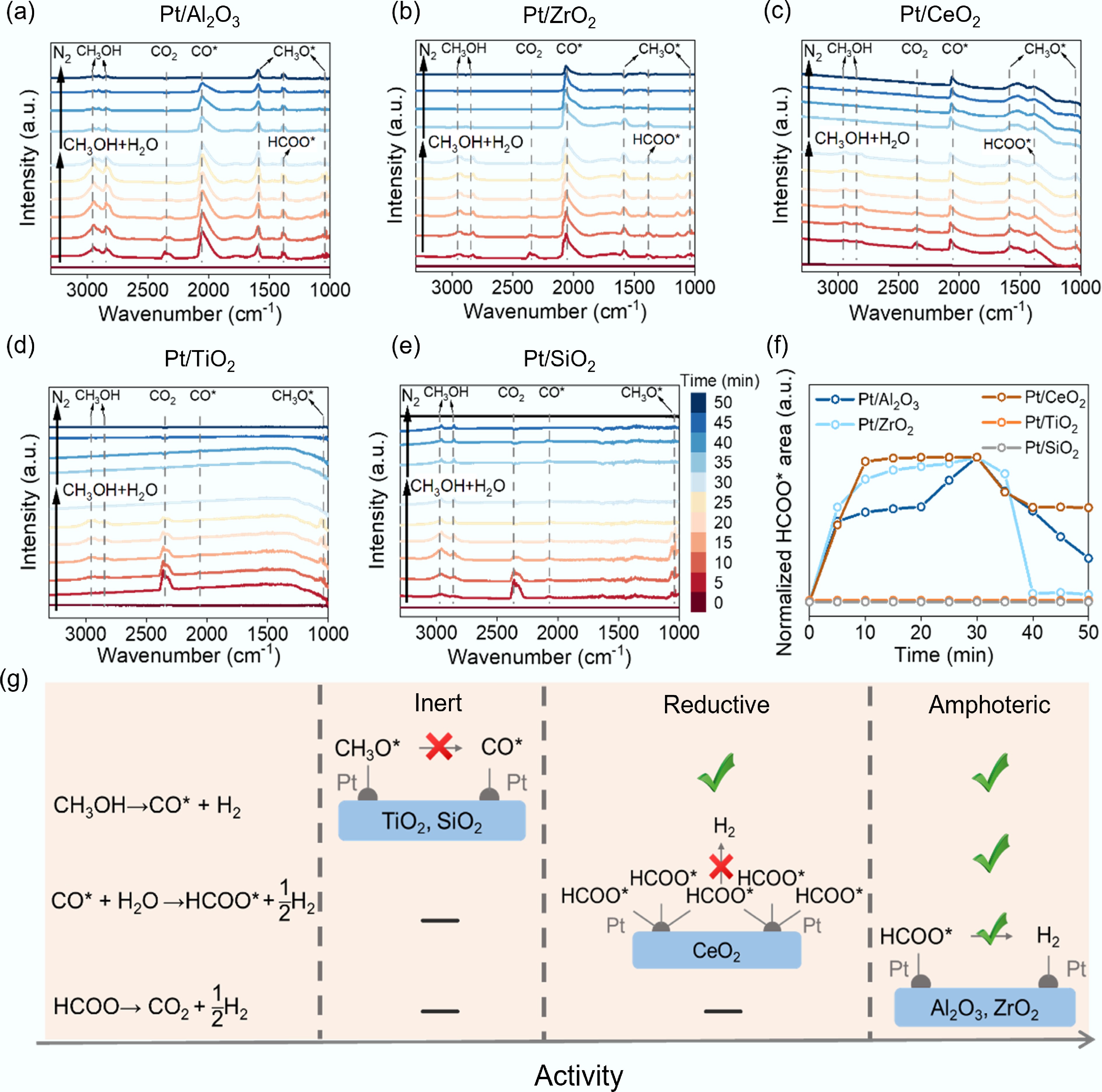
Figure 4.
The catalytic mechanism of Pt/oxide catalysts. The in-situ DRIFTS of APRM over (a) Pt/Al2O3, (b) Pt/ZrO2, (c) Pt/CeO2, (d) Pt/TiO2, and (e) Pt/SiO2 under CH3OH/H2O (1:3) at 230 °C. (f) The normalized integrated peak area of surface HCOO* (1,395 cm–1). (g) Schematic illustration of the APRM reaction pathways over Pt/oxide catalysts.
We also integrated the HCOO* bands to enable a semi-quantitative comparison of both the formation behavior and the relative abundance of HCOO* species over the different catalysts (Fig. 4f). Notably, the peak areas of Pt/TiO2 and Pt/SiO2 are barely detectable, indicating that the HCOO* species cannot be formed on their surfaces. In contrast, the normalized HCOO* areas on Pt/Al2O3 and Pt/ZrO2 gradually increase upon methanol introduction, but decrease during N2 purging, with a small amount of HCOO* remaining on their surfaces. This suggests that HCOO* species are weakly adsorbed on the catalyst surface and are prone to participate in subsequent WGS reactions[43]. On Pt/CeO2, a large amount of HCOO* signal appears and remains even after N2 purging. This persistence indicates the formation of strongly adsorbed HCOO* species, which likely block active sites and consequently inhibit the catalytic performance of Pt/CeO2.
We systematically summarized the mechanism of Pt-based catalysts supported on different types of oxides (Fig. 4g). On weakly reducible and inert oxide supports (TiO2 and SiO2), APRM is largely restricted by CO* generation steps (first step), owing to the restriction of MD by weak metal-support interaction induced by inert oxygen species. Over strongly reducible oxides with active oxygen species (e.g., CeO2), the strongly adsorbed HCOO* intermediates hinder the H2 production step in WGS (second step), thereby limiting the overall reforming activity. On amphoteric oxides with hydroxyls like Al2O3 and ZrO2, methanol reforming proceeds readily via the MD and WGS pathway (third step), resulting in a relatively high H2 production rate.
We also carried out the in-situ DRIFTS by introducing CH3OH and H2O in sequence to probe the role of the catalysts in promoting methanol and water dissociation. On Pt/SiO2 and Pt/TiO2, only the limited MD reaction can happen, due to the obvious CH3O* intermediates at 1,586, 1,033 cm–1 and nearly undetectable CO* (2,082 cm–1) in the DRIFTS graph (Fig. 5a, Supplementary Fig. S20). After introducing H2O, the CH3O* species are converted into final products (CO2 and H2) via WGS[30]. We proposed that poor catalytic performance originated from the weak metal-support interaction between Pt and inert oxygen species on inert and weakly reducible oxide-based catalysts. Although they may possess water activation ability, their rate-limiting step is MD to H2 and CO* (Fig. 5b).
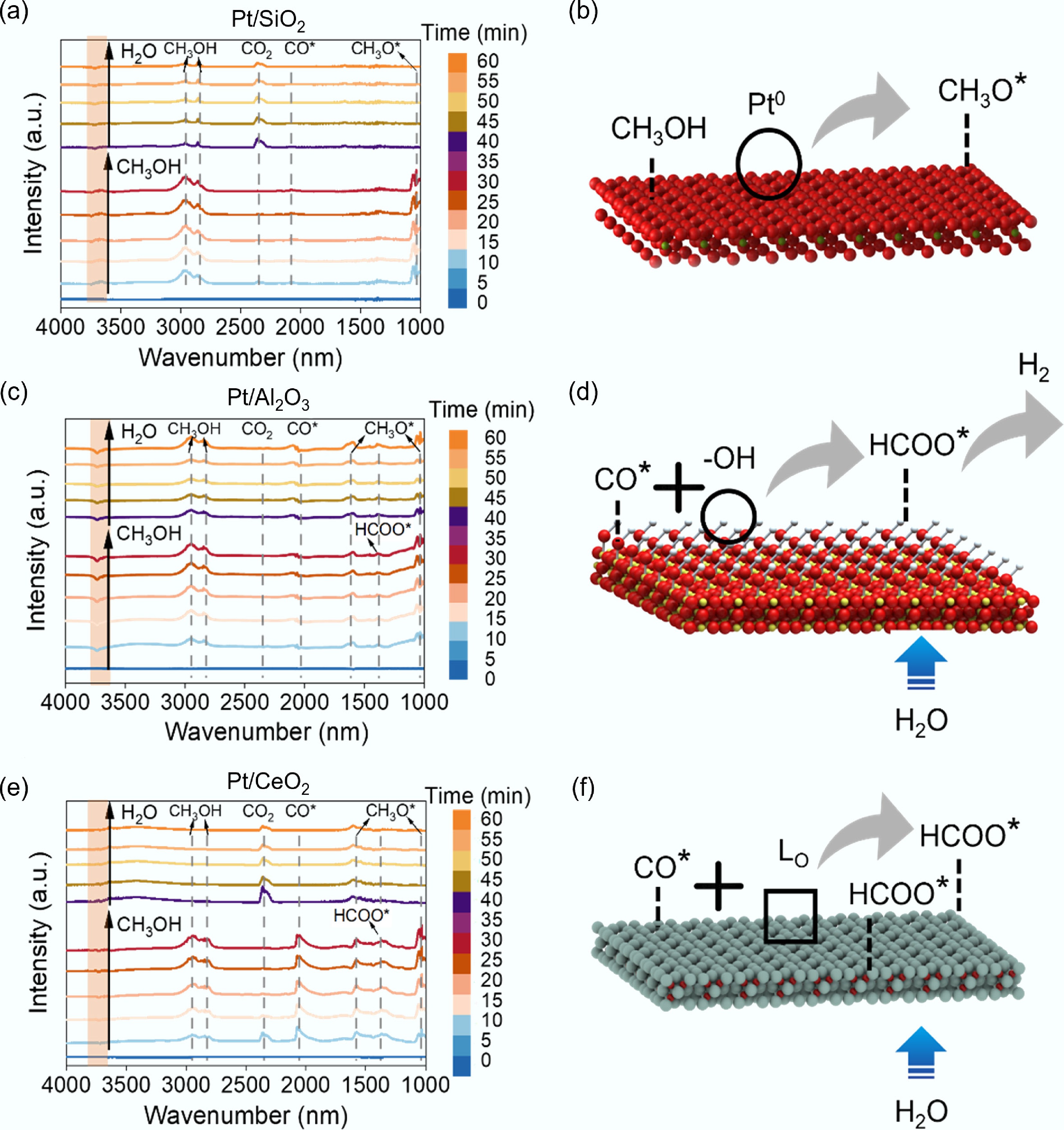
Figure 5.
Effects of surface oxygen species on APRM over Pt/oxide catalysts. (a) In-situ DRIFTS over Pt/SiO2 catalyst upon the separate introduction of methanol and water. (b) Schematic illustration of the role of inert oxygen species on Pt/SiO2 in methoxy formation. (c) In-situ DRIFTS over the Pt/Al2O3 catalyst upon separate introduction of methanol and water. (d) Schematic illustration of the role of hydroxyls on Pt/Al2O3 in formate formation. (e) In-situ DRIFTS over Pt/CeO2 catalyst upon separate introduction of methanol and water. (f) Schematic illustration of the role of reactive lattice oxygen on Pt/CeO2 in formate formation.
On Pt/Al2O3 and Pt/ZrO2, the decomposition of CH3OH over Pt/Al2O3 occurred, producing abundant intermediates including CH3O* and CO* (Fig. 5c, Supplementary Fig. S21). It is worth noting that the HCOO* species (requiring an additional oxygen source) formed on Pt/Al2O3 via the consumption of surface hydroxyls, as evidenced by the decrease of the surface hydroxyls at ~3,700 cm–1[38,45]. After introducing H2O, the intensity of OH groups improved, and the previously formed CO* species rapidly disappeared, which can be attributed to the rapid H2O activation and the occurrence of WGS. Therefore, we proposed that both CH3OH and H2O activation proceed rapidly on Pt/Al2O3. MD occurred efficiently on Pt sites, while surface OH acted as OH* intermediates to facilitate the conversion of CO*, thereby accelerating the H2 production rate (Fig. 5d). Meanwhile, these surface OH can be continuously replenished through water dissociation, sustaining the reaction cycle. We also carried out the in-situ DRIFTS over Pt/nanorod Al2O3 and Pt/nanosheet Al2O3 to explore the applicability. Pt/Al2O3 with various morphologies proceeds via a hydroxyl-mediated route, as proved by the decrease of the ~3,700 cm–1 band assigned to hydroxyls (Supplementary Figs S22 and S23). These results indicate that morphology is not the dominant factor and that surface oxygen species play a more critical role.
As for Pt/CeO2, the decomposition of CH3OH proceeded effectively, as evidenced by the appearance of CH3O* and CO* (Fig. 5e). Subsequently, HCOO* species, which typically require an additional oxygen source, were formed without noticeable changes in the intermediate signals. Compared with Pt/Al2O3, HCOO* intermediates were not formed via consumption of surface hydroxyls, but are instead associated with reactive lattice oxygen. We propose that HCOO* formation on Pt/CeO2 proceeds via a redox pathway involving the consumption of lattice oxygen[46,47]. The introduction of H2O led to the consumption of CO* intermediates and the formation of gaseous CO2, indicating Pt/CeO2 possessed a strong capability for WGS. However, CH3O* and HCOO* intermediates still can be observed on Pt/CeO2. This indicates that these species are strongly adsorbed on the catalyst surface, hindering the production of H2. Therefore, we propose that Pt particle sites serve as active sites for MD, while the active lattice oxygen species provide OH* for CO* conversion (Fig. 5f). However, the adsorption strength of the key intermediate of WGS (HCOO*) is so strong that it limits the H2 generation. This phenomenon is also observed on other CeO2-based catalysts like Pt/nanorod CeO2, where strongly adsorbed HCOO* intermediates form via consumption of lattice oxygen (Supplementary Fig. S24). It can be evidenced by the high intensity signal of HCOO* at 1,395 cm–1 and the negligible change in the 3,700 cm–1 band.
-
In this study, we reveal that oxygen species, including hydroxyls, active lattice oxygen, and inert oxygen species, govern the catalytic performance of APRM by modulating methanol activation and the evolution pathways of HCOO*. Amphoteric oxides with hydroxyls outperform other catalysts owing to the oxygen supply effects of exposed surface hydroxyls. In contrast, inert and overly reactive oxygen species lead to limited activity due to weak metal-support interactions or over-stabilization of HCOO* intermediates. These findings establish surface oxygen species as a key descriptor for APRM catalytic performance and provide mechanistic guidance for the rational design of oxide-supported catalysts. The key novelty of this work is the mechanistic classification and specific roles of oxygen species in APRM, rather than the identification of an isolated pathway for a single catalyst.
-
It accompanies this paper at: https://doi.org/10.48130/een-0026-0013.
-
Not applicable.
-
The authors confirm contribution to the paper as follows: Yuyao Yang, Xuan Bie: study conception and design; Yuyao Yang: data collection; Yingbo Zhu, Xuelong Quan: analysis and interpretation of results; Bocheng Yu: data curation; Yuyao Yang: draft manuscript preparation; Qinghai Li: result validation; Yanguo Zhang: project administration; Hui Zhou: supervision. All authors reviewed the results and approved the final version of the manuscript.
-
The data that support the findings of this study are available from the corresponding author upon reasonable request.
-
The authors declare that they have no conflict of interest.
-
# Authors contributed equally: Yuyao Yang, Xuan Bie
Full list of author information is available at the end of the article. - The supplementary files can be downloaded from here.
- Copyright: © 2026 by the author(s). Published by Maximum Academic Press, Fayetteville, GA. This article is an open access article distributed under Creative Commons Attribution License (CC BY 4.0), visit https://creativecommons.org/licenses/by/4.0/.
-
About this article
Cite this article
Yang Y, Bie X, Zhu Y, Quan X, Yu B, et al. 2026. Surface oxygen species dictate reaction pathways in platinum-catalyzed aqueous phase reforming of methanol. Energy & Environment Nexus 2: e019 doi: 10.48130/een-0026-0013 

Surface oxygen species dictate reaction pathways in platinum-catalyzed aqueous phase reforming of methanol
- Received: 21 March 2026
- Revised: 08 May 2026
- Accepted: 08 June 2026
- Published online: 07 July 2026
Abstract: Aqueous phase reforming of methanol (APRM) enables direct hydrogen release from liquid methanol, offering a safe and efficient approach for hydrogen storage and supply. Pt-based catalysts supported on oxides have been shown to enhance catalytic activity, yet the mechanistic role of surface oxygen species remains poorly understood. Herein, we reveal that oxygen species, including hydroxyls, lattice oxygen, and inert oxygen species, govern the reaction pathways of APRM. Contrary to the common expectation that reactive oxygen species enhance catalytic performance, we uncover that reactive lattice oxygen species limit catalytic activity by over-stabilizing formate intermediates in the water-gas shift reaction (WGS). Instead, amphoteric oxides with hydroxyls (in particular Pt/Al2O3) outperform other catalysts, achieving a H2 production rate of 846.9 μmol gPt–1 s–1 and reforming selectivity of 97.3% at 250 °C. This is attributed to the exposed surface hydroxyls, which facilitate the WGS via supplying available OH* reactants and thereby enhance H2 generation. For inert and weakly reducible oxygen species, the weak metal-support interaction limits the ability of Pt sites to activate methanol toward CO* and H2 formation. These findings demonstrate that oxygen species dictate reaction pathways and provide mechanistic guidance for designing oxide-supported catalysts for APRM.