









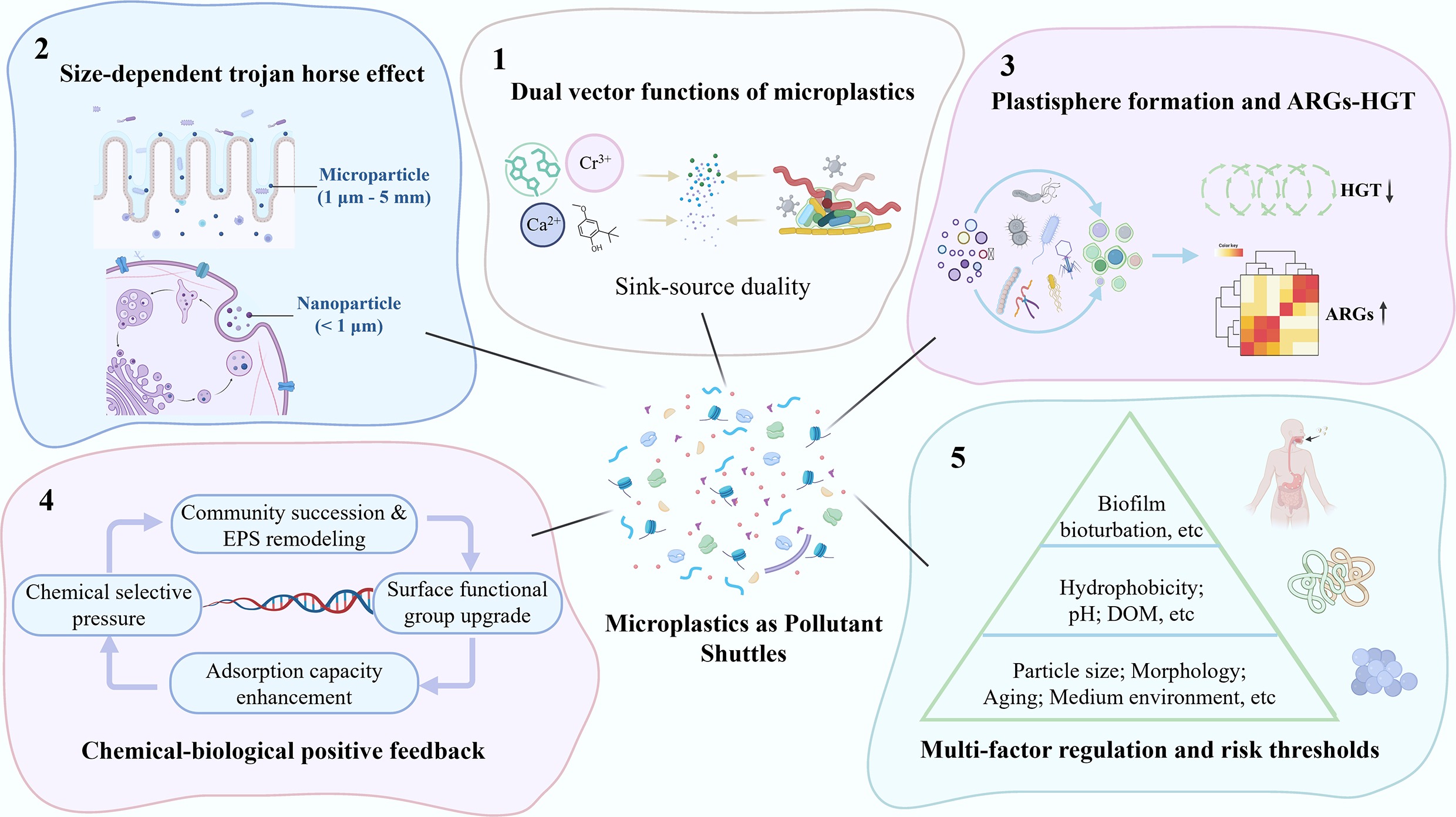


-
Plastics have deeply permeated all sectors of modern society, yet the linear 'use-and-dispose' economic model has escalated plastic pollution to one of the top three global environmental challenges[1]. Global plastic production reached approximately 430 million tons in 2024, with China accounting for 34.5%[2], and is projected to exceed 1.2 billion tons by 2060[3]. To date, humanity has generated over 7 billion tons of plastic waste, yet the global recycling rate remains below 10%[4]. This linear model not only drives severe microplastic pollution but also leaves the polymer carbon backbone's recovery potential untapped.
Over 98% of commodity plastics derive from fossil feedstocks, and their environmental weathering progressively generates microplastics (MPs, 1 μm–5 mm) and nanoplastics (NPs, < 1 μm)[5]. MPs primarily exert their vector effect through macroscopic pollutant accumulation and food chain transfer[6]. In contrast, NPs exhibit markedly enhanced adsorption capacity and can directly cross biological membranes via transmembrane transport, creating a qualitatively distinct exposure pathway[7,8]. This fragmentation process overcomes spatial dispersal limitations, facilitating long-distance transport and cross-compartment diffusion that underpin the global distribution of micro/nanoplastic pollution[5].
To systematically map the global distribution of micro- and nanoplastics (MNPs), we compiled a comprehensive residue dataset (2015–2025) in Table 1. Parallel to the oral exposure route, inhalation constitutes a critical yet underappreciated pathway for the MP-mediated Trojan horse effect. Atmospheric MNP concentrations in megacities can reach thousands of particles per cubic meter. Soil and sediment act as important MNP sinks, with detection rates consistently high across all studies. More critically, MPs have been directly detected in human biological matrices including blood and placental tissue[9]. Coarse MPs deposit predominantly in the upper airways and are cleared via the mucociliary escalator, which redirects them to the gastrointestinal tract—effectively converting inhalation into a secondary oral exposure[10]. A 2025 study confirmed that NPs cross the alveolar-capillary barrier via transcytosis and interstitial migration, delivering adsorbed pollutants directly into the systemic circulation while bypassing hepatic first-pass metabolism—a pathway that renders inhaled NPs pharmacokinetically distinct from orally ingested ones[11]. Moreover, MPs are not inert—they adsorb heavy metals, polycyclic aromatic hydrocarbons (PAHs), pathogens, and antibiotic resistance genes (ARGs), forming co-contamination systems that drive toxicity transfer and biomagnification along the food chain[12,13].
Municipal wastewater treatment plants act as critical junctures, returning MP-associated contaminants to receiving waters and agricultural soils; however, research on this combined pollution faces three interconnected bottlenecks. First, knowledge remains fragmented, with most investigations predominantly confined to single media or single pollutants (e.g., soil[14], river basins[15], and the Bohai Sea[16]), which impedes systematic understanding of cross-media transport. Second, ecotoxicity assessments are poorly calibrated to real-world conditions—laboratory single-species, high-dose tests poorly represent chronic, low-dose combined exposures. While combined toxicity with heavy metals, antibiotics, or persistent organic pollutants (POPs)[17−20] and impacts on low-trophic-level organisms[21−23] have been documented, molecular-level damage mechanisms remain largely unexplored[24]. Third, methodological inconsistencies hinder cross-study comparability[25,26], and in situ detection remains technically challenging. Most critically, the specific thresholds and environmental conditions under which microplastic vector effects become the dominant driver of ecological risks have yet to be clearly defined.
This review systematically synthesizes the mechanisms, ecological risks, and regulatory factors of microplastic vector effects, with a focus on dissecting the core processes and coupling interactions of microplastic-mediated transport of chemical and biological contaminants. We analyze the complex landscape of multi-factor regulation and identify the major risk types and governance challenges of combined pollution. The overarching objective is to advance the theoretical system of microplastic combined pollution research and provide a scientific foundation for mechanistic research, risk assessment, and global pollution governance.
Table 1. Distribution and residual concentration of microplastics in different environmental media and biological samples
MPs/NPs Sources Concentration Methods Ref. PE Adults/children 4.62 × 10⁵ particles/(kg × day) Micro-Fourier-Transform Infrared Spectroscopy [27] Polyester/acrylic Everest snow sample and Everest stream water sample 30 particles/L (average) and
1 particle/L (average)Micro-Fourier-Transform Infrared; Spectroscopy; Stereomicroscopic visual observation [28] PET/PS/PMMA Human blood 1.6 µg/L Double shot pyrolysis gas chromatography-mass spectrometry [29] PP Human placenta Microplastics were detected in
four out of six placentas, totaling
12 fragments (5–10 μm)Micro-Raman Spectroscopy [30] PE/PVC/PP/PS Shenyang atmosphere 7.62 μg/m³ Pyrolysis gas chromatography-mass spectrometry [31] PP/PE The Yangtze River 5.13 items/L in water column,
113.9 items/kg
(dry weight) in sedimentMicro-Raman Spectroscopy [15] PVC/PE/PS Industrial soil 0.03 wt%–6.7 wt% Fourier-Transform Infrared Spectroscopy [32] PE/PP/PS/PVC Groundwater in Australian agricultural areas 38 ± 8 pcs/L Laser Direct Infrared Spectroscopy [33] PE/PP/PS Chinese tap water 440 ± 275 particles/L Micro-Raman Spectroscopy Fluorescence microscopy coupled with Nile Red staining [34] PS/PE/PP/PMMA Retina 49.21 μg/g Pyrolysis gas chromatography-mass spectrometry; Laser Direct Infrared Spectroscopy [35] PET/PS Tianjin 102–103 ng/g dw in open-grown
leafy vegetablesLaser-ablation inductively coupled plasma mass spectrometry [36] Due to methodological differences, the data in this table should be interpreted qualitatively as evidence of the widespread presence of MNPs across global environmental media and should not be used for direct quantitative comparisons. -
Owing to their distinctive physicochemical and interfacial properties, MPs act as efficient carriers for chemical and biological pollutants. These two types of vector effects can function independently or interact synergistically, which substantially exacerbates combined pollution risks. As illustrated in Fig. 1, MPs originating from industrial, urban, mining, and agricultural activities form composite pollutant complexes. These complexes undergo abiotic migration, biological uptake, and in situ transformation across diverse environmental media, and MPs play a dual role as both contaminant sinks and sources throughout their entire environmental lifecycle.
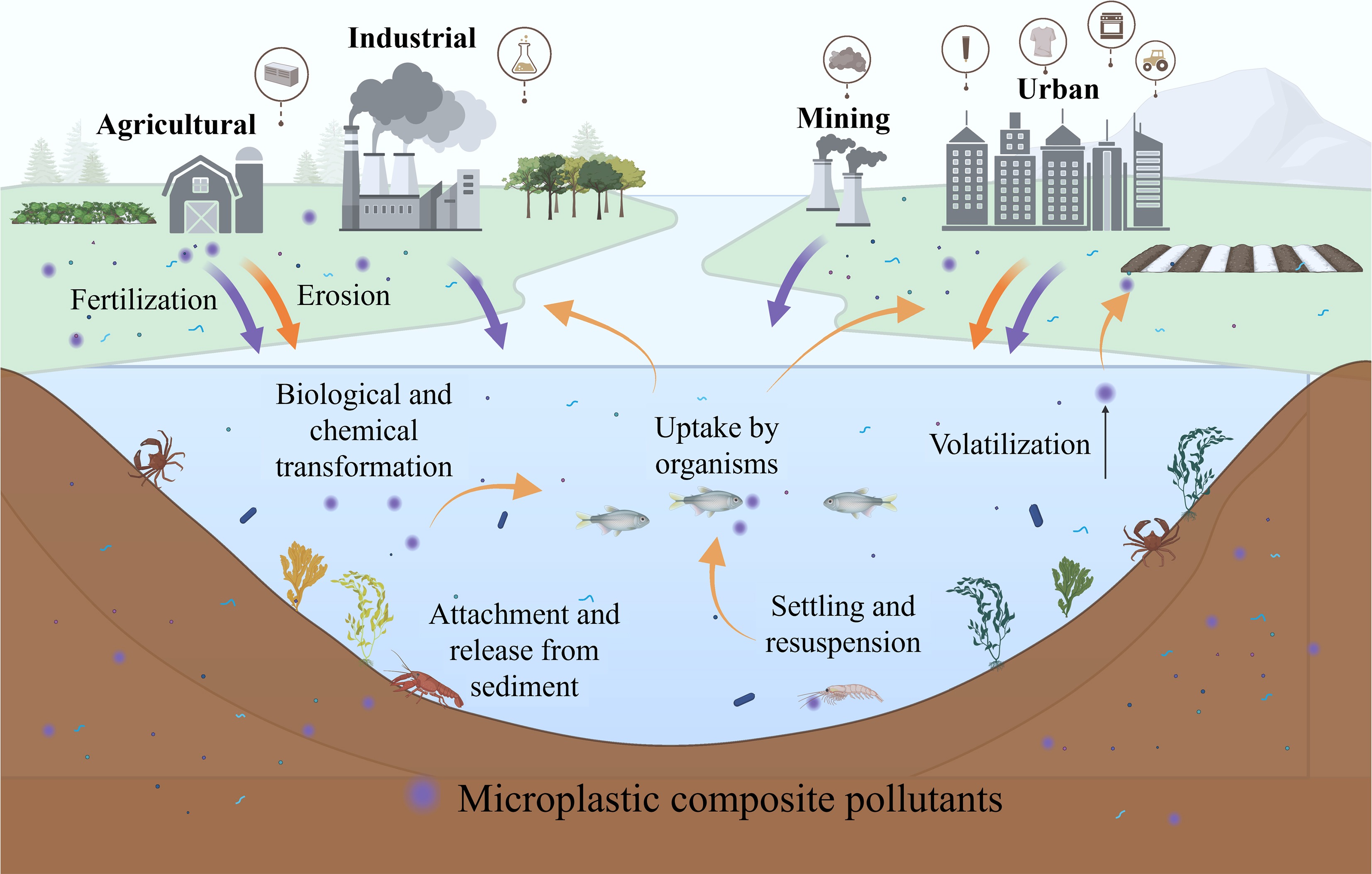
Figure 1.
Schematic illustration of the sources, cross-media migration and transformation, and ecological risks of microplastic composite pollutants in multi-media environments.
Microplastics as transport vectors for chemical pollutants
Typical chemical contaminants bound to MPs
-
Microplastics accumulate chemicals via two distinct pathways: exogenous adsorption of environmental pollutants and endogenous leaching of plastic additives[37]. For adsorbed pollutants (e.g., POPs, heavy metals), concentration gradients drive bidirectional exchange, allowing MPs to function alternately as contaminant sinks and sources[38]. Simulated gastrointestinal environments confirm enhanced POP desorption from MP surfaces[39], underscoring their 'Trojan horse' role. Unlike adsorbed pollutants, plastic additives (e.g., PAEs, BPA) are embedded during manufacturing and escape via Fickian diffusion, with > 65% of more polar congeners becoming orally bioaccessible in gut fluids[40]. Crucially, the same particle can simultaneously deliver both adsorbed and leached chemicals, creating complex co-exposure scenarios. However, most studies remain limited to single-contaminant, ultrapure-water designs, precluding reliable prediction of source-sink transitions under realistic multi-pollutant conditions.
The Trojan horse effect of microplastics
-
MPs induce direct toxicity across multiple trophic levels through physical damage and oxidative stress, including reduced feeding rates in sandworms[41], hepatic oxidative damage and lipid metabolism disorders in zebrafish[42], intestinal microbiota disturbances[43] in aquatic organisms[44], and immune and reproductive developmental toxicity in mammals[45]. However, a far more insidious hazard lies in the Trojan horse effect, whereby MPs adsorb and deliver toxic chemicals into organisms, fundamentally shifting the risk paradigm from physical harm to chemically mediated combined pollution[43].
Teuten et al.[46] established the classical three-stage mechanism: external contamination → ingestion → intestinal release. This vector effect becomes ecologically relevant when MP-borne pollutants account for ≥ 10% of total dietary exposure[47], and can escalate into systemic ecological risks via biomagnification along food webs[48,49]. Critically, their environmental relevance is highly context-dependent. In POPs-contaminated environments, MPs contribute minimally to pollutant uptake, as contaminated water and food remain the dominant exposure routes[50]. In contrast, MPs serve as the primary vector for pollutant entry into pristine ecosystems such as the open ocean and polar regions[51].
This context-dependence is further complicated by particle size: the Trojan horse effect operates through fundamentally different mechanisms above and below the ~1 μm boundary. Whereas conventional MPs (1 μm–5 mm) deliver pollutants via gut-lumen release, NPs (< 1 μm) bypass the gut lumen entirely via transmembrane transport[7,52], creating a qualitatively different exposure front characterized by systemic organ distribution rather than localized gut epithelial exposure. Specifically, NPs cross the intestinal epithelium through endocytosis and paracellular transport, after which NP-pollutant complexes migrate via the portal circulation to the liver and subsequently to extrahepatic organs including the spleen and brain[53]. This means that pollutants adsorbed onto NPs are released intracellularly within target organs, rather than being diluted in the gut lumen—a distinction that fundamentally alters dose–response relationships and target-organ toxicity profiles.
The Trojan horse effect in terrestrial ecosystems remains understudied but has been experimentally validated. For example, polyethylene MPs in agricultural soils adsorb pesticides (imidacloprid, atrazine) that are subsequently transferred to earthworm guts via ingestion, inducing oxidative stress, intestinal damage, and immune responses[54].
Analysis of existing evidence reveals that fundamental differences between terrestrial and aquatic systems drive divergent vector efficiency: soil organic matter competes for adsorption sites and soil aggregates impede MP-pollutant complex migration, while the neutral-to-alkaline gut of soil organisms lacks bile salts—which drastically accelerate POP desorption in aquatic organisms[52]—thereby reducing pollutant bioavailability in terrestrial fauna.
Combined with existing evidence, we summarize the preconditions for chemical vector effects to dominate ecological risks: (1) the target pollutants are trace hydrophobic organics or low-water-solubility plastic additives; (2) the habitat is a pristine environment with low dissolved organic matter (DOM); (3) pollutant-carried micro/nanoplastics are aged particles with large specific surface areas; and (4) organisms are filter feeders with acidic digestive tracts rich in bile salts. Notably, the vector dilution effect may offset the pollutant enrichment capacity when microplastic concentrations exceed 100 particles/L.
Chemical contaminant risks at individual, population, and ecosystem levels
-
MP-associated chemical risks exhibit distinct multi-level cascading characteristics. At the individual level, MPs induce oxidative stress leading to lipid peroxidation, DNA damage[55], apoptosis[56], and endocrine-disrupted reproductive abnormalities[57]. Toxicity is highly species-specific: mercury-loaded MPs increased mercury bioaccumulation by 2.5-fold in tiger copepods but reduced bioavailability in other zooplankton taxa[58], underscoring the necessity of incorporating species sensitivity into risk assessments.
At the population level, MPs and their absorbed contaminants undergo trophic transfer and biomagnification, translating individual toxicity into altered population dynamics. In aquatic ecosystems, contaminants progressively concentrate in higher trophic levels[24]; in terrestrial ecosystems, MPs transfer among soil biota and plants, eliciting toxic responses[59]. Long-term combined exposure reduces reproductive rates, juvenile survival, and growth, leading to population decline or local extinction[60]. Loss of sensitive species simplifies community structure, whereas loss of keystone species triggers food web cascades, reducing biodiversity and ecosystem stability.
At the ecosystem level, MP pollution has shifted from macroscopic contamination to perturbation of biogeochemical cycles, altering ecosystem structure and function[61]. In food waste hydrothermal systems, melanoidins—typical Maillard products that commonly co-occur with MPs in sludge and food waste—can exacerbate MP-mediated disruption of carbon cycling and resource recovery[62]. Notably, biomagnification has been robustly validated in freshwater food chains but remains controversial in marine and terrestrial ecosystems, likely due to interspecific variation in egestion rates and feeding strategies—underscoring the need to integrate species sensitivity into risk assessment frameworks.
Microplastics as vectors of biological contaminants
Basic connotation
-
With unique physicochemical and interfacial traits, MPs serve as effective carriers for biological contaminants, enabling their cross-media and transboundary dispersal[63]. Notably, MPs function not merely as inert physical carriers, but as selective bio-interfaces that actively facilitate microbial colonization. Three major groups of biological substances attach to MPs: pathogenic bacteria such as Pseudomonas aeruginosa and Vibrio spp., ARGs, and non-pathogenic microbes alongside their toxic metabolites. While pathogens and ARGs raise concerns over disease transmission and horizontal gene transfer (HGT), the ecological impacts of harmful microbial metabolites remain poorly explored, and the underlying transmission mechanisms are still not fully clarified[64].
The formation of biofilms underpins MPs' capacity to carry biological contaminants. Owing to their long environmental lifespan and hydrophobic surfaces, non-degradable MPs readily attract microbes and develop mature biofilms over time[65]. The selective enrichment of microbes on MP surfaces—distinct from natural substrates under certain conditions[66]—underpins their capacity as biological vectors. This observation suggests that environmental nutritional status is a key factor shaping plastisphere characteristics. Additionally, biofilm-attached microbes migrate alongside MP sedimentation and water flow. Wastewater treatment plants continuously release MP-associated microbes into the environment, which can eventually enter food chains via crop uptake, greatly amplifying ecological risks[67]. It is important to note that the biofilm formation dynamics of NPs (< 1 μm) differ qualitatively from those of conventional MPs. Although NPs possess a higher specific surface area that enhances microbial colonization per unit mass, their sub-micrometer dimensions mean that individual particles are smaller than many bacterial cells. Consequently, NPs cannot support the archetypal three-dimensional biofilm structures that form on MP surfaces; instead, they are typically encapsulated by proteins and organic matter to form an eco-corona rather than a plastisphere[53]. Moreover, NPs may be internalized by microbial and host cells, creating an intracellular niche that shelters associated pathogens and ARGs from environmental stressors and immune clearance—a pathway unavailable to larger MPs.
Main transmission pathways
-
MP-borne biological contaminants spread via four primary routes, of which food chain transfer acts as the dominant pathway. When filter-feeding organisms ingest biofilm-covered MPs, gastrointestinal fluids release bacteria and ARGs into host tissues[68]. These contaminants propagate along trophic levels[69]. Moreover, polymer types strongly influence microbial communities on MP surfaces: polyethylene (PE) and polypropylene (PP) harbor microbial communities similar to those in natural media, while polyvinyl chloride (PVC) carries distinct microbial assemblages[70]. Biofilm-laden MPs settle into sediments, and hydrodynamic disturbance can trigger resuspension, leading to secondary pollution[71].
Soil is a major sink for MPs, where their vector effects pose multiple threats to terrestrial ecosystems. MPs alter soil microbial composition and serve as a food source for soil fauna, disrupting their metabolism and reproduction[72]. More alarmingly, pathogens on MPs can be taken up by crops, forming a complete soil-plant-human exposure chain[73]. Accurate identification and quantification of soilborne human pathogens are essential for health risk assessment. Qi et al.[74] developed a machine-learning approach based on virulence gene profiles that enables high-throughput identification and quantification of soilborne human pathogens, advancing exposure risk assessment for MP-mediated transmission, while in drinking water, RF and Decision Tree models (R2 > 0.90 for P. aeruginosa) with SHAP analysis clarify driving factors[75].
Beyond local diffusion, ocean currents and atmospheric deposition drive long-distance transboundary transport[76,77]. This global dispersal means biological contamination carried by MPs has evolved into a universal biosecurity threat. From a One Health perspective, environmental antibiotic resistomes evolve and disseminate as a growing public health risk, while natural ARG spread is constrained by genomic incompatibility and niche differentiation; anthropogenic pressures—antibiotic overuse and habitat modification—enhance cross-habitat connectivity and promote resistance gene transfer into pathogens across compartments[78]. As mobile vectors, MPs amplify this risk by providing stable niches and hotspots for horizontal gene transfer. The resulting multi-compartment, cross-regional pollution thus poses substantial obstacles to coordinated prevention and remediation.
-
The interaction between MPs and chemical pollutants lies at the core of MP vector effects, forming a continuous sorption–migration–desorption dynamic chain. When combined with trophic transfer and cross-medium transport, these three major interaction mechanisms jointly determine the pollutant-carrying capacity of MPs and the corresponding ecological risks (Fig. 2).
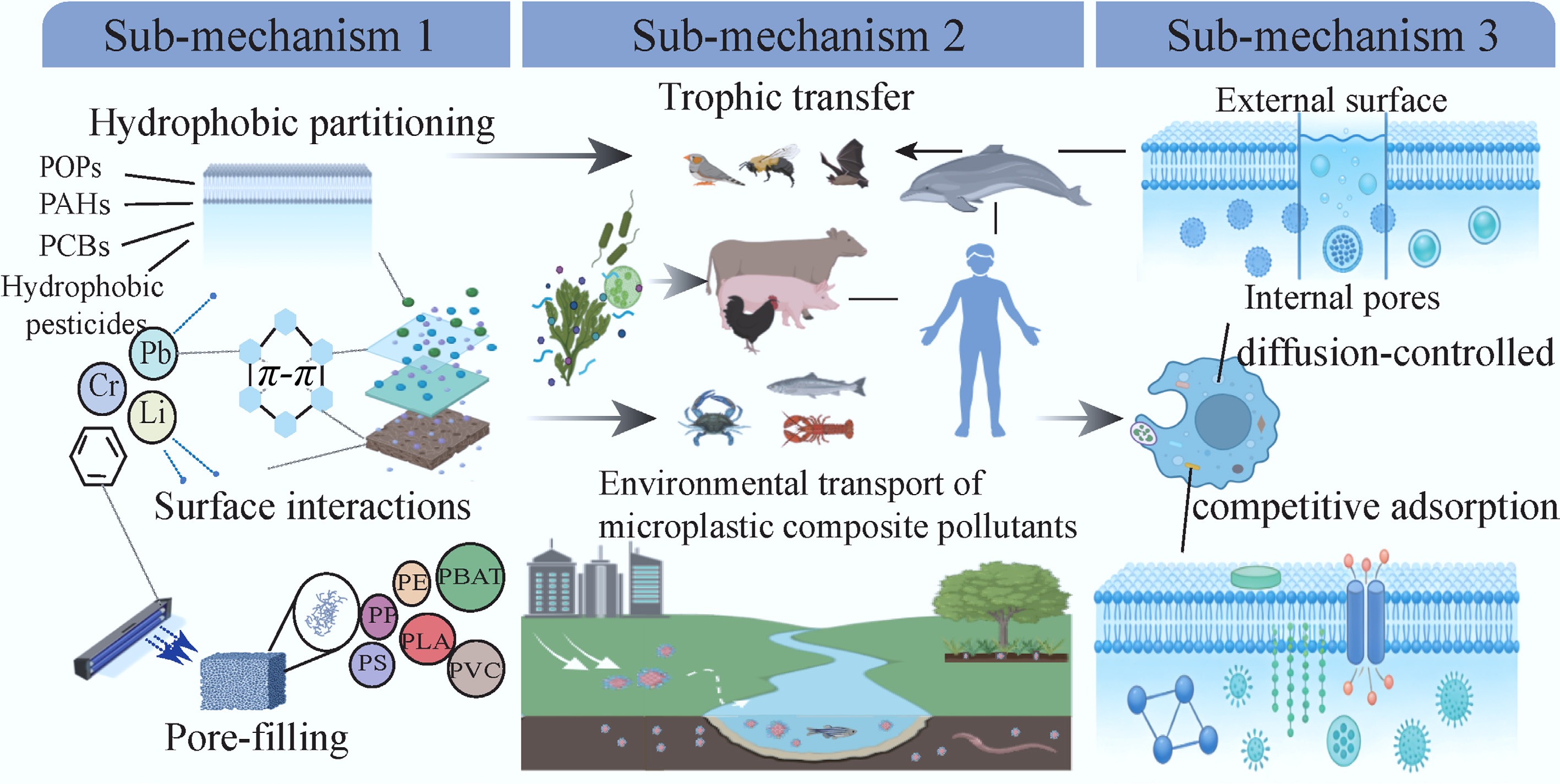
Figure 2.
Sorption–desorption mechanisms between microplastics and pollutants.
Interfacial adsorption mechanism
-
MPs function as both environmental sinks and carriers, and they capture chemical pollutants via three dominant pathways: hydrophobic partitioning, surface interactions, and pore filling[79,80]. Adsorption coefficients are positively correlated with octanol-water partition coefficients (log Kow)[58,81].
The thermodynamic basis of hydrophobic partitioning lies in Gibbs free energy minimization (ΔG < 0)[82,83]. The strong linear log Koc–log Kow relationship across polymer types confirms that entropy dominates over enthalpic contributions[84]. For highly hydrophobic pollutants (log Kow > 4), partitioning overwhelmingly dominates; for moderately hydrophobic compounds (2 < log Kow < 4), surface interactions and pore filling gain importance and become sensitive to polymer polarity[85]. Aromatic MPs (e.g., PS) exhibit additional exothermic π–π stacking, enhancing adsorption of aromatic contaminants 2- to 47-fold over aliphatic polymers[86].
Surface interactions—electrostatic forces, hydrogen bonding, and π–π conjugation—dominate for polar/ionized pollutants. Aged MPs with oxygen-containing groups show greatly enhanced uptake; e.g., UV-modified carboxylated PS achieves a 6.8-fold increase via exothermic surface complexation. Pore filling contributes 15%–40% of total capacity in foamed/fractured aged PS but is often overlooked[87,88].
These mechanisms compete for limited sites, and natural DOM can inhibit 30%–40% of hydrophobic partitioning while introducing bridging effects[89]. The dominant pathway is thus governed by polymer–pollutant–medium interactions, yet quantitative contributions of environmental variables to each mechanism are rarely assessed; integrating thermodynamic and molecular dynamics approaches is critically needed for predictive modeling[80,90].
Competitive adsorption becomes more complex in multi-pollutant systems. Efficiency varies with polymer type and pollutant properties (summarized in Tables 2 and 3; note that Table 2 provides kinetic fitting parameters, while Table 3 gives thermodynamic partition coefficients—not directly comparable). Aromatic polymers (e.g., PS) show strong affinity for aromatic pollutants via π–π stacking, e.g., 558.66 mg/g for 3D rGO-modified PS[91], though this reflects engineered composites, not weathered MPs (whose capacities are typically μg/g–mg/g)[84]. Non-polar organics on aliphatic polymers (PE, PP) rely mainly on hydrophobic partitioning, as seen in PE-phenanthrene systems[85].
Table 2. Kinetic fitting parameters of pollutant adsorption on various microplastics
Microplastic types Target pollutant Adsorption capacity Dominant sorption
mechanismRef. Pseudo-first-order Pseudo-second-order qe, ca1 (mg/g) K1 qe, ca1 (mg/g) K2 PVC BPAF 0.107 0.0030 min−1 0.244 0.085 g/(mg·min) Hydrophobic partitioning, electrostatic interaction [92] PS 3D RGO 6.15 0.093 min−1 558.66 0.226 g/(mg·min) π–π stacking [91] 100–154 μm HDPE Cd2+ 23.65 0.0008 g/(mg·min) 95.88 0.0097 g/(mg·min) Physical interaction [93] PP 9-NAnt 80.41 µg/g 0.0530 h−1 666.67 µg/g 0.0028 g/(µg·h) Hydrophobic partitioning, electrostatic interaction [94] 30–50 mesh mPS Aniline 0.0203 0.9609 min−1 0.0252 15.9572 g/(mg·min) π–π stacking [95] PE MG 4.360 1.572 h−1 4.530 2.273 g/(mg·h) Electrostatic interaction [96] PE RhB 1.217 0.946 h−1 1.236 2.072 g/(mg·h) Electrostatic interaction PS BPA 0.5577 21.8068 min−1 0.5577 60.3331 g/(mg·min) Hydrophobic partitioning, π–π stacking [97] Original PLA CIP 0.049 0.091 min−1 0.382 22.84 g/(mg·min) Hydrogen bonding [98] Aging PLA CIP 0.137 0.099 min−1 0.472 4.275 g/(mg·min) π–π stacking PP Cd2+ 0.18 ± 0.01 0.19 ± 0.05 h−1 0.20 ± 0.01 1.50 ± 0.48 g/(mg·h) Physical adsorption [99] PBAT Chlorpyrifos 9.2047 0.2521 h−1 9.6241 0.0435 g/(mg·h) Hydrophobic partitioning, π–π stacking [100] Original 80 μm PS AZI 366.87 mg/kg 0.675 min−1 389.66 mg/kg 0.0024 × 10⁻⁴ kg/(mg·min) Hydrophobic partitioning, electrostatic interaction [101] The fitted equilibrium adsorption capacities (qe, cal) have heterogeneous units due to differences in initial pollutant concentrations and detection limits across studies. Therefore, direct cross-comparison of kinetic data within this table is not recommended. Table 3. Thermodynamic partition coefficients (Kd) of pollutant adsorption on various microplastic
Microplastic types Target pollutant Adsorption capacity
(linear [Kd])Dominant
sorption mechanismRef. PE PFOS 32.8 L/kg Hydrophobic partitioning [102] PE FOSA 298.3 L/kg Hydrophobic partitioning PVC PFOS 100.5 L/kg Hydrophobic partitioning, electrostatic interaction PVC FOSA 115.7 L/kg Hydrophobic partitioning PE Phenanthrene 38,100 ±
5,600 L/kgHydrophobic partitioning [46] PP Phenanthrene 2,190 ±
170 L/kgHydrophobic partitioning PS BPA 18.8 L/kg π–π stacking [103] PVC BPA 0.4 L/kg Hydrophobic partitioning PA BPA 76,287 L/kg Hydrogen bonding PE CIP 55.1 ±
7.94 L/kgVan der Waals force [104] PE TMP 8.38 ± 1.32 L/kg Van der Waals force PE SDZ 6.19 ± 0.238 L/kg Van der Waals force PS CIP 51.5 ± 7.76 L/kg Van der Waals force, π–π stacking PP SDZ 7.85 ± 0.679 L/kg Hydrophobic partitioning PA AMX 756 ± 48.0 L/kg Hydrogen bonding PVC SDZ 6.61 ± 0.549 L/kg Hydrophobic partitioning Critically, more than 85% of studies use single pollutants in ultrapure water; however, fipronil adsorption on PE drops 40%–60% in natural river water due to DOM and ion competition[105], underscoring the urgent need for a multi-pollutant, environmentally relevant model.
Migratory transport mechanisms
-
The environmental fate of pollutants adsorbed onto microplastics (MPs) is governed by MP transport behaviors, which alter pollutant migration pathways and bioavailability through physical and biologically driven mechanisms[10].
Physically, low-density and durable MPs act as 'floating rafts' that carry POPs and heavy metals across vast distances via ocean currents and wind-driven atmospheric transport. Biologically, the 'biological pump effect' drives vertical and trophic migration: MPs ingested by organisms across trophic levels transfer adsorbed contaminants along food chains, while feeding, excretion, and mortality events transport pollutants downward to sediments or redistribute them in the water column, altering their phase partitioning between abiotic and biotic compartments[106]. We note that ecosystem-specific structures significantly modulate these processes; for instance, reservoir dams function as critical interception nodes that alter MP vertical flux and form persistent sediment pollution hotspots, as quantitatively demonstrated by Gao et al.[107].
Desorption kinetics mechanism
-
Desorption kinetics directly determine pollutant bioavailability and the persistence of MP-associated contamination, as the dynamic adsorption–desorption equilibrium links interfacial interactions to biological effects. Intra-particle diffusion is the primary rate-limiting step for desorption, particularly in porous or aged MPs[108,109], while competitive adsorption from coexisting substances can trigger rapid pollutant release—for example, pharmaceuticals adsorbed on PE or PS desorb almost completely in humic-rich waters[110].
A core limitation of current risk assessment is that conventional desorption models (pseudo-first/second-order kinetics, Langmuir isotherms) assume symmetric adsorption–desorption pathways[81,84]. This assumption does not hold in real-world scenarios: hydrophobic partitioning-dominated systems (e.g., PE–POPs) follow Fickian diffusion, whereas surface complexation-dominated systems (e.g., aged PS-heavy metals) exhibit pronounced desorption hysteresis caused by inner-sphere complex formation. This asymmetry indicates that adsorption and desorption are governed by distinct kinetic pathways, yet most models treat them interchangeably. Biofilm EPS further increases desorption activation energy two- to three-fold[111], while DOM competition reduces field-scale desorption fluxes by more than 50% compared with laboratory predictions[112]—underscoring that existing models cannot simulate the complete 'adsorption–transport–desorption–bioavailability' cascade.
Adsorption–desorption dynamics not only govern the bioavailability of chemical contaminants, but also inversely modulate the biological functions of the plastisphere via a 'chemical signaling' pathway. Heavy metals and organic pollutants adsorbed onto microplastic surfaces exert selective pressure on attached microorganisms, enriching tolerant taxa and reshaping community structure[113]. For instance, the sustained release of adsorbed Cu2+ forms local concentration gradients within the biofilm, inducing microorganisms to upregulate the expression of EPS biosynthesis genes[114]. This demonstrates that the chemical and biological vector effects of MPs are dynamically coupled at the temporal scale rather than simply superimposed independently—a core interaction mechanism frequently overlooked in single-effect studies.
Mechanisms of interaction between microplastics and biocontaminants
Formation and ecological functions of the plastisphere
-
Environmental plastics are not inert substrates; their surfaces selectively enrich microorganisms to form a distinct artificial niche termed the 'plastisphere'. First systematically proposed by Zettler et al.[115], this concept fundamentally reshaped our understanding of the environmental roles of MPs[116]. A defining feature of the plastisphere is that its microbial community differs significantly in taxonomic composition and functional potential from that of microbial communities in the surrounding water column or on natural particles[117].
Plastisphere development follows a sequential process: initial physical adsorption forms a 'conditioning film', which then facilitates colonization by pioneer microbes[118]. These pioneers modify the local microenvironment to support successive colonization, eventually leading to the formation of a mature, metabolically complex, and structurally stable biofilm community within weeks to months that is clearly differentiated from the background environment[117]. Ecologically, the plastisphere exhibits dual functions. On the one hand, it can selectively enrich functional microbes such as hydrocarbon-degrading bacteria, implying potential applications in the bioremediation of plastic pollution[116]. On the other hand, it can harbor pathogenic microorganisms and harmful algal propagules, acting as a 'mobile platform' for their dispersal[119]. Additionally, microbial activity alters microplastic surface properties, influencing their environmental fate. Cross-ecosystem comparative studies are needed to elucidate universal and ecosystem-specific patterns of plastisphere function, particularly in underrepresented freshwater and terrestrial environments[118,120].
From biofilm to gene exchange: biotransmission effects and ecological hazards of microplastics
-
The unique microenvironment of the plastisphere confers microplastics with a critical advantage as biocontaminant vectors, distinguishing their dispersal capacity from that of natural particles. This functionality operates through a sequential process: biofilm stabilization followed by the formation of gene exchange hotspots. Biofilms form the functional foundation of microplastic biocarriers. These three-dimensional matrices create a protective niche that enhances the survival of pathogens and ARGs[121], while drastically reducing spatial barriers to HGT—a process that gives rise to 'gene exchange hotspots'[122], a defining risk feature of microplastics as biological vectors. Research confirms that microplastic biofilms enrich ARGs with significantly greater diversity and abundance than the surrounding environment[123].
Critically, ARG enrichment efficiency and underlying HGT mechanisms vary markedly across polymer types, even though all major commercial polymers (PE, PP, PS, PVC, PET, and biodegradable PLA) can act as ARG vectors[124,125]. Liu et al.[125] reported that PS and PVC microplastics increased ARG relative abundance by 1.41–2.84 times, with polymer type dominating over particle size in regulating ARG enrichment. Additives released from PVC further boosted conjugative gene transfer synergistically by inducing oxidative stress and improving bacterial membrane permeability. Polar polymers (PVC, PET) enhance transformation-mediated ARG acquisition through electrostatic DNA adsorption[126]. Biodegradable PLA exhibits a 'low-colonization, high-transfer' pattern: its degradation remodels surface properties and enriches mobile genetic elements, elevating HGT risk despite lower initial colonization. An 88-day tidal river incubation[127] revealed divergent risk trajectories—non-biodegradable PVC acted as a persistent ARG/MGE hub, while biodegradable PLA showed a transient mid-degradation peak, enriching opportunistic pathogens and ARGs co-localized with virulence factors.
Laboratory experiments have consistently demonstrated that MPs can increase the conjugation frequency of ARGs by 2- to 20-fold; however, most field surveys have failed to observe significant enhancement. Particle size further exacerbates this discrepancy, complicating the overall understanding of horizontal gene transfer (HGT). Liu et al.[128] demonstrated that small polystyrene nanoplastics (S-PSNPs) significantly enhanced conjugative transfer frequency by up to 1.51-fold compared to larger particles, which generally had no significant effect. Beyond conjugation, Tang et al.[129] revealed that bottle-derived nanoplastics facilitate HGT through transformation, by physically carrying plasmids across bacterial membranes, and through outer membrane vesicle (OMV) secretion—mechanisms unique to the nanoscale. Their high surface-to-volume ratio enhances extracellular DNA adsorption, and because individual NP particles are smaller than bacterial cells, they cannot sustain the multicellular biofilm architecture that drives conjugative hotspots. Instead, NPs act as DNA shuttles that transport adsorbed DNA across cell membranes, facilitating intracellular transformation. This size-dependent shift in HGT modality represents a critical but underexplored dimension of the plastisphere resistome.
Core ecological risks driven by synergistic interactions
-
Chemical-biological interactions form a bidirectional positive feedback loop that synergistically amplifies ecological risks: biological colonization does not merely respond to chemical pressure but actively reshapes the chemical adsorption landscape of microplastic surfaces. Microplastic colonization triggers polymer-dependent community succession: hydrophobic polyolefins (PE, PP) favor Pseudomonas-dominated biofilms with protein-rich EPS, whereas aromatic PS enriches Actinobacteria producing polysaccharide-dominant EPS[130]. This divergence remodels surface functional groups, shifting heavy metal adsorption from electrostatic attraction to surface complexation (two to five-fold increase)[113] and enhancing organic pollutant sorption by 40%–170%[131]. This self-amplifying cascade—chemical enrichment modifying community/EPS, which in turn enhances adsorption affinity—intensifies two core outcomes: accelerated horizontal gene transfer (HGT) of ARGs and enhanced coupled toxicity.
These two core effects operate through distinct but interconnected pathways. Regarding genetic contamination, chemical pollutant stress synergizes with the biofilm microenvironment to significantly increase ARG HGT frequency via four core pathways. First, surface-enriched antibiotics (one to two orders above ambient levels) form localized selection hotspots that stabilize resistant strains[132]. Second, heavy metals (e.g., Cu2+) drive ARG spread via co-selection; microplastic-adsorbed Cu2+ synergizes with antibiotics, increasing HGT efficiency by 3.7-fold. Third, hydrophobic organic pollutants (e.g., PAHs) induce intracellular ROS overproduction and trigger SOS-mediated DNA damage, which upregulates conjugation-related genes to facilitate HGT[133]. Finally, co-occurring contaminants exert synergistic effects: combined antibiotic and heavy metal exposure increases ARG transmission risk by two- to five-fold, particularly in polluted environments (e.g., mariculture zones)[134]. In estuarine sediments, sulfamethoxazole (SMX) exhibits U-shaped inhibition of denitrification, promotes N2O emission by suppressing nirS over nosZ, and enriches the resistance gene sul1 in active degraders that overlap with denitrifying taxa—indicating that degradation co-selects for resistance and alters nitrogen cycling[135].
Regarding toxic effects, chemical and biological pollutants produce superimposed toxicity through a 'stress–immunosuppression–infection' cascade. Combined exposure to PVC microplastics and copper causes long-term metabolic disorders in oysters, accompanied by immune suppression and elevated Vibrio infection rates[136]; combined contamination of polyethylene MPs and atrazine reduces earthworm survival by 27%, and pathogens on MPs can enter crop roots, increasing human exposure risk[137]. However, interactions are not exclusively synergistic—co-exposure to DEHP alleviates submicron plastic toxicity in soil-plant systems[138]. Thus, the composite toxicity of MP-associated pollutants remains highly debated, characterized by complex synergistic, additive, and antagonistic effects that complicate straightforward risk prediction.
Current statistical syntheses indicate that synergistic interactions predominate in more than half of published studies, while antagonistic outcomes are relatively rare. Building on the chemical vector preconditions identified in the Trojan horse analysis above, we establish a four-condition risk threshold framework that identifies when coupled chemical-biological vector effects are most acute. These conditions are: (1) contaminant concentrations fall below individual toxicity thresholds yet exert selective pressure on microbial communities[134]; (2) biofilm EPS content exceeds 60%[139]; (3) microplastics are highly aged with abundant oxygen-containing functional groups; or (4) prolonged exposure exceeds 30 days.
Toward quantitative understanding of chemical-biological coupling
-
Current research remains largely confined to qualitative descriptions of chemical-biological coupling and lacks quantitative dissection of coupling pathways, critical ecological thresholds, and long-term system dynamics, which constitutes the core bottleneck for accurate risk assessment.
Recent advances in multi-scale research have begun to address this gap: Raman-fluorescence imaging revealed that more than 78% of adsorbed pollutants accumulate in EPS layers at 112- to 143-fold ambient concentrations[140,141]. Multi-omics approaches have established a quantitative causal chain showing that upregulated amino acid metabolism increases EPS production by 2.4-fold, which in turn elevates ARG conjugation frequency by 3.1-fold in microplastic-copper co-exposure systems[142]. Additionally, a random forest model trained on 132 global datasets achieved 89.1% accuracy in predicting ARG transfer frequency and identified microplastic aging degree, chemical pollutant concentration, and biofilm biomass as the three dominant driving factors[143].
Despite these promising advances, three specific limitations persist: (1) existing datasets rarely include exposure durations exceeding 90 d, precluding assessment of chronic and transgenerational effects; (2) no current model incorporates climate-change variables (e.g., temperature rise, salinity shifts) as modulators of adsorption and HGT dynamics; and (3) the absence of standardized quantification protocols makes cross-study meta-analysis unreliable.
-
Microplastic-mediated contaminant transport is governed not by isolated factors but by synergistic interactions among physical, chemical, and biological drivers[47,106]. To systematize these complex interactions, we introduce a three-tiered regulatory framework (Fig. 3) that delineates the hierarchical roles and cross-coupling effects of physical, chemical, and biological drivers: physical factors determine the substrate availability and spatial distribution of microplastics; chemical factors modulate adsorption-desorption dynamics at the microplastic-water interface; and biological factors mediate the transfer of contaminants from abiotic environments into biota. Their cross-scale interactions amplify ecological risks progressively, ranging from subcellular and organismal toxicity to population and community disruption, and ultimately to ecosystem-level functional impairment[144].
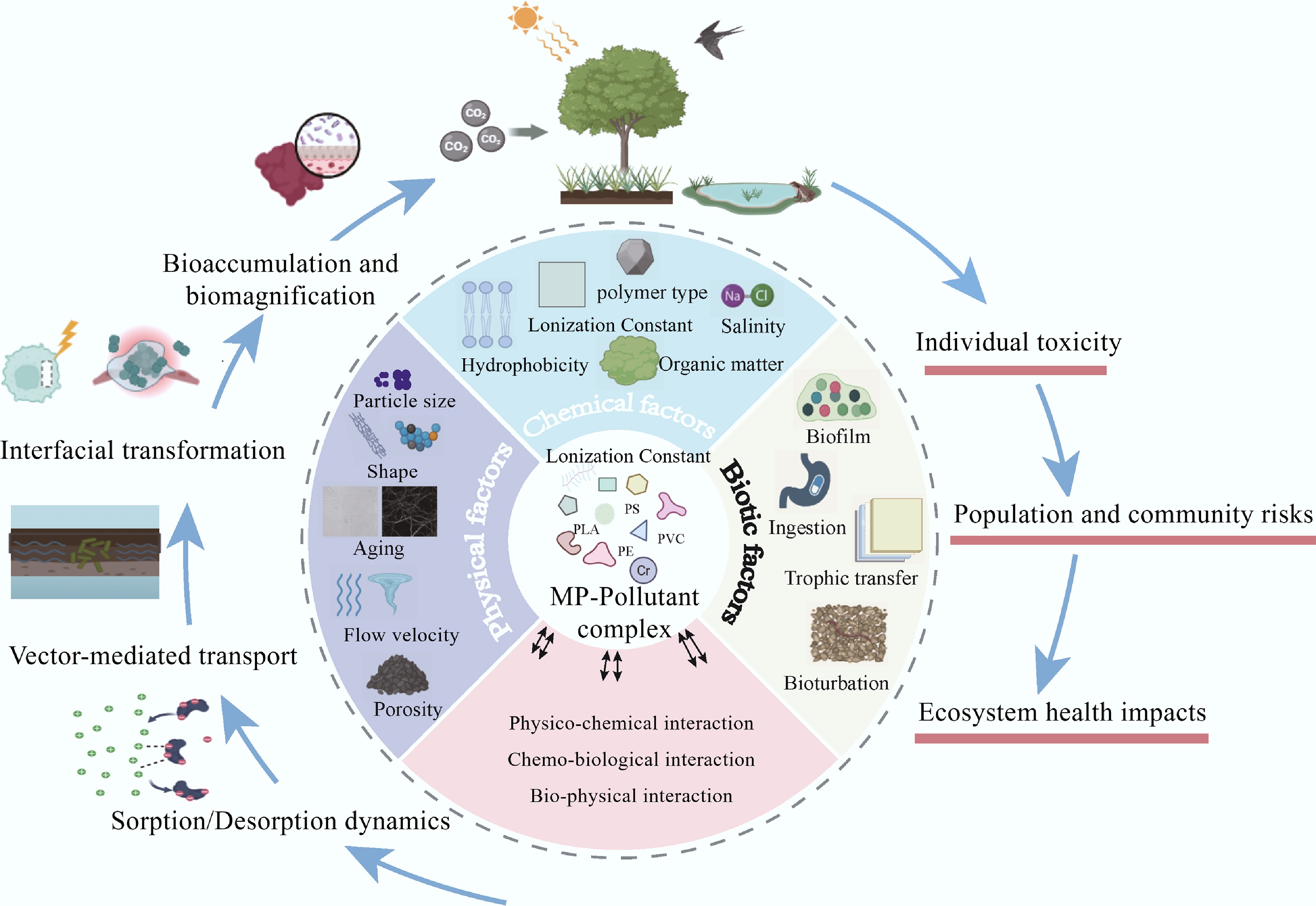
Figure 3.
Multi-dimensional regulatory effects of environmental factors on the microplastic-pollutant system.
Physical factors
-
The physical properties of microplastics are fundamental regulators of their vector capacity, with transport efficiency determined by the interplay between intrinsic particle characteristics and external environmental conditions across all stages, from interfacial adsorption to final spatial fate[145].
Particle size is the most critical intrinsic parameter, as it directly dictates specific surface area and thus governs adsorption capacity and kinetics. For instance, the adsorption of PAHs on polystyrene and the adsorption of heavy metals on polyethylene increase significantly as particle size decreases[146]. Particle shape further modulates vector potential: fibrous microplastics exhibit higher adsorption rates than spherical particles due to their larger effective surface area, making them particularly potent vectors in aquatic environments[147]. Aging reconstructs MP surface morphology via UV radiation, mechanical abrasion, and weathering, increasing surface roughness and introducing oxygen-containing functional groups[17,88]. A recent systematic review has revealed that weathering amplifies MPs' surface roughness and the amount of oxygen-containing functional groups by two- to ten-fold, and greatly enhances their pollutant adsorption capacity and transport potential[148]. This dual effect—enhanced chemical adsorption and altered biological colonization—creates a positive feedback loop between chemical adsorption and biological colonization[149], exacerbating long-term ecological risks.
Environmental conditions govern microplastic distribution. In aquatic systems, flow velocity and turbulence intensity alter the suspension–sedimentation equilibrium. In terrestrial and benthic environments, soil and sediment porosity and permeability directly control migration rates: coarse-textured media facilitate transport, while fine-pored matrices enhance retention[130].
Beyond fundamental understanding, these physical drivers also inform targeted remediation. For example, screening specialized microbial degraders with high adhesion affinity for high-surface-area aged MPs—the most ecologically hazardous fraction—can significantly improve remediation efficiency.
Chemical factors
-
The chemical regulation of microplastics as pollutant vectors arises from the complex interplay between pollutant properties, intrinsic polymer characteristics, and environmental chemical conditions. Pollutant hydrophobicity, quantified by the octanol-water partition coefficient (Kow), is the primary driver of adsorption onto non-polar polymers via hydrophobic partitioning. However, the carrier efficacy of microplastics is inherently defined by the polymer's own physicochemical traits. Beyond chemical composition, the physical state of the polymer is critical[150]: for instance, low-crystallinity LDPE exhibits significantly higher adsorption rates and capacities than high-crystallinity HDPE, because its rubbery state provides greater free volume and more diffusion pathways[151]. Furthermore, specific chemical interactions (e.g., π–π interactions between aromatic rings in PS and certain pollutants) can result in adsorption strengths that exceed predictions based solely on hydrophobicity[90,152].
Chemical structure also determines interaction mechanisms. Liu et al.[153] compared PAE adsorption by PE, PVC, and PS and found that PS had the strongest adsorption capacity, which is mainly attributed to the strong π–π interactions between the aromatic ring structures of PS. In addition, Huang et al.[86] systematically characterized the surface physicochemical properties of PE and PS microplastics before and after natural aging in coastal waters, as well as their adsorption behavior toward dibutyl phthalate. Together, these findings demonstrate that practical assessments must consider specific forces (e.g., polarity, hydrogen bonding) beyond hydrophobic interactions.
External environmental chemical conditions dynamically modulate interfacial equilibrium. Bakir et al.[154] first clearly revealed the 'salinity effect', demonstrating that salinity enhances the adsorption of hydrophobic organic pollutants, indicating that microplastics have stronger pollutant enrichment and transport potential in marine environments. Solution chemical conditions exert complex yet critical regulation on adsorption behavior: Wu et al.[89] found that low pH and high ionic strength promote adsorption, while high pH and dissolved organic matter often inhibit it via electrostatic repulsion and site competition. This underscores that the carrier function of microplastics cannot be evaluated independently of specific environmental parameters.
A frequently overlooked yet critical factor is competitive adsorption in multi-pollutant scenarios. Coexisting contaminants compete for limited sorption sites and pore space, significantly reducing the adsorption capacity of single POPs[112]. This challenges simplistic risk assessments based on single-contaminant experiments and highlights the necessity of investigating combined pollution systems.
Biological factors
-
Biological factors constitute the core mechanism driving the transfer of microplastic-associated pollutants from abiotic to biotic phases and their subsequent ecological amplification. Their impacts are mediated through four interconnected pathways: biofilm interface reconfiguration, biotic uptake and desorption, food web transfer, and bioturbation migration, forming a cascading risk chain from micro-interfaces to entire ecosystems.
Biofilm formation represents the initial biological step. The biofilm matrix, rich in organic matter and microbial cells, exhibits significantly higher affinity for hydrophobic organic pollutants and heavy metals than pristine plastic, effectively creating localized 'pollutant hotspots'[131]. Extracellular polymeric substances (EPS) are particularly critical: they introduce functional groups that enable complexation and ion exchange, transforming adsorption from a simple physical partitioning process into a complex multi-mechanism phenomenon.
Ingestion is the central driver of pollutant transfer into organisms. The gastrointestinal environment acts as a key regulator: digestive fluids containing bile salts drastically enhance contaminant desorption compared to aqueous environments, with micellar structures efficiently 'extracting' hydrophobic pollutants and greatly increasing their bioavailability. Interspecific differences in gut physiology lead to variable transfer efficiencies and toxicities, including synergistic effects exceeding additive predictions[155].
Food web transfer enables cross-trophic pollutant transport and biomagnification. For example, contaminants such as benzo(a)pyrene can be transferred from mussels to fish. Polyester microplastics can undergo trophic transfer in a three-level marine food web (zooplankton → mysid shrimp → fish), confirming microplastics as vectors for trophic-level pollutant transfer[156,157]. Furthermore, bioturbation by benthic organisms (e.g., polychaetes) actively redistributes microplastics in sediments, with migration selective for particle size and polymer type[158,159]. This alters the chemical environment of stored pollutants, affects their degradation kinetics, and may create secondary pollution sources.
While the independent functions of these biological pathways are increasingly well understood, systematic knowledge of their coupling mechanisms remains insufficient. Future research should integrate parameters across these biological connections to develop a multi-process, biologically grounded risk assessment model, which will improve the prediction accuracy of ecological effects under microplastic co-contamination.
-
Building on the mechanistic synthesis above, we now outline four interconnected priority directions to address the core bottlenecks identified in this review.
Fundamental mechanisms
-
Persistent controversies stem from the mismatch between simplified laboratory simulations and real-world complexity. Key quantification targets include π–π stacking coefficients, aging correction factors, and DOM competition coefficients for multi-component dynamic models, alongside long-term in-situ observation of chemical-biological coupling, which is the least understood aspect of microplastic combined pollution.
Exposure assessment
-
Current toxicity data, derived mostly from high-concentration, short-term tests, poorly represent chronic low-dose combined exposures. Future assessments must incorporate pathway-specific physiology: gut fluid compositions for oral bioaccessibility and size-dependent alveolar interactions for inhalation desorption kinetics.
Risk control and remediation
-
Targeted pollution prevention and control strategies should be developed based on a hierarchical risk assessment framework. Source reduction and mechanical recycling remain the most cost-effective approaches to curb microplastic generation at the source. For high-risk areas where vector effects dominate ecological risks, targeted removal technologies for aged microplastics and their associated biofilm complexes require urgent development. Additionally, unified global governance standards are essential to address the transboundary nature of microplastic pollution.
Overall, future microplastic research needs to shift its paradigm from descriptive literature reviews to quantitative mechanistic exploration and rigorous verification of ecological risk thresholds, so as to provide solid theoretical support for global microplastic pollution management and ecosystem protection.
Not applicable.
-
Not applicable.
-
The authors confirm their contributions to the paper as follows: Zhengyingzi He: writing - original draft, investigation; Xinping Zhu: writing - original draft, investigation; Rui Pei: investigation; Jingliang Shi: writing - review & editing, investigation, conceptualization; Qinghua Zhang: resources, funding acquisition. All authors reviewed the results and approved the final version of the manuscript.
-
No new experimental data are reported in this review article. Therefore, all data discussed herein are derived from the cited literature and publicly accessible databases.
-
The authors declare that they have no known competing financial interests or personal relationships that could have appeared to influence the work reported in this paper.
-
# Authors contributed equally: Zhengyingzi He, Xinping Zhu
Full list of author information is available at the end of the article. - Copyright: © 2026 by the author(s). Published by Maximum Academic Press, Fayetteville, GA. This article is an open access article distributed under Creative Commons Attribution License (CC BY 4.0), visit https://creativecommons.org/licenses/by/4.0/.
-
About this article
Cite this article
He Z, Zhu X, Pei R, Shi J, Zhang Q. 2026. Microplastics as pollutant shuttles: unraveling the drivers of chemical and biological vector effects. Energy & Environment Nexus 2: e023 doi: 10.48130/een-0026-0017 

Microplastics as pollutant shuttles: unraveling the drivers of chemical and biological vector effects
- Received: 10 May 2026
- Revised: 16 July 2026
- Accepted: 08 August 2026
- Published online: 28 August 2026
Abstract: Microplastics serve as pivotal mobile vectors enabling long-distance and cross-media transport of chemical and biological pollutants. This review systematically elucidates the interfacial mechanisms, ecological risks, and multi-factor regulatory processes of microplastic-mediated pollutant migration. Chemically, microplastics accumulate persistent organic pollutants and heavy metals via hydrophobic partitioning and surface interactions, thereby increasing contaminant bioavailability via the Trojan horse effect. Biologically, the plastisphere selectively enriches pathogenic microorganisms and antibiotic resistance genes, driving cross-media dissemination via biofilm protection and horizontal gene transfer. These two vector effects act synergistically to amplify ecological hazards. We propose a three-tiered regulatory framework and identify hierarchical critical conditions—spanning chemical vector preconditions and coupled chemical-biological thresholds—under which microplastic vector effects become the dominant drivers of ecological risk. This multi-factor framework provides a conceptual and emerging quantitative basis for developing risk assessment models and identifying ecological thresholds for combined microplastic pollution.