












-
The marketing of e-cigarettes as a healthier alternative to combustible cigarettes has contributed to their growing popularity among young people worldwide[1,2]. Advertising and online promotion often highlight e-cigarettes as 'harmless' or 'safe' nicotine delivery products, which tend to foster more favorable attitudes and reduce young people's perceived risks of e-cigarette use[3,4]. Such beliefs influence both initiation and switching behaviors between e-cigarettes and combustible cigarettes[4]. In China, this trend is reflected in national surveillance data. The prevalence of e-cigarette use among young adults in China increased from 1.5% in 2018 to 2.5% by 2021[5,6]. A large-scale national survey found that 24.4% of young adults had ever used e-cigarettes, and over half (51.9%) were dual users of e-cigarettes and combustible cigarettes[7].
Combustible cigarettes remain a leading cause of preventable disease and premature death[8]. Compared with combustible cigarettes, e-cigarettes eliminate the combustion process that generates most toxicants in cigarette smoke. Two comprehensive reviews by the National Academies of Sciences, Engineering, and Medicine, and Public Health of England have suggested that e-cigarettes may expose users to fewer harmful chemicals[9,10]. However, 'less harmful' does not mean harmless. The long-term health effects of e-cigarette use remain uncertain, and short-term studies have identified oxidative stress, inflammation, endothelial dysfunction, and cardiovascular complications with e-cigarette use[11−13]. While e-cigarettes are often positioned within harm reduction paradigms, the magnitude and consistency of such reduction remain debated[14]. Concerns also persist about high nicotine concentrations and youth-oriented flavors, which may increase nicotine dependence and facilitate progression to combustible smoking[15−19].
In response to rising e-cigarette use, China has introduced a series of regulatory measures, including bans on sales to minors, restrictions on online sales implemented in 2019[20], the integration of e-cigarettes into the national tobacco control framework in 2021[21], and a national flavor ban in 2022[22]. Despite these policies, e-cigarettes continue to be promoted as fashionable and health-conscious products. Public messaging around relative harm is frequently simplified or distorted in commercial and social media discourse, blurring the distinction between 'less harmful' and 'harmless'. Recent analyses of Chinese e-cigarette marketing, including studies of social media content and official manufacturer websites, show that promotional materials frequently minimize or omit health warnings while emphasizing lifestyle appeal, interactivity, and social connection, which reinforces perceptions of safety and normalizes e-cigarette use among young people[23]. At the same time, combustible cigarettes in China carry longstanding symbolic meanings related to masculinity, social status, and social exchange. These associations do not apply to e-cigarettes, which young people often perceive as more neutral and socially flexible[24]. National survey data show that only 27.8% of young adults in China believe e-cigarettes are harmful to users, and 22.7% believe they are harmful to others[7]. Limited awareness of potential health risks may contribute to ongoing dual use rather than smoking cessation[25−27].
Most studies examining youth perceptions of tobacco-related harm in China rely on cross-sectional surveys[5−7], which describe what young people believe, but not how such beliefs are formed, interpreted, and acted upon. A qualitative approach is therefore essential to capture the nuanced ways in which personal experiences, peer norms, and digital marketing shape young people's understanding of relative harm. This perspective is particularly important in China's unique context, where rapid regulatory changes[20−22], distinct social norms surrounding smoking[24], and the pervasive influence of social media shape young people's perceptions[23]. The interaction between these factors may create a distinct pattern of interpretation and behavior that cannot be fully captured through quantitative data alone. Our updated literature review in PubMed (up to Oct 2025), using the keywords 'e-cigarette', 'vaping', 'relative harm', 'perception', 'qualitative', and 'China', found no published qualitative studies specifically exploring how young people in China understand and compare the harms of e-cigarettes and combustible cigarettes.
This study therefore, explores how young smokers in China perceive and interpret the relative harms of e-cigarettes and combustible cigarettes, and how these perceptions influence patterns of use. By examining how messages about reduced harm are understood and internalized, the study aims to inform more accurate public health communication and evidence-based regulation to reduce tobacco-related harm among youth.
-
We conducted a qualitative study using semistructured, in-depth interviews with young adults in China who used e-cigarettes daily. Individual interviews were selected instead of focus groups to facilitate open discussion of potentially sensitive experiences related to e-cigarette use and to capture individual perspectives in depth. Interviews were conducted between November 2022 and January 2023, and aimed to understand how young users perceive and experience e-cigarette use in their daily lives. This study was approved by the Research Ethics Committee of the School of Social Development and Public Policy at Beijing Normal University (SSDPP-HSC2022002). All participants provided informed consent before participation.
Sampling and recruitment
-
Young adults aged 18−25 years who used e-cigarettes daily during the past three months were recruited using purposive and snowball sampling strategies (Fig. 1). The sample included both exclusive e-cigarette users and dual users. Dual users were defined as individuals who reported concurrent use of both e-cigarettes (daily use) and combustible cigarettes (any use) in the past three months. Recruitment information was posted on popular Chinese social media platforms, such as WeChat Moments and WeChat groups. Potential participants completed a brief online screener assessing sociodemographic characteristics, smoking history, frequency and patterns of e-cigarette and cigarette use, and motivations for use.
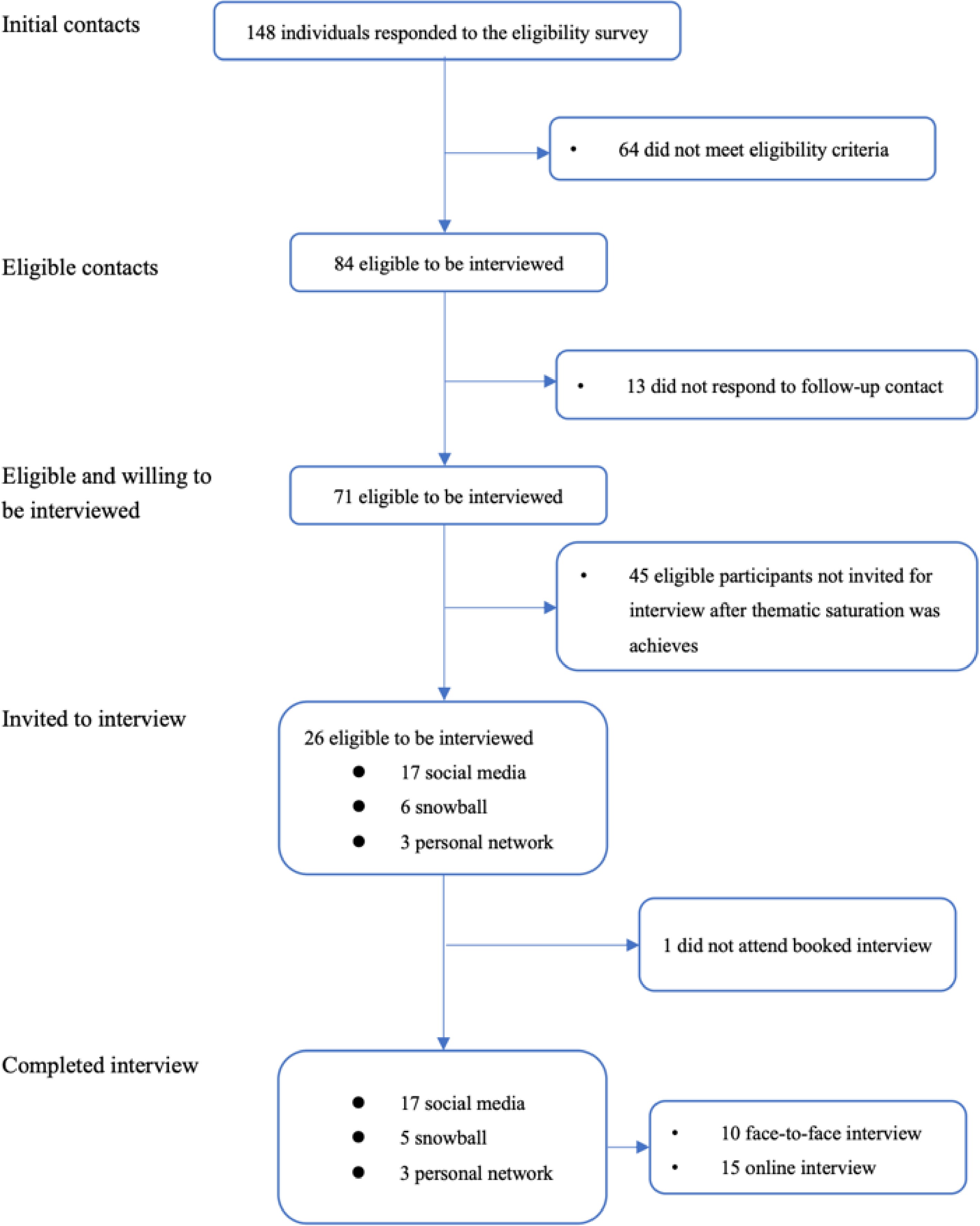
Figure 1.
Participant recruitment flowchart.
Participants were purposively selected based on their responses to a brief screening survey to ensure variation in tobacco use patterns and sociodemographic backgrounds. As data collection progressed, snowball sampling was used to recruit individuals with underrepresented or unique vaping experiences. Recruitment continued until thematic saturation was reached, with no new themes emerging from additional interviews.
Data collection
-
A total of 25 individual interviews were conducted using a pre-established interview guide. The guide included several open-ended questions, such as, 'Could you describe your experiences with using e-cigarettes, including your initial reasons for use, the contexts in which you use them, and your usage frequency?', 'How harmful do you think e-cigarettes are? How does this compare to combustible cigarettes?', and 'Have your views on harm changed over time? If so, what influenced that shift?'. Other questions explored participants' views on the relative harms of e-cigarettes vs cigarettes, the factors influencing these perceptions, and how such beliefs shaped their tobacco use behaviors.
Two trained research team members (XW and CS) conducted the interviews. Both have received formal training in qualitative research methods and have had prior experience in conducting semi-structured interviews. Before data collection, they also completed project-specific training that covered the interview protocol, ethical considerations, and techniques for building rapport and probing sensitively. The data collection process was supervised by XW to ensure consistency and methodological rigor. Ten interviews were conducted face-to-face in quiet, private locations (e.g., university meeting rooms), and 15 were held online via Tencent Meeting to accommodate participants from different locations, and their preferences. Each interview lasted between 60 and 90 min. Participants received a cash incentive of 80 RMB (approximately 12 USD). All interviews were audio-recorded with participants' consent, transcribed verbatim in Chinese, and anonymized to protect privacy. Thematic saturation was achieved after 22 interviews. An additional three interviews were conducted to ensure no new information would be forthcoming, confirming saturation. Data collection concluded upon reaching thematic saturation.
Data analysis
-
A thematic analysis approach was developed following the six-phase guideline by Braun & Clarke[28]. Coding was primarily inductive, allowing themes to emerge from data rather than being imposed by pre-existing frameworks. The analysis was conducted by the two research members (XW and CS), who also carried out the interviews, ensuring deep familiarity with the data. Initially, codes were generated from a line-by-line reading of the transcripts, followed by identifying potential themes and subthemes. The themes were then reviewed, defined, and named. Any discrepancies regarding themes and codes were resolved through discussions within the research team until a consensus was reached. The final report was generated based on the agreed themes and codes. NVivo 12 software was used to organize, manage, and retrieve coded data throughout the analysis process.
All participants' names and personal information were kept confidential to ensure ethical considerations, and IDs were used in descriptions and quotes. To assess this study's rigor, a thorough examination was conducted in four domains: epistemological integrity, analytic logic, representative credibility, and interpretive authority[29]. To enhance credibility, we applied triangulation in both the research process, and data analysis. First, coding discrepancies were addressed through regular consensus meetings, and when disagreements remained unresolved, a senior qualitative researcher was consulted to reach agreement. Second, methodological triangulation involved integrating semistructured interview data with screening-questionnaire demographics to cross-check observed patterns. These measures were taken to ensure the trustworthiness of the findings.
-
The participants' demographics and tobacco use characteristics, stratified by exclusive and dual users, are presented in Table 1. Our sample comprised 25 young adults, including 12 males and 13 females, with a mean age of 22.5 years (SD = 1.6). Most participants had attained tertiary education (n = 22). Ten participants were exclusive e-cigarette users, and 15 were dual users who used both e-cigarettes and combustible cigarettes. Among exclusive users, seven had previously been dual users but switched to exclusive e-cigarette use; among dual users, four had previously been exclusive e-cigarette users but added combustible cigarette use (see Supplementary Table S1 for detailed smoking histories). Daily e-cigarette use was reported as fewer than 10 times (n = 4), 10 to 29 times (n = 14), and 30 or more times (n = 7) per day. The mean duration of e-cigarette use was 2.3 years (SD = 1.1), while the mean duration of combustible cigarette use 3.6 years (SD = 2.5). Most participants resided in urban areas (n = 22).
Table 1. Participants' demographics and tobacco use characteristics (n = 25).
Characteristics Total
(n = 25)Exclusive e-cigarette user
(n = 10)Dual cigarette/
e-cigarette user (n = 15)Sex Male 12 (48.0) 5 (50.0) 7 (46.7) Female 13 (52.0) 5 (50.0) 8 (53.3) Age, mean (SD) 22.5 (1.6) 23.0 (1.5) 22.1 (1.6) Education level Secondary 3 (12.0) 1 (10.0) 2 (13.3) Tertiary 22 (88.0) 9 (90.0) 13 (86.7) Occupation Student 14 (56.0) 2 (20.0) 12 (80.0) Employed 11 (44.0) 8 (80.0) 3 (20.0) E-cigarette use frequency per day (times) < 10 4 (16.0) 2 (20.0) 2 (13.3) 10−29 14 (56.0) 5 (50.0) 9 (60.0) > 30 7 (28.0) 3 (30.0) 4 (26.7) Duration of e-cigarette use (years), mean (SD) 2.3 (1.1) 2.5 (1.2) 2.2 (1.1) Duration of combustible cigarette use (years), mean (SD)a 3.6 (2.5) 5.2 (3.0) 3.1 (2.2) Residence Urban 22 (88.0) 9 (90.0) 13 (86.7) Rural 3 (12.0) 1 (10.0) 2 (13.3) a For exclusive e-cigarette users, this reflects prior combustible cigarette use history. Thematic analysis identified two overarching themes regarding participants' perceptions of the relative harms of e-cigarettes and combustible cigarettes: (1) Exclusive users' perception of e-cigarettes as a reduced-harm alternative; and (2) dual users' ambivalent perception of harm reduction and nicotine dependence.
Exclusive users' perception of e-cigarettes as a reduced-harm alternative
Cigarettes are perceived as more harmful than e-cigarettes
-
A dominant theme among participants who exclusively used e-cigarettes generally viewed combustible cigarettes as more harmful to physical health. For most, this perception was influenced by both subjective bodily sensations and broader public discourse. Participants frequently cited the physical discomfort caused by cigarette smoking as evidence of harm.
'Cigarettes seem more harmful. After smoking, my fingers get stained, and the tar damages my lungs. If I smoke heavily at night, my throat feels dry the next morning'. (ID11, M-23, exclusive e-cigarette user).
'If you smoke too many cigarettes, it mainly causes nausea and even shortness of breath. After smoking, I lose my appetite'. (ID15, M-22, exclusive e-cigarette user).
Some participants also interpreted smoking bans in public places as an official recognition of cigarettes' health risks, whereas the relative permissibility of e-cigarette use in these settings signaled a perception of lower harm.
'Cigarettes cannot be smoked in public places, but e-cigarettes can still be used. Because e-cigarettes do not produce secondhand smoke, they have little effect on other people's health'. (ID15, M-22, exclusive e-cigarette user).
External information further reinforced many participants' risk perceptions. While combustible cigarettes have long been associated with public health warnings, similar cautionary messages about e-cigarettes were perceived as lacking.
'Since childhood, we have always heard that cigarettes are harmful, even cigarette boxes say it. This constant exposure made me subconsciously believe that cigarettes are very harmful. But there is not much information about e-cigarettes, so I do not feel the same sense of danger'. (ID24, F-21, exclusive e-cigarette user).
However, this reliance on sensory cues and the absence of warnings was not universal. For instance, one participant referenced scientific explanations that attribute most harmful chemicals to combustion rather than nicotine itself.
'I think the harm from e-cigarettes should be less. I read some research saying cigarettes produce carcinogens through combustion. Although e-cigarettes still have nicotine and second-hand smoke risks, they avoid the harmful substances produced by burning'. (ID19, M-22, exclusive e-cigarette user).
E-cigarettes are viewed as a less harmful alternative
-
Many exclusive users described e-cigarettes as a safer and cleaner choice. Their belief in reduced harm was often linked to the absence of combustion, which they associated with fewer toxins and other risks.
Many participants perceived e-cigarettes as safer, and smoking was a fire hazard.
'I once felt sleepy and fell asleep with a cigarette. If it had not been discovered in time, it could have caused a fire, burning a big hole in the blanket'. (ID21, F-23, exclusive e-cigarette user).
Others noted that fruity flavors and trendy packaging contributed to the perception that e-cigarettes are less harmful. The dissociation from combustible smoking imagery masked their risk.
'Most e-cigarette flavors are fruity, and they smell much better than the strong smell of combustible cigarettes, making them feel less harmful'. (ID17, M-21, exclusive e-cigarette user).
'The packaging of e-cigarettes is also quite diverse, with milk tea cups being popular recently. They are so cute that I do not even associate them with something harmful like smoking'. (ID16, F-24, exclusive e-cigarette user).
Beyond personal experience and sensory cues, many participants also mentioned that information encountered on social media and in commercial marketing reinforced their belief that e-cigarettes are a healthier alternative. Promotional content on platforms such as Douyin (the Chinese version of Tiktok), WeChat, and Xiaohongshu often portrayed e-cigarettes as modern, fashionable, and 'clean', emphasizing the absence of tar or secondhand smoke while downplaying potential health risks. Several participants noted that such repeated exposure strengthened their perception that e-cigarettes carried minimal harm.
'I often see short videos saying that e-cigarettes are just water vapor and don't harm others. After seeing that many times, I felt they were much safer'. (ID20, F-25, exclusive e-cigarette user).
'On social media, people share pictures of new flavors or limited-edition designs. It makes e-cigarettes look like something stylish, not like real smoking'. (ID22, F-24, exclusive e-cigarette user).
Some participants also noted that flavored e-cigarette products remained readily accessible through informal or online channels despite regulatory restrictions, which further reinforced their perception that these products were acceptable and relatively low-risk.
'Even after the flavor ban, you can still buy all the fruity ones through WeChat sellers'. (ID16, F-24, exclusive e-cigarette user).
In addition, similar perceptions were reported by participants with and without a history of combustible cigarette use.
Dual users' ambivalent perception of harm reduction and nicotine dependence
E-cigarettes are viewed as a smoking cessation tool
-
Many dual users reported taking up e-cigarettes with the intention of cutting down or quitting cigarette smoking. Some experienced a temporary reduction in cigarette consumption, which reinforced the perception that e-cigarette use could aid cessation. However, these effects were often short-lived, and participants reported fluctuating patterns of use rather than complete substitution.
'My cigarette consumption dropped a lot; it felt like I could almost quit combustible cigarettes. But I still could not quit completely'. (ID4, M-21, dual user).
'E-cigarettes cannot help you quit; they can only replace cigarettes. There is no way to actually quit'. (ID9, M-21, dual user).
Reflecting this diversity of experience, some participants came to view e-cigarettes not as a path away from nicotine dependence, but as a parallel form of addiction or a 'false solution'.
'The idea that e-cigarettes help you quit is fake. From my experience, it just shifts your addiction to e-cigarettes. It is just a marketing strategy, though I did smoke fewer cigarettes'. (ID13, M-23, dual user).
Some participants reported that cigarette use increased after initiating e-cigarettes; causality cannot be inferred.
'I used to smoke very few cigarettes, but since I started vaping, I smoke even more cigarettes than before'. (ID14, M-21, dual user).
'Two years ago, cigarettes were optional for me; I could take them or leave them. But after using e-cigarettes, my cigarette use increased. I suspect e-cigarettes made me more dependent on nicotine'. (ID18, M-22, dual user).
E-cigarettes reinforce dual use and nicotine dependence
-
Despite initial intentions to quit, many dual users found that e-cigarettes became an additional source of nicotine, rather than a replacement for cigarettes. Participants highlighted design features, such as ease of use, appealing flavors, and minimal smell, as making e-cigarettes highly accessible and habit-forming. These features facilitated use in situations where smoking cigarettes was previously not feasible, contributing to more frequent overall nicotine intake.
'E-cigarettes are more addictive because they are so convenient. You do not need a lighter—you just carry the e-cigarette and use it anytime, anywhere'. (ID8, F-21, dual user).
'When I go out, I probably reach for my e-cigarette more often than my phone. Even in malls where smoking is banned, I can sneak a puff of an e-cigarette without being noticed'. (ID18, M-22, dual user).
A few participants described vaping as compulsive or habitual, tightly integrated into daily routines and activities.
'It is super convenient. I keep my e-cigarette under my pillow—one puff in the morning wakes me up, and at night, I vape before sleeping'. (ID2, F-20, dual user).
'When I am drawing, I hold my e-cigarette in one hand and my brush in the other. It helps me stay alert and sometimes even sparks inspiration'. (ID5, F-21, dual user).
Participants described e-cigarettes as convenient and suitable for discreet use in smoke-free settings. They also reported frequent exposure to commercial and social media content that presented e-cigarettes as cleaner or less harmful, with few salient health warnings. Some participants reported dual use, and continued e-cigarette use was also reported. Several participants discussed harms mainly in comparative terms, using the phrase 'less harmful', without specifying particular health effects.
In both groups, harm perceptions were influenced more by sensory experience and everyday social or commercial messages than by formal health information.
-
This study explored how young people in China perceive the relative harm of e-cigarettes compared with combustible cigarettes, revealing distinct patterns between exclusive and dual users. A recent study among young adults found variation by user status, with current e-cigarette users being more likely than non-users to view e-cigarettes as lower in harm, and as a tool for quitting[30]. Most participants in our study perceived e-cigarettes as less harmful than cigarettes; however, this view was not universal, and few clearly differentiated relative from absolute risk. Although a few participants showed a more scientific understanding, recognizing that many toxicants arise from combustion, most relied on personal sensations or marketing narratives rather than scientific evidence when assessing harm. Exclusive users generally viewed e-cigarettes as cleaner and less harmful, while dual users expressed ambivalence, citing concerns about increased nicotine dependence and challenges in quitting. Despite these differences, both groups appeared to base their harm perceptions largely on personal experience and social cues, rather than on formal health knowledge or authoritative information sources.
Several interpretive processes and contextual conditions may help explain why some participants equated 'less harmful' with 'harmless'. Participants described using milder taste and reduced odor as cues of lower risk. Repeated exposure to marketing and peer-shared content also appeared to reinforce these perceptions[31−33]. In this information environment, the perceived distinction between 'less harmful' and 'harmless' was often blurred, particularly when formal health information is limited or inconsistently communicated. Consistent with recent analyses of Chinese e-cigarette marketing, online promotional environments often present e-cigarettes as lifestyle products that emphasize social connection, modern design, and personal expression, while providing minimal or no health warnings[23]. Such representations reduce the visibility of health risks and make e-cigarette use appear acceptable, aspirational, and even routine among young people. Perceived permissibility in smoke-free settings normalized continued use. Lifestyle cues such as pastel colors, compact devices, and packaging that resembles consumer goods, combined with algorithmic repetition and limited counterwarnings, heightened salience in everyday contexts. These interconnected processes appeared to normalize vaping and reinforce young users' perceptions of e-cigarettes as low-risk products.
Differences in harm perception also appeared to align with tobacco use patterns. Exclusive users generally maintained confidence in the reduced-risk narrative on e-cigarettes, often citing perceived improvements in physical sensations or reduced stigma. Dual users expressed greater uncertainty. Although many initially turned to e-cigarettes to cut back on cigarettes, they described higher overall nicotine intake and difficulty discontinuing either product[34,35]. These experiences fostered frustration and skepticism, especially when marketing claims did not align with lived outcomes. Some participants reported bidirectional transitions between exclusive e-cigarette use and dual use. Reported influences included convenience, discreet use in smoke-free settings, flavor availability, peer and social-media cues, and perceived reduced harm. Addiction concerns were raised predominantly by dual users; this should not be taken to imply an absence of concern among exclusive users.
Although recent regulatory measures in China have restricted flavored e-cigarettes, mandated warning labels, and limited use in certain public settings[36], our findings and prior research suggest enforcement remains weak[31]. Many participants reported continued access to flavored products through informal channels, and noted that ongoing promotional claims about safety or cessation benefits were still common. These findings indicate that existing policies may not sufficiently constrain the marketing and distribution practices that shape public perceptions of e-cigarettes. The limited visibility of enforcement actions and inconsistent communication about health risks have created space for misinformation and selective interpretation to persist. As a result, young users relied heavily on personal experience, peer discourse to assess risk, and social media narratives as more immediate sources of information than official health messaging. Weak enforcement and inconsistent communication together diminish the effectiveness of regulatory measures, emphasizing the need for clearer and more engaging risk communication strategies for young audiences.
In addition, harm perceptions in China appear to be shaped by distinctive regulatory and cultural contexts that may differ from those in Western countries. Unlike in many high-income settings where e-cigarettes are often discussed within a harm-reduction discourse[10], official information in China has provided limited comparison of the relative harms of e-cigarettes and combustible cigarettes, and public education on this issue remains limited. Regulatory enforcement is also inconsistent, with flavored products and misleading health claims still circulating through informal markets and social media[31]. Culturally, e-cigarettes may carry different social meanings from combustible cigarettes[24,37]. While smoking has long been associated with masculinity and social bonding, e-cigarette use, particularly among young women, appears influenced by shifting social expectations and the pursuit of modern or fashionable identities[24]. These regulatory and cultural conditions jointly influence how harm is perceived and negotiated among young users, often through social norms and consumer symbolism, rather than scientific evidence.
Limitations
-
This study has several limitations. First, interviews were conducted between November 2022 and January 2023, a period during which e-cigarette regulation in China was still evolving. Subsequent regulatory changes may have influenced both product availability and user perceptions. Second, our recruitment strategy of online and snowball sampling resulted in a sample of predominantly university students in urban settings. Their experiences may differ from those of youth with lower educational attainment or those living in rural areas. Third, as a qualitative study, our findings provide rich, contextual insights, but cannot provide the prevalence of specific beliefs or behaviors across the broader population. Lastly, our study relied on self-reported data, which may be subject to recall bias or social desirability, particularly when discussing motivations or health concerns. Some participants may have downplayed perceived risks of e-cigarettes, as acknowledging engagement in a risky behavior could evoke cognitive dissonance or challenge their self-concept.
Policy and practice implications
-
Our findings highlight the need for clearer risk communication and more consistent enforcement. Despite existing regulations, enforcement appears inconsistent[38]. Recent studies show that flavored e-cigarettes and unsupported health claims remain widespread on social media and through informal markets[31]. Without proactive enforcement and penalties for noncompliance, narratives portraying e-cigarettes as benign or beneficial are likely to persist and shape youth perceptions and use.
Risk communication should move beyond simplified comparisons, and clearly explain both the potential reductions in exposure and the continuing risks associated with e-cigarette use. Public messages need to emphasize that reduced exposure does not equate to safety, and that nicotine dependence and other health effects remain concerns. Digital communication strategies should include salient, platform-appropriate warnings. Peer-led strategies can increase receptivity among young adults[39]. Integrating peer counselors or youth ambassadors into outreach efforts may help dispel myths about 'safe vaping', emphasize the addictive nature of nicotine, and frame e-cigarette use as a health concern rather than a harmless alternative.
Interventions should be tailored to the specific needs and beliefs of different user groups[40]. Exclusive e-cigarette users may benefit from messages that highlight the risks of prolonged nicotine use and challenge the assumption that vaping is consequence-free. Dual users, on the other hand, need support to break the cycle of dual use, including accurate information about cessation outcomes and access to practical resources for quitting both products. Campaigns grounded in users' lived experiences, rather than relying solely on abstract scientific data, may offer greater credibility and resonance[41,42]. This audience-centered approach is particularly important in contexts where trust in official health messaging is limited.
Targeted, youth-centered campaigns using peer and social media engagement may effectively correct misconceptions about 'safe vaping'. At the same time, stricter enforcement of regulations, especially against misleading marketing and flavored product sales, is essential to reduce misinformation and product accessibility.
-
Most participants viewed e-cigarettes as less harmful than combustible cigarettes, but these perceptions were primarily shaped by sensory experiences, product design, and marketing narratives, rather than by scientific evidence. Dual users expressed more uncertainty, often reporting higher nicotine dependence and greater difficulty quitting. These findings highlight a disconnect between regulatory efforts and user understanding. Public health responses should clearly separate relative from absolute risk in youth-oriented communication and be paired with consistent enforcement, particularly on flavors and unsubstantiated safety or cessation benefits.
-
The study was conducted in accordance with the Declaration of Helsinki, and all procedures were approved by the Ethics Committee of the School of Social Development and Public Policy at Beijing Normal University (SSDPP-HSC2022002; approval date: March 7, 2022).
-
The authors confirm their contributions to the paper as follows: study conception and design: Weng X; data collection, draft manuscript preparation: Song C, Weng X; analysis and interpretation of results: Song C, Weng X, Yang H. All authors reviewed the results and approved the final version of the manuscript.
-
The data that support the findings of this study are available on request from the corresponding author.
-
This work was supported by the Guangdong Natural Science Foundation (2025A1515011178), and the Start-Up Fund of Beijing Normal University, Zhuhai (310432104).
-
The authors declare that they have no conflict of interest.
-
accompanies this paper online at: https://doi.org/10.48130/jsc-0026-0003.
- Supplementary Table S1 Participant characteristics and use patterns (n = 25).
- Copyright: © 2026 by the author(s). Published by Maximum Academic Press, Fayetteville, GA. This article is an open access article distributed under Creative Commons Attribution License (CC BY 4.0), visit https://creativecommons.org/licenses/by/4.0/.
-
About this article
Cite this article
Song C, Yang H, Liu K, Tu J, Weng X. 2026. Understanding young smokers' perceptions of the relative harms of e-cigarettes and combustible cigarettes in China: a qualitative study. Journal of Smoking Cessation 21: e004 doi: 10.48130/jsc-0026-0003 

Understanding young smokers' perceptions of the relative harms of e-cigarettes and combustible cigarettes in China: a qualitative study
- Received: 18 June 2025
- Revised: 20 January 2026
- Accepted: 18 March 2026
- Published online: 22 April 2026
Abstract: E-cigarette use continues to rise among young smokers in China, driven partly by the perception that e-cigarettes are less harmful than combustible cigarettes. Several reviews indicate e-cigarettes expose users to fewer toxicants, yet this 'relative harm' message is often simplified or misinterpreted as implying harmlessness. We explore how young smokers perceive the relative harms of e-cigarettes and cigarettes, and how these perceptions shape smoking behaviors. We conducted semistructured interviews with 25 daily e-cigarette users aged 18–25 (15 dual users; 10 exclusive users). Thematic analysis identified two themes: exclusive users' view of e-cigarettes as a reduced-harm alternative, and dual users' ambivalence about harm reduction and nicotine dependence. Across both groups, participants described forming harm perceptions largely through sensory experience, peer discussion, and exposure to commercial or social media messaging, rather than formal health information. While most exclusive users viewed e-cigarettes as a safer alternative, dual users often expressed uncertainty about relative harms and reported heightened nicotine dependence through concurrent use. These findings suggest that such perception patterns may reinforce misconceptions and contribute to risky use behaviors among young smokers. Targeted communication strategies are needed to clarify harm and prevent overgeneralizing harm-reduction messages among young smokers.
-
Key words:
- Harm perception /
- E-cigarette /
- Combustible cigarette /
- Young smokers /
- Qualitative analysis