











-
Global biogeochemical nitrogen (N) cycles have been significantly disrupted by the rising agricultural reliance on N-based fertilizers, triggering numerous environmental complications, including elevated nitrous oxide (N2O) discharges[1,2]. On a global scale, an annual influx of approximately 6 Tg N is attributed to both direct and indirect N2O losses from agricultural soils treated with N fertilizer[3]. In coastal saline-alkali soils, a significant reduction in soil organic carbon (SOC) and substantial N2O emissions are driven by continuous cultivation practices with a high reliance on N fertilizer[4,5]. Moreover, saline-alkali soils are widely distributed in coastal regions and are characterized by high pH, excessive soluble salts, and accumulation of carbonates and bicarbonates. These properties not only constrain crop productivity but also profoundly affect soil nitrogen cycling. High pH and elevated salinity are known to influence the activity and community structure of nitrifying and denitrifying microorganisms, thereby altering the production and reduction of N2O[6,7]. Consequently, implementing robust agricultural strategies has become a matter of urgency to curb N2O release from saline-alkali regimes.
By enriching the substrate supply for nitrification and denitrification, the primary pathways driving nitrous oxide synthesis, the input of synthetic N fertilizers significantly accelerates N2O release from soil systems[8]. A linear relationship was established between N fertilizer application and direct N2O emissions[9]. Evidence for an exponential relationship between them has even been presented in previous studies[10,11]. In saline-alkali soils, straw incorporation is broadly acknowledged as an effective strategy to bolster crop yields[12,13], enhance SOC sequestration[14,15], and enrich soil nutrient status[16,17]. However, since these soils usually require the addition of inorganic fertilizers to maintain crop yields[18,19], the application of straw simultaneously provides additional readily available carbon and nitrogen sources, promoting microbial activity and thereby affecting N2O emissions[20]. Indeed, the net effect of straw return on N2O emissions remains inconsistent across studies. Some investigations have reported a mitigating effect, attributing it to enhanced microbial N immobilization driven by the readily available C supply from straw, with a significant decrease of 17.3% in rice paddies[21−23]. Conversely, other studies have observed a stimulatory effect, whereby straw triggers a priming effect that accelerates native soil organic matter decomposition and intensifies N2O release, with a significant increase of 21.5% in dryland crops[24]. Consequently, establishing viable mitigation strategies for N2O in saline-alkali soils hinges on uncovering the optimal synergy between N input rate and straw return management.
Such ambiguity regarding the effect of straw return input arises from the intricate microbial dynamics governing N2O release, primarily driven by the dual pathways of nitrification and denitrification[25−27]. Ammonia oxidation (NH3→NH2OH/HNO→NO2−) serves as the initial and bottleneck stage within the two-step nitrification pathway. This conversion is driven by ammonia-oxidizing archaea (AOA) and bacteria (AOB), two distinct guilds characterized by the possession of the amoA gene, which codes for the ammonia monooxygenase enzyme[21]. Existing literature demonstrates that straw application affects the dynamics of soil nitrate nitrogen (NO3−-N) and improves aeration[28,29] or enhances the activity of microorganisms, thereby influencing the abundance and community structure of AOA and AOB, and ultimately affecting N2O emissions[30−32]. For instance, long-term nitrogen fertilization elevated soil NO3−-N, which in turn increased AOB abundance and altered its community composition[33,34]. Nevertheless, a critical knowledge gap persists regarding how the synergy between N fertilization and straw incorporation management modulates these specific ammonia-oxidizing communities and subsequent N2O fluxes, necessitating closer scrutiny.
N2O generation throughout denitrification is mediated by NO-forming nitrite reductase (harboring either the nirS or nirK gene), with its subsequent attenuation to N2 driven by the nosZ-encoded nitrous oxide reductase[35]. N application dosages exert a regulatory control over the copy numbers of denitrification-related functional genes. Studies have shown that high N application rates promote the activity of microorganisms related to nirS[36], inhibit the activity of nosZ- and nirK-related microorganisms[37,38], weaken the N2O reduction ability, and increase the emission of N2O. The influence of straw return on denitrifying gene abundances remains inconsistent across studies. While some reported increased abundance of nirS, nirK, and nosZ following straw addition[39], others observed reductions in nirK and nosZ[40]. In another case, only nosZ gene abundance was significantly enhanced[41]. Concurrently, in saline-alkali soils, the proliferation of N2O emissions is accelerated by the prominent C:N ratio of straw, which amplifies denitrification pathways through the stimulation of microbial turnover and subsequent SOC depletion[25]. However, the interaction effects of different N fertilizers and straw application methods on denitrification genes are not yet clear, and these differences also emphasize the need for a systematic assessment of how denitrification genes respond to the interaction between N fertilizers and straw management.
To address these knowledge gaps, we designed a microcosm experiment that simultaneously manipulated N input level and straw amendment form. Five straw management treatments were selected to represent a spectrum of decomposition rates, carbon availability, and practical relevance to coastal saline-alkali farming systems, allowing us to distinguish the effects of substrate quality from those of microbial inoculation. The treatments included: (1) no straw control (NS); (2) crushed straw return (CS), the conventional regional practice in which straw is mechanically chopped and incorporated into the soil; (3) pelleted straw return (PS), where shredded straw is compressed into dense pellets, thereby altering surface area and decomposition kinetics; (4) through-belly straw return (MS), where straw was first fed to cattle as roughage. After digestion and excretion, the resulting manure was collected and subjected to aerobic composting to ensure stabilization and pathogen elimination. The composted material was then incorporated into the soil at the same carbon rate as the other straw amendments; and (5) carbonized straw return (CBS), which refers to straw-derived biochar produced by pyrolysis, is characterized by high aromaticity, low labile carbon, and high stability relative to uncharred straw. These five materials exhibit contrasting C/N ratios, pH, electrical conductivity (EC), ash contents, and labile organic carbon levels (Supplementary Table S1), providing the necessary gradient to test mechanistic hypotheses. By combining two N input levels (120 and 240 kg ha−1) with these five straw amendments, we continuously monitored N2O fluxes and integrated these measurements with analyses of soil inorganic nitrogen dynamics, SOC content, and quantification of key functional genes (AOA and AOB amoA, nirS, nirK, nosZ) via qPCR. Additionally, high-throughput amplicon sequencing targeting the bacterial amoA gene was employed to resolve the structural composition of ammonia-oxidizing bacterial communities. This integrated approach aimed to: (1) quantify the interactive effects of nitrogen rate and straw incorporation on N2O emissions in saline-alkali soil; (2) assess the response of soil N pools and microbial functional gene abundances to these management practices; and (3) elucidate the mechanistic linkages between the abundances of N2O-production and N2O-consumption-associated genes and the resulting emission patterns.
-
The sampling site was located at the Demonstration Base for Salt-Alkali Land Improvement and Application in Weifang City, Shandong Province, China (119°37' E, 37°01' N). The soil in this area is typical salinized alluvial soil. In March 2025, five topsoil subsamples (0–20 cm layer) were collected along a diagonal transect and thoroughly mixed to form one composite soil sample. The soil samples were air-dried, sieved (2 mm mesh size), and homogenized for physicochemical property analysis and incubation experiments. The pH, salt content, total organic carbon (TOC), available phosphorus (AP), available potassium (AK), and total nitrogen (TN) of the background soils were 8.21, 2.39, 4.45 g kg−1, 17.1, 161, and 655 mg kg−1, respectively.
Incubation experiment
-
To re-establish microbial metabolic vitality, the soil matrices underwent a 7-d pre-incubation at 25 °C, during which the moisture regime was rigidly regulated at 60% of the maximum field water holding capacity (WHC). Following pre-incubation, formal incubation was conducted for 90 d under the same conditions. Specifically, individual 1-L glass incubation vessels were charged with fresh soil aliquots, each corresponding to a dry mass equivalent of exactly 200 g. Low-N fertilizer (LN: 120 kg ha−1) or high-N fertilizer (HN: 240 kg ha−1) and straw in different forms (NS, CS, PS, MS, and CBS) were added to the microcosms. For the MS treatment, straw was first fed to cattle as roughage. After digestion and excretion, the resulting manure was collected and subjected to aerobic composting for 30 d to ensure stabilization and pathogen elimination. The straw was applied at a rate of 5 g C kg−1 soil[42], a level commonly used in straw incubation studies to ensure sufficient carbon input for stimulating microbial activity while avoiding N limitation and excessive straw decomposition[43]. According to the calculated addition amount, each treatment was replicated three times. To establish the target moisture regime of 60% maximum water-holding capacity, specified incubation systems were spiked with aqueous urea solutions at distinct low- or high-N enrichment dosages. Following raw preparation, individual vessels were covered with perforated parafilm sheets to facilitate continuous gas exchange while preventing excessive desiccation. Subsequently, a 90-day dark incubation was conducted at a constant thermal regime of 25 °C, with evaporative water losses compensated weekly via gravimetric replenishment to ensure stable baseline moisture contents across all systems.
Soil sampling was carried out on the 90th d. Some soil samples were sealed and stored in refrigerators at 4 °C and −80 °C. The residual soil aliquots underwent subsequent ambient air-drying and physical sieving, preparing the matrices for the quantification of ammonium nitrogen (NH4+-N), nitrate nitrogen (NO3−-N), SOC, MBC, as well as microbial abundance and associated community profiles. To isolate soil inorganic nitrogen fractions, an extraction utilizing 2 M KCl was executed at 25 °C under a 1:5 (w/v) matrix-to-solvent ratio, followed by automated quantification via a San++ continuous flow analyzer (Skalar, Breda, Netherlands). Meanwhile, the SOC was verified through an external heating oxidation leveraging potassium dichromate[44]. Aligning with the methodological framework described by Killham et al.[45], a sextet of fresh soil aliquots, each scaled to a precise mass of 25.00 g, was isolated per treatment to facilitate the subsequent quantification of MBC inventories. Three of the samples were placed in 100-mL beakers, transferred into desiccating dishes, and fumigated with CHCl3 for 24 h. After fumigation, the residual chloroform in the soil samples was removed by repeated vacuuming. Subsequently, an extraction mixture was established by blending the matrix with 50 mL of an aqueous potassium sulfate (K2SO4, 0.5 mol L−1) solution, followed by a 1-h continuous mechanical agitation phase. To clarify the resultant soil eluates, a sequential centrifugation process was implemented, paired with subsequent filtration across a nylon membrane possessing a 0.2-μm pore size. Ultimately, the organic carbon concentration within the resulting eluates was determined via a total C/N analyzer (Multi N/C 3100, Analytik Jena GmbH, Germany). The quantification of MBC for each discrete profile was subsequently calculated by applying a conversion factor of 2.22 to the mathematical variance between the extractable C pools of the fumigated and non-fumigated matrices.
Gas sampling and the determination of soil N2O flux
-
Gas sampling was conducted on days 1, 4, 11, 14, 30, 45, 60, 75, and 90 during the 90-d incubation period. On each sampling day, the incubation bottles were ventilated for 30 min prior to headspace gas collection. Following ventilation, the bottles were quickly sealed with rubber stoppers fitted with three-way valves. Headspace gas samples (20 mL) were withdrawn using disposable medical syringes at two time points (0 and 40 min after sealing) and immediately transferred into 12-mL evacuated vials. The N2O concentrations in the samples were then measured using a gas chromatograph (Shimadzu GC-2010 plus, Japan). The concentration of N2O, as well as the emission rate and accumulation amount of N2O, were calculated based on the following two equations (1) and (2).
$ F=\dfrac{M}{22.4}\times\dfrac{V}{m}\times\dfrac{\text{d}c}{\text{d}t}\times\dfrac{273}{273+T} $ (1) $ R=24\sum\nolimits_{i=1}^{n}\dfrac{{F}_{i}+{F}_{i+1}}{2}({T}_{i+1}-{T}_{i}) $ (2) Within this mathematical framework, the emission rate and cumulative discharge of N2O were denoted by F and R, respectively; V represented the interior volume of the vessel containing a soil mass of m; while the term dc/dt signified the linear derivative of gas concentration derived over time; i designated the specific measurement sequence within a total density of n; and the differential (Ti + 1 − Ti) expressed the diurnal span partitioning two consecutive sampling operations.
DNA extraction and quantitative PCR
-
Following the 90-d incubation event, total genomic DNA extraction was carried out from 0.5-g soil aliquots, strictly following the directions validated by the manufacturer of the FastDNA SPIN Kit for Soil (MP Biomedicals, Santa Ana, CA, USA). The yield and molecular integrity of the recovered nucleic acids were subject to inspection via 0.8% agarose gel electrophoresis. To track specific nitrogen-cycling signatures, functional marker genes—including bacterial and archaeal amoA, nirK, nirS, and nosZ—were systematically profiled via quantitative real-time PCR, a process driven by a CFX96 optical detection platform (Bio-Rad Laboratories, Hercules, CA, USA). A standard curve was generated using plasmid DNA from a representative clone of each target gene. A 25-μL assay volume was tailored for each PCR run, comprising 12.5 μL of 1 × SYBR Premix Ex Taq (Takara Bio, Shiga, Japan), 0.25 μL of individual forward and reverse primers, and a 1-μL genomic template yielding roughly 1–10 ng of DNA. To verify the absence of contamination, negative validation runs consistently swapped out the nucleic acid template for sterile distilled water. Specific primer sequences alongside corresponding cycling parameters are summarized in Supplementary Table S2. Each target yielded a distinct melt-curve peak, exhibiting highly robust amplification dynamics with efficiency metrics locked between 90.9% and 101.2% and linear R2 coefficients spanning 0.991 to 0.997.
High-throughput sequencing and bioinformatic analyses
-
High-throughput sequencing targeted the bacterial AOB community by utilizing the specific primer set amoA-1F/amoA-2R[46]. To facilitate sample multiplexing, the 5′ terminus of the forward primer was modified by incorporating fusion adapter A flanked by a six-nucleotide, sample-specific tracking barcode, whereas fusion adapter B was appended to the 3′ end of the reverse primer. The amplification assembly was conducted via triplicate 25-μL reactions; each batch combined 2.5 μL of 10 times reaction buffer, 2 μL of genomic DNA template, 0.4 μM of each customized primer, 0.2 mM dNTPs, and 0.625 U of Pyrobest DNA Polymerase (Takara Bio, Shiga, Japan). Thermal cycling was initiated with a 3-min initial denaturation at 95 °C, cascaded into 32 successive loops of nested denaturation (95 °C for 30 s), annealing (55 °C for 30 s), and elongation (72 °C for 45 s), and concluded with a 10-min final polishing extension at 72 °C. The resulting PCR products were subsequently pooled, resolved via agarose gel electrophoresis, and recovered using a gel purification protocol. Lastly, mass sequencing of the prepared amplicons was outsourced to Shanghai Personal Biotechnology Co., Ltd. and performed on an Illumina MiSeq platform (Illumina, San Diego, CA, USA) using paired-end 2 × 300 bp sequencing.
Bioinformatics processing of raw sequences was primarily executed via the Quantitative Insights Into Microbial Ecology (QIIME) platform, under a stringent quality-filtering regime designed to eliminate subpar reads (length range = 400–600 bp, maximum ambiguous bases = 0, homopolymer maximum = 8, barcode and primer mismatches = 0, and minimum average quality score = 25). To purge artifacts, de novo chimeras were identified using the self-referencing algorithm within the mothur software package nested inside QIIME, and subsequently omitted from the downstream workflow. Surviving reads were assigned to operational taxonomic units (OTUs) at a fixed 97% identity cutoff. Dissimilarity matrices capturing beta diversity metrics were computed via weighted UniFrac distances. For functional profiling, individual amoA gene sequences were harvested by extracting the single highest-frequency read from each discrete OTU cluster. Prior to resolving alpha diversity statistics, sample-size heterogeneity was explicitly rectified by executing a random rarefaction procedure, with localized richness and evenness finally evaluated using the sobs (2001) and Simpson (1949) algorithms within the QIIME environment.
Statistical analysis
-
Computational processing of experimental data relied on the SPSS 18.0 software environment (SPSS Inc., Chicago, IL, USA). Prior to conducting the analysis of variance (ANOVA) protocols, compliance with parametric assumptions, specifically the Gaussian distribution of datasets and the homogeneity of variances, was rigorously validated via Levene's test. For cumulative N2O emissions and endpoint soil properties, two-way ANOVA was applied with nitrogen level, straw treatment, and their interaction as fixed factors. When significant interactions occurred, simple effects were examined using one-way ANOVA within each nitrogen level, followed by Fisher's LSD post-hoc tests (p = 0.05). For repeated N2O flux measurements, repeated-measures ANOVA was used with nitrogen level, straw treatment, and sampling day as within- and between-subject factors; the Greenhouse–Geisser correction was applied when sphericity was violated (Mauchly's test, p < 0.05). Linear regression was used to examine relationships between N2O fluxes and soil properties or gene abundances. Model fit was evaluated by R2 and Fisher's F-test; regression coefficients were tested using Student's t-test. Non-parametric associations were assessed using Spearman's rank correlation. Random forest analysis was performed to rank the importance of functional genes in predicting cumulative N2O emissions. The response variable was cumulative N2O emissions; predictors included the abundances of AOB amoA, AOA amoA, nirK, nirS, and nosZ. The analysis was run using the 'randomForest' package in R (v4.2.1) with 500 trees. Variable importance was measured by %IncMSE; model performance was evaluated using out-of-bag error. PLS-SEM was used to explore potential pathways through which N fertilization and straw incorporation regulated cumulative N2O emissions. The model included latent variables: N rate, straw return, MNN (MBC/[NH4+-N + NO3−-N]), nitrification genes (AOA amoA and AOB amoA), denitrification genes (nirK, nirS, nosZ), and cumulative N2O emissions. The model was estimated using 5,000 bootstrap resamples. Model fit was assessed by SRMR (acceptable < 0.08) and GOF. Given the exploratory nature of this analysis, results are interpreted as associations rather than causal relationships. The mathematical validation and execution of the final PLS-SEM network were conducted within the SmartPLS 4.0 software environment (SmartPLS GmbH, Buxtehude, Germany).
-
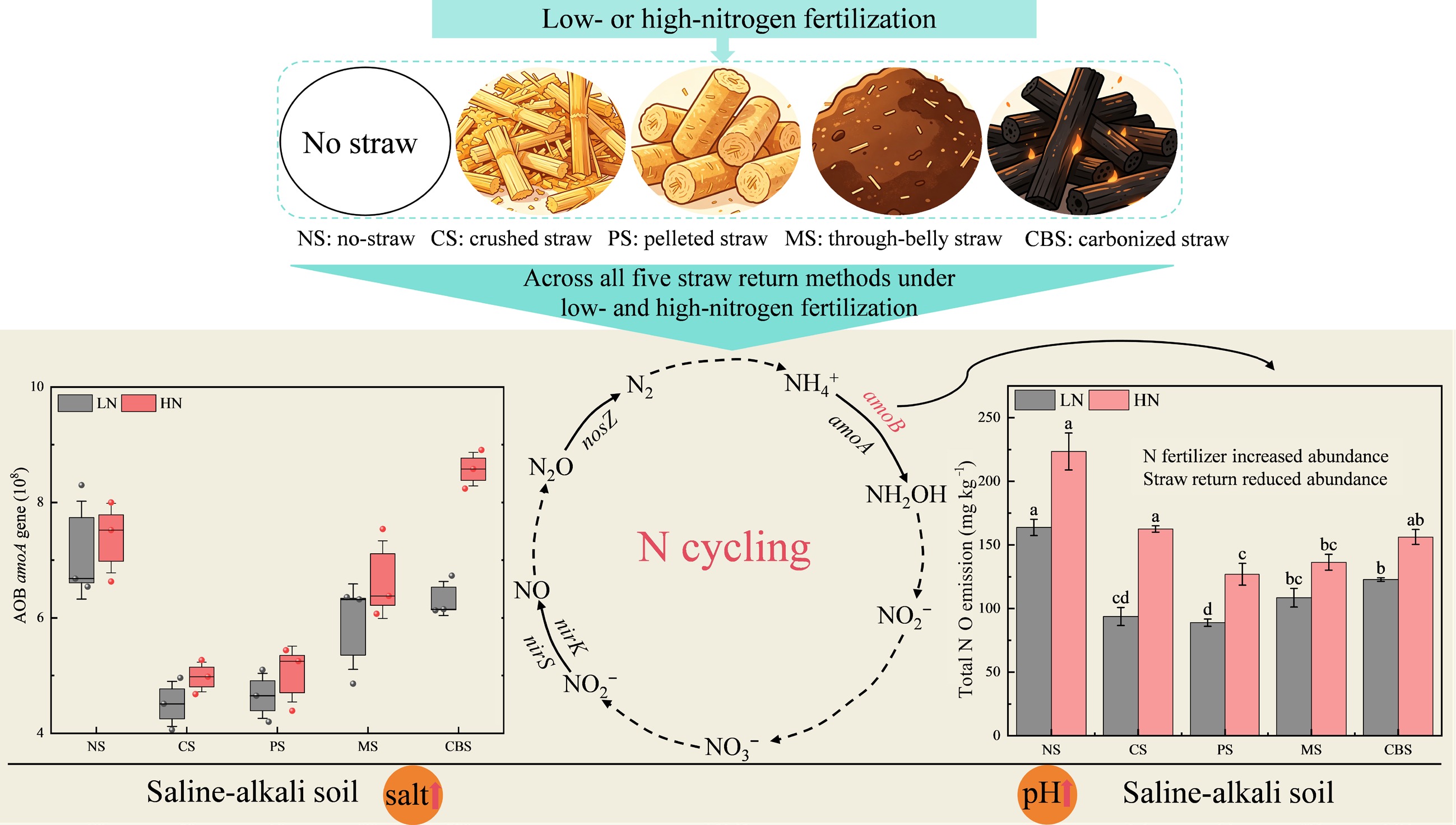
A relatively low N2O emission rate was recorded during the first 10 d, regardless of N application rate or straw return method, with a small peak observed on day 11 (Fig. 1a). Elevated applications of N fertilizer triggered a pronounced surge in total N2O inventories compared with the low-N regimes (Fig. 1b); furthermore, across both nitrogen supply levels, the chronological N2O discharge trajectories were heavily modulated by straw return. The non-straw (NS) control reached its peak flux on day 30, whereas all straw-amended treatments exhibited delayed peak emissions, which did not occur until day 60 (Fig. 1a, b). The method of straw return significantly reduced the N2O emission flux compared with the NS treatment, regardless of the amount of N fertilizer. Across all five straw return methods, total N2O emissions were elevated by an average of 41.6% under high-N fertilizer input compared with low-N, with the most pronounced difference recorded in the CS treatment. Compared with the NS treatment, under low-N conditions, the cumulative emissions of CS, PS, MS, and CBS treatments decreased by 42.8%, 45.7%, 33.7%, and 25.0%, respectively. Under high-N conditions, this mitigation effect was also significant, with the emissions decreasing by 31.8%, 43.2%, 39.0%, and 30.1%, respectively. Among these, PS treatment resulted in the lowest cumulative emissions overall (Fig. 1c, d). N fertilizer applications and straw return methodologies manifested a potent, synergistic interaction that conjointly governed the cumulative vectors of N2O discharge, meaning that N2O cumulative emissions were not only affected by N fertilizer or straw individually, but also significantly influenced by their combined effects (Supplementary Table S3).
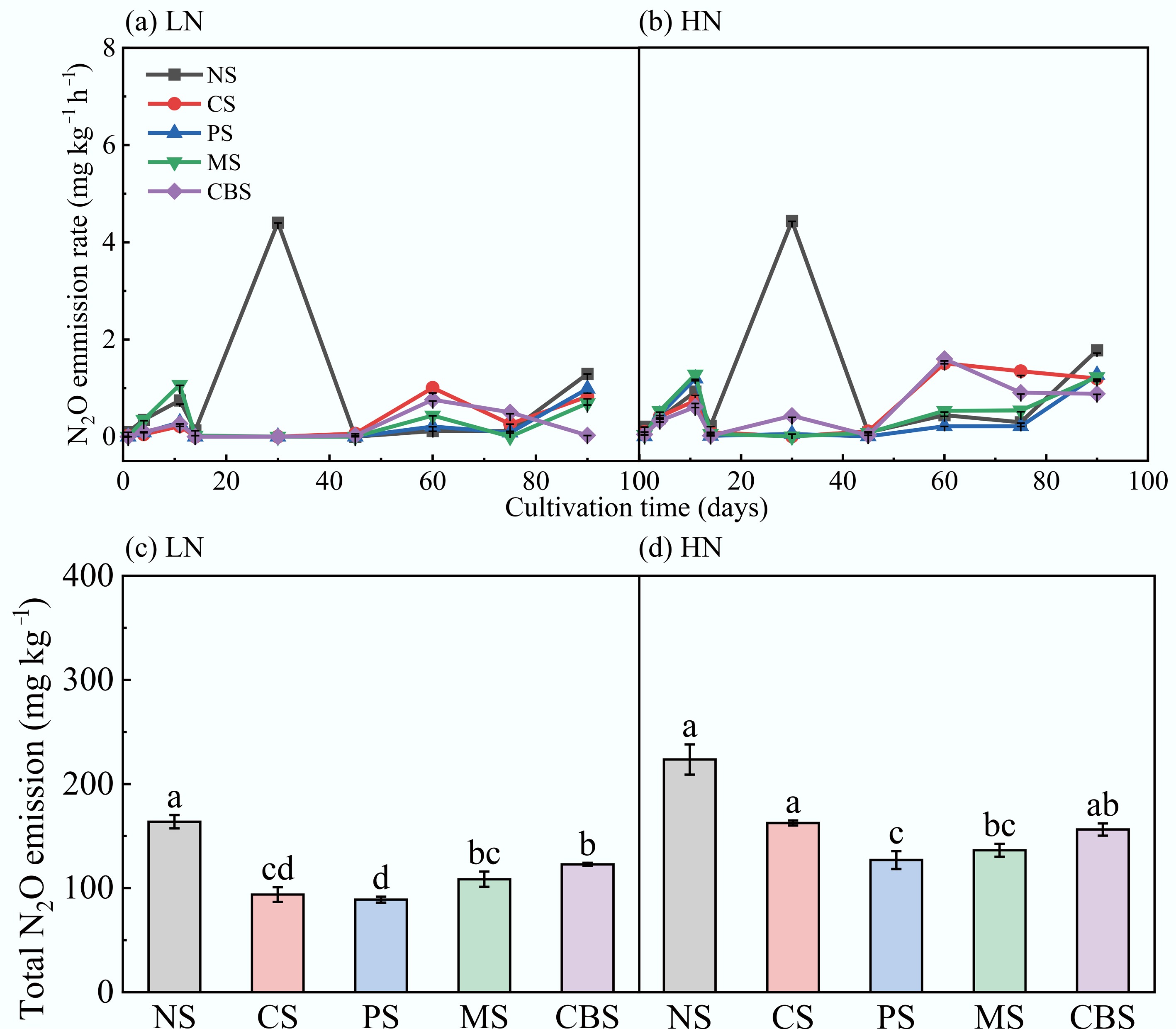
Figure 1.
During the 90-d incubation period, the temporal variations of (a), (b) N2O flux and (c), (d) cumulative N2O emissions in soil under five different straw return methods under low- or high-N conditions. Different letters indicate significant differences among treatments (p < 0.05). Vertical lines represent the standard error of the mean (n = 3).
Soil SOC, MBC, and inorganic nitrogen as affected by N fertilization and straw return
-
SOC content changed little with N fertilizer application rates, while it increased significantly with straw return (Fig. 2a). Compared with the NS treatment, the SOC content of CS, PS, MS, and CBS treatments increased by 13.3%, 20.5%, 52.7%, and 105%, respectively, under low-N conditions. Likewise, the increasing effects were 28.4%, 26.1%, 50.5%, and 59.7%, respectively, under high-N conditions (Fig. 2a). Two-way ANOVA indicated that the SOC content was solely influenced by the straw application method (p < 0.001, Fig. 2a). MBC was influenced by straw, N fertilizer, and their interaction (Fig. 2b). MBC content was generally higher under low-N than high-N, except for the PS treatment. Straw return increased MBC relative to NS, with the CS treatment showing the greatest enhancement under both N levels. The effect of straw incorporation on the MBC/SOC ratio depended on the type of amendment (Fig. 2c). While PS and CBS treatments increased the ratio under high-N relative to low-N, the opposite trend was observed for other treatments, with the CS treatment showing the largest difference (Δ = 1.71). At a given N level, all straw treatments (except MS, which showed a marginal decrease) elevated the ratio compared with the no-straw (NS) control. Notably, the CS treatment caused the most substantial increase, by 86.2% under low-nitrogen and 146% under high-N conditions.
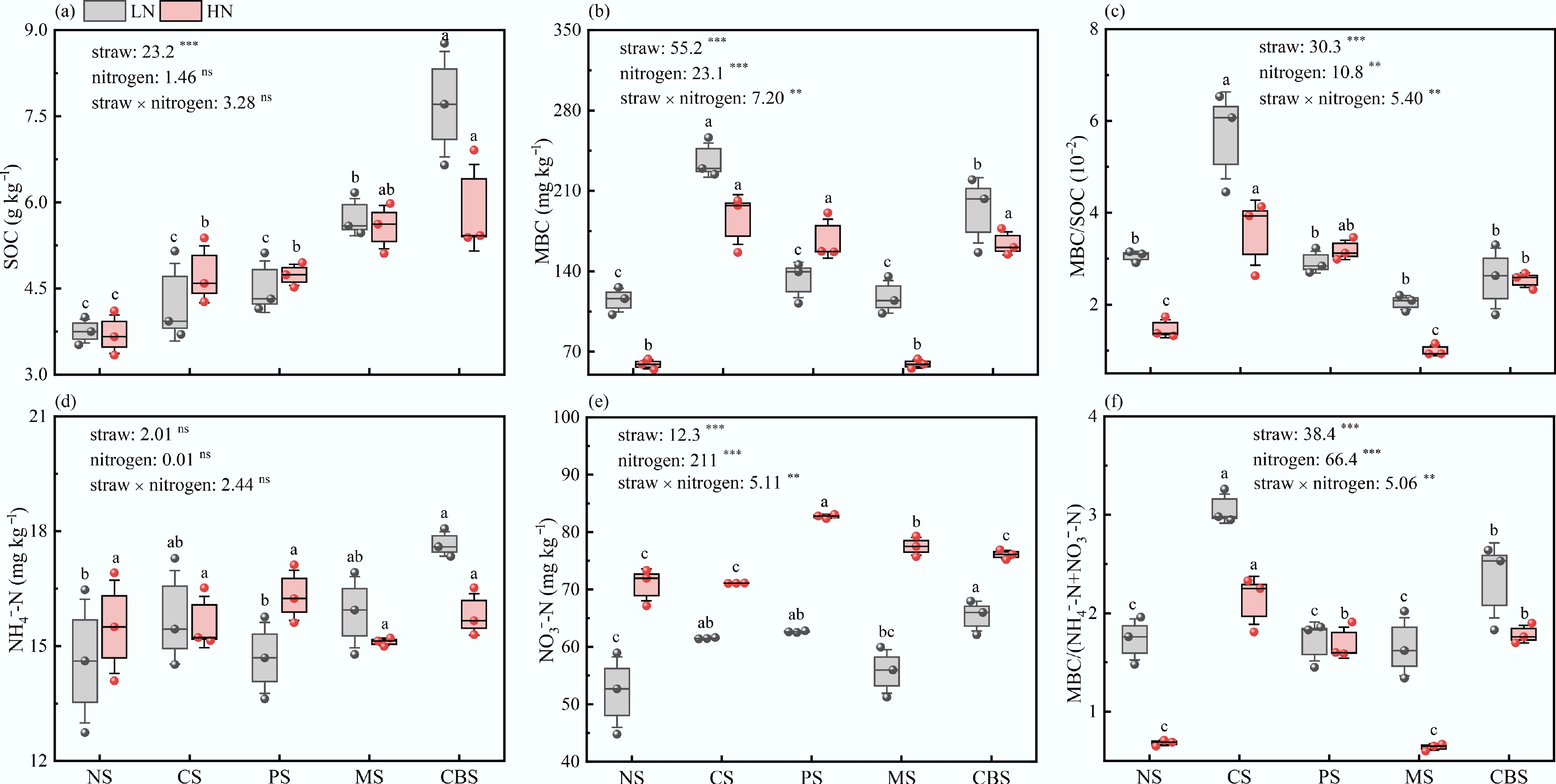
Figure 2.
After 90 days of cultivation, under low- or high-N conditions, the effects of five different straw return methods on the contents of soil SOC, MBC, MBC/SOC, NH4+-N, NO3−-N and MNN: (MBC/[NH4+-N + NO3−-N]).
NH4+-N was unaffected by N or straw, whereas NO3−-N was significantly influenced by both factors and their interaction (Fig. 2d, e). Straw return increased NO3−-N relative to NS, with CBS and PS showing the greatest effects under low-N and high-N, respectively. The MNN ratio was higher under low-N and was elevated by straw return, particularly under CS. F-values indicated that N fertilizer exerted a stronger influence than straw on both NO3−-N and this ratio, suggesting that inorganic N dynamics were driven primarily by N input.
Abundance of N2O-related functional genes in response to N fertilization and straw return
-
Overall, the abundance of AOA amoA genes was higher under high-N fertilizer than under low-N fertilizer (Fig. 3a). Under the same N fertilizer input, compared with the NS treatment, straw return significantly reduced the AOA amoA gene abundance; the CBS treatment significantly decreased this abundance by 36.8% and 33.7%, respectively, under low- and high-N fertilizer conditions (Fig. 3a). Similar to the AOA amoA gene, the abundance of the AOB amoA gene was higher under high-N fertilizer compared with low-N fertilizer (Fig. 3b). Under low- and high-N fertilizer conditions, the copy numbers of the AOB amoA gene under NS treatment were 7.18 × 10⁸ and 7.39 × 10⁸, respectively, which were significantly higher than those under straw return treatments (except for the CBS treatment under high-N fertilizer); among them, the CS treatment showed the greatest reduction in the AOB amoA gene, with a reduction of 36.9% (under low-N fertilizer) and 32.6% (under high-N fertilizer) (Fig. 3b). Finally, the two-way ANOVA confirmed that the two main factors had significant effects on the abundance of the nitrification gene, but there was no significant interaction between N fertilizer and straw application.
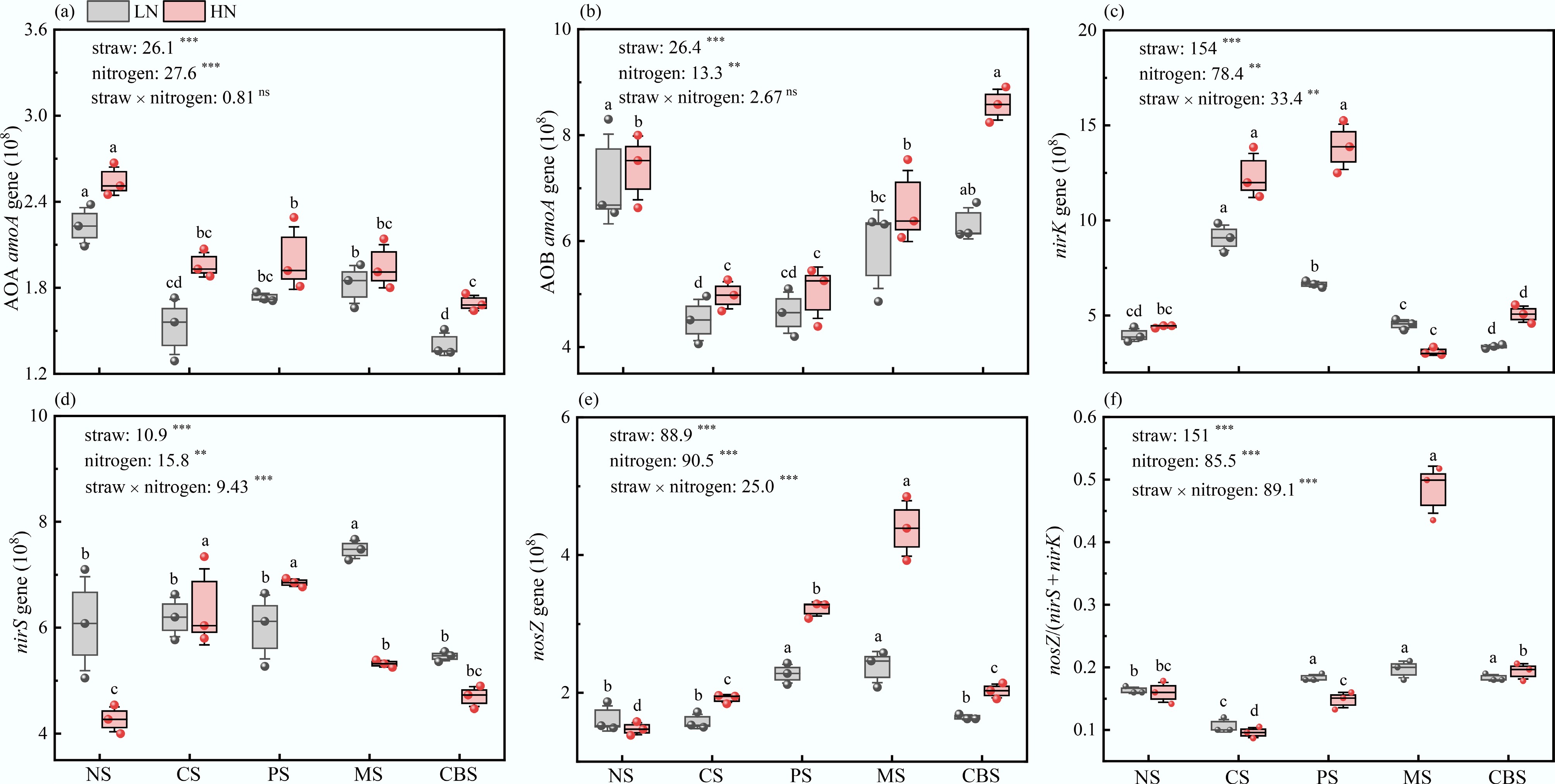
Figure 3.
After a 90-d cultivation period, the gene copy numbers of functional genes (a) AOA amoA, (b) AOB amoA, (c) nirK, (d) nirS, (e) nosZ, and (f) nosZ/(nirS + nirK) in the soil under low- or high-N conditions determined for five different straw return methods.
The abundance of denitrification genes was assessed by quantifying nirK, nirS, and nosZ copy numbers, along with the nosZ/(nirS + nirK) ratio (Fig. 3c–f). N fertilization increased the abundance of these genes, though the response varied by gene and treatment. High-N elevated nirK gene abundance by an average of 50.8% across all straw return treatments except MS. For nirS, significant increases occurred only under CS (3.06%) and PS (14.0%) treatments with high-N, while other straw amendments showed reduced abundance. In contrast, high-N consistently enhanced nosZ gene abundance by an average of 42.9% in all straw return treatments relative to NS. As for nosZ/(nirS + nirK), only the MS treatment showed a significant difference between low- and high-N fertilizer, while there were no significant differences among the other straw application methods. Straw return methods increased the abundance of denitrification genes, which was consistent between low- and high-N inputs. At the two N levels, compared with the NS treatment, the CS and PS treatments significantly increased the abundance of the nirK gene by 130% and 180% at the low N level, and by 67.3% and 214% at the high N level, respectively. At low-N levels, only the MS treatment resulted in a significant 23.0% increase in nirS abundance compared with the NS control. In contrast, under high-N, other straw return treatments except CBS significantly enhanced nirS gene copies compared with NS, with the PS treatment showing the greatest increase (60.4%). Under low-N input, only the PS and MS treatments exhibited significantly higher nosZ gene abundances compared with the NS control, with increases of 39.9% and 45.4%, respectively. Under high-N input, all straw-incorporated treatments except CS significantly increased nosZ gene copy numbers relative to NS, with the MS treatment showing the most pronounced rise (197%). Compared with NS, the MS treatment significantly increased the nosZ/(nirS + nirK) ratio under both low- and high-N conditions (by 22.2% and 206%, respectively). In contrast, the CS treatment reduced this ratio by 35.4% and 39.8% under the respective nitrogen regimes. The PS and CBS treatments also increased the ratio under low-N, although no significant differences were detected under high-N. Two-way ANOVA confirmed that the abundances of denitrification genes and the nosZ/(nirS + nirK) ratio were significantly affected by straw return, N fertilizer, and their interaction.
The random forest model analysis revealed that, regardless of low- or high-N levels, the abundance of the AOB amoA gene had the greatest contribution to the cumulative N2O emissions and was significantly correlated (Supplementary Fig. S1). However, during the incubation process, there was no significant correlation between N2O emissions and the abundance of other functional genes (Supplementary Table S4). Similarly, soil NO3−-N and MNN were significantly correlated with the abundance of AOB amoA genes, but not with the abundance of other genes (Supplementary Table S5). These results indicated that the AOB amoA gene played a crucial role in N2O emissions, and further studies focused on the community structure of bacteria carrying the AOB amoA gene rather than the community structure of other microbial groups.
Effects of N fertilizer and straw return methods on the nitrifying communities
-
Given the strong correlation between bacterial amoA genotype abundance and episodic soil N2O fluxes, high-throughput sequencing targeting the AOB amoA gene was employed to resolve the compositional structure of the AOB community. Under low-N fertilizer conditions, the Sobs index of AOB showed no significant differences among various straw return methods. The CS and PS treatments significantly reduced the Sobs index of AOB, from 405 under NS to 350 and 370 under CS and PS, respectively, compared with the NS treatment, under high-N fertilizer conditions. For the Simpson index, it was not affected by the straw, nor by the nitrogen fertilizer, and there was no interaction between the two. Furthermore, the empirical F-statistics derived from the two-way analysis demonstrated that straw incorporation exerted a more dominant regulatory leverage over the alpha diversity indices of the AOB community than the input of N fertilizer (Supplementary Fig. S2).
NMDS analysis revealed that CBS and NS treatments were separated from other straw return strategies under low-N conditions (Fig. 4a). Under high-N conditions, MS and NS treatments were distinguished along the NMDS1 axis, and the PS treatment was clearly separated from both the MS and CS treatments (Fig. 4b). A similar pattern was revealed by heat map analysis (Supplementary Fig. S3), in which the AOB communities were clustered into several distinct groups, with each cluster representing a specific straw return method. Moreover, a clear separation was observed between the low- and high-N fertilizer treatments, which were divided into two larger, N-level-specific clusters. Under low- and high-N conditions, the correlation between the straw return treatment and Nitrosospira was stronger than that of the NS treatment, and the MS treatment had the strongest correlation with Nitrosospira. Under low-N conditions, straw incorporation consistently increased the relative abundance of Nitrosovibrio compared with the NS treatment, with the MS treatment showing the greatest rise (from 7.78% to 11.3%). In contrast, the abundance of Nitrosospira decreased across all straw treatments. A similar trend was observed under high-N conditions: Nitrosovibrio abundance was again enhanced, most markedly in the MS treatment (from 9.50% to 13.6%), while Nitrosospira abundance was reduced by straw application (Supplementary Fig. S4).
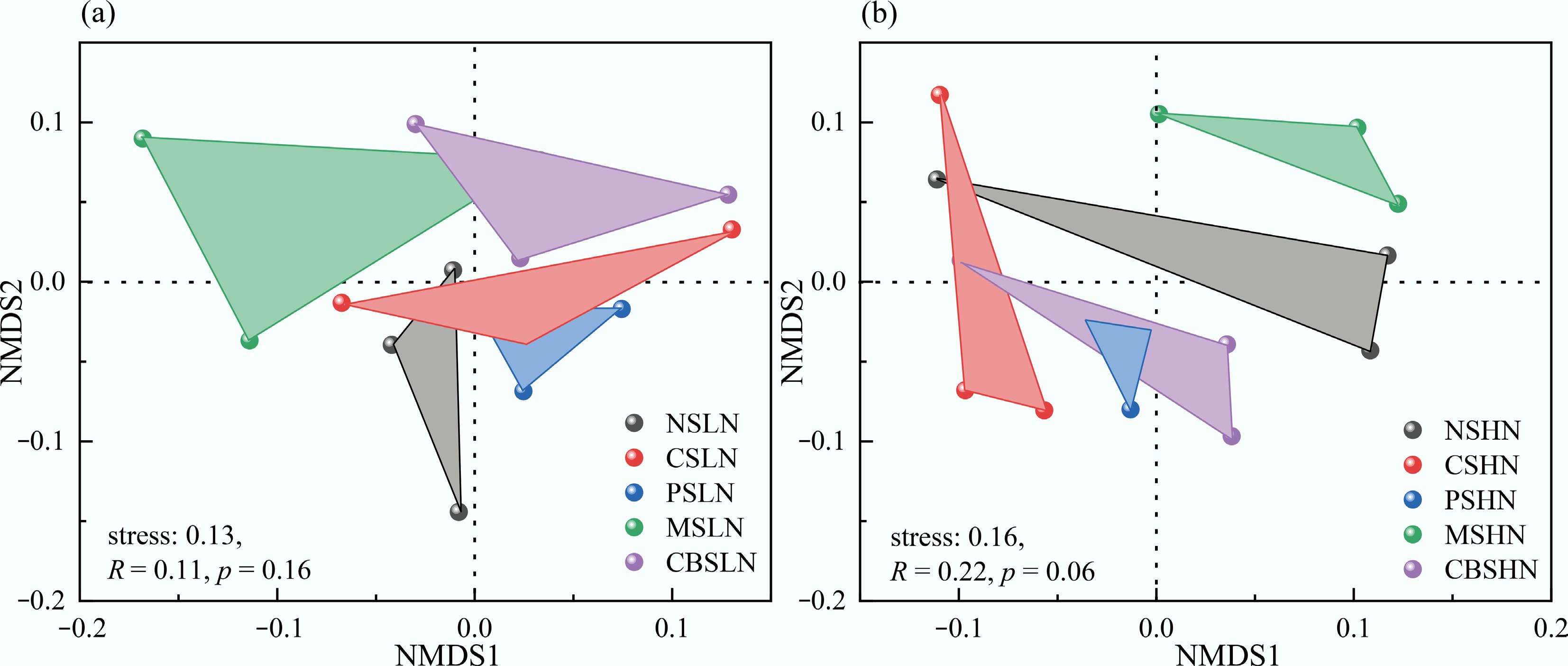
Figure 4.
NMDS analysis of AOB nitrifying bacterial communities under different straw return methods at (a) low-N or (b) high-N conditions.
Integrated relationships among environmental variables, microbial communities, and N2O emissions
-
Mantel tests revealed differential associations between AOB communities and properties under low-nitrogen (LN) and high-nitrogen (HN) conditions (Fig. 5). Under LN, the bacterial community under the NS treatment correlated significantly with most soil properties, positively with NO3−-N and negatively with MBC, SOC, MBC/SOC, and NH4+-N. In contrast, straw return treatments shifted these correlation patterns. Under HN, straw application led to a consistent positive correlation with NH4+-N and a negative correlation with NO3−-N across treatments, except for NS. The MS treatment uniquely showed a negative correlation with the MBC/SOC ratio under HN.
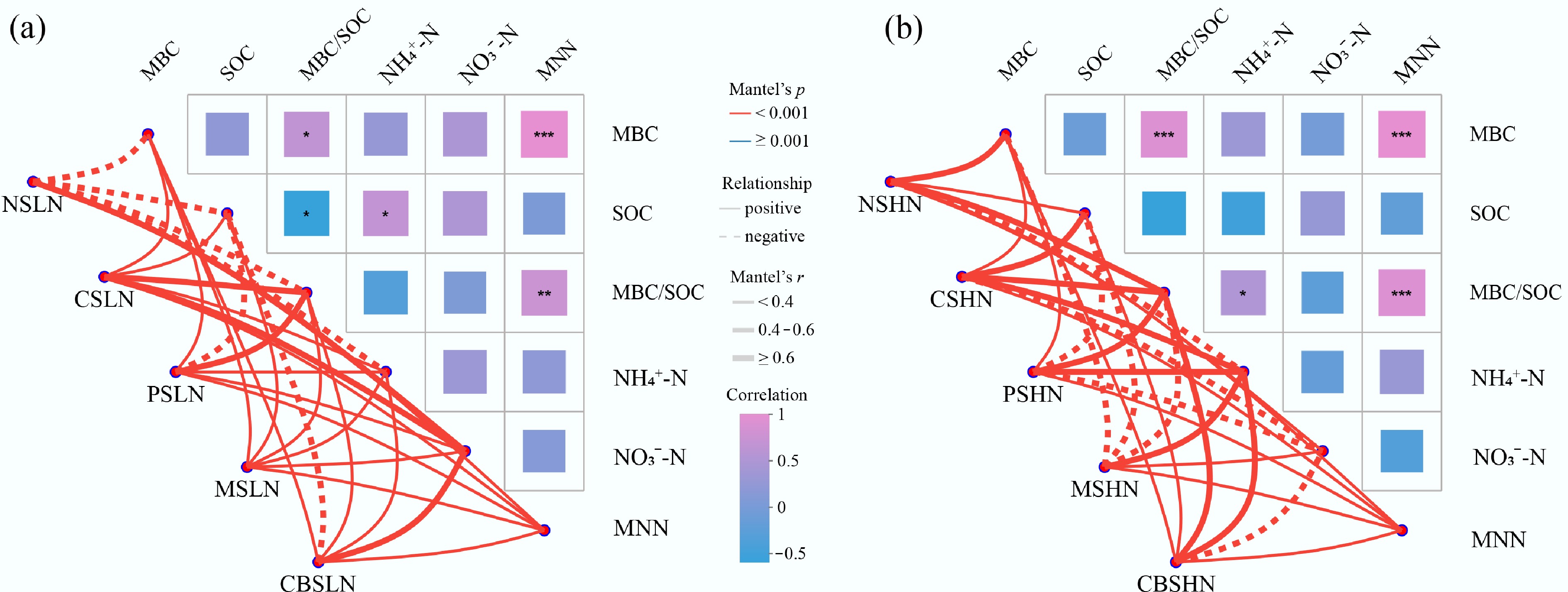
Figure 5.
The relationship between bacterial communities and soil properties under low-N or high-N conditions for different straw return methods (MNN: MBC/[NH4+-N + NO3−-N]).
PLS-SEM analysis indicated that cumulative N2O emissions were jointly driven by nitrifying (AOB and AOA amoA) and denitrifying gene abundances (Fig. 6). Their regulatory pathways differed with nitrogen level. Under LN, AOB amoA was positively regulated by nitrogen rate, whereas AOA amoA and denitrification genes were negatively regulated by nitrogen rate and MNN, respectively. Under HN, both AOB and AOA amoA were negatively regulated by MNN, while denitrification genes were positively regulated by both nitrogen rate and MNN. In both regimes, N2O emissions were primarily governed by AOB amoA. Under LN, AOA amoA exerted secondary control, whereas under HN, denitrification genes mediated the secondary influence via indirect pathways.
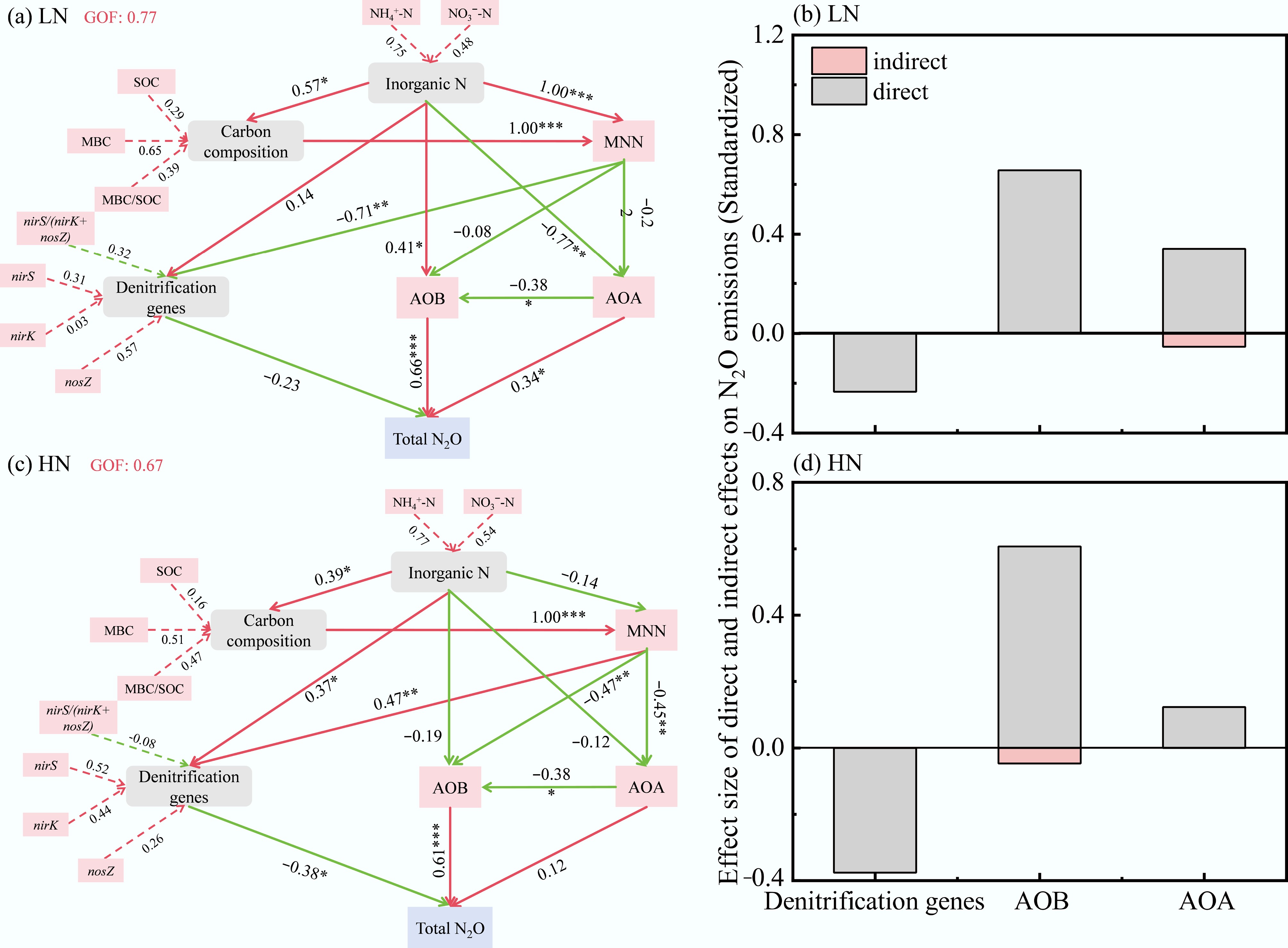
Figure 6.
Nitrification and denitrification gene responses to N2O accumulation emissions. The red line represents a positive effect, while the green line represents a negative effect. The numbers on the arrows indicate the standardized path coefficients. GOF (goodness-of-fit), a measure used for the explanatory power of the entire model as a whole. * p < 0.05; ** p < 0.01; *** p < 0.001.
-
Under identical straw incorporation methods, high-N fertilizer input significantly increased the expression of nitrification genes compared with the low-N fertilizer input (Fig. 3a, b). This aligned with observations by Ouyang et al.[47] who attributed such increases to the supply of substantial N substrate for the nitrification process. A meta-analysis by Li et al.[37] further demonstrated that chronic N fertilization stimulated potential nitrification rates alongside functional gene pools, highlighting the high responsiveness of nitrifying microbial guilds under sustained nutrient inputs. This pattern was further corroborated by the two-way ANOVA performed in the present study (Fig. 3a, b). Linear regression modeling explicitly decoupled a selective responsiveness in gas production, demonstrating that intermittent N2O fluxes were tightly coupled with the numerical density of bacterial amoA (p < 0.05), whereas the absence of statistical interdependence was observed for archaeal amoA (Supplementary Table S4). Shen et al.[48] continuously observed in an alkaline sandy loam substrate a similar pattern where the abundance of the bacterial amoA gene was correlated with the corresponding nitrification rate. Overall, in saline-alkali soils, increased N fertilizer application leads to higher N2O emissions, primarily driven by an increase in the abundance of the AOB amoA gene; meanwhile, denitrification genes also respond to N input, a trend particularly pronounced under HN conditions.
Mitigating effects of straw return on N2O emissions through microbial regulation
-
Compared with the NS control, all straw incorporations significantly reduced cumulative N2O emissions under equivalent N fertilization (Fig. 1c, d). This result contrasted with some previous studies. For instance, Lin et al.[49] reported that returning carbonized crop residues significantly increased N2O emissions, an effect possibly attributable to their use of acidic paddy soil, where straw application could alleviate soil acidification and stimulate nitrifier activity. In contrast, in the saline-alkali soil of this study, straw incorporation may lower pH, thereby suppressing nitrification and N2O production. Similarly, whereas Guo et al.[50] conceptualized that surging N2O fluxes were tightly coupled with the liberation of straw-derived NH4+-N reservoirs; our long-term incubation results demonstrated an absence of statistical divergence in soil NH4+-N between straw return and NS control (Fig. 2d), and regression analysis indicated no direct relationship between NH4+-N and N2O emissions (Supplementary Table S5). Instead, straw application in this system increased the ratios of MBC/SOC and MNN (Fig. 2e, f), suggesting enhanced microbial assimilation of carbon and nitrogen; a shift that may promote microbial nitrogen immobilization and reduce N2O emissions. This aligned with findings that straw return could elevate soil C content and maintain a C:N ratio favorable for microbial growth, thereby mitigating N2O emissions[51,52]. Thus, in saline-alkali soils, the N2O-reducing effect of straw appears to operate through modified microbial carbon and nitrogen stoichiometry rather than through inorganic nitrogen dynamics alone.
Notably, the outcomes of the present investigation diverged starkly from the precedents set by Song et al.[53] within coastal saline-alkali environments, where biochar application historically upregulated archaeal and bacterial amoA via a pH-mediated optimization cascade; conversely, the diverse straw incorporation methodologies deployed in our workflow universally suppressed both the AOA and AOB functional genes (Fig. 3a, b). This discrepancy may stem from differences in initial soil conditions, as our soil had a pH of 8.21, and straw incorporation can further acidify saline-alkali soil, thereby inhibiting nitrifier activity. Consistent with our results, Wang et al.[39] reported that maize straw incorporation suppressed the nitrification process and lowered the copy numbers of related functional genes. Furthermore, the observed negative correlation between AOB amoA gene abundance and SOC, supported by Huang et al.[40] aligned with our data showing that straw addition raised SOC content but reduced AOB amoA gene abundance (Figs. 2a, 3b). The dominant role of AOB in driving N2O emissions in our system was consistent with findings in grassland and straw-amended soils[54,49,55], whereas AOA tended to dominate in acidic or water-logged soils[56,57]. Furthermore, among the four straw application treatments, the CS treatment exhibited the most pronounced effect on MBC enhancement and AOB amoA suppression, whereas the MS treatment showed the greatest stimulation of nosZ gene abundance. The PS treatment generally performed intermediately, while the CBS treatment had relatively weaker effects on most microbial parameters. These differences suggested that the physical form and properties of straw influenced microbial community responses and N2O mitigation efficiency[58,59]. Thus, the reduction in AOB amoA abundance by straw incorporation provided a correlative mechanistic explanation for the observed reduction in N2O emissions, which was corroborated by earlier reports[60]. Within the AOB community, Nitrosospira remained the dominant genus at both N levels; however, straw return consistently reduced its relative abundance while promoting that of Nitrosovibrio (Supplementary Fig. S4). This shift is in line with previous observations that biochar and organic fertilizer amendments stimulate Nitrosovibrio in saline-alkali soils, a response often attributed to changes in soil pH, NH4+-N, and salinity[61,62]. These two genera exhibit distinct ecological preferences: Nitrosovibrio-affiliated phylotypes appear better adapted to the combined stresses of high pH and salinity, as evidenced by the salt-tolerance-based niche differentiation of soil ammonia oxidizers[63]. Moreover, their response to organic carbon input suggests that Nitrosovibrio may be more competitive in organically amended saline-alkali niches, where substrates are heterogeneously distributed, and osmotic stress is elevated. While both Nitrosospira and Nitrosovibrio contribute to N2O production through nitrification and nitrifier denitrification, comparative data on their intrinsic N2O yields per unit of ammonia oxidized remain scarce. Consequently, the taxonomic shift reported here is best interpreted as a community-level response to straw-induced changes in soil physicochemical conditions. Whether the enrichment of Nitrosovibrio directly contributes to the observed N2O mitigation, for instance, by altering nitrification kinetics or nitrite dynamics, remains to be confirmed through activity-based measurements and pure-culture studies.
Integrated regulation of N2O emissions by the interplay between N fertilizer and straw return
-
In this study, N2O emission dynamics followed a similar temporal pattern under both low- and high-N conditions, with emission peaks typically occurring around 10 d after fertilization (Fig. 1a, b). This sharp increase was likely driven by the transient accumulation of NH4+-N and NO3−-N in topsoil following N input[64]. N2O emissions were jointly regulated by soil nitrification and denitrification genes, as also reported in previous studies[40,65]. Our results further demonstrated that N input levels determined the relative contributions of nitrification vs denitrification-associated genes in regulating N2O emissions (Fig. 6). This finding aligns with a meta-analysis by Ouyang et al.[47], who reported that both low- and high-N fertilization significantly increased AOB amoA gene abundance, with the effect of nitrogen on AOB being nine times greater than that on AOA amoA genes. Their analysis further indicated that denitrification genes were unaffected under low-N but responded significantly under high-N conditions. This differential regulation could be explained by nitrogen availability. Under low-N input, the limited N supply primarily favored nitrification. In contrast, high-N input promoted urea hydrolysis via urease activity, elevating NH4+-N levels, which in turn enhanced nitrification and NO3−-N production, thereby creating favorable conditions for denitrification and significantly increasing N2O emissions[59]. Our findings highlighted an N-level-dependent regulatory mechanism that only under high-N input did inorganic N exert a significant positive effect on denitrification genes (Fig. 6a, c). This corresponded directly to the marked increase in denitrification gene abundance observed under HN conditions (Fig. 3c–e).
Overall, these results emphasized that denitrification in saline-alkali soils (and the resulting large amount of N2O production) depends on whether the nitrogen input exceeds the critical value (such as the HN of 240 kg ha−1 in this study). However, the response intensity of this regulatory mechanism varies between saline-alkali soils and ordinary farmland soils, and this difference may be determined by the inherent physical and chemical properties of saline-alkali soils (high pH, salt stress, low SOC). Firstly, the pH value of the tested saline-alkali soil in this study was as high as 8.21, with a salt content of 2.39 g kg−1, and the soil TOC content was only 4.45 g kg−1; while non-saline-alkali farmland (such as the loess soil in the North China Plain or the black soil in Northeast China) usually has a pH ranging from 6.5 to 7.5, with an EC lower than 0.5 dS m−1, and the SOC content is generally above 1.5% to 2.5%[4,66]. Therefore, compared with saline-alkali soil, if the same high-nitrogen treatment was applied to ordinary soil, the AOB community and denitrification products might have had different responses. This was mainly because in saline-alkali soil, the high pH and salts (Na+, Cl−) enhanced the osmotic stress and ionic imbalance of AOB cells[67], while in ordinary soil, the AOB community had a higher abundance and adaptability, and its amoA gene abundance could often tolerate up to 200 mg N kg−1 of ammonium salt addition without significant inhibition[68]. Secondly, due to the low SOC content and severe lack of electron donors in saline-alkali soil, when the input of nitrate increased sharply, the reductase (especially the N2O reductase encoded by nosZ) became inhibited due to carbon source competition, resulting in a large accumulation of N2O[69]. In contrast, the abundant DOC in ordinary farmland provided sufficient electrons for the terminal reduction of denitrification, promoting the rapid reduction of N2O to N2[70]. In conclusion, the mechanism revealed by this study had biological universality, but its response intensity and actual environmental effects were closely related to the saline-alkali characteristics. This also means that when formulating emission reduction strategies for saline-alkali soil in the future, carbon source supplementation and N control must be coupled together, rather than relying solely on reducing the amount of N fertilizer.
-
Overall, our research indicated that straw return mitigated N2O emissions induced by excessive N fertilization in saline-alkali soils. It is of vital importance that soil NO3−-N is the primary non-biological determinant for regulating N2O emissions in saline-alkali soils. While N fertilizer increased the abundance of AOB amoA genes, straw incorporation significantly reduced AOB amoA gene abundance, which was significantly correlated with the observed mitigation effect. Straw return also shifted the dominant AOB genus from Nitrosospira to Nitrosovibrio. Furthermore, N2O emissions were differentially regulated under low- vs high-N conditions: emissions were primarily driven by the positive regulation of nitrifying genes under low-N, whereas they were co-regulated by the positive effect of AOB amoA and the negative influence of denitrification genes under high-N. Therefore, our research systematically revealed the interaction effect of N fertilizer and straw on N2O emissions in saline-alkali soil. Surplus N inputs exerted a profound primordial priming effect on the internal edaphic nitrogen reservoirs—predominantly expanding the NO3−-N fractions—which subsequently catalyzed a massive upsurge in cumulative N2O. However, the interaction between straw and N fertilizer showed a reducing effect on N2O emissions. These findings provide a mechanistic, gene-centric rationale for using straw return as an effective strategy to repurpose agricultural waste and mitigate greenhouse gas emissions in saline-alkali croplands. Future studies should focus on optimizing the rate, placement, and formulation of straw amendments to enhance their efficacy and sustainability in cropping systems.
No acknowledgements are applicable for this work.
-
It accompanies this paper at: https://doi.org/10.48130/nc-0026-0014.
-
Not applicable.
-
The authors confirm their contributions to the paper as follows: Zhen Li, Huimin Dong, Wenshuo Liu, Quangang Yang: data collection; Zhen Li, Wenshuo Liu, Hong Pan: data analysis; Zhen Li, Hong Pan: manuscript drafting and editing; Huimin Dong, Yuping Zhuge: study conception and design; Yaqi Yu, Marcela Hernández: conceptualization; Yaqi Yu: investigation; Marcela Hernández, Hongjie Di, Hong Pan: resources; Yanhong Lou: methodology; Yanhong Lou, Haojie Feng, Hui Wang: formal analysis; Haojie Feng: writing original draft. All authors reviewed the results and approved the final version of the manuscript.
-
Authors can confirm that all relevant data are included in the article.
-
The authors declare that they have no conflict of interest.
-
# Authors contributed equally: Zhen Li, Huimin Dong
Full list of author information is available at the end of the article. - The supplementary files can be downloaded from here.
- Copyright: © 2026 by the author(s). Published by Maximum Academic Press, Fayetteville, GA. This article is an open access article distributed under Creative Commons Attribution License (CC BY 4.0), visit https://creativecommons.org/licenses/by/4.0/.
-
About this article
Cite this article
Li Z, Dong H, Liu W, Yu Y, Hernández M, et al. 2026. Straw return methods differentially mitigate N2O emissions with reduced AOB amoA abundance and shifted community composition in N-fertilized saline-alkali soils. Nitrogen Cycling 2: e027 doi: 10.48130/nc-0026-0014 

Straw return methods differentially mitigate N2O emissions with reduced AOB amoA abundance and shifted community composition in N-fertilized saline-alkali soils
- Received: 17 June 2026
- Revised: 07 August 2026
- Accepted: 07 September 2026
- Published online: 24 September 2026
Abstract: In saline-alkali soils, nitrogen (N) fertilization is crucial for crop productivity but stimulates substantial nitrous oxide (N2O) emissions. While straw return can ameliorate saline-alkali soils, its effect on N2O emissions is ambiguous, and it is unclear how this effect varies with different straw application methods. Here, we conducted a 90-d incubation experiment to compare the effects of different straw management pathways, combined with low (120 kg ha−1) and high (240 kg ha−1) N levels. The treatments included: no straw (NS), direct straw incorporation as crushed (CS) or pelletized (PS) forms, and straw-derived organic amendments, namely cattle manure from straw-fed livestock (MS) and carbonized straw biochar (CBS). Our results showed that high N input increased cumulative N2O emissions by an average of 41.6%, primarily by elevating the abundance of ammonia-oxidizing bacterial (AOB) amoA genes, the only functional gene significantly correlated with N2O flux (R2 = 0.328, p < 0.005). Importantly, the magnitude of N2O mitigation varied substantially among straw methods. Pelletized straw (PS) achieved the greatest reduction, lowering emissions by up to 45.7% compared with NS, while carbonized straw (CBS) was the least effective. These methods differentially suppressed AOB amoA abundance and shifted the dominant AOB genus from Nitrosospira to Nitrosovibrio. Crushed and pelletized straw were more effective in suppressing AOB amoA and reducing N2O than through-belly or carbonized straw, likely due to higher decomposition rates and labile carbon release. Straw incorporation also delayed the N2O emission peak from day 30 to day 60, a pattern significantly correlated with soil NO3−-N content. Our results demonstrate that the mitigation effect of straw return on N2O emissions in saline-alkali soils is method-dependent, with pelletized straw being the most effective strategy for suppressing AOB-driven N2O production. These insights provide a mechanistic basis for optimizing straw management to balance soil amelioration and greenhouse gas mitigation.
-
Key words:
- Nitrous oxide /
- amoA genes /
- Saline-alkali soils /
- Straw return /
- Nitrogen fertilizer