












-
While humans have consumed mushrooms since ancient times[1], scientific research into mushrooms—particularly cultivation and breeding—is relatively recent[2]. In the Japanese archipelago, covered by vast forests, earthenware featuring mushroom motifs was produced over 4,000 years ago, in an era before writing was used[3]. While precise information on mushroom consumption during that era remains unclear, the ancient Japanese poetry anthology Man'yōshū contains a poem praising the mushroom hunting of matsutake (Tricholoma matsutake [S. Ito & S. Imai] Singer), believed to date from around 700 AD[4]. Furthermore, texts on medicinal substances and foodstuffs written during the Edo period, before the introduction of natural sciences, already documented approximately 300 species of mushrooms, describing their ecology and edible uses[5,6]. Building on this deep insight into wild organisms, hundreds of mushroom species were documented under the natural sciences introduced during the Meiji era, with many entries including descriptions of their edibility and toxicity[7,8]. Even in the 20th century, the consumption of wild mushrooms remained widespread in Japan's mountain villages, which were still far from developed. Records collected during this era indicate that around 300 species of mycorrhizal fungi alone were known for food use[9]. Adding saprophytic fungi, such as wood-rotting fungi, suggests that around 500 species of mushrooms was utilized for food. This species count represents one of the highest levels globally, likely surpassing even the levels seen today in Yunnan Province, China, and its surrounding areas, which are considered the most active regions for such utilization[10]. However, the number of wild mushrooms actually consumed in Japan today is thought to be around 200 species at most. Even so, this vast number of species were utilized for food in their respective regions, and it is from this pool that many cultivated mushrooms were selected.
In Japan, technical development has been conducted on over 50 mushroom species for commercial cultivation. Of these, 32 species are eligible for variety registration within Japan (Table 1;
www.zenkinkyo.jp/reg/index.html ). Today, the most produced cultivated mushroom in Japan is enokitake (Flammulina velutipes [Curt.: Fr.] Sing.), followed by buna-shimeji (Hypsizygus marmoreus [Peck.] Bigelow) and shiitake (Lentinula edodes [Berk.] Pegler) (Table 2; Fig. 1). Within Japan, statistical data on cultivated mushrooms have been recorded as government statistics since the mid-20th century. When a new cultivated species enters commercial production, it is collected as statistical data by item. The total annual production of cultivated mushrooms in Japan is approximately 450,000 tons, with a production value of about 200–250 billion yen (Figs 2 and 3). While some international statistics indicate this production volume is only about one-ninetieth that of China, based on the FAO data in 2021[11], the world's largest producer, some view the gap between the two, considering other logistics and trade data, as closer to one-fiftieth. Regardless, the overwhelming quantitative difference between these two countries is undeniable; nevertheless, Japan's production volume ranks second globally. Particularly, the sight of numerous varieties of packaged, fresh cultivated mushrooms abundantly sold in supermarkets is unique to Japan worldwide. This fact starkly demonstrates the existence of an advanced production system for cultivated mushrooms, built upon market importance and supply. Such technological capability and efficiency can be said to place Japan at the global forefront. One key point examined in this review is the historical background upon which this high technological capability is founded.Table 1. List of mushroom species eligible for variety registration under the Plant Variety Protection and Seed Act in Japan.
Japanese common name Latin name* Year of registration Arage-kikurage Auricularia polytricha (Montagne) Sacc. 1983 Kikurage Auricularia auricula-judae (Bull.) Quél. 1983 Enokitake Flammulina velutipes (Curtis) Singer 1983 Shiitake Lentinula edodes (Berk.) Pegler 1983 Hiratake Pleurotus ostreatus (Jacquin) P. Kumm. 2004 Usuhiratake Pleurotus pulmonarius (Fr.) Quél. 2004 Eryngi Pleurotus eryngii (DC.) Quél. 2004 Oohiratake Pleurotus cystidiosus O.K. Mill. 2004 Kuro-awabitake Pleurotus abalonus Y.H. Han, K.M. Chen & S. Cheng 1983 Tamogitake Pleurotus citrinopileatus Singer 1991 Shiro-tamogitake Hypsizygus ulmarius (Bull.) Redhead 2004 Buna-shimeji Hypsizygus marmoreus (Peck.) Bigelow 2004 Hatake-shimeji Lyophyllum decastes (Fr.) Singer 2004 Hon-shimeji Lyophyllum shimeji (Kawam.) Hongo 2004 Niou-shimeji Macrocybe gigantea (Massee) Pegler & Lodge 2004 Murasaki-shimeji Lepista nuda (Bull.: Fr.) Cooke 2004 Komurasaki-shimeji Lepista sordida (Schumach. : Fr.) Singer 1991 Mukitake Sarcomyxa edulis (Y.C. Dai, Niemelä & G.F. Qin) T. Saito, Tonouchi & T. Harada 1983 Tsukuritake Agaricus bisporus (J.E. Lange) Imbach 2004 Hime-matsutake Agaricus subrufescens Peck 1991 Yanagi-matsutake Agrocybe cylindracea (Fr.) Gill. 1983 Nameko Pholiota microspora (Berk.) Sacc. 2004 Numeri-sugitake Pholiota aurivella (Batsch) P. Kumm. 1991 Kuritake Hypholoma lateritium (Schaeff.) P. Kumm. 2004 Tama-choreitake Polyporus tuberaster (Jacquin ex Persoon) Fries 1983 Maitake Grifola frondosa (Dicks.) Gray 2004 Tonbi-maitake Meripilus giganteus (Pers.) Karst. 2004 Hanabiratake Sparassis crispa (Wulfen) Fr., 2004 Buna-haritake Mycoleptodonoides aitchisonii (Berkeley) Maas Geesteranus 2004 Yamabushitake Hericium erinaceum (Bull.) Persoon 2004 Mannentake Ganoderma lucidum (Leyss. ex. Fr.) Karst 2004 Kinugasatake Phallus indusiatus Ventenat 2004 *Although several species have arguments in the Latin name, this list follows the government report. Table 2. Annual production of primary cultivated mushrooms in Japan in 2022.
Species (Japanese common name) Production (metric tons) Production share (%) by the local provinces in the domestic market 1 2 3 Market share (%) Province Market share (%) Province Market share (%) Province Flammulina velutipes* (Enokitake) 126,000 59.1 Nagano 15.2 Niigata 4.4 Fukuoka Hypsizygus marmoreus (Buna-shimeji) 123,000 42.0 Nagano 17.5 Niigata 12.3 Fukuoka Lentinula edodes (Shiitake; fresh) 69,000 10.9 Tokushima 8.8 Iwate 7.1 Hokkaido Lentinula edodes (Shiitake; dried) 2,000 37.8 Ooita 17.7 Miyazaki 10.2 Kumamoto Grifola frondosa (Maitake) 57,000 64.0 Niigata 9.6 Shizuoka 6.7 Fukuoka Pleurotus eryngii (Eringi) 38,000 42.3 Nagano 31.5 Niigata 4.7 Fukuoka Pholiota microspora (Nameko) 24,000 22.9 Nagano 20.9 Niigata 18.1 Yamagata Sum of the above six species 460,000 33.5 Nagano 21.3 Niigata 6.2 Fukuoka * Although Flammulina filiformis is recently used for the taxonomy, the government report has used F. velutips. Data source: The database of the Ministry of Agriculture, Fisheries, and Forestry ( www.maff.go.jp/j/tokei/kouhyou/tokuyo_rinsan/index.html ).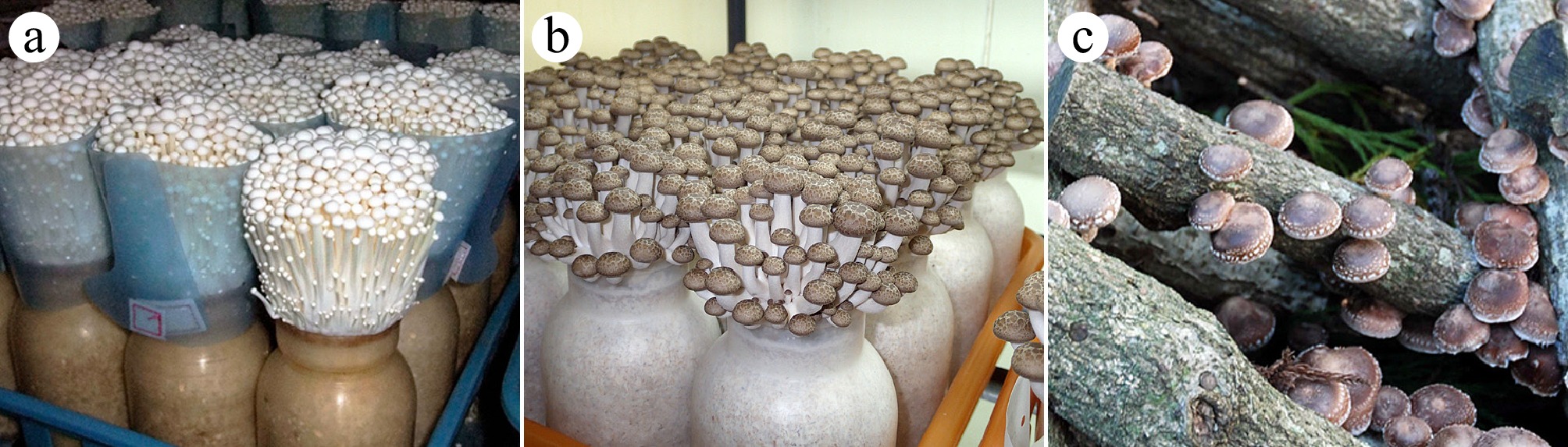
Figure 1.
Cultivated mushrooms of (a) Flammulina velutipes photographed by Hiroyuki Shimizu, (b) Hypsizygus marmoreus photographed by H. Shimizu, and (c) Lentinula edodes photographed by Hisayasu Kobayashi.
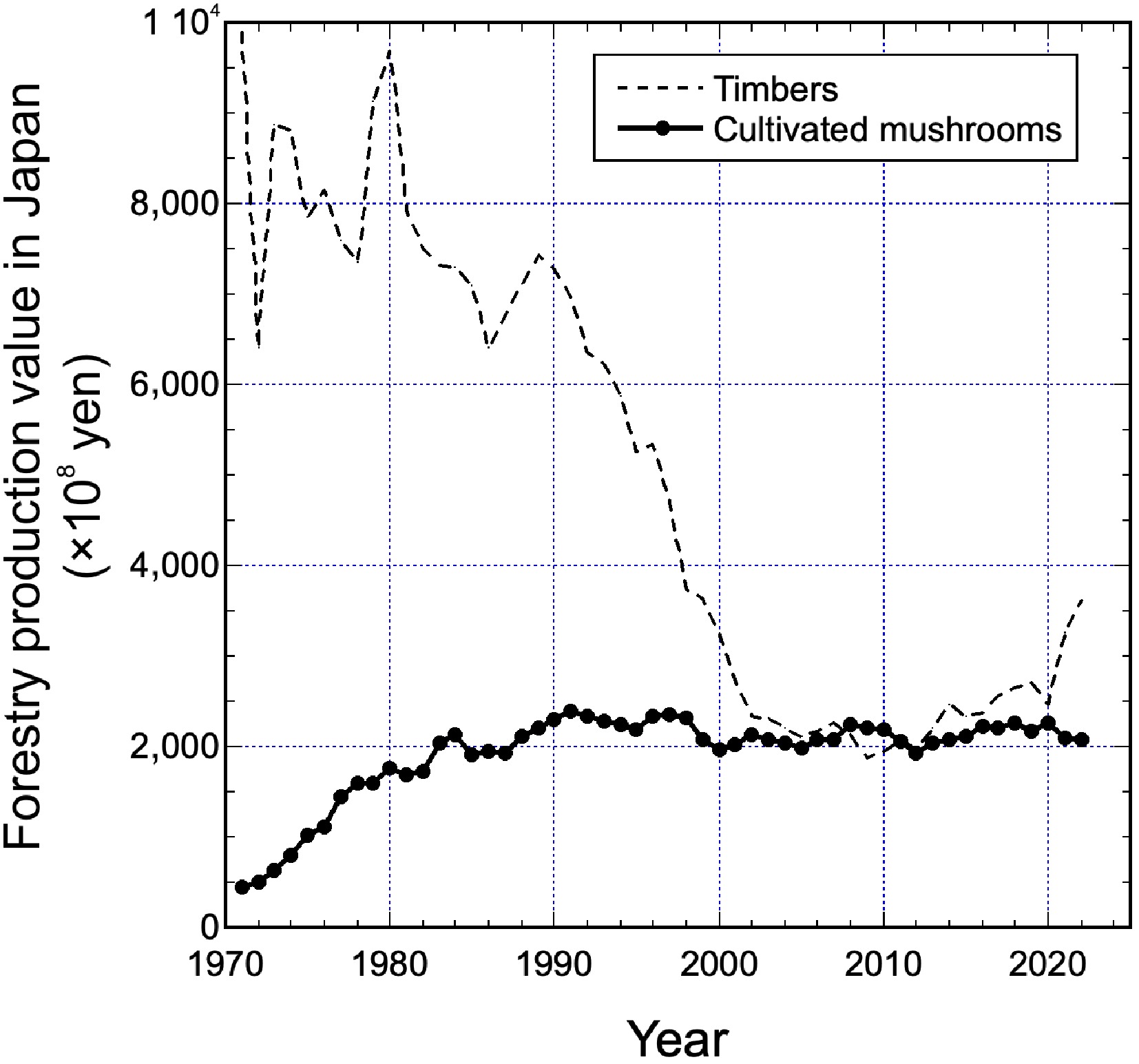
Figure 2.
The production of timbers and cultivated mushrooms in Japan in the past half-century. Data source: Statistics of the Ministry of Agriculture, Forestry and Fisheries, Japan (
www.maff.go.jp/j/tokei/index.html ).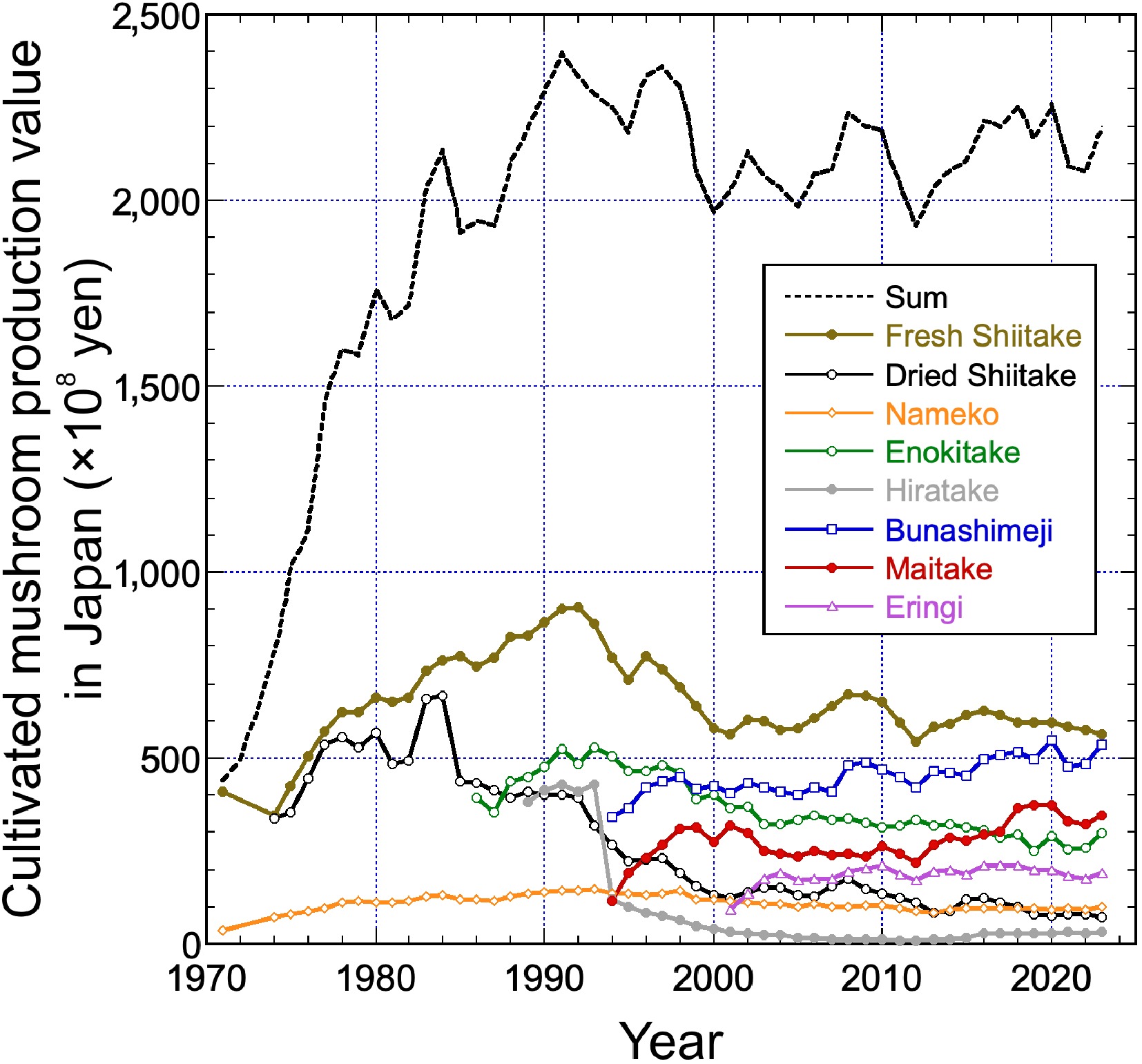
Figure 3.
Cultivated mushrooms production value in Japan in the past half a century. Data source: Statistics of the Ministry of Agriculture, Forestry and Fisheries, Japan (
www.maff.go.jp/j/tokei/index.html ).Until the early 20th century, Japan was by no means an economic powerhouse; it remained merely a small Asian nation dependent on primary production. Within this context, Japanese agriculture and forestry were vital domestic industries, and the consumption of wild mushrooms held an importance incomparable to today. During this era, mushroom cultivation was barely practiced through log cultivation, and mushroom production was essentially a privilege granted to mountain villages, characterized by their proximity to forests[12]. Within this context, residents of mountain villages, including forestry workers, collectively gathered a wide variety of mushrooms such as T. matsutake, Lyophyllum shimeji (Kawam.) Hongo, Suillus bovinus (L.) Roussel, Pholiota microspora (Berk.) Sacc., Hypholoma lateritium (Schaeff.) P. Kumm., and Armillaria mellea s. l. mushrooms to support their livelihoods (Fig. 4; Table 3). Of these, the yield of mycorrhizal mushrooms showed a definite correlation with the number of people involved in harvesting them, as well as with the amount of firewood and fallen branches collected as essential fuel for mountain village life, or fallen leaves plowed into fields as fertilizer[13]. In other words, the removal of a certain amount of fallen branches and leaves accumulating on the forest floor, and environments where these were scarce, had a positive effect on the yield of mycorrhizal mushrooms. This causal relationship gradually became apparent amid the gradual decline in mushroom harvests in mountain forests since the mid-20th century[14]. Under Japan's current economic conditions and climate change, a major challenge now looms: how to maintain and even restore the harvests of mycorrhizal mushrooms, particularly the significantly reduced T. matsutake. We will examine these points by presenting specific case studies.
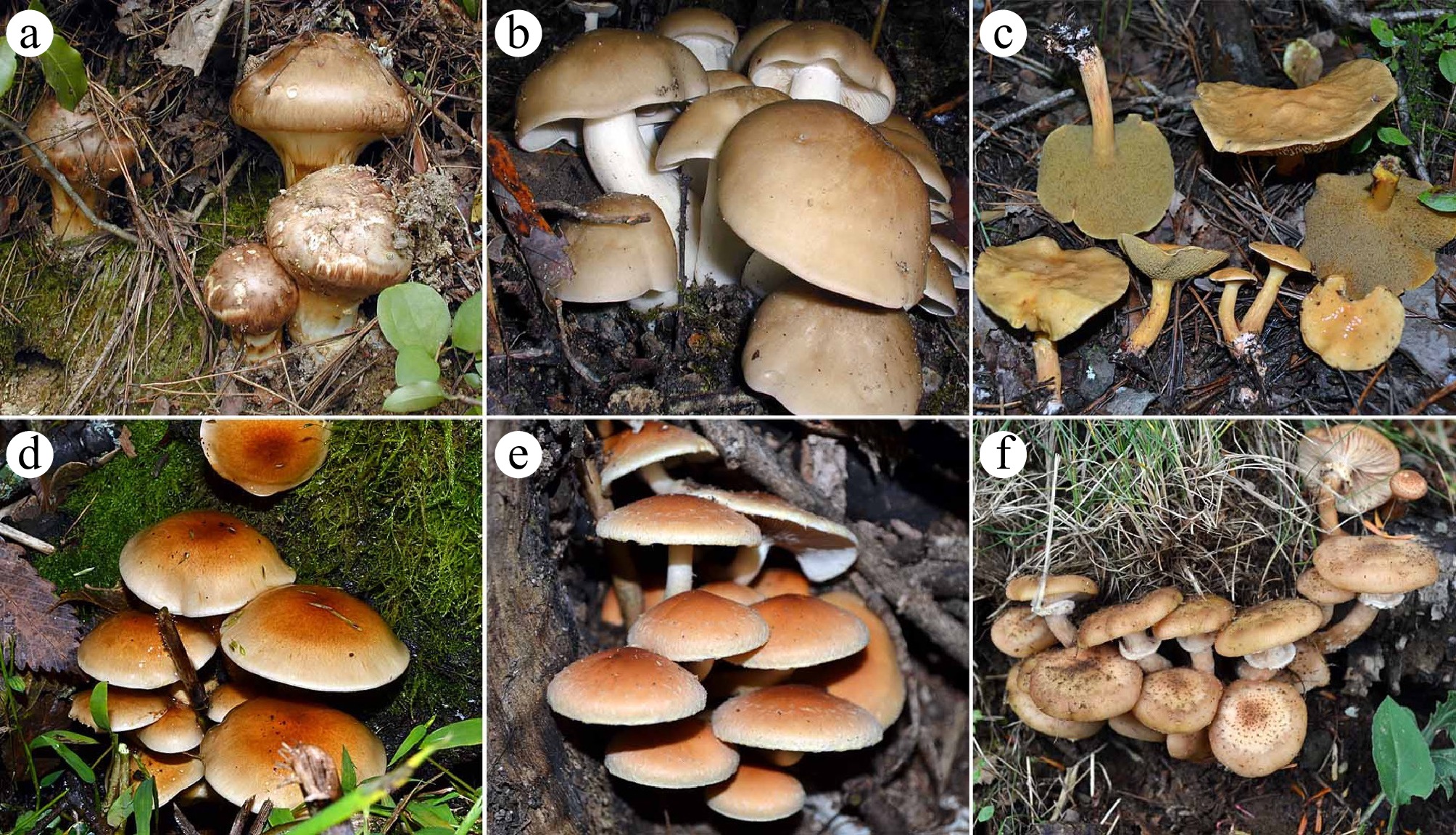
Figure 4.
Popular wild mushrooms in Japan since the old era. (a) Tricholoma matsutake (Oct 2007; Toyooka, Nagano). (b) Lyophyllum shimeji (Oct 2008; Nakagawa, Nagano). (c) Amitake (Sep 2018; Saku, Nagano). (d) Suillus bovinus (Oct 2011; Takayama, Gifu). (e) Hypholoma lateritium (Oct 2018; Okaya, Nagano). (f) Armillaria mellea (Sep 2012; Saku, Nagano).
Table 3. List of mushroom species commonly used as foods, medicines, or model organisms in Japan (excluding species list in Table 1).
Japanese common name Latin name (Saprotrophic species) Naratake Armillaria mellea s. l. Ushiguso-hitoyotake Coprinopsis cinerea (Schaeff.) Redhead, Vilgalys & Moncalvo Chorei-maitake Polyporus umbellatus (Pers.) Fr. Chaname-tsumutake Pholiota lubrica (Pers.) Singer Saketsubatake Stropharia rugosoannulata Farl. ex Murrill Bukuryou Wolfiporia extensa (Peck) Ginns. (Ectomycorrhizal species) Kurokawa Boletopsis leucomelaena (Pers.) Fayod Yamadoritake Boletus edulis Bull. Yamadoritake-modoki Boletus reticulatus Schaeff. Momitake Catathelasma ventricosum (Peck) Sing. Shougenji Cortinarius caperatus (Pers.) Fr. Kuri-fuusentake Cortinarius claricolor var. tenuipes Hongo Abura-shimeji Cortinarius elatior Fr. Mureoo-fuusentake Cortinarius praestans (Cordier) Gillet Numeri-sasatake Cortinarius pseudosalor J.E. Lange Urabenihotei-shimeji Entoloma sarcopum Nagasawa & Hongo Sakura-shimeji Hygrophorus russula(Schaeff. ex Fr.) Kauffman Aka-hatsutake Lactarius akahatsu Nobuj. Tanaka Hatsutake Lactarius hatsudake Nobuj. Tanaka Aka-momitake Lactarius laeticolor (S. Imai) Imazeki ex Hongo Chichitake Lactifluus volemus (Fr.) Kuntze Shaka-shimeji Lyophyllum fumosum (Pers.) P.D. Orton Matsuba-haritake Phellodon fuligineoalbus (J.C. Schmidt) R.E. Baird, in Baird, Wallace, Baker & Scruggs Houkitake Ramaria botrytis (Persoon) Ricken Shouro Rhizopogon roseolus (Corda) Th. Fr. Amitake Suillus bovinus (L.) Roussel Hanaiguchi Suillus grevillei (Klotzsch) Singer Kogane-hanaiguchi Suillus orientalis Y. Miyam., Tamai & A. Yamada Shironumeri-iguchi Suillus viscidus (L.) Roussel Koutake Sarcodon aspratus (Berk.) S. Ito Shimokoshi Tricholoma auratum Gillet Ki-shimeji Tricholoma flavovirens (Pers.: Fr.) S. Lundell Shiro-shimeji Tricholoma japonicum Kawam. Matsutake Tricholoma matsutake (S. Ito & S. Imai) Singer Shimofuri-shimeji Tricholoma portentosum (Fr.) Quél. Ajiakuro-seiyoushouro Tuber himalayense B.C. Zhang & Minter Hon-seiyoushouro Tuber japonicum Hir. Sasaki, A. Kinosh. & Nara This review summarizes Japan's mushroom production and the mushroom industry centered around it, categorizing them into cultivated mushrooms primarily involving wood-decay fungi and mycorrhizal mushrooms that form symbiosis with trees and are difficult to cultivate. As a conclusion to this discussion, we briefly address Japan's mushroom industry and the mushroom science that underpins it.
-
Most mushrooms cultivated today are ecologically classified as saprotrophs (saprotrophic fungi). These fungal species enzymatically break down cellulose, a primary component of plant cell walls, producing low-molecular-weight sugars such as glucose. They absorb and utilize these sugars as a carbon source[15]. This mechanism is applied in log cultivation and substrate cultivation of mushrooms. In nature, these fungi utilize carbon sources such as wood, fallen leaves, and dead grass. Furthermore, saprotrophs are often capable of being cultured alone on nutrient media, making spawn production relatively straightforward. Moreover, once fruiting body development is successful, spore isolation can be performed promptly. Breeding operations can then proceed by confirming mating systems through inbreeding and creating new genetic combinations via outcrossing to develop cultured strains[16]. Various cultivated varieties of mushrooms, such as Flammulina velutipes, Lentinula edodes, and Pleurotus ostreatus, have been developed through breeding operations spanning multiple generations (Fig. 5). Furthermore, from the perspective of elucidating the biological background of such breeding operations, model systems like Coprinopsis cinerea have also been used, and research to expand the molecular basis of cellular manipulation has been actively conducted since the latter half of the 20th century[17]. Today, building upon classical genetics of mushrooms based on cellular manipulation, large-scale decoding of genomic information has become routine[18]. This enables new breeding techniques that utilize necessary functional information at the required location and timing. The development of cultivation techniques for these saprophytic mushrooms is advancing visibly day by day, significantly contributing to our dietary habits.
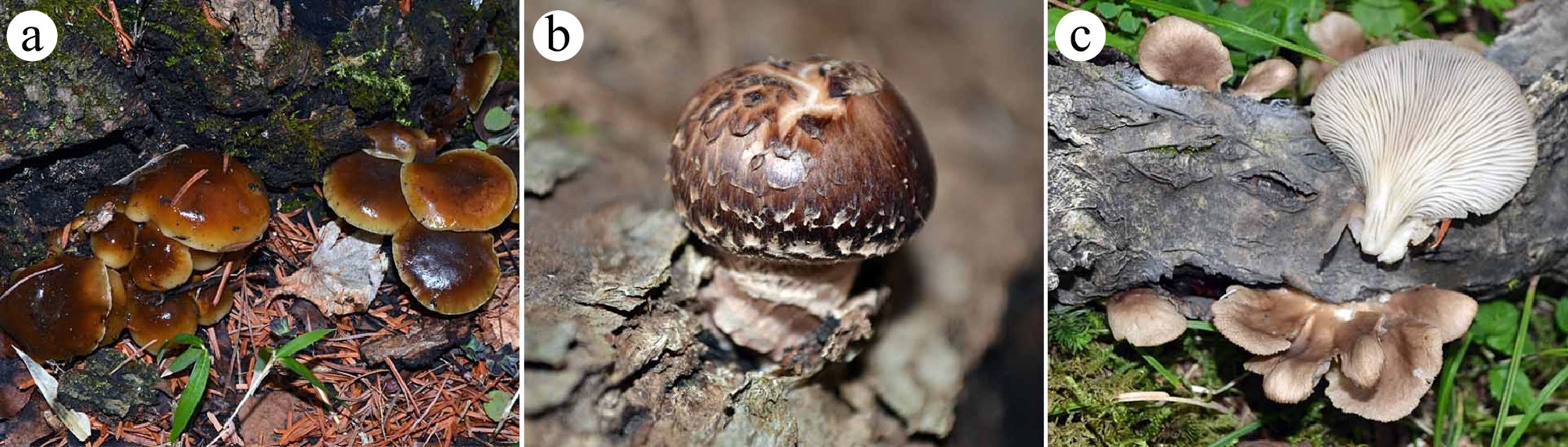
Figure 5.
Commercially important cultivated mushrooms in Japan. (a) Flammulina velutipes (Feb 2016; Okaya, Nagano; wild). (b) Lentinula edodes (Nov 2019; Koumi, Nagano; wild). (c) Pleurotus pulmonarius (July 2021; Saku, Nagano; wild). In Japan, P. pulmonarius and P. ostreatus are both common in the field and have been used in both wild and cultivated mushrooms.
In Japan today, the average person consumes about 10 g of fresh mushrooms per day (≈3.5 kg per year; Fig. 6), representing what is likely the world's largest mushroom-consuming culture. While this paper does not address the relationship between such consumption and health[19,20], it is an important aspect to consider when contemplating mushroom cultivation in this century.
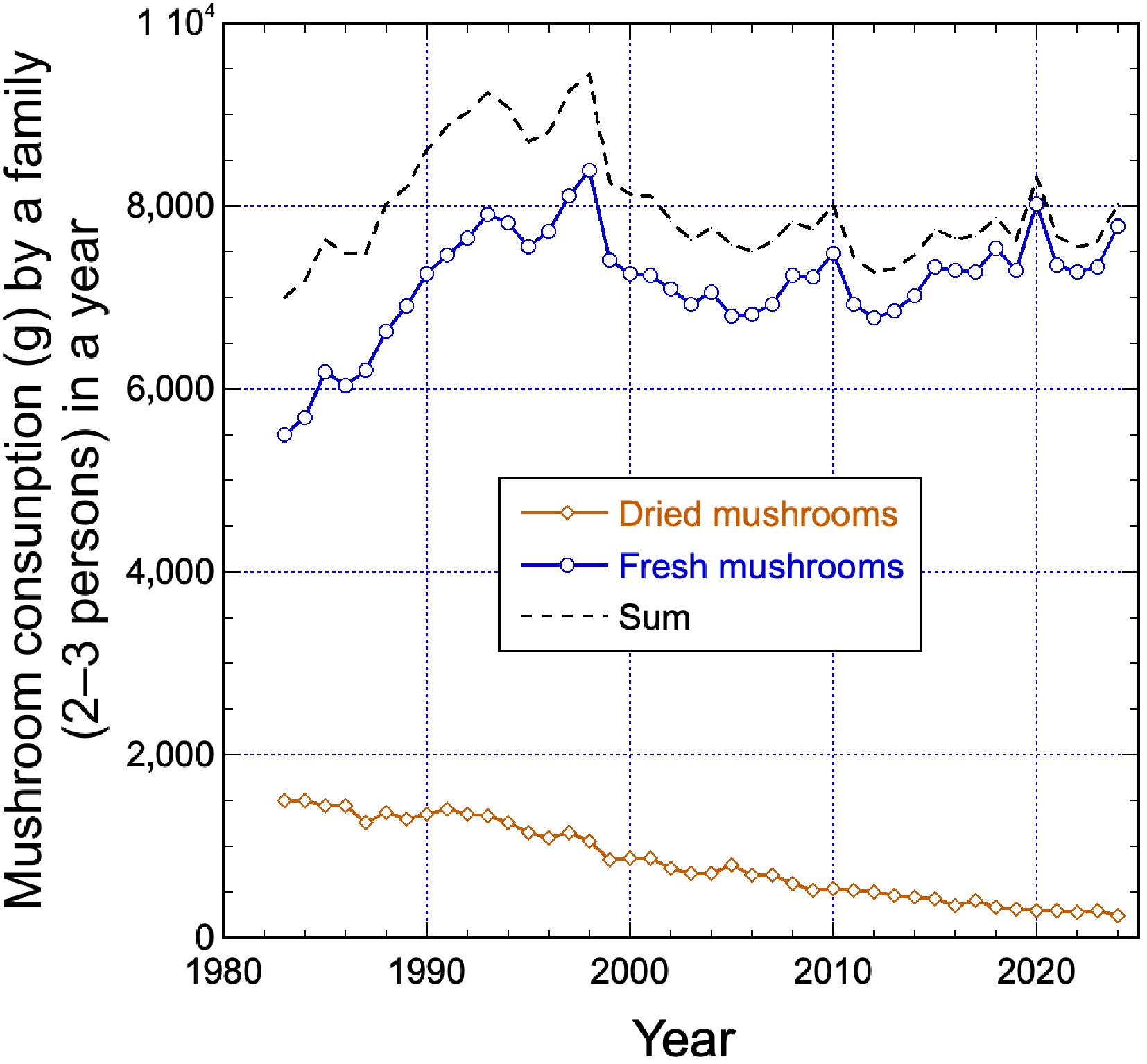
Figure 6.
Mushroom consumption by a family (two to three persons) in a year in Japan. Data source: Statistics of Japan (
www.e-stat.go.jp ).Origins and history of mushroom cultivation systems in Japan
-
The origins of mushroom cultivation in Japan are believed to stem from the primitive (but distinct) cultivation of Lentinula edodes that began in ancient times. During the middle of the Edo period (18th century AD), a technique was systematized on the Izu Peninsula: making cuts with a hatchet into the trunks of felled oak trees and then spreading L. edodes spores into these cuts. This technique, along with technical manuals, spread widely throughout the country[12]. With the introduction of microbiological knowledge during the Meiji era (1868–1912), Nagane Tanaka introduced the use of living mycelium and spores as inocula for log cultivation of shiitake around the 1880s[21,22]. This involved pulverizing logs colonized by L. edodes mycelium and inoculating the resulting powder onto logs. Methods for adding spores to this process were also proposed. However, these techniques were rudimentary compared to modern cultivation methods. The advent of true cultivation technology required the development of pure culture techniques for mycelium. Around the 1920s, Hikosaburou Morimoto developed 'sawdust culture spawn' using pure-cultured spawn for various mushrooms[23], and such efforts gradually spread. In 1942, Kisaku Mori invented L. edodes 'tanegoma' (block-shaped spawn), which became widespread nationwide[24]. Particularly after World War II, shiitake cultivation using these 'tanegoma' on logs spread nationwide, and dried L. edodes fruiting bodies became an important cash crop for mountain villages. However, this success also began to show signs of change amid shifting social structures, and L. edodes cultivation in mountain villages gradually declined over the final quarter-century of the 20th century (Fig. 7).
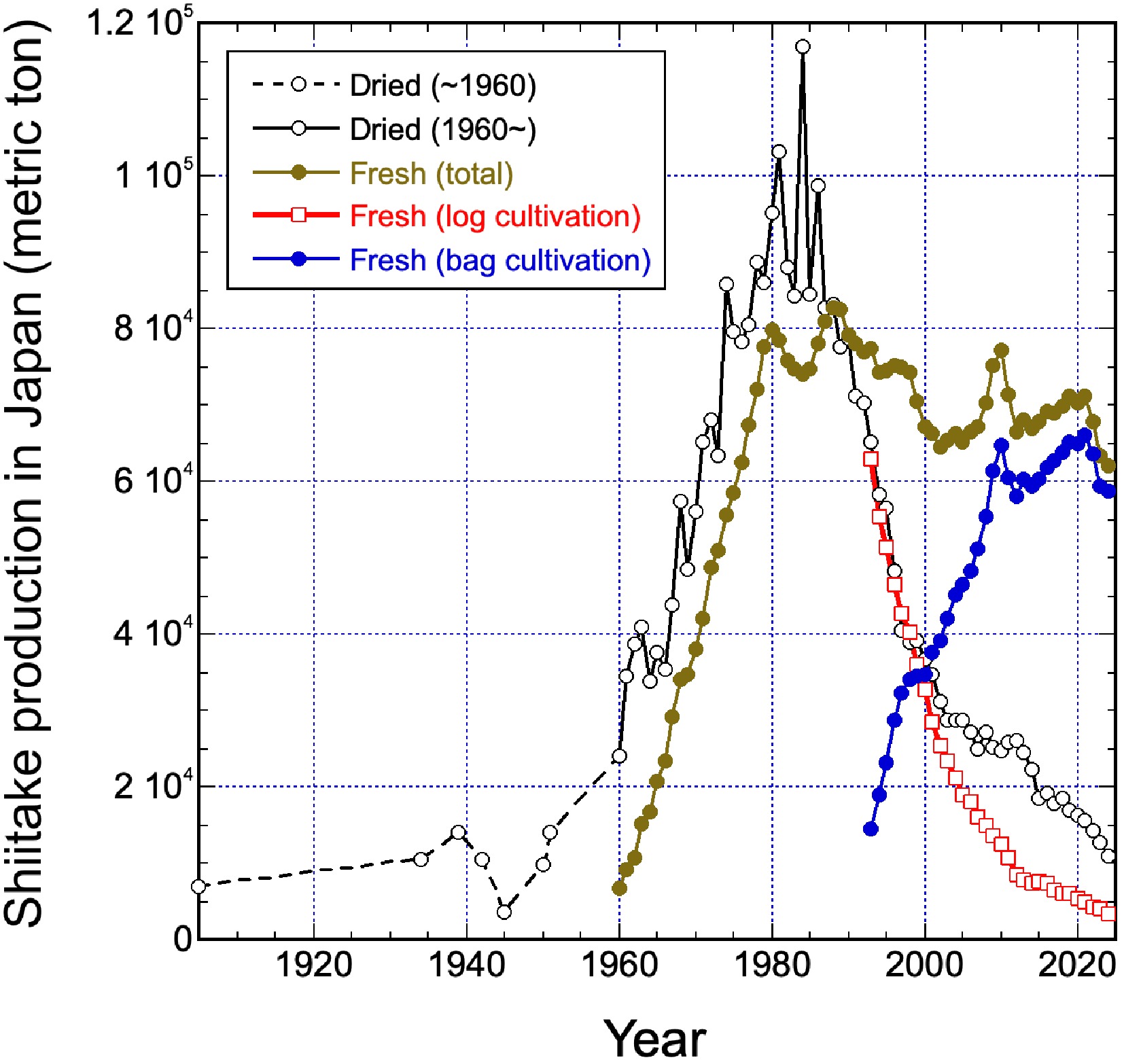
Figure 7.
The production of Lentinula edodes (shiitake) in Japan in the past 120 years. Data source: Statistics of the Ministry of Agriculture, Forestry and Fisheries, Japan (
www.maff.go.jp/j/tokei/index.html ).Separate from this trend, an approach utilizing the 'sawdust culture spawn' developed by H. Morimoto—cultivating Flammulina velutipes in glass bottles filled with sawdust—developed in the northern region of Nagano Prefecture throughout the pre- and post-war periods. An interesting aspect of this background is that, since agriculture was impossible in winter due to the cold and heavy snowfall in this area, indoor mushroom cultivation was conceived as an alternative. This method of indoor mushroom cultivation using 'sawdust culture spawn' gradually found application in Pholiota microspora cultivation within the relatively cool Tohoku region as well. Alongside Japan's economic development, cultivation shifted from log-based L. edodes farming in mountain villages to bottle cultivation of F. velutipes and Pleurotus ostreatus on flatlands as a form of agriculture. Furthermore, specialized production groups and companies emerged, establishing dedicated mushroom cultivation facilities on these flatlands to focus exclusively on mushroom farming. Today, high-quality mushrooms are cultivated in large-scale facilities under advanced climate control. In essence, throughout the 20th century, the log cultivation of mushrooms that flourished in mountain villages gradually shifted away from these areas and into agricultural regions[25]. Furthermore, the trend has evolved to the present day, where large-scale mushroom production plants are established in locations deemed suitable based on logistics systems near urban areas and anticipated urban mushroom consumption, enabling intensive production.
Establishment and development of log cultivation techniques
-
From an industrial perspective, the Lentinula edodes 'tanegoma' developed and popularized by K. Mori can be positioned as the starting point for log cultivation in Japan. In pre-World War II Japan, self-sufficiency was fundamental to the economy, and a high proportion of the population lived in mountain villages. This social structure persisted to some extent until the 1950s. Within the forestry-centered lifestyle of mountain villages, log cultivation of L. edodes—offering short-term cash returns—rapidly gained popularity. Oak trees felled from winter to early spring were cut into logs. Holes about 1 cm in diameter were drilled into these logs, and block-shaped spawns were hammered into the holes. This allowed the L. edodes mycelium to spread throughout the wood. Logs colonized by the inoculated mycelium were called 'hodagi'. By skillfully arranging and managing these logs within the forest, fruiting bodies could begin to be harvested as early as six months after inoculation, or at the latest within a year. While fruiting body development and harvest were weather-dependent, the mainstream practice involved harvesting fruiting bodies that appeared from autumn to spring, promptly drying them, bundling them, and shipping them to cities. Since the production areas (mountain villages) and consumption areas (cities) were often distant, dried fruiting bodies, not fresh ones, were the mainstream product. This log cultivation method was applicable not only to oak species but also to various other broad-leaved trees, making it possible to continue cultivation by appropriately utilizing these naturally occurring trees in mountain villages.
However, in the 1960s, large-scale social structural changes progressed. Increasing numbers of people, primarily young villagers, migrated to cities. Remote areas with poor transportation access gradually lost their populations, and the remaining residents faced a wave of aging. Amidst these changes, L. edodes log cultivation itself increased production volume until the early 1980s but then rapidly shifted into a declining trend (Figs 7 and 8). Furthermore, as dietary habits changed, demand shifted from dried to fresh L. edodes fruiting bodies. This led to a situation where L. edodes production sites gradually moved from mountain villages to flatlands near urban areas. Amidst these changes, cultivation techniques evolved from simply leaving logs in the forest to more controlled methods. These included watering the logs, moving them to water tanks for forced hydration, and developing techniques to manage fruiting body development[26].
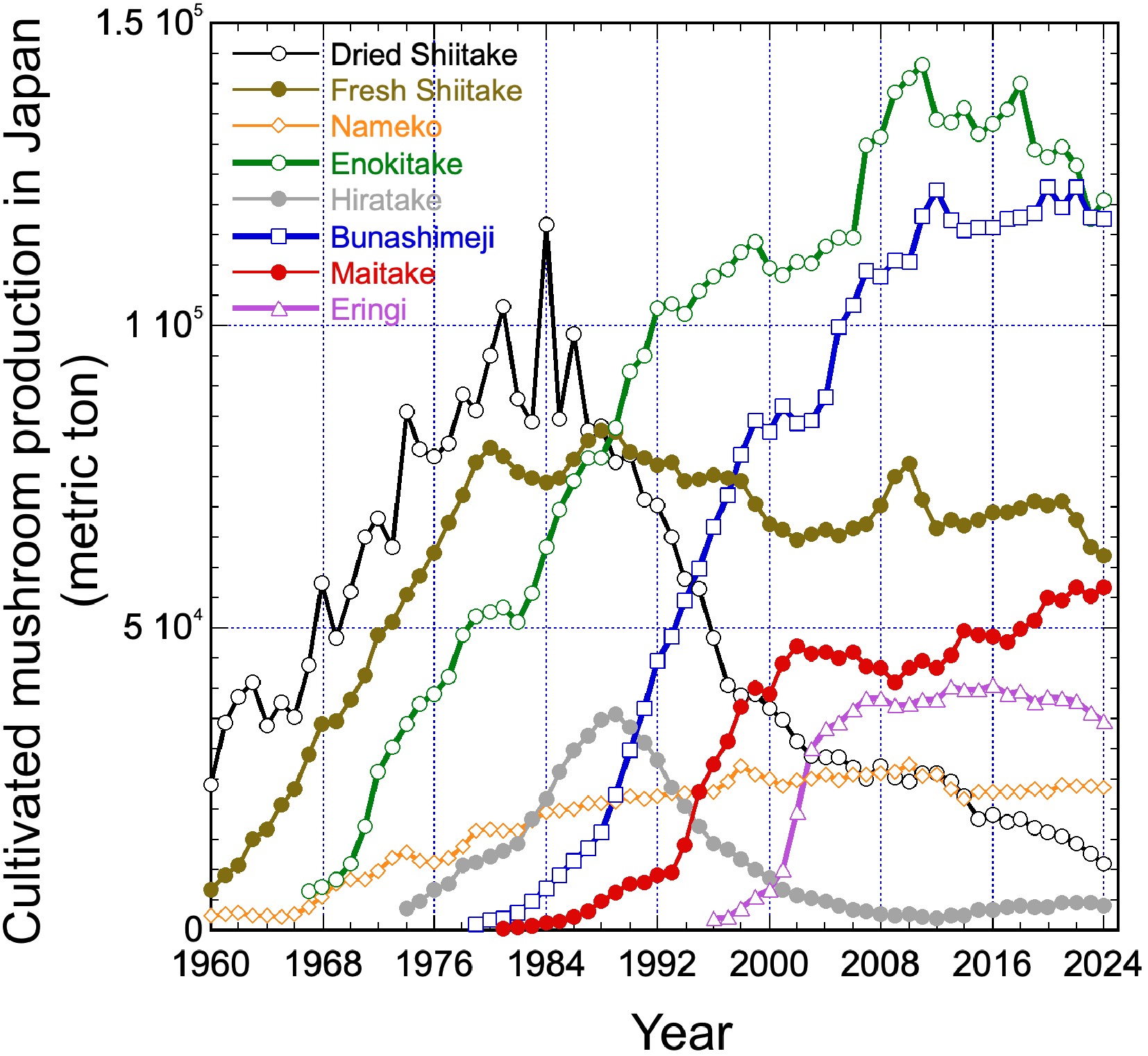
Figure 8.
The production of cultivated mushrooms in Japan in the past 65 years. Data source: Statistics of the Ministry of Agriculture, Forestry and Fisheries, Japan (
www.maff.go.jp/j/tokei/index.html ).The log cultivation technology, initially developed for L. edodes, proved applicable to other species like Pleurotus ostreatus, Pholiota microspora, Hypholoma lateritium, Auricularia auricula-judae, and Flammulina velutipes. Consequently, cultivation techniques for these fungi were once developed using various tree species[27]. However, given the advantages of 'sawdust culture spawn' cultivation (substrate cultivation) discussed later, the significance of log cultivation has diminished. Today, log cultivation is primarily limited to L. edodes, P. microspora, H. lateritium, and P. ostreatus. From a technical standpoint, log cultivation can be applied to various edible mushrooms such as Pholiota adiposa (= Pholiota aurivella; Table 1), Grifola frondosa, Pleurotus citrinopileatus, Lyophyllum, Hericium erinaceum, Sarcomyxa edulis, Cyclocybe aegerita (=Agrocybe cylindracea; Table 1), Stropharia rugosoannulata, and Pholiota lubrica. Furthermore, it is sometimes utilized for cultivating Ganoderma lucidum and Wolfiporia extensa.
Contemporary significance of log cultivation
-
Compared to the substrate cultivation described later, log cultivation has a more extensive aspect and is not particularly efficient in terms of fruit body production per unit area or time. Therefore, in the 21st century, log cultivation, primarily conducted in mountainous rural areas, requires added value such as high quality and a production environment closer to nature. As shown in Table 1, the regions currently thriving in log cultivation of Lentinula edodes are located in the relatively warm Kyushu region of the Japanese archipelago, specifically in Oita, Miyazaki, and Kumamoto Prefectures, where vast evergreen broadleaf forests extend. Meanwhile, in the Tohoku region, home to vast beech forests, efforts are underway to cultivate Pholiota microspora by inoculating large-diameter beech logs felled within the forest, using a method close to natural growth patterns. These are then sold as 'wild P. microspora fruiting bodies' with added value.
Meanwhile, from the 1950s to the 1970s, a policy was implemented across many mountainous areas of the Japanese archipelago to clear broadleaf trees and convert the land to conifers like cedar (Chamaecyparis obtusa [Siebold et Zucc.] Endl.), cypress (Cryptomeria japonica [Thunb. ex L.f.] D.Don), and larch (Larix kaempferi [Lamb.] Carrière), which are suitable for construction timber. However, after these conifers matured into trees in the 1990s, demand for them as construction timber declined. Amidst this, the decline of forestry accelerated population loss in mountain villages. Not only were timber resources left unused, but an excess of woody biomass, including the forest floor environment, began to accumulate. Consequently, a movement has emerged to reintroduce log cultivation of mushrooms. This aims to utilize and reduce the woody biomass from conifers, linking it to new economic value. While few edible mushrooms can be cultivated on coniferous logs, attempts are underway to cultivate mushrooms such as Pleurotus ostreatus, Pholiota microspora, and Hypholoma lateritium using larch and cedar logs, and Pholiota lubrica using cedar and cypress logs. Integrating forest utilization and management with mushroom cultivation to build sustainable systems with low environmental impact is expected to become increasingly necessary in Japan going forward.
Origins and history of substrate cultivation
-
The substantial industrialization of substrate cultivation (bottle cultivation, bed cultivation) in Japan began after World War II. Initially promoted as a winter industry in northern Nagano Prefecture, where winter farming was difficult and many people worked away from home, bottle cultivation of Flammulina velutipes gradually developed into a local industry throughout the 1950s, supported by local governments (Fig. 9). During this time, high school teachers Gosaku Hasegawa and Misao Kurasawa played a leading role in technology dissemination, which contributed significantly to the local community to make foundation for establishing F. velutipes cultivation as the unique industry. Furthermore, during the high economic growth period of the 1960s, improvements in transportation networks and logistics led to increased F. velutipes supply to major cities. From this era, F. velutipes cultivation shifted from a seasonal industry centered on winter to year-round cultivation utilizing climate-controlled facilities. Simultaneously, the material for cultivation containers changed from glass bottles to heat-resistant plastic bottles. Naturally, from the perspective of mushroom breeding, the collection of wild strains of F. velutipes also progressed. Within this context, while Japan's mushroom cultivation had previously been centered in warmer regions like Kyushu, known for Lentinula edodes cultivation, Nagano Prefecture's F. velutipes-focused mushroom farming gradually became the driving force of Japan's mushroom industry. By the 1980s, F. velutipes production had matched the previously dominant L. edodes production volume, later overtaking it (Fig. 8). By this time, other notable mushroom crops in Japan included Pholiota microspora and Pleurotus ostreatus, with P. ostreatus production accounting for a significant share.
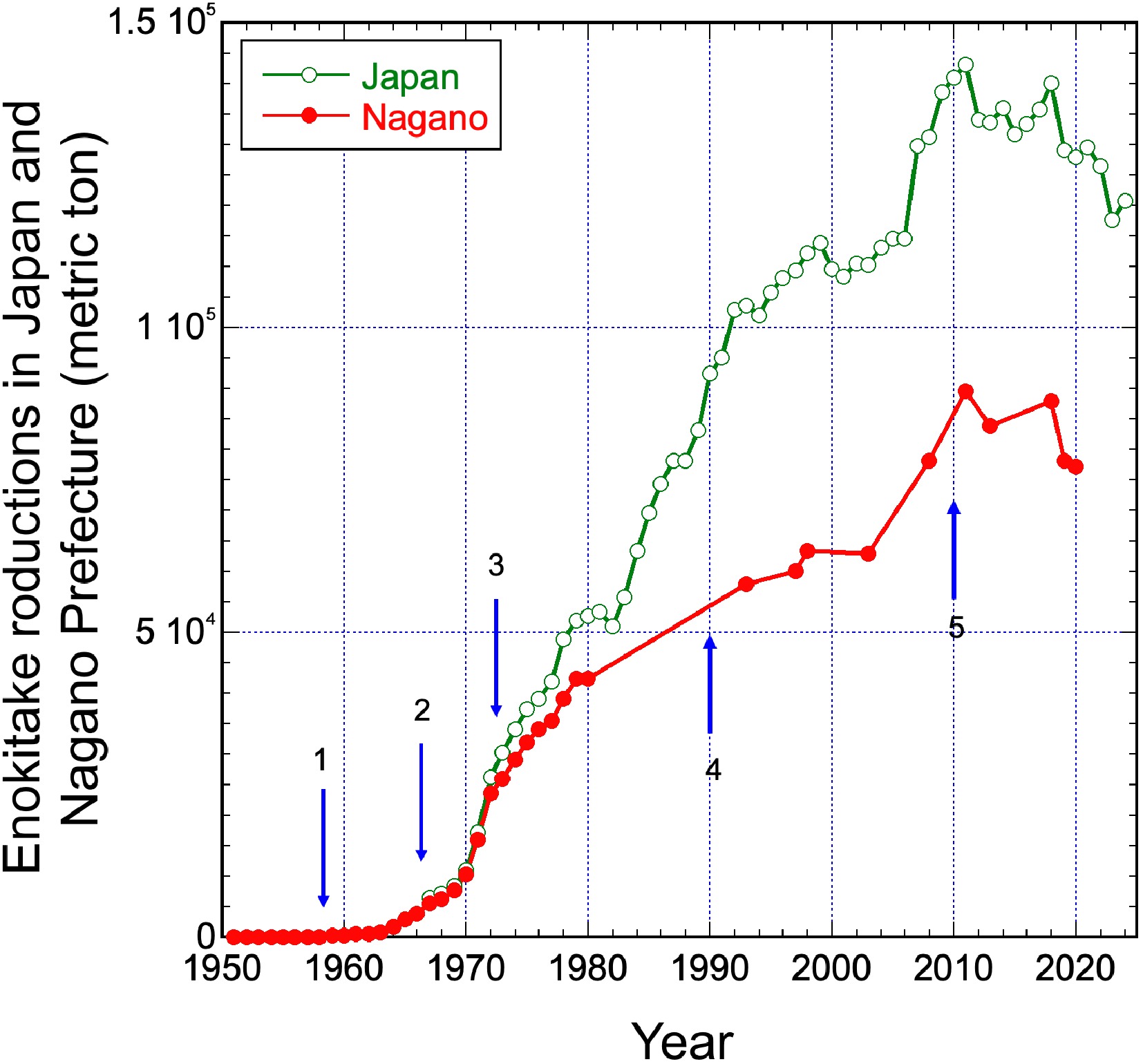
Figure 9.
The production of Flammulina velutipes (enokitake) in Japan and Nagano Prefecture in the past 75 years. 1: Nagano Prefecture provided subsidies for installing autoclaves to sterilize sawdust-based substrates. 2: Installation of air conditioners (coolers) at production sites and introduction of refrigerated trucks begun. 3: Transition from glass bottle cultivation to plastic bottles progressed. 4: Cultivation facilities became increasingly large-scale. 5: Large-scale, efficient mycelium inoculum production advances. Data source: Statistics of the Ministry of Agriculture, Forestry and Fisheries, Japan (
www.maff.go.jp/j/tokei/index.html ) and Uchiyama[28].By the 1970s, cultivation techniques for a wide variety of mushrooms were being developed across Japan[27,29]. Once the cultivation technique for Hypsizygus marmoreus (Fig. 10a) was established, commercial cultivation spread widely in Nagano Prefecture, already the most active center of the mushroom industry centered on F. velutipes production. This expansion accelerated rapidly from the 1980s onward. Entering the 1990s, the cultivation of H. marmoreus saw a rapid increase in production volume, partly due to the entry of HOKTO Corporation, which today holds the largest mushroom production volume in Japan. By the 2000s, its production volume had reached that of F. velutipes (surpassing L. edodes production; Fig. 8). Also in the 1990s, the commercial cultivation of Grifola frondosa (Fig. 10b) became established, and since the turn of the century, the production volume of Pleurotus eryngii has also gradually increased. As a result of these trends, when ranking Japan's current mushroom production by species from highest to lowest volume, the order is F. velutipes, H. marmoreus, L. edodes, G. frondosa, P. eryngii, and P. microspora.
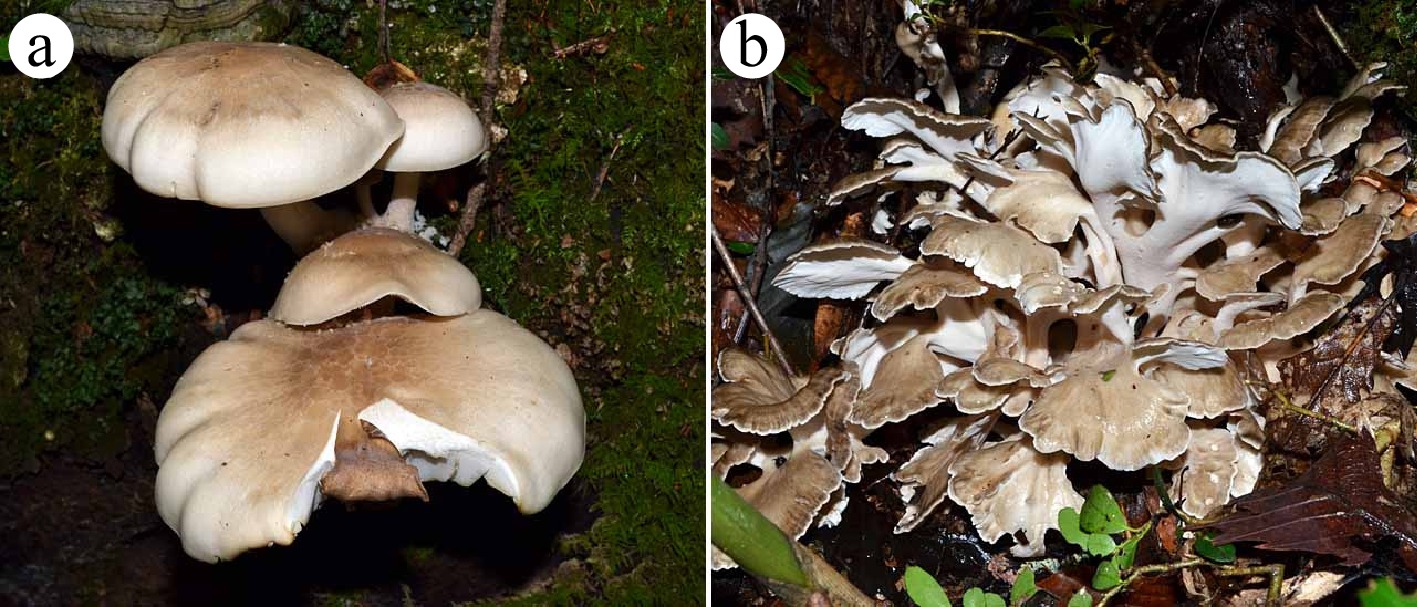
Figure 10.
Commercially important cultivated mushrooms in Japan. (a) Hypsizygus marmoreus (Sep 2015; Matsumoto, Nagano; wild). (b) Grifola frondosa (Oct 2016; Takayama, Gifu; wild).
Development and spread of substrate cultivation techniques
-
As previously mentioned, the basic technique of creating a substrate based on sawdust, packing it into containers such as bottles, and cultivating wood-decay fungi like Flammulina velutipes and Pleurotus ostreatus was pioneered by H. Morimoto in the 1920s. Utilizing this technique, F. velutipes cultivation began as a local industry in northern Nagano Prefecture from the 1940s onwards. With support from Nagano Prefecture, the scale of F. velutipes cultivation expanded by the 1950s (Fig. 9). The subsequent technological developments were also outlined earlier.
Here, we will focus on F. velutipes, which still boasts Japan's largest production volume, specifically examining the technological developments from the late 20th century to the present. By the 1980s, F. velutipes already exhibited high yield potential through breeding manipulation and displayed their characteristic shape, with countless fruiting bodies growing in bundles (Fig. 1a), thanks to the paper-rolling technique developed in the 1940s. Fruit bodies of cultivars from this period had a slightly cream-colored hue[30], but by the 1990s, white-colored varieties became mainstream after introducing naturally occurring white-colored mutants. Today, the pure white strains are the predominant F. velutipes cultivated in Japan. These cultivation techniques and varieties were also introduced to China and South Korea, leading to widespread cultivation there. Amidst this development, the scientific name of F. velutipes was changed to F. filiformis (Z.W. Ge, X.B. Liu & Zhu L. Yang) Wang et al.[31]. This change was based on molecular phylogenetics, which identified the European/North American F. velutipes and the Asian F. velutipes group (including Japanese cultivated strains) as independent clades. Although the morphological differences were slight, the latter was classified as a new species. However, based on knowledge of hybrid breeding up to the 1990s, Japanese F. velutipes cultivated varieties and European/North American F. velutipes can be considered a single hybrid population[32]. Therefore, the treatment of F. filiformis as a distinct species warrants reconsideration.
While Japanese F. velutipes cultivation traditionally used broadleaf sawdust as the base substrate, today it is common practice to blend in a certain amount of cedar sawdust (sometimes up to half) for ease of material availability and cost considerations. Efforts to reduce costs also include reusing a certain amount of spent substrate. Flammulina velutipes is a highly efficient species to cultivate, as both the mycelium growth period on the substrate and the subsequent period required for fruiting body development are short[26]. In recent years, significant efficiency improvements have been achieved, including the advancement of robotic manufacturing systems and the introduction of systems where liquid-cultured mycelium is injected into the substrate using specialized equipment (
www.agries-nagano.jp/wp/wp-content/uploads/2021/10/2009-1-s01.pdf ). Within this trend, fruiting body production systems are becoming increasingly large-scale and labor-saving.In Japan, much of the substrate cultivation technology that began after the war was derived from F. velutipes cultivation techniques. Naturally, the substrate's nutrient composition, moisture content, cultivation temperature, cultivation period, and fruiting body induction operations differ for each mushroom species. However, the basic operations are common. Therefore, it is common for a single company to cultivate and sell multiple species simultaneously. For F. velutipes, Hypsizygus marmoreus, Pleurotus eryngii, Pholiota microspora, and Pleurotus ostreatus, substrate cultivation using plastic bottles is the mainstream method. On the other hand, for Lentinula edodes, Grifola frondosa, and Auricularia polytricha, substrate cultivation using blocks of substrate packed into bags is the mainstream method[25,26].
New research methods for advancing substrate cultivation technology and its applications
-
Even today, hybrid breeding remains the most rational approach for improving the productivity and quality of cultivated mushrooms. This is because, unlike livestock and vegetables—which have undergone long-term selection from wild populations throughout human history—mushrooms still contain significant elements where quality can be enhanced through selection from wild strains and their inbreeding and outbreeding offspring. In Japan, since the 1980s, genetic backgrounds forming the basis for mushroom variety development have been researched and practically applied using mutant strains obtained through various mutation techniques, including gamma-ray radiation[33]. Entering this century, Japan advanced legal frameworks for the industrial use of recombinant organisms. Unfortunately, however, amid intense public scrutiny, the development of recombinant agricultural crops, including mushrooms, has not progressed significantly. However, the situation has changed dramatically with the advent of precise genome editing technologies like CRISPR-Cas9. Currently, no successful examples of mushroom variety development using these new technologies are known within Japan. Nevertheless, as genome-edited Agaricus mushrooms developed in the United States are already on the market[34], the potential for such varieties to be developed in Japan is high.
In mushroom breeding, improving fruit body productivity alongside selecting strains with desirable appearance and taste has been a longstanding challenge. Wild Flammulina velutipes fruiting bodies have brownish-red caps, but cultivating them in darkness using paper-wrapped cultivation produced cream-colored, slender, clustered fruit bodies. This proved successful and became the standard cultivated form today. Similarly, white variants of Hypsizygus marmoreus and Grifola frondosa were developed as varieties and are now sold commercially. Furthermore, since the start of this century, breeding focused on the functional properties of mushrooms has flourished, leading to the development of varieties with enhanced levels of eritadenine, GABA, and ergothioneine. The perspective of utilizing mushrooms for human health, combined with scientific findings such as the immune-boosting effects of β-glucan (a component of mushroom cell walls)[35], will undoubtedly gain even greater importance in our future lives. Moreover, hericenones and erinacines, discovered in Hericium erinaceum[36], are attracting attention from a medical perspective for preventing cognitive decline, particularly in the context of the aging populations seen in developed nations. To consistently and efficiently ingest these health-maintaining compounds through the consumption of edible mushrooms, molecular breeding approaches appear promising for increasing their content[37].
-
Mycorrhizal mushrooms have long been recognized as an important food resource in forest regions worldwide since ancient times. In particular, truffles (Tuber spp.), porcini (Boletus spp.), chanterelles (Cantharellus spp.), hedgehog mushrooms (Hydnum spp.), saffron milk caps (Lactarius spp.), and Caesar's mushrooms (Amanita spp.) remain widely utilized in European culinary cultures today[38−40]. In Asia, genera such as Russula, Boletus, Suillus, Lyophyllum, Tricholoma, Lactarius, and Astraeus have been extensively utilized in China, Japan, Thailand, and other countries[10]. Comparing Europe and Asia reveals significant differences in vegetation and culinary traditions, leading to distinct patterns in the types of mushrooms utilized[9]. This paper does not broadly cover the specifics of such extensive resource utilization. Instead, it covers the history of resource use in Japan up to today's technological development research.
Background reasons for utilizing diverse mycorrhizal mushrooms: ecological and social aspects
-
As mentioned at the outset, the history of mushroom utilization in Japan undoubtedly predates the written records, dating back to around the 7th century. The Japanese word 'kinoko', meaning mushroom, originates from 'tree child'. Japan remains a country with a high forest coverage rate globally, with forests currently covering approximately 67% of its land area. In ancient times, nearly the entire country was forested. As previously stated, within this environment, diverse ectomycorrhizal mushrooms, alongside saprotrophic fungi, were utilized for food. Within this history, Tricholoma matsutake has been recognized since ancient times as a seasonal delicacy. During the Heian period (roughly 9th–12th centuries), imperial family members would hunt T. matsutake fruiting bodies in Kyoto's pine forests and even hold banquets right there in the woods. Meanwhile, commoners also enjoyed T. matsutake hunting, and a culture existed where they would gift T. matsutake fruiting bodies to relatives and acquaintances[4,41]. During the Edo period (roughly 17th–19th centuries), Japan's social structure required feudal lords from across the country to reside periodically in Edo. This likely facilitated the spread of T. matsutake culture, originally centered in western Japan around Nara and Kyoto, throughout the nation via human interaction and logistics in Edo.
The Japanese archipelago, characterized by high precipitation, complex topography due to orogenic activity, and numerous volcanoes, has developed an extremely diverse forest vegetation. This, in turn, supports a wide variety of fungi. Conversely, arid areas were limited to coastal sand dunes, volcanic wastelands, and steep, eroded rocky mountains. The Japanese red pine (Pinus densiflora Siebold et Zucc.), currently the primary host tree for T. matsutake harvesting, possesses the characteristic of being a pioneer species capable of rapidly colonizing open environments prone to soil desiccation. Consequently, it was not necessarily a dominant tree species in ancient times. However, between 3000 and 2000 BC, as rice cultivation began along the western Japanese coast and the population started to grow, coastal and lowland forests were cleared and utilized. Concurrently, Japanese red pine forests, which colonize barren land early, gradually expanded. By the mid-Edo period (18th century), Japan's population reached 30 million, and large areas of Japanese red pine forests developed not only around cities but also in the mountain forests surrounding mountain villages. As mentioned earlier, in these mountain forests, the removal of forest litter and fallen branches likely resulted in drier soils, creating an environment suitable for T. matsutake (Fig. 4a). At the beginning of the Meiji era (1868–1912), the population was around 30 million, but by 1912, the Japanese population had reached 50 million. Under these conditions, the vast red pine forests were considered ideal habitats for T. matsutake. However, following World War II, as Japan's social structure underwent significant changes, shifts in population dynamics and land use led to major alterations in the dynamics and area of red pine forests near cities and in lowland areas. Consequently, the nationwide production of T. matsutake continued to decline (Figs 11−13). This trend was particularly pronounced in western Japan. Hiroshima Prefecture, which boasted the largest T. matsutake production in Japan half a century ago, has seen its production drop to nearly zero in this century. On the other hand, T. matsutake harvests from central to eastern Japan are also generally experiencing a decline in production. However, these regions contain many mountain areas with a high proportion of natural vegetation. The local populations of T. matsutake inhabiting these forests maintain a certain level of population density. Consequently, T. matsutake production in this century has centered on Nagano Prefecture in central Japan, surrounded by high-altitude mountainous areas, and Iwate Prefecture in Tohoku. Potentially, Hokkaido, with its vast conifer forests, can also be considered a major habitat for T. matsutake[ 42].
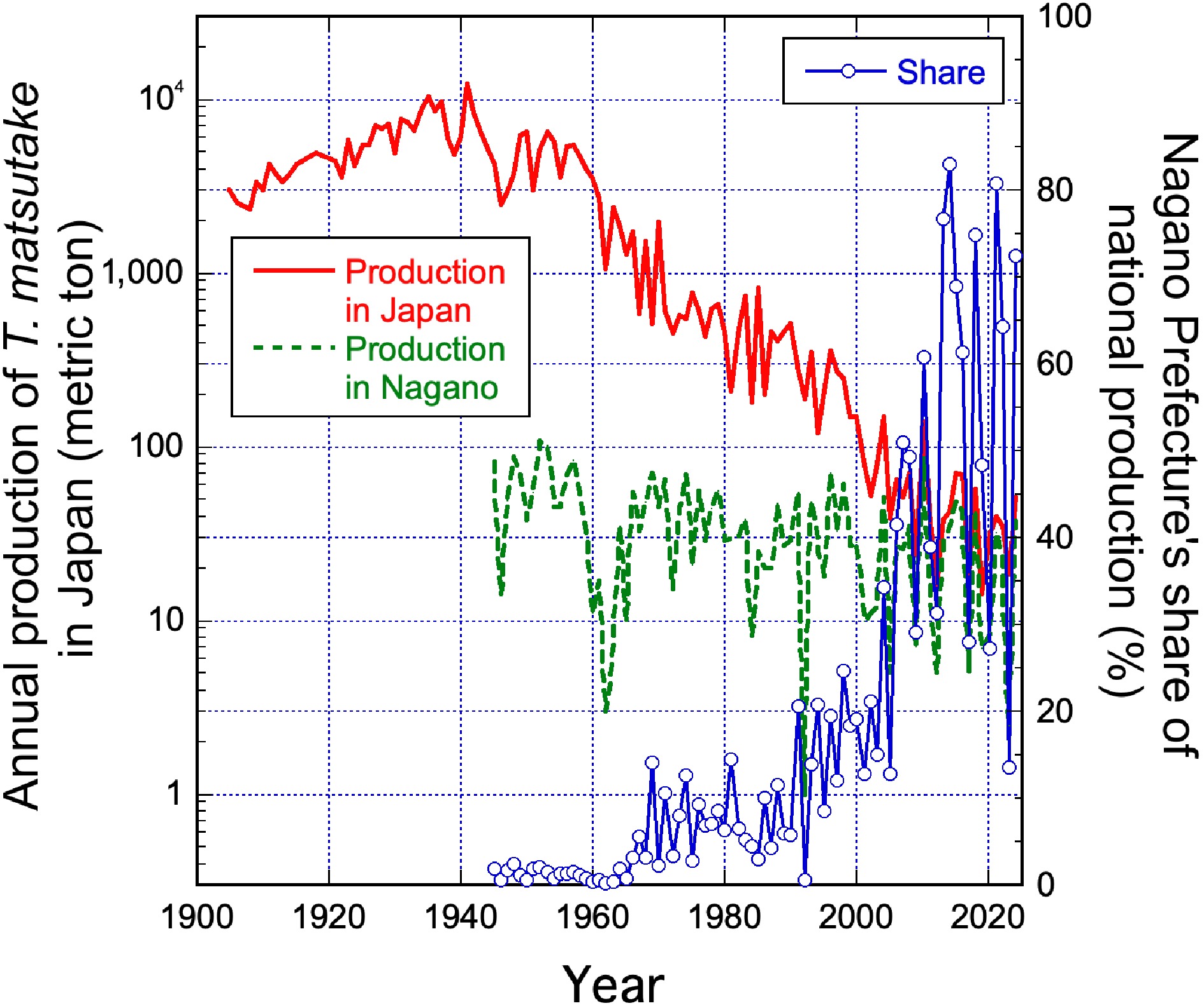
Figure 11.
Annual production of Tricholoma matsutake fruiting bodies in Japan and Nagano Prefecture in the past 120 years. Data source: Statistics of the Ministry of Agriculture, Forestry and Fisheries, Japan (
www.maff.go.jp/j/tokei/index.html ) and Editorial Committee of the Guide to Increasing Matsutake Production[43].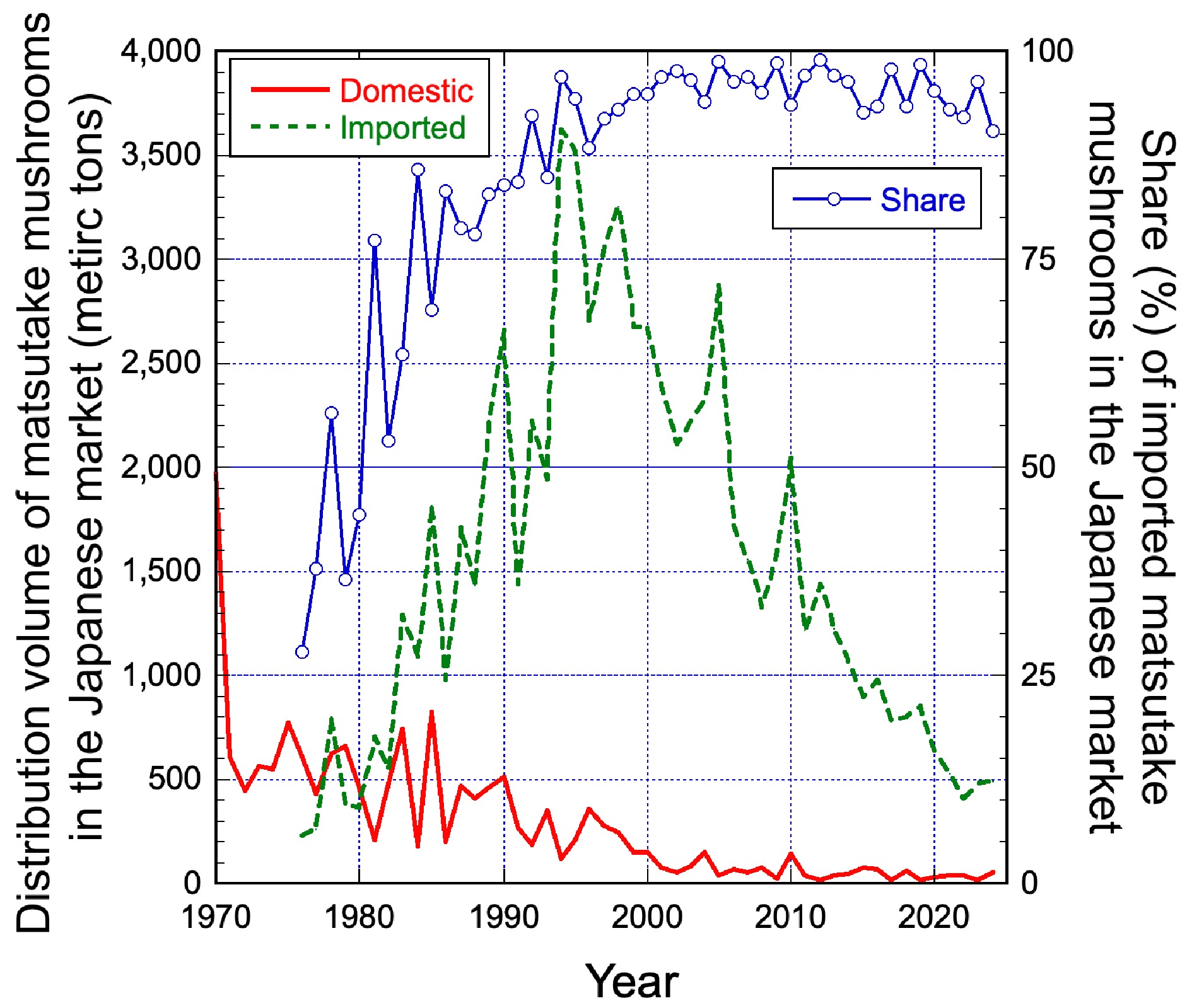
Figure 12.
Distribution volume of Tricholoma matsutake fruiting bodies in the Japanese market in the past half a century. Domestic matsutake only includes T. matsutake, whereas imported matsutakes include several closely related species. Data source: Statistics of the Ministry of Agriculture, Forestry and Fisheries, Japan (
www.maff.go.jp/j/tokei/index.html ).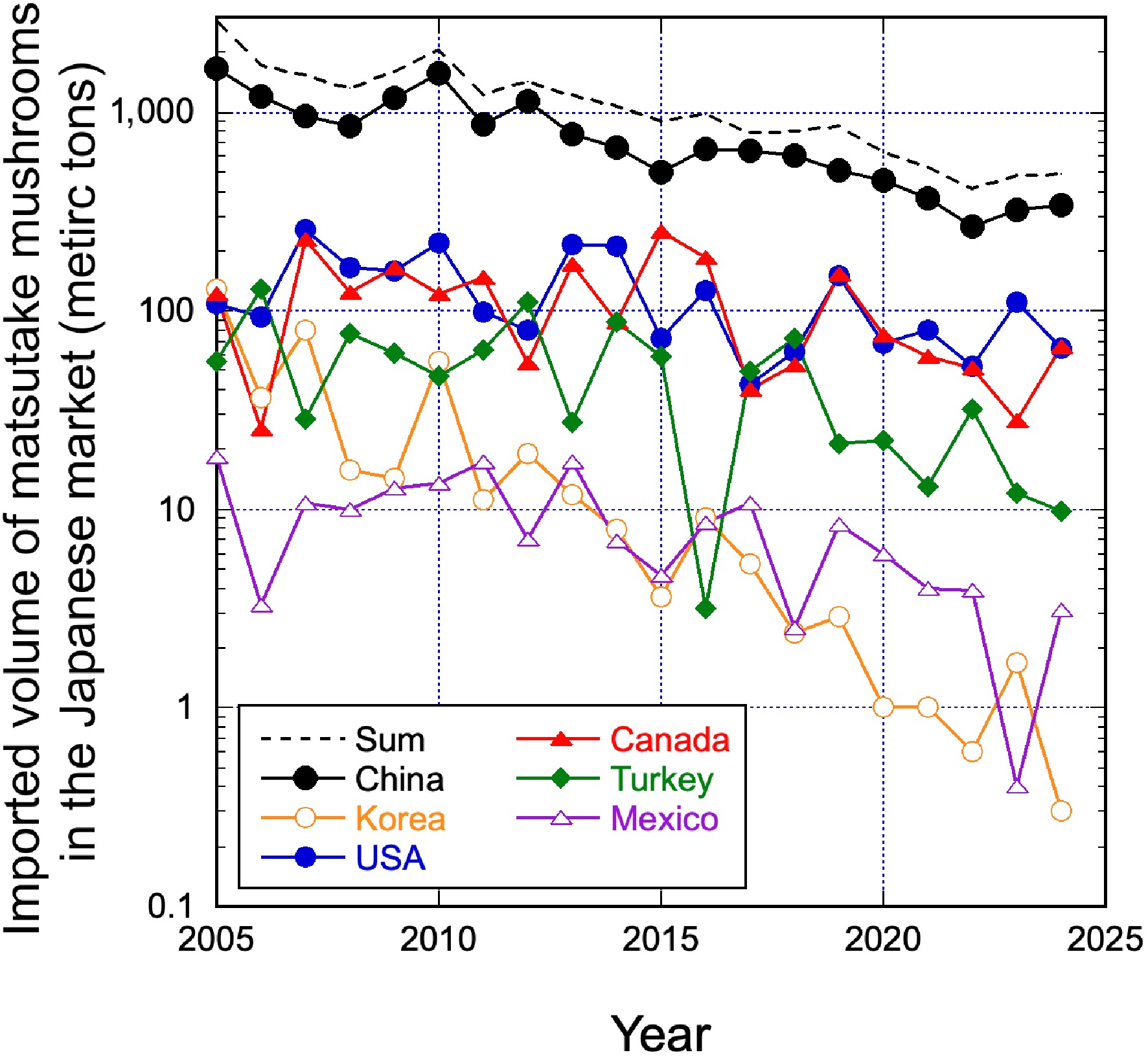
Figure 13.
Imported volume of Tricholoma matsutake and related species (matsutake mushrooms) in the Japanese market in the past 20 years. As well as Fig. 12, imported matsutakes include T. matsutake and several other closely related species. Data source: Statistics of the Ministry of Agriculture, Forestry and Fisheries, Japan (
www.maff.go.jp/j/tokei/index.html ).Relationship between the utilization of mycorrhizal mushrooms and mountain forest use/forestry
-
It is a well-known fact that mycorrhizal mushrooms, represented by Tricholoma matsutake, are widely utilized in Japan. However, the species actually consumed for food vary by region (Table 3). In pine forests, species such as Suillus bovinus (Fig. 4c), Ramaria botrytis, Cortinarius caperatus, Boletopsis leucomelaena, Lyophyllum shimeji (Fig. 4b), Lactarius hatsudake, Tricholoma flavovirens, Catathelasma ventricosum, and Rhizopogon roseolus are also widely used (Fig. 14a–g). In stands dominated by Fagaceae trees, a highly diverse range of mushrooms is utilized, including L. shimeji, L. fumosum, Tricholoma portentosu, Sarcodon aspratus, Boletus reticulatus, Hygrophorus russula, Lactifluus volemus, Entoloma sarcopum, Cortinarius elatior, C. pseudosalor, C. claricolor var. tenuipes, and C. praestans (Fig. 14h–p). Additionally, popular mushrooms include Suillus grevillei and S. viscidus found in larch forests, and Lactarius laeticolor found in fir forests (Fig. 14q, r). Many of these diverse mushrooms are sold in small markets. Since there is no system for compiling data on these individual species at the local government level, no aggregated government statistical data exists. While the production volume of each individual species is not particularly large, the total volume is estimated to be far greater than that of Tricholoma matsutake, for example. Consequently, while it is difficult to discuss the economic scale and impact of these resources in concrete terms, they are by no means negligible from the perspective of the economic viability of mountain village communities.
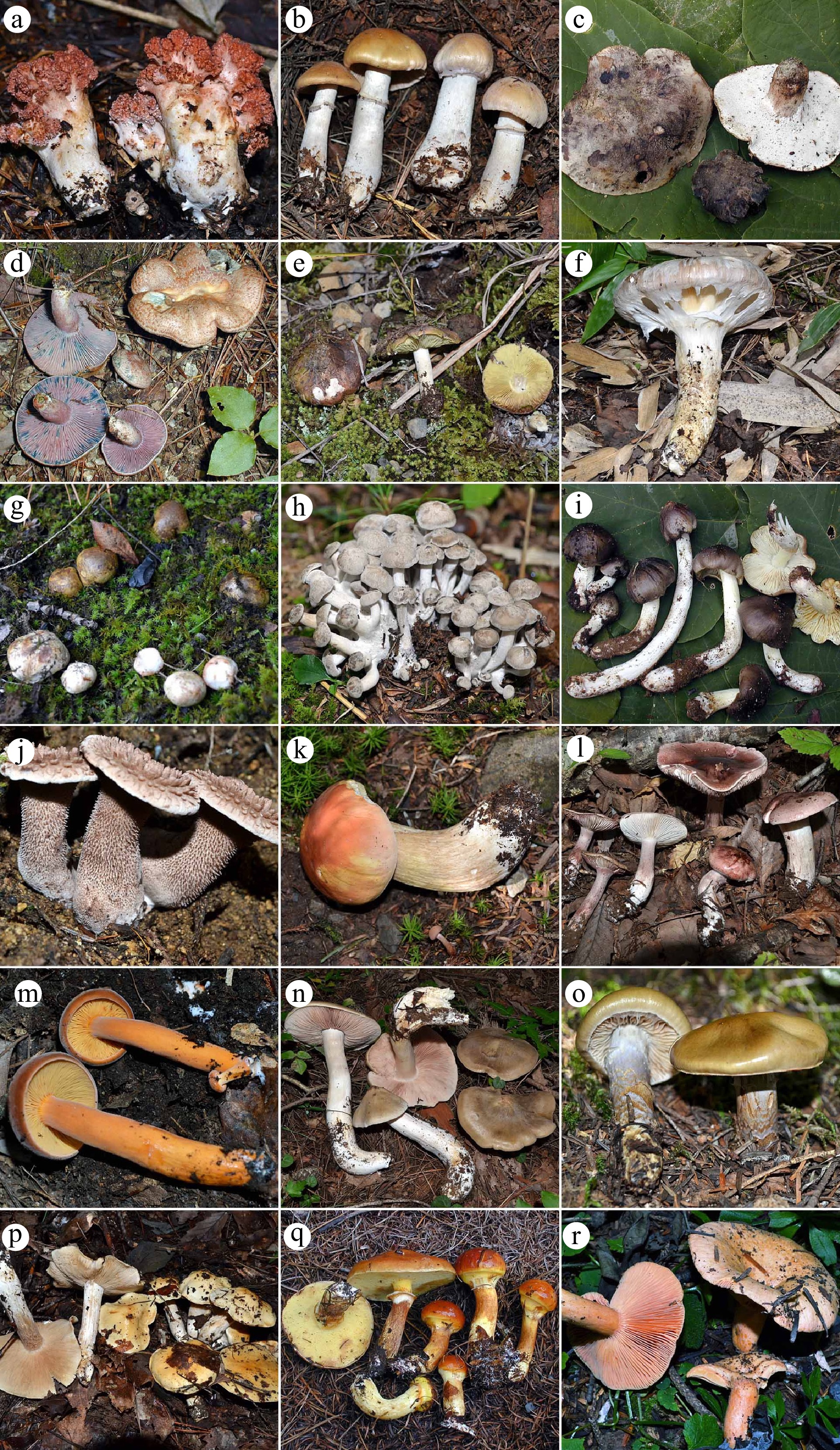
Figure 14.
Popular edible ectomycorrhizal mushrooms in Japan since the old era. (a) Ramaria botrytis (Sep 2013; Matsumoto, Nagano). (b) Cortinarius caperatus (Nov 2019; Okaya, Nagano). (c) Boletopsis leucomelaena (Oct 2000; Nakagawa, Nagano). (d) Lactarius hatsudake (Oct 2007; Ooshika, Nagano). (e) Tricholoma auratum (Nov 2022; Omi, Nagano). (f) Catathelasma ventricosum (Aug 2017; Matsumoto, Nagano). (g) Rhizopogon roseolus (Nov 2013, Takatori, Nara). (h) Lyophyllum fumosum (Oct 2018, Iiyama, Nagano). (i) Tricholoma portentosum (Oct 2000, Nakagawa, Nagano). (j) Sarcodon aspratu (Oct 2016, Ooshika, Nagano). (k) Boletus edulis (Aug 2022, Matsumoto, Nagano). (l) Hygrophorus russula (Sep 2014, Saku, Nagano). (m) Lactifluus volemus (July 2011, Okaya, Nagano). (n) Entoloma sarcopum (Sep 2014, Saku, Nagano). (o) Cortinarius pseudosalor (Sep 2021, Matsumoto, Nagano). (p) Cortinarius claricolor var. tenuipes (Sep 2015, Nakagawa, Nagano). (q) Suillus orientalis (Oct 2000, Ina, Nagano). (r) Lactarius laeticolor (Oct 2012, Matsumoto, Nagano). In Japan, T. auratum and T. flavovirens are often confused in the taxonomy, but both have been commonly used since the old era. In B. edulis, several related species such as B. reticulatus, B. violaceofuscus W.F. Chiu, and B. hiratsukae Nagas. are known in Japan and used as edible mushrooms in common. Suillus orientalis was recently described as a new species, divided from the S. grevillei complex.
The cultivation of mycorrhizal mushrooms occurs in limited forms, but the bottle cultivation of L. shimeji is particularly noteworthy. Lyophyllum shimeji itself is a true ectomycorrhizal fungus, and there is no evidence that it partially decomposes wood components such as cellulose and uses them as a carbon source. However, experiments have shown that on culture media, its ability to decompose starch and use it as a carbon source is relatively high among ectomycorrhizal fungi[44,45]. Leveraging this property, a bottle cultivation method for L. shimeji using starch as a carbon source was established. Since the beginning of this century, commercial bottle cultivation production has continued, albeit on a small scale. Among these, the production group with the highest current output has undergone organizational restructuring and business transfers, and is now under the umbrella of Yukiguni Factory Co., Ltd. Going forward, as new production groups rise and production competition intensifies, this could lead to an overall increase in production volume.
For other ectomycorrhizal mushrooms, recent reports indicate that planting ectomycorrhizal seedlings of the native Japanese whitish truffle, Tuber japonicum[46], and the blackish truffle, Tuber himalayense (
www.ffpri.go.jp/press/2023/20231204/documents/20231204press.pdf ), have resulted in fruiting in the wild. Commercial production of these truffles is likely to begin in the near future. Beyond truffles, mycorrhizal synthesis and fruiting body production under laboratory conditions have been reported for several other mycorrhizal fungal species[47,48], but efforts toward subsequent commercial production have yet to commence.For the vast majority of other species, efforts focus on preparing forest environments for fruiting body development or dispersing spores within forest environments. Regarding T. matsutake, it has been pointed out that such efforts have been undertaken empirically since ancient times, even without a clear objective of environmental preparation. Since the early introduction of scientific analysis in the Meiji era, maintaining T. matsutake production and properly managing red pine forests became key challenges[49,50]. Similarly, efforts are also underway to inoculate pine seedlings with spores of R. roseolus to form mycorrhizae, leading to fruiting body development[51,52]. While these techniques are as simple as cultivation methods, under the premise of sustainably producing and harvesting mushrooms within the primary objectives of forestry and forest management, they can be considered the most rational cultivation techniques in practice.
Harvesting mycorrhizal mushrooms and the organizational structure of mountain forest communities
-
When harvesting mushrooms in Japanese mountain forests, several constraints and agreements exist regarding relationships with landowners and legal aspects. However, for individuals venturing into the mountains to gather mushrooms for personal consumption, significant restrictions are often absent.
Within government-managed national parks, all living organisms are generally protected, requiring special permits for collection and use, making commercial mushroom harvesting difficult. Conversely, in other state-managed forests, while management objectives like land conservation or forestry utilization are set, mushroom harvesting is often not strictly prohibited. Consequently, while personal mushroom foraging is often unrestricted, commercial harvesting is subject to specific regulations. However, since wild mushroom harvesting is often conducted on a small scale by small organizations, few substantive restrictions exist as long as it does not cause deforestation or vegetation disturbance. While some forests owned by local governments or municipalities have specific agreements prohibiting mushroom harvesting in certain areas, most do not explicitly ban entry into the forest or the harvesting of wild mushrooms. On the other hand, in privately owned forests, while the forms of ownership (individuals, organizations, etc.) are complex, generally, restrictions are placed on entering such woodlands and harvesting wild mushrooms. Particularly in areas where woodlands are managed specifically for Tricholoma matsutake harvesting, signs prohibiting third-party entry are posted (Fig. 15). Unauthorized entry into such areas to harvest T. matsutake can lead to lawsuits or compensation claims. Furthermore, even on private land where harvesting of other mushrooms, wild vegetables, and other forested resources with monetary value is permitted, restrictions similar to those for T. matsutake may be in place.
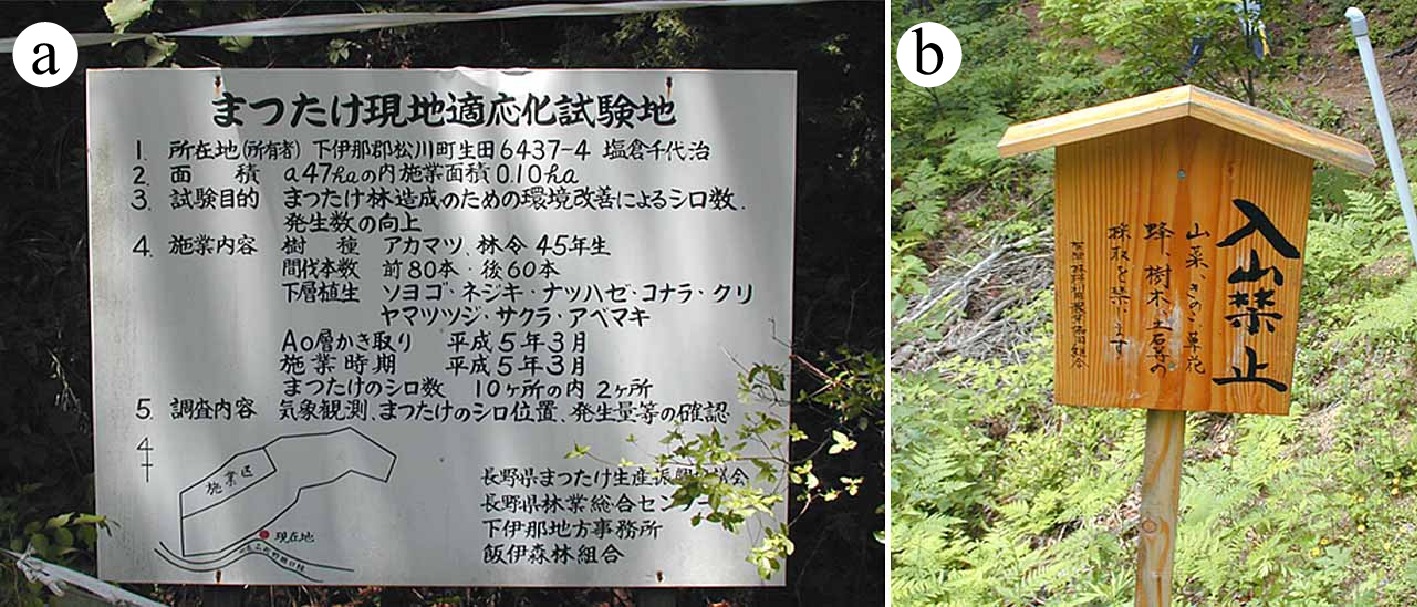
Figure 15.
Signs indicating management of the forest for Tricholoma matsutake harvest. (a) Sign indicating test areas through collaboration between private organizations and local governments. (b) No trespassing sign for private forest.
Most of the forested areas maintained specifically for T. matsutake harvesting are privately owned. Such initiatives are not undertaken in national forests, and only a very small number of local governments implement them. In forests managed for T. matsutake harvesting, if the owner is a private organization or local government, regular bidding takes place. The successful bidder then maintains and manages a designated area of forest and holds the right to harvest T. matsutake. Eligibility for bidding is often restricted to individuals registered as residents in the forest area or members of forest-owning groups (typically forestry cooperatives). In practice, this means families residing in mountain villages have traditionally won bids for T. matsutake harvesting forests, maintained the forests, and harvested the mushrooms. However, the decline and aging of mountain village populations continue into the present century, making a new management system likely necessary in the future.
Development and progress of Tricholoma matsutake cultivation research
-
Research into cultivating T. matsutake fruiting bodies gained particular prominence in Japan during the 1960s, coinciding with the start of a decline in domestic harvests. While harvests at that time were enormous compared to the situation in this century, they had fallen to less than half of the peak recorded in 1941 (Figs 11−13). The 1960s saw a focus not only on this harvest situation but also on biological research into T. matsutake, marking the beginning of the cultivation research that continues today. Detailed accounts of subsequent research developments can be found in Yamanaka et al.[14] and Yamada [53]. This paper will therefore focus primarily on trends in this century, including later developments.
Development of research focused on ectomycorrhization of Tricholoma matsutake
-
Research into cultivating T. matsutake fruiting bodies gained particular
From the late 20th century to the early 21st century, studies using cultured T. matsutake strains revealed that T. matsutake forms ectomycorrhizae with Japanese red pine through mycorrhizal synthesis, establishing a symbiotic relationship[9,54−58]. However, the success achieved in vitro using small seedlings was not immediately applied to seedling acclimatization and field planting. Efforts to increase the size of mycorrhizal seedlings by scaling up the culture apparatus were promptly undertaken[2,58,59]. However, although studies have shown that T. matsutake mycorrhizae survive for 2 to 3 years after planting such mycorrhizal seedlings in the field[60], the development of mycelium colonies within the seedling root system and the proliferation of mycorrhizae have not yet been conclusively demonstrated. Furthermore, the progression of matsutake primordia formation during the acclimation and cultivation of mycorrhizal seedlings in the laboratory remains unconfirmed.
When in vitro mycorrhiza synthesis is successful, transplanting such seedlings into potting soil and acclimating them can often lead to fruiting body formation[47,48,61]. However, this process does not always proceed smoothly with T. matsutake. It is necessary to plant the seedlings in large pots while carefully preserving the structure of the small T. matsutake mycelium mass (a three-dimensionally developed colony within the root system called 'shiro') – formed by the aggregation of countless mycorrhizae within the root system and the surrounding extraradical mycelium – until it develops to a macroscopically visible size, and then monitor its growth[53]. Using large pots in the indoor acclimatization process, this shiro structure has been successfully expanded to approximately 30 cm in horizontal diameter and 15 cm in vertical thickness within the root system of red pine seedlings[62].
The 'competitive activation' of growing mycelium reported by Horimai et al.[63], where mixing genetically distinct T. matsutake strains onto a single host of Japanese red pine seedling increases ectomycorrhiza formation, has seen limited subsequent verification. However, from the perspective of overcoming the difficulty of increasing T. matsutake mycorrhiza after the above-mentioned adaptation or after field planting, it represents a promising approach. Similarly, the phenomenon reported by Horimai et al.[64], where new genets emerge on preformed T. matsutake mycelium after spore germination on a single host of Japanese red pine seedling, leading to increased mycorrhiza formation in a mixed state, can also be interpreted as competitive activation between hyphae[53]. While such interactions between T. matsutake mycelia can be inferred from previous analyses of T. matsutake mycelium dynamics in the field using individual identification markers[65], the extent to which they contribute to mycelial activity and survival strategies in nature remains unanalyzed.
Development and expansion of Tricholoma matsutake cultivation research: management measures for fruit body production sites
-
Research on managing mushroom harvesting forests is positioned as cultivation research in the broadest sense from the perspective of achieving sustainable production while protecting T. matsutake resources. As mentioned earlier, the technology for mass-producing mycorrhizal seedlings, planting them outdoors, and artificially creating matsutake harvesting forests remains at the initial research stage. This is partly because planting mycorrhizal seedlings on flat land, as done with truffle plantations, is unsuitable for T. matsutake. As previously noted, in the humid Japanese archipelago, T. matsutake tends to colonize Japanese red pine forests established on rocky mountains or steep slopes with good drainage (Figs 4a, 16, and 17). From the mid-20th century onward, forest management techniques for T. matsutake production by dedicated foresters began to be documented[66,67]. Research involving the establishment of managed Japanese red pine forests meeting these prerequisites and monitoring T. matsutake yield over 20 to 30 years was conducted in pine forests across western Japan from the 1970s to the 1990s. These studies provided some scientific confirmation that classical management practices, such as thinning out shrubs and clearing the forest floor, remain effective. However, many of these studies often lacked clear comparative analysis between experimental and control plots, partly due to complex mountainous topography. Furthermore, in many of these pine forests studied during the 20th century, subsequent widespread pine die-offs led to the discontinuation of numerous experiments. Consequently, longer-term trends, particularly the dynamics as pine forests age, remained unverified. Amidst this, in Nagano and Iwate Prefectures, where commercial T. matsutake harvesting has continued into this century, monitoring surveys of matsutake occurrence have persisted[68,69]. The site in Toyooka Village, Nagano Prefecture, has yielded the longest-term data collected. Here, in 1980, experimental and control plots were established along a ridge in a red pine forest where matsutake occurrence was observed. Since then, T. matsutake yield has been meticulously recorded. While the interim results of this survey were reported, the detailed yield dynamics over the past 40 years up to 2020 were analyzed and reported by Furukawa et al.[70]. The results showed that with continuous appropriate management practices (thinning of shrubs and clearing of the forest floor), T. matsutake harvest levels could be maintained at a consistent level (commercial production) over 40 years (Fig. 18). Even as the host of Japanese red pines transitioned from mature to old-growth forests (50–70 years old), no significant decline in pine fine root biomass was observed, demonstrating that the habitat for T. matsutake could be sustained. In other words, by appropriately maintaining vegetation and forest floor conditions in T. matsutake-producing areas, long-term and continuous income can be obtained. This perspective can also be considered an aspect of T. matsutake cultivation technology. This 40-year continuous harvest data represents the world's longest record and holds significant importance for our discussions on 'resource conservation' and 'sustainable production' of mycorrhizal mushrooms. Note that this Toyooka experimental site is village land (public property). The same individual won the bidding for this land for over 40 years and shipped the harvested fruiting bodies to the market. During this period, at the request of Nagano Prefecture, all occurrences of fruiting bodies—including when, where, and how many (or how many grams) appeared—were meticulously recorded (Figs 17b and 18). Nagano Prefecture then handled the data analysis of these fruiting body occurrences. Subsequently, the winning bidder who had continued collecting data at this trial site retired due to advanced age. Starting in 2024, another winning bidder will maintain and manage the experimental site, while the joint research with Nagano Prefecture continues.
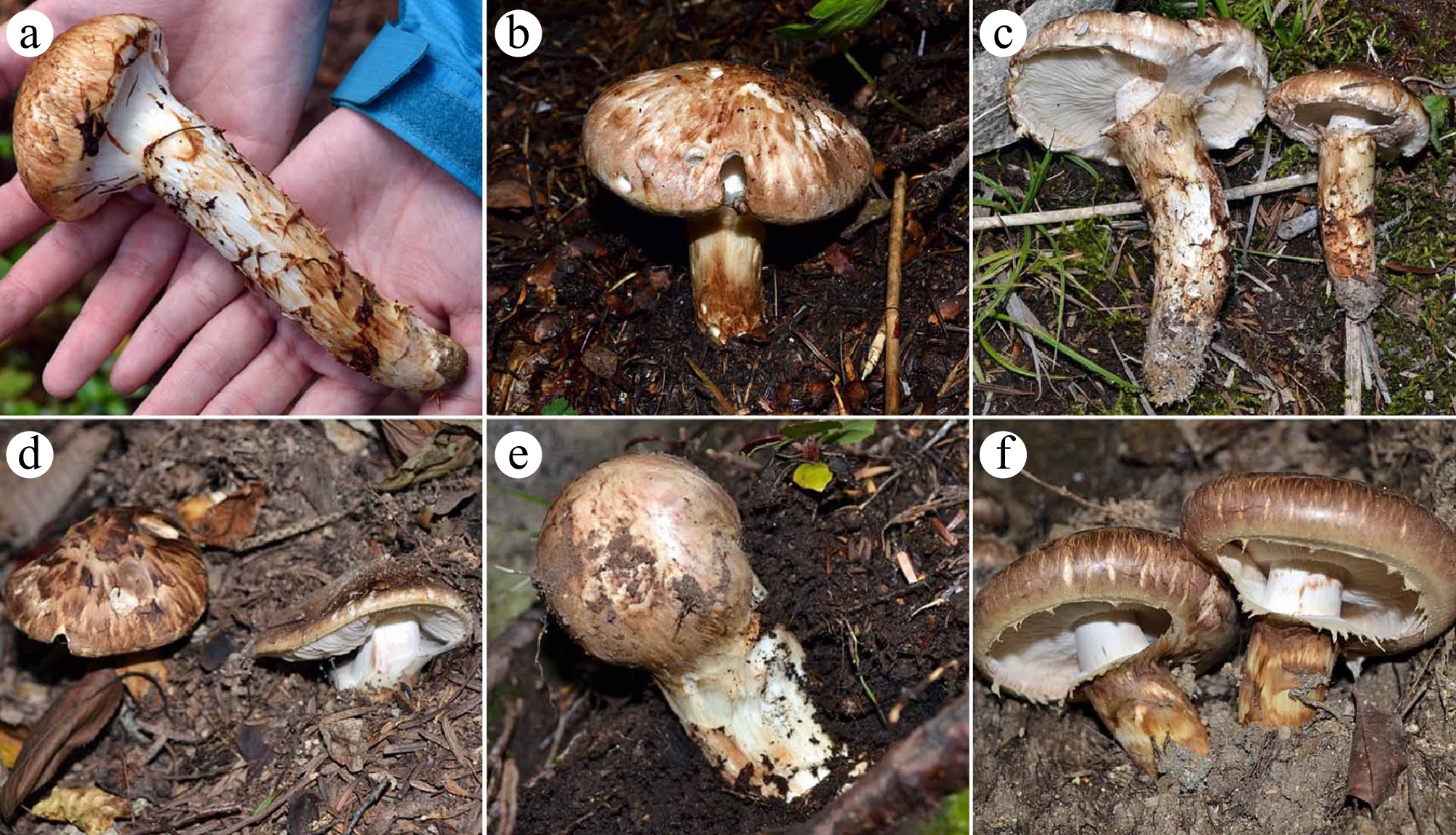
Figure 16.
Tricholoma matsutake occurrences in various forests other than Pinus densiflora. (a) Pinus pumila forest (Sep 2015, Ashoro, Hokkaido). (b) Abies sacharinensis forest (Sep 2015, Nishi-okoppe, Hokkaido). (c) A. veitchii forest (Aug 2017, Matsumoto, Nagano). (d) A. firma forest (Oct 2023, Nasu-shiobara, Tochigi). (e) Tsuga diversifolia forest (Sep 2021, Saku, Nagano). (f) T. sieboldii forest (Sep 2021, Ooshika, Nagano).
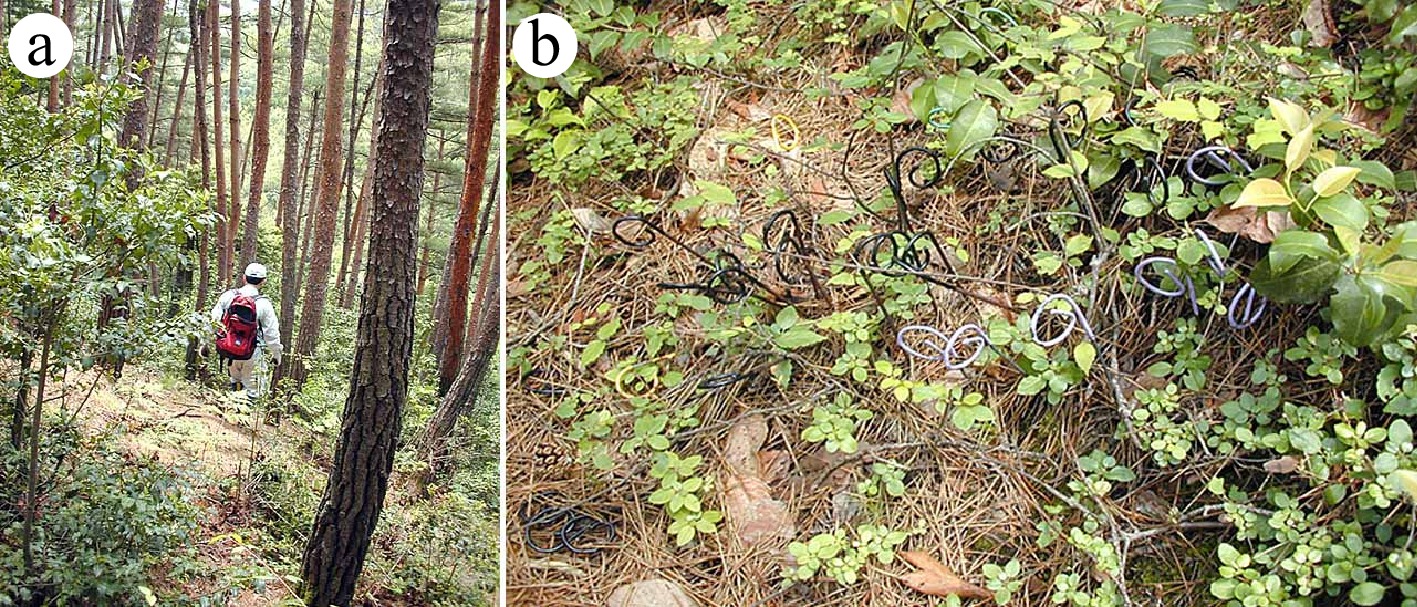
Figure 17.
Toyooka experimental site for Tricholoma matsutake research. (a) forest condition. (b) The pin was stuck in the spot where the T. matsutake fruiting body occurred. Different colors indicate different years of pins stuck. These two photographs were both taken in 2007.
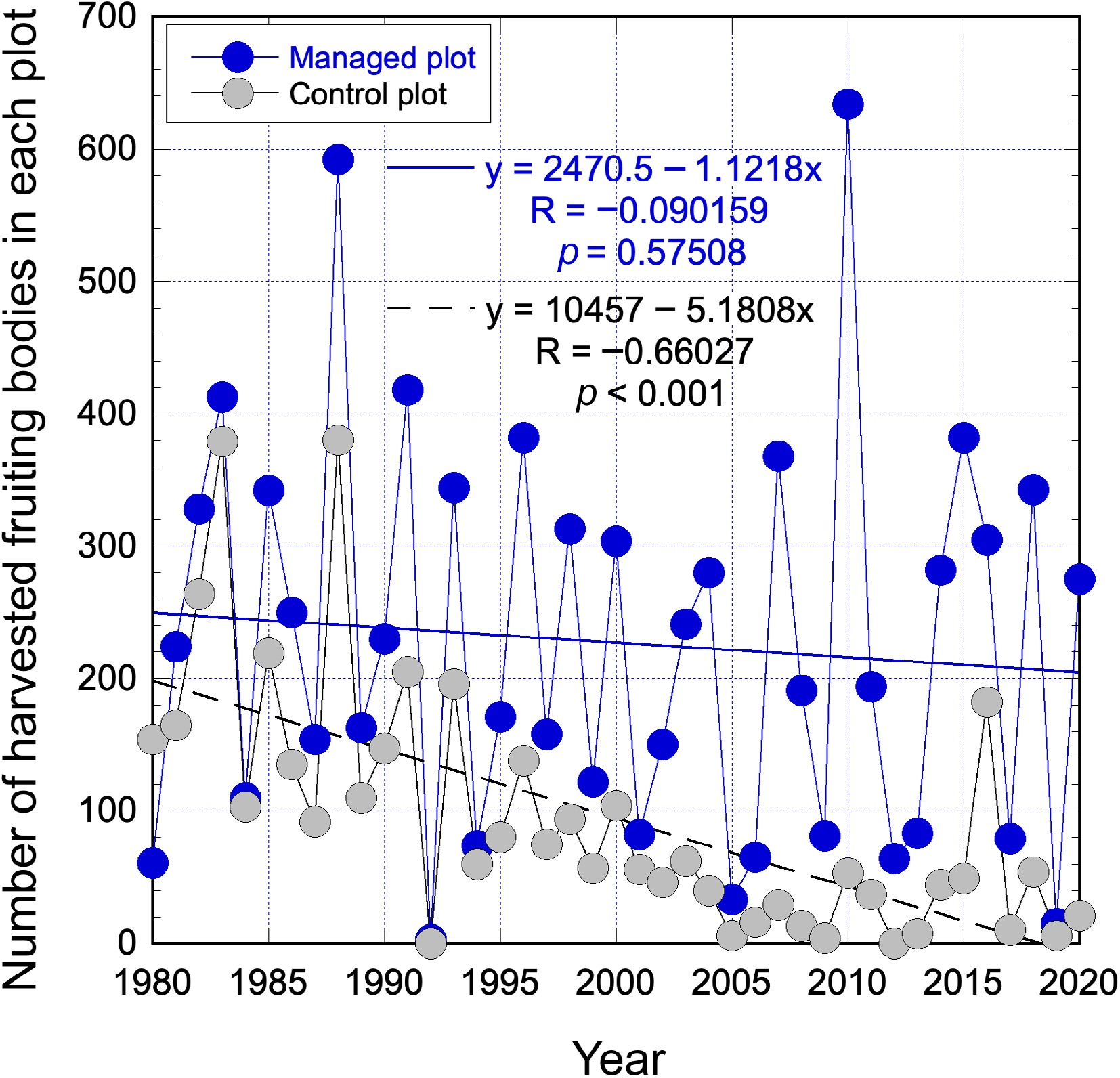
Figure 18.
Forty years of harvest records for Tricholoma matsutake fruiting bodies at the Toyooka experimental site in Nagano Prefecture (Fig. 17). While the harvest of fruiting bodies in the control plot decreased significantly throughout the experimental period, the harvest remained stable in the managed plot. This graph was redrawn based on the original data from Furukawa et al.[70]. In 2024, the number of harvested fruiting bodies in the managed plot was nearly equal to the number in 2010 (Hitoshi Furukawa, personal communication).
Cultivation research on Japanese truffles
-
Research on cultivating truffles in Japan began relatively recently. The first discovery of fruiting bodies of the genus Tuber in Japan dates back to 1935[71], and since the 1970s, their distribution within the country has become widely recognized[72−74]. However, it was only in this century that domestic Tuber species began to be considered as edible mushroom resources, and their cultivation was explored. Specifically, research aimed at producing mycorrhizal seedlings and establishing future plantations has only been underway for about a decade[75]. Even within this short timeframe, the Japanese endemic whitish species Tuber japonicum has successfully produced fruiting bodies in fields planted with mycorrhizal seedlings[46], making plantation establishment increasingly feasible. For the blackish species T. himalayense (Fig. 19), which is relatively widely distributed across the Japanese archipelago, successful fruiting body development similar to T. japonicum has been reported. However, due to limited academic documentation, technical details remain unclear. While the species targeted in such research for truffle cultivation in Japan are currently very limited, cultivation efforts may extend to blackish species such as Tuber longispinosum A. Kinosh. and Tuber sp. 5[76] in the future.
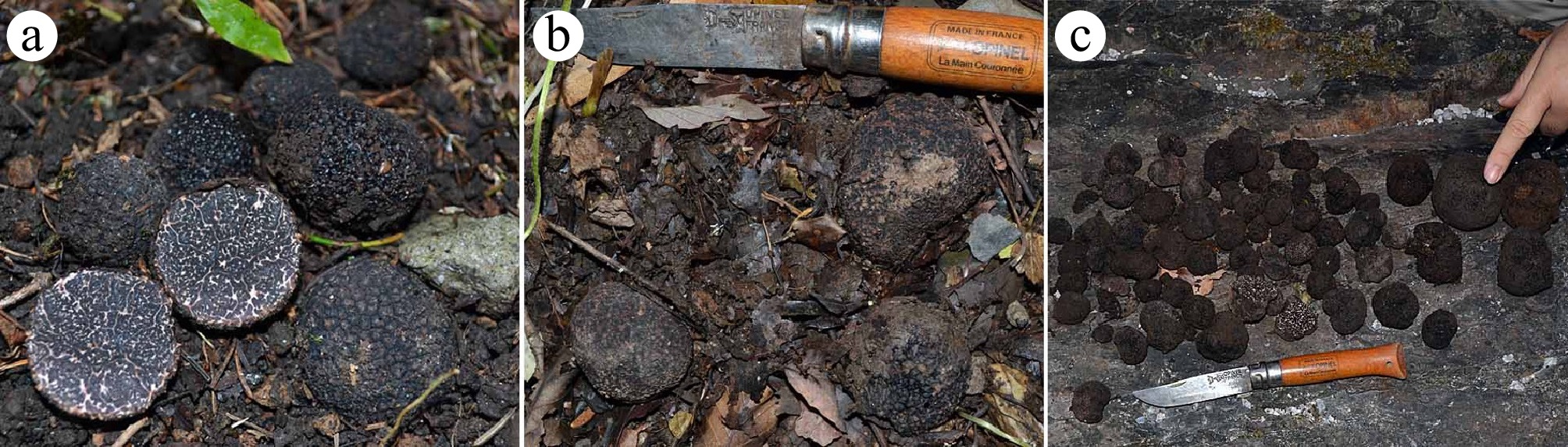
Figure 19.
Fruiting bodies of Tuber himalayense. (a) November 2019, Iizuna, Nagano. (b) October 2017, Tatsuno, Nagano. (c) December 2019, Tatsuno, Nagano.
To date, no academic reports on cultivation research concerning the Perigord truffle (T. melanosporum Vittad.) within Japan are known. The primary reasons for this are differences in climate and the native host-fungus associations. Regarding the former, the natural habitat of the Perigord truffle spans Mediterranean to western maritime climates, which differ significantly in precipitation from the warm, humid climate of the Japanese archipelago. Consequently, establishing the Perigord truffle in Japan, with its warm, humid conditions and high biodiversity, is likely to be difficult. Tuber himalayense and T. lonigispiosum, native species closely related to the Perigord truffle in taxonomy, similarly require relatively high soil pH for growth[77]. Consequently, introducing the Perigord truffle to Japan could lead to competition with these native species. Furthermore, recent restrictions on the import of genetic resources make the domestic cultivation of T. melanosporum in Japan challenging. On the other hand, Japan's truffle imports have shown a yearly increasing trend since the beginning of this century (Figs 20, 21). This situation suggests that policies emphasizing the cultivation of native truffle species as alternatives to T. melanosporum and T. magnatum Picco for the domestic market will likely gain importance in Japan. The aroma of mature fruiting bodies of T. himalayense and T. lonigispiosum is similar to that of T. melanosporum, while the aroma of mature T. japonicum fruiting bodies has a garlic-like odor, similar to T. magnatum[78].
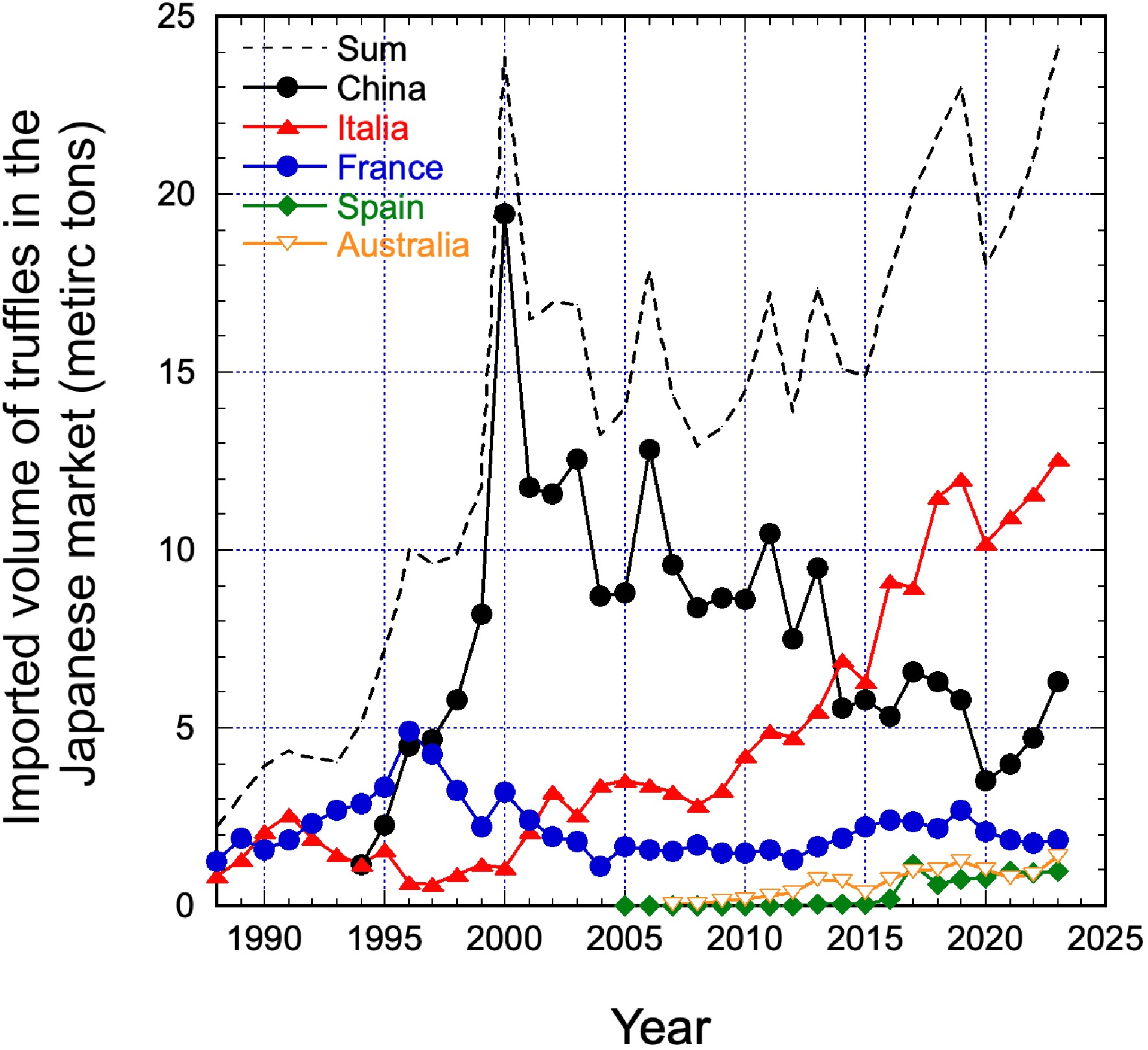
Figure 20.
Imported volume of truffles in the Japanese market in the past 40 years. Data source: Trade Statistics of Japan (
www.customs.go.jp/toukei/info/ ).
Figure 21.
Imported truffle value in the Japanese market in the past 40 years. Data source: Trade Statistics of Japan (
https://www.customs.go.jp/toukei/info/ ).Mycorrhizal seedlings of T. himalayense and T. japonicum can be produced using several Fagaceae tree species, including Quercus serrata Murray. Therefore, cultivation of these truffles is considered feasible in coastal areas of Korea and China, which share similar climates and vegetation.
Research on mycorrhizal fungi other than Tricholoma matsutake and truffles
-
As previously mentioned, Japan has utilized a diverse range of wild edible ectomycorrhizal fungi. We have also outlined the basics of commercial cultivation of Lyophyllum shimeji on bottle cultivation, and the cultivation of Rhizopogone roseolus, primarily cultivated in pine forests on coastal sand dunes. Here, we briefly touch upon the known findings regarding mycorrhizal synthesis and forest management, which form the basis for such research.
Regarding mycorrhizal synthesis in edible mycorrhizal mushrooms, reports exist for Lyophyllum, Tricholoma, Suillus, Rhizopogon, Amanita, Boletus, Astraeus, Lactarius, Cantharellus, and Hydnum[47,48,79−81], and fruiting body production has been reported for some species. For Hygrophorus, Catatherasma, Sarcodon, Boletopsis, Ramaria, Cortinarius, Entoloma, and Craterellus, which are desired for cultivation, mycelium culture itself has not been extensively studied. Therefore, establishing cultivation for these species will likely require starting from the fundamentals.
It is empirically known that in natural forests where mycorrhizal mushrooms occur, forest management practices similar to those demonstrated in T. matsutake research tend to increase fruiting body production. In pine forests, these include L. shimeji, Suillus bovinus, S. luteus, Tricholoma flavovirens, T. japonicum, R. roseolus, Lactarius hatsudake, L. akahatsu, Boletopsis leucomeranea, Phellodon fulgineoalbus, and Ramaria botrytis; in Quercus serrata stands, Lyophyllum fumosum, Tricholoma portentosum, and Sarcodon aspratus; and in Larix kaempferi stands, S. orientalis and S. grevillei, among others. This forest management, while having an aspect of artificial cultivation, also creates habitats suitable for species adapted to such anthropogenic environments (where the surface soil layer of the forest floor tends to dry out more easily compared to natural forests). Japanese red pine forests and deciduous broadleaf forests like those of Quercus acutissima Carruth. and Q. serrata have been closely intertwined with human life since ancient times. Therefore, especially in mountain forests adjacent to human settlements, it is desirable to optimize these forests with the premise of harvesting and sustainable use of such fungi. In countries and regions with dry climates, regenerating forests after logging requires significant cost and time. However, in humid climates like Japan's, where forest coverage is already high, vegetation recovers rapidly after logging. In some cases, forests regenerate within a few years after logging. Under such vegetation, selectively retaining pine and oak trees can often provide stands favorable for harvesting mycorrhizal mushrooms.
-
As seen thus far, the history of mushroom cultivation in Japan began with a focus on revitalizing regional economies and domestic demand. This trend remained consistent until the 1980s, with annual and future plans being formulated by both the mushroom industry and the government centered around these objectives. Meanwhile, large-scale mushroom cultivation began in China during the 1980s, and by the 1990s, the situation shifted to massive imports of these products into the Japanese market. Particularly, dried and fresh Lentinula edodes fruiting bodies imported from China were cheaper than Japanese products. Although there were quality differences initially, these gradually diminished. These developments accelerated the decline in prices for cultivated mushrooms, including L. edodes, produced in Japan. Consequently, the domestic mushroom industry faced increasing demands for large-scale operations and production efficiency. Amidst these changes, while domestically produced mushrooms still dominate the fresh mushroom market sold within Japan, a significant portion of dried mushrooms and boiled mushrooms used as ingredients in processed foods now comes from overseas sources, primarily China (especially L. edodes, Pleurotus ostreatus, and Auricularia polytricha).
Entering the 21st century, Japan's mushroom consumption reached a steady state, and accordingly, mushroom production also stabilized. Particularly over the past decade, there have been no significant fluctuations in the production volumes of major mushrooms (Fig. 3). Instead, efforts have focused on developing new varieties and improving production processes for each species. Against the backdrop of Japan's economic stagnation and a trend toward cost reduction, a practice emerged where L. edodes substrate was manufactured in China, while only the fruiting bodies were harvested in Japan. This allowed the mushrooms to be sold cheaply as 'domestically produced L. edodes.' In response, a legislative amendment requiring the separate labeling of the country of origin for the growing medium and the country of harvest for the fruiting bodies was enacted and took effect in 2022. Only products where both substrate production and fruiting body harvesting occur domestically can be labeled 'domestic.' This policy aims to protect domestic mushroom producers and the industry. Furthermore, it often became problematic when cultivated mushroom varieties imported into Japan—originally developed domestically and protected under Japan's Seed and Plant Variety Protection Act—were leaked overseas, where domestic laws did not apply. These varieties were then produced abroad and re-imported into Japan. These cases, including those involving Japanese vegetable and fruit varieties, became social issues. Consequently, the Seed and Plant Variety Protection Act was amended. Specifically, taking varieties developed and registered in Japan overseas without the registrant's permission became an illegal act.
During the 1990s, amid China's economic development and the rapid growth of mushroom cultivation there, Japanese mushroom production companies also explored entering the Chinese market and forming joint ventures with Chinese firms. However, many companies subsequently withdrew, and today, collaboration tends to be limited to specific forms of community or partnership. On the other hand, Japan's mushroom cultivation systems (machinery and production plants) are highly efficient and compact in size, leading to cases where such systems have been introduced in North America and Europe.
Japan's total population peaked in 2004 and has since declined. Consequently, significant future growth in total cultivated mushroom production appears unlikely. Therefore, from the perspective of promoting healthy eating habits, a realistic goal is to maintain current production levels while increasing per capita mushroom consumption. This means that in mushroom breeding and new variety development, there will be an increasing demand for varieties that are not only high-yielding and productive but also nutritionally rich. Furthermore, within the framework of the mushroom industry, alongside the advancement of cultivation techniques for cultivated mushrooms, efforts to harvest wild mushrooms under extensive cultivation methods utilizing mountain forests and sell them with added value will likely gain importance. Strategies like those practiced in Spain and France—combining truffle hunting and forest walks with stay-type tourism to attract inbound demand and boost the local economy[82]—may hold the key going forward.
Relationship between the domestic industrial structure and mushroom cultivation
-
Currently, mushroom cultivation in Japan primarily follows two models: nationwide production centered around several large enterprises, and a method where medium-sized enterprises produce the mushroom substrate, which is then managed and harvested by local farming households. Furthermore, there are frequent reports of enterprises specializing in specific varieties, or even companies previously unrelated to the mushroom industry, entering mushroom cultivation as ventures. Among the latter examples, some successfully expand their operations and capture a significant market share, while others may withdraw from the business due to economic trends, cash flow issues, production costs, or unforeseen problems.
Here, we will examine several specific cases, focusing primarily on Nagano Prefecture, which ranks first in domestic cultivated mushroom production, and Niigata Prefecture, which ranks second. These two prefectures alone produce approximately 55 % of Japan's cultivated mushrooms (Table 2).
As mentioned earlier, Flammulina velutipes, currently Japan's most produced species, originated as a small-scale local industry in northern Nagano Prefecture during the post-war recovery. Support from the local government, followed by participation from agricultural cooperatives (JA), propelled it into a major industry. The initial model involved producing seed spores based on varieties developed by JA and local government research institutes, distributing them to individual farmers (producers), and managing the entire process from substrate preparation to shipping the fruiting bodies. Subsequently, driven by the need for improved production efficiency and quality control, a shift towards centralization gradually occurred. The process of manufacturing seed spores from varieties developed by research institutions and inoculating them onto the substrate was consolidated and handled centrally by companies. Only the subsequent fruiting operation was outsourced to surrounding farmers (producers). Particularly since the start of this century, this trend has accelerated further, with companies increasingly handling even the fruiting operation itself entirely within their own plants. A similar progression occurred in Niigata Prefecture, adjacent to northern Nagano Prefecture. Together, these two prefectures now produce approximately 75% of Japan's F. velutipes.
The cultivation of Hypsizygus marmoreus, currently Japan's second-most produced mushroom variety, began in Nagano Prefecture in 1972. This was initiated by the Nagano Prefectural Economic Federation, which secured an exclusive contract for cultivation technology (patented) established by a private company in another prefecture, limiting production to farmers within Nagano Prefecture. After the license agreement expired in 1987, allowing cultivation to be liberalized, companies from Nagano Prefecture—now Japan's largest mushroom producer—entered the market, leading to increased production centered in Nagano. Furthermore, entering this century, the entry of the second-largest mushroom producer in Japan, based in Niigata Prefecture, contributed to the current production levels. Together, these two prefectures now produce approximately 60 % of Japan's beech mushrooms.
Regarding companies entering mushroom production from other industries, I would like to introduce an example observed in Niigata Prefecture, which has the highest production volume of Grifola frondosa. Facing the sea, Niigata Prefecture also has a thriving fishing industry and hosts major domestic companies in seafood processing. Leveraging their strength in food management technology (temperature, quality, and safety of food ingredients) from large-scale plants, these companies entered maitake production in 1996, a crop where greenhouse temperature control is critical. Today, they boast the second-largest production scale in Japan. While such new entrants remain a distinct possibility, factors like Japan's declining population suggest that sustaining or expanding production may prove difficult without promising synergies or fresh perspectives linking existing local industries with the mushroom sector, beyond mere production efficiency. On the other hand, mushroom cultivation itself does not necessarily require special prerequisites or large-scale investment, as it can utilize existing structures for space and leverage temperature control and manufacturing processes. Therefore, with careful marketing, it holds the potential to create promising niches and significantly contribute to the regional economy.
In today's Japan, alongside population decline, inadequate forest management and the underutilization of woody biomass have become significant issues. While the use of mushrooms as a solution to these problems has been discussed for a long time, most discussions have been based on the premise that it is merely a secondary use of forestry. That is, concepts or business models centered on maximizing the utilization of woody biomass from forests through mushroom production and harvesting have not been explored. By effectively combining established European truffle farming, traditional Japanese matsutake mountain management, and shiitake log cultivation, along with sawdust-based mushroom cultivation techniques, a new business model could be created, potentially becoming a new mushroom business model for the 21st century. These production techniques remain fully functional today, and access to the academic knowledge supporting them has become significantly easier through the use of modern IoT. Furthermore, Japan's unique geographical environment—where mountains and forests are arranged in a mosaic pattern with relatively well-developed transportation infrastructure—enables collaborative initiatives linking urban and mountainous rural areas.
Global trends affecting Japan's mushroom industry
-
To reiterate, trends in major mushroom production hubs like China, countries with significant potential for increased production like India and Southeast Asia, and developed nations such as the United States—where investment in mushroom production is expected to grow due to nutritional benefits—are anticipated to greatly impact Japan's mushroom industry going forward. In Japan, there is a demand for systems that enable harvested cultivated mushrooms to be promptly packaged and distributed to markets on the same day. This represents a major difference compared to countries like China. Such rapid harvesting, packaging, and distribution systems and know-how are essential for mushroom production near major cities. As the number of countries and cities demanding these systems is expected to grow, the importance of developing corporate strategies and cultivation techniques that can flexibly meet diverse needs is anticipated to increase.
Since the 1980s, Japan has provided technical guidance on mushroom cultivation worldwide, particularly in developing countries and regions. As mushroom cultivation gradually became more widespread globally, the novelty of this technical guidance gradually diminished. Nevertheless, these steady efforts continue to this day. Until the 1990s, it was common practice for Japanese mushroom farmers and others to publicly share new cultivation techniques and know-how for producing high-quality mushrooms through books and other publications. However, as this technical information spread beyond national borders, situations detrimental to the domestic industry became increasingly known. Consequently, awareness gradually shifted toward emphasizing information management. Entering the 21st century, information management became particularly emphasized. Nevertheless, the disclosure of fundamental knowledge and technical guidance remains indispensable for fostering the industry. In Japan, each prefecture has a forestry research institute, and approximately half of these conduct research related to developing mushroom cultivation techniques. The primary mission of these research institutions is to improve mushroom cultivation techniques at the regional level and develop new mushroom varieties that contribute to the local economy. However, activities within this framework can also readily lead to the development of international cooperation. From the perspective of organically utilizing such cooperative frameworks, government policies and legal frameworks play a crucial role, making discussions at intergovernmental meetings and international conferences involving academic researchers important.
In recent years, mushrooms have been actively researched not only as food but also for their mycelium structure as a polymer raw material, with applications in clothing materials, packaging materials, and construction materials[83−85]. Research and development in these fields does not necessarily share the same objectives as research on edible mushrooms. However, there is common ground in understanding the fundamental properties of mycelium cells and efficiently proliferating them. Regarding the related metabolic and genetic mechanisms, discussions can take place on the same level. Furthermore, in the field of alternative meat research, fungal mycelium—whether from mushrooms or other fungi—is cultivated and ultimately processed into meat-like foods. In Japan, edible mushrooms have traditionally been consumed relatively frequently, and thick-fleshed varieties like Lentinula edodes, Pleurotus eryngii, and P. eryngii var. tuoliensis have often been prepared in ways reminiscent of meat substitutes. Consequently, the concept of processing cultured mycelium into meat-like foods was not widely explored, and even when encountered, there was little domestic industry interest in pursuing it. Amidst this, efforts have emerged to process Grifola frondosa fruiting bodies into meat-like ingredients. Transforming edible fruiting bodies into products with meat-like texture and flavor represents a unique endeavor, both domestically and internationally. Interest lies in whether such initiatives will expand globally in the future.
-
Japan's mushroom industry, rooted in a long culinary tradition of utilizing wild mushrooms, experienced rapid development from the mid-20th century onward. Log cultivation and sawdust-based substrate cultivation can be considered prototypes for today's global mushroom cultivation. Against this backdrop, high-quality fruiting bodies are now efficiently produced in highly controlled climate-controlled facilities. However, due to sluggish domestic demand growth and declining prices, further streamlining of production systems and development of next-generation products are desired. Globally, mushroom cultivation itself has continued to grow even into this century. Considering future projections for a circular society and healthy longevity, it is highly likely that this growth will persist. Therefore, it is desirable to shift from the previous purely domestic industry toward increasing international elements, including technology exports. Among the mushroom species registered under Japan's Plant Variety Protection and Seed Act, many have not been developed as varieties in any other country that is a signatory to the UPOV Treaty besides Japan. For these species, public-private collaboration will become increasingly important, such as swiftly aligning with UPOV Test Guidelines when establishing examination standards within Japan. Furthermore, for new variety development, which has primarily been based on empirical cultivation techniques, incorporating a fundamental biological perspective is expected to establish a more robust framework.
Furthermore, in Japan—an advanced nation where approximately 70% of the land is covered by forests and mountainous regions still hold deep virgin forests—policy discussions continue unabated regarding how to utilize this forest biomass moving forward. Amidst this, efforts are emerging not only to conserve edible mycorrhizal fungi resources like Tricholoma matsutake and truffles but also to aim for domestic self-sufficiency through cultivation in mountain forests. Under Japan's unique natural and topographical conditions, where large cities, farmland, and forests coexist in a mosaic pattern, the industrial utilization of these wild mushrooms could potentially serve as a model case for the circular society we humans strive to achieve.
This study was supported in part by a grant from the Institute of Fermentation, Osaka (Grant No. LA-2025-002).
-
The author confirms sole responsibility for the following: study conception and design, data collection, analysis and interpretation of results, manuscript preparation, and approved the final version of the manuscript.
-
All statistical data are available from the government report of Japan or published papers. I retain the copyright to all photographs except those for which I have provided annotations.
-
The author declare that they have no conflict of interest.
- Copyright: © 2026 by the author(s). Published by Maximum Academic Press on behalf of Jilin Agricultural University. This article is an open access article distributed under Creative Commons Attribution License (CC BY 4.0), visit https://creativecommons.org/licenses/by/4.0/.
-
About this article
Cite this article
Yamada A. 2026. Current status and challenges of Japan's mushroom industry. Panfungi 1: e006 doi: 10.48130/panfungi-0025-0006 

Current status and challenges of Japan's mushroom industry
- Received: 16 February 2026
- Revised: 11 April 2026
- Accepted: 13 April 2026
- Published online: 29 April 2026
Abstract: As we approach the mid-21st century, mushroom science and industry have become global challenges. In particular, the cultivation of edible mushrooms continues to expand beyond traditional culinary uses into the fields of alternative meat and health supplements. To deeply understand these trends, a thorough grasp of the historical development of mushroom cultivation techniques and the underlying foundational technologies and research methodologies is essential. In Japan, which modernized in the early 20th century, mushroom cultivation techniques were established earlier, significantly supporting the economic development of mountainous rural areas. Furthermore, since the latter half of the 20th century, advanced cultivation techniques have developed and been introduced worldwide, becoming the de facto global standard in many aspects. On the other hand, for mycorrhizal mushrooms like matsutake, truffles, porcini, and chanterelles, which are difficult to cultivate intensively, production primarily occurs in natural forests or artificial plantations. Consequently, in economically developed nations, their overall economic value cannot be said to be high. Japan's matsutake mushroom can be considered a symbol of Asia among wild mushrooms. This is largely due to its long history as an important ingredient in Japan, dating back about 1,300 years. However, domestic harvests peaked in 1941 and have continued to decline since then. Efforts to conserve resources and regenerate production areas are ongoing, but initiatives with a long-term perspective would be beneficial.
-
Key words:
- Ectomycorrhizal /
- Enokitake /
- Hon-shimeji /
- Saprotrophic /
- Shiitake