











-
Lateral roots (LRs) are the major components of root system architecture (RSA) in plants, increasing overall root surface area and enabling adaptation to spatial and temporal heterogeneity in resource availability. In addition, they provide structural support to plants and mediate interactions with the surrounding soil environment. Primary roots (PRs) in dicots and monocots, as well as adventitious roots (ARs) in monocots and dicots (under special conditions), produce LRs[1,2]. The growing PR or AR can be partitioned into the meristematic, basal meristem/transition, elongation, and differentiation zones. The pericycle cells of the basal meristem adjacent to the xylem pole are responsible for LR formation in Arabidopsis thaliana and tomato (Solanum lycopersicum), and these cells are termed xylem pole pericycle (XPP) cells[3,4]. However, in rice (Oryza sativa) and maize (Zea mays), both pericycle and endodermal cells adjacent to the phloem poles, referred to as phloem-pole pericycle (PPP) and phloem-pole endodermal (PPE) cells, respectively, contribute to LR formation[2,5].
The LR development process in both dicots and monocots can be categorized into priming, initiation, outgrowth, and emergence stages. During initiation, auxin accumulates in XPP and PPP cells, inducing a change in their identity as lateral root founder cells (LRFCs)[6]. Following nuclear migration towards the cell wall in the initiation stage, LRFCs undergo an anticlinal asymmetric cell division, producing two small daughter cells flanked by two larger cells. Further, the central daughter cells expand and divide periclinally, forming a two-layered (outer and inner) lateral root primordium (LRP)[4]. Likewise, PPE cells also undergo division, later contributing to root cap formation in rice. During the outgrowth and emergence stage, the outer and inner layers continue to divide, forming a dome-shaped LRP that gradually establishes a root apical meristem (RAM)[6,7]. This structure ultimately resembles a mature root tip, emerging as a functional LR from the PR/ARs in the differentiation zone.
Phytohormones play a crucial role in LR formation, with auxin serving as a central regulator of LR development in both dicots and monocots. In addition to auxin, brassinosteroids (BRs) have emerged as important regulators of LR formation[8,9]. Although the distinct roles of auxin and BR signalling have been extensively characterized, their coordinated interaction during LR development remains inadequately understood. In particular, how these hormonal pathways are integrated to control the different stages of LR formation remains unclear. Addressing these gaps will provide a more comprehensive understanding of LR development. Thus, this mini-review highlights current knowledge of the roles of auxin and BRs, and their interplay, in regulating LR development. We also discuss how environmental cues, particularly nitrogen (N) availability, influence LR plasticity through hormonal regulation, illustrating how auxin-BR crosstalk contributes to root system adaptation. Most of the mechanistic insights discussed are based on studies in Arabidopsis, with relevant findings from crop species also incorporated.
-
Auxin plays a fundamental role in LR formation in both dicots and monocots, regulating LR development from early patterning events through the production of a functional LR. Auxin acts by regulating transcription through the coordinated action of TRANSPORT INHIBITOR RESPONSE 1/AUXIN SIGNALING F-BOX (TIR1/AFB) proteins, Auxin/Indole-3-Acetic Acid (Aux/IAA) repressors, and AUXIN RESPONSE FACTOR (ARF) transcription factors[10]. During the absence or lower levels of auxin, Aux/IAA proteins heterodimerize with ARFs, thus inhibiting their transcriptional activity. However, during sufficient auxin availability, TIR1/AFB F-box receptors bind auxin and facilitate ubiquitin-mediated proteasomal degradation of Aux/IAA repressors, thereby relieving their inhibition of ARFs[10]. Subsequently, ARF transcription factors regulate the expression of auxin-responsive genes by binding to auxin-responsive elements (AuxREs) in their promoters, thereby controlling LR development.
In plants, auxin regulates LR formation in a dose-dependent manner. While lower-to-moderate auxin treatments promote LR formation, higher concentrations inhibit it[11]. In Arabidopsis, LRs are typically positioned at regular intervals along the PR in an alternating right-left arrangement. This spatial organization is governed by an internal clock-like mechanism that produces periodic auxin signaling maxima within the protoxylem cells of the oscillation zone (OZ), which spans the elongation zone and basal meristem[12]. The periodic auxin signaling maxima in the protoxylem cells of OZ induce the priming of adjacent XPP cells and establish pre-branch sites. At pre-branch sites, the Aux/IAA28-ARF/5/6/7/8/19 auxin signaling module specifies XPP cells as LRFCs by activating GATA23, one of the earliest molecular markers of LRFC specification in Arabidopsis[13].
LR initiation
-
Following the LRFC specification, auxin accumulation in LRFCs activates ARFs by abolishing their repression by the SOLITARY ROOT (SLR)/IAA14 and BODENLOS/IAA12 repressor proteins[14,15]. The activated ARFs subsequently induce the expression of downstream auxin-responsive genes, mainly LATERAL ORGAN BOUNDARIES DOMAIN/ASYMMETRIC LEAVES2-LIKE (LBD/ASL) family genes, through binding to the AuxREs in their promoter regions[15]. The LBD/ASL transcription factors establish cellular asymmetry within LRFCs and promote the first asymmetric cell division by activating cell cycle-related genes, thereby initiating the LR formation[16,17]. In rice, OsLBD1-8 positively regulates LR formation and is directly activated by OsARF19 following derepression from OsIAA13 under optimum auxin levels[18]. Likewise, mutants of LBD orthologs in tomato (bsbrl1 and bsbrl2) and lotus (asl18/lbd16a) also exhibit reduced LR number, suggesting that the Auxin-Aux/IAA-ARF-LBD signaling module is evolutionarily conserved across both monocots and dicots[3,19].
LR outgrowth and emergence
-
Following initiation, the outer and inner layers of LRP continue to divide, forming a dome-shaped primordium that gradually establishes a root apical meristem (RAM), a process referred to as LR patterning. This process is regulated through coordinated feedback regulation among auxin biosynthesis and signaling, PIN proteins, and PLETHORA (PLT) transcription factors in Arabidopsis[20,21]. Furthermore, ARF5/MONOPTEROS (MP), WUSCHEL-RELATED HOMEOBOX5 (WOX5), SCARECROW (SCR), and SHORT ROOT (SHR) specify the quiescent center (QC), stem cell niche (SCN), and other root tissues' identity in the newly developing RAM in Arabidopsis[21,22]. Once the functional RAM is established, auxin regulates the remodeling of overlying tissues such as the endodermis, cortex, and epidermis to facilitate LR emergence[23]. This process involves changes in cell wall properties and cell separation, allowing the developing LR to penetrate surrounding tissues and establish a functional organ.
Common auxin regulatory mechanisms operating throughout LR development
-
Several auxin-dependent regulatory mechanisms function throughout multiple stages of LR development by maintaining auxin homeostasis and establishing local auxin gradients. Polar auxin transport (PAT) is primarily mediated by PIN-FORMED (PIN) auxin efflux carriers and AUXIN1/LIKE-AUX1 (AUX1/LAX1) influx carriers, playing a central role in auxin redistribution during LR development[24]. Both PIN3 and AUX1 play a crucial role in LR initiation by facilitating auxin accumulation in LRFCs through auxin redistribution from the surrounding root tissues in Arabidopsis[25,26]. Furthermore, LAX3 and AUX1 tightly regulate the activity of auxin-induced LBD/ASL genes during initiation and emergence stages of LR development in Arabidopsis, highlighting coordination among PAT machinery, auxin signaling, and the ARF-LBD module[17].
Auxin homeostasis is further maintained through the coordinated regulation of auxin conjugation and biosynthesis. Members of the Gretchen Hagen3 (GH3) family negatively regulate LR development by conjugating excess free indole-3-acetic acid (IAA) to amino acids. Overexpression of SlGH3.15 suppressed LR formation due to a substantial decrease in free IAA content in tomato. In contrast, SlGH3.15 mutants produced more LRs in tomato[27]. Similarly, LR initiation and emergence are promoted in Arabidopsis mutants of group II GH3 genes[28]. In addition, FUSCA3 (FUS3), a B3 domain-containing transcription factor, is expressed in LRFCs and stimulates YUC4 expression, thereby promoting the auxin biosynthesis required for LR initiation in Arabidopsis[29]. Collectively, these transport, biosynthesis, and homeostatic mechanisms ensure auxin distribution and signaling throughout the successive stages of LR development (Fig. 1).
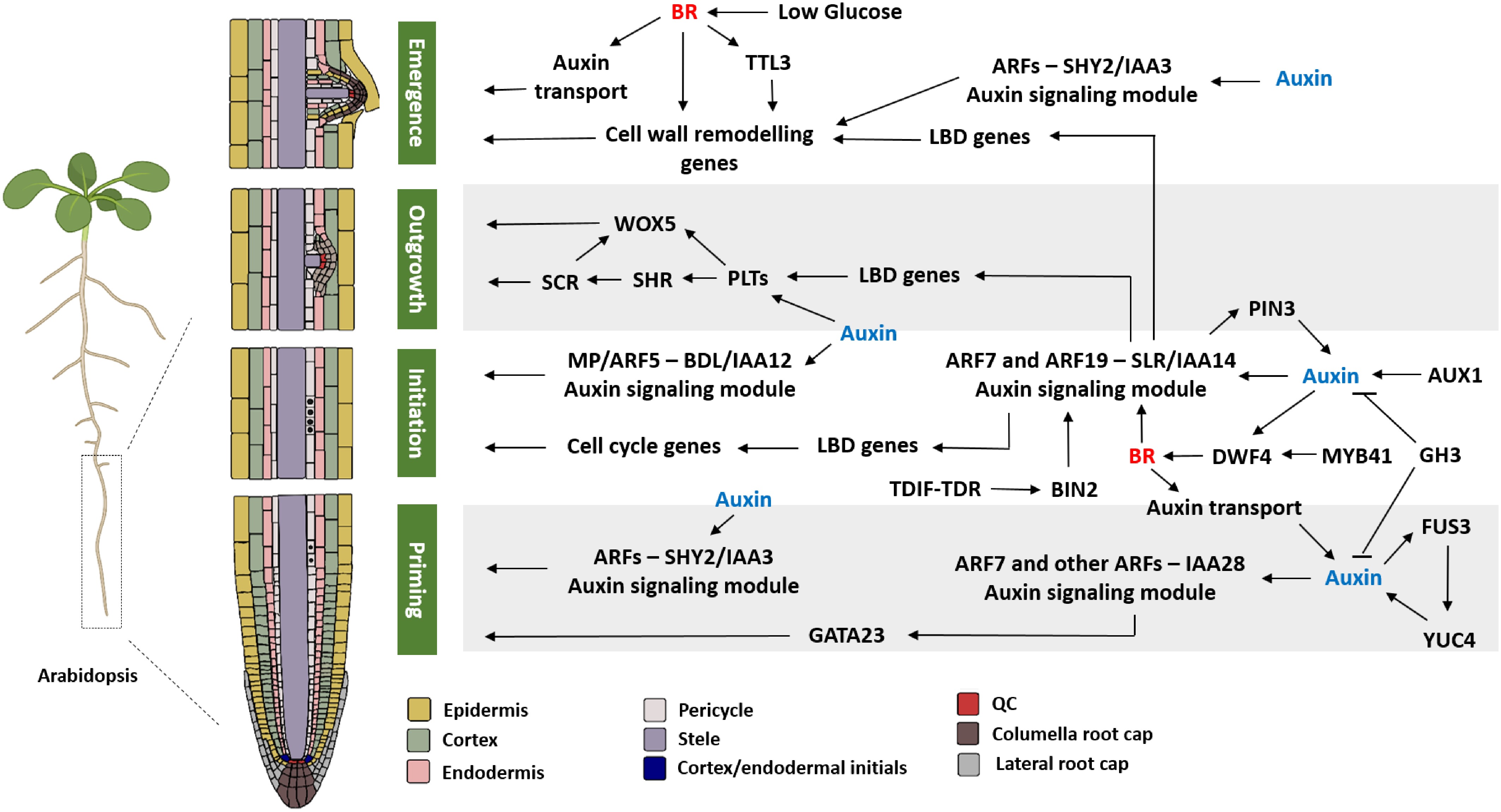
Figure 1.
Proposed model illustrating the roles of auxin, brassinosteroids (BR), and their crosstalk during different stages of lateral root (LR) development in Arabidopsis. Auxin regulates multiple stages of LR formation, including priming (LR founder cell specification), initiation, outgrowth, and emergence. During LR priming, auxin-Aux/IAA-ARF modules and subsequent activation of GATA23 specify the LRFC's identity in the XPP cells. During LR initiation, MP/ARF5-BDL/IAA12 and ARF7/ARF19-SLR/IAA14 auxin signaling modules activate downstream genes, such as LBD and cell cycle genes, which promote the cell division of LRFCs and LR primordia (LRP) formation. In parallel, peptide signaling through the non-canonical TDIF–TDR–BIN2 pathway promotes LR initiation by phosphorylating ARF7 and ARF19, thereby enhancing their transcriptional activity independently of auxin perception. Brassinosteroids (BRs) interact with the auxin signaling machinery, including auxin signaling modules and auxin transport, for promoting the LR priming and initiation processes. In the outgrowth stage, developmental regulators such as PLTs, WOX5, SCR, and SHR coordinate LRP development together with auxin-dependent LBD gene expression. BR may regulate this process by interacting with the ARF7/ARF19-SLR/IAA14 auxin signaling module. During LR emergence, BR promotes cell wall remodeling and auxin transport, facilitating primordia emergence through overlying tissues. GH3 proteins maintain auxin homeostasis during different stages of LR development by conjugating free IAA. Together, auxin and BR signaling pathways form an integrated regulatory network that coordinates LR development from LRFC specification to LR emergence.
-
Brassinosteroids (BRs) are a class of polyhydroxylated steroidal phytohormones that regulate RSA development by modulating cell division, elongation, and differentiation. For consistency throughout this mini-review, the term BRs refers to the brassinosteroid family, and BR is used as a general abbreviation in compound terms (e.g., BR signaling, BR biosynthesis, and BR-deficient mutants). Under BR-deficient conditions, a GSK3-like kinase named BRASSINOSTEROID INSENSITIVE 2 (BIN2) inhibits the expression of BR-responsive genes by destabilizing BRASSINOZOLE RESISTANT 1 (BZR1) and BRI1-EMS-SUPPRESSOR (BES1) transcription factors through phosphorylation. In the presence of BR, the activated BR signaling cascade mediated by the BRASSINOSTEROID INSENSITIVE 1 (BRI1)/BRI1-ASSOCIATED KINASE 1 (BAK1) receptor complex and BRI1-SUPPRESSOR 1 (BSU1) phosphatase inactivates BIN2[30]. Therefore, both BZR1 and BES1 are activated and translocate to the nucleus to regulate the expression of genes associated with cell proliferation and expansion, thereby influencing LR development.
BRs have been shown to play an important role in LR development at multiple stages. BR effects on LR development are strongly concentration-dependent. Exogenous application of brassinolide (BL), the most biologically active and naturally occurring BR, at low concentrations (1–100 nmol/L) typically promotes LR formation, increasing both LR number and density. However, higher concentrations (> 100 nmol/L) inhibit LR formation in both monocots and dicots[8,31−33]. This biphasic response is consistent with BRs' broader role as a dose-sensitive growth regulator and suggests that the root system is tuned to respond to a specific BR optimum. BR biosynthesis of cucurbita (cpdwf5) and tomato (dwf), and BR signaling mutants of Arabidopsis (bri1), and tomato (bzr1), exhibit significantly reduced LR numbers; a phenotype partially/completely rescued by exogenous BR application[31,33,34]. Similarly, overexpression of OsGSK2, a negative regulator of BR signaling, significantly reduced LR formation in rice. In contrast, constitutive activation of BR signaling by OsGSK2 gene knockout increased the number of LRs[32].
Furthermore, overexpression of AtDWF4 and heterologous expression of wheat TaDWF4, BR biosynthesis genes, increased the LR number and density in Arabidopsis. In fact, heterologous overexpression of TaDWF4 in Arabidopsis dwf4 mutants suppressed the LR developmental defects and restored the normal developmental phenotype[35]. Similarly, a mutation in the MtBRI1 gene produced a few LRs in Medicago truncatula, and heterologous expression of this gene in Arabidopsis bri1 mutants complemented the mutant phenotypes[36], suggesting that BR-mediated positive regulation of LR development is conserved among dicots and monocots. A critical prerequisite for LR initiation is the re-entry of differentiated pericycle cells into the cell cycle. D-type cyclins (CYCDs), which regulate the G1-S phase transition, are known to be involved in LR development in Arabidopsis. For instance, Arabidopsis cycd2;1 and cycd4;1 mutants exhibit defective LR development, resulting in reduced LR density[37,38]. BRs have been reported to regulate the expression of various CYCDs during root development. BZR1 directly activates CYCD3;3 expression, which plays a crucial role in lateral root cap development, thereby providing a molecular link between BR signaling and cell cycle regulation[39]. However, the direct relationship among BRs, CYCDs, and LR development remains unclear and warrants further investigation.
BRs facilitate LR emergence by regulating the expression of cell wall remodeling enzymes. TETRATRICOPEPTIDE-REPEAT THIOREDOXIN-LIKE 3 (TTL3), a component of the BR signaling pathway, interacts with microtubules and endomembrane compartments in Arabidopsis. Mutations in TTL3 impair LR development and emergence, and these defects are further exacerbated in ttl1 ttl3 ttl4 triple Arabidopsis mutants. Moreover, these mutants exhibit reduced sensitivity to BR-induced LR formation compared with wild-type plants, suggesting that BRs promote LR development and emergence through TTL protein-mediated regulation of cell wall remodeling[40]. The cell wall-loosening enzymes XYLOGLUCAN ENDOTRANSGLUCOSYLASE/HYDROLASE 19 (XTH19) and XTH23 are strongly expressed during LR development in Arabidopsis. While the LR density is reduced in xth19 and xth23 mutants, their constitutive overexpression promoted LR development in Arabidopsis. Exogenous application of BR induced the expression of both XTH19 and XTH23, consistent with this, their expression was downregulated in dwf4 mutants and BES1-RNAi lines. Furthermore, it was found that BES1 directly regulates XTH19 and XTH23 expression by binding to their promoters to promote LR development[41]. Together, these findings indicate that BR-BES1-XTH signaling plays an important role in regulating LR development in Arabidopsis.
-
The regulation of LR formation involves a complex interplay among multiple phytohormonal pathways, including auxin and BRs, which act synergistically at multiple stages of LR development. Current evidence suggests that auxin−BR crosstalk operates at two interconnected spatial levels. At the systemic level, BR signaling influences RAM activity and auxin transport, thereby contributing to the establishment of auxin gradients required for periodic priming of XPP cells. At the local level, BR signaling fine-tunes auxin transport, auxin sensitivity, and downstream transcriptional responses within LRFCs and developing LRP, ensuring proper LR initiation and emergence.
BR signaling modulates auxin transport and signaling during LR development
-
At the systemic level, BR signaling contributes to auxin transport and distribution, which are required for periodic XPP cell priming and subsequent LR initiation. DIRECT REPEAT 5 (DR5) is an auxin-responsive synthetic promoter, and its activity is widely used as a proxy for endogenous auxin levels in plant tissues, including roots. The DR5::GUS reporter system facilitates the examination of different stages of LR development across plant species[6]. In Arabidopsis, GUS expression is enhanced in DR5::GUS transgenic seedlings treated with BL, consistent with increased LR initiation. However, BR-promoted LR initiation is suppressed by N-1-naphthylphthalamic acid (NPA), an auxin transport inhibitor, suggesting that BRs positively regulate auxin transport and distribution, thereby influencing the establishment of local auxin maxima required for LR formation[8].
Following XPP priming, BR signaling further regulates auxin responses locally during LR initiation and LRP development. LR development is impaired in Arabidopsis seedlings treated with BL at higher concentrations (1 µM). The downstream analysis in these seedlings confirmed that the expression levels of various Aux/IAA genes, including IAA28 and SLR/IAA14, known negative regulators of LR development, are induced. In addition, AXR3/IAA17 expression is induced, and its inducible overexpression impairs LR development in Arabidopsis[42]. This suggests that elevated BR levels may inhibit LR formation by inducing Aux/IAA expression, which represses auxin signaling. As discussed above, the identity of LRFCs in XPP depends on ARF7/ARF19-mediated transcription, and BIN2 directly amplifies this output through a non-canonical mechanism. BIN2 phosphorylates both ARF7 and ARF19, thereby preventing their interaction with Aux/IAAs and subsequently activating the downstream LBD genes. This process is regulated by the TDIF−TDR−BIN2 signaling cascade and is completely independent of auxin perception during LR development[43]. These findings indicate that peptide signaling through the TDIF–TDR pathway regulates ARF7/ARF19 activity via BIN2, thereby integrating peptide and auxin signaling during LRFCs specification and initiation. In tomato, SlBZR1 regulates auxin response and directly activates SlPIN5 and SlPIN10, which are essential for maintaining intracellular auxin homeostasis during LR development[33]. Also, BZR1 in Arabidopsis directly binds the promoter regions of both ARF7 and ARF19 and activates their expression during seedling establishment and callus formation[44], suggesting a potential role in regulating LRFC identity and LR initiation. Furthermore, heterologous expression of MirMAN, a mannanase gene from Mirabilis jalapa, in Arabidopsis promoted LR development by elevating the expression of genes associated with auxin signaling and transport, cell cycle progression, and LBD transcription factors. Further analysis revealed that MirMAN-mediated mannose significantly induces MYB41 expression, a transcription factor that directly binds the DWF4 promoter, a BR biosynthetic gene. Consequently, elevated BR levels activate auxin signaling modules, thereby promoting LR formation in Arabidopsis, suggesting that BR-mediated modulation of auxin signaling contributes to this effect[45]. Furthermore, glucose exerts a concentration-dependent effect on LR emergence, promoting it at low concentrations and inhibiting it at higher concentrations. Gupta et al. demonstrated that, under low-glucose conditions, BRs function downstream of glucose by enhancing auxin transport, thereby promoting LR emergence in Arabidopsis[31]. Collectively, these findings suggest that BRs fine-tune auxin responses during LR development rather than simply promoting or inhibiting them.
Auxin regulates BR biosynthesis and signaling during LR development
-
The interaction between auxin and BR signaling is bidirectional, as auxin regulates various components of the BR signaling pathway during LR development. For instance, exogenous auxin induces DWF4 expression, a key BR biosynthesis gene that plays an important role in maintaining BR homeostasis during plant growth and development[46,47]. Consistent with this, treatment with BL and brassinazole, a BR biosynthesis inhibitor, results in the downregulation and upregulation of DWF4 expression, respectively. In dwf4 mutants or brassinazole-treated seedlings, auxin-induced LR elongation is suppressed, which is further rescued by BL treatment[47]. Furthermore, chromatin immunoprecipitation (ChIP) assays have shown that auxin inhibits BZR1 binding to the DWF4 promoter, thereby promoting BR biosynthesis[46]. Maharjan et al. demonstrated that auxin-induced DWF4 expression and subsequent LR formation are enhanced in the bin2 gain-of-function mutants compared with the wild type in Arabidopsis[48]. Together, these findings demonstrate that auxin not only activates BR biosynthesis but also modulates BR signaling components, highlighting the reciprocal nature of auxin-BR crosstalk during LR development.
Auxin–BR crosstalk fine-tunes LR plasticity under nitrogen deficiency
-
Beyond their developmental roles, auxin–BR crosstalk also integrates environmental signals to regulate LR plasticity. LR plasticity refers to the ability of plants to dynamically modify LR growth, branching, and distribution in response to environmental cues, thereby optimizing resource acquisition. Among these cues, N availability is a major determinant of RSA. Under mild N deficiency, plants enhance LR formation and elongation to improve nutrient foraging, whereas prolonged or severe N starvation restricts these processes to conserve metabolic resources. Recent studies indicate that auxin–BR crosstalk plays a crucial role in N-deficiency-regulated LR development in various plants. Low nitrogen (LN) induces the expression of the BR co-receptor BAK1, BR biosynthetic genes, and activates the canonical BRI1-BSK3-BIN2-BZR1/BES1 signaling pathway in Arabidopsis[49]. Subsequently, the BR signaling cascade induces the expression of auxin biosynthetic genes, TAA1/TAR2 (in pericycle and vasculature) and YUC3/5/7/8 (in LR tips), resulting in localized auxin accumulation that promotes LR initiation and elongation in Arabidopsis. Genetic studies further show that exogenous IAA rescues the impaired LR phenotype of bsk3 mutants, placing auxin biosynthesis downstream of BR perception[49]. The transporter protein NRT1.1 facilitates auxin transport to root tips, which represses LR elongation under LN conditions in Arabidopsis. In another recent study, a regulatory BIN2-GRF5-UBP12/13 module was reported to influence root foraging to LN conditions in Arabidopsis[50]. The authors report that BIN2-mediated phosphorylation of GRF5 targets it for degradation. Once stabilized, GRF5 activates low-nitrogen-responsive genes, suppresses NRT1.1, and promotes LR formation. Collectively, these findings highlight the complexity of auxin–BR crosstalk, which not only orchestrates the LR developmental program but also integrates environmental signals to dynamically remodel RSA, thereby enhancing plant adaptation to changing environments.
Future prospects
-
In plants, LRs largely determine the RSA and play a crucial role in anchorage, water absorption, and nutrient uptake. Although substantial progress has been made in understanding the individual roles of auxin and BRs during LR development, the molecular framework underlying their coordinated action remains unclear. Emerging evidence suggests that auxin–BR crosstalk operates at multiple regulatory levels, including hormonal biosynthesis and downstream signaling, transcriptional signaling, and cell wall remodeling. However, several important questions remain unresolved. First, where are bioactive BRs synthesized within roots during LR development, and how is their production spatially regulated? Since different steps of BR biosynthesis occur in distinct root tissues and BRs exhibit limited long-distance movement, understanding the tissue-specific and developmental stage-specific regulation of BR synthesis and signaling will be essential for deciphering their precise roles during LR formation. In addition, although BIN2 has emerged as a central regulator of auxin-BR crosstalk, its precise function during LR development remains unclear. Whether BIN2 primarily regulates vascular development, controls specific stages of LR formation, fine-tunes auxin responses, or acts in concert with additional BIN2-independent BR signaling pathways remains to be investigated. To better understand the role of BRs and their crosstalk with auxin during LR development, reporter systems and biosensors for BRs, similar to those developed for auxin, are needed.
Recent findings in Arabidopsis demonstrating direct interactions between BR signaling regulators, such as BIN2 and BES1/BZR1, and auxin signaling modules, including ARF7/ARF19 and Aux/IAA proteins, highlight the existence of highly interconnected regulatory networks. Nevertheless, whether these interactions function in a stage-, cell-type-, or environmentally specific manner during LR development remains unclear. Moreover, most mechanistic studies have been largely restricted to Arabidopsis, whereas comparatively little is known in crop species such as rice, maize, wheat, and tomato, which exhibit distinct RSA and developmental programs. Future studies should also explore how BR signaling can be precisely manipulated to engineer beneficial root architectures in crops. Since BRs regulate multiple aspects of plant growth, constitutive manipulation of BR signaling may result in undesirable pleiotropic effects. Therefore, tissue-, developmental-stage-, or stress-specific modulation of BR signaling components, together with advances in genome editing, single-cell transcriptomics, and spatiotemporal gene expression analysis, may provide effective strategies to optimize RSA while minimizing adverse effects on plant growth. Furthermore, the influence of abiotic and biotic stress factors on auxin-BR interactions during LR development remains largely unexplored. Overall, a deeper understanding of the coordinated regulation of LR development by auxin and BRs may facilitate the development of crops with improved RSA, nutrient uptake efficiency, and stress adaptability.
-
Claude (Anthropic) was used for grammar checking and text formatting. All scientific content, interpretations, and conclusions were independently developed, verified, and fully approved by the authors. This work represents the authors' own intellectual contribution, and no artificial intelligence tool is credited as an author.
-
The authors confirm their contributions to the paper as follows: study conception and design, draft manuscript and figure preparation: Kumar R, Chennakesavulu K. Both authors reviewed the results and approved the final version of the manuscript.
-
Data sharing not applicable to this article, as no datasets were generated or analyzed during the current study.
-
The authors declare that they have no conflict of interest.
- Copyright: © 2026 by the author(s). Published by Maximum Academic Press on behalf of Chongqing University. This article is an open access article distributed under Creative Commons Attribution License (CC BY 4.0), visit https://creativecommons.org/licenses/by/4.0/.
-
About this article
Cite this article
Chennakesavulu K, Kumar R. 2026. Auxin–Brassinosteroid crosstalk: a hidden layer of control in lateral root development. Plant Hormones 2: e022 doi: 10.48130/ph-0026-0020 

Auxin–Brassinosteroid crosstalk: a hidden layer of control in lateral root development
- Received: 13 June 2026
- Revised: 24 July 2026
- Accepted: 05 August 2026
- Published online: 31 August 2026
Abstract: Lateral root (LR) development is essential, as LRs constitute the major part of the root system architecture (RSA) in plants. In addition to providing structural support, LRs enable plants to efficiently take up water and nutrients and adapt to heterogeneous soil environments. Among phytohormones, auxin plays a crucial role in LR development, while the other hormones regulate it either independently or mostly by interacting with auxin signaling modules. Brassinosteroids (BRs), the steroidal phytohormones, have also emerged as important regulators of LR development in plants. Recent studies have shown that BRs interact with auxin signaling components at multiple levels to coordinate LR development. However, the molecular mechanisms underlying auxin–BR crosstalk during LR development remain poorly discussed. In this mini-review, we summarize recent advances in understanding the individual and coordinated roles of auxin and BRs during LR development, with particular emphasis on the molecular mechanisms governing their interactions. In addition, we discuss how environmental cues, particularly nitrogen availability, reshape LR plasticity and RSA. A better understanding of auxin–BR crosstalk will provide important insights into the hormonal regulation of RSA and may contribute to strategies for improving crop adaptation and nutrient acquisition.