








-
Most of the energy sources currently in use are derived from non-renewable resources, such as coal, oil, and natural gas[1−4]. However, their finite availability and the environmental damage associated with their exploitation and consumption make them unsustainable for meeting the long-term development needs of modern society[5−8]. Consequently, the development of technologies for the clean and efficient conversion and utilization of energy is of critical importance. To date, a variety of renewable energy technologies, such as solar, tidal, wind, and geothermal energy, have undergone considerable advancement and are now widely adopted[9−13]. Nevertheless, the dispersed and intermittent nature of these renewable energy sources continues to hinder their large-scale utilization[14−16]. As a result, achieving the efficient and cost-effective use of renewable energy remains a global challenge[17,18].
Since the Industrial Revolution, the widespread consumption of fossil fuels has caused a marked elevation in atmospheric CO2 levels, which in turn has given rise to increasingly severe environmental and energy-related challenges[19−21]. Accordingly, developing clean and efficient CO2 utilization technologies, while simultaneously curbing CO2 emissions to meet carbon neutrality targets, has become both urgent and essential[22,23]. Among the various electrolysis technologies, solid oxide electrolysis cells (SOECs) are particularly well suited for large-scale industrial CO2 electrolysis by utilizing renewable electricity and industrial waste heat to convert excess electrical energy into chemical fuels[24−26]. SOECs are therefore widely regarded as one of the most environmentally benign and efficient technological platforms for this purpose[27,28]. In addition, within renewable-energy-based power grids, the integration of SOECs can help balance electrical loads, alleviate mismatches between electricity supply and demand, and improve the overall utilization efficiency of renewable energy (Fig. 1)[29−31].
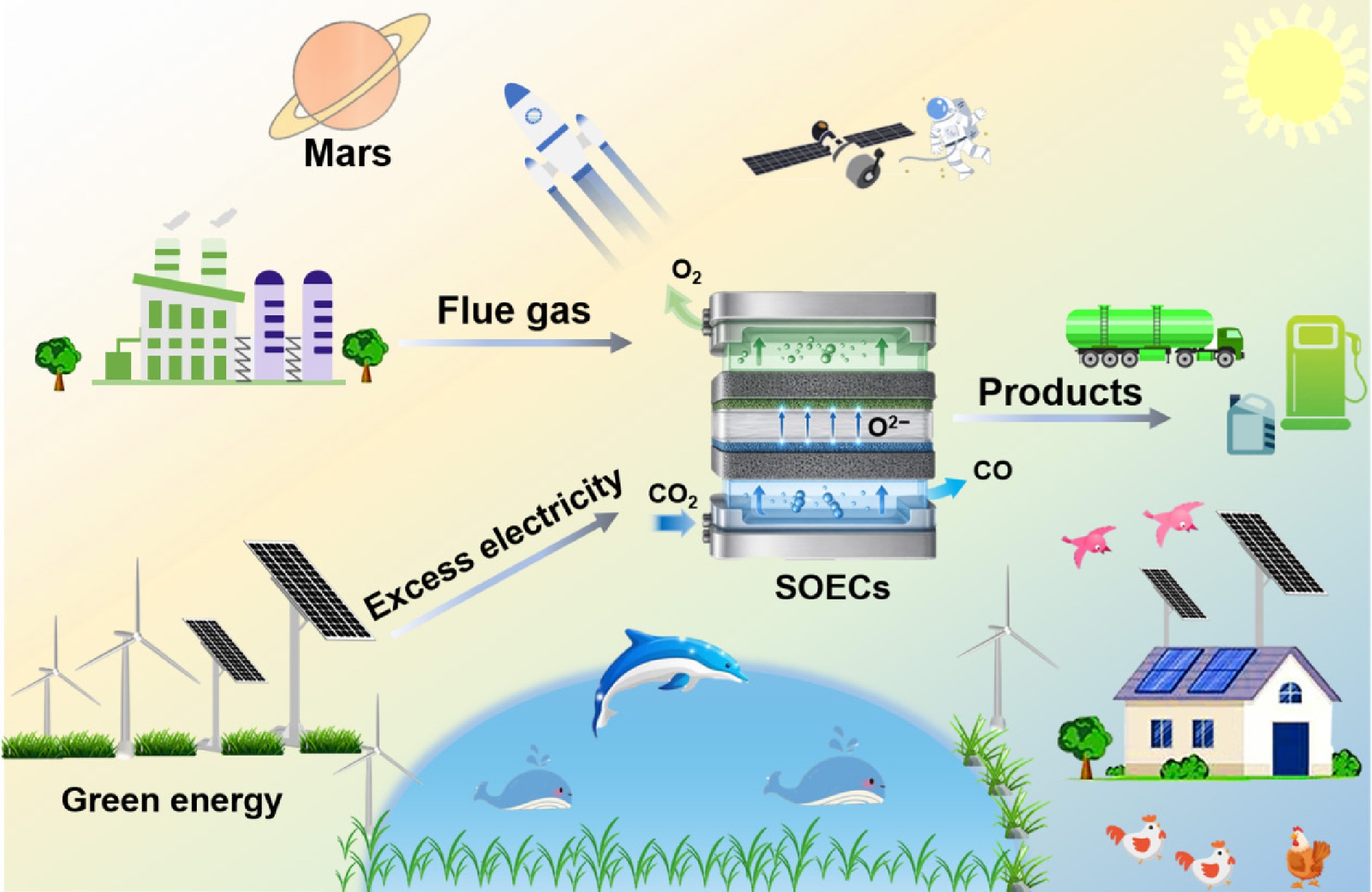
Figure 1.
Conceptual overview of SOECs' functionality in future renewable-rich energy systems, illustrating the interconnections among power, gas, thermal, and transport networks, along with deep space exploration applications.
SOECs employ an oxide-ion- or proton-conducting solid electrolyte to electrochemically reduce gaseous CO2 at high temperatures, typically above 600 °C[32]. The elevated operating temperature significantly enhances the reactivity of CO2, accelerates molecular transport, and increases the probability of effective collisions at the electrode surface, thereby promoting faster reaction kinetics and enabling current densities much higher than those of many low-temperature electrolysis systems[33]. This feature makes SOECs highly promising for practical applications[34]. Moreover, SOEC devices can also be used for in situ oxygen production on Mars, thereby supporting astronaut life-support systems and offering important implications for space exploration and in situ resource utilization[35−37]. According to the charge carrier in the electrolyte, SOECs can be classified into oxygen-ion-conducting and proton-conducting systems[38]. Based on cell geometry, they can be divided into planar and tubular configurations[39]. Regardless of the specific design, each SOEC generally consists of a fuel electrode, an electrolyte, and an oxygen electrode[40]. Tubular cells have garnered growing research interest, owing to their high mechanical stability, rapid start-up capability, ease of sealing, and favorable thermal cycling stability[41]. By contrast, planar configurations typically exhibit lower internal resistance, higher current density, and simpler, more cost-effective electrode fabrication, thereby remaining the predominant focus in both academic research and industrial scale-up[42].
The CO2 reduction reaction (CO2RR) to produce CO involves a series of elementary steps, including CO2 adsorption, activation or dissociation, and CO desorption, which occur mainly at the fuel electrode[43]. Consequently, the efficiency of CO2 electrolysis in SOECs strongly depends on the electrocatalytic activity of the fuel electrode[44]. To date, Ni-based ceramics, such as Ni/YSZ and Ni/GDC, are among the most commonly used fuel-electrode materials for CO2RR in SOECs because of their favorable catalytic performance at high temperatures[45]. However, the stability of their active sites remains unsatisfactory[46]. During long-term operation, Ni oxidation, particle agglomeration, and carbon deposition become major causes of performance degradation in Ni-based cathodes[47]. Perovskite-type mixed ionic-electronic conductors have been considered promising alternatives to conventional Ni-based fuel electrodes because of their excellent resistance to carbon deposition and superior structural stability[48]. However, their intrinsic CO2RR activity is often limited[49]. Therefore, substantial efforts have been devoted to enhancing the electrocatalytic activity and stability of perovskite oxides through strategies such as elemental doping, impregnation, in situ exsolution, and high-entropy modification[50].
In situ exsolution has emerged as a widely adopted approach in the fabrication of fuel electrodes for SOECs, distinguishing itself among various design strategies[51,52]. Compared with other strategies, in situ exsolution offers several important advantages:
(1) Strong anchoring and improved thermal stability. The exsolved metal or composite nanoparticles (NPs) are partially embedded in the perovskite lattice, which effectively suppresses nanoparticle agglomeration and sintering at high temperatures and thereby prolongs electrode lifetime[53].
(2) Abundant active interfaces and enhanced coke resistance. The exsolution process is typically accompanied by the formation of both NPs and oxygen vacancies, generating abundant nanoscale metal-oxide interfaces that facilitate CO2 adsorption and intermediate conversion while improving resistance to carbon deposition[54].
(3) Tunability of nanoparticle structure. By adjusting parameters such as reduction temperature, reduction time, and the composition of the A-site and B-site cations, the size, density, and composition of the exsolved NPs can be precisely tuned, allowing optimization of catalytic performance[55].
(4) Synthetic simplicity and scalability. Through post-treatment in a reducing atmosphere, NPs can be generated directly on the perovskite surface without complex synthetic procedures, avoiding the introduction of external impurities or residual contaminants and offering potential for batch preparation and scale-up[56].
(5) Regenerability and recyclability. Under oxidizing conditions, the exsolved NPs can reincorporate into the parent perovskite lattice and subsequently re-exsolve under reducing conditions to form fresh NPs, endowing the material with excellent thermochemical regenerability and further extending service life[57].
These features highlight the broad potential of exsolved heterogeneous catalysts in SOEC applications. Nevertheless, despite their many advantages, currently reported laboratory-scale perovskite materials still fall short of the requirements for industrial-grade SOEC stacks in terms of both catalytic activity and long-term stability, which continues to limit their practical application and calls for further optimization. In addition, a comprehensive and systematic understanding of the use of exsolved NPs for high-temperature CO2 electrolysis in SOECs is still lacking. We believe that high-temperature CO2 electrolysis based on SOECs will play an important role in the future carbon cycle (Fig. 2). In this review, we summarize the latest research progress on exsolved NPs in SOECs. We first introduce the fundamentals of SOECs technology, then discuss the exsolution strategy from both theoretical and experimental perspectives, and subsequently analyze recent advances in the application of exsolved NPs for CO2 electrolysis in SOECs. Finally, we discuss the major challenges faced by exsolved nanoparticle-based electrodes during SOECs operation, including insufficient current density, limited durability, and electrode degradation, and provide an outlook on future strategies for improving the current density, product selectivity, and long-term stability of CO2 electrolysis in SOECs.
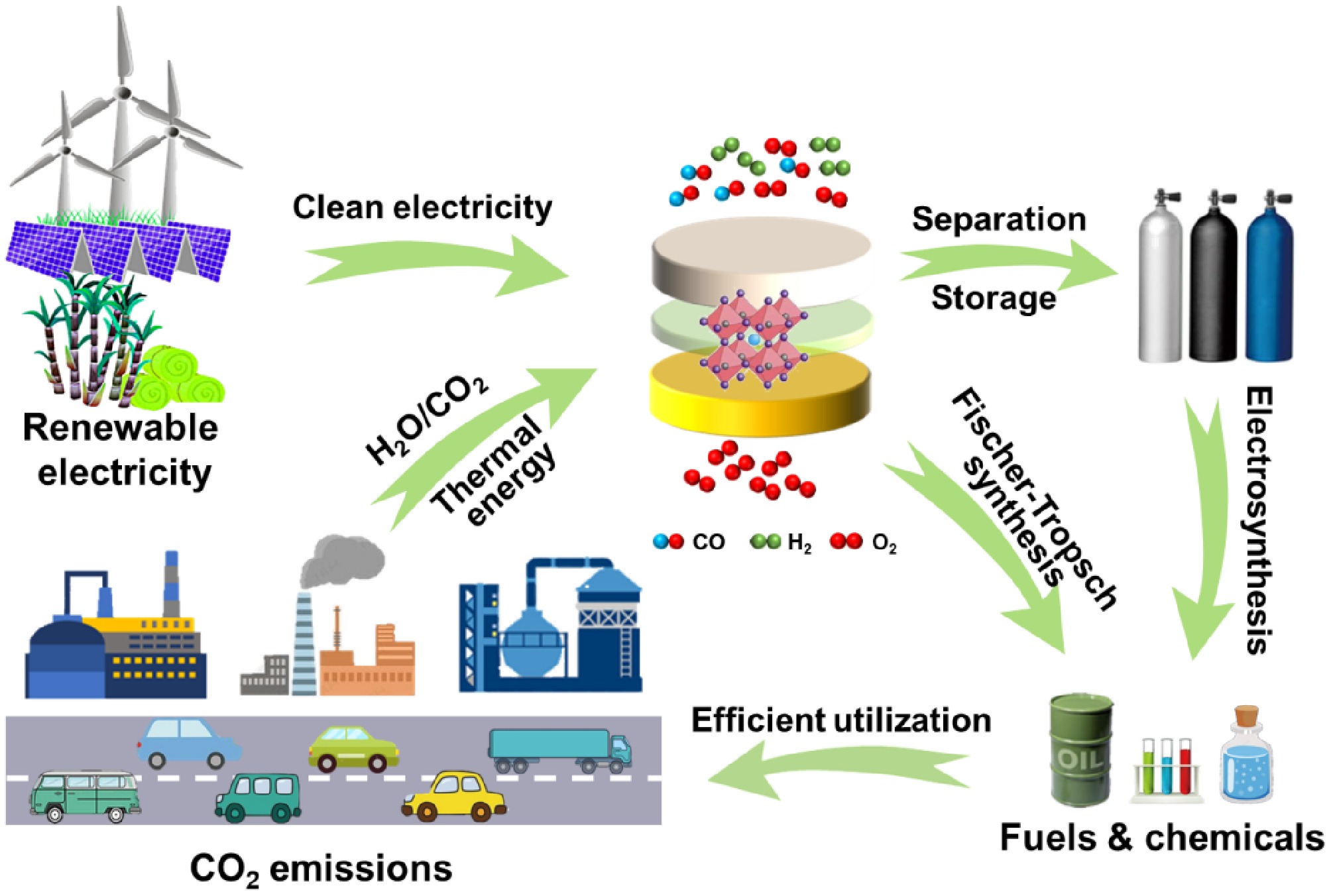
Figure 2.
Illustration of the conceived carbon cycle by SOECs.
-
SOECs serve as electrochemical platforms that convert electrical power and process heat into chemical fuels, thereby achieving efficient energy conversion with high thermodynamic efficiency. In principle, they operate as the reverse of solid oxide fuel cells (SOFCs). Typically, SOECs are architecturally composed of a dense electrolyte layer positioned between two porous electrodes, forming the fundamental building block of the device. Gas channels are located on the outer sides of the porous electrodes to supply reactant gases and remove product gases, thereby ensuring efficient gas transport and uniform gas distribution. Because CO2 electrolysis is an endothermic reaction, increasing the operating temperature thermodynamically favors the reduction process. When a direct current voltage is applied across the electrodes at elevated temperatures, electrical energy is converted into stored chemical energy. However, the extreme operating conditions of SOECs, including high temperature, strongly oxidizing atmospheres, and strongly reducing atmospheres, place stringent demands on electrode materials. In particular, the constituent materials must exhibit sufficient thermal stability and mechanical strength, thermal expansion coefficients compatible with those of the other cell components, and high electrical conductivity.
Although the electrolysis reactions in SOECs can be represented by simple electrode half-reactions, the actual processes of molecular decomposition, species transport, and product recombination are highly complex. From a macroscopic perspective, the physicochemical processes in an SOECs can be divided into three parts[58]: (1) CO2 electrolysis occurs at the gas-solid-solid three-phase boundaries (TPBs), where electrons are consumed to produce CO; (2) mass transport processes, including diffusion and charge transfer, occur within the porous electrodes, while the generated gases diffuse to the electrode surface and are released; and (3) flow and heat transfer take place throughout the entire cell and gas channels, involving coupled transport of mass, momentum, and energy.
During the electrolysis of CO2 in SOECs, CO2 is electrochemically reduced at the cathode to yield O2− species, which are then transported through the electrolyte to the anode compartment, where they undergo oxidation to produce O2. In addition, carbon deposition can readily occur during CO2 electrolysis because of excessive reduction. This phenomenon decreases the catalytic activity of the electrode, damages the cell structure, and shortens the cell lifetime. Since SOECs operation involves the coupling of multiple physical fields and multiple reaction pathways, and since many of the proposed mechanisms are derived from those of SOFCs, it is essential to decouple the various physicochemical processes as much as possible and investigate them systematically[59]. Such efforts are critical for clarifying the reaction mechanisms of SOECs, increasing electrolysis current density, improving the output of individual SOEC stacks, lowering the cost of CO production, and ultimately promoting the widespread commercialization of SOEC technology.
Economic analysis of CO2-to-CO conversion
-
The feasibility of industrial CO2 reduction depends on multiple factors, including market size and product value, as well as capital expenditures, such as the cost of CO2 electrolyzers and catalysts, and operating expenditures, including CO2 feedstock, electricity, and product separation. The electrochemical conversion of CO2 to CO is a two-electron reduction process. Assuming an industrial electricity price of USD 0.05 kWh−1, the theoretical minimum electricity cost for converting CO2 to CO is approximately USD 0.13 kg−1[60]. By contrast, the electricity cost per kilogram of C2–C4 products is much higher because their formation requires the transfer of more electrons. In addition, the electrocatalytic reduction of CO2 to C2+ products proceeds through multiple elementary reaction steps, resulting in sluggish kinetics and large overpotentials. Therefore, when both market value and electricity consumption are considered, CO and formic acid emerge as the most economically attractive CO2RR products.
Compared with low-temperature electrolyzers, SOECs offer nearly 100% Faradaic efficiency for CO production during CO2 electrolysis, while also enabling long-term stable operation at high current densities exceeding 1 A·cm−2. Moreover, SOECs suppress byproduct formation and largely eliminate the need for complex product separation. Owing to their high operating temperatures, however, the further reduction of CO2 followed by C–C coupling to form long-chain hydrocarbons is thermodynamically and kinetically unfavorable[61]. The CO generated by SOECs can therefore be directly used as an important feedstock for chemical synthesis.
For instance, CO is a major component of syngas, an industrial gas mixture mainly composed of H2 and CO, and can be further upgraded through the Fischer–Tropsch process to produce a wide range of valuable chemicals and fuels. Conventionally, CO is produced through the reverse water-gas shift reaction, an endothermic process that requires temperatures above 400 °C and is associated with high energy consumption, slow kinetics, undesirable side products, and elevated costs. Accordingly, the electrochemical reduction of CO2 to CO is widely regarded as one of the most economically viable and technically feasible routes for industrial-scale CO2 electrolysis.
Exsolution strategy in electrode materials design
-
As efficient energy conversion devices operating at intermediate to high temperatures, SOECs still face a major technical bottleneck in the development of fuel electrodes with high catalytic activity, high stability, and good durability. The design of SOECs fuel electrode materials has largely built upon the knowledge base established for SOFCs, leading to the development of three generations of electrode materials[62]. The first generation mainly relied on surface impregnation to modify electrode surfaces; however, the resulting particles were prone to agglomeration and exhibited poor long-term stability. The second generation employed physical deposition techniques, such as magnetron sputtering and pulsed laser deposition, to modify the electrode surface. Although these methods produced more uniformly distributed particles than impregnation, the long-term stability of the resulting SOEC electrodes remained unsatisfactory. The third generation is characterized by the in situ exsolution of metal NPs from oxide surfaces under reducing atmospheres. Because the exsolved NPs are partially embedded in the parent oxide lattice, they provide larger active surface areas, more exposed three-phase boundaries (TPBs), and more uniform dispersion, while showing a lower tendency toward agglomeration. As a result, these materials exhibit excellent electrochemical activity and stability.
The exsolution of NPs is typically accompanied by phase reduction and is affected by many factors, including crystal structure, composition, defect chemistry, temperature, and reaction atmosphere. To date, research on exsolved NPs for SOECs applications has primarily focused on perovskite-type oxides. These materials offer several advantages, including compositional tunability, rich defect chemistry, structural diversity and stability, good electrical conductivity, and excellent resistance to high-temperature operating conditions[63].
The perovskite materials currently used for in situ exsolution in SOECs mainly include single perovskites, double perovskites, Ruddlesden–Popper (R–P) phases, and layered perovskites[64]. In these materials, the A-site cations are typically alkali metal, alkaline earth metal, or rare earth metal ions, whereas the B-site cations are generally transition metal ions. Under suitable induction conditions, B-site cations can migrate out of the perovskite lattice and exsolve as metallic NPs. At the same time, A-site cations may segregate to the oxide surface at high temperature, creating a B-site-rich subsurface region without severely disrupting the overall crystal structure.
A-site cation segregation and B-site cation exsolution are two important surface phenomena in perovskite oxides. At high temperatures, A-site cations, especially alkaline earth ions such as Sr, tend to segregate to the surface and form insulating phases, such as SrCO3, Sr(OH)2, and SrCrO4[65]. These phases block electron transfer and oxygen exchange pathways, slow the oxygen reduction and oxygen evolution reactions (OER), and ultimately shorten cell lifetime[66]. In contrast, under reducing conditions, B-site cations can be reduced to their metallic states, migrate out of the lattice, and nucleate as NPs on the material surface. Because these exsolved metal or alloy NPs are socketed into the perovskite framework, they are more resistant to sintering and detachment, thereby effectively improving catalytic activity and durability. The exsolution tendency of B-site cations is closely related to the Gibbs free energy of their reduction reactions. For common B-site transition metals in perovskites, such as Fe, Co, Ni, Cu, Ru, Pd, and Pt, the Gibbs free energy of reduction is negative under appropriate conditions, allowing spontaneous exsolution to form metal or alloy NPs.
Normally, A-site deficiency and oxygen nonstoichiometry generally facilitate the exsolution of B-site transition metal NPs relative to stoichiometric perovskite oxides. In particular, deliberately introduced A-site defects can promote the in situ exsolution of metal or alloy NPs and simultaneously increase the concentration of oxygen vacancies, thereby significantly enhancing catalytic activity. Surface oxygen defects may also influence both the number density and particle size of the exsolved NPs. The detailed effects of these factors on B-site exsolution have been comprehensively discussed in previous reviews and are therefore not repeated here.
At present, two main approaches are used to promote the exsolution of transition metal NPs: high-temperature H2 reduction and electroreduction, with high-temperature H2 reduction being the more widely adopted strategy[67]. In addition, regulating the oxygen partial pressure at the air electrode has also been reported as an effective means of promoting exsolution. Following high-temperature H2 reduction, the oxygen vacancy concentration in the lattice increases markedly, which is beneficial for enhancing both catalytic activity and stability. Although high-temperature H2 treatment and oxygen partial pressure control can often be implemented in a relatively simple one-step process, the exsolution of metal cations under these conditions is generally slow and may require prolonged treatment times.
By comparison, applied-voltage-driven electroreduction can induce the rapid exsolution of a large number of NPs within a short time while simultaneously endowing SOECs with excellent electrochemical activity and stability[68]. This electroreduction-mediated exsolution process is driven by lattice contraction and regulated by the support material, surface defects, and external operating conditions. When an external voltage is applied, the electron concentration in the material increases abruptly. To maintain charge neutrality, oxygen vacancies are generated and incorporated into the lattice. As electroreduction proceeds, these oxygen vacancies disrupt the stoichiometric balance of the oxide, lower the average oxidation state of reducible cations, and thereby promote the nucleation of metallic NPs on the surface[69]. Compared with conventional high-temperature H2 reduction, the oxygen partial pressure difference required for voltage-driven exsolution is much smaller, making this a more selective and controllable strategy for nanoparticle formation[70].
In recent years, exsolution-based electrode design for SOECs CO2 electrolysis has attracted increasing attention as a promising route to increase electrolysis current density, reduce operating voltage, and prolong cell lifetime. More broadly, the study of in situ exsolution provides a versatile materials design strategy for discovering highly active electrocatalysts and serves as an important guide for the development and optimization of electrode materials targeted at high-performance SOECs.
-
The application of perovskite oxides in high-temperature CO2RR is limited by their intrinsically low catalytic activity. Over recent decades, driven by the rapid development of catalytic materials for CO2 electrolysis in SOECs, a diverse range of exsolution-derived nanocatalysts, encompassing metals, alloys, and oxides, has been successively developed. These materials typically exhibit high mixed ionic-electronic conductivity (MIEC), which effectively facilitates oxygen-ion transport toward the anode and electron transfer to surface active sites, thereby enhancing their intrinsic catalytic activity. The preparation conditions and methods used to construct exsolved NPs on oxide supports profoundly influence their catalytic performance. Through strategies such as surface engineering, morphology control, defect design, and compositional modulation, key properties including oxygen-ion conductivity, catalytic activity, stability, and selectivity can be substantially tuned. In this section, we systematically summarize the various exsolved NP catalysts reported to date and critically discuss their effects on the activity, stability, Faradaic efficiency, and CO production of high-temperature CO2RR in SOECs (Table 1). Furthermore, we systematically compared the key characteristics, advantages, and limitations of various exsolved Ni-based NPs (Table 2).
Table 1. Exsolved Ni-based cathode materials reported for SOECs applications.
Fuel electrode Electrolyte Air electrode Exsolved nanoparticles Operating conditions Current density @ Potential
(A·cm−2@V)Stability Faradaic efficiency CO production
(mL·min−1·cm−2)Ref. LSTN-r8 8YSZ (~500 μm) LSCF Ni (5% H2/N2, 800 °C for 10 h) 85% CO2 -18% CO
(30 mL·min−1)1.50@2.0 (800 °C) 35 h (2.0 V, 800 °C) 80.2% 8.379 [71] LCTNi-Ce LSGM (~300 μm) LSCF-GDC Ni (H2, 800 °C for 3 h) 50% CO2−50% H2
(50 mL·min−1)0.557@1.3 (800 °C) 2 h (0.24 A·cm−2, 800 °C) ~100% ~1.7 [72] LCNMT5 ScCeSZ (150 μm) LSM Ni (5% H2/N2, 900 °C) 77.6% CO2−19.4 H2−3% H2O (50 mL·min−1) 2.89@1.8 (900 °C) 133 h (1.2 V, 900 °C) − − [73] CZO-Ni0.1 YSZ CZO-Ni0.1 Ni (5% H2/Ar, 750 °C for 20 h) CO2 0.78@1.6 (850 °C) 100 h (1.6 V, 850 °C) 99% 5.42 [74] Ni-SFM/Ni-GDC LSGM (270 μm) PBSCF/GDC Ni (H2, 800 °C for 0.5 h) Pure CO2 (50 mL·min−1) 1.72@1.5 (800 °C) 100 h (1.2 V, 800 °C) 95.2% − [75] DP-NPs-GDC YSZ (250~300 μm) LSCF-GDC NiFe alloy
(5% H2/N2, 850 °C for 2 h)Pure CO2 (50 mL·min−1) 0.95@1.4 (850 °C) 100 h (1.4 V, 850 °C) ~100% 9.17 [78] LSFNM LSGM (~200 μm) SBSCO FeNi3
(97% H2−3% H2O, 800 °C)Pure CO2 (100 mL·min−1) 3.07@1.5 (800 °C) 100 h (1.5 V, 750 °C) − − [79] LSFN LSGM (~550 μm) LSCF-GDC FeNi alloy Pure CO2 (15 mL·min−1) 0.88@1.6 (800 °C) 100 h (1.2 V, 800 °C) 100% 6.0 [80] LCNFT YSZ (200 μm) (La0.8Sr0.2)0.95MnO3 FeNi alloy
(5% H2/Ar, 800 °C for 10 h)Pure CO2 (20 mL·min−1) 0.75@1.6 (900 °C) − − − [81] PSMFN LSGM (230 μm) PSMFN-GDC FeNi alloy
(100% H2, 800 °C for 0.5 h)30%CO/CO2 (50 mL·min−1) 1.02@1.5 (800 °C) ~90 h (0.39 A·cm−2, 750 °C) ~91% ~3.54 [82] PBFN YSZ (300 μm) PBFN FeNi alloy
(5% H2/N2, 800 °C for 5 h)Pure CO2 (50 mL·min−1) 0.843@2 (800 °C) ~60 h (0.28 A·cm−2, 800 °C) − − [83] SFNM + 1.2 Fe-red YSZ LSCF-GDC FeNi alloy
(5% H2/N2, 800 °C for 2 h)Pure CO2 (100 mL·min−1) 1.13@1.6 (850 °C) 100 h (1.6 V, 850 °C) ~90% ~9.2 [84] CeO2−NiFe@SCeFNM LSGM LSCF-GDC NiFe
(5%H2/Ar, 800 °C for 2 h)Pure CO2 (50 mL·min−1) 1.57@1.5 (850 °C) 120 h (1.2 V, 850 °C) > 96% 10.32 [85] PSNFM-NFA@FeO LSGM (200 μm) LSCF-GDC FeNi alloy
(97% H2−3% H2O, 800 °C)Pure CO2 (50 mL·min−1) 1.58@1.4 (800 °C) 500 h (0.5 A·cm−2, 800 °C) 95% 9.54 [86] LSCNM LSGM (300 μm) LSCF-GDC NiCo alloy
(20% H2/N2, 800 °C)30%CO/CO2 0.703@1.3 (850 °C) 90 h (30% CO/CO2 with H2S, 850 °C) 97.8% ~4.7 [87] LSM-Ni0.05Cu0.05 YSZ (272 μm) LSM-Ni0.05Cu0.05−SDC CuNi alloy
(5% H2/Ar, 800 °C)CO2 0.75@1.3 (850 °C) 100 h (1.6 V, 800 °C) > 95.5% 9.51 [88] Sr2FeCo0.2
Ni0.2Mn0.1Mo0.5O6−δScSZ (150 μm) CGO-LSGF FeCoNi alloy
(5% H2/Ar, 600 °C for 4 h)15% CO2/Ar (100 mL·min−1) 0.4@1.3 (800 °C) 80 h (1.2 V, 800 °C) > 90% ~4.7 [92] SFCNCM LSGM LSCF-GDC FeCoNiCu alloy
(3H2O%-H2, 600 °C)CO2 : CO = 1:2
(40 mL·min−1)0.45@1.5 (800 °C) 300 h (1.3 V, 800 °C) − − [93] HE-PBM LSGM (250 μm) HE-PBM-SDC FeCoNiCu alloy
(67% CO2−33% CO,
60 mL·min−1)67% CO2−33% CO
(60 mL·min−1)1.21@2.0 (800 °C) 80 h (1.2 V, 800 °C) > 95% ~4.4 [94] PBLFNN LSGM (~200 μm) LSCF-SDC FexNi1-xO (Li2O volatilization) Pure CO2 (50 mL·min−1) 1.76@1.5 (800 °C) 200 h (0.75 A·cm−2, 800 °C) 98.98% 10.73 [96] Table 2. The systematically compared various exsolved Ni-based nanoparticles mentioned in section Research progress of SOECs for CO2 electrolysis.
Cathode Exsolved nanoparticles Material systems Induction method Advantages Limitations Ref. LSTN-r8 Ni Perovskite oxide 5% H2/N2, 800 °C for 10 h The density, size, and distribution of the exsolved Ni NPs are controllable Faraday's efficiency and current density of CO2 RR is low, and its stability is poor; susceptible to carbon coking [71] LCTNi-Ce H2, 800 °C for 3 h [72] LCNMT5 5% H2/N2, 900 °C [73] CZO-Ni0.1 Ni Fluorite-type oxide 5% H2/Ar, 750 °C for 20 h Relatively high stability Relatively low activity; susceptible to carbon coking [74] Ni-SFM/Ni-GDC Ni Dual-exsolved heterointerface
of perovskite and fluorite-type oxideH2, 800 °C for 0.5 h Relatively high current density of CO2RR and stability Sr segregation during long-term operation; susceptible to carbon coking [75] DP-NPs-GDC NiFe alloy Double perovskite oxide 5% H2/N2, 850 °C for 2 h Relatively high stability and activity Sr segregation during long-term operation; volume expansion of electrode materials [78] LSFNM 97% H2−3% H2O, 800 °C [79] LSFN − [80] LCNFT NiFe alloy Perovskite oxide fibers 5% H2/Ar, 800 °C for 10 h High specific surface area and abundant active sites Poor contact at the electrode/electrolyte interface; poor stability [81] PSMFN NiFe alloy Ruddlesden–Popper structure 100 %H2, 800 °C for 0.5 h High ionic electron conductivity, relatively high activity Poor stability under harsh conditions; element segregation at the A site [82] PBFN NiFe alloy Perovskite oxide 5% H2/N2, 800 °C for 5 h High electrochemical performance. Low production cost Poor stability under harsh conditions; element segregation at the A site [83] SFNM+1.2Fe-red NiFe alloy 5% H2/N2, 800 °C for 2 h High electrochemical performance Poor stability [84] CeO2−NiFe@SCeFNM NiFe alloy + CeO2 5% H2/Ar, 800 °C for 2 h High ionic electron conductivity, relatively high activity Poor stability under harsh conditions; volume expansion of electrode materials [85] PSNFM-NFA@FeO NiFe alloy + FeOx Double perovskite oxide 97% H2−3% H2O, 800 °C Enhanced CO2 adsorption, relatively high activity Poor stability [86] LSCNM NiCo alloy Ruddlesden–Popper structure 20% H2/N2, 800 °C Sulfur-tolerant Relatively low activity, poor stability [87] LSM-Ni0.05Cu0.05 NiCu alloy Perovskite oxide 5% H2/Ar, 800 °C Stability of the active site Relatively low activity, poor stability [88] Sr2FeCo0.2;
Ni0.2Mn0.1Mo0.5O6−δNiFeCo alloy Double perovskite oxide 5% H2/Ar, 600 °C for 4 h High ionic electron conductivity Relatively low activity, poor stability [92] SFCNCM FeCoNiCu alloy Layered perovskite oxide 3H2O%-H2, 600 °C High ionic electron conductivity Relatively low activity, poor stability [93] HE-PBM FeCoNiCu alloy Perovskite oxide 67% CO2−33% CO Low production cost Relatively low activity [94] PBLFNN FexNi1-xO Perovskite oxide Li2O volatilization Enhanced CO2 adsorption Poor stability [96] Exsolution of Ni NPs
-
The exsolved Ni NPs derived from perovskite oxides often exhibit a pronounced synergistic catalytic effect toward high-temperature electrocatalytic CO2 reduction. Serving as excellent electron conductors, Ni NPs act as 'current collectors' on the surface of the relatively poorly conductive perovskite oxide. Distributed in this manner, they not only increase the quantity and density of TPBs but also facilitate electron transfer to adsorbed CO2, thereby promoting the formation of key carbonate intermediates and lowering the reaction energy barrier. Liu’s research team constructed exsolved Ni NPs on layered (La4Srn-4)0.9Ti0.9nNi0.1nO3n+2 with n = 5, 8, and 12 (LSTNn) through an in-situ growth strategy[71]. It was observed that the density, size, and distribution of the exsolved Ni NPs are determined by the n value in LSTNn, owing to the distinct stacking configurations of TiO6 octahedra along the c-axis (Fig. 3a). Experimental results demonstrate that the activity of LSTNn cathodes can be tuned by controlling both the n value and the exsolution of Ni NPs. Among these LSTNn cathodes, LSTN8 achieves a CO2 electrolysis current density of 1.50 A·cm−2 at 800 °C under an applied potential of 2.0 V.
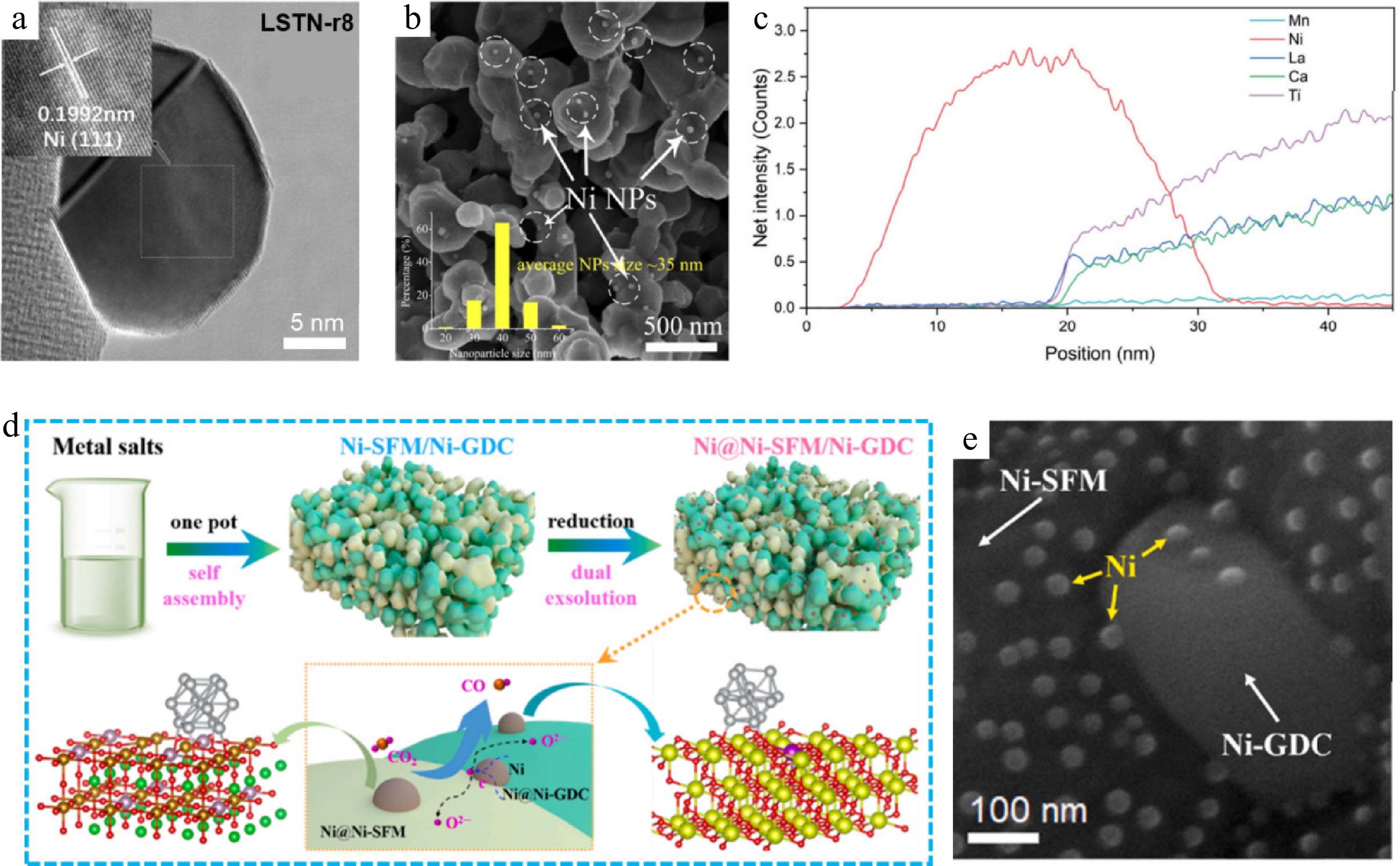
Figure 3.
(a) High-resolution TEM images of LSTN-r8[71]. Reproduced with permission. Copyright 2023, Elsevier. (b) The SEM images of LCTNi-Ce electrodes reduced at 800 C for 3 h in pure H2[72]. Reproduced with permission. Copyright 2022, RSC. (c) EDX line scan of the exsolved Ni NPs and the perovskite outer layers[73]. Reproduced with permission. Copyright 2024, Wiley. (d) The Synthesis scheme, and (e) SEM images of Ni@Ni-SFM/Ni-GDC[75]. Reproduced with permission. Copyright 2023, Elsevier.
Li et al. reported a Ce-decorated La0.43Ca0.37Ti0.94Ni0.06O3-δ perovskite (LCTNi-Ce)[72]. Through the in-situ exsolution method and A-site deficiency, a large number of Ni NPs are decorated on the surface (Fig. 3b), serving as efficient reactive sites. Additionally, they also found that the introduction of Ce boosted oxygen vacancy concentration, accelerated oxygen exchange kinetics, and enhanced CO2 desorption capability. In contrast to the LCTNi, the LCTNi-Ce cathode achieved a current density of 0.557 A·cm−2 and an Rp value of 0.514 Ω·cm−2 when operated at 800 °C in a 50% CO2/50% H2 atmosphere. Zhang et al. investigated the influence of exsolved Ni NPs from the perovskite oxide La0.3Ca0.6Ni0.05MnxTi0.95-xO3-γ (x = 0, 0.05, 0.10) on high-temperature CO2 electrolysis in SOECs by applying a current of 1.2 A in a 97% CO2–3% H2O atmosphere[73]. They found that Mn doping generates a higher concentration of oxygen vacancies, promotes oxygen ion migration, enhances Ni NPs exsolution, facilitates Ni NPs exsolution with a notably high population density (Fig. 3c), and improves the adsorption, desorption, and dissociation of CO2. When employed as a cathode material for SOECs, the optimized composition achieves a maximum electrolysis current density of 2.89 A·cm−2 at 1.8 V and 900 °C. Furthermore, it exhibits stable operation at 900 °C and 1.2 V for 133 h without observable performance degradation.
Fluorite-phase oxides play an indispensable role in SOECs, owing to their unique crystal structure and excellent ionic conductivity. They not only dominate the field of electrolytes but also serve as a core material for constructing high-performance electrodes, particularly cathodes. In Li et al.'s work, they incorporated Zr and Ni into CeO2. Upon reduction treatment, metallic Ni NPs exsolved on the CeO2 surface, forming stable and abundant active sites[74]. The Zr within the CeO2 lattice interacted with the reduced Ni NPs, effectively preventing aggregation and deactivation, thereby preserving the stability of dynamic active sites during the CO2RR. Moreover, the Ce0.85Zr0.15O2–Ni0.1 cathode achieved a CO production rate of 5.42 mL·min−1·cm−2 under the conditions of 850 °C and 1.6 V, with a Faraday efficiency of up to 99%. Interestingly, Hu et al. proposed a novel dual-exsolution approach for self-assembled SOECs cathodes (Fig. 3d), wherein metallic nickel NPs exsolve on the surfaces of Ni-doped Sr2Fe1.5Mo0.5O6-δ (Ni-SFM) and Ni-doped Gd0.1Ce0.9O2-δ (Ni-GDC) under the action of in-situ exsolution (Fig. 3e)[75]. The SOECs with the Ni@Ni-SFM and Ni@Ni-GDC heterointerfaces (Ni@Ni-SFM/Ni-GDC) cathode achieved a high current density of 1.72 A·cm−2 at 800 °C and 1.5 V, and exhibited good durability for 100 h. Theoretical calculations revealed that Ni@Ni-SFM/Ni-GDC facilitates CO2 adsorption, contributing to promoted intrinsic activities for CO2RR.
Exsolution of Ni-based bimetallic alloy
-
Carbon deposition is one of the primary deactivation mechanisms for pure Ni electrodes. Bimetallic alloys can effectively suppress carbon accumulation by altering the surface carbon chemistry or physical structure[76]. Furthermore, they can significantly optimize the energy barriers of key reaction steps in CO2 reduction (e.g., C–O bond cleavage and intermediate adsorption/desorption) by modifying the electronic structure of Ni[77].
Exsolution of NiFe alloy NPs
-
In the electrocatalytic reduction of CO2 in SOECs, exsolved Fe-Ni (Fe-Ni) alloy NPs exhibit significant advantages over exsolved pure Ni NPs in several key performance aspects, including catalytic activity, carbon deposition resistance, and long-term stability. These advantages primarily arise from the synergistic effects and electronic structure optimization of the bimetallic alloy. Zhang et al.[78] strategically broke the long-standing trade-off between 'promoted exsolution' and 'suppressed phase transition' by B-site supplementation strategy on Sr2Fe1.2Ni0.3Mo0.5O6-δ, thereby expanding the application scope of exsolution-facilitated perovskite materials (Fig. 4a). Integrated experimental and theoretical analyses demonstrate that the exsolved FeNi alloy NPs (DP-NPs-GDC) are pivotal for tailoring the surface chemical environment and strengthening surface-bulk charge transfer, thereby dictating the cathode kinetic response to applied voltage and even modulating the rate-determining step of the reaction. Moreover, at 1.6 V, the CO productivity reaches 9.17 mL·min−1·cm−2 with close-to-100% Faraday efficiency of CO (Fig. 4b), and the cell operates stably for 100 h at 1.4 V and 850 °C. Wang et al.[79] developed a non-stoichiometric double perovskite oxide (La0.3Sr1.55Fe1.5Ni0.1Mo0.4O6−δ, LSFNM). Under reducing atmosphere, FeNi3 alloy NPs were in-situ exsolved within the parent oxide, accompanied by the generation of a large number of oxygen vacancies, achieving a maximum current density of 3.07 A·cm−2 for CO2 electrolysis at 1.5 V and 800 °C (Fig. 4c). Experimental analyses and density functional theory (DFT) calculations reveal a synergistic catalysis involving oxygen vacancies (V̈O), doped Ni2+ ions, and FeNi3 NPs through cooperative V̈O–O(CO2), Ni(II)–C(sp), and Ni(0)–O(CO2) interactions in LSFNM (Fig. 4d). This synergy not only promotes the chemisorption of CO2 at oxygen vacancies but also induces the spontaneous decomposition of surface carbonates near the adjacent FeNi3 into CO. Furthermore, Wang et al. investigated the electrochemical reconstruction characteristics of Ni-doped La0.8Sr0.2Fe0.95Ni0.05O3-δ (LSFN) and revealed the structural origin of its high efficiency in CO2 electrolysis (Fig. 4e, f)[80]. The resulting FeNi@LSFN cathode achieved a current density of 0.88 A·cm−2 at 00 °C and 1.6 V, outperforming La0.8Sr0.2FeO3-δ without structural reconstruction. Combined experimental characterizations and DFT calculations demonstrate that moderate Ni doping effectively increases the oxygen vacancy concentration, induces surface reconstruction to create active FeNi@LSFN TPBs, and thereby promotes the activation and conversion of CO2. Xu et al. investigated the in-situ exsolved process of FeNi3 NPs on La0.52Ca0.28Ni0.04Fe0.04Ti0.92O3 fiber with a diameter of 200 nm[81]. They found that the B-site-doped perovskite fibers exhibited a high degree of exsolution, with the surface covered by FeNi3 NPs having an average diameter of approximately 35 nm. According to DFT calculations performed on FeNi3 nanocluster models on the La0.52Ca0.28Ni0.04Fe0.04Ti0.92O3 surface, FeNi3 clusters exhibit a stronger interaction with CO2 and weaker binding of the product CO (Fig. 4g).
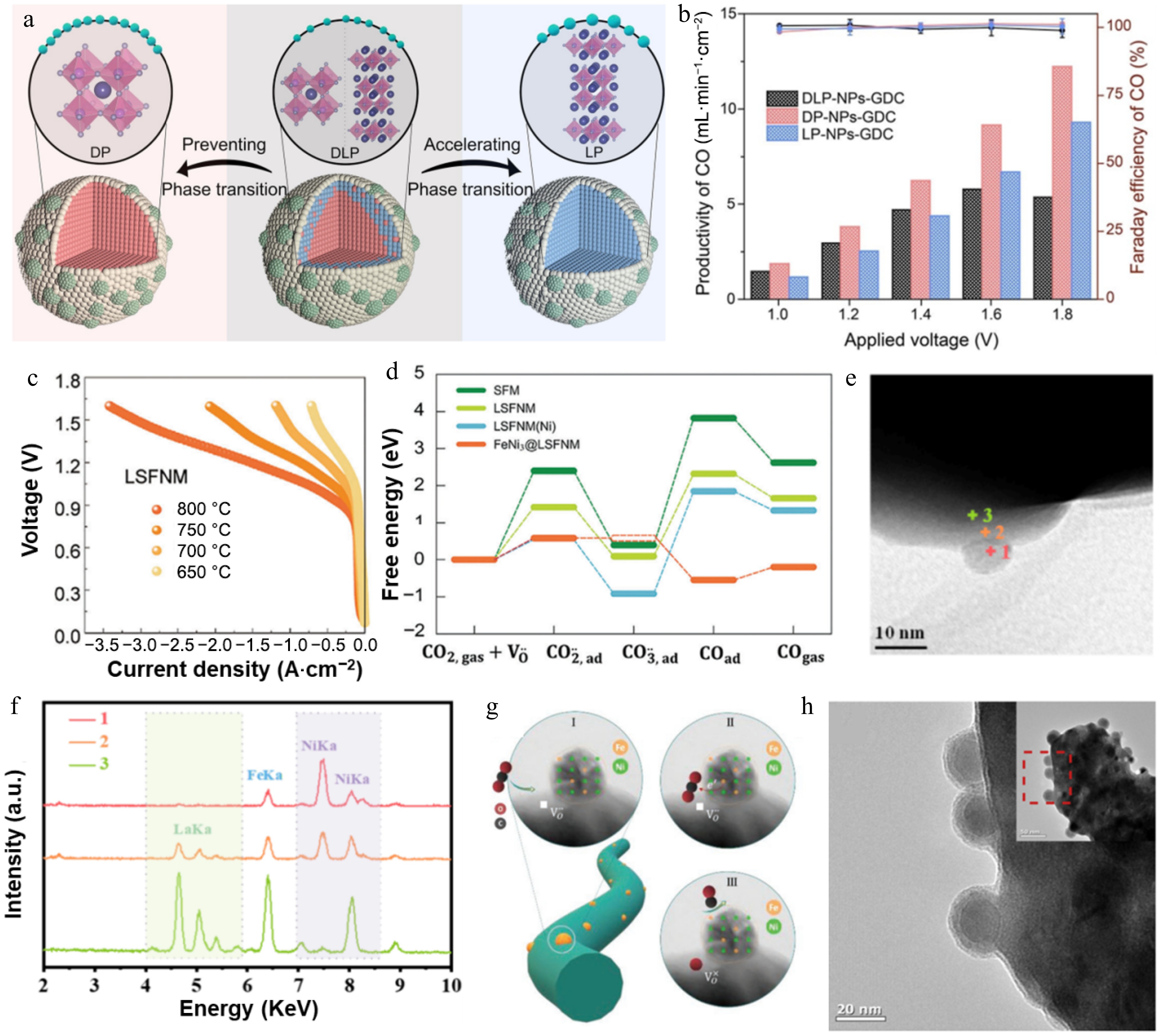
Figure 4.
(a) Design scheme of the Sr2Fe1.2Ni0.3Mo0.5O6-δ-based exsolution-facilitated perovskites with exsolved NPs, with a pure double perovskite, layered perovskite, and their composite perovskite as scaffolds, respectively[78]. Reproduced with permission. Copyright 2023, Wiley. (b) The corresponding CO productivity (histogram) and Faraday efficiency of CO for DP-NPs-GDC and comparison samples[78]. Reproduced with permission. Copyright 2023, Wiley. (c) Pure CO2 electrolysis performance for the cells and (d) the calculated free energy diagram for CO2RR on impregnated LSFNM cathodes[79]. Reproduced with permission. Copyright 2024, Wiley. (e) Bright-field STEM image and (f) EDS results at the FeNi@LSFN interface[80]. Reproduced with permission. Copyright 2026, ACS Publications. (g) CO2 conversion processes over perovskite fibers decorated with exsolved active NPs[81]. Reproduced with permission. Copyright 2023, Wiley. (h) Magnified TEM image of reduced PSMFN[82]. Reproduced with permission. Copyright 2024, RSC.
Under reducing gas treatment, in addition to the exsolution of NPs from the parent perovskite oxides, the perovskite oxide matrix itself also undergoes structural changes. Choi et al. reported a novel Pr0.6Sr0.4Mn0.2Fe0.7Ni0.1O3-δ (PSMFN) perovskite oxide electrode as an efficient symmetrical SOEC electrode material[82]. After H2 treatment, PSMFN transforms from single perovskite oxides to Ruddlesden–Popper perovskite oxides and Ni-Fe alloy NPs (Fig. 4h). Under the electrochemical catalytic mode for CO2 electrolysis, the current density reached 1.02 A·cm−2 at 800 °C with an applied voltage of 1.5 V. Tian et al. report a novel perovskite oxide, Pr0.5Ba0.5Fe0.8Ni0.2O3-δ (PBFN), which functions as a highly efficient electrode materials for symmetric SOECs[83]. Following H2 treatment, PBFN transitions from a single to a double perovskite structure, along with the exsolution of Fe-Ni alloy NPs. This structural evolution enables a maximum current density of 0.843 A·cm−2 for pure CO2 electrolysis at 800 °C and 2 V.
The exsolution strategy has shown great application potential in SOECs for CO2RR, with rapid progress having been achieved. However, the stability of exsolved NPs under high voltage remains poor. Zhang et al.'s study demonstrates that B-site supplementation can serve as an effective alternative strategy to enhance the stability of exsolved NPs for CO2 electrocatalysis in SOECs (Fig. 5a)[84]. By incorporating guest Fe ions into the residual B-site vacancies of the Sr2Fe1.3Ni0.2Mo0.5O6-δ (SFNM) perovskite scaffold (SFNM + xFe-red, x = 0.0, 0.5, 0.8, 1.2), SFNM + 1.2 Fe-red exhibits superior catalytic activity, charge transport properties, and structural robustness compared to SFNM + 0.0 Fe-red. As a result, it achieves both high catalytic activity and excellent stability, particularly at high voltages (i.e., ≥ 1.6 V). The SFNM + 1.2 Fe-red cathode delivers a current density of 1.13 A·cm−2 at 1.6 V and 850 °C (Fig. 5b). Moreover, it operates stably for 100 h at 0.75 A·cm−2.
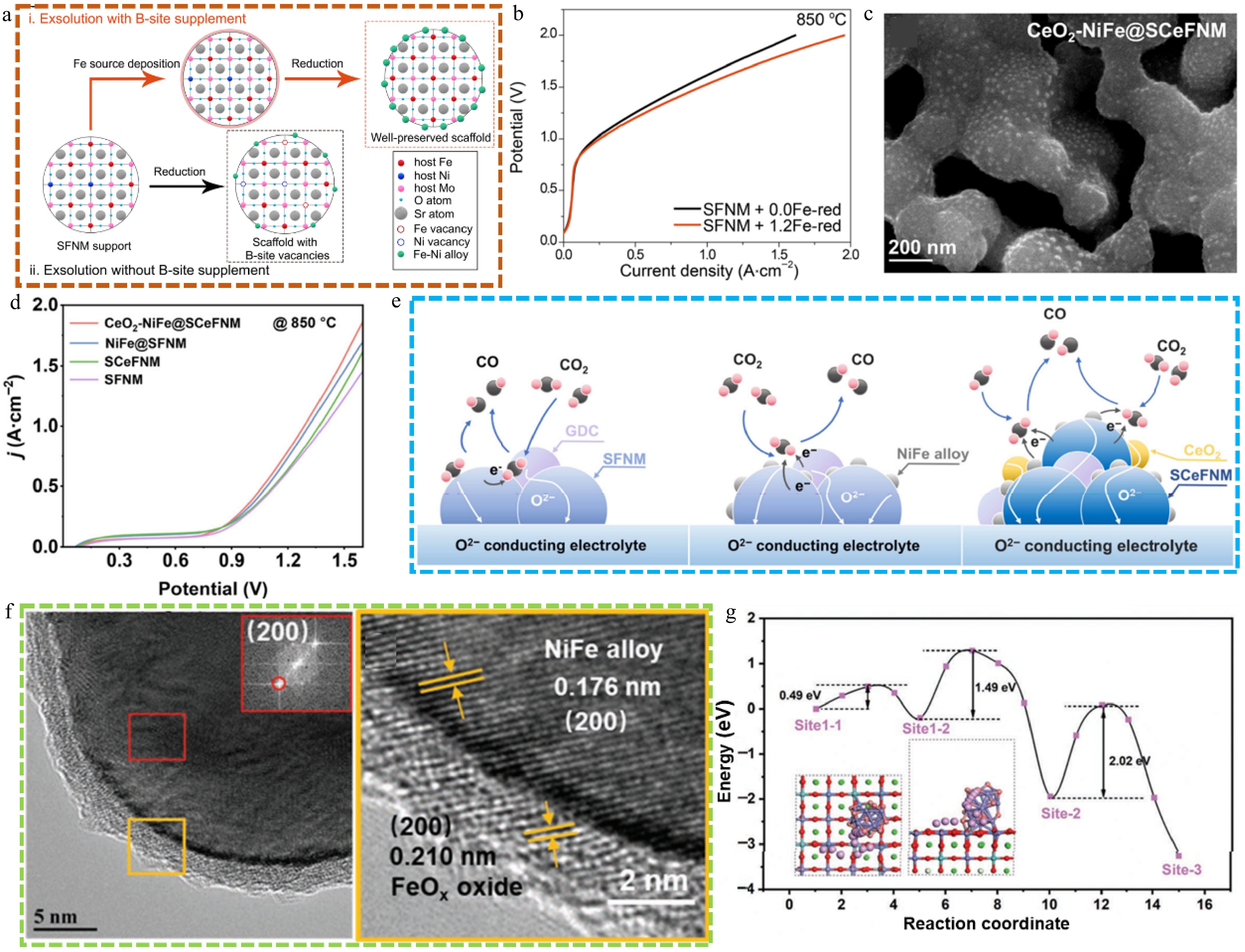
Figure 5.
(a) Schematic illustration of exsolution with and without B-site supplement, and (b) current density-voltage curves on SFNM[84]. Reproduced with permission. Copyright 2022, Springer Nature. (c) SEM image of CeO2- NiFe@SCeFNM. (d) I-V curves and (e) schematic illustrations of possible reaction pathways for CO2 electrolysis over SFNM, NiFe@SFNM, and CeO2-NiFe@SCeFNM[85]. Reproduced with permission. Copyright 2025, RSC. (f) TEM and HRTEM images of PSNFM-NFA@FeO and (g) diffusion energy barriers of O atoms on the PSNFM-NFA@FeO surface[86]. Reproduced with permission. Copyright 2022, Wiley.
Simultaneous exsolution of NiFe alloy and oxide NPs
-
Although the in situ exsolution strategy of B-site cations of perovskite oxides can effectively improve the SOEC cathode activity, it often triggers the segregation of insulating AOx phases at the A-site, thereby reducing the exposure of active sites and diminishing MIEC. To address this challenge, Ouyang et al. incorporated Ce into Sr1.95Ce0.05Fe1.3Ni0.2Mo0.5O6-δ (SCeFNM), effectively mitigating the critical issue of insulating phase segregation in conventional exsolved perovskites[85]. After annealing under a reducing atmosphere, a nanoscale CeO2-NiFe/oxide heterostructure (CeO2–NiFe@SCeFNM) was in situ constructed on the surface through the co-exsolution of oxygen-deficient CeO2 phase and NiFe alloy NPs (Fig. 5c). This unique architecture achieved a high current density of 1.57 A·cm−2 at 1.5 V and 850 °C with CO faradaic efficiency exceeding 96% (Fig. 5d). The results demonstrate that the superior activity mainly originates from the synergy within the 'three-in-one' heterostructure: the NiFe alloy NPs enhance electronic conductivity, the CeO2 phase extends O2− migration channels to improve CO2 adsorption and activation, while the perovskite backbone ensures structural integrity (Fig. 5e). Tan et al. constructed core-shell structured NiFe/FeOx (NFA@FeO) NPs on the surface of Pr0.4Sr1.6(NiFe)1.5Mo0.5O6-δ (PSNFM) double perovskite oxide matrix via exsolution (Fig. 5f)[86]. The PSNFM-NFA@FeO cathode achieved a high current density of 1.58 A·cm−2 for CO2 electrolysis at 800 °C and 1.4 V. The excellent electrocatalytic activity of PSNFM-NFA@FeO stems primarily from two factors: (i) the in-situ exsolved NFA@FeO NPs and the associated oxygen vacancies in the PSNFM matrix, which generate abundant active NFA@FeO/PSNFM interfaces for CO2 adsorption and electrolysis; and (ii) the FeO shell on the NFA, which itself contains a high density of oxygen vacancies. The presence of these vacancies expands the catalytically active domain from the NFA@FeO/PSNFM heterointerfaces to the entire NPs surfaces, which in turn significantly enhances the kinetics of CO2 adsorption, dissociation, and subsequent reduction (Fig. 5g).
Exsolution of other nickel-based binary alloys
-
In addition to the involvement of iron in the alloying exsolution with Ni, other elements can also modulate the electronic structure of Ni and co-exsolve with it to form bimetallic alloys, thereby promoting the CO2RR at high temperatures. Park et al. developed a novel, efficient, and sulfur-tolerant catalyst by anchoring CoNi alloy NPs onto La1.2Sr0.8Co0.4Mn0.6O4 supports with Ruddlesden–Popper structures via in-situ exsolution (CoNi-R.P.LSCM)[87]. In CO2 atmospheres containing H2S, this catalyst achieved a current density of 703 mA·cm−2 at 1.3 V and 850 °C, with a maximum Faradaic efficiency of 97.8%, and operated stably for 90 h without degradation, demonstrating high resistance to sulfur poisoning (Fig. 6a). Gao et al. utilized an in situ exsolution strategy to drive the exsolution of Ni and Cu from La0.8Sr0.2MnO3 lattice and their subsequent anchoring onto the electrode surface as Ni-Cu alloy NPs, constructing abundant and stable reaction active sites (Fig. 6b)[88]. Using LSM-Ni0.050Cu0.050 as the SOEC cathode, a CO yield of up to 9.51 mL·min−1·cm−2 was achieved under testing conditions of 800 °C and 1.8 V.
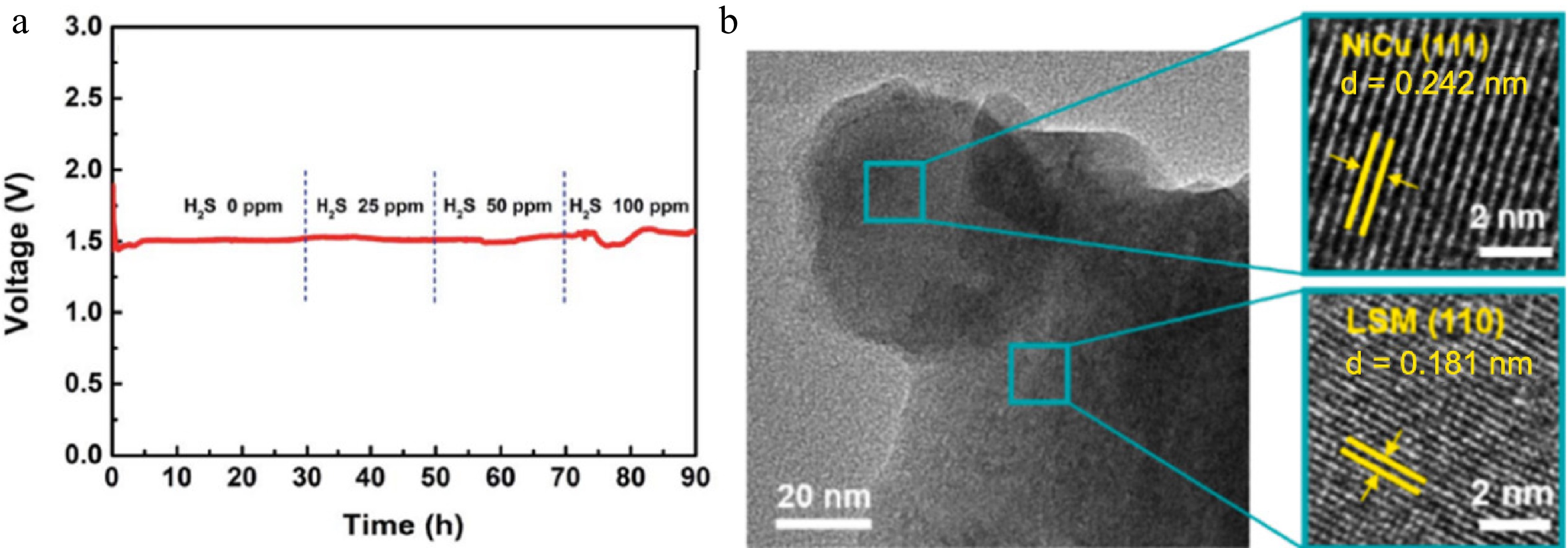
Figure 6.
(a) Voltage profile of the single cell with the CoNi-R.P.LSCM cathode at a constant current density of 700 mA·cm−2 at 850 °C and using the reaction gas (30% CO/CO2) streams that contain different H2S contents[87]. Reproduced with permission. Copyright 2020, RSC. (b) HR-TEM of reduced LSM-Ni0.050Cu0.050[88]. Reproduced with permission. Copyright 2024, Elsevier.
Exsolution of multi-element Ni-based alloy
-
Compared to single metals (such as Ni, Cu, and so on), alloy NPs composed of different metals (e.g., Fe-Ni, Ni-Cu) exhibit superior catalytic performance: (1) Fe: excels at breaking C=O bonds and lowering the energy barrier for CO2 dissociation; (2) Cu: offers good selectivity and binding energy for CO, effectively suppressing carbon deposition; (3) Ni: possesses extremely high catalytic activity but is prone to carbon deposition when used alone, alloying with other elements allows it to maintain high activity while enhancing coking resistance[89−91]. Therefore, the exsolution technology of multi-element alloys, by constructing highly active triple-phase boundaries, creating oxygen vacancies, and achieving multi-metal synergistic catalysis, is expected to solve the two major challenges of insufficient catalytic activity and poor long-term stability of SOEC cathodes, propelling SOECs towards high efficiency, stability, and industrialization.
López-García et al. investigated a medium-entropy double perovskite system of SrxFeCo0.2Ni0.2Mn0.1Mo0.5O6-δ (x = 2, 1.9, and 1.8) oxides and found that the alloy composition can be tuned by adjusting the reduction conditions, leading to the exsolution of Fe-Co-Ni ternary alloy NPs and the formation of Ruddlesden–Popper structures (Fig. 7a)[92]. The exsolution temperature significantly influences the Fe content in the NPs: the Fe content increases with temperature, while the Ni and Co contents are less affected by temperature. The exsolution sequence of the NPs is Ni, followed by Co, and then Fe. At 1.2 V and 800 °C, the 600 °C exsolved cell shows a larger current density, and it can operate continuously for 80 h (Fig. 7b). Furthermore, they found that electrodes functionalized with exsolved NPs prepared at 600 °C exhibited lower polarization resistance compared to the non-exsolved material, whereas degradation occurred after exsolution at 800 °C (upon exposure to a CO2 environment) (Fig. 7c). This degradation was attributed to the formation of strontium carbonate (SrCO3), which may be triggered by the presence of the Ruddlesden–Popper secondary phase. This secondary phase also affects cathode stability, leading to more pronounced performance loss and morphological changes of the metal NPs under electrolysis conditions, a phenomenon not observed for the electrodes exsolved at 600 °C.
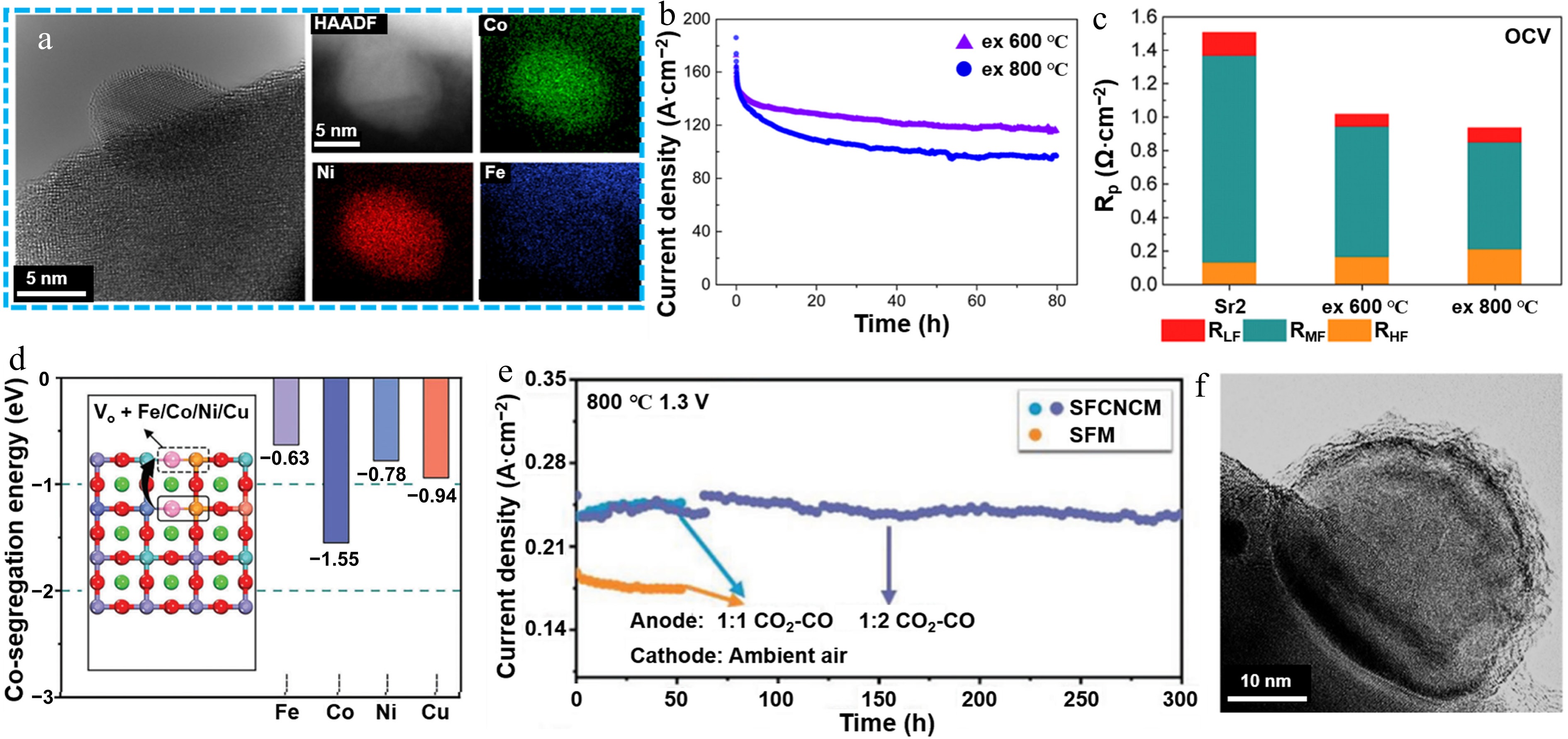
Figure 7.
(a) HR-TEM image and the EDS mapping images of an FeCoNi ternary alloy nanoparticle exsolved from SrxFeCo0.2Ni0.2Mn0.1Mo0.5O6-δ at 600 °C, 4 h, and a 5% H2/Ar atmosphere[92]. Reproduced with permission. Copyright 2024, ACS Publications. (b) CO2 electrolysis measurements at 800 °C for 80 h at 1.2 V for cells after in-situ exsolution at 600 and 800 °C[92]. Reproduced with permission. Copyright 2024, ACS Publications. (c) Total Rp and its three contributions (RLF, RMF, and RHF; LF, MF, and HF being low, medium, and high frequency, respectively) at OCV[92]. Reproduced with permission. Copyright 2024, ACS Publications. (d) Schematic illustration of the computational model for co-segregation energy and the comparison of the co-segregation energy[93]. Reproduced with permission. Copyright 2024, Wiley. (e) Long-term electrochemical stability of QA@SFO during CO2 electrolysis at 1.3 V[93]. Reproduced with permission. Copyright 2024, Wiley. (f) HR-TEM images of reduced HE-PBM with exsolved nanoparticles[94]. Reproduced with permission. Copyright 2023, Elsevier.
Luo et al. reported a fuel electrode for SOECs composed of an entropic perovskite-based matrix decorated with in-situ exsolved Fe-Co-Ni-Cu quaternary alloy NPs (QA@SFO). Upon reduction, the exsolution of the quaternary alloy induces a structural transformation from double perovskite to layered perovskite, generating an interface in which the alloy NPs are firmly anchored onto the oxygen-vacancy-rich perovskite backbone (Fig. 7d)[93]. Moreover, the highly active sites afforded by the QA@SFO interface substantially enhance the reaction kinetics of the reversible CO2-CO conversion, and the electrode exhibits outstanding durability exceeding 300 h at 800 °C and 1.3 V (Fig. 7e). In addition, the first-principles calculations and ab initio molecular dynamics simulations at the atomic scale further rationalize the remarkable electrocatalytic activity and stability, revealing that Fe and Ni in the exsolved NPs promote catalytic activity, whereas the strong coupling of Co and Cu with the host matrix underpins interfacial stability. Zhang et al. designed a high-entropy perovskite oxide electrode, Pr0.5Ba0.5Mn0.2Fe0.2Co0.2Ni0.2Cu0.2O3-δ (HE-PBM), for use in a symmetric SOEC for CO2RR (Fig. 7f)[94]. The transition metal elements in this material promote the OER at the anode, while the in-situ exsolved Co-Fe-Ni-Cu quaternary alloy NPs on the HE-PBM cathode surface accelerate the CO2RR. At 800 °C and 2.0 V, the cell achieves a polarization resistance as low as 0.289 Ω·cm−2 and an electrolysis current density of CO2 as high as 1.21 A·cm−2. Furthermore, the electrode operates stably for over 60 h at 800 °C and 1.2 V.
Exsolution of Ni-based oxide NPs
-
Compared with exsolved metal-phase NPs, oxide NPs exsolved in SOECs also exhibit superior performance. Zhang et al. quantitatively analyzed the CO2 electroreduction activity of a series of perovskite thin-film platforms (La0.4Ca0.4Ti0.94Ni0.06O3, LCTN) enhanced by exsolved hetero NPs (especially Ni and NiO) (Fig. 8a)[95]. Experimental results, combined with DFT + AIMD simulations, collectively confirmed that the NiO/LCTN interface exhibits significantly superior catalytic activity compared to Ni/LCTN and pristine LCTN, mainly due to its unique CO2 adsorption mode (bidentate carbonate) and the fastest oxygen exchange rate for carbonate intermediate dissociation and migration. At this interface, the intrinsic reaction rate per active site reaches a highest turnover frequency (TOF) of 7.05 ± 0.75 × 10⁴ s−1 at 800 °C (Fig. 8b). Using a model electrolytic cell for CO2 electrolysis coupled with near-ambient pressure X-ray photoelectron spectroscopy, it was further revealed that the NiO/LCTN interface captures carbon species as CO intermediates rather than forming solid carbon during electrolysis, thereby determining the onset overpotential and accumulation rate of carbon deposition.
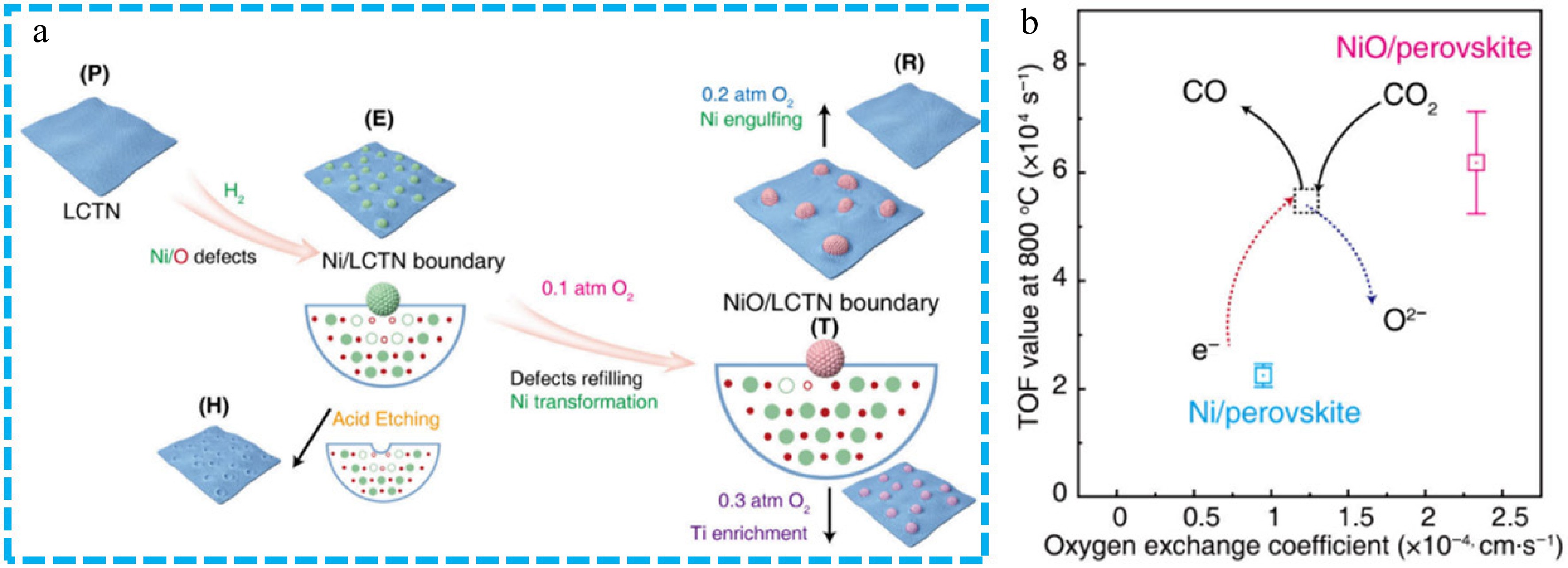
Figure 8.
(a) Schematic of the construction of perovskite platforms. (b) The TOF vs kchem plot of individual exsolved Ni and NiO sites. AIMD simulations of the diffusion of oxygen ions across LCTN and NiO/LCTN surfaces at 300 K, including the energy landscape and atomic-scale diffusion pathway[95]. Reproduced with permission. Copyright 2025, ACS Publications.
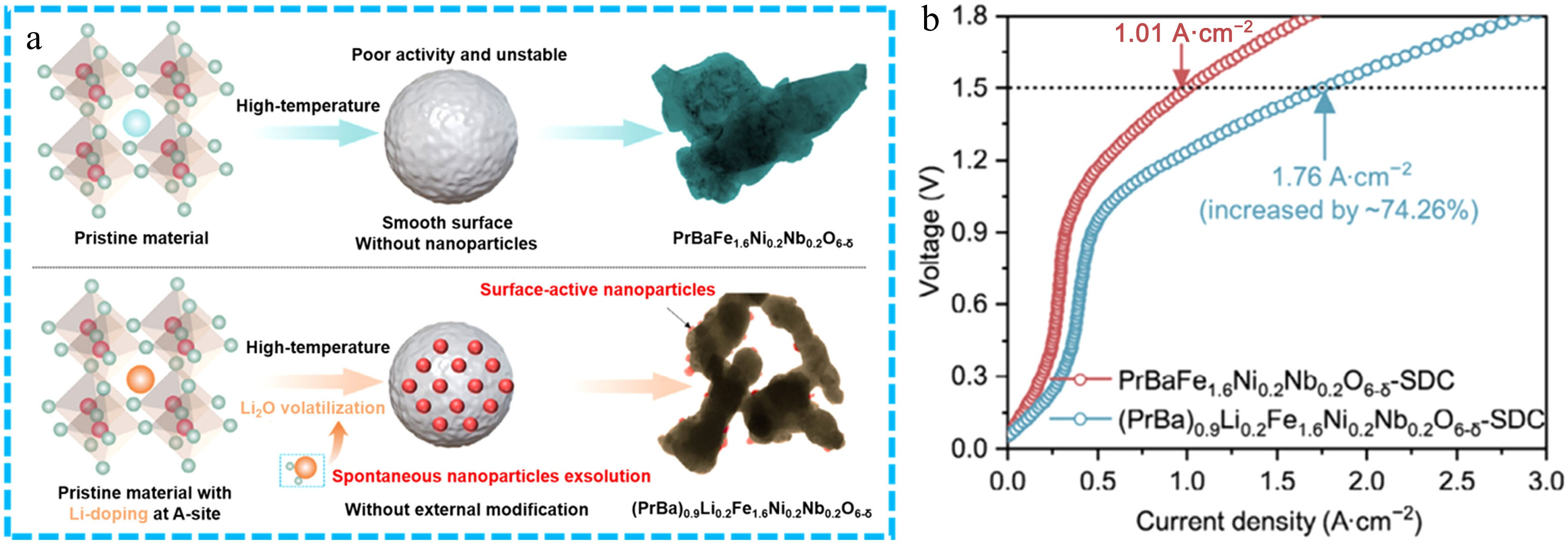
Furthermore, Fu et al. doped Li into PrBaFe1.6Ni0.2Nb0.2O6-δ to form (PrBa)0.9Li0.2Fe1.6Ni0.2Nb0.2O6-δ (PBLFNN)[96]. During the synthesis process, the volatilization of Li2O promoted the spontaneous exsolution of Fe-Ni-O NPs (NixFe1-xO) from the PBLFNN matrix, effectively enhancing its stability and catalytic activity in a high-temperature pure CO2 environment (Fig. 9a). The PBLFNN-SDC cathode achieved a high current density of 1.76 A·cm−2 in pure CO2 at 1.5 V and 800 °C (Fig. 9b), and operated stably for 200 h with a degradation rate of 0.81 mV·h−1. DFT calculations confirmed that the doping of Li and the accompanying volatilization of Li2O lead to the exsolution of NixFe1-xO and the formation of A-site defects, which collectively lower the oxygen vacancy formation energy and promote CO2 adsorption and activation.
-
Perovskite oxides are increasingly regarded as promising electrode materials for high-temperature SOECs due to their excellent MIEC, tunable structures, thermochemical stability, and cost-effective raw materials. In recent years, the exsolution strategy, which enables the in-situ generation of metal, alloy, or oxide NPs on perovskite surfaces, has become a critical approach for enhancing catalytic activity and operational stability. During exsolution, B-site transition metal ions are reduced by gaining electrons, precipitating from the parent lattice as NPs that become firmly anchored to the perovskite substrate. This forms a strongly interacting 'embedded' structure. Compared with conventional impregnation methods, such architectures effectively suppress nanoparticle agglomeration and sintering while enabling cyclic regeneration of the electrode through redox cycling, thereby substantially improving long-term stability.
Extensive research has demonstrated that precise control over the size, population density, morphology, and composition of exsolved NPs can be achieved by tuning intrinsic factors, including A/B-site elemental composition, non-stoichiometry, lattice strain, and crystal orientation, and extrinsic parameters such as reduction temperature, atmosphere, duration, and applied potential. Among these, population density is commonly employed to characterize the distribution and anchoring strength of exsolved particles. Despite significant advances in perovskite exsolution technology, several challenges persist:
(1) Limited mechanistic understanding. The microscopic mechanism of perovskite exsolution remains incompletely understood. Research has focused predominantly on perovskite-type oxides, while the exsolution behavior of non-perovskite structures (e.g., fluorite-type oxides) has received insufficient attention, with particularly scarce mechanistic studies.
(2) Incomplete characterization metrics. Most investigations emphasize nanoparticle size and anchoring strength but lack a systematic analysis of population density, a parameter closely tied to catalytic performance.
(3) Lack of standardized protocols. Experimental conditions vary substantially across studies, hindering direct comparisons. Standardized testing methods and systematic comparative analyses for high-temperature CO2 electrolysis remain absent.
(4) Phase decomposition issues. Perovskite oxides prone to decomposition under high-temperature reducing atmospheres (e.g., LaSrCoO3) often experience failed exsolution due to phase instability. Additionally, segregation of insulating phases (such as SrO) during reduction can cover active sites and reduce ionic/electronic conductivity, diminishing catalytic efficiency.
(5) Scale-up challenges. The transition from laboratory-scale single cells to industrial stacks is hampered by severe material degradation and limited cathode lifespan, representing critical bottlenecks to commercialization.
(6) Fundamental reaction mechanisms. The elementary steps governing SOECs' performance remain insufficiently understood. A comprehensive grasp of reaction kinetics and thermodynamics is essential for optimizing cell performance, refining multiphysics models, and predicting long-term stability. However, systematic understanding of reaction pathways, intermediate species, and their coupling with electrode microstructures at multiphase interfaces under high-temperature, strongly reducing/oxidizing conditions remains limited. Consequently, in-situ characterization combined with theoretical simulations is urgently needed. Furthermore, molecular dynamics studies of nanoparticle exsolution from perovskite and other oxide matrices are scarce. Such simulations can elucidate the microscopic exsolution mechanism and provide theoretical guidance for precisely designing nanoparticle size, population density, and composition by controlling temperature, atmosphere, and applied potential. Integrating macroscopic electrochemical performance with microscopic exsolution dynamics therefore represents a pivotal direction for developing high-performance SOEC electrodes.
-
Although small-area button cells currently exhibit excellent performance, their performance drops sharply when scaled up to form a stack. Therefore, it is necessary to develop advanced stack designs (e.g., flow field optimization, sealing technology) in parallel with high-performance cathode materials. Perovskite-based exsolved cathodes are expected to replace traditional Ni-YSZ electrodes, particularly demonstrating clear advantages in terms of coking resistance, sulfur tolerance, and chloride corrosion resistance. In addition, batch-to-batch variations in powders and slurries are a common cause of product inconsistency; therefore, it is essential to establish stringent quality inspection standards for these materials during industrial-scale production. Moreover, the mature fabrication processes centered on tape casting, screen printing, and co-sintering operate synergistically and constitute the foundation for large-area, low-cost, and scalable production, offering a practical pathway toward the industrialization of SOECs. The core challenge, however, lies in coordinating the sintering shrinkage behavior of dissimilar materials (e.g., NiO-YSZ and YSZ) to avoid defects such as warpage, cracking, or delamination. In contrast, emerging technologies exemplified by magnetron sputtering, ultrasonic spray pyrolysis, and additive manufacturing are directed toward precise microstructural engineering and the preparation of high-performance thin films, thus representing key directions for overcoming performance bottlenecks and exploring next-generation cell architectures. Further research should be conducted on coupling demonstrations of high-temperature electrolysis with renewable energy sources (such as wind and solar) as well as chemical synthesis processes (e.g., CO2 hydrogenation to methanol) to verify their technical and economic feasibility, thereby laying the foundation for industrial application[97,98].
Enhance research on reversibility and long-term stability
-
Most exsolved NPs can redissolve into the parent lattice in an oxidizing atmosphere, presenting a reversible process. This property can be used for catalyst regeneration and dynamic regulation. Systematic studies should be conducted on the effects of oxidation/reduction cycles on NPs re-exsolution behavior, size distribution, and morphology, as well as the performance degradation patterns after multiple cycles. In parallel, it is essential to perform long-term stability tests on the order of thousands of hours at ampere-level current densities and to establish an accelerated aging method for predicting the practical service life of industrial-scale stacks. At the same time, it is necessary to study the morphological evolution, element diffusion, agglomeration, and deactivation mechanisms of the exsolved NPs under real SOEC conditions (such as high current density, thermal cycling, and impurity gases) during the long-term operation process[99,100].
Deepen in-situ studies of the exsolution mechanism
-
By means of advanced in situ/operando characterization techniques (such as in-situ XRD, XPS, XAS, Raman spectroscopy, FT-IR, environmental TEM, etc.), the evolution of the perovskite lattice, elemental migration behavior, as well as the nucleation and growth kinetics of NPs during the exsolution process can be monitored in real time[101−103]. Combined with isotope labeling and secondary ion mass spectrometry, the specific roles of oxygen vacancies and lattice oxygen in the exsolution process can be systematically revealed. The deep integration of in-situ characterization with DFT calculations is expected to elucidate the driving forces, reaction pathways, and regulatory mechanisms of exsolution at the atomic scale, thereby resolving existing theoretical controversies[104,105].
Explore novel exsolution methods and stabilization strategies for unstable materials
-
(1) Plasma-assisted exsolution. This enables exsolution at low temperatures without the need for a reducing atmosphere, avoiding high-temperature phase decomposition. However, its mechanism remains unclear, and systematic studies are needed to investigate the effects of plasma type, power, gas composition, and other factors on the exsolution process[106].
(2) Topotactic ion exchange. For easily decomposable perovskite materials, guest ions can be introduced after exsolution to fill B-site vacancies, maintaining the perovskite framework and achieving 'reversible exsolution'.
(3) Oxidative atmosphere exsolution. Some metal oxides (e.g., certain nonstoichiometric oxides) can also undergo exsolution in an oxidizing atmosphere. Such anomalous behavior is expected to expand the scope of exsolution material research[107].
Expand high-entropy alloy exsolution and single-atom/dual-atom catalyst systems
-
High-entropy perovskite oxides, by virtue of the entropy stabilization effect, can maintain structural stability at high temperatures and promote multi-element synergistic catalysis. However, it is necessary to clarify whether the main source of performance improvement is the 'high-entropy effect' or the 'multi-element doping effect', which requires the design of systematic comparative experiments and theoretical analyses[108]. Meanwhile, although single-atom catalysts exhibit excellent performance in low-temperature electrocatalysis, their thermal stability under high-temperature reducing atmospheres is poor[109−113]. How to construct thermally stable single-atom or dual-atom sites (e.g., through site isolation strategies) remains a major challenge. Furthermore, the metal loading in single-atom catalysts is generally low; developing high-loading single-atom/dual-atom exsolution methods warrants in-depth exploration.
Establish a systematic regulation database and machine learning-assisted screening
-
It is recommended to systematically record the composition information, processing parameters, and exsolution results (including particle size, population density, morphology, alloy composition, anchoring strength, etc.) of perovskite materials under uniform or comparable experimental conditions, thereby constructing an 'exsolution material library'. On this basis, machine learning algorithms (such as random forests, graph neural networks, etc.) can be used to mine the relationships between material structure and catalytic performance, enabling rapid screening of candidate materials with high activity and high stability, as well as predicting optimal exsolution conditions. Appropriate descriptors (such as B–O bond energy, tolerance factor, oxygen vacancy formation energy, etc.) are key to the success of machine learning[114−116].
Expanding the application boundaries of the exsolution strategy in the field of SOECs
-
The interface formed by exsolved NPs and their oxide parent, rich in oxygen vacancies, enables rapid adsorption of alkane gases, efficient electron transfer, and fast product desorption. Recent studies have shown that feeding a mixture of methane and CO2 to the fuel electrode enables methane reforming to produce CO and H2, significantly improving energy efficiency and economics[117]. Furthermore, when CO2 is supplied to the fuel electrode while alkane gases are supplied to the air electrode, the active oxygen species migrating from the fuel electrode can drive the oxidative reforming of methane and the oxidative dehydrogenation of multi-carbon alkanes[118,119]. As a result, high-value-added CO and olefins are obtained in the air electrode compartment, while CO is obtained in the fuel electrode compartment. This coupled reaction greatly enhances energy utilization and expands the production pathways for high-value-added products. If scale-up experiments can be realized with high stability in the future, it will greatly promote the development of petrochemical technology. In addition, by adjusting the gas composition and operating temperature in the fuel electrode compartment, high-temperature electromethanation and oxidative coupling of methane to olefins can be achieved, showing highly attractive industrial prospects and comprehensive electrochemical energy efficiency.
-
Over the past decade, exsolution technology for perovskite oxide NPs has advanced significantly, progressing from single-metal exsolution to encompass high-entropy alloys, core-shell structures, and reversible exsolution, continually expanding the boundaries of catalytic performance and operational stability. Despite this progress, substantial challenges remain on the path from mechanistic understanding to practical industrial application. We are confident that the synergistic integration of multi-scale in-situ characterization, advanced theoretical calculations, machine learning, and systematic comparative studies will drive a transformative breakthrough in exsolution technology. Such advances will ultimately establish a robust material foundation for efficient CO2 electrolysis in SOECs, sustainable CO production, and the realization of a carbon-neutral society.
-
The authors confirm their contributions to the paper as follows: investigation, writing – original draft, visualization: Zheng H; conceptualization, writing – review and editing: Zheng H, Ye TN; funding acquisition and supervision: Ye TN, Chen JS. All authors reviewed the results and approved the final version of the manuscript.
-
All data generated during this review are included in this published article.
-
The authors declare that they have no conflict of interest.
- Copyright: © 2026 by the author(s). Published by Maximum Academic Press, Fayetteville, GA. This article is an open access article distributed under Creative Commons Attribution License (CC BY 4.0), visit https://creativecommons.org/licenses/by/4.0/.
-
About this article
Cite this article
Zheng H, Chen JS, Ye TN. 2026. Ni-exsolved ceramic cathodes for high-temperature CO2 electrolysis in solid oxide electrolysis cells: progress and perspectives. Progress in Reaction Kinetics and Mechanism 51: e028 doi: 10.48130/prkm-0026-0022 

Ni-exsolved ceramic cathodes for high-temperature CO2 electrolysis in solid oxide electrolysis cells: progress and perspectives
- Received: 10 June 2026
- Revised: 24 July 2026
- Accepted: 25 August 2026
- Published online: 15 October 2026
Abstract: High-temperature solid oxide electrolysis cells (SOECs) have emerged as an efficient energy-storage and conversion technology, enabling the conversion of small molecules such as CO2 and H2O into value-added chemicals and fuels using renewable electricity at 600–900 °C. For industrial deployment, particular attention must be paid to the long-term stability of all cell components under harsh operating conditions, especially at high current densities and elevated temperatures. However, severe degradation of electrode materials remains a major barrier to the development and commercialization of SOECs technology. Therefore, the selection and design of SOECs materials must simultaneously prioritize both catalytic activity and operational stability. Among the available strategies, in situ exsolution has attracted considerable interest because the embedded architecture of exsolved nanoparticles within the parent oxide support can effectively balance activity and stability through strong metal–support interactions. This review summarizes recent progress in exsolved Ni-based ceramic cathodes for CO2 electrolysis in SOECs, including the exsolution mechanism of nanoparticles, their catalytic performance, and the underlying mechanistic insights. In addition, the prospects and challenges associated with exsolved metal nanoparticles in SOECs applications are discussed. We hope this review will provide useful guidance for the rational design of catalysts for long-term stable CO2 electrolysis in SOECs under high-current-density operating conditions.