











-
Peach (Prunus persica) is a deciduous temperate stone fruit native to China. Persia, used in the binomial name, is misperceived as the place of origin[1−3]. Peach was disseminated to Persia and the Mediterranean region via the Silk Route and then spread to other regions around the world. Through breeding and natural selection, the adaptability of the peach has dramatically expanded towards warmer subtropical and colder subarctic zones[4−7]. Peach was first introduced to the American colonies in the 1620s[1]. Peach cultivars have been developed and adapted primarily to three major U.S. production regions (the West, Southeast, and Northeast), through chance seedling selection and conventional breeding[1,8−13]. Peach production is complicated and determined by many biotic and abiotic factors, including sequentially ripening cultivars, good compatible rootstocks, a favorable climate, and robust orchard management. Chilling requirement, a quantitative trait of peach[14], is an important climate-related production factor, which must be satisfied in the winter to bloom normally in the coming spring[15]. While infrequent winter chilling inadequacy can cause varying degrees of floral bud failure and crop loss in the southeastern U.S.[16,17], spring freeze is a more often yield-limiting factor that has contributed significantly to the change of the industry landscape and decline of peach production, especially in the Southeastern region[18−20]. Limited by chilling requirements and other adapting factors, few peach cultivars can be used in more than one production area, in which however, due to short peach harvest and storage time many cultivars with different ripening times are needed to cover the entire market season[6,13]. Therefore, states with significant or prospective peach industries established breeding programs that released cultivars intended for local use[21], although for many reasons, most of them were long terminated or are now being phased out. Peach breeding in public universities is usually one part of a faculty's responsibilities and is shared with other crop breeding, related research, and/or teaching activities. In this report an overview of peach breeding and production in the U.S. is provided, including the status of public and private peach breeding programs and perspectives on future breeding directions. It is worth noting that glabrous nectarine fruit, usually marketed as a different commodity, genetically is the natural recessive mutant (genotype: gg) at the G locus from the fuzzy peach (GG or Gg). In this context, nectarine is often narrated with peach breeding, production, and literature and is so in this article.
-
Peach breeding programs in the U.S. are mostly public, though a few are private, which primarily focus on industries' need for peach/nectarine scion cultivars[21]. A few of them are also extensively engaged in rootstock breeding[9,22−25], and other stone fruit breeding to more or less an extent[10]. Most peaches/nectarines in the U.S. are for fresh consumption. Peach industries in states with large peach production, for example, in California, South Carolina, and Georgia – the top three producers, are primarily for the shipping market, whereas others in states with limited production are for local niche markets, including roadside sales. Some main past and current public and private peach breeding programs in the U.S. are summarized (Table 1), which have developed cultivars adapted to different climatic and environmental conditions and meeting different industry/market needs in these states roughly spread in three regions: the West, Southeast, and Northeast. For example, in the West, California has the largest industry and multiple public and private peach breeding programs. The UC Davis program aims at rootstock breeding and provides both fresh and canning peaches[12]. It is worth noting that, Zaiger Inc. Genetics, a private, prolific fruit breeding program in Modesto, CA, USA has released several hundred cultivars (many patented) for worldwide use, including several distinguishing, trademarked interspecific hybrid fruit types (see a list at
www.davewilson.com/about/zaiger-genetics-partnership ). In the Southeast, the United States Department of Agriculture (USDA) Agricultural Research Service (ARS) Byron stone fruit program in Georgia includes three breeding objectives with emphases on peaches: high-chill scions, medium-chill scions, and rootstocks. Since 1937 it has released or co-released 47 high-chill peach cultivars (15 in the 'prince' series and 5 in the 'Joy' series)[26−33], seven medium-chill peach cultivars (six in the 'Gulf' series)[34,35], three rootstocks[24,25], and a few nectarines and other stone fruit types[13]. Most cultivars in the 'prince', 'Joy', and 'Gulf' series (Table 2), along with 'Guardian' rootstock, remain predominant in commercial use. The Texas A&M University breeding program aims to develop various types of peaches and nectarines for the low and medium chill zones, including yellow or white flesh, acid or subacid flavor, melting or non-melting texture, and round or flat shape (Table 3). The Florida peach program focuses on the needs of the small subtropic industry in the state where chill is low or ultra-low[11,36], and also emphasizes non-melting peaches for better postharvest handling and longer shelf life in subtropical climate. The two programs and all other low-medium chill programs also emphasize early maturity for better market values. The University of Arkansas peach program primarily focuses on the breeding and release of white-fleshed, subacid cultivars for niche markets of that fruit type[37], and also works towards unique textures and improved postharvest suitable for shipping and resistance to bacterial spot. In the Northeast, the Rutgers University program in New Jersey has released several series of peach and nectarine cultivars primarily tested in the state and region. Paul Friday Farms Inc., another well-known private peach breeding company in Coloma, MI, USA, has released and patented several dozens of Flamin' Fury series peach cultivars primarily used in the Northeastern states. Tree fruit breeding is a long, laborious process and peach is no exception. Generally, from the beginning of crosses, it takes 10−15 years to release a peach scion cultivar and may double at least the time to test and release a rootstock. Breeders need to work diligently with vision, discipline, passion, and understanding of the risk of releases. Many aspects of research are also advanced along with breeding activities, such as trait discovery, genome exploration, horticulture, and management optimization, which generally benefit breeding and regional peach industries but will be covered to a limited extent in this article.Table 1. Some U.S. public and private peach breeding programsz.
Breeding programs and locations Status Releases (series) Past/retired breeders Current breeders University of Arkansas, Fayetteville, AR Active White River, White Rock J. N. Moore, C. R. Rom, John R. Clark M. L. Worthington University of California, Davis, CA Active Fireglobe, Rizzi L. A. Thompson, P. Mansche, J. Beutel T. M. Gradziel University of California, Riverside, CA Terminated in the 1960s Banquet, Sunglow C. O. Smith, H. B. Frost, J. W. Lesley USDA-ARS, Fresno, CA; now in Parlier, CA Phased out recently Fairtime, Fantasia; Nemared L. A. Thompson, J. H. Weinberger, D. W. Ramming University of Florida, Gainesville, FL Active Flordaguard, UFSun, TropicSnow, GulfAtlas R. H. Sharpe, W. B. Sherman J. X. Chaparro USDA-ARS, Byron, GA Active Julyprince, Rich Joy, Gulfsnow; Guardian, MP-29 J. H. Weinberger, V. E. Prince, W. R. Okie, T. G. Beckman C. Chen, J. Lau University of Illinois, Urbana, IL Terminated in the 1950s Prairie Rose, Prairie Sunrise L. F. Hough, C. J. Birkeland, D. F. Dayton Louisiana State University, Baton Rouge, LA Terminated in the 2000s La Gem, GaLa, Harvester J. Boudreaux, C. E. Johnson, C. J. Graham Michigan State University, East Lansing, MI Active with reduced peach breeding Red haven, Crest haven S. Johnston, R. L. Andersen W. W. Shane North Carolina State University, Raleigh, NC Terminated recently Coralina Red, Clayton, Pekin F. E. Correll, J. R. Ballington Jr., D. J. Werner Rutgers University, New Brunswick, NJ Active with reduced peach breeding Jerseyqueen, Babygold 9, Nectared 6, Summer crest M. A. Blake, L. F. Hough, C. Bailey J. C. Goffreda Clemson University, Clemson, SC Active Carored, Camden; Guardian D. W. Cain, W. C. Newall, G. L. Geighard K. Gasic Texas A&M University, College Station, TX Active and being phased out recently Tex king, White Delight 4, White Zest One A. H. Krezdorn, J. B. Storey, H. H. Bowen D. H. Byrne USDA-ARS, Kearneysville, WV Phased out recently Earlired, Bounty, Redglobe R. Scorza Zaiger Inc. Genetics, Modesto, CA Active Arctic Queen, Sauzee Jewel, many other series, hundreds of patents Floyd Zaiger Gary Zaiger and other family members Paul Friday Farms Inc., Coloma, MI Phased out PF 24-C (Flamin' Fury series); dozens of patents Paul Friday z Not all U.S. peach breeding programs, releases (series), or past/retired breeders are listed. Same names in different programs are co-releases. Scions and rootstocks released in a program are separated by semicolons. Data on status and current breeders is as of 2023. Table 2. Three series of peach scion cultivar releases from the USDA-ARS Byron programsy.
Cultivars Release year Ripe date relative to Elberta Chilling requirement Flesh Flower Leaf gland Bacterial spot Sunprince 1981 −1 800 YMF L, SH G R Juneprince 1985 −35 600 YMF L, SH N MR Fireprince 1985 −21 750 YMF L, SH R MR Goldprince 1989 −45 650 YMS L, SH N MR Summerprince 1992 −42 850 YMS L, SH R MR Flameprince 1993 14 850 YMF L, SH R MR Blazeprince 1997 −20 850 YMF L, SH R S Rubyprince 1997 −42 800 YMC L, SH R MR Autumnprince 1998 45 850 YMF L, SH G MR Springprince 1998 −50 650 YNC L, SH G MS Sureprince 1998 −33 900 YMS L, SH N MR Julyprince 2005 −10 850 YMF L, SH R R Scarletprince 2005 −13 850 YMF L, SH R MR Augustprince 2006 6 850 YMF L, SH R MR Early Augustprince 2006 1 825 YMF L, SH G MR Rich Joy 2019 2 850 YMF L, SH R MR Liberty Joy 2019 −15 650 YMF L, SH R MR Crimson Joy 2019 −25 850 YMF L, SH R MR Cardinal Joy 2023 −56 850 YMF L, SH R MR May Joy 2023 −71 650 YMF L, SH R MR Gulfprince 2000 N/A 400 YNC L, SH R R Gulfcrest 2005 N/A 525 YNC L, SH R R Gulfking 2005 N/A 350 YNC L, SH R R Gulfcrimson 2008 N/A 400 YNC L, SH R R Gulfsnow 2013 N/A 400 WNC L, SH G R GulfAtlas 2014 N/A 400 YNC L, SH R R y Some are joint releases. Table 3. Series names and characteristics for releases from the Texas A&M University peach programx.
Series Number Type Flesh color Texture Acidity Royal Zest 4 Peach Acid Fire Zest 2 Peach Yellow-
orange
Non-
melting
Acid Golden Zest 1 Peach Yellow-
orange
Non-
melting
Acid White Zest 1 Peach White Melting Acid White Delight 4 Peach White Melting Subacid Smooth Texan 3 Nectarine Yellow Melting 2 Acid, 1 Subacid Smooth Delight 3 Nectarine 1 yellow,
2 white
Melting Subacid Smooth Zest 2 Nectarine 1 Yellow,
1 white
Melting Acid Flat Delight 3 Peach 1 yellow,
2 white
Melting Subacid Tropic Zest 4 Peach Yellow Melting Acid Tropicprince 1 Peach Yellow Melting Acid Tex 4 Peach Yellow Melting Acid Royal Delight 4 Peach Yellow Melting Subacid x In the series names, Smooth is referred to as nectarine, Zest as traditional acid tart flavor, Delight as super sweet subacid flavor, and Flat as pantao peach. Additional releases may be planned in some series. Information courtesy of Dr. David Byrne. Peach scion breeding aims to develop new and improved cultivars that must possess desired basic and some superior fruit characteristics and outstanding horticultural performance essential for viable commercial production and marketing, compared to standard or concerned cultivars currently in use. Basic fruit characteristics include desired sizes of fruit with attractive appearance and shape, good firmness, pleasant eating quality, and preferably balanced acidity, freestone pit, and melting flesh. Assessment of the relationship between key components and consumer acceptance has been conducted to hopefully facilitate breeding peaches with high quality and acceptance[38,39]. Eating quality of peach fruit is not simply genetic, it appears more perceived subjectively with sugars, acids, and volatiles and is influenced substantially by harvesting time and post-harvest storage[40−42]. Peach cultivars with slow-softening fruit are also highly desired, which, unlike non-melting or typical fast melting types, take a longer time to melt the flesh. Such fruit also hang longer on trees, allowing fewer harvests and thereby reducing labor costs.
The horticultural performance of peach scion cultivars includes desired tree size, vigor, adaptability, vegetative health, and cropping reliability, some of which depend considerably on climatic and edaphic conditions, scion and rootstock compatibility/interactions, and their combined resistances/tolerances to diseases, pests, and various abiotic stresses. Most concerned peach diseases on scions vary by region, and so do priorities for scion disease resistance breeding. For example, in the Southeast among the most important diseases in peaches is bacterial spot (Xanthomonas arboricola pv. pruni), which is difficult to manage by sprays and may cause significant crop losses in years with high disease incidences. In several U.S. programs, resistance breeding has been aimed at bacterial spot[43−45]. Quantitative trait loci associated with resistance to bacterial spot were identified[44], and some alleles have potential for marker-assisted selection[46]. Phony peach disease, caused by Xylella fastidiosa subsp. multiplex and vectored by insects, is a rising concern in the Southeast[47−49], which requires more studies and identification of resistant germplasms ultimately towards a breeding solution for the disease.
Compared to scion breeding, peach rootstock breeding aims at more, complicated and completely different traits and needs more trials in different production areas to test these traits and horticultural performances, including but not limited to, broad and durable resistances to main soil-borne diseases, pests, and other concerned biotic and abiotic stresses, desired vigor control, good comparability with scions, positive influence on scion fruit yield and quality, limited sucker, easy seed or clonal propagation, to name a few. They are almost equally important, although the priority of primary objectives and the order of tests might be different. Most rootstocks are primarily tested for some serious soil-borne problems facing peach and other stone fruit and used in the main production regions or states, such as the Southeast and California (Table 4). For example, rootstock breeding for use by the peach industry in the Southeast has been primarily focusing on two well-known soil-borne diseases, peach tree short life (PTSL) and Armillaria root rot (ARR), which are two primary causes for the high mortality of peach trees, which could reduce orchard life to less than 10 years on some sites and incur millions of dollars of production losses[50,51]. PTSL is a syndrome causing the 'sudden' death of peach trees, likely by diseases (e.g., bacterial canker), nematodes (e.g., Criconemella xenoplax), cold injury, scion/rootstock incompatibility, and other potential factors[52,53]. ARR is caused by several Armillaria species and A. tabescens is the most common[51]. The symptoms, varying by the host, range from stunted leaves to chlorotic needles and dieback of twigs and branches. ARR is the second leading cause of peach tree mortality after PTSL in the Southeast. Rootstocks were bred and tested primarily to combat the two diseases, which led to the releases of several important rootstocks, such as 'Guardian' and 'MP-29'[24,25]. 'Guardian' is a peach seedling rootstock with resistance to PTSL and normal vigor, whereas 'MP-29' is a sterile plum × peach hybrid with resistance to both PTSL and ARR, semidwarf vigor, and need of clonal propagation. Public and private breeding programs in California have released about a dozen stone fruit rootstocks primarily intended for different stone fruit and/or soil types in the state (Table 4), most of which are not extensively tested out of the state and may have uncertain performance elsewhere. In general, almost no rootstock is suitable for all soil types, climates, or production regions. Each rootstock has its own advantages and disadvantages, in terms of tolerance/adaptability to various concerned soil-borne biotic and abiotic issues and influence on the horticultural performance of scions (including grafting compatibility). Rootstocks intended for and tested in one region usually may not be a desired choice in another region and additional testing is required before commercial use.
Table 4. Some rootstocks for use in the U.S.*
Rootstock Genetic background Year Propagation Dwarfness Brief comments USPP#, PVP#,
Developer, or Ref.Bailey Prunus persica 1836 seed 100% Popular in northern climates. Charles Jacob Friday, Scott County, IA[21] Lovell P. persica 1882 seed 100% A canning peach most commonly used. G. W. Thissell, Winters, CA[21] Halford P. persica 1919 seed 100% A canning peach (likely a seedling of Lovell) widely used since the 1920s. J. T. Halford, Modesto, CA[21] Nemaguard P. persica × davidiana or P. persica 1959 seed 100% Most commonly used for peaches and almonds. USDA-ARS, Fort Valley, GA[21] Nemared P. persica × davidiana or P. persica 1983 seed 100% Very similar to and more vigorous than Nemaguard. [22] Flordaguard P. persica × davidiana 1990 seed 100% Commonly used in low-chill regions. [23] Guardian P. persica 1994 seed 100% Mainly tested and used in the Southeast. PVP9400013[24] MP-29 Unknown plum species ×
P. persica2011 clonal 70% Mainly tested and used in the Southeast. PP23583[25] Controller 5 P. salicina × P. persica 2003 clonal 50%−60% Primarily used in CA. PP15228 Controller 9 P. salicina × P. persica 2003 clonal 90% Primarily used in CA. PP15225 Brights Hybrid 5 P. dulcis × P. persica 2006 seed 100% Surviving well in high pH soils. PP18782 Hansen 536 P. dulcis × P. persica 1982 clonal 100% Use with almonds and peaches. PP05173 Hansen 2168 P. dulcis × P. persica 1982 clonal 100% Use with almonds and peaches. PP05210 Cornerstone P. dulcis × P. persica 2009 clonal 100% Commonly used for almond and peach in CA. PP21248 Sharpe P. angustifolia × unknown
plum species2007 clonal 60% Not widely used. [54] Marianna 2624 P. cerasifera × P. munsoniana 1940 clonal 90% Use with plums in heavy soils. W. L. Howard, Davis, CA[55] M40 P. cerasifera × P. munsoniana 1998 clonal 100% Primary use with plums. PP11403 Atlas P. persica × (P. dulcis × (P. cerasifera × P. armeniaca)) 1994 clonal 100% One popular rootstock commonly used in CA. PP08913 Viking P. persica × (P. dulcis × (P. cerasifera × P. mume)) 1994 clonal 100% One popular rootstock commonly used in CA. PP08912 * The information is summarized primarily from patents and a handbook[21] for early-year, non-patented, unpublished rootstocks. Additional information on some stone fruit rootstocks may also refer to Foundation Plant Services and some commercial nurseries. In addition, many U.S. peach programs are also engaged in genetic, genomic, and/or phylogenetic analysis of peach cultivars, rootstocks, and other stone fruit materials[14,44,56−59], and understanding of other biotic and abiotic agents deteriorating tree health and longevity[60,61]. These efforts aim at gene mapping, marker-assisted selection, and germplasm assessment, which ultimately hasten breeding.
-
In the three major U.S. production regions, California in the West region is the dominant No. 1 producer. South Carolina and Georgia in the Southeast are the distant second and third. New Jersey, Pennsylvania, Michigan in the Northeast, and other states in different regions follow with varying minor production scales from year to year. The production is presented in acreage (Fig. 1) and yield (Fig. 2), according to NASS (National Agricultural Statistics Service). California also produces almost all U.S. shipping nectarines and canning peaches that were also included in the charts. Despite overall commercial success as an introduced fruit crop, total U.S. peach production has been fluctuating downwards but the farm values increasing steadily since the 1990s (USDA, NASS, Fig. 3)[17], suggesting peach production with lower yields and increasing values might be a new norm. There were many reasons for the fluctuating but overall declining trend, such as the nature of peach fruit, climate, and other biotic and abiotic factors, increasing the land price and booming residential house development, competition from rising market shares of various berries, and nuts, labor shortage, and cost increase to shift production to fruit/nut crops with less need for labor, to name a few. These factors, along with other production issues, may vary by state or region, having led to dramatic changes in the peach industry in the U.S. For example, the peach production and farm value in Georgia have demonstrated a similar trend but with greater fluctuation (Fig. 4)[17]. The incidences of severe spring freeze and/or extremely inadequate chill were the main culprits in years with low production, which has resulted in the disappearance of thousands of small farms in Georgia[18]. The overall declining trend may continue in U.S. commercial peach operations, in terms of farm number, acreage, yield, and consumption. In addition to uncooperative and unpredictable weather, peach production is also difficult and expensive due to the needs for dozens of cultivars to cover the entire harvest season, many sprays to control common diseases and pests, and workers to perform hand pruning, thinning, and picking. Cultivars used in a region probably share similar fruit characteristics but differ in many other aspects such as chilling requirements, susceptibility to certain diseases, and response to pruning, to name a few. These differences could ultimately increase uncertainty of management and variation of productivity among cultivars. In general, due to chill requirements and other adaption factors, peach cultivars are very localized; few cultivars can perform well in different regions. In this context, peach production management guides and cultivation techniques in different regions are very different. Extension service from each region may provide the regional management and culture guide each year for regional peach growers. One of the best examples is the 'Southeastern Peach, Nectarine, and Plum Pest Management and Culture Guide', providing details on almost all aspects associated with peach production. Growers learn cultivars and rootstocks from releasing institutions, participating trials, commercial nurseries, and other available avenues and media. The choice of cultivars, rootstocks, and their combinations will depend on many factors; soil types, soil-borne issues, climatic conditions, and marketing profiles probably are the most related and considered. Cautions and additional trials are essential if cultivars or rootstocks are not developed for and tested in a region but are intended to be planted in the region.
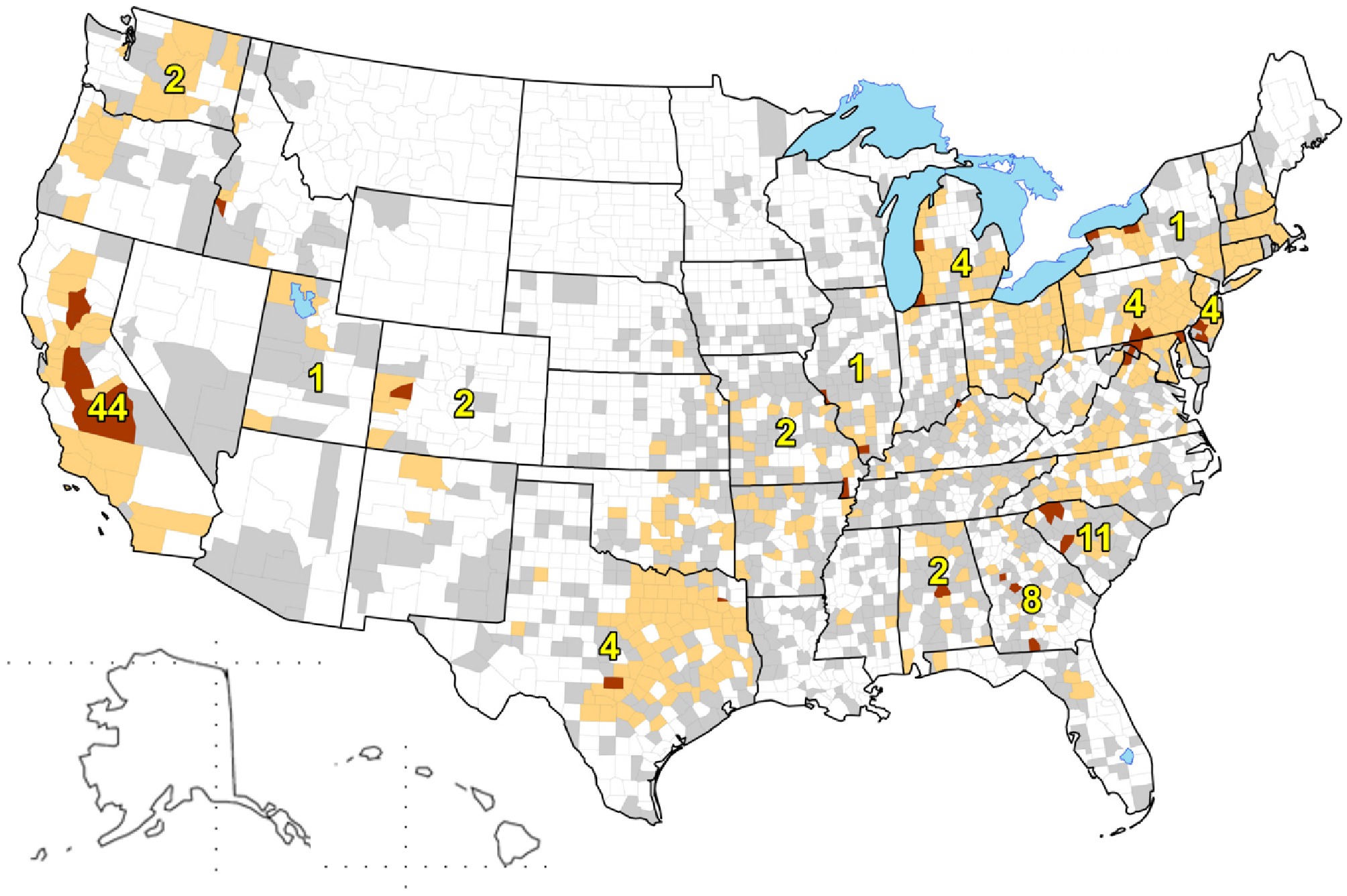
Figure 1.
U.S. major (red, accounting for 75%), and minor (orange, 24%) peach production areas and acreage percentages (yellow numbers) in each state to the national total. Grey color represented areas or counties with data not published by NASS and hence not used in delineating the major and minor agricultural areas. States not numbered contributed to less than 1% of the national total acreage. The percentages were derived from USDA NASS 2007 Census of Agriculture data. Additional information on these data can be found at
www.nass.usda.gov/AgCensus . This figure was modified slightly from its original USDA version athttps://ctgpublishing.com/united-states-strawberry-production/united-states-top-peaches-producing-areas-map/ .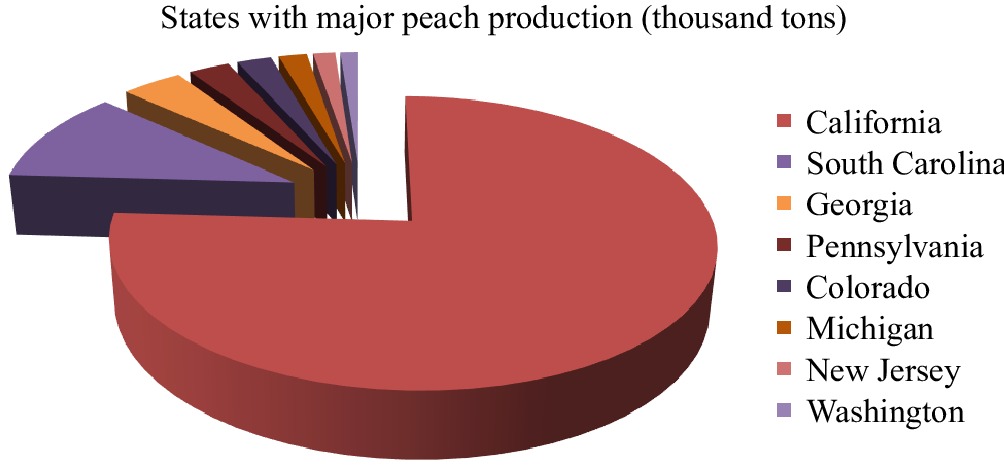
Figure 2.
States with major peach production (thousand tons) in the U.S. (data from USDA NASS 2022). Production ranks in states after the top three may vary from year to year.
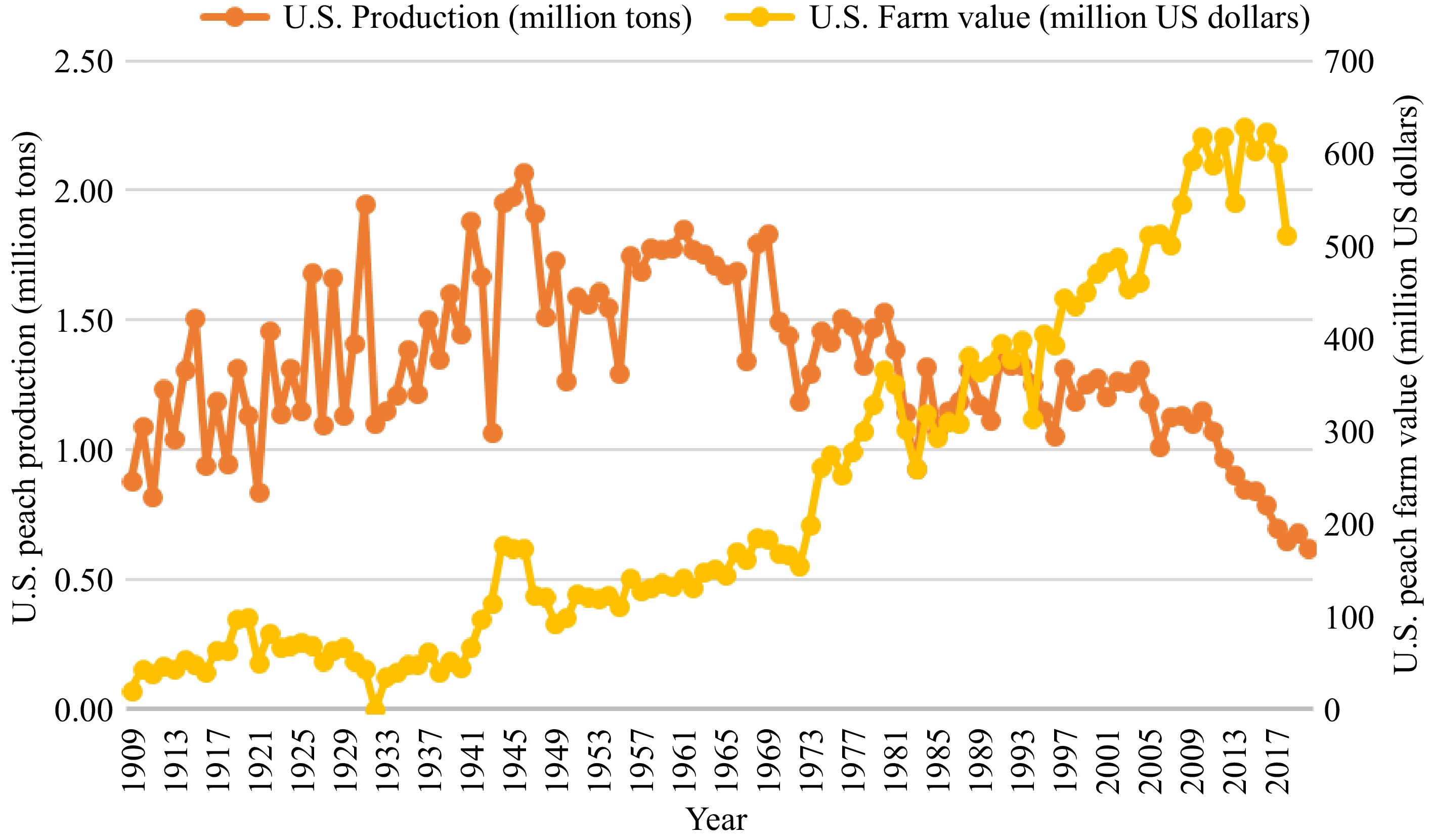
Figure 3.
Trend of U.S. total peach production and farm value (data from USDA NASS).
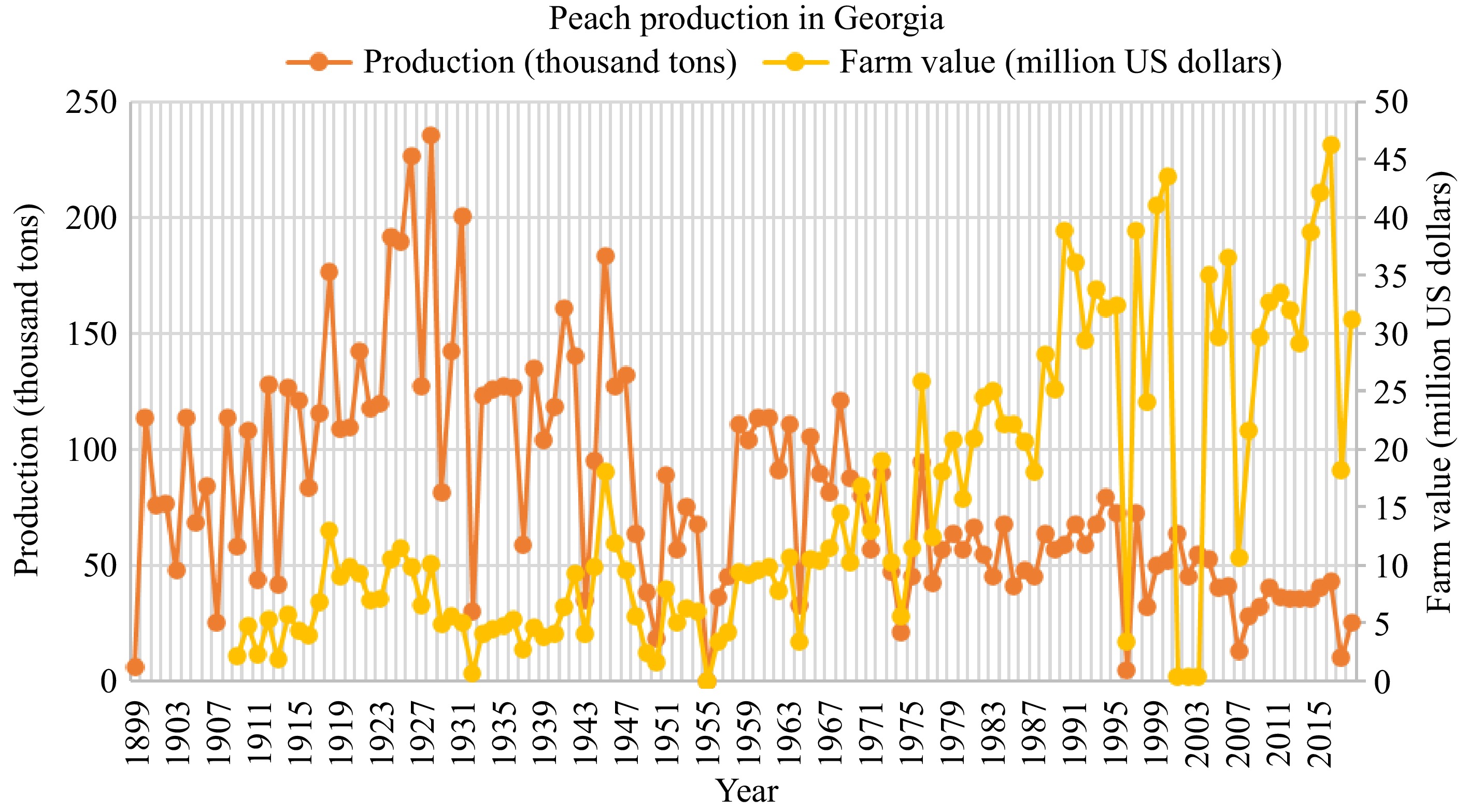
Figure 4.
Trend of peach production and farm value in Georgia (data from USDA NASS).
-
Given an introduced crop with a relatively short history, U.S. peach breeding and production reasonably are considered a great success. Hundreds of peach cultivars have been released from breeding programs. Consequently, states with peach industries have eventually evolved into the current production landscape (Fig. 1). However, the declining trend in peach acreage and production suggests imminent challenges and issues facing the industries and demands continuous visionary varietal improvement and horticultural research to find solutions for the sustainability and profitability of the U.S. peach industries. In addition, for some reason peach cultivars tend to become obsolete quickly and new cultivars are highly desired and beneficial in this context. Sustainable peach production largely is dependent on cropping reliability, which is one of the most important and complicated traits inherently interacting with highly unpredictable changing climates. Most incidences of big yield loss were due to unfavorable weather, such as inadequate chilling in the winter and spring frost during the weeks of blooming and fruit setting. The latter appears to be more often, more unpredictable, and more devastating. Therefore, improving cropping reliability under different climatic conditions should be among top breeding priorities to turn the tide. Identification or introduction of new climate-resilient materials is essential for improving cropping reliability as most current elite cultivars are prone to spring frost. The relatively short longevity of commercial peach orchards, about 10 years in the Southeast and 15 years in CA, is also a big production limiting factor for the industries. A recent comparison of peach hardwood decay between cultivars and rootstocks revealed colonization of environmental wood-decay fungi almost exclusively occurred in cultivars, not in rootstocks[61], implying that loss of appropriate defense genes in cultivars might be the culprit, due to almost exclusive focus on fruit characteristics during thousands of years of domestication and selection. Restoration of some genes helping defend decay in rootstock into scion cultivars might be a breeding objective with great benefit to prolong commercial orchard longevity and boost profit. Profitable peach production also relies on cultivars with improved traits and cost-effective culture practices that can reduce labor needs and management costs. Therefore, breeding programs should include an objective to develop cultivars and rootstocks with tree architecture permitting easier pruning, thinning, and picking, reducing labor need, and favoring orchard automation, a trend now for many fruit crops. Of course, disease resistance is always a breeding priority, allowing reduced chemical sprays and prolonging orchard lifespan. Genetic research that deciphered related important genes/traits are needed in addition to testing of these new materials in multiple locations to enhance understanding of their heritability and performance. Though most peach breeding programs have been terminated over the past decades or are being phased out recently, active breeders will continue working diligently with vision, discipline, passion, and understanding of the risk of release programs and releasing new improved peach cultivars and rootstocks to produce attractive nutrient-rich fruit for consumers, and ultimately, to meet the needs for the U.S. industries' competitiveness and profitability. Visionary peach breeding and production with new directions are now more needed than ever to turn the declining tide of production.
The author would like to thank Dr. David Byrne for providing general information on the Texas A&M University peach breeding program, including cultivar series naming conventions. The author is also grateful for anonymous reviewers and editors who gave their constructive feedback to improve the article. This article was part of the research supported by the USDA National Programs of Plant Genetic Resources, Genomics and Genetic Improvement (Project No: 6042-21000-006-000D). This article reports the results of research only. Mention of a trademark or proprietary product is solely for the purpose of providing specific information and does not constitute a guarantee or warranty of the product by the USDA and does not imply its approval to the exclusion of other products that may also be suitable.
-
The author confirms sole responsibility for the following: study conception and design, data collection, analysis and interpretation of results, and manuscript preparation.
-
The datasets summarized and presented in this article are properly cited and publicly available.
-
The author declares that there is no conflict of interest. This article has been written by a U.S. Government employee in the course of their official duties as defined by the U.S. Copyright Act, 17 U.S. Code § 105.
- Copyright: © 2025 by the author(s). Published by Maximum Academic Press, Fayetteville, GA. This article is an open access article distributed under Creative Commons Attribution License (CC BY 4.0), visit https://creativecommons.org/licenses/by/4.0/.
-
About this article
Cite this article
Chen C. 2025. Overview of U.S. peach breeding and production. Technology in Horticulture 5: e014 doi: 10.48130/tihort-0025-0009 

Overview of U.S. peach breeding and production
- Received: 21 February 2024
- Revised: 23 December 2024
- Accepted: 19 February 2025
- Published online: 09 April 2025
Abstract: Peach is an introduced crop with a relatively short history in the U.S., where dozens of public and private breeding programs have released hundreds of peach cultivars and successfully helped establish considerable production in many states. This paper provides a glimpse of U.S. peach breeding and production. Most public and private peach breeding programs have been terminated over the past decades or are currently being phased out, active breeding programs will continue releasing new improved peach cultivars and rootstocks to produce attractive nutrient-rich fruit for consumers. The declining trend in U.S. peach acreage and production suggests imminent challenges and issues facing the industry and demands continuous visionary breeding and horticultural research to find solutions for the sustainability and profitability of the U.S. peach industry.
-
Key words:
- Prunus persica /
- Scion breeding /
- Rootstock breeding /
- Chill requirement