












-
Zucchini (Cucurbita pepo spp.), a globally favored vegetable, flourishes in various climates and boasts significant yield potential, making China one of its leading producers[1]. In 2024, China's zucchini fruit output exceeded 10.8 million tonnes, with primary cultivation occurring in Shandong, Henan, Hebei, Gansu, and Ningxia provinces. Technological advancements have facilitated the expansion of greenhouse systems, enabling zucchini production in regions with extreme environmental conditions, such as the Qinghai-Xizang Plateau. This expansion has addressed food scarcity in these colder regions by increasing both yield and winter supply[2−4]. Beyond its economic contributions, zucchini fruit is rich in dietary fiber, vitamins (A, C, and K), and carotenoid antioxidants, all of which enhance human health[5,6].
Despite these nutritional and economic benefits, zucchini's high water content (> 95%) and vigorous metabolic activity make it highly perishable after harvest, especially when exposed to unsuitable temperatures[7,8]. While low-temperature storage is commonly employed to prolong the shelf life of fruit and vegetables, zucchini fruit is particularly vulnerable to chilling injury (CI) at such temperatures. When stored below 5 °C, zucchini fruit tends to develop surface pitting (SP), water-soaked lesions, softening, and decay[9−11]. To counteract CI, both physical and chemical strategies have been devised for zucchini fruit preservation. Physical methods involve altering the storage environment or the fruit's physiology, including techniques such as heat treatment[12], humidity control (i.e., near-saturation and high relative humidity [RH])[13,14], temperature preconditioning[15], UV-B irradiation[16], controlled atmosphere storage (i.e., low-O2 or high-CO2)[17,18], and modified atmosphere packaging (MAP)[19]; chemical strategies utilize bioactive compounds to modulate physiological pathways, including polyamines[20], melatonin[21], 1-methylcyclopropene[22], glycine betaine[23], and hydrogen sulfide[24]. Among these methods, modified atmosphere packaging (MAP) stands out for its operational simplicity, cost-effectiveness, and safety. Unlike chemical treatments that pose the risk of residue accumulation, MAP uses gas-permeable films to passively regulate the levels of O2 and CO2 within the packaging, thereby effectively delaying senescence without compromising food safety[25]. For zucchini fruit, active MAP systems have shown efficacy in reducing titratable acidity loss, weight loss, and the decline in fruit firmness by actively flushing initial gas mixtures (e.g., 5% O2, 10% CO2, 85% N2) into packages[19]. However, the effectiveness of passive MAP, which depends on the fruit's respiration and the permeability of the film to achieve optimal gas gradients remains uncertain for the postharvest management of zucchini fruit. The primary aim of this study is to assess whether passive MAP can improve CI tolerance and preserve the high quality of cold-stored zucchini fruit.
Despite zucchini being categorized as a non-climacteric fruit with low ethylene production, recent findings suggest that certain cultivars produce higher levels of ethylene[11,26]. This physiological variation explains the effectiveness of 1-methylcyclopropene (1-MCP), an ethylene receptor inhibitor, in prolonging the postharvest life of zucchini fruit by blocking ethylene signaling[27]. In 'Cronos' zucchini fruit, the application of 2,400 μL L−1 1-MCP treatment significantly reduced ethylene production by 40%−45%, decreased electrolyte leakage by 30%, and delayed flesh softening over a storage period of 15 d at 4 °C, followed by 2 d at 20 °C[22]. Conventional methods of applying 1-MCP typically involve fumigation, which necessitates an airtight, temperature-controlled chamber. This approach is technically complex and impractical for small-scale farmers. To overcome this challenge, slow-release 1-MCP sachets have been developed as a more accessible alternative, allowing treatment without the need for specialized equipment. The second objective of this study was to ascertain whether slow-release 1-MCP synergistically enhances the efficacy of MAP in zucchini fruit. Should this not be the case, the final objective was to investigate alternative pre-storage treatments, such as temperature and/or relative humidity preconditioning, as potential substitutes for 1-MCP in MAP systems. Addressing these questions advances the development of low-cost, residue-free preservation protocols to extend the marketability of zucchini fruit.
-
The 'Xiuyu 170' zucchini fruit were hand-harvested from the commercial greenhouse of the Dazhezi Village, Ping'an District, Haidong, Qinghai, China (36°25'34'' N, 102°1'32'' E, elevation 2,371 m). Drip irrigation was administered daily, with water supply adjusted according to the plant's developmental stage and substrate moisture levels, maintaining soil volumetric water content at approximately 70%−80% of field capacity. This approach ensured optimal growth and minimized water stress. Fertilization was delivered via a nutrient solution containing nitrogen (N), phosphorus (P2O5), potassium (K2O), and microelements (including Fe, Zn, Mn, and B) through the irrigation systems. Harvesting took place early in the morning (6:00−8:00 am) to reduce field heat and physiological stress. After harvesting, zucchinis weighing between 0.4 and 0.5 kg were selected, ensuring they were free from injury or infection. The fruit were then placed in ventilated plastic crates and transported to the laboratory within 1.5 h.
Experimental designs
-
Experiment 1: Evaluate the effect of polyethylene packaging (PEP) and MAP on CI. A total of 720 zucchinis were divided into three treatments, with three replicates of twenty fruits each. The treatments were as follows: (1) No packaging (NP): fruits were immediately stored in a cold room without any packaging; (2) PEP: fruits were enclosed in polyethylene bags (500 mm × 500 mm, 40 μm thickness, featuring 12 holes of 8 mm diameter spaced 125 mm apart); (3) MAP: fruits were packed in MAP bags (O2 permeability at 6.0 × 10⁻⁷ mol·m−2·s−1 and CO2 permeability at 12.0 × 10⁻⁷ mol·m−2·s−1, 350 mm × 400 mm, 25 μm thickness, produced from polyethylene, ZhongShan Taili Household Products Manufacturing Co. Ltd., Guangdong, China). Measurements were taken at harvest and after 7, 14, 21, and 28 d of storage at 3 ± 0.5 °C (in the dark) and 90%−95% RH. Twenty zucchini fruit from each treatment of one bag per replicate were determined for SP, decay, O2 and CO2 concentrations, quality attributes (flesh firmness [FF], skin color, and WL), lipid peroxidation of plasma membranes, reactive oxygen species (superoxide anion [O2·−] and hydrogen peroxide [H2O2]), and antioxidant oxidant systems (peroxidase [POD], catalase [CAT], ascorbic acid [AsA], and glutathione [GSH]). Pulp tissue was rapidly frozen and ground in liquid nitrogen before being stored at −80 °C.
Experiment 2: Evaluate the effects of 1-MCP combined with PEP or MAP on CI. The 720 fruits were allocated into four distinct treatments, each with three replicates comprising 20 fruit. The treatments were as follows: (1) PEP treatment, where fruits were placed in PE bags; (2) PEP + 1-MCP treatment, where fruits were placed in PE bags with a 1-MCP sachet (500 mg containing 3.3% 1-MCP active ingredients, Xianyang Xiqin Biotechnology Co. Ltd., Shaanxi, China); (3) MAP treatment, involving fruits packed in MAP bags without a 1-MCP sachet; (4) MAP + 1-MCP treatment, with fruit in MAP bags containing a 1-MCP sachet. Evaluations were conducted at harvest and after 14, 21, and 28 d of storage at 3 ± 0.5 °C and 90% ± 5% RH, using 20 zucchini fruits from each treatment per replicate as outlined in Experiment 1. Given the adverse impact of the 1-MCP + MAP treatment on quality, pre-storage low humidity conditioning was applied in Supplementary Table S1, and an optimal temperature of 15 ± 0.5 °C with 40% ± 2% RH was determined in Experiment 3.
Experiment 3: Evaluate the effects of pre-storage low humidity conditioning (PLHC) combined with PEP or MAP on CI. The 720 fruit were divided into six treatments, each with three replicates of 20 fruit, and subjected to the following processes: (1) PEP treatment involved packing the fruit into PE bags and placing them in cold storage; (2) PEP + 1 d PLHC treatment required storing the fruit for 1 d at 15 ± 0.5 °C with 40% ± 2% RH before packing them into PE bags and placing them in cold storage; (3) PEP + 2 d PLHC treatment followed the same procedure as the previous treatment but extended the storage period to 2 d. (4) MAP treatment involved packing the fruit into MAP bags immediately after harvest, followed by cold storage; (5) MAP + 1 d PLHC treatment involved storing the fruit for 1 d at 15 ± 0.5 °C with 40% ± 2% RH before packing them into MAP bags and placing them in cold storage; (6) MAP + 2 d PLHC treatment extended this storage period to 2 d before packing fruit into MAP bags and storing them in cold conditions. At harvest and after 21 and 28 d of cold storage, 20 zucchini fruit from each treatment, representing one bag per replicate, were assessed as outlined in Experiment 1.
Evaluations of CI-induced surface pitting (SP) and decay
-
When fruit were removed from each cold storage period, the CI-induced SP was determined after 4 h of temperature equilibration at 20 °C (50%−60% RH) and quantified using the SP index, assessed visually by a panel of five trained judges. These judges evaluated both the superficial area affected by SP damage and the severity of SP (Fig. 1a). A standardized 5-point scale was employed[26]: 0, no SP; 1, 0%−25% SP; 2, 25%−50% SP; 3, 0%−75% SP; and 4, 75%−100% SP. The SP index was calculated by summing the number of zucchini fruit in each category, multiplying by the respective factor (0, 1, 2, 3, or 4), and dividing by 10 fruit. The percentage of fruit exhibiting any form of decay per replicate was used to indicate the decay level, although no decay organisms were identified.
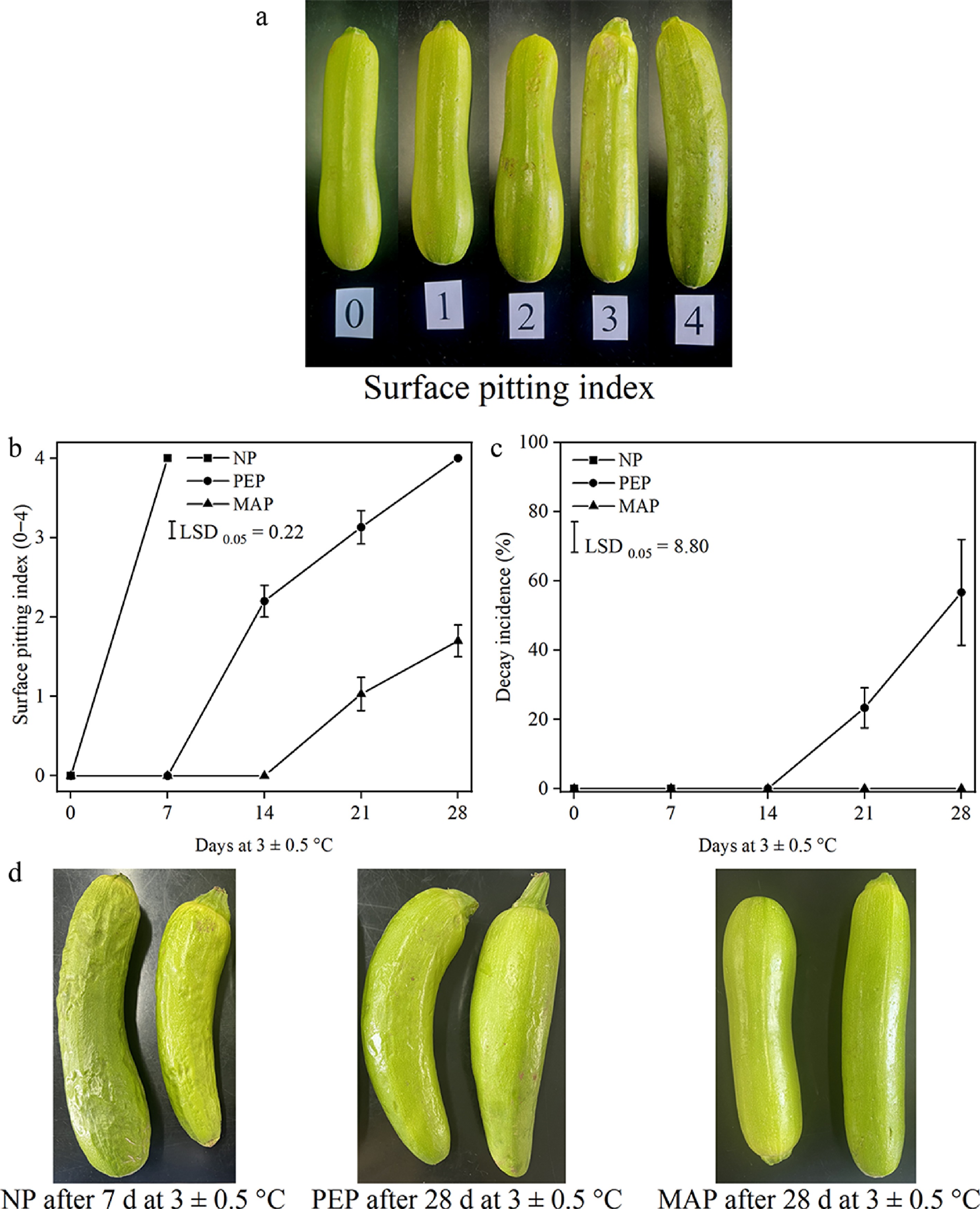
Figure 1.
(a) Zucchini fruit depicting a range in severity of chilling injury (CI)-induced surface pitting (SP). (b) SP index, and (c) decay incidence of the no packaging (NP)-, polyethylene packaging (PEP)-, and modified atmosphere packaging (MAP)-treated zucchini fruit after 7, 14, 21, and 28 d of storage at 3 ± 0.5 °C. Values are presented as the mean ± standard deviation (SD). (d) The zucchini fruit treated with NP, PEP, and MAP after 7, 28, and 28 d of storage at 3 ± 0.5 °C, respectively.
Evaluations of O2 and CO2 concentrations
-
The concentrations of O2 and CO2 in bags were determined during storage using O2 and CO2 analyzers (FW-UHQV-K531, Forensics Detectors, Rolling Hills Estates, CA, USA).
Evaluations of flesh firmness (FF), skin color, and weight loss (WL)
-
A digital firmness tester (GY-4, Yueqing Handi Instrument Co., Zhejiang, China) equipped with a 35 mm probe was used to measure firmness by pressing 2.0 mm into the zucchini fruit at its widest point. This measurement was taken once per replicate, and the maximum force was recorded in Newtons (N). Prior to measuring FF, the skin color was assessed with a colorimeter (CR-400, Konica Minolta, Osaka, Japan), and the hue angle was calculated[28]. WL was determined using the formula: WL = ([Initial fruit weight − Final fruit weight] / Initial fruit weight) × 100%.
Determinations of malondialdehyde (MDA), superoxide anion (O2·−), and hydrogen peroxide (H2O2)
-
MDA content[29]: For each replicate, 2 g of frozen pulp tissue powder were homogenized in 5.0 mL of 10% (w/v) trichloroacetic acid (TCA) and then centrifuged at 10,000 g for 10 min at 4 °C. In a 15-mL glass tube, 2.0 mL of the supernatant was combined with 2.0 mL of 0.67% (w/v) thiobarbituric acid. After boiling the mixture for 20 min at 95 °C, it was cooled in ice water. Absorbance was measured at 450, 532, and 600 nm using an Agilent BioTek Synergy H1 multi-mode microplate reader (Agilent Technologies, Inc., Santa Clara, CA, USA). MDA content was calculated using the formula: 6.45 × (OD532 − OD600) − 0.56 × OD450. Results were expressed on a fresh weight basis as μmol kg−1.
O2·− content[30]: For each replicate, 1 g of frozen pulp tissue powder was homogenized in 5.0 mL of 5.0% (w/v) TCA and then centrifuged at 10,000 g for 10 min at 4 °C. In a 15-mL glass tube, 1.0 mL of the supernatant was combined with 0.425 mL of 50 mM sodium phosphate buffer (pH 7.4) and 0.075 mL of 10 mM hydroxylammonium chloride. This mixture was incubated in darkness at 37 °C for 20 min. Subsequently, 1.5 mL of 17 mM 3-aminobenzenesulfonic acid and 1.5 mL of 7.0 mM 1-naphthylamine were added, and the mixture was incubated in darkness at 20 °C for 24 h. Absorbance was measured at 540 nm. A standard calibration curve was constructed using sodium nitrite, and the results were expressed on a fresh weight basis as mg kg−1.
H2O2 content[30]: For each replicate, 1 g of frozen pulp tissue powder was homogenized in 5.0 mL of 50 mM sodium phosphate buffer (pH 7.2) and then centrifuged at 10,000 g for 10 min at 4 °C. In a 15-mL glass tube, 1.0 mL of the supernatant was combined with 1.0 mL of distilled water and 2.0 mL of an assay reagent containing 0.5 mM ammonium ferrous sulfate, 50 mM H2SO4, 0.2 mM xylenol orange, and 20 mM D-sorbitol. Following a 30 min incubation in darkness at 20 °C, absorbance was measured at 560 nm. A standard calibration curve was constructed using H2O2, and results were expressed on a fresh weight basis as mg kg−1.
Determinations of peroxidase (POD), catalase (CAT), ascorbic acid (AsA), and glutathione (GSH)
-
POD activity[30]: For each replicate, 1 g of frozen pulp tissue powder was homogenized in 5.0 mL of 50 mM sodium phosphate buffer (pH 7.4) and subsequently centrifuged at 10,000 g for 10 min at 4 °C. In a 15-mL glass tube, 0.15 mL of the supernatant was combined with 0.65 mL of 50 mM sodium phosphate buffer (pH 7.4), 3.0 mL of 25 mM guaiacol, and 0.2 mL of 50 mM H2O2. One unit of POD activity was defined as the enzyme quantity required to induce a 0.01 OD change per min at 470 nm.
CAT activity[30]: For each replicate, 1 g of frozen pulp tissue powder was homogenized in 5.0 mL of 50 mM sodium phosphate buffer at pH 7.4, then centrifuged at 10,000 g for 10 min at 4 °C. In a 15-mL glass tube, 0.1 mL of the supernatant was mixed with 2.9 mL of 50 mM sodium phosphate buffer at pH 7.4, which contained 20 mM H2O2. One unit of CAT activity was defined as the enzyme amount that could induce a 0.01 OD change per min at 240 nm.
AsA content[31]: Three grams of frozen pulp tissue powder per replicate were homogenized in 3.0 mL of 5.0% (w/v) TCA and then centrifuged at 10,000 g for 10 min at 4 °C. In a 15-mL glass tube, 0.5 mL of the supernatant was combined with 0.5 mL of 5.0% (w/v) TCA, 0.8 mL of 42.5% (w/v) phosphoric acid, 0.8 mL of 2.0% (w/v) 2,2'-bipyridine, and 0.4 mL of 3.0% (w/v) FeCl3. The mixture was incubated in darkness at 42 °C for 1 h. Absorbance was then measured at 525 nm. A standard calibration curve using ascorbic acid was constructed, and the results were expressed on a fresh weight basis as mg kg−1.
GSH content[32]: For each replicate, 3 g of frozen pulp tissue powder were homogenized in 3.0 mL of 5.0% (w/v) TCA, then centrifuged at 10,000 g for 10 min at 4 °C. In a 15-mL glass tube, 0.5 mL of the supernatant was combined with 0.8 mL of distilled water, 2.0 mL of 100 mM Tris-HCl buffer (pH 8.9), and 0.2 mL of 4.0 mM 5,5-dithiobis-2-nitrobenzoic acid. This mixture was incubated in the dark at 20 °C for 10 min. Absorbance was then measured at 412 nm. A standard calibration curve was created using reduced glutathione, and results were expressed on a fresh weight basis as mg kg−1.
Statistical analysis
-
The experiments employed a completely randomized design. A one-way analysis of variance (ANOVA) assessed significant differences in the data utilizing Fisher's protected least significant difference (LSD) test at p < 0.05. Two-way ANOVA was performed on the data using treatment (T) and storage time (ST) as the variability factors. All analyses were performed using IBM SPSS Statistics software, v19.0 (IBM Co., Armonk, NY, USA).
-
After 7 d of storage at 3 ± 0.5 °C, the NP-treated zucchini fruit exhibited CI-induced SP with a high index of 4.00 (Fig. 1b, d). In contrast, the PEP-treated fruit began showing SP with an index of 2.20 after 14 d, which increased to 4.00 by day 28. For the MAP-treated fruit, an SP index of 1.03 was recorded on day 21, rising to 1.70 after 28 d (Fig. 1d). No decay was detected in either NP- or MAP-treated fruit during the 7- and 28-d storage periods, respectively (Fig. 1c). However, the PEP-treated fruit experienced a decay incidence of 23.33% on day 21, escalating to 56.67% by day 28. As the NP-treated zucchini developed (Fig. 1d) a severe SP index of 4.00 after just 7 d, no further elevation was carried out during the 14−28 d of the storage period.
For the evaluation of gas components and quality attributes at harvest and during storage, as detailed in Table 1, the NP and PEP treatments exhibited O2 concentrations of 18.60% and CO2 concentrations of 0.00% after 7 and 28 d of storage, respectively. In contrast, the O2 concentration within MAP bags declined to 7.57% after 28 d, while CO2 levels rose to 6.46% by day 14 before slightly decreasing to 5.56% by day 28. No significant differences were observed among NP, PEP, or MAP treatments compared to the FF at harvest for storage periods of 7, 14, and 28 d. However, a reduction in FF was noted in PEP-treated zucchini during the 21−28 d storage period. Furthermore, after 28 d, the PEP-treated zucchini exhibited a significantly lower hue angle compared to the MAP-treated fruit. Skin lightness decreased in the PEP and MAP treatments during the 7−14 and 14−28 d storage periods, respectively, although an increase in skin lightness was detected in PEP-treated fruit after 28 d. As storage time increased, all zucchini fruits showed an increase in WL, with MAP-treated fruit exhibiting a lower rate of WL compared to PEP-treated fruit during the 14−28 d storage period. ANOVA indicated significant differences in O2 concentration, CO2 concentration, FF, skin lightness, and WL between treatment (T) and storage time (ST).
Table 1. Effects of no packaging (NP), polyethylene packaging (PEP), and modified atmosphere packaging (MAP) on gas components (O2 and CO2 concentrations) in bags and quality attributes (fruit firmness [FF], hug angle, skin lightness, and weight loss [WL]) of zucchini fruit at harvest and after storage at 3 ± 0.5 °C (Experiment 1).
Treatment Storage time
(d)O2 concentration
(%)CO2 concentration
(%)FF
(N)Hug angle
(h)Skin lightness
(L*)WL
(%)At harvest 0 − − 44.23 ± 1.42 a 122.34 ± 0.49 abc 54.57 ± 4.75 b − NP 7 18.60 ± 0.00 a 0.00 ± 0.00 d 44.37 ± 2.26 a 122.07 ± 1.59 abc 50.20 ± 4.13 bcd 3.92 ± 0.51 c PEP 7 18.60 ± 0.00 a 0.00 ± 0.00 d 46.37 ± 3.88 a 123.81 ± 0.45 a 48.53 ± 2.15 cd 0.76 ± 0.08 e MAP 7 11.93 ± 0.35 b 4.40 ± 0.22 c 43.93 ± 2.59 a 123.53 ± 1.38 ab 51.68 ± 3.45 bcd 0.70 ± 0.05 e PEP 14 18.60 ± 0.00 a 0.00 ± 0.00 d 46.40 ± 1.35 a 122.90 ± 0.12 abc 42.24 ± 2.50 e 2.24 ± 0.23 d MAP 14 8.53 ± 0.25 c 6.46 ± 0.34 a 44.40 ± 1.01 a 123.82 ± 0.63 a 48.39 ± 2.31 cd 1.09 ± 0.12 e PEP 21 18.60 ± 0.00 a 0.00 ± 0.00 d 37.67 ± 2.20 b 121.09 ± 1.91 cd 52.01 ± 3.56 bcd 5.28 ± 0.36 b MAP 21 8.43 ± 0.45 c 6.34 ± 0.42 a 44.13 ± 4.39 a 123.38 ± 1.85 ab 47.45 ± 0.49 d 1.34 ± 0.11 e PEP 28 18.60 ± 0.00 a 0.00 ± 0.00 d 32.03 ± 1.97 c 119.52 ± 1.51 d 62.83 ± 2.51 a 7.54 ± 0.88 a MAP 28 7.57 ± 0.28 d 5.56 ± 0.25 b 44.33 ± 1.31 a 121.66 ± 0.95 bc 53.51 ± 1.93 bc 2.06 ± 0.08 d T *** *** ** * ns *** ST *** *** *** *** *** *** T × ST *** *** *** ns *** *** Values are presented as means of three replicates ± SD. Different lowercase letters indicated significant differences among means using Fisher's protected least significant difference (LSD) test at p < 0.05. T, treatment; ST, storage time; ns, no significant effect; * significant effect at the 0.05 level; ** significant effect at the 0.01 level; *** significant effect at the 0.001 level. In the assessment of biochemical changes during harvest and storage, as presented in Table 2, the NP treatment led to significantly higher levels of MDA, O2·−, and H2O2, alongside reduced POD activity, AsA, and GSH compared to the PEP and MAP treatments after 7 d of storage. Extending the storage duration from 7 to 28 d resulted in notable increases in MDA, O2·−, and H2O2 with a decrease in CAT activity, AsA, and GSH in both the PEP and MAP treatments. However, zucchini fruit treated with MAP maintained lower levels of MDA, O2·−, and H2O2 with higher concentrations of AsA and GSH compared to those treated with PEP. The POD and CAT levels in PEP-treated fruit peaked after 14 d of storage, whereas in MAP-treated fruit, these levels peaked after 28 and 21 d, respectively. ANOVA indicated significant differences for MDA, O2·−, H2O2, POD, CAT, and AsA between T and ST, although not for GSH.
Table 2. Effects of no packaging (NP), polyethylene packaging (PEP), and modified atmosphere packaging (MAP) on malondialdehyde (MDA) content, reactive oxygen species (superoxide anion [O2·−] and hydrogen peroxide [H2O2]), antioxidant enzymes (peroxidase [POD] and catalase [CAT]), and antioxidants (ascorbic acid [AsA] and glutathione [GSH]) of zucchini fruit at harvest and after storage at 3 ± 0.5 °C(Experiment 1).
Treatment Storage time
(d)MDA
(μmol kg−1)O2·−
(mg kg−1)H2O2
(mg kg−1)POD
(U kg−1)CAT
(U kg−1)AsA
(mg kg−1)GSH
(mg kg−1)At harvest 0 3.72 ± 0.15 e 0.85 ± 0.11 ef 8.69 ± 0.40 f 54.60 ± 2.40 ef 11.73 ± 1.40 bcd 152.57 ± 6.99 a 10.50 ± 0.70 a NP 7 32.93 ± 1.18 a 2.39 ± 0.14 a 16.28 ± 1.58 a 24.73 ± 2.69 g 13.07 ± 1.51 ab 36.77 ± 3.89 f 2.57 ± 0.74 f PEP 7 4.71 ± 0.49 e 0.72 ± 0.03 f 10.52 ± 0.50 d 64.27 ± 1.33 de 6.93 ± 1.17 e 133.00 ± 3.08 b 9.17 ± 0.31 b MAP 7 3.82 ± 0.32 e 0.87 ± 0.08 ef 9.06 ± 0.34 ef 47.27 ± 2.53 f 5.00 ± 0.87 f 149.07 ± 3.50 a 10.40 ± 0.44 a PEP 14 7.12 ± 0.44 d 1.18 ± 0.14 d 11.80 ± 0.76 c 166.47 ± 9.22 a 13.87 ± 0.70 a 109.83 ± 6.31 c 8.00 ± 0.66 c MAP 14 6.50 ± 0.56 d 0.94 ± 0.05 e 10.25 ± 0.28 de 109.93 ± 11.42 c 10.07 ± 0.99 d 133.93 ± 4.41 b 9.47 ± 0.25 b PEP 21 10.55 ± 0.83 c 1.58 ± 0.09 c 13.01 ± 0.44 b 119.97 ± 5.60 c 10.17 ± 1.47 cd 86.27 ± 3.42 d 6.50 ± 0.53 d MAP 21 7.02 ± 0.17 d 1.12 ± 0.07 d 10.59 ± 0.57 d 118.70 ± 8.75 c 12.00 ± 1.44 abc 126.80 ± 3.42 b 8.80 ± 0.40 bc PEP 28 14.84 ± 1.27 b 1.80 ± 0.08 b 16.20 ± 0.70 a 71.67 ± 8.30 d 6.27 ± 0.31 ef 78.13 ± 3.71 e 4.80 ± 0.26 e MAP 28 7.68 ± 1.01 d 1.14 ± 0.09 d 11.83 ± 0.57 bc 137.47 ± 5.75 b 7.23 ± 0.40 e 113.77 ± 2.18 c 6.73 ± 0.47 d T *** *** *** *** *** *** *** ST *** *** *** *** *** *** *** T × ST *** *** ** *** *** *** ns Values are presented as means of three replicates ± SD. Different lowercase letters indicated significant differences among means using Fisher's protected LSD test at p < 0.05. T, treatment; ST, storage time. ns, no significant effect; * significant effect at the 0.05 level; ** significant effect at the 0.01 level; *** significant effect at the 0.001 level. Effect of slow-release 1-MCP on the CI of PEP- and MAP-treated zucchini fruit
-
For PEP-treated fruit, the SP index significantly rose to 4.00 over 28 d of storage at 3 ± 0.5 °C (Fig. 2a). In contrast, SP was initially detected and observed in PEP + 1-MCP-, MAP-, and MAP + 1-MCP-treated zucchini with index levels of 0.07, 2.30, and 0.93 after 14, 21, and 21 d of storage, respectively, before increasing to 2.97, 1.63, and 3.60 by day 28 (Fig. 2c). Notably, no decay was observed in zucchini treated with PEP + 1-MCP and MAP throughout the entire 28-d period (Fig. 2b). Conversely, PEP- and MAP + 1-MCP-treated fruit exhibited a decay incidence of 16.67% and 10.00% after 21 d, which rose to 23.33% and 43.33% by day 28, respectively.
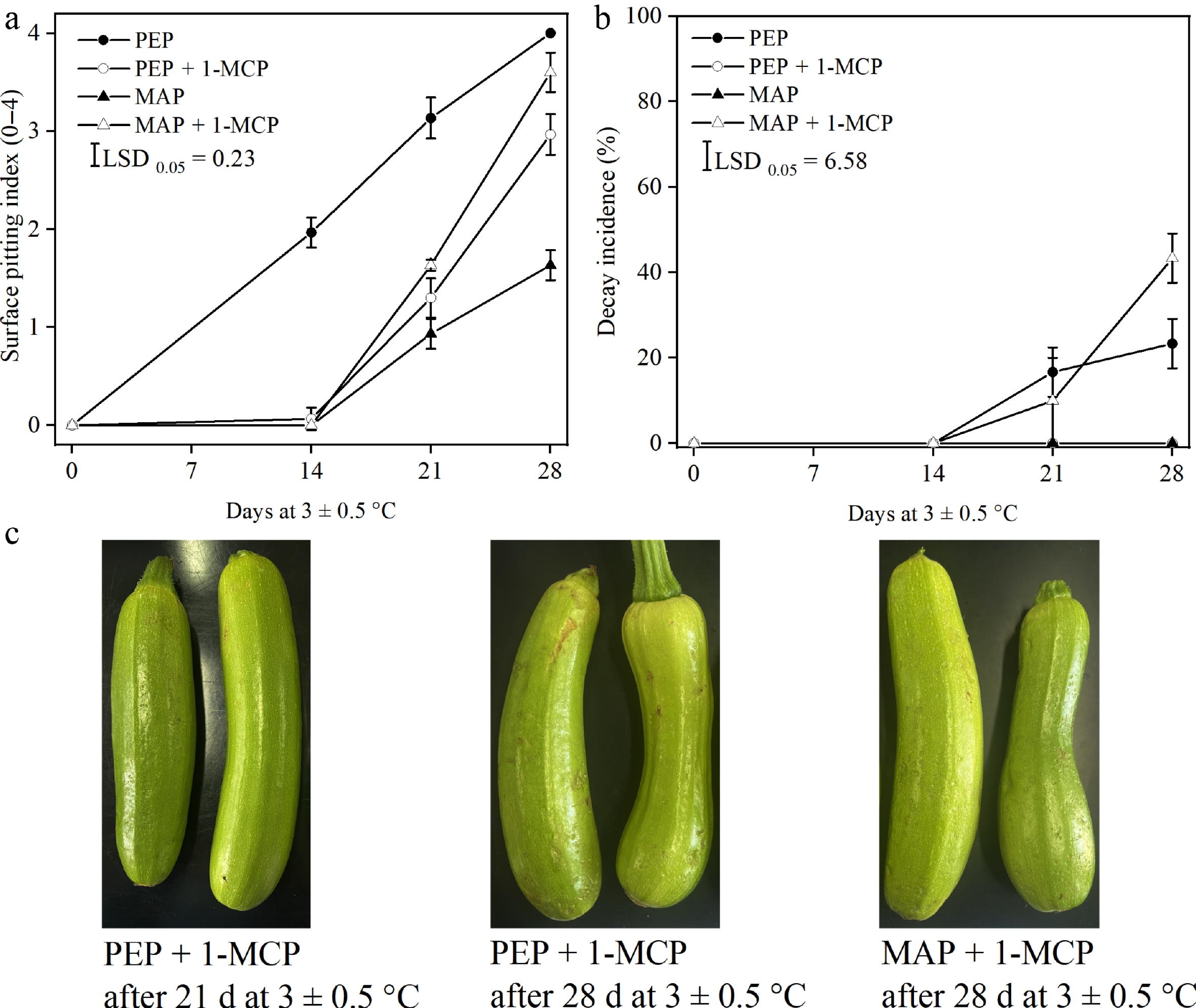
Figure 2.
(a) Surface pitting (SP) index, and (b) decay incidence of the polyethylene packaging (PEP)-, PEP + 1-methylcyclopropene (1-MCP)-, modified atmosphere packaging (MAP)-, and MAP + 1-MCP-treated zucchini fruit after 14, 21, and 28 d of storage at 3 ± 0.5 °C. Values are presented as the mean ± SD. (c) The zucchini fruit treated with PEP + 1-MCP, PEP + 1-MCP, and MAP + 1-MCP after 21, 28, and 28 d of storage at 3 ± 0.5 °C, respectively.
In Table 3, the evaluations of gas components and quality attributes at harvest and during storage reveal distinct patterns among the treatments. The PEP and PEP + 1-MCP treatments consistently maintained the O2 and CO2 concentrations at 18.60% and 0.00%, respectively, throughout the storage period. Conversely, MAP and MAP + 1-MCP treatments exhibited a decrease in O2 concentration accompanied by an increase in CO2 concentration. Specifically, for MAP treatment, the O2 concentration in bags was 8.97% after 14 d of storage, rising slightly to 9.28% by day 28. In contrast, the O2 concentration in MAP + 1-MCP treatment continuously declined from 7.65% to 4.49%. The CO2 concentration in MAP- and MAP + 1-MCP-treated fruit was 5.77% and 6.12% after 14 d of storage, increasing to 6.20% and 9.50% by day 28, respectively. Regarding FF, no significant difference was noted in PEP and PEP + 1-MCP treatments during the initial 21 d of storage compared to the harvest. However, extending storage to 28 d led to a reduction in FF for both treatments. Although the MAP treatment showed lower FF after 14 and 21 d, the FF of MAP-treated fruit was similar to that of PEP and PEP + 1-MCP-treated fruit. In contrast, the inclusion of 1-MCP in the MAP treatment resulted in a rapid FF loss over the 28-d storage period. For PEP-treated fruit, the hue angle diminished rapidly from 14 to 28 d of storage, whereas MAP treatment delayed the yellowing process. After 28 d of storage, the PEP treatment resulted in notably higher skin lightness, whereas no differences were detected among the other treatments either at harvest, or during storage. As the storage period increased, all treatments exhibited enhanced WL. However, the PEP + 1-MCP, MAP, and MAP + 1-MCP treatments significantly curtailed WL throughout the 28-d storage period, with the MAP treatment being particularly effective. Furthermore, ANOVA indicated significant differences in O2 concentration, CO2 concentration, FF, skin lightness, and WL between T and ST.
Table 3. Effect of postharvest 1-methylcyclopropene (1-MCP) on gas components (O2 and CO2 concentrations) in bags and quality attributes (fruit firmness [FF], hug angle, skin lightness, and weight loss [WL]) of the polyethylene packaging (PEP)- and modified atmosphere packaging (MAP)-treated zucchini fruit at harvest and after storage at 3 ± 0.5 °C (Experiment 2).
Treatment Storage time
(d)O2 concentration
(%)CO2 concentration
(%)FF
(N)Hug angle
(h)Skin lightness
(L*)WL
(%)At harvest 0 − − 49.27 ± 3.73 a 123.14 ± 0.36 ab 51.63 ± 3.58 bc − PEP 14 18.60 ± 0.00 a 0.00 ± 0.00 f 46.83 ± 0.61 abc 120.84 ± 1.51 cd 49.83 ± 1.57 c 1.93 ± 0.18 e PEP + 1-MCP 14 18.60 ± 0.00 a 0.00 ± 0.00 f 47.93 ± 2.78 ab 122.39 ± 1.20 abcd 49.88 ± 2.17 c 0.85 ± 0.07 h MAP 14 8.97 ± 0.27 c 5.77 ± 0.24 e 43.87 ± 3.07 bcde 123.62 ± 0.49 a 51.75 ± 3.64 bc 0.79 ± 0.10 h MAP + 1-MCP 14 7.65 ± 0.14 d 6.12 ± 0.13 cd 41.80 ± 3.12 de 121.16 ± 1.48 bcd 51.79 ± 2.54 bc 0.76 ± 0.06 h PEP 21 18.60 ± 0.00 a 0.00 ± 0.00 f 46.27 ± 5.42 abcd 118.32 ± 0.77 ef 55.90 ± 3.00 b 3.95 ± 0.16 b PEP + 1-MCP 21 18.60 ± 0.00 a 0.00 ± 0.00 f 49.80 ± 2.41 a 121.44 ± 2.18 abcd 50.07 ± 2.35 c 1.46 ± 0.11 fg MAP 21 9.01 ± 0.18 bc 5.98 ± 0.21 d 43.97 ± 1.68 bcde 123.04 ± 1.11 abc 51.27 ± 2.53 bc 1.23 ± 0.14 g MAP + 1-MCP 21 6.57 ± 0.36 e 8.30 ± 0.14 b 34.00 ± 0.87 f 120.52 ± 1.04 de 53.38 ± 1.86 bc 1.59 ± 0.09 f PEP 28 18.60 ± 0.00 a 0.00 ± 0.00 f 41.60 ± 2.19 e 117.09 ± 2.24 f 61.47 ± 2.20 a 6.34 ± 0.35 a PEP + 1-MCP 28 18.60 ± 0.00 a 0.00 ± 0.00 f 42.70 ± 0.10 cde 120.72 ± 1.36 d 50.00 ± 4.07 c 2.42 ± 0.23 c MAP 28 9.28 ± 0.13 b 6.20 ± 0.13 c 43.67 ± 1.70 bcde 123.31 ± 1.51 ab 51.95 ± 5.14 bc 2.01 ± 0.10 de MAP + 1-MCP 28 4.49 ± 0.18 f 9.50 ± 0.12 a 27.67 ± 3.34 g 120.36 ± 0.92 de 54.15 ± 0.98 bc 2.26 ± 0.11 cd T *** *** *** *** ** *** ST *** *** *** * * *** T × ST *** *** ** ns * *** Values are presented as means of three replicates ± SD. Different lowercase letters indicated significant differences among means using Fisher's protected LSD test at p < 0.05. T, treatment; ST, storage time. ns, no significant effect; * significant effect at the 0.05 level; ** significant effect at the 0.01 level; *** significant effect at the 0.001 level. In Table 4, the evaluation of biochemical changes during harvest and storage revealed significant increases in MDA, O2·−, and H2O2 alongside decreases in AsA and GSH across all treatments throughout the storage periods. When comparing the PEP treatment with the addition of 1-MCP, there was a further reduction in the accumulation of MDA, O2·−, and H2O2, as well as in the losses of AsA and GSH. Moreover, MAP maintained higher levels of AsA and GSH with lower levels of MDA, O2·−, and H2O2 compared to the PEP + 1-MCP treatment. Conversely, the addition of 1-MCP to MAP accelerated the accumulation of MDA, O2·−, and H2O2 and reduced AsA and GSH more rapidly than MAP alone and PEP + 1-MCP treatments. The POD levels in fruit treated with PEP, PEP + 1-MCP, MAP and MAP + 1-MCP peaked after 14, 21, 28, and 14 d of storage, respectively. Similarly, CAT levels peaked in PEP, PEP + 1-MCP, MAP, and MAP + 1-MCP treatments after 14, 14, 21, and 14 d of storage, respectively. ANOVA indicated significant differences in ROS, antioxidant enzymes, and antioxidants between T and ST.
Table 4. Effect of postharvest 1-methylcyclopropene (1-MCP) on malondialdehyde (MDA) content, reactive oxygen species (superoxide anion [O2·−] and hydrogen peroxide [H2O2]), and antioxidant enzymes (peroxidase [POD] and catalase [CAT]), and antioxidants (ascorbic acid [AsA] and glutathione [GSH]) of polyethylene packaging (PEP)- and modified atmosphere packaging (MAP)-treated zucchini fruit at harvest and after storage at 3 ± 0.5 °C (Experiment 2).
Treatment Storage time
(d)MDA
(μmol kg−1)O2·−
(mg kg−1)H2O2
(mg kg−1)POD
(U kg−1)CAT
(U kg−1)AsA
(mg kg−1)GSH
(mg kg−1)At harvest 0 4.04 ± 0.14 h 0.82 ± 0.04 g 7.95 ± 0.14 g 58.37 ± 1.92 e 12.17 ± 1.31 c 165.30 ± 6.19 a 11.37 ± 0.57 a PEP 14 8.02 ± 0.17 d 1.04 ± 0.07 de 10.00 ± 0.37 de 160.83 ± 3.42 a 14.17 ± 0.77 a 117.60 ± 2.35 d 8.40 ± 0.17 d PEP + 1-MCP 14 5.53 ± 0.40 fg 0.90 ± 0.03 f 8.88 ± 0.16 f 115.57 ± 11.22 c 12.72 ± 0.94 bc 151.13 ± 4.80 b 9.67 ± 0.29 bc MAP 14 5.35 ± 0.42 g 0.83 ± 0.05 fg 8.84 ± 0.26 f 117.03 ± 3.87 c 10.84 ± 0.99 d 154.90 ± 3.77 b 9.90 ± 0.36 b MAP + 1-MCP 14 6.55 ± 0.29 ef 1.00 ± 0.05 e 9.02 ± 0.14 f 134.03 ± 9.91 b 14.37 ± 1.03 a 150.93 ± 7.41 b 9.73 ± 0.25 b PEP 21 11.38 ± 0.59 b 1.42 ± 0.03 b 12.20 ± 0.44 c 132.17 ± 2.84 b 9.39 ± 0.36 e 90.73 ± 1.71 f 7.00 ± 0.20 e PEP + 1-MCP 21 6.74 ± 0.35 e 1.09 ± 0.06 d 9.40 ± 0.56 ef 165.93 ± 19.04 a 11.90 ± 0.18 cd 139.73 ± 5.50 c 8.10 ± 0.36 d MAP 21 5.92 ± 0.37 efg 1.07 ± 0.03 de 9.04 ± 0.27 f 123.57 ± 5.94 bc 13.74 ± 0.60 ab 152.70 ± 3.40 b 9.17 ± 0.35 c MAP + 1-MCP 21 8.40 ± 0.47 d 1.26 ± 0.06 c 11.84 ± 0.49 c 132.30 ± 9.36 b 9.04 ± 0.18 e 109.50 ± 6.94 e 8.30 ± 0.26 d PEP 28 17.60 ± 0.73 a 1.68 ± 0.04 a 15.16 ± 0.56 a 83.43 ± 4.72 d 5.29 ± 0.30 fg 80.47 ± 1.85 g 5.50 ± 0.20 g PEP + 1-MCP 28 7.55 ± 0.46 b 1.23 ± 0.06 c 12.01 ± 0.81 c 85.67 ± 3.87 d 6.43 ± 0.58 f 114.23 ± 5.75 de 6.43 ± 0.40 f MAP 28 6.77 ± 0.33 e 1.03 ± 0.05 de 10.27 ± 0.25 d 154.43 ± 7.24 a 8.54 ± 0.53 e 133.87 ± 1.71 c 7.03 ± 0.15 e MAP + 1-MCP 28 9.70 ± 1.51 c 1.60 ± 0.03 a 13.83 ± 0.63 b 48.07 ± 8.33 e 4.74 ± 0.35 g 86.17 ± 3.97 fg 5.20 ± 0.30 g T *** *** *** *** *** *** *** ST *** *** *** *** *** *** *** T × ST *** *** *** *** *** *** *** Values are presented as means of three replicates ± SD. Different lowercase letters indicated significant differences among means using Fisher's protected LSD test at p < 0.05. T, treatment; ST, storage time. ns, no significant effect; * significant effect at the 0.05 level; ** significant effect at the 0.01 level; *** significant effect at the 0.001 level. Effects of PLHC on the CI of PEP- and MAP-treated zucchini fruit
-
After 21 d of storage at 3 ± 0.5 °C, the SP indexes for PEP-, PEP + 1 d PLHC-, PEP + 2 d PLHC-, MAP-, MAP + 1 d PLHC-, and MAP + 2 d PLHC-treated zucchini were 3.40, 1.63, 2.20, 0.63, 0.33, and 1.43 respectively. These values increased to 4.00, 1.97, 2.70, 1.80, 0.97, and 2.00 after 28 d (Fig. 3a, c). Notably, no decay was observed in the PEP + 1 d PLHC, PEP + 2 d PLHC, MAP, and MAP + 1 d PLHC treatments throughout the entire 28-d period (Fig. 3b). In contrast, the PEP- and MAP + 2 d PLHC-treated fruits exhibited decay incidences of 6.67% and 10.00% after 28 d.
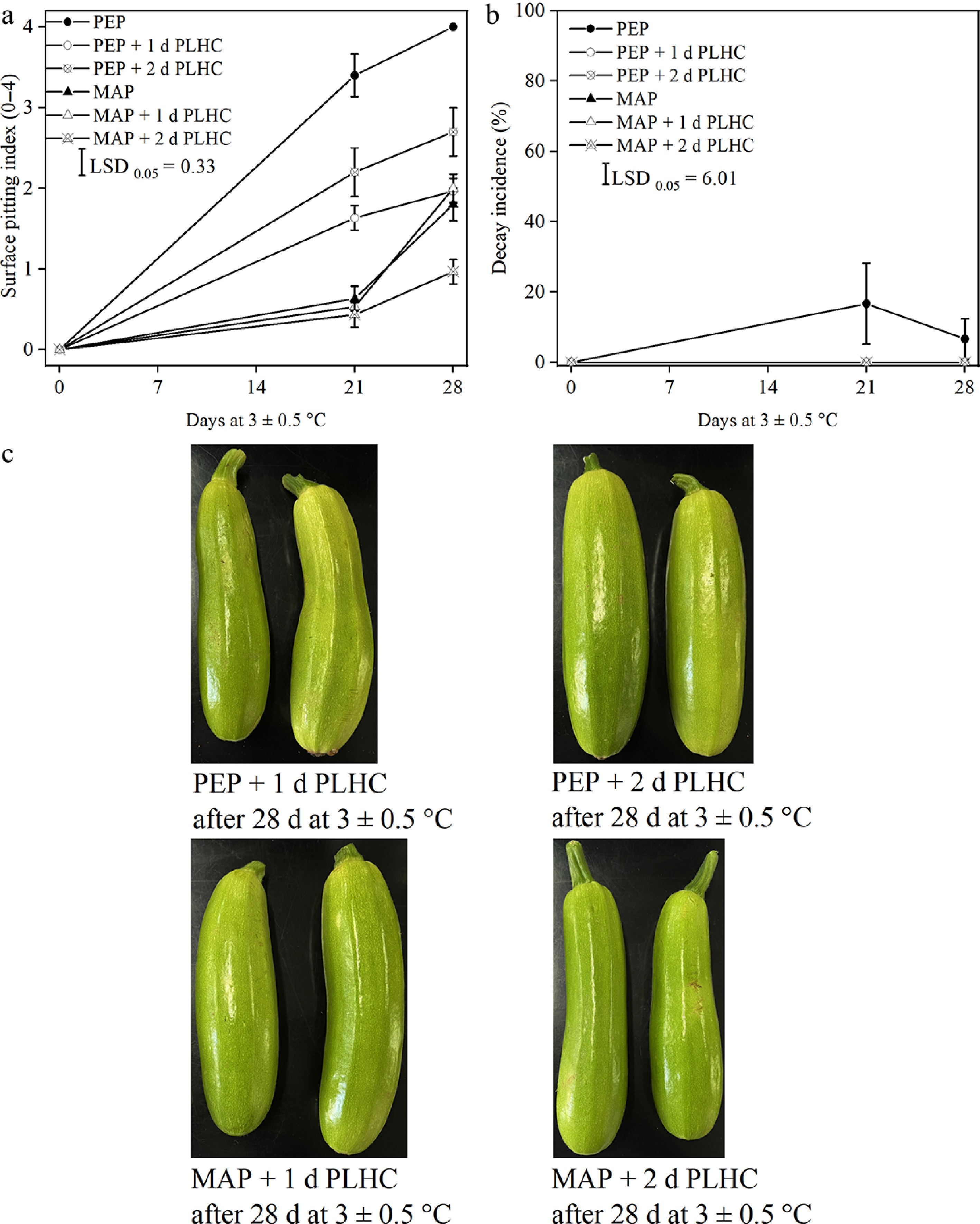
Figure 3.
(a) Surface pitting (SP) index, and (b) decay incidence of the polyethylene packaging (PEP)- and modified atmosphere packaging (MAP)-treated zucchini fruit with 1 and 2 d pre-storage low humidity conditioning (PLHC) after 21 and 28 d of storage at 3 ± 0.5 °C. Values are presented as the mean ± SD. (c) The zucchini fruit treated with PEP + 1 d PLHC, PEP + 2 d PLHC, MAP + 1 d PLHC, and MAP + 2 d PLHC after 28 d of storage at 3 ± 0.5 °C.
In the evaluations of gas components and quality attributes at harvest and during storage, as detailed in Table 5, the PEP and PEP + 1 and 2 d PLHC treatments consistently maintained O2 and CO2 concentrations at 18.60% and 0.00%, respectively, throughout the storage period. Predictably, MAP, irrespective of PLHC treatment, led to low O2 and elevated CO2 levels within the bags. Specifically, the O2 concentration for MAP, MAP + 1 d PLHC, and MAP + 2 d PLHC treated fruit was 11.87%, 11.80%, and 13.27% after 21 d of storage, subsequently decreasing to 9.63%, 9.53%, and 11.23% by 28 d. Similarly, the CO2 concentration of these treatments was recorded at 4.76%, 4.21%, and 3.20% after 21 d, increasing to 5.94%, 5.99%, and 4.47% by 28 d, respectively. At harvest, all treatments exhibited a decrease in FF, although the PEP + 1 d PLHC-, MAP + 1 d PLHC-, and MAP + 2 d PLHC-treated fruits maintained relatively high FF values after 28 d of storage. The PEP and PEP + 2 d PLHC treatments showed low hug angles after 21 and 28 d of storage. Additionally, the MAP + 2 d PLHC-treated fruits demonstrated a reduction in hug angle after 28 d of storage. In terms of skin lightness, the MAP + 1 d PLHC treatment showed no change during storage compared to harvest, whereas other treatments resulted in increased skin lightness. The WL was mitigated by PLHC and MAP, with the MAP + 1 d PLHC treatment significantly reducing WL over the 28-d storage period. ANOVA indicated significant differences in O2 concentration, CO2 concentration, skin lightness, and WL between T and ST.
Table 5. Effects of 1 and 2 d pre-storage low humidity conditioning (PLHC) on gas components (O2 and CO2 concentrations) in bags and quality attributes (fruit firmness [FF], hug angle, skin lightness, and weight loss [WL]) of polyethylene packaging (PEP)- and modified atmosphere packaging (MAP)-treated zucchini fruit at harvest and after storage at 3 ± 0.5 °C (Experiment 3).
Treatment Storage time
(d)O2 concentration
(%)CO2 concentration
(%)FF
(N)Hug angle
(h)Skin lightness
(L*)WL
(%)At harvest 0 − − 49.03 ± 5.72 a 122.97 ± 0.77 a 48.71 ± 2.54 e − PEP 21 18.60 ± 0.00 a 0.00 ± 0.00 f 32.80 ± 2.45 ef 120.15 ± 0.91 c 55.69 ± 1.89 c 3.87 ± 0.24 b PEP + 1 d PLHC 21 18.60 ± 0.00 a 0.00 ± 0.00 f 43.00 ± 3.29 b 122.12 ± 1.10 ab 53.45 ± 0.83 cd 1.52 ± 0.13 f PEP + 2 d PLHC 21 18.60 ± 0.00 a 0.00 ± 0.00 f 39.80 ± 3.39 bcd 119.73 ± 1.22 c 56.26 ± 1.69 bc 1.84 ± 0.10 e MAP 21 11.87 ± 0.21 c 4.76 ± 0.10 b 37.37 ± 2.06 cde 122.85 ± 0.44 a 55.88 ± 2.61 c 1.13 ± 0.06 g MAP + 1 d PLHC 21 11.80 ± 0.20 c 4.21 ± 0.14 d 42.97 ± 4.76 b 122.86 ± 2.28 a 56.31 ± 1.96 bc 1.11 ± 0.09 gh MAP + 2 d PLHC 21 13.27 ± 0.25 b 3.20 ± 0.17 e 42.87 ± 2.35 b 122.50 ± 0.51 a 48.53 ± 1.71 e 0.87 ± 0.08 h PEP 28 18.60 ± 0.00 a 0.00 ± 0.00 f 32.03 ± 1.63 f 118.55 ± 0.99 c 61.88 ± 1.49 a 6.07 ± 0.24 a PEP + 1 d PLHC 28 18.60 ± 0.00 a 0.00 ± 0.00 f 41.77 ± 1.15 bcd 122.70 ± 0.27 a 59.41 ± 0.98 ab 2.05 ± 0.19 de PEP + 2 d PLHC 28 18.60 ± 0.00 a 0.00 ± 0.00 f 37.00 ± 1.41 de 120.35 ± 1.95 bc 61.24 ± 1.55 a 3.09 ± 0.14 c MAP 28 9.63 ± 0.15 e 5.94 ± 0.12 a 37.27 ± 2.73 cde 122.65 ± 0.98 a 54.94 ± 1.40 c 2.19 ± 0.13 d MAP + 1 d PLHC 28 9.53 ± 0.14 e 5.99 ± 0.22 a 38.67 ± 2.20 bcd 119.92 ± 0.70 c 56.39 ± 1.30 bc 2.05 ± 0.06 de MAP + 2 d PLHC 28 11.23 ± 0.22 d 4.47 ± 0.11 c 42.10 ± 3.30 bc 122.64 ± 1.10 a 51.00 ± 3.28 de 1.12 ± 0.13 g T *** *** *** *** *** *** ST *** *** ns ns *** *** T × ST *** *** ns ns ** *** Values are presented as means of three replicates ± SD. Different lowercase letters indicated significant differences among means using Fisher's protected LSD test at p < 0.05. T, treatment; ST, storage time. ns, no significant effect; * significant effect at the 0.05 level; ** significant effect at the 0.01 level; *** significant effect at the 0.001 level. In evaluating the biochemical changes during harvest and storage as shown in Table 6, there were notable increases in MDA and O2·− levels, alongside a decrease in AsA across all treatments throughout the storage periods compared to the harvest. After 21 d of storage, fruit treated with MAP + 2 d of PLHC maintained H2O2 and GSH levels comparable to those at harvest. However, extending the storage to 28 d led to increased H2O2 and decreased GSH across all treatments. The fruits treated with PEP-, PEP + 2 d PLHC-, and MAP + 1 d PLHC exhibited high POD activities after 21 d of storage. In contrast, those treated with PEP + 1 d PLHC-, MAP-, and MAP + 2 d PLHC showed elevated POD activities after 28 d of storage. Regarding CAT activity, all treatments demonstrated higher levels after both 21 and 28 d of storage compared to the harvest. ANOVA indicated significant differences in MDA, O2·−, H2O2, POD, AsA, and GSH between T and ST, but not in CAT.
Table 6. Effects of 1 and 2 d pre-storage low humidity conditioning (PLHC) on malondialdehyde (MDA) content, reactive oxygen species (superoxide anion [O2·−] and hydrogen peroxide [H2O2]), antioxidant enzymes (peroxidase [POD] and catalase [CAT]), and antioxidants (ascorbic acid [AsA] and glutathione [GSH]) of polyethylene packaging (PEP)- and modified atmosphere packaging (MAP)-treated zucchini fruit at harvest, and after storage at 3 ± 0.5 °C (Experiment 3).
Treatment Storage time
(d)MDA
(μmol kg−1)O2·−
(mg kg−1)H2O2
(mg kg−1)POD
(U kg−1)CAT
(U kg−1)AsA
(mg kg−1)GSH
(mg kg−1)At harvest 0 4.14 ± 0.19 i 0.98 ± 0.04 h 9.88 ± 0.38 i 47.00 ± 1.67 g 9.03 ± 0.67 d 134.97 ± 4.06 a 8.27 ± 0.31 a PEP 21 12.14 ± 0.75 b 1.65 ± 0.07 b 15.44 ± 0.45 b 79.40 ± 6.58 d 8.77 ± 0.21 d 65.70 ± 3.06 h 4.23 ± 0.25 e PEP + 1 d PLHC 21 8.22 ± 0.44 fg 1.29 ± 0.01 de 12.56 ± 0.20 fg 69.87 ± 1.89 ef 11.93 ± 0.40 b 117.60 ± 2.95 bc 6.20 ± 0.20 c PEP + 2 d PLHC 21 9.97 ± 0.84 de 1.44 ± 0.06 c 13.85 ± 0.29 cd 95.47 ± 2.27 c 9.00 ± 0.50 d 86.32 ± 2.28 f 4.67 ± 0.42 e MAP 21 8.07 ± 0.80 g 1.23 ± 0.05 ef 12.20 ± 0.29 gh 74.87 ± 4.03 de 10.23 ± 0.75 c 111.60 ± 2.59 c 6.60 ± 0.20 bc MAP + 1 d PLHC 21 9.26 ± 0.43 ef 1.21 ± 0.05 f 13.33 ± 0.39 de 116.73 ± 4.96 b 10.47 ± 0.42 c 102.10 ± 2.26 d 6.63 ± 0.23 bc MAP + 2 d PLHC 21 5.70 ± 0.51 h 1.12 ± 0.03 g 10.18 ± 0.35 i 80.33 ± 6.18 d 12.83 ± 0.35 a 122.13 ± 4.74 b 7.90 ± 0.10 a PEP 28 14.99 ± 0.32 a 1.88 ± 0.08 a 18.65 ± 0.39 a 62.40 ± 3.68 f 4.63 ± 0.38 g 54.43 ± 3.26 i 2.20 ± 0.30 g PEP + 1 d PLHC 28 9.08 ± 0.25 efg 1.31 ± 0.04 d 12.92 ± 0.47 ef 98.27 ± 3.46 c 7.33 ± 0.42 e 93.23 ± 3.13 e 5.23 ± 0.32 d PEP + 2 d PLHC 28 11.66 ± 1.34 bc 1.48 ± 0.04 c 15.95 ± 0.30 b 73.77 ± 3.66 de 5.00 ± 0.20 fg 74.57 ± 3.46 g 2.97 ± 0.21 f MAP 28 8.64 ± 0.37 fg 1.23 ± 0.03 ef 13.09 ± 0.28 ef 119.20 ± 4.23 b 5.70 ± 0.20 f 99.50 ± 0.66 de 4.53 ± 0.32 e MAP + 1 d PLHC 28 8.87 ± 0.58 cd 1.33 ± 0.03 d 14.42 ± 0.41 c 79.27 ± 8.54 d 5.67 ± 0.23 f 99.87 ± 4.20 de 4.33 ± 0.29 e MAP + 2 d PLHC 28 6.09 ± 0.23 h 1.16 ± 0.05 fg 11.77 ± 0.30 h 142.97 ± 10.84 a 8.93 ± 0.45 d 112.13 ± 9.73 c 6.97 ± 0.15 b T *** *** *** *** *** *** *** ST *** *** *** *** *** *** *** T × ST * ** *** *** ns ** *** Values are presented as means of three replicates ± SD. Different lowercase letters indicated significant differences among means using Fisher's protected LSD test at p < 0.05. T, treatment; ST, storage time. ns, no significant effect; * significant effect at the 0.05 level; ** significant effect at the 0.01 level; *** significant effect at the 0.001 level. -
The primary challenge for local growers lies in marketing zucchini while maintaining its firmness and dark green color, essential quality parameters. Wholesalers, markets, and retailers demand products free from disorders such as decay, scuffing, bruising, or SP upon receipt[33]. However, zucchini is highly prone to quality deterioration and physiological disorders induced by CI, especially when stored below 5 °C[34]. In this study, storage at 3 ± 0.5 °C quickly triggered CI symptoms in NP-treated fruit, with the SP index reaching 4.00 within just 7 d (Fig. 1b), alongside significant WL (Table 1). This demonstrated that although low-temperature storage slowed metabolic activity[7,35−37], it paradoxically accelerated SP development, likely due to membrane damage and oxidative stress under chilling conditions. The strong link between low RH, water loss, and the onset of SP was well-documented[38]. Consequently, maintaining a humid micro-environment around zucchini fruit was crucial for mitigating SP[39]. Previous research had demonstrated that SP was eliminated when zucchini was stored under high RH conditions, such as in packinghouse patios or sealed packages[13,14,38,40,41]. In the present study, the use of PEP effectively delayed SP onset until day 14 and significantly reduced early WL (Table 1). This highlighted its efficacy as a physical barrier that maintained high local RH and minimized dehydration[42]. These findings were consistent with studies on other cucurbits, where plastic film packaging reduced CI at low temperatures by preserving moisture[43].
Despite the initial advantages, PEP did not ensure long-term protection. By day 28, the SP index in PEP-treated fruit escalated to 4.00, matching that of NP, while decay incidence surged to 56.67% (Fig. 1c). This suggested that although PEP effectively reduced WL and maintained a relatively high RH around the fruit, it failed to alleviate oxidative stress during extended storage. Notably, PEP-treated fruit showed increased MDA levels and a progressive depletion of AsA and GSH during 14–28 d of storage (Table 2), indicating that ROS might cause severe oxidative damage over prolonged storage periods. Conversely, MAP not only preserved high RH, but also created a protective gaseous environment, which helped suppress respiration[41] and, crucially, reduced oxidative stress (Table 2). Consequently, SP development was significantly delayed, with a lower SP index of 1.03 observed (Fig. 1b). Additionally, MAP maintained elevated enzymatic antioxidant capacity and postponed the peaks of POD and CAT activity, indicating a more balanced stress response, delaying senescence and tissue degradation[24,44,45]. Overall, these findings indicated that although PEP offered short-term physical protection by maintaining high RH and reducing WL, it lacked the physiological regulation required to mitigate long-term chilling-induced oxidative damage. Conversely, MAP combined physical and biochemical protection, proving to be a more effective strategy for prolonging the postharvest life of zucchini during low-temperature storage.
Utilizing the slow-release 1-MCP in PEP and MAP to resist the CI of zucchini fruit
-
Although zucchini is classified as a non-climacteric vegetable, in this study the ethylene production rate between 0.10 and 0.12 μL kg−1 h−1 was found in PEP and MAP treatments after 14−28 and 21−28 d of storage at 3 ± 0.5 °C, respectively (Supplementary Table S2). As expected, no ethylene was determined after adding the 1-MCP to the PEP or MAP bags. These results suggested that ethylene signaling modulated stress responses, including the regulation of oxidative metabolism and senescence under low temperatures[46,47]. As a result, the incorporation of slow-release 1-MCP into PEP postponed the onset of SP by 7 d and reduced the final SP index to 2.97 after 28 d of storage at 3 ± 0.5 °C, which was significantly lower than the 4.00 observed with PEP alone (Fig. 2a). Remarkably, no decay was observed throughout the storage period, indicating that this protective effect was closely associated with 1-MCP's ability to alleviate CI and enhance pathogen resistance[48]. Our results also demonstrated that fruit treated with PEP + 1-MCP accumulated significantly lower levels of O2·−, H2O2, and MDA compared to those treated with PEP alone. Additionally, key antioxidants such as AsA and GSH were better preserved, and the peak activities of antioxidant enzymes POD and CAT were delayed from day 14 (PEP treatment) to day 21 (PEP + 1-MCP treatment) (Tables 3, 4). These findings indicated that 1-MCP, under the ambient gas conditions provided by PEP, effectively reduced ROS generation and membrane lipid peroxidation, while enhancing cellular redox buffering capacity, thus slowing senescence and improving chilling tolerance[49].
Conversely, the combination of 1-MCP with MAP did not result in synergistic advantages; instead, it hastened quality decline. Initially, SP was suppressed, but then surged to 3.60 by day 28, surpassing even the PEP treatment, while decay incidence increased to 43.33% (Fig. 2, Table 4). This phenomenon might be attributed to 1-MCP heightening chilling sensitivity in immature fruit and vegetables such as bananas, citrus, and tomatoes, possibly due to their low ethylene production capacity[48,50,51]. In this study, the zucchini fruit were harvested at an immature stage with no ethylene detected, increased sensitivity was observed only in the MAP + 1-MCP treatment, not in the PEP + 1-MCP treatment. Thus, immaturity alone was not solely responsible for the heightened sensitivity to CI induced by 1-MCP. The deterioration in the MAP + 1-MCP treatment coincided with a gradual shift in the internal atmosphere, where O2 levels fell to 4.49% and CO2 accumulated to 9.50% by day 28 (Table 3), creating a hypoxic and hypercapnic environment. In such conditions, the inhibition of ethylene perception by 1-MCP appeared to disrupt the fruit's adaptive stress response. Ethylene is increasingly recognized not only as a senescence hormone, but also as a signaling molecule involved in activating antioxidant defenses and anaerobic metabolism under hypoxia[52]. By inhibiting ethylene receptors, 1-MCP appeared to impair the fruit's ability to activate protective pathways essential for surviving low-O2 stress. This impairment likely led to uncontrolled ROS accumulation, an early decline in POD and CAT activities (peaking on day 14), and a rapid depletion of AsA and GSH (Table 4). The resulting oxidative burst probably triggered premature cell death and tissue softening, causing a rapid decrease in fruit firmness. Consequently, while 1-MCP enhanced chilling tolerance under PEP, its combination with MAP in low O2 conditions might have compromised CI resistance. Based on these findings, incorporating 1-MCP into MAP posed a high risk when storing zucchini fruit at low temperatures.
Utilizing the PLHC in PEP and MAP to resist the CI of zucchini fruit
-
Pre-storage conditioning methods, such as hot water treatment[53] and nitric oxide application[54], had become effective strategies to enhance postharvest stress tolerance in chilling-sensitive zucchini fruit. In this study, PLHC for either 1 or 2 d before cold storage significantly mitigated CI, especially when combined with MAP. After 28 d of storage, the chilling injury index decreased from 4.00 in PEP-treated fruit to 1.97 and 2.70 in fruit treated with PEP + 1 d PLHC, and PEP + 2 d PLHC, respectively. In MAP-treated fruit, the chilling injury index was further reduced to 1.80, 0.97, and 2.00 for MAP, MAP + 1 d PLHC, and MAP + 2 d PLHC treatments, respectively (Fig. 3a). Notably, no decay occurred in the treatment of PEP + 1 d PLHC, PEP + 2 d PLHC, MAP, or MAP + 1 d PLHC during the entire storage period, indicating that PLHC effectively decreased the fruit's susceptibility to both chilling injury and microbial infection. The protective effect of PLHC was likely due to the hardening of the fruit stem (Supplementary Fig. S1) and surface, which primed the fruit's antioxidant defense system and enhanced membrane stability under chilling stress. For instance, PLHC, particularly the 1 d treatment, effectively reduced the accumulation of MDA and O2·−, which were indicators of oxidative damage, and better preserved AsA and GSH levels during storage (Table 6). These findings concurred with earlier studies indicating that pre-storage low RH conditioning could enhance antioxidant systems, thus improving low-temperature tolerance[55]. Notably, the duration of PLHC was crucial in determining its effectiveness. A 1 d PLHC provided the most robust protection for both PEP and MAP systems, as evidenced by the lowest SP index, highest retention of fruit firmness, and minimal WL. In contrast, a 2 d PLHC treatment was less beneficial, particularly under PEP conditions. Specifically, the combination of 2 d PLHC with PEP resulted in elevated levels of MDA and H2O2 and accelerated FF loss compared to the 1 d PLHC treatment (Tables 5, 6). This suggested that extending the PLHC duration might trigger fruit senescence or cellular damage. When PLHC was applied in conjunction with MAP, it further enhanced chilling tolerance, quality, and antioxidant retention. This improvement was possibly due to PLHC strengthening cellular defenses and MAP creating a favorable internal atmosphere. Consequently, a 1 d PLHC emerged as the most effective, simple, cost-efficient, and practical strategy for commercial use, particularly when combined with MAP liners. This approach offered substantial protection against chilling injury and prolonged the shelf life of zucchini fruit.
-
This study illustrated that MAP was markedly more effective than PEP or NP in mitigating CI and preserving the postharvest quality of zucchini fruit stored at 3 ± 0.5 °C. MAPs protective effect was due to its modification of internal gas composition, which suppressed respiration, reduced weight loss, and delayed the accumulation of ROS and membrane lipid peroxidation. Additionally, MAP maintained antioxidant systems, such as AsA, GSH, POD, and CAT, thereby enhancing tolerance to oxidative stress. The use of slow-release 1-MCP with PEP further diminished CI development and decay incidence. However, combining 1-MCP with MAP resulted in excessive ROS accumulation, accelerated firmness loss, and increased decay. In contrast, PLHC, particularly for 1 d, significantly improved chilling tolerance, especially when combined with MAP. This conditioning treatment primed the fruit's antioxidant defenses and reduced oxidative damage, leading to lower SP, reduced WL, and delayed decay. A 1 d PLHC was optimal, while a 2 d PLHC showed diminishing returns, highlighting a narrow window for effective acclimation. These findings collectively indicated that an integrated approach involving MAP, PEP + 1-MCP, and MAP + 1 d PLHC presented the most promising strategy for extending the postharvest life of zucchini fruit during low-temperature storage. Of the treatments assessed, the combination of MAP and 1 d PLHC proved most effective in maintaining quality and reducing chilling injury, offering a practical solution for the zucchini supply chain. These results enhance our understanding of CI mechanisms in chilling-sensitive vegetables, and provide valuable insights for improving postharvest management practices.
We thank the Qinghai Province Science and Technology Specialist Project (2025-NK-P59) for funding.
-
The authors confirm their contributions to the paper as follows: data curation, formal analysis, methodology, software: Xu M, Zhi H; writing − original draft: Xu M, Zhi H, Na T; methodology: Na T; writing − review and editing: Na T, Dong Y; investigation: Na T, Liu X, Yang S, Duan W, Xu S, Ma X, Ren L, Dong Y; resources: Liu X, Yang S, Duan W, Xu S, Ma X, Ren L; conceptualization, funding acquisition, project administration, supervision, validation, visualization: Dong Y. All authors reviewed the results and approved the final version of the manuscript.
-
The datasets generated during and/or analyzed during the current study are available from the corresponding author on reasonable request.
-
The authors declare that they have no conflict of interest.
-
accompanies this paper online at: https://doi.org/10.48130/tihort-0026-0007.
-
# Authors contributed equally: Minghao Xu, Huanhuan Zhi
- Supplementary Table S1 Effect of pre-storage conditioning (conditioning temperature, relative humidity, and treatment time) on weight loss (WL) before storage and decay incidence of polyethylene packaging (PEP)-treated zucchini fruit after 21 d of storage at 3 ± 0.5 °C.
- Supplementary Table S2 Effect of postharvest 1-methylcyclopropene (1-MCP) on ethylene production rate of the polyethylene packaging (PEP)- and modified atmosphere packaging (MAP)-treated zucchini fruit at harvest and after storage at 3 ± 0.5 °C (Experiment 2).
- Supplementary Fig. S1 Effect of 0 (A), 1 (B) and 2 (C) d pre-storage low humidity conditioning (PLHC) on the stem of polyethylene packaging (PEP)-treated zucchini fruit after 28 d of storage at 3 ± 0.5 °C.
- Copyright: © 2026 by the author(s). Published by Maximum Academic Press, Fayetteville, GA. This article is an open access article distributed under Creative Commons Attribution License (CC BY 4.0), visit https://creativecommons.org/licenses/by/4.0/.
-
About this article
Cite this article
Xu M, Zhi H, Na T, Liu X, Yang S, et al. 2026. Alleviating chilling injury and maintaining quality of cold-stored zucchini fruit by utilizing modified atmosphere packaging, 1-methylcyclopropene, and pre-storage low humidity conditioning. Technology in Horticulture 6: e014 doi: 10.48130/tihort-0026-0007 

Alleviating chilling injury and maintaining quality of cold-stored zucchini fruit by utilizing modified atmosphere packaging, 1-methylcyclopropene, and pre-storage low humidity conditioning
- Received: 22 December 2025
- Revised: 15 March 2026
- Accepted: 25 March 2026
- Published online: 12 May 2026
Abstract: Chilling injury (CI)-induced surface pitting (SP) presents a significant challenge in the storage of zucchini fruit. This study aimed to determine whether the slow-release 1-methylcyclopropene (1-MCP) or pre-storage low humidity conditioning (PLHC) could effectively delay the onset of SP and enhance the storage quality and antioxidant systems within polyethylene packaging (PEP)- and modified atmosphere packaging (MAP)-treated zucchini fruit. Results indicated that zucchini fruit without packaging exhibited a significantly high SP after 7 d of storage at 3 ± 0.5 °C. In contrast, zucchini treated with PEP and MAP remained free from SP for 7 and 14 d of storage, respectively. Moreover, MAP effectively suppressed SP development and decay over the whole 28-d storage period compared to the PEP treatment. This effect was linked to reduced O2 and increased CO2 levels, which mitigated weight loss and oxidative damage. Evidence for this included lower concentrations of malondialdehyde, superoxide anion, and hydrogen peroxide, alongside enhanced activities of antioxidant enzymes (i.e., peroxidase and catalase), and increased levels of antioxidants (i.e., ascorbic acid and glutathione). Applications of slow-release 1-MCP and PEP effectively reduced SP and oxidative stress. However, when combined with MAP, this treatment resulted in excessive physiological suppression, which accelerated the loss of firmness and decay. Treating with PLHC for 1 d significantly alleviated SP, particularly when combined with MAP, by boosting antioxidant defense and reducing weight loss (WL). In conclusion, the integration of PEP with slow-release 1-MCP, or the use of MAP alongside PLHC for 1 d, effectively mitigated CI in zucchini fruit.