













-
Lilium spp., a genus of herbaceous geophytes, holds significant economic value, such as ornamental cut flowers, medicinal resources, and edible crops[1,2]. Due to the limitations of sexual reproduction, including extended juvenile phases (three to five years), genetic heterogeneity in seed-derived progeny, and low germination rates, commercial propagation of lilies predominantly relies on asexual propagation like bulb division, stem bulbil induction, in vitro tissue culture, and scale propagation[3]. Among them, scale propagation has emerged as the most practical approach due to its broad applicability and cost-effectiveness[4].
Scale propagation efficiency is significantly influenced by both internal and external factors. Among internal factors, the physiological characteristics of the explants play a critical role. Scales sourced from different bulb regions exhibit varying propagation capacities, with middle-layer scales demonstrating the highest propagation coefficient[5]. While inner-layer scales possess robust regenerative capacity, their limited surface area and insufficient nutrient accumulation hinder the formation of bulblets[6,7].
External factors such as disinfection treatments, substrate composition, and plant growth regulators are also crucial in determining scale propagation efficiency. Before propagation, appropriate disinfection treatment prevents scale rot and minimizes scale loss during propagation[8]. Chemical disinfection treatment, such as potassium permanganate, carbendazim, baycor, and dinoclor, alongside physical treatments like warm water immersion, are commonly utilized. For environmental factors, the selection of substrate is crucial, as it significantly affects the number of bulblets, propagation coefficient, and bulblet diameter[9]. Optimal substrates require appropriate permeability, water retention, and nutrient capacity. Peat optimizes the number of bulblets per scale, fresh weight, and diameter, and minimizes scale rot[10]. Plant growth regulators also exert profound influences on bulb formation, as it has been discovered that GA3 and IBA treatments facilitate starch degradation and elevate soluble sugar content in lily scales, providing essential energy for bulblet growth and development[11].
Utilizing information technology to predict plant growth is an effective and economical strategy. Based on morphological indicators, relatively accurate models for predicting plant growth can be constructed. For instance, digital imaging technology has been used to measure the leaf area during the early growth stage of lettuce, establishing a regression model between leaf area and fresh weight[12]. In maize, a predictive model relating top-side projection area to plant biomass has been established[13]. However, no related studies have been conducted on lilies. In recent years, advancements in computer science have facilitated the use of large models that combine physiological indicators with environmental and genotype data to predict plant biomass and morphology. For example, an analysis using the SoyDNGP neural network framework on the traits of 121 wild soybean accessions, 207 local varieties, and 231 elite varieties revealed that key traits had a correlation coefficient with soybean growth of 70% or higher[14]. However, the use of large models is not only complex but also incurs high training costs. Therefore, developing a cost-effective and accurate plant growth prediction model is crucial for production.
In this study, a predictive model for lily bulblet growth was developed based on scale morphological indices, including circularity, width, height, and weight. This model achieved high accuracy in predicting key morphological indices of bulblets before scale propagation. Additionally, this study provides further refining techniques for lily propagation from disinfection treatment, substrate composition, and growth regulators. These optimizations provide a reference to further elucidating the mechanisms underlying lily propagation, enhancing bulb quality, thereby ultimately propelling the advancement and development of the entire industry.
-
All plant materials were harvested from Yanqing District, Beijing, China. Twenty lily varieties from three hybrid groups including 'Apricot Fudge', 'Easy Dream', 'Easy Sun', 'Easy Whisper', 'Pearl Frances', 'Pearl Melanie', 'Pearl White', 'Pink Flight', 'Purple Marble', 'Red Twin', 'Red Velvet', 'Strawberry Event', 'Tresor', 'Tribal Dance', 'Yellow Cocotte' belong to Lilium Asiatic hybrid group (A), 'Hotel California', 'November Rain' from Asiatic/Oriental/Asiatic hybrid group (AOA) and 'Eyeliner', 'Royal Sunset', 'Yellow Diamond' from longiflorum/Asiatic hybrid group (LA). Uniform middle scales (third to fifth layers of scales) from dormancy-released bulbs were collected to establish growth models (Supplementary Fig. S1). For specific treatments (disinfections, substrate compositions, plant growth regulators), five main varieties, 'Red Twin', 'Tresor', 'Eyeliner', 'Royal Sunset', and 'Yellow Diamond' were selected.
Scale propagation process
-
Healthy middle scales were aseptically excised from bulbs (circumference: 14–18 cm) and subjected to a sequential disinfection and embedding treatment: (1) rinsing under running tap water; (2) immersing in 1 g/L carbendazim solution (Guoguang, Sichuan Runer Technology Co., Ltd., Sichuan, China) for 30 min; (3) air-drying for 12 h in shaded conditions (24 ± 2 °C). Scales were propagated in 32 cell seedling trays (100 g capacity) filled with sterilized substrate comprising peat (0–30 mm grade, Pindstrup), perlite, and vermiculite (3:1:1 by volume). Substrate was maintained at 60% water-holding capacity through controlled irrigation. Scales were positioned concave-side upward at a depth of 2–3 cm, with trays sealed in polyethylene bags containing a 2 cm ventilation aperture at the base. The cultures were maintained in complete darkness for 6 months (15 July 2023 to 15 January 2024) at 24 ± 2 °C.
To explore the effects of different treatments (disinfections, substrate compositions, plant growth regulators) on scale propagation, additional treatments were carried out based on the process.
Carbohydrate and protein content analysis
-
Carbohydrate and protein content were measured using the following kits: Sucrose (BC2460), Glucose (BC2500), and Starch (BC0700) assay kits (Solarbio, China), and Protein assay kits (G0417F, Geruisi-bio, China).
Morphological and statistical protocols
-
Bulblet formation patterns were documented through (1) bulblets generation position (Supplementary Fig. S2); (2) root architecture analysis (Supplementary Fig. S3), and (3) digital morphometry using Photoshop and ImageJ software (Supplementary Fig. S4).
Evaluation of the bulblet growth prediction model
-
After establishing the bulblet growth prediction model by multiple linear regression methods, the model accuracy was tested using the following formula:
$\rm Average\; Absolute\; Error\; (MAE) =\dfrac{1}{\mathrm{n}}\sum {|}{\mathrm{y}}_{\mathrm{i}}-{\mathrm{x}}_{\mathrm{i}}{|} $ $\rm Error\; Rate\; (ER) = \dfrac{|{\mathrm{y}}_{\mathrm{i}}-{\mathrm{x}}_{\mathrm{i}}|}{{\mathrm{y}}_{\mathrm{i}}}\times 100{\text{%}} $ $\rm Average\; Error\; Rate\; (AER)= \dfrac{|\sum {\mathrm{y}}_{\mathrm{i}}-\sum {\mathrm{x}}_{\mathrm{i}}|}{\mathrm{n}\sum {\mathrm{y}}_{\mathrm{i}}}\times 100{\text{%}} $ where, n represents the number of samples, yi represents the true value, and xi represents the model's predicted value.
Data analysis
-
The difference significance analysis was conducted on the bulblets from 64 scales. Analysis of Variance (ANOVA) was used on data analysis, and different letters indicate significant differences at the p ≤ 0.05 level. SPSS2023 and ImageJ2024 software were used to analyze data, and Photoshop2024 software was used to process images.
-
Scale propagation is the primary method for obtaining bulblets, and the morphological and nutritional characteristics of scales may significantly influence bulblet formation, potentially serving as predictive indicators for bulblet growth. To investigate the relationships, 20 different lily varieties were selected from three groups of lily hybrids, and the morphological differences in scale were analyzed while exploring the effects of these differences on bulblet formation. Due to the varying units and magnitudes of the morphological indices, principal component analysis (PCA) was performed on standardized data to minimize potential bias in the results. On the Principal Component 1 (PC1) dimension, a subset of varieties within the Asiatic (A) hybrid group exhibited distinct separation characteristics, indicating substantial intra-hybrid variation within the A hybrid group (Fig. 1). In contrast, the three varieties from Longiflorum × Asiatic (LA) hybrid group and two varieties from Asiatic × Oriental × Asiatic (AOA) hybrid group showed a more clustered distribution pattern (Fig. 1).
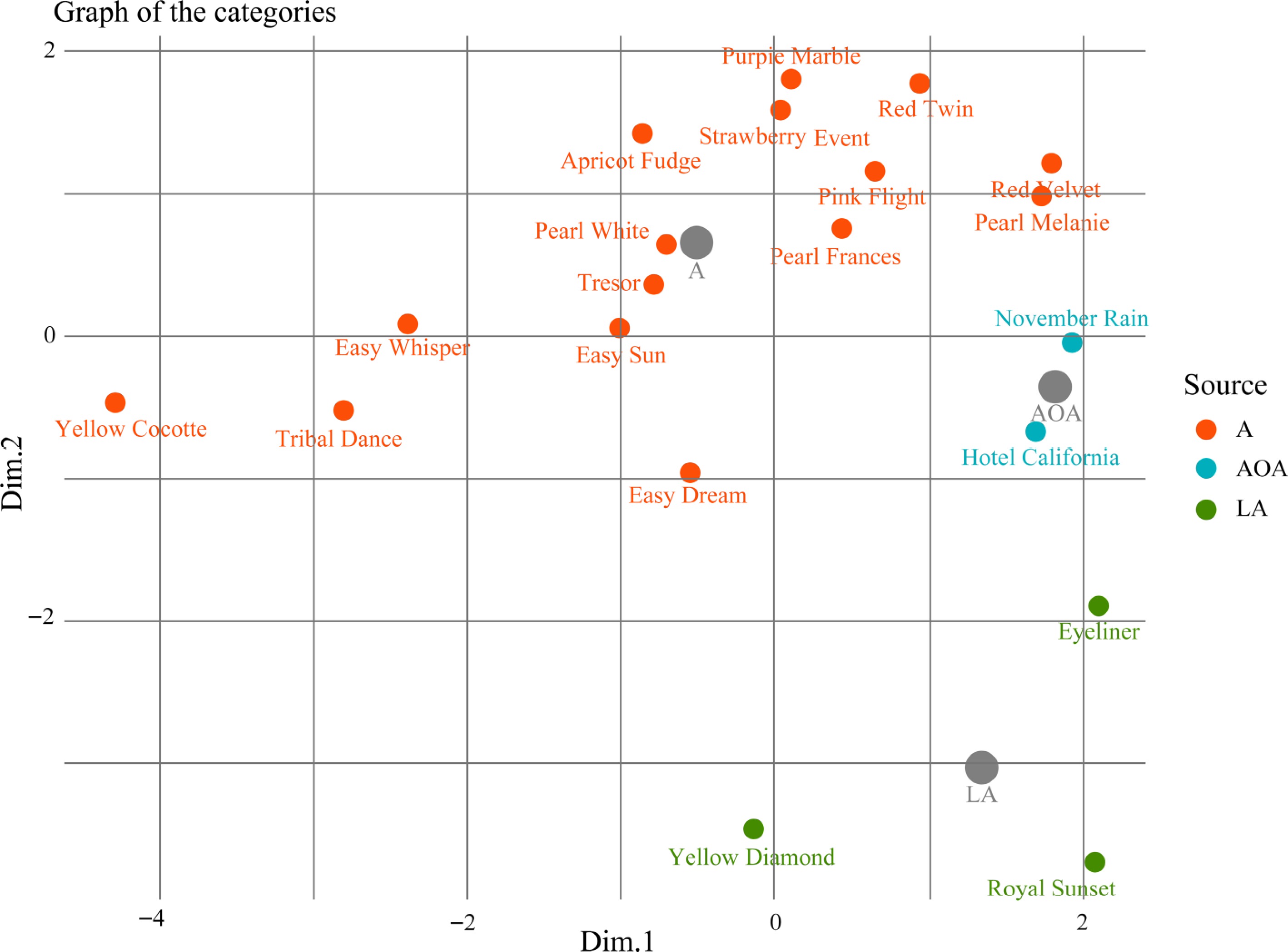
Figure 1.
PCA analysis of morphological indices data of different varieties of lily scales. The morphological indices data of 20 varieties were selected for analysis. n = 64 scales per variety.
To further validate these findings, coefficient variation (CV) analyses were conducted for scales from different hybrid groups (Supplementary Table S1). Apart from width and circularity, the CV for other morphological and nutritional indices was higher in the A hybrid group compared to the AOA and LA hybrid groups, suggesting greater data dispersion within the A hybrid group. Additionally, the range (from maximum to minimum values) of all morphological indices in the A hybrid group (excluding circularity) was greater than that observed in the AOA and LA hybrid groups (Supplementary Tables S1, S2; Fig. 1). These results collectively indicate that the seven morphological indices of scales can effectively distinguish lily hybrid groups, however, intra-hybrids variation within the A hybrid group is greater than the inter-hybrids variation between the A, AOA, and LA hybrid groups.
Since the intra-hybrids variation of morphological indices within the scale hybrids exceeds the inter-hybrids variation, analysis of inter-hybrids differences alone cannot fully reflect data variations. Analysis of Variance (ANOVA) was conducted separately on the morphological indices and nutritional indices of 20 lily varieties. The results showed that there were significant differences in both the morphological (Supplementary Fig. S5) and nutritional indices (Supplementary Fig. S6) of the scales from different varieties.
Next, an analysis was conducted on whether the morphological and nutritional differences among varieties would influence the patterns of bulblet formation. According to the scale propagation experiments, all varieties successfully produced bulblets within 12 d, with root formation occurring within 16 d. Among these, 70% of the varieties formed bulblets on the proximal base of the adaxial surface, with root formation occurring later than bulblet formation. Additionally, 95% of the varieties produced roots at both the base of the maternal scale and the bulblets (Supplementary Table S3). Thus, despite significant differences in the morphological and nutritional indices of scales among varieties, the pattern of bulblet formation remained uniform (Fig. 1; Supplementary Tables S1–S3).
Correlation analysis of morphological and nutritional indices in scales and bulblets
-
The morphological evaluation indices for scale and bulblets include 7 factors: circumference, weight, area, perimeter, width, height, and circularity. Measuring all indices is costly for industry. So, based on the data in Supplementary Table S1, correlation analyses were conducted separately on the morphological indices and nutritional indices of the scales and bulblets to screen more representative indices (Fig. 2).
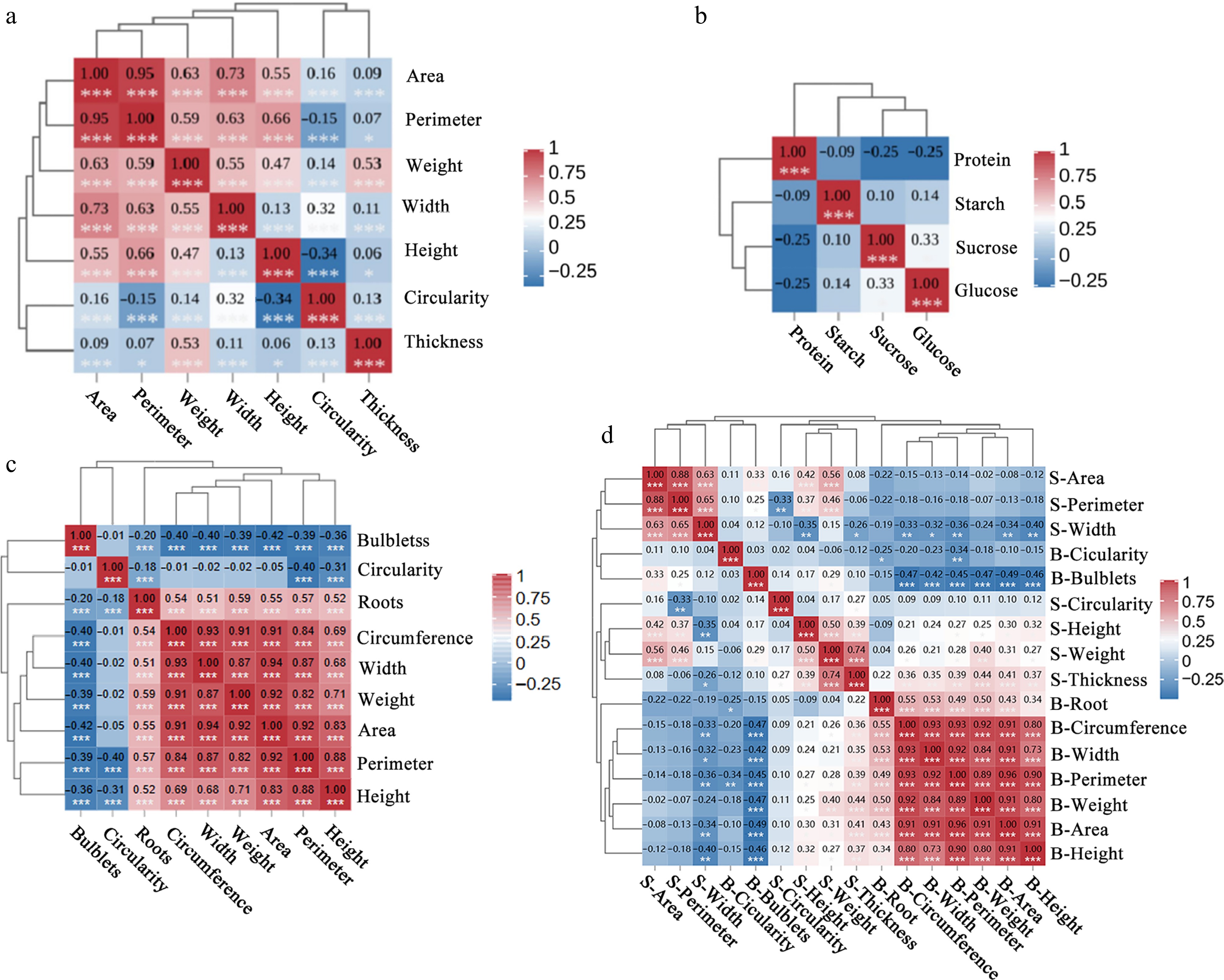
Figure 2.
Correlation analysis of morphological and nutritional indices of scales and bulblets. Correlation heat map of (a) morphological indices, and (b) nutritional indices of lily scales. 1,280 scales of 20 lily varieties were selected for data analysis. (c) Lily bulblets morphological indices correlation heat map, select 20 lily varieties, 2,601 bulblets for data analysis. (d) Correlation analysis of the scales' morphological indices and bulblets' morphological indices. 1,280 scales and 2,601 bulblets produced after propagation were selected for data analysis. The morphological indices of the scales and the morphological indices of the bulblets were in one-to-one correspondence. S represents the scales, and B represents the bulblets. The correlation heat map was made by the Jidi'ao Biological Online Data Analysis Platform (
www.omicshare.com ). The number in the heat map represents the Pearson correlation coefficient between the horizontal axis and the vertical axis index (represented by the letter r). The color represents the degree of correlation. The positive correlation is red, and the negative correlation is blue. The stronger the correlation, the deeper the color of the table. The * under the number represents the p value. No *: p ≥ 0.05, *: 0.01< p < 0.05, **: 0.001 < p<0.01, ***: p = 0.001.For scales, circumference and area were highly correlated (r = 0.95), suggesting their interchangeability (Fig. 2a). Weight, width, and height also exhibited strong correlations with circumference and area, with correlation coefficients exceeding 0.5 (Fig. 2a). However, thickness and circularity showed no significant correlations with other parameters, except for weight (Fig. 2a). Additionally, the glucose, sucrose, starch, and soluble protein contents of the scales were barely correlated (Fig. 2b). Besides, given the determination of the nutritional indices of the scales cost more time and expansion, which is unsuitable for industrial applications, therefore, sequent analyses did not consider the effects of nutritional indices on bulblet growth. For bulblets, strong correlations were observed between circumference, width, weight, area, perimeter, and height, with coefficients ranging from 0.68 to 0.94 (Fig. 2c). Given the operational challenges of measurement width, area, perimeter, and height, it is more practical to measure circumference and weight. Additionally, the root number is strongly correlated with the other six indices, ranging from 0.5 to 0.6. Interestingly, circularity was negatively correlated with bulblets circumference and height, indicating that as circumference and height increased, bulblets became less rounded (Fig. 2c). Bulblets number was also negatively correlated with circumference and weight, suggesting that as the number of bulblets increased, individual bulblets exhibited smaller morphological dimensions (Fig. 2c).
To explore the correlation between the scales' morphological indices and bulblet development, correlation analyses were established between the scales and their propagated bulblets. Scales' thickness was correlated with six bulblet indices, indicating that thickness is a key factor influencing scale propagation (Fig. 2d). Among the 6 morphological indices of the scales, area showed the strongest effect on bulblet number (r = 0.33), highlighting its importance in bulblet propagation (Fig. 2d).
In conclusion, scale thickness and area were significantly correlated with bulblet growth, whereas other indices showed weaker associations. In practical applications, increasing the thickness and area of scales could enhance the effectiveness of scale propagation. However, in the establishment of predictive growth models, it is essential to incorporate more comprehensive indices to improve model accuracy. Therefore, all seven morphological indices of scales should be included when constructing such models.
Construction of the bulblet growth prediction model
-
Based on the previous analyses, this study aimed to predict the number of bulblets, the number of roots, the circumference of bulblets, and the weight of bulblets using seven morphological indices of scales: circumference, area, circularity, width, height, weight, and thickness. According to Supplementary Table S1, the model was initially fit using multiple linear regression analysis, and multicollinearity was evaluated among the independent variables using the Variance Inflation Factor (VIF). The results indicated that both scale circumference and area exhibited severe multicollinearity (VIF > 5) and low tolerance (< 0.2), which could compromise the stability of the model (Supplementary Table S4). Consequently, circumference and area were excluded from the model; circularity, width, height, thickness, and weight were retained as independent variables (Supplementary Table S5).
Next, multiple linear regression was performed using the five selected morphological indices to predict the number of bulblets, the number of roots, thr circumference, and the weight (Supplementary Table S1). The resulting predictive model equations were derived. For example, using the 'Apricot Fudge' variety as a reference, the formula for predicting the number is as follows:
$ \rm Y=-2.262 + 2.730X_1 +0.057X_2 +0.016X_3 -0.058X_4 +0.570X_5 $ where, Y: bulblets number; X1: Circularity of scales; X2: Width of scales; X3: Height of scales; X4: Thickness of scales; X5: Weight of scales; Parameters of the formula are in Supplementary Table S6.
Since in the correlation analysis, circularity, width, height, thickness and weight of scales were not significantly correlated with the number of bulblets (Fig. 2), which may cause a low explanatory power (R2 = 0.165) and failing to achieve statistical significance in the F-test (F = 1.819, p = 0.128), however, the mean absolute error (MAE = 0.654) and absolute error rate (AER = 12.81%) between predicted and observed values fell within operational tolerance thresholds (15%). By analyzing the model validation of 20 varieties, the AER for the predicted models of bulblets number, roots number, circumference, and weight were 12.11%, 15.39%, 7.19%, and 15.67% respectively, with the highest prediction accuracy for circumference (Supplementary Tables S6–S9). These findings suggest that while the model has statistical limitations, it still has high prediction accuracy and substantial potential for industrial applications, particularly in circumference prediction.
Effect of disinfections on scale propagation
-
During scale propagation, early-stage scale rot is often attributed to inadequate disinfection measures, which subsequently impacts the formation of bulblets. To optimize this process, 5 varieties of lilies ('Red Twin', 'Tresor', 'Eyeliner', 'Royal Sunset', and 'Yellow Diamond') were utilized as materials and nine disinfection treatments were conducted, including varying durations of hot water (42 °C) treatment and treatments with different concentrations of carbendazim and mancozeb (Fig. 3). In lily production, the propagation coefficient is the most crucial index for evaluating the effectiveness of scale propagation. While the weight and circumference of bulblets are also significant, these indices can still be improved during subsequent growth. Therefore, in this study, the assessment of the effects of different treatments on the propagation coefficient was prioritized, followed by the circumference and weight of bulblets. The number of roots had a minor impact on the later growth of bulblets and was considered as an auxiliary reference index.
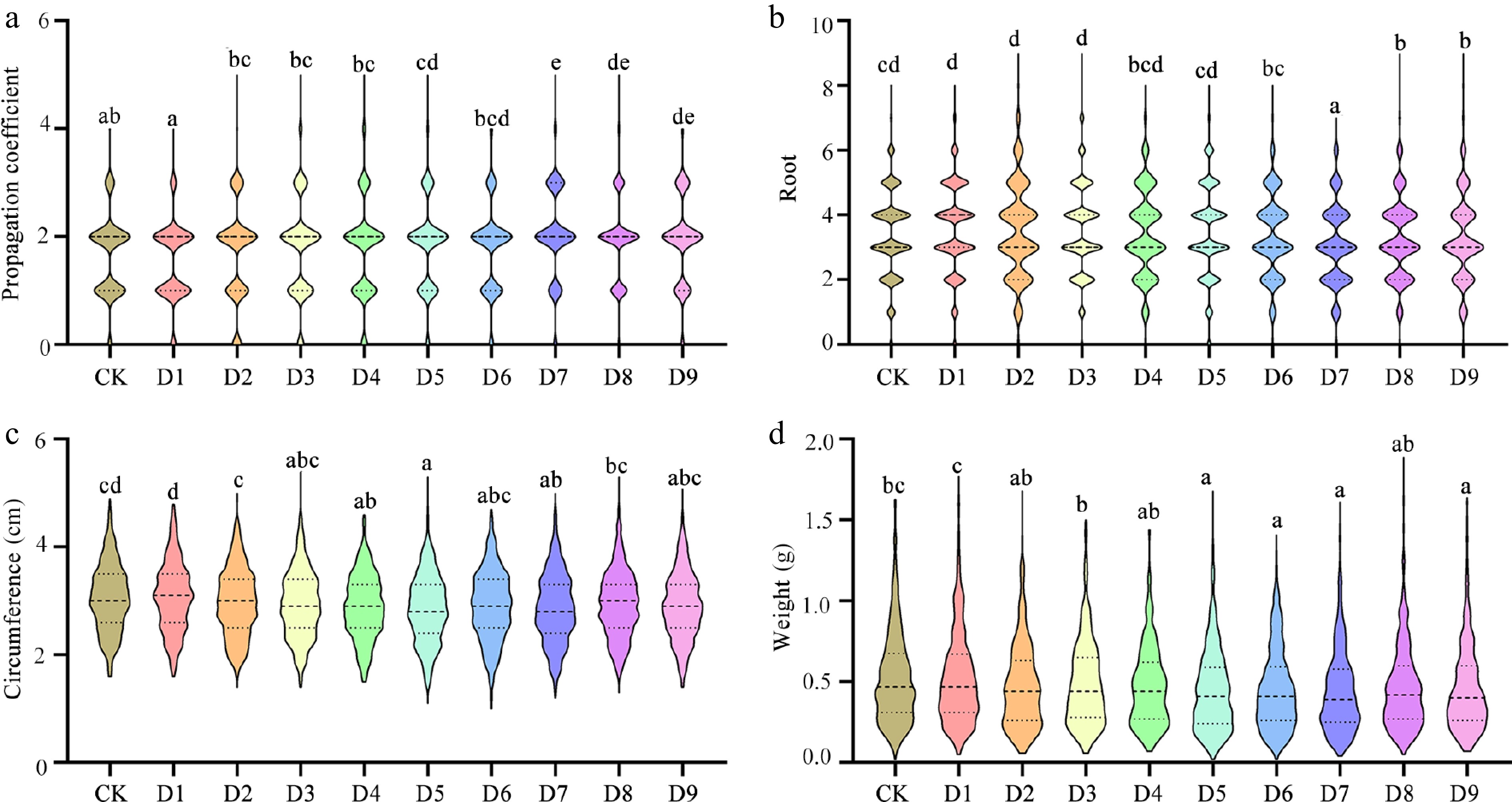
Figure 3.
Influence of different disinfection techniques on morphological indices of bulblets. (a) Analysis of propagation coefficient for bulblet. (b) Analysis of the number of roots for bulblets. (c) Analysis of circumference for bulblets. (d) Analysis of weight for bulblets. Data is based on the mean of bulblets generated from 64 scales of five varieties and is analyzed using ANOVA. Different letters indicate significant differences at p ≤ 0.05. CK: 30 min soaking in clean water; D1: 15 min soaking in water at 42 °C. D2: 30 min soaking in water at 42 °C. D3: 45 min soaking in water at 42 °C. D4: 30 min soaking in 1 g/L carbendazim. D5: 30 min soaking in 0.7 g/L carbendazim. D6: 30 min soaking in 0.5 g/L carbendazim. D7: 30 min soaking in 2 g/L mancozeb. D8: 30 min soaking in 1 g/L mancozeb. D9: 30 min soaking in 0.7 g/L mancozeb.
The results revealed that treatments with 0.7 g/L carbendazim (D5), 0.7 g/L mancozeb (D9), 1 g/L mancozeb (D8), and 2 g/L mancozeb (D7) enhanced the propagation coefficient (Fig. 3a). Among these four treatments, carbendazim had no significant impact on the roots number. In contrast, different concentrations of mancozeb inhibited root growth (Fig. 3b). Additionally, 0.7 g/L carbendazim, 0.7 g/L, and 2 g/L mancozeb treatments suppressed the circumference or weight of bulblets (Fig. 3c, d). Based on these findings, 1 g/L mancozeb for scale disinfection before propagation effectively increased the propagation coefficient without adversely affecting the circumference and weight of bulblets.
Effects of substrates on scale propagation
-
During the scale propagation, the scales are embedded in substrate; therefore, the selection of the substrate is crucial for propagation success. To ensure healthy growth of the plant material, the substrate needs to possess both water retention and air permeability. Commonly used substrates include vermiculite, perlite, and turf soil. This study set nutrient garden soil as the control, and combined commonly used substrates to design nine different substrate compositions. Compared to garden soil with high-temperature disinfection (CK1) and without (CK2), perlite (S3) and the substrate combinations with a domestic peat : perlite : vermiculite ratio of 1:1:1/2:1:1/3:1:1 (S7–S9) significantly improved the scales propagation efficiency (Fig. 4a). There was no significant positive effect on the roots number (Fig. 4b). In terms of bulblets circumference and weight, perlite and the substrate with different ratio combination of domestic peat, perlite, and vermiculite showed no significant advantages compared to undisinfected garden soil, while disinfected garden soil performed better (Fig. 4c, d). In practical production, it is not feasible to disinfect garden soil, and imported peat (S2) is always favored due to its superior properties. Therefore, a comparison was conducted using imported peat as a control, and it was found that different ratio combinations of domestic peat, perlite and vermiculite exhibited significant increases in bulblets circumference and weight (Fig. 4c, d). From a cost perspective, the substrate composition with a domestic peat : perlite : vermiculite ratio of 1:1:1 emerges as a more economically viable and efficient option.
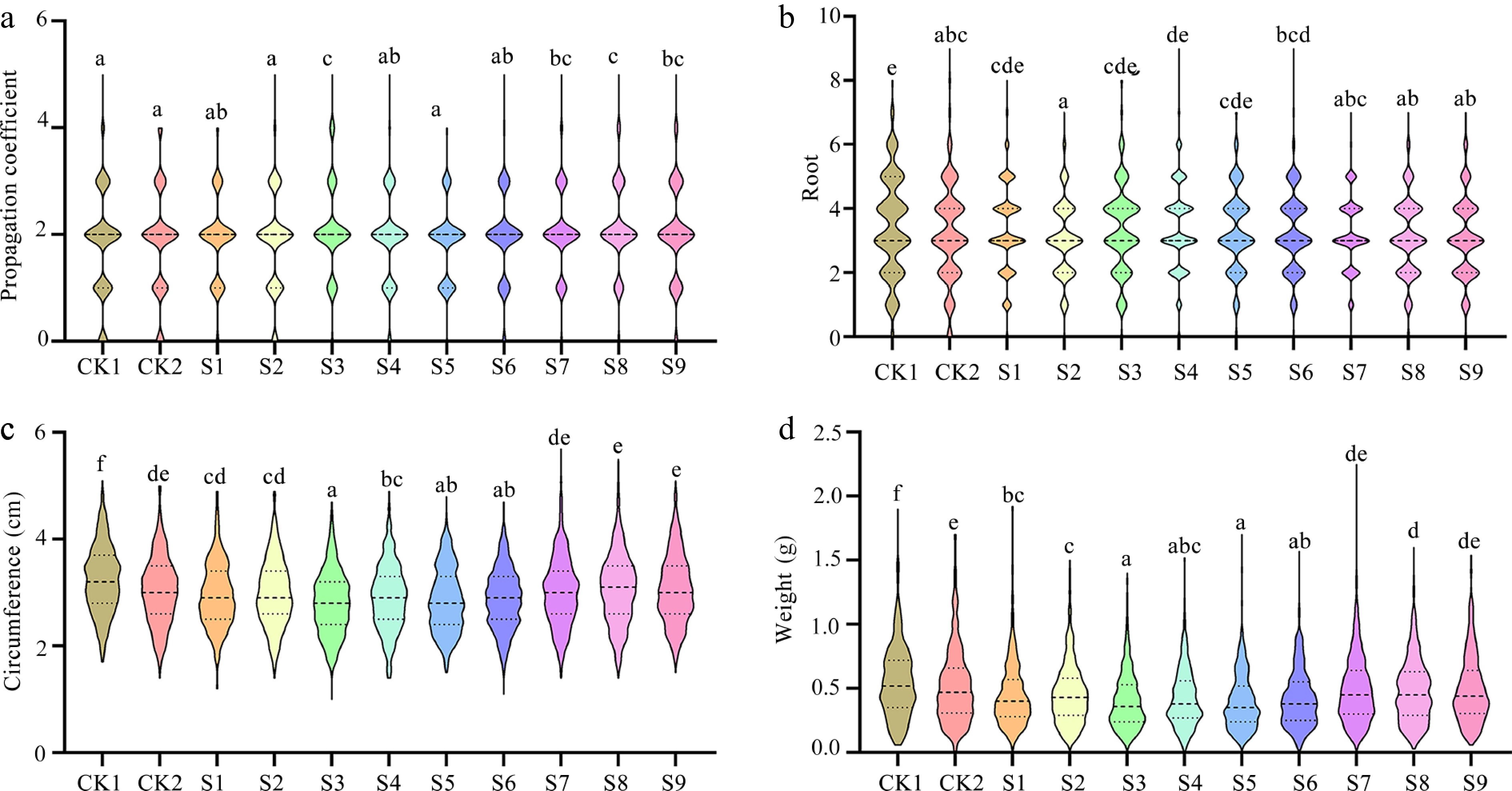
Figure 4.
Influence of different substrates on morphological indices of bulblets. (a) Analysis of propagation coefficient for bulblet. (b) Analysis of the number of roots for bulblets. (c) Analysis of circumference for bulblets. (d) Analysis of weight for bulblets. Data is based on the mean of bulblets generated from 64 scales of five varieties, and is analyzed using ANOVA. Different letters indicate significant differences at the p ≤ 0.05 level. CK1: Garden soil with high-temperature disinfection. CK2: Garden soil without high-temperature disinfection. S1: Vermiculite. S2: Imported peat. S3: Perlite. S4: Imported peat : perlite : vermiculite = 1:1:1. S5: Imported peat : perlite : vermiculite = 2:1:1. S6: Imported peat : perlite : vermiculite = 3:1:1. S7: Domestic peat : perlite : vermiculite =1:1:1. S8: Domestic peat : perlite : vermiculite = 2:1:1. S9: Domestic peat : perlite : vermiculite =3:1:1. The ratio indicates the volume ratio of each component.
Effects of plant growth regulators on scale propagation
-
Plant growth regulators are exogenous non-nutritive chemicals that can be transported within plants to their target sites and effectively promote or inhibit specific aspects of plant life processes at very low concentrations. During the development of bulblets, the appropriate application of PGRs can enhance not only the propagation efficiency but also the quality of the bulblets. In this study, distilled water was used as the control, and 12 PGR treatments were designed, including various concentrations of indole-3-butyric acid (IBA), kinetin, CPPU, and rooting powder (an auxin analog). Specifically, 0.2 g/L IBA (C2), 0.5 g/L (C9) and 1 g/L (C7) CPPU, 0.4 g/L (C12), 0.5 g/L (C11), and 0.7 g/L (C10) rooting powder had positive effects on the bulblet propagation coefficient (Fig. 5a). As for root number, only 0.2 g/L IBA among the aforementioned six treatments significantly increased the number of roots (Fig. 5b). In terms of bulblets circumference and weight, 0.5 g/L CPPU and 0.4 g/L rooting powder showed in addition to positive regulatory effects. Although 0.2 g/L IBA significantly increased the reproductive coefficient and root number, it significantly inhibited bulblets circumference and weight (Fig. 5c, d).
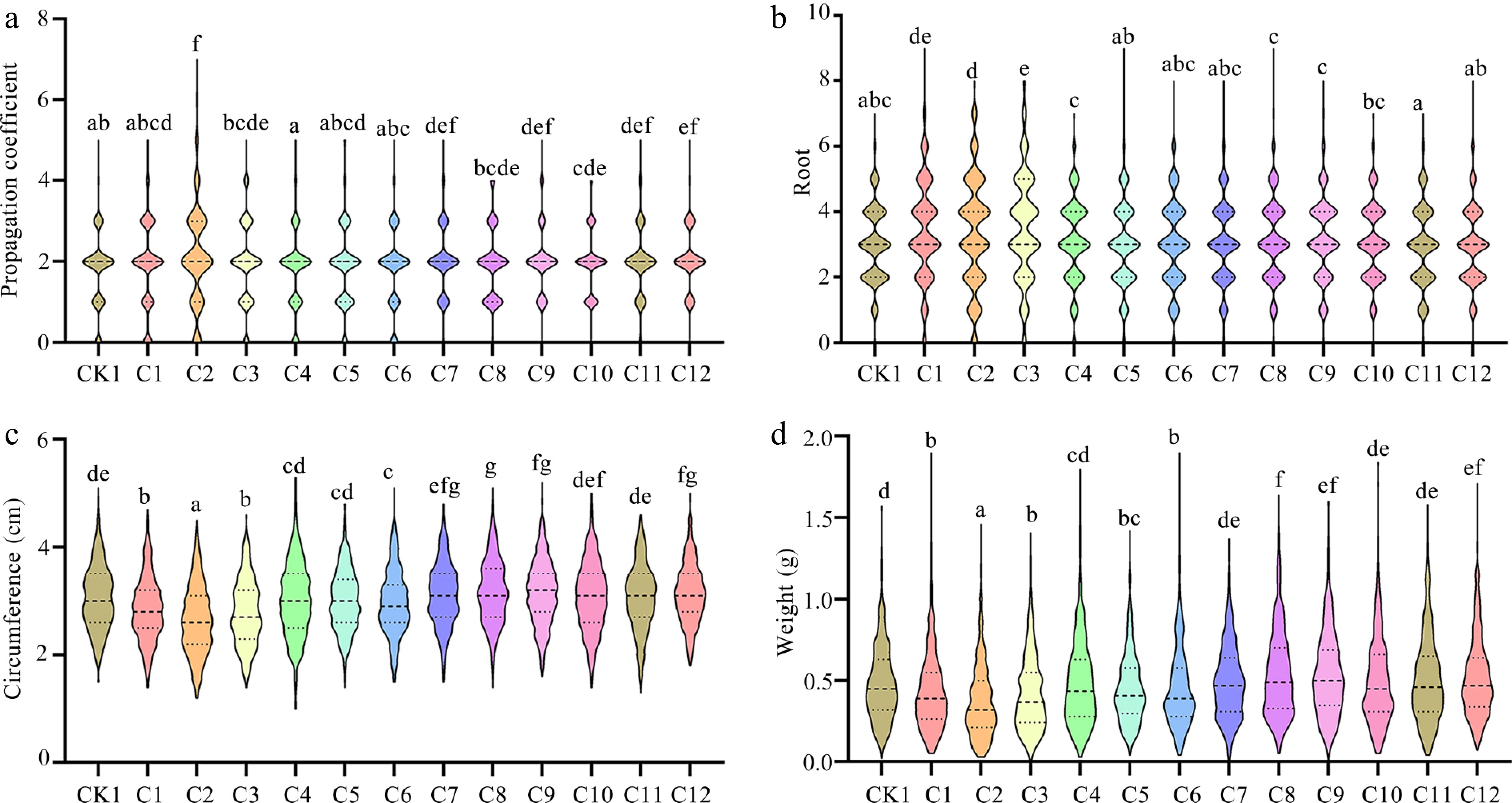
Figure 5.
Influence of different plant growth regulators on morphological indices of bulblets. (a) Analysis of propagation coefficient for bulblet. (b) Analysis of the number of roots for bulblets. (c) Analysis of circumference for bulblets. (d) Analysis of weight for bulblets. Data is based on the mean of bulblets generated from 64 scales of five varieties and is analyzed using ANOVA. Different letters indicate significant differences at the p ≤ 0.05 level. All the scales were soaked once in the following solution for 2 h. CK1: distilled water. C1: 0.1 g/L IBA solution. C2: 0.2 g/L IBA solution. C3: 0.3 g/L IBA solution. C4: 0.5 g/L kinetin solution. C5: 0.4 g/L kinetin solution. C6: 0.3 g/L kinetin solution. C7: 1 g/L CPPU. C8: 0.7 g/L CPPU. C9: 0.5 g/L CPPU. C10: 0.7 g/L rooting powder. C11: 0.5 g/L rooting powder. C12: 0.4 g/L rooting powder.
In summary, 0.5 g/L CPPU and 0.4 g/L rooting powder demonstrated more outstanding performance in terms of the propagation coefficient, bulblets circumference, and weight (Fig. 5a, c, d). From a cost perspective, 0.5 g/L CPPU treatment is more economical for promotion. However, future research could explore whether the combination of CPPU and rooting powder can further enhance propagation efficiency.
-
Scale propagation is one of the most widely used methods for lily propagation in industry. Many factors influence the outcome of lily scale propagations, including variety characteristics, scale position, temperature, humidity, light, disinfection treatment, substrate, and plant growth regulators. However, the mechanism of bulb formation remains unclear. To explore the relationship between lily scale morphological indices and regeneration ability, this study selected 20 lily varieties from hybrids A, AOA, and LA. It analyzed seven indices of scales from each variety, including area, circumference, height, width, thickness, circularity, and weight. The scales were propagated and managed uniformly, and after six months, nine indices of the bulblets were recorded, including propagation coefficient, number of bulblets, number of roots, circumference, area, width, height, and circularity.
PCA analysis and coefficient of variation analysis indicated that the internal differences within hybrid group A were greater than the differences between hybrid groups AOA and LA (Fig. 1; Supplementary Tables S1, S2). By observing the bulblet generation patterns of scales, it was found that although there were significant differences in scales among different varieties, there were no significant differences in the time, manner, and position of bulblet generation (Supplementary Table S3). To further investigate the impact of differences in scale morphological indices on bulblets, nine indices of number of bulblets, number of roots, circumference, weight, area, width, height, and circularity were statistically analyzed from different varieties and correlation analysis was performed with the morphological indices of scales. The results showed that there was a weak correlation between scales and bulblet morphological indices (Fig. 2). However, the thickness of the scale had weak correlations with the circumference, weight, area, circumference, width and height of the bulblets, the thickness of the scale also had a positive correlation with the weight of the bulblets (0.4). So, growth evaluation indices of bulblets may be predicted through multiple morphological indices of scales. To enhance the accuracy of the model, all indices of scales were considered. Due to the severe collinearity between scale area and circumference with other indices, the construction of the growth prediction model selected five indices: thickness, weight, width, height, and circularity of scales. The AER results showed that the growth prediction models for bulblets number (Supplementary Table S6), roots number (Supplementary Table S7), circumference (Supplementary Table S8), and weight (Supplementary Table S9) of the 20 varieties had AER of 12.11%, 15.39%, 7.19%, and 15.67%, respectively, with the growth prediction model for bulblets circumference being more accurate. The construction of the bulblet growth prediction model provides a quantitative reference for lily bulb producers, allowing for the rational arrangement of production tasks and the reduction of waste of human and financial resources.
However, the AER of the model still could be improved, with environmental factors and human operational variations likely acting as critical variables limiting predictive precision. The lily scale propagation exhibits high sensitivity to environmental conditions, particularly temperature and moisture. Sustained temperatures above 25 °C may accelerate scale senescence and suppress bulblets initiation, whereas a 15–20 °C environment coupled with elevated humidity can activate callus formation. During bulb development, uncontrollable factors such as greenhouse diurnal temperature fluctuations and irrigation-induced humidity variations may lead to morphological instability in bulblets. Furthermore, operational discrepancies may also lead to errors. The angle and force applied during scale detachment, as well as the integrity of the basal preservation, may directly influence the activity of peripheral meristematic cells. Such operator variability may cause the model to misinterpret as morphological influences of the scales.
Mancozeb enhances the propagation coefficient of lily scales
-
This study used five lily varieties to conduct treatments with hot water (42 °C), carbendazim, and mancozeb. The final results showed that, compared to the control (distilled water), the 1 g/L mancozeb could increase the scale propagation without affecting the circumference and weight of the bulblets (Fig. 3). The chemical formula of mancozeb is C4H8MnN2S4Zn, which is a complex of mancozeb and mancozeb zinc, containing 20% manganese and 2.55% zinc. Manganese and zinc are essential trace elements for plant growth and development. Manganese is an important element for chlorophyll synthesis, participating in key processes of photosynthesis and respiration. As an activator of multiple enzymes, it helps to enhance plant stress resistance and disease resistance[15]. Manganese also participates in metabolic processes such as nitrogen metabolism and protein metabolism, which are crucial for plant growth and development. Zinc is involved in various physiological processes in plant growth and development, including DNA synthesis, protein synthesis, and enzyme activity[16], and it plays a significant role in enhancing plant resistance to diseases. Additionally, zinc influences the absorption and utilization of phosphorus by plants[17], contributing to the enhancement of plant stress resistance and disease resistance.
The bulb formation from lily scale propagations can be divided into two stages: the generation and development of the bulblets[18]. The generation stage involves cell dedifferentiation, apical meristem formation, leaf primordium formation, and bud formation. The inner hypodermal cells at the proximal and distal ends of the scales store a large amount of starch granules. After the cells at the base of the scale enter the dedifferentiation stage, the starch granules at the proximal end of the scale are consumed in large quantities to provide nutrients and energy for cell differentiation. This stage may be the key phase determining the propagation coefficient of the scales.
The co-application of manganese and zinc with other macronutrients and micronutrients can increase the starch content in tobacco leaves; therefore, mancozeb may act based on the scales through its manganese and zinc components to promote the increase of starch granules, providing sufficient nutrition for cell differentiation and ultimately increasing the propagation coefficient of the scales.
Research on Arabidopsis roots indicates that excessive manganese content not only inhibits the expression of genes related to auxin biosynthesis, reducing the accumulation level of auxin in the roots, but also significantly decreases the expression of output proteins PIN4 and PIN7 involved in auxin polar transport; in addition, the accumulation of manganese through the fixation of Aux/IAA proteins inhibits the transcriptional activity related to auxin in the roots[19]. In lilies, the application of the auxin polar transport inhibitor N-1-naphthylphthalamic acid (NPA) leads to a decrease in auxin levels or the silencing of auxin biosynthesis genes LlYUC6 and tryptophan amino LlTAR1, which activates the expression of LlSusy1 and LlCWIN2 to promote sucrose metabolism, thereby promoting bulblet formation and increasing the number[20]. Therefore, mancozeb may inhibit the expression of genes related to auxin synthesis through the accumulation of manganese, while simultaneously promoting sucrose metabolism to promote bulblet formation, thereby increasing the propagation coefficient of lily scales.
The combination of peat, perlite, and vermiculite improves the substrate's physical characteristics
-
The physical characteristics of the substrate play a pivotal role in determining the adsorption capacity of water and nutrients, as well as the air content within the growth medium. These factors collectively influence the supply, absorption, and transport dynamics of water and nutrients, ultimately affecting root growth. Within the optimal growth parameters for lilies, a substrate with lower bulk density and pH, coupled with higher total porosity, aeration porosity, and organic matter content, generally fosters superior lily growth[21,22]. In this study, through the screening of different substrates, the results revealed that although the substrate combination of peat : perlite : vermiculite in a 1:1:1 ratio did not exhibit a statistically significant difference in the scale propagation coefficient compared to imported peat, this combination was capable of enhancing the weight and circumference of bulblets (Fig. 4). The bulk density, total porosity, and aeration porosity of imported peat exhibit higher values compared to other peats, while its pH value is notably the lowest. These attributes suggest that imported peat possesses enhanced suitability for lily scale propagation. In practical production scenarios, to mitigate the limitations inherent in using a single substrate, it is a prevalent practice to incorporate additional substrates for blending purposes. Specifically, a substrate combination comprising peat, perlite, and vermiculite in a 1:1:1 ratio effectively addresses the deficiencies of imported peat in terms of total porosity and aeration porosity. Consequently, this combined substrate demonstrates superior efficacy for propagation when compared to imported peat alone.
CPPU is an effective plant growth regulator in regulating bulblet formation
-
The CPPU is a medium-element complex fertilizer, primarily composed of calcium. Calcium is often present in plants in the form of insoluble compounds and is classified as an immobile element. However, calcium plays a crucial role in stabilizing cell membranes, information transmission, and plant stress resistance. Low concentration calcium treatments can enhance the activity of superoxide dismutase (SOD), catalase (CAT), and peroxidase (POD) in plants[23,24]. Compared to high-concentration calcium (45 mmol/L) treatments, low-concentration calcium increases the content of soluble sugars, soluble proteins, and antioxidant enzymes. Soluble proteins and sugars can provide energy for the growth and development of lily bulblets[25].
Furthermore, this research found that IBA treatment significantly reduced the circumference of bulblets, while 0.2 g/L IBA significantly increased the propagation coefficient of scales (Fig. 5a, b). In the scale propagation of lilies, the number of bulblets formed on the same scale is negatively correlated with their circumstances, meaning that a greater propagation coefficient would result in smaller circumstances. Additionally, there exists a complex regulatory relationship among hormones; exogenous IBA treatment may influence the levels of gibberellins (GA) and cytokinins, with gibberellins being a critical hormone affecting the development of bulblets[26,27]. During lily bulbils formation, IAA treatment decreased GA3 concentration[28]. Moreover, the effects of hormones are typically closely related to their concentration; therefore, it is essential to explore the impacts of different concentrations when applying plant hormones and their analogs.
In this research, soaking the scales in 0.5 g/L CPPU for 2 h before propagation increases the coefficient, bulblets circumference and weight (Fig. 5). It is likely that this is due to the increased content of soluble proteins and sugars within the scales, which in turn provides nutrients for the development of the bulblets, thereby increasing their circumference and weight.
-
This study established a bulblet growth prediction model based on the correlation between scale and bulblet morphology through a systematic evaluation of 20 lily varieties. The model enables producers to make precise predictions about the occurrence of bulblet formation prior to propagation, providing a practical reference value for most varieties. Additionally, the effects of different disinfection treatments, substrate compositions, and plant growth regulators on the scale propagation of five lily varieties were investigated. The results revealed that a 1 g/L mancozeb treatment improved the propagation coefficient. Regarding substrate composition, a 1:1:1 mixture of peat, perlite, and vermiculite significantly increased bulb circumference and weight compared to imported peat. For plant growth regulators, pretreatment with 0.5 g/L CPPU notably enhanced the propagation coefficient, as well as bulblets circumference and weight. These findings provide optimized protocols and parameters for efficient lily scale propagation, offering both theoretical insights and practical guidance for large-scale production. Additionally, this study not only analyzed the efficacy of various treatments but also compared the costs associated with these treatments. The price of imported peat is about 2.7 CNY/tray, while the mixture of domestic peat, perlite, and vermiculite only costs 1.43 CNY/tray. Following a comprehensive analysis, an enhanced and economically viable scale propagation system was developed (Fig. 6).
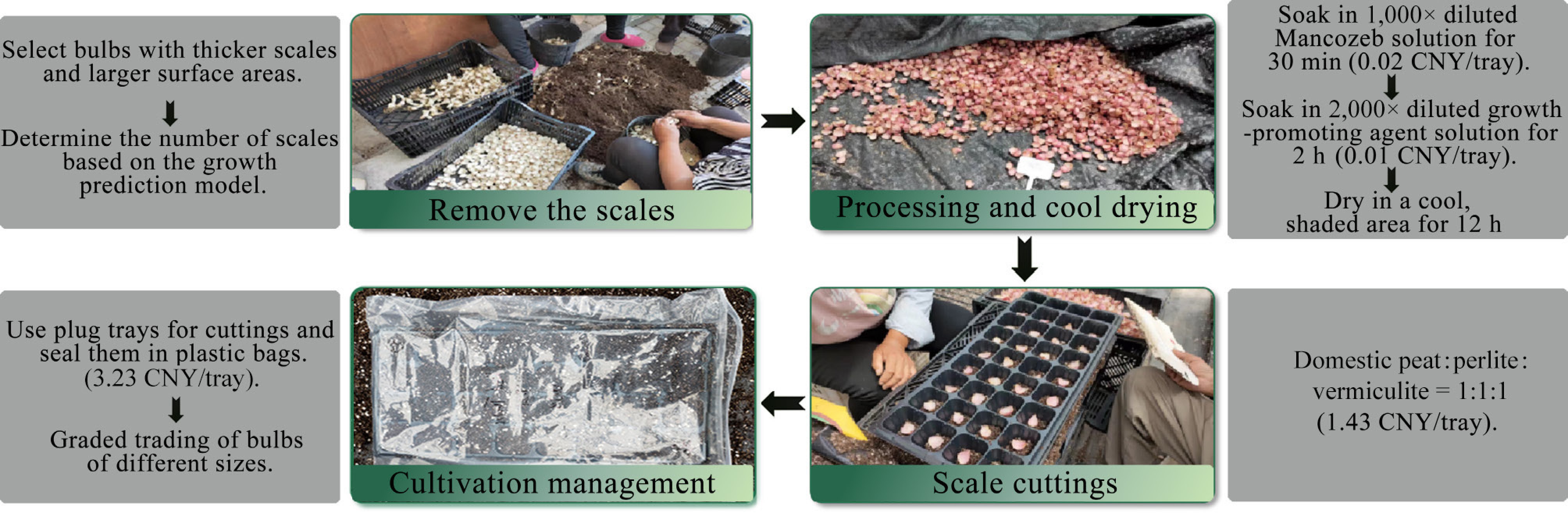
Figure 6.
Sequential disinfection and embedding treatment. CNY: Chinese Yuan.
This work was funded by the National Natural Science Foundation of China projects (Grant Nos 32372740 to Jian Wu and 32171864 to Yunpeng Du), Pinduoduo-China Agricultural University Research Fund (Grant No. PC2023B02009 to Jian Wu), Chinese Universities Scientific Fund (Grant Nos 2024TC055 and 2025TC139 to Jian Wu), The 2115 Talent Development Program of China Agricultural University, Construction of Beijing Science and Technology Innovation and Service Capacity in Top Subjects (Grant No. CEFF- PXM 2019_014207_000032), The Strategic Development Department of China Association for Science and Technology.
-
The authors confirm contributions to the paper as follows: study conception and design: Wu J, Du Y; experiments: Wu JX, Shi J; analyisis and interpretation of results: Pan W, Chen Y, Ma Y; draft manuscript preparation: Zhao Y, Li Y, Wu J; manuscript revision: Zhao Y, Wu J. Both authors Wu J and Du Y agree to serve as the author responsible for contact and ensures communication. All authors reviewed the results and approved the final version of the manuscript.
-
All data generated or analyzed during this study are included in this published article and its supplementary information files.
-
The authors declare that they have no conflict of interest.
-
# Authors contributed equally: Jingxiang Wu, Jinxin Shi, Yajie Zhao
- Supplementary Table S1 Coefficients of variation of scale characteristics and nutritional indices for 20 varieties.
- Supplementary Table S2 Variations in morphological indices of lily scales in different groups.
- Supplementary Table S3 Formation patterns of bulblets in different varieties.
- Supplementary Table S4 Collinearity of the ‘Apricot Fudge’ Bulblets Prediction Model from 7 indices.
- Supplementary Table S5 Collinearity of the ‘Apricot Fudge’ Bulblets Prediction Model from 5 indices.
- Supplementary Table S6 Prediction model and verification of the bulblets number in different varieties.
- Supplementary Table S7 Prediction model and verification of roots number in different varieties.
- Supplementary Table S8 Prediction model and verification of bulblets circumference in different varieties.
- Supplementary Table S9 Prediction model and verification of bulblets weight in different varieties.
- Supplementary Fig. S1 Middle-layer scales from different lily varieties.
- Supplementary Fig. S2 Schematic diagram of the bulblets formations position on scales.
- Supplementary Fig. S3 Schematic diagram of the root formation position on scales.
- Supplementary Fig. S4 Measurement standard for the morphological indices of scales and bulblets.
- Supplementary Fig. S5 Morphological differences in scales among different varieties.
- Supplementary Fig. S6 Varietal differences in sugars and soluble proteins in scales.
- Copyright: © 2025 by the author(s). Published by Maximum Academic Press, Fayetteville, GA. This article is an open access article distributed under Creative Commons Attribution License (CC BY 4.0), visit https://creativecommons.org/licenses/by/4.0/.
-
About this article
Cite this article
Wu J, Shi J, Zhao Y, Li Y, Chen Y, et al. 2025. Effects of disinfection, substrates, and plant growth regulators on scale propagation in Lilium spp.. Ornamental Plant Research 5: e036 doi: 10.48130/opr-0025-0032 

Effects of disinfection, substrates, and plant growth regulators on scale propagation in Lilium spp.
- Received: 01 April 2025
- Revised: 02 June 2025
- Accepted: 20 June 2025
- Published online: 09 September 2025
Abstract: Scale propagation is the predominant commercial method for lily bulbs due to its high efficiency, genetic stability, and direct virus elimination from bulbs. The morphology of scales is closely related to the growth of bulblets, and optimizing each step in the propagation process can also improve reproduction efficiency and bulblet quality. This study developed a growth prediction model based on the correlation between scale and bulblet morphology through a systematic evaluation of 20 lily varieties, offering a quantitative benchmark for lily producers to organize production tasks in a rational manner and minimize resource wastage. Additionally, the effects of different disinfection treatments, substrate compositions, and plant growth regulators (PRG) on the scale propagation of five lily varieties were investigated. The results revealed that a 1 g/L mancozeb treatment improved the propagation coefficient. Regarding substrate composition, a 1:1:1 mixture of peat, perlite, and vermiculite significantly increased bulb circumference and weight compared to imported peat. For plant growth regulators, pretreatment with 0.5 g/L CPPU (N-[2-chloropyridin-4-yl]-N'-phenylurea) notably enhanced the propagation coefficient, as well as bulblets circumference and weight. These findings provide optimized protocols and parameters for efficient lily bulb propagation, offering both theoretical insights and practical guidance for large-scale production.
-
Key words:
- Lily /
- Scale propagation /
- Disinfection /
- Substrates /
- Plant growth regulators /
- Growth prediction model