












-
A century ago, Nikola Tesla proposed a long-distance wireless power transfer (WPT) system based on Tesla coils[1,2]. In this system, the Tesla coil excites a high-frequency electric field, generating displacement currents. These currents couple with the earth and effectively form a complete electrical circuit. Despite its ingenuity, the initiative stalled due to financial constraints and technological bottlenecks at the time, failing to yield substantial progress. Over the next hundred years, the rapid advancement of wired power transfer methods overshadowed the development of WPT. As a result, Tesla's innovative idea received scant attention. The situation changed in 2001 when D Strebkov, an academician of the Russian Academy of Sciences, developed a single-wire power transfer system using Tesla transformers. This system capitalizes on the displacement current between a single conductor and the earth or a terminal capacitor to transmit electrical energy. Capable of achieving long-distance, high-power electricity transfer, it has since spurred extensive research interest[3].
Based on this technology, researchers have explored two main directions. One group focuses on single-wire power transfer (SWPT) by connecting a wire between the top (or bottom) ends of two Tesla transformer high-voltage coils, enabling coupling with the ground for long-distance power transfer[4,5]. Also known as single-wire earth return (SWER)[6], SWPT reduces wiring complexity without extra power conversion stages[7]. Rather than relying solely on a wire, SWPT enables quasi-wireless transfer by utilizing natural conductors such as buildings or oceans. The other group concentrates on single-capacitive coupled wireless power transfer (SCC-WPT), relying on the principle of electric field resonance. SCC-WPT employs coupling capacitors formed by metal plates and utilizes stray capacitance to the ground to achieve short-distance wireless power transfer. SCC-WPT, also referred to as single-wire capacitive power transfer (SW-CPT) or single-contact capacitive power transfer (SC-CPT) in some papers[8−11], effectively avoids cross-coupled capacitor issues in traditional electric-coupled wireless power transfer (EC-WPT) systems. It leverages stray capacitance and ground coupling to enable wireless and quasi-wireless transfer, making it suitable for flat-surface flexible movement and multi-load power supply applications. Moreover, natural conductors like the ground or seawater can extend the transfer range of these systems and enhance dynamic wireless transfer capabilities.
This paper provides a comprehensive review of key research achievements in electric field power transfer technology based on earth coupling. First, it systematically summarizes the fundamental classifications and transfer mechanisms of this technology. It then provides a detailed overview of the current research status, exploring its wide-ranging applications across various sectors. By analyzing the existing research and ongoing developments, the paper further deliberates on prospective research directions, offering valuable insights to guide future research efforts and technological advancements.
-
At present, SCC-WPT and SWPT are the principal technologies in the realm of electric field power transfer based on earth coupling. As a derivative of the traditional EC-WPT system, the SCC-WPT system shares a similar transfer mechanism, utilizing electric fields as the primary medium for power transfer. The key difference lies in the SCC-WPT system's use of coupling capacitances between metal bodies, self-capacitances, and stray capacitances between system components, circuitry, and ground, as well as coupling capacitances between metal bodies and ground to form a complete electric loop for wireless or quasi-wireless power transfer. This approach mitigates interference caused by cross-coupling capacitances in multi-plate systems, enabling flexible power transfer across two-dimensional surfaces[12]. In contrast, SWPT uses a Tesla coil with a top-end conductor. Connecting a wire to the top or bottom of the system exploits the stray capacitance between the coil, the top conductor, and the ground, where the single wire facilitates long-distance power transfer. Moreover, SWPT can replace the wire with natural conductors such as seawater or buildings, thereby enabling quasi-wireless power transfer[5,13].
Figure 1a depicts the experimental prototype of the SCC-WPT system. Comprising a power supply, a pair of metal coupling plates, an inverter-rectifier power converter, a compensation network, and a load, the SCC-WPT system demonstrates remarkable robustness against misalignment. It features a cost-effective design and holds great potential for flexible two-dimensional power delivery and multi-load wireless power transfer, offering versatile solutions across various applications[10].
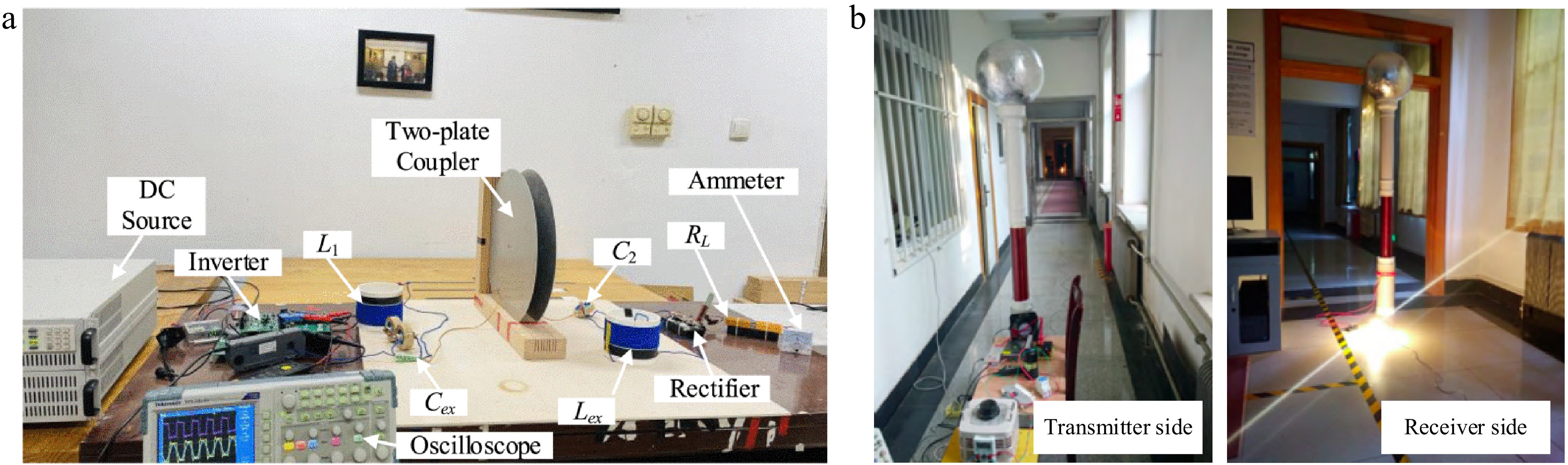
Figure 1.
Experimental prototype of electric field power transfer technology based on earth coupling. (a) SCC-WPT. (b) SWPT.
Figure 1b showcases the experimental prototype of the SWPT system. This system consists of a high-frequency AC power supply, transmitting and receiving Tesla coils, a single wire that utilizes ground coupling for stable operation, a rectifier for AC-DC conversion, and a load. Based on the principle of earth coupling, the SWPT system is distinguished by its capability to achieve long-distance power transfer using only a single wire. Recent experimental results indicate that this system's current energy efficiency is relatively high, reaching a level suitable for practical applications in cases where traditional multi-wire power transfer systems are unfeasible due to technical or economic constraints. Thus, the SWPT system emerges as a promising solution for a wide range of long-distance power transfer applications[4].
Research on electric field power transfer technology based on earth coupling can be broadly classified into two categories. The first category relies on metal plates for electric field coupling. Utilizing the self-capacitance of the plates and the stray capacitance between the wiring and the ground, this approach forms a current loop. This mechanism allows for flexible power delivery across two-dimensional surfaces. To achieve wireless or single-contact power transfer, this approach generally requires a higher resonant frequency along with ground coupling. The second category utilizes a Tesla coil. It leverages the stray capacitance between the top-end conductor of the Tesla coil and the ground. A single wire serves as a conduction path, enabling long-distance power transfer. Additionally, this method enables quasi-wireless energy transfer via natural conductors like seawater or buildings. For long-distance power transfer, a larger Tesla coil is typically required to generate the high voltage essential for efficient power transfer.
-
Presently, researchers have extensively studied the transfer mechanisms of these systems. These studies are grounded in key theoretical frameworks, including self-capacitance and stray capacitance theory, electromagnetic wave theory, and standing wave theory. The following sections will systematically explain the transfer mechanisms of electric field power transfer technology based on earth coupling. This paper aims to provide a holistic understanding of electric field power transfer technology based on earth coupling, offering guidance for future research and development efforts.
SCC-WPT
-
Researchers have carried out comprehensive investigations into the SCC-WPT system, aiming to explain the intriguing phenomenon where power transfer occurs between two metal plates without an explicit current loop. Several theories have been proposed to demystify this unique transfer mechanism. One such explanation is the standing wave theory, which analyzes the behavior of oscillating electromagnetic fields. Another is the self-capacitance theory, which focuses on the inherent capacitance of the metal plates. Virtual ground theory explains the electrical properties and power flow using the concept of a virtual ground, while ground coupling theory highlights the role of the earth as an integral part of the power transfer path. Together, these theoretical frameworks offer a comprehensive understanding of the power transfer process in SCC-WPT systems.
Stray capacitance refers to the capacitance between two electrically insulated conductors with a potential difference, or between a charged conductor and the ground. In contrast, self-capacitance is the capacitance of a charged conductor relative to a point at infinity[14]. Unlike stray capacitance, self-capacitance is independent of the conductor's coupling with its surrounding environment or the ground. In practice, the ground is often considered a representation of infinity[15]. Figure 2 shows the capacitance model of a pair of parallel disks in free space. The two disks carry equal but opposite charges, with a non-uniform distribution. In this model, C12 represents the coupling capacitance between the disks, while C11 and C22 denote their respective self-capacitances. Research has shown that when the distance between the coupling disks and the ground is much larger than the size of the disks, the self-capacitance of each disk approaches half of its isolated self-capacitance value[9,14]. The capacitance can be calculated according to Eq. (1), where r is the radius of the plates, ε0 ≈ 8.854 × 10⁻¹² F/m is the permittivity of free space and approximately that of air, d is the distance between the two coupling plates, and b is the aspect ratio (b = d/2r)[9].
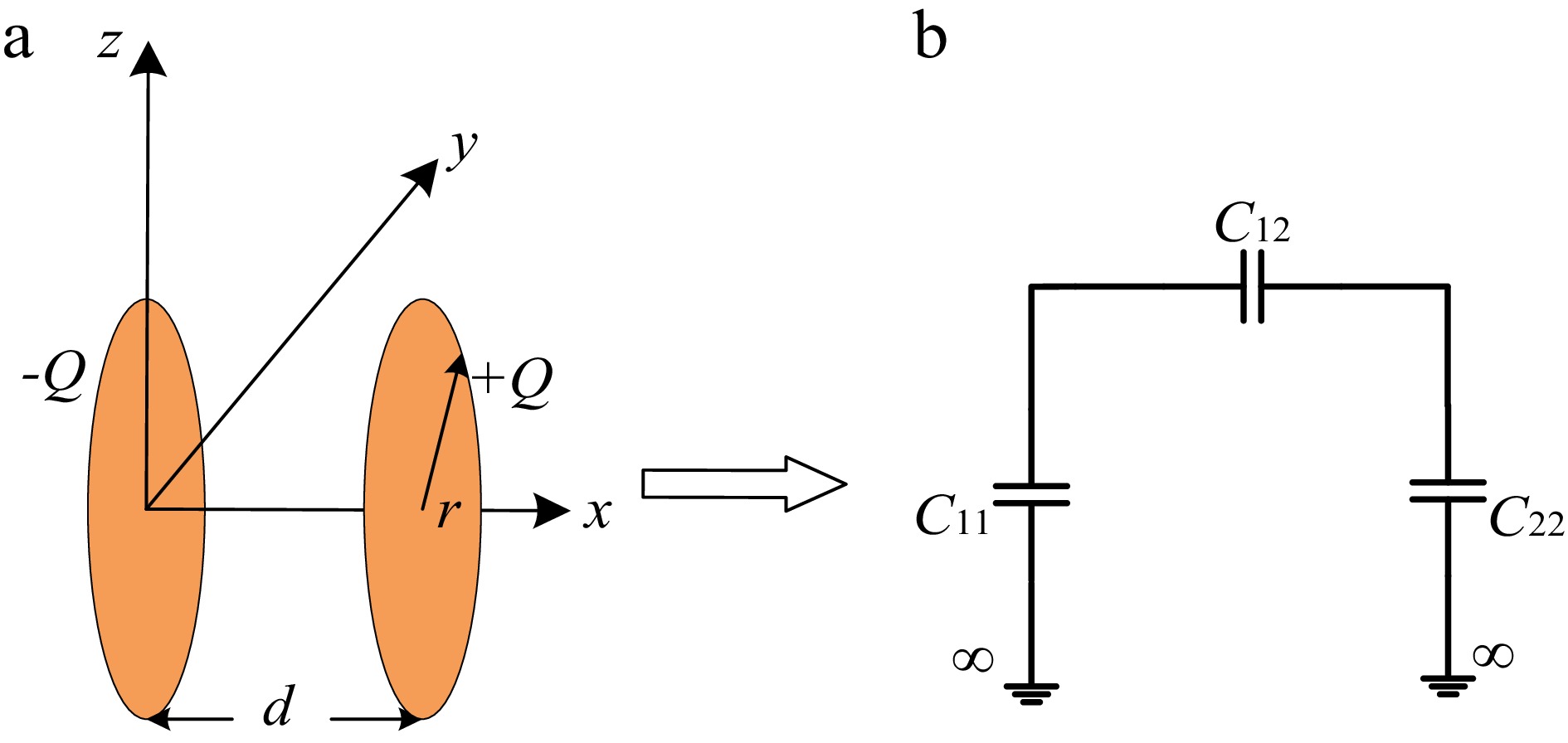
Figure 2.
Parallel disk capacitance model with opposite polarity. (a) 3D diagram. (b) Circuit diagram.
$ \left\{ {\begin{array}{*{20}{l}} {{C_{12}} = (1 + 2.367{b^{0.867}})\left(\dfrac{{{\varepsilon _0}\pi {r^2}}}{d}\right)\;\;{\text{ (0}}{\text{.005}} \leqslant b \leqslant {\text{0}}{\text{.5)}}} \\ {{C_{12}} = (1 + 2.564{b^{0.982}})\left(\dfrac{{{\varepsilon _0}\pi {r^2}}}{d}\right)\;\;{\text{ (0}}{\text{.5}} \leqslant b \leqslant {\text{5}}{\text{.0)}}} \\ {{C_{11}} = {C_{22}} = 4{\varepsilon _0}r} \end{array}} \right. $ (1) Based on Tesla's pioneering concept, Canadian scholar C W Van Neste proposed a quasi-wireless power transfer method based on standing wave principles, utilizing a single contact and the stray capacitance of a receiver coil to form a complete electrical circuit. A standing wave, in this context, results from the interference of two sinusoidal waves with identical wavelengths, periods, and wave speeds, but propagating in opposite directions. At the receiving end, Van Neste designed an open-circuit coil with a length of precisely one-quarter of the standing wave's wavelength. When exposed to an alternating electric field, the coil generates a time-varying, spatially non-uniform electromagnetic field. The electric field at any point along a quarter-wavelength helical resonator can be expressed as:
$ {E_{out}} = {E_{in}}{e^{j(\gamma d + \omega t)}} $ (2) where, d is the fractional wavelength along the position of the resonator, γ is the propagation constant represented as γ = α + β, α being the attenuation factor and β the phase constant; and ω is the angular frequency[11].
Researchers from Wuhan University proposed an innovative electric field wireless power transfer system based on self-capacitance theory. This system forms a complete electrical circuit through the coupling capacitance between metal plates, as well as the self-capacitance of the plates and a metal sphere, theoretically eliminating the need for a current return through the earth. Notably, even without a metal sphere, the receiving end can still obtain significant amounts of electrical power[15].
Virtual ground theory suggests that when an alternating high-potential transmitting plate generates an electric field, the receiving plate acquires an alternating potential relative to the virtual ground terminal. To test this theory, researchers from the University of Auckland, and Chongqing University collaborated and published a paper on their findings. However, their experimental results showed that the measured potential at this point significantly deviated from zero[16].
Following initial investigations, research teams from the University of Auckland, and Chongqing University conducted comprehensive investigations into the transfer mechanism of the SCC-WPT system. The University of Auckland team, based on self-capacitance theory, formed a complete current loop through the stray capacitance of plates to ground, the coupling capacitance between plates, the stray capacitance of the single wire at the receiving end to ground, and the earth. The earth, as part of the return path, plays an indispensable role (Fig. 3a)[9]. Based on these research findings, the Chongqing University team developed a generalized SCC-WPT system model by leveraging stray capacitance and self-capacitance theories, forming a complete electrical circuit through coupling with the ground. They simplified the model using a two-port network, derived the equivalent circuit, identified key limiting factors for power transfer, and determined conditions for achieving optimal efficiency (Fig. 3b)[10]. The system efficiency can be expressed as:
$ \eta = \dfrac{1}{{1 + \dfrac{{{P_{L1}} + {P_{L2}} + {P_{C1}} + {P_{C2}} + {P_{Cc}}}}{{{P_{out}}}}}} $ (3) where, PL1, PL2, PC1, PC2, and PCc represent the losses of the system. Additionally, they proposed a novel compensation topology to enhance efficiency. Simulations and experiments validated the accuracy of the model and the effectiveness of the topology, demonstrating strong consistency among theoretical, simulation, and experimental results.
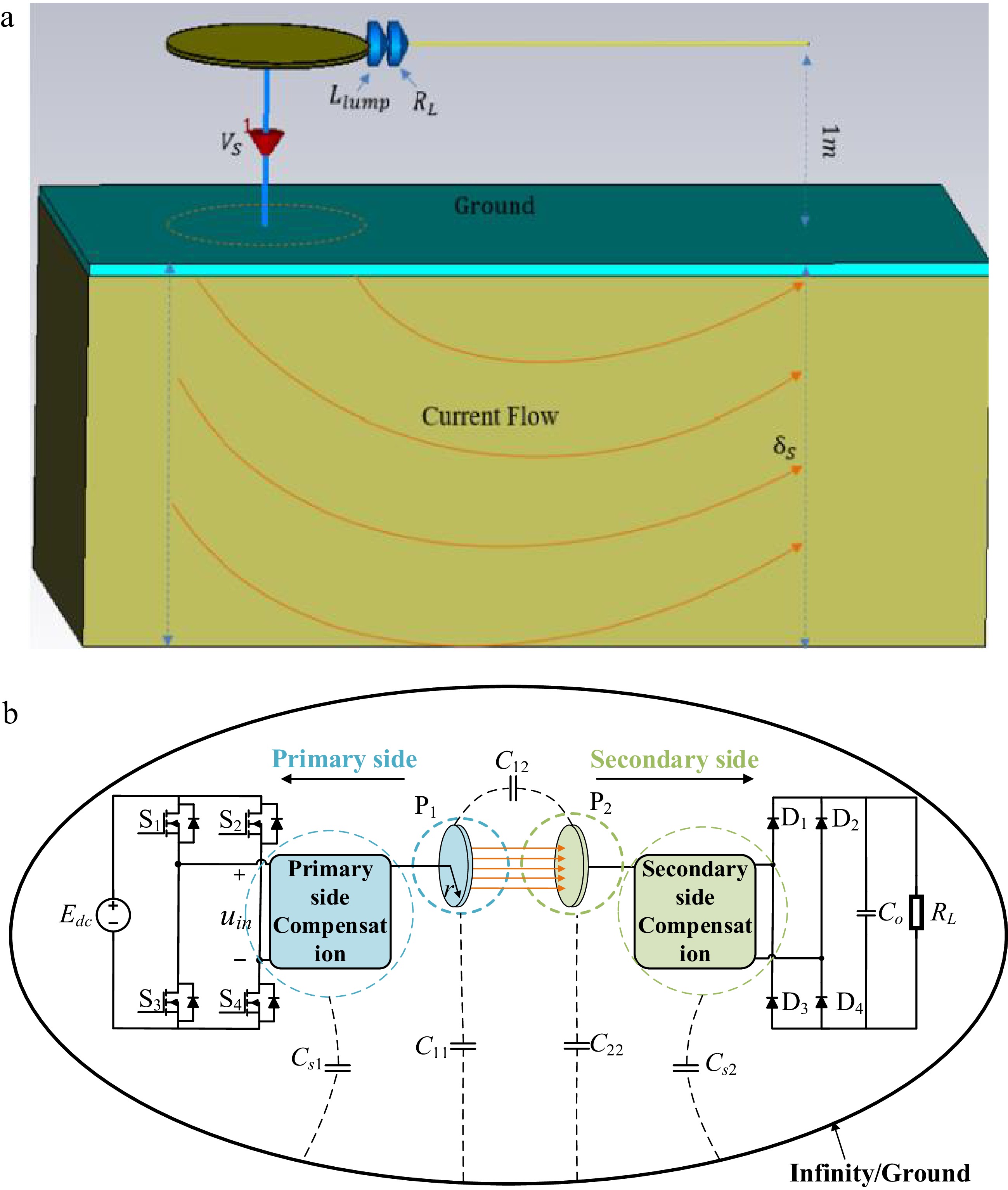
Figure 3.
SCC-WPT system structure diagram. (a) Theory of strong ground coupling. (b) Stray capacitance and self-capacitance theory.
SWPT
-
Building on Nikola Tesla's groundbreaking concept of wireless power transfer, researchers have developed a long-distance SWPT system that connects two Tesla coils with a single wire, enabling efficient long-range power transfer. Aiming to extend transfer distances and replace traditional long-distance power lines, researchers have conducted in-depth explorations into the fundamental principles of the SWPT system. They have examined the mechanisms of the SWPT system from various perspectives, including electric field resonance, electromagnetic field theory, and electric dipole radiation theory.
Researchers from Dalian University of Technology conducted a comprehensive analysis of the transfer mechanism of SWPT systems. Generally, SWPT systems can be classified based on the strength of electric field coupling between the top conductors of Tesla coils into short-distance SWPT systems and long-distance SWPT systems. They can also be categorized based on whether the single wire is connected to the top or bottom of the high-voltage coil, into overhead SWPT systems and near-ground SWPT systems.
In the short-range near-ground SWPT system, as shown in Fig. 4a, a complete current loop is formed by the coupling capacitance between the top conductors, the system's stray capacitance, the inter-turn capacitance of the coils, the single wire, and the ground. For short-range overhead SWPT systems, the current flows along the wire from the transmitting side to the receiving side, with the complete current loop formed by the stray capacitance between the overhead wire and the ground, the stray capacitance of the transmitting and receiving sides to the ground, and the ground itself[17,18].
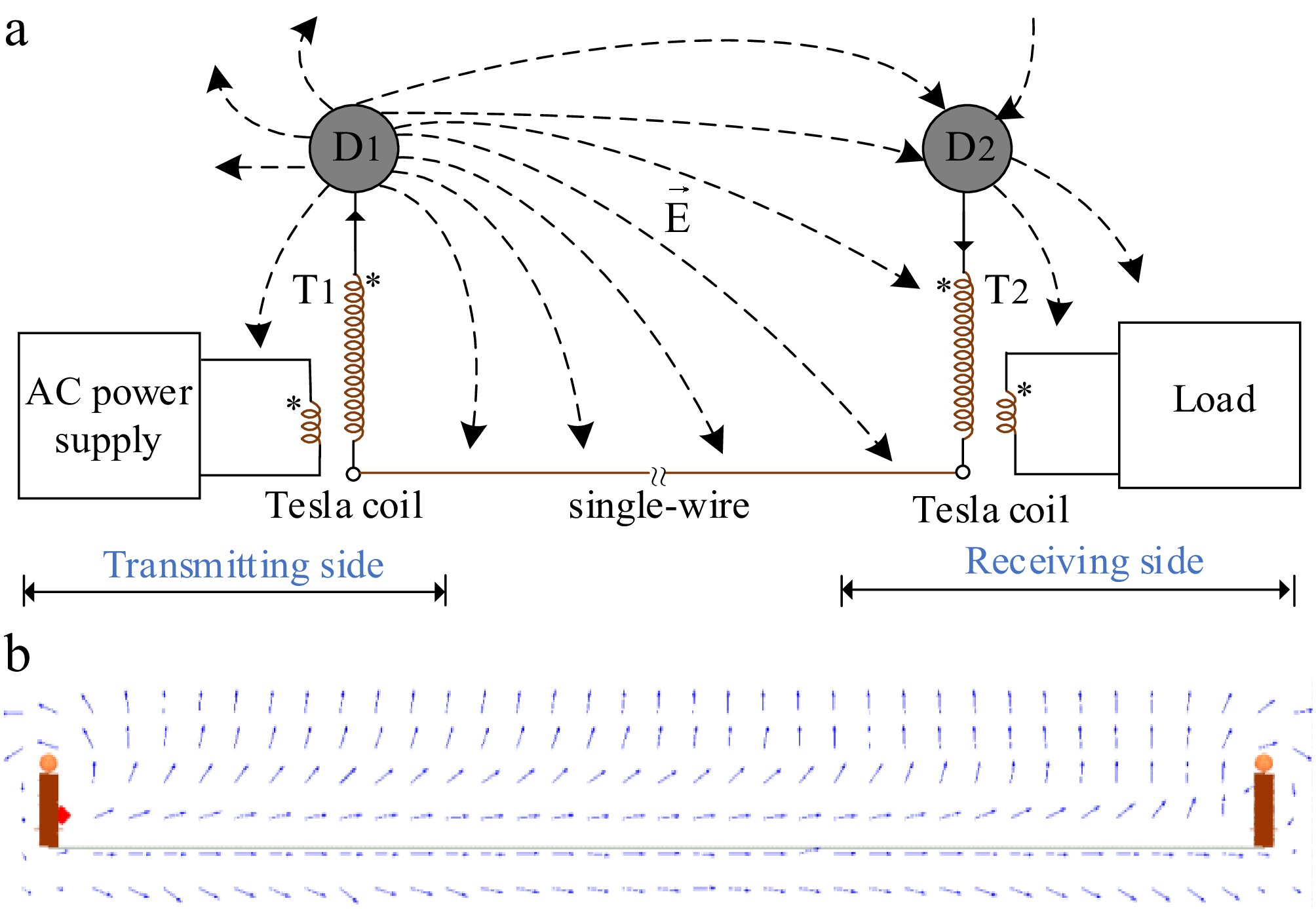
Figure 4.
Field distribution of SWPT at different transfer distances. (a) Schematic diagram of the short-distance SWPT system. (b) Poynting vector distribution of the long-distance SWPT system.
In long-distance SWPT systems, when the total length of the transfer line, such as the high-voltage coil and the single wire, approaches the wavelength of the electromagnetic wave, the weak coupling effect between the conductors at the top can be neglected. And when constructing an accurate model, the distributed parameter circuit model of the transfer line needs to be considered. The transfer mechanism has been analyzed using electromagnetic wave theory in prior works[5,19−22], where the Poynting vector distribution of the system is also demonstrated, as illustrated in Fig. 4b. In this context, the single wire acts as a guide for the electromagnetic wave flow. Maxwell's equations for a sinusoidal electromagnetic wave propagating along a single wire are expressed as follows:
$ \left\{ \begin{gathered} \nabla \times {{\mathbf{H}}_{\mathbf{S}}} = ({\sigma _2} + {\text{j}}\omega {\varepsilon _2}){{\mathbf{E}}_{\mathbf{S}}} \\ \nabla \times {{\mathbf{E}}_{\mathbf{S}}} = - {\text{j}}\omega {\mu _2}{{\mathbf{H}}_{\mathbf{S}}} \\ \nabla \cdot {{\mathbf{H}}_{\mathbf{S}}} = 0 \\ \nabla \cdot {{\mathbf{E}}_{\mathbf{S}}} = 0 \\ \end{gathered} \right. $ (4) where, Hs is the magnetic field intensity in the single wire, Es is the electric field intensity in the single wire, and σ2 is the conductivity. ε2 represents the dielectric constant, and μ2 represents the magnetic permeability in the single wire.
The flow of electromagnetic energy is described by the Poynting vector S, also known as the electromagnetic energy flux density, defined as follows:
$ {\mathbf{S}} = {\mathbf{E}} \times {\mathbf{H}} $ (5) The vector in the equation is measured in W/m2, representing the electromagnetic energy passing through a unit area perpendicular to the direction of energy propagation per unit time. The direction of the vector indicates the propagation or flow of electromagnetic energy. In the SWPT system, a standing wave phenomenon occurs on the Tesla coil, where the voltage wave forms a standing wave through the superposition of incident and reflected waves, with the node at the bottom and the antinode at the top. This means the electric field is strongest and the voltage is highest at the top of the coil, thereby facilitating power transfer[5]. A recent study[23] also highlights the critical role of standing waves in the power transfer process. On the other hand, compared to SWPT systems using air as the transfer medium, SWPT systems using seawater as the transfer medium have less dispersion of the Poynting vector[19]. In SWPT systems using the ground as a quasi-conductor, when both sides are grounded, the ground also plays a role like a single wire in guiding electromagnetic wave propagation[20].
Scholars from Tianjin University of Technology have explained the transfer mechanism of SWPT based on electric dipole radiation theory. When an electric dipole oscillates, it generates varying electric and magnetic fields, which radiate outward as electromagnetic waves. As a result, energy from the transmitter is transferred to the single conductor, which then transmits the power to the receiver in the form of electromagnetic waves[21]. In the SWPT system, the single conductor guides and confines the electromagnetic waves. The electric field lines originate and terminate on the surface of the conductor, with both transverse and longitudinal components. The magnetic field lines encircle the conductor and are perpendicular to the electric field lines, having only a transverse component. Consequently, the electromagnetic waves transmitted along the conductor are transverse magnetic waves[22].
The SCC-WPT system currently explains its transfer mechanism mainly from a circuit perspective (i.e., stray capacitance and self-capacitance theories), while the SWPT system explains its transfer mechanism from both circuit and electromagnetic field perspectives. For the SCC-WPT system, future research should further explore the transfer mechanism from the perspective of electromagnetic field energy distribution, the distribution and calculation of stray capacitance, and the distribution of ground currents. For the SWPT system, future research should analyze the model and loss distribution of quasi-wireless SWPT systems using the ground as a transfer medium (especially underwater) based on surface electromagnetic wave theory.
-
Current research on electric field power transfer technology based on earth coupling primarily focuses on three areas: system modeling, energy efficiency, and compensation networks. Additionally, due to the flexible power supply capabilities and lightweight coupling mechanisms of SCC-WPT systems, there has been growing interest in simultaneous wireless power and data transfer, as well as multi-load power supply. The following section will focus on the current state of research in these two areas.
System modeling
-
For the SCC-WPT system shown in Fig. 3b, assuming the use of high-quality factor components and neglecting parasitic resistance, the system's two-port Y-parameter network is derived, as illustrated in Fig. 5. In this setup, U1 represents the voltage on the transmitter side of the coupling mechanism, while U2 represents the voltage on the receiver side. The voltage-current relationship is given by Eq. (6).
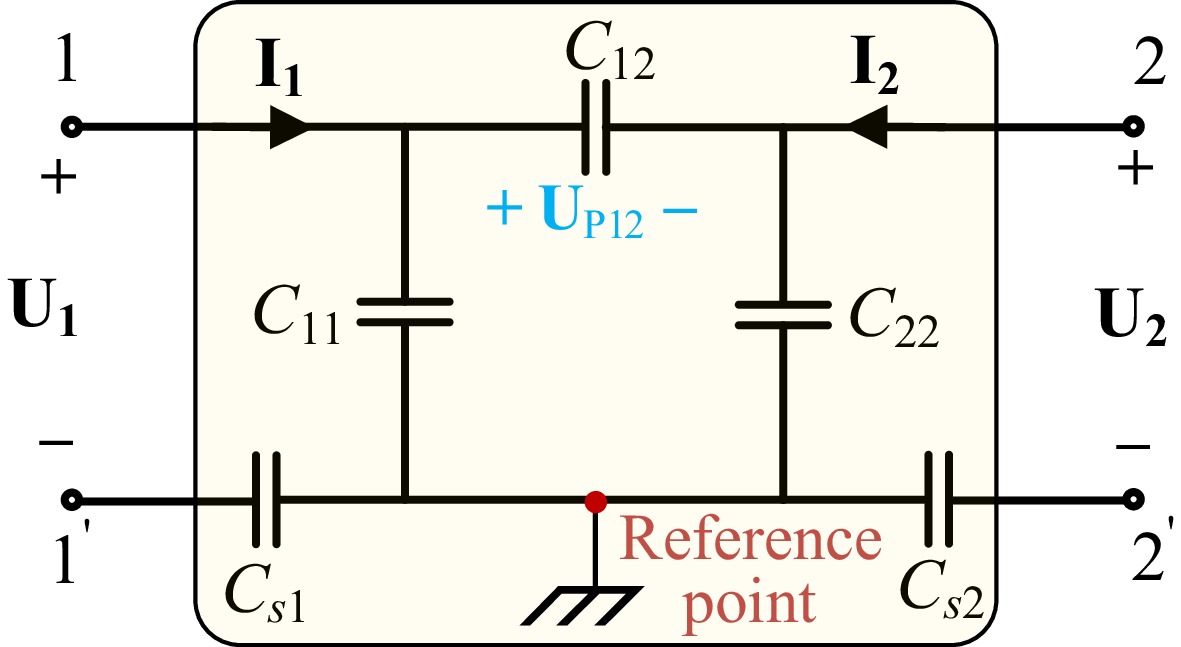
Figure 5.
Two-port network of the circuit model.
The corresponding π-type simplified circuit model of the system is shown in Fig. 6. This model approximates the inverter output voltage using the fundamental wave approximation, neglecting higher-order harmonics, and representing it as an AC voltage source Uin. The current Ic flows through the capacitor element Cc. The equivalent AC resistance of the rectifier and load, denoted as Req, is given by: Req = 8RL/π2, where RL is the load resistance.
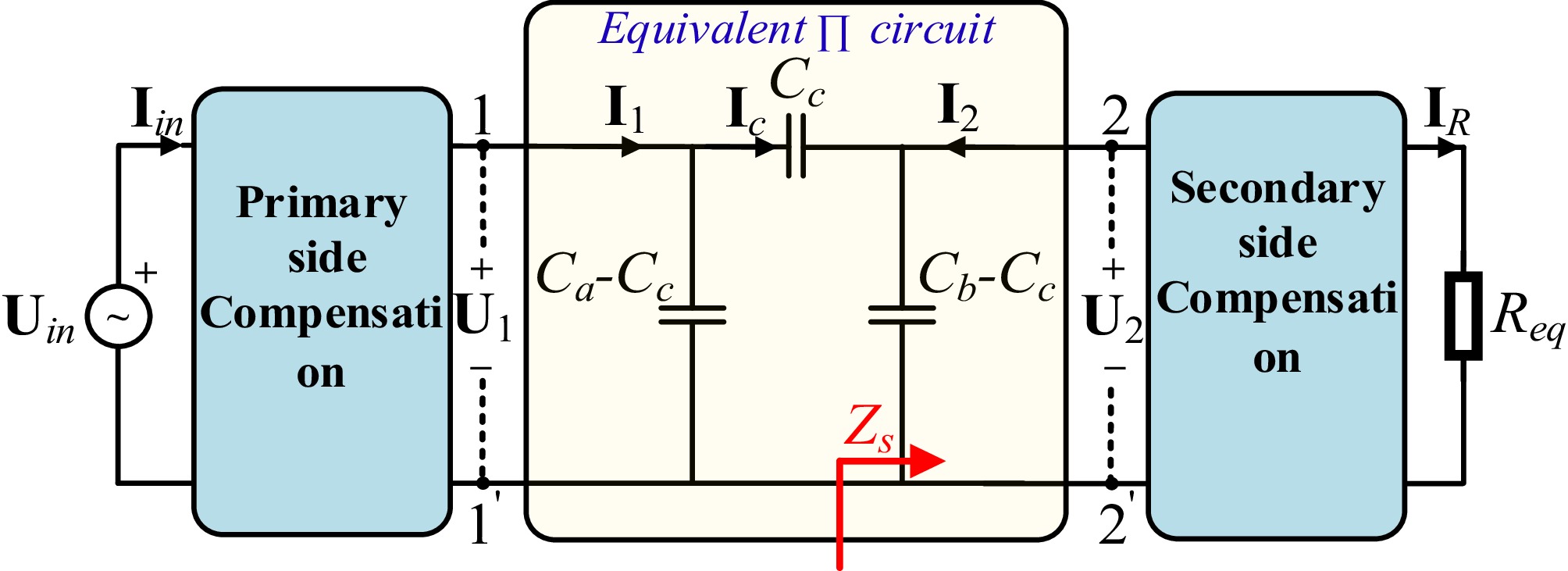
Figure 6.
Equivalent circuit of the SCC-WPT system.
$ \left\{ \begin{gathered} {{\mathbf{I}}_1} = j\omega ({C_a} - {C_c}){{\mathbf{U}}_1} + j\omega {C_c}({{\mathbf{U}}_1} - {{\mathbf{U}}_2}) \\ {{\mathbf{I}}_2} = j\omega ({C_b} - {C_c}){{\mathbf{U}}_1} + j\omega {C_c}({{\mathbf{U}}_2} - {{\mathbf{U}}_1}) \\ \end{gathered} \right. $ (6) Notably, existing SCC-WPT models do not establish an equivalent circuit model for the ground. However, nearly all SCC-WPT systems complete their electrical circuit through the earth, which acts as a quasi-conductive medium. Therefore, developing an accurate equivalent circuit model is essential for system analysis and design. Researcher C. W. Van Neste has conducted extensive studies in this area, designing sensors to detect the magnitude and direction of earth currents, which are useful for power grid monitoring and fault detection[24]. Furthermore, by leveraging conductive currents in the soil for wireless power transfer, sensor networks can be powered to monitor real-time parameters such as soil temperature and humidity, transmitting data to base stations to support precision agriculture and digital farming[25]. At high operating frequencies, grounding resistance increases significantly, and most of the energy dissipates into the soil in the form of heat and/or electromagnetic waves, making grounding reactance negligible[9,26]. The conductivity of the ground depends on its physical and chemical properties. Assuming a layered structure with concrete on the surface and soil beneath, the grounding resistance can be expressed as:
$ {R_g} = \dfrac{2}{{|{I_0}{|^2}}}S $ (7) where, I0 represents the magnitude of the current in the floating open circuit within the system, determined by integrating the current density over the earth's effective conductive area. S denotes the magnitude of the Poynting vector generated by I0, which is influenced by factors such as the system's operating frequency, ground conductivity, dielectric constant, and permeability. However, research on the precise distribution of current within the earth remains limited.
In the context of the SWPT system model, a distributed parameter circuit model of the Tesla coil and single wire was developed based on the space electric field coupling mechanism[18]. In contrast, a lumped parameter circuit model was developed in a previous study[20], as shown in Fig. 7a, incorporating the transfer mechanism of electromagnetic wave theory and accounting for the parasitic parameters of the multi-layer Tesla coil. Although the resistance and inductance of the earth were measured experimentally, the transfer line effect of the single wire was overlooked, and a distributed parameter model for the line was not established. An SWPT system utilizing a limiter[27], along with the formulation of an equivalent circuit model based on coupled mode theory, as shown in Fig. 7b. The power module primarily consists of a limiter, a gain module, and a current-controlled voltage source (CCVS), imparting a negative resistance feature to the system.

Figure 7.
Equivalent circuit model of SWPT system. (a) SWPT system model using a multi-layer Tesla coil structure. (b) SWPT system model using a limiter.
Overall, the system models developed for electric field power transfer technology based on earth coupling, whether using the theory of stray capacitance and self-capacitance or electromagnetic field theory, require further refinement and optimization. Future research is needed on the equivalent model of the ground, precise models of system losses, the establishment of a distributed parameter model for long-distance SWPT systems using transmission line theory, and system models under the influence of environmental factors and foreign object interference.
Energy efficiency features
-
Early studies on the energy efficiency of SCC-WPT systems explored various approaches. The virtual ground theory was applied using a Class-E converter and a double-sided LCLC compensation network[16], achieving a power output of 3.8 W and a transfer efficiency of 32% at 1.6 MHz, while exhibiting strong tolerance to horizontal, vertical, and angular misalignments. Building on this approach, the operating frequency was increased to 3.3 MHz, and a floating wire was introduced on the receiver side to enhance stray capacitance to the ground, resulting in a transfer distance of 3 mm, a power output of 3.6 W, and a transfer efficiency of 35%[9]. To further improve misalignment tolerance, a novel coupling structure was proposed, significantly enhancing resistance to lateral, longitudinal, and rotational misalignments, and achieving a peak efficiency of 82.5% at 34.28 W[28]. The loss distribution, electrode current density, and the effects of electrode thickness and excitation position on current density distribution were investigated in recent studies[29,30]. A 50 W power output and 83% transfer efficiency at 2.2 MHz were achieved using a single-contact method, in which a helical coil contacts a conductive plane[11]. A current loop was further established via the stray capacitance of four helical coils to the ground, achieving a 2.54 cm transfer distance, a 36 W power output, and 20% efficiency at 2.74 MHz[31]. System efficiency was improved by implementing impedance matching through a series connection of capacitors and resonant coils[32]. Additionally, system efficiency was improved by increasing self-capacitance with a 45 cm diameter disk and a 30 cm diameter metal sphere; however, the earth was assumed to be an ideal conductor, and ground losses were neglected[15]. To address this limitation, a hybrid wireless power transfer (HWPT) system incorporating an outer metal frame around the inner coil was proposed, which optimized spatial efficiency and enhanced transfer performance[33].
Recent studies further illustrate this principle using Eq. (8)[10]. For the system depicted in Fig. 6, the transmitted power is expressed as:
$ P = \omega {C_c}{U_1}{U_2}\sin {\varphi _{21}} $ (8) where, φ21 represents the phase difference between the voltages at both ends of the coupling mechanism. For fixed plate size and transfer distance, the capacitance Cc increases as CS1 and CS2 increase. When CS1 and CS2 approach infinity, the capacitive reactance becomes zero, meaning Cc reaches its maximum value, C12, under the equivalent short-circuit condition. In practical applications, the transmitting-end power source can be grounded or directly connected to the ground. In this case, CS1 is considered infinite, and Cc increases as CS2 increases.
To further reduce losses, both the transmitting and receiving sides were connected to a wall, using reinforced concrete instead of the ground as the return path[34]. The specific application scenario of rail transit was considered, where the receiving and transmitting sides were directly connected through metal wheels[35]. At an operating frequency of 2 MHz, this system achieved a transfer distance of 17 mm, a power output of 700 W, and a transfer efficiency of 91%. However, in general applications, effectively grounding the receiving side or directly connecting it to the transmitting side remains challenging. A return path was formed using the stray capacitance between the vehicle's metal chassis and the ground; to minimize losses, the ground was replaced with a well-grounded metal plate, which could be smaller than the vehicle chassis[36]. Energy efficiency was further enhanced by adding a metal plate on the receiving side to increase stray capacitance[12,37]. These methods all optimize energy efficiency by improving the system's coupling structure. According to Eq. (4), energy efficiency can also be increased by raising the system's operating frequency, operating voltage, and sinφ21. However, to ensure safety, the operating voltage cannot be excessively high. The use of compensation networks, which will be discussed in the following sections, provides another approach to improving efficiency.
In efforts to enhance SWPT system efficiency, more compact low- and high-voltage coils were designed to increase the coupling coefficient and reduce energy loss[20]. Additionally, grounding both the transmitter and receiver enabled the earth to guide electromagnetic waves similarly to a single-wire setup, improving efficiency. Previous studies[22,38] have investigated the impact of coaxial structure parameters, such as operating frequency, wire bending, transmitter/receiver length and shape, and environmental conditions. The effects of transfer medium properties—such as electromagnetic characteristics, physical structure, and bending—on long-distance SWPT efficiency have been investigated[39]. It was highlighted that a medium with high conductivity and low permeability improves efficiency, with central bending exerting the greatest impact. A quarter-wavelength helical resonant coil was designed to enhance ground coupling on the receiver side, achieving a 30 m 'ground-to-air' transfer distance, 500 W power output, and 92% efficiency at 220 kHz[40]. An additional quarter-wavelength Tesla resonator was introduced at the transmitting end, building on this research, to eliminate the need for grounding and enable single-wire power transfer between any two points in space. At a 10 m transfer distance and 500 W power output, a transfer efficiency of 85% for AC loads and 80% for DC loads was achieved[41].
In practical applications, a trade-off between system efficiency and safety is often required. SCC-WPT technology has been applied to power implantable medical devices (IMDs)[42], enhancing transfer efficiency through full-band loss compensation while ensuring compliance with IEEE C95.1 safety standards[43] for temperature rise and specific absorption rate (SAR). However, the transfer efficiency remained low at 2.06%, with safety as the top priority. When an external object approaches the system, the stray capacitance changes, leading to a shift in the resonant frequency. This principle is utilized for foreign object detection in SCC-WPT systems.[44,45]. By using sensors to detect object position, movement direction, and speed, these studies aimed to improve user safety. In terms of SWPT system safety, a high-turns-ratio coupled coil with both its top and bottom short-circuited was employed to effectively mitigate high-voltage issues at the coil's top conductor[46].
Table 1 summarizes the energy efficiency features of some SCC-WPT and SWPT systems. It can be observed that SCC-WPT systems typically operate at MHz-level frequencies in air, with short transfer distances and limited energy efficiency, especially when the receiving side is not effectively grounded. However, when operating underwater, the high stray capacitance allows for reduced operating frequency while maintaining good energy efficiency and transfer distance. In contrast, SWPT systems can achieve transfer distances measured in meters and exhibit large stray capacitance when operating over long distances or underwater, which helps lower the operating frequency. However, at short distances, high frequencies are still required, which imposes stringent demands on high-frequency power supplies. Additionally, these systems often require large coils, and quasi-wireless power transfer systems that use natural conductors as the transfer medium tend to have relatively poor energy efficiency.
Table 1. Energy efficiency features of SCC-WPT and SWPT.
Classification Frequency Distance Power Efficiency Ref. SCC-WPT 3.3 MHz 3 mm 3.6 W 35% [9] 1 MHz 50 mm 266 W 62% [10] 1.97 MHz 5 mm 106.9 W 56.2% [12] 741.5 kHz 550 mm 20 W 19.5% [15] 2.74 MHz 25.4 mm 36 W 20% [31] 2 MHz 17 mm 700 W 91% [35] 1 MHz 110 mm 350 W 74.1% [36] 2 MHz 10 mm 30 W 30% [37] 85 kHz 50 mm (seawater) 1.2 kW 91% [47] 200 kHz 100 cm (seawater) 300 W 91.07% [48] SWPT 847 kHz 2 m 200 W 61% [17] 10.55 MHz 5 m 65.28 W 72.08% [23] 6.7 kHz 5 km 5 kW 87% [20] 220 kHz 30 m 500 W 92% [40] 580 kHz 4.5 m (salt water) 25 W 54% [13] 40 kHz 51 m (salt water) 30.2 W 51.8% [49] 300 kHz 10 m (seawater) 206.8 W 83% [50] * Unless otherwise specified in the table, air is used as the transfer medium. Compensation network
-
The compensation network improves system efficiency by adjusting the voltage phase between the primary and secondary sides, as well as the voltage across the coupling plates. It also enables impedance matching, reduces the reactive power output of the inverter to achieve zero phase angle (ZPA) operation, filters high-order harmonics, facilitates soft switching, and supports constant voltage/constant current (CV/CC) output.
In SCC-WPT systems, double-sided LC compensation is the most commonly used topology for the compensation network. Double-sided LC compensation has been utilized to achieve functions such as voltage boosting and filtering[8,34,37]. When the LC resonance method is adopted, the experimental results achieve a DC-DC efficiency of 91.9% at 1.24 kW with the constant voltage[8]. To enhance transfer power, a novel LC-CL compensation topology that achieves a 90° voltage phase difference between transmitter and receiver[10]. An LCLC compensation network was used on the transmitting side to regulate voltage[9], while double-sided LCLC compensation was utilized to enhance the transmitting-side voltage and receiving-side current[16]. Additionally, LCLC-S and LCLC-M compensation methods were implemented to achieve CV and CC outputs, respectively[12].
In SWPT systems, the Tesla coil was replaced by a double-sided LC compensation topology, which reduces electric field radiation and environmental interference while simplifying system design[17]. S-LCC compensation was utilized to achieve zero-phase-angle (ZPA) input on the primary side and impedance matching on the secondary side[19]. Building upon the multi-layer Tesla coil SWPT system[20], a double-sided LCL compensation topology was employed to suppress high-order harmonics and improve transfer efficiency[51]. At a transfer distance of 70 m with a power output of 720 W, the system efficiency increased from 87.3% to 91.3%, while high-order harmonics were reduced by 87.5%. Further research[52] found that this system could achieve CC or CV output by selecting an appropriate operating frequency. Additionally, during CC output, ZPA input could be realized without the need for extra compensation circuits or control methods.
In summary, the adoption of compensation topologies can significantly enhance the transfer performance of the system. Higher-order compensation networks provide greater flexibility for parameter tuning and improve the regulation of both active and reactive power. SCC-WPT and SWPT systems can benefit from these advanced compensation networks to further optimize performance. However, this comes with trade-offs, including increased system complexity, higher power losses, and potential variations in robustness.
Simultaneous wireless power and data transfer
-
With the increasing application of WPT technology in implantable medical devices (IMDs), electric vehicles, and consumer electronics, simultaneous wireless power and data transfer (SWPDT)[53] has garnered significant attention in recent years. SWPDT enables real-time information feedback, supporting closed-loop control, system monitoring, and overall performance enhancement.
Recent research on SWPDT in SCC-WPT systems has seen notable advancements. Multi-channel SWPDT was implemented in an underwater environment, where the energy channel was formed through magnetic coupling and the signal channel was established using a coupled single capacitor formed by two coils[47]. The system's stray capacitance completed the circuit, and due to its small value, the resulting high capacitive reactance minimized electromagnetic interference from power transfer to the signal channel. This setup successfully achieved 1.2 kW power transfer and 1 Mb/s full-duplex communication. In an underwater SCC-WPT system, stray capacitance was utilized to create closed-loop circuits for both the energy and signal channels[48]. A field programmable gate array (FPGA) was used for data modulation and demodulation, and differential phase shift keying (DPSK) was employed for signal modulation, effectively reducing the bit error rate. This approach enabled 300 W power transfer and 500 kb/s bidirectional communication. Building upon this, an underwater single-to-multiple-load power supply system was developed, adopting a shared channel approach to enable multi-channel bidirectional communication between the transmitter and receivers[54]. This enhancement increased the transfer rate of each channel to 1 Mb/s.
Research on SWPDT in SWPT systems is still in its early stages. An energy modulation method was employed to achieve bidirectional signal transfer and simultaneous power transfer using a single conductor[55]. However, both the transfer power and signal transfer rate remained relatively low. An SWPT system was designed, using a mooring cable and open seawater as transmission media, to enable simultaneous power and data transfer, filling the research gap in the relevant field. A double-sided LCC compensation circuit was employed to filter out harmonics and reduce the interference of power transfer on signal transfer. The system adopted binary frequency shift keying (2FSK) modulated signals and used coherent demodulation for signal decoding. Theoretically, it achieved a 170 W power supply and 10 kb/s data transfer for underwater sensors, but further experimental validation is lacking[56].
In summary, further research is required on SWPDT in SCC-WPT and SWPT systems to improve transfer distance and energy efficiency, adopt advanced modulation and demodulation techniques to enhance system robustness in harsh environments, increase data rates, improve the signal-to-noise ratio (SNR), and reduce bit error rate (BER). In addition, studies are required on the generation mechanisms and suppression methods of system harmonics, as well as on the implementation of multi-load systems capable of bidirectional power transfer and full-duplex communication using SCC-WPT technology in air media.
Multi-load power supply
-
Simultaneous wireless power transfer to multiple loads enhances system flexibility and convenience, making it a key research focus in WPT technology and a critical need in practical applications. Notable examples include free-positioning wireless charging for multiple devices on a desktop, wireless charging platforms for drones, and dynamic wireless power transfer for electric vehicles[54,57].
SCC-WPT offers several advantages, including high offset tolerance, low cost, compact size, and flexible power delivery within a two-dimensional plane, making it particularly suitable for powering multiple loads on a single surface. A compact SCC-WPT system for a dual-load power supply was proposed, which accounted for cross-coupling capacitance among five plates and introduced a three-port equivalent circuit model[12]. This system achieved a power output of 106.9 W with a transfer efficiency of 56.2%. It enabled CC and CV outputs for two independent loads, ensuring that removing one load did not affect the performance of the other. A desktop SCC-WPT system operating at 813 kHz was designed to power multiple mobile phone-sized loads within a 1.2 m2 area under the influence of a high-frequency electric field[58]. However, the system's efficiency remained susceptible to environmental factors.
For multi-load power supply in SWPT systems, a single wire was used to power a sensor network, and the system's omnidirectionality capabilities were experimentally demonstrated[23]. A large-scale quasi-wireless SWPT system was developed using the ground as a power transfer medium to supply multiple loads[25,26]. However, due to its relatively low energy efficiency, the system is currently suitable only for low-power applications, such as powering sensors. A rebar matrix structure was utilized as a single-wire transfer medium to power multiple sensors embedded in reinforced concrete, enabling real-time health monitoring of civil structures such as buildings and bridges[59].
Currently, multi-load power supply in SCC-WPT and SWPT systems still suffers from low energy efficiency. In particular, quasi-wireless SWPT systems that utilize natural conductors like the ground instead of a dedicated transfer wire can only support low-power devices. The design of efficient multi-load power transfer systems requires a comprehensive approach, taking into account system modeling, coupling mechanisms, control strategies, and compensation network optimization.
-
Electric field power transfer technology based on earth coupling offers advantages such as low cost and flexible power delivery, making it applicable across various fields, including consumer electronics, transportation, industrial production, underwater equipment, and wearable devices. The following sections will explore its applications in detail and discuss the challenges hindering its development.
Wireless charging planes
-
In recent years, the increasing demand for convenient and safe wireless charging solutions has been driven by fast-paced lifestyles. WPT technologies offer an efficient, low-carbon, and cost-effective approach to simultaneously charging personal electronic devices such as mobile phones, laptops, and earphones. Beyond consumer electronics, advancements in WPT have also facilitated research into powering multiple high-power loads, such as electric vehicles, over large surface areas. Figure 8a illustrates a two-dimensional flexible power supply system designed by Chongqing University, based on SCC-WPT technology. This system is capable of illuminating a 40 W bulb at any position within the plane while maintaining consistent brightness[37]. Expanding upon this concept, a dual-load SCC-WPT system was proposed that preserves planar flexibility while enabling independent constant current (CC) and constant voltage (CV) outputs for multiple loads[12]. Further advancements include a large-area wireless power transfer plane developed by Kunming University of Science and Technology, as shown in Fig. 8b. This system integrates SCC-WPT technology with a four-coil compensation topology, achieving an output power of 538 W and a transfer efficiency of 84.7% over a 1 m2 charging surface while maintaining stable energy efficiency features[60]. Additionally, Fig. 8c presents a dynamic wireless power transfer system for robotic applications, designed by the University of Alberta. Operating over a 28 × 28 cm2 charging plane, this system incorporates a 17 cm wire attached to the top of the receiver to enhance stray capacitance to the ground. Within the charging plane, efficiency fluctuations are limited to within 3%, with an average transfer efficiency of 93%[61].
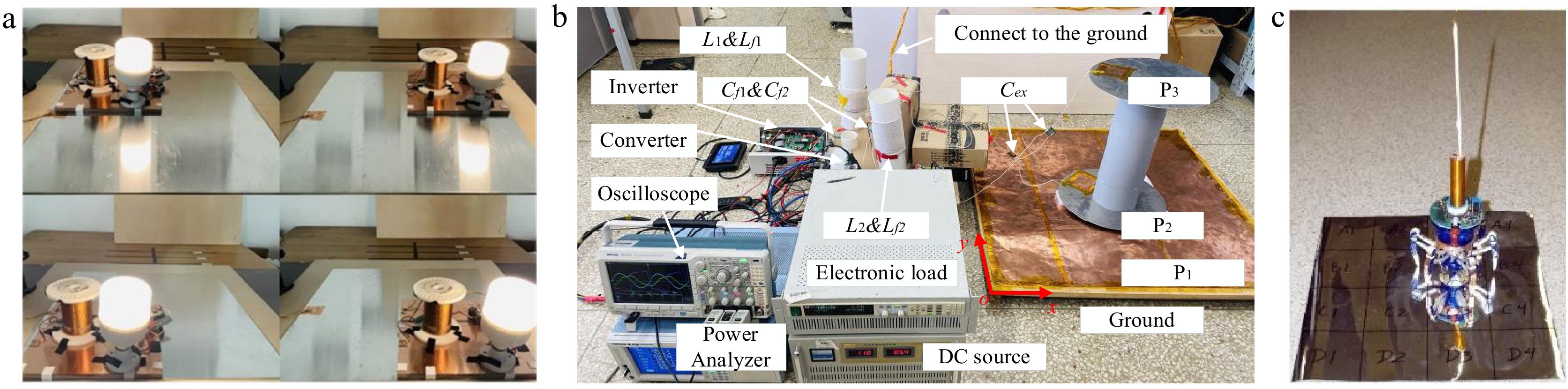
Figure 8.
Application of SCC-WPT in wireless charging plane. (a) Flexible power supply system. (b) Large-area free-position power supply system. (c) Robot free-position power supply system.
A wireless charging plane must efficiently power multiple devices simultaneously while ensuring that the receiving side remains lightweight without compromising energy efficiency. Moreover, the cross-coupling effects introduced by multiple loads can lead to system detuning, making it essential to maintain independent output regulation for each load while preserving high overall system efficiency. This challenge has become a key focus of research in WPT technology.
Transportation
-
To lessen dependence on petroleum and other energy sources while accelerating the 'dual carbon' goals, electric vehicles (EVs) are increasingly gaining attention and adoption. However, wired charging poses challenges such as high costs, plug wear, cable breakage, and electric shock risks in rain or snow. Industry forecasts predict that the global market for wirelessly charged EVs will reach $568 million by 2030[62], significantly driving advancement in wireless power transfer technology[63−65].
SCC-WPT technology, with its advantages of fewer plates, minimal cross-coupling issues, and strong misalignment tolerance, is well-suited for both static and dynamic EV charging. A research team from the University of California, San Diego, replaced the traditional two-plate EC-WPT system by utilizing the EV chassis and the ground as conductive elements. By harnessing the stray capacitance between the chassis and the ground, they established a current loop, achieving a transfer power of 350 W with an efficiency of 74.1%[36], as shown in Fig. 9a. Similarly, Kyushu University in Japan designed a static SCC-WPT charging system for EVs[66], adopting the same principle but with different compensation structures. Simulations confirmed that the system could transmit 3.3 kW of power while maintaining a chassis voltage of only 114 V. Figure 9b illustrates a dynamic EV charging system developed by the University of Alberta[31], which delivers power through a 3 m long, 0.3 m wide aluminum foil surface. This system achieves an output power of 36 W with an overall efficiency of 20%.
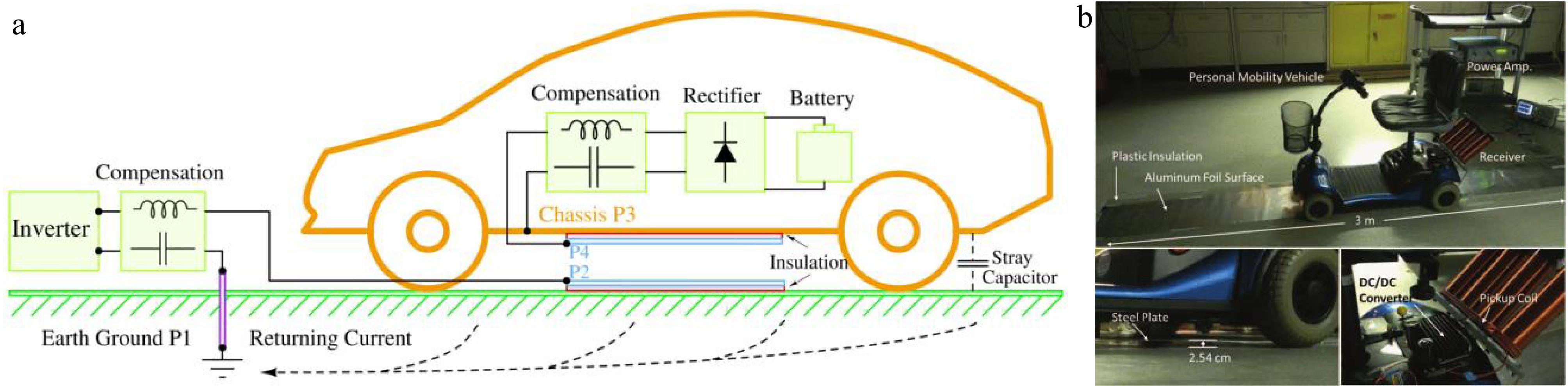
Figure 9.
Application of SCC-WPT technology in transportation. (a) Static wireless charging EV. (b) Dynamic wireless charging mobile EV.
Overall, transportation demands high power levels, and research on electric field power transfer technology based on earth coupling for this application is still in its early stages. Practical implementation must also address factors such as chassis voltage, ground impedance, and leakage current.
Underwater equipment
-
At present, autonomous underwater vehicles (AUVs) and other underwater equipment are increasingly utilized for monitoring underwater environments and conducting underwater operations. To ensure long-term operation, underwater charging is essential to avoid frequent battery replacements that waste manpower and financial resources[67,68]. Additionally, it is crucial to transmit the data collected by AUVs to personnel in real-time and enable simultaneous wireless power and data transfer among multiple devices.
Underwater wireless power transfer based on SCC-WPT technology offers several advantages, including low eddy current losses, strong misalignment tolerance, and minimal impact from cross-coupling capacitance. Additionally, the high coupling capacitance of the water medium reduces the required inductance in the compensation network and lowers the system's resonant frequency, resulting in a more compact system and increasing power density. The Institute of Electrical Engineering, Chinese Academy of Sciences, achieved a transfer power of 1 kW and an efficiency of 76% over a 1 m transfer distance at a 200 kHz operating frequency using an electronic load[69]. They also developed an underwater SWPDT system with a transfer power of 300 W, an efficiency of 91.07%, and a bidirectional communication rate of 500 kb/s[48]. Building on this research, a system was designed for wireless power and data transfer in AUV clusters, achieving a total output power of 200 W, an efficiency of 71.27%, and a bidirectional transfer rate of 1 Mb/s over a 60 cm transfer distance[54]. Harbin Institute of Technology implemented SCC-WPT technology for signal transfer and achieved a transfer power of 1.2 kW with an efficiency of 91% over a 5 cm distance using a dual-sided LCC compensation network with an electronic load. The system also maintained a full-duplex communication rate of 1 Mb/s over a 50 cm transfer distance[47].
In underwater applications based on SWPT technology, Tennessee Technological University replaced a single-wire system with a 4.5 m long, 0.15 m wide, and 0.15 m deep saline solution, creating a quasi-wireless SWPT system. This system is capable of providing power to isolated offshore islands, though its energy efficiency remains relatively low in practical applications[13]. Figure 10a shows an underwater SWPT system developed by Tianjin University based on electromagnetic wave theory[19]. This system achieves a transfer power of 19.93 W and a transfer efficiency of 24.95% over a transfer distance of 51 m at a 40 kHz operating frequency. Building upon this research, a reconfigurable cascaded coupler (RCC) and its control strategy were proposed, substantially expanding the system's load range and enhancing energy efficiency[49]. Figure 10b presents a SWPT system proposed by the Harbin Institute of Technology-Weihai[50], designed for long-distance power supply to underwater sensors. Using a dual-sided LCL compensation network, this system achieved a transfer distance of 10 m and a transfer power of 206.8 W, with an efficiency of 83% in real ocean conditions.

Figure 10.
Application of SWPT technology in underwater equipment. (a) A 51 m underwater SWPT system. (b) A 10 m underwater SWPT system.
In summary, SCC-WPT and SWPT technologies for underwater device applications still require significant improvements in energy efficiency and communication speed. Current systems fall far short of practical requirements in terms of energy transfer distance and efficiency, and communication rates are insufficient for real-world applications. Additionally, crosstalk between power and communication channels needs to be further reduced to ensure system stability. Most existing studies are conducted under idealized experimental conditions, lacking tests for significant variations in the physicochemical properties of the transfer medium (e.g., dielectric properties). Future research should focus on enhancing system robustness in complex underwater environments (e.g., foreign object interference, high salinity, deep-sea low-temperature, and high-pressure conditions). Moreover, research on SWPT technology supporting multiple underwater devices (e.g., sensor networks) with simultaneous data transfer remains limited. For SCC-WPT-based systems supplying more than two loads underwater, the mutual coupling between loads and its impact on system efficiency must be further considered. Additionally, the effects of load entry and exit on system safety, robustness, and power loss require in-depth analysis.
Industrial applications
-
SCC-WPT and SWPT technologies have also found applications in light industries such as drones, household appliances, and robotics. Chongqing University proposed an SCC-WPT system for wireless charging of drones. The system has excellent longitudinal, lateral, and angular misalignment tolerance performance, and achieves an efficiency of 64.1% with a CV output of 66.4 W[70]. Figure 11a illustrates an SCC-WPT system for a robotic arm, developed through collaboration between Tennessee Technological University and NASA. This system is designed for aerospace engineering applications and features the added capability of collecting data and sending commands[71]. Figure 11b shows a SWPT system developed by the University of Wisconsin, designed to provide power to outdoor aerial devices. This system is known for its economic and flexible features, achieving a 500 W power output with a transfer efficiency of 92% over a 30 m air-to-ground distance[40].
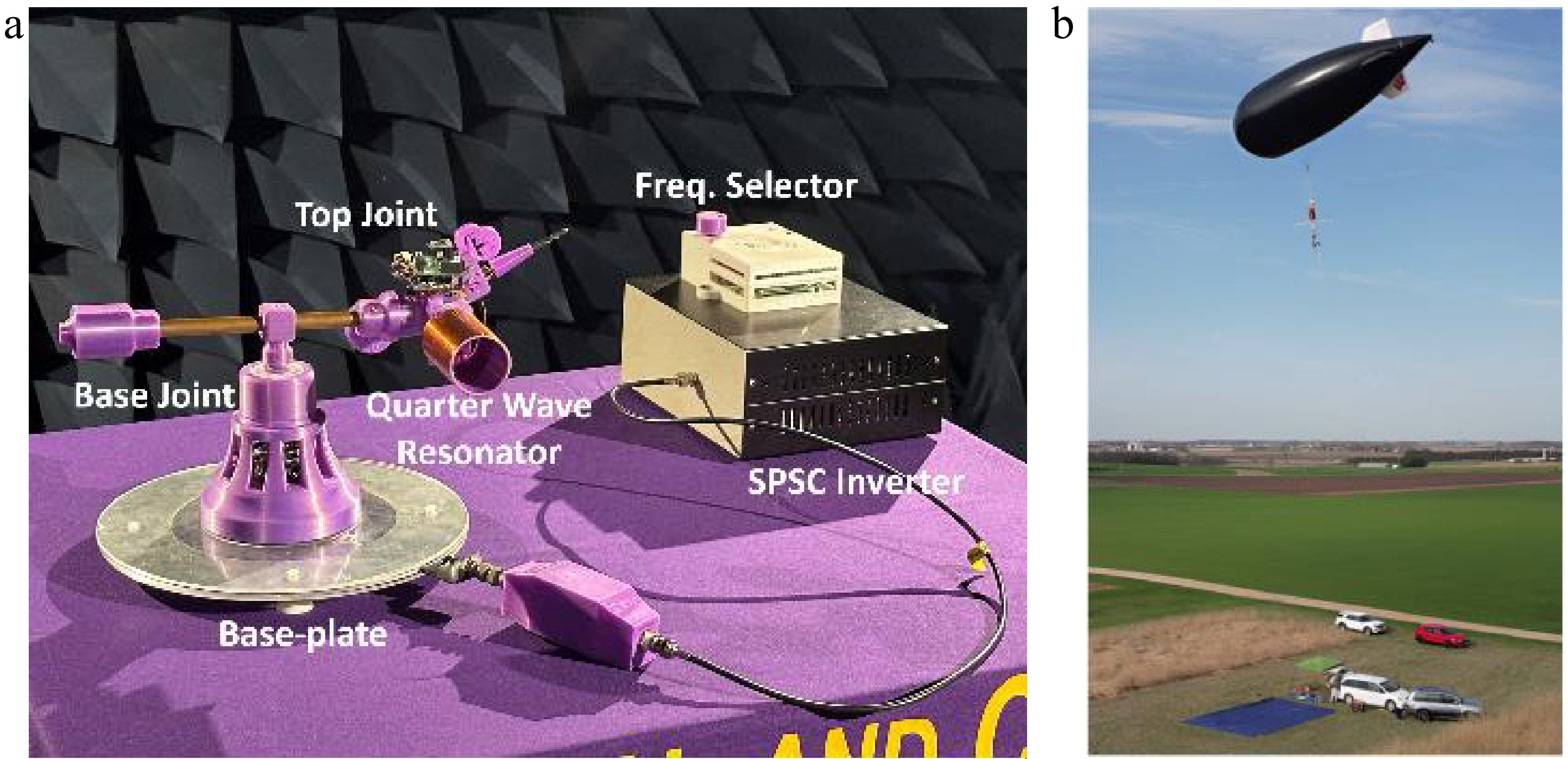
Figure 11.
Application of SCC-WPT and SWPT technology in industrial applications. (a) For the robotic arm. (b) For an aerial platform.
In summary, electric field power transfer technology based on earth coupling offers significant advantages in specific industrial applications, but its energy efficiency remains insufficient to meet the demands of heavy industries and power systems. Future research should not only focus on improving system efficiency to expand practical applications but also leverage the strong misalignment tolerance and flexible power delivery capabilities of SCC-WPT technology, as well as the long transfer distance and relatively high efficiency of SWPT technology, to promote their broader adoption in industrial scenarios.
Wearable devices
-
Wearable devices can monitor heart rate in real-time while enabling information exchange, making life healthier and smarter. Powering such devices with SCC-WPT technology reduces system weight and volume, offering higher power density and greater application value. Figure 12a illustrates a system developed by Donghua University, which uses flexible cross-linked interactive fibers (i-fiber) for electromagnetic energy collection and wireless data transfer based on SCC-WPT technology. The team designed a chip-free smart fabric with advantages such as comfort, washability, and high integration. The complete current loop is formed by the coupling capacitance between the human body, which has a high dielectric constant and conductivity, the i-fiber, the stray capacitance between the system and the ground, and the coupling to the earth[72]. Figure 12b shows an SCC-WPT system developed by Xi'an University of Technology, using flexible graphene films (measuring 10 mm × 5 mm × 0.2 mm) as the coupling mechanism[73]. Known for its flexibility, transparency, compact size, and excellent conductivity, this system achieved a transfer power of 200 mW and a transfer efficiency of 31.3% over a 20 mm transfer distance.
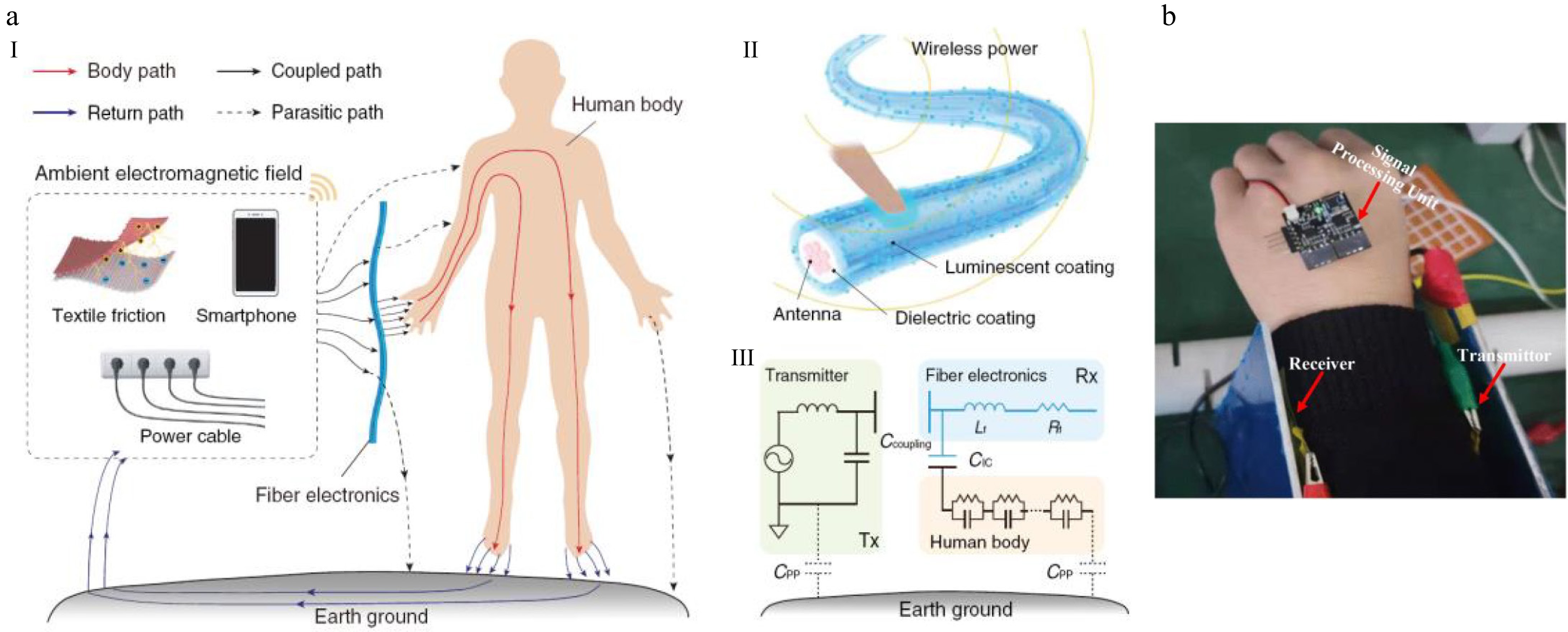
Figure 12.
Application of SCC-WPT technology in wearable devices. (a) Schematic diagram of I-fiber harvesting energy in various situations. (b) Wireless power transfer is realized when metal plates interfere and thin films bend.
For wireless power transfer in wearable devices, the most critical issue is ensuring human safety. Long-term use raises concerns about potential health risks to the human body, and the impact of environmental factors on the stability of the power supply also requires further research. Ensuring that energy transfer remains safe, efficient, and unaffected by external factors such as temperature, humidity, and electromagnetic interference is essential for the widespread adoption of these technologies.
-
With the continuous development of SCC-WPT and SWPT technologies in recent years, this section explores future research directions based on existing studies, focusing on five key aspects: large-area free-position wireless power transfer, long-distance single-wire power transfer, the influence of the human body on the transfer channel, energy efficiency improvement, and space electromagnetic safety issues.
Large-area free-position WPT
-
SCC-WPT technology offers significant advantages in terms of cost, lightweight design, and flexible power delivery over large flat surfaces, making it particularly suitable for wireless power transfer to multiple devices in free positions within a large area. As the power delivery area increases, the size and losses of the transmitting plates can significantly impact the system's output features. The mechanisms behind these effects, as well as the losses associated with large flat surface couplers, still require further investigation. Additionally, in large-area free-position wireless power transfer, powering multiple loads has become a necessity and has already been demonstrated in agricultural applications, where power is supplied to multiple sensors[25]. However, current research has not yet addressed the output effects caused by coupling between multiple devices placed nearby. To ensure a stable power supply in multi-device systems, it is crucial to maintain load independence during the process of moving devices in and out. Furthermore, the output variation caused by the coupling relationships between multiple devices needs to be explored in more depth.
Long-distance single-wire power transfer
-
SWPT technology has shown promising results in terms of transfer distance and energy efficiency, making it a viable option for power transfer projects in remote rural areas, isolated islands, and other sparsely populated regions[7,74]. However, the current transfer distance still falls short of the standards required for large-scale power transfer, and the use of natural conductors such as the earth or oceans to replace single-wire systems for quasi-wireless power transfer remains in the exploratory phase. As early as the beginning of the last century, Tesla envisioned using the earth as a conductor, establishing a low-frequency resonance (Schumann Resonance) between the earth and the ionosphere, and utilizing the electromagnetic waves surrounding the earth's surface to achieve global wireless power transfer. To effectively realize long-distance power transfer, new transfer mediums must be explored to replace single-wire systems for guiding electromagnetic waves. Moreover, the safety, cost, transfer mechanisms, energy efficiency, and robustness of these systems require further investigation to enable their practical and widespread implementation.
Human body transfer channel
-
A paper published by Donghua University in Science demonstrated the tremendous potential of SCC-WPT technology[72]. By using flexible fibers or flexible PCBs, the technology can be embedded in wearable devices, achieving power transfer through the human body as a transfer channel and coupling with the earth. This approach offers a convenient, flexible, and low-cost solution. In the future, it is necessary to study the efficiency improvement of energy harvesting over a wider frequency range, enhancing system robustness for factors such as human height, weight, gender, position, and varying environmental conditions (e.g., temperature, humidity, pressure). Additionally, research is needed on the distance and efficiency of signal transfer. Furthermore, studies should address potential skin irritation and allergy testing for such wearable or implantable devices[42], precise circuit models of the human body, and the flow of current within the human body.
Energy efficiency improvement
-
Compared to traditional EC-WPT, SCC-WPT reduces the number of electrode plates, while SWPT reduces the number of conductors compared to traditional two-wire power transfer systems. On the surface, both technologies appear to adopt a 'one-way transfer' approach, offering cost advantages. However, when compared to traditional wireless or power transfer methods, the current energy efficiency features of these technologies still lag significantly behind traditional approaches[20,75]. Improving the system's energy efficiency to meet practical needs is an urgent task. This requires not only further research into the loss distribution of the coupling mechanism, the use of wide-bandgap devices for soft-switching power converters, optimization of compensation topologies, and the development of improved circuit models, but also innovation in the transfer medium, coupling mechanism materials, and even the transfer mechanisms themselves.
Space electromagnetic safety
-
SCC-WPT technology forms a current loop through stray capacitance generated by coupling with the earth, creating an electromagnetic field of a certain intensity around the system. Similarly, SWPT technology, using the high voltage generated by Tesla coils, creates an electromagnetic field along the transfer path. In both methods, the presence of a strong electromagnetic field could pose safety risks to individuals. Currently, there is limited research on the electromagnetic field distribution during the power transfer process in WPT technology, as well as methods for suppressing it, and the transmitted power remains relatively low[76,77]. To balance energy efficiency and safety, the system must be designed with multiple constraints, including energy efficiency and safety considerations. In the future, further research is needed on the temperature rise in human tissues, specific absorption rate (SAR), spatial electromagnetic field distribution and intensity, as well as the electric field strength and current density in various human organs (e.g., brain, heart, liver, stomach, lungs, kidneys, etc.). Notably, for SCC-WPT systems, suppressing leakage electric fields by adding shielding plates may affect the system's stray capacitance, thereby impacting energy efficiency features. Currently, further research is also required on foreign object detection technology for SCC-WPT systems.
-
Electric field power transfer technology based on earth coupling is currently divided into two major categories: SCC-WPT and SWPT. This paper first explains the power transfer mechanism of the system, followed by a discussion of its circuit models and the challenges it faces. It then analyzes the current research status of the system's energy efficiency features and methods for improvement, as well as the research achievements and difficulties that need to be overcome in compensation circuit topology design, simultaneous wireless power and data transfer, and multi-load power supply. Regarding the advantages of SCC-WPT technology, such as its simple and lightweight coupling structure, strong misalignment tolerance, and flexible power supply capabilities, this paper discusses its applications in multi-load power supply, SWPDT, large-area free-positioning power supply, transportation, underwater devices, and wearable medical devices. For SWPT technology, based on its good energy efficiency and long-distance power transfer capabilities, this paper highlights its applications in underwater devices and industrial settings. The disadvantage of SCC-WPT technology lies in its relatively low energy efficiency, while SWPT's drawback is its limited power supply flexibility, which restricts its application scenarios. Finally, the paper discusses the future research directions of electric field power transfer technology based on earth coupling, focusing on five key areas: large-area free-position wireless power transfer, long-distance single-wire power transfer, the influence of human transfer channels, enhancement of transfer features, and space electromagnetic safety issues.
This research was funded by Yunnan Fundamental Research Project (Grant No. 202501CF070119), and Yunnan Double First Class Special Project in KUST (Grant No. 202401BE070001-061).
-
The authors confirm contribution to the paper as follows: conceptualization: Liu Z; writing-original draft preparation: Liu Z, Nie R; visualization: Nie R; supervision: Rong E; writing - review & editing: Rong E, Li T, Xia J, Luo W, Lu S, Li S; resources: Li S. All authors have read and agreed to the final version of the manuscript.
-
The data that support the findings of this study are available from the corresponding author upon reasonable request.
-
The authors declare that they have no conflict of interest.
- Copyright: © 2025 by the author(s). Published by Maximum Academic Press, Fayetteville, GA. This article is an open access article distributed under Creative Commons Attribution License (CC BY 4.0), visit https://creativecommons.org/licenses/by/4.0/.
-
About this article
Cite this article
Liu Z, Nie R, Rong E, Li T, Xia J, et al. 2025. Review of electric-field power transfer technology based on earth coupling. Wireless Power Transfer 12: e032 doi: 10.48130/wpt-0025-0031 

Review of electric-field power transfer technology based on earth coupling
- Received: 24 April 2025
- Revised: 27 June 2025
- Accepted: 21 July 2025
- Published online: 10 December 2025
Abstract: Recent studies, inspired by Tesla's idea of using earth coupling and space electromagnetic fields to achieve global wireless power transfer (WPT), have focused on two main research directions: single-capacitive coupled wireless power transfer (SCC-WPT) technology and single-wire power transfer (SWPT) technology. By coupling with the earth, these approaches enable more flexible wireless power supply features and long-distance single-wire power transfer, attracting widespread attention. This paper reviews the current global research status of electric field power transfer technology based on earth coupling. First, it summarizes and briefly classifies the concepts and definitions of this technology as presented in the relevant studies and explains the transfer mechanisms of different modes. This paper further discusses the research status of the system model, energy efficiency features, compensation networks, simultaneous wireless power and data transfer, and multi-load power supply. Moreover, it reviews the application of this technology in wireless charging planes, transportation, underwater equipment, industry, and wearable devices. Finally, this paper analyzes and discusses future research directions worthy of attention in this field, centering on five aspects: large-area free-positioning WPT, long-distance single-wire power transfer, the influence of the human body on the transfer channel, energy efficiency improvement, and space electromagnetic safety issues.