








Search
2025 Volume 1
Article Contents
COMMENTARY   Open Access    

A Chinese model for 30 × 30: ecological redlines as other effective area-based conservation measures

  • Full list of author information is available at the end of the article.

  • Achieving the "30 × 30" target is a core commitment of the Kunming–Montreal Global Biodiversity Framework. However, the key challenge lies in effectively managing large-scale protected areas, particularly for emerging economies facing significant development pressures. China has implemented the Ecological Protection Redline (EPRL) system, which scientifically delineates 32% of its terrestrial territory as ecological space, thereby establishing a systematic conservation network that covers 90% of terrestrial ecosystem types and 85% of key species. This approach has significantly curbed ecological degradation and promoted species recovery. This study proposes that designating approximately 12% of the EPRL area—which has high conservation value but remains outside the formal protected area system—as "other effective area-based conservation measures" (OECMs) could swiftly confer strict protection under the existing governance framework. This pathway would bridge the conservation gap with lower costs and institutional resistance. The EPRL to OECM strategy not only offers a feasible solution for China to achieve its 30 × 30 goal but also provides a replicable model of innovating governance for other countries facing similar challenges, emphasizing functional conservation outcomes over mere spatial coverage.
  • 加载中
  • [1] Ren H, Corlett RT, Ouyang Z, Blackmore S. 2025. How can China protect 30% of its land? Trends in Ecology & Evolution 40:824−826 doi: 10.1016/j.tree.2025.06.014

    CrossRef   Google Scholar

    [2] Fanning AL, Raworth K. 2025. Doughnut of social and planetary boundaries monitors a world out of balance. Nature 646:47−56 doi: 10.1038/s41586-025-09385-1

    CrossRef   Google Scholar

    [3] Maxwell SL, Cazalis V, Dudley N, Hoffmann M, Rodrigues ASL, et al. 2020. Area-based conservation in the twenty-first century. Nature 586:217−227 doi: 10.1038/s41586-020-2773-z

    CrossRef   Google Scholar

    [4] Bai Y, Wong CP, Jiang B, Hughes AC, Wang M, et al. 2018. Developing China's Ecological Redline Policy using ecosystem services assessments for land use planning. Nature Communications 9:3034 doi: 10.1038/s41467-018-05306-1

    CrossRef   Google Scholar

    [5] Li L, Hu R, Huang J, Bürgi M, Zhu Z, et al. 2020. A farmland biodiversity strategy is needed for China. Nature Ecology & Evolution 4:772−774 doi: 10.1038/s41559-020-1161-2

    CrossRef   Google Scholar

    [6] Lü Z. 2022. Meeting China's '3030 Goal' on biodiversity conservation. People's Forum Academic Frontiers 4:24−34 doi: 10.16619/j.cnki.rmltxsqy.2022.04.003

    CrossRef   Google Scholar

  • Cite this article

    Li S, Chen X. 2025. A Chinese model for 30 × 30: ecological redlines as other effective area-based conservation measures. Environmental and Biogeochemical Processes 1: e014 doi: 10.48130/ebp-0025-0014
    Li S, Chen X. 2025. A Chinese model for 30 × 30: ecological redlines as other effective area-based conservation measures. Environmental and Biogeochemical Processes 1: e014 doi: 10.48130/ebp-0025-0014

Figures(1)

Article Metrics

Article views(94) PDF downloads(23)

Other Articles By Authors

Commentary   Open Access    

A Chinese model for 30 × 30: ecological redlines as other effective area-based conservation measures

Environmental and Biogeochemical Processes  1 Article number: e014  (2025)  |  Cite this article

Abstract: Achieving the "30 × 30" target is a core commitment of the Kunming–Montreal Global Biodiversity Framework. However, the key challenge lies in effectively managing large-scale protected areas, particularly for emerging economies facing significant development pressures. China has implemented the Ecological Protection Redline (EPRL) system, which scientifically delineates 32% of its terrestrial territory as ecological space, thereby establishing a systematic conservation network that covers 90% of terrestrial ecosystem types and 85% of key species. This approach has significantly curbed ecological degradation and promoted species recovery. This study proposes that designating approximately 12% of the EPRL area—which has high conservation value but remains outside the formal protected area system—as "other effective area-based conservation measures" (OECMs) could swiftly confer strict protection under the existing governance framework. This pathway would bridge the conservation gap with lower costs and institutional resistance. The EPRL to OECM strategy not only offers a feasible solution for China to achieve its 30 × 30 goal but also provides a replicable model of innovating governance for other countries facing similar challenges, emphasizing functional conservation outcomes over mere spatial coverage.

  • The "30 × 30" target—to safeguard 30% of the world's land and sea by 2030—is a cornerstone of the Kunming–Montreal Global Biodiversity Framework[1,2]. However, achieving this goal hinges on a crucial yet often overlooked question: how can nations effectively govern these vast expanses, particularly in densely populated and developing regions where traditional protected areas are insufficient[1]?

    China's recently implemented Ecological Protection Redline (EPRL) system represents a policy-led transformative solution (Fig. 1). Through the scientifically precise delineation of approximately 3.19 million km2 (32% of its terrestrial territory), the system has legally entrenched ecological security boundaries, thereby establishing a robust spatial foundation. At the protection level, this foundation supports a highly intact network that effectively safeguards key water sources and biodiversity corridors, thus systematically protecting 90% of terrestrial ecosystem types and 85% of key wildlife populations. Consequently, at the effectiveness level, the system has significantly curbed the erosion of ecological space, promoted the recovery of endangered species, and fostered a harmonious coexistence between humans and nature. In conclusion, the ECRL policy has largely fulfilled its core mandates: the demarcation of conservation boundaries, the institutionalization of a management framework, and the effective restraint of ecologically destructive development. This accomplishment provides a fundamental institutional safeguard for the realization of the "Beautiful China" vision.
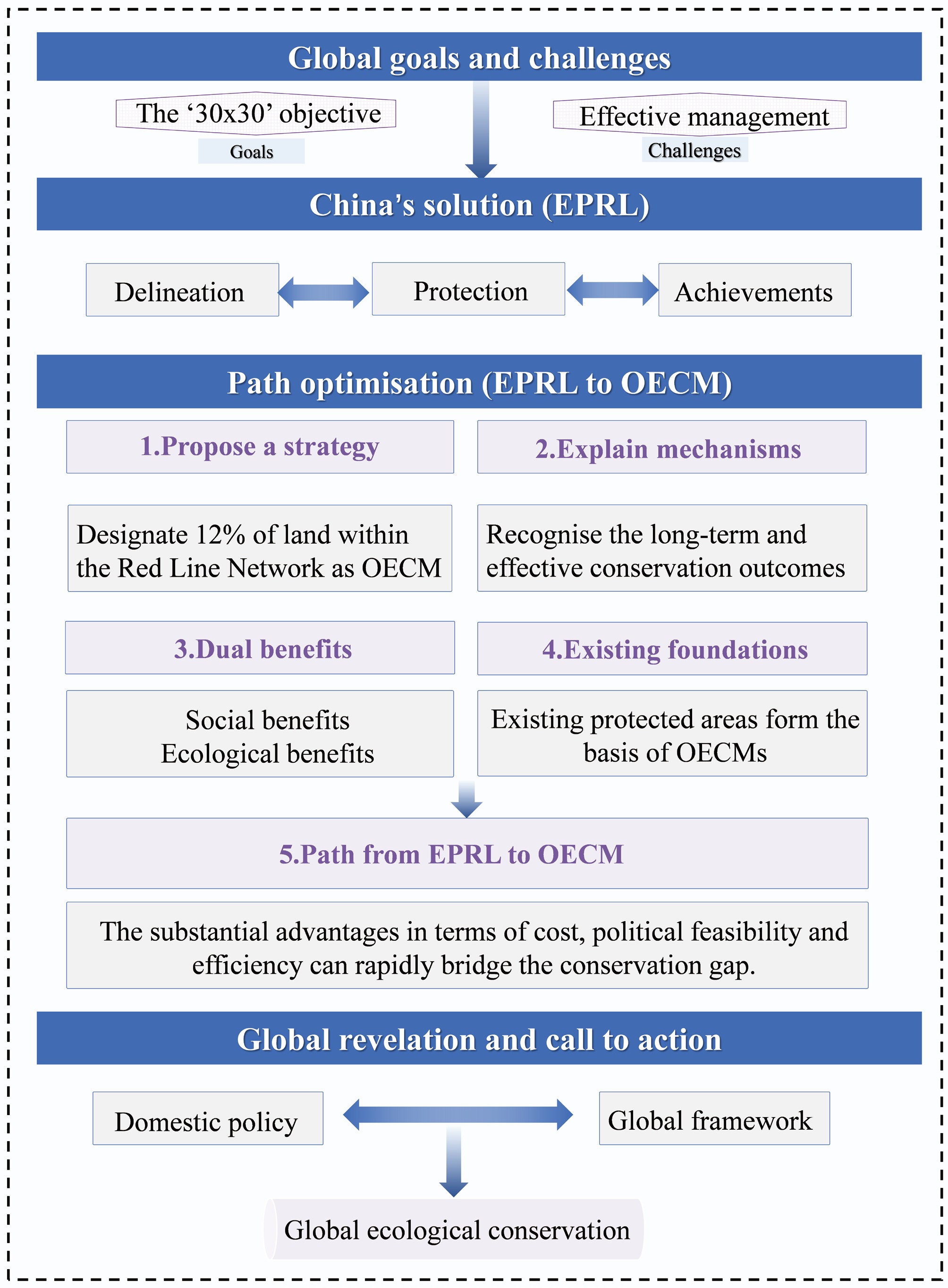
    Figure 1. 

    Technical roadmap flowchart.

    We argue that the most effective and scientifically sound strategy for China and other countries is to formally designate eligible areas (12% of land) within this established EPRL network as other effective area-based conservation measures (OECMs). The core innovation of OECMs lies in their recognition of long-term effective conservation outcomes, regardless of whether conservation is the primary management objective. The implementation of OECMs has significant benefits for key ecological and social elements. Ecologically, endangered species (e.g., the Siberian tiger) and biological corridors gain enhanced legal status and more robust conservation planning, which improves habitat connectivity. Socially, these measures reciprocally support local communities through developing eco-tourism and the preservation of natural and cultural heritage, thereby providing sustainable support for local livelihoods. The EPRL's strict development prohibitions and mandatory ecological restoration measures have already secured such outcomes, making it a ready-made foundation for the designation of OECMs[3].

    This EPRL to OECM pathway avoids the high costs and political resistance associated with establishing new protected areas. China has set the interim goal of bringing 18% of its land into the formal protected area system by 2030[1], but there remains a gap of approximately 12% of the national territory to meet the 30 × 30 effective conservation target proposed by the Convention on Biological Diversity (CBD). The EPRL encompasses the country's most critical ecological spaces, some of which, despite their high conservation value, fall outside the formal protected area system. Designating these areas as OECMs would directly confer a strictly protected status under the existing governance framework, enabling China to bridge the 12% gap more quickly, efficiently, and with less institutional friction and resource investment. For other emerging economies facing similar pressures, this institutional innovation offers a highly replicable and feasible model[4].

    China's experience demonstrates that achieving the 30 × 30 target is not merely a challenge of spatial planning but also one of governance capacity. The crucial next step is for the international conservation community to embrace and incentivize such innovative, nationally tailored solutions. By integrating robust domestic policies with global frameworks like OECMs, we can ensure that the 30 × 30 target yields a functionally and effectively protected planet, rather than merely fragmented lines on a map[5,6].

    • The authors confirm their contributions to the paper as follows: Shaokun Li: conceptualization, resources, writing − original draft, writing − review and editing. Xiaoqian Chen: formal analysis, software, visualization. Both authors reviewed the results and approved the final version of the manuscript.

    • Data sharing is not applicable to this article as no datasets were generated or analyzed during the current study.

    • This study was supported by the Geological Survey Projects of the China Geological Survey (Grant No. DD202308008).

    • The authors declare that they have no conflict of interest.

    • Full list of author information is available at the end of the article.

    • Copyright: © 2025 by the author(s). Published by Maximum Academic Press, Fayetteville, GA. This article is an open access article distributed under Creative Commons Attribution License (CC BY 4.0), visit https://creativecommons.org/licenses/by/4.0/.
Figure (1)  References (6)
  • About this article
    Cite this article
    Li S, Chen X. 2025. A Chinese model for 30 × 30: ecological redlines as other effective area-based conservation measures. Environmental and Biogeochemical Processes 1: e014 doi: 10.48130/ebp-0025-0014
    Li S, Chen X. 2025. A Chinese model for 30 × 30: ecological redlines as other effective area-based conservation measures. Environmental and Biogeochemical Processes 1: e014 doi: 10.48130/ebp-0025-0014

  • Catalog

      /

      DownLoad:  Full-Size Img  PowerPoint
      Return
      Return