











-
Paddy fields represent key hotspots for the formation and accumulation of methylmercury (MeHg), primarily due to fluctuating redox potential and high contents of organic matter, which fuel the microorganisms responsible for mercury (Hg) methylation[1]. Rice plants exhibit efficient uptake of MeHg, with the bioaccumulation factor reaching up to 34[2]. Consequently, rice, a staple food for over half of the world’s population, serves as a major dietary source of MeHg exposure, posing a notable threat to food security and public health[3]. Estimates indicate that human dietary exposure to MeHg results in an average reduction of 0.086 IQ points per newborn and approximately 29,000 fatal cardiovascular cases annually, amounting to economic losses of approximately
${\$} $ In response, efforts have been devoted to mitigating human exposure risks. Current Hg abatement strategies primarily rely on controlling Hg emissions into the environment. Fundamental approaches include phasing out Hg-containing products, switching to clean energy sources, and installing flue-gas purification systems. These measures have started to produce detectable effects. For instance, Feng et al. reported that atmospheric elemental Hg declined by ~40% from 2013 to 2022[5]. However, these source-oriented measures are less effective in reducing MeHg bioaccumulation. This is because the precursor for MeHg formation, i.e., mobile inorganic Hg (IHg), stems not only from the anthropogenic Hg emissions, but also the natural sources and the re-mobilization of legacy Hg[6]. Consequently, it is estimated that the reduction in human exposure to MeHg is only 1/3–1/2 of that in Hg emissions[4]. While these source-oriented measures are crucial for reducing global Hg pools, they fall short of addressing the legacy Hg already deposited in ecosystems. Consequently, direct intervention in contaminated environments has been explored, though it presents its own set of challenges. Commonly used in situ remediation techniques, such as the application of soil amendments, are often constrained by their tendency to disrupt soil ecosystems and their uncertain long-term efficacy. Notably, excessive use of biochar, a commonly used agent for immobilizing heavy metals and improving fertility, may even increase paddy MeHg production[7]. Hence, there is a clear need to develop precise, efficient, and ecologically compatible strategies that align with the goals of sustainable agriculture and food security.
-
Selenium (Se) is a natural antagonistic element of Hg and shows potential for mitigating Hg risks, in part through its reported capacity to inhibit Hg methylation. Traditionally, Se is believed to suppress MeHg formation by efficiently immobilizing IHg to form inert and highly insoluble HgSe due to the strong chemical affinity between Se and Hg[8]. However, formation of HgSe typically requires a relatively high dose of Se, for instance, around 100 mg/kg. Such a high dose could cause Se contamination and associated risks, given that the threshold for soil Se pollution is set at only 3 mg/kg in China. At environmentally relevant doses, Se undergoes complex biogeochemical cycling in soil. It is prone to immobilization by soil constituents or interaction with other metal ions, thereby limiting the fraction of applied Se that remains bioavailable for Hg antagonism. Recently, Se has been reported to reduce the abundance of iron-reducing bacteria (FeRB) such as Geobacteraceae, a key microbial group that influences MeHg bioaccumulation in paddy fields, thus indirectly mitigating Hg risk[9]. These data suggest that amending soil with Se to regulate MeHg production is promising. However, the molecular mechanisms by which Se influences FeRB remain unclear. Moreover, introducing Se may alter soil microbiome composition and induce unexpected impacts on soil properties, making meticulous validation necessary before large-scale field implementation. Collectively, while Se addition—whether through IHg immobilization or FeRB regulation—holds theoretical promise for inhibiting Hg methylation, its practical adoption in agricultural production remains limited.
Selenium has also been reported to be involved in MeHg degradation in vivo, thereby reducing its accumulation in biota. The potential role of Se in MeHg degradation was proposed in 1982[10]. After that, Se-mediated MeHg degradation was occasionally reported[11−13]. In this process, MeHg-cysteine complexes (MeHgCys)—which disrupt biological functions—can be transformed into the tetrahedral configuration Hg(SeC)4 in the presence of Se. In vertebrates, the reaction is chiefly catalyzed by selenoprotein P, synthesized in the liver; in invertebrates such as earthworms, it is driven by low-molecular-weight selenol molecules such as selenoneine. The resulting intermediate aggregates through interactions between metal centers, forming disordered atomic clusters that eventually self-assemble, crystallize, and undergo biomineralization to generate nanoparticulate HgSe. This pathway effectively sequesters and detoxifies Hg[14]. Notably, all the aforementioned demethylation processes occur in animals. Whether Se can similarly mediate MeHg demethylation in plants remains an open question. If such Se-induced MeHg demethylation were to occur in rice plants, it could represent a viable strategy to mitigate MeHg accumulation in rice grains.
-
The main challenge in investigating the potential role of Se in mitigating MeHg accumulation in rice plants is efficiently incorporating Se into the plants while minimizing impacts on soil properties. Although soil Se application can significantly increase plant Se content, this approach is often unsuitable due to the relatively high doses required, which risk causing Se toxicity and altering soil biogeochemistry. Alternatively, foliar Se application can also increase Se content in plant tissues; however, such a method showed no significant effect on MeHg accumulation[15]. This might be attributed to the spatial separation of Se and MeHg within the plant, resulting from their different exposure pathways, i.e., foliar absorption vs root uptake, which likely restricts their interaction at relevant physiological sites.
In contrast, seed priming presents a compelling alternative that navigates the trade-offs between efficacy, safety, and sustainability. As a sustainable agricultural practice, seed priming involves treating seeds with exogenous substances and then re-drying them prior to germination. This priming process in seeds improves nutrient uptake, activates ROS signaling pathways, and modulates hormone levels or enzyme activities, thereby pre-establishing oxidative stress defense and building systemic resistance memory. As a result, germination efficiency and seedling tolerance to both biotic and abiotic stresses are significantly enhanced[16]. Commonly used priming methods and agents include hormone-mediated priming (e.g., with gibberellin A3,3-indoleacetic acid, or abscisic acid), bio-priming mediated by probiotics, nano-priming mediated by advanced materials such as SiO2 or AgNPs, as well as physical priming mediated by magnetic fields or cold plasma[17]. Se, particularly in its nanoscale form, has emerged as a novel focus in seed priming due to its high bioactivity, low toxicity, and controlled-release characteristics. Previous research demonstrated that priming with Se nanoparticles increased germination rate, root development, plant height, and biomass accumulation of rice seedlings under environmental stress by 15.90%, 39.87%, 5.81%, and 8.54%, respectively[18]. Critically, seed priming uses only minute quantities of Se, eliminating the risks of soil toxicity and biogeochemical disruption associated with soil application. Furthermore, by priming the seed itself, this method ensures that Se is present within the plant from the earliest growth stage, co-localizing with MeHg as it is taken up by the roots—a distinct advantage over foliar spraying. This pre-positioning maximizes the potential for their in-planta interaction, offering a precise, efficient, and ecologically compatible strategy for mitigating MeHg accumulation in rice grains.
Seed priming might mitigate Hg risk by modulating the absorption, transportation, and metabolism of the highly toxic MeHg. Seed priming, regardless of the priming agents, has been reported to significantly mitigate the accumulation of various heavy metals in plants. These beneficial effects are mainly achieved through the activation of the antioxidant enzyme system to reduce oxidative damage[19], regulation of heavy metal transporter expression to limit uptake and translocation[20], and improvement of the rhizosphere microenvironment to alter heavy metal speciation and bioavailability[21]. Seed priming with Se has also demonstrated potential in enhancing heavy metal resistance[22]. For instance, it can effectively mitigate antimony (Sb) toxicity in rice seedlings by regulating the transcription levels of genes involved in phytochelatin synthesis and transport (e.g., OsPCS2 and OsABCC1), cell-wall modification (e.g., OsWAK11), and Se/Sb uptake (e.g., OsLsi1), thereby reducing Sb distribution in rice roots by approximately 80%[20].
Seed priming might also mitigate Hg risk by promoting MeHg demethylation within rice plants. Our previous study reported that ROS in roots can cleave the Hg-C bond of MeHg with the aid of thiols, thereby converting it into IHg[23]. Se priming pre-activates the antioxidant system and fine-tunes intracellular redox homeostasis. This process promotes moderate and stable ROS generation while preventing excessive quenching, consequently optimizing the microenvironment for the demethylation reaction. In addition, the pre-loaded Se is widely involved in metabolism in the form of organic species such as SeCys. The selenol group (-SeH) in these compounds can competitively bind MeHg to form MeHg-SeR complexes. Within these complexes, the strong Hg-binding affinity and electron-donating capacity of Se weaken the Hg-C bond. This increased lability makes the bond more vulnerable to cleavage by ROS, thereby promoting the conversion of MeHg to IHg. Nevertheless, immediate experimental evidence for a net demethylation effect driven by Se priming is still limited. The specific regulatory pathways and detailed molecular mechanisms through which Se might improve this process also remain poorly defined. These gaps represent key scientific questions that require systematic validation and in-depth investigation in future research.
-
Therefore, to determine whether seed priming with Se could be a promising measure to mitigate MeHg risks, three core questions should be addressed, including effectiveness validation, mechanism exploration, and feasibility assessment. To elaborate: (1) the antagonistic effect of Se on Hg is strongly concentration-dependent, creating a dilemma in which too little Se offers no benefit, while too much increases the risk of Se toxicity; (2) Although several pathways have been suggested for Se action, its exact role remains uncertain. In particular, the key protein expression involved in natural demethylation in rice and the exact sites at which selenium interacts within those steps remain unknown; and (3) The efficacy of this technique is susceptible to interference from various field variables such as soil properties, water management, and co-existing pollutants, and its stability and generalizability have not been validated.
Addressing these challenges requires an integrated methodology that combines controlled laboratory experiments with systematic field validation. As shown in Fig. 1, we propose a feasible research framework to advance this line of inquiry:
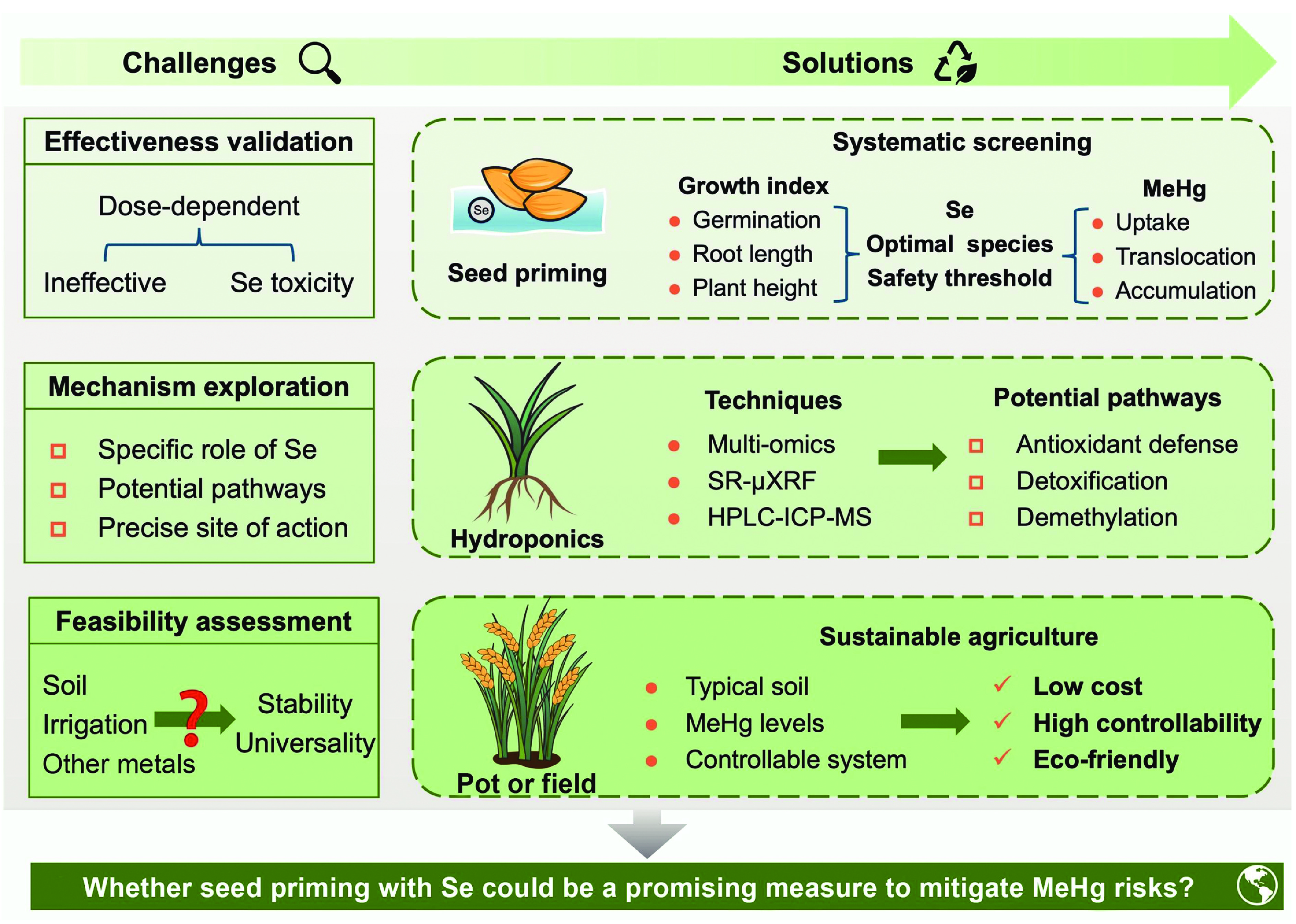
Figure 1.
Seed priming with selenium for mitigating mercury risk: three key challenges and a proposed research framework.
(1) For efficiency validation, controlled hydroponic conditions should be employed to systematically evaluate the effects of seed priming with different Se species (e.g., selenite, SeCys, and Se nanoparticles) at a range of concentrations on MeHg uptake, translocation, and accumulation in rice. Combined with rice growth parameters, the optimal Se species and its safety threshold can be identified.
(2) For potential mechanisms, advanced in vivo elemental distribution techniques should be used to visualize and quantify the speciation dynamics as well as spatial co-localization of Se and Hg at the root interface and within plant tissues. Meanwhile, integrated multi-omics analyses, including transcriptomics, proteomics, and metabolomics, should be applied to elucidate the molecular network underlying the responses of primed rice to MeHg accumulation. The primary focus should be on identifying key genes and proteins involved in antioxidant defense, heavy metal detoxification, or potential demethylation pathways.
(3) For large-scale application, once we have a clearer picture of the dose-response relationships and the underlying mechanisms, the final step is to test Se priming under more realistic conditions—first in pot experiments using representative paddy soils with varying physicochemical properties (e.g., acidic vs neutral pH, high vs low organic matter content), then in field trials with different levels of historical MeHg contamination. These trials should assess not only agronomic performance but also its environmental stability and long-term ecological side effects.
By incorporating these specific techniques, experimental designs, and assessment endpoints, the proposed three-step framework becomes a technically grounded roadmap for systematically evaluating seed priming with Se as a sustainable strategy to mitigate MeHg accumulation in rice.
Seed priming provides clear benefits for enhancing rice tolerance to heavy metals, with potential applicability to Hg stress, and is characterized by low cost, high controllability, and environmental friendliness. In the case of Se, seed priming represents a promising strategy that sustains antagonism against MeHg uptake and translocation throughout the entire growth period, thereby reducing Hg accumulation in grains and effectively mitigating associated environmental and health risks while strengthening food safety at the source. Furthermore, this strategy provides a transferable interdisciplinary framework for research and application in addressing similar paddy pollution challenges, thereby contributing to the transition of agricultural production systems toward more eco-friendly practices.
-
Not applicable.
-
The authors confirm their contributions to the paper as follows: Yang Ji: data collection, analysis and interpretation of results, draft manuscript preparation, manuscript revision; Jiannan Liao: data collection, analysis and interpretation of results; Bin Yang: manuscript revision; Wenli Tang: study conception and design, draft manuscript preparation, manuscript revision; Huan Zhong: study conception and design, manuscript revision. All authors reviewed the results and approved the final version of the manuscript.
-
Data sharing is not applicable to this article because no datasets were generated or analyzed during the current study.
-
Wenli Tang and Huan Zhong acknowledge the financial support from the National Natural Science Foundation of China (Grant Nos 42577256, 42525710), and the Natural Science Foundation of Jiangsu Province (Grant No. BK20230082).
-
The authors declare that they have no conflict of interest.
-
Full list of author information is available at the end of the article.
- Copyright: © 2026 by the author(s). Published by Maximum Academic Press, Fayetteville, GA. This article is an open access article distributed under Creative Commons Attribution License (CC BY 4.0), visit https://creativecommons.org/licenses/by/4.0/.
-
About this article
Cite this article
Ji Y, Liao J, Yang B, Tang W, Zhong H. 2026. Seed priming with selenium: potential pathway for mitigating mercury risk in rice. Agricultural Ecology and Environment 2: e010 doi: 10.48130/aee-0026-0007 

Seed priming with selenium: potential pathway for mitigating mercury risk in rice
- Received: 12 February 2026
- Revised: 06 March 2026
- Accepted: 13 March 2026
- Published online: 15 March 2026
Abstract: Rice is the primary dietary source of neurotoxic methylmercury (MeHg) for inland populations and infants, as paddy fields are critical hotspots for its formation and accumulation. Many efforts—such as Hg emission control strategies and in situ immobilization approaches—have been made to mitigate human exposure to MeHg, but their efficiency is often limited by high costs, unexpected soil ecosystem disruption, or unstable effectiveness, hindering effective Hg risk mitigation. Here, we propose that seed priming—an agricultural practice involving seed treatment with chemicals followed by controlled drying prior to germination—with selenium (Se) might be a promising approach to reduce MeHg accumulation in rice. This is supported by: (1) the widely reported inhibition of heavy metal accumulation after seed priming; (2) the potentially more efficient Se-Hg antagonism due to the dynamic transformation of Se species pre-loaded during the priming process; and (3) the potential elevated MeHg demethylation in vivo by reactive oxygen species (ROS) resulting from seed priming-induced ROS levels. Based on this hypothesis, we further outline a research roadmap to figure out whether and how seed priming with Se mitigates Hg risks, which integrates in vivo elemental distribution, multi-omics-based mechanistic elucidation, and application evaluation in pot or field systems. If seed priming with Se proves effective, it would be a promising approach to mitigate Hg risks and provide a precise, efficient, and environment-friendly solution for sustainable agriculture.
-
Key words:
- Seed priming /
- Selenium-mercury antagonism /
- Methylmercury /
- Sustainable agriculture