











-
Garlic flavour is a pungent sensory experience combining taste and aroma. It is a characteristic feature of many Allium species (e.g., garlic and onion) and makes these plants highly valued as foodstuffs[1]. This flavour is not confined to plants, as comparable flavour profiles have also been reported in certain macrofungi, including some species in Agaricales, Boletales, etc. Lentinula edodes (Berk.) Pegler, commonly known as "shiitake (香菇)", is noted for its garlic-like aftertaste and aroma[2,3], and has become one of the most extensively cultivated mushrooms worldwide[4]. The garlic-like flavour in Lentinula has been described as including notes reminiscent of garlic, onion, rotten cabbage, or radish[4−6]. This feature has also been reported in the phylogenetically related genera Mycetinis and Gymnopus. Together with Lentinula, they form a monophyletic lineage within the Omphalotaceae in one phylogenetic work[2], in which the substances responsible for the flavour have therefore been discussed as an apomorphic character. Species exhibiting a garlic-like flavour have been reported in four additional genera of the family, extending the known taxonomic distribution of this feature[3,7−10]. In China, Lanmaoa asiatica G. Wu & Zhu L. Yang and Butyriboletus roseoflavus (H.B. Li & H.L. Wei) D. Arora & J.L. Frank are usually called "red garlic (红葱)" and "white garlic (白葱)", respectively, by the local people because of their garlic-like flavour. Unfortunately, such flavour has rarely been clearly documented in the literature. Although these two species are distantly related to the Omphalotaceae, the occurrence of garlic-like flavours in Boletales implies that the trait may be more widespread and potentially under-reported. However, it remains unclear whether this feature has been documented in Agaricales outside Omphalotaceae. It is therefore difficult to determine whether the trait is apomorphic or plesiomorphic within the family. A better understanding of the phylogenetic and taxonomic distribution of this feature is essential for exploring its evolutionary history.
The diversity of garlic-flavoured species across lineages has not yet been systematically reviewed. Historically, these fungi were placed in several genera of marasmioid and collybioid fungi[11] and then reassigned into at least five genera of Omphalotaceae by morphomolecular approaches[2,7,8,12,13]. Some taxa may have been overlooked during previous taxonomic revisions, and their placement requires further evaluation. These unresolved taxonomic and phylogenetic questions constrain current assessments of the taxonomic distribution of garlic-flavoured species.
This review aims to collect and summarise the available records of Agaricales species exhibiting this feature, to advance knowledge of their diversity, to discuss their taxonomic placement, and, on this basis, to elucidate their phylogenetic distribution and evaluate possible evolutionary scenarios.
-
In this review, flavour broadly refers to sensory impressions described as smell or taste, because flavour is a multidimensional experience primarily composed of smell and taste[14]. The term "garlic-like flavour" refers to a smell or taste reminiscent of garlic, rotten cabbage, onion, or radish.
Data collection and processing
-
Information on Agaricales species reported to possess a garlic-like flavour was collected from published literature. Searches were conducted using scientific databases such as Web of Science and Google Scholar, as well as available taxonomic monographs and reference books. Relevant records were retrieved using combinations of keywords such as "garlic odour/taste", "alliaceous smell/taste", "rotten cabbage", "onion", and "Agaricales". Records referring to infraspecific taxa (e.g., varieties or subspecies) were treated at the species level to maintain a uniform taxonomic rank. The retained records were considered reliable after applying the following filtering criteria: records derived from monographs (M), records derived from protologues (P), and records derived from taxonomic research publications (C) in which the trait is commonly present in closely related lineages within the family and, if this was not the case, the record had to be supported by at least two independent literature sources. The corresponding letters are used in Table 1 to indicate which criterion each record satisfied. For each valid species, the genus, family, and suborder were recorded according to the latest classification of the Agaricales[15,16]. The backbone topology followed a genome-scale phylogeny of Agaricales[17] and was then pruned to match our taxon set. To increase genus-level coverage, additional genera were incorporated according to published multilocus phylogenies (internal transcribed spacer 1, 5.8S ribosomal RNA gene, internal transcribed spacer 2, and large subunit regions of the nuclear ribosomal DNA)[3], yielding the final hybrid tree used for trait mapping (Fig. 1a). The genus Rhodocollybia appeared as two separate lineages in the multilocus phylogenies. The nontype lineage was removed to clarify intergeneric relationships prior to grafting.
Table 1. Overview of garlic-like flavour reported in Agaricales species
Species name Odour Taste Ref. Filters Amanita alliacea (Murrill) Murrill Decided odour of wild onion Not recorded [18] P A. alliodora Pat. Very distinct garlic odour Not recorded [19] P A. suballiacea (Murrill) Murrill Strong garlic odour Not recorded [18] P Clavaria alliacea Corner Strong garlic Strong garlic [20] P C. fuscata Oudem. Strong garlic Not recorded [20,21] C, M Dendrothele alliacea (Quél.) P.A. Lemke Garlic-like Not recorded [22] P Gymnopus alliifoetidissimus T.H. Li & J.P. Li Strongly alliaceous Not recorded [23] P G. alpicola (Bon & Ballarà) Esteve-Rav., V. González, Arenal & E. Horak Strong smell reminiscent of rotten cabbage, with faint a component of garlic Tastes like the smell [12] M G. brassicolens (Romagn.) Antonín & Noordel. Foetid smell like rotten cabbage or sewage; sometimes more like garlic Not recorded [12] M G. ceraceicola J.A. Cooper & P. Leonard Garlic/rotten cabbage Not recorded [24] P G. chowii J.P. Li, Chang-Tian Li & Y. Li Rotten cabbage-like Not recorded [7] P G. cystidiosus J.J. Hu, B. Zhang & Y. Li A strong smell reminiscent of rotten cabbage or onion Not recorded [25] P G. densilamellatus Antonín, Ryoo & Ka Unpleasant, like rotten cabbage or garlic Mild or bitterish [26] P G. dysodes (Halling) Halling Pungent, like old onions or garlic Onion-like, but not too disagreeable [27] P G. dysosmus Polemis & Noordel. Strong, unpleasant, foetid, or like garlic Strong, unpleasant, foetid, or like garlic [12] M G. epiphyllus J.J. Hu, B. Zhang & Y. Li A strong smell reminiscent of rotten cabbage or onion Not recorded [25] P G. foetidus (Sowerby) P.M. Kirk A nasty smell like rotten cabbage Nasty [12] M G. graveolens (G. Poirault ex Boud.) Antonín & Noordel. Like rotten cabbage Distinctly bitter [12] M G. hakaroa J.A. Cooper & P. Leonard Garlic/rotten cabbage Not recorded [24] P G. hariolorum (Bull.) Antonín, Halling & Noordel. A strong, fetid smell, like rotten cabbage or sewage Very unpleasant [12] M G. herinkii Antonín & Noordel. Strong, like garlic/onions Strong, like garlic/onions [12,28] M G. imbricatus J.A. Cooper & P. Leonard Garlic/rotten cabbage Not recorded [24] P G. impudicus (Fr.) Antonín, Halling & Noordel. Like rotten cabbage, sometimes with a garlic component Like rotten cabbage, sometimes with a garlic component [12] M G. iocephalus (Berk. & M.A. Curtis) Halling Pungent and unpleasant (reported as smelling of garlic, radish, sauerkraut, or gunpowder) Unpleasant [27] M G. iodes J.P. Li, Chang-Tian Li, Chun Y. Deng & Y. Li Garlic-like Not recorded [29] P G. montagnei (Berk.) Redhead Garlic Not recorded [30] M G. neobrevipes R.H. Petersen Negligible Negligible or weakly alliaceous [31] P G. polyphyllus (Peck) Halling Garlic Garlic [27] M G. purpureicollus (Corner) A.W. Wilson, Desjardin & E. Horak Smell of garlic, not strong Tasting rancid or rotten [32,33] P, C G. pyrenaeicus (Bon & Ballarà) Antonín & Noordel. Like cabbage or foetid Sweet or slightly like cocoa [12] M G. similis Antonín, Ryoo & Ka Garlic-like Garlic-like [26] P G. sinopolyphyllus J.P. Li, Chang-Tian Li & Y. Li Garlic-like Not recorded [29] P G. spadiceus J.J. Hu, B. Zhang & Y. Li A strong smell reminiscent of rotten cabbage Not recorded [34] P G. subdensilamellatus J.J. Hu, Y.L. Tuo, B. Zhang & Y. Li A strong smell reminiscent of rotten cabbage or onion Not recorded [25] P G. subpolyphyllus J.J. Hu, B. Zhang & Y. Li A strong smell reminiscent of rotten cabbage or onion Not recorded [25] P G. talisiae V. Coimbra, F.G.B. Pinheiro, Wartchow & Gibertoni Not garlic Radish-like [35] P G. thiersii (Desjardin) Mešić & Tkalčec Mild or rarely slightly foetid when old and wet The taste slowly becomes strongly alliaceous [36] P G. tianbaoyanensis J.P. Li, Chang-Tian Li & Y. Li Rotten cabbage-like Not recorded [7] P G. trabzonensis Vizzini, Antonín, Seslı & Contu Typically and strongly cabbage-like Indistinct [37] P G. variicolor Antonín, Ryoo, Ka & Tomšovský Odour foetid and garlic-like with a component of rotten cabbage Mild and unpleasant [26] P G. violaceigregarius Qasmi, A. Izhar & Khalid Garlic-like Not recorded [38] P Hygrocybe helobia (Arnolds) Bon Garlic Not recorded [39,40] M Lentinula edodes (Berk.) Pegler Garlic- or rotten cabbage-like Garlic-like [2,3] C L. raphanica (Murrill) Mata & R.H. Petersen Radish-like Radish-like [41] P Marasmiellus alliiodorus (Mont.) Singer Strong smell of garlic Not recorded [42,43] P, M M. osmophorus Dennis Strong smell of garlic Not recorded [43] M M. subingratus (Dennis) Singer Strong of garlic Not recorded [43] M Marasmius alliifoetidus Corner Garlic-like, strong, and foetid Not recorded [32] P Ma. alliipotens Corner Strong smell of garlic Not recorded [32] P Ma. edodoides Corner Slight smell of onions or of meal Not recorded [32] P Ma. hortorum Corner Smell of garlic, rather strong Not recorded [32] P Ma. matangensis Corner Smell of garlic, not strong Not recorded [32] P Mycetinis alliaceus (Jacq.) Earle ex A.W. Wilson & Desjardin Strong smell of garlic Distinct smell of garlic, sometimes also acrid [31] C My. applanatipes (Desjardin) A.W. Wilson & Desjardin Strongly alliaceous Strongly alliaceous [44] P My. arbuscularis J.P. Li, Chang-Tian Li & Y. Li Garlic-like Not recorded [7] P My. copelandii (Peck) A.W. Wilson & Desjardin Strongly alliaceous Strongly alliaceous [36] C My. curraniae (G. Stev.) J.A. Cooper & P. Leonard Garlic-like Garlic-like [45] C My. ignobilis (Berk. & Broome) Desjardin & B.A. Perry Strong smell of garlic Strong taste of garlic [46] C My. kallioneus (Huhtinen) Antonín & Noordel. Strongly alliaceous Strongly alliaceous [45] C My. olidus (Gilliam) R.H. Petersen Weakly pleasant to pungent smell of garlic Garlic or onion, often persisting with drying and storage [45] C My. prasiosmus (Fr.) R.H. Petersen Strong smell of garlic Distinct garlic component [45] C My. querceus (Britzelm.) Antonín & Noordel. Garlic Not recorded [47] C My. rufodiscus J.P. Li, Chang-Tian Li & Y. Li Garlic-like Not recorded [7] P My. salalis (Desjardin & Redhead) Redhead Strong smell of onion or garlic Strong taste of onion or sweet garlic [45] C My. scorodonius (Fr.) A.W. Wilson & Desjardin Weak to strong smell of garlic, rarely lacking Usually alliaceous [45] C My. subalpinus (P.-A. Moreau) R.H. Petersen Very powerful of garlic Alliaceous and sweet [45] C My. virgultorum (Malençon & Bertault) R.H. Petersen Garlic Garlic [45] C Paragymnopus foliiphilus (R.H. Petersen) J.S. Oliveira Usually reported as negligible, occasionally resembling boiled cabbage after drying or mildly foetid Usually reported as negligible, occasional very weak taste of garlic [9] C Pg. magnisporus J.P. Li, Chang-Tian Li & Y. Li Garlic-like Not recorded [7] P Pg. perforans (Hoffm.) J.S. Oliveira Like rotten cabbage Often tardily alliaceous [9] C Pg. sequoiae (Desjardin) J.S. Oliveira Mild or rarely slightly foetid when old and wet Strongly alliaceous after 1–2 min [9] C Paramycetinis austrobrevipes R.H. Petersen Negligible Negligible or weak taste of garlic [10] P Peckorumyces umbonatus (Peck) J.P. Li, J.S. Oliveira & Chang-Tian Li Garlic-like Not recorded [7] C Phyllotopsis nidulans (Pers.) Singer Similar to rotten cabbage Not recorded [48,49] C Pusillomyces rhizoalliaceus J.P. Li & Chang-Tian Li, nom. prov. Garlic-like Not recorded [3] C 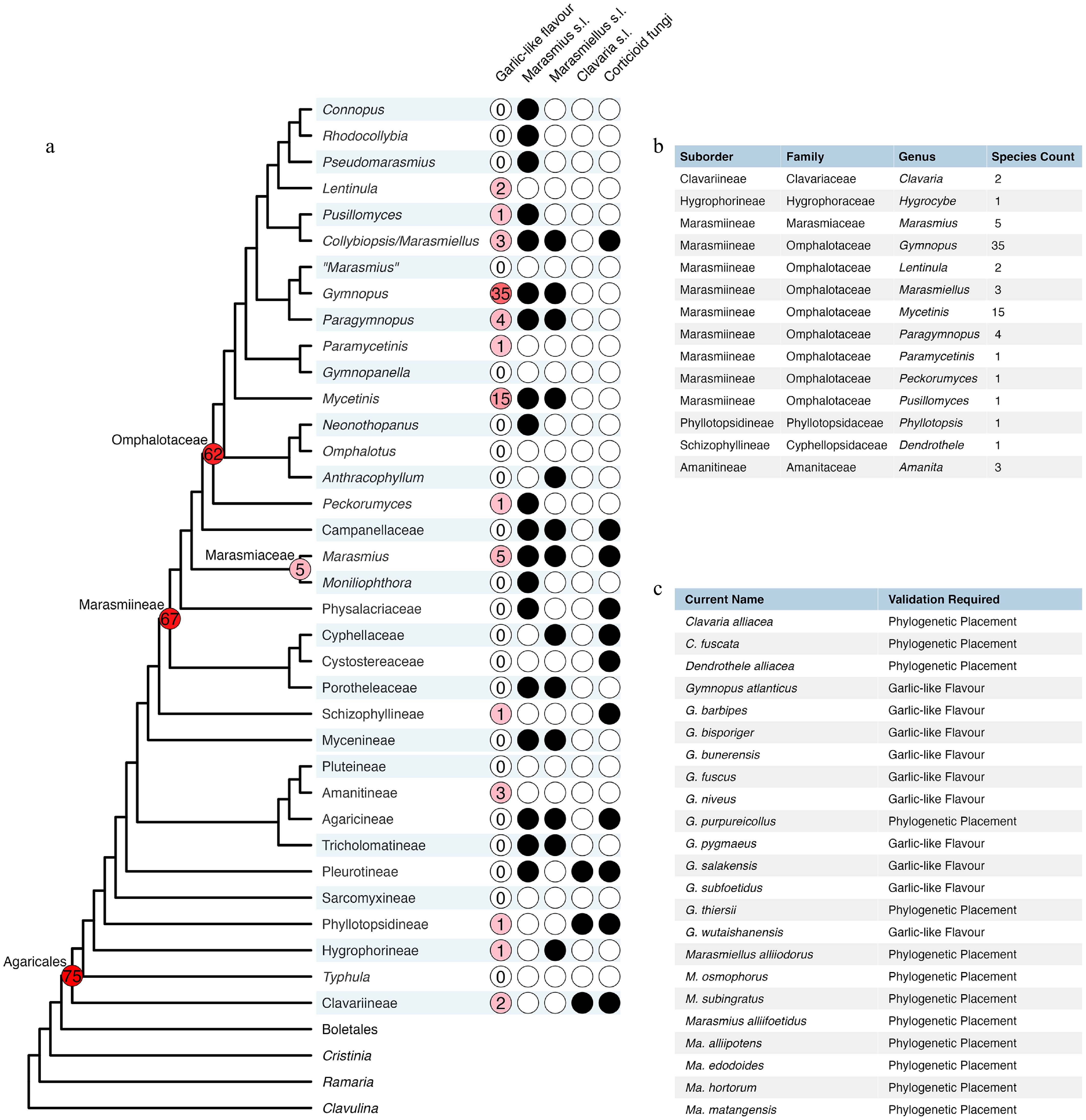
Figure 1.
The taxonomic distribution of garlic-like flavour in the Agaricales. (a) Hybrid tree of Agaricales. Numbers inside open circles indicate the number of species with a garlic-like flavour within each taxon; red fill intensifies with increasing species counts. The "Marasmius" lineage was provisionally treated as lacking the garlic-like flavour because no verifiable records were available from literature. Black-filled circles indicate the presence of the corresponding annotation. In columns representing legacy genus concepts (Marasmius s. l., Marasmiellus s. l., and Clavaria s. l.), they mark genera containing species historically placed under those names according to Index Fungorum[50]. In the "Corticioid fungi" column, they indicate genera containing corticioid taxa as documented in Larsson[51]and Dong et al.[52]. Open circles indicate absence. (b) Summary table of taxa with a garlic-like flavour across Agaricales, listing the suborder, family, and genus, with the corresponding number of species recorded as having a garlic-like flavour. (c) List of species records requiring validation, indicating whether verification is needed for phylogenetic placement or for the presence of garlic-like flavour[7,12,33,35,53−57].
-
Phylogeny is the foundation for understanding the trait's distribution. A hybrid tree was constructed by combining the robustness of phylogenomic analyses with the broader taxonomic coverage provided by multilocus phylogenetic data. The presence or absence of a garlic-like flavour and its species diversity were mapped onto the hybrid tree to explore the trait's distribution and possible evolutionary pattern.
A garlic-like flavour has been reported in 75 species of Agaricales, spanning 14 genera placed in 7 families across 6 suborders (Table 1, Fig. 1a, b). Its distribution is strongly uneven: Most records are in the Marasmiineae, where the trait is confined to Omphalotaceae and Marasmiaceae (Fig. 1a). Omphalotaceae represents the main hotspot, including 62 of the 75 recorded species and eight of the 14 genera, with the highest numbers in Gymnopus (35 species) and Mycetinis (15 species). Outside the Marasmiineae, the trait is rare and patchy, accounting for the remaining records being scattered across five suborders, each represented by a single genus. The remaining seven species were distributed among five suborders. Single species were recorded in the genera Dendrothele (Schizophyllineae), Hygrocybe (Hygrophorineae), and Phyllotopsis (Phyllotopsidineae), whereas two species were recorded in Clavaria (Clavariineae) and three in Amanita (Amanitineae).
This pattern indicates a pronounced phylogenetic clustering within a single lineage, coupled with sporadic occurrences in distant clades (Fig. 1a). At the scale of the Agaricales, the pattern is most consistent with repeated, independent origins. Outside the Marasmiineae, the garlic-like flavour is recorded only as single-genus occurrences in five other suborders. Altogether, these occurrences point to at least seven independent gains at the family level within Agaricales. Within the Omphalotaceae, the flavour is widespread across several genera but is missing from a few lineages nested within the family. If Omphalotaceae is treated as having a single origin of the trait, the genus-level patchiness within the family can be explained parsimoniously by a minimum of four secondary losses or, under a less parsimonious scenario, by eight independent gains, assuming one origin per genus. A single origin of the garlic-like flavour at the base of Agaricales would, by contrast, require losses across most major lineages, which is unlikely, given the observed pattern.
-
The distribution of garlic-like flavour in the Agaricales is compiled from published descriptions and may be biased by multiple factors. Barriers to literature access and retrieval limit the records' coverage. Recent studies continue to document new taxa exhibiting a garlic-like flavour, suggesting that additional species likely remain to be discovered and may further reshape the distribution pattern[23,29,38,58]. In addition, detection bias in accessible sources and terminological vagueness make determination of the presence or absence of a garlic-like flavour uncertain in some cases. These uncertain cases require further clarification and are highlighted in Fig. 1c.
The garlic-like flavour is diagnostic for certain groups, such as Gymnopus section Impudicae[12]. However, several species within the clade of section Impudicae (e.g., G. barbipes and G. salakensis) were originally characterized as lacking a distinct flavour[33,53]. This discrepancy may reflect either true phenotypic absence or a detection bias, as the lack of recorded flavour could result from sensory limitations. Crushing the basidiomata may be involved in releasing the flavour, and it can intensify the smell[24,45]. This is further exemplified by Peckorumyces umbonatus, in which the garlic-like flavour is sometimes negligible but becomes distinct after the stipe is cut longitudinally[7].
Even if they belong to the clade of section Impudicae, the descriptions of several species fail to provide flavour traits or specific details. This reporting gap suggests that the apparent lack of recorded garlic-like flavours could stem from incomplete descriptions rather than an actual lack of the flavour. This is largely because several descriptions prioritise broad sensory categories over specific diagnostic traits, and a reliance on generalised terms that can mask the distinct garlic-like components. Specifically, flavour data were not recorded in the original descriptions for several species, including G. atlanticus, G. fuscus, G. niveus, G. pygmaeus, and G. subfoetidus[7,35,55,56]. Furthermore, the odours of G. wutaishanensis and G. bunerensis were described only in broad terms as "tangy and unpleasant" or simply "unpleasant"[54,57].
-
Phylogeny is instrumental in resolving the evolutionary relationships of taxa exhibiting trait convergence. Recent phylogenetic studies assigned taxa with a garlic-like flavour to Peckorumyces and Pusillomyces, two genera in which the trait had not previously been recognised[3,7]. These studies have significantly expanded the known distribution of garlic-like flavour.
Phylogenetic relationships and morphology-based classifications are not always in agreement, particularly among marasmioid, clavarioid, and corticioid fungi[2,52,59]. Most species that fall outside the core distribution of the garlic-like flavour trait have an unresolved phylogenetic position, largely because most are historical taxa without molecular data. This is compounded by the nomenclatural instability and taxonomic ambiguity that characterise many historical taxa according to Index Fungorum (Fig. 1a, c)[50]. The eventual phylogenetic resolution of species currently assigned to Clavaria (two species), Dendrothele (D. alliacea, one corticioid species), Marasmiellus (three species), and Marasmius (five species) may reshape the perceived phylogenetic range of garlic-like flavour within the Agaricales. Specifically, the phylogenetic placements of the Clavaria species sampled here may define the most phylogenetically distant occurrence of garlic-like flavour within the Agaricales. The phylogenetic placement of species currently assigned to the other three genera may influence whether the distribution of this trait becomes further concentrated within the family Omphalotaceae. According to previous studies, many species of Marasmiellus and Marasmius exhibiting a garlic-like flavour have been phylogenetically recovered within the Omphalotaceae[2,45]. Furthermore, although corticioid fungi are known to be distributed across multiple suborders within Agaricales, such corticioid lineages have been repeatedly recovered within the Omphalotaceae or in closely related clades in the Marasmiineae[52,60−62]. These findings raise the possibility that many currently unplaced taxa may eventually be resolved within the Marasmiineae or Omphalotaceae, which would further reinforce the concentrated distribution of garlic-like flavour.
Because garlic-like flavour occurs in phylogenetically distant clades, it is a phylogenetically patchy trait. Such traits pose a great challenge in evolution because they can be either explained by a single origin and multiple subsequent losses, or by multiple independent origins. Some similar examples have recently been documented in the Agaricales, such as the evolution of bioluminescence[63]. In the case of garlic-like flavour, its phylogenetic distribution suggests multiple independent origins, though the situation may be more complex in the Omphalotaceae, where species with and without a garlic-like flavour form closely related clades. Another consideration for future studies is clarifying whether its genetics is also convergent, e.g., by the recruitment of the same gene families for the production of garlic-like flavour. However, given that the genetic bases of producing the garlic-like flavour are themselves partially known, their evolution also remains to be clarified in the future.
-
Garlic-like flavour has been reported in multiple suborders of Agaricales, yet its occurrence is taxonomically and phylogenetically clustered overall rather than broadly dispersed. The available evidence indicates that Omphalotaceae represents the main centre of this trait, showing the highest diversity and record density at both the species and genus levels. However, the current picture is likely to underestimate the true extent of the distribution. Limited access to the literature, continued reports of additional taxa, detection bias in published descriptions, and inconsistent terminology all introduce uncertainty into presence–absence assessments, which, in turn, affects how the continuity and discontinuity of the distribution pattern are interpreted. In addition, the phylogenetic placement of several historically described taxa remains uncertain; once these lineages are robustly resolved, the taxonomic distribution of garlic-like flavour and the degree to which it appears to be concentrated or dispersed may need to be revised.
This review helps clarify how garlic-like flavour is distributed among the existing records and how that distribution aligns with phylogenetic structure. It provides a starting point for exploring the evolutionary history of the trait and raises hypotheses about gains and losses across lineages. The observed phylogenetic clustering offers practical value in prioritizing lineages for aroma-related compound screening, even in the absence of detailed chemical data. Trait-informed targeting can improve the efficiency of identifying strains with desirable volatiles for use in food production or natural product development. In cultivars such as Lentinula, where a garlic-like flavour is already present, the identified pathways may support targeted enhancement of aroma intensity through breeding or metabolic regulation. In other lineages where the trait is absent, these findings may enable the introduction of garlic-like flavour via gene transfer or synthetic biology approaches, offering new possibilities for aroma improvement.
-
The authors confirm contribution to the paper as follows: study conception and design: Nagy LG; data collection: Li JP; analysis and interpretation of results: Nagy LG, Li JP; manuscript preparation: Nagy LG, Li JP. All authors reviewed the results and approved the final version of the manuscript.
-
All data generated or analyzed during this study are included in this published article.
-
The first author thanks Geng-Shen Wang for sharing the phylogenetic tree of Agaricales. LGN acknowledges support by the National Research Development and Innovation Office (Grant No. OTKA 142188). JPL was supported by China Scholarship Council (Grant No. 202308220156). We thank the editor and the anonymous reviewers for their constructive comments, which improved the manuscript.
-
The authors declare that they have no conflict of interest.
- Copyright: © 2026 by the author(s). Published by Maximum Academic Press on behalf of Jilin Agricultural University. This article is an open access article distributed under Creative Commons Attribution License (CC BY 4.0), visit https://creativecommons.org/licenses/by/4.0/.
-
About this article
Cite this article
Li JP, Nagy LG. 2026. The taxonomic distribution of garlic-like flavour in the Agaricales. Panfungi 1: e005 doi: 10.48130/panfungi-0025-0005 

The taxonomic distribution of garlic-like flavour in the Agaricales
- Received: 06 February 2026
- Revised: 25 February 2026
- Accepted: 08 March 2026
- Published online: 30 March 2026
Abstract: Garlic-like flavour is widely appreciated by consumers and has been reported in some plants and mushroom-forming fungi. However, its overall taxonomic distribution within the order Agaricales (Fungi) remains poorly understood. In this review, published reports of garlic-like flavour across taxa are summarised, and its phylogenetic distribution and potential evolutionary explanations are discussed. In total, 75 species representing 14 genera, 7 families, and 6 suborders are recognised. The family Omphalotaceae is a main hub for taxa with a garlic-like flavour, with Gymnopus and Mycetinis contributing most species. Only a few taxa are scattered in other families. The garlic-like flavour is concentrated in the suborder Marasmiineae but is only sporadically present in the other five suborders, a pattern suggesting multiple independent origins. Within the Omphalotaceae, its genus-level patchiness is most parsimoniously explained by a single origin and several secondary losses. The summary presented here provides an updated overview of garlic-flavoured diversity in the Agaricales and a basis for future studies on the evolution and chemical mechanisms of flavour traits in fungi.
-
Key words:
- Alliaceous /
- Marasmiineae /
- Odour /
- Omphalotaceae, Onion /
- Rotten cabbage /
- Shiitake /
- Smell /
- Taste