












-
Plastic waste is a global pollution challenge, and biological degradation by insects has emerged as a promising disposal strategy. Notably, the larvae of the yellow mealworm beetle (Tenebrio molitor) and the darkling "superworm" (Zophobas morio) can consume polystyrene foam, fragmenting and metabolizing the plastic with help from their gut microbiota[1,2]. In addition to reducing plastic mass, this process yields insect biomass and frass (larval excreta) that can be repurposed. Mealworm frass produced on a plastic diet was reported to be nontoxic and to support normal plant growth in a previous study[1], indicating its potential as a safe soil amendment.
Insect frass in general is a nutrient-rich organic fertilizer, shown to improve crop growth as effectively as synthetic N-P-K fertilizer in some cases[3]. Beyond providing basic nutrients, frass contains bioactive components such as chitin (a plant defense elicitor) and diverse beneficial microorganisms[4]. Many of the microbes associated with insect frass are plant growth-promoting bacteria that produce phytohormones such as auxins and cytokinins[4].
However, it remains underexplored how an insect’s diet, especially an unusual diet like plastic, influences the phytohormone profile of its frass. The fertilizer value of frass can vary dramatically with the larval diet[5], so we hypothesized that a nutrient-poor plastic diet might trigger changes in the frass’s hormonal signals. Because plastics provide virtually no nutrients or phytohormone precursors, any hormones detected in the frass would likely be produced by the larvae’s gut microbiota or stress-induced physiological pathways.
Here, we demonstrate that mealworms and superworms reared on plastic-rich diets produce frass with significantly elevated levels of auxins, cytokinins, jasmonates, and salicylates relative to conventional diet controls. This hormone-rich frass could serve as a biostimulant fertilizer, illustrating a novel approach to a circular economy that converts plastic waste into a value-added agricultural input[6]. To our knowledge, these findings constitute the first demonstration that an insect’s diet can broadly alter the phytohormone profile of its frass, revealing a previously unrecognized route to enhance frass's bioactivity.
-
A panel of chemicals and phytohormones was tested on the frass from the insects on the various diets (see Supplementary Table S1−S5 for the full panel of phytohormones and chemicals tested; note that the data are shown in nmol/g, but we used µg/g here for the data for better comparisons). Most of the chemicals did not show significant differences between the frass of larvae fed on plastic and organic food, except for the ones highlighted below. We did not detect significantly different mortality rates in insects fed with plastics throughout the duration of the frass collection period. All frass samples contained detectable auxins and cytokinins (Fig. 1a, b). Notably, plastic-fed larvae, especially superworms, showed notable increases in auxin levels. Frass from superworms on polystyrene (PS) or polyethylene (PE) diets had indole 3-acetic acid (IAA) concentrations around 10–11 µg/g, nearly a fivefold increase over ~2 µg/g in the bran-only (control) frass. In contrast, mealworm frass IAA remained around 1.5–2.5 µg/g regardless of diet, indicating a species-specific response. The elevated IAA in superworm frass under plastic stress was tempered when sucrose was added to the diet: Superworms on plastic with sugar produced only ~1–2 µg/g IAA, suggesting that improved nutrition alleviated the microbial or metabolic pathways driving auxin overproduction. Several minor indolic auxin metabolites (e.g. indole-3-lactic acid and IAA–amino acid conjugates) showed similar trends of accumulating in plastic-fed superworm frass but changing little in mealworms. This was consistent with the activation of tryptophan-catabolizing gut microbes under nutritional stress. These results suggest that superworms, more so than mealworms, enlist their microbiome to synthesize auxin under suboptimal (plastic) diets.
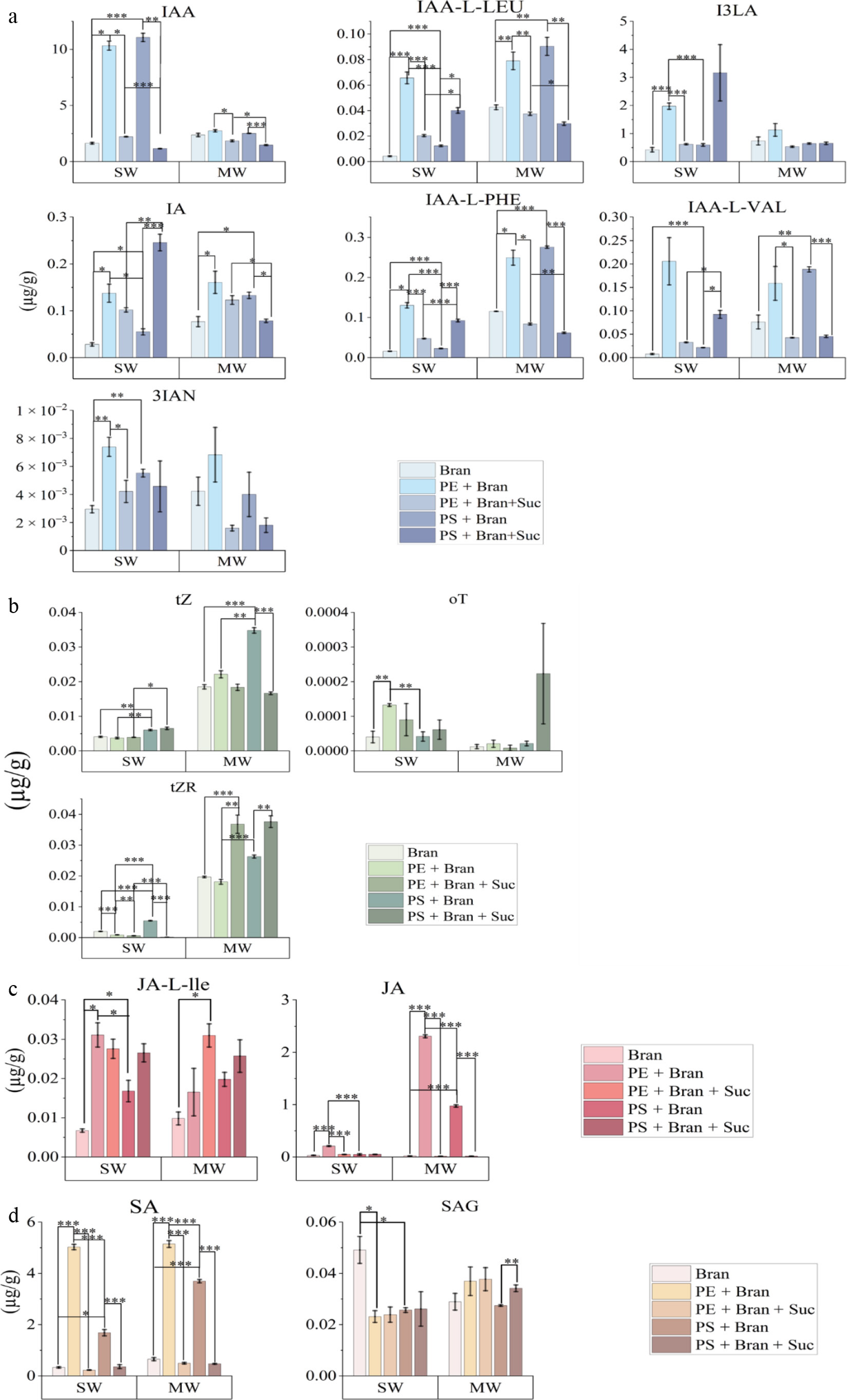
Figure 1.
Phytohormone (auxins and cytokinins) and defense-related jasmonate and salicylate levels in insect frass. (a) Auxins in superworm (SW) and mealworm (MW) frass under five diet treatments: Bran (control), PE + bran (polyethylene + bran), PE + bran + suc (polyethylene + bran + sucrose), PS + bran (polystyrene + bran), and PS + bran + suc (polystyrene + bran + sucrose). From left to right: Indole-3-acetic acid (IAA), IAA–L-leucine (IAA-L-LEU), indole-3-lactic acid (I3LA), 3-indoleacrylic acid (IA), IAA–L-phenylalanine (IAA-L-PHE), IAA–L-valine (IAA-L-VAL), and 3-indoleacetonitrile (3IAN). Frass from plastic-fed superworms had higher IAA compounds than bran-fed controls (note the prominent peaks in the blue bars for the PE and PS diets), whereas mealworm frass auxin levels remained similar. Sucrose added to the plastic diet (bars) attenuated the auxin levels in superworms. (b) Cytokinins in the same frass samples: Trans-zeatin (tZ), ortho-topolin (oT), and trans-zeatin riboside (tZR). Although the y-axis is shown in μg/g, the cytokinin values correspond to sub-μg/g, ng/g-range concentrations. Mealworm frass generally had higher cytokinin levels than superworm frass. (c) Jasmonate levels in superworm (left) and mealworm (right) frass across diets. Jasmonic acid (JA) and jasmonoyl-L-isoleucine (JA-Ile) are shown. Plastic-fed mealworm frass (especially the PE + bran treatment, dark pink bar) had elevated JA (~2 to 3 µg/g) compared with bran-fed mealworms. Superworm frass showed a smaller increase in JA under plastic diets. JA-Ile exhibited parallel trends at lower concentrations (tens of ng/g). Sucrose addition in mealworm diets enhanced JA-Ile accumulation (compare solid vs. pink bars), whereas in superworms, sucrose had a minimal effect. (d) Salicylate levels in frass: Salicylic acid (SA) and its glucose conjugate, salicylic acid 2-O-β-glucoside (SAG). Plastic feeding increased SA levels in a species and diet-dependent manner. SAG was present at much lower levels (≤ 0.05 µg/g). For the full panel of phytohormones and chemicals tested, see the Supplementary Table S5. Note that the data in the Supplementary Table S5 are shown in nmol/g, but we used µg/g here for better comparisons. Data shown here are averaged from the replicates. All values represent the mean ± standard deviation (SD) of biological replicates; the significance of differences relative to the bran controls is indicated by * = p < 0.05, ** = p < 0.01, and *** = p < 0.001.
Even though cytokinins were present at much lower concentrations (generally tens of ng/g), there were slight diet and species effects. For instance, trans-zeatin in mealworm frass generally showed higher levels than superworm frass. Given that many soil and gut bacteria produce cytokinins, the insect gut microbiome is a likely source of these hormones as well[4]. Although auxins and cytokinins in frass are in the low parts per million (ppm) to parts per billion (ppb) range, their presence could enhance plant growth beyond the fertilizer’s basic nutrients. Auxins can stimulate root development and branching, whereas cytokinins promote shoot growth. Thus, the higher auxin content of superworm frass may help explain early observations that superworm frass stimulates the rooting and growth of plants more than mealworm frass[6].
Jasmonates and salicylates in frass (Fig. 1c, d)
-
Frass from plastic-fed mealworms (especially the PE + bran diet, dark pink bar) had elevated jasmonic acid (JA) compared with frass from bran-fed mealworms. Superworm frass showed a more modest JA increase on plastic (on PE). The conjugated form, jasmonoyl-L-isoleucine (JA-Ile), followed a similar pattern: Plastic-fed worm frass contained more JA-Ile than controls. These data indicate that mealworms mount a stronger octadecanoid (jasmonate) pathway response to a plastic diet, possibly caused by greater metabolic stress or shifts in gut microbial composition when their preferred nutrients are scarce. Interestingly, adding sucrose to mealworm diets further elevated their frass's JA-Ile levels, the opposite of the effect of sucrose on superworms' auxin. This contrast suggests fundamental differences in how the two species' metabolism and microbiota respond to diet: Improved nutrition may boost microbial activity or detoxification pathways in mealworms (leading to more JA-Ile production), whereas in superworms, which cope better with a plastic diet, added sugar mainly dampened auxin-related pathways without amplifying jasmonates.
Salicylic acid (SA) accumulation were species and diet-specific. Baseline SA in bran-fed larvae was low. Under plastic diets, SA levels varied by treatment, with the strongest increases observed in PE-fed superworms. Notably, unlike auxin or JA, adding sucrose had little effect on SAG levels in either species. The elevation of salicylic compounds in plastic-fed treatments hints that certain microbes in the larval gut or frass may produce salicylates when plastics are present. Alternatively, ingestion of plastic could induce a mild stress or immune response in the insect, indirectly leading to greater excretion of phenolics (although the insects themselves do not use SA as a signaling hormone). Importantly, no toxic chemicals were detected in the frass from plastic-fed larvae (data not shown) (e.g., no residual styrene monomers or plastic additives), in agreement with earlier findings that mealworm frass does not accumulate harmful residues from polystyrene[1]. This indicates the hormone-rich frass is safe and usable as a soil input.
The enrichment of jasmonates and salicylates in worm frass could have significant biostimulant effects on plants. Exogenous application of JA or SA is known to trigger plants' defense responses and induce systemic resistance in the absence of pathogen attack, essentially "priming" the plant’s immune system[4]. Consistently, recent studies have shown that amending soil with insect frass can enhance plants' pest resistance. For example, maize (Zea mays) grown in soil supplemented with Hermetia illucens frass had upregulated expression of JA/SA-regulated defense genes and suffered less herbivore damage[7]. Similarly, components in insect frass (including a recently identified plant-derived peptide in caterpillar frass) can elicit stronger defense responses in crops like rice (Oryza sativa)[8]. However, we have not yet directly tested the effects of this hormone-rich frass on plant growth or pest resistance. Thus, the presence of JA and SA in mealworm/superworm frass may imbue it with pest-protective qualities by priming plants' defense pathways. Coupled with the auxins and cytokinins that can promote growth, this plastic-derived frass is likely to be a biostimulant fertilizer that both enhances plant vigor and fortifies plants against stress.
-
Late-instar mealworm and superworm larvae were reared for 28 days on one of five diets: (1) Wheat bran (control); (2) PS + ~50% wheat bran; (3) PS + bran + ~10% sucrose; (4) low-density PE + ~50% bran; (5) PE + bran + ~10% sucrose. Bran provided minimal nutrition, and sucrose was included in some treatments as a co-substrate on the basis of prior findings that supplemental sugar can enhance plastic consumption by these larvae[6]. Frass (excreta) from each group was collected after the feeding period, ensuring separate true replicates for each diet and species. Each diet treatment for each species was maintained in three independent rearing containers, serving as biological replicates.
Hormone analysis
-
Frass samples were dried and analyzed for a suite of phytohormones spanning four major classes. Using targeted UHPLC–MS/MS (ultrahigh-performance liquid chromatography–tandem mass spectrometry), we quantified representative growth hormones, including auxins (IAA and several indolic IAA metabolites) and cytokinins (e.g. trans-zeatin), defense-related hormones such as JA, its isoleucine conjugate JA-Ile, and SA plus its glucose conjugate. Quantification was based on calibration with authentic standards, and hormone levels in frass are reported on a dry-weight basis (ng or µg per g). Data were analyzed using pairwise t-tests to assess the effects of species and diet on each hormone against the control and other treatments (with significance at p < 0.05). Details of calibration and the hormone levels are shown in the Supplementary Table S3−S5.
-
Mealworms and superworms fed on plastic waste produce frass containing all four major classes of plant hormones at biologically relevant levels and without any detectable toxic residues. Such hormone-rich frass can act as a combined fertilizer and plant biostimulant, supplying nutrients, beneficial microbes, and signaling compounds that promote growth and induce resistance in crops. Our findings highlight an innovative strategy for sustainable agriculture: using insects to upcycle nonrecyclable plastic into a value-added organic fertilizer. This approach aligns with circular economic principles by turning plastic pollution into a resource for food production rather than treating it as a contaminant. Future work should explore the agronomic performance of plastic-derived frass in various crops and soil settings, as well as to elucidate the microbial origin of the frass phytohormones, but our results underscore its promise as a sustainable fertilization and plant health tool. Embracing insect-mediated plastic conversion to fertilizer could help close waste loops and enhance crop productivity in an environmentally responsible way.
This research was financially supported by the Wenzhou-Kean University High Level Talent Program (No. WB20220901000091).
-
The authors confirm their contributions to the paper as follows: study conception and design: Gan SKE; data collection: Lin H, Xu W, Qiu Z; analysis and interpretation of the results: Lin H, Xu W, Zeng Y, Zhou Z, Qiu Z, Gan SKE; draft manuscript preparation: Lin H, Zeng Y, Wong A, Gan SKE. All authors reviewed the results and approved the final version of the manuscript.
-
The quantified hormone dataset supporting the findings of this study is provided in Supplementary Table S1, and raw instrument data files are available from the corresponding author upon request. All other relevant data are included in this published article.
-
The authors declare that they have no conflicts of interest.
-
accompanies this paper online at: https://doi.org/10.48130/ph-0026-0007.
-
# Authors contributed equally: Haojie Lin, Wan Xu
- Supplementary Table S1 Targeted analyte information (phytohormone panel).
- Supplementary Table S2 MRM parameters for target analytes.
- Supplementary Table S3 Calibration and linearity parameters.
- Supplementary Table S4 Accuracy and precision of hormone quantification.
- Supplementary Table S5 Quantification results for phytohormones in frass (nmol per gram dry frass).
- Copyright: © 2026 by the author(s). Published by Maximum Academic Press on behalf of Chongqing University. This article is an open access article distributed under Creative Commons Attribution License (CC BY 4.0), visit https://creativecommons.org/licenses/by/4.0/.
-
About this article
Cite this article
Lin H, Xu W, Zeng Y, Zhou Z, Wong A, et al. 2026. Worm frass phytohormones from plastic waste. Plant Hormones 2: e009 doi: 10.48130/ph-0026-0007 

Worm frass phytohormones from plastic waste
- Received: 11 December 2025
- Revised: 04 February 2026
- Accepted: 12 March 2026
- Published online: 21 April 2026
An Author Correction to this article was published on 21 April 2026, http://doi.org/10.48130/ph-0026-0015
Abstract: Certain insect larvae can biodegrade plastic into frass (excrement) that functions as a biofertilizer. We found that yellow mealworms and superworms fed on polystyrene or polyethylene produced frass enriched in all four major classes of plant hormones, i.e., auxins, cytokinins, jasmonates, and salicylates, compared with bran-fed controls. This suggests that plastic-derived frass could simultaneously promote plant growth and prime plant defenses, adding sustainable value to this waste-to-fertilizer pathway.