












-
Soils in the upper 1 m store approximately 1,500–2,400 Pg C, exceeding the carbon held in the atmosphere and vegetation combined, although the exact estimate depends on depth definition and whether deeper permafrost pools are included[1,2]. Because agricultural climate-mitigation strategies are evaluated primarily through changes in soil organic carbon (SOC), this review focuses on SOC rather than soil inorganic carbon, while considering dissolved organic matter (DOM) and greenhouse-gas (GHG) fluxes where they directly affect SOC persistence or interpretation. In managed croplands, even small relative changes in SOC matter because they influence climate regulation, soil fertility, and the credibility of carbon-removal claims.
Biochar is widely promoted as a climate-smart amendment because it adds persistent pyrogenic carbon (PyC) and can alter aggregation, pH, nutrient retention, and microbial processing of carbon. At the same time, agricultural soils increasingly receive microplastics (MPs) from mulch films, drip-irrigation materials, sludge, compost, tire wear, and atmospheric deposition. Reported MPs loads in croplands span orders of magnitude, from tens of mg kg−1 to g kg−1 levels and from hundreds to more than 105 particles kg−1 depending on management system, polymer type, and analytical method[3,4]. In many agricultural topsoils targeted for biochar application, the prevailing MPs background is already dominated by weathered PE- and PP-rich residues derived from mulch films, irrigation infrastructure, and waste-associated organic amendments, with fragments and fibers often more common than pristine particles[5,6]. Thus, biochar deployment increasingly occurs within a polymer-impacted soil matrix rather than in a chemically simple background.
The central gap is not whether biochar and MPs matter individually, but how they interact once they occupy the same plough layer, aggregate surfaces, and pore networks. Biochar can stabilize or prime SOC depending on its properties and the receiving soil, whereas MPs can alter pore continuity, DOM routing, microbial habitats, and the apparent measurement of soil carbon. Yet few studies have experimentally tested this co-occurrence hypothesis directly, and even fewer have linked process responses to carbon-accounting consequences. Treating the two materials separately, therefore, obscures non-additive effects on SOC persistence and GHG emissions.
Accordingly, this review has three aims: first, to synthesize realistic co-occurrence pathways of biochar and MPs in agricultural soils, including field-relevant evidence on polymer types, abundances, and weathering states; second, to organize evidence from particle-scale interfaces to system-scale SOC and GHG outcomes while explicitly distinguishing evidence-supported mechanisms, emerging evidence, and conceptual hypotheses; and third, to develop an MRV-oriented analytical framework for separating native SOC from PyC and MPs-derived carbon, with implications for field management and model integration. An overview of the contrasting and converging pathways by which biochar and MPs reshape SOC stocks and fluxes is shown in Fig. 1.
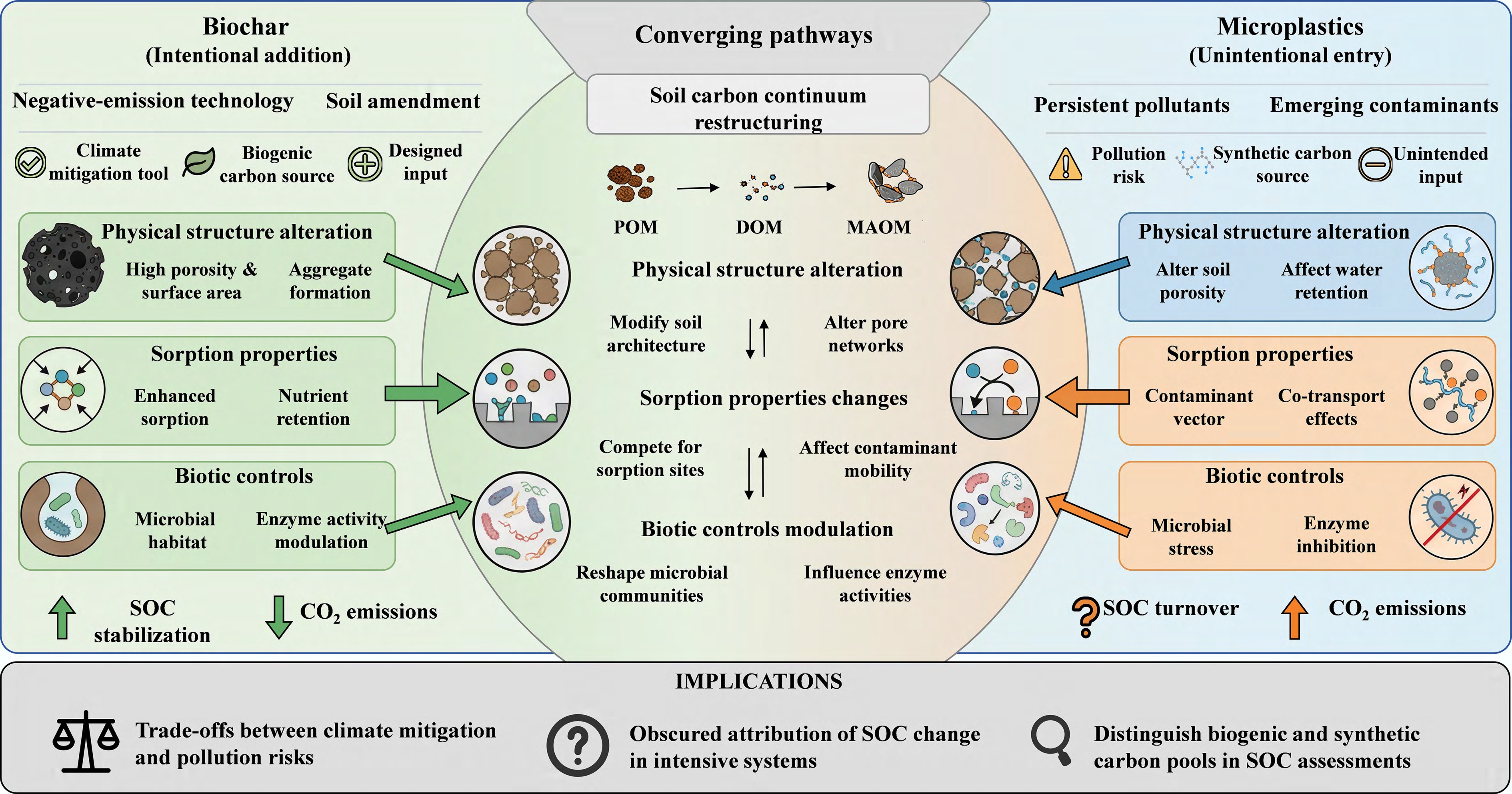
Figure 1.
Contrasting and converging pathways by which biochar and MPs reshape SOC stocks and fluxes. Biochar is intentionally added as a negative-emission technology and soil amendment, whereas MPs enter soils largely unintentionally as persistent pollutants. Despite this contrast, both act as persistent carbonaceous particles that enter the soil carbon continuum and alter physical structure, sorption properties, and biotic controls on SOC turnover, thereby influencing the formation, stabilization, and mineralization of SOC and associated CO2 emissions. In the central overlap, biochar and MPs co-occur in many intensively managed systems, jointly restructuring the continuum from particulate organic matter to dissolved and mineral-associated forms. This unified framework highlights trade-offs between climate mitigation and emerging pollution risks, obscures attribution of SOC change and associated climate feedbacks in intensive systems, and underscores the need to distinguish biogenic and synthetic carbon pools in SOC assessments and models.
-
In agricultural soils, biochar, MPs, and SOC increasingly co-exist as a coupled carbon system (Fig. 2). In the framework below, we distinguish evidence-supported co-occurrence pathways from emerging or still conceptual interaction pathways so that mechanisms, hypotheses and MRV implications are not conflated. Before discussing these pathways, however, it is important to recognize that neither biochar nor MPs is a uniform material class. Biochar behavior depends strongly on feedstock, pyrolysis temperature, ash content, aromaticity, porosity, and surface functional groups, whereas MPs behavior depends on polymer type, morphology, size, additive content, crystallinity, and weathering status. Throughout this review, these attributes are treated as first-order controls on sorption, DOM routing, microbial colonization, and analytical recoverability rather than as background descriptors.
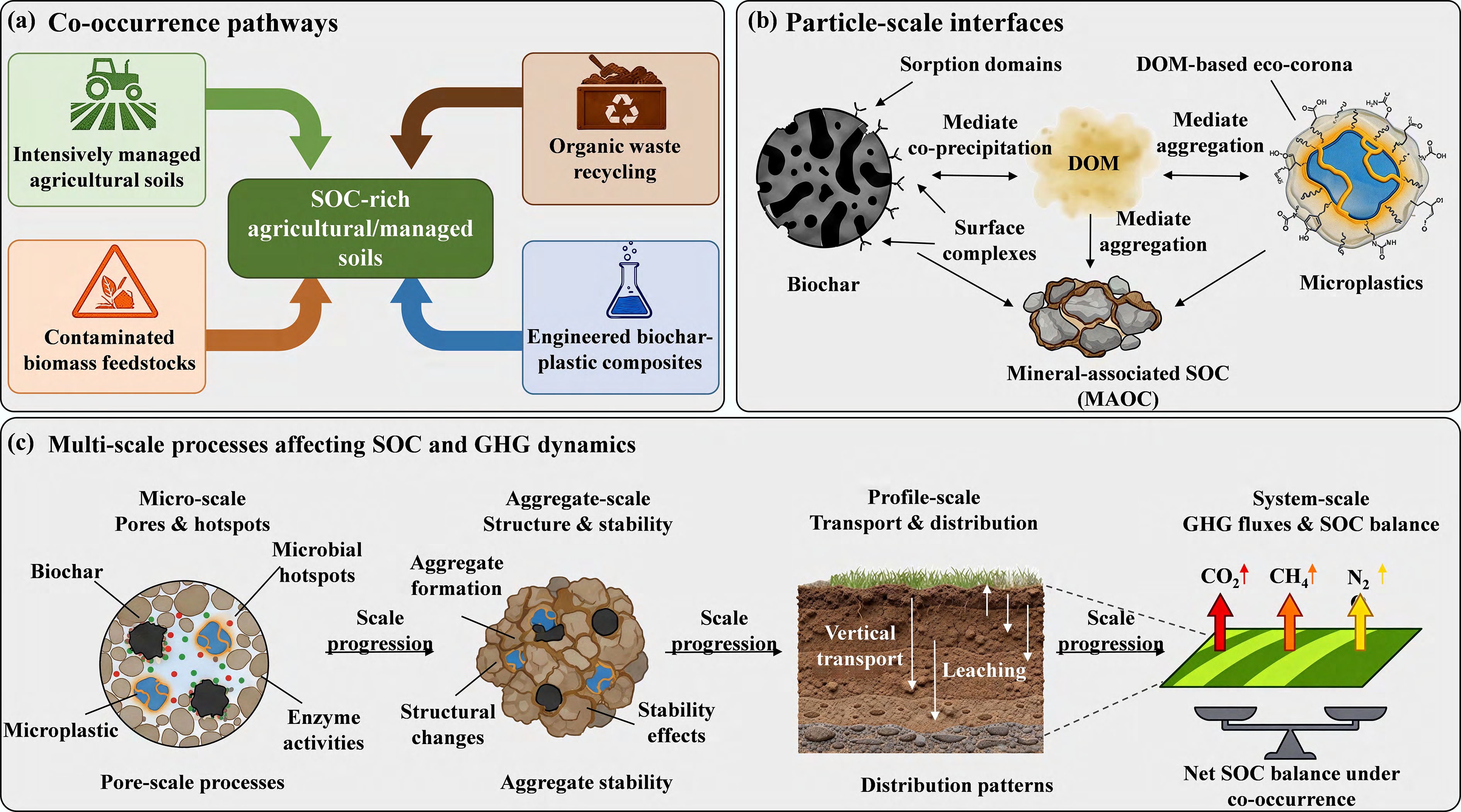
Figure 2.
Conceptual framework linking co-occurrence scenarios, particle-scale interfaces, and multi-scale processes of biochar–MPs-SOC interactions. (a) Pathways by which biochar and MPs co-occur in soils, including intensively managed agricultural soils, organic waste recycling, contaminated biomass feedstocks, and engineered biochar-plastic composites, converge on SOC-rich agricultural/managed soils. (b) Particle-scale interfaces among biochar, microplastics, DOM, and mineral-associated SOC. Biochar forms sorption domains and surface complexes, MPs develop DOM-based eco-coronas, and DOM mediates co-precipitation and aggregation that influence MAOC formation. (c) Multi-scale processes through which these interfaces affect SOC and greenhouse gas (GHG) dynamics, from micro-scale pores and hotspots, through aggregate- and profile-scale changes in structure and transport, to system-scale CO2, CH4, and N2O fluxes and net SOC balance under co-occurrence.
Co-occurrence scenarios of biochar and MPs in SOC-rich soils
-
We distinguish four major co-occurrence pathways, each with different occurrence characteristics and therefore different implications for SOC dynamics and MRV. Although direct field datasets that simultaneously quantify biochar and MPs remain limited, agricultural surveys already show that cropland MPs backgrounds commonly span approximately 102 to > 105 particles kg−1 and from tens of mg kg−1 to g kg−1, with polymer identity, morphology, and weathering state varying systematically with management and input pathway[3−6]. In intensively managed systems, PE and PP frequently dominate because of mulch-film and irrigation-related sources, whereas sludge- and compost-associated inputs can introduce more compositionally diverse mixtures, including fibers and fragments with broader size spectra. These field patterns indicate that future factorial studies should preferentially use field-relevant polymers, aged particles, and realistic loading ranges rather than relying predominantly on pristine materials or single-polymer scenarios.
Evidence-supported pathway 1 is legacy field co-occurrence: MPs generated from mulch films, drip lines, and greenhouse plastics accumulate gradually in the topsoil and are typically weathered, spatially heterogeneous, and chronically present before biochar is added. Under this pathway, biochar is incorporated into an aged polymer background dominated by surface-oxidized fragments and fibres, so the first-order consequence is interaction with pre-existing plastic residues rather than fresh polymer inputs. Pathway 2 is co-input through organic-waste recycling. Sewage sludge, composted municipal waste, and some manures can carry mixed MPs into soil, and the same waste streams are increasingly thermochemically converted into biochar. Compared with pathway 1, this route tends to generate more compositionally diverse particle mixtures, stronger coupling with nutrients and DOM, and pulsed rather than purely legacy inputs. It is therefore especially relevant to microbial priming, additive release, and the analytical co-counting of non-native carbon. Pathway 3 is the pyrolysis of plastic-contaminated biomass. Crop residues, forestry slash, and green waste can contain bale wrap, twine, and film remnants; after pyrolysis, most polymers are degraded, but plastic-derived carbon, additives, or residual fragments may persist within or on the resulting biochar. This route creates the most intimate particle-scale association between PyC and polymer-derived carbon and therefore poses one of the strongest challenges for attribution and carbon accounting. Also, emerging pathway 4 is the reuse or disposal of engineered biochar-plastic composites, such as filtration media, remediation materials, or biodegradable composite products. In contrast with diffuse agricultural contamination, this pathway may create localized hotspots with relatively well-defined compositions but high local concentrations, making it important for risk management even if its current geographic extent is smaller. Across these pathways, the key differences are the aging state of the MPs, the intimacy of contact between polymers and biochar, the vertical distribution of particles, and whether co-occurrence is chronic or pulsed. These differences help explain why apparently similar biochar–MPs systems can produce different sorption behavior, microbial responses, and measurement bias. Representative field-relevant backgrounds are summarized in Table 1. Together, they imply that experimental designs should be anchored in realistic co-occurrence contexts, particularly with respect to MPs loading, polymer identity, morphology, and weathering status.
Table 1. Representative field-relevant microplastic backgrounds in agricultural soils where biochar is likely to be deployed or evaluated
Agricultural context Dominant MPs features Representative abundance reported
in agricultural surveysTypical field state Implication for factorial experiments Plastic-mulched, greenhouse, or irrigation-intensive systems PE/PP films, fragments, and fibers derived from mulch films, drip lines, and greenhouse plastics Commonly within the upper agricultural range, often 103 to > 105 particles kg−1 and from tens of mg kg−1 to g kg−1, depending strongly on method and management Mostly weathered; topsoil-enriched and spatially heterogeneous Prioritize aged PE/PP fragments and fibers, legacy topsoil placement, and realistic rather than pristine inputs Organic-waste amended systems (sludge, compost, manure-associated inputs) More compositionally diverse mixtures, including PE, PP, PET, PS, and fiber-rich materials Broad but measurable backgrounds that commonly fall within 102 to 104 particles kg−1 and mg kg−1 to g kg−1 ranges, with strong source dependence Mixed aged and less-aged particles; pulsed rather than purely legacy inputs Use polymer mixtures, fiber-rich treatments, and pulsed co-input scenarios rather than single-polymer additions only General intensively managed cropland background Heterogeneous legacy residues, secondary fragments, fibers, and weathered surface-oxidized particles Overall cropland surveys span about 102 to > 105 particles kg−1 and from tens of mg kg−1 to g kg−1 Aged, weathered, and patchily distributed across the plough layer Constrain experiments with realistic loading ranges, weathering state, and management history The abundance values are intended as field-relevant orders of magnitude synthesized from agricultural surveys; they remain strongly method-dependent because size cutoffs, extraction procedures, and polymer-identification methods differ among studies[3−7]. Physicochemical interfaces among biochar, MPs, and SOC
-
At the particle scale, biochar and MPs exhibit contrasting but complementary properties that determine their interactions with SOC, dissolved organic matter, nutrients, and pollutants (Fig. 2b). Importantly, the three interface types below should not be viewed as isolated categories; they often operate as a cascade from surface conditioning to DOM bridging to composite-particle formation. These processes are best interpreted against explicit descriptors of biochar identity (feedstock, pyrolysis conditions, elemental ratios, and particle size) and MPs identity (polymer type, morphology, size, and aging status).
Interface 1, sorption domains and surface chemistry. Biochar commonly provides high specific surface area, micro- and mesoporosity, aromatic domains, and oxygen-containing functional groups, with charge behavior strongly controlled by feedstock and pyrolysis temperature[8,9]. In practice, lignocellulosic biochars produced at moderate-to-high pyrolysis temperatures often show stronger aromaticity and surface area development, and therefore greater capacity to retain DOM and organic co-contaminants than less-condensed materials or ash-rich chars[8,10]. MPs, by contrast, are lower-capacity but potentially mobile sorbents whose behavior depends on polymer type, crystallinity, additives, and aging. Weathering commonly introduces carbonyl, hydroxyl, and carboxyl-like functionalities, increases roughness, and creates cracks, thereby increasing DOM and contaminant affinity; aged fragments and fibers therefore behave differently from pristine particles in both sorption strength and interfacial reactivity[9,11]. Together with mineral surfaces, these phases redistribute SOC and co-contaminants among solution, particle surfaces, and mineral-associated domains. Interface 2, DOM bridges and eco-coronas. MPs rapidly acquire eco-coronas composed of DOM, microbial exudates, and biomacromolecules, whereas DOM can sorb to biochar through hydrophobic partitioning, hydrogen bonding, cation bridging, and surface complexation. Specific studies further show that DOM leached from plastics such as PVC and PS can bind effectively to mineral phases such as kaolinite and goethite, indicating that MPs influence SOC not only as particles but also through dissolved intermediates[12]. Biochar particles also develop organo-mineral coatings and mixed sorption domains over time, which can redirect DOC from the solution phase to sorbed or mineral-associated pools rather than merely removing it from detection[10]. When both materials co-occur, DOM can act as a bridge rather than merely a coating: it can connect biochar, mineral particles, and MPs into biochar-DOM-mineral or MPs-DOM-biochar assemblages, while simultaneously changing surface charge, wettability, and microbial colonization. The central regulatory pathway here is carbon routing: DOM bridging can favor mineral-associated organic carbon formation in some contexts but divert ligands away from minerals in others. Interface 3, composite particles and ambiguous SOM fractions. As coatings accumulate, biochar and MPs can become embedded in mixed particles composed of polymers, PyC, minerals, DOM, and microbial residues. Analytical syntheses and fractionation-oriented studies suggest that low-density MPs and biochar fragments may be co-recovered in light fractions, whereas mineral- or DOM-coated particles and fine PyC can be carried into heavy fractions that are often interpreted as MAOM[6,13,14]. These composite particles, therefore, blur the operational boundary between particulate organic matter and mineral-associated organic matter and create direct analytical ambiguity because polymer-derived carbon and PyC may be co-recovered in fractions that are often interpreted as stabilized biogenic SOC. Within the soil organic matter continuum, these composites act as junctions where synthetic, pyrogenic, and biogenic carbon intersect.
Taken together, these representative results make clear that the interface problem is materially specific rather than generic: a weathered PE fragment is not equivalent to a pristine PS bead, and a high-temperature lignocellulosic biochar is not equivalent to a low-temperature ash-rich char. This heterogeneity is one reason why apparently similar studies can report different directions or magnitudes of SOC response, and it should therefore be built directly into experimental design, interpretation, and MRV logic. Therefore, the dominant cascade is often: (1) aging and sorption condition particle surfaces; (2) DOM and biomolecules form coatings or bridges; (3) mixed aggregates and composite particles emerge; and (4) SOC accessibility, mineral association, and microbial processing are altered. The main regulatory pathways from microscopic to macroscopic scales are partitioning, accessibility, and microbial habitat filtering rather than any single material trait, and these pathways should be interpreted against explicit material identity and field-relevant co-occurrence intensity.
Multi-scale processes and emergent effects on SOC dynamics
-
Embedding particle-scale interfaces into an SOC framework requires connecting micro-scale interactions, aggregate- and profile-scale structure and transport, and system-scale carbon budgets (Fig. 2c). At the microscale, biochar fragments create highly porous microhabitats that can concentrate substrates, microbes, and enzymes, whereas MPs, particularly fibres and films, can disrupt or reorganize pore continuity and water films[9,11]. Microcosm experiments show that MPs alone can enhance or suppress SOC mineralization depending on polymer type, soil texture, and moisture, largely via changes in microbial biomass, enzyme activities, and community composition[7]. By contrast, biochar often increases microbial carbon use efficiency and alters community composition by modifying pH, sorbing inhibitory compounds, and providing refugia. When both materials co-occur, their combined effect on SOC depends on who has access to which carbon under which microenvironmental conditions. At larger scales, biochar can improve aggregation, water retention, and mechanical stability, whereas MPs can weaken or fragment aggregates and create preferential flow paths, leading to divergent controls on DOM residence time and redox heterogeneity that shape decomposition pathways and GHG production[3,9,11]. These physical drivers interact with biological controls because biochar often increases microbial carbon use efficiency by modifying pH and sorbing inhibitory compounds, while MPs can change microbial resource allocation by creating unique microsites for microbial colonization.
Recent studies show that co-occurrence interactions frequently yield additive, synergistic, or antagonistic responses in SOC turnover and GHG fluxes, rather than a single predictable direction. In agricultural soils, co-application of biochar and MPs has altered cumulative CO2, CH4, and N2O emissions relative to individual treatments[15−17], confirming that effects cannot be inferred by simple summation. Within the SOM continuum framework, biochar and MPs alter accessibility, routing, and residence time of organic matter through coupled effects on surfaces, pores, microbes, and minerals. Their combined effects therefore emerge from interactions among surfaces, pores, microbes, and minerals, not from the properties of either material alone. Mechanisms discussed below are summarized in Table 2.
Table 2. Mechanism–scale evidence matrix linking biochar–microplastic co-occurrence to soil organic carbon dynamics and measurement, reporting, and verification (MRV) risks
Mechanism Scale Key indicators Expected direction Boundary conditions Methods and MRV notes Ref. Plastic use → fragmentation → MPs accumulation Field/profile MPs abundance; polymer types; size spectrum MPs ↑ over time Intensive croplands; mulch/greenhouse; tillage and UV aging Extraction and ID bias; size cutoffs; density separation limits [3] Biochar → aggregation and physical protection pathways Aggregate WSA; MWD; aggregate-associated C WSA ↑; protected C ↑ Texture and dose dependent; feedstock/pyrolysis T Fractionation logic needed; biochar particles may be
co-recovered[18] MPs → aggregate disruption/pore reconfiguration Aggregate/profile WSA; bulk density; pore metrics WSA ↓ or ± Strongly depends on shape (fiber/film), loading, texture, moisture Physical shifts may precede SOC response; report MPs shape and dose [19] Sorption/partitioning at biochar interfaces → DOM routing changes Micro (particle–solution) DOC; SUVA254; fluorescence indices DOC bioavailability ↓ or ± Depends on biochar surface chemistry/ash; DOM type; aging Sorption ≠ stabilization; distinguish solution loss vs mineral association [8] MPs affect DOM transport/mobilization (DOC export and routing) Micro→profile DOC flux; DOM composition DOC transport ↑ or ± Polymer type and aging; colloids; flow regime Filtration pore size and DOC methods bias signals; MPs-leachates confound [20] MPs alter soil C cycling and microbial processes (synthesis-level evidence) Micro→system CO2, CH4; microbial metrics/CO2, CH4 CO2 ↑ and CH4 ↓, but ± Plastic type/size/dose; moisture and texture Strong scale dependence; report dose (w/w) and exposure time [21] Non-additive outcomes under biochar × MPs co-occurrence Microcosm/incubation Cumulative CO2; priming index Non-additive common (±) Requires factorial design; biochar × MPs × soil context Must test interaction term; avoid single-factor inference [15] Co-occurrence reshapes GHG trade-offs (CO2–CH4–N2O) System CO2, CH4, N2O; GWP Direction ± (trade-offs frequent) Redox + N availability govern sign If using GWP, state time horizon; report moisture/redox [15−17] Paddy/flooded soils: MPs perturb CH4/N2O processes System (redox) CH4, N2O flux; redox proxies Direction ±; flooding-dependent Flooding regime + substrate + soil type Record redox proxies (Eh, DO, Fe[II]) and flooding duration/regime. [22] SOM 'continuum' view: accessibility > intrinsic recalcitrance Conceptual Accessibility proxies; mineral association Emphasizes context dependence Universal theory anchor Avoid 'recalcitrance-only' framing; stress accessibility/protection [23] MRV bias: MPs carbon inflates operational SOC (chemical oxidation) MRV Walkley–Black/dichromate SOC SOC overestimation risk ↑ MPs-contaminated soils; low native SOC higher risk Must declare artifact; use blanks/parallel methods [24] MRV bias: biochar/PyC causes 'CDR double counting' risk MRV/accounting PyC quantification; attribution logic Over-crediting risk ↑ Biochar-amended soils; project accounting contexts Separate native SOC change vs exogenous PyC stock [25] This table synthesizes cross-scale pathways by which biochar and microplastics (MPs) co-occur in agricultural soils and jointly shape soil organic carbon (SOC) formation, stabilization, and mineralization, highlighting where methodological artefacts and attribution errors can bias SOC and greenhouse-gas (GHG) assessments. Scale indicates the primary level of observation (particle–solution, aggregate/pore, soil profile/field, system flux, or MRV/accounting). Expected direction (↑, ↓, ±) is relative to appropriate controls; ± denotes strong context dependence. Boundary conditions summarize dominant controls on response magnitude/sign. Methods and MRV notes flag key biases (e.g., fractionation co-recovery, DOM/DOC method artefacts, and misclassification of exogenous pyrogenic/polymeric C as 'operational SOC'). SOC, soil organic carbon; SOM, soil organic matter; MPs, microplastics; DOM, dissolved organic matter; DOC, dissolved organic carbon; SUVA254, specific ultraviolet absorbance at 254 nm; WSA, water-stable aggregates; MWD, mean weight diameter; MAOM, mineral-associated organic matter; Ksat, saturated hydraulic conductivity; CUE, carbon use efficiency; GHG, greenhouse gases; CO2, carbon dioxide; CH4, methane; N2O, nitrous oxide; GWP, global warming potential; MRV, measurement, reporting and verification; PyC, pyrogenic carbon; Eh, redox potential; DO, dissolved oxygen; Fe(II), ferrous iron; CDR, carbon dioxide removal. Evidence-base, temporal dynamics and model implications
-
Most evidence summarized above still comes from short-term laboratory incubations, controlled mesocosms, and conceptual syntheses. Field studies that explicitly manipulate both biochar and MPs remain rare, and the temporal dimension is therefore poorly constrained. This matters because some mechanisms are evidence-supported over days to months (for example, surface conditioning and short-term GHG responses), whereas others remain emerging or conceptual at annual to decadal scales (for example, persistent buffering, critical ratios, and model transferability). Existing soil-carbon models, such as RothC- or CENTURY-type frameworks, only partly represent PyC and generally do not represent polymer-derived carbon explicitly. Model integration will therefore require at least one additional persistent anthropogenic carbon pool, together with transfer pathways describing sorption, fragmentation, priming, and measurement bias. Without this step, long-term projections of SOC persistence and MRV outcomes will remain weakly constrained.
-
Biochar is often promoted as a negative-emission technology because it adds a highly aromatic, thermally altered carbon pool to soils while simultaneously modifying SOC cycling. Yet its net impact on SOC is the sum of two components: (1) the direct input of pyrogenic C and (2) indirect changes in native SOC stabilization and mineralization. Recent global syntheses show that biochar generally increases SOC stocks, but with strong context dependence across soil type, climate, feedstock, and co-management practices[26−28] (Fig. 3).
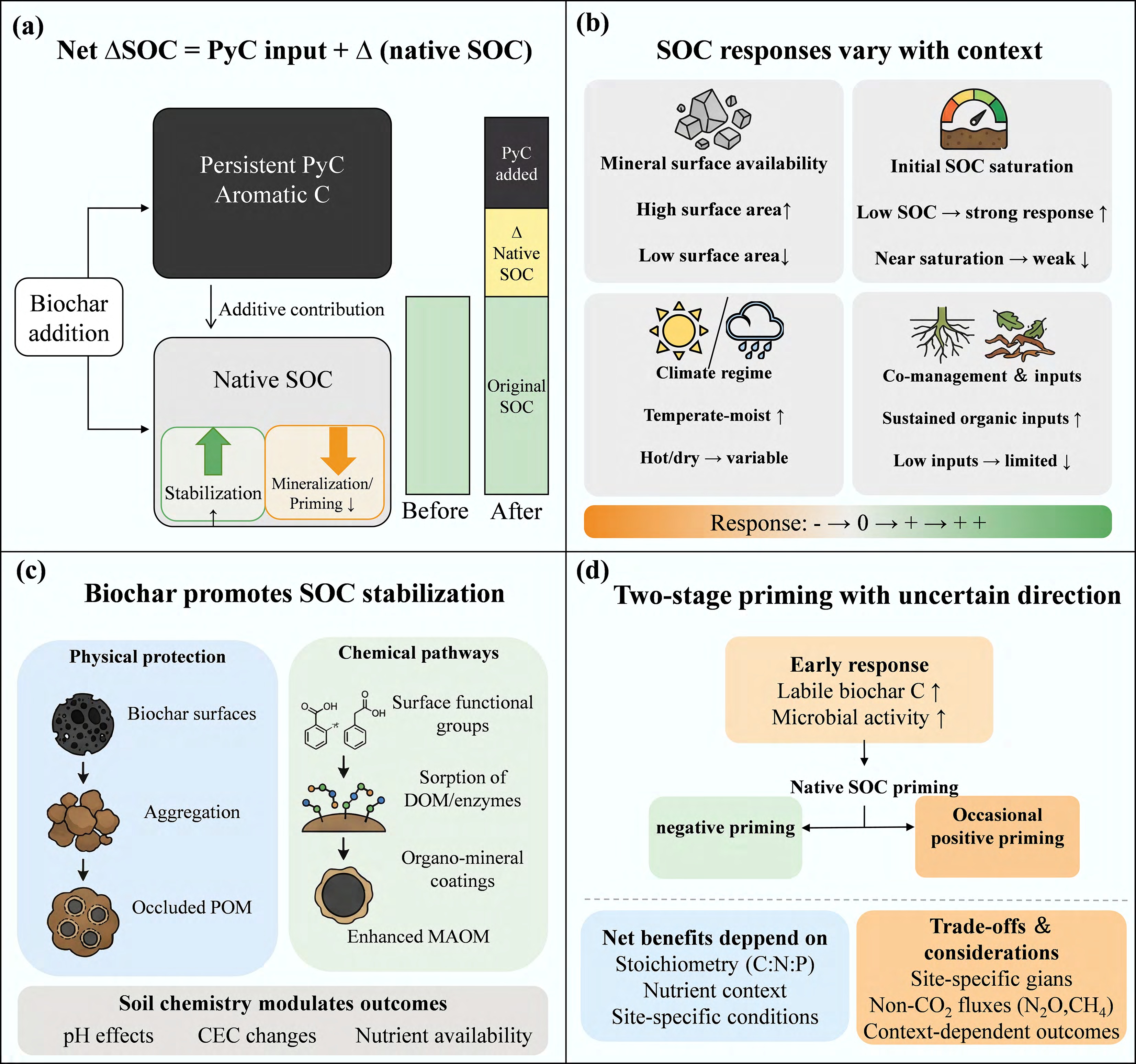
Figure 3.
Conceptual synthesis of biochar impacts on SOC stocks. (a) Net SOC change reflects the additive contribution of persistent PyC and context-dependent changes in native SOC (stabilization vs mineralization/priming). (b) SOC responses vary with mineral surface availability, initial SOC saturation status, climate regime, and co-management sustaining organic inputs. (c) Biochar promotes SOC stabilization via physical protection (aggregation and occluded POM) and chemical pathways (sorption and organo-mineral coatings enhancing MAOM), with soil chemistry (pH/CEC/nutrients) modulating outcomes. (d) Priming is often dynamic (early CO2 pulse followed by neutral/negative effects), and net benefits depend on stoichiometry and nutrient context, with site-specific gains and trade-offs requiring consideration of non-CO2 fluxes.
Direct contribution of pyrogenic carbon to SOC stocks
-
During pyrolysis, biomass loses most of its H and O but retains a large fraction of C in condensed aromatic structures. Typically, 50%–80% of the original feedstock C is retained in biochar, and 60%–90% of that C is chemically recalcitrant[27,29]. Radiocarbon and incubation studies suggest mean residence times ranging from several centuries to millennia, especially for high-temperature (> 500 °C) biochar[27,30]. A global meta-analysis of decomposition and priming experiments found that, on average, only a small fraction of biochar C mineralizes over typical experimental timescales, and that the majority of biochar C behaves as a quasi-inert pool in soil C models[30]. Consequently, even if biochar has neutral or slightly negative effects on native SOC, the direct addition of pyrogenic C can markedly increase total SOC stocks, especially when application rates are ≥ 10 t C ha−1 and biochar is incorporated into the plough layer[26,27] (Fig. 3a).
Effects on SOC stocks across climates and management systems
-
Quantitatively, recent meta-analyses converge on a broadly positive but highly variable SOC response to biochar. A global integrative meta-analysis including > 1,000 paired observations reported that biochar increased SOC stocks in most cases, but effect sizes ranged from negative to strongly positive depending on soil texture, initial SOC, climate, and management[26]. A Chinese synthesis of 637 paired comparisons found significant SOC increases, with the largest gains in temperate, moist climates, under rotary tillage, and in soils with low available P and K[28].
Other global syntheses focusing on agricultural systems similarly report SOC increases of ~10%–30% on average, with stronger responses in acidic, low-C soils and under straw-based biochar[27,31]. However, several studies also document negligible or even negative SOC responses in already C-rich soils, coarse-textured soils with low mineral surface area, or systems with insufficient organic inputs after biochar application[27,32]. These patterns indicate that biochar is most effective as a SOC-building strategy where mineral surfaces and nutrient regimes are limiting SOM stabilization, rather than where soils are already near saturation (Fig. 3b).
Physical and chemical mechanisms of SOC stabilization
-
Biochar modifies multiple stabilization pathways simultaneously (Fig. 3c). Physically, its porous structure, irregular morphology, and surface roughness promote aggregate formation and occlusion of particulate organic matter (POM) within macro- and microaggregates[33,34]. Increased aggregate stability has been repeatedly observed in biochar-amended soils and is often correlated with enhanced SOC protection in occluded POM and mineral-associated fractions[34,35].
Chemically, biochar surfaces bear a combination of aromatic C, functional groups (e.g., carboxyl, phenolic), and mineral coatings that provide sorption sites for dissolved organic matter and microbial metabolites. Over time, biochar particles acquire organo-mineral 'coatings' and function as composite sorbents with both hydrophobic and polar domains[10]. This sorptive capacity can reduce DOC leaching, slow down the turnover of labile SOC, and favor the formation of mineral-associated organic matter (MAOM), especially in fine-textured soils with abundant Fe/Al oxides[10]. Biochar also alters soil pH, cation exchange capacity, and nutrient availability, indirectly affecting SOC dynamics. In acidic soils, liming effects of alkaline biochar can raise pH, reduce Al toxicity, and enhance root growth and litter inputs, while also shifting microbial communities towards groups with higher carbon use efficiency[36,37]. Conversely, in already neutral-alkaline soils, further pH increases may enhance mineralization of some SOC pools or reduce the sorption of anionic organic compounds, partially offsetting the gains from pyrogenic C inputs[27,38].
Priming effects and microbial processes
-
The most debated aspect of biochar-SOC interactions concerns priming effects, that is, changes in native SOC mineralization after biochar addition. Evidence-supported findings from short-term incubations show that an initial positive priming pulse is common, especially when biochar contains labile fractions, raises pH rapidly, releases nutrients, or improves access to fresh substrates[39,40]. However, most of this mechanistic evidence is laboratory-based and should not be extrapolated directly to multi-year field behavior.
Across longer incubations and syntheses, the median priming response is often close to zero or slightly negative, especially under realistic moisture and temperature conditions[30]. Proposed mechanisms include physical occlusion of SOC within more stable aggregates, sorption of labile substrates or extracellular enzymes to biochar surfaces, and substrate switching in which microbes use biochar-associated or newly added labile carbon instead of decomposing native SOC[39,41]. Isotope-tracing studies further suggest that biochar can increase microbial carbon use efficiency and redirect carbon into necromass, particulate organic matter, and mineral-associated organic matter pools[35]. At the same time, emerging field evidence indicates that significant positive priming or reduced net SOC gains can occur under specific conditions and should not be ignored. Positive priming is more likely when biochar stimulates rhizodeposition, aeration, pH, or nutrient availability in already active soils, or when fertilization, warming, and repeated wet-dry cycles enhance microbial access to otherwise protected carbon[31,42]. Thus, the contrast between laboratory-negative priming and field-positive priming is not necessarily contradictory; it often reflects differences in time scale, fresh plant inputs, hydrology, and whether native SOC mineralization is separated from total CO2 efflux. Overall, priming should be interpreted as a dynamic balance among biochar chemistry, soil nutrient status, fresh carbon supply, redox regime, and time since application. A more robust prediction framework, therefore, requires repeated field measurements, isotopic partitioning of native versus added carbon, and explicit separation of transient priming from long-term net SOC storage benefits (Fig. 3d).
Site-specific gains, limits, and trade-offs of biochar for SOC
-
Across studies, a consistent message emerges: biochar is not a universal SOC sequestration solution, but a context-dependent modifier of SOC dynamics. Positive SOC responses are most likely when biochar is: (1) produced at moderate-high temperatures from lignocellulosic feedstocks, (2) applied to acidic, nutrient-poor, or structurally degraded soils, and (3) combined with sustained organic inputs (crop residues, manures, cover crops) that supply labile C and nutrients[26−28,32]. In contrast, in soils approaching C saturation or with limited mineral surfaces, biochar may mainly act as an inert C addition, with relatively small changes in native SOC. In some cases, particularly under high N fertilization or warming, biochar can even accelerate SOC loss by stimulating microbial activity or by altering soil moisture and aeration[31,42].
For climate mitigation, these findings imply that (1) site-specific targeting of biochar to responsive soils, (2) co-optimization with nutrient and residue management, and (3) explicit accounting for priming and non-CO2 fluxes (N2O, CH4) are essential to realize net negative emissions. In the context of this review, they also highlight that interactions between biochar and MPs, both increasingly present in intensively managed soils, may further modify SOC stabilization pathways and priming responses, warranting integrated assessment in subsequent sections.
-
Unlike natural organic matter, MPs represent a distinct, anthropogenic carbon phase entering the soil matrix. Their impact is not merely an additive pollution problem but a fundamental disruption of how soil carbon is measured and how it cycles (Table 3).
Table 3. The accounting dilemma (conceptual equation)
To understand the risk microplastics pose to carbon accounting (MRV), one must define the components of measured soil carbon. In a co-contaminated system, the measured Total Organic Carbon (TOCmeasured) is: $ TO{C}_{measured}={C}_{native}+{C}_{PyC}+{C}_{MP}\text{+ϵ} $ where, Cnative is biogenic SOC, CPyC is pyrogenic carbon (if biochar is applied), and CMP is the polymeric carbon from microplastics. The risk: Without specific separation, standard protocols count CMP as soil carbon. The reality: High CMP loads can mask a decline in Cnative, creating a 'false positive' signal of sequestration. The 'apparent' vs the 'protected': measurement artifacts and physical destabilization
-
The first challenge in evaluating SOC dynamics under MPs contamination is that the bias is both analytical and process-based: polymer-derived carbon can be counted as apparent SOC, while the same particles may simultaneously destabilize native organic matter through structural disruption. Method-specific bias must therefore be made explicit.
Dry combustion or elemental analysis approaches near-total oxidation of organic carbon and will count native SOC, PyC, and most MPs-derived carbon together. Walkley-Black-type wet oxidation is less specific: it commonly under-recovers highly condensed PyC, while oxidation of polymers and additives is partial and matrix-dependent[24]. Loss-on-ignition is even less diagnostic because mineral dehydration and ash effects can confound interpretation. By contrast, BPCA or HyPy narrow the PyC window, whereas micro-FTIR, micro-Raman, and Py-GC/MS are needed for polymer-specific MPs identification. The key implication is that no single routine SOC method can resolve native SOC, PyC, and MPs-C simultaneously. A practical MRV consequence is that apparent sequestration can be overstated by several Mg C ha−1. For example, in a 0–20 cm plough layer with a bulk density of about 1.3 Mg m−3, 0.1%–0.5% MPs-C would correspond to roughly 3–15 Mg C ha−1 being included in routine TOC/SOC measurements if uncorrected. This is the specific bias referred to throughout this review: false-positive attribution of fossil-derived polymer carbon to soil carbon gains. Beyond analytical co-counting, MPs can erode physical protection. Fibres, films, and fragments may reduce water-stable aggregates, alter pore continuity, and change water and oxygen distribution, thereby exposing previously occluded particulate organic matter to microbial attack. In other words, a soil may show higher apparent total carbon while losing physically protected biogenic carbon at the same time.
Biogeochemical forcing: a bidirectional mechanism
-
The accumulation of MPs rewires the chemical routing of carbon and biological turnover, though the net outcome depends on the specific interactions between the 'plastisphere', minerals, and organic inputs.
(1) Sorption as a 'two-way door'. The interaction between MPs and DOM is complex. MPs provide hydrophobic surfaces that adsorb DOM, forming an 'eco-corona' that may compete with minerals for organic ligands and potentially reduce the formation of MAOM. On the other hand, leachates derived from MPs (plastic-DOM) can exhibit high affinity for soil minerals. Lee & Hur[12] demonstrated that DOM leached from plastics (e.g., PVC, PS) effectively binds to kaolinite and goethite. Thus, the net effect on carbon stability is a trade-off: MPs may block native SOC stabilization while simultaneously contributing a novel, potentially mineral-stabilized 'plastic-MAOM' fraction. (2) Plastisphere-mediated priming. The biological response generally follows a three-level hierarchy. Global meta-analyses indicate that MPs typically increase soil respiration and microbial biomass[7], suggesting accelerated turnover. This is often driven by the 'plastisphere', where additives or oligomers act as labile substrates, triggering co-metabolism and upregulation of extracellular enzymes that prime the decomposition of native SOC[43]. However, this destabilization is not universal. In contexts with high fresh organic input (e.g., straw return), Yu et al.[44] observed that MPs could inhibit mineralization or alter substrate availability, suggesting that the priming response is highly context-dependent (e.g., MPs dose, soil texture, and nutrient status).
Synthesis: a destabilization spectrum with accounting implications
-
Synthesizing these pathways shows that MPs create a destabilization spectrum rather than a single directional effect on soil carbon. The same contamination event can simultaneously increase measured carbon by adding polymer-derived C and decrease native carbon protection by weakening aggregate structure or altering microbial processing.
(1) Accounting implication. The mismatch between measured TOC/SOC and native biogenic carbon poses a fundamental challenge to carbon MRV. If MPs-C is not bounded or subtracted, carbon-removal projects may inadvertently credit fossil-derived polymer carbon as sequestration. (2) Process implication. Although many studies point toward accelerated turnover and aggregate instability[45], the magnitude and even direction of change depend on soil texture, organic inputs, polymer type, and moisture regime[44]. A more scientific interpretation is therefore not that the system is simply 'in flux', but that it can move between apparent accumulation and accelerated native-C loss depending on boundary conditions. (3) Transition to the next section. This uncertainty helps explain why biochar has been proposed as a potential buffering agent. The key question is not whether biochar is beneficial in general, but under which conditions it can shift the system from destabilization toward greater structural and biogeochemical resilience[30,46].
-
MPs can destabilize SOC cycling via structural disintegration and biogeochemical priming[3]. Biochar, in contrast, is a deliberate engineering intervention that introduces a persistent, high-surface-area sorbent and a structural modifier into soils. The co-occurrence of these two carbonaceous phases creates coupled interfaces, biochar-mineral-organic and MPs-DOM-microbe, that can either buffer MPs-induced destabilization or shift the system toward saturation and failure modes, thereby reshaping SOC persistence and GHG fluxes.
Structural and chemical re-engineering: from physical disruption to partitioning
-
Unlike the 'aggregate dilution' effects commonly reported under MPs contamination, biochar application has the potential to promote aggregate formation and reconfigure pore networks, thereby moderating MPs-driven structural perturbations. In soil-plant systems, biochar has been shown to alleviate MPs toxicity and reshape rhizosphere microbial diversity, consistent with a buffering role mediated through habitat modification and altered rhizosphere functioning[47]. Importantly, recent syntheses explicitly highlight structural buffering under MPs contamination, noting that biochar can enhance macroaggregate formation and water stability even when MPs are present[9].
Biochar-facilitated organo-mineral association and aggregation may reduce MPs exposure and mobility (e.g., by increasing physical entanglement within aggregate domains and shifting transport pathways), thereby tempering microbial accessibility to POM that would otherwise become vulnerable when aggregate integrity is weakened[48,49]. This buffering is expected to be contingent on MPs form (fibers and films vs fragments), size distribution, baseline soil structure, and hydrological regime, and should be interpreted as moderation rather than universal immobilization.
Concurrently, biochar re-engineers the chemical environment by altering the partitioning of dissolved organic carbon (DOC) and MPs-derived leachates[50,51]. While MPs constitute a persistent polymer phase, they can release labile MPs-derived additives and oligomers that fuel priming and stress responses. Biochar acts as a high-capacity sorbent phase that can intercept organic contaminants and leachates via pore-filling and surface interactions, including hydrophobic partitioning and H-bonding, and π–π interactions for aromatic leachates such as phenolic additives[50]. By shifting leachate partitioning from soil solution to biochar surfaces, biochar lowers the bioavailable pool that can drive stress-linked enzyme induction and metabolic priming, thereby weakening the coupling between MPs presence and accelerated SOC turnover[51]. Where possible, these mechanisms should be evaluated with explicit measurements of (1) porewater markers (DOC quantity and quality), (2) diagnostic additives and leachate compounds, and (3) biochar surface properties (e.g., O/C ratio, contact angle) because sorption behavior depends strongly on surface chemistry, hydrophobicity, and aging[50,52,53].
Modulating the biological pump: non-linear GHG responses and necromass pathways
-
Short-term studies show that structural and chemical buffering can translate into non-linear changes in microbial turnover and GHG emissions[15]. Co-application experiments increasingly report additive, synergistic, or antagonistic responses of CO2, CH4, and N2O, with the direction and magnitude governed by biochar feedstock, soil redox and moisture status, and MPs characteristics[16]. For example, in a 45-d incubation with polyethylene MPs, straw biochar and manure biochar produced contrasting N2O responses but both lowered cumulative global warming potential relative to simple additivity[15]. These results show that biochar does not merely cancel MP effects; it reorganizes biogeochemical states through habitat modification, sorption-driven resource routing, and redox-sensitive pathways.
Emerging evidence suggests that biochar can shift carbon processing away from respiratory loss and toward more stabilized pools by supporting microbial residue accumulation even in the presence of MPs[54]. This microbial-pump pathway is most plausible when biochar reduces bioavailable stressors, improves microsite conditions, and increases carbon use efficiency. However, this effect should not be treated as static. During long-term aging, oxidation of biochar surfaces, changes in wettability, pore blockage by secondary coatings, and shifts in sorption affinity may weaken its ability to intercept plastic-derived leachates or sustain high microbial carbon use efficiency. Consequently, short-term necromass gains do not automatically imply persistent buffering over years to decades. Additionally, in anoxic microsites or waterlogged soils, conductive biochar may facilitate direct interspecies electron transfer (DIET)[55], potentially altering microbial energetics and redox-coupled pathways under MPs stress. Here we explicitly treat DIET as an emerging, context-dependent mechanism rather than an established general explanation, because empirical support in well-aerated agricultural soils remains limited.
Boundary conditions, field indications, and conceptual failure modes
-
Despite its buffering potential, biochar has a finite functional capacity. Because published field datasets are still too sparse to define universal numeric thresholds, we now frame failure as operational threshold domains rather than fixed constants. The core question is when biochar no longer lowers the bioavailable pool of plastic-derived carbon or no longer maintains aggregate and pore functions under increasing MPs pressure.
Threshold domain 1: sorption saturation. Functional saturation is indicated when increasing biochar dose no longer decreases porewater DOC or diagnostic plastic-leachate markers, or when adsorption isotherms show that relevant sorption domains are already occupied. This risk is especially important for biodegradable plastics and additive-rich polymers, which can supply higher dissolved-carbon or leachate fluxes than weathered conventional fragments[50,56,57]. Threshold domain 2: structural failure. Buffering is functionally lost when water-stable aggregates, saturated hydraulic conductivity, pore connectivity, or aeration indicators return to the contaminated control level or decline below it. This threshold is most likely when fine plastics, gels, or film residues block pores or when repeated tillage and traffic destroy biochar-induced aggregates faster than they can be re-formed[58,59]. Threshold domain 3: aging mismatch. The probability of failure rises when aging increases biochar O/C ratio, lowers contact angle, and changes sorption affinity, while MPs continue to weather and release dissolved carbon or additives. Operational monitoring can therefore combine biochar surface indices (for example, O/C ratio and wettability) with MPs weathering indicators and porewater optical metrics such as SUVA254 to detect weakening buffering capacity over time[60].
Available field-relevant evidence remains limited but increasingly suggests that buffering efficacy weakens with time and exposure history. For example, polyethylene MPs have been shown to hamper the carbon-sequestration potential of aged biochar[54]. We therefore reframe this subsection as a set of testable field hypotheses with operational indicators, rather than as a claim of already universal thresholds, while emphasizing the urgent need for multi-year validation in realistic mulched or waste-amended systems.
Mini-synthesis and testable predictions: linking buffering to design and MRV
-
Overall, biochar buffering in MPs-impacted soils can be conceptualized through a structure-partitioning-microbial efficiency linkage: biochar modifies pore and aggregate architecture, redirects leachate, DOC partitioning toward sorbed pools, and can promote residue retention rather than respiratory carbon loss. However, the net climate and SOC outcome depends on boundary conditions (moisture and redox, MPs type and degradability, MPs loading, and aging trajectories) and may transition toward saturation or reversal as functional capacity is exceeded.
Testable predictions that can guide future factorial and long-term studies: At fixed MP loading, increasing biochar dose should reduce porewater leachate markers and weaken priming intensity, with a measurable shift in C partitioning from CO2 loss to necromass accumulation (validated using isotope tracing where possible)[54,61]. When MP size distributions shift toward nano-fractions that reduce pore connectivity, biochar structural benefits should diminish, and hydraulic indicators (Ksat, CT connectivity) should predict the onset of functional saturation[59]. With biochar aging (increasing O/C and wettability), sorption partitioning for hydrophobic additives should decline, weakening buffering over time; this decay should correlate with surface property trajectories and leachate chemistry[60,62].
-
When biochar and MPs co-occur, soils contain at least three carbon phases: native biogenic SOC, pyrogenic carbon (PyC), and polymer-derived MPs-C that can be co-counted by routine carbon assays and mis-assigned during physical fractionation (Fig. 4).
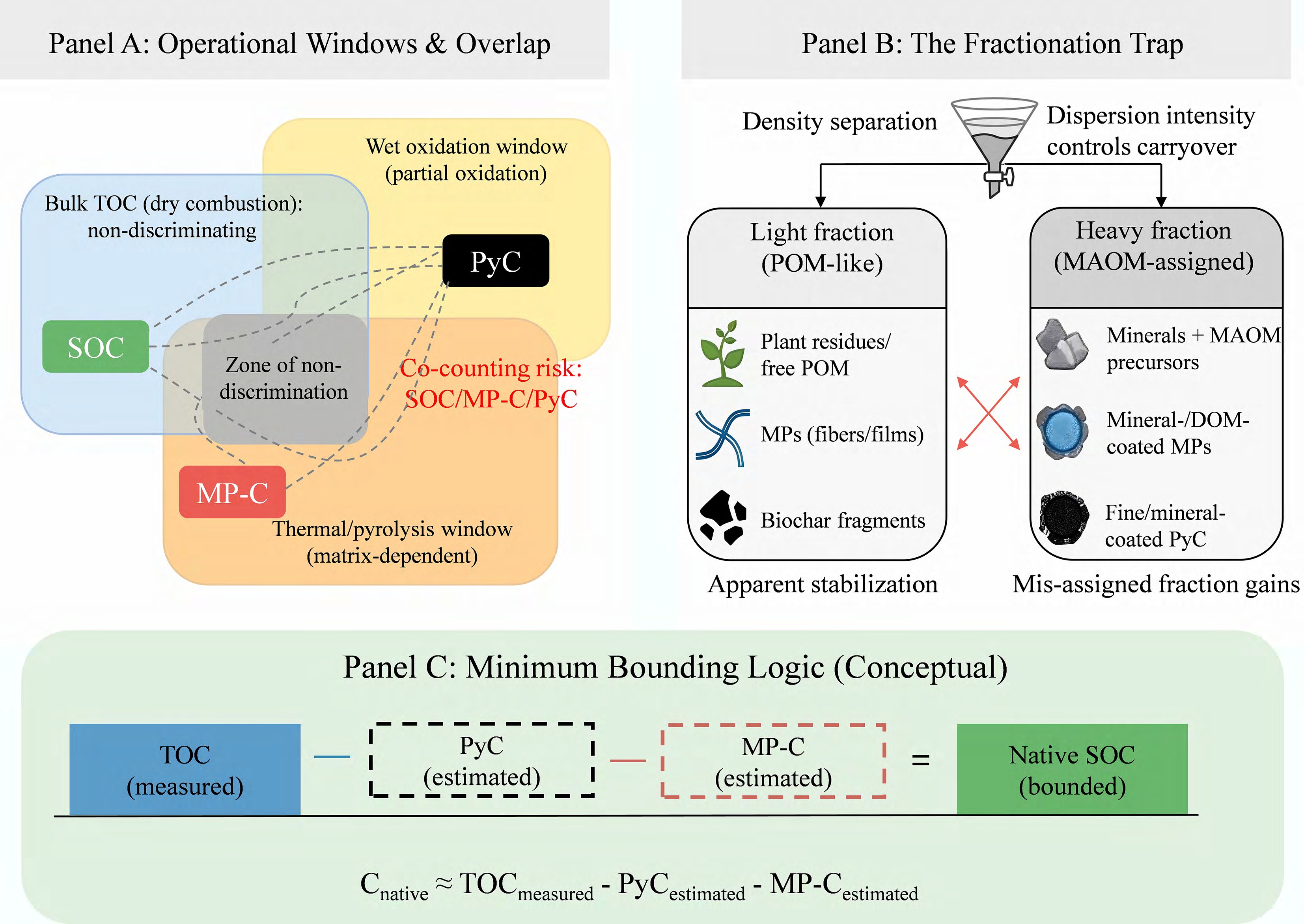
Figure 4.
Analytical artifacts and misclassification pathways in biochar–MPs-soil systems. (Panel A) Operational windows and overlap. Native biogenic SOC, pyrogenic carbon (PyC, biochar-derived and related forms), and polymeric carbon from MPs (MPs-C) can co-occur and be co-counted because common bulk-carbon assays and operational oxidation/thermal pyrolysis window do not uniquely discriminate among these phases. Their overlap defines a zone of non-discrimination, in which apparent changes in 'SOC/TOC' may reflect admixture and method-defined recoveries rather than a true change in native SOC persistence. Dashed links indicate potential co-counting under each operational window (schematic, not to scale). (Panel B) The fractionation trap. During operational fractionation (e.g., density separation followed by POM/MAOM partitioning), low-density MPs (fibers/films) and biochar fragments can be co-recovered in the light fraction (POM-like), whereas mineral-/DOM-coated MPs and fine or mineral-coated PyC can be carried over into the heavy fraction that is often interpreted as MAOM. Such co-recovery and carryover can generate apparent stabilization and mis-assigned fraction gains unless fractions are screened for polymer- and PyC-derived contributions. (Panel C) Minimum bounding logic (conceptual). To interpret native SOC in co-occurring systems, measured total carbon should be treated as a composite metric, and native SOC should be evaluated as a bounded estimate by subtracting independently quantified PyC and MPs-C. This panel illustrates the correction logic rather than a prescriptive protocol.
Quantifying PyC in the presence of MPs-C: what each method 'sees'
-
PyC is not a single compound but a continuum of thermally altered products; consequently, different methods quantify different 'PyC windows'. The benzene polycarboxylic acids (BPCA) approach oxidizes condensed aromatic structures into diagnostic BPCAs and is widely used as an operational proxy for PyC quantity and characteristics across soils and chars[63]. BPCA is analytically mature and can be paired with compound-specific isotopes for apportionment, but yields remain operational and depend on matrix effects and condensation state, so studies should explicitly state the target PyC pool and its fit-for-purpose rationale[64]. Hydropyrolysis (HyPy) targets a more refractory subset of black carbon and is often used for cross-validation and reference-material testing[65]. Method intercomparison syntheses emphasize that BPCA, HyPy, and spectroscopic approaches can disagree systematically because they interrogate different chemical domains of PyC; therefore, PyC should be reported as a method-defined pool (e.g., BPCA-C vs HyPy-refractory C), with recovery/QA information and an explicit statement of the targeted PyC domain[66]. In biochar–MPs co-occurring soils, PyC quantification becomes interpretable for budgeting or MRV only when paired with polymer-specific MPs quantification, because routine TOC/SOC baselines represent composite signals that cannot be attributed without bounding non-native carbon phases.
Quantifying MPs in soils: separation, identification, and the metric problem
-
The second bottleneck is that MPs' measurements are strongly method-dependent in soils because mineral particles, natural fibers, and organic matter can mask or mimic polymer signals. Most defensible pipelines combine: (1) drying/sieving; (2) density separation; (3) chemical or enzymatic digestion of organic matter; and (4) polymer identification by spectroscopy or thermo-analytical chemistry, with strict QA/QC (procedural blanks, contamination control, spike-recovery) treated as non-optional[67,68]. For polymer identification, vibrational microspectroscopy provides polymer-specific fingerprints at the particle level, whereas pyrolysis–GC/MS (Py-GC/MS) uses polymer-specific marker pyrolysates to support mass-based quantification in complex matrices, often with higher scalability but limited particle-level information unless coupled with imaging[13]. This methodological diversity reinforces a crucial design principle: the MPs endpoint should be aligned with the hypothesis. Number-based metrics (and size/shape distributions) are typically more informative for transport and biological contact, whereas mass-based metrics are essential for carbon budgeting and for bounding MPs-C when TOC/SOC-based conclusions are drawn. This distinction matters for SOC interpretation because carbon assays used in soil studies generally report composite carbon unless polymer-derived carbon is explicitly quantified and bounded; hence, MPs-C should be treated as part of the carbon measurement chain rather than as a separate 'pollution-only' metric[7,14]. In biochar–MPs systems, this framing also establishes a practical bridge to fractionation-based inference: without polymer verification, apparent shifts among operational SOC pools can reflect co-recovery of MPs and PyC fragments rather than true changes in biogenic SOC stabilization.
SOC fractionation under mixed persistent particles: avoiding the fractionation trap
-
MPs and biochar fragments can behave like particulate organic matter, become occluded in aggregates, and acquire mineral/organic coatings, thereby blurring intended separations and creating a 'fractionation trap' where polymer- or PyC-bearing particles are interpreted as stabilized biogenic SOC. The POM-MAOM framework remains valuable because it links persistence to accessibility and organo-mineral association rather than intrinsic recalcitrance, but in mixed systems, it must be implemented with explicit checks for misclassification[6]. Two safeguards are recommended. First, physical fractions should be complemented by chemical/spectroscopic verification to identify PyC and polymer signals within each operational pool (e.g., BPCA-C or HyPy-C in MAOM, polymer markers by Py-GC/MS in POM-like material). Second, when using carbon saturation concepts, studies should define the stabilization target (e.g., incremental MAOM-C) and the mineral-capacity proxy, recognizing that saturation frameworks were developed for finite mineral-associated storage and are sensitive to how MAOM is operationally defined[69].
Experimental design and data integration: minimum evidentiary structure for attribution and MRV
-
Because co-occurrence effects are frequently non-additive, factorial designs that cross biochar level × MPs type and loading × environment and management provide the most direct route to attribution, especially when paired with process readouts (CO2, CH4, N2O, DOC, enzymes) and stabilization endpoints (POM, MAOM, microbial necromass markers, organo-mineral association). Global syntheses show that MPs' effects on soil carbon cycling and respiration are strongly conditioned by polymer type and soil context, reinforcing the need for harmonized metadata and transparent reporting to enable comparability and meta-analysis[7]. To make these designs comparable and MRV-relevant, we summarize the minimum evidentiary reporting items required to bound native SOC under biochar–MPs co-occurrence (Table 4).
Table 4. Minimum evidentiary checklist to bound native SOC in biochar–microplastic co-occurring systems (recommended reporting items)
Under co-occurrence, at least three persistent carbon phases, native biogenic SOC, PyC, and polymer-derived MPs-C, can be co-counted by routine carbon assays and co-recovered during fractionation. This checklist defines a minimum reporting/evidence structure to reduce misclassification, support mechanistic attribution, improve cross-study comparability, and enable MRV-relevant interpretation. A. System definition and boundary conditions Biochar description Feedstock, pyrolysis temperature, residence time, ash content, pH, H/C and O/C (or elemental ratios), particle size, application rate. Microplastic description Polymer type (PE/PP/PS/PET, etc.), morphology (fiber/film/fragment/bead), size range, pristine vs weathered/aged, and loading. Soil background Texture, pH, Fe/Al oxide or clay + silt content (as mineral-capacity proxies), initial SOC/TOC, moisture, and redox regime (upland vs flooded/periodically reducing). B. PyC quantification (state the analytical 'window') PyC method and targeted pool Specify BPCA/HyPy/solid-state13C NMR/thermal methods, and state which PyC domain is captured (operational window). QA/quality metrics Recovery, precision/replicates, reference materials/standards where applicable, and key QA notes. Isotopes/tracers (if used) 13C and 14C or compound-specific isotopes, target, assumptions, and boundaries (mandatory if used for apportionment). C. Microplastic quantification and identification (align endpoint with inference) Pre-treatment and separation Sieve cutoffs, density medium, and density, digestion approach (H2O2/Fenton/enzymatic), and their potential impacts on polymer integrity. Identification and thresholds µ-FTIR/µ-Raman match criteria and size detection limits, or Py-GC/MS markers and quantification strategy. QA/QC essentials Procedural blanks, contamination control (especially fibers), polymer-specific spike-recovery, false-positive control. Reported endpoints Number-based (counts per mass, plus size/shape distributions) and/or mass-based (mg kg−1 polymer mass). If TOC/SOC-based conclusions or MRV are involved, mass-based metrics and MPs-C bounding are strongly recommended. D. SOC/TOC and fractionation safeguards ('misclassification protection') Total carbon statement Report TC/TOC method (dry combustion vs wet oxidation, etc.) and whether MPs-C and PyC are included, if used for sequestration claims, specify the bounding/correction approach. Fraction verification For POM/MAOM (or free/occluded) fractions, verify PyC and polymer signals in key fractions (e.g., BPCA/HyPy markers for PyC, Py-GC/MS or spectroscopy for polymers) to detect co-recovery/carryover. Carbon saturation boundaries If using saturation concepts, define the operational MAOM pool, mineral-capacity proxy, and provide evidence that MAOM changes are not driven by fine biochar fragments or nano-/microplastic carryover. E. Attribution and MRV minimum evidence Three-phase bounding Report or bound Cnative ≈ TOC − PyC − MPs-C (at least provide PyC and MPs quantification, or defensible upper/lower bounds). Process–endpoint pairing Pair ≥ 1 process indicator (CO2/CH4/N2O, porewater DOC, enzymes/microbial biomass) with ≥ 1 stabilization endpoint (POM/MAOM, necromass markers, organo-mineral association evidence). Reusable metadata Moisture/temperature regime, application timing/method, sampling depth/time, and effect-size/statistical model reporting sufficient for meta-analysis and MRV scrutiny. -
As biochar is promoted as a negative emission technology (NET) in agriculture and microplastic contamination intensifies, soils increasingly sit at the intersection of climate mitigation and pollution management. This raises practical questions: under what conditions does biochar remain an effective SOC-building tool in MPs-contaminated soils, and how can management be optimized to avoid undermining its benefits?
Aligning biochar deployment with soil carbon saturation and MPs loads
-
The carbon saturation concept predicts that SOC sequestration is most efficient in soils far from their mineral stabilization capacity, particularly those with low silt- and clay-associated C[70,71]. In such soils, biochar inputs can both add persistent C and enhance stabilization of new plant-derived C. Where soils are already near saturation, biochar is more likely to behave as a relatively inert C additive, and MPs-induced structural disruption may further limit additional SOC storage.
For MPs-contaminated systems, management should therefore prioritize biochar deployment in: (1) structurally degraded, low-SOC soils where biochar can rebuild aggregates and buffer MPs effects on soil structure; (2) regions with high plastic use (mulching, greenhouses, wastewater-derived amendments) but realistic potential to reduce plastic inputs; and (3) soils with clear 'saturation deficits' where incremental SOC gains are biophysically plausible. In highly saturated, MPs-contaminated soils, emphasis may need to shift from SOC accumulation to maintaining soil function, reducing GHG emissions, and limiting pollutant mobility.
Designing 'MPs-smart' biochars and amendment packages
-
Not all biochars are equally suited to MPs-contaminated soils. Mechanistic evidence and broader sorption studies suggest that biochars with: (1) moderate-to-high aromaticity and durable pore structure; (2) appropriate alkalinity to correct acidity without overshooting into strongly alkaline ranges; and (3) surface functional groups or mineral coatings that favor DOM and contaminant sorption are more promising candidates for stabilizing SOC and retaining MPs-associated contaminants[8,36,37,50,53,60]. In addition, data-driven optimization used in related biochar design studies may help guide future development of 'MPs-smart' biochars by linking feedstock choice and process conditions to targeted surface chemistry and sorption performance[72,73].
At the management level, biochar should be integrated into amendment packages that also include plastic-smart agronomy, such as reduced use of single-use films, better retrieval of mulching materials, and adoption of reusable or better-designed coverings[5,6]; enhanced organic inputs (residues, cover crops, composts with low plastic contamination), which provide the labile C and nutrients needed for microbial necromass formation; and conservation tillage and controlled traffic, which protect biochar-induced aggregates and help prevent vertical transport of MPs into deeper horizons[6]. Where biodegradable plastics are introduced, management must explicitly consider their priming potential and interactions with biochar: high inputs of biodegradable polymers could accelerate SOC loss despite co-applied biochar, unless nutrient and moisture regimes are tightly controlled[74,75].
Edge-of-field interception and circular design
-
Biochar also offers opportunities beyond the soil profile. Interest is growing in integrating biochar-based materials into broader agricultural plastic mitigation and circular biomass-to-biochar strategies; in this context, polymer-specific analytical verification is essential, and claims of field interception or circular benefit should be demonstrated rather than assumed[5,67,68,76,77]. Where plastic-contaminated residues are thermochemically treated, polymer destruction and by-product control should be explicitly demonstrated. Life-cycle and inventory-based assessments that integrate SOC change, emissions, and broader system impacts are needed to evaluate whether such circular strategies deliver net environmental benefits[78,79].
-
The combined issue of biochar and MPs sits at the interface of climate policy, soil protection, and chemical regulation, yet these domains are often treated separately.
Biochar as a negative emission technology under MPs pressure
-
Biochar is now widely recognized as a promising NET for agriculture, with global assessments estimating substantial mitigation potential if deployed sustainably[80−82]. The IPCC Special Report on 1.5 °C explicitly lists biochar among negative emission options[80]. However, most mitigation pathways implicitly assume 'clean' soils. If widespread MPs contamination reduces the permanence of biochar-induced SOC gains or increases non-CO2 GHG emissions (e.g., N2O), the mitigation value of biochar projects could be overestimated.
In this context, future carbon-market methodologies and MRV protocols for biochar would benefit from recognizing MPs contamination as a potential risk factor for SOC permanence and GHG leakage, encouraging baseline assessment of soil MPs loads in project areas, and promoting co-benefit framing where biochar is paired with plastic-reduction measures and MPs interception strategies[79,81].
MPs governance and soil protection
-
Microplastic pollution in soils and soil–plant systems is now well documented, with reviews synthesizing sources, transport, ecological risks, and mitigation options[6,75,83]. Regulatory responses, such as bans on microbeads and single-use plastics, have focused mainly on aquatic systems; soil-focused policies lag behind. High-level assessments, including the SAPEA report 'A scientific perspective on MPs in nature and society', stress the ubiquity of MPs across environmental compartments and the need for precautionary, cross-sector governance[84].
Key governance needs include: guidelines or thresholds for MPs contamination in agricultural soils, linked to soil health and ecosystem service indicators rather than mass concentrations alone; incentives for plastic-smart agronomy, as highlighted in the FAO report on agricultural plastics and their sustainability[5]; and integration of MPs considerations into soil-health, circular-economy, and sustainable agriculture frameworks so that biochar deployment does not inadvertently legitimize continued plastic overuse[84].
Risk-benefit assessment and communication
-
Both biochar and MPs are complex, with benefits and risks that depend strongly on local context. For policymakers and stakeholders, the central message is not that 'biochar is unsafe in MPs-contaminated soils', but that context matters: in some systems, biochar can mitigate MPs' impacts and enhance SOC; in others, MPs can erode biochar's mitigation potential and alter risk profiles. Transparent risk–benefit assessments should communicate these nuances, including uncertainties, so that decisions about biochar projects, plastic regulations, and soil-health programs are based on integrated, evidence-based trade-offs[6,82,84].
-
This review yields four main conclusions. First, the co-occurrence of biochar and MPs is not exceptional but increasingly typical in intensive agricultural soils through legacy plastic contamination, waste recycling, contaminated feedstocks, and engineered composite pathways. Second, the key controls are interfacial rather than material-specific: surface conditioning, DOM bridging, composite-particle formation, and microbial habitat filtering together determine whether native SOC becomes more protected or more accessible. Third, biochar can buffer some MPs-induced destabilization, but responses are frequently non-additive and can shift with polymer type, soil context, hydrology, and aging. Fourth, routine carbon assays cannot by themselves distinguish native SOC from PyC and MPs-derived carbon, creating a real risk of false-positive sequestration accounting. The main contribution of this review is therefore conceptual and methodological. Conceptually, it treats biochar and MPs as co-occurring carbonaceous particles embedded in the same aggregates, pore networks, and organo-mineral domains that govern SOC persistence. Methodologically, it links process ecology with attribution by showing why polymer-specific and PyC-specific measurements are necessary whenever SOC change is interpreted for management, modeling, or MRV.
The most urgent research priorities are now clear: long-term factorial field experiments across contrasting climates and management systems; harmonized methods that quantify native SOC, PyC, and MPs-C together but separately; threshold-oriented monitoring that links pore structure, leachate chemistry, and aging to functional buffering; and process-explicit models that extend beyond current RothC- or CENTURY-type representations to include persistent anthropogenic carbon phases. A more integrated evidence base will improve both science and practice. It will sharpen estimates of the real mitigation value of biochar, clarify when microplastic pollution undermines or reshapes SOC gains, and support risk-aware management strategies for agricultural soils facing multiple interacting global-change drivers.
The authors greatly appreciate the suggestions from reviewers and editors, and we thank all those who helped in the execution of the research and the writing of the manuscript.
-
Not applicable.
-
The authors confirm their contributions to the paper as follows: all authors contributed to the study conception and design; Zhimei Yang: writing − review and editing, writing − original draft, visualization, conceptualization; Khanom Simarani: writing − review and editing, writing-original draft; Xi Zhang: writing − review and editing, reviewing and editing; Antonio Di Martino: writing − review and editing; Yi Chen: writing − review and editing, writing − original draft; Yonglei Jiang: writing – review and editing, writing − original draft; Binbin Hu: project administration, conceptualization, reviewing, and editing; Xiaodong Chen: writing − review and editing, supervision, visualization, project administration, conceptualization. All authors reviewed the results and approved the final version of the manuscript.
-
The datasets used or analyzed during the current study are available from the corresponding author upon reasonable request.
-
This work was supported by the National Natural Science Foundation of China (Grant No. 32460456). Project of Yunnan Daguan Laboratory (Grant No. YNDG202302QT12).
-
The authors declare that they have no known competing financial interests or personal relationships that could have appeared to influence the work reported in this paper.
-
Full list of author information is available at the end of the article.
- Copyright: © 2026 by the author(s). Published by Maximum Academic Press, Fayetteville, GA. This article is an open access article distributed under Creative Commons Attribution License (CC BY 4.0), visit https://creativecommons.org/licenses/by/4.0/.
-
About this article
Cite this article
Yang Z, Simarani K, Zhang X, Martino AD, Chen Y, et al. 2026. Biochar-microplastic co-occurrence in agricultural soils: interfaces, effects on soil organic carbon, and implications for measurement and verification. Agricultural Ecology and Environment 2: e017 doi: 10.48130/aee-0026-0014 

Biochar-microplastic co-occurrence in agricultural soils: interfaces, effects on soil organic carbon, and implications for measurement and verification
- Received: 24 March 2026
- Revised: 16 April 2026
- Accepted: 07 May 2026
- Published online: 28 May 2026
Abstract: Biochar is increasingly promoted as a negative-emission soil amendment, but its performance in agricultural soils may be modified by co-occurring microplastics (MPs). Existing studies still treat biochar and MPs largely as separate drivers, leaving unresolved how pyrogenic carbon, polymeric carbon, and native soil organic carbon (SOC) interact within the same aggregates, sorption domains, and microbial habitats, and how this co-occurrence affects SOC accounting. Here we synthesize evidence on four linked questions: where biochar and MPs co-occur, how their interfaces with minerals and dissolved organic matter form, how these interfaces alter SOC formation, stabilization, and mineralization as well as greenhouse-gas fluxes, and why co-occurrence complicates measurement, reporting, and verification of soil carbon. We additionally emphasize field-relevant evidence on MPs types, abundances, and weathering states in agricultural soils so that co-occurrence intensity can be interpreted more realistically and future experimental designs can be better constrained. Evidence-supported mechanisms indicate that biochar can promote aggregate-scale protection, organo-mineral association, and microbial necromass retention, whereas MPs can alter pore continuity, redistribute dissolved organic matter, and stimulate or suppress priming depending on polymer type, morphology, aging state, and soil context. Emerging studies further suggest that combined effects are often non-additive because biochar may partly buffer MPs-driven destabilization, but this buffering can weaken as sorption domains saturate and materials age. A key methodological implication is that routine carbon assays may co-count native SOC, pyrogenic carbon, and MPs-derived polymer carbon; in a plough layer, 0.1%–0.5% MPs-C could inflate apparent SOC stocks by roughly 3–15 Mg C ha−1 if uncorrected. We conclude that most evidence remains short-term and laboratory-based, and we propose an evidence-tiered, MRV-oriented framework that couples polymer-specific and PyC-specific measurements, distinguishes evidence-supported processes from conceptual hypotheses, and prioritizes long-term field validation and model integration.